• Skip to primary navigation
  • Skip to main content
  • Skip to primary sidebar
  • Home
  • About Us
    • Privacy Policy
    • Comment Policy
    • Disclosures & Disclaimers
  • Resources
    • Links, Essays & Articles
    • Fandomology!
    • CLAMP Directory
    • BlogRoll
  • Features & Columns
    • 3 Things Thursday
    • Adventures in the Key of Shoujo
    • Bit & Blips (game reviews)
    • BL BOOKRACK
    • Bookshelf Briefs
    • Bringing the Drama
    • Comic Conversion
    • Fanservice Friday
    • Going Digital
    • It Came From the Sinosphere
    • License This!
    • Magazine no Mori
    • My Week in Manga
    • OFF THE SHELF
    • Not By Manga Alone
    • PICK OF THE WEEK
    • Subtitles & Sensibility
    • Weekly Shonen Jump Recaps
  • Manga Moveable Feast
    • MMF Full Archive
    • Yun Kouga
    • CLAMP
    • Shojo Beat
    • Osamu Tezuka
    • Sailor Moon
    • Fruits Basket
    • Takehiko Inoue
    • Wild Adapter
    • One Piece
    • After School Nightmare
    • Karakuri Odette
    • Paradise Kiss
    • The Color Trilogy
    • To Terra…
    • Sexy Voice & Robo
  • Browse by Author
    • Sean Gaffney
    • Anna Neatrour
    • Michelle Smith
    • Katherine Dacey
    • MJ
    • Brigid Alverson
    • Travis Anderson
    • Phillip Anthony
    • Derek Bown
    • Jaci Dahlvang
    • Angela Eastman
    • Erica Friedman
    • Sara K.
    • Megan Purdy
    • Emily Snodgrass
    • Nancy Thistlethwaite
    • Eva Volin
    • David Welsh
  • MB Blogs
    • A Case Suitable For Treatment
    • Experiments in Manga
    • MangaBlog
    • The Manga Critic
    • Manga Report
    • Soliloquy in Blue
    • Manga Curmudgeon (archive)

Manga Bookshelf

Discussion, Resources, Roundtables, & Reviews

Manga

Confession

April 1, 2025 by Katherine Dacey

Confession is a tight, twisty thriller that reads like an episode of The Twilight Zone or Alfred Hitchcock Presents. Author Fukumoto Nobuyuki establishes the premise in a few quick strokes: two hikers—one gravely injured—huddle on a mountainside pummeled by a fierce winter storm. As they debate the best course of action, Ishikura—who is bleeding profusely—confesses to murdering a mutual acquaintance, telling Asai, “I killed Sayuri… with my own two hands.” Asai, however, refuses to abandon Ishikura, dragging his wounded friend to the safety of an abandoned cabin. As the two wait for a rescue team to arrive, it finally dawns on Asai that Ishikura might regret what he said.

For a two-hander like this to work, it’s not enough to know what Asai is thinking; we need to feel his growing sense of desperation. Kaiji Kawaguchi’s art is up to the task, creating a spare, claustrophobic environment that’s almost as hostile as the barren slopes that surround the cabin. The cabin itself is rendered in just enough detail for the reader to grasp the layout and size, as well as the lack of good hiding places. Equally important, Kawaguchi’s character designs emphasize the wide social gap between the conventionally handsome Asai and the squat, dour Ishikura, encouraging the reader to question how these two people ever travelled in the same circles.

The artwork is so effective, in fact, that some of Asai’s internal monologue feels superfluous, especially when he states the obvious: “If my suspicions are right, are you and I going to fight to the death?” (Signs point to yes!) Aside from a few clumsy monologues, however, the story never sags under the weight of too much exposition; Nobuyuki carefully doles out information about Asai and Ishikura’s past to reveal how fraught their relationship was before they went climbing, hinting at a long-simmering conflict between them. The final scene is a shocker in the best sense, challenging the reader’s perception of both characters without cheating or taking any narrative shortcuts to get there. Hitchcock, I think, would approve. Recommended.

CONFESSION • STORY BY NOBUYUKI FUKUMOTO • ART BY KAIJI KAWAGUCHI • TRANSLATION BY EMILY BALISTERI • PRODUCTION BY TOMOE TSUTSUMI, PEI ANN YEAP, AND HIROKO MIZUNO • KODANSHA USA • RATED 16+ (VIOLENCE) • 314 pp.
Filed Under: Manga, Manga Critic, Recommended Reading, REVIEWS Tagged With: kodansha, Thriller

Trillion Game, Vol. 1

February 16, 2025 by Katherine Dacey

By all rights, Trillion Game should be a blast. Creators Riichiro Inagaki and Ryoichi Ikegami have more than a dozen hit series to their names—including Eyeshield 21, Dr. Stone, Sanctuary, and Crying Freeman—and a flair for writing shamelessly entertaining stories that burst at the seams with crazed villains, over-the-top plot twists, and jaw-dropping action scenes. Trillion Game, however, is just plain bad, saddled with a premise so dumb I’m almost embarrassed to type it: a young man sets out to be the first Japanese entrepreneur to make a trillion dollars without an actual plan for achieving that goal.

A dumb premise isn’t automatically a deal-killer; executed with panache, a silly idea can still work if the reader feels invested in the main character’s success. Trillion Game, however, has both a dumb premise and an awful lead who is less a person than a teenage male fantasy, a ruthless entrepreneur who weaponizes his charm and good looks to get what he wants. Haru lies, bluffs, and cheats, manifesting new talents—say, bantering in Mandarin or scaling skyscrapers—whenever the plot demands, prompting other characters to gush about his charisma and business acumen. His only redeeming quality is his unwavering loyalty to friend and business partner Gaku, a helmet-haired nerd with computer skills. Even that relationship is fraught, however, as Haru repeatedly puts Gaku into situations that test the limits of his abilities.

The other issue plaguing Trillion Game is its sincerity: we’re supposed to admire Haru’s audacious, go-for-broke style, even when his behavior seems more sociopathic than strategic. No matter what he does, Haru always gets the best of his opponents, especially when they appear to be more logical, experienced, or perceptive than he is. That dynamic is most evident in his interactions with the beautiful, inscrutable Kirika Kokuryū, a.k.a. “Kirihime,” a twenty-six-year-old wunderkind who helps her father run the all-powerful Dragon Bank. Any time she gets the upper hand in her dealings with Haru and Gaku, the authors undercut Kirihime’s authority by dreaming up new ways to humiliate her while suggesting she’s turned on by Haru’s cutthroat tactics.

The only bright spot is Ikegami’s artwork. As he did in series like Samurai Crusader and The Wounded Man, Ikegami populates the story with attractive leads while rendering the supporting players as caricatures, making it easy to keep track of the sprawling cast. The layouts, too, are easy to scan: they’re dynamic and detailed, capturing the density and opulence of Tokyo’s financial district with the same degree of realism as the spartan office that Haru and Gaku rent.

No amount of stylish artwork, though, can disguise the fact that Trillion Game feels like an macho artifact of the 1980s, a Wall Street for the Young Jump reader. I have no doubt that there are folks who will love this series, but I found it impossible to get swept up in Haru’s embrace of greed and deceit, especially when he approvingly cites broligarchs like Mark Zuckerberg and Jeff Bezos as an inspiration. Not recommended.

TRILLION GAME, VOL. 1 • STORY BY RIICHIRO INAGAKI • ART BY RYOICHI IKEGAMI • TRANSLATED BY STEPHEN PAUL • TOUCH-UP & LETTERING BY JOANNA ESTEP • VIZ MEDIA • RATED M FOR MATURE (NUDITY, SEXUAL REFERENCES) • 208 pp.

Filed Under: Manga, Manga Critic, REVIEWS Tagged With: Riichiro Inagaki, Ryoichi Ikegami, Seinen, VIZ, VIZ Signature

The Manga Review: Lost in Translation

February 10, 2025 by Katherine Dacey Leave a Comment

As part of an ongoing series about working in the manga industry, io9 recently interviewed the translators for One Piece, Undead Unluck, and Spy x Family to learn more about their working conditions and the challenges of adapting culturally specific material into English. The article is sobering: not only do translators cope with tight deadlines and low pay, but they face harassment from fans who disagree with the way they’ve translated a phrase, voiced a character, or substituted an American pop-cultural reference for a Japanese one. The problem is especially pervasive among Shonen Jump readers, who frequently “dogpile” on work that doesn’t match their favorite scanlations:

“Especially when it comes to Shonen Jump stuff, one misconception I see a lot is when [readers] see the scanlation first, they think if there’s something different that it was something we saw it and we changed when that’s not the case,” [Stephen] Paul said. “We work before anyone sees the material. There no prior conception of the material before we get our hands on it.”

The article also touches on the looming threat of AI-generated translations; though AI currently “produces subpar output that readers notice and abhor… it also results in the same amount of work for translators while they are paid less to copy-edit.” If you care about the quality and artistry of good translation, this is a must-read essay.

NEWS AND VIEWS

Everything old is new again: Dark Horse announced that it will publish new editions of Blood Blockade Battlefront and Planetes. Both are slated for a July release. [Dark Horse]

Speaking of licensing announcements, VIZ unveiled its summer 2025 line-up, which includes a new Star Wars manga, a Castle in the Sky cookbook, and a historical drama set in China’s Warring States era. [Behind the Manga]

Erica Friedman rounds up the latest yuri news, with updates on Galette and a new Vampire Princess Miyu-Yui manga. [Okazu]

David and Jordan kick the tires on Chameleon Jail, a new Shonen Jump series. [Shonen Flop]

ICYMI: Ray and Gee discuss their top five manga debuts of 2024. [Read Right to Left]

Adam Wescott jumps in the WABAC Machine for a look at Ranma 1/2 fanfic from the early 1990s, when English-speaking fans penned their own scripts and circulated them through Usenet. [Anime Herald]

REVIEWS

SKJAM! offers a full-series review of Undead Unluck… Kara Dennison argues that Komi Can’t Communicate “had a perfect final chapter”… Sarah gives I’m Here, Beside You mixed marks… and Tony Yao explains why Manga Goes to School is an essential resource for parents, teachers, and librarians.

  • 86-Eighty-Six: Operation High School (Demelza, Anime UK News)
  • Attack on Titan, Vols. 1-2 (SKJAM! Reviews)
  • Becoming a Princess Knight and Working at a Yuri Brothel, Vol. 2 (Paul Ens, Okazu)
  • Beyblade X, Vol. 1 (Manga Alerts, Behind the Manga)
  • Boruto: Two Blue Vortex, Vol. 1 (Josh Piedra, The Outerhaven)
  • Cheerful Amnesia, Vol. 5 (Josh Piedra, The Outerhaven)
  • Days With My Stepsister, Vol. 2 (Josh Piedra, The Outerhaven)
  • Dogs and Punching Bags (Demelza, Anime UK News)
  • Dog Days (Kevin Brown, The Comics Journal)
  • Emanon, Vol. 1 (Sara smith, The Graphic Library)
  • Firefly Wedding, Vol. 1 (Kristina Elyse Butke, The Beat)
  • Hitorijime, My Hero, Vol. 15 (Sarah, Anime UK News)
  • How to Connect, Share, and Play Safely Online: A Manga Guide for Preteens, Teens, and Parents (Sakura Eries, The Fandom Post)
  • I Want to Escape From Princess Lessons, Vol. 1 (Megan D. The Manga Test Drive)
  • Lady Murasaki’s Tale of Genji (Sakura Eries, The Fandom Post)
  • Let’s Do It Already!, Vol. 3 (King Baby Duck, The Boston Bastard Brigade)
  • Little Mega Man, Vol. 1 (Josh Piedra, The Outerhaven)
  • Love and the Highly Sensitive Person (Dee, Anime News Network)
  • Love on the Horizon, Vol. 1 (Merve Giray, The Beat)
  • Kawaii Cafe Ramen (Kennedy, Anime News Network)
  • Marvel Meow (A Library Girl’s Familiar Diversions)
  • Mujina into the Deep, Vol. 1 (Josh Piedra, The Outerhaven)
  • Orb: On the Movements of the Earth, Vol. 1 (Sara Smith, The Graphic Library)
  • The Revenge of My Youth, Vol. 1 (Renee Scott, Good Comics for Kids)
  • The Revenge of My Youth, Vol. 1 (Josh Piedra, The Outerhaven)
  • Sherlock Holmes, Vol. 1: A Study in Scarlet (Sara Smith, The Graphic Library)
  • Studio Ghibli: The Complete Works (A Library Girl’s Familiar Diversions)
  • Super Ball Girls, Vol. 1 (Giovanni Stigliano, Asian Movie Pulse)
  • The Urban Legend Files, Vol. 6 (Chris Beveridge, The Fandom Post)
  • The Way of the Househusband, Vol. 12 (King Baby Duck, The Boston Bastard Brigade)
  • This Monster Wants to Eat Me, Vol. 1 (darkstorm, Anime UK News)

Filed Under: FEATURES, Manga

Drunks

January 4, 2025 by Katherine Dacey

In the shadow of the mainstream North American manga industry, there are a handful of indies who are keeping manga weird. They’re publishing the kind of offbeat stories that you won’t read in Shonen Jump or stream on Crunchyroll, stories that are elliptical, profound, strange, funny, or unsettling in ways that My Hero Academia or Blue Lock aren’t. 

On a recent visit to Star Fruit Books, for example, I discovered Okaya Izumi’s Drunks, a pair of stories that put a novel spin on the meet-cute. In the first, a shy salary man staggers home from a night of drinking only to fall prey to a chatty vampire who casually asks, “Do you have blackout drapes at your house?” You can guess where this is going, but the light tone and odd notes of humor push “Drunks” in an unexpected direction as these two wildly different people find solace in each other’s company. The second story—“Tick Tock”—also crosses genre boundaries, using elements of science fiction to set the plot in motion. Tomoko, the heroine, spends a century in a cryogenic chamber before a young man accidentally frees her. Though the pair stumble into a physical relationship quickly, Okaya focuses as much on Tomoko’s complex reaction to rejoining the world as on her sexual reawakening, helping us understand why Tomoko is secretly relieved to discover that the future is not much different than the past.

Art-wise, Okaya’s style recalls Nishi Keiko (Love Story) and Yamada Murasaki (Talk to My Back, Second Hand Love), as Izumi’s characters are rendered in thin, almost scribbly, lines that make them look a little fragile. In her stories’ most emotionally charged scenes, there is almost no background detail; the reader’s eye is drawn to the characters’ faces and body language, allowing us to more fully appreciate their sense of joy, astonishment, and confusion over finding companionship in unexpected places. The quiet authenticity of these moments help both stories transcend their cliché elements to make a deeper point about the characters’ need for connection. Recommended.

DRUNKS • BY OKAYA IZUMI • TRANSLATED BY DAN LUFFEY • LETTERING/RETOUCHING BY KELLY NGO • STAR FRUIT BOOKS • 60 pp.

Filed Under: Manga, Manga Critic, Recommended Reading, REVIEWS Tagged With: Okaya Izumi, Star Fruit Books

The Manga Review: Freeze Frame

January 19, 2024 by Katherine Dacey Leave a Comment

I usually start The Manga Review with industry news, but the announcement that Pitchfork was being folded into GQ has been on my mind this week. Whatever its faults, Pitchfork was one of the few websites still offering idiosyncratic, thought-provoking music reviews in 2023. Their critics could be gratuitously nasty—Jeremy Larson’s scathing assessment of Greta Van Fleet’s Anthem of the Peaceful Army comes to mind—but I always appreciated their efforts to promote obscure artists, hold the music industry to account, and challenge the critical consensus around established acts like Sonic Youth. (Brett DiCrescenzo predicted their 2000 album NYC Ghosts & Flowers “will be heard in the squash courts and open mic nights of deepest hell.”)

We’ve seen something similar happen in the comics sector with CBR and Comics Alliance, two once-independent sites that were acquired by big media companies. For a brief moment, it seemed as if the acquisitions were a positive development, but over time, CBR and Comics Alliance’s owners phased out the in-depth journalism and serious criticism that defined the original sites in favor of click-bait articles, press releases, and toothless reviews. There are still a handful of great sites covering manga and anime—Anime News Network, The Beat, WWAC—but there’s less meaningful criticism overall, and fewer distinctive voices writing manga reviews. We need more of those spaces; they provide a meaningful alternative to the group-think and fan orthodoxies that prevail on Twitter, TikTok, YouTube, and Reddit, and the industry-cozy reviews on platforms such as CBR. Maybe this is the year YOU start your own site.

NEWS ROUNDUP

Everybody wants to go to Anime NYC 2024 it seems, as three-day passes for the annual convention sold out less than two hours after they went on sale… Yen Press published a list of its top-selling books of 2023… Azuki just announced four new titles… Hayao Miyazaki’s The Boy and the Heron is setting box office records around the world… and the Fifth Circuit just ruled that Texas cannot require book sellers to use a rating system when selling materials to libraries and schools. Brigid Alverson has the full details on this ongoing case.

ESSAYS AND PODCASTS

Tony Yao explains why My Girlfriend’s Child is a refreshingly honest look at the challenges facing teen parents in Japan and elsewhere. [Drop-In to Manga]

Kevin Lainez lists his five favorite manga of 2023. [Comic Book Review]

And speaking of best-of lists, Jordan and David announce the winners of the Shonen Flop Awards for 2023, “the most prestigious awards in canceled manga.” [Shonen Flop]

Also looking back on 2023 are Ray and Gee, who name their five favorite debuts of 2023. [Read Right to Left]

The Manga Machinations team devote their latest podcast to a discussion of Eldo Yoshimizu’s Hen Kai Pan. [Manga Machinations]

ICYMI: Lisa De La Cruz offers five recommendations for readers who share her love of BL manhwa. [The Wonder of Anime]

REVIEWS

Adam Symchuk gives high marks to Since I Could Die Tomorrow, an all-too-rare manga about a career woman in her forties… D. Morris declares Shiro Moriya’s Soloist in a Cage a promising debut… WWAC assembles an all-star team of reviewers to recommend manga and comics worth reading… and the gang at Beneath the Tangles offers an assortment of short and sweet reviews.

  • 7Fates: Chakho, Vol. 1 (Noemi10, Anime UK News)
  • Backstage Prince, Vol. 1 (Daniel Van Gorder, The Fandom Post)
  • Bergamot & Sunny Day (Lisa De La Cruz, The Wonder of Anime)
  • Chitose Is in the Ramune Bottle, Vol. 5 (Josh Piedra, The Outerhaven)
  • Choujin X, Vol. 4 (Boston Bastard Brigade)
  • Fairy Tail: 100 Years Quest, Vols. 13-14 (Demelza, Anime UK News)
  • Fly Me to the Moon, Vol. 21 (Josh Piedra, The Outerhaven)
  • The Horizon, Vol. 1 (A Library Girl’s Familiar Diversions)
  • The Horizon, Vol. 3 (Adam Symchuk, Asian Movie Pulse)
  • I’m Quitting Heroing, Vol. 4 (Antonio Miereles, The Fandom Post)
  • Jujutsu Kaisen, Vol. 5 (Sara Smith, The Graphic Library)
  • Kaiju No. 8, Vol. 7 (Sara Smith, The Graphic Library)
  • Neighborhood Story, Vol. 1 (Boston Bastard Brigade)
  • Super Morning Star, Vol. 2 (Sarah, Anime UK News)
  • Tokyo Aliens, Vol. 5 (Demelza, Anime UK News)
  • Tokyo These Days, Vol. 1 (Tom Batten, School Library Journal)
  • Tokyo These Days, Vol. 1 (Marcus Orchard, Sequential Planet)
  • Touge Oni: Primal Gods in Ancient Times, Vol. 2 (Kate O’Neil, The Fandom Post)
  • Touring After the Apocalypse, Vols. 3-4 (Adam Symchuk, Asian Movie Pulse)
  • Virgin Love, Vol. 1 (Demelza, Anime UK News)
  • We Can’t Do Plain Love, Vols. 1-2 (Ilgin Side Soysal, The Beat)
  • Whisper Me a Love Song, Vol. 1 (Sara Smith, The Graphic Library)
  • Witch Life in a Micro Room, Vol. 1 (Adam Symchuk, Asian Movie Pulse)
  • Zom 100: Bucket List of the Dead, Vol. 12 (Boston Bastard Brigade)

Filed Under: FEATURES, Manga

The Manga Review: Out With the Old, In With the New

January 12, 2024 by Katherine Dacey 2 Comments

Between the bad weather and the bad news from all over the globe, the first twelve days of January have felt more like the End Times than a fresh start. One thing that’s helped lift my spirits: browsing the best-of-2023 lists at Anime News Network, Anime UK News, Asian Movie Pulse, The Beat, The Comics Journal, From Cover to Cover, Okazu, and The School Library Journal. Though a few manga appeared on multiple lists, there was no real consensus among critics about the year’s best—a refreshing development, as best-of lists can sometimes feel more like an echo chamber than an expression of individuals’ own taste. Go, read!

NEWS ROUNDUP

Brigid Alverson pores over the December 2023 Circana Bookscan data for insight into end-of-year manga sales. Not surprisingly, Chainsaw Man, Jujutsu Kaisen, and Spy X Family all posted strong numbers, as did Demon Slayer and One Piece… Beckett Collectibles announced that it will rate, bag, and board manga, just as it does for floppies and trading cards… The Simpsons won an Emmy for poking fun at Death Note…  Makoto Ojiro, author of Insomniacs After School, will unveil a new series on February 5th… and Kia Asamiya is also launching a new series which, true to form, he describes as “retro future sci-fi action” and features the “Symphonica Waffe,” some sort of intergalactic weapon.

ESSAYS AND PODCASTS

Erica Friedman explains why she loves doujinshi, comparing it to a “schmaltzy mid-20th century American movie in which, oh, I don’t know, Rosemary Clooney or Donald O’Connor says, ‘Hey kids, let’s put on a show!'” She elaborates: “The appeal of that idea is the youthful energy of a bunch of enthusiasts who get together and make a thing. Well…in many ways, doujinshi is a different example of that ideal.” [Okazu]

In their first new episode of 2024, the Mangasplainers discuss one of last year’s best new titles: Kyoko Okazaki’s River’s Edge. (N.B. The podcast and the book itself contain some NSFW material.) [Mangasplaining]

Ed Pisko, Jim Rugg, and Geof Darrow explore the work of Taiyō Matsumoto. [Cartoonist Kayfabe]

Should ANN have pulled its controversial review of My Pancreas Broke, But My Life Got Better? Tony Yao weighs in. [Drop-In to Manga]

Over at Women Write About Comics, Kayleigh Hearn, Masha Zhdanova, and Carrie McClain dish the dirt on Asa Mitaka, “the HBIC” of Chainsaw Man‘s current story arc. [WWAC]

ICYMI: That Manga Hunter explores the complicated, frustrating discourse around “good enough shoujo.” As they explain, this term applies to “a series that’s not technically” shoujo or josei “but shares enough traits that it gets a pass. It’s well… good enough except in the only way that matters: targeting a female audience.” [That Manga Hunter]

REVIEWS

Before we get too deep into 2024, I wanted to highlight two recent reviews that you might have missed. The first is Tegan O’Neil’s in-depth essay about Osamu Tezuka’s One Hundred Tales and the second is Helen Chazan’s thoughtful critique of Shin’ichi Sakamoto’s Innocent. Both reviews demonstrate why they are two of the smartest, sharpest voices in comics criticism right now. If they haven’t been on your radar, both essays are an excellent introduction to their writing. Go, read!

Here are this week’s new review links:

  • The Apothecary Diaries, Vols. 1-4 (Liz, No Flying No Tights)
  • Akane-banashi, Vol. 3 (King Baby Duck, Boston Bastard Brigade)
  • Bungo Stray Dogs, Vol. 23 (Antonio Miereles, The Fandom Post)
  • Chainsaw Man, Vol. 13 (King Baby duck, Boston Bastard Brigade)
  • Cherry Magic! Thirty Years of Virginity Can Make You a Wizard?!, Vol. 9 (Sarah, Anime UK News)
  • Dark Moon: The Blood Altar, Vol. 1 (Yazmin Garcia, The Beat)
  • Daughter of the Emperor, Vols. 4-5 (Noemi10, Anime UK News)
  • Demon Slayer, Vol. 18 (Sara Smith, The Graphic Library)
  • Kaiju No. 8, Vol. 9 (Michael Guerrero, AiPT!)
  • Kubo Won’t Let Me Be Invisible, Vol. 11 (Josh Piedra, The Outerhaven)
  • Marriage Toxin, Vol. 1 (King Baby Duck, Boston Bastard Brigade)
  • My Ultramarine Sky (Sarah, Anime UK News)
  • Nina the Starry Bride, Vol. 1 (Demelza, Anime UK News)
  • Not-Sew-Wicked Stepmom, Vol. 2 (Adam Symchuk, Asian Movie Pulse)
  • One Piece, Vol. 3 (Sara Smith, The Graphic Library)
  • Otherside Picnic, Vol. 6 (Onosume, Anime UK News)
  • The Shadow Over Innsmouth (Richard Serrano Denis, The Beat)
  • Tsubaki-chou Lonely Planet, Vol. 5 (Demelza, Anime UK News)

Filed Under: FEATURES, Manga Tagged With: The Manga Review

The Best and Worst Manga of 2023

January 9, 2024 by Katherine Dacey

This weekend’s Nor’easter provided me a swell opportunity to finish my long-gestating Best and Worst Manga list for 2023. One of the things that tripped me up was the sheer volume of new work published last year; when I first started reviewing manga in 2006, it was hard to imagine a market that offered a title for every conceivable reader, from the Chainsaw Man enthusiast to the the romantic, the oenophile, the foodie, the soccer fan, the gore hound, the isekai buff, and even the middle-aged manga critic. Though I made a concerted effort to be as thorough as possible, I freely admit that my picks barely capture the sheer quantity and diversity of last year’s new releases. Instead, I focused on the titles that stayed with me weeks and months after I first read them, from the exuberant One Hundred Tales to the unnerving The Summer Hikaru Died. For additional perspective on 2023’s best and worst manga, I encourage you to check out the well curated lists at Anime News Network, Anime UK News, Asian Movie Pulse, The Beat, The Comics Journal, From Cover to Cover, Okazu, and The School Library Journal.

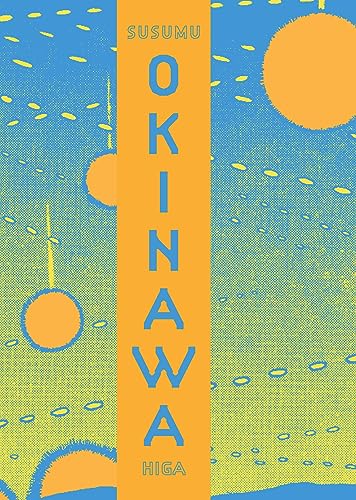
Best New Manga: Okinawa
Story and Art by Susumu Higa • Translated by Jocelyne Allen • Lettering by Patrick Crotty and Kayla E. • Fantagraphics
There are books that critics like, and books that readers like. I’d put Okinawa squarely in the first category, as it has all the hallmarks of a Serious Manga™: slightly naïve artwork, historically important events seen through the eyes of ordinary people, and detailed footnotes explaining the story’s cultural and linguistic nuances. If I sound a little cynical, I was; I put off reading Okinawa for months after its release because so many reviewers rehearsed the same talking points about how “harrowing,” “heartbreaking,” “complex,” and “haunting” it was. After reading Okinawa, however, I have to admit the critics were right: Okinawa is a deeply moving exploration of the island’s fraught relationship with Japan and the United States. It’s also a tribute to Susumu Higa’s parents, whose memories of World War II pervade many of Okinawa’s most affecting stories; a celebration of Okinawan resilience and spirituality; and the best manga I read in 2023.

Best New Drama: River’s Edge“Story and Art by Kyoko Okazaki • Translated by Alexa Frank • Vertical Comics
River’s Edge offers a gritty portrait of adolescence before chat rooms, cell phones, and social media, focusing on the slackers and misfits at a Tokyo high school. Haruna Wakakusa, the protagonist, is caught between her fierce sense of justice and her ambivalent feelings towards her on-again, off-again boyfriend Kannonzaki, a horny, hot-headed loser who bullies weaker classmates. Over the course of the story, Haruna forges an unlikely friendship with one of Kannonzaki’s targets, an aloof young man whose popularity with the girls belies his true sexual orientation. Okazaki’s spare, stylish linework is ideally suited to the material, as the character’s exaggerated facial features and ungainly proportions remind the reader of how confusing, weird, and uncomfortable it is to be on the physical cusp of adulthood. Okazaki also nails the casual cruelty and cluelessness of adolescence: her characters’ impulsiveness, selfishness, and inexperience often compel them to betray each other in small (and big) ways that feel true to life even when the plot teeters on the brink of melodrama.

Best Classic Title: One Hundred Tales
Story and Art by Osamu Tezuka • Translated by Iyasu Adair Nagata • Lettering by Aidan Clarke • ABLAZE
Over the course of his long career, Osamu Tezuka published three series based on the legend of Doctor Faustus, among them One Hundred Tales (1971), which ran in Weekly Shonen Jump. Tezuka takes a few liberties with the original story: his hero is not a brilliant scholar in search of knowledge but a lowly samurai who’s been sentenced to death for his employer’s misdeeds. In a fit of desperation, he sells his soul to a witch and is reborn as Fuwa Usuto, a dashing young man who wants two things: love and power. What follows is a rowdy picaresque, as Fuwo ventures into the lair of an alluring demon, saves his daughter from an arranged marriage, and insinuates himself into the house of a foolish daimyo in his quest to become more worldly and powerful. These episodes provide Tezuka ample opportunity to insert pop-cultural sight gags—Christopher Lee and Astro Boy both make fleeting appearances—but they also showcase Tezuka’s flair for character design and panel structure; the artwork is fluid and playful, equally suited to moments of exquisite silliness and heartbreaking sadness as Fuwo stumbles towards transcendence.

Best New Horror Series: The Summer Hikaru Died
Story and Art by Mokumokuren • Translated by Ajani Oloye • Lettering by Abigail Blackman • Yen Press
The Summer Hikaru Died begins with a familiar scene: two high school buddies are clowning around outside a convenience store, trading good-natured barbs. But something’s off, and midway through a seemingly ordinary conversation Yoshiki realizes that he’s talking to an impostor who’s the spitting image of his friend Hikaru. Though the mystery of what happened to the real Hikaru is resolved quickly, many questions remain: is it possible for Yoshiki to befriend “Hikaru” even though he has no real memories of their relationship? And what, exactly, is “Hikaru”? Mokumokuren resists the temptation to provide simple answers, relying instead on suggestion to create a tense, atmospheric story that skillfully blends elements of body horror, BL, and fantasy in a fresh, unsettling way.

Best New Cat Manga: Nights With a Cat
Story and Art by Kyuryu Z • Translated by Stephen Paul • Lettering by Lys Blakesly • Yen Press
Though there are dozens of great pet manga now available in English, Nights with a Cat has something genuinely new to offer: simple, observational storytelling that doesn’t shamelessly tug on the heartstrings or anthropomorphize our furry companions. The series explores the relationship between Fuuta and Kyuruga, his roommate’s cat. As someone who’s never lived with a cat before, Fuuta is fascinated by Kyuruga, marveling at Kyuruga’s anatomy—his pupils, his sandpaper tongue, his retractable claws—as well as Kyuruga’s ability to silently materialize in surprising places. Kyuryu Z doesn’t play these moments for laughs, choosing instead to emphasize how strange and amazing cats really are with illustrations that capture the fluidity of Kyuruga’s movements and the changeability of his moods. Recommended for new and long-time cat owners alike. (Reviewed at Manga Bookshelf on 5/21/23)

Best Ongoing Series: Go With the Clouds, North by Northwest
Story and Art by Irie Aki • Translated by David Musto • Vertical Comics
After a two-year wait, a new installment of Go With the Clouds, North by Northwest arrived in stores this fall, demonstrating once again why this odd, delightful, and occasionally thrilling story deserves a bigger audience. Strictly speaking, Go With the Clouds is a murder mystery, but Aki Irie refuses to observe the basic tenets of the genre, frequently interrupting her story for interesting diversions: a fitful romance between supporting characters, a brief lesson on Icelandic geography, a casual conversation between Kei, the main protagonist, and his trusty jeep. What prevents the story from being twee or mannered is its matter-of-fact tone. In the first chapter of volume six, for example, Kei uses ESP to track a kidnapping victim through the streets of Reykjavik by chatting up parked cars around the city, a goofy gambit that works thanks to Irie’s superb pacing and commitment to character development; Kei’s methodical approach suggests that his ESP is something he uses on an everyday basis, not something that manifests per the plot’s demands. Swoon-worthy art and twisty plotting add to the series’ considerable appeal. (Volumes one and two reviewed at The Manga Critic on 8/30/19).

Most Disappointing New Series: #DRCL: Midnight Children
Story and Art by Shin’ichi Sakamoto • Based on Bram’s Stoker’s Dracula • Translation Caleb Cook • Touch-Up & Lettering by Brandon Hull • VIZ Media
Let’s face it: Bram Stoker’s Dracula sucks, marred by turgid prose and a convoluted form. In the hands of other creators, however, Stoker’s ideas have thrilled, titillated, and shocked six generations of horror buffs. The introduction to #DRCL: Midnight Children suggests that Shin’ichi Sakamoto might be one of those creators, as he offers the reader a claustrophobic, suspenseful riff on Dracula‘s most famous chapter, “The Voyage of the Demeter.” The rest of volume one, by contrast, is a fever dream of short, incoherent scenes that bump up against each other like commuters on a rush-hour train. Anyone familiar with Stoker’s original novel will recognize the characters’ names but wonder why Sakamoto re-imagined Renfield as a nun who’s chained up in a dormitory room or Mina Murray as a short, scrappy redhead who’s an expert wrestler. (Also: a dead ringer for Anne of Green Gables.) It’s a pity that the story is so fragmented and overripe, as Sakamoto has a fertile imagination; the first volume is filled with hauntingly beautiful renditions of Dracula himself that instill a sense of awe and fear that’s missing from the rest of the story.

Filed Under: Manga, Manga Critic, Recommended Reading, REVIEWS Tagged With: ABLAZE, Aki Irie, Bad Manga, BEST MANGA, Cats, fantagraphics, Kyoko Okazaki, Mokumokuren, Osamu Tezuka, Shin'ichi Sakamoto, Susumu Higa, Vertical Comics, VIZ, yen press

The Manga Critic’s Year in Review: 2023

December 31, 2023 by Katherine Dacey

At the beginning of 2023, I vowed to post one review or essay per month, a goal I met for the first half of the year. Then work got busy, and my husband and I did some home improvement projects we’d been putting off, both of which made it harder to find the bandwidth for reviewing. The reviews I did publish, however, seemed to have found an audience, so I’m setting the same goal for myself in 2024 with the aim of writing more in-depth essays about older titles like Furari and BL Metamorphosis, as well as more reviews of classic, indie, and overlooked series. My other major goal for 2024 is to revive The Manga Review, though the upheaval on Twitter has made me wonder whether I’d reach more people with a newsletter than a weekly column. If you’ve been a regular reader, I encourage you to offer your two cents in the comments field! (Note that comment moderation has been set to stun due to an uptick in random links, so it may take a few hours for it be approved.)

As I was compiling this post, I spent some time reviewing my WordPress data and learned that…

  • I’ve posted 332 articles and reviews at The Manga Critic since 2009.
  • My most-viewed post is a 2017 review of Naoki Urasawa and Hokusai Katsushiki’s Master Keaton. To date, more than 23,000 people have read it.
  • My second most-viewed post is a 2019 review of Ichigo Tanako’s Become You. To date, more than 22,000 people have read it.
  • My most-viewed post of the 2020s is a review of Junji Ito’s No Longer Human, which I wrote in 2020. To date, more than 10,000 people have read it.

Focusing more specifically on 2023, I wrote one article, published seven full-length and eleven capsule reviews, and rediscovered a cache of essays I wrote for PopCultureShock between 2006 and 2009, one of which I shared with readers. I also created a new page at The Manga Critic listing some of the best manga podcasts in English, with help from dozens of Twitter followers. (Feel free to suggest more in the comments below!)

Here’s to a more productive 2024!

Essays and Features

  • The Best and Worst Manga of 2022

Full-Length Reviews

  • Blood on the Tracks, Vols. 1-5
  • Innocent, Vol. 1
  • Insomniacs After School, Vol. 1
  • Lovely Muco!, Vol. 1
  • Marmalade Boy: Collector’s Edition, Vol. 1
  • Mitsukazu Mihara’s The Embalmer, Vols. 1-4*
  • My Dear Detective: Mitsuko’s Case Files, Vol. 1
  • Yashahime: Princess Half-Demon, Vols. 1-2

Capsule Reviews

  • Ayashimon, Vol. 1
  • Daemons of the Shadow Realm, Vol. 1
  • Doomsday with My Dog, Vol. 1
  • The Fox and the Little Tanuki, Vol. 1
  • Issak, Vol. 1
  • The Music of Marie
  • Night of the Living Cat, Vol. 1
  • Nights With a Cat, Vol. 1
  • Orochi: Perfect Edition, Vol. 1
  • Tatsuki Fujimoto Before Chainsaw Man: 17-21
  • Under Ninja, Vol. 1

* This review was originally published at Pop Culture Shock in 2007.

Filed Under: Manga, Manga Critic

Innocent, Vol. 1

December 24, 2023 by Katherine Dacey

Innocent is hard to pin down. On the one hand, it’s a meticulously researched period drama starring real-life figures such as Charles-Henri Sanson, Casanova, Robert-François Damiens, and Jeanne Bécu, the sort of thing you might see on Masterpiece Theater or HBO. On the other, it’s a lurid portrayal of a young man’s corruption, filled with over-the-top scenes of torture and debauchery that, intentionally or not, recall Justine, or The Misfortunes of Virtue. The tonal mismatch between its historical aspirations and its treatment of the principal character never gel into a coherent story, however, resulting in a handsome but repellant mess that isn’t serious enough to move the reader or ridiculous enough to be enjoyed as camp.

The series opens in 1793, then jumps back in time to reveal how Sanson evolved from a sensitive young man into the Royal Executioner of France. In making Sanson his protagonist, author Shin’ichi Sakamoto has a major hurdle to overcome: Sanson executed almost 3,000 people and championed the guillotine as a more efficient, humane tool for dispatching convicts. To ensure the reader’s sympathy lies firmly with Charles-Henri, therefore, Sakamoto commingles fact and fiction, depicting Sanson as a beautiful, raven-haired teen with flowing locks and trembling lips, the epitome of a guileless young man. Everything makes Charles-Henri’s enormous eyes glisten with tears: the cruel comments of boarding school classmates, the sound of a flute, the sight of a beautiful young aristocrat. He’s also prone to outbursts of teenage indignation and fits of nausea, unable to stomach his father’s lessons on how to decapitate a person with a single blow.

For all the feverish dialogue and graphic violence, there’s almost no meaningful character development, as Sakamoto seems more intent on demonstrating Charles-Henri’s capacity for suffering than in depicting a flesh-and-blood person’s efforts to resist his destiny. In one of the most egregious examples of this tendency, Père Sanson tortures his son with techniques cribbed from the Book of Martyrs: he shackles Charles-Henri to a chair, deprives him of food and water, pierces his skin, and pulverizes his legs with a sledgehammer in an effort to bend Charles-Henri to his will. The true horror of the scene, however, is undercut by the way in which Sakamoto luxuriates in Charles-Henri’s wounded body with same fervid zeal as Titian painted the Crucifixion; Charles-Henri is stripped to waist and strapped to a pole, his hands tied above his head as he cries out in bewilderment. And if those Baroque flourishes aren’t enough to ruin the scene’s emotional authenticity, the cartoonishly evil Père Sanson is; he’s less a fully-realized character than a foil for Charles-Henri’s innocence, prone to making over-the-top pronouncements that would be right at home in a Nicholas Cage flick.

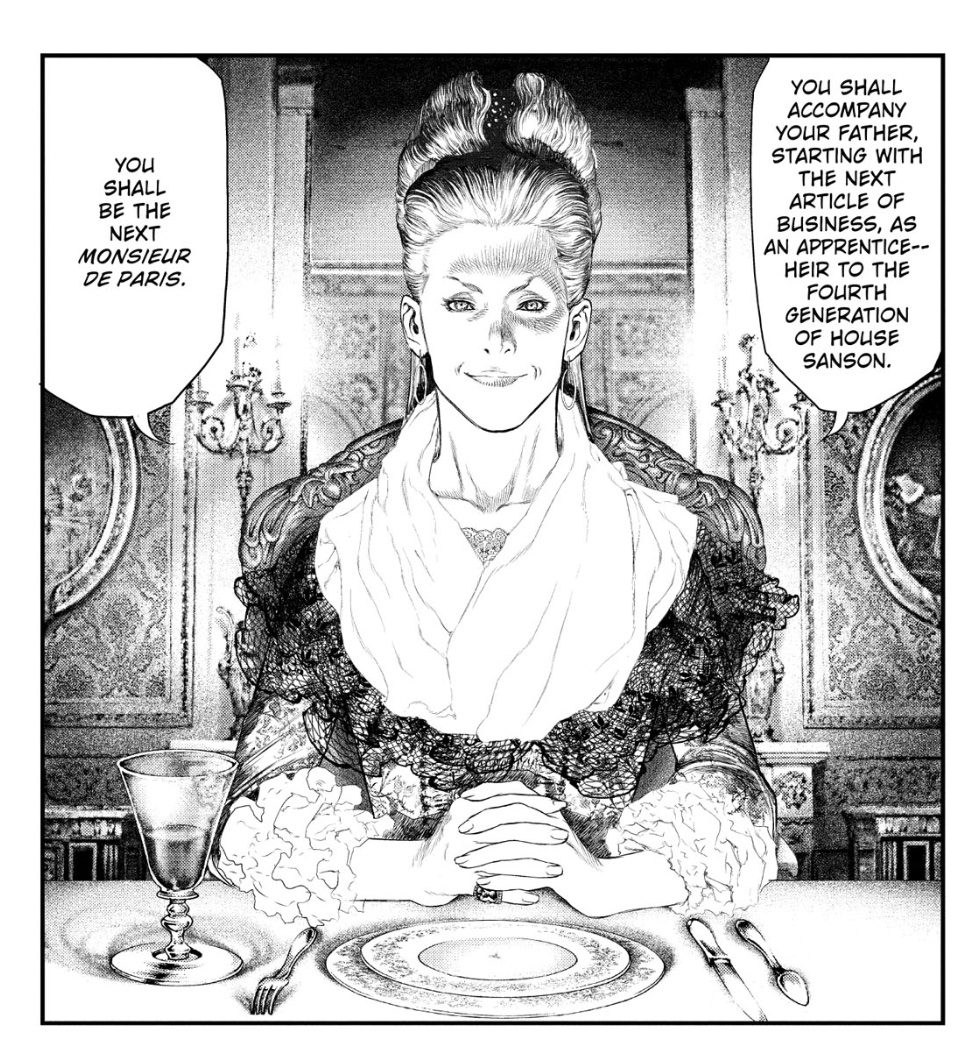
If the narrative disappoints, the artwork does not. Sakamoto draws sumptuous costumes and grand estates, lavishing considerable attention on small but historically meaningful details—a china pattern, the buckle of a shoe—in a meticulous effort to evoke the material culture of eighteenth century France. His real gift, though, is making obscure historical figures come to life on the page. Anne-Marthe Sanson, the matriarch of the Sanson clan, is a prime example: she looks like a bird of prey with a piercing stare and sharp nose, an impression reinforced by the way her fichu drapes across her chest like a ruff. In several key scenes, Sakamoto illuminates her from below, casting her face into shadowy relief to reveal the full extent of her hawkish vigilance:

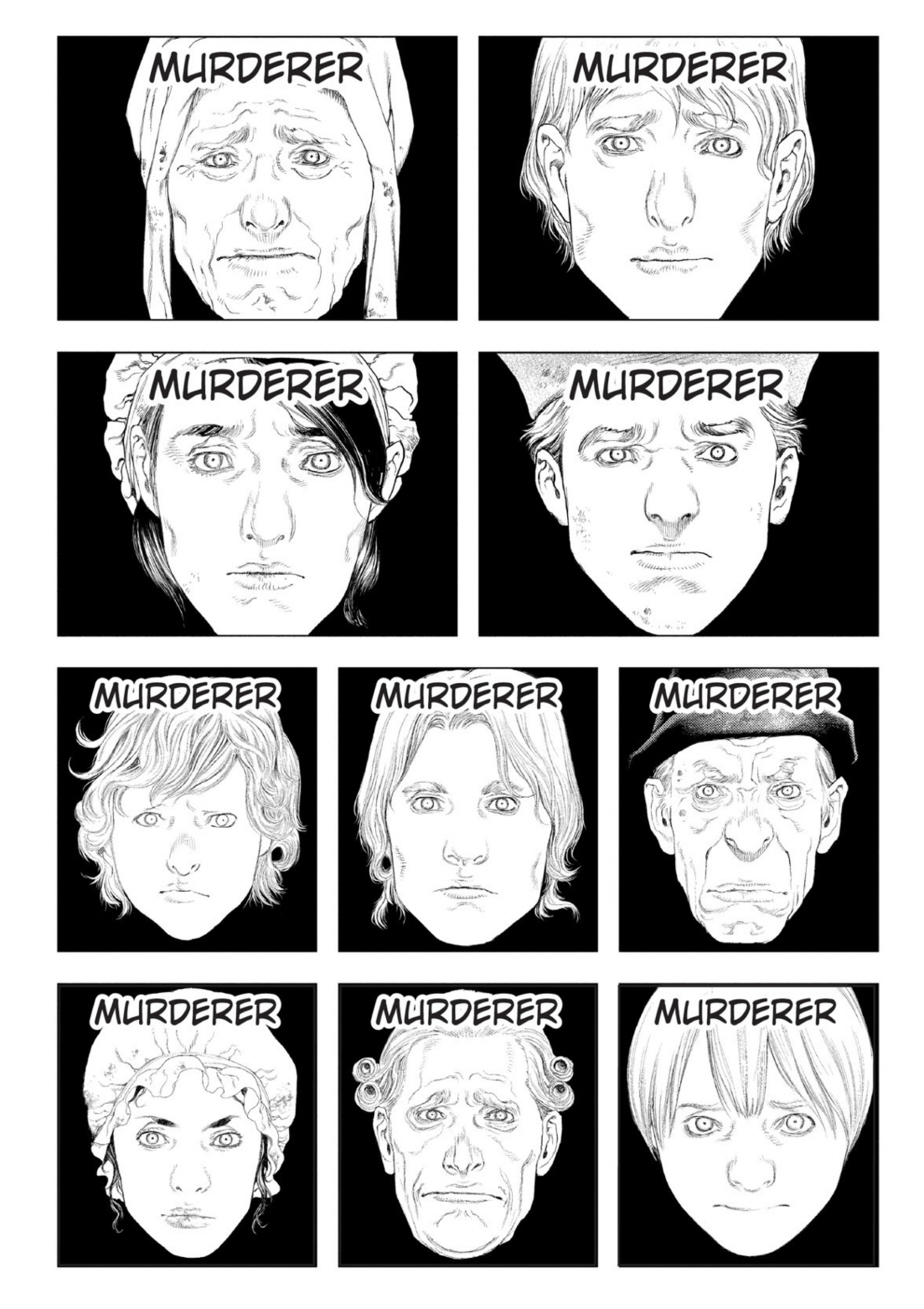
Sakamoto also has a flair for using abstraction, fantasy, and non-sequiturs to reveal his characters’ innermost thoughts. Not all of these gambits work; in one visually jarring moment, for example, Sakamoto depicts Charles-Henri in modern streetwear, an image that serves no obvious dramatic purpose. Other scenes, however, are devastatingly effective in conveying the full extent of Charles-Henri’s paranoia and loneliness. After botching the execution of an acquaintance, Sanson looks out at the crowd and sees a motley assortment of faces staring at him:Sakamoto then repeats this motif, adding more and more faces:It’s a simple but powerful sequence: we feel the collective weight of the crowd’s revulsion and the individual opprobrium of everyone who witnessed Sanson’s orgiastic display of violence. At the same time, however, we feel Sanson’s growing sense of terror and confinement, imprisoned in a role he loathes and unable to escape the scrutiny of commoners and noblemen alike.
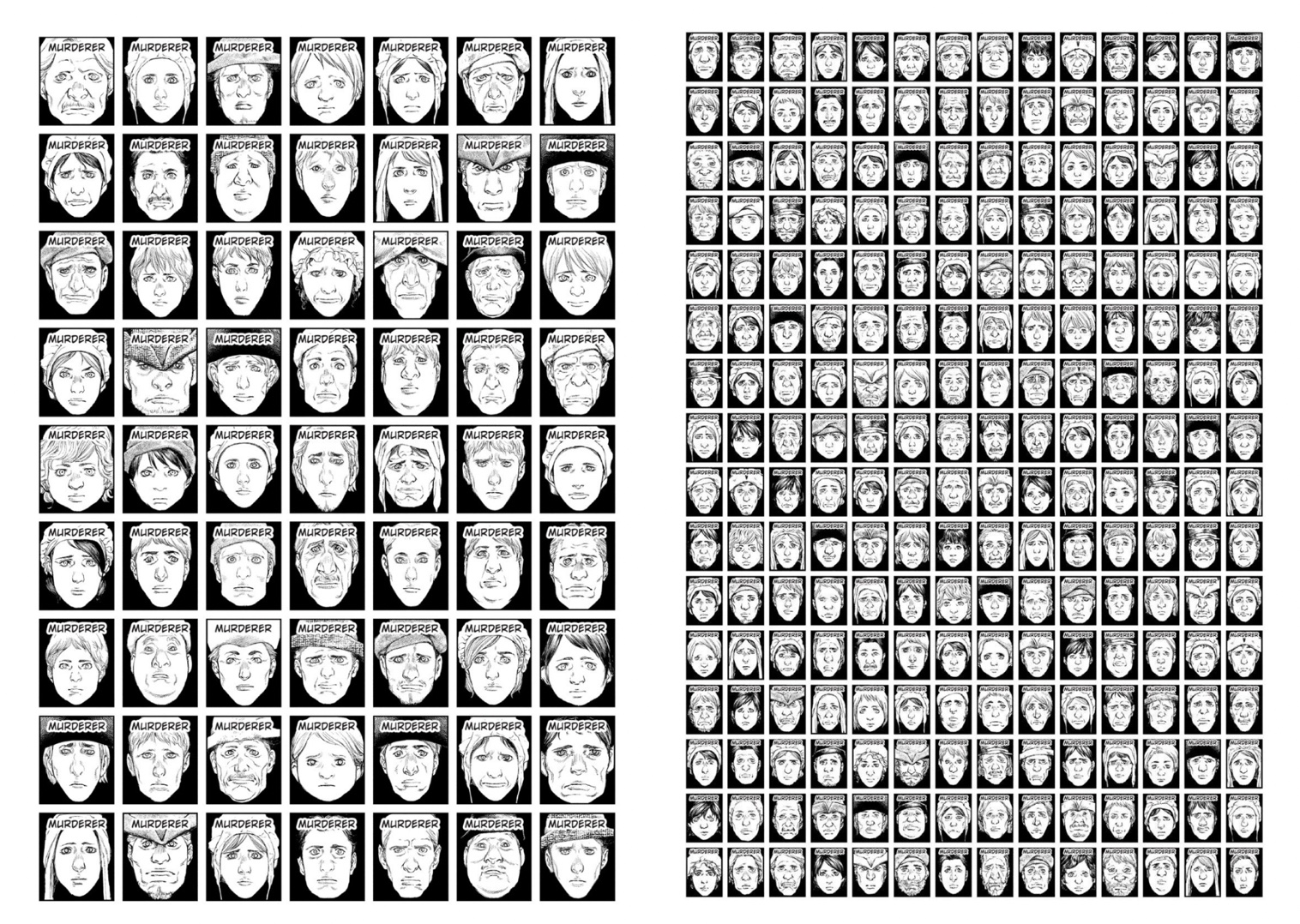
These kind of emotionally resonant scenes are few and far between, however, as Sakamoto is more interested in showing Charles-Henri’s martyrdom than making him into a real person; you’d be forgiven for thinking that Sanson was a real-life saint and not someone who’s remembered today for his enthusiastic embrace of the guillotine. Not recommended.

INNOCENT, VOL. 1 • STORY AND ART BY SHIN’ICHI SAKAMOTO • TRANSLATED BY MICHAEL GOMBOS • LETTERING AND RETOUCH BY SUSIE LEE AND STUDIO CUTIE • DARK HORSE • 632 pp. • RATED 18+ (Violence, nudity, language)

Filed Under: Manga, Manga Critic, REVIEWS Tagged With: Ancien régime, Dark Horse, Historical Drama, Shin'ichi Sakamoto

From the Vault: Mitsukazu Mihara’s The Embalmer

September 30, 2023 by Katherine Dacey

This month, I’m reaching into the PopCultureShock vault for a review of Mitsukazu Mihara’s The Embalmer, one of those offbeat titles that Tokyopop published back in the aughts. It’s not hard to see why Tokyopop thought there was an audience for Mihara’s work, as she played an important role in defining the Gothic Lolita aesthetic. Tokyopop licensed five of her works—Doll, Haunted House, IC in a Sunflower, Requiem in Phonybrian, and The Embalmer—but they didn’t really catch on with North American readers. That’s a pity, as titles such as The Embalmer, Doll, and IC in a Sunflower were anything but cookie cutter, tackling difficult subjects with sensitivity and style. (Well, most of the time; some of the stories in Sunflower haven’t aged particularly well.) Readers interested in tracking down The Embalmer should note that Tokyopop only translated four of the seven volumes before canceling the series; used copies are relatively easy to obtain through Amazon and eBay, however. A quick search of WorldCat indicates that there are public libraries around the US that still have copies as well.

Mitsukazu Mihara’s The Embalmer, Vols. 1-4
Story and Art by Mitsukazu Mihara
Published by Tokyopop

Let’s face it: even in a medium known for exploring a diverse array of topics—cooking, Viagra, Linux, vampires—embalming doesn’t sound like a promising subject, yet Mitsukazu Mihara’s gripping manga is less an examination of death and decay than a meditation on how coping with loss gives meaning to life.

The series focuses on embalmer Shinjyurou Mamiya. At first glance, he looks like the quintessential bad boy with his skate punk wardrobe, rock star ‘do, sloppy digs, and fondness for the ladies. That’s certainly how Atzuki Natsui, his housekeeper and love interest, views him. Shinjyurou, however, proves more substantial than his casual demeanor might suggest. In a country where Buddhist custom dictates that bodies be cremated, his profession inspires hostility and suspicion from grieving families and medical professionals alike. Shinjyurou, however, reaches out to skeptics with the argument that embalming is a service for the living, not the dead. By preserving (and sterilizing) the body of a tuberculosis victim, for example, Shinjyurou allows the man’s young son to hug his father goodbye—something that would have been impossible during the man’s final days in quarantine—while Shinjyurou’s reconstruction of a badly mangled ballerina helps her grieving fiance imagine the wedding and professional debut she was denied by a deadly car crash.

Each volume of The Embalmer has a slightly different rhythm; some read like anthologies of thematically related stories, while others contain more conventional, multi-chapter story arcs involving the lead characters. Volumes one and two, for example, consist primarily of vignettes about Shinjyurou’s clients with a sprinkling of chapters exploring his personal life. In volume three, Mihara shifts gears, delving into Shinjyurou’s past to explain how an aspiring medical student from Okinawa ended up studying mortuary science in Pittsburgh. Volume four returns to the same format as volumes one and two, offering both glimpses of the embalming profession and scenes from Shinjyurou’s muddled courtship of Atsuki.

Volume four also includes an afterword from Mihara explaining her interest in embalming. Contrary to what one might expect from a manga-ka best known for her goth-loli motifs and dark themes, Mihara’s curiosity about the practice stemmed from personal experience, not a general fascination with death:

The inspiration for this book came from the death of my friend. Because of the funeral schedule, I didn’t feel like I was able to properly say goodbye. I think embalming is a technique well suited to Japan, where we often have very little time. So the circumstances led me to investigate embalming…

It’s this personal investment in the material, I think, that prevents The Embalmer from shading into ghoulishness or sentimentality. Mihara did her homework on the subject. Each volume includes extras explaining the practice—origins, tools, training—and the difficulties faced by Japanese professionals in a country where cremation is the norm. At the same time, however, each volume contains vivid, poignant scenarios that dramatize the very human need for closure when a loved one dies unexpectedly, showing us how personal tragedy leads to catharsis. Mihara’s highly stylized figures—often rendered with slender, angular frames, coal-black eyes, and dark shocks of hair—and empty backgrounds amplify her characters’ shifting moods from despair to peaceful acceptance.

Tokyopop has done Mihara’s work justice with a smooth, idiomatic translation, helpful notes explaining pop culture references, and a distinctive cover design in a muted palette of green, gray and black. It’s a worthwhile addition to every serious manga fan’s collection, and a fine introduction to the unique art and storytelling of Mitsukazu Mihara.

This review originally appeared at PopCultureShock on September 18, 2007 at http://www.popcultureshock.com/manga-review-mitsukazu-miharas-the-embalmer-vols-1-4/42616/.

Filed Under: Manga, REVIEWS Tagged With: From the Vault, Mitsukazu Mihara, Tokyopop

My Dear Detective: Mitsuko’s Case Files, Vol. 1

August 31, 2023 by Katherine Dacey

Have you seen The Law According to Lidia Poët? It’s a period drama that’s loosely inspired by the career of Italy’s first woman lawyer. Though the series explores the real-life Poët’s long, lonely battle for professional recognition, it also makes plenty of room for romance and adventure, portraying her as a free spirit who solves mysteries with the aid of a handsome male journalist. The show’s breezy tone is more Remington Steele than Masterpiece Theater, but it never shies away from acknowledging that nineteenth-century Italy was truly a man’s, man’s world.

If Lidia Poët sounds like something you’d watch, you might like My Dear Detective, which also features a plucky heroine in a male-dominated field. The setting is Taisho-era Japan, where twenty-something Mitsuko Hoshino works for the Ginza Detective Agency as an investigator. Though Mitsuko is a natural, she faces skepticism and condescension in her day-to-day work that sometimes shades into outright hostility; early in volume one, for example, local hooligans vandalize the agency with slogans accusing her of “stealing men’s jobs.” Her boss is unfazed, however, and remains quietly but kindly supportive of her desire to be, in her words, “a working woman.”

Through one of those only-in-manga contrivances, Mitsuko crosses paths with Satou Yoshida, a handsome young man who turns out to be the scion of a prominent family. (The Yoshidas own one of the poshest department stores in Tokyo.) He soon joins the agency as Mitsuko’s assistant, chauffeur, and bodyguard, dropping the Yoshida name whenever it expedites their investigation, and swooping in to save Mitsuko whenever she’s in danger. Mitsuko—ever the consummate professional—won’t admit to herself that she likes Satou, and puts up a blustery front any time he flirts with her.

Though the script is lively and the pacing brisk, the artwork is a little plain. The costumes, hairstyles, and props are just detailed enough to give a sense of the period, but the backgrounds are a little too sterile and generic to really evoke Tokyo in the 1920s. More appealing are the character designs: Natsumi Ito does an effective job of conveying each cast member’s age, social standing, and personality through small but meaningful details. Mitsuko, for example, sports a sleek, modern bob and knee-length skirts, while the older women she interacts with favor Nihongami and kimono, evoking the transitional spirit of the Taisho era.

Taken as a whole, however, My Dear Detective is the manga equivalent of The Law According to Lidia Poët. One the one hand, it’s a fizzy, fun series that offers solid mysteries with interesting twists solved by impossibly good-looking people. On the other hand, My Dear Detective gently reminds the reader how many practical barriers professional women faced a century ago, acknowledging the degree to which misogyny made it all but impossible for smart, ambitious women to chart a course for themselves outside of traditional gender roles. These two sensibilities don’t always mesh harmoniously, but most of the time My Dear Detective toes the line between escapism and didacticism in a highly entertaining fashion. Lidia Poët would undoubtedly approve. Recommended.

MY DEAR DETECTIVE: MITSUKO’S CASE FILES, VOL. 1 • BY NATSUMI ITO • TRANSLATED BY SAMUEL R. MESSNER • LETTERING BY BARRI SHRAGER • COVER DESIGN BY GLEN ISIP • AZUKI • 183 pp. • NO RATING

Filed Under: Manga, Manga Critic, Recommended Reading, REVIEWS Tagged With: Azuki, Historical Drama, Mystery/Suspense

YashaHime: Princess Half-Demon, Vols. 1-2

June 27, 2023 by Katherine Dacey

YashaHime: Princess Half-Demon epitomizes what I dislike most about IP-driven entertainment. It’s a manga adaptation of an anime sequel to a popular series, made with little involvement from the original author. Though the scriptwriters have created new characters and plot lines for the sequel, YashaHime feels more like the product of a focus group than an organic continuation of the story.

Like InuYasha, YashaHime begins in present-day Tokyo, where one of Sesshomaru’s twin daughters is living with the Higurashi clan. There are a few hints that Towa is troubled—she’s bounced from school to school, never really fitting in with her peers—but she valiantly tries to be a normal teenager. The sudden appearance of a demon at the Higurashi’s shrine sets the plot in motion, whisking Towa back to the feudal era and reuniting her with Setsuna, her fraternal twin, and Moroha, her cousin. Once back in her own time period, Towa joins Setsuna and Moroha on a quest to locate a set of “mystical pearls” and solve the mystery of what happened to their families.

There’s real potential in building a sequel around Sesshomaru and InuYasha’s daughters, but the authors skimp on meaningful character development. Setsuna, for example, is stoic and surly like Sesshomaru, while Moroha is boastful and loud like InuYasha; only Towa feels like a fully realized character. Towa is depicted as a shojo prince, decked out in a white pants suit and cropped haircut that lend her an aura of gender-bending cool—a point reinforced in the early chapters of volume one, when Towa is showered with notes from adoring female classmates. Beneath her cool exterior, however, Towa is haunted by the gaps in her memory, as she struggles to fit in with her adoptive family.

The other big drawback to YashaHime is that the authors lack Rumiko Takahashi’s gift for imaginative, economical storytelling. They shamelessly mine the original series for ideas, staging several action sequences that recall the earliest chapters of InuYasha. (Remember the three-eyed crows? Or the centipede demon who kidnapped Kagome? They’re back for another turn in the spotlight.) In between the demon-wrangling and the unfunny sight gags, the authors fall back on long-winded conversations to reveal how the three girls were separated from their parents, over-explaining everything to such a degree that the story groans under the weight of expository dialogue.

About the best I can say for YashaHime is that Takashi Shiina has done an admirable job of capturing the charm of InuYasha‘s character designs while making them look a little more up-to-date. Though Shiina’s linework is more angular than Rumiko Takahashi’s, the characters strongly resemble Takahashi’s original creations. All three leads have features that recall their famous fathers—Setsuna’s fluff is a particularly nice touch—while the human characters from InuYasha have aged in a naturalistic fashion. The demons, too, are drawn with care; Myoga, Jaken, and Kirara are all immediately recognizable.

I wish I enjoyed this series more, as I’ve been an InuYasha fan for almost twenty years. Part of the reason I loved the original series was that it felt like a real work of imagination, with odd flourishes of horror and genuine moments of pathos. YashaHime, by contrast, is so beholden to Takahashi’s original text that it never takes the kind of creative risks that would elevate it beyond the level of corporate doujinshi. There’s nothing as deeply unsettling as the sight of Naraku’s flesh bubbling in a cauldron, or as poignant as Kikyo and InuYasha’s final conversation; everything has a warmed-over quality, even when Shiina and Katsuyuki Sumisawa’s script explores new ground. Not recommended.

YASHAHIME: PRINCESS HALF-DEMON, VOLS. 1-2 • STORY AND ART BY TAKASHI SHIINA, MAIN CHARACTER DESIGN BY RUMIKO TAKAHASHI, SCRIPT COOPERATION BY KATSUYUKI SUMISAWA • TRANSLATED BY JUNKO GODA • ADAPTED BY SHAENON K. GARRITY • LETTERING BY JAMES GAUBATZ • VIZ MEDIA • 200 pp. • RATED TEEN (Fantasy violence, horror)

Filed Under: Manga, REVIEWS Tagged With: Fantasy, Horror/Supernatural, inuyasha, Rumiko Takahashi, shonen sunday, VIZ, YashaHime

Lovely Muco!, Vol. 1

May 16, 2023 by Katherine Dacey

For thirteen years, I lived with Grendel, a smart, stubborn Australian shepherd who treated me and my husband like a pair of unruly sheep. She woke us up at 5:45 am every day, herded us to the park, and marched us around until we were exhausted. She nipped our ankles when we left for work—we weren’t supposed to leave the farm, I guess—and had strong preferences about everything, from which routes we walked to which brand of kibble we bought. When she wasn’t trying to bend us to her will, she applied her formidable intelligence to foraging snacks; she had a black bear’s talent for opening containers of peanut butter, Tums—you name it. I loved her dearly, but I admit that there were times when I fantasized about living with a dog who wasn’t so determined to run our house.

With my current commute, I can’t own the happy-go-lucky dog of my dreams, but I can do the next best thing: read about one. That’s where Lovely Muco! comes in. It’s a gag manga inspired by the real-life relationship between Komatsu, a professional glass blower, and Muco, his exuberant Shiba Inu. In every chapter, Muco makes a discovery—that her nose is shiny, or that Komatsu isn’t a dog—and becomes so consumed with excitement that she ends up in trouble. Muco’s reactions to everyday situations bring out her inner Gracie Allen; she’s less dim than dizzy, viewing the world with the peculiar logic of a canine enthusiast. A trip to the vet, for example, leads her to wax rhapsodic about the cone of shame, which she views as a stylish accessory, rather than an encumbrance. Even when her injury starts to itch, Muco remains convinced that she looks cool, going so far as to imagine how Komatsu would look with his own cone.

As much as I love Muco’s antics, my favorite storyline focuses on Komatsu, who hires his pal Ushiko to design him a website. Ushiko uses the tools that you’d expect—a digital camera, a laptop—but Komatsu’s reactions to these technologies seem more appropriate for someone who’d just spent the last 20 years living off the grid than someone making a living in modern-day Japan. His child-like wonder mirrors the way Muco approaches just about everything in her life, from tennis balls to car rides—a neat inversion of their usual roles.

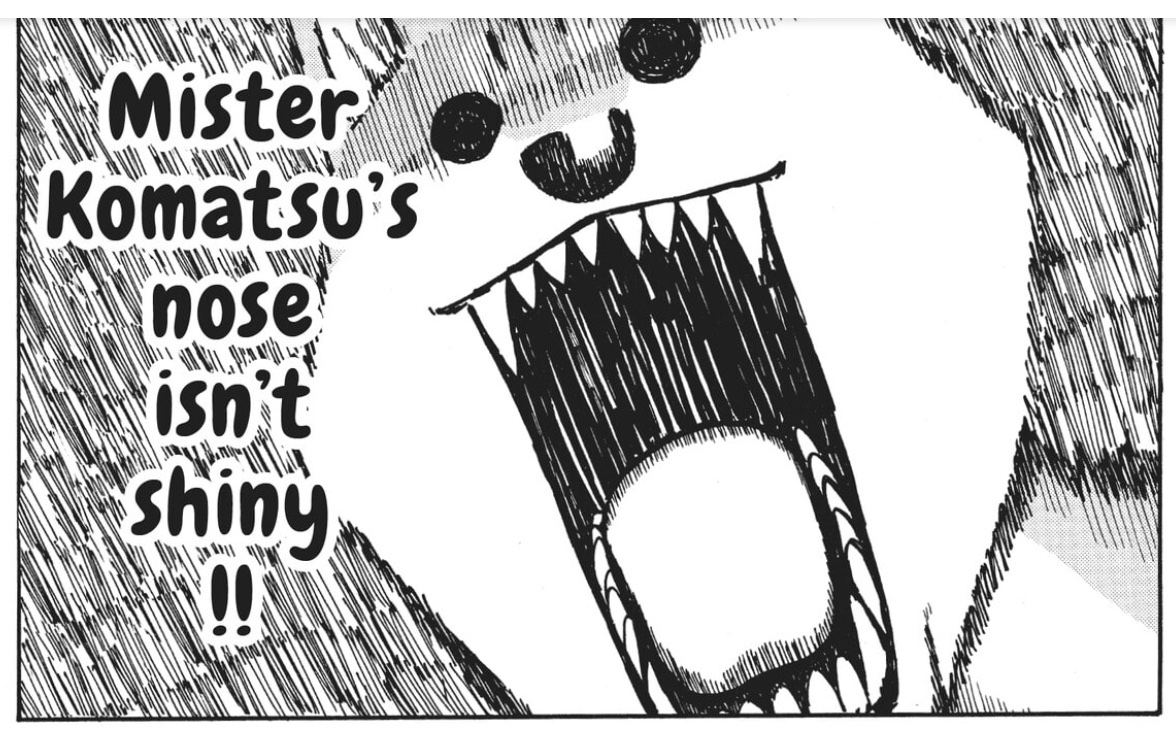
Takayuki Mizushina’s artwork plays a big role in making their owner-dog dynamic funny. Mizushina’s approach is more gestural than literal, distilling each character, human or animal, to a set of bold lines and basic shapes. Muco, for example, bears only a passing resemblance to a Shiba Inu, as Mizushina  draws her head like a stop sign with triangular ears. That hexagonal shape, however, provides Mizushina an ideal frame for Muco’s facial expressions:

And while plenty of other manga artists use this same device to express extreme emotion, Mizushina really captures the essence of how an excited dog reacts to new things in its environment; you can almost hear Muco barking whenever she has an epiphany.

What I like best about Lovely Muco, though, is that Muco’s thought process isn’t like Grommit or Snoopy’s. She’s not building wild contraptions or fantasizing about being a World War I flying ace; she’s just trying to make sense of the people and things around her. Her fascination with ordinary objects is a nice reminder that part of living with a dog—or any sentient creature—is recognizing how strange and interesting our world must seem to them, and taking pleasure in their curiosity and enthusiasm. Recommended.

PS: If you just can’t get enough shiba inu hijinks, you can follow the real-life Muco’s exploits on Twitter. (Hat tip to @debaoki for the link.)

LOVELY MUCO! THE HAPPY DAILY LIFE OF MUCO AND MR. KOMATSU, VOL. 1 • ART AND STORY BY TAKAYUKI MIZUSHINA • TRANSLATED BY CASEY LEE •  KODANSHA COMICS  220 pp. • RATED 10+ (SUITABLE FOR READERS OF ALL AGES)

Filed Under: Manga, Manga Critic, Recommended Reading, REVIEWS Tagged With: Animals, Comedy, Kodansha Comics

Insomniacs After School, Vol. 1

April 6, 2023 by Katherine Dacey

First published in 1911, Frances Hodgson Burnett’s The Secret Garden has beguiled millions of readers with its portrait of Mary and Colin, two sickly children who heal themselves by finding a forgotten space and bringing it back to life. Burnett’s story is very much a product of the Edwardian era, steeped in colonialism and patriarchy, but the core plot—in which the children discover their own agency, and create their own sanctuary—seems as relevant in 2023 as it did over a century ago.

Insomniacs After School steals a page or two from The Secret Garden, shifting the action from a British manor to a Tokyo high school where Nakami, a grumpy, uptight boy, and Magari, a goofy, spontaneous girl, are struggling with insomnia. The two meet cute when Nakami stumbles over Magari sleeping on the floor of the school’s long-abandoned observatory. After commiserating about their difficulty falling asleep, Nakami and Magari hatch a plan to transform the observatory into a clubhouse where they can hang out or sneak in a much-needed midday nap. They scavenge furniture, hang curtains, and welcome a neighborhood cat into their space, in the process uncovering the telescope left behind by the now-defunct astronomy club and, of course, becoming friends.

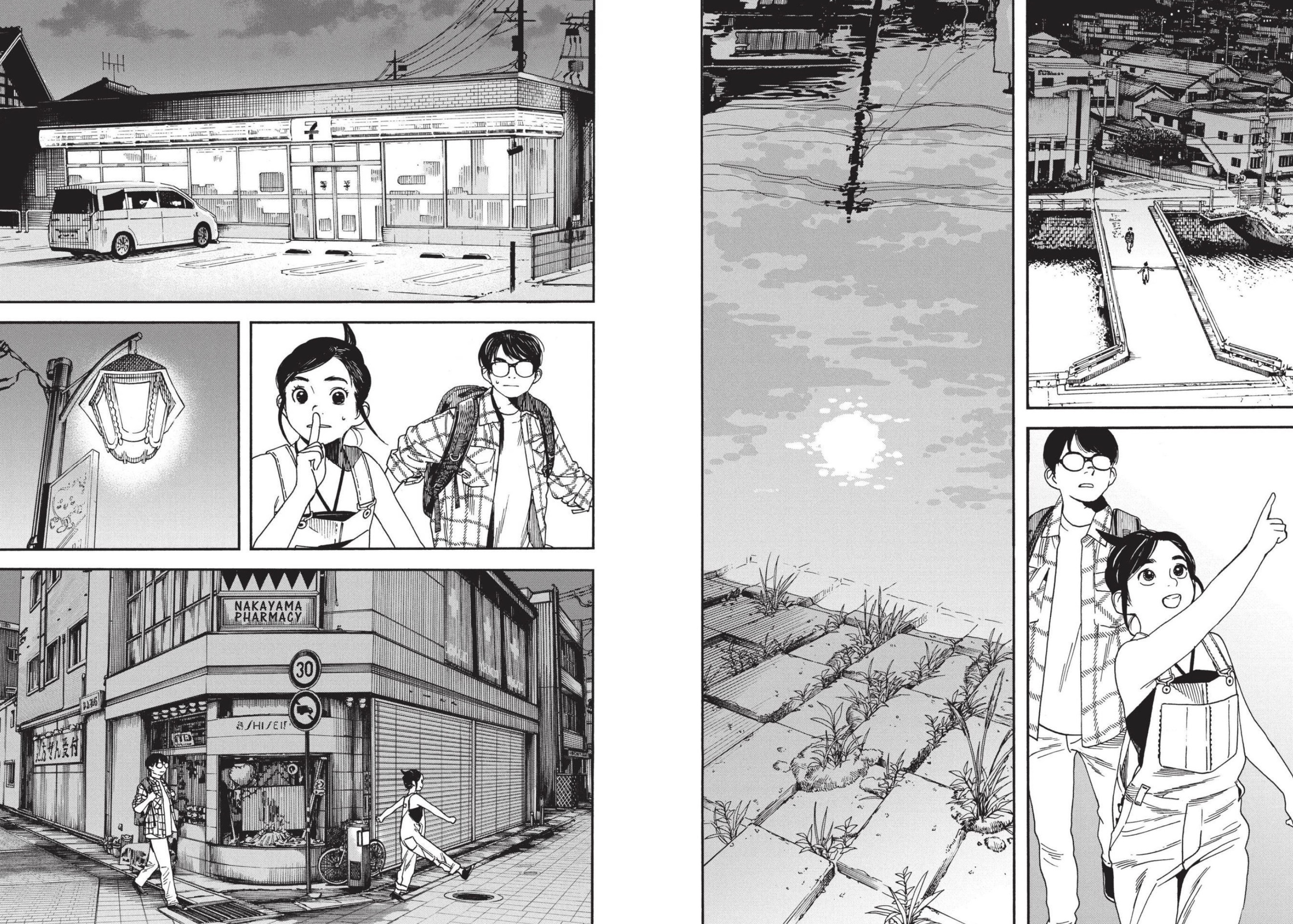
As delightful as these early scenes are, the best sequence in volume one documents their first outing as members of the “Enjoy-the-Night Club.” Nakami and Magari sneak out of their homes and into the city, meandering through empty neighborhoods, dodging a night patrolman, posing for photographs, and gazing out over the harbor as the first glimmers of dawn form on the horizon. Though there are a few lines of dialogue sprinkled throughout the chapter, most of Nakami and Magari’s adventure unfolds in companionable silence, allowing us to appreciate the stillness of early morning, and their thrill at being the only ones to witness the sunrise:

One of the strengths of Insomniacs After School is Ojiro’s low-key approach to character development. Ojiro isn’t in a hurry to reveal too much about his characters, fleshing out their backstories in an organic fashion through snippets of conversation and brief glimpses into their home lives. Nakami’s dad, for example, seems troubled, though it’s not clear from context what might be wrong, while Magari reveals she suffered from a serious childhood illness that made her frail. Neither teen wants their parents to know the full extent of their exhaustion, however, so they don’t seek help from the adults; as Magari declares, “When I was sick as a kid, I really hated how everyone worried about me. That’s why I keep my insomnia a secret.”

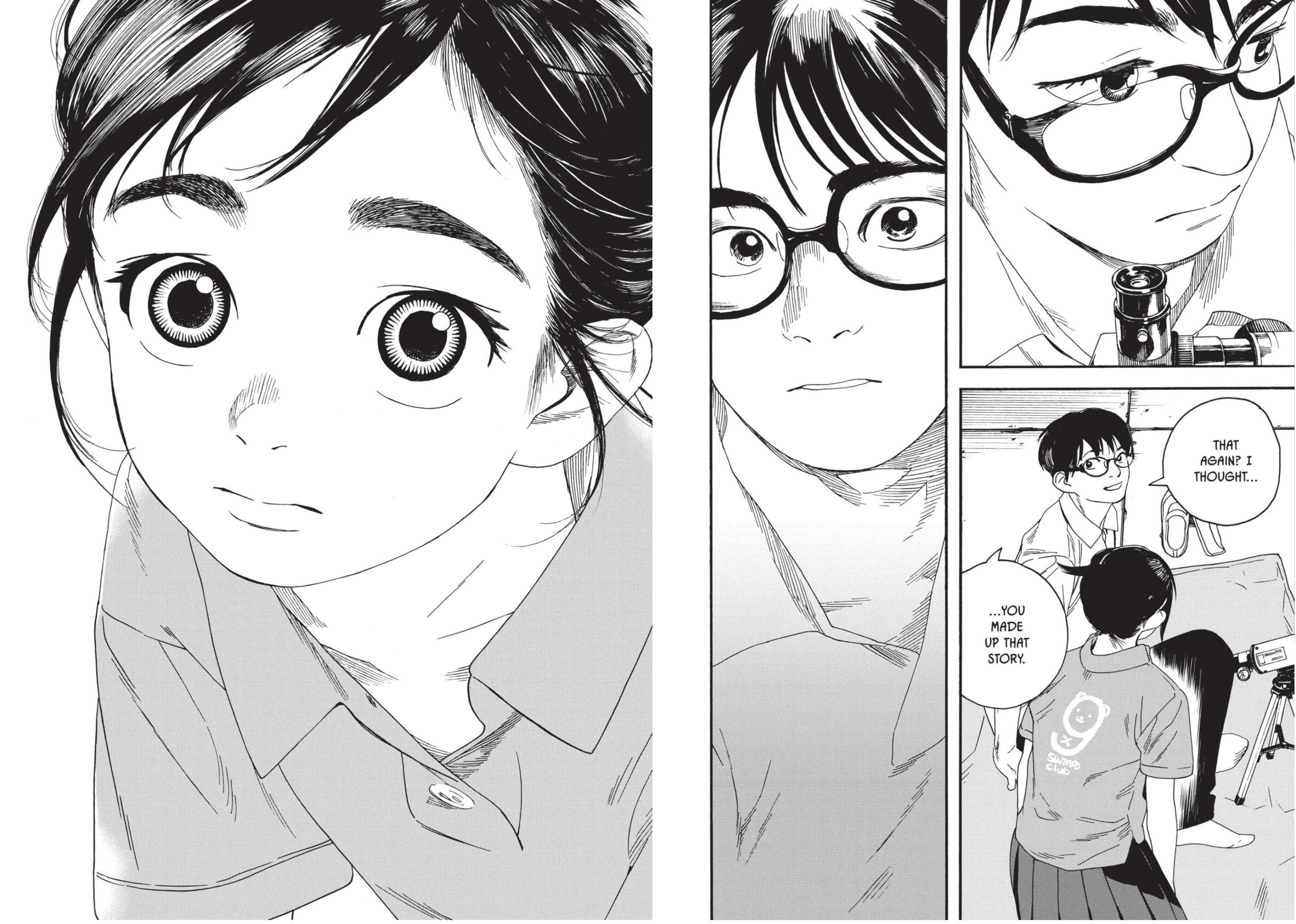
Another strength is the clean, expressive artwork. Ojiro’s facial close-ups and fresh use of perspective give us a sense of the characters’ eagerness for connection as well as their vulnerability and inexperience. In this sequence, for example, we see what happens when Nakami’s simple, matter-of-fact statement lands differently than expected:

The shift in perspective neatly underscores Nakami’s confusion: one minute he felt at ease with Magari, and the next he’s puzzled by her reaction, a note of trepidation registering on his face. Ojiro resists the temptation to verbalize what his characters are thinking, instead letting the reader feel his characters’ discomfort as Nakami’s comment hangs in the air.

Ojiro’s knack for capturing these small but emotionally charged moments lends Insomniacs After School a realism that will appeal teen readers; it’s a quiet, carefully observed portrait of two kids who are navigating the space between friendship and romance, with all the confusion and excitement that entails. Other readers—especially those of us with vivid memories of The Secret Garden—will find Insomniacs a warm reminder that bringing light and life to a neglected place can heal the heart, no matter how old you are. Highly recommended.

INSOMNIACS AFTER SCHOOL, VOL. 1 • BY MAKOTO OJIRO • TRANSLATED BY ANDRIA CHENG • TOUCH-UP & LETTERING BY INORI FUKUDA TRANT • VIZ MEDIA • RATED T (FOR TEENS)

Filed Under: Manga, Manga Critic, Recommended Reading, REVIEWS Tagged With: Romance/Romantic Comedy, VIZ

Marmalade Boy: Collector’s Edition, Vol. 1

March 1, 2023 by Katherine Dacey

One of shojo manga’s most time-honored plot lines goes something like this: a young girl’s life is turned upside down when her mother or father remarries someone with a teenager of their own, usually a cute boy who’s smart, athletic, and insufferable. Over the course of six or ten volumes, however, the heroine gradually moves from indignation to infatuation, finally admitting to herself what everyone else could plainly see: she likes her stepbrother. There are a usually a few complications on the way to a blissful relationship—say, a crazy ex-girlfriend who won’t go away—but the step-siblings eventually realize that they’re meant to be together.

Wataru Yoshizumi’s Marmalade Boy adds a new wrinkle to the formula, however, by engineering a crazy scenario for bringing her romantic antagonists under the same roof. In the opening pages of volume one, fifteen-year-old Miki Koishikawa’s parents come back from a trip with shocking news: they’re getting divorced. Making matters worse is that the Koishikawas have decided to swap partners with the Matsuras, a couple they met while traveling, and combine their families into a single household that includes both Miki and the Matsuras’ son Yuu. Yuu, of course, is a quintessential shojo prince: he’s gifted at tennis, an ace at math, and popular at school and—naturally—Miki hates him. She finds him smug in his refusal to criticize their parents’ impulsive behavior, and is furious that no one seems to understand her reservations about their new living situation. 

Their blended family life is established with great efficiency, setting the stage for plenty of misunderstandings and fights between Miki and Yuu. Yoshizumi also wastes no time in introducing other romantic prospects for both leads; a good part of volume one, in fact, follows the complicated friendship between Miki and Ginta, a cute tennis player who Miki used to like. Yuu, meanwhile, has his own romantic travails when his ex-girlfriend Arimi tracks him down at his new school, determined to rekindle their relationship by any means necessary. And if all those potential entanglements weren’t enough to fill thirty or forty chapters, Miki’s best friend Meiko starts hooking up with her hot homeroom teacher in the school library.

If I’m reading the story in Responsible Adult Mode™, it’s hard to ignore all the WTF? shenanigans. In one of the weirdest scenes in volume one, for example, the Matsuras and Koishikawas stage a fight to see whether Miki truly disapproves of their living arrangement, confessing their deceit only after a tearful Miki begs them to follow their hearts. The sight of all four parents gaslighting their daughter is comically awful; I’d be the first to admit that I’m on Team Miki, as she seems to be the only person who grasps the impulsiveness of the adults’ spouse-swapping arrangement. Then there are the usual shojo red flags: student-teacher relationships, stolen kisses, and characters whose behavior sails over the line between friendly interest and stalking.

If I allow myself to reconnect with my inner twelve-year-old, however, I have to admit that Marmalade Boy is funny, silly, and engrossing, offering a teenage gloss on Dynasty or Melrose Place. It’s the kind of manga in which two romantic rivals settle their differences with a high-stakes tennis match—in front of the whole school, of course—and characters state their intentions in a bald fashion: “I won’t lose you to him,” Arimi cheerfully warns Miki over a sundae. (A sundae!) Yoshizumi’s ability to balance the absurd with the everyday lends an air of plausibility to these scenarios; there’s always a kernel of emotional truth to the interactions between the characters, even when they’re dreaming up soap-worthy schemes.

Though the plotting is intricate, the artwork is clean and unfussy; backgrounds, hairdos, and clothing are rendered in a style that keeps the focus on the characters’ faces and body language. Miki has big, dramatic reactions to everything, but Yoshizumi avoids too much deformation or mugging to convey Miki’s distress. More surprising is how gracefully the artwork has aged, aside from an errant headband here and there; it wouldn’t look out of place at Barnes & Noble in 2023. (Well, that’s not entirely true; Yuu has a major case of 90s Shojo Prince Hair™, notable for its height and for the artful way it flops to one side of his face.)

All of this is to say that I enjoyed Marmalade Boy waaaaaaaaaay more than I expected, given my advanced age and my strong preference for stories about, y’know, adults. I cheerfully recommend it to anyone looking to recapture the feeling of reading their first shojo manga, or the palpable excitement of being a manga fan in the early 2000s, when Tokyopop published these kind of stories by the truckfull. Recommended.

MARMALADE BOY: COLLECTOR’S EDITION, VOL. 1 • BY WATARU YOSHIZUMI • TRANSLATED BY AMBER TAMOSAITIS • ADAPTED BY KRISTA GRANDY • LETTERING BY JENNIFER SKARUPA • SEVEN SEAS • RATED TEEN+ 

Filed Under: Manga, Manga Critic, REVIEWS Tagged With: Romance/Romantic Comedy, Seven Seas, shojo

  • Page 1
  • Page 2
  • Page 3
  • Interim pages omitted …
  • Page 26
  • Go to Next Page »
 | Log in
Copyright © 2010 Manga Bookshelf | Powered by WordPress & the Genesis Framework