• Skip to primary navigation
  • Skip to main content
  • Skip to primary sidebar
  • Home
  • About Us
    • Privacy Policy
    • Comment Policy
    • Disclosures & Disclaimers
  • Resources
    • Links, Essays & Articles
    • Fandomology!
    • CLAMP Directory
    • BlogRoll
  • Features & Columns
    • 3 Things Thursday
    • Adventures in the Key of Shoujo
    • Bit & Blips (game reviews)
    • BL BOOKRACK
    • Bookshelf Briefs
    • Bringing the Drama
    • Comic Conversion
    • Fanservice Friday
    • Going Digital
    • It Came From the Sinosphere
    • License This!
    • Magazine no Mori
    • My Week in Manga
    • OFF THE SHELF
    • Not By Manga Alone
    • PICK OF THE WEEK
    • Subtitles & Sensibility
    • Weekly Shonen Jump Recaps
  • Manga Moveable Feast
    • MMF Full Archive
    • Yun Kouga
    • CLAMP
    • Shojo Beat
    • Osamu Tezuka
    • Sailor Moon
    • Fruits Basket
    • Takehiko Inoue
    • Wild Adapter
    • One Piece
    • After School Nightmare
    • Karakuri Odette
    • Paradise Kiss
    • The Color Trilogy
    • To Terra…
    • Sexy Voice & Robo
  • Browse by Author
    • Sean Gaffney
    • Anna Neatrour
    • Michelle Smith
    • Katherine Dacey
    • MJ
    • Brigid Alverson
    • Travis Anderson
    • Phillip Anthony
    • Derek Bown
    • Jaci Dahlvang
    • Angela Eastman
    • Erica Friedman
    • Sara K.
    • Megan Purdy
    • Emily Snodgrass
    • Nancy Thistlethwaite
    • Eva Volin
    • David Welsh
  • MB Blogs
    • A Case Suitable For Treatment
    • Experiments in Manga
    • MangaBlog
    • The Manga Critic
    • Manga Report
    • Soliloquy in Blue
    • Manga Curmudgeon (archive)

Manga Bookshelf

Discussion, Resources, Roundtables, & Reviews

Reviews

Boys Over Flowers 28 by Yoko Kamio: B+

July 21, 2009 by Michelle Smith

boysoverflowers28From the back cover:
Tsukushi’s friend Yuki is still fixated on Sojiro*, a member of the F4. While struggling to understand him she immerses herself in a mysterious event from his past. Meanwhile, spies continue to track Tsukushi and Tsukasa’s every move. The two of them will have to take some outlandish steps to outsmart the snoops and get some “alone time!”

* The back cover actually says “Akira” here. Tsk tsk, VIZ. While Akira and Sojiro might’ve seemed interchangeable at the beginning of the series, they certainly aren’t anymore.

Review:
Here’s another volume that very nicely balances the relationship between Tsukushi and Tsukasa with Yuki’s ongoing efforts to get through to Sojiro. On the former front, after an annoying bout of insecurity in which Tsukushi wonders whether Tsukasa just sees her as a novelty because she’s poor (since she hasn’t seen him return to the dingy apartment he rented next door), they proceed to have some cute/good scenes, like when she thinks that her laying next to him will help him sleep in an unfamiliar place (wrong!) or when they very nearly consummate their relationship.

Yuki, meanwhile, has been told by Sojiro that there was one girl he loved—whom we meet in a side story called “Story of an Encounter”—but he did her wrong by not showing up to a certain rooftop at 5 a.m. as she’d requested. Yuki searches through a bunch of rooftops until she finds the right one and drags Sojiro off to see what the girl had been trying to show him. Personally, I’m not sure what Yuki sees in Sojiro, but I like her calm determination quite a bit, so I’m interested to see where this’ll go.

Once again, not a whole lot more to say other than “it’s good and here were my favorite bits.” With this volume, it also beats Basara for the honor of Longest Shoujo Series I Have Read.

Filed Under: REVIEWS Tagged With: VIZ, Yoko Kamio

High School Debut, Volume 11

July 21, 2009 by MJ 10 Comments

High School Debut, Vol. 11
By Kazune Kawahara
Published by Viz Media

hsd11
Buy This Book

As this volume begins, Miyabi, the girl in Yoh’s prep class who was very obviously developing a thing for him in the previous volume, starts pushing herself between Yoh and Haruna. Though it is unclear in the beginning how much is intentional, as the volume goes on, she moves into bona fide psycho territory–sending fake messages from Yoh’s phone, blocking Haruna’s calls, and so on. Fortunately, just as this arc is becoming a bit too much to bear, things lighten up with a story in which Haruna’s lack of understanding about the significance of an overnight trip with Yoh runs them both around in circles, bringing the series back into its comfort zone (and me with it).

I won’t lie. I really disliked the first half of this volume. I have very little patience for the too-common portrayal of physically unattractive characters as obvious villains. I’ve long accepted that manga characters–especially shojo manga characters and always the romantic leads–are going to be uniformly beautiful people, even when they begin as ugly ducklings. The idea that people must be (or become) beautiful in order to be loved pervades all media, not just manga, and I’ve learned to clutch my Charlotte Brontë novels closely to my chest, deal with it, and move on.

It is really irksome, then, that in this rare instance in which a character with a plain face and unconventional body type is introduced, she is an angry, loathsome, seriously unbalanced stalker, threatening to steal the good-looking hero away from his cute, perky heroine. (Though even the heroine becomes overweight and unattractive while being kept away from her man–look what happens to a girl deprived of love!) I realize I’m ranting at this point, but I honestly found this story line to be pretty repugnant, especially in a series aimed at teen girls, many of whom may be seeing a young, female character who they can relate to physically for the first time ever in the manga they read, only to find her portrayed as a complete monster.

It is a real testament to the charm of this series, however, that by about ten pages into the next arc it had already won me back. Haruna is adorably innocent, Yoh is adorably devoted, and all is right with the world. I suspect most readers will not have the same extreme reaction to the beginning of volume as I had, but for those who might, take heart! Though the first half of this volume loses some of the fun inherent to this series, by the end it has returned to its usual, delightful self. High School Debut, I still love you.

Volume eleven of High School Debut will be available on September 1st, 2009. Review copy provided by the publisher.

Filed Under: MANGA REVIEWS Tagged With: high school debut, manga

Boys Over Flowers 27 by Yoko Kamio: B+

July 20, 2009 by Michelle Smith

boysoverflowers27From the back cover:
Tsukushi makes a shocking announcement at a party! Then her parents move into a tiny apartment, forcing Tsukushi and her brother to get their own place—next door to someone she knows. And Tsukushi’s friend Yuki is becoming increasingly infatuated with Sojiro, one of the F4. Is she willing to compromise herself for what she thinks he wants?!

Review:
So many nice things happened in this volume. It’s a feel-good volume on the main couple front and also significantly advances the subplot about Tsukushi’s friend Yuki and her feelings for Sojiro.

What did I love?
* Kamio-sensei evidently knows full well that fans squee when Tsukasa is shown when wet hair, because she finds a couple of excuses to depict him thusly in this volume. I don’t disapprove.

* Tsukushi makes an effort to be more forthright with Tsukasa, and ends up telling the gang that she loves him and they’re going out.

* All of the shoujo angst about Yuki’s confession to Sojiro and his subsequent attempts to scare Yuki by making it seem he intends to bed her are a lot of fun. I’m really enjoying this subplot!

* After a thief breaks into Tsukushi and Susumu’s new apartment, Tsukasa moves in next door and takes an adorable trip to a public bath house.

* There’s a really sweet scene between Tsukushi and Rui wherein he says he’s happy for her but a bit sad as well, since he looked on her as his pet.

Other than new plot developments, there really isn’t a lot to praise in this series that I haven’t praised already. I can only say that I really like the place that it’s in right now.

Filed Under: REVIEWS Tagged With: VIZ, Yoko Kamio

Fruits Basket, Volume 23

July 18, 2009 by MJ 4 Comments

Fruits Basket, Vol. 23
By Natsuki Takaya
Published by Tokyopop

furuba
Buy This Book

Finally, after the intense drama of the last two volumes (particularly the breaking of the zodiac curse) things begin to settle for everyone here in Fruits Basket‘s final volume. Tohru and Kyo begin to plan their life together away from the rest of the Sohma family, Yuki gets ready to go away to college, and everyone begins to pair off with nothing now standing in their way (except, of course, themselves). The easing of all that drama, however, does not mean this volume is at all lacking in tear-inducing moments. There are touching scenes throughout the volume, between Akito and Shigure, Yuki and Machi, and Tohru and everyone. The most heart-wrenching scene of all, however, is a look at the sequence of events inside Kyoko Honda’s head as she lies dying in the street–truth that Kyo can never know and that Tohru believes without knowing.

…

Read More

Filed Under: MANGA REVIEWS Tagged With: fruits basket, manga

Kimi ni Todoke: From Me to You 1 by Karuho Shiina: A-

July 17, 2009 by Michelle Smith

kiminitodoke1Sawako Kuronuma doesn’t mean to terrify her classmates. In fact, she wants nothing more than to befriend them, but her resemblance to a character from a horror movie combined with her reserved demeanor keeps them at bay. Everyone, that is, except for a cheerful boy named Kazehaya, who is friendly to all and known to look out for those who don’t quite fit in. When Sawako accidentally says something about him that might be construed as insulting, Kazehaya gives her the opportunity to explain her true feelings. Learning from this experience, she henceforth attempts to clear up misunderstandings about her temperament and rumored psychic powers by revealing her true feelings all over the place, earning her a few additional friends who are moved by her earnest efforts. Kazehaya continues to encourage her to open up, though the attention he pays Sawako causes rumors to fly, including one that might put her new friendships in jeopardy.

I could tell before I even confirmed it that Kimi ni Todoke was serialized in Margaret or one of its offshoots. There’s a similar (but not identical) kind of warmth to series like High School Debut and Crimson Hero that really I really like, and Kimi ni Todoke possesses it as well. Part of the appeal is the importance of friendship as the basis for a relationship, as in each of the series mentioned, the romantic leads have many reasons to like and respect each other, with their feelings developing as a result of one another’s good qualities rather than reasons more shallow. Friendships between female characters are also important, something which is sometimes lacking in shojo manga.

Another point in Kimi ni Todoke’s favor is that the main cast is genuinely likable. True, Sawako is somewhat clueless at times, but her inability to realize that Kazehaya has feelings for her is not due to ditziness; she just’s so very happy and grateful to have him as a friend that it simply doesn’t occur to her that he could possibly want something more. I’m also quite fond of Sawako’s first new friends, Yano and Yoshida, who look kind of tough but end up rallying around her at crucial moments. Sawako, with her long dark hair and spooky vibe and Yoshida, who is brash and rumored to be an ex-gang member, also remind me of Hanajima and Uotani from Fruits Basket, which is definitely a compliment.

Karuho Shiina’s panel layouts and sparse backgrounds pretty much adhere to the shojo standard, but she does possess a unique style where faces are concerned. They’re drawn simply yet expressively, perfectly suited to all of the sincere feeling on display. Sawako is depicted in a variety of ways—creepy-looking, super-deformed—and only manages an unselfconscious smile once, eliciting surprise from all around and prompting Yano to remark later that it actually made her seem “pretty normal.” It does take a little while to tell Sawako’s new friends apart, but they’re distinct enough that it’s not a major problem.

The bottom line: Kimi ni Todoke is feel-good shojo at its best.

Review copy provided by the publisher. Review originally published at Manga Recon.

Filed Under: REVIEWS Tagged With: Karuho Shiina, shojo beat, VIZ

Venus Capriccio, Volume 1

July 16, 2009 by MJ 3 Comments

Venus Capriccio, Vol. 1
By Mai Nishikata
Published by CMX

venuscap1
Buy This Book

Takami is a tall, pretty second-year high school student and also a life-long tomboy. When her most recent date dumps her for not being feminine enough, she runs straight to her childhood friend Akira for comfort, just like always. Akira, whom Takami first met as a child in piano school, is two years her junior and an accomplished young pianist who regularly plays at a local jazz nightclub. Since Akira is as delicate and beautiful as a girl (with unusually fair features thanks to his half-Austrian heritage) Takami has always treated him like a beloved little sister. When it becomes clear that Akira–now grown into an extremely attractive and confident young man–has feelings for Takami, she is forced to recognize that he is not her “sister” after all. Though Akira’s confession makes Takami feel happy, she is not yet sure how she really feels about him so, they continue on as friends for quite some time. The more time Takami spends with Akira, however–now with her eyes wide open–the more she begins to recognize his true worth, though it takes the appearance of a few determined rivals to help her finally understand her own feelings.

…

Read More

Filed Under: MANGA REVIEWS Tagged With: manga, venus capriccio

Cat Paradise, Vol. 1

July 16, 2009 by Katherine Dacey

When I was applying to college, my guidance counselor encouraged me to make a list of amenities that my dream school would have — say, a first-class orchestra or a bucolic New England setting. It never occurred to me to add “pet-friendly dormitories” to that list, but reading Yuji Iwahara’s Cat Paradise makes me wish I’d been a little more imaginative in my thinking. The students at Matabi Academy, you see, are allowed to have cats in the dorms, a nice perk that has a rather sinister rationale: cats play a vital role in defending the school against Kaen, a powerful demon who’s been sealed beneath its library for a century.

Yumi Hayakawa, the series’ plucky heroine, is blissfully unaware of Kaen’s existence when she and her beloved pet Kansuke enroll at Matabi Academy. Within hours of their arrival, however, they find themselves face-to-face with a blood-thirsty demon who describes himself as “the right knee” of Kaen. (N.B. He’s a lot more badass than “right knee” might suggest, and has a coat of human skulls to prove it.) The ensuing battle reveals that the school’s six-member student council is, in fact, comprised of magically-enhanced warriors who fight in concert with their pets. Each Guardian has a different ability; some possess super-strength, while others transform their cats into powerful weapons. Though prophecy foretold only six “fighting pairs,” Yumi and Kansuke quickly discover that they, too, have similar powers that obligate them to fight alongside the Guardians. Iwahara hasn’t explained why the prophecy proved wrong — a cloudy crystal ball, perhaps? — but it’s a safe bet that Yumi and Kansuke will have a special role to play in the impending showdown with Kaen, who has yet to materialize.

Though the plot sounds like an amalgam of manga cliches, Cat Paradise proves fun and fresh, thanks to Iwahara’s rich imagination and wicked sense of humor. The Guardians’ powers are handled in a particularly droll fashion: each student’s ability is based on his best talent, whether that be great physical speed or the ability to make a mean dumpling. The scenes in which Yumi and the other Guardians unleash their powers are both hilarious and horrifying, as Iwahara pokes fun at fighting-pair manga (e.g. Loveless) while punctuating the action with scary, visceral images (e.g. the demon’s coat). Iwahara also milks the talking animal concept for all its humorous potential, giving each Guardian’s cat a distinctive voice. The jokes are predictable but amusing; Kansuke speaks for many cats when he voices disdain for sweaters.

At first glance, Iwahara’s artwork looks a lot like other manga-ka’s. His cast is filled with familiar types, from the bishonen who’s so pretty people mistake him for a girl to the steely female fighter who looks older and more worldly than her peers. Yet a closer inspection of Iwahara’s drawing reveals a much higher level of craftsmanship that his generic character designs might suggest; he’s a consummate draftsman, favoring intricate linework over screentone to create volume and depth. (Even his character designs are more distinctive than they initially appear, as each human’s face contains a subtle echo of his cat’s.) The story’s good-vs-evil theme is neatly underscored by Iwahara’s use of white spaces and bold, black patches to create strong visual contrast and menacing shadows.

I’d be the first to admit that Cat Paradise defies easy classification. Is it a parody? A horror story? A plea for greater human-cat understanding? Or just a goof on Iwahara’s part, as his afterword suggests? No matter. Iwahara demonstrates that he can make almost any story work, no matter how ridiculous the premise may be. The proof is in the pudding: you don’t need to have a special fondness for cats, manga about cats, or manga about teen demon fighters to enjoy Cat Paradise, just a good sense of humor and a good imagination.

CAT PARADISE, VOL. 1 • BY YUJI IWAHARA • YEN PRESS • 192 pp. • RATING: OLDER TEEN

Filed Under: Manga, Manga Critic, REVIEWS Tagged With: Animals, Cats, Horror/Supernatural, yen press

Sayonara, Zetsubou-Sensei: The Power of Negative Thinking, Volume 2

July 14, 2009 by MJ 5 Comments

Sayonara, Zetsubou-Sensei: The Power of Negative Thinking, Vol. 2
By Koji Kumeta
Published by Del Rey Manga

szs2
Buy This Book

Unflinchingly bleak schoolteacher Nozomu Itoshiki and his students are back, beginning with a chapter set during Tanabata in which Itoshiki-sensei’s wish (“I want to resign”) stands in contrast to the actions of overly-optimistic Kafuka who hangs people’s college applications on the bamboo tree and convinces the masses that their wishes can be granted in their next lives. This chapter opens the volume well, re-introducing the characters effectively before moving on. This volume also features a visit from a man posing as Commodore Perry (the man who famously “opened” Japan), a tirade against information, the tragedy of overshadowed achievers, Comiket, a beach where everyone is perilously on edge, the Itoshiki family’s unusual marriage traditions, so-called “criticism training,” and an ode to instability, all presented with the same sharp, fast-paced satire as the series’ first volume.

The success of this volume once again mainly comes down to personal taste and sense of humor. If the first volume did not make you laugh, this one will not either, but if it did, you’re in for another treat. Though the numerous Japanese cultural references may actually be even more dense in this volume, Joyce Aurino’s adaptation still reads quite smoothly and I maintain my original recommendation against following her meticulous translation notes during the first read.

It is the thick layers of humor that strike me most in this series. Not only are each chapter’s main gags wonderfully funny and over-the-top, but the tiny details–small, throw-away jokes nearly lost in the din with their barely legible font sizes–are often so funny I have to stop reading to let myself get in a good, long laugh. Like the first volume, this book gets funnier with multiple rereads–another reason why catching each reference the first time around is honestly unnecessary. Unlike a lot of shonen manga which is consumed so quickly it leaves you just as hungry as when you began, this series is best ingested slowly, chewed carefully several times over for the most satisfying meal.

Simultaneously breezy and dark, volume two of Sayonara, Zetsubou-Sensei is just as grimly delightful as it can be.

Filed Under: MANGA REVIEWS Tagged With: manga, sayonara zetsubou-sensei

Kamichama Karin Chu, Vol. 4

July 13, 2009 by MJ Leave a Comment

By Koge-Donbo
Del Rey, 192 pp.
Rating: T (13+)

In volume three, Karin had a dream that showed her a vision of the future featuring the horrible deaths of those she loves most. As this volume begins, she struggles to carry on with daily life while holding on to this painful truth that she believes she must keep to herself. After a blow to her head gives everyone a scare, Karin finally confesses the details of her dream to Kazune and he determines that together they must find a way to change it. Unfortunately things go rapidly downhill from this point on. After hearing about Karin’s dream, Micchi decides to give up his position as a god for good; Himeka, Kazune’s cousin who has just returned to them, is kidnapped by a mysterious and sinister girl; and new, shocking truths about their idol friend, Jin Kuga, are revealed.

Though this series is impossibly complicated and almost disturbingly cute, it’s hard not to be compelled by the overblown emotional drama and layers of supernatural intrigue. Time travelers, reincarnation, cloning, and magical girl-gods are the stuff of fantastic shojo, and if this series doesn’t quite come together like the best shojo fantasies, it is certainly fantastic in the most basic sense of the word. This volume’s drama is particularly thick with everyone fighting against their own fated deaths, but the over-the-top whimsy keeps things from ever becoming too heavy and the prevailing mood is oddly fun. A little romance never hurts either.

Dramatic, frilly, and a little bit trippy, the fourth volume of Kamichama Karin Chu provides a colorful mix of shojo staples in a super-cute package.

Review copy provided by the publisher. Review originally published at PopCultureShock.

Filed Under: MANGA REVIEWS Tagged With: kamichama karin chu

The Manga Guide to Physics

July 11, 2009 by MJ 3 Comments

The Manga Guide to Physics
By Hideo Nitta & Keita Takatsu
Published by No Starch Press

mg_physics_big
Buy This Book

Megumi is a fine high school athlete, but her failure in physics is distracting her on the tennis court. After losing a match to arch-rival Sayaka, Megumi gloomily hangs around the court retrieving stray tennis balls, until she is accidently struck in the head with a ball thrown by Ryota Nonmura, the school’s physics star, as he clumsily attempts to help her clean up. After ranting about her loss in the game, Megumi is struck with inspiration and asks Ryota to tutor her in physics. Thanks to his guilt over hitting her in the head, Ryota reluctantly agrees and the physics lessons begin. Revolving around Newton’s three laws of motion, Ryoto’s lessons are able to not only help Megumi with her study of physics, but also with her tennis game!

…

Read More

Filed Under: MANGA REVIEWS Tagged With: manga

Her Majesty’s Dog, Volume 2

July 11, 2009 by MJ 3 Comments

Her Majesty’s Dog, Vol. 2
By Mick Takeuchi
Published by Go!Comi

hmd21
Buy This Book

This volume begins by revealing that Takako’s memory wipe (intended to make her forget Amane and Hyoue’s true identities) really did not take, leaving Amane in the position of having to decide whether to try again, something she really does not want to do. The decision made here reflects their growing friendship and starts the volume off in a very touching manner that persists for much of the volume. The main story here revolves around another Koma-oni, Zakuro, who once served the same master as Hyoue. Driven by hurt and jealousy, Zakuro tries to steal Amane away for himself, but again the conclusion to this story is surprisingly moving and reinforces the relationships between the series’ primary characters.

…

Read More

Filed Under: MANGA REVIEWS Tagged With: her majesty's dog, manga

Moon Child, Volume 2

July 9, 2009 by MJ 5 Comments

Moon Child, Vol. 2
By Reiko Shimizu
Published by CMX

moonchild2
Buy This Book

This volume starts out somewhat joyously for Jimmy. Though his powers freak him out and he keeps running into monsters that Art can’t see, somehow all the weirdness is making things go his way. A traffic jam caused by a giant apparition causes Art to arrive too late to an audition but the situation (aided by invisible fish only Jimmy can see) ends up bringing him directly into the path of a producer who is dying to audition him for a new Broadway show. Thrilled by the news, Art and Jimmy rush off to celebrate, only to be intercepted by Art’s ex-girlfriend, Holly, who unsubtly tells Jimmy that he is in Art’s way. (“Don’t you see?” she says, bowing her head in false concern. “You’re just holding him back.”) After this, things turn ugly for Jimmy. Left alone for the night, he falls asleep in the moonlight which causes him to transform into Benjamin, the beautiful half-human, half-mermaid daughter of Siera, the original “Little Mermaid.”

…

Read More

Filed Under: MANGA REVIEWS Tagged With: manga, moon child

Swallowing the Earth

July 9, 2009 by Katherine Dacey

Nineteen sixty-eight was a critical year in Osamu Tezuka’s artistic development. Best known as the creator of Astro Boy, Jungle Emperor Leo, and Princess Knight, the public viewed Tezuka primarily as a children’s author. That assessment of Tezuka wasn’t entirely warranted; he had, in fact, made several forays into serious literature with adaptations of Manon Lescaut (1947), Faust (1950), and Crime and Punishment (1953). None of these works had made a lasting impression, however, so in 1968, as gekiga was gaining more traction with adult readers, Tezuka adopted a different tact, writing a dark, erotic story for Big Comic magazine: Swallowing the Earth.

Like MW (1976-78), which was also serialized in Big Comic, Swallowing the Earth is an overripe, overstuffed period piece that’s both entertaining and frustrating for modern readers. The basic plot is simple: seven beautiful young women seek to avenge the untimely death of their mother by wrecking havoc on the political, social, and economic systems that robbed Zephryus of her money and her home. The only thing standing in their way is Gohonmatsu, a perpetually drunken longshoreman who’s immune to their charms.

Tezuka’s presentation of the story, however, is anything but straightforward, as he employs flashbacks, subplots, and red herrings galore to sustain the reader’s interest. Some of these gambits are so ridiculous and nervy they work. Zephyrus’ daughters, for example, team up with a female scientist to produce Dermoid Z, a synthetic skin that can completely transform a person’s appearance. From a manga-ka’s standpoint, Dermoid Z is a brilliant device, as it allows him to plausibly conceal his characters’ identities from the reader and the other actors in the drama, giving him latitude to do just about anything.

Other gambits flat fall, as they rely on outdated notions of gender and race for their dramatic impact. When Dermoid Z arrives in the United States, for example, African-Americans begin buying white “skins” in vast quantities, donning them to commit crimes, enjoy privileges that had been denied them, and exact retribution on their oppressors. White retaliation is swift and brutal, plunging American cities into a race war that destroys the very fabric of society. Lacking a deep understanding of American history, or the underlying causes of the 1968 riots that erupted after Martin Luther King, Jr. was assassinated, Tezuka’s subplot feels like a crude attempt to be topical. He’s grasped the basic injustice of segregation, yet he never humanizes his black characters; they remain a violent, faceless mob throughout this unfortunate episode.

Tezuka’s treatment of women is likewise muddled. He clearly recognizes that men have treated women as property throughout human history, a point he illustrates both through Zephryus’ story (which unfolds in Nazi-occupied France) and through an interlude in the South Seas, where a tribal chief barters with Gohonmatsu for a downed airplane, offering his two daughters in exchange for the machine. Yet Tezuka’s own notions of female sexuality frequently undermine his critique of male privilege. He depicts Gohonmatsu’s South Seas brides as sexual grotesques, with bodies as roundly deformed as the Venus of Willendorf’s and libidos that verge on nymphomania. Women from the developed world don’t fare much better, as Tezuka neatly divides them into two camps: man-hating hysterics (e.g. Zephyrus’ daughters) and tormented victims (e.g. a beautiful aphasiac who lost her ability to speak after she was raped).

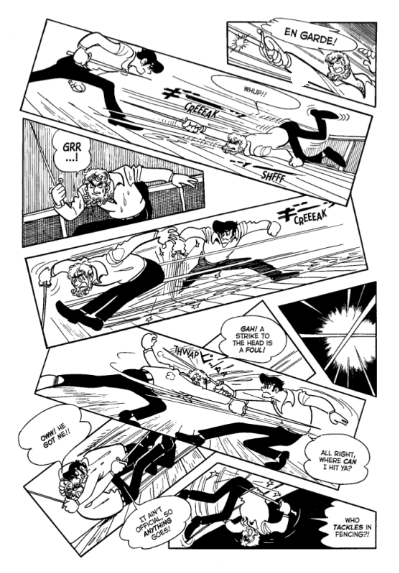
However dated Swallowing the Earth‘s racial and sexual politics may be, it’s hard to deny the sheer exuberance of Tezuka’s artwork. His imagination yields some stunning — and stunningly weird — images. Zephyrus’ palace, in particular, is a marvelous creation, an Art Deco ziggeraut filled with enormous cat statues that look like they were swiped from Cleopatra’s tomb. Tezuka frequently experiments with the layout, varying the shape of the panels to suit the pace and intensity of the action, or to suggest the simultaneity of two events. One of the best examples occurs early in the story, when Gohonmatsu duels a handsome Spanish count on the deck of a tugboat:

fightscene

Tezuka uses diagonal panels to mimic the rocking motion of a ship anchored in choppy water. The shape of the panels also demonstrate just how difficult it is for both characters to find their footing on the slippery deck — a small but tricky detail that isn’t easy to capture in a static image.

In an excellent companion essay to the English-language edition, manga scholar Frederick Schodt acknowledges Swallowing the Earth‘s myriad flaws — its surfeit of plotlines, its racial caricatures — while celebrating the almost anarchic way in which the story unfolds. He encourages readers to enjoy Earth as a “wild ride” and a window into a critical period in Tezuka’s development, showing us “how he began to make the transition from a children’s artist to someone who could push the manga medium in every genre, even for adult readers.” It’s in this spirit that I recommend Swallowing the Earth, as testament to Tezuka’s fertile imagination, and his ability to grow as an artist and a storyteller.

SWALLOWING THE EARTH • BY OSAMU TEZUKA • DMP • 516 pp. • RATING: OLDER TEEN (16+)

Filed Under: Manga, Manga Critic, REVIEWS Tagged With: Action/Adventure, Classic, DMP, Osamu Tezuka

Kimi ni Todoke: From Me to You, Volume 1

July 8, 2009 by MJ 2 Comments

Kimi ni Todoke: From Me to You, Vol. 1
By Karuho Shiina
Published by Viz Media

kiminitodoke
Buy This Book

Sawako Kuronuma is a quiet, socially awkward girl with an unfortunate physical resemblance to “Sadako” from Ringu–enough so that her classmates call her by that name, either out of cruelty or (in many cases), ignorance. Though rumors persist that she sees ghosts, summons spirits, and places curses on those who are foolish enough to look her in the eye for more than three seconds, Sawako is actually an earnest, exceptionally kind girl who always volunteers to do the work nobody else wants to do and whose most heartfelt dreams involve helping her classmates understand their schoolwork. The only student in school who shows Sawako kindness is, inexplicably (to her), a popular boy named Kazehaya. He smiles at her and calls her by her real name–treating her no differently than anyone else, something for which Sawako is consistently grateful. What Sawako doesn’t realize is that to Kazehaya she is much different from everyone else, in a way she is honestly unable to fathom.

…

Read More

Filed Under: MANGA REVIEWS Tagged With: kimi ni todoke, manga

Boys Over Flowers 26 by Yoko Kamio: B+

July 7, 2009 by Michelle Smith

boysoverflowers26From the back cover:
Tsukushi struggles to understand her feelings for Tsukasa, her on-and-off boyfriend, and he struggles to not destroy Tokyo. Will the man who came between them step aside? The meddlesome F4 try their hand at forcing Tsukushi and Tsukasa together. All the while Tsukasa’s mother’s spies are hot on their trail!

Review:
If I were to give a one-word reaction to the events of this volume, that word would be “hooray!” Tsukasa intercepts Tsukushi at a bus stop with Amon and makes another attempt at convincing her to be with him, saying, “I don’t want anyone but you. It has to be you.” While moved by his plea, Tsukushi remembers what will happen to her friends’ families if Tsukasa’s mother finds out they’re dating, and so she gets on the bus. Moments later, there’s a terrific scene where she comes running back and, honestly, I have goosebumps just typing about it!

While the fangirl in me would’ve loved a big epic declaration of mutual feeling, that would be completely out of character for these two headstrong people. Instead, awkward tension ensues. Tsukushi is unable to express herself adequately and Tsukasa worries that he has misunderstood yet again. What’s different now is that Tsukushi realizes they’re on the verge of falling into their same old pattern and actually comes out and tells Tsukasa that she wants to be with him. The catch is that she wants their relationship to remain a secret. Amon has bought them some time by telling Kaede’s minions that he and Tsukushi are dating, but the problem of her threats has yet to be resolved.

It’s truly great seeing these two together, and even small things like hugs are so hard-won that they are elevated into monumental moments. Even though they still have to face Kaede—a looming obstacle that has Tsukushi thinking that their happiness is “like standing over water, on a layer of thin ice”—at least they’ll (presumably) be doing so together and seem to understand each other at last.

This volume also picks up the friendship between Sojiro and Yuki, spawned a few volumes back when he helped her get revenge on the boyfriend that betrayed her. I really like how Kamio is handling this subplot. I’ve read a few other series where the heroine’s friends get some attention (Kare Kano and Love*Com come to mind) but only in Boys Over Flowers does it feel like a well-integrated part of the main storyline. In fact, I am downright happy to let Tsukasa and Tsukushi remain united for a while and shift the focus to fleshing out some of the supporting characters. I’d also like to see some kind of resolution to Rui’s relationship with Shizuka, who at least gets a mention here after being off the radar for quite some time.

Lastly, I must spare a paragraph to compliment the cover to this volume. While Tsukushi’s face looks a little frenzied, I love Tsukasa’s expression and the colors are gorgeous.

Filed Under: REVIEWS Tagged With: VIZ, Yoko Kamio

  • « Go to Previous Page
  • Page 1
  • Interim pages omitted …
  • Page 323
  • Page 324
  • Page 325
  • Page 326
  • Page 327
  • Interim pages omitted …
  • Page 345
  • Go to Next Page »
 | Log in
Copyright © 2010 Manga Bookshelf | Powered by WordPress & the Genesis Framework