• Skip to primary navigation
  • Skip to main content
  • Skip to primary sidebar
  • Home
  • About Us
    • Privacy Policy
    • Comment Policy
    • Disclosures & Disclaimers
  • Resources
    • Links, Essays & Articles
    • Fandomology!
    • CLAMP Directory
    • BlogRoll
  • Features & Columns
    • 3 Things Thursday
    • Adventures in the Key of Shoujo
    • Bit & Blips (game reviews)
    • BL BOOKRACK
    • Bookshelf Briefs
    • Bringing the Drama
    • Comic Conversion
    • Fanservice Friday
    • Going Digital
    • It Came From the Sinosphere
    • License This!
    • Magazine no Mori
    • My Week in Manga
    • OFF THE SHELF
    • Not By Manga Alone
    • PICK OF THE WEEK
    • Subtitles & Sensibility
    • Weekly Shonen Jump Recaps
  • Manga Moveable Feast
    • MMF Full Archive
    • Yun Kouga
    • CLAMP
    • Shojo Beat
    • Osamu Tezuka
    • Sailor Moon
    • Fruits Basket
    • Takehiko Inoue
    • Wild Adapter
    • One Piece
    • After School Nightmare
    • Karakuri Odette
    • Paradise Kiss
    • The Color Trilogy
    • To Terra…
    • Sexy Voice & Robo
  • Browse by Author
    • Sean Gaffney
    • Anna Neatrour
    • Michelle Smith
    • Katherine Dacey
    • MJ
    • Brigid Alverson
    • Travis Anderson
    • Phillip Anthony
    • Derek Bown
    • Jaci Dahlvang
    • Angela Eastman
    • Erica Friedman
    • Sara K.
    • Megan Purdy
    • Emily Snodgrass
    • Nancy Thistlethwaite
    • Eva Volin
    • David Welsh
  • MB Blogs
    • A Case Suitable For Treatment
    • Experiments in Manga
    • MangaBlog
    • The Manga Critic
    • Manga Report
    • Soliloquy in Blue
    • Manga Curmudgeon (archive)

Manga Bookshelf

Discussion, Resources, Roundtables, & Reviews

Reviews

9th Sleep

June 14, 2010 by MJ 2 Comments

9th Sleep
By Makoto Tateno
Digital Manga Publishing, 200 pp.
Rating: 16+

Luke is the child of a “Maria possession,” meaning that his mother was still a virgin when he was born. What he soon finds out is that he is also a god-prince fallen to Earth, as well as the reincarnation of the “King’s Soul,” which he received upon the death of his father. Unwilling to wed the bride chosen for him, Luke carried that soul with him when he committed suicide sixteen years previous and placed it in the womb of the earth-woman he loved.

Now that sixteen years have passed, he must fight his “brother” Malchus for possession of their father’s soul and kingdom.

If that summary seems convoluted, that’s no mistake. The premise of this manga is extraordinarily opaque, despite the fact that the mangaka attempts to explain it repeatedly, mainly by playing out the original scenario two more times over the course of the volume. In each incarnation, Luke avoids his final standoff with Malchus by killing himself, thus impregnating another unsuspecting young woman on the earth below.

While boys’ love plotlines are rarely required to be coherent (or even to exist at all) in order to attract a major portion of their fanbase, in this case there is also no boys’ love to speak of, leaving very little for fans of the genre to latch on to. Though the mangaka does offer up very pretty drawings of her two warring brothers, even standard fan service is in short supply.

Despite some attractive artwork, a confusing, vapid plot and lack of boys’ love action leave this one-shot manga without a clear audience.

Review copy provided by the publisher. Review originally published at PopCultureShock.

Filed Under: BL BOOKRACK, MANGA REVIEWS Tagged With: yaoi/boys' love

Two by Inoue: Slam Dunk & Real

June 13, 2010 by MJ 22 Comments

Slam Dunk, Vols. 1-2
By Takehiko Inoue
Published by Viz Media

Red-haired tough guy Hanamichi Sakuragi just can’t get a girl. After a string of rejections in junior high, he finally meets pretty Haruko on his first day of high school. Trouble is, Haruko already has a huge crush on a junior high basketball star who has also enrolled at their school! Determined to win Haruko’s heart, Hanamichi decides to join the basketball team. He’s a huge, strong guy with a lot of natural ability. Unfortunately, he’s also brash, self-involved, and utterly lacking in maturity or emotional boundaries. Can Hanamichi ever learn to be a team player?

On one hand, Slam Dunk is an extreme example of a typical shonen sports manga, with its overblown characters, outrageous rivalries, and intense focus on winning. On the other, it is a fresh, lighthearted look at a guy who just can’t seem to catch a break, despite a level of optimism previously unknown to mankind.

It’s not that Hanamichi never wins, of course. The guy can’t lose in a fight, and he even manages to win (sort of) against Haruko’s brother Akagi (who also happens to be the captain of the basketball team) in an epic game of one-on-one. What he can’t win, no matter how he tries, is the girl, and it’s somehow refreshing to meet a shonen sports hero whose real focus is far, far from the game. Also, while Hanamichi’s myopic pig-headedness makes him generally insufferable, it’s also the key to his charm.

There’s a scene in the second volume, for instance, in which the captain of the school’s judo team attempts to lure Hanamichi away from basketball by offering him some photographs of Haruko in exchange. After a series of conversations consisting basically of, “So, will you join the team?” “No.” “But don’t you want the photos?” “I do!” it finally becomes clear that Hanamichi intends to refuse the captain’s offer and simply take the photos by force. Though the scene does nothing to improve Hanamichi’s image as a hopeless brute, it is surprisingly satisfying to see the judo captain’s tired scheme dismissed so easily.

Another strength of the series is its supporting characters. Though Hanamichi’s strong and silent love rival, Rukawa, is barely seen in these early volumes, basketball captain Akagi is already a powerful character. Mature enough to separate his personal dislike of Hanamichi from his responsibilities as captain, he displays the beginnings of the kind of depth and nuance found in Inoue’s later seinen series, Real. Also notable is the basketball team’s manager, Ayako, who is very much welcome as a confident, athletic, female presence on the testosterone-heavy court.

Inoue’s art is similarly refreshing, with a clean, easy-to-follow quality too rare in shonen manga. The artwork is quite expressive as well, revealing a real investment in the characters and a genuine love of the game.

Though the real action gets a slow start in favor of important characterization (and some less impressive class hi-jinx), Slam Dunk shows its potential right from the beginning. Just two volumes in, it’s not difficult to see why it’s a popular series on both sides of the Pacific. Recommended.

This review is a part of Shonen Sundays, a collaborative project with Michelle Smith.

*****

Real, Vols. 1-8
By Takehiko Inoue
Published by Viz Media

Tomomi Nomiya is a high school dropout, consumed by guilt over his involvement in a motorcycle accident that leaves a young woman without the use of her legs. Kiyoharu Togawa is a former junior high runner whose struggle with bone cancer costs him his right leg below the knee. Hisanobu Takahashi is a high school basketball hotshot who becomes paralyzed from the chest down after colliding with a truck while riding a stolen bicycle. What these three teens all have in common is a passion for basketball.

It’s not quite fair to compare this series to Takehiko Inoue’s earlier basketball series, Slam Dunk. After all, Slam Dunk is written for young boys, and Real for adults. Still, with both series being released concurrently in English, its difficult to resist. Though Slam Dunk contains the seeds of a great basketball manga, it is through Real that Inoue is able to express not only his real love of the game, but his real insight into the human condition.

The main action of the series revolves around the Tigers, a wheelchair basketball team with which Togawa maintains a fairly tormented relationship over the course of the series’ early volumes. It’s this team that brings Togawa and Nomiya together to begin with (in a sort of roundabout way). And though Takahashi has (as of volume eight) still just barely begun rehabilitation that might make it possible for him to one day participate in wheelchair basketball, it feels inevitable that he’ll end up there at some point. The basketball scenes in this series are intense, in a very different way from the super-fueled play in Slam Dunk, and entirely gripping even for non-fans of the game.

What’s most impressive about this series, however, is Inoue’s ability to get inside his characters’ heads and transform their thoughts and feelings into compelling narrative. Enormous chunks of the later volumes, for instance, involve Takahashi’s bitterness over his father leaving him as a child, torment over his current condition, and his inability to adjust to his new body.

Inoue not only brings Takahashi’s memories to life with a series of powerful flashbacks, he also focuses heavily on Takahashi’s grueling rehabilitation process, with a level of realism that kicks your average training montage squarely in the behind. Yet, through all this, Inoue deftly steers clear of allowing his story become mired in its own weight. Even the series’ heaviest sequences are a true pleasure to read.

Something that seems important to note, and possibly why Real is able to avoid becoming intolerably dark, is that it’s clear from the beginning that Inoue genuinely likes people. Despite the fact that each of his characters has endured terrible heartbreak, pain, and various levels of personal misery (not to mention that most of them have also been responsible for causing significant pain to others), Real is far from cynical. There is no overarching disappointment in humanity here, no deep bitterness, no long-winded speeches about the unavoidable fallibility of the species. Even his characters’ most bitter reflections are directed toward individuals rather than humanity as a whole.

Inoue’s artwork in this series is impressively mature. Without the attractive sheen of Slam Dunk‘s shonen sensibility, the world of Real is unpolished and gritty. Inoue’s early expressiveness is even more pronounced in this series, and much more detailed. Also, despite some great dialogue, Inoue lets his artwork do the bulk of the storytelling. Important moments are played out visually, panel-to-panel, without the need for any narration or extraneous dialogue to pick up the slack.

Both heart-wrenching and down-to-earth, this series makes the most of its human drama, both on and off the court, without ever sinking into melodrama. Simply put, Real is real. Highly recommended.

Review copies of vols. 5-8 provided by the publisher.

Filed Under: MANGA REVIEWS Tagged With: real, shonen sunday, slam dunk

Hey, Sensei?

June 13, 2010 by Ash Brown

Creator: Yaya Sakuragi
U.S. publisher: Digital Manga
ISBN: 9781569700471
Released: April 2009
Original run: 2007

It is almost entirely the fault of Yaya Sakuragi’s Hey, Sensei? that I am now gladly suffering from an addiction to yaoi. Before Hey, Sensei?, I had never read yaoi. I had a basic understanding of the genre, but for whatever reason I had never tried it. (It actually really surprises me how long it took me to get around to reading any.) So, when I came across a review on Graphic Novel Reporter praising Hey, Sensei?, especially for not falling into some of the traps of the genre, I figured “Hey, why not? I gotta start somewhere.” I tracked down a copy with a little bit of difficulty and when it finally arrived I only allowed myself one chapter a day to make it last. Since then I’ve read plenty more yaoi and continue to do so but Hey, Sensei? remains one of my favorites—not just because it was my first yaoi manga, but because it is really quite good.

Hey, Sensei? actually contains two stories: the main story “Hey, Sensei?” which is four acts and an epilogue, and “Unbreakable Bones,” which is a one-shot. In “Hey, Sensei?”, high school math teacher Isa is taken aback when his ex-girlfriend’s younger brother, now one of his students, makes a pass at him during a review lesson. Isa can hardly take the situation seriously—what could Homura possibly see in a guy ten years older than him? The age difference will cause some difficulties, and they communicate terribly, but the two men have fallen hard for each other. In “Unbreakable Bones” two childhood friends are unexpectedly reunited after fourteen years. After growing apart, Yuji became a juvenile delinquent although he’s turned his life around and is now working in a ramen shop, while Manabu has become the small town’s local policeman. Yuji hates the idealized memories Manabu has of him, only to realize that he’s the one stuck in the past.

I really enjoy Sakuragi’s art style. Her men are distinctive and handsome and are unmistakably male. Her figures are elongated and angular, particularly noticeable in the hands and fingers and in the long, lanky legs when standing. These slightly odd proportions may bother some people, but I quite like the effect and love her character designs. Sakuragi also does a fantastic job with facial expressions, especially with the eyes; the characters don’t always come out and say what they’re feeling but it’s pretty apparent just by looking at them. She is also skilled in showing the same character at different ages and make the changes look natural while still being identifiable. One issue that I did have with the art was that the genitals were blurred out or erased. However, I’m not sure if this is the case in the original Japanese version or if the art has been censored for the United States which does happen. Either way, I found it distracting and feel that it calls more attention to itself that way.

While the stories in Hey, Sensei? may not be particularly original, Sakuragi makes up for it with the depth of her characters and their feelings for one another. Homura is immature, hot-tempered and brash but ultimately very sincere while Isa is inexperienced, sensitive and reserved but very capable of being stern when necessary; Yuji and Manabu’s relationship is also very sweet. The translation has an occasional awkward moment but overall is very good. In addition to Hey, Sensei? becoming a favorite, I have also become a huge fan of Yaya Sakuragi—I’ve also read and loved her Tea for Two series—and will pick up anything that she has worked on. However, Hey, Sensei? will always hold a special place for me. It’s one manga, yaoi or not, that I come back to again and again.

Filed Under: REVIEWS Tagged With: Digital Manga, Juné, manga, Yaya Sakuragi

Silent Möbius, Vol. 1

June 10, 2010 by Katherine Dacey

I like science fiction, I really do, but I have limited tolerance for certain tropes: futures in which all the women dress like strippers — or worse, fascist strippers — futures in which giant bugs menace Earth, and futures in which magic and technology freely commingle. Small wonder, then, that Kia Asamiya’s Silent Möbius has never been on my short list of must-read manga — it’s a festival of cheesecake, gooey monsters, and pistol-packing soldiers who, in a pinch, must decide whether to cast a spell or fire a rocket launcher at the enemy. Imagine my surprise when I discovered just how entertaining Silent Möbius turned out to be, gratuitous panty shots, bugs, and all.

When shorn of its mystical mumbo-jumbo and elaborate character histories, Silent Möbius is, at heart, a classic “They came from outer space!” tale. The story begins in 2026, when the Earth is under siege from interdimensional beings known as Lucifer Hawks, fierce, shape-shifting beasties that can assume a variety of forms: dragons, humans, oversize millipedes. Only a small team of elite agents — the so-called Attacked Mystification Police Force (AMP) — are capable of killing the Hawks with a mixture of up-to-the-minute technology and good old-fashioned sorcery. Where the Hawks are coming from and why remains mysterious — at least in the very early stages of the story — though we learn that one agent’s father may be responsible for opening the floodgate between Earth and the Hawks’ home world.

If the plot is pedestrian, Asamiya’s towering cityscapes and appealing character designs aren’t. To be sure, there are plenty of other sci-fi manga from the 1980s and 1990s peddling similar visions of a dysfunctional future paved in concrete and lit by neon, but Asamiya and his helpers pull off even the busiest compositions, bringing the urban scenes to energetic life; I dare you not to compare Silent Möbius with Blade Runner. (Someone else must have thought so, too, as Asamiya was tapped to do the manga adaptation of Star Wars: The Phantom Menace, yet another work that pilfered visuals from Scott’s ground-breaking film.) Then there are the character designs: each member of the AMP seems to be taking her grooming cues from the golden age of MTV, when video vixens came in two flavors: those with enormous feathered hair, and those with short, heavily lacquered locks. Better still, their uniforms consist of jackets with epaulets, neckties, and stirrup leggings. Who knew that 2026 would look suspiciously like 1986?

The other thing that won me over was the characters. I wouldn’t construe Asamiya’s decision to make the AMP a strictly female force as a nod to feminism; there are enough costume failures and half-clad characters to suggest Asamiya was as interested in satisfying the male gaze as he was in promoting the idea that women can kick ass just as well as men. At the same time, however, the ladies of AMP are tough and decisive, and don’t take guff from their male peers; in one of the series’ few nods to realism, the largely male police force resents the AMP for their ability to assume control of any investigation, grumbling about jurisdiction and occasionally baiting the women into fights.

Not that Silent Möbius doesn’t have moments of eyeball-rolling stupidity. Asamiya saddled his characters with borderline stripper names, for example: who but an adult entertainer would choose a name like “Rally Cheyenne” or “Katsumi Liqueur”? (Worse still: Katsumi’s father was Gilgelf Liqueuer, a name best suited for a drunken Hobbit.) Then, too, the series’ rather complicated mythology isn’t well explained; it’s the kind of universe where some characters kill aliens by drawing pentagrams on the ground while others use bazookas. And the cheesecake… sigh. I often had the sinking feeling that Asamiya was secretly auditioning to do a Pirelli Tire calendar with his frequent images of semi-naked women in provocative poses.

Costume failures and panty shots aside, I enjoyed the first volume of Silent Möbius well enough to continue with the series. It’s a fun, escapist romp that occasionally takes itself a little too seriously, but never bogs down in its own ridiculous mythology.

SILENT MÖBIUS: COMPLETE EDITION, VOL. 1 • BY KIA ASAMIYA • UDON ENTERTAINMENT • 200 pp. • RATING: OLDER TEEN (16+)

Filed Under: Manga, Manga Critic, REVIEWS Tagged With: Classic, Kia Asamiya, Post-Apocalyptic Sci-Fi, Silent Moebius, Udon Entertainment

13th Boy, Vols. 1-4

June 8, 2010 by Katherine Dacey

Like Water for Kimchi — that’s how I would describe 13th Boy, a weird, wonderful Korean comedy with a strong element of magical realism.

The plot is standard sunjong fodder: Hee-So, a teen with a flair for the dramatic, believes that the handsome Won-Jun is destined to be her twelfth and last boyfriend, the man with whom she’ll spend the rest of her life. Though Won-Jun accepts her initial confession of love — she drags him on television to ask him on a date — he dumps her just one month later, sending Hee-So into a tailspin: how could her destiny walk away from her? She then resolves to take fate into her own hands, launching an aggressive campaign to win him back: she stalks Won-Jun, looking for any opportunity to be alone with him; she joins the Girl Scouts so that she can go on a camping trip with him (he’s a Boy Scout); she even befriends her romantic rival Sae-Bom, defending Sae-Bom from bullies and risking her life to rescue Sae-Bom’s beloved stuffed rabbit from a burning building. In short: Hee-So is a girl on a mission, dignity be damned.

Our first clue that 13th Boy isn’t just another dreary comedy about a girl going to extremes to nab a cute boy is the introduction of Beatrice, Hee-So’s sidekick. Beatrice is a talking cactus (no, really, a talking cactus) who transforms into a handsome, if somewhat androgynous, teen whenever there’s a full moon. I don’t know too many storytellers who could make something as cracky as a lovelorn saguaro work, but SangEun Lee presents Beatrice matter-of-factly, as if every self-respecting girl had a walking, talking man-plant living in her bedroom. If anything, Beatrice functions as a nifty surrogate for the reader, voicing concern about Hee-So’s fanatical commitment to Won-Jun and urging Hee-So to focus her attention elsewhere.

Our second clue is the revelation that one of Hee-So’s classmates has magical powers: Whie-Young can change the weather, make himself invisible, walk through walls, and bring inanimate objects to life. Though Whie-Young’s mother and grandmother have warned him not to use his abilities, he persists, hoping to prove the depth of his feelings for Hee-So. (Yes, 13th Boy is one of those comedies in which every character is head-over-heels for the wrong person.) Those rescues and romantic acts come at a steep price, as each spell shortens Whie-Young’s life; if he doesn’t stop playing Hee-So’s guardian angel, he’ll die a very young man.

If the fantasy elements enliven a tepid premise, the story’s more down-to-earth aspects — especially Hee-So’s relationship with her female friends — give 13th Boy some real emotional heft. Hee-So’s best buddy, Nam-Joo, is a welcome addition to the cast, a tough tomboy who’s fiercely loyal to Hee-So yet takes a dim view of her pal’s romantic obsession. Their squabbles and pep talks have a ring of truth to them, even if Lee contrives some ridiculous scenarios for the girls to resolve their differences. (I don’t know about you, but I never settled a score with anyone by challenging them to a dodge ball game or judo match.) Sae-Bom, too, turns out to be a more interesting, complicated character than she first appears; as the story unfolds, we realize that she has the emotional IQ of a grade schooler but the physical appearance and intellect of a teenager, making her an object of scorn among the class alpha girls. If Hee-So’s motivation for defending Sae-Bom was initially less-than-pure (a fact she readily concedes), she develops a genuine sense of empathy for Won-Jun’s friend — one of our first clues that Hee-So’s boy-crazed exterior belies a more compassionate, less narcissistic nature.

Lee’s crisp layouts and cute character designs are an excellent complement to her storytelling. She uses bold, strong lines to define her characters, shying away from heavy use of screentone; the white of the page plays just as important a role in defining space and volume as the ink, making her designs pop. (Beatrice is a notable exception, as his cactus skin is toned dark grey.) Though Hee-So and Won-Jun have enormous, doll-like eyes, Lee’s grasp of anatomy is solid; her characters have the rangy, slightly awkward bodies of fifteen-year-olds, rather than the hyper-stylized physiques of the Bring It On! gang. Only the backgrounds disappoint, a mish-mash of traced architectural elements and Photoshopped images that seem a little too generic for such a whacked-out story. (Or maybe that’s the genius of the bland background art? I can’t decide.)

I’ll be honest: I went into 13th Boy knowing about Beatrice, which predisposed me to overlook some of the first volume’s groan-worthy moments. And as much as I love Beatrice — and really, what’s not to like about a chatty cactus? — what really won me over was the deft way in which SangEun Lee balanced the series’ magical elements with its more realistic ones, creating a unique story in which magical acts reveal character and everyday acts affect change.

Review copy of volume 4 provided by the publisher.

13TH BOY, VOLS. 1-4 • BY SANG-EUN LEE • YEN PRESS • RATING: TEEN

Filed Under: Manga Critic, Manhwa, REVIEWS Tagged With: manhwa, Romance/Romantic Comedy, yen press

Mijeong

June 8, 2010 by MJ 2 Comments

Mijeong | By Byun Byung-Jun | Published by NBM Publishing – An angel finds his way to earth, drawn to a world that seems to embody the eternal sadness he carries with him, and longing for someone who might understand his pain. He finds this in a young woman he spots along the street, and in a moment of impulsive rebellion takes it upon himself to save her from being struck by an oncoming car. It is a moment of sharp ecstasy for the angel, who is able to feel both the woman’s deep despair and her great capacity to love as he embraces her. By doing this, however, he has doomed them both to a life of suffering, “a rending love for which I can do nothing.” “Her name is Mijeong,” he says, “and I have no name yet, here.” It is here that the tale ends–the title story in Byun Byung-Jun’s second anthology of short manhwa, Mijeong–a beautiful introduction to this melancholic collection.

Though the quality of its individual tales is somewhat uneven, Mijeong as a whole promises a great future for the artist, whose insight into his deeply lost and broken characters is nearly as stunning as his often impressionistic art style. The collection wanders in and out between true melancholy and dark humor, sometimes with more success than others. The volume’s second story, “Yeon-du, Seventeen Years Old,” the intersecting tales of an emotionally damaged young woman seeking revenge for the death of a childhood love and a desperately lonely older man, is one of its strongest and most thoughtful. Just as effective is the darkly humorous story, “Courage, Grandfather!” in which a girl expresses her gratitude to a boy who rescued her from a brutal attack, viewed entirely through the filter of a cat’s unrequited love. Another of the volume’s best shorts, “Utility,” (story by Yun In-wan) about a group of students dispassionately pondering the most effective way to dispose of a dead sibling’s body, is starkly brilliant yet quite difficult to read, thanks to its subject matter. On the flip side, “202 Villa Siril,” a dark comedy about a manhwa artist with a disturbing power, feels predictable and flat.

A recurring theme throughout the anthology is its characters’ enslavement to their pasts. “For me, only my past has any meaning,” says young Yeon-du in the story named for her. What keeps this book from slipping into irreparable despair, however, is that this isn’t only a bad thing. Byun Byung-Jun’s characters are both burdened and enriched by their histories, an insight that rings inescapably true. Even when longing for the past leaves characters bleeding to death in the grass (as in the grimly abrupt “Song for You”) there is an unmistakable sense of hope lingering around the edges of most of these stories—a haunting paradox that helps maintain the volume’s momentum.

Though the stories’ characters are almost uniformly touching, what is notable above all is the persistent sense of place. The volume’s first story sets the tone clearly with the cold, unfeeling city, filthy with despair, indifferent to its people’s gaping, open wounds. Whether it is the people who have created their environment or the other way around is a question in the background of each story—one that is destined to remain unanswered.

Byun Byung-Jun’s art varies throughout the collection, from the moody watercolor of “Song for You” to the sketchy photorealism of “Yeon-du, Seventeen Years Old,” though in all cases the art feels unsettled and immature. This is not so much a criticism as an observation, as there is a pervading sense that one is previewing the work of an artist who will inevitably achieve importance in the medium. In a note at the end of the book, the artist confesses that the work reflects his own state of mind. “Eternally hesitant, I feel like I’m stuck at an impasse.” What the work truly reveals, however, both in its storytelling and style, is a restless mind on the brink of true brilliance—something for all of us to look forward to.

Simultaneously dark and hopeful, Mijeong‘s inconsistency and fretful tone may betray the early weaknesses of its creator, but its insight and uncommon beauty promise much greater things to come.

Review copy provided by the publisher. Review originally published at PopCultureShock.

Filed Under: Manhwa Bookshelf, MANHWA REVIEWS Tagged With: NBM/Comics Lit

Arata: The Legend, Vols. 1-2

June 6, 2010 by MJ 12 Comments

Arata: The Legend, Vols. 1-2
By Yuu Watase
Published by Viz Media
Rated T (Teen)

In a world full of magic and gods, young Arata of the Hime Clan has been framed for the murder of his people’s beloved princess and is now on the run from her twelve godlike “protectors” who actually committed the crime. Arata Hinohara is a modern-day schoolboy just entering high school, where a bully from his past threatens to ruin the new friendships he’s just begun to form. When otherworld Arata flees into an enchanted forest in order to evade his pursuers, the two Aratas suddenly change places, each finding himself in a truly foreign world.

Though much of the story’s setup and look will be very familiar to fans of Watase’s well-known shojo epic Fushigi Yugi (and its currently-running prequel, Fushigi Yugi Genbu Kaiden), Arata: The Legend has considerable charm of its own. By exchanging her “schoolgirl in a strange land” for a schoolboy in a strange land, Watase plays right into her greatest strengths–period-inspired fantasy, action sequences, and pretty young men.

In otherworld Arata, Watase has inserted all the characteristics of the standard shonen hero. Brash, boyish, goodhearted, and strong, this Arata would be at home in nearly any shonen manga universe, protecting his loved ones with all his might. With modern-day Arata, however, she’s gone off the beaten path, at least to start.

Arata Hinohara is deeply scarred by the intense bullying that haunted him through junior high. Anxious not to stand out at his new high school, he hides his athletic abilities and avoids joining any clubs. He tentatively accepts the new friendships offered to him, but is wary of pushing them too far.

When, just a month into the new school year, the ringleader of his junior high misery suddenly joins his class, it’s a nightmare come true. And as his new friends abandon him, one by one, bitterness and cynicism take over his mind. Still, Arata’s raw hurt keeps him vulnerable, turning him not into a typical hard-as-nails loner (as much as he might wish it), but just a deflated, lonely boy who desperately needs someone to believe in him.

Though this may not be exactly profound, it’s a nice change of pace for a shonen adventure/fantasy and it goes a long way towards helping old material feel new again. With the first two volumes focusing heavily on Arata Hinohara, it will be interesting to see what Watase does with otherworld Arata in the next volume as he heads off for his first day at high school.

While Watase’s shojo fantasies have always featured a lot of action, this series allows her to really shine, with fights, chases, and weapons galore. There’s a natural, easy feel to the artwork in this series, even when compared to her other current work like Fushigi Yugi Genbu Kaiden, as though by choosing to draw shonen action heroes, she’s finally really hit her stride. Her gift for pretty, poignant faces is used to great advantage as well–something that surely can’t be hurting Weekly Shonen Sunday‘s crossover numbers.

Though Arata: The Legend may offer nothing truly new, its vulnerable hero and attractive, expressive artwork help to create a thoroughly enjoyable fantasy with a surprisingly fresh feel.

Review copy of volume two provided by the publisher.

Filed Under: MANGA REVIEWS Tagged With: arata: the legend, shonen sunday

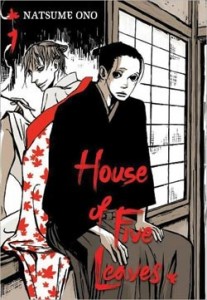
Ristorante Paradiso by Natsume Ono: B+

June 5, 2010 by Michelle Smith

Twenty-one-year-old Nicoletta arrives in Rome with the intention of confronting her absentee mother, Olga, and revealing the fact of her existence to Olga’s husband, Lorenzo, who had believed his wife to be childless. Instead, she becomes entranced by her mother’s world and ultimately finds a place in it.

Olga and Lorenzo run a restaurant, and though the food is excellent, many of the patrons come just to see the waiters, a staff of mostly older men who all wear glasses (whether necessary or not) to indulge Olga’s whim. At first Nicoletta is perplexed by the multitude of women swooning over these men until she begins to notice the particular charms of Claudio, the head waiter. Claudio is graceful, sexy, and very kind, though he’s still hung up on his ex-wife and continues to wear his wedding ring. Although Nicoletta originally wrangles a job as a kitchen apprentice in order to be near him, she proves to be genuinely good at cooking. She becomes part of the restaurant’s family, and her relationship with Olga improves as a result.

Ristorante Paradiso is a completely different kind of story than not simple, the other Natsume Ono title currently available in English. It’s happy, for one thing, with a cozy, slice-of-life storytelling style and the kind of predictable yet comforting conclusion that would be perfectly at home in an Italian holiday kind of chick flick. Things between Nicoletta and Olga work out too easily, but most of the focus is on the guys anyway, so I’m not as annoyed as I otherwise would be.

Let’s talk about those guys for a minute. Sexy Claudio is definitely the star among them, but grumpy yet kind Luciano is another standout, as is Gigi, Lorenzo’s eccentric half-brother who seems to have a completely unspoken thing for the boss’s wife. Nicoletta is continually upstaged by these men—and by Olga, whose zeal for life makes her a sympathetic character despite the mistakes she made in the past—and it’s no wonder that Gente, the prequel/sequel series due from VIZ in July, focuses on them and not her. Nicoletta starts out as a directionless twenty-something in search of her place in the world, but we just don’t get to know her well enough to find her journey truly compelling. That said, I did appreciate her confidence in certain situations and she has a terrific final line.

It might just be an illusion, but Natsume Ono’s art looks a little more traditional here than in not simple. There’s no way you’d mistake her work for anyone else’s, but the characters seem more normally proportioned and she really does a great job in conveying Claudio’s gentle demeanor and appeal whenever he appears. While the “show don’t tell” rule gets broken on several occasions, there are still a few examples of good nonverbal communication, too. My one artistic complaint is that I wish we could have seen more of the food! Then we might have had something like the Antique Bakery of Italian cuisine. The subtle inclusion of a hilariously oversized ravioli made by Olga is some compensation, however.

In the end, Ristorante Paradiso is definitely worth reading. The plot won’t knock your socks off, but the experience will likely put a smile on your face nonetheless.

Review copy provided by the publisher. Review originally published at Manga Recon.

Filed Under: REVIEWS Tagged With: Natsume Ono, VIZ, VIZ Signature

I’ll Give It My All… Tomorrow, Vol. 1

June 3, 2010 by MJ Leave a Comment

I’ll Give it My All… Tomorrow
By Shunju Aono
Published by Viz Media.
Rated T+ (older teen).

Shizuo Ogura is a single dad and low-level salaryman who, at the age of forty, drops out of the workforce to find himself. In actuality, where he “finds” himself is lost, unmotivated, and paralyzed by guilt and an increasing sense of panic. When inspiration finally hits and he announces to his family–his elderly father and teenaged daughter–that he’s decided to become a mangaka, the news is not terribly well-received.

Determined to prove himself, Shizuo digs in enthusiastically, despite a lack of any previous ambition or experience in the field. Unfortunately, his resolve fades quickly under the pressures of everyday life, eventually becoming part of an endless pattern of grand declarations, chronic procrastination, and unfulfilled promises, both to himself and to his family.

This series is technically a comedy, but it has a firm grasp on several unpleasant truths that are just too real to laugh at for anyone who has experienced this kind of profound loss of confidence at an age many would consider to be too late for a fresh start. Furthermore, Shizuo’s life lends itself to a series of humiliations, beginning just pages in when he runs into his teenaged daughter at a massage parlor (she’s working, he’s just finished being, uh, serviced) and going downhill from there. Though he’s moderately likable, Shizuo’s persistent inability to improve his circumstances is painful to watch, and it’s difficult to imagine how the series will remain readable if something doesn’t change pretty shortly into its next volume.

That said, volume one is genuinely funny and often insightful, especially when portraying Shizuo’s strained relationship with his daughter, who finally lets out some of her frustration with him near the end. “What would you do if I got published?” Shizuo asks her, after a volume’s worth of progressively pathetic starts and stops. “I really don’t know,” she responds. “So get published and we’ll find out.”

Aono draws Shizuo in a style that should feel cartoonish and exaggerated, but doesn’t. Shizuo’s hunched shoulders, awkward posture, and oversized head ably represent the epic torpidity of his character in both sickening and sympathetic terms, stopping just short of caricature. As a result, Shizuo exists in a sort of amplified reality that is both uncomfortable to accept and too real to ignore.

Whether providing a cynical chuckle or hitting just a bit too close to home, I’ll Give It My All… Tomorrow is a surprisingly compelling read.

Review copy provided by the publisher. Review originally published at Examiner.com.

Filed Under: MANGA REVIEWS Tagged With: examiner.com, I'll give it my all... tomorrow

Neko Ramen, Vol. 1: Hey! Order Up!

June 2, 2010 by Katherine Dacey

If you’ve ever lived with a cat or dog, you know that no meal is complete without a pet hair garnish. Now imagine that your beloved companion actually prepared your meals instead of watching you eat them: what sort of unimaginable horrors might you encounter beyond the stray hair? That’s the starting point for Neko Ramen, a 4-koma manga about a cat whose big dream is to run a noodle shop, but author Kenji Sonishi quickly moves past hair balls and litter box jokes to mine a richer vein of humor, poking fun at his cat cook’s delusions of entrepreneurial grandeur.

Taisho is forever dreaming up ways to expand his business, ideas that seem sound in the abstract, but prove disastrous in the execution: a dessert ramen consisting of noodles and milk, a delivery service that’s thwarted by feline territoriality, a playing card promotion featuring unappetizing pictures of soup. In fact, Taisho is so completely misguided that he doesn’t grasp what’s novel about Neko Ramen; when a competitor in a cat costume opens a shop, hoping to capitalize on Taisho’s appearance on “The World’s Most Amazing Animals,” Taisho thinks he, too, needs an animal costume in order to drum up business. His sole customer, the long-suffering Tanaka-san, tries hard to offer sensible advice, but Tanaka’s counsel falls on deaf ears. (Why Tanaka sticks around for ramen that he freely admits is “awful” is one the series’ great mysteries.)

Sonishi’s artwork is crude and sketchy; each character is rendered with just enough lines to give a general impression of who or what he’s supposed to be. The primitive quality of the art actually works in the series’ favor, conveying the low-rent nature of Taisho’s business. More effective still is Sonishi’s strategy for differentiating Taisho from the other cats who regularly appear in the series: Taisho resembles a maneki neko (beckoning cat statue) in an apron, while other felines are depicted as simple, rounded shapes with ears and tails.

None of this would work if the translation were stiff or colorless, but TOKYOPOP wisely employed the husband-and-wife team of Emily Gordon and Kumail Nanjiani to adapt the script for English-speaking audiences. Both are experienced writers and performers (she wrote for Bust and Jane, he does stand-up comedy), and their ear for language is evident throughout volume one; the dialogue is idiomatic and the punchlines are snappy. The other secret to the script’s success is the care with which the adaptors distinguish Taisho’s voice from Tanaka’s, infusing the characters’ owner-customer banter the feeling of a good manzai routine, with Taisho as the boke and Tanaka as the tsukkomi.

The biggest surprise about Neko Ramen is that Sonishi manages to wring so many laughs out of what could be a one-joke premise. Sonishi’s gags remain fresh throughout the first volume, thanks, in part, to several interludes in which he abandons the 4-koma format to relate stories of Taisho’s past: his ill-fated stint as a cat model, his rivalry with a noodle shop staffed by a dog, a monkey, and a bird. These interludes nicely set the table for volume two, providing Sonishi more avenues for his absurd humor without straying too far from the series’ basic idea. Highly recommended, whether or not you fancy cats.

NEKO RAMEN, VOL. 1: HEY! ORDER UP! • BY KENJI SONISHI • TOKYOPOP • 156 pp. • RATING: TEEN (13+)

Filed Under: Manga, Manga Critic, REVIEWS Tagged With: 4-koma, Cats, Comedy, Cooking and Food, Tokyopop

Library Wars: Love & War, Vol. 1

June 1, 2010 by Katherine Dacey

If I were thirteen years old, Library Wars would be at the top of my Best Manga Ever list, as it reads like a catalog of the things I dug in my early teens: books about the future, books about women breaking into male professions, books with bickering leads who harbor secret feelings for each other. I can’t say that Library Wars works as well for me as an adult, but I can recommend it to younger female manga fans who are tired of stories about wallflowers, doormats, or fifteen-year-old girls whose primary objective is to nab a husband.

The story focuses on Iku Hasahara, a former track star and future librarian who enlists in the Library Defense Force (LDF), a paramilitary organization dedicated to combating censorship. Formed in response to the Media Betterment Act, the LDF actively challenges the national government’s efforts to remove books from stores and libraries, using weapons and strong-arm tactics when necessary. Iku is the only female recruit who can keep pace with the guys, push-up for push-up, and is the frequent target of abuse from Atsushi Dojo, a handsome drill sergeant who takes grim delight in pointing out her weaknesses. (Her mastery of the Japanese Decimal System leaves a lot to be desired.) As Iku advances through basic training, however, she begins to realize that Dojo isn’t so bad; his sometimes brusque demeanor masks genuine concern for his pupil, and a sincere desire to help her become a top-notch officer.

Library Wars‘ premise certainly invites comparisons with Fahrenheit 451. The future society depicted in Library Wars isn’t nearly as bleak or disorderly as the one Ray Bradbury imagined back in 1951, but creators Hiro Arakawa and Kiiro Yumi are just as insistent on the importance of standing up for free speech; Iku joined the Defense Forces after the Media Betterment Committee’s jack-booted thugs attempted to confiscate a book from her. (A hot guy also factored into her decision to enlist.) The MBC is as arbitrary and ruthless as the Firemen of Fahrenheit 451, working hard to restrict citizens’ access to potentially “harmful” materials, even going so far as to infiltrate libraries to weed out undesirable material.

In adapting Library Wars from novel to manga, however, Kiiro Yuki places less emphasis on the book-banning crisis and more on her characters’ relationships, preserving just enough background about the LDF’s history to justify the action sequences. That’s not necessarily a bad choice; Iku and Dojo’s banter has a pleasant, antagonistic zing to it that infuses the boot camp scenes with some playful energy. The LDF’s rationale for existing, however, often seems underdeveloped, as we don’t know what prompted the national government to pass the Betterment Act. In leaving these details vague, one could argue that Yuki is simply being true to historical fact; oppressive regimes from tsarist Russia to Maoist China have arbitrarily banned books and condemned authors in the interest of “the national welfare,” yet in the context of the Library Wars manga, that lack of specificity comes off as sloppiness. We don’t know whether censorship is having a real impact on citizens’ ability to say and think what they please; the few scenes in which we glimpse the MBC in action suggest that they’re more of a nuisance than a genuine threat to the social order.

The artwork is serviceable but not great. The character designs are about as basic as they get, with haircuts playing a pivotal role in establishing each cast member’s personality; we know Iku is a tomboy from her sensible and slightly androgynous bob, for example, while Dojo’s neat ‘do paints him as a hardcore military man. (By contrast, Sgt. Komaki, the series’ designated McDreamy character, has the kind of tousled locks that wouldn’t pass muster in the Marines.) The action scenes are hasty affairs, rendered with little respect for continuity or background detail, while the layouts often feel busy, with too many small panels and design elements hampering the visual flow.

If the censorship theme and artwork aren’t as well executed as I might have hoped, Library Wars earns high marks for having a smart, capable heroine and a smart, topical premise. Iku may not be a wonder woman, but she’s a plausible mixture of strength and uncertainty; teen girls will relate to her shifting moods, fierce temper, and high principles, even if they can’t agree whether she should end up with Dojo. And really, what’s not to like about a series that features hot guys who hate censorship but like books, libraries, and butt-kicking women? Now there’s a fantasy female readers of all ages can endorse.

LIBRARY WARS: LOVE & WAR, VOL. 1 • STORY & ART KIIRO YUMI, ORIGINAL CONCEPT BY HIRO ARAKAWA • VIZ • 200 pp. • RATING: OLDER TEEN (16+)

Filed Under: Manga, Manga Critic, REVIEWS Tagged With: Sci-Fi, shojo beat, VIZ

You’re So Cool, Vols. 1-6

June 1, 2010 by MJ 1 Comment

You’re So Cool | By YoungHee Lee | Published by Yen Press | Rated T (Teens) – My big news for the afternoon is the event of my guest review of YoungHee Lee’s You’re So Cool (full series) over at Brigid Alverson’s MangaBlog. This is a series that began on weak footing with me, setting itself up to be another Hot Gimmick or Black Bird or any number of other girls’ comic series dedicated to romanticizing smug, controlling men.

Fortunately, by the time I got around to this series, there was enough of it released for me to avoid being turned off by just the first couple of volumes. It’s not a perfect series by any means, but the romantic content is surprisingly satisfying (thanks mainly to the series’ secondary romance) and its heroine is the most endearing little tomboy you’ll ever meet. The artist doesn’t go crazy prettying her up in the later volumes, either, which is a refreshing choice indeed.

This is also my very first guest review at MangaBlog, so if you like it, be sure to say so! Click here for more!

Filed Under: Manhwa Bookshelf, MANHWA REVIEWS Tagged With: yen press

13th Boy, Vol. 2

June 1, 2010 by MJ 1 Comment

13th Boy, Vol. 2 | By SangEun Lee | Published by Yen Press – Still determined that Won-Jun is her destined true love, Hee-Soo campaigns to join the Girl Scouts so that she can attend the joint scouts camping trip along with him. The scouts are reluctant to accept Hee-Soo into their ranks since she is applying well after the deadline (and they suspect her motives are far from pure) but when Hee-Soo miraculously passes their impossible test for membership they are unable to refuse. Meanwhile, more is revealed about Whie-Young’s supernatural powers and the long-standing romantic triangle between him, Won-Jun, and Sae-Bom which Hee-Soo has complicated further. Most importantly, however, talking cactus Beatrice has a mysterious secret which provides this volume’s greatest shock!

What was charming but incoherent in the first volume of this unusual supernatural romance has become simply charming in its second volume now that the story has apparently hit its stride. Without losing any of the elements that made the first volume so perfectly whimsical (strange teenagers, hints of magic, talking plant life), the relationships between the characters are finally taking shape, though much mystery still remains. What is the true nature of Whie-Young’s magic? Why doesn’t Hee-Soo remember her childhood friendship with him? What on earth is the deal with Beatrice? These questions linger on, but there is enough solid ground to stand on to make this story’s foundation comfortably secure.

Though Hee-Soo’s unwavering pursuit of Won-Jun could easily become too strident to bear (the heroine of Sarasah comes to mind) her sincerity and determination to remain smiling as he repeatedly (but not unkindly) rejects her make her too sympathetic to dislike. It is quite painful to watch the four-way tangle of unrequited love between Hee-Soo, Won-Jun, Sae-Bom, and Whie-Young, but there is enough real affection between them all–even Hee-Soo who is the outsider of the group–to render each of them likable in his/her own way. It is especially refreshing to see them take steps to save each other from pain and public humiliation, including those who are rivals. There is real kindness in each of these characters, no matter how hard they work to hide it.

With its nuanced relationships, idiosyncratic characters, supernatural themes, quirky art, and sense of true whimsy, 13th Boy is a real winner with me. Let’s hope it continues to build on this new strength!

Review copy provided by the publisher.

Filed Under: Manhwa Bookshelf, MANHWA REVIEWS Tagged With: 13th boy, yen press

13th Boy, Vol. 3

June 1, 2010 by MJ Leave a Comment

13th Boy, Vol. 3 | By SangEun Lee | Published by Yen Press – A volunteer outing with the Scouts gives Hee-So a new opportunity to get close to Won-Jun, but a blatant demonstration of Won-Jun’s devotion to Sae-Bom gets things off to a painful start. It would seem that revelation is the theme of the day, as Whie-Young finally forces Hee-So to remember the details of their childhood together. Later on, the full moon offers cactus Beatrice to the chance to seek out some answers about his supernatural origins, leading to some shocking truths for him as well as for his unwitting creator.

Love parallelograms are all well and good but there is no question that this volume’s real excitement is The Truth About Beatrice, possibly the weirdest and most wonderful bit of manhwa eccentricity I’ve encountered so far. Even as no more than a talking cactus, Beatrice was an undeniable highlight of my comics experience, but with the stakes raised and secrets peeling away rapidly, it’s hard to imagine what could top him. Also, though the series has positioned Whie-Young as Hee-So’s destined love since the very beginning, I really can’t help myself. I’m rooting for the cactus.

Fabulous whimsy aside, what really makes this series work is Hee-So. Though she is self-centered, pushy, and occasionally conniving, unlike some other boy-crazed manhwa heroines (Sarasah‘s Ji-Hae springs immediately to mind), she is also funny, oddly practical, and above all, immensely likable. Her most attractive characteristics are also her most contradictory, which is honestly half the fun. She is incredibly stubborn, yet open-minded enough to accept some fairly outrageous realities. She believes deeply in fated true love but has been through twelve boyfriends on her way to find it. Even in her most self-involved moments (and there are many of them), she’s able to consider questions such as whether or not her cactus might be going through puberty. She’s a complete mess, but she’s a mess with a mission and I find it impossible not to love her.

Just three volumes in, this series has become a real favorite for me. With its mix of supernatural oddities and quirky romance, 13th Boy offers something for both fans of cracktastic ’80s shojo manga and modern romantic manhwa. Highly recommended.

Review copy provided by the publisher.

Filed Under: Manhwa Bookshelf, MANHWA REVIEWS Tagged With: 13th boy, yen press

Comic, Vol. 6

June 1, 2010 by MJ Leave a Comment

Comic, Vol. 6 | By Ha Sihyun | Published by Yen Press – Volume five ended with turmoil for both protagonist and aspiring manhwa-ga Alice Song and her love interest, established manhwa-ga Patrick Kang. Having not quite escaped the clutches of manipulative queen bee Daria, Patrick lied to Alice about it, only to be shocked by a furious slap in the face from Alice who (unbeknownst to him) spotted them together in the physics classroom at the very worst time possible. Volume six opens with the reintroduction of the infamous piano room “pervert” whom Alice caught dancing half-naked back in volume four. …

Read More

Filed Under: Manhwa Bookshelf, MANHWA REVIEWS Tagged With: comic, yen press

  • « Go to Previous Page
  • Page 1
  • Interim pages omitted …
  • Page 304
  • Page 305
  • Page 306
  • Page 307
  • Page 308
  • Interim pages omitted …
  • Page 342
  • Go to Next Page »
 | Log in
Copyright © 2010 Manga Bookshelf | Powered by WordPress & the Genesis Framework