• Skip to primary navigation
  • Skip to main content
  • Skip to primary sidebar
  • Home
  • About Us
    • Privacy Policy
    • Comment Policy
    • Disclosures & Disclaimers
  • Resources
    • Links, Essays & Articles
    • Fandomology!
    • CLAMP Directory
    • BlogRoll
  • Features & Columns
    • 3 Things Thursday
    • Adventures in the Key of Shoujo
    • Bit & Blips (game reviews)
    • BL BOOKRACK
    • Bookshelf Briefs
    • Bringing the Drama
    • Comic Conversion
    • Fanservice Friday
    • Going Digital
    • It Came From the Sinosphere
    • License This!
    • Magazine no Mori
    • My Week in Manga
    • OFF THE SHELF
    • Not By Manga Alone
    • PICK OF THE WEEK
    • Subtitles & Sensibility
    • Weekly Shonen Jump Recaps
  • Manga Moveable Feast
    • MMF Full Archive
    • Yun Kouga
    • CLAMP
    • Shojo Beat
    • Osamu Tezuka
    • Sailor Moon
    • Fruits Basket
    • Takehiko Inoue
    • Wild Adapter
    • One Piece
    • After School Nightmare
    • Karakuri Odette
    • Paradise Kiss
    • The Color Trilogy
    • To Terra…
    • Sexy Voice & Robo
  • Browse by Author
    • Sean Gaffney
    • Anna Neatrour
    • Michelle Smith
    • Katherine Dacey
    • MJ
    • Brigid Alverson
    • Travis Anderson
    • Phillip Anthony
    • Derek Bown
    • Jaci Dahlvang
    • Angela Eastman
    • Erica Friedman
    • Sara K.
    • Megan Purdy
    • Emily Snodgrass
    • Nancy Thistlethwaite
    • Eva Volin
    • David Welsh
  • MB Blogs
    • A Case Suitable For Treatment
    • Experiments in Manga
    • MangaBlog
    • The Manga Critic
    • Manga Report
    • Soliloquy in Blue
    • Manga Curmudgeon (archive)

Manga Bookshelf

Discussion, Resources, Roundtables, & Reviews

Reviews

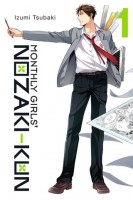
Monthly Girls’ Nozaki-kun, Vol. 1

November 29, 2015 by Anna N

Monthly Girls’ Nozaki-kun, Vol. 1 by Izumi Tsubaki

This was by far one of my most anticipated new manga titles of the year. I generally don’t get into 4-koma manga all that much, but Oresama Teacher is one of my favorite shoujo comedy titles, so I was looking forward to reading this.

Poor Chiyo has a crush on the handsome yet mysterious Nozaki. When she confesses her affection to him, he assumes that she’s a rabid fan and hands her an autograph – as it turns out he’s secretly a successful shoujo manga-ka. Chiyo soon finds herself serving as his assistant, along with a quirky supporting cast. Nozaki is incredibily odd, as the main thing that he’s an expert in are shoujo manga tropes, which causes plenty of real-life confusion. He also finds inspiration from his classmates, turning one awkward boy nicknamed Mikorin into his shoujo heroine and making a tomboyish girl his inspiration for a new male character. Shoujo and manga conventions are constantly lampooned, for example Nozaki has a habit of always drawing his favorite face, making his characters indistinguishable from each other. Also, his relationship with his deadpan editor is hilarious, as Nozaki is always determined to believe the best of his editor, even when his drawings get a lukewarm or negative response.

One of the things I like about Tsubaki’s work is that she’s able to quickly assemble a large and exceedingly quirky supporting cast, providing plenty of fodder for humor. That she’s able to go from two characters to over half a dozen within the constraints of a 4-koma strip in one volume is impressive. This is a genuinely funny manga, and the perfect thing to get for a manga fan for the holidays if they haven’t snagged it already. I will never think about tanuki the same way again after reading this volume!

monthlygirlsnozaki

Filed Under: REVIEWS

The Disappearance of Nagato Yuki-chan, Vol. 8

November 29, 2015 by Sean Gaffney

By Nagaru Tanigawa and Puyo. Released in Japan as “Nagato Yuki-chan no Shoushitsu” by Kadokawa Shoten, serialization ongoing in the magazine Young Ace. Released in North America by Yen Press.

It is not particularly surprising that, having resolved its main relationship in this volume, Nagato Yuki-chan continues. After all, the main Haruhi novels are still in limbo, and may remain there permanently. The anime, unlike this spinoff manga, is not allowed to use Sasaki (indeed, the anime of the Nagato Yuki-chan manga took pains to avoid having her appear). And Haruhi-chan, while fun, is still just a gag manga. Thus is is this title which has almost become the series flagship, despite featuring characters who remain, at heart, really nice and sweet. And so we continue to toddle along, vaguely discussing graduation plans and learning how to cook, and occasionally teasing the main continuity, such as when Yuki gets sick.

nagato8

Now that Kyon and Yuki have resolved their affections, most of the stress in this volume is carried by Ryouko, who remains my favorite and gets a lot of face time this time around. She’s not made aware that anything has changed till the very end of the book, mostly as Kyon and Yuki are too embarrassed to say anything. And it’s honestly easier, when repurposing material that may have been used in prior spinoffs or the main series, to use Ryouko’s POV, as she wasn’t in them by virtue of being evil and erased. She goes back and forth between being a mom, a big sister, a shipper, and a nervous wreck here, and once again it’s Haruhi who is forced to play the minder to the minder and comfort Ryouko when she begins to cry in happiness at Kyon and Yuki’s relationship.

Speaking of Haruhi, she’s still trying to do interesting things, but she’s also the one who, along with Tsuruya, actually has her act together and is thinking about what comes next. She’s given up on Kyon, but in this title is OK with that, and appears to be content to move on. (Koizumi is still sticking with her, but again she appears to regard him more as a useful tool than anything else). Mikuru is useless in the original series, adult form aside, but here Tsuruya admits that she’s genuinely trying to change that, and give Mikuru the experience with people she desperately needs to move forward when Tsuruya can’t be there to take care of her.

And so it looks as if the next volume of the series (and yes, there is one) will discuss graduation plans. Ryouko is undecided, mostly as she really hasn’t focused on her own life as much as living vicariously through Yuki. As for everyone saying Yuki is the housewife type, given Kyon’s less than zero ambition, I’m not sure that’s such a good idea. But of course this is a mild, sweet, happy title, so I suspect any crises of faith will be resolved in about 50 pages or so. It may not be the Haruhi we’d like to see, but if all we can get now is this continuity, I’m perfectly happy, and want to see what the cast will do in the future.

Filed Under: REVIEWS

Rising of the Shield Hero Vol 1

November 27, 2015 by Anna N

Rising of the Shield Hero Volume 1 by Aneko Yusagi

It has been some time since I’ve read a light novel, and so when One Peace sent me Rising of the Shield Hero, I decided to give it a try. The plot centers around Naofumi Iwatani, a disaffected otaku who abruptly finds himself transported into an alternate universe where he suddenly has to take on the role of the Shield Hero, on a quest that closely resembles a Japanese RPG.

I found the first couple chapters of the book a bit difficult to get into, partially because Naofumi is such an unsympathetic character who narrates his daily existence with flat declarative sentences. He soon finds himself in possession of an odd book which promptly transports him to another world, along with 3 other young men. They are the heroes of the sword, spear, bow, and shield respectively. Naofumi gets the shield, and finds himself scorned and mistreated partially due to his attitude and partially due to his only having a defensive weapon. The heroes all are assigned companions, and have to go out and get more experience to improve their abilities, just like one would have to grind in a typical game. Naofumi gets a female sidekick named Myne, but she promptly betrays him and leaves him penniless and alone.

The events centering around Myne’s betrayal of Naofumi were my least favorite part of the book, because she claims that he attempted to rape her. A woman making a false rape claim is not a plot point I enjoy reading, and shortly after his betrayal, Naofumi gets yet another female sidekick in the form of a slave tanuki girl named Raphtalia. He decides that he might enjoy owning a female slave because he now hates all women. Naofumi and Raphtalia embark on leveling up in their world by killing a number of low level demons that resemble orange balloons. Each time Naofumi defeats a different monster, his shield gains additional abilities. This was the part of the book I enjoyed the most, because Naofumi can’t use weapons due to his status as a shield hero. So he has to have a companion around to actually stab at things in order to get points and loot, and he manages to be fairly clever about coming up with ways to make money to get better equipment. Since he’s the shield hero, Naofumi has a great deal of personal defense. He decides to carry around orange balloon monsters underneath his cloak, and if people give him a hard time, he sets them loose. Naofumi’s bartering and blackmailing of the townspeople in order to get better equipment were one of the more amusing aspects of the book

Naofumi has an incredibly selfish way of thinking about things, but his actions often turn out to be less self-serving than I was expecting. Despite his dark thoughts, he actually treats Raphtalia more like a younger sister or companion. However, as she levels up, she grows up, so there is undoubtedly a romance ahead between the two main characters, which seems skeevy to me, since Naofumi met her when she was 10 years old.

The book needed a good solid pass from a copy editor, there were quite a few punctuation and spelling errors. The illustration included in the book were quite nice. Overall, this was a mixed read for me. I enjoyed aspects of the world building and Naofumi’s ingenuity. His general crankiness is also a nice contrast from the type of character that gets caught up in an adventure in another world. The flat, non-descriptive writing style made The Rising of the Shield Hero a bit of a slog in the earlier chapters, and I find myself creeped out by the prospect of romance developing in the later volumes.

riseshieldhero

Filed Under: REVIEWS Tagged With: light novel, One Peace Books

Attack on Titan: Kuklo Unbound

November 27, 2015 by Ash Brown

Attack on Titan: Kuklo UnboundAuthor: Ryo Suzukaze
Illustrator: Thores Shibamoto

Translator: Ko Ransom
U.S. publisher: Vertical
ISBN: 9781939130877
Released: May 2015
Original release: 2012

Between 2011 and 2012, three light novels written by Ryo Suzukaze and illustrated by Thores Shibamoto were released in Japan, forming a prequel trilogy to Hajime Isayama’s massively popular manga series Attack on Titan. All three novels were translated into English by Ko Ransom and published by Vertical. The first novel was released as Attack on Titan: Before the Fall, which is the title that the entire trilogy is known by in Japan. The second and third novels, originally published in 2012, were released together in English as an omnibus in 2015 called Attack on Titan: Kuklo Unbound. The manga series Attack on Titan: Before the Fall adapts the same story found in Kuklo Unbound. I’ve been reading the Before the Fall manga and I enjoyed the first Before the Fall novel well enough, so I was interested in reading Kuklo Unbound as well.

Roaming the earth in search of humans to feast upon are the Titans–giant, monstrous creatures of mysterious origins which nobody completely understands. In order to protect itself, humanity literally walled itself off from the outside world. The Titans are nearly invincible and very few people manage to live through a direct encounter with them, but Kuklo is one such survivor. Swallowed whole by a Titan while still in his mother’s womb, against all odds Kuklo was somehow saved. However, he has never been able to completely rid himself of the stigma of being born the “son” of a Titan. Feared and hated during a time when very few people have actually even seen a Titan, Kuklo is an orphan who is abused, held captive, and treated as a sideshow oddity. As he grows older he desires nothing more than to escape his cruel fate and to prove to himself and others that he is indeed human. And though his birth was ill-omened, Kuklo may in fact be the key needed to unlock humanity’s full potential in the fight against the Titans.

Attack on Titan: Kuklo Unbound, page 52Since I have been reading the ongoing Before the Fall manga series, I was already familiar with a fair amount of the story of Kuklo Unbound and wasn’t especially surprised by any of the developments. I do think that out of the two versions the original novels are the stronger, though. The manga doesn’t always capture the internal thoughts and feelings of the characters very well, and that perspective is very important to understanding Kuklo Unbound. I feel that Kuklo Unbound is better written than the first Before the Fall novel, too, or at least it was overall more enjoyable to read. Parts of Kuklo Unbound did feel very repetitive–there was a tendency to restate obvious and well-established plot points and even use the exact same descriptions over and over again–but for the most part the pace of the narrative is quick enough that the redundancy wasn’t too frustrating. As a whole, many of the characters in Kuklo Unbound seemed to be slightly better-developed and less reliant on worn tropes when compared to those of Before the Fall, too.

Kuklo Unbound works well as an omnibus, telling Kuklo’s entire story, but the two novels contained are distinct in their focus. In the first novel, Kuklo is the undisputed star. In the second novel attention is still primarily turned towards Kuklo, but by that point in the trilogy the story is really about the Vertical Maneuvering Equipment, the most recognizable technological innovation to be found in Attack on Titan. The predecessor of the Vertical Maneuvering Equipment was created in the Before the Fall novel, so this ties the prequel together quite nicely. While being different from most other Attack on Titan stories, the prequel trilogy also feels familiar, incorporating the types of scenes that have been seen before, including deadly battles with Titans, political intrigue and religious turmoil, and intense military training sequences. What makes Before the Fall and Kuklo Unbound particularly interesting is that they serve as an origin story, showing not only the development and implementation of the Vertical Maneuvering Equipment, but also the beginnings of the Survey Corps when it was still celebrated instead of despised.

Filed Under: REVIEWS Tagged With: attack on titan, Light Novels, Novels, Ryo Suzukaze, Thores Shibamoto, vertical

The Manga Revue: Deadman Wonderland and Livingstone

November 27, 2015 by Katherine Dacey

The November release of Jinsei Kataoka and Tomohiro Maekawa’s Livingstone provided me a nifty excuse to try Deadman Wonderland, an earlier series written and illustrated by Katoaka. Fans of Deadman Wonderland may know its complex licensing history here in the US: Tokyopop was its first publisher, releasing five volumes before going bankrupt in 2011. VIZ acquired the series in 2013, and is now just two volumes shy of the series’ grand finale, which arrives in February 2016. Whether you’re new to Kataoka’s work or have been a long-time fan, this column has something for you–so read on!

deadman_wonderland1Deadman Wonderland, Vol. 1
Story & Art by Jinsei Kataoka and Kazuma Kondou
Rated T+, for Older Teens
VIZ Media, $9.99

In the not-so-distant future, visitors flock to Deadman Wonderland, a prison-cum-theme park in Tokyo Bay where inmates fight to the death in front of paying crowds. Our guide to this Roman circus is newly minted prisoner Ganta Igarashi, an ordinary fourteen-year-old who’s been wrongfully convicted of murdering his classmates. Ganta’s fundamental decency is challenged at every turn; try as he might to cling to his humanity and clear his name, the prison’s arbitrary rules and roving gangs make it hard to be principled.

From my thumbnail description, you might conclude that Deadman Wonderland was cobbled together from parts of Judge Dredd, Rollerball, and Escape from New York–and you wouldn’t be wrong. What prevents Deadman Wonderland from reading like Rollerball 2: The Revenge is imaginative artwork. Jinsei Kataoka and Kazuma Kondou have created a Bizarro World Disneyland with rides, concessions, grinning animal mascots, and attractions like the Happy Dog Run, a lethal obstacle course featuring swinging blades and spike-filled pits. The characters who inhabit this landscape are a motley crew: though some telegraph their bad-guy status with tattoos and goofy haircuts, there are enough ordinary-looking prisoners that it’s impossible to judge who’s trustworthy. That uncertainty creates a strong undercurrent of tension in every scene, making Ganta’s routine activities–a conversation in the bathroom, a trip to the cafeteria–as fraught with peril as an actual contest.

The manga’s other great strength is pacing. Kataoka and Kondou resist the temptation to dole out too much information in the first volume; we’re never more than a clue or two ahead of Ganta, though perceptive readers may finish volume one with some notion of the prison’s true purpose. The authors’ expert timing also prevents us from dwelling on the story’s most shopworn elements, instead focusing our attention on how Ganta responds to new characters and new challenges.

All of which is to say: Deadman Wonderland is more fun than it has any right to be, considering the high body count and recycled plot points. Count me in for the next twelve volumes!

The verdict: Great art, smart pacing, and an appealing lead character make Deadman Wonderland a winner. (A note to parents, teachers, and librarians: this manga’s rating is justified.)

livingstoneLivingstone, Vol. 1
Story  by Tomohiro Maekawa, Art by Jinsei Kataoka
Rated 16+
Kodansha Comics, $10.99

Livingstone is a handsomely illustrated bore, the kind of manga in which the writer has dressed up a simple concept with a profusion of fussy details that don’t add depth or interest to the story. The title refers to human souls–or, more accurately, the rock-like form that human souls take after a person dies. Sakurai and Amano, the manga’s protagonists, work together to harvest livingstones, thus ensuring that a soul is properly passed from one person to the next. If a person dies before his appointed time, however, his soul curdles into a gooey blob of bad juju.

The manga has the rhythm of a cop show: in each chapter, Sakurai and Amano solve or prevent one unscheduled death, usually by negotiating with someone who’s planning to kill himself. Livingstone‘s intense fixation on suicide is off-putting; none of the would-be victims are particularly sympathetic, and Sakurai and Amano’s ministrations are so tone-deaf that it’s hard to know what message author Tomohiro Maekawa is hoping to impart to readers. Sakurai and Amano’s antagonistic bickering is supposed to inject a note of levity into the proceedings, I think, but the timing of the jokes and the staleness of the characterizations do little to offset the dour tone. By the end of volume one, I found myself feeling bummed out and irritated–never a good sign for a series that’s exploring a subject as serious as death.

The verdict: Nice art, lousy script; I liked this story better when it was called The Kurosagi Corpse Delivery Service.

Reviews: At Comics Worth Reading, Johanna Draper Carlson dives into the eleventh volume of Fumi Yoshinaga’s Ooku: The Inner Chambers, which she describes as “something like Macbeth in kimonos.” Megan R. of The Manga Test Drive offers an in-depth assessment of Oishinbo, “the longest running food manga in Japan,” while Seth Hahne, proprietor of Good OK Bad, weighs in on Yamada-Kun and the Seven Witches. Feeling crafty? Vertical Comics shares some early reviews of their latest Arnazi Aronzo book Cuter Stuff.

Connie on Alice in the Country of Hearts: Ace of Hearts (Slightly Biased Manga)
Lindsey Tomsu on The Celebration of Haruhi Suzumiya (No Flying No Tights)
Sean Gaffney on vol. 5 of A Certain Magical Index (A Case Suitable for Treatment)
Wolfen Moondaughter on vol. 27 of Claymore (Sequential Tart)
Allen Kesinger on vols. 1-2 of D-Frag (No Flying No Tights)
ebooksgirl on vol. 2 of The Devil Is a Part-Timer! High School! (Geek Lit Etc.)
Ken H. on vol. 1 of Devil Survivor (Sequential Ink)
Connie on vol. 32 of Eyeshield 21 (Slightly Biased Manga)
Kory Cerjak on vol. 50 of Fairy Tail (The Fandom Post)
Troy Nikandler on vol. 1 of Is It Wrong to Try to Pick Up Girls in a Dungeon? (Otaku Review)
Holly Saiki on Junji Ito’s Cat Diary: Yon & Mu (Examiner)
Karen Maeda on vol. 1 of Komomo Confiserie (Sequential Tart)
Sean Gaffney on vol. 1 of Log Horizon: Game’s End (A Case Suitable for Treatment)
Connie on vol. 1 of Meteor Prince (Slightly Biased Manga)
Wolfen Moondaughter on vol. 2 of My Hero Academia (Sequential Tart)
Johanna Draper Carlson on vols. 4-6 of My Love Story!! (Comics Worth Reading)
Justin Stroman on Oh! My Goddess (Organization Anti-Social Geniuses)
Kane Bugeja on vol. 6 of Seraph of the End: Vampire Reign (Snap 30)
Matthew Warner on vol. 18 of Tegami Bachi (The Fandom Post)
Wolfen Moondaughter on vol. 8 of Tiger & Bunny (Sequential Tart)
Frank Inglese on vol. 7 of World Trigger (Snap 30)
Sheena McNeil on vol. 1 of Yo-Kai Watch (Sequential Tart)
Dustin Cabeal on vols. 1-2 of Yo-Kai Watch (Comic Bastards)
Paige Sammartino on vols. 1-2 of Yo-Kai Watch (Women Write About Comics)

PS: Our Manga Bookshelf colleague Ash Brown is giving away the first volumes of four awesome shojo titles from Kodansha Comics, including LDK, Let’s Dance a Waltz, My Little Monster, and one of my personal favorites Say I Love You. Don’t dally; the contest closes on December 2nd!

Filed Under: MANGABLOG, REVIEWS Tagged With: Deadman Wonderland, Jinsei Kataoka, Kodansha Comics, Livingstone, Manga Review, viz media

Log Horizon: Game’s End, Part 1

November 26, 2015 by Sean Gaffney

By Mamare Touno and Kazuhiro Hara. Released in Japan by Enterbrain. Released in North America by Yen On.

After two reasonably stand-alone novels, Log Horizon now has the first of the ever popular ‘2-volume arc’ books, as seen in SAO, Accel World, and Index has a few soon as well. This does allow for a leisurely pace throughout the book, with only a token cliffhanger at the end. But that’s fine, as this book is doing what Log Horizon does best, which is to showly explain how its world works and how the mechanics of gaming fit into “real” battles. Of course, as Shiroe finds out towards the end of this book, things may not be as simple as all that, particularly when it comes to death in this world.

lh3

I’ve said earlier that these books get into game mechanics far too much, and I admit at times I was getting a little bored at all the exposition. At the same time, however, the mechanics are far more important here than they are in SAO, where Kirito may as well just be genuinely using his sword as a sword. Each class has its own strengths and weaknesses, something that takes our newbie heroes (the twins from last book, Serara, and two new kids) the entire volume to really understand. I suspect a few gamers may be a bit frustrated by the “gosh, we need teamwork” lesson being drilled in here, but it’s cute, and serves the purpose of the actual book, which is to develop these five kids into deeper characters, particularly Minori. And we even get a mini-cliffhanger of our own with them, as Rudy seems to have a secret he’s been keeping from everyone.

As for Shiroe and company, instead of dungeon crawling they’re worrying about diplomacy. The other big function of this book is to set up the “people of the land”, which is to say the NPCs – as genuine characters with hopes, dreams, and desires, rather than “I’d love it if you could get that cat out of the tree for me” quest points. They have a history, one that is long and rather dark, as Shiroe finds out. And they have goals that may not mesh well with the adventurers, who they seems to regard as dangerous unknowns. Luckily, we meet Reinesia, the princess of one of the main capitols, who would much rather just lie against a table and be moody all day. I can identify with that. Her interaction with Crusty, who reminds me a lot of Heathcliff from SAO only hopefully without the evil, is one of teh funniest parts of the entire book.

There are also a few suggested romances, though I’m not sure if any of them will actually come off. Isuzu searches her feelings and realizes she likes Rudy as a big dog sort of guy. Akatsuki searches her feelings and comes up empty, though the more experienced reader can tell she’s in love with Shiroe and as yet unaware of it. In any case, romance may take a back seat in the next book, as evil creatures from the black lagoon are coming out from the sea all over the continent. Well, they’re in a game world, you can’t just turn off the bad guys. Log Horizon remains a well thought out series with relatable characters (so many introverts!), and is easy to recommend.

Filed Under: REVIEWS

A Certain Magical Index, Vol. 5

November 24, 2015 by Sean Gaffney

By Kazumi Kamachi and Kiyotaka Haimura. Released in Japan as “To Aru Majutsu no Index” by ASCII Mediaworks. Released in North America by Yen On.

After four novels that were basically one plotline, this fifth book gathers up three interlocking stories, one a novella and two short stories, all taking place on the last day before the school semester begins. Indeed, it’s a bit startling as you get into Index to see how fast everything is moving. The 4th book, and the Angel Fall arc, took place only a few days before this. These stories also share a certain theme, which I suspect was sort of shoehorned into the non-Accelerator ones to make it work better as a book, or people choosing to do the right thing rather than let someone else do it. It’s what makes a ‘superhero’, and given that Index is in many ways about a city filled with superheroes, it rings thematically true, though in some places more than others.

index5

Introduced in this volume: Last Order, Kikyou Yoshikawa, Eztali (as Mitsuki Unabara). There’s no real equivalent to this in the Railgun timeline, mostly as Misaka features in two of these stories. It’s still right after the final battle in the SS anime.

There’s no getting around the fact that one of these stories is much, much better than the other two, so let’s deal with the other two perfunctorily here. The scenes with Mikoto, Touma and the fake Mitsuki look to have been editorially mandated owing to a certain Railgun’s overwhelming popularity, and if you like Mikoto being the tsunnest dere in the city, there’s plenty for you to like here. But it’s very slight, and fake Mitsuki (we don’t actually learn his real name here) seems to fall for Mikoto for no real reason other than to allow the story to vaguely tie into the novels’ theme. As for the final story with Touma, Index, and Ouma, it’s even slighter (the villain is even Touma with one letter removed, though I suspect the Japanese name is suitably different). It does allow Index fans (are there Index fans?) to brag that that she’s actually a smart cookie when not whining at Touma about food or his harem hero tendencies.

But the main reason to read this, as you might guess from the cover, is the beginning of Accelerator’s journey from a mass-murdering villain to a broken anti-hero. He does a lot of soul searching here, and doesn’t like what he sees, but he can’t really see any way to redeem himself for what he’s done, and has no real reason to do so. Enter Last Order, who despite fandom’s best efforts (and the artist’s, let’s be frank) to sexualize her is pretty much written here as a “little sister” figure for Accelerator. She’s tied heavily into the Sisters project, and is able to offer him as much forgiveness as she can given the circumstances, and show off that he was not being as sociopathic as he thought. In the end, he does manage to save the girl and save the day, though it gets him shot in the head for his troubles, thus solving the other problem with Accelerator, which is that he was simply far too powerful for this series. We haven’t seen the last of him, though.

The translation continues to have the usual strengths and weaknesses, but I really have to highlight two issues. First off, Last Order’s speech quirks are very hard to translate into English at all. I don’t mind the ‘like’ inserted into her words, as it’s a casualness the other Misakas (and Mikoto herself) don’t have that works well with Last Order. But the doubling of the ‘says Misaka’ makes it look more like someone accidentally screwed up the find-and-replace rather than a genuine adaptation choice. Secondly, did Touma really say the word ‘Japanimation’? In 2015?

The three stories in this novel are of variable quality, but the Accelerator one is excellent, and it’s also the longest, so it’s definitely worth reading the book for.

Filed Under: REVIEWS

Monthly Girls’ Nozaki-kun, Vol. 1

November 22, 2015 by Sean Gaffney

By Izumi Tsubaki. Released in Japan as “Gekkan Shoujo Nozaki-kun” by Square Enix, serialization ongoing in the online magazine Gangan Online. Released in North America by Yen Press.

As my regular readers are aware, I’ve been excited for this title for a long time. I’ve been a fan of Tsubaki ever since The Magic Touch (in fact, I am the only fan of The Magic Touch), and I’ve also loved her other ongoing series right now, Oresama Teacher. Those, however, are normal shoujo series, albeit with a lot of humor in them. Monthly Girls’ Nozaki-kun is a 4-koma gag series. As such, we do not need to worry quite as much about depth of characterization, advancing the plot, and romantic resolution. We just have to worry about 1) Build to a gag, and 2) Have a character react to the gag. This series succeeds admirably at both, but especially the second.

nozaki1

The setup is fairly simple, and ripe for amusing situations. Sakura has fallen for the tall, handsome, stoic Nozaki, and confesses to him in a roundabout way, trying not to use the words “I love you”. Unfortunately, Nozaki is as dense as lead when it comes to matters of the heart, so interprets this as a desire to work with him on the shoujo manga he draws for a monthly magazine under a pseudonym. Luckily for him, Sakura is quite good at art. And Sakura is okay with this if it means she can spend more time with him. Over the course of this volume, though, the cast broadens to include a wide variety of eccentrics, and we also discover that Nozaki’s manga, while popular still has its problems. As such, many of the final panels are Sakura giving a comeback to the ridiculous situation, in typical Japanese tsukkomi style.

Not that Sakura is always the straight man. As with Tsubaki’s other current series, the characters have the ability to alternate between boke and tsukkomi as the situation requires, and so if Sakura is off in Nozaki-kun fantasy land, it will be Mikoshiba or Seo who will boggle at her antics. And Nozaki-kun may be stoic, but this doesn’t mean he’s without emotions, as we see whenever he’s reminded of his prior editor. The 4-koma format serves this series perfectly, as the gags all land dependably right where they should, and have just the right amount of impact. There are no drawn out scenes where half the 4-komas are setup to a final gag – there is humor every 3rd and 4th panel throughout.

Indeed, there’s even humor on the front and back covers, and in extra stories at the back, which might be why the translation notes are awkwardly placed midway through. For those worried, by the way, the presence of the -kun in the title should tell you that this translation is allowed to be a bit more Japanese than other comparable series, and thus “in my heart I call him Mikorin” is present and correct. There are a few adaptations of super obscure things, like the concept of ‘KY’, but honestly, ‘oblivious’ is a pretty accurate translation of that. Fans of the Nozaki-kun anime will definitely enjoy reading the series in its original form, and if you simply like to laugh, this is a great series for it.

Also, there are tanukis.

Filed Under: REVIEWS

Durarara!!, Vol. 2

November 20, 2015 by Sean Gaffney

By Ryohgo Narita and Suzuhito Yasuda. Released in Japan by ASCII Mediaworks. Released in North America by Yen On.

It can sometimes be difficult to review a light novel that is part of a long-running franchise whose fans have already seen variations on it – anime, manga, etc. In Japan, of course, the light novel came first, and thus the manga and anime give artistic attention to plot twists and character beats that the audience knows about through the book. In North America, it’s usually the opposite – we get the anime first, then an associated manga (though that’s switching around lately), and finally if it’s popular we see the light novels it was based on. And honestly, while I’m sure there will be some casual readers of DRRR!!, the primary audience for this 2nd book are people who already knows what’s happened in it. It’s thus more than a little amusing that the primary twist in this book is Anri’s identity, and the book goes to great lengths to keep it a secret from the reader for as long as possible.

drrr2

Just as Mikado and Izaya shared the ‘main character’ stage with Celty in the first novel, so Anri and Shizuo do with her here in the 2nd. The two are not dissimilar, though you wouldn’t guess that at first. Due to past parental abuse and then emotional trauma of their death (oh, and being possessed by a katana with a mind of its own), Anri is naturally repressed emotionally, and usually has no idea whether she should be happy, sad, or angry in any given situation. This is why she became best friends with Mika, and later on with Mikado and Masaomi – she sort of leeches onto their emotions and thus feels a semblance of normality. As for Shizuo, he simply has no limited, and has to repress his own naturally strong rage through sheer force of will – something he’s very bad at. The final fight he gets into is very cathartic, as he goes all out in his violent fury but doesn’t kill anyone, as he delightfully crows at the end. Shizuo is probably the most popular character in the series – Izaya is his equal, but has just as many people who hate him. You see why here.

It’s actually almost one year after the events of the first book, which comes as a bit of a surprise. There won’t be as much of a wait between the second and third, though – if the first book teased hints of future plots to come, the second is blatant about it, leading up to a cliffhanger where we finally see what the amassing Yellow Scarves are trying to do, and who they’re trying to pull in to lead them once again. It’s not all that much of a surprise – given that Mikado turned out to be the creator of the Dollars, and Anri (or at least Saika) being responsible for all the slashings, the identity of the leader of the third major force in this triangle is obvious in a literary way. It’s a nice way to bring in new readers to a third book, though, and as for those who’ve already seen the anime, hey, don’t hate on Saki too much, OK?

A good solid book for DRRR!! fans, who will enjoy the extra depth the narrative gives to the characters, particularly Celty, Shizuo, and Anri. And also for anime fans, Erika loves Shizaya, but it makes everyone around her, including Celty, want to throw up when they hear about it. Hee.

Filed Under: REVIEWS

The Manga Revue: Kill la Kill and Platinum End

November 20, 2015 by Katherine Dacey

File this column under I’m Not Dead Yet! November has been hectic, and it shows; my last post was over a month ago. Today’s column is an attempt to get back on track with regular updates. On the agenda are reviews of Kill la Kill, an adaptation of the wildly popular anime, and Platinum End, a new shonen series with an impeccable pedigree.

Kill_la_KillKill la Kill, Vol. 1
Comic by Ryo Akizuki; Story by TRIGGER and Kazuki Nakashima
No rating (best for readers 13+)
UDON Entertainment, $12.99

In my small and unscientific sampling of manga based on anime, I’ve read a lot of duds. Wolf’s Rain and Cowboy Bebop, for example, both fell flat in print, conveying little of the personalities or plot intricacies that made both animated series compelling. Kill la Kill is a more artful transfer of show to page, but suffers from some of the same issues as other anime-cum-manga.

Like the anime on which it’s based, the Kill la Kill manga see-saws between flamboyant parody and straight-faced action, mixing jokey conversations with bone-crunching fights. Navigating these tonal extremes in print proves challenging, however. The manga is funniest when skewering tropes that don’t need sound effects or color to make the joke stick–like equipping characters with goofy weapons or populating Honnouji Academy with students who look like extras from Mad Max: Beyond Thunderdome. 

The artists’ desire to spoof other cliches fall flat. On the page, heroine Ryuko Matoi’s barely-there power suit seems like blatant pandering to the male gaze; the artistic team lavishes considerable attention on Ryuko’s body, lovingly depicting her torso and buttocks from myriad angles. On the screen, however, the addition of sound puts a different spin on the material. The cheerful voice acting, peppy music, and snappy sound effects transform an exploitative sequence into an absurd riff on the indignities of fighting in a costume that consists of two well-placed suspenders and a dinner napkin. It isn’t deep, but it is funny, highlighting the stupidity of the “power up!” sequence that’s ubiquitous in anime, manga, and tokusatsu.

The manga suffers from the absence of color and sound in other passages, too. Without a voice actor to modulate the dialogue, almost EVERY PAGE READS LIKE THIS!!! OMG!!! ARE YOU LAUGHING YET??!!!! By the end of volume one, I felt pummeled into submission rather than amused by the affectionate send-up of Japanese pop culture’s most ubiquitous storytelling conventions.

The verdict: The manga looks like a million bucks, but the script strains too hard for effect.

plantinum_endPlatinum End, Chapter 1
Story by Tsugumi Ohba, Art by Takeshi Obata
Rated T+, for teens over 13
VIZ Manga, $.99 (digital only)

Over the last twelve months, VIZ has been experimenting with digital-first releases, a strategy that’s worked well for high-profile shonen titles like One-Punch Man and Tokyo Ghoul. It’s not surprising, then, that VIZ is using the same roll-out for Platinum End, the latest collaboration between Death Note creators Tsugumi Ohba and Takeshi Obata. This time, however, VIZ is making the first chapter of the series available as a stand-alone option–a decision that may backfire if other readers find it as off-putting as I did.

The main issue is the story. It’s mawkish and violent, shamelessly manipulating the reader into feeling sorry for a sullen protagonist by mining familiar adolescent themes: “I was born into the wrong family!” “No one will miss me when I’m gone!” “They’ll be sorry when I’m powerful/rich/famous!” We’re first introduced to Mirai as he’s leaping to his death. As we learn through flashbacks, he was orphaned at eight, and forced to live with an aunt and uncle who treated him like a slave. Nasse, a guardian angel, foils Mirai’s suicide attempt and grants him superpowers that are supposed to make him happy.

Lest you worry that Ohba and Obata have lost their taste for violence, Mirai’s first road test of these newfound abilities results in a gruesome, sexually charged scene. Ohba and Obata have stacked the deck firmly against the victims, but the characters are so cartoonishly evil (and visually repulsive) that their punishment registers not as a justifiable act of vigilantism, but as a plot contrivance. Ohba takes other narrative shortcuts in these opening pages, saddling guardian angel Nasse with dialogue that baldly explains her reasons for helping Mirai–an amateurish and lazy way to justify her part in the drama.

Perhaps the most disappointing element of Platinum End is Obata’s artwork. Though the human characters are drawn with consummate attention to detail, Mirai’s angelic sidekick is utterly generic: she’s a wide-eyed cutie with wings, ringlets, and halo. When placed side by side with Obata’s greatest supernatural creations–Death Note‘s Ryuk and Rem–the paucity of imagination is startling. Obata’s shinigamis looked like otherworldly rock stars with their glassy eyes, Frankenstein scars, and feathery protrusions, whereas Nasse looks like something traced from How to Draw Manga (or perhaps a volume of Kobato). That’s a pity, because Obata’s artwork has carried me through rough patches in his other series; here, however, it doesn’t really do much other than emphasize how thin the story is.

The verdict: Platinum End may find its footing in later chapters, but the first 70 pages are such a let-down that I won’t be tuning in for later installments.

Reviews: At Adventures in Poor Taste, Jordan Richards posts a more positive assessment of Platinum End (though he shares some of my reservations about the lead female character). Also weighing in on the first chapter of Platinum End is Justin Stroman, who offers an in-depth, spoiler-heavy review at Organization Anti-Social Geniuses. Foodies may prefer to visit The Manga Test Drive, where Megan R. samples two culinary comics: Mixed Vegetables, a shojo rom-com about rival teen chefs, and Not Love But Delicious Foods Make Me So Happy!, an older Fumi Yoshinaga title.

Mark Pellegrini on vol. 2 of AKIRA (AiPT!)
Connie on Alice in the Country of Clover: Lizard Aide (Slightly Biased Manga)
Helen on The Ancient Magus’ Bride (Organization Anti-Social Geniuses)
Lori Henderson on Awkward (Manga Xanadu)
ebooksgirl on vol. 12 of Chi’s Sweet Home (Geek Lit Etc.)
Connie on vol. 2 of Citrus (Slightly Biased Manga)
Theron Martin on vol. 27 of Claymore (Anime News Network)
Chris Sims on COWA! (Comics Alliance)
Connie on vol. 13 of Dorohedoro (Slightly Biased Manga)
Terry Hong on Fragments of Horror (Book Dragon)
Jordan Richards on vol. 1 of JoJo’s Bizarre Adventure Part 2: Battle Tendency (AiPT!)
Christophe on Junji Ito’s Cat Diary: Yon & Mu (Anime UK News)
Ken H. on vol. 1 of Kiss Him, Not Me! (Sequential Ink)
Demeiza on vol. 1 of Livingstone (Anime UK News)
Johanna Draper Carlson on vol. 4 of Love Stage!! (Comics Worth Reading)
Wolfen Moondaughter on vols. 3-4 of Maid-Sama! (Sequential Tart)
Rebecca Silverman on vol. 1 of Monthly Girls’ Nozaki-Kun (Anime News Network)
Kane Bugeja on vols. 1-2 of One-Punch Man (Snap 30)
Al Sparrow on vol. 1 of Pandora in the Crimson Shell: Ghost Urn (Comic Spectrum)
Sean Gaffney on vols. 21-22 of Ranma 1/2 (A Case Suitable for Treatment)
Kristin on vol. 2 of Requiem of the Rose King (Comic Attack)
Alice Vernon on vol. 1 of Rose Guns Days: Season One (Girls Like Comics)
Sarah on vol. 3 of Servamp (Anime UK News)
Robert Prentice on vol. 8 of Food Wars! Shogugeki no Soma (Three If By Space)
ebooksgirl on vol. 1 of School Live! (Geek Lit Etc.)
Nick Creamer on vol. 3 of A Silent Voice (Anime News Network)
Danica Davidson on vol. 1 of So, I Can’t Play H (Otaku USA)
Jordan Richards on vol. 1 of UQ Holder (AiPT!)
Austin Lanari on issue 51 of Weekly Shonen Jump (Comic Bastards)
Ash Brown on vol. 8 of What Did You Eat Yesterday? (Experiments in Manga)
Wolfen Moondaughter on vol. 4 of Yukarism (Sequential Tart)

Filed Under: MANGABLOG, REVIEWS Tagged With: Kill la Kill, Manga Review, Platinum End, Takeshi Obata, Tsugumi Ohba, Udon Entertainment, viz media

What Did You Eat Yesterday?, Vol. 8

November 19, 2015 by Ash Brown

What Did You Eat Yesterday, Volume 8Creator: Fumi Yoshinaga
U.S. publisher: Vertical
ISBN: 9781941220238
Released: May 2015
Original release: 2013

I have been a fan of Fumi Yoshinaga’s manga for quite some time now, so I was very happy when her series What Did You Eat Yesterday? was licensed for release in English. Although I’ve enjoyed all of Yoshinaga’s translated work, I was particularly interested in What Did You Eat Yesterday? because it promised and has since proved to be a manga realistically portraying the lives of two gay men (and boyfriends) living together in Japan. As can be safely assumed from the title of the series, What Did You Eat Yesterday? also happens to be a food manga, which is another niche genre that I especially enjoy. Unsurprisingly, with its well-developed characters a touches of humor, I find the series immensely appealing. What Did You Eat Yesterday?, Volume 8 was originally released in Japan in 2013 while Vertical published the English-language edition of the manga in 2015.

As a lawyer, Shiro often finds himself involved in sorting out other people’s relationships, helping to resolve child custody disputes and providing divorce consultations and such. In many ways, this allows him to better appreciate his relationship with his boyfriend Kenji. Shiro isn’t always the most outwardly or physically demonstrative with his affection, especially when in public or when compared to Kenji’s exuberance, but the two men have built a comfortable life together. Their relationship has its ups and downs, just like any other couple might encounter, though being gay in contemporary Japan still has its own particular challenges. While Kenji’s family is largely supportive, Shiro’s parents are still adjusting to the fact that their son is in committed relationship with another man and has been for years. Thankfully, both Kenji and Shiro have close friends and acquaintances who have no problems whatsoever with the two of them being together.

What Did You Eat Yesterday?, Volume 8, page 53While Shiro and Kenji are obviously a couple, What Did You Eat Yesterday?, Volume 8 offers several scenarios in which they’re actually acting as a couple. I honestly enjoyed all of the stories collected in the volume, but two that particularly stood out to me explicitly showed them as boyfriends. The first story featured a trip where the two of them visit Kyoto together for Kenji’s birthday in which Shiro acts more stereotypically romantic and boyfriend-like than he has during the entire rest of the series, stunning Kenji in the process. Granted, the underlying reason for Shiro treating Kenji to such an extravagant vacation is a little heartbreaking when it is revealed. A story taking place a few months later sees Kenji and Shiro baking brownies together to celebrate Valentine’s Day, which is all sorts of sweet and wonderful. That chapter is also an excellent example of how the food and recipes included in What Did You Eat Yesterday? can be directly incorporated into the story itself. Some chapters are more successful at this than others–occasionally the food in the series comes across as being tangential–but I absolutely love when Yoshinaga pulls it off well.

The relationships between the characters of What Did You Eat yesterday?, often expressed through the sharing and enjoyment of food, are a crucial part of the series. There are many different types of relationships portrayed, but What Did You Eat Yesterday?, Volume 8 in particular reminded me of the importance of family relations in the manga. Just like in real life, the opinions and actions of family members can have a tremendous impact on an individual. The eighth volume reveals more about Kenji’s family circumstances when he returns home on the occasion of the death of his father. The acceptance shown to him by his mother and his sisters and their children was comforting to see, giving hope that in time Shiro’s parents, too, will be able to more fully accept their son. Family isn’t necessarily limited by law or blood in the series, either–Shiro ends up becoming a godfather of sorts when the daughter of one of his friends has a baby. And, of course, there is the small family made up of Shiro and Kenji themselves. Though they have their disagreements, What Did You Eat Yesterday? makes it clear that they greatly care for each other.

Filed Under: REVIEWS Tagged With: fumi yoshinaga, manga, vertical, what did you eat yesterday?

Ranma 1/2, Vols. 21-22

November 17, 2015 by Sean Gaffney

By Rumiko Takahashi. Released in Japan by Shogakukan, serialized in the magazine Shonen Sunday. Released in North America by Viz.

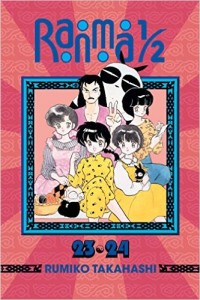
I discussed in my last review that the reader of Ranma 1/2 has to hit that sweet spot of caring enough about the characters to want to read more, while also not caring enough about them to take them too seriously. Nowhere is that more evident in Ranma than with how Takahashi deals with parents. She’s always had issues with parents, especially fathers, being mined for comedy, and even today in Rin-Ne we have one of the worst fathers she’s ever introduced, which is impressive in a career that’s give us Mr. Fujinami and Genma Saotome. So when we have the opening story here, where we’re meant to wonder if Genma really does have deeper emotions and feelings, it doesn’t quite ring true for us, as we’ve seen 20 volumes of him being a gigantic uncaring ass.

ranma 21

And of course that’s exactly what she wants us to think. She’s going for humor, and having the characters believe that Genma might care about his son while having the reader know better is why we’re here. What we’re left with is a fairly standard Ranma comedy arc of about three chapters, but you are reminded that Ranma lived almost his entire life on the road with only Genma to teach him, which explains much. It sets up the best story in this collection, which is the introduction of Ranma’s mother, Nodoka Saotome, who has come to the Tendos in search of her long-lost husband and son. Naturally, they are still long-lost because (say it with me) Genma is an ass, and Ranma is getting dragged into it with him.

Nodoka is a new character, and gets a more serious introduction than what we’ve seen before (witness the introduction of Mariko in the cheerleading arc, which is pure 100% silliness from moment one). There are signs she could be used for comedy, mostly based around her somewhat disturbing tendency to carry around a sword in case she has to decapitate her husband and son for being dishonorable. But for the most part Nodoka herself is treated seriously, and the comedy comes from Genma’s increasing efforts to hide Ranma’s male identity from her. Indeed, Ranma reflects on the fact that he never even knew he had a mother, and Nabiki, of all people, reminds him that the Tendos will never have the ability to see their mother again, so he should reach out more. (Takahashi immediately undercuts this with Nabiki charging him for hiding his identity, but we’re used to that from this author.)

Sadly, this wonderful arc is followed by one of my least favorite. It’s not that it’s poorly written – on the contrary, Ranma is painfully in character. Everything about the ‘reversal jewel’ arc plays into Ranma’s biggest weakness, his pride and his ego, and thus he cannot stop trying to get Shampoo to fall in love with him again, even when everyone else realizes “you idiot, this solves your problem!”. It also has a lot of Mousse, which I also tend to dislike, but at least he’s been dialed back to desperate here, as opposed to madman, and we’ll see more of that in the next volume.

But this is life with reading Takahashi, and Ranma in particular. Every arc you like that shows off the sweet, heartwarming sides of our characters is followed by showing off their petty, vengeful sides. Never grow, never learn. We’ll see if that keeps up with the next omnibus, which features one of the most beloved arcs (by the old 90s Ranma fandom, at least) of the entire series.

Filed Under: REVIEWS

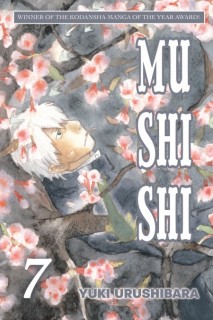
Mushishi, Vol. 6

November 12, 2015 by Ash Brown

Mushishi, Volume 6Creator: Yuki Urushibara
U.S. publisher: Del Rey
ISBN: 9780345501660
Released: November 2008
Original release: 2005
Awards: Japan Media Arts Award, Kodansha Manga Award

I discovered Yuki Urushibara’s award-winning manga series Mushishi more by chance than anything else, but it quickly became a favorite and I made a point to collect the manga as it was being released in English. I’m very glad that I did–replacing my copies would cost a fair amount since Mushishi is currently out-of-print and increasingly difficult to find. Fortunately, Kodansha Comics released the entire series digitally in 2014. Mushishi, Volume 6 was first released in print in English in 2008 by the now defunct Del Rey Manga. In Japan the volume was initially published in 2005, the same year that the series’ first anime adaptation began airing. (The Mushishi anime is also a personal favorite and I re-watch it frequently.) In addition to being popular enough to warrant multiple adaptations in a variety of different media over the course of its publication, Mushishi was also a recipient of a Japan Media Arts Award and a Kodansha Manga Award.

Mushi are creatures which are invisible to most and which few people truly understand. But even so, they are an integral part of the natural world, said to be very similar to the original form of life. Mushi’s influences on humans, though not necessarily intentional or malicious, can be both good or bad depending on the circumstances. Some people, like Ginko, have made a profession out of studying mushi. These mushishi gather and share invaluable knowledge about mushi and about the world. By closely observing mushi and their environment, mushishi are able to recognize signs of impending disaster, explain what would seem to be the unexplainable, and identify when and where balance to the natural order must be restored to avoid dire consequences. The work of mushishi is inherently dangerous as they are frequently dealing with the unknown, but their perseverance can also be extremely rewarding, allowing them to some extent to leverage and even control the abilities of mushi for their own purposes.

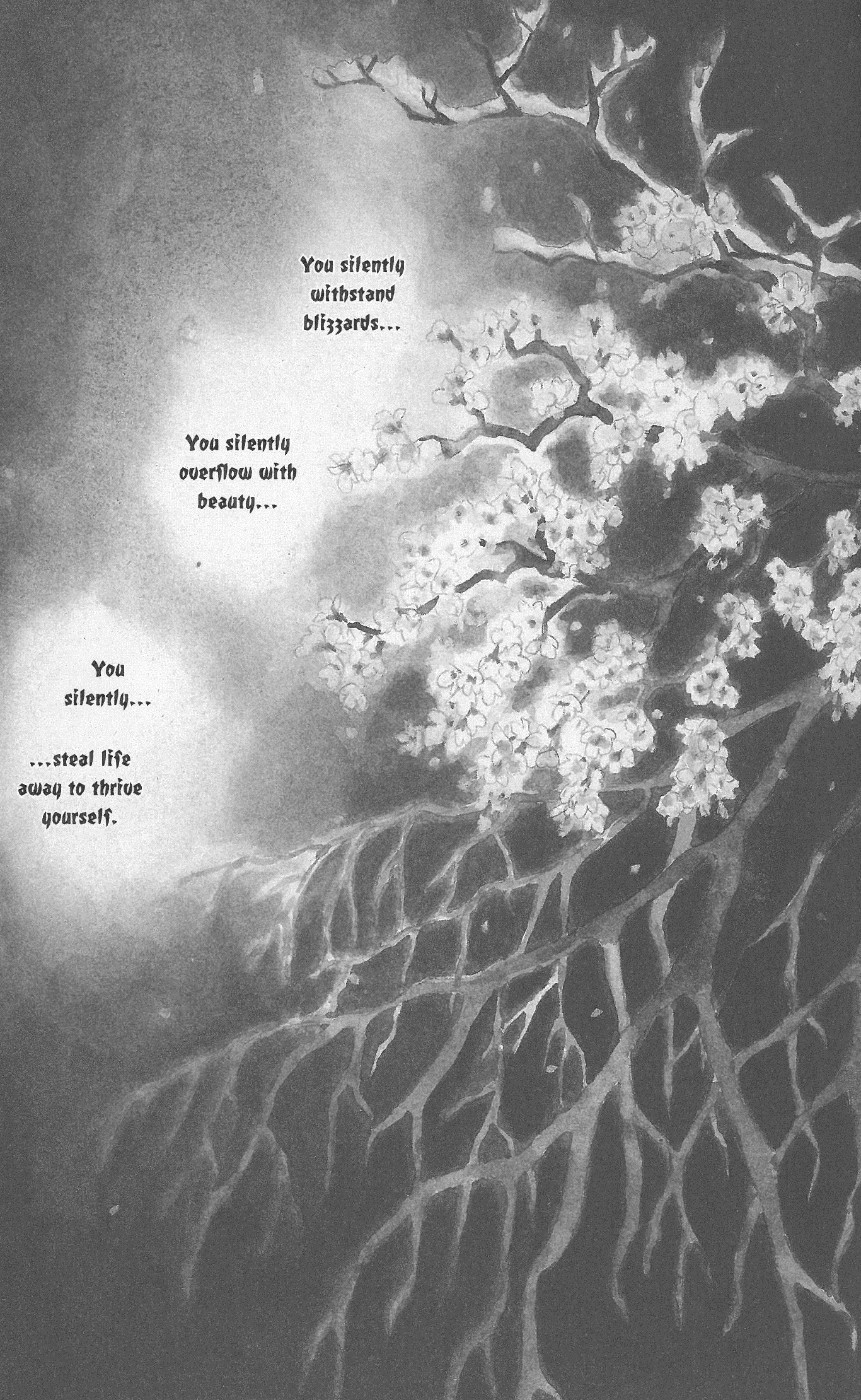
Mushishi, Volume 6, page 133Mushishi, Volume 6 collects five chapters of the series. Except for the presence of Ginko and mushi, none of them are directly related to one another, however three of the stories deal in some fashion with the powerful phenomenon known as kōki. Whereas mushi could be considered primordial, kōki is an even purer and more basic form of life from which the varied multitude of mushi originate. Kōki is portrayed as a river of light, the glowing liquid proving to have both harmful and healing effects depending on how it is used. Mushi are intensely attracted to these rivers and will seek them out. In “Heaven’s Thread” this becomes a problem for humans living near the light flow–mushi that prey on other mushi sometimes catch a person instead. Humans can also be infected by decaying kōki, as is seen in “The Hand That Pets the Night,” negatively impacting families for multiple generations while also benefiting them. The third story in Mushishi, Volume 6 delving into kōki is “Banquet in the Farthest Field” in which a sake brewer unknowingly attempts to replicate the taste of the liquor of life with unintended consequences.

The other two stories collected in Mushishi, Volume 6, while still unrelated, both explore the loss of a loved one. Mushi’s involvement in “The Chirping Shell” is actually fairly minimal as the chapter focuses on a man coming to terms with the tragic death of his wife and learning to forgive in the face of an even greater imminent tragedy of which the mushi are an omen. “Under the Snow” is likewise about a young man in denial who is grieving the loss of the life of his little sister. In this story snow-like mushi literally suck the heat from his body, but they also serve as a metaphor–because of his sister’s death Toki has become numb to the people and the world around him. Many of the stories in Mushishi can be read on multiple levels like this, which is one of the reasons that I love the manga so much and find it so enjoyable to read and reread. The series frequently feels like a collection of folktales and stories of the supernatural, but at its heart Mushishi is very often about an individual’s personal struggle when confronted by something in their life beyond their control or understanding.

Filed Under: REVIEWS Tagged With: del rey, Japan Media Arts Award, Kodansha Manga Award, manga, mushishi, Yuki Urushibara

JoJo’s Bizarre Adventure: Battle Tendency, Vol. 1

November 12, 2015 by Sean Gaffney

By Hirohiko Araki. Released in Japan as “Jojo no Kimyou na Bouken” by Shueisha, serialized in the magazine Weekly Shonen Jump. Released in North America by Viz Media.

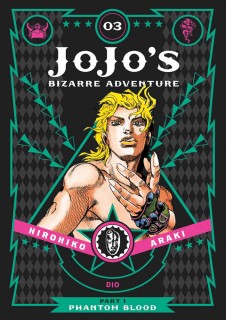
There was a bit of a worry in the Jump editorial offices when the 2nd part of this series began, Araki tells us, as Jump rarely killed off the hero and then kept going. This is why Joseph Joestar is a clone of his grandfather in terms of looks. Thankfully, he doesn’t act remotely like his grandfather, and we get to enjoy seeing a hero who is far more in the mold we’re used to today: brash, immature, confident, and a bit of a jerk. But he loves his grandma, and when it turns out that an ancient evil is upon them once more, he drops everything and bikes to Mexico to figure out what’s going on. Once again, no one does things in JoJo, they overdo them.

jojo2-1

The first half of this omnibus gives us a lot to work with, as Joseph Joestar arrives in New York City and immediately starts beating up cops, making friends of black pickpockets, and dealing with an old ally from the first series who has now turned evil fifty years later as he seeks to find a way to keep himself young and powerful. Yes, Straizo is our initial villain, as he and Speedwagon are no longer brothers in arms (see what I did there?), but he’s mostly just a teaser to show off that Joseph is starting out this series with an innate knowledge of the things Jonathan had to learn. Not that there won’t be training arcs in this series, but Joseph has an advantage from the start. He’s also cocky, with his tendency to predict the corny lines people will say to him endearingly dickish.

It’s a good thing that he has such a strong personality, as the rest of the cast doesn’t get as much of a chance to shine. Speedwagon and Erina are still around, but their function is the same even as they’ve become elderly: stare in awe at what is going on around them and comment aloud on it. Smokey too doesn’t do much here except be a standard sidekick, and he doesn’t even get to go to Mexico with Joseph. Indeed, the other character who gets the most development is one of the villains, von Stroheim (not named after a band, but a film director this time), who is a Nazi trying to use the newly discovered Pillar Men to help Hitler, but rapidly finds himself in over his head.

Those who enjoyed the first arc of JoJo’s should not be too worried about things being different here. Joseph may be a different personality, but the author isn’t, and there’s lots of things like his using Coca-Cola or cacti as amazing weapons to please the reader who just wants to see… well, bizarre things. This is a manga that can make a line like “How did he stop my Hamon-infused spaghetti al nero?!” into dramatic climaxes, and we wouldn’t have it any other way. The cliffhanger also implies that Jonathan wasn’t the only one to leave badass descendants. Fans of ridiculous Jump manga will find this is more ridiculous than the ones most influenced by it.

Filed Under: REVIEWS

Yukarism, Vol 4

November 10, 2015 by Anna N

Yukarism Volume 4 by Chika Shiomi

I’ve always liked manga by Chika Shiomi, and even though my favorite of her works is the older title Night of the Beasts, her art and storytelling skills have progressed greatly over the years. Yukarism’s final volume is a great way to wrap up the series, coming to a conclusion with a few nice plot twists that make it not at all like a standard supernatural shoujo manga.

As this series unfolded, we’ve seen the present day characters grow more and more affected by the past. Yukari is starting to show symptoms of illness that mirror the sickness of the courtesan Yumurasaki, while Mahoro is taking on the supernatural powers of Takamura. Edo bodyguard’s protectiveness is manifested in Satomi in the modern day. Not only are personality traits crossing over to the present day, as the volume progresses the past is physically manifesting in the present. While it seems like the present day trio is doomed to repeat the tragedy from the past, Shiomi manages to wrap things up in a much more satisfying and hopeful way.

I don’t want to give too much away of the resolution of the manga, but I thought it was very nice that the inevitable love triangle in most shouojo manga was sidestepped. Most of the problems of the past centered around the trio not communicating clearly with each other and making assumptions, and in the present day the high school students manage to work things out both in their own lives and for the spirits that possess them briefly. Even situations that seem very threatening get resolved, but not without enough of a struggle that the happy ending feels unearned.

Shiomi’s art is always clear and easy to follow, but the level of detail in the flashbacks to the Edo period, combined with the way the past is portrayed as bleeding into the present in this volume makes the illustrations stand out. In the hands of a lessor artist, the events could easily be a muddled mess, but both spirit possession and the physical struggles are portrayed with clear techniques that never confuse the reader. I honestly would have been happy if this series were stretched out over another volume or two, but by the end there is resolution for each character, both past and present. There’s a depth of emotion in this concluding volume that shows how Shiomi is able to be so precise in planning out her story, it never feels unearned. Yukarism is a series that I’m going to keep on the shelves for a long time, and I’m going to look forward to reading it again.

yukarism4

Filed Under: REVIEWS Tagged With: shojo beat, viz media, Yukarism

  • « Go to Previous Page
  • Page 1
  • Interim pages omitted …
  • Page 223
  • Page 224
  • Page 225
  • Page 226
  • Page 227
  • Interim pages omitted …
  • Page 342
  • Go to Next Page »
 | Log in
Copyright © 2010 Manga Bookshelf | Powered by WordPress & the Genesis Framework