• Skip to primary navigation
  • Skip to main content
  • Skip to primary sidebar
  • Home
  • About Us
    • Privacy Policy
    • Comment Policy
    • Disclosures & Disclaimers
  • Resources
    • Links, Essays & Articles
    • Fandomology!
    • CLAMP Directory
    • BlogRoll
  • Features & Columns
    • 3 Things Thursday
    • Adventures in the Key of Shoujo
    • Bit & Blips (game reviews)
    • BL BOOKRACK
    • Bookshelf Briefs
    • Bringing the Drama
    • Comic Conversion
    • Fanservice Friday
    • Going Digital
    • It Came From the Sinosphere
    • License This!
    • Magazine no Mori
    • My Week in Manga
    • OFF THE SHELF
    • Not By Manga Alone
    • PICK OF THE WEEK
    • Subtitles & Sensibility
    • Weekly Shonen Jump Recaps
  • Manga Moveable Feast
    • MMF Full Archive
    • Yun Kouga
    • CLAMP
    • Shojo Beat
    • Osamu Tezuka
    • Sailor Moon
    • Fruits Basket
    • Takehiko Inoue
    • Wild Adapter
    • One Piece
    • After School Nightmare
    • Karakuri Odette
    • Paradise Kiss
    • The Color Trilogy
    • To Terra…
    • Sexy Voice & Robo
  • Browse by Author
    • Sean Gaffney
    • Anna Neatrour
    • Michelle Smith
    • Katherine Dacey
    • MJ
    • Brigid Alverson
    • Travis Anderson
    • Phillip Anthony
    • Derek Bown
    • Jaci Dahlvang
    • Angela Eastman
    • Erica Friedman
    • Sara K.
    • Megan Purdy
    • Emily Snodgrass
    • Nancy Thistlethwaite
    • Eva Volin
    • David Welsh
  • MB Blogs
    • A Case Suitable For Treatment
    • Experiments in Manga
    • MangaBlog
    • The Manga Critic
    • Manga Report
    • Soliloquy in Blue
    • Manga Curmudgeon (archive)

Manga Bookshelf

Discussion, Resources, Roundtables, & Reviews

Reviews

Yona of the Dawn, Vol. 19

August 12, 2019 by Sean Gaffney

By Mizuho Kusanagi. Released in Japan as “Akatsuki no Yona” by Hakusensha, serialization ongoing in the magazine Hana to Yume. Released in North America by Viz Media. Translated by JN Productions, Adapted by Ysabet Reinhardt MacFarlane.

After last volume’s tragic Zeno backstory, I was ready for a change of pace, and I ended up getting two. Bad things happen when Sinha is possessed by a former Bluer Dragon seemingly out for revenge, and our heroes end up in a cave filled with the spirits of the unquiet dead, which are drawn in a very creepy way. It could almost be horror… were it not for the fact that these are some of the funniest chapters of Yona to date. Every third page seems to have a new and better gag. Sinha’s possession is taking as him entering a “rebellious phase”, Yun’s Team Mom personality is constantly called into the light and dragged around for all to see (rice balls!), Hak, who has the dead pressing against him so hard he’s feeling weak, assumes that waking up in Yona’s embrace means he’s having one of THOSE dreams; and of course we get “hold on to me” as an excuse for a giant group hug. It’s wonderful.

It’s also only half the book, though the other half is a bit more serious (save for the discussion of why Su-Won hasn’t gotten married yet, which is a strange combination of hilarious and incredibly awkward). Yona and friends meet up with Riri and her bodyguards, who are still trying to protect the Water tribe by ferrreting out the source of the drugs still filtering into the cities. Well, Riri is, the other two are just following her and trying to ensure she doesn’t get kidnapped or killed or anything. This is actually a much bigger job than they’d like, especially as Ayura is still injured, so the bodyguards hire Yona and company to help protect her and also find out what’s going on. Of course, Yona being the type of series it is, this leads to a cliffhanger where she and Riri are captured by the bad guys, but if there’s one thing Yona has taught us to date it’s that this is not a series where the heroine stays put and waits to be rescued.

Another fantastic scene involves Yona and Riri discussing Su-Won, what he’s doing for the countries, and what Yona’s actual goal is. She’s seen what her father’s rule was like, and what Su-Won is doing, and has come to an understanding about it, though that doesn’t necessarily mean accepting it. But she still thinks that Hak will never forgive Su-Won, and I suspect she’s right there. There’s also a bit of romance, as Yona and Riri spend the night in bed together./. wait, wrong romance. Yona gives Hak a charm, and is clearly in love with him but unaware of her feelings. Hak, on the other hand, is very much aware of his feelings, but is not going to be doing anything about them anytime soon and is content to simply be by Yona’s side. I can’t wait till this eventually boils over.

So another stellar volume of Yona of the Dawn. You know the drill. Buy it.

Filed Under: REVIEWS, yona of the dawn

Toradora!, Vol. 6

August 11, 2019 by Sean Gaffney

By Yuyuko Takemiya and Yasu. Released in Japan by Dengeki Bunko. Released in North America by Seven Seas. Translated by Jan Cash & Vincent Castaneda. Adapted by Will Holcomb.

Sadly, I’ve caught up with when I started to review the manga version of this series, hence the annoying 2 at the end of the URL. In the meantime, we were always going to get a book devoted to Kitamura at some point, and this is the book. Like Minori, he’s a seemingly goofy and eccentric friend, though his iss more genuine and less of a mask than Minori’s. The start of the book sees him devastated by a (hidden to the reader) declaration from Sumire, the current Student Council President. Unfortunately, after he snaps out of it he seemingly goes off the deep end, dying his hair blond and stating he’s not running for student council. thus shocking the entire school. Ryuuji and Taiga may be the only ones who can help him, but what is that help going to entail, and will it mean that the new student council president actually has to be Taiga?

That’s Sumire on the cover, and I suspect that fan opinion of her may be divided. She’s shown to be a flawed character whose reasons for doing what she did are in character but also immature. Unfortunately, we’re not shown that till the very end of the book, in a fantastic and brutal fight with Taiga (which ends with Taiga suspended for two weeks); till then, we’re told over and over again how perfect she is, and when she’s not absent from the book she’s making the situation worse. I liked her arc, but many might think “too little too late”, especially as she’s seemingly also written out here. Speaking of divided opinion, Kitamura gets this book for character development, but just like Sumire that involves being an immature child for most of the volume, doing things like “becoming a delinquent” as a cry for attention from someone who won’t give it to him. You sort of which Taiga would have beaten him up as well, though that’s not going to happen.

Much better handled are the rest of the main cast. Minori is still clearly recovering from the events of the last book, and still trying to find her feet around Ryuuji. I have suspicions about that, but will save it till it’s more obvious. Ami is simply fantastic, being at her bitchy arrogant best while also showing that she too is changing, though she’s not very happy about it at all. (Minori and Ami is a fan ship, and there’s a nice, if short, scene here for that ship). And then there’s our main couple, Taiga and Ryuuji, who have not yet realized that they love each other but both have independently realized that they can’t imagine living without each other. The series is now in its second half, so we need to start heading towards endgame. Taiga too has matured… though perhaps not enough to avoid getting suspended for beating the shit out of a fellow student.

So an excellent volume of Toradora… except that the two characters at the center of it are being very difficult and stubborn. Still worth reading.

Filed Under: REVIEWS, toradora!

One Piece, Vol. 91

August 10, 2019 by Sean Gaffney

By Eiichiro Oda. Released in Japan by Shueisha, serialization ongoing in the magazine Weekly Shonen Jump. Released in North America by Viz. Translated by Stephen Paul.

Oda is very fond of writing chaotic scenes, and the last few arcs have all consisted of “start slow, then work to lots of chaos’. But the period of slow starts is decreasing, and we’re barely halfway into this volume before Luffy, reuniting with Zoro, is doing things at his own pace and upturning everything, mostly as we’re present in another country where evil bad guys are lording it over everyone while the poor and downtrodden starve. And, let’s face it, beating up those evil bad guys doesn’t really get old. It is worth noting, though, that Luffy has matured a great deal since the start of the series, and particularly in the last few arcs. Sure, he still doesn’t listen to anyone and does his own thing, and He’s still happy-go-lucky, but his reaction to Otama’s condition and the state of the country itself show a maturity that I really like seeing in him. You’re starting to see him turn into someone who CAN be the Pirate King.

This is the first time in ages that we’ve had the entire Straw Hat crew assembled, but aside from Zoro, the rest of the “missing” crew from the last few books remain missing here. But that doesn’t mean we’re not making new friends and introducing old ones. Otama is the cute and spunky little girl who made a promise with Ace years ago and now finds that Ace isn’t able to fulfill it. But that’s why Luffy is here. There’s also Okiku (get used to the O- prefix), a samurai who is gorgeous and also really tall, but does not let that get in the way of excellent sword skills and wanting to protect people. Trafalgar Law is around, still trying to achieve things quietly and sanely and still running into Luffy making that impossible. And we also have Basil Hawkins,k the fortune-telling pirate who seems to be working for the bad guys here, and who briefly gives Luffy and Zoro a run for their money till the cards say they get away.

And there are also some classic Oda scenes here. For everyone who thinks that the man is losing his touch, I urge you to take a peek at Holdem, a member of the Animal Kingdom Pirates who has a living Lion Head on his stomach, and the fact that the lion head proceeds to, when annoyed, punch Holdem in the nuts… forgetting that they are also the lion’s own nuts. That sort of goofy, juvenile gag requires a fantastic imagination. And it’s not just used for gags. The revelation towards the end of the volume as to the fate of Kin’emon and his compatriots, and where they really come from, is the sort of thing that you might protest breaks the story a bit if it weren’t handled with the deftest touch. And yes, there’s also Kaido, who really deserves that cliffhanger with an amazing two-page spread appearance showing off “I am the villain” vibes.

91 volumes in, One Piece has started a new arc that has me riveted already. I wonder how many volumes it will be? (Answer: many, many volumes.)

Filed Under: one piece, REVIEWS

86 –Eighty-Six–, Vol. 2: Run Through the Battlefront [Start]

August 9, 2019 by Sean Gaffney

By Asato Asato and Shirabii. Released in Japan by Dengeki Bunko. Released in North America by Yen On. Translated by Roman Lempert.

Fans of Lena, the star of Vol. 1 of this series, may be disappointed, as this is not a sequel to the previous book but an interquel – it explains what happened to the rest of the squad between when she last saw them and the epilogue, and thus Lena only appears at the start and end in a “she’s still in the Republic” sort of way. That said, this is still a very good volume of Eighty-Six, combining the mechs and battle scenes with more look at warfare, what makes us fight, and how even well-meaning people can try to impose their own wishes on others. It’s not as unrelentingly bleak as the first book, but it’s not a laugh riot, either – Eighty-Six will always be about as serious as its male lead, Shin, who may be with a different army but still has some of the same problems. And then there’s the Legion, the enemy soldiers whose attack near the end of the book feels like they’re trying to cause our heroes to simply give up in despair. There’s a lot of them. (Well, they are Legion, after all.)

The girl on the front is Frederica, who is a “mascot” for Shin’s unit, the Federation Army’s way of getting troops to bond with each other by giving them an adorable kid to look after. It’s not clear if this is actually true or not – Frederica’s the only one we see, and her situation is certainly one where a great cover story would be needed – but in any case, she fulfills some of the role Lena did in Vol. 1, attempting to get the other Eighty-Six to think about something besides fighting until they inevitably die. At least she’s just trying to get them to consider it, though – their main benefactor, Ernst, after rescuing them from certain death, is ready to have them retire and become good little civilian boys and girls, and is appalled when they all, to a man, decide to re-enlist. The trouble is that not only have this group been soldiers so long that anything else seems deeply off, but they know the Legion better than anyone else, and won’t allow others to take up that fight.

The Federation is better than the Republic in many ways, so there’s less explicit racism here towards the Eighty-Six, but that does tend to mean that it’s implicit. The soldiers are unnerved at both the Eighty-Six’s combat prowess (particularly Shin) and their stoic demeanor, and use the word “Eighty-Six as a slur several times throughout the book. “Monster” also comes up, and it’s clearly a point of tension that the Eighty-Six could have chosen to retire and never fight again. That they’d fought enough. But is it enough? The Legion are attacking in greater and greater waves. Where do you draw a line that says “that’s fine, you can leave it to everyone else now”? Especially if you’re Shin, with his seemingly psychic connection to the Legion.

This series continues to be what it was in the first book – unrelentingly grim but not despairing, and making me want to read more even if it is depressing much of the time. As you can tell by the subtitle, this is the first of a two-parter, and I suspect by the end of Book 3 we’ll be back to where we were with Lena reuniting with everyone.

Filed Under: eighty-six, REVIEWS

Ryuko, Vol. 1

August 8, 2019 by Katherine Dacey

If you’ve been jonesing for a stylish thriller that doesn’t take itself too seriously, Eldo Yoshimizu’s Ryuko might just fit the bill: it has the pulpy soul of a Kazuo Koike manga and the brash attitude of a James Bond flick. And while Ryuko never quite achieves the simmering intensity or cohesion of Lady Snowblood and Crying Freeman, it does hold its own against Koike’s best work thanks to its audacious action sequences and cool-as-ice heroine who’ll stop at nothing to avenge her mother’s kidnapping.

Running in tandem with the kidnapping storyline are four —maybe five — other subplots, all connected to the Soviet-Afghanistan war. There’s gun-running and opium harvesting, Soviet malfeasance and CIA chicanery, and some other elements that, frankly, don’t make a lot of sense, though they provide sufficient justification for the imaginatively staged combat. Anyone hoping for a few helpful lines of expository dialogue will be frustrated, as the characters are so laconic they seldom utter more than a few words before throwing a punch or brandishing a gun.

The real star of Ryuko is Eldo Yoshimizu’s artwork, which deftly synthesizes Japanese and European influences without slavishly copying them. His female characters, in particular, have the undulating hips, flowing locks, and determined scowls of Leiji Matsumoto’s most lethal heroines, while the male characters’ appearances owe a debt to the rugged manly-men that stalked the pages of Hugo Pratt, Takao Sato, and Goseki Kojima’s adventure stories. Not surprisingly, Yoshimizu lavishes his greatest attention on Ryuko, swathing her in barely-there dresses and leopard-print catsuits–an artistic decision that makes her look cool, but seems impractical for dodging bullets and karate-chopping enemies.

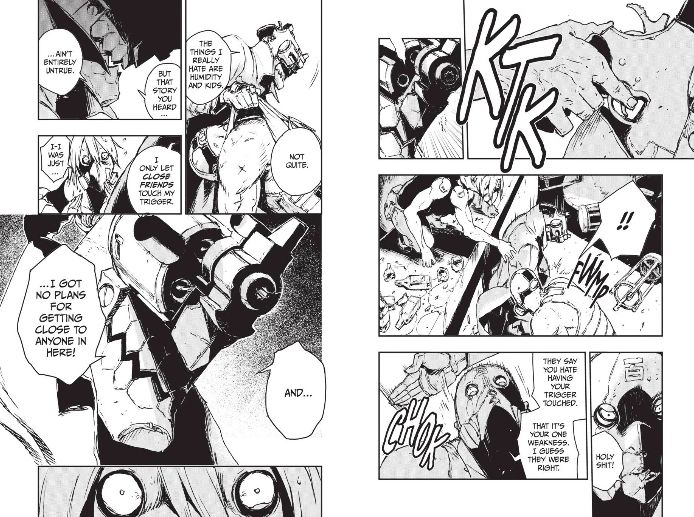
But oh, Ryuko’s fight scenes! They’re worth the price of admission, as they showcase the full range of Yoshimizu’s talents as a draftsman, veering sharply between naturalism, suggestion, and pure abstraction. In this sequence, for example, we see the young Ryuko ambushing a group of Soviet soldiers:

In the first panel, the tank is drawn with utmost specificity, allowing us to appreciate its sheer mass and its weaponry. The subsequent panels, however, are more gestural than the first, as we glimpse Ryuko silhouetted against the explosion, her age and gender completely obscured by the brilliant flash of light behind her. In the final panel of the sequence, Yoshimizu uses two horses to frame the action, rendering them as bold patches of black, with just a suggestion of a nostril and an eye, their demonic appearance echoing Ryuko’s own fierce resolve. Other sequences, such as this one, are even more abstract, dispensing with a grid in favor of fluid, overlapping images; in a particularly effective gambit, Ryuko’s arm forms a kind of panel boundary between the first stage of the attack — a knee to the stomach — and the second, in which she flips and pins her opponent:

Even Ryuko’s hair plays an important role in helping us understand what’s happening in this confrontation. In the first sequence, her hair swings around her face and shoulders in a naturalistic fashion, but in the final panel, her hair looks like a furious nest of snakes, each poised to strike her victim. That shift is subtle but important, a nifty metaphor for just how quick and lethal Ryuko can be.

For all the verve with which these scenes are drawn, Ryuko‘s characters never quite register as flesh-and-blood people. Yoshimizu has provided them with backstories, but the characters’ behavior is so steeped in action-movie cliche that their motivations for shooting and punching are almost immaterial. The story’s breakneck pacing doesn’t allow anyone much time for introspection, either; the few flashbacks to Ryuko’s childhood separation from her mother are the only genuinely emotional moments in the story. Still, no one reads trashy thrillers for a deep exploration of the human psyche; they’re looking for an over-the-top story that serves up generous helpings of car chases, gun battles, and fist-fights, the more outlandish, the better. On that front, Ryuko performs admirably, infusing a shopworn revenge plot with the sensual swagger of old-school classics like Lady Snowblood and Lupin III. Recommended.

RYUKO, VOL. 1 • ART AND STORY BY ELDO YOSHIMIZU • TRANSLATION BY MOTOKO TAMAMURO AND JONATHAN CLEMENTS • TITAN COMICS • NO RATING (PARTIAL NUDITY, VIOLENCE) • 256 pp.

Filed Under: Manga, Manga Critic, REVIEWS Tagged With: Eldo Yoshimizu, Ryuko, Titan Comics, Yakuza

Cocoon Entwined, Vol. 1

August 8, 2019 by Sean Gaffney

By Yuriko Hara. Released in Japan as “Mayu, Matou” by Enterbrain, serialization ongoing in the magazine Comic Beam. Released in North America by Yen Press. Translated by Amanda Haley.

Hair.

I suppose I should go into a LITTLE more detail, but honestly, after reading the first volume of this new series, “hair” is going to be what everyone takes away from it. It is hair-drenched and hair-permeated, a story about a private Japanese Girls’ Academy whose very uniforms are created using the hair of their seniors, but even there you get the sense that the story is somewhat irrelevant, an excuse to simply draw hair in every possible way. Even the cover art gets into it – the front cover may look relatively sedate, but turn the book over and you can see the hair of the two leads tangling into each other, trying to be the best metaphor that hair can be. Which is good, as hair gets to be a metaphor for a lot here. In addition to hair, the story focuses on three students at the school, two of whom are what you’d expect, and one of whom seems to have wandered in from some other manga.

Saeki is the girl who crosses over into both storylines, the “prince” of the school because the school needs one, rather than due to any desire of her own, though she plays the part even as it exhausts her. She gets closer to Yokozawa, who is our “normal girl” viewpoint character, though Yokozawa’s tongue is a lot more acid than this sort of character usually is. They like each other. The third cast member is Hoshimiya, the granddaughter of the headmistress, who spends her days locked in her room and seems to have a far more casual attitude towards hair than the rest of the school (seriously, you can be expelled for your hair being too short). Hoshimiya seems to be ethereal to the point of ridiculousness, and even when she and Saeki escape the school and go all the way to the local docks, there’s no real escape.

This is, of course, meant to be a yuri manga. Yokozawa clearly likes Saeki, and the book ends with a kiss, albeit the usual “they’re sleeping but I can’t resist” sort. Saeki and Hoshimiya also clearly have doomed chemistry in that Sei-and-Shiori sort of way. That said, you could also argue that the story is horror. Aside from a few exceptions like Saeki, most of the cast is the traditional long black haired heroine, which fits the private school setting but is also a trope in Japanese horror stories. The gimmick of the student’s shorn hair being used to make the uniforms of the incoming students is milked for all its worth, with the uniforms seeming alive and described as breathing, and it is meant to be dream-like and erotic but also a bit creepy. Hoshimiya herself also makes me think of horror, and it’s worth noting that we never clearly see her face. Don’t be surprised if she ends up being a ghost or a Zashiki-warashi of some sort.

This was a riveting if somewhat baffling read. I’m definitely getting the second volume, but I’m not sure if we’ll stick with this cast or see it expand to other couples. That said, you don’t read this for the couples, you read this for the hair. Hair will definitely star in the second book.

Filed Under: cocoon entwined, REVIEWS

The Dirty Way to Destroy the Goddess’s Heroes: Damn You, Heroes! Why Won’t You Die?

August 7, 2019 by Sean Gaffney

By Sakuma Sasaki and Asagi Tosaka. Released in Japan by Famitsu Bunko. Released in North America by Yen On. Translated by Jordan Taylor.

I didn’t have high hopes for this title going in. Despite assurances from the publisher that it wasn’t THAT kind of dirty, the title still didn’t inspire confidence. It was also the most traditional “isekai” of this month’s debuts. But as frequently happens with things I read, as I got further into the book I found myself warming up to it. This is mostly thanks to the main hero, Arian, who is bright and shiny and yet also lonely and needs a friend. Had the book gone with the original set of heroes we meet, who are rather quickly dispatched, it might have been unbearable, just watching a Japanese guy with nothing to stop him become a sadist because it’s fun. (Indeed, we’re seen other light novels like this, though mercifully few have been licensed.) But Arian’s inner goodness causes Shinichi, the protagonist, to reach down and find his inner ethical sense, and so the last third of the book is actually pretty good, despite the appearance of yet another lecherous and corrupt bishop from a questionable religion.

Our hero is Shinichi, a standard young Japanese protagonist whose backstory is merely hinted at, but who seems to relish the opportunity to let loose in the situation he’s now in. He’s been summoned by the demon king to a) eliminate the heroes who keep attacking, and b) find delicious food for his cute daughter, as all the demon world food tastes awful. With the help of a sharp-tongued maid who rains abuse on him at every opportunity, he’s soon able to dispatch the first group of heroes through his prior knowledge of old-school RPGs and also by being a complete and utter bastard. However, the remaining hero that’s left to attack is not only far more talented than the previous heroes, but she’s also cute and a kind, good-hearted person! Can he find it in himself to trick her and save the demons?

There are, of course, still a few big flaws in the book. Despite a last-minute attempt to give him some inner monologue, the bad guy of this volume is (apologies for spoiling, but it’s obvious the moment he appears on the page) your standard corrupt and evil priest, in this case a bishop. Celes, the dark elf maid who accompanies Shinichi on his tasks, is so much like Ram from Re: Zero that I was almost calling the hero Barusu. Possibly as, while he shows signs of depth that may be explored in future books, Shinichi really doesn’t do much to stand out until, as I said, the last third or so of the book, where he uses his sadistic cleverness for good rather than evil. Well, OK, for the good of the demons, but they’re more interested in better food than attacking humans. On the bright side, I liked the relationship between Arian and Shinichi, though I’m sure it will be walked back a bit in the next book. Her immediate infatuation feels in character.

This isn’t the greatest light novel out there, but it gets better as it goes along, and there’s hints of some depth down the road. Recommended for isekai fans.

Filed Under: dirty way to destroy the goddess's heroes, REVIEWS

The Saga of Tanya the Evil: Nil Admirari

August 5, 2019 by Sean Gaffney

By Carlo Zen and Shinobu Shinotsuki. Released in Japan by Enterbrain. Released in North America by Yen On. Translated by Emily Balistrieri.

Sometimes war can be filled with pitched battles, back and forth action and excitement, and sometimes war can be filled with not a heck of a lot happening except people talking about tactics. The same holds true for Tanya the Evil, especially in this sixth volume, where action scenes are kept to an absolute minimum in favor of dialogue, inner monologue, and a lot of grumbling about the futility of war. Which, it has to be said, makes for a book that’s a bit of a struggle to get through at times. Most of the time Carlo Zen balances his dry military tactics prose with other scenes that pick up the pace, but we don’t have that here, so some of this book is simply boring. But not all of it. There is, once again, the threat of peace on the horizon, and Tanya is all for it, though she’s not the one in charge, and you get the sense that von Zettour is not simply going to agree to anything that isn’t “we win, and then discuss terms”. Winning, of course, is not happening right now.

The title is Latin once more, and means “Nothing Will Surprise Me”. That’s put to the test in this book, which sees the nation of Ildoa getting involved – seemingly to be a neutral broker for peace, but in reality looking to get the best deal for themselves by playing both sides. As the Empire is not-Germany, Ildoa is not-Italy, though their political leader seems to be nothing like Mussolini so far – Carlo Zen is avoiding the main Axis villains in this series. The Empire is understandably rather wary of Ildoa, who put on a show of strength that actually shows off that they don’t have much strength to back it up. Still, an overture for peace is a start. Certainly it’s what Tanya wants, to the surprise of everyone – possibly the funniest scene in the book is when she talks with Visha, Weiss and the others in her unit and realizes how they’re all warmongers, not realizing who trained this into them.

On the other side, we have the Commonwealth and the Federation still making very awkward allies, as they come to the realization that the Empire is far stronger than they had expected. (The Empire, of course, is coming to the same realization about their enemy.) Colonel Drake appears to be the Lergen of the Allied side, and he has his own Tanya analogue in Lieutenant Mary Sue, still bright and idealistic and shiny and driven by sweet, sweet revenge. “The Saga of Tanya the Evil” is a Western title, albeit one approved by the author, I believe – the Japanese title, Youjo Senki, translates as “The Military Chronicles of a Little Girl”. Tanya is evil in the sense that she’s working for the Empire, and she can be morally reprehensible at times, but she knows about war and why things happen. Mary Sue, though, can’t believe everyone doesn’t think the way that she does, and she’s a headache to everyone around her. I really want to see her and Tanya fight again – perhaps I should watch the movie.

So there’s a lot of talking but little forward movement in a book which sees Tanya’s unit going from the Federation to the Empire Homeland and then up towards the Entente Alliance in an effort to win the war. Which Tanya knows isn’t happening, but she can’t convince anyone else. A necessary read for fans of the series, but it’s really dry and dull at times, I admit.

Filed Under: REVIEWS, saga of tanya the evil

Snow White with the Red Hair Vol 2

August 4, 2019 by Anna N

Snow White with the Red Hair Volume 2 by Sorata Akiduki

Snow White with the Red Hair had a fairly episodic first volume, so I was curious to see what the second volume would bring now that the characters and setting had all been set up. This volume blended medical mystery and palace intrigue with a little hit of the undercurrent of emotions between Shirayuki and Zen, in a way that sets up a great escapist read for anyone wanting to disappear momentarily into another world.

Snow White With the Red Hair Volume 2

Snow White with the Red Hair
doesn’t have the magical elements of a fantasy manga yet, but it has a quasi-medieval setting in an imaginary kingdom, and this volume opens with a low key slice of life situation as Shirayuki takes up her role as a court herbalist and finds out that she’s been paired with Ryu, a 12 year old prodigy as her new mentor. Ryu is brilliant, but not so great at dealing with people. Shirayuki’s open manner and genuine approach to dealing with people wins him over gradually. Shirayuki also learns some hard truths about Zen’s life when she gets a glimpse of his medical chart, which shows that however idyllic the setting of this manga is, people are still cruel to each other in unfathomable ways.

Shirayuki’s skills come to the forefront yet again when Zen investigates a fort where many of the soldiers are dealing with a mysterious illness. Here, all of Zen’s princely strategies aren’t all that useful, but Shirayuki’s keen knowledge and observational powers cause her to come up with a solution that he’d be unable to achieve. Things are complicated even further when Zen’s older brother comes back to the palace and shows himself to be thoroughly unpleasant. Even though there might be some manipulative scheming going on, the core of Snow White with the Red Hair is the gradually deepening friendship between Shirayuki and Zen. Seeing two characters who treasure each other so much invests this manga with a ton of heart. While most of their serious interactions are just a few panels here and there in between dealing with various tough situations, Akiduki has built up a tremendous amount of goodwill towards the couple in just two volumes. It is impossible not to root for them, even seeing that they will have plenty of obstacles ahead.

Filed Under: Manga Reviews, REVIEWS Tagged With: shojo beat, shoujo, snow white with the red hair, viz media

Our Dreams at Dusk: Shimanami Tasogare, Vol. 2

August 4, 2019 by Sean Gaffney

By Yuhki Kamatani. Released in Japan by Shogakukan, serialization ongoing in the magazine Hibana. Released in North America by Seven Seas. Translated by Jocelyne Allen. Adapted by Ysabet MacFarlane.

It was always a possibility, of course. We’ve seen that sort of thing in countless other titles. The new character comes along to an already existing group and is able to magically help all of them with their problems. And indeed, we saw Tasuku last time introduced to the drop-in center, and the bulk of this second volume revolves around Misora, the kid from last time who was rude and dismissive of Tasuku, and is on the cusp of puberty and also having gender identity issues. It would make perfect sense to see Tasuku help drag Misora out of their shell and help them come to firm realizations. Indeed, we start to see something like that. But life is just not that simple, and Misora’s issues are deep-rooted and not easily solved. And so we end with more lashing out, and more slurs used to hurt, and more art as metaphor with Tasuku’s world literally collapsing around him.

Both people on the cover are Misora, who dresses as a girl at the drop-in center but would never do anything like that at home. Their relationship with Tasuku is extremely bitter and confrontational, and Misora takes delight at times in not only correcting Tasuku’s misconceptions but also hammering on Tasuku’s wounds. At the same time, of course, Misora is also guardedly opening up to Tasuku and feeling him out, ready to lash out in pain and fury at the slightest sign of pity or confusion. But at least Tasuku has defined himself, even if he can’t admit it to the man he loves. Misora is not sure at all what they are – a boy, a girl, or what have you. And they also know that puberty is soon going to make this much, much harder. Meanwhile, Tasuku’s story is hardly over, as he’s spotted at the drop-in center, and outed to his crush… who may already have an inkling about things anyway.

The plot of this volume is very good, but it’s the journey that’s even better. There are no wasted pages, and the frustration burns off the pages as Misora spews more and more slurs at Tasuku – there’s lots of them in this book, all meant to push Tasuku away and also other him to a degree. There’s also more terrific art – I’d mentioned the collapsing building metaphor earlier that serves as the climax, but there’s also little moments like Tasuku taking a wave that Tsubaki gives to him and consuming it at stars, or Misora shown in the water of a glass that Tasuku drops, about to shatter to the floor. Little moments like these help to move the reader along, and the character moments – which can be agonizing – help to slow things down. (I also want to know more about Tchaikovsky guy, and hope we see him next time.)

If you’d been on the fence about reading this series (and I can’t imagine too many who were), pick it up. It’s a painful journey, but also amazing to read.

Filed Under: our dreams at dusk, REVIEWS

Last Round Arthurs, Vol. 1: Scum Arthur & Heretic Merlin

August 3, 2019 by Sean Gaffney

By Taro Hitsuji and Kiyotaka Haimura. Released in Japan by Fujimi Shobo. Released in North America by Yen On. Translated by Jan Cash.

Even the author knew what people were going to be thinking. In the afterword, he describes getting the premise from his editor and thinking that it had been done to death. The words “Fate/Stay Night” did not get mentioned explicitly, but the implication was certainly there. Actually, it appears the editor and publisher were really stepping up to the plate for this one. The author is known for Akashic Records of Bastard Magic Instructor, a very popular LN series with a manga out over here. They also brought in Haimura as the illustrator, who’s already busy drawing Index and DanMachi Sword Oratoria. All that and a series about a bunch of King Arthur wannabes fighting each other in a battle to the death to see who can be the Last Round Arthur (see what they did there?). The obvious flaw in this series is that it reeks at times, especially in the first half, of being written to be a franchise rather than a story. Fortunately, it gets better, especially in the last third.

The premise is essentially Mallory’s Arthur legends meets Fate/Stay Night meets Haruhi Suzumiya. Rintarou is a young man who is perfect at everything he’s ever done since he was born, which makes everyone think that he’s a monster – including his parents. He hears about a competition between those with the blood of King Arthur, a battle involving Kings and their “Jacks”, essentially a summoned Servant a la Fate. The winner takes over the world… which isn’t all good, as there’s also a reality incursion they’ll have to deal with. Rintarou wants in on this competition, and finds the weakest candidate – Luna Artur, a seemingly arrogant young woman who’s taken over the local Camelot High School and made it her plaything – and sold her Excalibur for cash. Despite thinking Luna is annoying and possibly bonkers, he becomes her vassal, mostly so that he can stop being bored with life. Of course, things aren’t going to be easy, as Luna’s childhood friend is fighting for the prize as well. And Rintarou also has a secret… which the title of the work may in fact give away.

Luna starts off as a weird mix of Haruhi and Gilgamesh from Fate, and it can make her hard to like until her true self shines through. In reality, she wants to see everyone happy and wants the power to achieve it. This does not mesh very well with Rintarou, who tends to be the pragmatic “let’s sacrifice their lives and sneak up behind the enemy” sort, but they eventually do get along quite well. I was less enamored with Sir Kay, Artur’s beleaguered Jack, but that’s the fault of the author, really – Kay is nice enough, but she’s Mikuru Asahina with a sword, and unfortunately I have no confidence she’ll rise above “comedy relief” in future books. The fights were well described and tense, which is good, as I think they may be the main reason people will read this. There’s also a few surprise revelations that AREN’T in the title, some amusing jokes, and some setup for the future.

When that future is I’m not sure – unlike the other July Yen debuts, Last Round Arthurs doesn’t have another book scheduled yet. It’s not fantastic, but it’s worth a read if you like modernization of Arthurian legend or just want a Fate book with the serial numbers filed off.

Filed Under: last round arthurs, REVIEWS

Skull-Face Bookseller Honda-san, Vol. 1

August 2, 2019 by Sean Gaffney

By Honda. Released in Japan as “Gaikotsu Shotenin Honda-san” by Media Factory, serialized in the magazine Gene Pixiv. Released in North America by Yen Press. Translated by Amanda Haley.

I had (shocking, I know) not actually seen the anime that is based off of this manga and took the internet by storm a while back. As such, I was a bit surprised to find that the skull face is actually irrelevant. No, this is not about a walking skeleton who works in a bookstore. The protagonist is the author, and the skull face is a mask that hides their identity – all the employees of the bookstore have different types of masks, for exactly the same reason. When you’re basing things on a true story, but don’t want to actually upset any of your colleagues, this is a good way to go about it. Moreover, it focuses the reader’s attention on the faces of the customers, which are gloriously well-done and expressive. No, instead of walking skeletons we just have life at a large bookstore in Japan, and insight into what’s going on behind the scenes. That does not mean this title is not fascinating, because it is.

Actually, the large bookstore also surprised me. I’ve seen manga about sleepy bookstores where a customer walks in once in a while, and the huge chain bookstore is usually the villain in those titles, trying to crush the mom and pop store and its individuality. But no, this manga is about a LARGE bookstore and its MANY employees – in fact, just the employees of the manga department of the store. It’s not made clear where it is, but given the large number of Westerners who wander through it, it has to be somewhere in Tokyo. Most of the time we see Honda-san at the front counter, helping customers find the manga they’re looking for, no matter how embarrassing, confusing, or impossible the request is. It doesn’t help that, as I mentioned earlier, many of the customers are foreigners with little concept of Japanese, and Honda-san’s English is also iffy. Still, service is the important thing, and we can’t leave a customer unhappy – though they may change their objective a bit.

Among the ‘types’ noted on the cover of the manga are ‘801 girls’, and a large chunk of the start of the book is devoted to BL manga and those searching for it. Sometimes they’re at sea, such as a dad whose daughter has asked for Gintama BL doujinshi, something Honda-san has to tell him isn’t sold at this bookstore. Sometimes you get a feeling of being “the Ugly American” in a sense, such as Honda-san watching the very loud American BL fans gushing about the types they like in the middle of the store. (That said, there’s no judgment given, and Honda-san seems to admire their forthrightness.) We do also meet several other employees, who tend to run the gamut from busy and harried to harried and busy, but the emphasis here, apart from Honda-san, is on the customers. (One exception is the class Honda-san has to take on customer service, where he meets a gorgeous young woman from another store who has trouble smiling for work – it’s amusing.)

I’ll be honest, this almost reads like a travel documentary about the Book Buyers of Shinjuku or something. It can be a bit exhausting (Honda-san reminds you time and again how painfully busy and overworked they are), but the stories and faces of the people involved are worth it. Even if they come in looking for shoujo manga and end up buying Berserk.

Filed Under: REVIEWS, skull-face bookseller honda-san

Bottom-Tier Character Tomozaki, Vol. 1

August 1, 2019 by Sean Gaffney

By Yuki Yaku and Fly. Released in Japan as “Jaku Chara Tomozaki-kun” by Shogakukan. Released in North America by Yen On. Translated by Winifred Bird.

These days, whenever a light novel is licensed that does not in some way shape or form ground itself in fantasy, I take notice. This is the “isekai boom”, and even the titles released that aren’t isekai seem to involve fantasy worlds, adventuring, and demon lords. We have seen a few normal “romantic comedy” LNs – Toradora!, My Youth Romantic Comedy Etc. – but they’re in a tiny minority, and were licensed well after the anime became popular. So Tomozaki, a high school kids title with no fantasy and no anime (at least not yet) was a surprise. I wondered what attracted Yen to it, especially as the publisher rarely deals with North America on their light novel end. I ended up being very happy with it. The novel starts slow, but as both it and its main character gradually find their feet it gets more and more interesting till a final quarter that was fantastic. This is especially interesting because of the odd little genre the book turns out to be: it’s a self-help guide.

Tomozaki is our title character, a quiet and sullen young man who is fantastic at gaming – particularly ‘Atafami’, the current hot new game – but not so good at everyday social interactions. His narrative voice will remind a few people of Hachiman, though he’s not as clever or misanthropic. (In fact, let’s get that out of the way – this is going to get compared to OreGairu, and some of that is by design. Even the cover art styles look similar. There’s even a reference saying that Saitama (where the books take place) can beat Chiba easily (OreGairu’s territory) that made me think the author is well aware of what he’s doing.) In any case, Tomozaki ends up playing a really good player online, and they arrange to meet up. To his shock – and hers – she’s his classmate Hinami, the cute and popular girl. Meanwhile, she’s incredibly disappointed in him, as she assumed he’d be as cool in real life as he was in the game. When he goes off about how life is much harder than a game, she decides to tutor him in how to life.

The first half of the book, as I said, feels like someone wanted to write a self-help manual for the introverted Japanese high schooler but make it interesting. To my surprise, the gaming talk did not bore me at all – it’s made relevant to the conversations throughout, and even when we’re watching characters play Atafami, it doesn’t drown us in stats unless that’s the point. Hinami explains how to make Tomozaki’s real-life character better, starting with learning to smile, then posture, then a new outfit, etc. And conversation. He has to get better at that as well. As the book goes on, it turns out that he and Hinami have a lot more in common than you’d think, and that she’s not explaining this from a superior position – she continues to do every day just what she’s telling him to do. Constant practice, just like in a game.

The book gets better when we start to see the results of her tutelage. Tomozaki doesn’t get perfect immediately, of course, and he’s still socially awkward much of the time. But once he starts treating these tasks – “have two conversations with a girl in class every day”, etc. – like a game that he needs to beat, he shows that he can be very good about it. He’s also observant and speaks his mind, like most LN narrators. And so he can spot that the over-the-top genki girl is putting on something of an act, or that the overly serious girl never starts conversations herself. Towards the end of the book he starts teaching another girl to play Atafami (so she can impress a guy) and he’s now the one giving the excellent advice – and also applying it to life, telling her that it’s never too late to change your character if you don’t like it. His growth is both astonishing and not surprising at all, given his gaming skills.

The book was clearly written as a stand-alone, but there’s more to come. I want to read it. The cast is all likeable (in fact, it’s a safe bet that Hinami, the female lead, is likely the least popular, as always happens in “harem” stories like this) and Tomozaki is relatable without being overbearing or irritating (well, he’s irritating to start with). It’s been called a “kinder, gentler OreGairu” and that’s simplistic but not a bad starting point. I had a ball reading it.

Filed Under: bottom-tier character tomozaki, REVIEWS

Magus of the Library, Vol. 1

July 31, 2019 by Sean Gaffney

By Mitsu Izumi, “based on Kafna of the Wind by Sophie Schwimm”. Released in Japan as “Toshokan no Daimajutsushi” by Kodansha, serialization ongoing in the magazine good! Afternoon. Released in North America by Kodansha Comics. Translated by Stephen Kohler.

This one surprised me. The premise was promising, but the artist has previously done 7th Garden, which was OK but didn’t wow me. To my surprise, this ended up being one of the most gorgeous manga I’ve read all year – the fact that Kodansha released both this and Witch Hat Atelier within a few months of each other shows we are in a golden age of pretty manga. The characters looks cute, the ‘dream sequences are fun, and best of all, there’s attention paid to the books. Which is good, as this is a manga for book lovers first and foremost. Despite the fact that the first volume serves as a prologue to the series proper (we get a “Several years later” timeskip0 at the end), this is a great introduction to the adventures of Theo, a young boy who loves to read more than anything, and can often be found hiding out in the local library. Which I’m sure a lot of this manga’s readers will find very familiar – certainly I did that as a kid.

Despite what the cover may imply, Theo has not had the best life so far. He’s poor (which means the head librarian doesn’t let him read books there), and his pointed ears mean that he’s bullied by the other kids. His older sister works four jobs to get enough money to send him to school, and he has one friend – ironically, the daughter of the librarian. His one pleasure is sneaking into the library to read books, which cam take him places he’s never even dreamed of. But his life is upended when a group of librarians come to town looking for a book. This being a manga, these are BADASS librarians, and they impress Theo with their love and knowledge of books. Unfortunately, all the books may soon be in danger, as the librarian accidentally lets loose a book with a fire spirit in it. Can the books be saved? Can Theo turn his life around?

As I noted, the librarians in this volume are very cool. There’s their leader Anzu, who is the “outwardly serene and sweet but terrifying when angry’ sort I always love. Blunt Nanako is there to tell the librarians how they’re doing their jobs wrong, and how to properly preserve books. Pipiri is a fairy who also seems to be the ‘cheerleader’ of the group, and also the oldest, though she looks young. And then there is Sedona, who just loves books, and bonds quickly with Theo. Sedona also notices that Theo has a few odd things about him – in addition to the pointed ears (which his sister does not have), he can apparently tame savage wolves. An intriguing young boy.

An intriguing series, too. We see Theo at the end of the volume, now a teenager, leaving his town behind and trying to become a librarian. Like the best series, I want to read what comes next.

Filed Under: magus of the library, REVIEWS

Seriously Seeking Sister! Ultimate Vampire Princess Just Wants Little Sister; Plenty of Service Will Be Provided!

July 30, 2019 by Sean Gaffney

By Hiironoame and Siso. Released in Japan as “Tonikaku Imouto ga Hoshii Saikyou no Kyuuketsuki wa Mujikaku Gohoushichuu” by TO Books. Released in North America digitally by J-Novel Club. Translated by David Evelyn.

I’ve talked before about how publishers can sometimes choose a title for a series that makes me want to run away rather than look forward to it when I reviewed Is It Wrong to Try to Pick Up Girls in a Dungeon?, a series that I think has lost a few readers who think it’s just a dumb harem series. (It *is* a harem series, but…) Similarly, when I saw the title of this book, I described it as ‘dire’. I owe it an apology; it has a few issues, but it’s actually pretty fun, and is not what I thought it would be, which was “vampire girl constantly glomps and feels up other girls”. In fact, consent is rather important in the one sorta relationship that exists in this book. (The amount of yuri you perceive in the book may depend on how you feel about “sucking blood = sex” motifs in vampire fiction.) No, what this is is another in the genre of “ludicrously OP girl boggles everyone’s minds”.

Ristia is a young vampire girl who is tired of being treated like a cute little sister by her powerful vampire family. She wants her own little sister to dote over! Sadly, vampires don’t procreate very often, so she decides to seal herself in stasis in a cave and wait for her little sister to wake her up. A millennium passes, and she’s women by Nanami, member of an adventuring party that’s run afoul of a dragon. Ristia can slay the dragon. Ristia can also get rid of morally bankrupt men, pull entire luxury houses out of her Item, Box, and create magical amulets that will literally regrow arms. But, she reassures Nanami, she’s just a normal girl. She ends up working for, and then taking over, an evil orphanage after purging it of its villains, and rebuilds it. To a ludicrous extent. And then starts a maid cafe. She can do anything… so why will no one see her as a little sister?!?!

A word of warning here, one of the girls in this book is a rape survivor, and it’s a function of her character and plotline. It actually felt rather odd to have a character like Maria is a story like this, which otherwise really enjoys leaning on the “silly” side of the fence. It should also be noted that Ristia looks like an older teen girl but that’s as a human; in vampire terms she starts the book pre-pubescent, and it’s her hitting puberty that also triggers part of the plot. My other major issue with the book is that it reads like it needed a better edit. The author comments on how they kept losing story contests for “bad structure”, and it’s still not that great; in particular, it reads like we get a little sister only to abandon her midway for a more interesting one. Don’t replace your cast halfway through a book.

That said, if you don’t mind OP characters, and can tolerate the word “normal girl” repeated so much it will make you sick (Nami from Zetsubou-sensei must be livid), this is a cute and fun read, and yes, has a little bit of fanservice and yuri, though not nearly as much of either as the title implies. So far this is the only volume, but there’s more of the original webnovel. I wouldn’t mind seeing more of Ristia.

Filed Under: REVIEWS, seriously seeking sister

  • « Go to Previous Page
  • Page 1
  • Interim pages omitted …
  • Page 137
  • Page 138
  • Page 139
  • Page 140
  • Page 141
  • Interim pages omitted …
  • Page 342
  • Go to Next Page »
 | Log in
Copyright © 2010 Manga Bookshelf | Powered by WordPress & the Genesis Framework