• Skip to primary navigation
  • Skip to main content
  • Skip to primary sidebar
  • Home
  • About Us
    • Privacy Policy
    • Comment Policy
    • Disclosures & Disclaimers
  • Resources
    • Links, Essays & Articles
    • Fandomology!
    • CLAMP Directory
    • BlogRoll
  • Features & Columns
    • 3 Things Thursday
    • Adventures in the Key of Shoujo
    • Bit & Blips (game reviews)
    • BL BOOKRACK
    • Bookshelf Briefs
    • Bringing the Drama
    • Comic Conversion
    • Fanservice Friday
    • Going Digital
    • It Came From the Sinosphere
    • License This!
    • Magazine no Mori
    • My Week in Manga
    • OFF THE SHELF
    • Not By Manga Alone
    • PICK OF THE WEEK
    • Subtitles & Sensibility
    • Weekly Shonen Jump Recaps
  • Manga Moveable Feast
    • MMF Full Archive
    • Yun Kouga
    • CLAMP
    • Shojo Beat
    • Osamu Tezuka
    • Sailor Moon
    • Fruits Basket
    • Takehiko Inoue
    • Wild Adapter
    • One Piece
    • After School Nightmare
    • Karakuri Odette
    • Paradise Kiss
    • The Color Trilogy
    • To Terra…
    • Sexy Voice & Robo
  • Browse by Author
    • Sean Gaffney
    • Anna Neatrour
    • Michelle Smith
    • Katherine Dacey
    • MJ
    • Brigid Alverson
    • Travis Anderson
    • Phillip Anthony
    • Derek Bown
    • Jaci Dahlvang
    • Angela Eastman
    • Erica Friedman
    • Sara K.
    • Megan Purdy
    • Emily Snodgrass
    • Nancy Thistlethwaite
    • Eva Volin
    • David Welsh
  • MB Blogs
    • A Case Suitable For Treatment
    • Experiments in Manga
    • MangaBlog
    • The Manga Critic
    • Manga Report
    • Soliloquy in Blue
    • Manga Curmudgeon (archive)

Manga Bookshelf

Discussion, Resources, Roundtables, & Reviews

Features & Reviews

3 Things Thursday: Ladies to look up to

December 16, 2010 by MJ 24 Comments

In checking my pingbacks this morning, I found I’d received one from Daniella Orihuela-Gruber’s wrap-up of this year’s Great Manga Gift Guide. In it, she describe my 2010 gift guide as being, “full of great choices for the manga-loving ladies on your list.”

While I do think of my blog’s primary audience as being adult women, this comment surprised me. “I’m an omnivorous reader,” I thought. “Surely my gift guide is more diverse!” I then rushed right over to take a look, certain my heterogeneous tastes would be plain for all to see. And though I wasn’t exactly wrong, I was indeed surprised by what I found.

Though my suggestions were spread over several major demographic categories (seinen, josei, shoujo) and numerous genres within those categories, the one thing that really stood out when I took in the collection as a whole is that a full 16 out of the 18 suggested gift ideas were written by female mangaka. They’re a pretty diverse group of artists, writing for a range of different audiences, so it would be inaccurate to describe my guide as a list of books for women, but I can’t deny that it’s strongly dominated by female creators. And It’s probably worth noting that the remaining two series feature female leads.

Now, I enjoy work by many male artists (several of whom are certain to appear on my “Best Of” lists for this year), and certainly I don’t consider the gender of the writer when I’m looking for something to read. Still, the guide is pretty revealing, and I suspect the facts speak for themselves.

So, with this discovery fresh in my mind, I thought I’d use this week’s 3 Things to talk about three of my favorite female mangaka.

3 Female manga artists to admire and adore

1. Fumi Yoshinaga – As the only mangaka (to date) to have received a week-long celebration of her very own here at Manga Bookshelf, did anyone doubt she’d make this list? With an impressive body of work that I’m pleased to say actually is mainly written for women, and some of the warmest, most charming dialogue ever to grace the printed page, Yoshinaga is the ultimate kindred spirit for female readers like me, who crossed over from our youthful obsession with prose and somehow never looked back.

It’s difficult to choose a favorite of her works, though they are favorites of mine in several genres. I think it’s possible that Ichigenme is my favorite yaoi manga of all time, while Antique Bakery and Flower of Life fill me with pure, pure shoujo joy. And though she tends to draw a lot of men, she also shines in All My Darling Daughters. Yoshinaga is a gem. It’s that simple.

2. Natsume Ono – I’ve had a rockier road with Natsume Ono, beginning with Not Simple, which was not a tremendous favorite, but she’s won me over completely with books like Ristorante Paradiso, Gente, and (most of all) my beloved House of Five Leaves, another of my favorite series of the year.

There’s a deep melancholy running through Natsume Ono’s work, but not one that begs for unwarranted attention. Instead, it simply offers a muted, gray background that allows her richer colors to display their true beauty, like vibrant autumn leaves against an overcast sky. That sounds terribly trite, I know, but I hardly know how else to describe it, except to say that there’s a surprising beauty to Ono’s work, peeking out between the sketchy lines of her unique, unmistakable art style. Now, if only someone would license her BL titles, my adoration could become complete!

3. CLAMP – This may seem like an obvious (and perhaps overdone) choice, but I simply can’t deny my love for CLAMP, whose work was perhaps the strongest influence in shaping my tastes as a beginning reader of manga. Series like xxxHolic and Tokyo Babylon contain imagery so deeply embedded into my emotional core as a reader that I can call them up in my memory at any given moment, as clearly and as viscerally as if they were sitting in front of me on the page. There’s a visual clarity to CLAMP’s work–their solid lines, the heavy use of black–that conveys an absolute certainty about the story they are telling. It’s mezmerising, truly.

Though some of their series have been aimed squarely at female readers, most of their current catalogue is serialized in magazines for boys and men, which is something I find quite interesting, given their enormous female fan base here in the US, and the strong homoerotic subtext in much of their work. Of course, my only wish is that they’d stop teasing, and finally write some official BL. :D

It pains me deeply not to be able to include Ai Yazawa and Hiromu Arakawa on this list as well. Though I am, of course, cheating simply by mentioning them at all. *sigh*


So, readers, who are three of your favorite female mangaka?

Filed Under: 3 Things Thursday

Off the Shelf: Four for the girls

December 15, 2010 by Michelle Smith and MJ 9 Comments

Welcome to another edition of Off the Shelf with MJ & Michelle! I’m joined, as always, by Soliloquy in Blue‘s Michelle Smith.

This week, we take a look at an upcoming debut from Tokyopop, as well as some continuing series from Yen Press and Viz Media.


MICHELLE: Once upon a time I worked for a circus and I lived in Omaha.

MJ: I’ve been to Omaha, if that counts for anything.

MICHELLE: That’s actually a lyric from the stage play version of The Wizard of Oz, which I was in in the sixth grade. For some reason, it gets stuck in my head all the time.

MJ: It serves as an interesting conversation-starter!

MICHELLE: I should try it at a party sometime. Anyway, I expect you’ve been doing some reading!

MJ: Indeed I have! I’ve had a pretty shoujo-tastic week, I have to say. Pretty snark-tastic, too, if I think about it, since both of the books I plan to discuss tonight feature wry humor in place of the usual wide-eyed shoujo optimism.

First on the docket, I’ve got the debut volume of The Secret Notes of Lady Kanoko by mangaka Ririko Tsujita, due out in a couple of weeks from TOKYOPOP. The series’ title refers to Kanoko, a third year junior high school student who prides herself on perfect objectivity. To maintain this emotional purity, she spurns any kind of social interaction with her classmates, preferring to simply observe (and, of course, take copious notes). When her interest is piqued by a classroom love triangle, Kanoko is shocked to find herself somehow drawn into the fray by each of the parties involved, and even more so to find herself accidentally befriending them.

My experience with this manga was a bit of a roller-coaster ride. I was immediately drawn in by Kanoko and the gloriously idiosyncratic friendships she develops against her will. Then, amidst a deep sigh of contentment, I was jerked right out of my shoujo-induced bliss by the volume’s second chapter, which begins with Kanoko having transferred to a new school, leaving everything I’d just learned to care about abruptly behind. My dissatisfaction continued through at least two more chapters before I finally realized that this is actually the premise of the series. That’s also when I realized that it’s brilliant.

Using Kanoko’s impossibly frequent school transfers as a structural conceit, Tsujita sets herself free from the bothersome constraints of reality, while also weaving in some of the most wonderfully real characterization I’ve seen in a manga comedy. It’s as though some sleep-deprived manga editor spliced together pages of Kimi ni Todoke with Sayonara, Zetsubou-Sensei, absent-mindedly inventing a new and delicious flavor of shoujo satire that manages to consistently maintain the gag while telling an unexpectedly heartwarming story at the same time. And in a fantasy space like this, of course, Kanoko’s original, accidental friends are able to pop up as needed, to help our heroine learn and grow, even as she snarks her way through another anonymous middle school.

The real secret to the story’s success, however, is Kanoko herself. She’s smart, hilarious, and even kind of heroic, like a super-hero version of Harriet the Spy. She wards off bullies by genuinely not caring what they think of her, and blows off “friendly” saboteurs with little more than a sneer. I seriously wanted to applaud several times during the first chapter alone. She’s also deeply damaged and a complete mess, but even that’s not overplayed. It’s astonishingly well done.

MICHELLE: That truly sounds awesome. I, too, was unaware of the series’ structure, but had managed to pick up somewhere or other that Kanoko is a unique heroine, which is why I’ve been looking forward to this volume’s release. I note from the exterior of the book that TOKYOPOP has a new logo and it looks quite snazzy. Were any differences apparent on the inside of the book?

MJ: I didn’t notice anything new inside, other than this very pleasant sight on the book’s page of credits, “Editor – Asako Suzuki.” :)

You know, the thought I had as I was writing this, Michelle, was that this ability to mix satire with an actual, forward-moving story is what I’ve fruitlessly hoped for from Otomen all this time.

MICHELLE: Oh, that is a welcome sight indeed! And yeah, I’m beginning to see more disappointment with Otomen‘s lack of forward movement popping up online. I usually buy new volumes as they come out, but after the disappointment I mentioned when I discussed volumes six and seven here back in September, I just couldn’t bring myself to buy volume eight.

MJ: So now that I’ve blathered on, what have you got for us tonight?

MICHELLE: Back in the waning days of Manga Recon there was this review copy for Angel Diary volume ten that no one had claimed, so I ended up reviewing it. And, actually, it was pretty interesting. It was primarily a fight between siblings, and though it didn’t make me want to read the series from the beginning, it at least made me want to see what happened next. Well, I’ve now read volumes eleven through thirteen (the final volume) and, unfortunately, what happens next is really not too much.

Briefly, the premise of the story is that Dong-Young, the Princess of Heaven, has fled an arranged marriage with the King of Hell and come to Earth disguised as a boy. Of course, one of her classmates is Bi-Wal, the King of Hell, and they end up falling in love. In volume eleven, there’s some brief resolution to the battle between Bi-Wal and his brother, Ryung, and then Dong-Young decides to get serious about becoming the Queen of Heaven which means going home and devoting herself to studying.

At first I thought, “Oh, this is the Boys Over Flowers school of story conclusions, with one member of a couple going away for an extended period of time.” With two volumes left at this point, I expected there would be several chapters, at least, of Dong-Young hard at work and maybe even the pair waiting quite a while to finally get married. Alas, much of this period is skimmed over and the series ends shortly into volume twelve. The rest of this volume and the whole of the thirteenth are bonus chapters about supporting characters, frequently as big-eyed bratty kids.

I didn’t like or follow this series enough to feel disappointed by this ending, but it certainly lacks substance. I’m glad I wasn’t more invested otherwise I might have been annoyed. I will say, though, that I associate this series with Moon Boy a lot, since they both began with Ice Kunion around the same time and are now wrapping up in the same month, and between the two series, this one is superior. Everything makes sense and Kara’s art is frequently nice to look upon. In fact, I must confess that I felt some squee for Bi-Wal’s chief aide, Hee-Young, mostly because he has really cool hair.

MJ: Is “superior to Moon Boy” really much of a recommendation? :D

MICHELLE: I guess not. If one were in the mood for some utter fluff with pretty boys in it, though, Angel Diary would probably be a decent choice.

MJ: I’m a fan of Kara’s artwork in another Yen Press series, Legend, so though I may snark, I can well imagine the appeal of her very pretty men and their undeniably cool hair.

MICHELLE: I actually scored the first few volumes of Legend recently, and look forward to checking it out.

So, what’s your other wry shoujo read for this week?

MJ: My second shoujo-snark-tastic selection for the evening is the third volume of Kaneyoshi Izumi’s Seiho Boys’ High School, from Viz’s Shojo Beat imprint. Now, you’ll recall that the series’ second volume is what originally won me over, but I’d say that it’s the third that earned it a place in my recent holiday gift guide. And though, in part, this is because it simply maintained the second volume’s quality, it also has some particular merit of its own.

The volume starts a bit slowly, with townie Miyaji coerced into dressing up as a boy-dressing-up-as-a-girl to help Dorm 1 spice up their entry for the school’s play competition. Things move up quickly from there, however, with the introduction of a new love interest for our hero, Maki, and an unexpected development in Nogami’s flirtation with the school nurse.

As in the series’ previous volumes, what really makes this manga shine is Izumi’s honest treatment of her teenaged male characters, even within the context of a fairly light comedy. Though perhaps the more impressive achievement is her demonstrated ability to make a bunch of (mostly) heterosexual horndogs actually appealing to female readers. That Nogami, for instance, the most hideously crass of the bunch, is even remotely sympathetic as a character is an accomplishment indeed. She’s not above poking fun at her readership either, as she proves in the volume’s final chapter with the revelation that Maki’s new love interest is a dedicated fujoshi.

And though Maki is definitely the most average guy of the bunch, he’s also the one who consistently tugs at my heartstrings, whether he’s struggling with overcoming his continued attachment to his lost girlfriend or discovering that there’s more to a popular classmate than he’d previously thought. He’s a fragile sort of everyman, but it really works for this series.

MICHELLE: I’ve seen the girl-dressed-as-boy-dressed-as-girl plot before, as well as the school nurse (there’s one in the second book I plan to discuss tonight, actually) but it sounds like Izumi is able to make some tried-and-true shoujo ideas feel original.

MJ: Yes, she really does, and it’s by doing little more than playing them honestly. Though her terrific sense of humor certainly doesn’t hurt.

So, school nurses, eh? Bring ’em on!

MICHELLE: If your theme this week has been wry shoujo, then mine is “final volumes of light shoujo (or sunjeong).” I wasn’t too impressed with the first two volumes of Cactus’s Secret, in which prickly Miku expects the easygoing object of her affections, Fujioka, to pick up on her feelings despite the fact that she gets angry and yells at him all the time. The series has gradually improved, though, and the scene in the third volume where Fujioka finally admits/realizes that he likes Miku too is truly sweet. Shortly into the fourth and final volume, alas, a buxom new school nurse is introduced and I began to fear that a lame plot centering on Miku’s jealousy would soon unfold. And, in fact, that’s sort of what happens, but in a much better way than I’d anticipated.

Rather than be outraged because Fujioka is spending time with a physically beautiful lady, Miku is actually made insecure by the fact that Fujioka, whom she has pressured into considering his future, has apparently been able to discuss something with the nurse that he couldn’t share with her. It’s a classic case of opposites getting together and realizing, “Hey, we really are majorly different here!” Miku is very focused on her future, so the fact that Fujioka isn’t bothers her. Because she does care so much, he feels unable to reveal to her how clueless he is, lest he lose estimation in her eyes.

Finding the nurse a good confidante herself, Miku eventually realizes what Fujioka’s been feeling and the two end up working things out. Just like Angel Diary, this series ends pretty abruptly and is followed by a couple of bonus stories featuring supporting characters. Even so, I found the conflict in this volume to be engaging and honest, evolving organically from who these characters are. Cactus’s Secret doesn’t rank as one of my favorite shoujo series ever, but it just might deserve a Most Improved award based on the difference between its first and last volumes!

MJ: I wasn’t impressed by the first volume of this series, which kept me from continuing on, and now I’m torn by a desire to watch it improve and a desire to avoid being disappointed by an abrupt ending!

MICHELLE: I think it’s worth it, personally. The creator is also really young, so it’ll be interesting to see her develop, assuming her future endeavors are licensed here.

MJ: You make a compelling argument! I do tend to get attached to flawed works that show promise for their creators.

MICHELLE: Like Heaven’s Will?

MJ: That’s exactly the manga that sprang to mind! You know me too well, my friend.

MICHELLE: As my husband always says, “That’s my gig!”

MJ: So true.


Tune in next week for December’s BL Bookrack, and then again on December 29th for this year’s final Off the Shelf!

Filed Under: OFF THE SHELF Tagged With: Angel Diary, Cactus's Secret, seiho boys high school, The Secret Notes of Lady Kanoko

Black Jack, Vols. 1-2

December 15, 2010 by Katherine Dacey

Black Jack practices a different kind of medicine than the earnest physicians on Grey’s Anatomy or ER, taking cases that push the boundary between science and science fiction. In the first two volumes of Black Jack alone, the good doctor tests his surgical mettle by:

  • Performing a brain transplant
  • Separating conjoined twins
  • Operating on a killer whale
  • Operating blind
  • Operating on a man who’s been hit by a bullet train
  • Operating on twelve patients at once… without being sued for medical malpractice.

Osamu Tezuka’s own medical training is evident in the detailed drawings of muscle tissue, livers, hearts, and brains. Yet these images are beautifully integrated into his broad, cartoonish vocabulary, making the surgical scenes pulse with life. These procedures get an additional jolt of energy from the way Tezuka stages them; he brings the same theatricality to the operating room that John Woo does to shoot-outs and hostage crises, with crazy camera angles and unexpected complications that demand split-second decision-making from the hero.

At the same time, however, a more adult sensibility tempers the bravado displays of surgical acumen. Black Jack’s medical interventions cure his patients but seldom yield happy endings. In “The Face Sore,” for example, a man seeks treatment for a condition that contorts his face into a grotesque mask of boils. Jack eventually restores the man’s appearance, only to realize that the organism causing the deformation had a symbiotic relationship with its host; once removed, the host proves even more hideous than his initial appearance suggested. “The Painting Is Dead!” offers a similarly bitter twist, as Jack prolongs a dying artist’s life by transplanting his brain into a healthy man’s body. The artist longs to paint one final work — hence the request for a transplant — but finds himself incapable of realizing his vision until radiation sickness begins corrupting his new body just as it did his old one. Jack may profess to be indifferent to both patients’ suffering, insisting he’s only in it for the money, but that bluster conceals a painful truth: Jack knows all too well that he can’t heal the heart or mind.

The only thing that dampened my enthusiasm for Black Jack was the outdated sexual politics. In “Confluence,” for example, a beautiful young medical student is diagnosed with uterine cancer. Tezuka diagrams her reproductive tract, explaining each organ’s function and describing what will happen to this luckless gal if they’re removed:

As you know, the uterus and ovaries secrete crucial hormones that define a woman’s sex. To have them removed is to quit being a woman. You won’t be able to bear children, of course, and you’ll become unfeminine.

Too bad Tezuka never practiced gynecology; he might have gotten an earful (and a black eye or two) from some of his “unfeminine” patients.

I also found the dynamic between Jack and his sidekick Pinoko, a short, slightly deformed child-woman, similarly troubling. Though Pinoko has the will and libido of an adult, she behaves like a toddler, pouting, wetting herself, running away, and lisping in a babyish voice. She’s mean-spirited and possessive, behaving like a jealous lover whenever Jack mentions other women, even those who are clearly seeking his medical services. These scenes are played for laughs, but have a creepy undercurrent; it’s hard to know if Pinoko is supposed to be a caricature of a housewife or just a vaguely incestuous flourish in an already over-the-top story. Thankfully, these Pygmalion-and-Galatea moments are few and far between, making it easy to bypass them altogether. Don’t skip the story in which Jack first creates Pinoko from a teratoid cystoma, however; it’s actually quite moving, and at odds with the grotesque domestic comedy that follows.

If you’ve never read anything by Tezuka, Black Jack is a great place to begin exploring his work. Tezuka is at his most efficient in this series, distilling novel-length dramas into gripping twenty-page stories. Though Tezuka is often criticized for being too “cartoonish,” his flare for caricature is essential to Black Jack; Tezuka conveys volumes about a character’s past or temperament in a few broad strokes: a low-slung jaw, a furrowed brow, a big belly. That visual economy helps him achieve the right balance between medical shop-talk and kitchen-sink drama without getting bogged down in expository dialogue. The result is a taut, entertaining collection of stories that offer the same mixture of pathos and medical mystery as a typical episode of House, minus the snark and commercials. Highly recommended.

This is a synthesis of two reviews that originally appeared at PopCultureShock on 10/26/2008 and 11/4/08. I’ve also reviewed volumes five and eleven here at The Manga Critic.

BLACK JACK, VOLS. 1-2 • BY OSAMU TEZUKA • VERTICAL, INC.

Filed Under: Manga, Manga Critic, REVIEWS Tagged With: Classic, Medical, Osamu Tezuka, vertical

From the stack: Genkaku Picasso vol. 1

December 14, 2010 by David Welsh

Between my fondness for Usumaru Furuya’s “Palepoli” strips in Viz’s Secret Comics Japan and my abiding love of episodic “psychic helper” manga, Genkaku Picasso (also from Viz) seemed likely to be a slam dunk. It’s not.

It’s about a high-school student who suffers a near-death experience and resumes life with the ability to see traumatic auras around his classmates, then capture their distress on his sketch pad. If he wants to continue to fend off premature death, he has to help these shrouded people with their issues. He’s the self-isolating type, so this isn’t a natural set of responsibilities for him, but at least he’s got the nagging, tiny ghost of a dead friend to prod him into doing the right thing.

There aren’t many surprises in the various adolescent traumas that our hero must confront, so the book’s interest is reliant on Furuya’s ability to layer compelling weirdness onto things like eating disorders, over-identification with pop idols, and daddy issues. There are some intermittent flourishes, some dollops of lurking nastiness, but the kids are on the dull side, and their woes need more verve than Furuya seems inclined to provide.

In fact, I sometimes found myself wondering if Furuya hadn’t determined on creating a satire without having any particularly novel observations on his subject other than “these are things that routinely happen in these stores.” The chapters sort of ramble through a set number of pages, not in an idiosyncratic, arrhythmic way, but in a “I have 20 pages of story to fill 50 pages of magazine” manner. I invariably lost interest before each tale’s conclusion, and I ended up concluding that, with Furuya, less may be more. He seems at his strongest when he’s being concise.

Part of the book’s problem might be that the protagonist, Hikari “Picasso” Hamura, isn’t especially pleasant company. He’s crabby when engaged, which can be a fun quality in a fictional character, and I wanted to like the fact that he doesn’t yearn for his classmates’ approval like so many of his shônen peers. But Hamura needs to be dragged into things too much, and he carps too much about how difficult his lot is. Beyond being annoying, it doesn’t read as organic. It feels more like a vamp, and a routine one at that.

The apparent time-killing gives me occasion to actively look for things that annoy me, even though I find Genkaku Picasso to be drawn very well. By volume’s end, I was improbably put out with Hamura’s pouty, blush-bruised lips. I know that the lips should barely have registered, that I had been given time to fixate on something minor and off-putting while so little was actually happening, and that it was less about the lips themselves than the fact that I’d had so little else to fill in the gaps of a rather lazy satire of a familiar formula.

I’m still looking forward to Furuya’s Lychee Light Club, due out from Vertical in April. It promises a much higher degree of adolescent perversion without any filter necessitated by placement in a shônen magazine while still being able to twist shonen conventions into knots. Maybe it was overly optimistic to expect that from Genkaku Picasso?

Filed Under: REVIEWS

Manhwa Monday: Enter the Dae-Bon-So

December 13, 2010 by MJ Leave a Comment

Welcome to another Manhwa Monday! Our featured article this week comes from the iSeeToon blog, where Jeong-Woo Seon (aka “mirugi”) continues to explain the Korean manhwa industry to its English-speaking audience, this time delving into manhwa created for the Dae-Bon-So, an old school manhwa rental system.

The article goes on to name some series that were specifically created for the Dae-Bon-So, including one of my personal favorites, Kyungok Kang’s sci-fi girls’ manhwa, In the Starlight, available in English from NETCOMICS.

From the article: “History of ‘Dae-Bon-So Manhwa’ was not clear exactly, however it begun after Korean War in 1950’s. ‘Dae-Bon-Son Manhwa’ was welcomed in 1960’s, while Korean culture is improving. There were very few TVs at then, ‘Dae-Bon-So’ was only 1 place to enjoy culture content with cheap price. ”

As with their earlier articles, iSeeToon has promised a future rewrite with more polished English, but what’s there now still makes for an interesting and informative read. Read the full article here!

This week in reviews, at Manga Maniac Cafe, Julie takes a look at volumes four and five of Goong and volume four of Jack Frost (all from Yen Press). At Mania.com, Kate O’Neil reviews volume four of Time and Again (Yen Press). Michelle Smith discusses that volume as well over at Soliloquy in Blue, along with the final volume of Moon Boy (Yen Press). Over at LiveJournal, user driftingsong talks about an untranslated series, My Lovable Fatty. And last week at Manga Bookshelf, I take a look at Korean-created March Story in our latest Off the Shelf column.

That’s all for this week!

Is there something I’ve missed? Leave your manhwa-related links in comments!

Filed Under: Manhwa Bookshelf, Manhwa Monday

Follow Friday: Braaaaaains

December 10, 2010 by MJ 5 Comments

Some bloggers and twitterati are must-follows quite specifically for their wealth of knowledge about manga, various genres of manga, and/or the the history and workings of the Japanese manga industry. There’s a lot of range to be found here, of course, and some are more useful than others. Sure, manga luminaries like Fred Schodt can be found on Twitter, but most of the time you can be certain that a guy who follows only 31 people is unlikely to have a conversation with you.

Since, for me, the internet is about conversation, whether it be the direct back-and-forth of Twitter, or the never-ending meta discussion that carries on, blog-to-blog, I find the most delicious brains are the ones who are not only willing to engage readers, but who are driven and energized by doing so. Fortunately, there are a lot of very knowledgeable people who fall into this category. I’ll name here just a few.

Erica Friedman of Okazu is not only the go-to blogger for yuri manga, but also quite knowledgeable about the industry as a whole, both in the US and Japan. She’s also an avid Twitterer, which means that readers have the opportunity to converse with her in a casual setting about nearly anything at all.

Sean Gaffney‘s fairly casual, under-the-radar blog can be a bit deceptive. He’s a guy who reads a lot of manga, both in English and in Japanese, and has a breadth of knowledge about the industry that I’ve certainly turned to for help from time to time. Sean, too, is very active on Twitter, where he’s always willing to share what he knows about manga.

Though professional duties take precedence nowadays, Ed Chavez the blogger is not dead. He may not have the same time to devote to keeping us up-to-date on the latest doujinshi and other news from Japan, he’s still a guy who knows more than most of the rest of us put together. Keep up with him on Twitter for whatever he’s got time to share.

For in-depth thought on the state of the American manga market, career bookseller Matt Blind is the guy you want to befriend. Though his blogging has taken a hit lately, thanks to a whoooole lot less available time, he still shows up on Twitter as often as he can.


That’s just the tip of the iceberg, of course. The are a whole lot of brains out there to be tasted and enjoyed. Where do you find some of your favorite brains?

Filed Under: Follow Friday

3 Things Thursday: Brrrrrrr

December 9, 2010 by MJ 22 Comments

It’s suddenly cold here in western Massachusetts, and even though I know it’s only going to get colder as the winter revs up, my body is rebelling in many uncomfortable ways. My hands are dry and cracked, the air is increasingly difficult to breathe, and I’ve had a headache for the past three days.

With this in mind, I’m going to take a moment on this 3 Things Thursday to ponder three manga that evoke thoughts of cold weather, even if it’s just a particular scene that sticks with me from some point in the series. You’d think I’d choose obvious things like, oh, The Summit of the Gods. But no.

Shall we proceed?

3 manga that remind me of winter (click images for a larger view)

1. NANA | Ai Yazawa | Viz Media – It can’t be just me, can it? When I think of snow in manga, this is the first scene that springs to mind–a snowy evening where Nana’s entire life is thrown out of balance as her boyfriend announces he’s leaving. This kind of cold-weather upset happens more than once to Nana over the course of the manga, and I wonder if it’s just that she’ll never quite shake the snow-covered world of her hometown, no matter how hard she tries. Of course, the next page is really much worse.

“I’m going to Tokyo.” *shiver* For me, this scene is cold in more ways than one.

– NANA, volume 1, chapter 2, “Nana Osaki”

2. Fullmetal Alchemist | Hiromu Arakawa | Viz Media – Another frozen tundra that always comes to mind for me is the area around Fort Briggs in Fullmetal Alchemist. I remember feeling that the cold was palpable in the scenes that take place there, and there’s a sense that everyone is just always cold (perhaps not unlike its commander’s demeanor), yet this somehow makes their group only more tight-knit. Of course the scene that stands out for me most vividly is Ed & Al’s initial arrival to the area, when they are immediately overtaken by the Briggs Mountain Patrol. Brrrrr.

– Fullmetal Alchemist, volume 16, chapter 64, “The Northern Wall of Briggs”

3. Otomen | Aya Kanno | Viz Media – Okay, maybe “cold” is not so much the thing here as a general sense of the season, but I can’t possibly let a December go by without bringing up Asuka’s incredibly strange and charming obsession with the yule log he imagines as the centerpiece of his romantic holiday celebration with Ryo. The fact that, out of all the bits of holiday cheer he originally imagines, the yule log is what he fixates on, time and time again… oh, it’s just the most delightful and hilarious thing.

Michelle, this one’s for you.

-Otomen, volume 2, chapter 6… no known title


So, readers, what are your favorite cold-weather manga?

Filed Under: 3 Things Thursday Tagged With: fullmetal alchemist, nana, otomen

Off the Shelf: Dream sweet dreams for you

December 8, 2010 by MJ and Michelle Smith 16 Comments

Welcome to another edition of Off the Shelf with MJ & Michelle! I’m joined, as always, by Soliloquy in Blue‘s Michelle Smith.

This week, Michelle wraps up her look at the end of Del Rey Manga, while I dig into some new volumes from Viz Media and Vertical, Inc.


MJ: Brrrrrrr. That’s all I really have to say tonight. Brrrrrr.

MICHELLE: People are saying “Brrrrrr” even down here! I am also adding my chorus of personal grumbles because I hate wearing bulky clothes, but that is really not relevant to this column, is it?

MJ: I guess not. Though for the record, I *love* wearing bulky clothes. :D

MICHELLE: I have this one coat that is so pooftacular that no strap will stay on one’s shoulder. It’s supremely frustrating!

Anyway, on with the program! This is my third and final week of Del Rey appreciation/mourning, and this week I am turning my attention to a couple of recent shounen releases. The first is the twelfth volume of Fairy Tail, a fantasy adventure series about which I have some pretty mixed feelings.

The main characters of Fairy Tail are members of a wizard guild by the same name, and undertake various jobs for monetary reward. Over the course of the series several wizards have formed a team, including Natsu, an insanely powerful “dragon slayer” with fire-based magic; Gray, a wizard with ice powers; Lucy, who wears insanely skimpy outfits and can call celestial beings to do her bidding; and Erza, an extremely powerful wizard with the ability to equip herself with all manner of armor and swords. Erza has always been somewhat of a mystery, and a story arc began in volume ten to tell the story of her childhood, culminating in a final battle here in volume twelve.

I wish I could say that I like the result, but I am unable to resist comparing it to the Water Seven arc in One Piece which I’ve been reading recently. Both stories feature a crew of sorts with one powerful, more mature female character that generally keeps to herself. She is in trouble, and though she attempts to undertake an act of self-sacrifice to protect her friends, they refuse to allow her to do so. Aside from these similarities, the differences between the two are profound. Characterization runs a hell of a lot deeper in One Piece, for one thing, and the world-building is much more imaginative. Emotional scenes in One Piece feel earned and can leave one a pile of sniveling goo. There is no chance of that happening in Fairy Tail.

Part of the problem, I think, is that mangaka Hiro Mashima admits that he’s making things up as he goes along, whereas Eiichiro Oda is notorious for having planned large quantities of One Piece well in advance. The result is a story that feels slapdash—this particular volume includes a clumsy retcon to explain why Erza did not recognize that a person in her present looks exactly like someone from her past. Also, even though Oda’s work is full of buxom ladies, they generally wear a lot more clothes than the females in Fairy Tail, and when they get into fights their opponents do not immediately target their bodices with the aim of getting a look at their boobs.

I know, I know, I’m supposed to be celebrating Del Rey here, but I can’t help but be rather disappointing in the execution of a story that could have been so much more.

MJ: Making things up as he goes along??? This is perhaps unfair of me, but I really have difficulty respecting that kind of process. How can you build anything meaningful into the story if you aren’t actually, you know, telling a story? I’m sure some people can pull it off, and sometimes things like that can start out okay, but in the end… they just turn into Twin Peaks.

MICHELLE: Yeah, I much prefer series where it’s evident that the mangaka has a clear goal in sight. In Mashima’s defense, he also says that he didn’t expect the series to go on for so long, so perhaps its longevity has outlasted his original ideas. I’ll still keep reading it, but it’s definitely something I check out from the library rather than purchase.

What’ve you got for us this week?

MJ: I read a whole stack of manga in a hurry this weekend, in order to prepare myself for my gift guide, including a couple of series that are simply too much a matter of taste for me to recommend them as gifts, despite the fact that I enjoyed them both quite a lot. Coincidentally, they are both also from non-Japanese artists, though they are both published in Japan.

The first of these is March Story, written by Korean manhwa-ga Hyung Min Kim and Kyung Il Yang. It’s a supernatural horror manga about a character named March who is among the Ciste Vihad–supernaturally gifted warriors who hunt and exorcise nasty demons known as “Ill.” The Ill hide themselves in beautiful objects with the purpose of tempting humans into allowing themselves to be possessed. Once invited into a human consciousness, the Ill turn their hosts into murderous beasts.

Though beautifully drawn from the very start, the series begins in a fairly clichéd and tedious fashion. March travels around, observing the foolish vanity of humans, occasionally warning them against the evils of the Ill, and ultimately being forced to save them from their own greedy mistakes. Even the gorgeous artwork is not enough to shine up this tired trope.

Fortunately it doesn’t have to, because just as you’re about to give up on the dull melodrama of it all, the creators start to really dig into the their protagonist’s origin story, which is definitely more interesting than most.

As I mentioned, the artwork is quite stunning, in a sort of creepy Lewis Carroll/Arthur Rackham-ish kind of way, which at first feels fairly shallow alongside such empty content. By the end, however, it all comes together beautifully, and to great effect. It was enough, honestly, that by the time I finished the volume, I’d forgotten that I ever thought it was lame at all, and in the span of about thirty minutes, that’s no small feat. As it is, I can’t wait to get ahold of the next volume to see where the series goes. I suspect things are going to get even creepier, to which I certainly have no objection.

MICHELLE: I meant to tell you I enjoyed your gift guide!

I’m glad to hear that you enjoyed March Story, because most of what I’ve read about it so far hasn’t been very enthusiastic. I’d be interested to learn more about the publishing history of this title, and why it ended up being published in Japan and not Korea. I don’t suppose there are any notes to that effect included in VIZ’s packaging.

MJ: Thanks!

I’m fairly certain that both the writer and the artist live in Japan and have for some time. The artist, at least, also works on a manga called Defense Devil, which is currently running in Weekly Shonen Sunday. I suspect this manga was conceived entirely between its creators and their editor in Japan, so I doubt there was ever any possibility of it being put out by a Korean publisher. Probably, their stories aren’t that much different than that of the second artist I’ll be discussing tonight, or really any artist who has journeyed to Japan with hopes of breaking into the industry there.

MICHELLE: That all sounds plausible.

MJ: I’m happy to have enjoyed March Story, too. It was David Welsh’s review that inspired me to really give it a chance, and I’m glad that I did. I’m looking forward to more.

So what’s next for you on this chilly evening?

MICHELLE: My second pick is the second volume of of Akimine Kamijyo’s C0de:Breaker. In the first volume—which has one of the most awesome opening scenes I’ve seen in a long time, I must note—we are introduced to Ogami, wielder of deadly flame and member of an organization “that punishes the evil the law fails to punish,” and Sakura, a strong-minded girl who is determined not to let Ogami go around killing people.

Volume two builds upon this dynamic, with Sakura testing out her idealistic approach on one of Ogami’s would-be victims, with dissatisfying results. Still, she’s convinced by random acts of kindness that Ogami still possesses a human heart, and pledges not to give up on getting through to him. The addition of Toki, another Code:Breaker with the ability to push Ogami’s buttons in a major way, interferes in some respect, but also brings to light some tantalizing hints about Ogami’s past, including the possibility that he committed patricide.

There are a few things about C0de:Breaker that I’m not too keen on. In order to keep Ogami sympathetic, for example, all of the villains are incredibly over the top, like the corrupt politician who harvests organs from unwilling donors and sells them to wealthy clients. Suddenly, too, Sakura is repeatedly the victim of boob groping. Is a real shame to see her objectified in this way because she’s otherwise such a strong heroine.

On the positive side, the story is really interesting and I’ll be truly saddened if Kodansha doesn’t continue the series. I am also loving the injection of cute provided by Puppy, the offspring of the dog whose violent demise you warned me of in volume one. I’m really glad to see that the horrific incident wasn’t simply forgotten and that taking care of Puppy is important to both Ogami and Sakura in the wake of what happened to his mother.

MJ: Aaaaah, the story’s shounen roots finally begin to show. The boob groping is especially unfortunate. I’m glad to hear that Puppy is so charming, though. I haven’t read this volume, but I really enjoyed the first, as you know, so I’m glad that there’s still enough of what made that volume compelling to balance some of the less desirable elements.

MICHELLE: Oh, definitely. The first volume is tighter and better-paced, but it seems that—unlike Hiro Mashima—Kamijyo knows where he wants his story to go, so there’s definitely a good bit of forward momentum here.

MJ: That’s always a plus.

MICHELLE: Forsooth! So, who’s this other foreigner making good in Japan? I bet I can hazard a guess!

MJ: My second book from a non-Japanese creator this week is the third (and, unfortunately, final) volume of Peepo Choo, from American manga artist Felipe Smith. Again, this is a series that is not quite appropriate for inclusion in a gift guide, but it’s one that I’ve grown to like more and more with each new volume.

There are two main storylines going on in Peepo Choo. First is the story of Milton, a young otaku from Chicago who adores a rather surreal anime series called, “Peepo Choo,” and who dreams of visiting Japan, where everyone shares his passion for the series and its message of happiness and goodwill. Second, is that of Morimoto, a Yakuza upstart who idolizes the members of a fictional Chicago street gang whose exploits he’s followed by way of imported films.

Milton wins a trip to Japan, and it isn’t long before he discovers the heart-wrenching truth. Not only are otaku nearly as much of a minority in Japan as they are over here, but almost no one has ever heard of Peepo Choo, which was a major flop in its home country (and a super-cheap license for the American publisher who imported it over).

Milton’s heartbreak is substantial, but he does make some real friends on his overseas journey, most notably a Japanese gravure model who is in as much need of an identity breakthrough as poor Milton. Meanwhile, Morimoto crosses paths with Milton’s traveling companion, Jody, whom he mistakes for a fellow “gangsta,” and eagerly welcomes him into his circle.

Though the first volume didn’t quite hold together, the second was strong enough to compel me to jump right on this one pretty much the moment it arrived in my mailbox. And by the end volume, I was honestly heartbroken that the series had been canceled. Smith is able to wrap up a couple of his major plot arcs (more or less), but there’s so much left unexplored, and these characters really deserve the life Smith gave them. They deserve the chance to live those lives out, fully, on the page for us to see. It’s really a shame.

Everything in Peepo Choo is painfully vivid. Violence, sex, humiliation, joy, sorrow, misunderstanding, and even its humor are so sharp and pointed, it can be difficult to handle at times. That a silent, colorless medium could be capable of creating such extreme sensory overload is something I never would have expected when I first started reading manga. But this extreme sensibility is what really drives Peepo Choo and cements it into the senses of the reader. It’s not pretty by any means, and not even always coherent, at least in its early chapters, but it’s something that compels attention–an attention that, by the end of its third volume, it has definitely more than earned.

This is an incredibly crude and violent manga, so it’s definitely not for everyone (probably including you), but it’s got a lot to say to American manga fans, and I’d recommend it to anyone who can stomach its more vulgar elements.

MICHELLE: Yeah, I admit that I tried to read the first volume and only got a couple of pages in before I realized it was really not my cup of tea. Maybe it’s my British genes acting up, but when something is this raw and unabashed, I just can’t take it. I realize this limits me as a reader, but I can’t shake it.

MJ: I think there are some elements of the third volume, in particular, that you would really like a lot, but it’s hard for me to imagine you actually getting that far. :) There’s some imagery in the first volume–gross-out stuff for the most part–that was tough for me to stomach, and I think I’ve got a higher tolerance than you do to begin with.

MICHELLE: Maybe it needs a Reader’s Digest Condensed Version for Prudes or something!

MJ: I’m trying to imagine the editors at Reader’s Digest even *reading* Peepo Choo and it’s pretty entertaining, let me tell you.

MICHELLE: Oh, dear. I’m sure many palpitations would ensue.


In Memoriam

Filed Under: OFF THE SHELF Tagged With: Code: Breaker, Fairy Tail, march story, peepo choo

Bunny Drop, Vols. 1-2

December 8, 2010 by Katherine Dacey

Fictional bachelor dads come in two flavors. The first is easily flummoxed by diapers, sippy cups, tantrums, and stomach aches, reacting in abject horror to bodily functions and extreme emotions (see Three Men and a Baby), while the second behaves more like a stand-up comedian than an engaged parent, commenting wryly on his charges’ behavior without doing much to guide or correct them (see Yotsuba&!). Daikichi, the singleton hero of Bunny Drop, is a pleasant corrective to these familiar stereotypes: he’s a sensitive, well-meaning thirty-year-old who steps up to the plate when his grandfather dies, leaving behind an illegitimate six-year-old daughter.

What begins as an impulsive decision — Daikichi is offended by his family’s reluctance to accept responsibility for gramps’ kid — quickly evolves into a serious commitment. Daikichi is humble enough to realize his limitations as a father, enlisting help from co-workers, friends, and family members in his efforts to find day care for Rin and impose some structure on her life, even though he isn’t entirely certain what kind of boundaries and routines are appropriate for a six-year-old. Yumi Unita wrings some humor out of Daikichi’s attempt to understand Rin’s unique point of view, but steers clear of easy laughs and easy victories. The early moments of rapport between Daikichi and Rin feel earned, not contrived, while Rin’s quirks reflect the bizarre circumstances of her early upbringing, as well as her deep fear of being abandoned.

Though Unita’s character designs are highly stylized and her panels free of busy detail, the spare, unfussy quality of her artwork is deceptive; her seemingly simple faces and bodies actually speak volumes about each character’s personality and history. The few lines on Daikichi’s face, for example, not only establish his age and his homeliness, they also give readers a window into his relationship with Rin. We see his growing attachment to the girl through the softening of his brow and jawline, and note the tension in his face when trying to negotiate new office hours for himself. (His co-workers are puzzled and angered by Daikichi’s decision to take care of Rin. “Just because it’s a relative’s child,” one underling complains, “why must you be the sacrifice, Kawachi-San?”)

With Rin, Unita focuses as much on the character’s body language as on her facial expressions. In the first volume, Rin appears closed off from everyone: rounded shoulders, downcast eyes, pursed lips, and folded arms. As Rin begins to trust Daikichi, however, her face and posture change: her limbs unfurl and her eyes brighten, and her repertory of faces soon includes pouty defiance and bravado. That same attention to detail extends to supporting cast members as well. Rin’s mother, whom Daikichi meets in volume two, comes across as impossibly young, swimming in an outfit too big for her slight frame, and fidgeting throughout her conversation with Daikichi, twisting her hair and avoiding eye contact in the manner of a sullen teenager.

The introduction of Rin’s mother suggests that future installments of Bunny Drop will continue to focus complex issues — what constitutes a family? who has the right to call himself a parent? what’s in the best interest of a damaged child? — in lieu of sitcom ones. (See sippy cups, bad dreams, and the stomach flu, above.) That Unita can take such potentially overwrought material and fashion a thoughtful, funny, and honest look at child-rearing is testament to her skill as a storyteller and — one suspects — as a parent. Easily one of 2010’s best new titles.

BUNNY DROP, VOLS. 1-2 • BY YUMI UNITA • YEN PRESS • RATING: TEEN (13+)

Filed Under: Manga, Manga Critic, REVIEWS Tagged With: Drama, yen press

Manhwa Monday: December Preview

December 6, 2010 by MJ 1 Comment

Welcome to another Manhwa Monday! First off, we’ll take a look at some upcoming manhwa releases.

Only Yen Press has new manhwa slated for this month, and just three volumes at that. Fortunately, this includes the latest omnibus release of Park SoHee’s Goong, a beautifully drawn cinderella story with a modern-day sensibility. Though this double-sized volume is number ten for Yen Press, thanks to the series’ new omnibus format, it actually contains Korean volumes 11-12.

Other releases this month include the 13th (and final) volume of Angel Diary and volume four of horror manhwa Jack Frost.

In other news this month, The Korean of Ask a Korean is asking for manhwa recommendations for one of his readers. Kate Dacey makes some suggestions in comments. Why not follow her lead?

Metanorn’s Manga Digest column takes a break from the usual to focus on some manhwa.

Over at LiveJournal, walkwithheroes asks, “What manga, manhua, and manhwa do you want to see on TV?”

And at the iSeeToon blog, we’re introduced to Jeong-Woo Seon (aka “mirugi”), who will be leading up their new informational manhwa feature. He starts off with an explanation of what makes manhwa different. Though the translation is a little rough at this time, it’s definitely readable, and very informative for manga fans especially, who may not realize how little the South Korean comics business resembles Japan’s.

This week in reviews, Kate Dacey lists Goong among her current reads at the latest Reading Pile at Good Comics for Kids. And at Kuriousity, Lissa Pattillo checks out two recent releases from Yen Press, volume ten of Legend and volume 11 of Black God.

That’s all for this week!

Is there something I’ve missed? Leave your manhwa-related links in comments!

Filed Under: Manhwa Bookshelf, Manhwa Monday

2010 Manga Bookshelf Gift Guide

December 5, 2010 by MJ 16 Comments

Once again, it’s the time of year when manga bloggers throw in their suggestions for the Great Manga Gift Guide. Daniella Orihuela-Gruber is keeping this year’s archive at All About Manga. (Check out David Welsh’s Manga Curmudgeon for links to last year’s guides.)

Since Manga Bookshelf’s guide last year drew from manga and manhwa in general published up to that point, this year’s guide acts as an appendix, focusing on comics that debuted in 2010 only.

Shall we begin?


Short and Sweet
For something easy on the pocketbook (and easy to wrap), take a look at these manga, complete in one volume.

Not Love But Delicious Foods (Make Me So Happy!) | Yen Press – This single-volume manga from creator Fumi Yoshinaga is a joy for foodies and manga fans alike. From my review, “There isn’t a real story to this manga, just a series of episodes moving from restaurant to restaurant, but what makes each chapter come together is a strong feeling of intimacy with the characters and the author’s characteristic banter. Humorous dialogue is Yoshinaga’s specialty, and she uses it to great advantage in this book, stringing together descriptions of complicated dishes in the most natural way possible.”
Ristorante Paradiso | Viz Media – From Natsume Ono, this single volume manga has spawned a currently-running sequel series, Gente, but the original stands beautifully on its own. From my review, “The story begins with conflict–a young woman, Nicoletta, seeks out her mother (who abandoned her for love) with the intention of outing her as a divorcée to her current husband. But things immediately become more complicated as she finds herself torn between resentment over her mom’s happiness and a desire to be a part of the life her mom has built for herself … It’s a fairly quiet story about a bunch of people just being people, for better or worse.”

I Enjoy Being a Girl
If you’re looking for a series aimed at teen girls, here are a couple of strong choices, each with a very different feel.

The Story of Saiunkoku | Viz Media – This historical manga features beautiful costumes and scenery, a smart female lead, and plenty of royal intrigue to make its period setting come alive for teen readers. From my review, “…the series’ execution is thoughtful and unexpectedly nuanced. And though the story first seems to be crafted out of the same, tired tropes … each of these standard elements–the happy-go-lucky heroine, the over-the-top humor, the contrived matchmaking–becomes fresh and even insightful in Sai Yukino’s hands … Nobody is perfect, and since flawed characters are generally the most compelling in any story, this makes for a very rich experience overall.”
Seiho Boys’ High School! | Viz Media – This humorous tale of teenaged boys in a secluded all-boys high school leaves behind the romantic ideals of most shoujo manga in favor of comedy and an unexpectedly frank look at the minds and lives of its subjects. From my review, “… reading the second volume actually sold me on the series to an extent I could not possibly have expected. The crude humor is still there, but what turns the series around is that it *finally* focuses on its lead, Maki, giving him a rich, poignant backstory that really takes the story to the next level … one of the most realistic depictions of teenaged boys I’ve seen in shoujo manga.”

Ladies’ Choice
For a racier and/or more sophisticated read, here are some options certainly not exclusive to the ladies.

Bunny Drop | Yen Press – For female readers, it’s often entertaining to explore what men experience when thrust into roles generally allotted to women. Bunny Drop does this better than most, even portraying its male lead in a genuinely warm light. From my review, “Daikichi, is a 30-something bachelor whose recently deceased grandfather has left behind a 6-year-old love child, Rin, previously unknown to the rest of the family … In an impetuous fit of frustration, he declares that he’ll take care of Rin himself … This might sound dull, but it’s really, really not. It’s moving and funny and honestly compelling.”
There’s Something About Sunyool | NETCOMICS – One of the few recent NETCOMICS’ series for adult women to actually make it to print, Sunyool brings together melodrama, smart humor, and a strong female lead. From David Welsh’s review, “The title of Youngran Lee’s There’s Something About Sunyool is accurate, though it takes a while to figure out what that something is and if you’d like to see more of it. By the time I’d finished the first volume, she had gone from blandly quirky to confidently madcap, and I was very much in her corner … I’m looking forward to seeing her refuse to suffer new fools and roll with life’s nastier punches as the series progresses.”

Uncommon Beauty
These stories are from artists who weave tales of great beauty–mysterious, melancholy, and each stunning in its own way.

House of Five Leaves | Viz Media – Though it might seem strange to describe a story about a misplaced samurai and a group of criminals with terms like “uncommon beauty,” the quiet melancholy of this series brings to mind words just like that. From my review, “Akitsu is drawn to Yaichi’s personal qualities–the same ones he most painfully lacks–but his illusions are shattered when he discovers that Yaichi’s line of business is a sort of twisted vigilante kidnapping racket …The story moves quite slowly, but that’s really not the point. It’s all about this strange, vulnerable man, and whether he can truly discover family in a bunch of morally ambiguous outlaws.”
A Drunken Dream and Other Stories | Fantagraphics – This collection of short stories spanning the career of shoujo pioneer Moto Hagio offers a poignant look into the author’s mind, both as a young artist and an established creator, focusing especially on themes of family and personal identity. From Erica Friedman’s review, “Moto Hagio is a woman, who draws stories for girls. She is a Master of her Craft. She is a groundbreaker in her field. A Drunken Dream is a must-read for any serious student of manga. While you’re getting a copy, buy one for a niece or friend – and don’t tell them it’s ‘important.’ This way they’ll be free to just enjoy it, tropes and all.”

Supernatural Smorgasbord
Spirits, superstitions, and a herd of deadly unicorns? Here are two series both weird and wonderful.

Demon Sacred | TOKYOPOP – For fans of cracktastic shoujo fantasy, TOKYOPOP’s got your number this year with this tale of demons, deadly unicorns, and hot young men. From my review, “Itsuki is a deft storyteller with the soul of a dreamy-eyed teen, and despite the story’s complicated plot and abundance of characters, the narrative is so strong, it’s not confusing in the least. Everything about this manga is perfectly crafted to appeal to its core demographic of teen girls, but sophisticated enough to grab the attention of those of us who are only teens at heart. I honestly can’t wait to read more.”
Natsume’s Book of Friends | Viz Media – Debuting in January, this quiet series took the manga blogging world by storm as one of the biggest surprises of this year. From my review of volume one, “This story is a pleasant surprise on all counts–art, characterization, storytelling … It possesses a sort of xxxHolic meets Mushishi vibe … which is not to suggest that it lacks its own unique charms. This volume is charming from start to finish, thanks to Takashi (whose good heart shines even as he faces rejection from family and peers) and the spirits he meets along the way, ranging from downright adorable to genuinely frightening.”

Sci-Fi on the Side
If sci-fi is the way to go, Vertical’s got you covered this year.

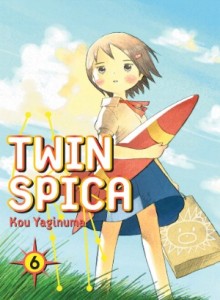
Twin Spica | Vertical, Inc. – Easily earning my vote for best new series this year, Twin Spica follows the adolescence of Asumi, an aspiring young astronaut in a time of recovery for Japan’s space program. From my review of volume one, “Though this series finished its run … just last year, its simple artwork and wistful tone make its first volume read like an instant classic. Even the volume’s cover art … evokes feelings of nostalgia. Also, though the story’s foundation is set firmly in hard sci-fi, it is its heroine’s poignant and occasionally whimsical inner life that really defines its voice. Asumi provides the heart of this story, and it is a strange and wonderful heart indeed.”
7 Billion Needles | Vertical, Inc. – This story, about an isolated young girl whose body becomes host to an alien entity, is psychologically-driven sci-fi of the very best kind. From my Pick of the Week, “Inspired by Hal Clement’s 1950s sci-fi novel, Needle, but set firmly in the present, this volume feels nostalgic and contemporary all at once … And though the premise is perhaps not quite original, as with most manga, the plot here is somewhat beside the point. The real story driving this volume is Hikaru’s own personal journey and the beginnings of her tenuous connection to the other seven billion people with whom she shares the planet.”

For the Young & Young at Heart
Here are some great choices that easily appeal to young and old alike.

Chi’s Sweet Home | Vertical, Inc. – Cute and simple enough for younger readers, but written originally for adults, Chi’s Sweet Home is the ultimate holiday gift this year, guaranteed to please nearly anyone. From my review of the early volumes, “Chi’s Sweet Home is the family-friendly manga we’ve all be waiting for. Its tiny feline protagonist is uniquely poised to appeal to readers of all ages, and even very young readers will find its image-heavy narrative easy to follow. Kanata’s simple, expressive art tells her story so clearly, it’s a series most of us could probably follow even if Vertical had printed it in the original Japanese.”
One Fine Day | Yen Press One of the few new manhwa series to debut this year, One Fine Day is filled with glorious whimsy, charming artwork, magic, and sweet scenes of home life between protagonist No-Ah and his furry “children.” From my review, “Perhaps the series’ most consistently delightful aspect, however, is its artwork. Alternating between crude sketches and elaborate fancies, Sirial’s drawings overflow with warmth and whimsy, matching the story’s tone perfectly. From No-Ah’s comically unmanageable hair to Rang’s footie pajamas, everything that could be labeled as “cute” is also an essential tool for expression, contradicting the series’ haphazard feel.”

Bang For Your Buck
For a whole lot of manga in just one or two volumes, here are gifts that come complete without breaking the bank!

Tenken | One Peace Books – This surreal fantasy, complete in one oversized volume, has an atypical look that may appeal to non-manga fans. Though it can be challenging to follow, the rewards are clear. From Julie Opipari, “I loved the brooding atmosphere of this post-apocalyptic tale … maybe it’s meant to be like a dream, one that fades and blurs after waking. One aspect of this story is crystal clear, and that is the compelling elegance of the visually arresting art. I am looking forward to more by Yumiko Shirai. Like Saki,her artwork shines with brilliance that can’t be ignored.”

Chobits Omnibus | Dark Horse Manga – This bulky, two-volume reissue of the entire series is a treat for CLAMP fans old and new. With a spiffy new translation and gorgeous color pages, these oversized volumes reflect the quality manga fans have come to expect from Dark Horse. From astronerdboy, “Considering the Japanese love of androids and 2-D characters, CLAMP’s work here lays out the groundwork that questions the very notions of love and whether or not a person having a relationship with a machine in human form is acceptable … Along the way, CLAMP picks up a lot of fun, sweetness, interesting characters, and a genuine mystery over Chi.”

Boys Who Love Boys
If your loved one’s a fan of boy on boy action, perhaps one of these?

Calling | BLU – Strong BL one-shots are difficult to find. Most try to accomplish to much (or too little), and few are able to create a believable relationship in just a few chapters. Fortunately, Calling strikes the balance. From my review, “Calling is a surprisingly sweet story about two lonely young men discovering love for the first time. Even the story’s obvious cliches are handled with nuance and care … If Calling is more warm than it is profound, that’s really not something to complain about. It’s the story’s focus on small moments that make it work so well in just a single volume. In a sea of disappointing BL one-shots, Calling is a welcome oasis indeed.”
Seven Days | Juné – Though the premise of this (yet incomplete) short series appears cringe-worthy, its execution is anything but. From my review, “There are a lot of layers to this odd little story, and though it’s unclear at this point how anything might be resolved … writer Venio Tachibana provides more than enough reason for us to want to find out. And though that reason includes school club drama, at least two love triangles, one wonderfully tough female character, and, of course, attractive archery uniforms, it’s still the story’s idiosyncratic leads who steal the show with a mountain of mixed signals, persistent defensiveness, and awkward moments of affection.”

For more ideas, try last year’s guide. Happy Shopping!

Filed Under: FEATURES Tagged With: gift guide

Fanservice Friday: Sundome

December 3, 2010 by MJ 2 Comments

Welcome to the second monthly edition of Fanservice Friday!

Today’s column is actually collaborative in a sense, and not hosted here in its entirety. Just yesterday, I appeared as a guest on the Manga Out Loud podcast, hosted by Ed Sizemore (Manga Worth Reading), where we discussed the manga series, Sundome, written by Kazuto Okada, and published in English by Yen Press.

The series mainly follows two Japanese teenagers, Hideo and Kurumi, who develop between them something very close to a classic dominant/submissive relationship (Hideo as the submissive party and Kurumi as the dom), presented in a fairly dark context of obsession and deep emotional damage (though not without some surprisingly warm moments).

For in-depth discussion of the series, please check out the podcast, though given the purpose of this column, I will take a moment to specifically mention the series’ dense volume of fanservice. There is so much of it in this series, in fact, I’m not entirely sure it can be properly categorized as “fanservice” which perhaps indicates something extraneous to the story. In the case of Sundome, “extraneous” could not be a less accurate description.

The entire series is steeped in erotic imagery, some of which could be characterized as quite crude, but with such a strong emotional core, it’s difficult to think of it as obscene, even in its most explicit moments. That the characters are high school students only makes the level of eroticism more disturbing, yet again, it’s so appropriate to the narrative and especially to Hideo’s point of view, it’s difficult to imagine the story working well without it. Eroticism is so much a part of the fabric of the story, anything less might just seem unbelievably coy.

One particular type of imagery, however, is used more prominently here than in any other manga I’ve personally encountered (which, in terms of this type of manga, is admittedly not all that much). That would be the constant presence of the cameltoe. Shots down the shirt or up the skirt are incredibly common, even in pretty mainstream shounen and seinen manga, but Okada’s obsession with the cameltoe is something new for me.

Observe.

Now, obviously I’m not necessarily the most appropriate judge in terms of appeal, but not only do I have difficulty finding this attractive, it mostly looks… kinda painful. Ouch.

As I mentioned in the podcast, given the sexual themes in the manga, I actually find the rather stunning wealth of male-oriented fanservice in Sundome mainly inoffensive, as it seems so integral to the series’ tone and plot. I find it quite a bit less offensive, in fact, than random, less explicit panty-shots tossed into standard fantasy or adventure manga.

What say you, readers?


Be sure to download this week’s Manga Out Loud podcast, and let us know what you think!

Filed Under: Fanservice Friday Tagged With: sundome

3 Things Thursday: Heroines for 2010

December 2, 2010 by MJ 15 Comments

This may not come as a surprise to most of you, but I spend a lot of time thinking about women in manga, both behind the pen and on the page. As I was pondering a topic for this week’s 3 Things, it occurred to me that I might like to pick out some of my favorite female leads from this year’s batch of new manga. What surprised me when I got down to it, however, was the realization that very few of my favorites this year come from the pages of shoujo manga.

While I’m not sure exactly what that says about me or the newest crop of shoujo, I’d certainly be interested in the discussion. In the meantime, lets take a look at three of my favorite heroines from the pages of this year’s debut series.

3 favorite heroines debuting in 2010:

1. Yukiko | All My Darling Daughters | Fumi Yoshinaga | Viz Media – Perhaps “heroine” is not quite the right word for Yukiko, but as the manga’s various stories are all threaded through her, I’ve decided she qualifies. In any case, I can’t let her go unrecognized.

What’s wonderful about Yukiko is that she’s entirely ordinary, in a way that makes clear just how individual “ordinary” actually is. She’s got average looks, an average job, an average relationship, and even a pretty average outlook on life, and yet both her story and her personality are just as intriguing as any “ordinary girl” who wins the love of a dashing hero, accidentally attains superpowers, and/or saves the world.

Yukiko’s a real everywoman. And every woman is awesome.

2. Asumi | Twin Spica | Kou Yaginuma | Vertical, Inc. – Asumi is a heroine after my own heart, mainly because of her skyward dreams and her rich inner life. She reminds me of myself as a young girl, though with a kinder heart and a much more tragic past. I’d like to have been strong enough at her age to reach out, without fear, to someone in need, even if that person was unfriendly to me, as she does with her deeply damaged classmate, Marika.

What’s especially enjoyable about Asumi’s journey, too, is that, though her ambitions are no less daunting than those of most fantasy heroines, she isn’t granted any special powers in order to achieve them. Her path entails numerous mundane obstacles, like scientifically-heavy schooling and real-world financial difficulties. Asumi is an idealized version of my young teenaged self, yet real enough that I can pick out exactly the ways in which I could have become her, with just a little more bravery and genuine self-awareness.

3. Shurei | The Story of Saiunkoku | Sai Yukino, Kairi Yura | Viz Media – Though Shurei’s happy-go-lucky attitude and strong sense of civil responsibility make her an ideal shoujo heroine, there’s a sense of deep intelligence and real mystery about her that somehow defies the norm.

Not that the norm is bad, mind you, but it’s refreshing to encounter a current shoujo heroine who has more on her mind than romance or the standard determination to “do her best!” Shurei does her best, all right, but she’s not necessarily forthcoming about what that is. She’s smart, she’s capable, and she’s every bit as interesting as the male characters who surround her–something that is not quite as common in girls’ manga as a reader might hope.

Honorable mention:

Chi | Chi’s Sweet Home | Konata Konami | Vertical, Inc. – I don’t cheat often in this column, but Chi is a kitty who demands special treatment, and who am I to refuse?

She’s cute, she’s fearless, she’s defiant when necessary, and she understands the value of good meal. What more could one ask for in a manga heroine? Though lately she’s been hanging with a questionable crowd, her love for her family shines through, even if they are too dense to understand her half the time.

With her bright, wide eyes and spunky personality, who could resist a cat like Chi?


So, readers, who are some of your favorite heroines from this year’s crop of manga?

Filed Under: 3 Things Thursday

3 Reasons to Read One Piece

December 2, 2010 by Katherine Dacey

Why would any sane person commit to reading a series that’s still going strong after sixty volumes? I can think of three compelling reasons why you should set aside your shonophobia — that’s Latin for “fear of incredibly long series with interminable fight scenes and characters who do their best” — and give Eiichiro Oda’s One Piece a shot.

1. THE ARTWORK

Though many shonen manga-ka love to populate their stories with flamboyantly ugly villains, Eiichiro Oda’s character designs are more memorable than his competitors’. That’s because Oda doesn’t just add a few scars and a crazy hairdo to distinguish the bad guys from the good; he creates every villain from scratch, making each garment, prop, tattoo, wart, and weapon a direct reflection of the character’s personality and personal history. The same goes for other supporting players: Oda emphasizes the greenness of one pirate’s kiddie followers by giving them vegetal hairdos, and the isolation of a pirate castaway by stuffing the character’s body into an empty treasure chest, with only Gaimon’s unkempt hair and feet poking out. (Gaimon gets one of the series’ best lines: “I used to have two eyebrows!” he exclaims, musing on his twenty years stranded on a remote island.)

Oda’s entire approach to drafting shows a similar thoughtfulness: his pirate ships, tropical islands, and sea coast villages are rendered in clean lines, with a minimum of screen tone. Oda relies instead on playful shapes to help set the stage, from a sea-going restaurant that looks like a cross between a carp and a Hong Kong dim sum parlor, to an island populated by rabbit-cobras, pig-lions, and rooster-foxes.

The only blind spot in Oda’s artwork is his female characters. Though he can draw a marvelous, gnarled pirate queen, as gloriously repulsive as any of the series’ other villains, his young, attractive girls are blandly interchangeable. Even as more female characters are introduced in later story arcs, their appearance seems more calculated to satisfy the male gaze than reveal much about their personality — besides, of course, the near-universal tendency among shonen artists to make a girl’s bust- and neckline a reliable predictor of her villainy.

2. THE LOVING SEND-UPS OF SHONEN CLICHES

One of the reasons I don’t read more shonen manga: I find the characters’ compulsion to shout the name of their fighting techniques kind of silly. (OK, a lot silly.) If anything, it brings back memories of the old Super Friends TV show in which the Wonder Twins clinked rings and announced that they’d be taking “the form of an ice sled!” or “the form of a green-striped tiger!” (If that was meant to be comedy and not a complete abdication of imagination on the writer’s part, I missed it.) Granted, InuYasha and Naruto boast cooler-sounding and more effectual powers, but the minute InuYasha yells “Wind Scar!”, I’m ripped out of the scene, pondering the need for such verbal displays.

In One Piece, however, Oda pokes fun at the practice by assigning his characters goofy powers with goofy names that are fun to say. Monkey D. Luffy’s Gum-Gum attacks are the most frequent and obvious example, as he pretzels himself into a Looney Tunes assortment of weapons and shields, but his crew mates also have a few tricks up their sleeves. The best of them, by far, is Tony Tony Chopper, a blue-nosed reindeer who also happens to be the ship’s doctor. His Human-Human powers enable him to assume a variety of forms, including a gargantuan were-reindeer that wouldn’t be out of place in the pages of Lycanthrope Leo.

Oda also walks a fine line between openly mocking his hero and using him to exemplify the “friendship, effort, and victory” motto that undergirds every Shonen Jump title. Monkey is, to put it nicely, one of the dumbest shonen heroes in the canon — and that’s part of his charm. Unlike, say, Naruto or Lag Seeing (of Tegami Bachi fame), Monkey’s single-minded pursuit of treasure is portrayed as a kind of insanity, not a sign of a stellar character. Monkey goes to extreme lengths to prove himself — not unusual for a shonen hero — but his behavior is clearly meant to be ridiculous. (In the very first pages of the series, he stabs himself in the face with a knife to demonstrate his imperviousness to pain, much to the horror of the assembled pirates.) Yet for all his ill-advised bravado, he’s a kind-hearted goof; anyone who demonstrates valor or integrity is invited to join his crew, regardless of the original circumstances under which they met Monkey. Again, those qualities don’t make Monkey unique, but they do make him appealing; he’s an indestructible hero who’s utterly fallible.

3. THE EXCELLENT ADAPTATION

Any text as thick with puns and pirate-speak as One Piece runs the risk of falling flat in translation, but the English-language adaptation is fluid, funny, and eminently readable. I can’t gauge how faithfully the VIZ edition adheres to the original Japanese, but the script’s buoyant, goofy tone complements the artwork perfectly, leading me to think that VIZ’s editorial team has given American audiences a reasonable approximation of the Japanese-language reading experience. Heck, they’ve even made Oda’s reader correspondence sound like a real, mischievous person answered those fan letters. Now that’s a good adaptation.

Filed Under: Manga, Manga Critic, Recommended Reading, REVIEWS Tagged With: Comedy, One Piece, Pirates, Shonen, Shonen Jump, VIZ

Off the Shelf: Sentimental Journey

December 1, 2010 by MJ and Michelle Smith 11 Comments

Welcome to another edition of Off the Shelf with MJ & Michelle! I’m joined, once again, by Soliloquy in Blue‘s Michelle Smith.

This week, Michelle continues her look at some final releases from Del Rey Manga, while I check out some new manga from Yen Press and Tokyopop.


MICHELLE: So, MJ. Read anything interesting on the internet today? :)

MJ: HAHAHAHAHAHAHAHAHAHAHAHAHAHAHAHAHAHA. Okay. *whew* Gotta recover here.

MICHELLE: Maybe we can recover by discussing some manga. By the way, you’re looking radiant tonight.

MJ: Why, thank you! You’re exceptionally brilliant, and possibly a little sparkly.

MICHELLE: Why, thank you for noticing. (I’m part vampire, you know.)

MJ: I suspected as much! Well, now that we both feel properly affirmed, I suppose we could talk about some manga.

MICHELLE: It is what we’re here for, after all!

MJ: Yes, yes, it is. So, usually I would save my favorite selection for last, but I admit that tonight I’m so anxious to talk about one of the manga I just read, that I’m going to just give in and go for it. I don’t know if you’ve read it yet, but I suspect you’re looking forward to it. Promise not to shriek when I tell you what it is?

MICHELLE: I will try to contain myself.

MJ: Good luck! As you may have guessed by this point, it’s Fumi Yoshinaga’s Not Love But Delicious Foods (Make Me So Happy), due out in December from Yen Press. As a fan of Yoshinaga’s previously-translated works, I’ve been eagerly anticipating this release for some time, though I knew very little about it, specifically, before I pulled open the cover. What I discovered inside was even more charming than I’d imagined.

The book is essentially a tour of several of the author’s favorite Tokyo restaurants, highlighting each establishment’s specialties, and including details ranging all the way from atmosphere to parking recommendations. What makes it especially rewarding for Yoshinaga fans, however, is that Yoshinaga herself stars as the main character, surrounded by her circle of friends. How much of this is fictionalized, of course we can’t know, but it feels so authentic, the overwhelming sense for readers is that we’re getting a peek into Yoshinaga’s private world, with a delightful view of her real-life quirks, hopes, desires, and of course, her obsessive love of food.

Yoshinaga portrays herself as an aging, neurotic slacker who eats like a horse, routinely spills food on her clothing, and has a thing for cute, chubby men, all of which makes her even more appealing to an older female reader like me. She strikes exactly the right balance between self-deprecation and self-love, warding off any danger of approaching either desperation or narcissism. She’s neurotic, sure, but also keenly self-aware, and her affection for her friends (be they real or fictional) is palpable.

There isn’t a real story to this manga, just a series of episodes moving from restaurant to restaurant, but what makes each chapter come together is a strong feeling of intimacy with the characters and the author’s characteristic banter. Humorous dialogue is Yoshinaga’s specialty, and she uses it to great advantage in this book, stringing together descriptions of complicated dishes in the most natural way possible. …

Read More

Filed Under: OFF THE SHELF Tagged With: ghost hunt, not love but delicious foods, papillon, summoner girl

  • « Go to Previous Page
  • Page 1
  • Interim pages omitted …
  • Page 468
  • Page 469
  • Page 470
  • Page 471
  • Page 472
  • Interim pages omitted …
  • Page 543
  • Go to Next Page »
 | Log in
Copyright © 2010 Manga Bookshelf | Powered by WordPress & the Genesis Framework