• Skip to primary navigation
  • Skip to main content
  • Skip to primary sidebar
  • Home
  • About Us
    • Privacy Policy
    • Comment Policy
    • Disclosures & Disclaimers
  • Resources
    • Links, Essays & Articles
    • Fandomology!
    • CLAMP Directory
    • BlogRoll
  • Features & Columns
    • 3 Things Thursday
    • Adventures in the Key of Shoujo
    • Bit & Blips (game reviews)
    • BL BOOKRACK
    • Bookshelf Briefs
    • Bringing the Drama
    • Comic Conversion
    • Fanservice Friday
    • Going Digital
    • It Came From the Sinosphere
    • License This!
    • Magazine no Mori
    • My Week in Manga
    • OFF THE SHELF
    • Not By Manga Alone
    • PICK OF THE WEEK
    • Subtitles & Sensibility
    • Weekly Shonen Jump Recaps
  • Manga Moveable Feast
    • MMF Full Archive
    • Yun Kouga
    • CLAMP
    • Shojo Beat
    • Osamu Tezuka
    • Sailor Moon
    • Fruits Basket
    • Takehiko Inoue
    • Wild Adapter
    • One Piece
    • After School Nightmare
    • Karakuri Odette
    • Paradise Kiss
    • The Color Trilogy
    • To Terra…
    • Sexy Voice & Robo
  • Browse by Author
    • Sean Gaffney
    • Anna Neatrour
    • Michelle Smith
    • Katherine Dacey
    • MJ
    • Brigid Alverson
    • Travis Anderson
    • Phillip Anthony
    • Derek Bown
    • Jaci Dahlvang
    • Angela Eastman
    • Erica Friedman
    • Sara K.
    • Megan Purdy
    • Emily Snodgrass
    • Nancy Thistlethwaite
    • Eva Volin
    • David Welsh
  • MB Blogs
    • A Case Suitable For Treatment
    • Experiments in Manga
    • MangaBlog
    • The Manga Critic
    • Manga Report
    • Soliloquy in Blue
    • Manga Curmudgeon (archive)

Manga Bookshelf

Discussion, Resources, Roundtables, & Reviews

Features & Reviews

Manga the Week of 9/14

September 7, 2011 by Sean Gaffney

Given that next week is all about Yen Press, let’s start with them. (Yes, I know Sailor Moon and Sailor V come out 9/13. Did you really expect Diamond to ship it on the same day it hits bookstores? Have you been reading my posts at all this year?) There’s lots of stuff from Yen that deserves mention, but I want to focus on one title in particular first.

With the Light, a manga about a young mother struggling to raise her autistic child, was one of Yen’s first manga series announced, and their most exciting. A josei manga that clearly was intended to be marketed to a much broader audience than anime fans, it was a sign of great things to come. And it turned out to be even better when you read it, heartwarming and inspiring. Sadly, the author passed away before she could finish the series. Yen has worked with Akita Shoten to make the final volume, out next week, as complete as it is possible to be. Everyone who loves manga that goes outside the boundaries of ‘fight, train, laugh’ should pick up this series.

Of course, Yen has other stuff too. There’s Bamboo Blade 10, which is about to start up its next big arc. There’s Bunny Drop 4, which is a big turning point in the series. My Girlfriend’s a Geek 4 will no doubt feature more knowing humor about the fujoshi lifestyle. Zombie Loan… I’ve never read, I admit. I presume it’s about a library where you borrow zombies for things they’d be useful for? And the cute moe librarians who run Zombie Loan? No?

And though I don’t cover manwha, I suspect I would be filleted by my fellow Manga Bookshelf colleagues if I did not mention the new Goong and Raiders manga. And for fans of OEL, there’s Svetlana Chmakova’s new series Witch and Wizard, which is written by some other guy… oh right, James Patterson.

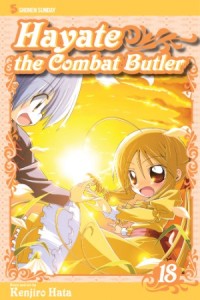
Viz also has titles! Albeit not many. But one is the 18th volume of Hayate the Combat Butler! Yes, it’s down to twice a year, and it seems to only garner bad reviews online these days (that will change when I get a hold of it), but this one resolves the ‘End of the World’ arc in a dramatic way, then kicks back to the comedy. And another final volume, as Detroit Metal City comes to a close. I kind of lost track of the series after the first couple of volumes, but I have a lot of friends who love it.

And Dark Horse is putting out the first volume of Yasuhiro Nightow’s new series, Blood Blockade Battlefront, no doubt meant to appeal to Trigun fans the same way Drifters is clearly designed to appeal to Hellsing fans. Sadly, on advice from my doctor, I can’t actually look at Nightow’s artwork anymore without a 24-hour nurse by my side, so I did not preorder it. But I’m sure hardier people than I will be willing to read it and try to figure out what the hell is happening in the panels.

(Apologies to Dark Horse… if it helps, I’ll be praising Drifters soon.)

So what intrigues you this week?

Filed Under: FEATURES

The Favorites Alphabet: B

September 7, 2011 by David Welsh

Welcome to another installment of the Favorites Alphabet, where the Manga Bookshelf battle robot gingerly approaches our meticulously organized collections to pick a favorite manga title from each letter of the alphabet, whenever possible. We’re trying to stick with books that have been licensed and published in English, but we recognize that the alphabet is long, so we’re keeping a little wiggle room in reserve. And sometimes you can’t pick just one.

“B” is for…

Banana Fish | By Akimi Yoshida | VIZ Media — Given my frequent posts on the subject, this choice likely comes as no surprise. Yet even after all that verbiage, I think I’ve talked very little about one of the main reasons I so love this series. Yes, it’s got fast-paced action, well-developed characters, and an almost-BL vibe to die for, and watching Yoshida’s artistry develop over the course of 19 volumes is truly a pleasure. But one of the series’ greatest draws for me is very simply its sincerity. I recently described another manga as reading like “a bad teen-penned novel,” and while Banana Fish shares some of the same over-the-top sentimentality and naive fancy that tends to characterize stories written by teens, like S.E. Hinton’s The Outsiders, Banana Fish reads like a great one. Yoshida offers up genuine intrigue and compelling action sequences, but her most winning quality as a writer is how sincerely she loves her characters, even when she’s putting them through hell.  This is a series I’ve read and re-read, and will likely read many times more before my eyes finally give out on me. Melodrama and all, it’s one of my favorite manga of all time. – MJ

Basara | By Yumi Tamura | VIZ Media — I hardly know where to start in extolling the virtues of Basara, Yumi Tamura’s epic 27-volume shôjo manga about a girl named Sarasa who assumes the identity of her twin brother Tatara (the so-called “child of destiny”) after his death and leads her people in revolt against a tyrannical king. Sarasa is highly competent and inspires the admiration and loyalty of people from all walks of life, but Tamura never lets us forget that this strong leader is also just a girl who experiences feelings she doesn’t understand and who denies herself a lot in order to be who the people need her to be. Just thinking about the reveal that it’s actually Sarasa who’s been the “child of destiny” all along literally gives me goosebumps. I’d urge everyone to read Basara, even though some volumes are notoriously hard to come by. It really is worth the effort. — Michelle Smith


Black Blizzard | By Yoshihiro Tatsumi | Drawn & Quarterly — I’ve found most of Yoshihiro Tatsumi’s work too bleak, too macho, or too bleakly macho to appeal to my own sensibilities, but Black Blizzard is a notable exception. Dating from the late 1950s, it’s thoroughly enjoyable pulp: a young murder suspect and a jaded criminal escape from custody into a raging snowstorm, police hot (cold?) on their heels. The story’s weaknesses are easy to catalog: the plot developments can be seen coming from a mile away, the characters are little more than types, and the ending is too compressed to be truly satisfactory. Black Blizzard leaves a fresh impression nonetheless, thanks to Tatsumi’s rough, energetic artwork; with all the slashing lines and images of trains in motion, you’d be forgiven for thinking that an Italian futurist had taken a stab at writing a comic book. — Kate Dacey

Black Jack | Osamu Tezuka | Vertical, Inc. — Part House MD, part globe-trotting adventure, Black Jack is easily Osamu Tezuka’s most accessible work. The stories often flirt with the outrageous: Black Jack performs a brain transplant, treats an extraterrestrial, and operates on himself while fending off dingoes in the outback. Yet the human dimensions of every story are never overwhelmed by the questionable medical diagnoses; at their best, the stories are parables about the importance of humility, responsibility, patience, and loyalty, using illness and injury to show us the best — and worst — of human nature. (Also: to show us that Black Jack is a complete bad-ass with a scalpel.) The series’ popularity meant that Tezuka cranked out more Black Jack tales than he probably should have (see “treats an extraterrestrial,” above), but even the weakest entries in the collection are still a lot of fun. — Kate Dacey

Black Jack | Osamu Tezuka | Vertical, Inc. — I’m going to second Kate’s endorsement of Black Jack for a very specific, possibly irrational reason. Sometimes a title becomes a favorite simply by virtue of the presence of a supporting character. In the case of this series, that character is Pinoko. She’s surly old Black Jack’s adorable kid assistant, except she’s actually a parasitic tumor that gestated for years in her twin sister’s abdomen until the good-bad doctor cut her out and gave her a twee little plastic body and took her in as his ward. Pinoko is wrong on every conceivable level – an 18-year-old woman with no meaningful life experience trapped in the body of an artificial child. On some subliminal level, I think every adorable kid sidekick is creepy, but Tezuka just goes there, and Pinoko’s every appearance is an unsettling, mildly heartbreaking, inappropriately funny treat. There are certainly Tezuka titles I like better than Black Jack, but there’s probably no Tezuka character who haunts me quite like Pinoko. – David Welsh

Bleach | By Tite Kubo | VIZ Media — In general, I enjoy talking about manga because I love it. I love finding underrated series I can promote the hell out of, I love reading the romantic ups and downs of a couple that grow and learn at a snail’s pace because it’s funnier that way, and I enjoy watching big guys hit each other. But sometimes you get obsessed with manga that you like… and hate as well.  It can be so good…  and so frustrating. No title currently being released over here does this to me more than Bleach, the second of Viz’s ‘Big Three’ Shonen Jump titles. Bleach has a fantastic cast of characters… who it abandons for years at a time to focus on other new characters. It has emotional resonance… which can sometimes get incredibly ham-fisted.  And while some manga work better in weekly installments, or in volumes, Bleach is one that works best by reading 5 volumes at a time then ignoring it for 6 months. Oh, and the shipping. God, the shipping. Love it or hate it, folks can’t stop talking about Bleach. Which, honestly, is even more valuable in a manga than a title that’s merely liked by everyone. — Sean Gaffney

What starts with “B” in your Favorites Alphabet?


Filed Under: FEATURES

Book Girl and the Captive Fool

September 6, 2011 by Sean Gaffney

By Mizuki Nomura. Released in Japan by Enterbrain. Released in North America by Yen Press.

By now I’ve grown somewhat used to how a Book Girl novel will feel. It will be based around a book of some sort (in this case, Saneatsu Mushanokoji’s 1919 novel Friendship) and the mystery plot will parallel the book in some way. It will flesh out the backstory of one of the minor characters we’ve met in the previous books. There will be dark, emotional themes that will connect with Konoha’s own thoughts and emotions. And in the end, Konoha will have grown a little bit more and moved on a bit from the girl in his past he can’t let go of.

But in general, the plot and mystery is not why anyone reads Book Girl. There were a few mystery aspects in this book, but I guessed at the most important one straight away, so they didn’t matter as much. However, it’s the characterization, style and prose that keep you coming back here, and in that respect Captive Fool is a worthy successor to the first two books.

This volume focuses on Konoha’s stoic and calm friend Akutagawa, and the discovery that much of his personality is a mask he puts on to conceal his past tragedies – both from others and from himself. Of course, this sounds a lot like what Konoha is doing now, and the irony is not lost on him. What’s more, the girl who was the focus of the first novel, Takeda, shows Konoha that being ‘cured’ of crushing emotional despair is not something that can happen over the course of a few weeks.

Much of the impetus of this book revolves around being unable to move on from a past tragedy, to the point where self-doubt and pressure make it impossible for you to do anything. Again, these novels are written for 15-17 year old readers, and I think these emotions would resonate well with them. How do you talk with someone after “ruining their life”? What if you make the exact same mistakes? What if one kind action turns out to be absolutely the wrong thing to do?

The author also manages to convey this to Konoha, the one who really needs to hear these words, in a way that doesn’t sound like everyone is acting as his therapist. The book Friendship mentioned above is being performed by the Book Club (and their assorted hangers-on) as a play, and so we see similar doubts and feelings play themselves out on three levels – elementary school (Akutagawa’s past), high school (Konoha’s present), and adulthood (the events of the novel/play). Growing up doesn’t always solve the problem.

Then there’s the ending to the book. I had discussed this with another reader, and it was felt that the revelation (which was a bit of a surprise, but not the complete shocker it was meant to be) was somewhat underwhelming, especially given that we’re only 3 volumes into what promises to be an 8-book “main story”. It seems a bit early for this particular plot gun to be fired off, in my opinion. But if nothing else, t shows us that when you are somebody’s mirror, you take on the same qualities as the person you are mirroring. Even if it’s unintentional.

Again, what I love most about this series is how much it makes me think about human nature. We see the growth of the characters, and even though it’s through artificial “what’s the mysterious tragic past of the novel?” means, that doesn’t make it less valid. And yeah, given the arc, I suspect the next book will focus on whatever demons Kotobuki has. But the writing and characters really make me want to find out what happens next. A great page turner, highly recommended.

Filed Under: REVIEWS

Bookshelf Briefs pointer

September 6, 2011 by Sean Gaffney

For those who read my reviews by category (like me), I have reviews of Deltora Quest 1, The Melancholy of Haruhi Suzumiya 9 and The Story of Saiunkoku 4 in this week’s Bookshelf Briefs.

I also review the first volume of Soredemo Machi wa Mawatteiru in this month’s Going Digital.

Filed Under: REVIEWS

Bookshelf Briefs 9/5/11

September 5, 2011 by MJ, Sean Gaffney, Katherine Dacey, David Welsh and Michelle Smith 6 Comments

This week, Sean, Kate, David, MJ, & Michelle look at recent releases from Yen Press, Kodansha Comics, Viz Media, and Digital Manga Publishing.


Black Bird, Vol. 10 | By Kanoko Sakurakoji | Viz Media – Dear Black Bird: I’ve nearly defeated you. After allowing you to work me into a state of blind fury over the course of nine volumes, I’ve finally become indifferent to your crimes. The constant belittlement of your heroine, her permanently flushed face—even the way your beloved hero always manages to blame her for his most abusive behavior no longer has the power to affect me. Wait, what am I saying? Okay, I admit I lied. You did get to me by the end of the volume, you sneaky devil. Sorry about those pages I ripped up and burned, but you have to admit you were asking for it. After all, I think you said it best. “There are times I want to treat you really well … and times when I want to treat you mean and make you cry … Which way I lean all depends on you. So don’t blame it all on me.” – MJ

Bleach, Vol. 36 | By Tite Kubo | Viz Media – It’s easy to become jaded as a manga reviewer, especially when it comes to long-running shounen manga. Though some series manage to transcend formula, others just seem to settle in, churning out pages of endless battles, increasingly generic foes, or whatever popular staples their genres require. Bleach has long walked the line between the two, just barely balancing compelling drama with mind-numbing repetition. After volume 35‘s strict conformity to this pattern, nothing could be more surprising than volume 36. Completely abandoning (for the moment) the battle set up in the volume before, Bleach 36 dives back into the past, promising new and exciting revelations about characters we already care about, including the enigmatic Kisuke Urahara and the entire lot of Visored. Though future tedium undoubtedly awaits, for the moment, Kubo gives us his very best. Unexpectedly recommended. – MJ

Deltora Quest, Vol. 1 | By Emily Rodda and Makoto Niwano | Yen Press –As a reviewer, sometimes you have to try to avoid the easy way out and grind through why you couldn’t really enjoy a title. It’s tempting, especially with a title as dull as Deltora Quest was, to simply wrote “No.” as a review and be done with it. But it’s my own fault, as I ordered the book even knowing that sword-and-sorcery fantasy is one of my least favorite genres, because it was part of a big pile of Kodansha Vol. 1s. And I have not even read the original novels by Emily Rodda either. Oh, and I’m not a 9-year-old boy. So, honestly, it should come as no surprise that I found this manga a tedious slog, with two-dimensional characters, action scenes where I kept flipping the pages faster and faster, and tortured exposition. Best of all, a time skip at the end shows us that the entire volume was mere prologue for the real story, which begins with the son of our protagonist next time. Also, kings should know better than to have grand viziers by now. It’s just asking for trouble. Skip this.– Sean Gaffney

Mardock Scramble, Vol. 1 | By Tow Ubukata and Yoshitoki Oima | Kodansha Comics – Mardock Scramble walks a fine line between dark and glum. The premise places it squarely in dark and compelling territory: a young woman gets a second chance at life — and a chance to bring her would-be killer to justice — after getting a bionic woman makeover. Rune Balot’s reluctance to embrace her new abilities, however, frequently threatens to drag Mardock into glum terrain; though it’s entirely plausible that someone as damaged as Rune isn’t ready to get all Lady Snowblood on her abuser’s ass, watching her passively resist self-actualization is a depressing and frustrating spectacle. Only the presence of Oefcoque, a cyborg mouse capable of transforming into just about anything, prevents the story from collapsing under the weight of its own grim agenda. – Katherine Dacey

The Melancholy of Haruhi Suzumiya, Vol. 9 | By Nagaru Tanigawa and Gaku Tsugano | Yen Press –This volume takes us through the end of Disappearance. For the most part, once again it’s simply poor when compared to the novel and the anime. I’ve no frame of reference to gauge how I’d feel about it if I hadn’t read/seen either of those, but I suspect I’d still find it wanting. I did note that Asakura is drawn far peppier and less evil/menacing than she appeared in the movie, which makes her final scene even creepier. There’s also a bonus story of the Christmas Party itself (which involves accidentally creating an ancient Egyptian hot pot), and another one set in Edo times (with Edo Haruhi being just as bad as the modern one, and wanting the perfect cup of tea), but neither add anything of note to the canon, nor are they bad enough to be entertaining on their own like the boxing story was last time. Substandard, though Vol. 10 apparently features Love at First Sight, a story as yet unanimated, so maybe it can try again there.– Sean Gaffney

Phoenix Wright: Ace Attorney, Vol. 2 | By Kenji Kuroda and Kazuo Maekawa | Kodansha Comics – I described the first volume of Phoenix Wright: Ace Attorney as “blah,” and I’m pleased to report that second volume is more to my liking. I’m still having issues with suspension of disbelief—ask me to believe in yokai, cyborgs, or reincarnated moon princesses and I’m fine, but ask me to believe that suspects go on trial two days after the crime, and I balk—but I’ve been (mostly) won over by the Case Closed vibe the kooky murder methods conjure. It doesn’t hurt that half of this volume is occupied with investigating the murder of an amusement park employee who was garbed in the furry mascot costume of a character named “Twinklestar” at the time of his death. Phoenix and his assistant Maya take it seriously, of course, but I enjoy the sheer absurdity of it all. – Michelle Smith

The Story of Saiunkoku, Vol. 4 | By Sai Yukino and Kairi Yura | Viz Media –First of all, I cannot emphasize enough how disappointed I am by Ensei shaving. His rough and tumble beard made him look like a man from a completely different world in this manga filled with interchangeable bishies. Now he’s just another one of them. At least he has a scar, but still, it’s the principle of the thing. In addition, we get hung up here with a classic problem adapting a prose novel to visual – someone has been described as inhumanly beautiful. The artist does their level best, but in the end, nope, just another pretty bishie. To be fair, it’s impossible to draw ‘inhumanly beautiful’, so they did their best. As for the manga itself, it’s still good, mainly focusing on court intrigue and Shurei’s learning curve, with only a brief stop at romance (I am highly amused that the emperor is doing the right thing entirely through instinct, rather than overthinking things. An excellent read.– Sean Gaffney

Warning! Whispers of Love | By Puku Okuyama | Digital Manga Publishing – This addition to the reading list was the result of one of my boys’-love polls , monthly quests where I try to find gems among the new BL and yaoi releases. Okuyama’s storytelling has its charms, but I found myself wishing for a little more genuine feeling mixed in with the antics. The title story is about a game of cat and mouse between two high-school students where both realize they enjoy the game. Logic isn’t driving the bus here, but Okuyama manages a pretty good, weird, recurring joke along the way. The middle piece, about a guy who values his solitude taking in a roommate on impulse, brings more emotional authenticity to the table, though the creator clearly has a possibly excessive fondness for flaky gamines. The last story is pretty much all antics, but at least there’s a really cute dog to distract me from the underdeveloped human characters in the story. This was pleasant enough, but I don’t think I’d rush to read more of Okuyama’s work. – David Welsh

Filed Under: Bookshelf Briefs

Going Digital: September 2011

September 4, 2011 by MJ 5 Comments

Welcome to Going Digital, a new, monthly feature focusing on manga available for digital viewing or download. On the first weekend of each month, the Manga Bookshelf bloggers will review comics we’ve read on our computers, phones, or tablet devices, to give readers a taste of what’s out there, old and new, and how well it works in digital form.

This month, we take a look at manga published for viewing on the iPad, Kindle, and web browser. Device, OS, and browser information is included with each review as appropriate, to let you know exactly how we accessed what we read.

iPad

Lone Wolf and Cub, Vol. 1 | By Kazuo Koike and Goseki Kojima | Dark Horse App | iPad 2, iOS 4.3 – Reading comics on a tablet adds a whole new decision-making category. In the old days, there were simply comics you wanted to read enough to own and comics you didn’t. (I say this as someone who isn’t fortunate to live near a library with a large selection of comics.) Now, with a number of publisher-specific applications, there’s a new subset: comics one might like to read, assuming they didn’t have to kill a tree to do it, which can be purchased for less than the cost of a physical copy.

Lone Wolf and Cub is sort of the perfect inaugural for me in this category. It’s a very accomplished work, one that arguably belongs in a theoretical canon of licensed manga, but its subject matter doesn’t speak specifically to me as a reader. I enjoy reading the comic and find the variations on its episodic core – accomplished killer uses a baby in his murder-for-hire work – very clever and perversely funny, but I don’t necessarily want a whole shelf of volumes staring down at me. It’s great pulp, which isn’t something I want to read often or read repeatedly, but it’s something I can enjoy occasionally on a rainy weekend afternoon.

Koike does a splendid job coming up with scenarios that call for the specific, almost superhuman skills of his assassin protagonist. Koike also throws in some marvelous use of the assassin’s toddler companion; he’s a spooky little presence, and Koike invites the reader to wonder just how aware the kid is of how he’s being used. Kojima does absolute justice to the material, from evocative period details to energetically staged violence to ostensibly adorable little kids. Kojima makes it all happen in a seemingly effortless and fluid way, which is just what this kind of material demands.

I know a lot of people view this title as a classic, and it might be slightly sacrilegious to view it as an amusing diversion, but that’s my response, and it’s the reason I’ll keep it in mind when making manga purchases on my tablet. — David Welsh


Kindle

Hot Steamy Glasses | By Tatsumi Kaiya | Digital Manga Publishing | Kindle (3rd Generation) – Like many Americans, I got a Kindle last Christmas. One of the first purchases I made for the device was Hot Steamy Glasses, a BL title from DMP. Here is a dramatic reenactment of what happened next:

“The book downloads onto the Kindle. Michelle opens it. “Wow, this looks like crap,” she thinks. “I shall hit this button that resizes text.” Nothing. “I shall try zooming.” Teensy improvement ensues. “Well, so much for that, then.”

I never bought another manga for the Kindle after that, and I never read Hot Steamy Glasses, either, until now.

While it’s absolutely true that there is no real way to enlarge the text and that it is pretty durn small, it’s still readable and I got used to it after a while. It’s not a comfortable experience, though. It’s also impossible to offer any kind of art critique if you’re reading manga on the Kindle; as opposed to the crisp black-and-white pages you’d get at VIZManga, for example, on a Kindle everything is just sorta blurry and grey. On the plus side, at least I can sit on my couch and read.

Hot Steamy Glasses itself is oddly mediocre. It isn’t bad, but it’s pretty shallow and unconvincing in its portrayal of a determinedly straight guy (Fumiaki) who finally admits that he reciprocates the feelings that his long-time friend (Takeo) has been confessing for ages. There are some amusing things about it—once Fumiaki finally agrees to go out with Takeo, they spend their first five weekends sitting around watching anime, and it turns out that Takeo’s ideas about “going out” are incredibly pure. But I just never really bought Fumiaki’s sudden transformation, and kept expecting Takeo to end up with Fumiaki’s much nicer younger brother instead.

I guess paying $6 for a Kindle edition of a book I didn’t like very much is better than paying $13 for same, but my advice to those considering reading manga on their Kindle is simple: “Don’t.” – Michelle Smith


Web Browser

Madame Joker, Vol. 1 | By Naka Tomoko | Futubasha/JManga | OSX 10.6.7, Firefox 5.0 – As a woman of a certain age, I’m temperamentally predisposed to liking stories about women who are smart and confident but not in their first blush of youth. So when I read the description of Naka Tomoko’s Madame Joker, I knew I had to read it:

“Ranko Gekkouji; a woman, a widow, blessed with wealth, with beauty, and with adorable children. Everyone is jealous of her gorgeousness, the envy towards her countless. But, that won’t stop Ranko as she fearlessly solves cases!”

Alas, the execution isn’t quite as fabulous as the summary. Though Ranko is a brash, memorable character, the script suffers from a bad case of obviousness. Ranko’s family members spend a lot of time telling each other how they’re related and explaining Ranko’s behavior, though even the least attentive reader could deduce these things for herself. The description, too, makes Ranko sound like Jessica Fletcher’s spry, sexy daughter-in-law, when in fact Ranko is more of a clever meddler than a Miss Marple-in-training, derailing a two-timing novelist’s career and thwarting a hostess’ scheme to marry for money. And the artwork! “Hot mess” is being kind.

For all its clumsiness, however, Madame Joker scores points with its strong cast of female characters. Ranko and her mother-in-law are both appealingly frank, discussing men, sex, and money with a salty candor that’s hilarious; neither seems the least bit concerned with appearances, either, doing and saying what they please, even when it scandalizes the men of the household. It’s a stretch to call Madame Joker a female empowerment fantasy — Ranko’s power, after all, comes from being a beautiful, rich widow, not a surgeon, police officer, or mother — but it’s fun to see a forty-something women get to enjoy traditionally male privileges. – Katherine Dacey

******

Soredemo Machi wa Mawatteiru, Vol. 1 | By Masakazu Ishiguro. | Shonen Gahosha/JManga | Windows XP, Firefox 6.0.1 – I had recommended this Young King OURS title when we were discussing JManga, mostly for the virtue of being a title that was a) available and b) not from Futabasha or Leed, as I didn’t want to be too biased towards one publisher after my prior Futabasha reviews. JManga seems to be pushing it hard as well, having it be #1 on their list of ‘100 unpublished in NA manga’ on the site. Unfortunately, the manga doesn’t quite live up to the hype.

It’s not actively bad, and certainly good for a chuckle, but seeing this comedic take on a cafe, and the life of the plucky yet dense heroine, Hotori, who works there as a maid, I was reminded that most of the slice-of-life we see here these days tends to be 4-koma style. This has regular 16-17 page chapters, and as such I think I was expecting more forward plot and character development than there ended up being. There does seem to be a bit of a plot hook in Hotori being a mystery addict; in fact, the best chapter was one where she actually got to be clever, deducing a mystery about a 4-eyed painting.

Unfortunately, most of the volume is more about watching goofy Hotori do dumb things. The translation is decent – there were a few parts that even seemed to be adapted with an English reader in mind (Hotori worries about PETA after trying to capture a tailless cat), but overall there wasn’t quite enough here to make me hungry for future volumes. — Sean Gaffney

******

Tired Of Waiting For Love | By Saki Aida & Yugi Yamada | Digital Manga Guild/eManga | Mac OS 10.7.1, Safari 5.1 – Kyousuke Sawaragi has been sentenced to five years in prison for dealing drugs for his yakuza boss. There, he meets Sone, a violent yakuza from a rival group, and his prison plaything, Shuuya. Though reluctant to get mixed up with either, Sawaragi finds himself protecting Shuuya and even becoming his cellmate, though he carefully resists Shuuya’s grateful advances. Once released from prison, Sawagari sheds his former life and devotes himself to the care of his widower brother-in-law and young nephew, but his past comes back to haunt him when he discovers Shuuya collapsed on the street.

This one-shot is significant as the first release from Digital Manga Publishing’s Digital Manga Guild, a new initiative intended to harness the talent and enthusiasm of fan translators, editors, and letterers in order to publish more manga in English without the prohibitive up-front costs associated with traditional licensing. Whether the DMG system is fair to its localizing teams or healthy for the industry as a whole is a conversation for another day, but what’s clear from the initiative’s first release is that it is capable of producing work roughly on par with DMP’s more conventionally localized works.

Kimiko Kotani, the one-woman localization team behind Tired of Waiting for Love, is clearly competent, though she does have her awkward moments when it comes to English prose. Sentences like “I have always lived my life the way that I wanted to live but the water that I was led to drink that should have been sweet, was always bitter,” cry out plaintively for editorial attention to punctuation and flow. Fortunately, these instances are few, and Kotani ultimately offers up a product that is clear, readable, and vastly more professional-looking than much of DMP’s other digital-only venture—its Harlequin Manga line.

It helps, of course, that the material is strong, particularly for a BL one-shot. Author Saki Aida and artist Yugi Yamada have crafted a touching, visually expressive tale that manages to maintain emotional believability within what is essentially a fantasy setting. And though the story never strays away from familiar BL territory, it’s consistently engaging.

All-in-all, Tired of Waiting for Love is a promising debut for both Kotani and the Digital Manga Guild. – MJ


Some reviews based on digital copies provided by the publisher.

Filed Under: Going Digital

Cardcaptor Sakura Omnibus, Vol. 2

September 2, 2011 by Sean Gaffney

By CLAMP. Released in Japan by Kodansha, serialized in the magazine Nakayoshi. Released in North America by Dark Horse.

The second omnibus of Cardcaptor Sakura gives us Vol. 4-6 of the original series, which was effectively the end of ‘Season One’ of the manga. As such, Sakura continues to find and capture Clow Cards one by one, gaining strength and confidence, until the climax where she is forced against the most powerful card – and a powerful enemy. Or is he?

I always have to remember to downshift my brain a bit when I read the early 90s shoujo stylings of Cardcaptor Sakura. In a modern, 21st century world where most manga, shonen and shoujo, are targeted to the largest possible market, it’s refreshing to see something that is clearly meant to primarily entertain 6 to 8-year-old girls. That said, the downside to this – although perhaps not a downside so much as simply a different way of seeing things – is that there really doesn’t seem to be much happening for the first two thirds of this book.

There’s certainly lots of entertaining things going on. Kaho Mizuki, the new teacher of Sakura’s that showed up at the end of the last book, continues to hang around, trying to guide Sakura by means of subtle hints and gentle boosts to her confidence. The relationship between Sakura’s brother Toya and his friend Yukito is subtle (well, really, everything about Toya is subtle – he’s not a man of many words or emotions), but also nice to see defined as much as it’s going to be in this sort of manga. And the chapter where Sakura and Syaoran have to put on a play is the funnest of the lot, with some classic gender reversal going on, and Yamazaki at his funniest.

That said, it does seem to meander a bit, so I was quite happy when things started to heat up towards the end. CLAMP have a lot of plot gun surprises going on, most of which they did a good job of building up to or giving hints for, and they pop out one by one – Cerebus’ true form, the final Clow Card, the Card’s other guardian, and finally Sakura, having proven that she can capture the cards, has to be judged worthy of being the cards’ leader. Of course, the outcome is not really in doubt – Sakura has spent the previous five books being awesome, after all, it’s not going to reject her right at the end – but the way that the cards end up judging her, rather than Yue, the aforementioned guardian, is excellent. As for Yue’s identity, it gives him a certain gravitas that I don’t think he’d have had as ‘just a random, last-minute character’, and adds some depth to his alter ego as well.

I missed Tomoyo, who was all over the first volume of these but appeared far less in this one. Syaoran is clearly the co-star of the series with Sakura now, and though we have not yet approached the romance stage – Sakura’s still far too young and naive – it’ clear that’s where we’re headed. I also note that people who like shaded characters and some flaws in their heroes are going to have issues with this manga – Sakura may worry and lack confidence at times, but she’s also a kickass magical girl good at sports and beloved by all her friends. As for Kaho, I like her, but I wish she was less nice and sweet. Everyone’s kind and considerate and seems to have all their ducks in a row, so to speak.

So it’s not exactly great angsty drama, but the second CCS omnibus is fun, fluffy magical girl shoujo that is perfect for a young girl wanting to read some manga. And Dark Horse’s presentation matches the first volume – crisp, sharp images, nice thick paper, oversize, and with lots of color pages. Also, despite being CLAMP, fear not – this series has an ending. Though not quite yet. Volume 3 will arrive soon, and bring with it one of the most controversial characters in the series, Eriol.

In the meantime, we have this book. Guaranteed to make you feel all floaty.

Filed Under: REVIEWS

A Yumiko Ôshima sampler

September 2, 2011 by David Welsh

This week’s radio programming has me curious about the work of a relatively unknown-to-me member of the Year 24 Group, Yumiko Ôshima, so let’s take a look at some of her works!

It seems like her best-known is The Star of Cottonland, which ran for seven volumes in Hakusensha’s LaLa. It’s about a kitten who falls in love with the human who cares for her and assumes that she’ll grow up into a human at some point so they can be together. When this dream is derailed, she hears of Cottonland, a place where dreams come true, and she sets off to find it. It’s credited with popularizing the cat-girl aesthetic (the kitten is rendered as a human with cat-ears), and it won the Kodansha Award. It was also adapted into an animated motion picture. My limited experience with manga pets falling in love with their owners has left me a bit unenthusiastic about that particular trope, but it’s a classic, and it’s from a Year 24 Group member, so I must support its eventual publication in English and hope for the best.

The title alone is enough to make me want someone to publish Banana Bread no Pudding, which ran for one volume in Shueisha’s Monthly Seventeen. Who doesn’t like banana bread? And pudding? This one’s about a young woman who feels adrift as her beloved older sister plans to marry. The younger sister becomes involved with an older, closeted gay man. I don’t need to tell you that this isn’t the solution for anything, except possibly a deportation threat, but I’d still read about it.

Ôshima seems to pack a lot into one volume with Tanjou!, which ran in Shueisha’s Margaret. A high-school girl gets pregnant to escape her strict home life, which (and I cannot stress this enough) isn’t the solution for anything, but props to Ôshima for addressing it way back in 1970. The pregnancy ends up being the least of the girl’s woes, or it at least seems to trigger a whole bunch of new woes, which is certainly more realistic than Teen Mom seems to be.

We’re back to cats, though in a vastly different context, with Guuguu Datte Neko de Aru, an autobiographical series that’s running in Kadokawa Shoten’s Hon no Tabibito. It’s about the loss of Ôshima’s beloved cat, subsequent writers block and illness, and the healing power of the new kitten she welcomes into her life. I think I must have something in my eye. Excuse me.


Filed Under: LICENSE REQUESTS

Off the Shelf: Three from Kodansha Comics

August 31, 2011 by MJ and Michelle Smith 8 Comments

MJ: Well, howdy, stranger.

MICHELLE: Howdy. This place looks like a ghost town. Check out that well-timed tumbleweed.

MJ: Do you think we can bring it back to life?

MICHELLE: I reckon we can. Especially if we can rustle up some of them ladies of ill repute.

MJ: Oh, good idea! I’ll see what I can come up with on that front. In the meantime, you wanna tell us what you’ve been reading?

MICHELLE: I guess it’ll pass the time.

A whole bunch of new series from Kodansha have debuted this month, so I checked out a couple of those. The first was Animal Land by Makoto Raiku, whose Zatch Bell! was previously released by VIZ. I wasn’t sure if I’d like this and, even after having read it, I’m still not quite sure what to make of it.

Monoko the tanuki lost her parents to wildcats three months ago and is very lonely. One day, when she’s trying to catch a fish in the river, she spots a floating basket with a baby inside and is instantly smitten. She is determined to be a mother to the baby, and braves many dangers to provide milk for him and, with the help of the other tanuki, brings him back to life when he seems on the verge of death.

It soon becomes apparent that this is one unusual baby, since he’s not only able to understand tanuki speech, but can actually converse with all animals. This skill manifests most poignantly in regards to Kurokagi, a scarred, black wildcat who’s been hanging around. The tanuki all fear him, but Kurokagi has actually appointed himself their protector after a tragic incident in which he caused the death of an infant animal. It’s fairly bizarre watching this baby, who doesn’t even crawl all that well, holding a reasonably adult conversation with a giant wildcat, I must say.

So, yes, there are some nice moments here. And I like Kurokagi. But there are also some things I don’t like. The art, for one, is often unattractive. I don’t like how the tanuki are drawn at all, for example. For another, this is clearly a story for young kids, with a zany sense of humor that relies heavily on poop jokes. Seriously, characters will just randomly start pooping for no reason. It’s ironic, really, since I bet the poop is there to appeal to ten-year-old boys—I imagine Japanese manga editors calling for “More poop!”—but here in the US, its prevalence results in the book receiving a teen rating.

I’ll probably check out a second volume, but this may end up being a series that’s just not for me.

MJ: You know, even as a kid, I was pretty much immune to the charm of poop jokes. I just don’t get the appeal.

MICHELLE: I think appreciation of poop jokes resides on the Y chromosome.

So, what have you been reading this week?

MJ: Well, I decided to make it a Kodansha week too, and the results surprised me greatly. First, I read the debut volume of Mardock Scramble, which is the manga adaptation of Tow Ubukata’s novel trilogy of the same name that was released as a single volume early this year on Viz’s Haikasoru prose imprint. I hadn’t read the novel, and didn’t have high expectations for the manga adaptation, but actually I enjoyed it quite a bit.

Young Rune Balot thinks she’d be better off dead. “Rescued” from a life of abuse and prostitution by a guy named Shell, it’s only after Shell tries to kill her that Rune makes a (subconscious) choice to stay alive. She’s rescued from near-death by a techie detective, who gives her a new body and a shape-changing cyborg mouse to protect her, in the hopes that she’ll agree to testify against Shell in court.

There’s a whole bunch of stuff about Shell, who apparently kills girls and then loses his memory afterwards, and another mysterious man who’s coming after Balot, but even with so much plot and intrigue going on, the real story is in Balot, about whom we still know little, whose second chance at life could turn her into a completely different person–probably awesome, possibly terrifying. She’s the thing that really draws the reader in. Though the super-cute, badass mouse doesn’t hurt either.

Novel adaptations are hit-and-miss with me.Too often, I think they try to rush the story, or try too hard to be visually thrilling (especially in terms of fanservice) when really they just need to practice good storytelling. But I’m on the edge of my seat with this one. There’s still a lot to be revealed, and mangaka Yoshitoki Oima has left us with quite a bit of mystery (and a pretty big cliffhanger) at the end of the series’ first volume, but I’ve been given enough to be pretty well hooked.

I’m tempted to pick up the novel now, though I’d hate to risk compromising my enjoyment of the manga when I really am enjoying it so much.

MICHELLE: Wow, that sounds truly awesome. I was also somewhat wary that the prostitution backstory would mean fanservice would ensue, so I am happy to hear that’s not the case. And my inner twelve-year-old is *really* keen on that mouse!

MJ: Michelle, you would love the mouse. Truly.

Now, my second Kodansha adventure this week had a bit of the opposite effect on me, and since I know we both tried out this one, I’m anxious to hear whether your experience was similar. Care to start with a little summary?

MICHELLE: I will give it a whirl.

Until the Full Moon is a two-volume series by Sanami Matoh (Fake) that was originally published in the US by Broccoli Books. I actually owned that edition for several years and gave it away unread, but now I am finally giving it another chance.

Vampire cousins David and Marlo were extremely close growing up, but Marlo has been keeping his distance the past ten years or so while his family lived in America. Now they’re back, and have come to David’s doctor father to discuss a bizarre condition Marlo has recently developed. He’s half-werewolf, and has begun to transform into a woman on the full moon! His parents angst in over-the-top fashion until David’s father suggests that the only possible solution is that David and Marlo must get married. The date is set for a full moon a year in the future.

Various obstacles insinuate themselves between the couple, be it a family friend who mistakenly believes his sister is in love with David, or an ex-girlfriend of Marlo’s who is jealous when she realizes that David is the one to whom Marlo was referring when he confessed he loved someone else. Everything is very campy, with lots of silliness and epic kisses upon floral backgrounds. The interior artwork is possessed of retro charm and that vintage Matoh look, but the cover art is distressingly generic-looking: I found myself very distracted by my inability to tell who some of these characters were even supposed to be. They look like they’re from some other series entirely!

MJ: Yes, I never would have picked it up from the cover art, but as soon as I saw the old-school look of the inner artwork, I was determined that I would love it. On top of that, the outrageous, gender-switching werewolf premise convinced me that this would be exactly the kind of cracktastic “classic” shoujo in which I most delight. Unfortunately, I was pretty disappointed in the silly reality.

The premise is, indeed, cracktastic, but the story itself reads more like a bad teen-penned novel than brilliantly mad shoujo. The volume’s main conflicts all read as completely contrived, with no real tension or meaning of any kind. I mentioned in Monday’s Pick of the Week that I would be content simply looking at this manga, and I’m wondering if I should have left it at that after all.

MICHELLE: While I was reading it, I kept comparing it to what I’d heard about the inventive kookiness of Demon Sacred which, from all accounts, was the very epitome of “brilliantly mad shoujo.” Alas, you’ve hit the nail on the head in describing this as “contrived.” David and Marlo also keep up the standard horny!seme and reluctant!uke roles, no matter what gender Marlo happens to be at the moment. The one element of the story I do appreciate is how David makes it clear that his feelings are for Marlo the person, not Marlo the specific gender.

MJ: The comparison with Demon Sacred is very apt, and sadly brings Until the Full Moon‘s shortcomings into clear view. Demon Sacred used its super-fantasy world as a tool for enhancing the real emotions of its characters. Here, the vampire/oddly transforming werewolf stuff feels superfluous to everything, like a badly re-themed board game.

What’s particularly sad to me, is that I actually sort of like David and Marlo as a couple, even with the clichéd BL roles, and might have been quite interested in just watching the two of them deal with their own issues. But the author relies so much on the external characters to threaten their happy existence, there’s never really any time spent on the two of them as a couple.

MICHELLE: You’re absolutely right. We just know they love each other ‘cos they say it all the time, but we don’t actually know why or see any of the moments between them that led to the development of these feelings. It’s extremely shallow.

And, yes, dead horse, but can we go back to the cover for a minute? Because seriously…. who are these people? Is David the blond on the couch with the ponytail? I don’t recognize ANY of these other characters. Not one. I am truly baffled.

MJ: I can only assume it’s going for a more contemporary style in an attempt to bring in newer readers? It’s a shame, really, since the vintage artwork is the book’s best quality by far.

MICHELLE: I assume that as well, but I am at a loss as to who the female characters in particular are even supposed to be. Maybe they’ll turn up in volume two, but it’s very puzzling and, as you will note, distracted me a good deal. :)

MJ: Yeah, it’s kinda like they took characters from Pandora Hearts (or something along those lines) and randomly stuck them on the cover.

MICHELLE: Heh. Yeah. So, anyway, do you think you’ll read volume two? I probably will, since that’s also the final volume.

MJ: Yes, I probably will. Though this disappointed me, it didn’t actively offend me, and I’ll nearly always give something a few volumes to find itself. Surely I can make my way through one more.

MICHELLE: I think that’s a great note to end on. “Until the Full Moon… not actively offensive!”

MJ: Works for me! See you next week!

Filed Under: OFF THE SHELF Tagged With: animal land, mardock scramble, until the full moon

Manga the Week of 9/7

August 31, 2011 by Sean Gaffney

It’s the first week of the month, and you know what that means. Far, far too much manga. What’s worse, Diamond is finally catching up with Kodansha. (Midtown, not so much). I mentioned most of the titles coming in last week (Bloody Monday, Cage of Eden, Phoenix Wright), but one I did not is the re-release of Gon, the adorable (and fearsome) baby dinosaur manga that is actually getting its third re-release. Kodansha is apparently trying to pitch it for a movie, and I think it could be a big hit with the right company. Naturally, being about the antics of a baby dino, it ran in Kodansha’s magazine for adult salarymen, Weekly Morning.

There is also Dark Horse, which is now releasing the 39th volume of Oh My Goddess. I should note that Dark Horse is worried about how old fans will think the manga is given the high volume number, and so ongoing volumes will also remain Volume 39, in tribute to Jack Benny.

The rest is aaaaaaaaall Viz. From Weekly Shonen Jump: Bleach 36, Death Note omnibus 5, Naruto 7-8-9 omnibus, regular Naruto 52, One Piece 58, and Toriko 6. There’s also Ultimo from Jump Square. All featuring Friendship, Perseverance, and Victory. There’s also Kekkaishi 7-8-9 omnibus as well, which is from Shonen Sunday, so is legally obligated not to have friendship, perseverance, or victory. Sad, really.

On the shoujo end, we have cute Hakusensha mangas! Library Wars 6, La Corda D’Oro 14 (another in Viz’s ‘see, it’s not cancelled, just on a ‘no one buys this at all’ schedule!’ titles), and Oresama Teacher 4. Slightly less cutely, we get Grand Guignol Orchestra 3. We have cute Shueisha manga! It’s another volume of tug-at-your-heartstrings Kimi ni Todoke. We have sexy Shogakukan manga! There’s ‘Who am I to argue with its sales?’ Black Bird 10, as well as techno-thriller shoujo romance Dengeki Daisy 6. And we have one final volume, as not-really-shoujo smutty comedy Butterflies, Flowers ends with Vol. 8. I’m betting on a wedding.

All this and a Pokemon Black and White! Are you prepared for this much manga?

Filed Under: FEATURES

Buffy the Vampire Slayer Season Eight, Vol. 7

August 31, 2011 by Michelle Smith

By Brad Meltzer, et al. | Published by Dark Horse

When I write a review, I do my best to articulate what I liked and didn’t like as clearly as possible. When one is a passionate fan of something, however—as I undoubtedly and unabashedly am of Buffy the Vampire Slayer—such clarity becomes more difficult to achieve. I will do my best to explain my aversion to the “Twilight” arc contained in this volume, but what it really boils down to is that I just don’t like it.

Spoilers abound. Beware.

The volume actually starts off pretty well, with a Joss-penned one-shot called “Turbulence” (issue #31) that finally gets rid of those irksome colorful goddesses for good and contains an amazing scene between Buffy and Xander wherein she reacts to seeing him kissing Dawn by confessing that she has begun to see him in a romantic light. He is appropriately incredulous:

Xander: Yoooou… have feelings. At me.
Buffy: Would that be good?
Xander: That would be great. If it was a bunch of years ago and you actually meant it.

He also points out that, even if her feelings were genuine, once she saw him and Dawn together she should’ve realized that the decent thing to do would be to keep quiet. Honestly, I’m a little bothered by how immature and selfish Buffy is here, but her desperate loneliness coupled by Xander’s rejection might play a part in her actions a few issues later. Xander, on the other hand, comes off as entirely in character; I think he is probably the best thing about the Season Eight comics, actually.

Really, the first 2.5 issues of the “Twilight” arc are pretty good, too. Buffy and Xander explore the extent of her newfound superpowers. Dawn is concerned, pointing out that “you don’t get power for free,” and she is proven correct when Willow’s search for the missing Faith, Giles, and Andrew leads to the discovery of a bunch of dead Slayers. It turns out that 206 Slayers have died since the start of the conflict, and Buffy has inherited all of their powers. She’s understandably pretty freaked out by this. “If I’m sucking their power… it makes me a vampire.”

Meanwhile, the missing trio are being held at Twilight headquarters, where Giles recognizes the enemy’s voice and many hints are dropped concerning what’s going on and Giles’s knowledge of it. “Every Watcher wonders if his Slayer might be the girl… and you’ve had more reason than any.”

The high point of the arc is when Buffy interrupts this conversation to attack Twilight, at which points he unmasks himself. Angel. Buffy’s anger is initially white-hot. “You killed my girls! Two hundred and six girls!” and “Why did you put us through this fucking hell for the past year?!” Angel rationalizes his actions as a way to keep the body count lower than if governments had gotten involved. If he posed as the masked villain and talked of “master plans,” he would distract others who might’ve wanted to take action. Simultaneously, he would focus Buffy and help her superpowers develop.

And here’s where things start to break down for me. What it boils down to is this: by activating all the Potentials, Buffy upset the balance of the Universe. But also, there’s this prophecy (referred to as merely a myth by Giles when he’s accused of not sharing his awareness of the possibility) that a Slayer and Vampire will be used to usher in a new reality of superbeings. Or something. It’s all very vague. When this new reality is established, the old one (and humanity with it) will be discarded. This is what the whole season has been building toward, and it’s just such a disappointment. Ugh.

What I really hate about this idea is that it basically retcons Buffy’s personal attraction to vampires and makes it something that the Universe’s grand plan was engineering. How much of what is happening is free will, and how much is the Universe controlling their actions? Does Angel really believe all this stuff? Or is he essentially possessed? Did Buffy really want to jump his bones so desperately (which she does, in fact, proceed to do) because she’s in a lonely and vulnerable place, or did the Universe make it easy for her to put aside her fury and make with the sexy times?

I also hate how their sexual encounter is treated, with a peanut gallery making jokes about it and many silly panels where they zoom across the sky, bodies entwined, while the world erupts in seaquakes and cyclones. It just looks stupid, but more than that, I think it was done to shock the reader. Is this juxtaposition (NSFW) of imagery and text coincidence? I think not, especially after the whole Buffy/Satsu thing.

The final issue of the arc offers some redemption, with Buffy gradually regaining her focus after sexual bliss and being dissatisfied with the pleasure paradise to which she and Angel have ascended. He is ready to believe in it (and, again, is this really his personal opinion?) and dwell there together forever but she doesn’t trust it and, more than that, can’t be happy in a nirvana while her friends are fighting for their lives. Her exact words are “Fuck evolution,” and, after a brief sad smile to acknowledge what might have been, she and Angel return to help her family fight off the hordes of demons who have invaded “the lower plane.” Willow is suitably pissed at Angel—“What you got coming you better hope never comes”—and then Spike arrives, seemingly with the intent of knocking a bunch of sense into everyone. Yay, Spike!

So, anyway, I just don’t like this arc. I don’t think it was thought through very well, and I don’t like the implications it retroactively conveys upon the events of the series. While I’m airing grievances, I shall also point out that Meltzer gets a basic fact wrong—Faith did not become a Slayer upon Buffy’s death—that no one on the editorial staff was knowledgable (or attentive) enough to spot. Too, Georges Jeanty’s renderings of Faith continue to be extremely ugly. The only way to enjoy her scenes is to just try really hard to imagine Eliza Dushku in her place.

The volume is rounded out by “Willow: Goddesses and Monsters,” another Joss-penned one-shot set before the beginning of Season Eight. In it, Willow takes some sort of magical journey that she originally skipped over in her accelerated path to power. There’s really not a lot going on here, and a lot of the dialogue is supposed to be funny but isn’t, but it’s noteworthy because it’s the first time we’ve glimpsed Tara in the comics.

One more volume to go, and it includes Spike! I never did read the final two issues, so though I am spoiled on one pivotal event, much of it will be new to me. I hope I don’t hate it.

Filed Under: REVIEWS Tagged With: Buffy the Vampire Slayer, Dark Horse

The Favorites Alphabet: A

August 31, 2011 by David Welsh

Welcome to the first installment of the Favorites Alphabet, where the Manga Bookshelf battle robot glances through our respective libraries to pick a favorite manga title from each letter of the alphabet, whenever possible. We’re trying to stick with books that have been licensed and published in English, but we recognize that the alphabet is long, so we’re keeping a little wiggle room in reserve.

“A” is for…

After School Nightmare | By Setona Mizushiro | Go!Comi — Gender-bending is not unusual in manga, but actual exploration of gender is, and that’s just one of several refreshing aspects of this unfortunately out-of-print manga. It’s also a story about teenagers that uses school-mandated shared nightmares as a way of forcing students to display and face their own worst fears right in front of each other. Is it creepy? Yes. It also serves as a pretty accurate metaphor for my own thankfully-distant teenage hell, and I expect I’m not alone there. Though the series’ dream setting places it soundly in the realm of the surreal, that doesn’t make it any less resonant. After all, where do our own fears feel more real than in our fevered dreams? For more about this series from smarter writers than I, look to Jason Thompson  and (of course) David Welsh. – MJ

Antique Bakery | By Fumi Yoshinaga | Digital Manga Publishing — Ostensibly a slice-of-life tale about four men working together in a bakery, Antique Bakery offers more dramatic surprises than one might expect. Early on, charismatic gay pastry chef Ono and cluelessly lovable Chikage emerge as favorites, but as we learn more about the bakery’s proprietor, Tachibana, the more fascinating he becomes. An ordeal suffered in his past has profoundly informed the man he is in the present, and when readers realize the truth of what’s been going on all along, Yoshinaga’s mastery suddenly becomes even more apparent. Yes, there are lighthearted moments in this series. Yes, there is a fun cast of characters who grow and change from working together. But most of all, there is Tachibana’s unforgettable story. – Michelle Smith


Apocalypse Meow | By Motofumi Kobayashi | ADV Manga — Apocalypse Meow does for the Vietnam War what Maus does for World War II, using animal surrogates to re-enact period conflict. In this case, rabbits stand in for American soldiers, and cats stand in for the Vietnamese, while the Chinese (pandas) and Russians (bears) observe from the sidelines. Author Motofumi Kobayashi is clearly a military enthusiast: every volume is studded with sidebars describing combat tactics and weaponry, as well as lovingly drawn maps of troop movement. Yet Kobayashi doesn’t lose sight of the human cost of war; watching a trio of bunnies caught in a brutal fire fight makes the horror of combat fresh and unsettling, especially for readers who have been desensitized to the conflict through years of watching movies and documentaries about Vietnam. The series is long out of print, but enterprising (and patient) readers can find inexpensive copies on eBay. – Katherine Dacey


Aria (and its prequel Aqua) | By Kozue Amano | ADV Manga/Tokyopop — A cynical person might say that what Aria really shows is that slice-of-life, look at the scenery manga with no moe schoolgirls in it will die a financial death here in North America.  But what we saw of this series just made me love it all the more.  For a science-fiction utopia fantasy world, Aria is so relaxed and sedate.  It’s not afraid to devote 30 pages to simply walking to a store in the rain, or visiting a friend.  And as the series goes on, the cast of characters that form the core group grow and change, some more startlingly than others.  It’s a classic example of the sort of series you read and feel a smile on your face and a warmth in your heart.  It ran for a total of 14 volumes between both series in Japan, of which 8 saw publication here (both of Aqua and 6 of Aria’s 12).  Sadly, if you want more, I suspect you’ll have to learn Japanese.  It’s now failed to sell with two different North American publishers, and its Japanese company, Mag Garden, is the *only* major manga publisher with no digital initiative – even Square Enix is striking out on its own, separate from JManga.  It’s a shame, as I’d love everyone to see the end of this. – Sean Gaffney


Astral Project | By Garon Tsuchiya and Syuji Takeya | CMX — Being able to describe this series as “a slice-of-life supernatural mystery” makes me enormously pleased, even though it isn’t by any means comprehensive. A young man’s sister has committed suicide, and he tries to make sense of her death. Along the way, he learns to project his spirit out of his body and encounters other astral travelers who change his perspective on life. Beyond his emotional trauma, we also learn of a decidedly odd government conspiracy that gives Tsuchiya a platform for all kinds of extremely pointed satire aimed at contemporary culture. Astral Project is really, really odd, though it’s ultimately very involving and likeable. It’s further proof that Enterbrain’s Comic Beam publishes some of the most unusual, interesting comics Japan has to offer. It may be difficult to find copies of this four-volume series, as CMX didn’t exactly flood the market with copies the first time, but it’s worth the hunt. – David Welsh

What starts with “A” in your Favorites Alphabet?


Filed Under: FEATURES

Bloody Monday, Vol. 1

August 30, 2011 by Katherine Dacey

To judge from all the shonen manga I’ve read, the fate of the world rests in teenage boys’ hands: not only do they have the power to kill demons and thwart alien invasions, they’re also blessed with the kind of superior intelligence that makes them natural partners with law enforcement. Bloody Monday is a textbook example of the teen-genius genre: high school student Fujimaru Takagi dabbles in crime-solving, hacking into secure networks and decoding encrypted files on behalf of the Public Security Intelligence Agency. (Naturally, he works for the PSIA’s super-secret “Third-I” division, which is “comprised solely of elites.”) Fujimaru’s deductive skills are put to the ultimate test when his father is falsely implicated in a murder. To find the real killer, Fujimaru must uncover the connection between his father and the “Christmas Massacre,” a terrorist attack that left thousands of Russian civilians dead, their bodies covered in boils.

In the right hands, Bloody Monday might have been good, silly fun, 24 for the under-twenty-four crowd. The script, however, is pointed and obvious, explaining hacker culture and internet technology to an audience that has grown up on the world-wide web: are there any fifteen-year-olds who don’t grasp the basics of computer viruses? The characters, too, seem impossibly dim, thinking out loud, missing obvious connections, and reminding each other how they’re related, whether they’re fellow reporters for the school newspaper or siblings. Small wonder they don’t realize that their school has been infiltrated by an enemy agent.

The art is more skillful than the script, with polished character designs and detailed backgrounds. The adults actually look like adults, not teenagers with unfortunate laugh lines, while the scenes aboard the Transsiberian Railroad convey the harshness of the Russian landscape. Though artist Kouji Megumi nevers misses an opportunity to show us an attractive woman in her underwear — and really, what well-trained assassin doesn’t snuff a target or two while wearing only a matching bra-and-panty set? — the fanservice never overwhelms the plot. The action sequences, too, are well-staged, using swift cross-cuts and imaginative camera angles to heighten the suspense.

In the end, however, the slick visuals aren’t enough to compensate for the flat-footed storytelling. A plot as potentially interesting and complex as Bloody Monday‘s should challenge the reader to arrive the solution independently, not spoon-feed it; too often, the story seems to have been written in boldface, depriving the reader of an opportunity to guess the outcome of the story for herself.

BLOODY MONDAY, VOL. 1 • STORY BY RYOU RYUMON, ART BY KOUJI MEGUMI • KODANSHA COMICS USA • 200 pp. • RATING: TEEN (13+)

Filed Under: Manga, Manga Critic, REVIEWS Tagged With: Action/Adventure, Bloody Monday, yen press

Bruiser by Neal Shusterman

August 30, 2011 by Michelle Smith

From the back cover:
Tennyson:
Don’t get me started on the Bruiser. He was voted “Most Likely to Get the Death Penalty” by the entire school. He’s the kid no one knows, no one talks to, and everyone hears disturbing rumors about. So why is my sister, Brontë, dating him? One of these days she’s going to take in the wrong stray dog, and it’s not going to end well.

Brontë:
My brother has no right to talk about Brewster that way—no right to threaten him. There’s a reason why Brewster can’t have friends—why he can’t care about too many people. Because when he cares about you, things start to happen. Impossible things that can’t be explained. I know, because they’re happening to me.

Review:
Let me just state upfront that any parents pretentious enough to name their children Tennyson and Brontë need a damn good whacking.

Moving on, Bruiser (from the author of Unwind) is the story of a social outcast named Brewster Rawlins who is perceived as a creepy delinquent by his classmates but is actually harboring a secret that compels him to keep his distance: if he cares about someone, he will absorb their pain, both mental and physical. Alternating between the perspectives of four characters (broody poetry fan Brewster, twins Tennyson and Brontë Sternberger, and Brewster’s daredevil little brother), the novel depicts how Brewster’s gift/curse affects his relationships with others and how, ultimately, being healed of all one’s ills is not necessarily a good thing.

Initially, Tennyson is opposed to his sister dating Brewster and sets out to warn the guy off, but once he catches a glimpse of Brewster’s terribly scarred back, he begins to suspect something awful is going on at the boy’s home. Concern and conscience win out, and he and Brewster begin to become friends, which is when Tennyson first notices that the scabs on his knuckles (a lacrosse injury) have miraculously disappeared in Brew’s presence. It takes a while for the specifics of his ability to come to light, and an interminable time for Tennyson and Brontë to realize that Brew’s ability to take away pain also extends to their feelings.

At first, I thought they did realize that Brew could quell mental anguish, and that that was part of the reason they convinced/manipulated their on-the-verge-of-divorce parents into taking temporary custody of Brew and his brother, Cody, after their guardian, Uncle Hoyt, passes away. Selfish to use Brew in this way, yes, but believably so for desperate teens. Eventually, though, it seems they really did not know, which is why Brontë kept pushing and pushing for Brew to make new friends, never considering that, for him, more people to care about means more potential injury. Uncle Hoyt was an abusive drunken bastard, true, but his ability to hang on to his own anger (instead of passing it off to Brew) and his insistence that Brew keep his distance from the world are seen in a new light by the novel’s end. (And speaking of the end, reports of its cheesiness are not exaggerated. The last few lines made me go “Pfft.”)

Even with the mystery of Brewster’s powers, Bruiser lacks the high-impact concept of Unwind. Instead of an epic dystopia where the whole country is going in a bizarre direction, Tennyson and Brontë’s world is defined by their home life, where they can tell that something very wrong is happening between their parents. Brew’s presence in their home acts as a balm for a while, but eventually they want to own their own pain because it seems so wrong to feel content while their family crumbles. The novel may not be as dramatic as Unwind, but is possessed of its own subtle themes and messages. I’ll definitely be reading more Shusterman in the future.

Filed Under: Books, YA Tagged With: Neal Shusterman

Tenjo Tenge, Vol. 2

August 30, 2011 by Sean Gaffney

By Oh!Great. Released in Japan by Shueisha, serialized in the magazine Ultra Jump. Released in North America by Viz.

We left off last time in the middle of a big melee at a bowling alley, and that’s where we stay for about half of this omnibus volume (it was Vol. 3-4 in Japan), as our ongoing villains begin to show their badassery, and our heroes realize that they really aren’t strong enough right now to do much about it. Not even Maya.

In terms of plot, there is some stuff thrown to us. Aya’s supernatural powers become more clear in these chapters, and it’s noted that her sister does NOT have the same ability – despite apparently being able to turn into a little kid. Of course, with great power comes great responsibility, and Aya’s still a moody teenager – she knows there’s no one to blame regarding Soichiro falling for her sister, but gets jealous anyway, and luckily there’s a handy demon blade to bring out her darker emotions. We don’t get to see what happens with her here, but I imagine it won’t be pleasant.

Then there’s her sister Maya, who gets expelled from school as a consequence of ‘defying’ the executive council at the bowling alley. In the present-day, she’s seemingly trying to do what’s best for the club, despite having ‘I am doomed’ written across her forehead. We do start to get a look at her past towards the end, though, featuring a Maya who has all the bravado of Soichiro – and like Soichiro, gets her ass handed to her. Multiple times. We also meet her brother in the flashback, whose death plays such a huge role in the mentalities of the cast.

To be honest, after 2 omnibus volumes of Tenjo Tenge, the character I probably like and respect most is Chiaki, Bob’s girlfriend, who’s also the only non-combatant. Trapped in the bowling alley with the rest of the fighters, and at one point literally shoved into a locker to protect her, she nevertheless manages to talk Bob down when he’s given an offer by the head bad guy to join them so he can achieve his true potential. What’s more, her confrontation with Maya, and subsequent discussion with Bunshichi shows her trying to come to terms with the aftermath of her rape, and trying to help Bob by understanding exactly how it is things at the school got to this point. I know she’s merely a minor character, but she’s handled quite well.

All this chatter about plot and characterization is deceptive, of course. For all the demon powers, the tragic pasts, and the philosophy of why mankind fights, this is still just a lot of people hitting each other hard, occasionally contrasted with the nudity and fanservice. The appearance of depth does not equal actual depth, and so while Tenjo Tenge is an addictive page-turner, it’s still like eating cake rather than eating steak, no matter how many manly fights are in it.

Oh yes, and Masataka’s comic relief persona gets very old very fast.

Filed Under: REVIEWS

  • « Go to Previous Page
  • Page 1
  • Interim pages omitted …
  • Page 436
  • Page 437
  • Page 438
  • Page 439
  • Page 440
  • Interim pages omitted …
  • Page 538
  • Go to Next Page »
 | Log in
Copyright © 2010 Manga Bookshelf | Powered by WordPress & the Genesis Framework