• Skip to primary navigation
  • Skip to main content
  • Skip to primary sidebar
  • Home
  • About Us
    • Privacy Policy
    • Comment Policy
    • Disclosures & Disclaimers
  • Resources
    • Links, Essays & Articles
    • Fandomology!
    • CLAMP Directory
    • BlogRoll
  • Features & Columns
    • 3 Things Thursday
    • Adventures in the Key of Shoujo
    • Bit & Blips (game reviews)
    • BL BOOKRACK
    • Bookshelf Briefs
    • Bringing the Drama
    • Comic Conversion
    • Fanservice Friday
    • Going Digital
    • It Came From the Sinosphere
    • License This!
    • Magazine no Mori
    • My Week in Manga
    • OFF THE SHELF
    • Not By Manga Alone
    • PICK OF THE WEEK
    • Subtitles & Sensibility
    • Weekly Shonen Jump Recaps
  • Manga Moveable Feast
    • MMF Full Archive
    • Yun Kouga
    • CLAMP
    • Shojo Beat
    • Osamu Tezuka
    • Sailor Moon
    • Fruits Basket
    • Takehiko Inoue
    • Wild Adapter
    • One Piece
    • After School Nightmare
    • Karakuri Odette
    • Paradise Kiss
    • The Color Trilogy
    • To Terra…
    • Sexy Voice & Robo
  • Browse by Author
    • Sean Gaffney
    • Anna Neatrour
    • Michelle Smith
    • Katherine Dacey
    • MJ
    • Brigid Alverson
    • Travis Anderson
    • Phillip Anthony
    • Derek Bown
    • Jaci Dahlvang
    • Angela Eastman
    • Erica Friedman
    • Sara K.
    • Megan Purdy
    • Emily Snodgrass
    • Nancy Thistlethwaite
    • Eva Volin
    • David Welsh
  • MB Blogs
    • A Case Suitable For Treatment
    • Experiments in Manga
    • MangaBlog
    • The Manga Critic
    • Manga Report
    • Soliloquy in Blue
    • Manga Curmudgeon (archive)

Manga Bookshelf

Discussion, Resources, Roundtables, & Reviews

Features & Reviews

The Favorites Alphabet: C

September 15, 2011 by David Welsh

Welcome to another installment of the Favorites Alphabet, where the Manga Bookshelf battle robot sift through our towering stacks of dog-eared paperbacks to pick a favorite manga title from each letter of the alphabet, whenever possible. We’re trying to stick with books that have been licensed and published in English, but we recognize that the alphabet is long, so we’re keeping a little wiggle room in reserve.

“C” is for…

City Hunter | By Tsukasa Hojo | Gutsoon — One of the saddest parts of the collapse of Raijin Comics and Gutsoon for me was the loss of one of my favorite Shônen Jump titles, City Hunter, which ran in Shueisha’s flagship magazine from 1985 – 1991. A classic action comedy, it focuses on “sweeper” Ryo Saeba, a handsome gun-for-hire who lives in Shinjuku and acts as a private detective for people (invariably young ladies) who need his services, assisted by his spunky young partner Kaori, who is also his love interest. They aren’t together, though, because Ryo is a complete and utter horndog – he will try to sex up any pretty girl he sees (which are many – Hojo draws beautiful women) and his huge erections are not only a running gag, but almost omnipresent – the term “mokkori” is used by City Hunter fans like “baka” or “hai” by other Japanese anime fans, referring to Ryo’s visible manhood (as well as his term for girl hunting). As for Kaori, her anger at Ryo’s antics, short tomboyish persona and use of huge mallets to flatten Ryo into the ground may sound familiar to some fans of Ranma 1/2 – the series ran in rival magazines. The combination of comedy, action and romance was a huge hit in Japan, but less so here, and no one has been able to restart the series. I believe that Hojo has the rights himself. As he’s currently with Shinchosha, perhaps we could ask them if they want to try it as a JManga title? Or even the semi-sequel, Angel Heart? — Sean Gaffney


Club 9 | By Makoto Kobayashi | Dark Horse — If you told me that one of my favorite manga would focus on a country girl-cum-hostess, my inner feminist would have scoffed at you: how could I possibly enjoy a series that celebrated one of the seamier aspects of Japanese business culture? Yet Club 9 is totally, thoroughly winsome, even if it isn’t very progressive. The story focuses on Haruo, a teenager who leaves her backwoods town to attend college in the big city. Through a series of improbable circumstances, she lands a job at a hostess club, disarming salarymen, tycoons, and manga-ka with her direct, down-home manner. Haruo’s innocence is the source of many comic misunderstandings, but Makoto Kobayashi never makes his heroine the butt of cruel jokes; Haruo always gets the last laugh, no matter how outrageous the circumstances. Fabulous caricatures and an imaginative re-write are the frosting on this very tasty cake. – Kate Dacey

Cross Game | By Mitsuru Adachi | Viz Media – I really love sports manga. I love it when it’s kind of juvenile (Eyeshield 21) and I love it when it’s kind of ridiculous (The Prince of Tennis), but mostly I love it when it’s kind of bittersweet, which is where Mitsuru Adachi’s Cross Game comes in. The depiction of the baseball games themselves are a lot of fun, but there is also strong character drama, as lead characters Ko Kitamura and Aoba Tsukushima, united in tragedy by the loss of Aoba’s sister some years ago, butt heads due to their similar personalities but gradually grow closer as they mature and develop a greater appreciation of the other’s worth. Reading this series always makes me sniffle (in a good way), and I am grateful that VIZ has licensed it. Not so grateful that I won’t take this opportunity to beg for more Adachi, however. Might I suggest Rough? — Michelle Smith

Cross Game | By Mitsuru Adachi | Viz Media — There’s a Japanese phrase, mono no aware, that I suspect I probably overuse to the point that I end up sounding pretentious. I actually don’t care, because that phrase, which is often translated as “the pity of things,” frequently pops to mind when I’m really, really loving a given manga. It may seem unlikely to link that phrase, defining a wistful awareness that everything ends eventually, to Adachi’s baseball comedy, but Adachi is about as good at embodying this haunting, preemptive kind of nostalgia as just about any of his peers. So, yes, Cross Game is hilarious, and, yes, it’s about baseball, but it’s also about youth in all of its awful glory, from the off-the-diamond losses you never quite figure out how to endure to the grand possibilities the future presents, even though they scare you a little because you’re not sure you’ll be able to realize them. And there’s a really cute cat. I don’t know what else you could reasonably expect. – David Welsh

Crown of Love | Yun Kouga | Viz Media — Unlike the first two letters we’ve explored here, “C” is a tough one for me. While there are a number of “C” manga I’m very fond of (Cardcaptor Sakura, Chi’s Sweet Home, and Children of the Sea all spring immediately to mind), I don’t have a deeply personal favorite–that kind of manga that just really gets me regardless of its more objectively-measurable qualities.  Except that I totally do. I don’t generally believe in “guilty pleasures” (why feel guilty over taking pleasure in storytelling?), but if I did, this would be at the top of the list. It’s a twisted josei love story that isn’t afraid to explore the possibility that its male protagonist may be genuinely creepy–made even more twisted by the fact that he’s got nothing on the people around him. Though its final chapters are a bit too romantic to suit the story as a whole, at four volumes total, it’s an addictive whirlwind of a series. And sometimes, honestly, that’s “favorite” enough for me. – MJ

What starts with “C” in your favorites alphabet?


Filed Under: FEATURES

Manga the week of 9/21

September 14, 2011 by Sean Gaffney

It’s a typical 3rd week of the month at Midtown, which is to say it’s typified by its untypicalness. (And no, no Kodansha titles, and no Sailor Moon, from Diamond again.)

Viz has the most coming out, including a couple of books that many stores have gotten in a while back. The penultimate volume of Fullmetal Alchemist, which no doubt will be the ‘darkest’ part of ‘it’s always darkest before the dawn’; the 7th Arata the Legend from shoujo turned shonen artist Watase Yuu; new Natsume Ono with House of Five Leaves, which will no doubt have more tortured souls; the penultimate volume of Kurozakuro, which if I recall correctly ended rather abruptly (read: got cancelled), so hopefully gets a good run up to an ending anyway; and two “Educational Biographies” from Shogakukan’s education division. Helen Keller has never looked more like Nanami Kiryuu, nor Thomas Edison more bishie. (The Edison cover in particular is a stitch.)

From other publishers, we have the 4th volume of Blood Alone from Seven Seas. I forget, do volumes with ‘blood’ in the title sell as well as volumes with ‘vampire’? And Midtown is also getting Jiro Taniguchi’s A Zoo in Winter from Fanfare, which I had thought came out ages ago. So it’s not just Kodansha getting shafted by Diamond?

And that’s it. Any titles strike a light?

Filed Under: FEATURES

Oh My Goddess!, Vol. 39

September 14, 2011 by Sean Gaffney

By Kosuke Fujishima. Released in Japan by Kodansha, serialization ongoing in the magazine Afternoon. Released in North America by Dark Horse.

At last we seem to have finished with the dojikko maids and the fluffy pointless cuteness, and are ready to get deep into another heaven vs. hell arc. As has always been the case, Fujishima’s manga excels whenever it’s not actually focused on the romantic comedy it’s supposed to be, either by showing everyone’s love of motorbike racing, or by giving the series’ cosmology a fresh new twist. This is definitely the latter, and leads to a very strong volume.

(I note the cover image above is not quite the one I have on my cover – Dark Horse must have redone it at the last minute. It’s the same image, just less of a close-up.)

When we left off, Hild had been overthrown from her position in Hell by her treacherous underlings, and is now (in chibi form as she prefers) trying to get help from Belldandy and company. Hild is, honestly, one of the best characters in this book, and anytime she’s in the story the quality shoots up. Her scenes with Urd in particular are fraught with that sort of love-hate dichotomy you get when the mother you love is also a demon and trying to get you to turn evil. But by far the best part is how Hild requests Belldandy’s help, getting down on one knee and humbly bowing. As Hild notes, not only does pride NOT come before everything she’s lost, but she has enough pride that she can humbly bow to Bell a hundred times and not have it affect her in the least.

As if that weren’t enough, we then get the discussion of entering the demon realm to fight Hagal, and why Keiichi, against all possible logic, needs to be there. As I noted, K1 and Bell’s best moments tend to be when the series is only obliquely focusing on their love, and that’s what we get here. Keiichi understands his goddess better than anyone, and therefore known that if it’s a true crisis, she’d end up going all out… even if it meant her death. His presence on the trip will mean she has to hold back to protect him and therefore is far less dangerous. As we’ve seen throughout the series, Urd or Skuld on a rampage is as nothing compared to Belldandy when her limiters are off, and it’s to her credit that she immediately gets this, and agrees to let Keiichi come with them.

As always with this series, there’s also some terrific laughs. Lind’s ability to break things, and subsequent inability to reconstruct them, is used to great comic effect throughout the volume, and she also makes a good boke when teamed up with Peorth. (Given Lind’s general stone-faced seriousness, she’s even more amusing than most bokes.) Anytime Mara appears guarantees laughs, of course, and I was highly amused with her explanation of how she got the crap beaten out of her – no, she didn’t lose a fight, she’s just an idiot. I was less amused with the presence of Aoshima, and Hasegawa’s crush on him – yes, it was another demon wish gone bad, but really, I don’t need tit jokes in Oh My Goddess, and Aoshima is a loathsome jerk, so even seeing him knocked out doesn’t quite help.

And so we’re ready to travel to hell – yes, believe it or not, that whole volume was setup. This is a large arc that we’re moving into – it’s still underway in Japan a good 2 years after these chapters appeared – and Fujishima is not about to sacrifice his leisurely pace just because it’s a battle. However, that means we also get lots of great character moments, and shows that Fujishima really knows his characters better than anyone. Everyone was absolutely dead on this volume (even Hasegawa, I will admit, who probably would fall for an ass like Aoshima). Volumes like these are why I’ve been reading OMG for 17 years now. Let’s hope it stays on a high for Volume 40.

Filed Under: REVIEWS

Pretty Guardian Sailor Moon, Vol. 1

September 13, 2011 by Michelle Smith

By Naoko Takeuchi | Published by Kodansha Comics | Did I Mention Squee?

I think it’s probably impossible for me to be impartial about Sailor Moon. I just love it so much. The third season of the anime comprised one of my first exposures to shoujo anime, and even though I’m cognizant of its shortcomings, I can’t look back upon it and feel anything other than nostalgic adoration.

I’ve read the manga before. I was warned early on that the TOKYOPOP versions changed some characters’ names and relationships, so I never bothered trying to acquire them. Instead, I remember checking the website for Boston’s Sasuga Books (sadly no longer with us) regularly to see whether the latest volume of the gorgeous tenth anniversary edition was available for order. Reading each volume was a fairly painstaking process of matching a text-only translation to the images in the physical book. But one makes do.

Still, as with Codename: Sailor V, I feel like I got much more out of the experience this time when reading a professionally prepared English translation. It felt more immediate to me. Alas, though I would love to be able to report that Pretty Guardian Sailor Moon is free from the text errors that plagued Sailor V, I can’t. I only spotted four problems, though: two cases of misplaced sound effects (one only noticeable if you read kana) and two where the word “who’s” is used instead of “whose.” Pretty minor, yes, but still disappointing. I can’t be alone in wishing for a flawless edition.

Moving on!

Because Pretty Guardian Sailor Moon came about due to the earlier success of Codename: Sailor V, there are some obvious similarities in their lead characters. Like Minako Aino, fourteen-year-old Usagi Tsuniko is a below-average and perpetually tardy middle-school student with a fondness for video games. Where Minako craves the spotlight and is somewhat more bold, however, Usagi is a crybaby who’s inclined to take the easy way out. Both are informed of their special destiny by a talking cat—white (male) Artemis for Minako (Sailor Venus) and black (female) Luna for Usagi (Sailor Moon)—and both soon find themselves squaring off against “the enemy” whose plans invariably involve sucking energy out of the populace.

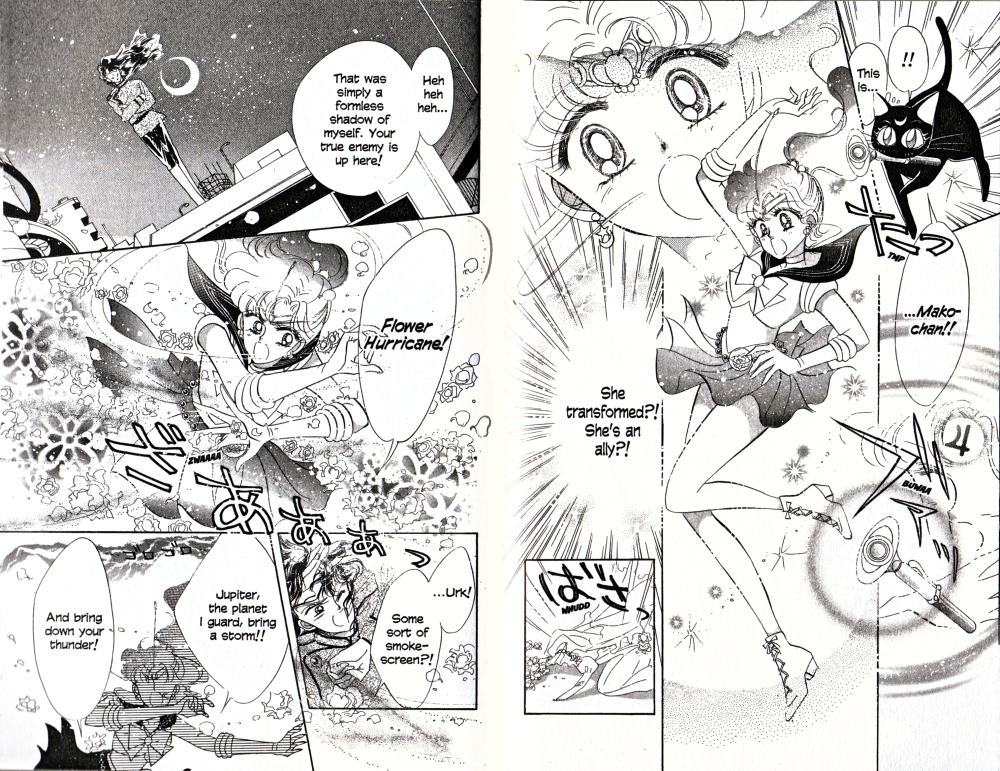
From the start, Usagi handles her duties differently than Minako. She’s more empathetic, but has a tendency to feel overwhelmed and require encouragement. (These are still, of course, early days.) She’s bolstered by her fellow guardians, however, and quickly accumulates three allies: the brilliant Ami Mizuno, guardian of water and wisdom (Sailor Mercury); classy and clairvoyant Rei Hino, guardian of fire and passion (Sailor Mars); and tomboyish yet girlish Makoto Kino, guardian of thunder and courage (Sailor Jupiter). Luna provides them all with information—I enjoy any scene that depicts the kitty in research mode—and handy gizmos that allow them to communicate and transform.

Together they face off against Queen Beryl and her Four Kings of Heaven, who are busily concocting schemes to collect energy to revive their “great ruler” while simultaneously searching for the “legendary silver crystal.” (We learn more about the enemies here than in Sailor V, incidentally, which makes them much more interesting. It’s still slightly disconcerting to see how quickly some of them are defeated, though, considering how long they stick around in the anime. Nephrite, for example, is vanquished after just one chapter!) The Guardians want to find the all-powerful crystal too, and are also searching for “the princess,” whom they are duty-bound to protect.

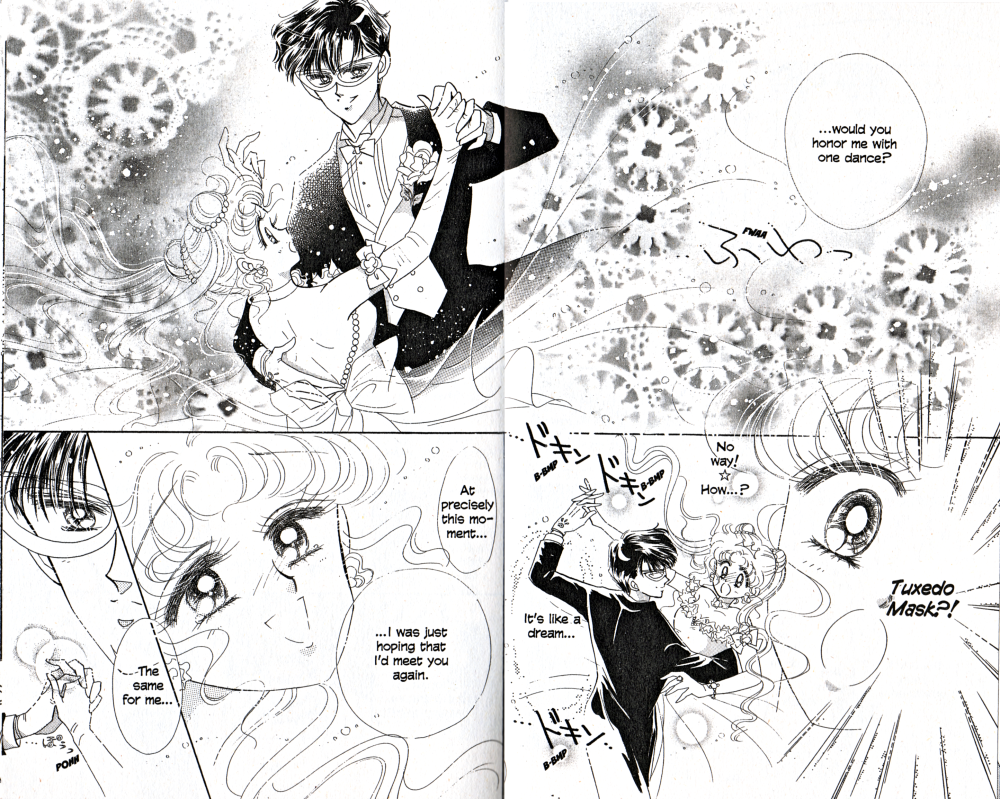
Also searching for the “legendary silver crystal” is a handsome fellow called Tuxedo Mask, two words that efficiently describe his costume. He has dreams wherein a faceless woman begs him to find the crystal, and so he tries to comply. Usually his efforts consist of lurking around when Sailor Moon is busy confronting the enemy, so as to be ready to bolster her confidence. Meanwhile, in his civilian guise of high school student Mamoru Chiba, he and Usagi keep running into each other and exchanging insults. I never much cared about their relationship in the anime, but it actually kind of works for me here. Maybe manga!Mamoru is appreciably more dreamy than his anime counterpart, because I can at least see why Usagi finds him so appealing. In this volume, there’s also some question as to whether he’s friend or foe, which gives Usagi something to worry about. (In general, while I don’t mind hyper Usagi, I like her much more when she’s being serious.)

I would probably still like Sailor Moon if it were merely the story of a band of cute girls in colorful outfits who defeat the enemy with various nifty/goofy attacks like “moon tiara boomerang” and “flower hurricane,” but its feminist message definitely elevates it in my esteem. While Usagi may be drawn to Mamoru and while Makoto may yet pine for the sempai who rejected her, these girls are fully cognizant that they’ve got a mission that’s more important than romance. Consider this exchange in which Makoto is explaining her reason for transferring schools:

Makoto: It seemed there was something far more important… even more important than falling in love… that was waiting for me here.

Rei: You’re right! We don’t have the luxury of the time it takes to cry over a man.

Though normal teens until just recently, these girls are quickly coming to grips with their destiny and the enormous importance of preventing the crystal from falling into the wrong hands. One gets the sense that this experience, though dangerous, is going to be critical in forming who they become as people, especially lazy Usagi, who is now thrust into a leadership role. And even though Mamoru does help her on occasion, it never comes off as condescending, but more like he’s reminding her of the strength that she already possesses. He, after all, has no powers of his own so it’s up to her to save the day.

Thank you, Kodansha Comics, for licensing this series and giving us a proper translation at last. I’m happy for myself and other existing fans, but I also can’t wait to see what Sailor Moon newbies make of the story.

Pretty Guardian Sailor Moon is published in English by Kodansha Comics. They’ve licensed the tenth anniversary edition, which condensed the eighteen-volume series into twelve volumes of the main narrative plus two volumes of short stories. It also has pretty new covers and some retouched art.

Review copy provided by the publisher.

Filed Under: REVIEWS Tagged With: Kodansha Comics, Naoko Takeuchi

Bookshelf Briefs pointer

September 13, 2011 by Sean Gaffney

For those who read my reviews by category (like me), I have reviews of Dengeki Daisy 6, Itazura Na Kiss 6 and Phoenix Wright: Ace Attorney 2 in this week’s Bookshelf Briefs.

Filed Under: REVIEWS

One Piece, Vol. 58

September 13, 2011 by Sean Gaffney

By Eiichiro Oda. Released in Japan by Shueisha, serialization ongoing in the magazine Weekly Shonen Jump. Released in North America by Viz.

First off, I can’t help but note that Vol. 59 is solicited in the back of this book for Feb. 2012. Oh Viz, you caught up with One Piece so well and now you fall behind again… sigh. However, first we get to read Volume 58, which is filled with one gigantic melee fight… again. This is a classic case where the release schedule is hurting the arc, as seeing these volumes so infrequently makes us more frustrated that the battle is moving, for Oda, relatively slowly.

That’s not to say that there isn’t a lot going on here, because there is. Whitebeard continues to have his forces inexorably move towards Ace’s execution scaffold, even as he takes mortal wound after mortal wound. Akainu proves to once more be a completely insane rabid dog (I was chilled when he asked “which platoon was that traitor with”, and the other marines desperately pointed out it was a pirate in disguise, clearly seeing that he planned to kill the whole platoon out of spite). And Luffy is leveling up with something called Haki, which we’ve seen before on occasion but really gets pointed out here. On the surface, it would appear to be ‘shouting so that people stop’, but is more about force of personality, I think. It’s something Luffy would have to develop instinctively, I think, and fits him well.

Our minor characters get stuff to do as well! Mr. 3 really astounded me here, not only disguising himself as a marine and making hi way to where he was one of the two men there to execute Ace (!!), but when asked about it reluctantly admits he’s pissed off about what happened to Mr. 2. We’ve seen gangs of villains turn out to have strong loyalty to each other even within Baroque Works before, but honestly, I was not expecting Mr. 3 to be one of them. I hope he makes it out of this. As for Coby… well, poor Coby. He really should have known better. If it helps, Coby, Garp also got punched out (though that was clearly deliberate).

And finally (FINALLY) Ace is freed… once he has admitted to himself that he doesn’t want to die, and allows himself to be freed. There’s a bit of a callback to Nico Robin in Ace’s arc, with his desperate please turning out to be a very deep self-hatred, but like Robin he is now ready to be proactive. Unfortunately, like Luffy, he is also ready to be impulsive, and is easily baited by Akainu, who starts tearing down Whitebeard as a useless failure in front of Ace. I’ll give Akainu credit, he may be the nastiest villain the series has ever had, but he’s no dummy. He knows exactly which buttons to push. And, in the end, we get… well, the final shot of the volume. Yipe.

This is a solid shonen volume of One Piece, but like some of my fellow reviewers, I think I’m getting a bit of arc fatigue, and would like Nami, Zoro and the others back in my story now. One Piece is the opposite of Bleach – it reads well weekly, and sometimes suffers in Volume form. Ah well, if it helps, the next volume will conclude the battle.

Filed Under: REVIEWS

Codename: Sailor V, Vol. 1

September 12, 2011 by Michelle Smith

By Naoko Takeuchi | Published by Kodansha Comics | Squee

There are few things in this world that can literally make me do “the dance of squee,” but the arrival of the first volumes of Codename: Sailor V and Pretty Guardian Sailor Moon at my house definitely did the trick. My husband can bear witness.

I’ve read Codename: Sailor V before (back in 2003), but that was with the Japanese edition in hand and a text translation on the computer screen, doing my best with my limited Japanese skills to put words and images together. But now it’s out in English, and translated by the venerable William Flanagan, to boot! I feel like I got a lot more out of this time, but whether that’s due to increased comprehension or a change in personal perspective, I can’t really say.

First, a bit of publication history. After completing her first series, The Cherry Project, Naoko Takeuchi and her editor decided that her next series would feature a magical girl in a sailor suit who fights for love and justice. The result was Codename: Sailor V, which premiered in the magazine Run-Run in July 1991. An anime was soon planned, but instead of starring only Sailor V, it would feature a five-person team, with the focus on a new character named Sailor Moon.

The Pretty Guardian Sailor Moon manga debuted in 1992, with the anime premiering shortly thereafter. Chapters of Codename: Sailor V continued to be released periodically, and actually wrapped up a couple of months after the Sailor Moon series. In this way, it functions both as a prequel and as a companion series to the more famous work.

Now to the story itself! Minako Aino is thirteen years old and in her first year of middle school. She’s got some… quirks—she is described at one point as a “binge-eating, nap-taking, below-average student” who “likes standing out in a crowd”—but also thinks fast on her feet and has acute physical reflexes. After observing her for a while, a mysterious white cat introduces himself as Artemis and tells her she has been chosen by the planet Venus. “You were born to fight to protect the world of incandescent heat. And you have a mission. A duty that no one but you can fulfill.” This whole sequence reminds me a lot of a young Buffy, similar in temperament and ability, hearing similar words from her first Watcher.

Minako promptly faints, and when she wakes she thinks the conversation was just a dream. When she spots her crush brainwashing a girl into becoming his slave, however, the “boss” speaks to her through a magical pen (really) and tells her that he is her enemy and that she must defeat him and save everyone. (She’s also got a crescent-shaped compact that can be used as a weapon and for creating disguises.) Her first transformation into Sailor V is accompanied by the following narration:

I feel liberated! I’m overflowing with power!! I’m struck with the urge to act!

And there, in a nutshell, is why this magical girl franchise appeals to feminists like me. It’s not about a girl in a sailor suit looking cute to attract boys or being validated by them. It’s about a girl choosing to become strong herself, to achieve her full potential, and to contribute to the welfare of the planet by actively engaging “the enemy.” If you’re tired of passive heroines—got those Black Bird blues?—then you really do need to read these books.

Further adventures pit Sailor V against a series of idols represented by the Dark Agency, whose modus operandi is to stage concerts and suck out the energy of their fans, who then become their slaves. The Agency president is a woman named Fluorite and she reports to an unseen guy named Danburite, and so far they seem content to try to take over the world by repeating the same tactics over and over, though they do eventually change things up a little near the end. These episodic stories do dull the impact of Sailor V’s mission slightly, but her introductions to her foes are always fun. Here’s my favorite:

Using idols to brainwash both men and women, young and old… Now that’s just greedy! Those are horrendous business practices and the Japanese Tax Office will not stand for it!

I am sometimes a GI Fighting Girl, and sometimes a Debuting Idol Beauty… But my true form is…—Moon Power: Transform!—Codename: Sailor V!! Champion of Justice!! The Pretty Guardian in a Sailor Suit! Sailor Venus… has arrived!

Takeuchi’s art is lovely, if somewhat busy. (Sometimes I wonder if she has a phobia of white space, because a lot of screentone is used to fill those areas. My favorite is the one that inexplicably mixes stamps and penguins.) I’m particularly fond of the chapter title pages, because Sailor V looks especially cool and mature in those. The English translation reads well, too, so it’s really too bad that the rest of the text has so many minor errors. For the most part, these consist of misattributed dialogue or sound effects being placed in the wrong spot. Though annoying, they don’t hamper one’s enjoyment much. The reference to Science Ninja Team Gotchaman (sic) in the end notes did elicit a cry of dismay from me, though.

So, yes. It is truly wonderful to have Codename: Sailor V available in English. Perhaps it won’t appeal to everyone as much as it does to me, but it’s got more depth that one might expect, and is definitely worth checking out.

Codename: Sailor V is published in English by Kodansha Comics. They’ve licensed the tenth anniversary edition, which condensed the original three volumes into two.

Review copy provided by the publisher.

Filed Under: REVIEWS Tagged With: Kodansha Comics, Naoko Takeuchi

Bookshelf Briefs 9/12/11

September 12, 2011 by Katherine Dacey, David Welsh and Sean Gaffney 7 Comments

This week, Kate, David, & Sean take a look at new releases from Viz Media, Dark Horse, Digital Manga Publishing, and Kodansha Comics.


Dengeki Daisy, Vol. 6 | By Kyousuke Motomi | Viz Media-It was only after reading this volume that I realized that not a heck of a lot plot-relevant stuff happened in it. We’re building up to what will likely be a big climax in the next volume or two, but it’s still a buildup, and despite the removal of one minor villain and the redemption of another, there’s a sense of the author trying to gauge how long she can spin out the Daisy/hacker plotline before she’s forced to fire the guns. Still, at the time I was reading it, I didn’t notice at all, as I was completely drawn in by everything. Teru still tends to be a damsel most of the time, as this is her role in the plot, but she’s not a damsel content to be passive, as her attack on one villain shows. As for Tasuku, it’s clear he can’t move forward with Teru till he gets over his own self-loathing – and we’ve not yet bottomed out there. Addictive.– Sean Gaffney

Eden: It’s an Endless World! Vol. 13 | By Hiroki Endo | Dark Horse –In spite of the fact that the 12th volume of this series came out just under two years ago, I found it surprisingly easy to get back in the groove. For those who are unfamiliar with the book, it’s a sprawling, violent sci-fi epic about a world changed utterly by a pernicious virus, a situation worsened by surviving humanity’s relentless desire to tinker with themselves and their world to gain advantage and power. It would probably be irrelevant to provide any kind of plot summary at this stage of the game, so I’ll just say this: Endo avoids just about every pitfall that can befall this kind of action drama. The technobabble is interesting, the ultraviolence is beautifully and imaginatively rendered, and the characters benefit from thoughtful and often surprising motivations. Even the sex scenes don’t feel quite as gratuitous as they could. It’s good stuff. Painfully slow to arrive, but always welcome. – David Welsh

Grand Guignol Orchestra, Vol. 4 | By Kaori Yuki | Viz Media –There’s a lot to like about this series, which I can’t always say with Yuki’s work. She really sells her blend of gothic violence and simmering emotional dysfunction. Unfortunately, it all seems a bit compressed. The overarching plot of Grand Guignol Orchestra – a troupe of traveling musicians battles an encroaching horde of doll-like zombies and tries to solve the various mysteries behind them – could have stretched out for a good long while, but Yuki seemed to barely begin scratching the surface of that premise before she moved into operatic endgame mode. To be honest, it seems like she’s working for an audience that can carry memory of the specific resonances of her style and fill in the narrative blanks. As a result, the most promisingly turgid moments here aren’t as persuasive as they could be. They’re all right, but they could be better if the series had taken the time to fully realize them. – David Welsh

Itazura Na Kiss, Vol. 6 | By Kaoru Tada | Digital Manga Publishing –Given that both the cover and blurb spoil the first half of the volume, I feel it’s safe to say that Kotoko and Naoki finally get together in this 6th omnibus and are married. Pleasingly, the manga doesn’t end there, but continues on with their married life. Unfortunately, given the story still tends to rely on “Kotoko panics and misses the point” and “Naoki doesn’t say what he’s thinking”, this can get even more frustrating. Naoki especially is hard – I’ve gone on about him before, but he really seems to want a wife who can literally read his mind, and doesn’t get how off-putting he can be. And Kotoko is still a dimwit, but her lovableness varies from moment to moment. Still, the sweet and joyous moments in this manga ARE really good, made all the better by the misunderstandings we waded through to get there.– Sean Gaffney

Kingyo Used Books, Vol. 4 | By Seimu Yoshizaki | Viz Media – Any volume of Kingyo Used Books that features manga by Go Nagai, Rumiko Takahashi, and Moto Hagio can’t be all bad; how could any self-respecting otaku dislike a story whose protagonists bond over their mutual affection for Ranma 1/2, or whose bespectacled hero is a connoisseur of classic shojo? The problem with Kingyo Used Books, however, is that even stories such as the aforementioned “A Common Language” or “Beautiful People” never deviate from the basic pattern established in the very first volume: characters stumble into Kingyo, reveal that they’re struggling with a difficult issue, then discover a manga that helps them feel better. The stories are so pat they often feel more like an Afterschool Special than a thoughtful reflection on the power of reading to transform our lives, and the shallow nature of the characters’ epiphanies — beauty is only skin deep, don’t judge a book by its cover — only emphasizes the series’ missed potential. – Katherine Dacey

One Piece, Vol. 58 | By Eiichiro Oda | Viz Media –With my long and turbulent history as a fan of soap operas, I certainly recognize what Oda is doing here. He’s creating a necessary sequence of events that will pay off later, even if that sequence isn’t necessarily what his audience has come to expect or prefer. The thing is, I only like it marginally better in One Piece than I would have on, say, All My Children. (This is because Oda, unlike a Megan McTavish, isn’t a manipulative hack.) So, while experience has taught me that I will eventually be sobbing and cheering at the edifice Oda builds from this foundation, I’m finding myself increasingly impatient with the absence of Oda’s lovingly crafted ensemble and with the relentless bombast of this seemingly never-ending battle. It’s actually pretty good stuff, but it’s wearing out its welcome, and I’m ready to get back to the regular delivery of great stuff. – David Welsh

Phoenix Wright: Ace Attorney, Vol. 2 | By Kenji Kuroda and Kazuo Maekawa | Kodansha Comics –First off, yes, the cover does look awful, as some of my colleagues mentioned before. It totally screams “tie-in fodder”. Which, to be fair, this is. That said, it’s still succeeding at trying to appeal to its demographic of those who have played the games but want more. The second volume brings Edgeworth into the story, and the manga is better for it – he’s dead on, particularly in how he tries to win his case while at the same time giving Phoenix the little hints he needs to turn everything around. The second half of the manga is a complete story, revolving around the murder of a costumed actor at an amusement park while doing a sentai show. The cases are much less convoluted than the games, by design – there’s just no time to go over everything – but even so, the resolution seems perfectly in keeping with the series. Perhaps we could get Franziska in Vol. 3? Please?– Sean Gaffney

Filed Under: Bookshelf Briefs

Butterflies, Flowers, Vol. 8

September 12, 2011 by Sean Gaffney

By Yuki Yoshihara. Released in Japan as “Chou Yo Hana Yo” by Shogakukan, serialized in the magazine Petit Comic. Released in North America by Viz.

It’s the final volume of this josei series being marketed here as mature shoujo, and there’s still a lot up in the air. Can Masayuki fulfill his dream of regaining the land Choko’s family lost? Can Choko get him to think of her as a woman rather than as a ‘Milady’ he must be subservient to? And can he ever stop being incredibly crass at the most inappropriate moments?

The answer to the last of those questions is thankfully no. Masayuki is as over the top as ever, and the ending to the first chapter, with his telling Choko’s intended about her ‘security blanket’, is one of the better ones. Choko’s reaction is picture perfect as well – she loves this man, but god, he can be such a terrible horndog and seems to think of absolutely nothing except his penis. On the downside, there wasn’t quite as much Gundam in this volume, Combattler getting the obligatory otaku reference this time around.

The middle of the book is comparatively serious, featuring some flashbacks to a surprisingly selfish Choko, and a crisis involving the land that Masayuki has been trying to earn back for so long being sold to an American developer. This actually leads to some conflict, as Choko knows that his desire to get back her land is the ‘servant’ part of him, and she doesn’t care about it if she can have him treat her as an equal. Unfortunately, much like the omiai suitor we saw at the start, the developer has sordid plans for the land, and Choko has to bring out her ‘Milady’ persona in order to get past the crisis… which makes him a more devoted servant than ever.

I will grant the series this, it is aware of its basic conflict, which is the fact that Masayuki will not let Choko get down off of that goddamn pedestal. The proposal in the second to last chapter seems almost too good to be true… and it is, as it’s Masayuki reacting on instinct rather than thinking things through. Sadly, when he uses his brain he realizes that he can’t go through with it, and even Choko proposing herself (an awesome moment) can’t turn him around.

Which is good, as it lets us have a final chapter of slapstick comedy, with some of the best violence and faces in the series. Choko is determined to get him to stamp a marriage license, and he is equally determined to avoid it. The shot of Masayuki leaping 20 feet into the air vertically, and then Choko throwing a huge steel desk at him (it’s helpfully footnoted ‘steel’ in case we were unaware) is priceless. But it’s not humor that gets us resolution – Choko finally gives up, and seems prepared to move on, as she notes that if he can’t do this for her then they can’t be a couple. And she’s right. And so (barring the ending gag, which is clearly a gag) he does, managing to call her Choko at last, and the final page is a wedding.

And so the series ends as it began, with a bunch of sweet moments interspersed with some of the most horrible sexism imaginable. If the series had taken this more seriously it would have been repulsive. But, like Ai Ore but even more so, there’s an undercurrent of humor that makes it more palatable to me. So much of Masayuki’s attitude is not designed to make you uncomfortable – it’s there to make your jaw drop. Exaggerated to grotesque proportions, it loses a lot of its bite. And in this final volume, Choko’s vacillating and tendency to be a damsel in distress is almost entirely absent, allowing her to finally be a strong heroine equal to her partner. This was an experiment for Viz, and I’m not entirely sure it sold well enough that we’ll see more Petit Comic stuff in the future. But I’d like to see more. Despite some reservations, recommended.

Filed Under: REVIEWS

Arata: The Legend, Vols. 1-6

September 11, 2011 by Michelle Smith

By Yuu Watase | Published by VIZ Media

As a fan of Yuu Watase’s shoujo classic, Fushigi Yûgi, I expected that I would like Arata: The Legend, her first shounen series. Turns out, I had underestimated my enjoyment: I really like it!

The story begins in a world known as Amawakuni, where the child-like princess is preparing to yield the thrown to her successor after reigning for 60 years. There are no suitable females in the royal (Hime) clan to take her place, however, and so a fifteen-year-old boy named Arata is coerced into passing himself off as a girl until another suitable candidate can be found. During the ceremony, the twelve retainers of the princess—known as the shinsho, because they are masters of powerful sword-gods known as hayagami—revolt and the princess is cut down before Arata’s eyes. The shinsho pin the deed on him and his flight to evade capture takes him to the mysterious Kando Forest, where he is swallowed up and exchanged with his counterpart from another world: Arata Hinohara.

Hinohara has been having a tough time lately. In middle school, he was bullied so much that he eventually stopped going altogether. Now it’s his first year of high school, and at first everything seems to be going okay. He purposefully chose a school far away, where no one would know his old self, and is able to make friends quickly, thanks to his quick actions in capturing a train groper. After a month, however, his former nemesis Kadowaki arrives and the torment starts anew, capped off by the betrayal of Arata’s closest new friend, Suguru.

When he arrives in Amawakuni—and is taken for Arata by everyone he meets—Hinohara is thrust into Arata’s role as a wanted criminal. When his touch awakens a slumbering family artifact—what turns out to be a legendary hayagami known as Tsukuyo—he is suddenly recognized as a sho, which means he’s part of the battle for the the throne. The shinsho overthrew the princess because they were tired of the control she exerted over their powers, but now they must battle and dominate each other until one stands supreme. Like it or not, as a sho, Arata is swept up in the conflict and has two choices: submit himself (this essentially means death) or force others to submit. (Meanwhile, Arata contends with life in modern Japan, including going to school and eventually beating up Kadowaki.)

I really love how Watase fleshes out Hinohara’s complex character here, because everything he does makes sense based on what he’s been through. When he first arrives, he refuses to trust anyone, but when Arata’s childhood friend, Kotoha, makes good on her promises to stick by him no matter what, it has a profound effect on him. Too, the prospect of forcing others to submit reminds him too much of the domination he suffered.

Because of his experiences—and because of the unique property that allows Tsukuyo to safeguard the souls of other sho without actually causing their death—he is gradually able to win over a few sho by sympathizing with their own suffering, whether it be betrayal, isolation, or loneliness. In a conversation with the princess—courtesy of the special necklace that also occasionally allows him to converse with Arata—he promises to unite the hayagami under Tsukuyo and return to her before she dies completely. He’s got a long road ahead, and it’s one that can only be won by changing the hearts of others.

It is this mission of Hinohara’s—not unlike those usually assigned to magical girls—that makes me want to apply the demographic label “jounen” to this series. It’s definitely shounen in scope and feel, but it’s also attuned to its shoujo side. The slowly developing romance between Hinohara and Kotoha is very well done, for example, with Hinohara cognizant of Kotoha’s love for the real Arata and Kotoha confused because “Arata” is responding to her in a way he never did before. I also like that Kadowaki eventually arrives in Amawakuni because a) that is so very Yuu Watase, for two outsiders to come into a fantasy world and immediately assume powerful destinies and b) the ultimate test of Hinohara’s newfound bravery and purpose is for him to be able to sustain it in the face of Kadowaki’s unrelenting hostility.

The pacing of the series is also outstanding. There’s just enough foreshadowing of significant things—the gravestone that connects one of the shinsho, Kannagi, with his reasons for rebelling against the princess—to make the eventual reveal more significant, but one never has to wait too long for the answer to a question. Similarly, Hinohara frequently actually comes out and says what he’s thinking, so misunderstandings are not allowed to perpetuate for long. In fact, revealing the truth behind things—like when Hinohara finally convinces Kotoha that he is not her beloved Arata—gives the story more places to go rather than reducing all dramatic options.

My one complaint about the series is largely rectified by Kadowaki’s entrance into Amawakuni, and that’s that Arata is given very little to do. At first, there’s only a chapter or two from his point of view every once in a while, but once he meets an intriguing girl named Oribe—who can tell he’s an entirely different person than Hinohara—things begin looking up, especially when one of the shinsho is transplanted to Japan in Kadowaki’s place. Suddenly, Arata is in genuine peril, which is bad for him but good for the story!

In the end, while there’s a lot going on in Arata, it never feels like too much, always makes sense, and yet always leaves one wondering what is going to happen next. Not only am I genuinely excited about continuing the series, it has also rekindled my determination to read Fushigi Yûgi: Genbu Kaiden, of which I have heard good things.

Arata: The Legend is still in serialization in Japan; the twelfth collected volume was released there in August 2011.

Review copies for volumes one, two, four, and five provided by the publisher.

Filed Under: REVIEWS Tagged With: shonen sunday, VIZ, Yuu Watase

The Goon Show Compendium, Vol. 6

September 10, 2011 by Sean Gaffney

As readers of this blog know, I don’t always talk about manga. Sometimes I’m discussing other comics, sometimes I’m droning on for hours about Frank Zappa, and sometimes I’m going into great detail about which previously censored Looney Tunes blackface gags are now uncut on the new DVDs. And then there’s British Comedy, which I have had a great love for for years. I started with Python, and of course devoured all the interviews with the cast, where they discussed the influence of Spike Milligan. I then watched The Goodies, where the cast ALSO discussed Spike’s influence. And heck, even the Beatles have a song (You Know My Name, Look Up The Number) directly influenced by the Goons. I had to find out more.

And I did. The Goon Show scripts book was in my local library. That was it for a while, as importing from the UK was not as easy in those days. But then the BBC started releasing cassettes and CDs of old Goon Shows, and I quickly grew even more obsessed. Then a few years back, the BBC decided to do things properly. No more CDs of 4 randomly selected shows plonked down for a few bob. Now we got all the shows from Series 5 onwards (the earliest series that completely survives) in giant CD box sets, restored from the best materials by Ted Kendall, with previously censored jokes put back in, all with copious liner notes and annotations by Radio and TV scholar Andrew Pixley. This is the 6th such box, containing the 2nd half of series 7 (which ran in 1957).

The Goon Show was a radio comedy on the BBC from 1951 to 1960. The scripts were primarily by Spike Milligan, but he usually had helpers at various points in the series, either for reasons of time or for reasons of mental stability (Spike was bipolar, a diagnosis unknown to everyone, including him, until the 1970s). The shows in this box are co-written by Larry Stephens, a friend of Spike’s and another BBC radio scriptwriter.

The cast was Spike Milligan (known to North Americans for his Muppet Show appearance, where he debated Sam the Eagle and sang It’s a Small World), Harry Secombe (known to North Americans as Mr. Bumble in the movie Oliver!, and for the song If I Ruled The World, which he debuted), and Peter Sellers (known to North Americans). Each week Spike and Peter would take on a variety of roles, all of which would revolve around Secombe’s well-meaning but dim oaf Neddie Seagoon, who Harry always described as “myself, only more so”. Generally speaking, there was no continuity except the characters; the plot resets every week and starts on another venue.

The plots varied, but tended to rely on a fixed form. Neddie was the main character, and would be approached by unscrupulous con-men Hercules Grytpype-Thynne (Sellers) and Jim Moriarty (Milligan) to do something incredibly stupid and/or impossible for money. Neddie would start on the task, usually with the help of fellow idiots Bluebottle (Sellers), a crack-voiced Boy Scout, and Eccles (Milligan), a cheerfully idiotic simpleton (Spike based Eccles’ voice partially off Goofy from the Disney cartoons, which many Americans will note immediately). He’ll also run into Major Dennis Bloodnok (Sellers), a retired Army officer and filthy lying coward. I’m not being mean – Bloodnok admits it himself. Events would spiral out of control, and usually the show ended with one or more (or all) of the cast dead – only to be resurrected the following week.

This set is a particularly good time for the series. The cast know their roles well, and the shows have a deft combination of surrealist humor, old vaudeville gags, and a wafer-thin plot to hang it all on. The set contains a few of the best known Goon Shows, including The Mysterious Punch-Up-The-Conker, which has the skit ‘What time is it, Eccles?’, a legendary classic showing off the way Eccles’ brain worked. It’s particularly fun as Spike enjoyed savagely mocking the brain power of these characters, but also felt a great affection for them – Harry and Peter both noted Spike was closest to Eccles in real life, not for the idiocy but for the skewed view of absolutely everything that is displayed.

Other episodes of note on the set include Shifting Sands, set in India around 1900 (as many Goon Shows were – Spike grew up there, and was fascinated with the ragged edges of the British Empire holding on despite everything) with special guest star Jack Train from an even earlier BBC radio comedy, It’s That Man Again; Ill Met By Goonlight, a World War II parody involving the capture of a suspected German spy (and one of the best-times awful puns in the entire series); and The Histories of Pliny the Elder, a Roman parody. There’s a few duffers in here, inevitable when you’re trying to write a half-hour of comedy every week. Emperor of the Universe is a parody of Bulldog Drummond that doesn’t quite savagely attack its subject enough to really work. The set also contains The Reason Why, a one-off comedy written without an audience about the moving of Cleopatra’s Needle to Britain. It’s a very odd duck, with Seagoon playing a different character that nevertheless has Neddie written all over him, and Bloodnok popping in as well. Goon Show once removed, shall we say.

The set comes, as I noted, with a long series of production notes detailing what was going on behind the scenes as these shows were being aired. They’re a nice look at what show-business Britain was like in the 50s – Harry and Peter were constantly off doing other shows and performances, and the BBC at one point told off Peter’s agent for booking him so much that he was unable to do the Goons easily. There is also a short guide to some of the more obscure jokes – Britain in the late 50s is a while ago, and not many would recall who Hughie Green or Field Marshal Alan Brooke are these days.

A word of warning to those who buy the set – there are some jokes that were made in 1950s British radio that would not be made today, particularly as regards racial stereotypes. The show had musical interludes, and the singer of the 2nd interlude, Ray Ellington, was frequently employed in the show to play African tribesman, servants, etc. – usually with a Rochester-type voice (Ray’s own voice, smooth and BBC English-sounding, was also heard in his songs.) There’s also several Chinese stereotypes in Emperor of the Universe, which, being a Bulldog Drummond parody, is all about the fiendish Chinese and how they are destroying our lovely Britain. Spike was quite progressive in many ways, but his jokes are a product of their time, and it’s best we view them the same way we view Bugs Bunny doing Al Jolson impressions in blackface to sell war bonds – as a slice of history.

The Goon Show has dated somewhat, especially as so much of modern British comedy is influenced by it. Some people may listen to the shows and wonder why they rely so much on old, hoary gags (you should have heard the other comedies on the radio at the time!). But even they will then listen in disbelief at the sheer surrealistic nonsense that then pours out the speaker. Spike could take gibberish and work magic with it, so that the cast could hold each other hostage with boa constrictors, bribe each other with receipts of a photo of a five-pound note, or have the time written down for them on a piece of paper. I could listen to these shows over and over again and still get new things out of them. Priceless.

Filed Under: REVIEWS

Ship Breaker by Paolo Bacigalupi

September 9, 2011 by Michelle Smith

From the back cover:
In America’s Gulf Coast region, where grounded oil tankers are being broken down for parts, Nailer, a teenage boy, works the light crew, scavenging for copper wiring just to make quota—and hopefully live to see another day. But when, by luck or by chance, he discovers an exquisite ship beached during a recent hurricane, Nailer faces the most important decision of his life: strip the ship for all it’s worth or rescue its lone survivor, a beautiful and wealthy girl who could lead him to a better life…

In this powerful novel, award-winning author Paolo Bacigalupi delivers a thrilling, fast-paced adventure set in a vivid and raw, uncertain future.

Review:
Ship Breaker won the Printz Award this year, and I must say I think it deserved it! It took a little while to grow on me, but I liked it a lot by the end.

At some unspecified point in the future, a community of people has sprung up on Bright Sands Beach (on the Gulf Coast) where the best work to be found is on crews breaking down giant, rusting wrecks of oil tankers. Everyone toils away to meet their quota, all the while dreaming of the lucky strike—oil or other scarce commodities—that could make them rich. Nailer Lopez is fifteen years old and works on the light crew, where his job is scuttling through pipes to scavenge copper, aluminum, and nickel.

After a near-death experience during which his wits and luck save him from drowning in a pocket of oil, Nailer is christened Lucky Boy by his friends. This moniker seems apt when he and his friend Pima discover a valuable wreck left behind in the wake of a hurricane. They set to work stripping it but are stunned to discover a survivor—a very wealthy girl named Nita Chaudhury, who promises her father will reward them for saving her life. When Nailer’s drunken and dangerous father Richard discovers the wreck, however, he opts to trade Nita to her father’s enemies, which forces Nailer to make a whole bunch of difficult decisions.

When he and Pima find the wreck, she urges Nailer to be smart about it. In her eyes, “smart” seems to involve profiting enough to obtain a position of power on Bright Sands Beach. Nailer is aiming higher, however, and makes Nita promise to take him and Pima away and into a better life. The choices he makes from that point on are partly in pursuit of this goal, but also out of a growing sense of loyalty towards Nita, who proves herself capable and quickly loses her prejudices towards those less cultured than she. There are many times where he could have walked away and abandoned Nita to her fate but doesn’t, and ultimately, his concern for her works out in his own favor.

The story ranges over a few different settings, from the beach to the drowned docks of “Orleans” to a clipper ship crewed by people loyal to Nita’s father. As a big fan of the Hornblower series, I liked the ship the best. I hadn’t realized how much I missed depictions of naval battles until the awesome sequence wherein Nailer’s familiarity with the coastline results in a surprise advantage over a superior foe. In fact, the whole final sequence of the book was quite exciting, and makes me think this would make a good movie.

I also found it interesting that the main villain of the work is Nailer’s father, Richard, because Nailer harbors such conflicted feelings about him. He remembers the man his father used to be before his mother died, and though Richard’s now more likely to be high and abusive than relaxed and kind, Nailer feels obliged to care about him and give him chances to be a better person. After many disappointments, he finally realizes that Pima and her nurturing mother, Sadna, are his true family and is able to muster the strength to stop believing that his father is capable of turning over a new leaf at this point. Essentially, he’s a victim of domestic abuse who finally achieves the strength to say, “I’m not going to let you hurt me anymore.”

Lastly, Ship Breaker is commendable for its effortless portrayal of characters of many ethnicities. None of the lead characters is Caucasian. Their skin color is mentioned as part of their physical description, but doesn’t factor in to their relationships at all. Characters are judged purely based on their individual actions. If anything, the only real prejudice left in the world seems to be between the rich (or “swanks”) and the poor, but Nailer’s actions convince Nita, at least, of the errors of her ways, especially since he proves fully capable of functioning in her world if given half a chance.

Although initially a little frustrating—despite my love for dystopic YA, I still get a little frustrated with crappy situations that just seem to be getting crappier—Ship Breaker turns out to be a well-crafted and riveting tale.

Filed Under: Books, Sci-Fi, YA Tagged With: Paolo Bacigalupi, Printz Award

License request day: Fashion Fade

September 9, 2011 by David Welsh

We’re in the midst of another season of Project Runway, one of my favorite reality competitions, even though I hate Josh C. M. to an absolutely unreasonable degree. So I thought I might take a look into the annals of fashion shôjo for today’s license request. (Note: We’re also into a new season of Top Chef: Just Desserts, but I’ve already requested a bunch of pastry manga, so I thought I’d branch out.) As is my way, I looked around for the oldest example I could find.

This led me to Tomoko Naka’s Fashion Fade, which debuted in Shogakukan’s Sho-Comi in 1977. Now, going by my history with the aforementioned rag-off, I’m not naturally inclined to like designers with stupid names (Suede, for example), but I also intensely dislike some designers with perfectly everyday monikers (like Gretchen). So perhaps I shouldn’t judge the heroine of this series too quickly, even though her name is, in fact, “Fade.”

Fade, it seems, grew up in Africa but ended up moving to France to live with her uncle. (Given that this is shôjo of a certain vintage, just about anything could have led to this development. My money is on a car accident that took place while rushing an important serum to a remote village, but my secret heart hopes a pride of lions were involved.) Fade and her uncle don’t hit it off. (Perhaps he prejudges her based on her name.) But she manages by becoming involved in the fashion industry, making friends, and building a career.

It ran for eight volumes originally and was subsequently republished in four thicker volumes. I honestly don’t know if it’s any good, as Naka seems to still be relatively off the radar of English-language readers. She doesn’t even have a Wikipedia page, even though she’s worked steadily since the 1970s. She hasn’t even been published in French. But the covers are pretty in a “Who would ever wear that?” way, aren’t they? The covers have sort of an Erté vibe to them.

Filed Under: LICENSE REQUESTS

Drifters, Vol. 1

September 8, 2011 by Sean Gaffney

By Kohta Hirano. Released in Japan by Shonen Gahosha, serialization ongoing in the magazine Young King OURS. Released in North America by Dark Horse.

Drifters is the newest title from the author of Hellsing and is spanking brand new – even Japan doesn’t quite have Volume 2 yet. That said, it does *not* have vampires. Which means it loses a lot of North America’s strong “I will buy anything with vampires in it” market. Can it get past this obvious handicap and manage to find its own voice?

Yes indeed it can, even though that voice most of the time is a big guy with a sword going “FUCK YEAH!!” Drifters is not particularly a manga for those who want subtle, intricate displays of emotion or great attention to historical detail. It takes famous soldiers from all over earth’s history and plants them in a fantasy world with elves, then watches them simply roll up and start to do battle. And the battle is the main draw of the manga. If you’ve seen Hellsing, you know how much Hirano loves to draw melee combat. This is all about that.

There is, of course, a bit of a plot. Our hero is Shimazu Toyohisa, who is real life was believed to have died in the Battle of Sekigahara in 1600. In this manga, he wanders off the battlefield, wounded, and ends up in a modern-looking hallway, where a mysterious man signs his name onto a sheet and teleports him through a gate to another world, where he’s found by some very Lodoss Wars-looking teens. He’s apparently not the first stranger to be found in these parts, so they dutifully take him off to a ruined castle, where he meets Oda Nobunaga, the Sengoku warlord, and Nasu Yoichi, a famous samurai from 400 years earlier.

They have apparently been brought there to try to stop a great evil from destroying the land (which appears to be controlled by a woman with the amusing name of Easy, who confronts Hallway Guy in a brief scene). What’s more, it would appear they will be joining up with Hannibal and Scipio, both seen here at a different castle that is being laid siege to, as well as Butch Cassidy and the Sundance Kid. Opposing them? Oh, just Hijitaka Toshizo, Joan of Arc, and Anastasia Romanov, all of whom are on the side of the bad guys, and also seem to have supernatural powers.

As you can see, this reads like a fanfiction written by a 12-year-old boy. Luckily, Hirano is mature and has a number of manga series under his best, so the execution is far more interesting. Provided you just turn off your brain and roll with events, this is a hell of a lot of fun. Shimazu makes a good “Who wants strategy, just point me at the enemy!” type hero, and the Black King, although seemingly a straight rip from Lord of the Rings, is a satisfyingly scary villain. And there’s sword fights, and battles, and people saying “Who can possibly save us now?” It is essentially Hirano having a ball every week, drawing whatever the hell he wants. And oddly, it works.

Admittedly, it has anime-style elves, who I normally avoid like the plague. But if you can get past the fantasy setting, what we have here is a bunch of historical soldiers fighting each other wile laughing and making trash talk. It almost reads like something Marvel or DC would put out. Definitely recommended to anyone who likes this sort of thing.

Filed Under: REVIEWS

Off the Shelf: Hungry?

September 7, 2011 by MJ and Michelle Smith 4 Comments

MICHELLE: Mmm… Leftover pad thai.

MJ: Um. Macaroni & cheese from a box? I’m not sure I can *quite* say “yum.”

MICHELLE: We put diced tomatoes in ours. It’s definitely yum. :)

So, what have you been reading this week?

MJ: Well, first I checked out the first two volumes of Eri Takenashi’s Kannagi. The second volume isn’t due out from Bandai Entertainment until October, but the first has been out for a while, and I’m just now catching up with it.

Kannagi tells the story of Jin, a spiritually gifted high school student who pays tribute to his town’s recently cut-down sacred tree by carving a statue of its spirit from the leftover wood. Having met the spirit of the tree as a child, his likeness is close enough to the real thing to actually bring the tree’s guardian deity to life in the form of a human girl. With her tree now gone, the deity, Nagi, has lost some of her power, and must rely on Jin to help her cleanse “impurities” that lurk around looking like insects and snakes. Meanwhile, newly-human Nagi wreaks havoc on Jin’s life, both at home and school.

As a premise, this all works pretty well. Foisting a pretty, domineering, otherworldly girl into the life of a young everyman may not be the most original shounen plot ever, but in-between boob jokes, Takenashi throws in some genuinely quirky stuff. For instance, after watching a magical girl anime on television, Nagi soberly builds her own magical staff out of plastic toys and paper, believing it will help her stamp out the impurities. The book’s early chapters are filled with small bits of humor like this, and even when the first volume beings to drift into harem territory, it retains most of its charm.

Unfortunately, things slide quickly downhill in volume two, when much of the series’ original premise is abandoned in favor of an increasingly obvious harem setup, complete with maid cafes, random swimsuits, and an endless supply of breast/otaku jokes (rotating on a regular schedule). By the end of the volume, in fact, pretty much everything I found charming about the series initially was gone, and it’s hard to say whether I’ll be sticking around to see if it ever returns.

MICHELLE: Oh, that’s too bad. For a while there it seemed like a shounen romantic comedy that any audience could enjoy. I guess it was too good to last.

MJ: Well, maybe I’ve given up too soon. But I’ll admit to being pretty disappointed, after such a promising start.

So what have you got for us this week?

MICHELLE: Like you, I read the first two volumes of a series whose second volume came out recently and its first some time ago (2009, in this case). I’m talking about Angelic Runes, a josei supernatural/fantasy series from Makoto Tateno, better known here for her BL work.

Sowil is a young man possessed of a unique brand of magic who is looking for his father and some answers. Shortly into his quest he comes upon a village where the people are preparing to bury two children alive, believing them to be the source of a curse. Sowil intervenes and ends up taking the kids—a girl named Allueh and a boy named Erudite—with him on his journey. Very quickly he realizes that they’re oracles; Allu can hear the divine voices of demons and Eru the voices of angels. These celestial beings provide Sowil advice on his travels and generally steer him in the direction of people needing his help.

As the trio travels, Sowil ends up helping an ocean-dwelling spirit return home and identifies the being responsible for a series of killings. Both have a connection to the father he is seeking, and gradually Sowil begins to break through the seal that has been placed over his memories and those of the people where he grew up. The angels and demons observing through Eru and Allu are concerned, as well, and through them we see even more investigation of Sowil’s past. Tateno mixes quite a lot of mythologies here, but it’s all in good fun.

What this results in is a kind of low-key story with some genuinely likeable characters, which is definitely my cup of tea. Sowil is really nice—his propensity to help random townspeople reminds me of Rakan from Silver Diamond—but his unique runic magic also makes him somewhat of a badass, so that’s an interesting juxtaposition. I’m also really interested in Allu and Eru, who seemingly have no personalities of their own and simply function as vessels for higher powers. That’s either mysterious or incredibly sad. Perhaps both.

Anyway, there is at least one more volume of this. I hope it won’t be another two years before we see it.

MJ: That does sound like a tasty cup of tea. Why have I been ignoring this series?

MICHELLE: Well, when the first volume comes out and then nothing happens for two years, I think one is justified in thinking, “Hm, perhaps this series has been discontinued.” I like Tateno in general, though, and remembered that Connie (of Slightly Biased Manga) liked the first volume back when we were all part of Manga Recon, so I never forgot about it. It probably doesn’t sell too well, alas, but I hope DMP makes enough through their BL catalog to finance a third volume someday.

What’s your second manga du jour?

MJ: My second read this week was volume one of Bloody Monday, one of Kodansha Comics’ many recent debut series over the past month or so. It’s a thriller about a teen hacker named Fujimaru aka “Falcon.” Though Fujimaru’s skills are often sought out by his special agent dad, he also uses them to do things like liberate his private school from the influence of a harassing faculty member.

When his dad stumbles onto something that gets him framed for murder and puts his family in jeopardy, Fujimaru takes matters into his own hands and, with the help of his high school newspaper crew, continues his dad’s investigation regardless of the danger. Though the series’ super-smart-teen shares some of the more over-the-top qualities of Death Note‘s Light Yagami, he’s at least not a sociopath, which certainly helps in terms of likability, if not in believability. Opening boob and panty shots would suggest that this series shares some other attitudes in common with Death Note-style boys’ comics as well, but at least it seems to feature at least a couple of potentially competent female team members. I suppose time will tell.

Comparisons to Death Note might suggest that I found little to like in Bloody Monday, but actually I enjoyed it more than I expected. Though it’s obviously intended to appeal to fans of the former, I have to admit that its kinder tone goes a long way with me. Despite its highly derivative premise, I expect I’ll continue on with it.

On the petty side, I did notice something early on, Michelle, that made me think of you. There’s a panel in the first chapter that is so poorly laid out in terms of speech bubble placement, that one bit of dialogue looks like it’s being spoken by a character’s hand, or maybe the canister she’s holding. Once I figured out what was really supposed to be going on, I thought, “Michelle would have a field day with this!”

MICHELLE: Probably I would! I kind of relish skewering things like that. I am glad you enjoyed this, though, because it’s written by the same guy behind GetBackers, which is a series I liked a good bit. If GetBackers is any indication, Bloody Monday may well be able to balance the fanservice and competent female characters to your liking.

Now this makes me sigh ‘cos I wish Kodansha would pick up GetBackers, but it’s really been so long…

MJ: I’m definitely interested to see where this goes! I feel a little weird about enjoying something that’s so obviously derivative of a series I was fairly wishy-washy on, but I’m going to just go with it.

So what’s your second offering for the evening?

MICHELLE: I seem to be mirroring you this week, since I also checked out another Kodansha debut. Gon may not be new to American audiences, but it was new to me. I’d seen it praised quite a bit, but never before been compelled to check it out. Now that I have… well… I’m not entirely sure whether I’ll keep reading it.

The premise and execution are certainly unique. Gon is the last remaining dinosaur, and is only a year old. This doesn’t stop him from challenging animals many times his size, however, as this volume finds him facing off against a bear whom he later uses for a bed, convincing a lion to serve as his steed and later eating alongside him as equals, and protecting a nest of eagles from a prowling bobcat. The art is incredibly detailed and entirely nonverbal. So, in that respect, I must say that Gon is really something special.

The thing is… I just don’t like Gon. While I commend mangaka Masashi Tanaka for not making him cute and endearing—he’s fierce and intimidating, even if diminutive—how can I like a critter who basically floods out an entire forest habitat making a dam that makes it easier for him to catch fish? So, on the one hand I’m like “Heh, what a little bastard”—and it is kind of cool how one can so easily invent dialog for all the displaced animals along the lines of “I hate that guy”—but on the other hand I’m like, “Man, what a little bastard!” Can I enjoy bastardly doings for six more volumes? I’m not sure.

One last thing puzzles me. This volume is quite slim. The material has previously been released in the US. And, being without words as it is, is a very quick read, even for a notorious slowpoke like me. These three factors seem to suggest this would be an ideal candidate for omnibus treatment—something Kodansha has shown a willingness to undertake for series like Love Hina and Tokyo Mew Mew—so why not Gon?

MJ: Well, huh. I’m intrigued for sure, though I suspect I may have a similar reaction overall. I find it really difficult to enjoy a series whose protagonist I dislike, especially if there isn’t some other character for me to really latch on to. Your omnibus question is interesting as well. I wonder if it has to do with licensing?

MICHELLE: Probably it does. Or else they’re keeping the volumes small so they’re not intimidating for kids.

MJ: Ah yes, could be.

MICHELLE: So. Um. Good night, then. :)

MJ: And to you, my friend!

Filed Under: OFF THE SHELF Tagged With: angelic runes, Bloody Monday, gon, kannagi

  • « Go to Previous Page
  • Page 1
  • Interim pages omitted …
  • Page 435
  • Page 436
  • Page 437
  • Page 438
  • Page 439
  • Interim pages omitted …
  • Page 538
  • Go to Next Page »
 | Log in
Copyright © 2010 Manga Bookshelf | Powered by WordPress & the Genesis Framework