• Skip to primary navigation
  • Skip to main content
  • Skip to primary sidebar
  • Home
  • About Us
    • Privacy Policy
    • Comment Policy
    • Disclosures & Disclaimers
  • Resources
    • Links, Essays & Articles
    • Fandomology!
    • CLAMP Directory
    • BlogRoll
  • Features & Columns
    • 3 Things Thursday
    • Adventures in the Key of Shoujo
    • Bit & Blips (game reviews)
    • BL BOOKRACK
    • Bookshelf Briefs
    • Bringing the Drama
    • Comic Conversion
    • Fanservice Friday
    • Going Digital
    • It Came From the Sinosphere
    • License This!
    • Magazine no Mori
    • My Week in Manga
    • OFF THE SHELF
    • Not By Manga Alone
    • PICK OF THE WEEK
    • Subtitles & Sensibility
    • Weekly Shonen Jump Recaps
  • Manga Moveable Feast
    • MMF Full Archive
    • Yun Kouga
    • CLAMP
    • Shojo Beat
    • Osamu Tezuka
    • Sailor Moon
    • Fruits Basket
    • Takehiko Inoue
    • Wild Adapter
    • One Piece
    • After School Nightmare
    • Karakuri Odette
    • Paradise Kiss
    • The Color Trilogy
    • To Terra…
    • Sexy Voice & Robo
  • Browse by Author
    • Sean Gaffney
    • Anna Neatrour
    • Michelle Smith
    • Katherine Dacey
    • MJ
    • Brigid Alverson
    • Travis Anderson
    • Phillip Anthony
    • Derek Bown
    • Jaci Dahlvang
    • Angela Eastman
    • Erica Friedman
    • Sara K.
    • Megan Purdy
    • Emily Snodgrass
    • Nancy Thistlethwaite
    • Eva Volin
    • David Welsh
  • MB Blogs
    • A Case Suitable For Treatment
    • Experiments in Manga
    • MangaBlog
    • The Manga Critic
    • Manga Report
    • Soliloquy in Blue
    • Manga Curmudgeon (archive)

Manga Bookshelf

Discussion, Resources, Roundtables, & Reviews

Features & Reviews

A Bride’s Story, Vol. 2

November 2, 2011 by David Welsh

For those who note that very little happens in Kaoru Mori manga, I must inform you that there is a pitched battle in the second volume of A Bride’s Story (Yen Press). Normally, this would be confined to Mori’s bonus comics and consist of a hyperactive, hilarious difference of opinion with her editor, but it actually happens in the narrative here.

Amir’s relatives try to reclaim the young woman, hoping to offer her in marriage for a more valuable alliance. But Amir is very taken with her young husband, as he is with her. The lesson here is to never underestimate a group of determined villagers with a big pile of bricks. The lesson is also that Mori can really stage an action sequence when she puts her mind to it. In addition to being exciting, these sequences shine with character-driven moments and really give you a sense of Amir’s new community.

Of course, me being me, I’m equally taken with the very long sequence where Amir’s sister-in-law teaches her daughter about embroidery and the family’s traditional designs. What can I say? I’m probably even more partial to scenes where next to nothing happens as I am to ones where lots does.

It’s a little hard to come up with anything new to say about a given volumes of Mori’s manga, because she’s so consistent. Her art is lovely, her attention to detail verges on hypnotic, and her clear fondness for her subject matter is infectious. I just love A Bride’s Story, maybe even as much as I loved Emma (CMX).


Filed Under: REVIEWS

Bookshelf Briefs, 10/31/11

October 31, 2011 by David Welsh and Michelle Smith 3 Comments

With several important limbs of the battle robot immobilized by snow, David and Michelle bravely forge on with a look at recent releases with a Halloween or costume party sort of vibe!


Animal Land, Vol. 1 | By Makoto Raiku | Kodansha Comics – The most striking thing about Animal Land is that it actually manages to convey the physical sensation of shrillness without actually creating any sounds. I swear my ears were ringing by the time I was done with this comic, and if it had been an animated cartoon, I would have clicked away from its high-pitched shrieking within seconds. It’s too bad, because Raiku has created a clever plot featuring a human baby winding up in a functioning society of tanuki. The baby, who can understand and communicate with all species, shakes up the inter-animal dynamic by helping them understand what everyone else is saying. That’s a really interesting starting point, but the hyperactive characters always seem to have their volume set at shônen 10, which is about 4 levels higher than I can tolerate. Some of Raiku’s anthropomorphic character designs for the tanuki end up being unintentionally creepy rather than cute, too. – David Welsh

Blue Exorcist, Vol. 4 | By Kazue Kato | Viz – There’s a pretty big reveal in this volume and, as is sometimes the case in stories by relatively inexperienced creators from weeklies, it seems a bit rushed. Kato does a great job in a lot of departments. Her art is attractive and stylized, but it keeps the action clear. The character types are certainly familiar, but they’re likeable and distinct in spite of the recognizable functions they fulfill. (I find myself surprisingly fond of hard-ass mentor Shura in spite of her fan-service-friendly wardrobe.) And Kato thinks about the small things in terms of the ways her characters interact and react to events, which is always welcome. As far as the long-term storytelling goes, though, Blue Exorcist seems a little lumpy. While Kato gets good follow-up mileage out of big events, the overall structure doesn’t seem as tight as it could or should be. There’s tons to like here, but it lacks the seamlessness of something like Fullmetal Alchemist. – David Welsh

Gate 7, Vol. 1 | By CLAMP | Dark Horse – Gate 7 is so extraordinarily pretty. From the handsomely detailed settings to the finely carved faces and gorgeous costumes, it’s a feast for the eyes. The glamour of it all almost – almost – excuses the fact that it has very little else working in its favor at this point. The plot reads like a CLAMP Mad Lib. A dorky but good-natured guy falls in with a pack of weird but incredibly attractive people with magical powers and lots of secrets, and he learns that he has some semblance of supernatural ability. In spite of the reams of exposition CLAMP has provided, I still feel like I know very little about most of the cast or what their function is in the grand scheme of things. But I really, really like looking at them, and I think I will be content to do so for at least a few more volumes. – David Welsh

Raiders, Vol. 7 | By JinJun Park | Yen Press – Raiders is such an odd series. It’s somewhat incoherent—the super-swift cuts between scenes don’t help one make sense of what is going on—but there’s enough intriguing about it that I keep reading. And now that I’ve read seven of the nine volumes, might as well keep going to the end! This volume features a pair of guys breaking into Area 51 in order to obtain data on the military’s research into weaponizing the undead. I’ve no idea how they learned about this, or who one of these guys even is, but with Raiders I’ve learned to set aside such concerns and just focus on the action, which is usually pretty cool. Also, the fanservice is not gratuitous—okay, yes, there’s one inexplicably nude moment for Lamia (the sexy zombie!) and copious bra flashes in a fight between two blade-wielding women, but these moments never subtract from the characters’ overall badassery, which I appreciate. – Michelle Smith

Vampire Knight, Vol. 13 | By Matsuri Hino | VIZ Media –So much of Vampire Knight is comprised of angst-ridden scenes and moody grey screentones that important revelations kind of sneak up on the reader. You’re reading along, lulled by the pretty art as you watch Zero mope about his plight as a vampire again (“Inside me… is there anything human left?”) and Kaname wrestle with conflicting impulses concerning Yuki, and then suddenly Kaname’s revealing the truth about his origins to Yuki, which explains how he could be both the progenitor of the Kuran clan and her sibling and also tangentially covers the formation of the vampire hunter society. I wouldn’t say it’s riveting stuff—it’s all a bit too languid to qualify—but it ought to have some interesting consequences. One thing I will say for Vampire Knight—it’s compulsively readable, and even though I’m not a fervent fan, I see myself sticking around for the long haul to see how things turn out. – Michelle Smith

Filed Under: Bookshelf Briefs

License request day: Franken Fran

October 29, 2011 by David Welsh

I swear I’ve seen Erica Friedman describe Akita Shoten’s Champion Red as a shônen magazine where dignity and hope for a better world go to die, perhaps even suggesting that its readership should be monitored for their potentially detrimental influence on the gene pool. I trust Erica implicitly, but there is a horror series that’s run in Champion Red that was recently… well… championed in comments, and – as sometimes happens with horrific scenarios – curiosity has overcome good sense. (Don’t go in the Champion Red basement, you fool! It’s filled with the creepiest kind of otaku!)

I refer, of course, to Katsuhisa Kigitsu’s Franken Fran. Those covers make me wish for the swift oblivion of death to end my shame, but the host of Sunday Comics Debt sent me on the road to no return with the following remark:

I like to think of Franken Fran as Pinoko all grown up, and being raised with the Doctor’s medical skill would make her a prime candidate for doing outlandish operations that would be banned in any country. Admit it – all the elements are there – she’s a childish tumor with no qualms of ethics or humanity, and enjoys operating madcap experiments that would make Desty Nova proud, just for the fun of it.

Now, you all know of my completely misguided adoration for Pinoko. I’m not going to bore you by repeating it, but she’s so creepy and disturbing and precious and… ahem. Sorry about that.

It’s being published in German by Panini, and you can see some preview pages at the Amazon listing for the volume. The insides look a little more restrained than the “purchase by mail and try not to think of the shipping clerk judging you” covers would suggest.

We’re almost done with Black Jack (Vertical), and while it seems like a series with great snowy-Sunday reread value, I’d feel better if I knew there was something similarly ridiculous and entertaining on the way. Franken Fran’s potential tackiness may overwhelm its giddiness, but I’m willing to take that risk.


Filed Under: LICENSE REQUESTS

The Witch Family by Eleanor Estes

October 28, 2011 by Michelle Smith

From the back cover:
Banished!

Old Witch likes nothing better than to fly about on her broomstick crying “Heh-heh!” and casting abracadabras, but now she has been sent away… by two young girls.

Amy and Clarissa love to tell stories about Old Witch… until one day they decide she is just too mean and wicked. Drawing a rickety old house upon a barren glass hill, the girls exile Old Witch there with the warning that she’d better be good—or else no Halloween! For company they draw her a Little Witch Girl and a Weeny Witch Baby.

Old Witch tries to be good, but anyone would get up to no good in a place as lonely as the glass hill… as Amy and Clarissa find out when Old Witch magics them into her world, a world of make-believe made real.

Review:
If you’ve got a clever and charming child and are looking for a clever and charming Halloween book that they might enjoy, The Witch Family just might fit the bill.

Amy and her best friend Clarissa, both “ordinary real girls,” are almost seven. Amy’s vivid imagination has been captured by the tales her mother tells about the wicked Old Witch, and she enlists Clarissa—who, with her faulty memory but pleasant disposition, is content with the sidekick role—in drawing a series of pictures that continue Old Witch’s adventures.

The story is presented in a really neat way. For example, it’s immediately clear through vocabulary that Amy is concocting Old Witch’s story herself. (She’s fond of big words, but doesn’t always know how to spell or pronounce them, so when she sentences Old Witch to live alone on a glass hill as punishment for her evil ways, she declares, “I banquished her!”) But a lot of the book is told from Old Witch’s point of view, so kids would probably enjoy the “is she really real?” mystery.

It’s certainly a fun Halloween tale, but I think Amy is the most fascinating character of all. What a bright little girl! Seriously, I found myself wishing for an epilogue that read, “And then Amy became a super-famous novelist” or something. There’s a real whimsy in the language used, and I love that she does typical little girl things like write the bumblebee who’d been in her yard into the story and give him a noble and heroic part to play. She’s also inserting herself into the story in a way, by giving Old Witch a little witch girl named Hannah to keep her company who looks so much like Amy that no one can tell them apart when Hannah comes to visit Amy on Halloween and goes trick-or-treating with her friends.

I find I haven’t a lot more to say about the book than this. It’s very cute. There are kitties and weeny witch babies and things to make adults giggle and the most adorable bee on the planet. Thanks for the recommendation, K!

Filed Under: Books, Children's Fiction, Fantasy, Supernatural Tagged With: Eleanor Estes

Re-flipped: Tokyo Zombie

October 28, 2011 by David Welsh

It doesn’t seem right to go through all of the current Manga Moveable Feast without addressing zombies, and it doesn’t seem right to address zombies without considering ironic zombies, so here’s an old Flipped column on a title that checks both off of the list.

I think Yusaku Hanakuma’s Tokyo Zombie (Last Gasp) has helped me crystallize my objections to zombie fiction in general.  Given the limitations of the genre, it very often seems like too much effort has gone into its various renderings.  Tokyo Zombie looks like it was dashed off during study hall, and that works in its favor.

The official tag for the style is heta uma, or “bad, but good.”  I might modify it to “bad, but appropriate,” to be honest.  That Hanakuma’s style of illustration suits the material doesn’t mean it’s aesthetically pleasing in any meaningful way or that a practiced knowledge of the fundaments of drawing seems to be peeking out through a conscious effort at crudeness.  Proportions are odd and shifting, and body language and composition are stiff.  To be honest, the living and the undead aren’t always immediately distinguishable from one another.

But really, the best a zombie story can be is crude, quick, and maybe a little subversive, and Tokyo Zombie is all of those.  The action begins on “Dark Fuji,” a mountain of garbage, studded with illegally dumped toxic waste and human remains.  Whatever the opposite of a primordial soup is reaches boiling point, and the undead begin shambling down from Dark Fuji to do what zombies do – very slowly overtake the living.

A small subculture of survivors build an enclosed area where the rich live on the labor of an oppressed class of slaves, and the balance is maintained by brutal enforcers.  Stripped of most of their comforts and diversions, the rich become extremely bored, and a brutal arena featuring slaves versus zombies springs up.  There isn’t much in the way of subtlety in the way Hanakuma portrays the class conflicts of post-zombie society, but there doesn’t need to be.  It’s just a backdrop for gross-out violence and a source of jokes about brutal things happening to generally terrible people.

Hanakuma’s greatest strength is probably pacing.  He rarely lets a sequence drag on longer than necessary, and he keeps the inventively gross gags coming.  If they’re imperfectly rendered, how much artistry does flesh-eating really require?  There’s plenty of gory event if not detail, and what would lovingly drawn innards really add to what seems intended to be a brisk, coarse outing?

(P.S. Tokyo Zombie was originally serialized in the alternative manga anthology, Ax.  In August of 2009, Top Shelf will publish a 400-page collection of stories from the decade-old magazine.  Kai-Ming Cha has an interview with the translated collection’s co-editor, Sean Michael Wilson, at Publishers Weekly.)

(P.P.S.  Last Gasp is also the publisher of one of the finest comics I’ve ever read, Fumiyo Kouno’s Town of Evening Calm, Country of Cherry Blossoms.  Aside from its publisher and creator’s nation of origin, it has absolutely nothing to do with Tokyo Zombie, but I like to mention it whenever I can, no matter how feeble the pretext.)


Filed Under: FEATURES

Haunted House

October 27, 2011 by Michelle Smith

By Mitsukazu Mihara | Published by TOKYOPOP

I blame my “meh” reaction to Mitsukazu Miharu’s Haunted House—which I honestly wanted to like!—on the back cover, which promises that readers will be “kept guessing—and giggling” by the behavior of Sabato Obiga’s flamboyantly goth parents. I might’ve smiled a time or two, but that’s about it.

The basic premise here is simple and reiterated several times throughout the volume: Sabato would like a steady girlfriend, but they inevitably ask to see his house, which means they will have to meet his bizarre, “death-flavored” family and be scared off by their creepy antics. Sabato’s mother strongly resembles Morticia Addams, his father (despite being a banker) often sports a sort of Victorian dandy look, and his twin sisters have a gothic lolita vibe and spend their free time making voodoo dolls. The Obiga family also likes to decorate their home with skeletons and shrines and threatens to serve the family cat for dinner. Sabato always obtains their promise to behave before inviting a girl over, but this is invariably broken.

Haunted House is pretty repetitive, but I think I wouldn’t have been dissastified with it if the powers that be at TOKYOPOP hadn’t strongly hinted that Sabato’s family has some reason for treating him like they do. Okay, yes, they abruptly promise to support him when it seems that he, after fancying a long string of random ladies, seems to have fallen in love at last, but it’s not like they actually follow through with this in any meaningful way.

Looking kooky is one thing, but they’re frequently just down-right mean. At one point, Sabato is hospitalized with a broken leg and his family comes to visit. Most of what they do is innocuous—bringing him only hospital-themed horror novels to read, for example—but his mother actually feeds him dog food. I just don’t get it. Is that supposed to be funny? Is that supposed to be someone who is merely tormenting their kid, as the back cover implies, in an effort to encourage him to grow up, become an independent person, and stop pursuing meaningless relationships with random girls?

I don’t know, but I am certain that I am thinking too hard about this. And I partly blame the back cover that encouraged me to expect more from a story that is really just a diverting bit of goofiness.

Filed Under: REVIEWS Tagged With: Tokyopop

Manga Bestsellers: 2011, Week Ending 23 October

October 27, 2011 by Matt Blind

Comparative Rankings Based on Consolidated Online Sales

last week’s charts
about the charts

##

Manga Bestsellers

1. ↔0 (1) : Sailor Moon 1 – Kodansha Comics, Sep 2011 [461.1] ::
2. ↔0 (2) : Sailor Moon Codename: Sailor V 1 – Kodansha Comics, Sep 2011 [442.8] ::
3. ↑1 (4) : Vampire Knight 13 – Viz Shojo Beat, Oct 2011 [434.3] ::
4. ↓-1 (3) : Sailor Moon 2 – Kodansha Comics, Nov 2011 [434.2] ::
5. ↔0 (5) : Naruto 52 – Viz Shonen Jump, Jul 2011 [416.5] ::
6. ↔0 (6) : Rosario+Vampire Season II 6 – Viz Shonen Jump Advanced, Oct 2011 [400.0] ::
7. ↑19 (26) : Yotsuba&! 10 – Yen Press, Oct 2011 [373.5] ::
8. ↑19 (27) : Black Butler 7 – Yen Press, Oct 2011 [354.8] ::
9. ↓-2 (7) : Blue Exorcist 4 – Viz Shonen Jump Advanced, Oct 2011 [339.9] ::
10. ↓-2 (8) : Skip Beat! 25 – Viz Shojo Beat, Oct 2011 [331.9] ::

[more]

Top Imprints
Number of volumes ranking in the Top 500:

Viz Shonen Jump 83
Viz Shojo Beat 80
Yen Press 72
Kodansha Comics 37
Viz Shonen Jump Advanced 34
Vizkids 28
Tokyopop 21
Viz 18
Del Rey 15
DMP Juné 15

[more]

Series/Property

1. ↔0 (1) : Sailor Moon – Kodansha Comics [1,064.4] ::
2. ↔0 (2) : Vampire Knight – Viz Shojo Beat [784.3] ::
3. ↑2 (5) : Black Butler – Yen Press [724.2] ::
4. ↔0 (4) : Naruto – Viz Shonen Jump [723.2] ::
5. ↓-2 (3) : Maximum Ride – Yen Press [702.7] ::
6. ↔0 (6) : Negima! – Del Rey/Kodansha Comics [577.4] ::
7. ↔0 (7) : Blue Exorcist – Viz Shonen Jump Advanced [512.4] ::
8. ↑6 (14) : Highschool of the Dead – Yen Press [508.1] ::
9. ↔0 (9) : Skip Beat! – Viz Shojo Beat [505.7] ::
10. ↔0 (10) : Rosario+Vampire – Viz Shonen Jump Advanced [472.7] ::

[more]

New Releases
(Titles releasing/released This Month & Last)

1. ↔0 (1) : Sailor Moon 1 – Kodansha Comics, Sep 2011 [461.1] ::
2. ↔0 (2) : Sailor Moon Codename: Sailor V 1 – Kodansha Comics, Sep 2011 [442.8] ::
3. ↑1 (4) : Vampire Knight 13 – Viz Shojo Beat, Oct 2011 [434.3] ::
6. ↔0 (6) : Rosario+Vampire Season II 6 – Viz Shonen Jump Advanced, Oct 2011 [400.0] ::
7. ↑19 (26) : Yotsuba&! 10 – Yen Press, Oct 2011 [373.5] ::
8. ↑19 (27) : Black Butler 7 – Yen Press, Oct 2011 [354.8] ::
9. ↓-2 (7) : Blue Exorcist 4 – Viz Shonen Jump Advanced, Oct 2011 [339.9] ::
10. ↓-2 (8) : Skip Beat! 25 – Viz Shojo Beat, Oct 2011 [331.9] ::
11. ↑22 (33) : Pandora Hearts 7 – Yen Press, Oct 2011 [327.3] ::
14. ↓-2 (12) : Negima! 31 – Kodansha Comics, Sep 2011 [309.0] ::

[more]

Preorders

4. ↓-1 (3) : Sailor Moon 2 – Kodansha Comics, Nov 2011 [434.2] ::
18. ↓-5 (13) : Sailor Moon Codename: Sailor V 2 – Kodansha Comics, Nov 2011 [275.0] ::
19. ↓-2 (17) : Sailor Moon 5 – Kodansha Comics, Apr 2012 [274.9] ::
21. ↓-2 (19) : Sailor Moon 3 – Kodansha Comics, Jan 2012 [257.1] ::
24. ↑1 (25) : Sailor Moon 4 – Kodansha Comics, Mar 2012 [246.0] ::
53. ↑49 (102) : Fullmetal Alchemist 27 – Viz, Dec 2011 [157.1] ::
60. ↑7 (67) : Negima! 32 – Kodansha Comics, Nov 2011 [141.1] ::
71. ↔0 (71) : Maximum Ride 5 – Yen Press, Dec 2011 [131.0] ::
77. ↓-12 (65) : xxxHolic 18 – Kodansha Comics, Dec 2011 [122.5] ::
85. ↑264 (349) : Sailor Moon 6 – Kodansha Comics, Jun 2012 [115.9] ::

[more]

Manhwa

121. ↓-17 (104) : March Story 3 – Viz Signature, Oct 2011 [88.6] ::
342. ↑63 (405) : Black God 14 – Yen Press, Oct 2011 [32.6] ::
514. ↑406 (920) : Bride of the Water God 9 – Dark Horse, Oct 2011 [19.4] ::
531. ↑307 (838) : March Story 2 – Viz Signature, Apr 2011 [18.5] ::
545. ↑new (0) : Antique Gift Shop 9 – Yen Press, Nov 2009 [17.9] ::
646. ↓-91 (555) : Goong 12 – Yen Press, Sep 2011 [13.4] ::
948. ↑135 (1083) : Jack Frost 4 – Yen Press, Dec 2010 [5.4] ::
966. ↑ (last ranked 2 Oct 11) : Totally Captivated 3 – Netcomics, Jun 2008 [5.2] ::
981. ↓-237 (744) : JTF-3 Counter Ops (ebook) – RealinterfaceStudios.com, Mar 2011 [4.9] ::
1005. ↑955 (1960) : Black God 8 – Yen Press, Feb 2010 [4.5] ::

[more]

BL/Yaoi

34. ↑10 (44) : Finder Series 4 Prisoner in the View Finder – DMP Juné, Aug 2011 [209.5] ::
90. ↓-20 (70) : Maelstrom (Kindle ebook) 1 – Yaoi Press, Jun 2011 [113.0] ::
110. ↑35 (145) : Finder Series 5 Truth in the View Finder – DMP Juné, Dec 2011 [93.9] ::
132. ↑2 (134) : About Love – DMP Juné, Nov 2011 [82.5] ::
149. ↑16 (165) : Private Teacher 2 – DMP Juné, Jan 2012 [74.3] ::
156. ↓-8 (148) : Secrecy of the Shivering Night – DMP Juné, Dec 2011 [69.5] ::
164. ↓-41 (123) : An Even More Beautiful Lie – DMP Juné, Jan 2012 [67.1] ::
165. ↓-13 (152) : Mr. Convenience – DMP Juné, Nov 2011 [67.0] ::
187. ↑new (0) : Attacked on a Tiger’s Whim (ebook) – DMP Digital Manga Guild, Oct 2011 [57.3] ::
245. ↓-15 (230) : Only Serious about You 2 – DMP Juné, Dec 2011 [45.9] ::

[more]

Filed Under: Manga Bestsellers Tagged With: Manga Bestsellers

The Favorites Alphabet: spooky supplement

October 27, 2011 by David Welsh

We interrupt your regularly scheduled, letter-by-letter installment of The Favorites Alphabet in honor of the horror-tinged Manga Moveable Feast! This week, the Manga Bookshelf Battle Robot retreated to the dank catacombs of our secret base to conjure the spirits of our favorite spooky manga! Read on… if you dare!

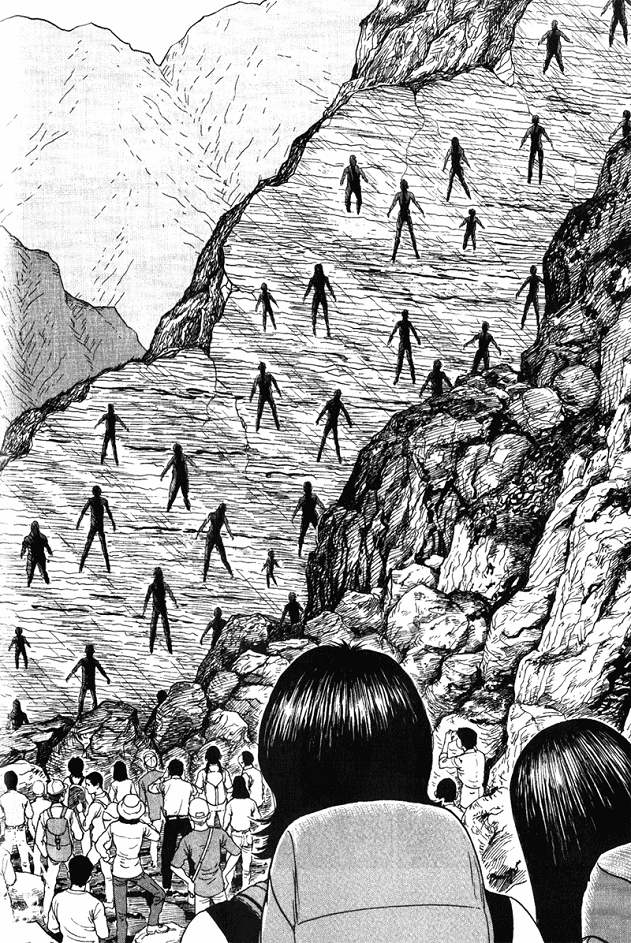
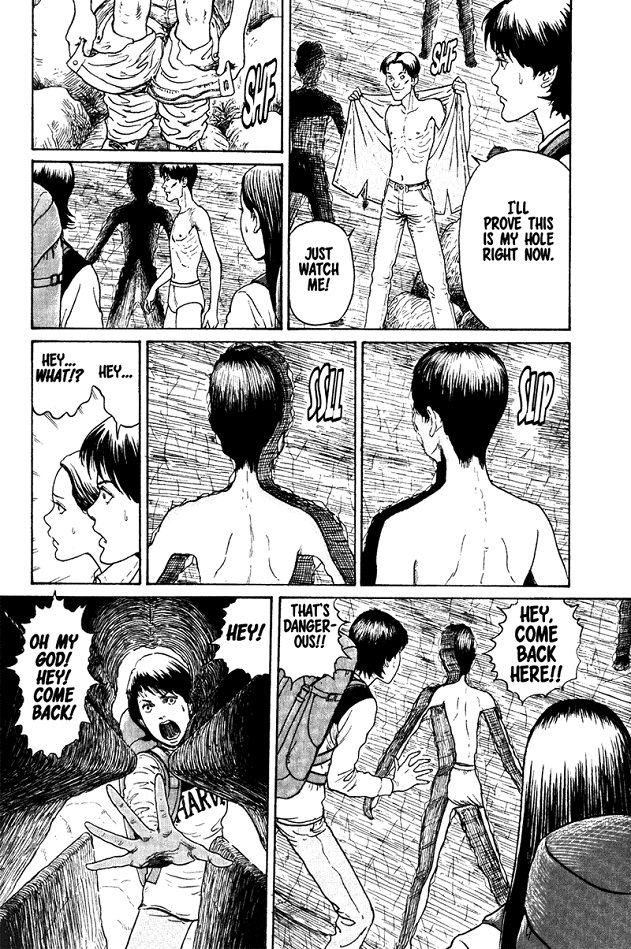
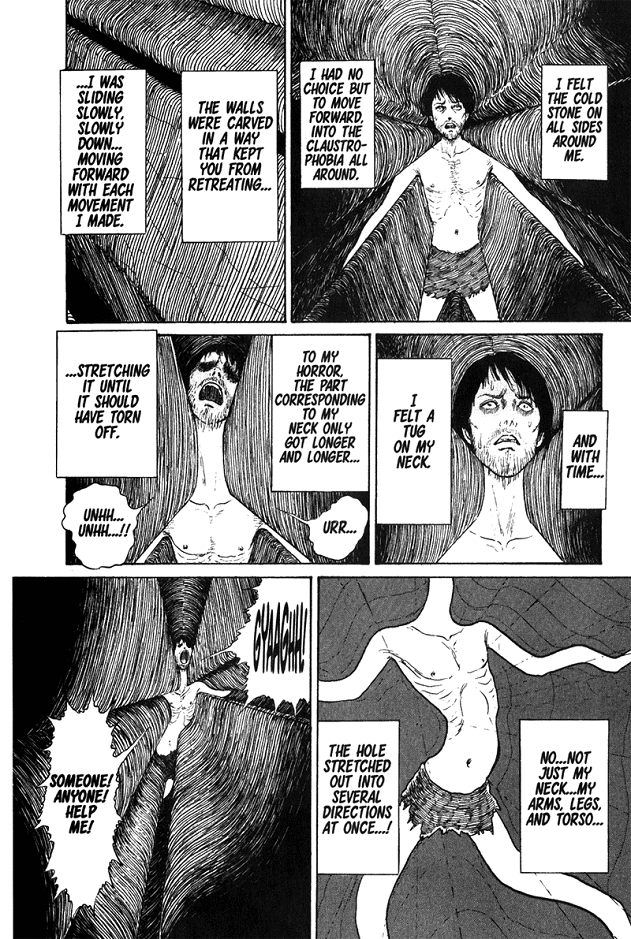
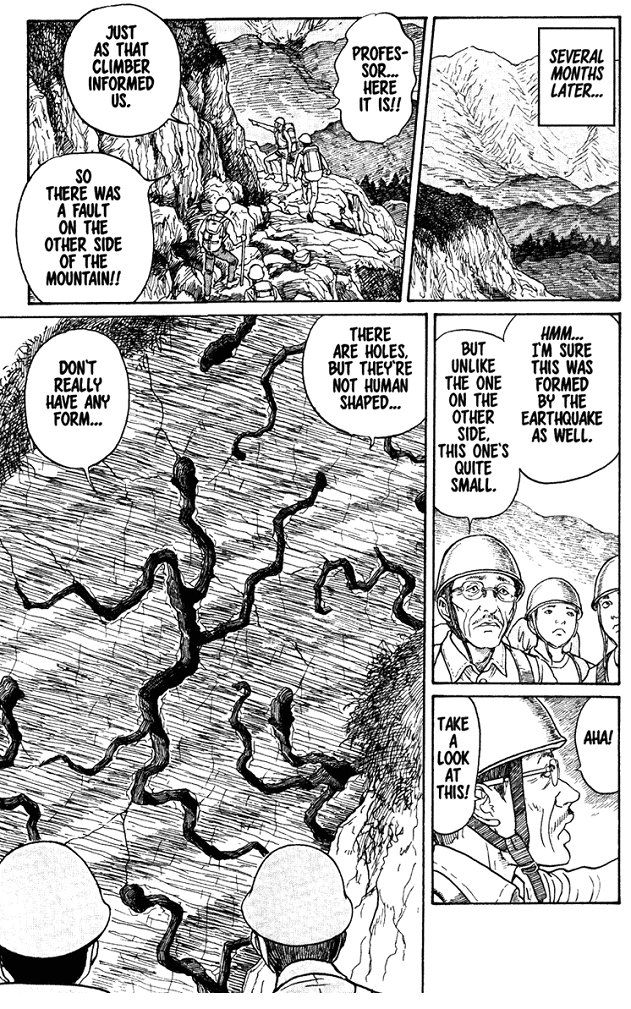
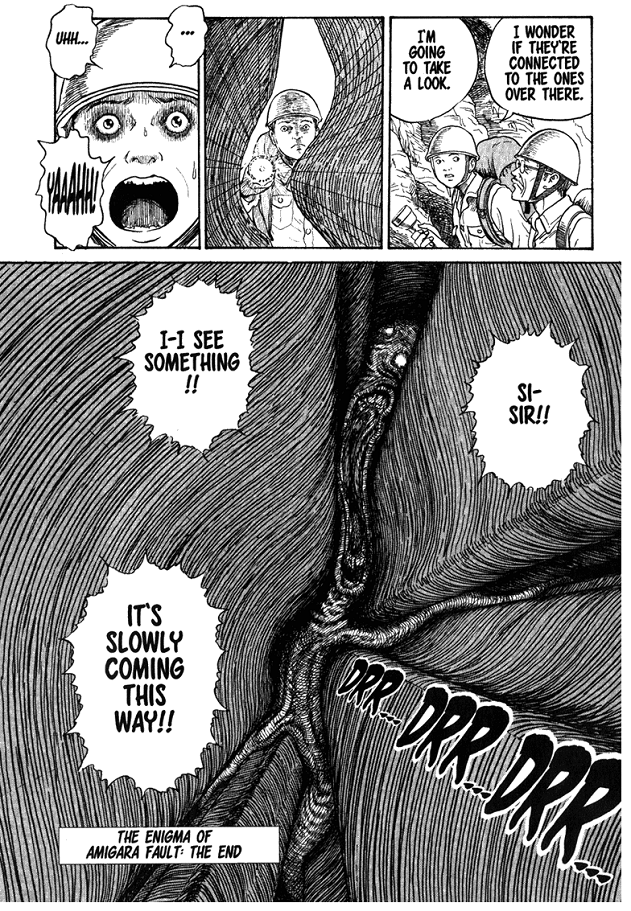
 “The Enigma of Amigara Fault” | By Junji Ito | VIZ Media – I haven’t read much horror manga. In fact, aside from the delightfully bizarre Tokyo Zombie and one volume (so far) of The Kurosagi Corpse Delivery Service, my experience is limited to the works of Junji Ito. While Gyo and Uzumaki certainly deliver weird and disturbing tales, it’s “The Enigma of Amigara Fault,” a short story that appeared in Gyo’s second volume, that I find most memorable.  In it, an earthquake has revealed a rock formation riddled with human-shaped holes that go farther back into the rock than researchers are able to measure. People flock to the site, drawn to holes that seem to be custom-made for them. Those who enter the holes are committed to moving forward with some profoundly jibbly-inducing results. Just thinking about it is kind of giving me a wiggins. Look for images from this one in this weekend’s Let’s Get Visual column! – Michelle Smith


The Kurosagi Corpse Delivery Service | By Eiji Ōtsuka and Housui Yamazaki | Dark Horse – Despite my ongoing reviews of Higurashi: When They Cry, I’m not really a big reader of horror manga, tending to find it too scary. Which says more about me than about the genre. However, I picked up Volume 1 of Kurosagi Corpse Delivery Service for its unusual cover, as well as the fact that it was translated and edited by Carl Horn. Imagine my surprise when I got one of the funniest, most satiric, and, yes, scariest manga coming out here. For our heroes, dealing with corpses isn’t like searching for mysteries a la Scooby Doo – it’s a job, and they are usually trying desperately to get paid. It just so happens that their various skills go really well with solving problems involving dead bodies. Nestled in among the sarcastic dialogue and long pointed looks at Japanese politics and society is some really creepy imagery – watch out for the chapter with the birds, or the one with the ears. – Sean Gaffney

Parasyte | By Hitoshi Iwaaki | Del Rey – There are just so many reasons this eight-volume series is awesome, not least of which is Iwaaki’s facility with really gruesome and surprising bits of violence. It’s an invasive-species nightmare scenario featuring bizarre space spores taking over indigenous creatures (mostly human) and turning them into ravenous, shape-shifting, and dangerously intelligent predators. Fortunately, one of the parasites doesn’t quite make it to its host’s brain, turning average teen Shinichi Izumi into humanity’s best protector, and his right hand into a formidable defensive weapon, not to mention an adorable and insightful pet! Iwaaki jumbles a lot of elements together – coming-of-age drama, violent suspense, evolutionary theory, family tragedy, and boy-and-his-dog sentiment. The beauty part is that Iwaaki jumbles it all well, making for one of the most beginning-to-end satisfying tales you’re likely to find on the manga shelves. Originally published by Tokyopop, Del Rey picked up this out-of-print gem and did a bang-up job repackaging it. – David Welsh


School Zone | By Kanako Inuki | Dark Horse – In this odd, hallucinatory, and sometimes very funny series, a group of students summon the ghosts of people who died on school grounds, unleashing the spirits’ wrath on their unsuspecting classmates. School Zone is as much a meditation on childhood fears of being ridiculed or ostracized as it is a traditional ghost story; time and again, the students’ own response to the ghosts is often more horrific than the ghosts’ behavior. Inuki’s artwork isn’t as gory or imaginative as some of her peers’, though she demonstrates a genuine flair for comically gruesome thrills: one girl is dragged into a toilet, for example, while another is attacked by a scaly, long-armed creature that lives in the infirmary. Where Inuki really shines, however, is in her ability to capture the primal terror that a dark, empty building can inspire in the most rational person. Even when the story takes one its many silly detours — and yes, there are many WTF?! moments in School Zone — Inuki makes us feel her characters’ vulnerability as they explore the school grounds after hours. – Katherine Dacey

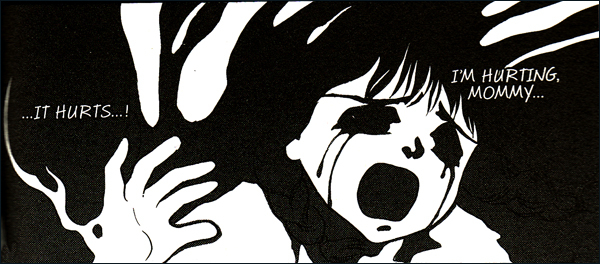
Tokyo Babylon | By CLAMP | TOKYOPOP – When David suggested that we all pick favorite horror manga for this week, at first I thought I didn’t have any. Though horror movies were a favorite genre once upon a time, that preference never really transferred to print for me, or at least I didn’t think it had. Then I realized that some of my most beloved occult-themed comics fall closer to the horror mark than I thought. My favorite of these (and indeed, one of my favorite comics of all time) is CLAMP’s 20-year-old series, Tokyo Babylon.  Complete in just seven volumes, it’s a decidedly immature work, featuring uneven storytelling, outrageous outfits, and one of the strangest, most over-the-top examples of BL-leaning shôjo I’ve seen to date. On the other hand, not only does it finally rip our hearts out with the precision of a serial killer, but it scares the bejeezus out of us all along the way. This is a dark, cruel little series, that takes real joy in its emotional shock value, and its occult setting provides ample opportunity for that quality. Not that I’m complaining. When I look at the images I chose for my review of the series , I can see that I picked out several of those that had creeped me out the most. For genuine scares and emotional brutality all wrapped up in one delicious “classic” shôjo package, you can’t beat Tokyo Babylon. – MJ

What are your favorite horror stories?


Filed Under: FEATURES

Psyren, Vol. 1

October 27, 2011 by Sean Gaffney

By Toshiaki Iwashiro. Released in Japan by Shueisha, serialized in the magazine Weekly Shonen Jump. Released in North America by Viz.

When it comes to weekly manga publication, there are several things we have to face up to. First of all, the editor of Weekly Shonen Jump has to get 18 series out every week. And they can’t all be One Piece. Sometimes you get super blockbuster hits, and sometimes you get those ‘workhorse’ series. Secondly, when Viz is looking for Jump series to license, they may see a series that’s 19 volumes and still running and think “Will this be profitable enough to risk it never ending like One Piece or Naruto?” Much easier to take a chance on a medium-length series, 16 volumes or so, that’s already over.

And so enter Psyren, a perfectly serviceable Jump series that I suspect is not going to gain much of a following simply as its first volume, like many Jump series, is pretty damn average. Of course, One Piece 1 was pretty mediocre as well, but it was already a huge phenomenon by the time most folks here read it. No one is telling Psyren readers, “Just wait it gets so much better later.” Indeed, it may not, I’ve no idea. But if this series is like most other Jump series, I suspect that it is a slow builder.

So, Psyren! Let’s see, we have the guy on the cover, who is our hero, Ageha. (No, he doesn’t sew designer accessories, wrong series.) Ageha is fairly cocky, likes to hit things, helps out cute young girls… he’s a very likeable teenage hero. He happens across a rather beaten and stoic classmate, Sakurako, who flips out when he returns her wallet that had been stolen and notes a red phone card in it saying Psyren. Mysterious card… damsel in distress… time for Ageha to jump to the rescue! Especially once he gets a phone card of his own.

Psyren’s predictability is both its strength and its weakness. You know to a certain degree what to expect, so the book moves fast and the plot sets up nicely. Naturally Ageha will never turn his back on someone in need, even a stranger he barely knows, and his stubborn desires impress his new soon-to-be friends. On the downside, there’s nothing that leaps out and makes you want to read Volume 2. It’s a fun read, but if the series was cancelled after this volume, most readers would simply never notice.

The setting is a desolate wasteland, so naturally there’s lots of room for battling huge ugly monsters, another Jump staple. These battles also seem to involve psychic powers, or at least they do for everyone but our hero, who I’ve no doubt will be unlocking his true abilities soon. And yes, the heroine does get a nosebleed after using her powers. It’s not just Marvel Comics doing that cliche. If there is one surprise in the volume, it’s the cliffhanger, which makes a refreshing change from the ‘we’re on an alien planet’ or ‘we’re in another dimension’ that I was expecting.

So the question is, is it worth getting volume 2 in hopes the series takes it up a notch? Not sure. But I don’t think you’ll have wasted your money if you get Vol. 1. Psyren is a perfectly normal manga series, which unfortunately may not have enough hooks to make folks come back for more.

Filed Under: REVIEWS

Off the Shelf: Generally Halloweenish

October 26, 2011 by MJ and Michelle Smith 4 Comments

MJ: Boo!

MICHELLE: Omigawd, you almost gave me a heart attack.

MJ: Yay?

MICHELLE: I suppose that is the spirit of the season.

MJ: So, speaking of the season, I expect you’ve been indulging in some spooky manga this week?

MICHELLE: Some spooky, others not-so-spooky, but generally Halloweenish, yes.

One thing I checked out was the debut of a new manhwa from Seven Seas (their first, I think) called My Boyfriend Is a Vampire. This series appears to be complete in fourteen volumes, and Seven Seas is releasing it in 2-in-1 omnibus editions.

I have to say, this does not get off to a very auspicious start. A girlish boy collapses on the street from a neck wound and the police are called when he is found to have no pulse. Just when the cops arrive, however, the guy sits up and takes off. When he gets home, the wound has already healed but he has inexplicably turned into a girl.

Cue flashback to a month ago, where the boy (Gene) is getting into lots of fights over the fact that he looks like a girl when he isn’t agreeing to masquerade as one. This is all fairly silly until he, in the middle of defending gang territory, ends up in the middle of a squabble between two vampire half-brothers, each with the potential to become their powerful father’s heir. Long story short, he saves one guy (Ryu) but ends up being made a vamp in the process (cue paragraph one) and of course there is some awesome legend or prophecy or something about a girl who survives being bitten and how she will be the 1337est vampire ever and also have the ability to change genders or something.

Honestly, a lot of this story is pretty ridiculous and the art is totally generic, but by the end I was looking forward to reading more. Strip away the supernatural trappings and what this reminds me of the most is Click, another manhwa which was published by NETCOMICS a few years ago. You’ve got the tough/bratty guy who becomes a girl, the best friend from childhood with whom there will now presumably be romantic tension, and the undesirable element to whom the protagonist finds him/herself drawn. The fact that vampires are involved really doesn’t matter very much at this point, since this seems poised to be a gender-bending comedy.

I believe you’ve read this one, too. What did you think of it?

MJ: Well, I’m absolutely with you on the general ridiculousness of this series so far, though I admit to enjoying it for its silliness more than I would have expected. While it lacks the cracktastic brilliance of something like Reiko Shimizu’s Moon Child or even slightly more down-to-earth treasures like SangEun Lee’s 13th Boy, it has enough of a spark to grab my interest, even in its lesser moments. I’m sad to note that there are many more of those “lesser moments” than I’d like, but I can’t help looking forward to the next volume.

MICHELLE: Same here, and though the second volume was much stronger than the first, which bodes well for things to come. It might not be a masterpiece, but it will likely be entertaining.

So, have you been reading spooky manga this week?

MJ: I have indeed, or at least partly so. My first read this week was volume seven of Yuki Midorikawa’s Natsume’s Book of Friends. Though this supernatural series tends more towards adjectives like “quiet” and “touching” than it does things like “scary,” this particular volume actually kinda hits the mark.

In this volume, Natusme finds himself relying on his uneasy friendship with flashy exorcist Natori in the face of someone much more terrifying, whose disregard for yokai puts Natsume and his friends in danger. And as it turns out, this is a really good thing. This is not a series that I generally consider suspenseful, but I was hovering on the edge of my seat for this entire volume, worried and anxious and generally creeped out.

Midorikawa’s artwork has always been a highlight of this series, creating wonderfully rich emotional moments with imagery alone. Even so, I was surprised here by how easily she was able to put me on edge with the tiniest visual details. The shade of an umbrella, a part of the hair, the shape of a lip—each of these tiny details is used in a way that stood my hair on end. It’s marvelous to behold.

Though this series was a fast favorite for me, early on, I’ll admit my interest waned during some of its middle volumes. Those days are clearly over now, and I simply can’t wait to see what comes next.

MICHELLE: I know I say this every time you mention Natsume’s Book of Friends, but I really am planning to get caught up on it soon. When you wrote about the worry and anxiety you experienced it reminded me of the similar atmosphere created by Ghost Hunt when that series was firing on all cylinders. Which, in turn, made me sad that we’ll probably never see its twelfth and final volume in English. Unless Sailor Moon makes Kodansha so much money they can afford to take on charity cases.

It seems like Midorikawa also gets that the secret to engaging your reader like this is not concocting frightening situations but creating characters that people will genuinely be concerned about. Sometimes that’s lacking in straight-up horror manga.

MJ: That’s a great point, Michelle, and definitely appropriate to this series! Yes, we’re anxious here not because Natsume has met a really creepy guy (though he has) but because of the vulnerable position Natsume and the yokai are in. It’s really quite harrowing!

So what’s your other maybe-spooky-maybe-not selection for the evening?

MICHELLE: The first volume of the Yen Press adaptation of James Patterson’s Witch & Wizard, drawn by Svetlana Chmakova, who has become somewhat of a Halloween fixture for me thanks to her Nightschool series.

Alas, I don’t like this one as much as Nightschool. At least, not yet. I can’t tell if the problem is Patterson’s original novel (which I haven’t read) or this adaptation, but I am leaning towards the latter. It’s not that it’s outright bad, but it’s extremely rushed and the juxtaposition of comedy (I use the term loosely) and drama (ditto) is jarring.

An oppressive organization known as N.O. (New Order) has taken over government and is rounding up anyone who does not conform to their ideals of law, logic, order and science. To this end, soldiers break into the home of the Allgood family and take children Whit (nearly 18) and Wisty (15) into custody. For some reason, N.O.’s representative during this encounter is some snot-nosed teen whom the Allgood siblings make fun of. Anyway, through various miscarriages of justice they end up incarcerated and facing imminent execution, until they are brought into the “Shadowland” by Celia, Whit’s deceased girlfriend.

I mean, there truly is potential here, but everything just happens so fast that many things ring false. For example, Whit pines a lot for Celia, his “soulmate” who has gone missing. When his powers have developed enough that he is able to slip through a wall and arrive in the Shadowland, she tells him that she’s been murdered. Only it’s like she’s fine one panel then in the next tears are suddenly streaming down her face as she infodumps the details of her demise. Nine pages later, Whit is making stupid quips again. That just seems so wrong to me. Where is the impact here?

MJ: Like you, I’ve never read the novel, so I can’t really make a clear call here, but what you describe seems to me to match the most common problem I’ve seen in comic adaptations of novels overall. Maybe some of it can be chalked up to some things transferring better from prose than others, but really most of the time it just seems to come down to… well, time. It takes time to tell a story well, regardless of the medium, and for some reason that’s where comic adaptations really seem to skimp.

MICHELLE: Yeah. I’ll probably give it another volume to see how it develops, at least. Maybe now that the exposition’s out of the way the story will be able to breathe a little.

So, what else have you got for us this evening?

MJ: Well, you know, “horror” can have various meanings, and in my ongoing experiment to see just how much “horror” I can take, I decided to delve into volume eleven of Kanoko Sakurakouji’s demon-centric romance, Black Bird.

It’s possible that the most horrifying aspect of the latest volume of Black Bird is that, relatively speaking, it’s really not all that bad. Sure, Misao walks around with a permanent flush on her face and Kyo is possessive and controlling, but somewhere along the way in this volume it seems like… I can’t believe I’m going to say this… it seems like maybe he kind of learns something.

*blink*

Assuming you haven’t died of shock, I’ll continue.

Furthermore, this volume is actually kind of scary in the more traditional sense. Kyo’s brother, Sho, has returned with an ugly agenda, and for once there seems to be some real danger here. And though there is a seriously overplayed “scorned woman” in the mix (groan, why do authors do this to women?), I have to admit that the volume wraps up with some genuine suspense, and I almost-sorta-kinda want to know what happens next.

Now, before you lose all faith in reality as you know it, I’m not exactly giving a positive review of a volume of Black Bird. But finding myself in a position where I’m not inclined to give a scathing one certainly seems like a step up.

Have you died? I hope you haven’t died.

MICHELLE: I haven’t died, but I did have to fetch my smelling salts.

I’ll be interested to see whether Black Bird will ever be able to redeem itself in your eyes. I keep thinking I should read it—and, indeed, I have quite a stockpile of volumes—but I only have so much time and I always prioritize something else. So, in a way, you’re doing this for all of us who want to see what happens without investing our own time and eyeballs.

MJ: Well, time will tell whether my eyeballs are truly up to the task. But thankfully, this particular volume offered up a not-too-horrible Halloween-appropriate read.

MICHELLE: I think it’s fitting that we end our Halloween column on the topic of eyeballs.

MJ: Agreed. Happy Halloween everyone, from Off the Shelf!

Filed Under: OFF THE SHELF Tagged With: black bird, halloween, my boyfriend is a vampire, natsume's book of friends, Witch & Wizard

Manga the Week of 11/2

October 26, 2011 by Sean Gaffney

Oh dearie me. (deep breath)

Bandai is shipping the 4th volume of Code Geass: Knight, the doujinshi anthology series that focuses on the male characters for female fans of the series. Expect lots of BL tease with no actual BL.

If you want actual BL, then DMP is the place for you. We get new volumes of the awkwardly titled Great Place High School Student Council, the deluxe edition of Kizuna, Seven Days, and The Tyrant Falls in Love. And there are three new series debuting: Mr. Tiger and Mr. Wolf (no, it’s not a Tiger and Bunny spinoff), Only Serious About You, and Private Teacher. I think this giant pile of BL will satisfy even the most hungry enthusiasts.

Remember when I said we’d get the rest of Kodansha’a October this week? I was indeed correct! New Air Gear, which has hit 20 volumes of rollerblading frenzy. Vol. 2 of Bloody Monday’s intrigue and Cage of Eden’s potboiler antics. And two new thick omnibuses: Love Hina 1-3 (which I reviewed here a couple of weeks ago), and Tokyo Mew Mew 1-2 (for those who can’t get enough magical girl shoujo and can’t wait for Sailor Moon/V).

Speaking of omnibuses, Seven Seas is releasing Vols. 7 & 8 of Gunslinger Girl, which I believe means we’re now caught up with ADV and getting new material. Yes, it’s about killer loli assassins and their kindly adult male guardians, but it actually manages to deal with the serious issues surrounding such a plot and not be too skeezy. Mostly. Well, a lot. OK, over 60% not skeezy. Seven Seas also has the third volume of Toradora, which does star a tsundere, but it actually manages to deal with the serious issues surrounding such a girl and not have her be too tsun. Mostly. OK, maybe 40% dere? Perhaps an actual math degree would help.

Vertical is debuting its new Furuya title, a modern updating of the famous Japanese novel No Longer Human by Osamu Dazai. I’ve also reviewed this, and it maintains Vertical’s reputation for cutting edge manga that makes you think.

And Viz has its first-week madness. From the Jump and Jump Square file, we have new volumes of Claymore, D.Gray-Man, the Death Note “Black Edition”, and Tegami Bachi. On the shoujo side, we have new Ai Ore! and Black Bird, some Dengeki Daisy (which I warn you has another nasty cliffhanger), Haruka: Beyond the Stream of Time (earlier BL manga, I’m sorry I called you unwieldy after reading this), The 11th volume of Kimi ni Todoke (wait, you mean it keeps going after they get together?!?!), and new Oresama Teacher and Story of Saiunkoku. It is a very Viz week.

So, in among that deluge, what do you want to buy?

Filed Under: FEATURES

Re-flipped: GoGo Monster

October 26, 2011 by David Welsh

Okay, I don’t know if this comic counts as horror in the strictest sense of the term, but it’s one of the first titles that came to mind when I considered this month’s Manga Moveable Feast. It’s one of my favorite spooky-ish comics, and yesterday was Taiyo Matsumoto’s birthday, so…

“Yeah, well…” a grade-schooler opines early in Taiyo Matsumoto’s GoGo Monster (Viz), “There’s a kid like that in every class, right?” He’s talking about Yuki, a classmate who claims to sense things no one else can, an invisible population of mischievous creatures and a new insurgence of more malevolent beings. And the classmate is right; if manga is to be believed, the schools of Japan are well stocked with young people who traffic in the eerie. None of them are quite like Yuki, though, probably because not many creators are quite like Matsumoto.

Matsumoto has an extraordinary talent for rendering kid logic, their concepts of loyalty and justice and the way they engage with the world around them. This knack was on vivid display in Tekkonkinkreet: Black and White (Viz), for which Matsumoto won an Eisner Award in 2008. Like that book, GoGo Monster features two temperamentally different boys cleaving together to face the inevitable.

Many supernaturally sensitive manga characters can be divided into two categories. They either use that sensitivity to protect the unaware, or they struggle to conceal their abilities for fear of ostracism. Some are driven by both motives, but Yuki answers to neither. He’s disconcertingly matter-of-fact about the things he perceives, and he’s genuinely immune to the ridicule of his peers. He’s an excellent student, but he’s a disruptive presence. Yuki doesn’t perceive his own abnormality, and he doesn’t feel any pressure to conform.

While Yuki has few allies in the student body or faculty, he does garner the sympathetic attention of a new kid at school, Makoto. Average in every respect, Makoto is less intrigued by Yuki’s beliefs than by his indifference to ridicule. Maybe he recognizes it as a kind of strength of character, or maybe some emerging empathy makes him realize Yuki is at risk. Makoto is engaged in all of the aspects of Yuki’s character, not just his oddity. Instead of limiting him to the role of sidekick, this engagement actually makes Makoto Yuki’s equal in terms of reader engagement, or at least it did with me.

Other benevolent figures in Yuki’s sphere include the school’s elderly groundskeeper, Ganz, who understandably takes the long view of things. While the teachers yearn to fix Yuki, Ganz is content to listen to the boy. Then there’s IQ, who is even more ostentatiously weird than Yuki. IQ, who’s in an older grade than Yuki and Makoto, wanders the school grounds with a box on his head with a single eyehole cut into it. It’s telling and slyly funny that this is less disconcerting to his peers and teachers than Yuki’s less obvious strangeness and bursts of temper. Like Ganz, IQ has an odd kind of faith in Yuki, though the source of that faith is oblique.

The most interesting thing about GoGo Monster, the thing that grounds it, is that it’s ultimately irrelevant whether or not the things Yuki perceives are real. It’s Yuki’s belief in their reality and the possible consequences of that belief that drive the drama. That belief is never in question; Yuki is absolutely sincere, as is Matsumoto.

Tekkonkinkreet was set in a dying fantastical city slowly being destroyed by crassness and consumerism. Treasure Town was a richly imagined, almost living place. In GoGo Monster, the school setting couldn’t be more prosaic, but it’s no less vivid. Matsumoto captures the rhythms of the place, the mundane snippets of conversation, the casual cruelty, and the bustle. Even without the meticulous visual detail Matsumoto lavishes on the place, you can practically smell the food from the cafeteria.

That fidelity makes it all the more effective when you start to see glimpses of it through Yuki’s enhanced perspective. Matsumoto is positively restrained in introducing the weirdness that Yuki sees infesting Asahi Elementary. You glimpse it from the corner of your eye at first, or blink and it disappears. The clearest sense of them comes from Yuki’s crude drawings, and even he admits that they aren’t literal renderings. “This is just a conceptual sketch,” he tells the closest thing he has to a friend. As the school year that constitutes the book’s timeline progresses, Matsumoto reveals more of what Yuki is sensing.

Beyond his marvelous illustrations and elliptical storytelling, the fascinating thing about Matsumoto’s work is his ability to make me root for undesirable outcomes. In Tekkonkinkreet, I found myself hoping that its protagonists would accept the futility of their fight for Treasure Town, that they would cut their losses. In GoGo Monster, I found myself siding with the forces of conformity. Admirable as Yuki’s sense of self is, and enviable as his immunity to social pressure may be, I still was persuaded by Matsumoto’s argument for a healthy, happy Yuki, even if it resulted in a less interesting, less special Yuki.

I should probably mention that GoGo Monster is a beautifully produced book. It’s magnificently colored hard cover comes sheathed in an equally handsome slipcase. The edges of the crisp, white pages are tinged red with a continuation of the cover image. It’s all very lovely, but the book would still be extraordinary even without those bells and whistles. Matsumoto has craft, intelligence, and heart, and he balances those qualities as well as almost any creator alive. In a fairly extraordinary year for challenging, artistically satisfying manga, it seems like a certainty that Matsumoto will garner a second Eisner nomination, perhaps even a second win.

Filed Under: FEATURES

Uzumaki, Vols. 1-3

October 25, 2011 by Michelle Smith

By Junji Ito | Published by VIZ Media

As with Ito’s two-volume work, Gyo, the best word to describe Uzumaki—despite a back cover blurb promising “terror in the tradition of The Ring”—is “weird.”

High school student Kirie Goshima lives in Kurôzu-Cho, a small coastal town nestled between the sea and a line of hills. She narrates each chapter in an effort to share the strange things that happened there. It all begins when, on the way to meet her boyfriend Shuichi Saito at the train station, she spots his father crouching in an alley, staring intently at a snail. Shuichi confirms that his dad has indeed been acting odd lately, and suggests that the entire town is “contaminated with spirals.”

Mr. Saito’s fixation with spirals grows to the point where he dies in an attempt to achieve a spiral shape, which drives his wife insane with spiral phobia. She too eventually passes away, leaving Shuichi alone to become a recluse who is able to resist the spiral menace while being more perceptive to it than most. Other episodic incidents fill out the first two volumes, including unfortunate events involving Kirie’s classmates (boys who turn into snails, a bizarre rivalry over spiralling hair, etc.), her father’s decision to use clay from the local pond in his ceramics, a mosquito epidemic that leads to icky goings-on at a hospital, and an abandoned lighthouse that suddenly begins producing a mesmerizing glow. Things come to a head in volume three when six successive hurricanes are drawn to Kurôzu-Cho, leaving it in ruins. Rescue workers and volunteers flock to the area, but find themselves unable to leave. Dun dun dun!

Creepy occurrences mandate creepy visuals, but I wouldn’t say that anything depicted herein is actually scary. Oh, there are loads of indelible images that made me go “ew” or “gross,” but was I frightened by them? No. The real horrors of Uzumaki are more subtle: the suggestions that there are ancient and mysterious forces against which humans are utterly powerless and that the spiral’s victims will live in eternal torment. Many tales of horror involve bloodthirsty monsters, but a menace that forces you to live and endure something horrific is much more capable of giving me the jibblies. It’s the ideas behind Uzumaki, therefore, and not the surfeit of disturbing images, that evoke dread.

Uzumaki has a much larger cast than Gyo, which prompted me to notice that Ito actually draws some really cute and realistic-looking female characters. Kirie is a prime example, but her classmates and TV reporter Chie Maruyama also fit the bill. I was pretty distracted by Ito’s rendering of a girl named Azami, though, because she reminded me so much of Madeline Kahn as Mrs. White in Clue. Observe:

Flames... FLAMES on the side of my face!

Uzumaki definitely delivers an unforgettable story with memorable art, but I would’ve liked to get to know the characters more. Kirie is a reasonably accessible lead and is smart, strong, and kind, but I felt at times that she was too strong. If anything gross is going on in town, Kirie is the one who’s going to discover it, and though she reacts in the moment, there wasn’t much emphasis on the cumulative effect of having witnessed all this madness. She keeps going and being shocked by things right until the very end, but a more normal person would’ve broken down long before. And why weren’t more people fleeing, I wonder? True, once the storms hit, nobody could leave, but for a while there plenty of crazy stuff is happening and folks are just sticking around.

I also would’ve liked to spend more time with Shuichi. He’s a pretty interesting guy, who wants to get out of town from the very start but remains because of Kirie. He seems to have inherited equal parts fascination with and fear of the spiral from his parents, which keeps him alive if not entirely sane, and is able to function at times when others are mesmerized, allowing him to come to Kirie’s aid on several occasions. Through these actions we see how much he cares for her, but I actually had no idea they were supposed to be a couple until he was specifically referred to as her boyfriend a couple of chapters in. Okay, yes, this isn’t a romance manga and I shouldn’t expect a lot of focus on their relationship, but even just a little bit of physical affection would’ve gone a long way.

Uzumaki is grim, gruesome, and a whole host of synonyms besides. This isn’t jump-out-of-your-skin horror, but a psychological tale with a decidedly grisly bent. I’m not sure I’d universally recommend it—I think I know several people who definitely shouldn’t read it, actually—but if it sounds intriguing to you, give it a whirl.

Uzumaki was published in English by VIZ Media. It is complete in three volumes.

For more entries in this month’s horror-themed MMF, check out the archive at Manga Xanadu.

Filed Under: REVIEWS Tagged With: Junji Ito, VIZ, VIZ Signature

Higurashi: When They Cry, Vol. 15

October 25, 2011 by Sean Gaffney

Story by Ryukishi07; Art by Karin Suzuragi. Released in Japan as “Higurashi no Naku Koro ni: Tsumihoroboshi-hen” by Square Enix, serialized in the magazine Gangan Powered. Released in North America by Yen Press.

It’s Halloween, and time for all good bloggers to discuss horror. And so I will talk about Higurashi, which may be a mystery series, and may also be a harem series, but is first and foremost known for its graphic horror. This volume starts a new arc, with events once again reset to the middle of June. There’s a basic horror in the premise: the cast are dying in horrible ways over and over, each time with someone falling into a spiral of paranoia and insanity. Worst of all, the young priestess Rika seems to be aware of the previous iterations. Will this arc, focusing on the cute redhead Rena, be any more optimistic?

Well, probably, but not in this first volume. This is the start of the “Atonement” arc, which is the mirror of the first arc of the entire series, the ‘Abducted by Demons’ arc. Unlike the previous Shion arc, however, which told the same events but from a new perspective, this is showing an entirely different plot, focusing on Rena. We do start off bright and happy as always, with Rena and the rest of the club playing a penalty game with water guns in gym class. As the story goes on, though, we realize that the chapter title “Happy Rena” is misleading, and that she uses a smile to mask her inner pain and sadness. And what’s more, it’s getting obvious.

Rena is an interesting case. Most of the previous arcs have shown the protagonist (Keiichi at first, then Shion) start off relatively well-adjusted, then slowly the paranoia and madness seeps into them as they start imagining things that aren’t really happening. Rena’s backstory shows us that she’s already been committed for a long period after her parent’s divorce, and has attempted suicide as well as assault. And while moving back to Hinamizawa helped briefly, now that a new woman is cozying up to her father, the old feelings are starting up again.

In addition to Rena not really needing much impetus to get her started into killing other people, the people she’s dealing with are those that we’re not really going to miss. It turns out that her father’s new love is a gold digger who leeches onto men and gradually strips them of their money… something she casually brags about in a cafe while on the arm of Satoko’s uncle. Remember him? Back in the Curse Killing arc, we saw his physical and mental abuse of the fragile Satoko. Combined with his new love, they’re a couple that Rena is allowed to kill while still retaining the audience’s sympathy… or are they? Does anything justify murder?

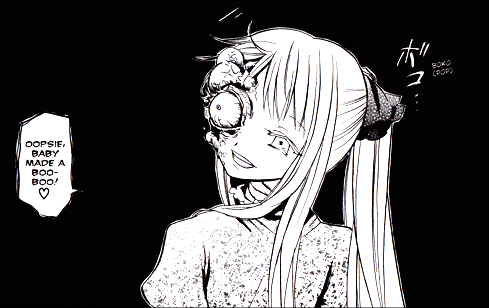
As for the horror elements in this volume, for those who were creeped out by the fingernail torture in the Eye Opening Arc, well, we may have found a way to top it. Rena’s repressed rage and despair apparently comes into her head in the form of imaginary maggots that are inside her skin. Note they don’t feel imaginary to her – or to us, as we see them a few times, most notably bursting from her neck as she tries to kill herself in a flashback. Karin Suzuragi’s art is generally considered the “cutest” and most “moe” of the group of artists adapting the series, so this is particularly grotesque. There’s also Rena’s murder of Rina, the aforementioned gold-digger. The anime keeps things vague and silhouetted, but the manga has no trouble being graphic, showing Rina being beaten to death with a pipe (after trying to strangle Rena, to be fair) and begging for her life once she realizes what Rena will do. Oh yes, and eyeballs bulging from sockets, a Higurashi classic.

Higurashi makes for an excellent horror series, but it’s the mystery and characters that keep me coming back after so many deaths and resets. This isn’t the final arc, so I know things will turn south – they already have. But I want to know if the heroes can get any closer to redeeming Rena, and if she can find the “atonement” the arc title implies. I also want to know why this reset keeps happening. There’s got to be more to it than just torturing teenagers over and over again. Gripping, unnerving, and with a jarring contrast between art and events. Welcome to Hinamizawa.

Filed Under: REVIEWS

Bookshelf Briefs 10/24/11

October 24, 2011 by David Welsh, Katherine Dacey, MJ, Sean Gaffney and Michelle Smith 3 Comments

This week, David, Kate, MJ, Michelle, & Sean take a look at recent releases from NBM/Comics Lit, Viz Media, Kodansha Comics, and Vertical, Inc.


Black Jack, Vol. 16 | By Osamu Tezuka | Vertical, Inc. – One of the many great things about Black Jack is that it keeps giving me new reasons to praise it, even in its penultimate volume. The quality that really asserts itself in this volume is the tremendous variety of story types Tezuka provides. There’s sentimental romance, creepy revenge drama, potentially lethal hubris, fraternal turmoil, and, in a dazzling, extra-long piece, a blend of baffling medical mystery, religious argument, and geopolitical drama all in one. It’s hard to think of a series that provides better volume-to-volume value than Black Jack, especially when you consider Tezuka’s bodacious skills as an entertainer and his seemingly limitless ambition as an artist. Yes, his long-form pieces are breathtaking, but you get a fuller sense of his genius when you see what he can do with 20-odd pulp-infused pages. And you get a great deal of entertainment along the way. What more could you ask? – David Welsh

Blue Exorcist, Vol. 4 | By Kazue Kato | VIZ Media – Unusually for a Jump manga, the fighting is not really drawing me into Blue Exorcist – it’s straight out of the Boy’s Book of Shonen. What is interesting here is Rin’s continual struggle against revealing his powers, and the reaction of everyone else once they do get revealed. It’s clearly a long-term plot – to our surprise, his friends do not immediately say “Oh, it’s OK, you’re just Rin to us”, but seem genuinely unnerved that Rin is the son of Satan. It’s a reminder that this is not something to be taken lightly in this series, and that Satan is not just a wacky final end boss. Meanwhile, Mephisto continues to show why he’s one of the better ‘playing all sides against one another’ long planners, and Shura and Yukio have a nicely developing relationship. As always, it’s the characters that make a series likeable. – Sean Gaffney

House of Five Leaves, Vol. 4 | By Natsume Ono | VIZ Media – With a delicate web of relationships already in place, it doesn’t immediately strike me as profitable for Ono to introduce a significant newcomer to her beguilingly battered gang of kidnappers. Given the new character’s puckish youth, it’s not unreasonable to detect a bit of Cousin Oliver Syndrome in play. But while the arrival of Ginta, a self-declared negotiator, seems a bit improvisational, it ends up moving the narrative forward in some satisfying and unexpected ways. Ginta is bright and observant, but he’s also got a reservoir of bitterness and distrust, so he fits right in with the damaged goods of the Five Leaves. He also disrupts their very controlled methodology and adds to the mounting worries of their leader, Yaichi. My conclusion is that, while Ono may not have every beat and twist of this story mapped out in advance, she’s got a very sure hand on the tone that story evokes. Highly recommended. – David Welsh

Mameshiba ♥ Winter | By Traci N. Todd and Thomas Flintham | VIZ Media – Based on the original characters by Sukwon Kim, Mameshiba ♥ Winter follows the adventures of a collection of adorable creatures (some kind of cross between beans and dogs) as they attempt to build the perfect snow castle. This is a children’s picture book, short on plot (well, short in general) and geared towards activity more than reading overall. Only twelve pages long, the real focus of the book is a pop-up snow castle at the end and a selection of pop-out Mameshiba, complete with ornamental stickers. None of the Mameshiba are well-introduced here, so previous familiarity with the franchise is recommended, especially for kids on the older end of its target audience, who might otherwise wondering who all these characters are. Though the story seems unsubstantial, even for a picture book, it’s pretty difficult not to be charmed by the super-cute Mameshiba. Lighthearted activity for a snowy afternoon. – MJ

Psyren, Vol. 1 | By Toshiaki Iwashiro | VIZ Media – Gantz with training wheels — that’s how I’d describe this mediocre addition to the Shonen Jump line. Like Gantz, Psyren deposits a large and varied cast of characters in an alternate reality, forcing them to participate in a contest reminiscent of a video game. The winners live to play another day; the losers die in gruesome fashion, often after disregarding advice from the story’s youthful hero. Though Psyren isn’t nearly as slick or violent as Gantz, it does have one big advantage over its seinen big brother: Amamiya, who turns out to be one of the toughest, smartest participants in the game, showing her male peers that true grit isn’t necessarily about physical strength or speed (though she’s pretty handy with a sword). The art is serviceable, but not particularly memorable, an observation that could be extended to the script and characters as well. – Katherine Dacey

Skip Beat!, Vol. 25 | By Yoshiki Nakamura | VIZ Media – First off, thanks to Viz for not licensing Tokyo Crazy Paradise, so I can make that “from the creator of” joke for at least another few months. Now for the main event. Clearly Kyoko and Ren will be the final couple whenever Skip Beat! decides to end, but I have to admit I still find Sho the more fascinating of the two lead males. I don’t *like* him more than Ren, but there’s a fantastic cunning to him, and he’s never more at his best than when he’s burning with jealous hatred. His move here to get Kyoko to think of only him is brilliant in its godawful dickishness, and Ren’s response, whiole very sweet, doesn’t quite pack the same emotional punch. I actually preferred Ren threatening Kyoko – a nice reminder of his true feelings. All this plus some cute Moko scenes. Now that Valentine’s is over, what’s next? – Sean Gaffney

Stargazing Dog | By Takashi Murakami | NBM Comics Lit – I may be a cat person, but I am certainly not immune to the touching tale of a good-hearted and grateful dog who is faithful to his master until the very end. Christened “Happie” by the little girl who plucked him out of a cardboard box, the cheerful dog chronicles the gradual changes in his owners’ lives, culminating in a divorce and a seaward journey with “Daddy,” who gradually loses what little possessions he has left. The outcome of the story is made clear from the beginning, but that doesn’t make what transpires any less poignant. My one complaint—setting aside the various typos plaguing the volume—is that NBM chose to flip the art. Backwards signage and sound effects are distracting enough on their own, but when dialogue expressly states that they’re keeping the sea on their left and when it is subsequenly shown to be on their right, it’s downright annoying. – Michelle Smith

The Wallflower, Vol. 26 | By Tomoko Hayakawa | Kodansha Comics – In case anyone is still reading this in order to get some romantic resolution, please. Stop. You’re only hurting yourself. There is no development here, the author has admitted she has no idea how to romantically resolve anything, and all we have is comedy hijinks we’ve seen before. That said, it’s pleasant enough – there’s nothing egregiously bad about this volume, and once you place your desires in park, it can be quite fun. The best chapter is probably the final one, where some boys from class use Sunako’s creepiness as part of a plan to excuse their bad grades – it’s a nice parody of the power of parent organizations. The worst chapter is the one with Sunako’s aunt, which contains not one thing we haven’t seen before. If you buy things out of pure inertia, you’ll still enjoy this. If you don’t, you likely dropped it long ago. – Sean Gaffney

Filed Under: Bookshelf Briefs

  • « Go to Previous Page
  • Page 1
  • Interim pages omitted …
  • Page 429
  • Page 430
  • Page 431
  • Page 432
  • Page 433
  • Interim pages omitted …
  • Page 538
  • Go to Next Page »
 | Log in
Copyright © 2010 Manga Bookshelf | Powered by WordPress & the Genesis Framework