The Baby-Sitters Club: Kristy’s Great Idea | Novel: Ann M. Martin / Scholastic | Graphic Novel: Raina Telgemeier / Graphix
 Kristy Thomas has a great idea — she and her friends can work together to give beleaguered a one-stop-shop for baby sitters. That’s how the Baby-Sitters Club is formed, with Mary-Anne, Claudia, and the new girl, Stacey. A few problems pop up—prank calls, crazy kids, and accidental dog-sitting among them—but the club can work through it all. Stacey has a secret, and Kristy’s dying to know what it is. But when she pushes her new friend too hard, she risks losing the club when it’s barely even started.
Kristy’s Great Idea, the very first book in The Baby-Sitter’s Club, was originally published in 1986. Since then there have been 131 novels (and that’s not including any of the spin-off series!), though original author Ann M. Martin only wrote the first 35 herself. In 2006, five years after the conclusion of the novel series, Scholastic’s imprint Graphix released a graphic novel adaptation by Eisner Award winner Raina Telgemeier. The books themselves went out of print in 2009, but recently, Scholastic began rereleasing the first several books for a new generation of fans.
Confession time—I was a HUGE Baby-Sitters Club fan. I owned half the novels, and continued getting the other half out of the library until I realized I was older than the characters I was reading about. I picked up the first Baby-Sitters Club book again with some trepidation. At the very least, it’s been 13 years since I last read a BSC novel, and as it tends to go with many things I loved as a child, I worried the book wouldn’t stand up today. I was wrong. Martin tells the story in simple but interesting prose, easily keeping her readers engrossed. And it’s funnier than I remembered, like when one child insists her cat, Boo-boo, has been bewitched by the creepy neighbor when the animal begins to freak out and streak across the yard. Now over 25 years old, the book has some quirks that date it in the 80’s (handwritten essays, overalls as a fashion statement), but much of the novel focuses on the girls and their relationships with both family and friends—universal problems with any preteen reader—so that the story still feels current and relatable. And although each of the characters has a particular role that she fills—the tomboy, the popular girl—within 150 pages Martin gives them enough depth so that we get realistic, fleshed-out characters instead of a group of stereotypes.
One thing I didn’t notice as a kid was the diversity in the book. A main character is Asian, many characters come from broken or mixed homes, and another deals with a disease. The Baby-Sitters Club covered a spectrum with its characters, but what’s really fantastic is how blended and natural this diversity is. Being a different race or having a non-traditional family doesn’t feel strange in this book, or forced as if Martin was trying to make a point. Instead it’s just natural—the way things simply are—a wonderful point of view for a children’s book to have.
 Having now rekindled my love of Ann M. Martin’s series I went into Raina Telgemeier’s graphic novel with a decent level of excitement. From the front cover you can tell that this adaptation is crafted by a fan. The character designs are alive with personality, from Kristy’s wide grin to Mary-Anne’s perpetually nervous looks. She even manages to make Claudia look sufficiently more “grown up” than her friends while still making her believably 12-years-old. Characters’ faces carry a range of emotions that are more telling than some of the prose, like with the loaded looks Kristy gives Watson, her stepfather-to-be.
The graphic novel matches the quick pace of the novel, packing in all of the events without making the comic feel crowded and rushed. Like a lot of adaptations, Telgemeier transfers parts of the novel’s narration to the comic’s voice over, but it works better here than in most cases. The first person point of view keeps the narration sounding like Kristy’s telling the story. Also, Telgemeier is pretty wise in how she uses it, generally only inserting the narration when it would be too awkward or long-winded to put the information into dialogue or thoughts.
I was absolutely wrapped up in the world of The Baby-Sitters Club through elementary and middle school, and it’s with a glad heart that I say I can still recommend the novel today. The novel is funny and easy to relate to, and with the cute updated cover little girls might not notice that the book is three times as old as they are. Telgemeier’s graphic novel is also a great introduction to the series, so much fun and so well-crafted that I’m genuinely disappointed that only the first four BSC books received adaptations. Acknowledging my own bias, I lean more towards recommending the novel, but both are great books that I’d give to any little girl.
Have any graphic novel adaptations you think do a good job? Or a comic you want me to check out for you? Leave suggestions for future columns in the comments!

 So, first I caught up with you (and the rest of the manga blogosphere), and finally read the first two volumes of
  MICHELLE: Well, speaking of second volumes… I checked out volume two of
  MJ: On a very different note, I also read the latest volume of one of my favorite current shoujo series, Yuuki Obata’s
  MICHELLE: You may remember that I was a big fan of Dining Bar Akira, a BL oneshot published by NETCOMICS. So when JManga licensed another oneshot by its creator—Tomoko Yamashita—I knew I had to read it.


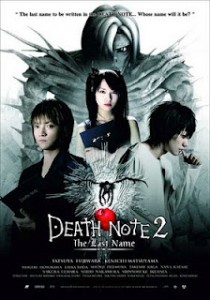 I did find the overall experience surprising. My snap judgment was that I would really enjoy Death Note, but I would find Gantz a little too dry & sci -fi for my taste. Instead, I frequently disliked Death Note, but I thoroughly enjoyed Gantz. There were two key differences for me between the two.
  In
In  , the production value runs the gamut from soap opera to video game. Story-wise a few new complications are added to the rules of the Death Note (and a second Death Note is introduced), though none of this really challenges L, who works intuitively. The story tension is meant to come not from whether or not L will know that Light is Kira, but whether or not he will be able to prove it. However, Light and his various associates, be they gods of death or devoted fans, continue to remain one contrived step ahead of L’s ability to discover hard evidence.
  On a whim I picked up
  at the library, and to my surprise, very much enjoyed it. It’s an L-specific spin-off of the Death Note live action films, and opens just before the Kira story begins. It starts with L working with Naomi on a case, and I actually really wished we could have had more of that. Naomi is a fun, capable character, and I enjoyed the taste we got of their relationship. If anyone could tell me if that is expanded on in the anime or manga I would really appreciate it.

 MICHELLE: Hmm… where to start? I suppose the simplest title can go first, and that would have to be Hayako Goto’s
  MJ: Sure! Let’s take a fairly drastic turn and look at the other single volume we each read, Ebine Yamaji’s
  Our last title is Milk Morinaga’s