• Skip to primary navigation
  • Skip to main content
  • Skip to primary sidebar
  • Home
  • About Us
    • Privacy Policy
    • Comment Policy
    • Disclosures & Disclaimers
  • Resources
    • Links, Essays & Articles
    • Fandomology!
    • CLAMP Directory
    • BlogRoll
  • Features & Columns
    • 3 Things Thursday
    • Adventures in the Key of Shoujo
    • Bit & Blips (game reviews)
    • BL BOOKRACK
    • Bookshelf Briefs
    • Bringing the Drama
    • Comic Conversion
    • Fanservice Friday
    • Going Digital
    • It Came From the Sinosphere
    • License This!
    • Magazine no Mori
    • My Week in Manga
    • OFF THE SHELF
    • Not By Manga Alone
    • PICK OF THE WEEK
    • Subtitles & Sensibility
    • Weekly Shonen Jump Recaps
  • Manga Moveable Feast
    • MMF Full Archive
    • Yun Kouga
    • CLAMP
    • Shojo Beat
    • Osamu Tezuka
    • Sailor Moon
    • Fruits Basket
    • Takehiko Inoue
    • Wild Adapter
    • One Piece
    • After School Nightmare
    • Karakuri Odette
    • Paradise Kiss
    • The Color Trilogy
    • To Terra…
    • Sexy Voice & Robo
  • Browse by Author
    • Sean Gaffney
    • Anna Neatrour
    • Michelle Smith
    • Katherine Dacey
    • MJ
    • Brigid Alverson
    • Travis Anderson
    • Phillip Anthony
    • Derek Bown
    • Jaci Dahlvang
    • Angela Eastman
    • Erica Friedman
    • Sara K.
    • Megan Purdy
    • Emily Snodgrass
    • Nancy Thistlethwaite
    • Eva Volin
    • David Welsh
  • MB Blogs
    • A Case Suitable For Treatment
    • Experiments in Manga
    • MangaBlog
    • The Manga Critic
    • Manga Report
    • Soliloquy in Blue
    • Manga Curmudgeon (archive)

Manga Bookshelf

Discussion, Resources, Roundtables, & Reviews

Features & Reviews

Manga the Week of 11/26

November 20, 2014 by Sean Gaffney, Ash Brown, MJ, Anna N and Michelle Smith 1 Comment

SEAN: The last week of the month is usually a nice breather after the deluge of the previous three weeks, giving us a chance to catch up on the piles of manga still out there. But there are still a few tasty bits of manga for (American) Thanksgiving.

opus

We’ll start with the tastiest, the long-awaited release from Dark Horse of Satoshi Kon’s Opus. It’s an omnibus of the original 2-volume Japanese release, and also apparently fairly metatextual. It’s also by Satoshi Kon, which is reason enough to buy it.

ASH: Oh! I knew this one was in the works, but hadn’t realized it was being released so soon!

MJ: Wow, this snuck up on me!

ANNA: This does sound interesting.

SEAN: From the sublime to the ridiculous, as Kodansha has the 2nd omnibus release of Attack on Titan Junior High. A lot of fans of the regular Titan series I think found this humor a bit too broad for their tastes, but I loved it, and appreciated the focus it gave to some of the minor characters from the main series. For anyone who likes comedy gag manga.

ASH: I agree. The first omnibus was surprisingly entertaining.

SEAN: Fairy Tail has its 44th volume, and we’re only 4 months behind Japan now!

There’s also the 2nd volume of xxxHOLIC Rei, where I keep hoping they’ll ignore that something is clearly wrong with this universe and keep giving me wonderful short unconnected supernatural stories.

MJ: I’m totally on board with whatever is wrong with this universe, and definitely looking forward to this volume! Hurray!

SEAN: If Syaoran shows up, I’m blaming you.

ANNA: I never thought the day would come when I would be very ambivalent about a CLAMP book, but here we are.

MICHELLE: I’m not exactly ambivalent about it, but I never finished the first xxxHOLiC, so Rei is sort of putting the cart before the horse for me.

SEAN: Cardfight!! Vanguard has its fourth volume come out from Vertical Comics. I hear the manga and anime are quite different.

Lastly, we have a digital only release (the physical volume is out in February), but it’s one we have been waiting almost 20 years for. The final volume of Neon Genesis Evangelion drops next week, and fans keep wondering if its finale will be slightly less apocalyptic and bleak than the anime or movies. We’ll find out soon.

Anything whet your appetite as you wait for all that turkey?
Filed Under: FEATURES, manga the week of

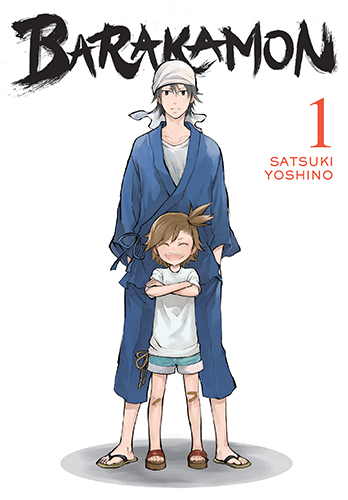
Review: Barakamon, Vol. 1

November 19, 2014 by Katherine Dacey

Yoshino_Barakamon_V1_TPBarakamon, Vol. 1
By Satsuki Yoshino
Rated T, for Teens
Yen Press, $15.00

Barakamon is a textbook fish-out-of-water story: an impatient city slicker finds himself in the country where life is slower, folks are simpler, and meaningful lessons abound. Its hero, Seishuu Handa, is a calligrapher whose fiery temper and skillful but unimaginative work have made him a pariah in Tokyo. His foils are the farmers and fishermen of Gotou, a small island on the southwestern tip of Japan that’s inhabited by an assortment of eccentrics, codgers, and naifs.

If this all sounds a little too familiar, it is; you’ve seen variations on this story at the multiplex, on television, and yes, in manga. (I think I liked it better when it was called Cold Comfort Farm, and starred Kate Beckinsale and Rufus Sewell.) Satsuki Yoshino does her best to infuse the story with enough humor and warmth to camouflage its shopworn elements, throwing in jokes about internet pornography, dead frogs, and bad report cards whenever the story teeters on the brink of sentimentality. The mandates of the genre, however, demand that Handa endure humiliations and have epiphanies with astonishing regularity—1.5 times per chapter, by my calculations.

From time to time, however, Yoshino finds fresh ways to show us Handa’s slow and fitful progress towards redemption. The first chapter provides an instructive example: Handa angrily dismisses his six-year-old neighbor Naru when she declares his calligraphy “just like teachers write.” After seeing Naru’s wounded expression, Handa chastises himself for lashing out at a kid. Handa never musters an apology to Naru, but makes restitution by joining her for a series of small adventures. The experience of swimming in the ocean, scrambling over a wall, and watching a sunset prove liberating, leading Handa to an explosive outburst of creativity punctuated by a few high-flying kicks. (Now that’s what I call action painting.) The results are messy, but the message is clear: Handa has the potential to be a genuine artist if he can connect with his playful side.

Like the story, the artwork is serviceable if not particularly distinctive. Yoshino creates enough variety in her character designs that the reader can easily distinguish one islander from another—an important asset in a story with many supporting players. Yoshino’s grasp of anatomy, however, is less assured. When viewed from the side, for example, Handa’s Tokyo nemesis has a cranium like a gorilla’s and a chest to match; when viewed from above, however, the Director appears small and wizened. Other characters suffer from similar bodily distortions that exaggerate their necks, arms, and torsos, especially when Yoshino attempts to draw them from an unusual vantage point.

Yoshino is more successful at creating a sense of place. Through a few simple but evocative images of the harbor and coastline, she firmly establishes the seaside location. She also uses architectural details to suggest how old the village is; though locals enjoy such modern conveniences as television, their homes look otherwise untouched by modernity. Yoshino is less successful in creating a sense of space, however. It’s unclear, for example, if Naru lives a stone’s throw from Handa’s house—hence her frequent intrusions—or if she lives a mile down the road.

The dialogue, too, plays an important role in establishing the setting. Faced with the difficult task of rendering the Gotou dialect, translators Krista and Karie Shipley chose a broad Southern accent for the local population. That decision neatly illustrates the cultural divide between Handa and his neighbors, but at the cost of nuance; a few jokes that hinge on vocabulary simply can’t be conveyed by this particular adaptation strategy. (The Shipleys’ translation notes are helpful in demystifying these exchanges.) Most of the punchlines, however, need no such editorial interventions to enjoy; certain elements of city slicker/country bumpkin humor transcend culture.

My verdict: Barakamon has enough charm and energy to engage the reader, even if the story isn’t executed with enough precision or subtlety to transcend the basic requirements of the fish-out-of-water genre.

Filed Under: MANGABLOG, REVIEWS Tagged With: Barakamon, yen press

Boogiepop Returns: VS Imaginator, Part 2

November 19, 2014 by Ash Brown

Boogiepop Returns: VS Imaginator, Part 2Author: Kouhei Kadono
Illustrator: Kouji Ogata

Translator: Andrew Cunningham
U.S. publisher: Seven Seas
ISBN: 9781933164236
Released: October 2006
Original release: 1998

Boogiepop Returns: VS Imaginator, Part 2 is the third volume in the Boogiepop light novel series written by Kouhei Kadono and illustrated by Kouji Ogata. It is also the third out of four Boogiepop novels to have been released in English. Translated by Andrew Cunningham, the second part of Boogiepop Returns was published by Seven Seas in 2006. In Japan, the volume was released in 1998, the same year as the first two books in the series. Boogiepop Returns is actually a two-part story, and so after reading the first novel in the arc I was particularly anxious to read the second. With all of the setup and steadily increasing tension in the first part, the story needed a conclusion and the final volume of the arc promised to deliver just that. Boogiepop is kind of an odd series which freely mixes the surreal with the real, making use of multiple genres in the process. But it’s also a series that I find peculiarly appealing because of that and because of its willingness to explore the more troubling aspects of the psyche.

A year ago a young woman committed suicide under the influence of an entity known only as the Imaginator. Her life was ended when, being pursued by Boogiepop, the Imaginator failed to change the world through her. But now the Imaginator has returned to inspire yet another person, this time with much greater success. Asukai Jin, with the Imaginator as a catalyst, has begun to use his unique abilities to not only read the hearts of other people but to manipulate them as well. Meanwhile, the mysterious Towa Organization also has a vested interest in the direction humankind is taking. Spooky E, a synthetic human and one of its agents, is actively hunting Boogiepop in order to prevent the spirit’s interference with the organization’s affairs. In an effort to draw Boogiepop out, he has arranged for the love-besotted Taniguchi Masaki to serve as a decoy by impersonating Boogiepop. Masaki didn’t initially realize he was being used as a pawn, and even if he had there was very little he could do to stop the developing crisis.

Despite the title being Boogiepop Returns, the real Boogiepop actually plays a very small albeit very important role in the two novels and is mostly relegated to the edges of the narrative while the other players take center stage. Granted, when Boogiepop finally does make an entrance during the second volume’s finale, it’s pretty spectacular. But until then the story largely follows the more mundane characters, the seemingly normal teenagers who have been caught up in the battle over the fate of humanity and who frequently are the victims of the supernatural and superhuman forces at work. At the same time, they are also dealing with their own personal issues and troubled relationships. In many ways I actually found these smaller struggles to be more emotionally immediate than the novel’s grander schemes, probably because they’re more relatable and the more realistic elements help to ground the stranger aspects of the Boogiepop series.

The doomed love story between Masaki and the girl he likes, Orihata Aya, has always been an important part of Boogiepop Returns but it become especially prominent in the second volume. It is because of his love for her that he “becomes” Boogiepop, his feelings and the burgeoning romance becoming closely entwined with the larger events of the novel. The second part of Boogiepop Returns has some fantastic fights and action sequences, but the  novel also has deeper contemplative and philosophical aspects to it as well. Employing the trappings of science fiction and the supernatural, the Boogiepop novels explore thought-provoking themes of free will, personal identity, the individual’s place within society, sacrifice, and what it truly means to be human. The characters are all damaged or suffering in some way but it’s how they choose to live their lives despite that pain that makes them who they are and makes Boogiepop Returns such an interesting and at times even compelling story.

Filed Under: REVIEWS Tagged With: Boogiepop, Kouhei Kadono, Kouji Ogata, Light Novels, Novels, Seven Seas

Lucifer and the Biscuit Hammer, Vols. 1-2

November 18, 2014 by Sean Gaffney

By Satoshi Mizukami. Released in Japan by Shonen Gahosha, serialized in the magazine Young King Ours. Released in North America by Seven Seas.

(This review contains spoilers.)

I reviewed the first half (i.e., Volume 1) of this series when it was digitally released by JManga a while back, but want to revisit it. It’s a new translation, and we get the addition of the 2nd volume, where things start getting a lot more serious. But also it’s a story that really holds up well when you reread it. What appears to be a standard story of superheroes uniting to defend the planet has a lot more going on under the hood, and you wonder if our hero and heroine are actually the least trustworthy people in the entire book… or if they’re just angsty teenagers dealing with life for the first time.

lucifer1

Yuuhi is a really fascinating and messed up character. The second time around I wasn’t as fond of the resolution of his past childhood traumas, which seemed a bit too pat to me, but then that was the point – Yuuhi was so angry that all the hardships he grew up with that twisted him into what he currently is could be resolved without his input or presence. He’s clever and calculating, and has latched onto Samidare in order to gain a tether he lost when his grandfather apologized, but there’s also a lack of an emotional center in the young man, something the series will slowly draw out of him, starting with the shocking events at the end of the first omnibus.

Biscuit Hammer is hardly the first series to introduce an amazingly cool and competent cast member and then kill them off – it’s actually a very common Japanese trope – but all the beats are handled well, including his nascent romance with Samidare’s sister (who is fantastic throughout) and the mere fact that he’s so powerful – he’s a giant threat to Yuuhi’s plans of world destruction, and thus his death settles on Yuuhi like a giant ball of guilt (with, of course, perfect timing in his younger brother immediately showing up). For the audience, the death of Hangetsu lets us know this series is going to be more seinen than shonen, and that we shouldn’t get too attached to our main cast.

As for Samidare herself, she’s just as screwed up as Yuuhi, but in a more extroverted way. Fatalistic due to her illness and its remission while she has powers, she’s determined to make the most of her short life, and one of the best (and most chilling) moments in the book is when she turns to Yuuhi, smiling, and asks him to die with her. It’s especially chilling as she’s such a great person otherwise – gung ho, cheerful, smart – and you can absolutely see why Yuuhi has started to fall for her.

There’s a lot more to discuss, such as the fact that the Yuuhi and Samidare that show up in dreams seem to be entirely different characters to their waking selves, or the suffering that is Noi’s daily life, where he deals with the fact that a talking lizard is the only sane character in this series – but again, that’s the beauty of a series like this. It has enough complexity to reward a reader more than just on a first read through. I suspect we’ll be seeing a lot more Knights in the next omnibus, and that makes me happy. Enjoy this twisted take on superheroes saving the Earth.

Filed Under: REVIEWS

My Week in Manga: November 10-November 16, 2014

November 17, 2014 by Ash Brown

My News and Reviews

Last week I posted two reviews at Experiments in Manga. The first review of was of Ajin: Demi-Human, Volume 1 written by Tsuina Miura and illustrated by Gamon Sakurai. It’s a manga with a rather dark atmosphere that deals with immortals, which is right up my alley. The first volume was a good start to the series; I’m looking forward to seeing how it continues to develop. The second review was of The Legend of Bold Riley, created by Leia Weathington and illustrated by a number of different artists. The review was actually the final review in my Year of Yuri project, so over the weekend I posted a wrap-up for the project as a whole. Later this week, most likely on Friday, a poll will go live so that readers of Experiments in Manga can vote to help me select my next monthly review project.

I came across a few fun and interesting things elsewhere online last week, too. Mangabrog has a translation of a conversation between Katsuhiro Otomo and Takehiko Inoue from 2012. Kate Beaton posted the second part of her collection of comics based on Natsume Sōseki Kokoro (a novel that I’ve reviewed in the past). The Ceiling Gallery posted “Girl Talk”, an article about “the life, friends and music of manga author Okazaki Kyoko” which is well worth reading. Anna Madill, a professor at The University of Leeds, is currently conducting research into boys’ love fandom. If you’re an English-speaking boys’ love fan, please consider assisting her research by completing a brief BL Fandom Survey.

Quick Takes

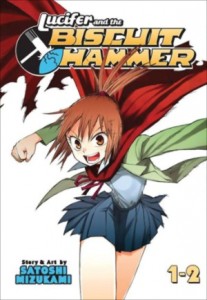
Lucifer and the Biscuit Hammer, Omnibus 1Lucifer and the Biscuit Hammer, Omnibus 1 (equivalent to Volumes 1-2) by Satoshi Mizukami. I really wasn’t sure what to expect from Lucifer and the Biscuit Hammer, but I ended up enjoying the first volume immensely. One morning, college student Amamiya Yuuhi wakes up to discover a talking lizard in his bed, requesting his help to protect a princess destined to save the world from an evil mage bent on destroying Earth by using a giant hammer floating in space. Despite his initial reluctance to get involved in the whole mess, Yuuhi decides to become her knight because of one simple fact: The only reason Samidare (who need little protection) wants to save the world is so that she can destroy it herself. Much like its title, Lucifer and the Biscuit Hammer is kind of strange. Both the characters and story are quirky, a little goofy, and rather bizarre. The manga is also quite a bit darker than it first appears; the characters are all revealed to have twisted pasts and tragedies to work through. It’s particularly interesting to see protagonists who are closer to being supervillians than superheros. I’m still not entirely sure where Lucifer and Biscuit Hammer is heading, but I’m really looking forward to reading more of the series and finding out.

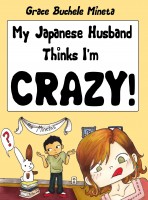
My Japanese Husband Thinks I'm Crazy!My Japanese Husband Thinks I’m Crazy by Grace Buchele Mineta. A companions of sorts to her blog Texan in Tokyo, My Japanese Husband Thinks I’m Crazy! is a collection of autobiographical comics and essays about Mineta’s life in Japan, her work as a freelancer, and her intercultural marriage. I’ll admit, I haven’t actually read much of Texan in Tokyo, but the comics made me laugh, so I decided to pick up the book. Some of the material collected is new to the volume while other material comes directly from the blog. My Japanese Husband Thinks I’m Crazy! is a wonderfully amusing and at times even enlightening collection. The main “characters” are Mineta herself, her salaryman husband Ryosuke, and Marvin–a talking rabbit who’s a figment of her imagination, the result of “stress, coffee, and loneliness from being a freelancer in Tokyo.” The comics are sweet, charming, and short, generally only a single page consisting of a few panels. Many of the comics are personal in nature, but some of Minata’s experiences are certainly shared by other foreign residents and visitors to Japan. My Japanese Husband Thinks I’m Crazy! is a fun way to learn little tidbits about Japan and Japanese culture.

Yakuza in Love, Volume 1Yakuza in Love, Volumes 1-3 by Shiuko Kano. Despite being one of the boys’ love creators with the most manga published in English, which I assume would be an indicator of her popularity, I generally find Kano’s work to be fairly hit-or-miss with me. Sadly, Yakuza in Love largely falls into the miss category. The short series is one of Kano’s earliest works, and it shows. The pacing is all over the place and frequently rushed, the action is difficult to follow, the sex and supposed romance doesn’t always mesh with the story, the plot doesn’t distinguish itself from any other generic yakuza-themed boys’ love manga, and she can’t quite seem to decide if she’s going for comedy or drama. She probably should have stuck with the humor–as a whole, Yakuza in Love simply doesn’t work as well when it takes itself too seriously. It wasn’t all bad, though. Just perhaps a little too ambitious. The best part of Yakuza in Love is actually all of the extras at the end which take up the last half of the third volume. Kano relaxes and just has fun with her characters, actually giving them more depth while parodying her own story. As a result, the extras end up being much more enjoyable.

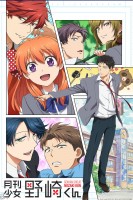
Monthly Girls' Nozaki-kunMonthly Girls’ Nozaki-kun directed by Mitsue Yamazaki. Based off of an ongoing yonkoma manga series by Izumi Tsubaki, Monthly Girls’ Nozaki-kun is an absolutely delightful twelve-episode anime series. The titular Nozaki is a tall, stoic, and slightly oblivious high school student who, despite what most people would assume from his appearance, also happens to be a published shoujo mangaka. Sakura has a crush on Nozaki, but when she tries to confess her love to him she somehow winds up as one of his assistants instead. Monthly Girls’ Nozaki-kun is a very funny and enjoyable series which freely plays around with shoujo manga tropes and character types. Nozaki finds inspiration for his manga from the other students at school, usually in slightly unexpected ways. He’s also amassed a handful of assistants in addition to Sakura, all with their own quirks and relationship problems which provide plenty of material for Nozaki to work with which eventually ends up in his manga. For the most part the anime tends to be fairly episodic, though there are several recurring characters and running jokes. Overall, the series is a tremendous amount of fun with a large cast of likeable characters.

Filed Under: FEATURES, My Week in Manga Tagged With: anime, comics, Grace Buchele Mineta, Lucifer and the Biscuit Hammer, manga, Monthly Girls' Nozaki-kun, Satoshi Mizukami, Shiuko Kano, Yakuza in Love

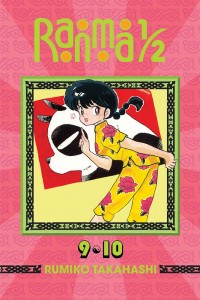
Ranma 1/2, Vols. 9 & 10

November 15, 2014 by Sean Gaffney

By Rumiko Takahashi. Released in Japan by Shogakukan, serialized in the magazine Shonen Sunday. Released in North America by Viz.

This particular omnibus is very illustrative of the perils and pitfalls of being a Ranma fan, both in terms of its ongoing tendency towards “everyone is terrible, comedy trumps everything”, and in terms of the fact that it was written in 1980s Japan, and is, shall we say, a little less than progressive. We’ve already seen Ranma’s treatment of Shampoo fall into the typical Chinese stereotype, complete with broken English. Now in this volume we get two characters introduced as boys who may (or may not) turn out to identify as someone else. I’m not asking a 1980s ‘aquatranssexual’ comedy to be progressive on LGBT issues, but even for that time this is pretty bad. But let’s begin with brighter stuff, and the first of our two gender-confusing newbies.

ranma9-10

Ukyou Kuonji is the last of the major Ranma cast members to join us, even if her role decreases as the series goes on. She’s also the last of the major antagonists in the battle to win Ranma’s heart, one that begins the moment that she realizes he never knew she was a girl, and he actively calls her the “cute fiancee” to Akane’s “uncute fiancee”. She’s a lot like Ranma, which makes them very believable as childhood friends, and clearly her chasing of him has less to do with her family honor and more due to the object of her “revenge fantasy” becoming a crush.

She also provided fandom with what seemed, at the time, to be a more “reasonable” choice than the hyperviolent Akane (note how violent Ukyou is in her introduction and the Tsubasa chapters), and thus became very very popular among fanfiction writers, who were frustrated by Akane and Ranma’s denial, and Akane’s tendency to hit Ranma, which was taken very seriously. Not that Ranma really returns any affection – even if he does enjoy teasing and mocking Akane, he does pick up when she’s seriously hurt and works to correct it. This doesn’t really happen with Ukyou, though he at least offers to let her get revenge for the idiocy his father perpetrated. (Also, asking a 6-year-old to choose between a friend they knew for maybe 3 weeks and food – wtf?)

(As for Ryouga and Ukyou, a very popular fan pairing, I will remain mostly silent, except to note that within minutes of meeting Ryouga, Ukyou is screaming at him in frustration.)

This volume also sees a very funny Kuno and Kodachi runaround, which balances Akane and Ranma’s love/hate relationship just right, as well as a beach episode featuring Happosai and Cologne (who ran into each other in their youth – big surprise), which does not get the balance right. Mousse returns, and has a Jusenkyo curse now to boot – one which he immediately tries to give to Ranma (or Akane – he claims he’s just bluffing about cursing her, but I doubt he’s care much if it happened). I’ve talked before about my dislike of Mousse, but I will note with amusement Shampoo’s rejections of him are immediate and incredibly blunt. Mousse is not a man that will take a vague answer. “Shampoo, do you hate me so much?” “Yep. Hate you.”

And then there’s the introduction of Tsubasa Kurenai. I believe we’ve seen the last of Tsubasa in the manga, though I think he becomes a recurring character in the anime like most of Takahashi’s one-shot antagonists. Tsubasa is from Ukyou’s old school, and is chasing after her out of love and to destroy Ranma, the one she is engaged to. Tsubasa’s gender reveal comes right at the end (which leads to some awkward translations – in Japanese, it’s much easier to hide gender pronouns) and for about a chapter and a half they think he’s a girl – and a lesbian. Then we also have the fact that Tsubasa makes a cuter girl than Ranma in her girl form – something that deeply stings his pride. (It’s also explicitly mentioned here, by the way, that the entire school bar Kuno knows Ranma can change.)

So Ranma decides to “date” Tsubasa. The line that is the worst in the volume comes after Akane tells (male) Ranma she assumed he was taking Tsubasa on a “girl-girl” date. He responds that he’s “trying to set her on the correct path”. There really isn’t much that I can add here except “ugh.” Takahashi frequently uses “uh oh, they may be a lesbian” for comedy, and yes, I realize Takahashi uses absolutely everything in the world for comedy, but this doesn’t mean she shouldn’t be called out on stuff like this, particularly when it makes the cast look homophobic. The whole thing isn’t helped by a wacky reveal ending where we see Tsubasa is just a guy who likes to cross dress, and Ukyou tells the others “I thought everyone knew that already”.

So, for me, this omnibus consisted of one excellent to good first half, and a mediocre to bad second half. The danger of omnibuses. Next time we’ll meet another incredibly annoying antagonist, but at least he’s more fun than Happosai. And surprise, he’s another abusive, horrible father! Find out why the Kunos are not just another insane brother and sister duo, but from a family of insanity!

Filed Under: REVIEWS

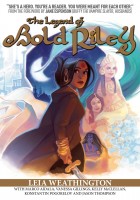
The Legend of Bold Riley

November 14, 2014 by Ash Brown

The Legend of Bold RileyCreator: Leia Weathington
Illustrator: Vanessa Gillings, Jason Thompson, Marco Aidala, Konstantin Pogorelov, and Kelly McClellan; Chloe Dalquist and Liz Conley

Publisher: Northwest Press
ISBN: 9780984594054
Released: June 2012

The Legend of Bold Riley is writer and illustrator Leia Weathington’s first graphic novel. Published by Northwest Press in 2012, the volume is a collection of related stories, each illustrated by a different artist. In addition to Weathington, Vanessa Gillings, Jason Thompson, Marco Aidala, Konstantin Pogorelov, and Kelly McClellan contributed their artistic skills to The Legend of Bold Riley, with Chloe Dalquist and Liz Conley assisting with some of the colors. I first became aware of The Legend of Bold Riley thanks to the involvement of Thompson (to whom I give partial credit for igniting my interest in manga). And it’s thanks to The Legend of Bold Riley that I discovered Northwest Press, a publisher specializing in queer comics, graphic novels, and anthologies. The Legend of Bold Riley is a sword and sorcery adventure featuring a princess as a hero. She also happens to be a lover of women. Happily, The Legend of Bold Riley doesn’t end with this collection. The second volume, Unspun is currently being serialized and Weathington has already started working on a third book.

Rilavashana SanParite, who would come to be known as Bold Riley, is the youngest child of the king and queen of the eastern nation of Prakkalore. She and her two older brothers are heirs to the throne, groomed to be fair and just rulers of the kingdom and knowledgeable in the arts of state in addition to the fine arts, sciences, history, and swordplay. But Riley finds that her heart lies somewhere beyond the walls of the capital city of Ankahla and even beyond the borders of Prakkalore. She wants to travel the world to see the places and meet the people she’s only ever read about in her studies. And so the princess sets out with a sword strapped to her side and a horse to carry her, first to the southern kingdom of Connchenn and then further to the jungles of Ang-Warr, the distant Qeifen, and all the lands in between. Over the course of her journey Riley meets gods and battles demons, the sharpness of her mind and wits just as valuable as the sharpness of her sword. She even falls into the bed of a lovely lady or two.

Although the stories in The Legend of Bold Riley all have continuity with one another, the prologue and the five individual chapters that follow can largely stand on their own once Riley has been introduced. As already mentioned, each chapter is illustrated by a different artist. Riley is always recognizable, but otherwise there is no attempt to have uniform artwork in the volume. Instead, the artists are given free rein, resulting in a marvelous assortment of different art styles and illustration techniques and a range of color palettes. The resulting shift of mood and atmosphere is quite effective in emphasizing the changes in the setting and the type of story being told from one chapter to the next. As Riley travels, visiting different countries and kingdoms, the artwork reflects those differences. The Legend of Bold Riley is diverse, and not just in its illustrations. The volume’s sceneries and stories take inspiration from the fantasy counterparts of India, Central and South America, Southeast Asia, and other areas.

The artwork in The Legend of Bold Riley may change from story to story, but Riley is always Bold Riley. She’s a fantastic and exceptionally appealing character, a dashing and daring young woman with strengths and weaknesses, remarkable talents, and human flaws. Although Riley’s sexuality is never the focus of the comic, it’s always a part of who she is as a person and as a well-rounded character. She falls in love, she makes mistakes, and she struggles and is challenged when faced with a world that’s not always black and white or even kind. The Legend of Bold Riley, while something new and refreshing, somehow also feels very familiar. It’s a collection of heroic tales, some ending in triumph and others ending in heartbreak. Because of its episodic nature there’s not a lot of character development, but Riley is such a great character to begin with that the work is still very satisfying. I thoroughly enjoyed The Legend of Bold Riley and look forward to reading more of Riley’s adventures in the future.

Filed Under: REVIEWS Tagged With: Chloe Dalquist, comics, Jason Thompson, Kelly McClellan, Konstantin Pogorelov, Legend of Bold Riley, Leia Weathington, Liz Conley, Marco Aidala, Northwest Press, Vanessa Gillings, Year of Yuri

Manga the Week of 11/19

November 13, 2014 by Sean Gaffney, Ash Brown, MJ, Michelle Smith and Anna N 1 Comment

SEAN: So. Many. Books.

ASH: Woo!

monster5

SEAN: Kodansha has the 5th volume of shoujo romance My Little Monster, which is still dealing with social ineptness in the best way.

MJ: I feel like I’m really missing out by not reading this. I probably have to fix that.

MICHELLE: I do honestly think that you would like it.

ASH: You should!

ANNA: Now I feel like I should be reading this! But I have far far too much manga to get caught up on.

SEAN: And the 2nd volume of Noragami, which I’m hoping kicks things into gear now that we have a 3rd cast member.

ASH: By the end, I rather enjoyed the first volume. Looking forward to seeing how the series develops.

SEAN: Seven Seas has another Devils and Realist, which I’m hoping keeps the denial in addition to all its handsome devils.

ASH: This series has actually really started to grow on me.

ANNA: I liked the first volume well enough but haven’t picked up the others for whatever reason.

SEAN: Dragonar Academy 4 has dragons and fanservice, possibly not in that order.

Kokoro Connect was surprisingly serious about its body swapping, even if at times the exposition felt a bit stilted. I look forward to seeing where the second volume goes.

Monster Musume 5 has monsters and fanservice, possibly not in that order.

ASH: Since both things are fairly constant, I’m not sure there can be much of an order…

prophecy1

SEAN: Prophecy is our first new title, a seinen title involving a masked man who predicts crimes… which then happen. This looks pretty grim, but is supposed to be a real page-turner.

MJ: Oooo, I like the sound of that.

MICHELLE: Me, too! Something just got added to my shopping list!

ASH: I’ll be checking it out!

ANNA: I’m intrigued but am reserving judgement until you guys check it out.

SEAN: Viz, as always in the 3rd week of the month, has its ‘Signature’ series titles. We have another volume of Gangsta, which I’m starting to like even more than Black Lagoon, its spiritual predecessor.

ASH: I think I do, too, actually.

SEAN: Ooku hasn’t come out in ages, so a 10th volume is very welcome.

MJ: Yay, yay, yay! And more yay!

MICHELLE: What she said.

ASH: And another yay for good measure!

ANNA: Yet another yay for Ooku!

SEAN: And I know the Manga Bookshelf crew will be ecstatic with a 13th volume of Real.

MJ: Truth.

MICHELLE: I am performing the Baby Groot dance as we speak.

ASH: Real is a phenomenal series. If you’re not already reading it, give it a try!

ANNA: It is really great.

SEAN: I’ve never played the games, but one can’t deny the overwhelming popularity of the Resident Evil franchise, and here we have the first volume of a manga adaptation called The Marwha Desire, which ran in Akita Shoten’s Weekly Shonen Champion.

Terra Formars 3 is also coming out.

Yen On has a 2nd volume of the light novel Accel World, whose first volume I enjoyed, and whose protagonist is intriguing, so I will see where it goes from here.

MJ: I’m on board for this, definitely!

index1

SEAN: The big light novel out next week, though, is even more well-known in the anime and manga fandom. A Certain Magical Index has become a giant franchise, whose anime is already out over here, and whose manga spinoff, A Certain Scientific Railgun, has sold quite well indeed. Now see where it all began, with this first volume.

Ani-Imo is a shoujo title from Aria, a magazine known for odd shoujo titles. Do you like bodyswapping? Do you like suggestions of incest? Then you’ll love this title, whose creator has been doing ‘saucy’ shoujo for years.

MJ: I was right there… until “incest.” Just. No.

MICHELLE: That’s an odd shoujo title for sure. Even the cover art looks like it’s meant for some other demographic.

ANNA: Yeah, I don’t think so.

SEAN: Anything I could have said about BTOOOM! I got out with the previous 7 volumes, so… 8.

Durarara!! continues adapting the third novel with the 2nd volume of the Yellow Scarves arc. (That can be confusing. Welcome to light novel adaptations, here’s your accordion.)

Another debut with Gou-dere Sora Nagihara, which ran in Hakusensha’s Young Animal Arashi. It’s pretty ecchi, and involves an otaku’s 2D fantasy girl coming to life and not being quite the shy, demure girl he was expecting.

Speaking of ecchi, another volume of High School DxD is here.

Higurashi: When They Cry ended last year, and Rika finally got her happy ending, provided she doesn’t do anything foolish like bike in front of a truck. (cough) Please enjoy Higurashi’s “epilogue”, the Dice-Killing Arc.

Jack Frost has reached its final, 11th volume! No more head-raising antics!

The Melancholy of Haruhi Suzumiya also has its 20th and final volume, though the spinoffs are still running. Forever doomed to be in the shadow of the novels and anime, it’s probably for the best it ends here as it runs out of novel to adapt.

milkyway1

Milkyway Hitchhiking is a new manwha from the creator of One Fine Day, and is also in full color. It seems to be episodic tales connected by a time-space cat.

MJ: Wahoo! I loved One Fine Day, so I am very enthusiastic about this.

MICHELLE: Oh! I forgot this was coming out. It looks like very much my sort of thing.

ASH: Space-time kitty!

ANNA: This does sound quite appealing.

SEAN: Pandora Hearts 22… MJ?

MJ: You know me so well. I will be eating this up with a spoon.

SEAN: As well as the Pandora Hearts artbook, Odds & Ends… MJ?

MJ: It’s beautiful! Truly. Really, truly. And I offer proof (thanks to Sean).

SEAN: Soul Eater’s covers are still nearly black, which tells me things are still not looking good for our heroes as we head towards the story’s climax.

And there’s also the 4th volume of Soul Eater NOT!, which I believe is also a final volume. Who will Tsugumi choose as her girlfr… um, partner?

Everyone’s least favorite arc of Sword Art Online, Fairy Dance, has its 2nd manga volume ship.

MJ: Heh, I haven’t enjoyed the manga as much as the novels (or the anime), but I’ll take it.

SEAN: Lastly, Triage X marches on, with its 8th volume out next week.

That’s not too much. Surely you can buy all of that in one week, right?

Filed Under: FEATURES, manga the week of

3 Things Thursday: SOS

November 13, 2014 by MJ 8 Comments

As I was casting about for ideas for this week’s column, I found myself consistently drawn back to a manga-related quandary in my own life that I have not quite been able to resolve. As you know, I have recently opened up my personal manga collection as a library for my students (with a few rules in place about age appropriateness). It’s gone about as well as I expected, which is to say that a small number have shown interest. My problem is this: while I have had no trouble at all recommending manga for my teen students, I have been pretty well flummoxed by requests for recommendations from parents of my tweens. These kids are mostly girls, 9-11 (some will turn 12 over the course of this school year), very smart, highly imaginative, fabulously ambitious, heavy readers, into the arts, and not particularly interested in romance or other “teen” concerns. And while I have a few series I’ve recommended for kids in this age range in the past, I don’t consider them ideal for a number of reasons. Let’s take a look:

shugochara1-200x3001. Shugo Chara! | Peach Pit | Kodansha Comics – This is a title I love very much and have recommended for younger readers in the past, for lots of reasons. It’s got a fantastic female protagonist (and lots of other great girl characters as well), wonderful friendships, an emphasis on positivity and cooperation, action, adventure, pretty artwork, and some pretty enticing, tween-fantasy romance, the likes of which my childhood self would have eaten up with a spoon. Thing is, these girls are (for the most part) much, much less interested in boys than I was a their age, which is great, but also makes this a far less compelling choice. Also, the early storytelling and artwork, especially, I think might strike these girls as childish (which, I find, tends to be way less forgivable to actual children than it is to adults). So as much as I love this series, I am having trouble recommending it to these particular girls. Also in this category: Cardcaptor Sakura.

sugar2. Sugar Sugar Rune | Moyoco Anno | Del Rey Manga – While this title is more combative than romantic, its wry take on romance as a competitive sport between girls is commenting on a social structure that, frankly, I’m hoping these particular girls are going to play a part in crushing. In my day, girls their age were already learning how to hate each other and bring each other down in pursuit of popularity with boys, and I see none of that at all in this collection of smart, empowered young girls. In fact, their kindness to each other pretty much blows me away any time I see them interacting as a group. The kind of competitiveness Sugar Sugar Rune so deftly skewers just does not seem to be part of their lives, and I’m hesitant to introduce it to them. Same problem (though less humorously approached): Fushigi Yugi.

fma13. Fullmetal Alchemist | Hiromu Arakawa | Viz Media – I love Fullmetal Alchemist. Everyone knows how much I love Fullmetal Alchemist. This is not a secret. So it should come to no surprise to anyone that it tends to be my number-one go-to manga recommendation for any kid with reading skills developed enough to take it on. It’s got incredible world-building, intricate plotting, compelling characters, heart-wrenching drama, hilarious comedy, action, adventure, fantastic artwork, minimal romance, and (hooray!) awesome female characters. Unfortunately, none of those female characters is the protagonist. There is nothing wrong with this. It’s a shounen manga, and its protagonists are among my favorites of all time. They are smart and funny and totally woman-friendly. They are written by an extremely talented woman. All these are reasons why this is my number-one, most recommended series for kids, including these girls. But man do I wish that I had something this good to recommend to them with girl protagonists, but without the romance themes they do not care about. At all. Similar problem: Hikaru no Go.
So let’s get to the real reason for this column. I do not doubt that there are series floating around that are perfect for my tween girls. I’m certain there are. I just may not own them. For the sake of these students (and for mine as well!), however, I’d be open to picking up a series or two to add to my library. So what do you recommend. With the girls I’ve described in mind, what manga would you recommend I give them?

Filed Under: 3 Things Thursday

Ajin: Demi-Human, Vol. 1

November 12, 2014 by Ash Brown

Ajin: Demi-Human, Volume 1Author: Tsuina Miura
Illustrator: Gamon Sakurai

U.S. publisher: Vertical
ISBN: 9781939130846
Released: October 2014
Original release: 2013

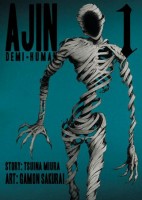
It was the cover art of Ajin: Demi-Human, Volume 1–a creepy image of disconcerting skeletal figure–that first sparked my interest in the series. When I learned that the manga was at least in part about immortals in addition to being fairly dark in tone, I knew that I wanted to read it. The exploration of immortality and its repercussions in fiction fascinates me. Series like Hiroaki Samura’s Blade of the Immortal and novels like Fumi Nakamura’s Enma the Immortal have actually been some of my favorite works of recent years. And so, I was very curious about Ajin. The first volume, written by Tsuina Miura and illustrated by Gamon Sakurai, was originally released n Japan in 2013. (Later volumes of the series are both written and illustrated by Sakurai.) The English-language edition of Ajin, Volume 1 was published by Vertical in 2014. The production values are particularly nice, with high-quality paper that really shows off Sakurai’s ink-heavy artwork.

Seventeen years ago, the first demi-human was discovered. Immortal, and perhaps something a little more, demi-humans are considered to be less than human–feared, despised, reviled, and subjected to horrific experiments in the name of science and for the advancement of humankind. Demi-humans seem to be rare, only forty-six have so far been identified, but that’s only because they appear to be normal humans, at least until they survive their first death. Most assumed Kei Nagai was an average high schooler, preoccupied with studying for his college entrance exams. But Kei’s hopes and dreams of becoming a successful doctor are shattered when he dies in a traffic accident, his body smashed into pieces. And then he comes back to life. Now he’s on the run, pursued by the general population, the police, the Demi-Human Control Commission, and even other demi-humans. His only ally is his friend Kai, who tries to help him escape, but that simply means that the two of them are in danger instead of Kei alone.

As in many other works about immortality, Ajin shows that living forever isn’t always something to be desired and can in fact bring a tremendous amount of pain and suffering. There’s the physical torment of death and injury in a body that revives again and again, but there’s also the mental and psychological damage to take into consideration as well. Kei has suddenly lost all of his rights as a person, he is being hunted as something not worthy of being human, his family and friends are filled with disgust towards him–of course this is going to have an impact on the young man. It would be exceedingly easy for him to lose his humanity or his sanity. Glimmers of those possibilities can be seen in the first volume of Ajin as Kei struggles to realign his worldview with his newfound reality. Granted, Ajin, Volume 1 largely focuses on the action surrounding Kei’s escape and explaining (not too subtly) the unusual abilities of the demi-humans. Not much character development has happened yet, but the potential is certainly there.

Ajin, Volume 1 is a good start to the series, though there is still room for improvement. In general, the artwork tends to be a little stronger than the writing at this point. The premise is interesting, and promising, but Sakurai’s illustrations are what really give Ajin its effectively dark atmosphere. Particularly chilling are the “black ghosts”–malignant extensions of the self capable of extreme violence which are able to be manifested and controlled by certain demi-humans. (That disconcerting figure from the cover? That’s a black ghost.) Humans are quite capable of shocking violence as well. Several examples of the gruesome experiments that have been conducted using demi-humans as test subjects are shown in Ajin, Volume 1. The methods are tortuous and the repeated deaths are cruel. So far, the only real difference between the two groups is that when bodies are mutilated or torn apart–which is not at all an uncommon occurrence in the first volume of Ajin–for better or for worse the demi-humans actually survive.

Filed Under: REVIEWS Tagged With: Ajin, Gamon Sakurai, manga, Tsuina Miura, vertical

Attack on Titan, Vol. 14

November 11, 2014 by Sean Gaffney

By Hajime Isayama. Released in Japan by Kodansha, serialization ongoing in the magazine Bessatsu Shonen Magazine. Released in North America by Kodansha Comics.

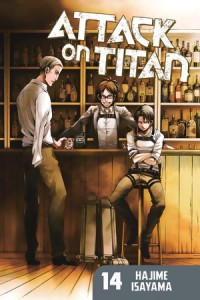
The cover to this volume features Levi (surly), Hange (insane grin) and Erwin (pensive) at a bar, looking for all the world like they’re about to tear the reader of the book apart, and honestly it wouldn’t surprise me in the least at this point. In the last volume was all about realizing how corrupt the government is from top to bottom and that it was our heroes against the world, this volumes takes it further by showing that our heroes are also not without horribleness. The griminess that the last volume had only increases here, and I find myself missing Titans a bit.

titan14

I’ve been reading the new chapters as they’re released on Crunchyroll, and have been somewhat dreading this review, as this volume seems to feature all the things I like least about the series. I will start with the stuff that was very good. Isayama’s art is still questionable, but the battle sequence between Levi and… well, everyone else in the last two chapters is quite well done, and should be really fun to animate assuming a series ever gets that far. Erwin laying out his plan for a bloodless revolution, as well as his own tragic past, is well-handled, and explains a lot about the lengths he’s decided to go to. Kenny Ackerman is dangerously psychotic and over the top, and brings a fresh terror to the villains’ side. Jean, Connie and Sasha are fantastic for being the remaining moral core of the Survey Corps, even if I worry it’s because they’re meant to be “the softest”.

OK, let’s talk about the torture scenes. I hate them. I hate that our heroes are forced to resort to this, I have VERY MUCH that it actually WORKS. This is the wrong message to send to anyone, particularly young Japanese readers of a shonen magazine, and no, Hange kicking a table in anger at herself does not really help to gloss over the problem. I do not want to see “torture is bad, but it gets results” in any manga, ever. Particularly when it’s our heroes doing it. Case closed.

Secondly, there’s the scene with Levi emotionally and physically abusing Historia till she gives in to their demands, which I think I hate even more than the aforementioned torture. There’s a theme in this volume of “we have to get our hands dirty if we want to win and bring about peace”, and it’s not a message I want Attack on Titan to have. Historia, after the loss of Ymir and the revelation of her true identity, is clearly suffering from shellshock of a sort, and doing this is just mean. And, as others have mentioned, having someone say afterwards “I know he seems harsh, but he’s really sweet underneath” makes things worse, if that’s possible.

I have avoided mentioning the fact in these reviews, mostly as it wasn’t really relevant when it was just the Corps trying to figure out how to defeat 30-foot monsters and not get eaten, but now that we’re into political intrigue and justifying the means, it needs to be said: Isayama has been reported to be a war crimes apologist, and many in Korea have called for readers to boycott the series because of this. And now here we have Levi and Hange committing war crimes for “the greater good”. It makes me dislike them, which is a shame as I loved Hange a lot. It also makes me dislike this volume, and I’m wondering how much rope I’m going to give the series before it hangs itself. You’re on notice, Attack on Titan.

Filed Under: REVIEWS

Bookshelf Briefs 11/10/14

November 10, 2014 by Sean Gaffney and Michelle Smith Leave a Comment

This week, Sean and Michelle look at recent releases from Seven Seas, Yen Press, Kodansha Comics, and Vertical, Inc.

alice-knights3Alice in the Country of Clover: Knight’s Knowledge, Vol. 3 | By QuinRose and Sai Asai | Seven Seas – I’m always more fascinated by the mechanics of Wonderland than who Alice ends up with (it’s Ace, in case you hadn’t been paying attention, and there’s a nice love scene towards the end), and I’m happy to say there was a lot of what I loved here. Faceless vs. Roleholders, Alice as a catalyst, etc. And yes, this also involves Alice as a hostage, but Alice isn’t meant to be an action hero. Her struggle for self-worth and acceptance is why we read Country of Hearts, and it’s nice to see she finds it in Ace, a character she shares a lot of similarities to Also, Blood and Vivaldi are AMAZING here, let me tell you. For Ace fans, ignore his earlier book, this is the series to get.-Sean Gaffney

haruhichan8The Melancholy of Suzumiya Haruhi-chan, Vol. 8 | By Puyo and Nagaru Tanigawa| Yen Press – I read this after reading the anthology omnibus The Celebration of Haruhi Suzumiya, and it reminded me how grateful I am that we have an author here who knows how to be funny and heartwarming and build on the characters, even though he’s doing a gag manga. We’re up to parodies of the 9th novel here, meaning Sasaki and company, and we therefore have parodies of the cast who have been through a year’s worth of stuff together. Celebration always has Haruhi & Co. at the ‘I have learned nothing, I read the first novel once’ stage. Appreciate the Haruhi-chan you have is what I’m saying. Also, the JoJo’s parody in here is hysterical.-Sean Gaffney

Sankarea9Sankarea, Vol. 9 | By Mitsuru Hattori| Kodansha Comics – This volume wraps up the seriously dark ZOMA arc, but its aftereffects linger. Rea still doesn’t have any memories of Chihiro, and is more than a little creeped out by his familiarity. The rest of the cast works to jog her memory, but it doesn’t really seem to be working. No matter what’s done to try and bring back the cute romantic comedy antics, though, it’s the darkness that we remember. And in this case that’s the last chapter, featuring one of Grandpa’s numerous wives, who is prepared to give Chihiro some exposition regarding his mother that we’ll have to wait till next volume for. There are moments of cuteness and fanservice here, but not since Franken Fran has a title made it this uncomfortable.-Sean Gaffney

say i love you4Say “I Love You”, Vol. 4 | By Kanae Hazuki| Kodansha Comics – There’s a lot going on in this fourth volume, as we not only get the model whose work is drawing Yamato, but also a new underclassman who has past ties with Yamato and feels a close bond with Mei. That said, the main reason to read this title is still its heroine, who is trying not only to figure out what love is and how to react to it, but also how to deal with friends and socialization at all. There’s also a great subplot devoted to bullying (a major theme of this work) and cycles of violence, and how yearning for payback can take you down a path you don’t want to go. This isn’t quite as movie of the week as the old potboilers like Life or Limit, but it’s operating on a smaller scale, and I really enjoy it.-Sean Gaffney

eat5What Did You Eat Yesterday?, Vol. 5 | By Fumi Yoshinaga | Vertical, Inc. – Fumi Yoshinaga’s charming What Did You Eat Yesterday? is a slice-of-life depiction of 40-something gay couple Shiro Kakei, a lawyer, and Kenji Yabuki, a hairstylist, as they go about their daily lives and make what I would consider pretty elaborate home-cooked meals. There’s actually a bit more plot in this volume than some others, introducing several ideas (new friends, matching rings, a murder trial…) that could move the story along in interesting ways, and though that’s a welcome development, I preferred some of the quieter moments, like Shiro cooking companionably alongside his mother and, most of all, a welcome glimpse into Kenji’s past with a story of how his newfound teenage height scared off his deadbeat dad even though “my heart was a fluffy princess’s.” Ha! This is a lovely series, and once again I find myself grateful to Vertical for licensing it. – Michelle Smith

Filed Under: Bookshelf Briefs

My Week in Manga: November 3-November 9, 2014

November 10, 2014 by Ash Brown

My News and Reviews

Last week at Experiments in Manga the winner of the Sherlock Bones manga giveaway was announced. As usual, I took the opportunity to compile a list of manga as well, in this case a list of manga available in English that feature detectives or other crime solvers. I also posted two reviews last week. The first review was of No. 6, Volume 9, the final volume of Hinoki Kino’s No. 6 manga adaptation. I’m happy to report that the manga has a much less rushed and much more complete ending than the anime adaptation had. And for something completely different, I also reviewed Ivan Morris’ translation of The Pillow Book of Sei Shōnagon last week. It may have been written in the tenth and eleventh centuries, but it’s still an engaging and enjoyable work.

Interesting reading found elsewhere online included a look at some of the most completely collected manga series in Japan, many of which have been licensed in English in whole or in part. (I was happy to see some of my personal favorites, like Parasyte and Hikaru no Go on the list.) Brigid Alverson has a nice overview of the current state of the manga industry in North America for School Library Journal. And over at A Case for Suitable for Treatment, Sean Gaffney has a roundup of some of the recent manga licenses from various publishers. There are also two surveys that are going on right now. Viz has its Fall 2014 Anime and Manga Survey and Vertical has its first ever light novel survey. Last but not least, Khursten Santos of Otaku Champloo has an excellent writeup of the Manga Futures conference recently held in Australia.

Quick Takes

Black Jack, Volume 14Black Jack, Volumes 14-17 by Osamu Tezuka. It’s a shame that much of Black Jack has gone out of print. Fortunately, Vertical announced just last week that it will be publishing ebooks of all its Tezuka manga, so readers who missed Black Jack in print will at least be able to read it digitally. Even though Black Jack isn’t my favorite Tezuka manga, I enjoy the series immensely and Black Jack is one of my favorite Tezuka characters. He can be a bit of a bastard, but there’s usually a reason for it and it tends to mostly be a cover for his extraordinary compassion. He’s also amazingly skilled. Some of the stories in Black Jack are fairly improbable although still highly entertaining while others are actually quite realistic. (Tezuka’s medical training comes in very handy for Black Jack.) Plastic surgery, specifically surgeries that are intended to change or hide a person’s identity, are particularly prominent in these final volumes. It provides an interesting contrast to Black Jack himself who rarely denies who he is. The seventeenth volume in Vertical’s edition of Black Jack also includes a handy guide to the publication history of the individual chapters.

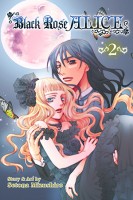
Black Rose Alice, Volume 2Black Rose Alice, Volume 2 by Setona Mizushiro. I absolutely loved the first volume of Black Rose Alice and I remained captivated by the second. It’s a strange, dark, and disconcerting series. Mizushiro’s vampires are completely different from any other type of vampire that I’ve come across in fiction. I do like that, but it’s also challenging since readers can’t rely on an already established mythos or assume what it actually means to be a vampire; Mizushiro has to explain it all. I’m not sure that I actually understand everything that is going on with the vampires yet, but I’m assuming that more will be revealed as the series progresses. One thing is certain, though: they are definitely very creepy. In exchange for the life of the young man with whom she is in love, Azusa has entered into an agreement with a nest of vampires. Out of the four vampires, she must choose one to procreate with after which they will both die. The relationship dynamics are bizarre, and honestly a little discomforting, but very compelling as the vampires vie for her affections. It’s not as simple as choosing one of the vampires; in order to fulfill her agreement, she will actually have to come to love them. I’m really looking forward to reading more of Black Rose Alice.

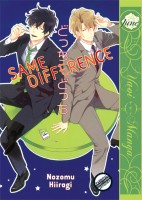
Same DifferenceSame Difference by Nozomu Hiiragi. Tsuburaya and Ozaki are the elite of the elite, and both adored by the women at the company where they work. (So much so that the ladies literally swoon in their presence.) However, Ozaki isn’t used to sharing the attention, and so decides to make Tsuburaya fall in love with him, unintentionally falling for Tsuburaya in the process. Out of the two of them, Ozaki is more muscular and crude while Tsuburaya is more elegant and refined. Despite arguably being the more masculine and aggressive of the pair, Ozaki is often the one being out-maneuvered by Tsuburaya in their seemingly antagonistic relationship. It’s not that Tsuburaya dislikes Ozaki–quite the opposite, actually–it’s just that he has a sadistic streak and enjoys making the other man squirm. Same Difference is definitely played for laughs more than romance. Apparently the manga is actually an ongoing series that’s currently up to three volumes in Japan, which I hadn’t realized while reading it. Unfortunately, only the first volume has been licensed in English at this point. Honestly, I wouldn’t mind reading more of the series. It doesn’t have the most subtle, nuanced, or realistic characters or story, but it’s amusingly ridiculous and doesn’t take itself seriously at all.

Filed Under: FEATURES, My Week in Manga Tagged With: black jack, Black Rose Alice, manga, Nozomu Hiiragi, Osamu Tezuka, Setona Mizushiro

The Pillow Book of Sei Shōnagon

November 8, 2014 by Ash Brown

The Pillow Book of Sei ShōnagonAuthor: Sei Shōnagon
Translator: Ivan Morris
U.S. publisher: Columbia University Press
ISBN: 9780231073370
Released: December 1991
Original release: 11th century

I’ve recently developed a particular interest in Heian-era Japan and literature. The Pillow Book of Sei Shōnagon is an important eleventh-century work that provides a glimpse into Heian society, especially that of the court and higher classes. Shōnagon was a lady-in-waiting to Empress Teishi as well as a contemporary and rival of Murasaki Shikibu, the author of The Tale of Genji and a lady-in-waiting who served Empress Shōshi. The Pillow Book of Sei Shōnagon has been translated into English, both in part and in its entirety, many times, the first translation appearing as early as 1889. Out of all of the English translations, I gravitated towards that of Ivan Morris’ whose works of nonfiction The World of the Shining Prince and The Nobility of Failure I thoroughly enjoyed. Excerpts of The Pillow Book of Sei Shōnagon were actually included in The World of the Shining Prince and I enjoyed his translation. Morris’ complete two-volume translation of The Pillow Book of Sei Shōnagon was published in 1967 by Columbia University Press. However, in 1971, an edited and abridged translation began to be released. It is this single-volume edition that is now more readily available and generally more approachable for the average reader, not to mention the version of The Pillow Book of Sei Shōnagon that I myself read.

The Pillow Book of Sei Shōnagon is a diary of sorts, a collection of thought and observances, lists and poetry. Most of the individual sections are short, some only a few paragraphs and the longest still being under fifteen pages. The volume isn’t arranged chronologically, some parts can’t even be definitely dated, but seeing as each section stands perfectly well on its own and there is no overarching “plot,” this isn’t particularly problematic. Shōnagon relates events and ceremonies that take place at court and at shrines, but she also details more personal affairs and gossip as well. The Pillow Book of Sei Shōnagon mostly deals with Heian-ea nobility and their lives, but the lower classes are occasionally mentioned, too, though usually with some disdain. While relatively little is known about Shōnagon outside of her own writings, it is clear she was a well-educated and intelligent women with a strong personality that brought her admirers as well as a those who could be considered her opponents.

While I haven’t read other translation of The Pillow Book of Sei Shōnagon and so am not able to offer comparisons, I was very pleased with Morris’ translation. I found it easy to understand, pleasant in its style, and overall very enjoyable. Morris’ translation presents an excellent balance between the literal and the literary. It reads well in English and yet retains a sense of poetic elegance. This particular edition of The Pillow Book of Sei Shōnagon also includes additional material for readers who are interested in the works’ specific historical context or in Heian-era Japan in general. Morris’ notes are copious and entire appendices are devoted to the calendar and time system, the government and its structure, places and their accompanying maps, an illustrated guide to clothing, households, carriages, instruments, and other daily objects, as well as several chronologies. A list of recommended reading is also given. In all, the supplementary material accounts for about a third of the volume’s total length.

I found The PIllow Book of Sei Shōnagon to be a very enjoyable and even charming read. However, it’s not a work to be read all at once or in a hurry. Instead, savoring a few sections here or there will generally provide a more pleasant reading experience. Shōnagon’s personality really comes through in her writings. She’s witty and sharp-minded, but also occasionally mean-spirited and a little self-important. Granted, as The Pillow Book of Sei Shōnagon serves at least in part as her diary, it’s not too surprising that she allows herself to express herself so freely within its pages. However, eventually she was quite aware that others were and would be reading the work as well. Even though centuries have passed since The Pillow Book of Sei Shōnagon was first written and compiled, it’s noteworthy how engaging and approachable the work can be for modern readers. Shōnagon was a keen observer of the people and society of her own time, but her humor and insights into human nature can still be appreciated even today.

Filed Under: REVIEWS Tagged With: Ivan Morris, Nonfiction, Sei Shōnagon

Fanservice Friday: Pandora Hearts Art Preview

November 7, 2014 by MJ 2 Comments

This year at New York Comic Con, publisher Yen Press gave out copies of their upcoming Pandora Hearts art book, Pandora Hearts ~Odds and Ends~, as prizes during their panel presentation. I was unable to attend this year, but fortunately for me, Sean is not a fan of the series, so he generously offered me his prize!

As you probably know, I am a big fan of Pandora Hearts, and the series has been featured in this column pretty heavily in the past, most notably in discussion of female-aimed fanservice in shounen manga and delectable manga costuming. So for a treat this week, I thought I’d share a few snapshots as a taste of what’s inside. If you were worried about a potential lack of fanservice, the very first image should quell your concerns immediately. Enjoy!

This slideshow requires JavaScript.


Look for Pandora Hearts ~Odds and Ends~ in bookstores later this month!

Filed Under: Fanservice Friday Tagged With: pandora hearts

  • « Go to Previous Page
  • Page 1
  • Interim pages omitted …
  • Page 331
  • Page 332
  • Page 333
  • Page 334
  • Page 335
  • Interim pages omitted …
  • Page 542
  • Go to Next Page »
 | Log in
Copyright © 2010 Manga Bookshelf | Powered by WordPress & the Genesis Framework