• Skip to primary navigation
  • Skip to main content
  • Skip to primary sidebar
  • Home
  • About Us
    • Privacy Policy
    • Comment Policy
    • Disclosures & Disclaimers
  • Resources
    • Links, Essays & Articles
    • Fandomology!
    • CLAMP Directory
    • BlogRoll
  • Features & Columns
    • 3 Things Thursday
    • Adventures in the Key of Shoujo
    • Bit & Blips (game reviews)
    • BL BOOKRACK
    • Bookshelf Briefs
    • Bringing the Drama
    • Comic Conversion
    • Fanservice Friday
    • Going Digital
    • It Came From the Sinosphere
    • License This!
    • Magazine no Mori
    • My Week in Manga
    • OFF THE SHELF
    • Not By Manga Alone
    • PICK OF THE WEEK
    • Subtitles & Sensibility
    • Weekly Shonen Jump Recaps
  • Manga Moveable Feast
    • MMF Full Archive
    • Yun Kouga
    • CLAMP
    • Shojo Beat
    • Osamu Tezuka
    • Sailor Moon
    • Fruits Basket
    • Takehiko Inoue
    • Wild Adapter
    • One Piece
    • After School Nightmare
    • Karakuri Odette
    • Paradise Kiss
    • The Color Trilogy
    • To Terra…
    • Sexy Voice & Robo
  • Browse by Author
    • Sean Gaffney
    • Anna Neatrour
    • Michelle Smith
    • Katherine Dacey
    • MJ
    • Brigid Alverson
    • Travis Anderson
    • Phillip Anthony
    • Derek Bown
    • Jaci Dahlvang
    • Angela Eastman
    • Erica Friedman
    • Sara K.
    • Megan Purdy
    • Emily Snodgrass
    • Nancy Thistlethwaite
    • Eva Volin
    • David Welsh
  • MB Blogs
    • A Case Suitable For Treatment
    • Experiments in Manga
    • MangaBlog
    • The Manga Critic
    • Manga Report
    • Soliloquy in Blue
    • Manga Curmudgeon (archive)

Manga Bookshelf

Discussion, Resources, Roundtables, & Reviews

Features & Reviews

Elegant Yokai Apartment Life, Vol. 1

September 18, 2017 by Katherine Dacey

Elegant Yokai Apartment Life suffers from multiple personality disorder, lurching awkwardly from one situation to the next without comfortably settling into one storytelling mode long enough for the reader to decide if it’s a sitcom, a soap opera, or a horror show.

In fairness to creators Hinowa Kouzuki and Waka Miyama, few stories purely embody a single genre; the labels that the publishing and entertainment industries have coined — rom-com, dramedy — give ample proof that hybridization is a common strategy for enlivening familar plots. For such hybrid forms to work, however, the tonal shifts must be intrinsic to the story, arising naturally from the interactions between the characters and their environment. Elegant Yokai‘s narrative swerves, however, feel more like a desperate attempt to appeal to as many different constituencies as possible: there’s fanservice for guys (a female ghost who wears only panties and a well-placed towel) and girls (a hot onmyoji with a ponytail and a silver fox with an eye patch), yokai drawn from folklore and urban myth, a potential love interest for the hero, a raft of comic-relief characters who get brief turns in the spotlight, a subplot borrowed from a 1983 Afterschool Special, and tragic backstories for several characters just in case the idea of a “ghostly boarding house” doesn’t tickle your funny bone.

The most frustrating part of this narrative abundance is that so much of it feels… extra. Any one of these elements could be excised from the story without fundamentally changing the premise, making room for more character development. That point is crucial: Elegant Yokai‘s lead is less a person than a reader surrogate, walking from one situation to another in a state of mild befuddlement about his supernatural neighbors. Author Hinowa Kouzuki has saddled Inaba with motivations that explain how he ended up rooming with yokai, but hasn’t actually given him any discernible personality traits. Kouzuki and Miyama’s few attempts to flesh out Inaba’s character are clumsy and, frankly, illogical: what well-adjusted person marks his middle school graduation by fighting his BFF in an abandoned lot because he’s “always wanted to do that”? (Shouldn’t Inaba quote one of the rules of Fight Club or something?)

The artwork suffers from a similarly overdetermined quality. The human characters are less drawn than assembled from bits and pieces of other artists’ work — a dash of CLAMP here, a bit of Yuu Watase there — while the yokai have been shamelessly copied from Rumiko Takahashi and Hayao Miyazaki’s oeuvre. Making deliberate allusions to other artists’ work is, of course, a time-honored tradition, but here, these nods feel less like tribute and more like theft; readers tempted to compare Miyama’s art with Miyazaki’s are bound to find hers a poor substitute.

It’s only in the final chapter of volume one that we get a glimpse of what Elegant Yokai might have been. The story trains the spotlight on Inaba’s fellow apartment dwellers Kuga and Shiro, a boy and his dog who were murdered by Kuga’s mother. Once a month, Kuga’s mother — also a ghost — shows up at the apartment building to reclaim her son. Over time, however, her human form has deteriorated and memories have faded, reducing her to a pitiful demonic state, more scribble monster than angry wraith. The frankness with which Kouzuki and Miyama depict her crime prevents these scenes from descending into bathos; these moments are the only ones that elicit an authentic emotional response from the reader, not least because Kuga and Shiro’s predicament has a demonstrable effect on the other characters. Too bad the rest of volume one is such a frantic, disjointed mess.

ELEGANT YOKAI APARTMENT LIFE, VOL. 1 • STORY BY HINOWA KOUZUKI, ART BY WAKA MIYAMA • TRANSLATED BY ADAM HIRSCH • 206 pp. • RATED T (13+)

Filed Under: Manga, Manga Critic, REVIEWS Tagged With: Comedy, Horror/Supernatural, Kodansha Comics, Yokai

Water Dragon’s Bride, Vol. 3

September 18, 2017 by Anna N

The Water Dragon’s Bride, Volume 3 by Rei Toma

The story in The Water Dragon’s Bride has been unfolding at a measured pace, in the third volume Asahi and Subaru are almost all grown up. As they become more adults, this results in some increased tension with Asahi’s eventual destiny as the bride of the Water Dragon as well as her role as priestess for Subaru’s village.

The volume opens with a little bit of backstory showing Asahi filing her role of priestess as she moves through adolescence. Every year, there’s a ritual designed to gain the favor of the water god, and Asahi disappears under the waves for three days. Her encounters with the water god are first limited to staring, glaring, and finally smiling. The elemental gods still are fundamentally alien when compared with humans. The Water Dragon at least has figured out that he needs to feed his young human bride, so he calls over the Tree God to give her some supplies. I enjoyed seeing these visits from the perspective of both the Water Dragon and Asahi.

I think a lot about clarity of art when I read a Rei Toma series, but I’m always struck by how much she is able to do with simple character designs and sparse backgrounds. It is expected that expressive eyes count for a great deal in shoujo manga, but she’s able to convey so much in just a couple pages. Subaru, aware that both his mother and his sister are prejudiced against Asahi, turns away from his family thinking “…don’t disappoint me more any than this.” His face is half in shadow, and blank in a way that shows he’s hiding the tension and disgust he feels inside. As he walks away he smiles and waves. All of this is accomplished with just one line of dialogue and some great sequencing and paneling from Toma in a two page spread.

For a series with such lovely illustrations and a seemingly fantastic premise, one of the reasons why I enjoy The Water Dragon’s Bride is that it explores some dark territory, particularly focusing on the way humans are capable of great cruelty. While the first volume also lingered on Asahi’s inhumane treatment by the Water Dragon who was absolutely ignorant and uncaring of the ways humans can suffer, humans seem like the real source of evil in the world. In addition to the leering gazes and jealously in Subaru’s village that Asahi has to isolate herself from, her capabilities as a priestess attract the attention of a neighboring village and a war is launched. Watching these events with Asahi, the Water Dragon thinks all the humans are fools.

While for most of this volume Asahi seems to be placed in a Persephone role, going back and forth between water and the human world, there’s a narrative turn as Water Dragon decides to dwell with humans for a time. Toma is able to pack an incredible amount of story in a single volume of manga, making this a shoujo fantasy series that is extremely rewarding to the reader.

Filed Under: Manga Reviews, REVIEWS Tagged With: shojo beat, shoujo, viz media, water dragon's bride

My Week in Manga: September 11-September 17, 2017

September 18, 2017 by Ash Brown

My News and Reviews

Last week at Experiments in Manga I posted August’s Bookshelf Overload which lists the manga, comics, and other media that found their way into my home last month. Otherwise, it was fairly quiet here at the blog, but I did come across some great interviews elsewhere online: Paul Semel interviewed author Kazuki Sakuraba whose novel A Small Charred Face will be released in translation this week. (I actually recently reviewed the book; it’s well-worth picking up.) Susannah Greenblatt interviewed Motoyuki Shibata, one of the cofounders of the Monkey Business literary magazine, discussing translation and Japanese literature among other things. (I’ve previously reviewed some of the early issues of Monkey Business.) And for something a little more manga-centric, Brigid Alverson interviewed manga editor Yumi Sukimune who works with Akiko Higashimura on Princess Jellyfish (which I greatly enjoy) in addition to other series.

And then there’s the licensing news from last week. Udon Entertainment, for example has plans to release Yuztan’s Dragon’s Crown manga adaptation. Most of last week’s manga and light novel licensing announcements came from another Seven Seas’ sprees, though: Accomplishments of the Duke’s Daughter manga by Reia and Suki Umemiya; two companion volumes to Kore Yamazaki’s The Ancient Magus’ Bride (which I’ll definitely be picking up); Arifureta: From Commonplace to World’s Strongest manga by Ryou Hakumai and RoGa; the original Cutie Honey manga by Go Nagai; The Dungeon of Black Company manga by Youhei Yasumura; Didn’t I Say to Make My Abilities Average in the Next Life?! light novels and manga by FUNA, Itsuki Akata, and Neko Mint; Go For It, Nakamura! manga by Syundei (probably the one I’m personally most excited about); Himouto! Umaru-chan manga by Sankaku Head; How Not to Summon a Demon Lord manga by Yukiya Murasaki and Naoto Fukuda; How to Treat Magical Beasts manga by Kajiya; Hungry For You: Endo Yasuko Stalks the Night manga by Flowerchild; If It’s for My Daughter, I’d Even Defeat a Demon Lord manga by CHIROLU and Hota; Little Devils manga by Uuumi; Mushroom Girls in Love, a one-volume manga by Kei Murayama; Precarious Woman Executive Miss Black General by Jin; Satan’s Secretary manga by Kamotsu Kamonabe; The Voynich Hotel manga by Seiman Doumanv. It’s an interesting mix!

Quick Takes

Delicious in Dungeon, Volume 2Delicious in Dungeon, Volume 2 by Ryoko Kui. I absolutely loved the first volume of Delicious in Dungeon and after reading the second volume my opinion of the series hasn’t changed–I still find it tremendously entertaining. The conceit of Delicious in Dungeon is fairly simple and straightforward. Basically, Kui has taken a dungeon-crawling adventure and turned it into a food manga. It’s a brilliant combination of subgenres with endless possibilities when it comes to the sheer variety monsters that could end up as a meal for the manga’s protagonists. While this alone could carry the series a fair distance (especially considering the immense creativity Kui exhibits in how fantasy creatures might be used to either directly or indirectly support an adventurer’s diet), Delicious in Dungeon also benefits from having a main cast that largely consists of a bunch of endearing goofballs. Kui has also started to expand on the actual worldbuilding of the series, too. While the manga still relies fairly heavily on the well-established tropes of fantasy role-playing games, small details are being introduced that make the setting of Delicious in Dungeon a little less generic. Of course, part of the series’ humor and charm is firmly based on Kui taking familiar fantasy elements and twisting them just a bit. It’s all great fun.

Sweetness & Lightning, Volume 6Sweetness & Lightning, Volumes 6-7 by Gido Amagakure. Although I love food manga, I never generally read a particular title thinking that I’ll actually make any of the recipes that might be contained within it. If I ever did, though, Sweetness & Lightning is probably the series that I would turn to. Since the main characters are in the process of learning to cook (and one of them is a preschooler about to start kindergarten), the dishes that they tackle typically tend to be within the reach of a beginner and aren’t usually overly-complicated. The fact that Sweetness & Lightning is a food manga is what initially brought the series to my attention, but at this point it’s really the characters which keep me coming back for more. I’m particularly impressed by the portrayal of the father-daughter relationship between Inuzuka and Tsumugi. Amagakure is also incredibly successful in depicting little kids in a convincing way. Sweetness & Lightning is in turns adorable and bittersweet, and these two volumes have some especially poignant and heartbreaking moments. Since Tsumugi is so young she still doesn’t entirely understand the death of her mother and Inuzuka still grieves the loss of his wife. But the sixth and seventh volumes also introduce more members of their extended family which was lovely.

What Did You Eat Yesterday?, Volume 12What Did You Eat Yesterday?, Volume 12 by Fumi Yoshinaga. The English-language edition of What Did You Eat Yesterday? has essentially caught up with the original Japanese release so the individual aren’t published as frequently as they once were, but I’m always very happy to get my hands on the latest installment in the series. The food in What Did You Eat Yesterday? is beautifully illustrated from start to finish. The individual ingredients, the techniques used, and the resulting dishes are wonderfully and realistically rendered. Visually, the people in What Did You Eat Yesterday? aren’t nearly as detailed as the food they are eating, but the believably complex and nuanced characterizations in the series is exceptional. The characters certainly have their personal flaws and Yoshinaga isn’t afraid to reveal them; rather than portraying some sort of romanticized ideal, Yoshinaga captures the messiness of real-life relationships in the series. It’s an approach that I particularly appreciate. What Did You Eat Yesterday? follows the day-to-day lives of two adult men who are in a committed, long-term relationship with each other which of course is something that I also greatly value. At times the food aspects of What Did You Eat Yesterday? seem tangential to everything else going on, but it’s still a great series.

Filed Under: FEATURES, My Week in Manga Tagged With: Delicious in Dungeon, fumi yoshinaga, Gido Amagakure, manga, Ryoko Kui, Sweetness and Lightning, what did you eat yesterday?

Invaders of the Rokujouma!?, Vol. 6

September 18, 2017 by Sean Gaffney

By Takehaya and Poco. Released in Japan as “Rokujouma no Shinryakusha!?” by Hobby Japan. Released in North America digitally by J-Novel Club. Translated by Warnis.

First off, going back to my worries from the last review, I am delighted to see that Yurika’s character development from the previous book is not only kept but noticed by others. Yes, she is still sometimes the butt of the joke – this is a comedy, after all – but she’s far more content with her lot in life now, talking easily with Koutarou and realizing that using her abilities secretly so that no one knows about it may actually be the best thing she can do right now. The other cast members are also keeping their growth – Koutarou is noticeably less formal with Harumi here, and the cast is all starting to realize they’re in love with Koutarou without having it become their defining trait, always a worry in harem titles. Rokujouma may be light as air at times, but there’s more depth here than I was expecting.

Of course, sticking with the ‘heroine is the cover girl of the previous book’ rule, the main focus here is on Kiriha, the last of the ‘main girls’ in the room to be fleshed out, provided you’re not counting Harumi, who’s sort of the plus one in this situation. (I’m not sure if Shizuka is going to do anything but be the landlord who knows lots of martial arts – she certainly gets more do do in this book than usual, but her feelings for Koutarou are not brought up.) Kiriha has been the teasing older woman sort in the series, but naturally we discover that this is mostly a front to disguise her true motives, which are actually pretty pure and noble given she was supposed to be a vanguard for a race trying to invade the Earth’s surface. In reality, what she has in mind is more like immigration than anything else, and Koutarou is relieved to discover this.

She also has a childhood dream she wants to fulfill, as when she was a kid she ran away to the surface and met a young man who she immediately fell in love with. Now, I have been saying how much I enjoy Rokujouma here, but it does have a few downsides, and the biggest one is that it’s about as subtle as a brick to the head. Time travel has not really come up yet in the series, though given the amount of weird tech we’ve seen so far it would be no surprise. Also no surprise is the fact that the boy Kiriha fell for all those years ago is clearly ‘our’ Koutarou, who no doubt will find a way to slip back in time in some future book. Then again, I’m not sure that subtlety and mysteries are what the author is going for here. I think we’re meant to be winking along with the narrative.

Of all the ‘light, fluffy romance series with no real point’ I’ve been reading in light novel form, Rokujouma is probably my favorite. It’s always a relaxed, easy read, and some of its jokes made me laugh out loud this time (particularly Koutarou’s reaction to the five-team sentai squad when they first show up). If you don’t mind harems, it’s an excellent light novel starting point.

Filed Under: invaders of the rokujouma!?, REVIEWS

Queen’s Quality, Vol. 1

September 17, 2017 by Sean Gaffney

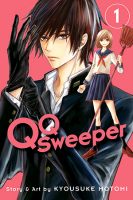
By Kyousuke Motomi. Released in Japan by Shogakukan, serialization ongoing in the magazine Bessatsu Comic (“Betsucomi”). Released in North America by Viz. Translated by JN Productions, Adapted by Ysabet Reinhardt MacFarlane.

This is, of course, not so much Vol. 1 of a new series as a reboot of an old one, which is why I’ll continue to use the QQ Sweeper tag for it. Just looking at the covers might show a difference, though – the first QQ Sweeper volume had Kyutaro front and center, with Fumi getting less attention. But now the Q in the title has changed to refer to Fumi herself, and she is front and center. It’s also a more dramatic, serious cover, which is appropriate, as while there are still many lighthearted moments in the book, the overall mood is darker, particularly towards the end. The series examines the popular idea of negative emotions manifesting themselves and how to fight that. And, also a popular idea, the answer is to get in touch with the darkness in your soul without letting it overwhelm you.

While the essential plot is much the same – under the guise of cleaning around the school and residence, Fumi and Kyutaro seek out bug infestations, and work out where they may have come from. But Fumi’s true nature is revealed now, making her more self-conscious, but not nearly as badly as it affects Kyutaro, who has no idea how to act around her anymore, especially given their past together – a past he’s not allowed to talk to her about. Sometimes it’s best not to rip the band-aid off all at once. They even bring in an expert to test Fumi’s ability, though I wasn’t too fond of him – but that’s mostly because I just don’t like his type. That said, they do grow closer, especially in the shopping sequence, the most fun adn heartwarming part of the volume, where we discover Fumi’s dreadful fashion sense.

Things get dark fast, though, and the last chapter is showing us just how terrifying the Black Queen can be when she’s active. And active she has to be, as Fumi can’t learn how to control her dark side without knowing what it is and how it can take over. The scene of her gleefully torturing her teacher – who is, to be fair, a nasty piece of work – and ordering her to never close her eyes again for the rest of her life is chilling, reminding me a bit of Delirium at her worst in the Sandman comics. Fortunately, Kyutaro reminds us that he’s not just there to be a potential romantic lead, he’s also got the experience and determination to bring Fumi back from this, even if afterwards she’s terrified.

And so we get what will likely be the plot going forward: teaching Fumi to use her powers for niceness instead of evil, with the villains (who pop up here and are somewhat generic, though there’s a hint they’re not truly black-and-white evil) trying to corrupt her over to their side. Balancing this sort of serious drama with cute romance is what Motomi does best, of course, as readers of Dengeki Daisy will no doubt remember. I’m not quite sure why the series rebooted itself, but I am happy to see it back, and look forward to more volumes.

Filed Under: qq sweeper, queen's quality, REVIEWS

My Love Story!! Vol. 13

September 16, 2017 by Anna N

My Love Story!! Volume 13 by Kazune Kawahara and Aruko

I had postponed reading the final volume of this series because I didn’t want it to end, but my curiosity about the conclusion helped me deal with my final volume procrastination syndrome. The final story arc was set up previously, with impending separation between Takeo and Yamato. I’ve probably been watching too many k-dramas where a couple gets separated and then they meet again 3 years later, but one of the refreshing things about this manga is that it actually deals with the problems of long-distance relationships instead of just conveniently fading to black and glossing over the separation period.

One of the hallmarks of this series is that in addition to the interest created by having a hulking giant of a boy as the main character in a shoujo series, My Love Story!! is able to step through some conventions shoujo plot elements and make them seem fresh due to the way the manga is infused with so much enthusiasm and heart. When Yamato goes to Spain Takeo is determined to bring his grades up so they can eventually go to the same college. He throws himself into studying with Suna constantly at his side. The unique circumstances surrounding Takeo and Yamato’s provide an opportunity to visit again with characters from throughout the series, as it seems everywhere Takeo goes someone feels the need to encourage him in his epic romance.

There are some hilarious scenes as Takeo goes to Spain in order to visit Yamato, and while a manga series set in high school ending at the point when the characters are about to head off to college is extremely typical, My Love Story!!, as always, ends on a note of such infectious optimism that I put the book down with a smile. This is going to be one of those series I keep around and read whenever I need to cheer myself up.

Filed Under: Manga Reviews, REVIEWS Tagged With: My Love Story, shojo beat, shoujo

Rokka: Braves of the Six Flowers, Vol. 2

September 16, 2017 by Sean Gaffney

By Ishio Yamagata and Miyagi. Released in Japan by Shueisha. Released in North America by Yen Press. Translated by Jennifer Ward.

(Despite the fact that this isn’t a whodunnit beyond page 1, I won’t reveal the culprit’s name in the first paragraph of the review. After that, though, I will. FYI.)

The first volume of this series was strongly concerned with the ‘whodunnit’, and did a decent job, but also left us with a cliffhanger that made me worry we’d have to go through the whole thing again. Sensibly, the second book dispenses with the ‘who is the traitor’ question right off the bat, for the most part (there are still hints there’s yet ANOTHER traitor, but I’ll leave that for now) and tells us on the very first page. And then we get a flashback as to how we got to that situation, though there’s no record scratch noise, nor does the guilty party look towards the camera. So instead of whodunnit, or why did they do it, we have a sort of ‘how are they gonna get out of it?’ situation, as a very nice person has been personally put through the wringer the past three years and may have to commit the worst act to save those they hold dear.

Mora was presented to us in the first book as an overly serious woman, perhaps a bit stubborn, but determined to fill her role as a Brave and defeat the Evil God. And to be fair, she really IS a Brave, rather than a fake. That said, she’s being blackmailed, and being (I think) the oldest of the Braves, she has to deal with a very old and familiar form of blackmail. Do what the villain says or your daughter will die horribly. The strongest part of the book is taking us into her head and her tortured motivations for doing exactly what she has to do to save her family and yet also try not to take a life. Tellingly, the book still keeps some information secret from us, but it’s obvious why, and I don’t blame it a bit, as suspense novels need, well, suspense.

As for the rest of the book, there is still a ‘who is it?’ aspect to the book, and lots of debate about same, but as with the first book, the debates are interspersed with enough action so as not to be tedious. Also, unlike the first book, we get a great number of scenes of our heroes fighting demons… though they don’t do as well as they could, given that they still suspect each other of being a traitor. Adlet remains the ‘hero’ type character, but is a bit more likeable here, possibly as he refers to himself as the Strongest Man in the World slightly less. I did have one egregious moment of “OK, I call no way” involving searching for a ludicrously tiny thing across the ruins of a battlefield, but every book leads at least one time when the disbelief suspension bridge breaks and you plummet to your death.

The main reason I’m still interested in reading this is that it’s not very much like a lot of the other light novels we’re getting these days. Yes, it’s a fantasy with fiends, magic, etc. but style-wise we’re a long way removed from ‘I am in another world and dungeon crawling’. That said, I do wonder how many volumes it will drag out “one of us is a traitor”. But overall, well worth your time, and if you missed the insane bunny girl, there’s a cliffhanger here with your name on it.

Filed Under: REVIEWS, rokka: braves of the six flowers

Kiss Me at the Stroke of Midnight, Vol. 1

September 15, 2017 by Sean Gaffney

By Rin Mikimoto. Released in Japan as “Gozen 0-ji, Kiss Shi ni Kite yo” by Kodansha, serialization ongoing in the magazine Bessatsu Friend. Released in North America by Kodansha Comics. Translated by Melissa Goldberg.

It’s a cliche, but it’s true: the best type of success is meant to look effortless. We always admire those who manage to achieve things with nothing more than a hair flip and a cool smile. But unfortunately, the reverse is also true. We look at those who strive, who struggle to achieve by any means necessary, and we think: they’re trying too hard. So not cool. You can see the sweat. And this is sometimes a shame, because those folks are trying just as hard as everyone else. but there you have it. And I got that feeling as I read this new shoujo manga. I finished the first volume, and my thought were “that was pretty good, but it’s trying too hard so it doesn’t quite come off”. It looks a bit too calculated, and the calculation’s off. That said, it’s still quite good, just not reaching the next level.

First off, a word of warning: this book does feature a blonde girl paired up with a blond guy. This is actually so unusual in shoujo manga that it attracted my attention: usually one of the couple will have darker hair for the ‘contrasting’ look. Hinana is our heroine, a high schooler with a reputation as a perfect and gorgeous student. Of course, this is just a reputation – in reality she’s as boy crazy as everyone else, she just hides it better. But fate smiles on her when an up-and-coming actor and ex-idol appears at her school during break to shoot scenes for a movie, and she’s chosen as an extra! He’s hot! He’s next to her! He’s… looking at girls’ butts? Yes, Kaede is also not quite what he seems, and his list of what he desires in a woman finds ‘DAT ASS’ in the first position. Can these two people who both project a false exterior find love with each other?

There are some very amusing things in this manga, which I enjoyed quite a bit. The running gag of how Hinana wakes up every morning made me chuckle, and the faces she makes are eccentric enough to get a montage on the back cover. Kaede’s ludicrous butt fetish is also funny, even more so when we see Hinana’s reaction to the “butt alien from the planet Butt”, as she goes on to describe him. The issue, I think, is that the humor doesn’t really go far enough. When it plays things for drama, such as when Hinana is falsely accused of putting a picture of Kaede’s shoes online it tends to fall into the “this is like every other dramatic shoujo” box. Hinana herself is also not as eccentric as you’d expect given the introduction showing how she’s not really the perfect princess – it reads more like “I’m secretly just like you, reader, so please identify with me”. And sometimes the punchlines are too telegraphed – the identity of Scarlet was pretty obvious to me.

Despite my misgivings, this was a decent beginning, and there are a few plot points that will hopefully bear fruit when they’re developed. I just hope that future volumes manage to have a bit less drama and a bit more weirdness. Also, what on earth does the title have to do with anything in the manga?

Filed Under: kiss me at the stroke of midnight, REVIEWS

Manga the Week of 9/20/17

September 14, 2017 by Sean Gaffney, Michelle Smith, Ash Brown and Anna N 1 Comment

SEAN: They did it again, so let’s talk Kodansha Comics. I love their digital line, even if I can’t keep up with it. I love it, but the short turnaround time on solicits/announcements means that I can never get it into Manga the Week of on time. And Amazon is also frequently very late with solicits (or absent with them), so sometimes I miss even more. So let’s start with what’s already out digitally.

Magical Sempai (Tejina Sempai) is a gag manga about a magician’s club that runs in Young Magazine.

And Grand Blue Dreaming is a title from good! Afternoon which combines the writer of Bakas, Tests and Summoned Beasts with the artist of the Amagi Brilliant Park manga. It’s about scuba diving (and romance, and ecchi situations – come on, look at the creators).

Now onto next week’s titles. J-Novel Club has the 5th volume of I Saved Too Many Girls and Caused the Apocalypse, which is not as good as it once was, but let’s see if more girls can solve that.

As the Gods Will 2nd Series is another one of those titles that have been sneakily getting digital all along but which Amazon only recently started listing. Vol. 20 is out next week. And no, the first series was not licensed.

Descending Stories gets a 3rd volume, and will no doubt have a great story to relate.

ASH: I’m still so glad this series is being translated!

SEAN: Hotaru’s Way gets a 3rd digital volume, House of the Sun gets a 7th, and Kasane gets a 5th. (Sorry, have to streamline, too much stuff this week).

Kiss Me at the Stroke of Midnight (Gozen 0-ji, Kiss Shi ni Kite yo) is a shoujo debut for Kodansha, from the Betsufure magazine. It is a “comedy romance”, and the creator also does Love’s Reach, which Kodansha is putting out digitally.

MICHELLE: I was kind of looking forward to this one ’til you mentioned Love Reach, which I didn’t enjoy too much. Oh well. I’ll give it a shot, at least.

ANNA: Huh, I’m usually good for at least the first volume of a new shoujo series.

SEAN: More digital. Peach Heaven 6 and Tokyo Tarareba Girls 7. Enjoy getting further behind!

MICHELLE: At least Tarareba has gotten less depressing!

ANNA: ARRGH, still need to read the first two volumes!

SEAN: And some print, with the 22nd Seven Deadly Sins, as well as the 7th Welcome to the Ballroom. Two titles unlikely to get a gimmicky crossover with each other anytime soon.

ASH: That’s probably true.

SEAN: Seven Seas has a quartet of titles, mostly for their female readers (yes, Seven Seas has female readers). There’s a 3rd Bloom into You for yuri drama, a 3rd Dreamin’ Sun for cishet drama, a 2nd High School Life of a Fudanshi for not-really-BL comedy, and a 2nd Plum Crazy for KITTY! fans.

MICHELLE: I’ll be picking up three of the four!

ASH: That’s pretty good odds! I still need to give Plum Crazy a try. I like High School Life of a Fudanshi more in concept than execution but largely enjoyed the beginnings of both Bloom into You and Dreamin’ Sun.

SEAN: We have reached the final volume of Nichijou with Vol. 10, surely one of the more bizarre comedies to get licensed over here. But fear not, its spinoff, Helvetica Standard, is coming soon, also from Vertical Comics!

The second volume of Golden Kamuy is out from Viz, and I understand it’s slowly transitioning to a cooking manga.

ASH: I think at heart it was always a cooking manga. (And of course I’ll be picking it up.)

ANNA: Really??

SEAN: Goodnight Punpun has its 7th and final volume out next week. A gripping and well-told narrative that I found myself absolutely unable to read, but that doesn’t negate its power.

ASH: Once I’m feeling brave enough, I’ll read the sixth and seventh volume together. It’s a tremendous series, but not at all an easy read.

SEAN: Master Keaton also reaches an end with its 12th volume. Will we ever get more insurance investigator manga?

MICHELLE: Someday, I really will read this.

ASH: And someday I will finally finish reading it!

ANNA: It is so good!

SEAN: Sweet Blue Flowers had a sort of aborted digital release from DMP a while back, but this omnibus edition from Viz is the real deal, and in print. It’s a great story and I can’t wait to read it.

MICHELLE: Yay!!!

ASH: One of my most anticipated releases this year!

SEAN: Yen On has a series of light novels, several of which I have dropped from my reading list. So fans of things that are really dark/evil will have to enjoy Black Bullet 7 and Overlord 5 without me, and fans of isekai-by-numbers will need to read Death March to the Parallel World Rhapsody’s 3rd volume.

As for series I am still reading, Accel World’s 11th volume will kick off a new arc. Baccano! surprises readers by jumping forward about 70 years (don’t worry, it’ll be back to the 1930s soon enough). Is It Wrong To Try To Pick Up Girls In A Dungeon? has a 9th volume that sees if Bell Cranel really can do something to piss off the entire cast.

There’s also the 3rd My Youth Romantic Comedy Is Wrong As I Expected, which refreshingly was not delayed. And a 7th Strike the Blood, which remains generic but highly readable.

As for Yen proper, let’s start with adaptations of light novels. We have a 5th Asterisk War, a 10th Devil Is a Part-Timer!, a 6th OreGairu (which is shorthand to avoid having to type out My Youth Romantic Comedy Is Wrong As I Epxected again), a 2nd of the No Game No Life Please! spinoff, an 8th Strike the Blood, and Vol. 3s of SAO titles Mother’s Rosary and Phantom Bullet.

There are non light novel adaptations as well, believe it or not. Alice in Murderland gives us a 7th volume of Kaori Yuki at her Kaori Yuki-est.

Barakamon has a 14th volume, and if you want to read the prequel, now’s your last chance, as we also have the 7th and final Handa-kun out in print.

MICHELLE: I watched some of the Barakamon anime recently, which convinced me I will love the manga when I finally get around to reading it.

ASH: I think you’ll like it!

SEAN: Big Order’s 3rd omnibus brings us closer to world domination, maybe?

A Bride’s Story may come out once a year here and in Japan, but it’s always welcome, and I will definitely want to read its 9th volume, even if I still find its main female lead a bit dull.

ASH: I really love this series. Mori’s artwork is stunningly beautiful in it.

ANNA: The art really is such a standout on this title.

SEAN: In titles I have nothing to say about, there’s a 4th Bungo Stray Dogs, an 8th Dragons Rioting, the 2nd Kakegurui – Compulsive Gambler (now in print), a 4th Kiniro Mosaic, a 3rd Royal Tutor (now in print), the 8th School-Live!, and a 5th Today’s Cerberus (now in print).

ASH: I need to catch up on Bungo Stray Dogs for the sake of all its J-Lit references if nothing else.

SEAN: Madoka Magica continues to push out spinoffs, with the 3rd Homura Tamura and the 4th Tart Magica.

Lastly, Rose Guns Days begins its 3rd Season, which presumably will feature a new main character to interact with Rose and her brothel of eccentrics.

Sorry for the compressing, but come on, look at all those titles. I have to save space. What’re you getting next week?

Filed Under: FEATURES, manga the week of

Infinite Dendrogram: The Beasts of Undeath

September 14, 2017 by Sean Gaffney

By Sakon Kaidou and Taiki. Released in Japan by Hobby Japan. Released in North America by J-Novel Club. Translated by Andrew Hodgson.

Much as people criticize the warnings on the back of manga noting when there is sex, nudity or violence, sometimes I do think it’s worth telling people in advance, particularly if it’s something that would upset a fairly significant chunk of the audience. So let’s get that out of the way first. This second volume of Infinite Dendrogram contains multiple grotesque and graphic murders of children – in fact, for the first half or so, child kidnapping and murder is the plot. It reaches his zenith when Ray and Nemesis come across skeletons and zombies with the remaining souls of the murdered children inside, and have to destroy them all to move on. This ties in with the main theme of the book, which I’ll get to in a bit, but boy howdy could I have used a warning. So, warning: LOTS OF MURDERED CHILDREN.

That said, of course, they’re not ‘real’ children, but ones designed by the game developers. I spoke before about the fact that Dendrogram is about the only light novel around that has a normal hero playing a game without getting caught in it, or the game being the actual fantasy world, or any one of a thousand other light novel game tropes. Ray still has to log out and eat/sleep, though that’s given somewhat short shrift here. And this means that we the reader view this as a game a bit more than we do in, say, Sword Art Online. Ray’s death means that the quest may not be completed, and some NPCs may suffer, but it doesn’t mean his actual death. As a result, Ray and his new friend Hugo find that no one has actually tried to stop the child murder scheme because it would be a pain in the ass to fix and likely not worth the cost. That said, Ray (and Hugo, it turns out) are of a different stripe. The “maiden” support they have, in the form of Nemesis and Hugo’s companion, means they are “too caught up” in the story. They’re the sort who would rescue the doomed children in a game, even for little reward and high difficulty, because it’s morally heinous.

Ray is helped along here by his brother, whose actions we helpfully see in a flashback. Ray’s brother hasn’t done much in the series besides introduce him to the game and make bear puns, but we see that he is definitely “the protagonist of another story”, as he gets a grievous injury right before a martial arts match, then goes on to win it anyway through the sheer power of GUTS! I take that back, he’s not the hero of another story, he’s the cool mentor who gets killed off midway through – ominous sign. But it does also signpost why Ray acts the way he does, and why he comes to the conclusion that it’s OK to treat the NPCs as real people. Admittedly, his main concerns may need to be the other players – the final scene in the book reminds us that there are various sections of the map all poised to wipe out Ray’s section, in a very ‘Horde vs’ Alliance’ sort of way.

Dendrogram is well-written, with a likeable hero, and I’ve even gotten over the underage pimp and his PG-rated pimp squad. It’s worth a read, but I have to admit the main thing I took away from it was “wow, that was some graphic child murder description I did not need”.

Filed Under: infinite dendrogram, REVIEWS

Frau Faust, Vol. 1

September 13, 2017 by Sean Gaffney

By Kore Yamazaki. Released in Japan by Kodansha, serialization ongoing in the magazine Itan. Released in North America by Kodansha Comics. Translated by Stephen Paul.

There is a scene towards the start of this manga where the title character is quizzing her protege about the history of their land that he had read. He parrots what he learned perfectly, but she quickly corrects his facts, saying that the actual reality wasn’t what was in the history books. This is something every kid growing up is going to come across sooner or later – certainly my generation learned a very whitewashed history in elementary school – and is always well worth pointing out. Don’t always take facts that you’re given at face value. The manga itself is another example, as it takes place seemingly in a world where the classic story of Faust is well known. But into this story comes our heroine, Johanna Faust, who most certainly is not the antihero we expected. And as we get further into the story, we find that a lot of other Faustian bargains may also be more than they seem.

The narrative of this story is not unfamiliar to manga readers, or indeed any reader of classic stories. Frau Faust comes to a small town on a mission, and happens to run into a boy, Marion, who’s being chased for stealing a book. After helping him escape, he explains that it was in fact his family’s book – their stuff was sold off, and he was trying to get it back. Needing a pasty – sorry, partner in order to achieve what she wants, she decides to become his tutor for a few days, and quickly blows his mind with both what she can teach and the way that she teaches it. Of course, she does have an ulterior motive in mind – she needs a pure-hearted boy like him to invite her into the local church, there to meet the demon Mephistopheles. Or at least a part of him. And their relationship seems to be somewhat more complicated than you’d expect.

As mentioned on the front cover, this is by the author of The Ancient Magus’ Bride, another series I greatly enjoy. This is a bit less introspective, but just as concerned with the nitty gritty of magic and the supernatural. And as you would expect with this author, the artwork is evocative and attractive, giving Faust and her co-stars excellent expressions. As for Faust herself, I was sort of expecting her to be a sly woman who turned out to be a big softie at heart, but I wasn’t expecting it to happen quite so fast, and the second and third chapters had moments of real sweetness in them. Be warned, like a lot of first volumes of shoujo and josei series (this is the latter – Itan is a supernatural/fantasy-oriented josei magazine), there is an unrelated short story at the end. But it’s good, dealing with a young girl whose family has divorced, whose mother drinks a lot, and who isn’t quite as mature as she wants to be, and her encounter with a museum of oddities. The mood fits well with the rest of Frau Faust.

I’ve been looking forward to this series since the moment I heard it was licensed, and it did not disappoint. Definitely any fans of fantasy should pick it up, but even if that’s not your thing give it a try. This makes you want to read the next volume right away.

Filed Under: frau faust, REVIEWS

The Irregular at Magic High School: Summer Vacation Arc +1

September 12, 2017 by Sean Gaffney

By Tsutomu Sato and Kana Ishida. Released in Japan as “Mahouka Koukou no Rettousei” by ASCII Mediaworks. Released in North America by Yen On. Translated by Andrew Prowse.

Yes, just like Maou-sama and DanMachi in April, it’s now Mahouka’s time to have a short story collection. As such, the stories in this volume are highly variable. That said, there are two that manage to be relevant to the ongoing story, so I’ll deal with them separately. As for the rest, we get a story with the grumpy guy who hates Tatsuya, Morisaki, who rescues a young woman from being abducted and then has to be her bodyguard; Eimi, who we met in the Competition stories, having a nasty amusement park encounter with thugs trying to steal her family spells; Ichijou and Kichijouji trying to recover after their loss last time, and making annoying lolicon jokes simply as Ichijou’s younger sister likes George; and a jaw-droppingly syrupy date between Tatsuya and Miyuki that seems to do nothing but take the incestuous subtext this series is filled with and rub it in your face. These stories are all readable but not great.

The first story in the collection, which is a beach episode, also starts off pretty fanservicey and pointless, and seems to be about Honoka trying to attract Tatsuya’s attention by almost drowning herself, which backfires in a typical anime “you saw my swimsuit fall off” way. The surprise, and actual plot relevance, comes towards the end. First of all, Shizuku, who’s mostly been in Miyuki’s corner, decides to ask Miyuki the rude question: does she like her brother in a romantic way? The answer is not really satisfying to me, but very much in character for Miyuki, so that’s acceptable. Better is Honoka actually working up her courage and confessing, and Tatsuya’s honest answer: he’s incapable of emotions like that. Of course, this is not stopping her from carrying on liking him till she finds someone better, as Tatsuya says he’d feel the same way about anyone else. I honestly wasn’t expecting one of the main pairings of this series to be shot down this fast, and it’s somewhat refreshing.

The longest story here is the last one, which deals with the fact that Mayumi is retiring, and would like to pass on the Student Council President position to someone she trusts. Hattori is the first that comes to mind, but he doesn’t want to do it. This leaves Azusa, but she’s simply too terrified to do it, having always been the meek one in the group. This is eventually resolved by one of the most blatant yet hilarious scenes in the book, which I will try not to spoil. More importantly, the successor is also carrying on Mayumi’s will by seeking to eliminate the prejudice against Course 2 students by allowing them to hold Student Council Positions. It’s a good reminder of the prejudice that still exists in many ways, which we haven’t really focused on since the first book. It also shows us that Miyuki’s immaturity is still hanging around, and that she can be TERRIFYING when lashing out – there’s a reason she wasn’t chosen to succeed as President. Yet.

The Irregular at Magic High School has likely locked in its audience already. If you enjoy the series, you’re going to pick up and enjoy this. If you’re one of those who despise Tatsuya, this is not going to change your mind (I didn’t even get into the politics occasionally on display here). Recommended to the former group – this isn’t an easy series to hate read, so the latter should move on.

Filed Under: irregular at magic high school, REVIEWS

Bookshelf Briefs 9/11/17

September 11, 2017 by Michelle Smith and Sean Gaffney 1 Comment

Absolute Duo, Vol. 1 | By Shinichirou Nariie, Takumi Hiragiboshi, and You Asaba| Seven Seas – In general, fans tend to dislike a couple of things in the manga they read, especially Western fans. The first is the tsundere female lead, and the second is the super-powered male lead. Not sure yet whether we’ll get the second, but Absolute Duo seems to be free of the first. Unfortunately, that does sort of make it clear why manga and light novel authors enjoy writing tsundere female leads—the conflict here is rather mild and undramatic, with our hero fighting against a nice girl, and when she loses, she just… says bye and leaves. As for the actual heroine, she’s nice and shy and sort of self-sacrificing. Absolute Duo is decent, and I like everyone, but if you didn’t see another volume you’d barely care. – Sean Gaffney

A Certain Scientific Accelerator, Vol. 6 | By Kazuma Kamachi and Arata Yamachi| Seven Seas – I said last time we were down to the final fight, and we’re still on it by the end of this volume. Index is filled with long, drawn-out battles, but in Railgun and the main series they tend to be separated by more mundane matters. Accelerator, true to its antihero, never really lets us relax, and humorous escapades are at a minimum. It also makes it rather difficult to review. I mean… the fights were cool? I actually understood the action, which is not always the case with heavy action manga. The villain is bad and you want to see them go down? And I’m pretty sure one of our team of heroes is going to die, though I’m also pretty sure it’s the girl who’s already dead. A good spinoff that’s not as good as Railgun at its best. – Sean Gaffney

Delicious in Dungeon, Vol. 2 | By Ryoko Kui| Yen Press – I’m enjoying this second volume more than I did the first, I think. We get a bit more backstory on the characters which makes them a bit more likeable, and Marcille is no longer whining at absolutely everything. On the opposite tact, Laios gets to do some truly ridiculous things showing that he’s a lot more impulsive than we expected (and we get flashbacks showing that his sister really was a major part of their party—I wonder if she’s actually died by now?). And Senshi, while he’s still the wise sage of the group, is also shown to sometimes be wrong. But of course the main draw here is the ridiculous food, detailed in loving “this is actually a cooking manga” detail. A lot of fun. – Sean Gaffney

Girls’ Last Tour, Vol. 2 | By Tsukumizu| Ywn Press – This volume sets itself up much like the last one did, with about 2/3 devoted to Chito and Yuuri’s slice-of-life adventures among the ruins of the world, and the last third has them meeting with another living person and helping them try to achieve a dream. Both times they do this the dreamer fails, though it’s not really the girls’ fault. It does make me wonder what sort of mood the author wants to convey here. There are occasional scenes of Yuuri being an airhead or Chito a grump in that Chika and Miu sort of way, but the air of melancholy you’s expect to hover over this world is more prevalent here. Is there an endpoint the author wants to get to, or when they run out of cute situations will we just have the girls quietly die? Good but odd. – Sean Gaffney

Haikyu!!, Vol. 15 | By Haruichi Furudate | VIZ Media – Karasuno has advanced to the semifinals of the Miyagi Prefecture qualifier tournament. Will their next opponent be Aoba Johsai or Date Tech? Readers are treated to some of that match-up before Aoba Johsai emerges victorious. There are some nice moments here, particularly one in which Kageyama actually admits to Hinata that he’s scared to face Oikawa again and a brief interlude where Sugawara is brought in to shut down a high-scoring newcomer, but not quite as many as in the last volume, which fleshed out background team member Ennoshita. There’s no such thing as a bad volume of Haikyu!!, and this has plenty of excitement and a cliffhanger ending, but the final page suggests I will like next volume’s payoff even more than this volume’s setup. Looking forward to it, as ever! – Michelle Smith

Kase-san and Shortcake | By Hiromi Takashima | Seven Seas – Well, the girls have gotten together in book one, and gotten to know each other more closely in book two. Book three has a double shot of plot, with Yamada realizing that Kase-san is going to a Tokyo university on a sports sholarship, while she’s going to a local college. This… really doesn’t sit well with her, and she frets about it as best you can do when your manga is meant to be cute and fluffy. We also deal with Kase-san wanting to take things further physically, but not wanting to pressure Yamada, and being somewhat stymied by Yamada’s complete ignorance of what to actually do—at one point, she even googles how to have sex with a girl, with hilarious results. Still adorable and fluffy even when everyone is crying. – Sean Gaffney

Kiss & White Lily for My Dearest Girl, Vol. 3 | By Canno | Yen Press – We’re back to the first volume’s couple at the start of this new book, and it’s become pretty clear that their story will tie into all the others we see in this series, which is also why it’s not official as such. Ayake is still overdramatic and difficult to like, though you sympathize with her having to deal with the blase Yurine. As for Yurine, she’s dragooned into the gardening club, which is short on members and about to lose its garden to the sports clubs. And, as it turns out, is also being sabotaged. Luckily, Yukina is the utterly straightforward sort of ojou-sama type, and so it doesn’t end quite as badly as it possibly should. The series continues to detail how absolutely EVERY girl at school is falling for another girl, but that’s not uncommon in this genre. – Sean Gaffney

Log Horizon: The West Wind Brigade, Vol. 6 | By Koyuki and Mamare Touno | Yen Press – It is not a good sign when the best, most interesting part of the spinoff is the one that’s basically telling the events of the main series. I have no doubt that we see Raynesia because she’ll be interacting with our heroes in future volumes, but seeing her and Krusty here made me wish that we had a side series focusing on them instead. Instead, we get a predatory lesbian who seems to be in the West Wind Brigade for only that reason, though Soujiro can still calm her down. The other minor plot is the newbies training at the beach, and how Kawara may not be a dependable sempai but that her type of personality is probably just as good in the long run. I wish this was more consistent. – Sean Gaffney

Murcielago, Vol. 3 | By Yoshimurakana | Yen Press – This series continues to be super violent and super uncaring about the status of its victims—TWO loving fathers are graphically butchered, one right next to his daughter, and we don’t even stay behind to see the horror and grief. It’s all about the killing and the killers. Now, that does not mean that we can’t have fun—seeing Kuroko go to town is the purpose of this series, and it’s nice to watch her be cool and take down actual monsters. And you get the feeling that the next volume, involving Kuroko infiltrating a girls’ academy, will be funnier. But you really need to not really care what happens to anyone at all in order to get into Murcielago. It’s pure rush, but the rush is filled with sociopaths. – Sean Gaffney

One-Punch Man, Vol. 12 | By ONE and Yusuke Murata | VIZ Media – Even though hero-hunting Garo is on the cover, he barely appears. Instead, this volume mostly consists of glimpses of Saitama’s progress through the martial arts tournament intercut with various heroes fighting against a slew of monsters. Genos handles quite a few himself, including a skittering bad guy called Roach Awakening who is wonderfully icky, and it’s also fun to see a few other Class-S heroes in action, especially Watchdog Man, who I bet would get along well with Saitama when and if they actually meet. The tournament stuff is okay, and the action scenes are great, but it all seemed to zoom by so quickly without leaving much of an impact. I’m not sure what exactly I’d change about it, though. Could the answer be as simple as Saitama doing more punching? Maybe so… – Michelle Smith

Tokyo Tarareba Girls, Vol. 6 | By Akiko Higashimura | Kodansha Comics (digital only) – The last time I reviewed Tokyo Tarareba Girls, I found it to be majorly depressing. As a result, I let a few volumes accumulate and, honestly, kind of dreaded reading them. To my surprise, I didn’t find them depressing at all, despite Rinko and friends still being in the same awful relationships as before. I think the difference is that they’re beginning to see the truth, and there’s a strong suggestion that they’re going to do something about it. In this volume, for example, it’s Key to the rescue again as he helps Kaori finally (hopefully) break free of Ryo. Interestingly, though, when Rinko seems about to reunite with Mr. Hayasaka—and they’re genuinely cute together—and Key is poised to intervene again, I suddenly found his interference very unwelcome. Very eager for volume seven! – Michelle Smith

Yowamushi Pedal, Vol. 6 | By Wataru Watanabe | Yen Press – As I’ve mentioned before, this is one of those sports series that runs in a shonen magazine whose Western audience is predominately female, and the BL fandom is huge. (Pity poor Kanzaki…) I was not really expecting to see quite as much of why the BL fandom was huge till I got to this volume, the last half of which is Makishima and Toudou’s race, which may in fact be the gayest thing I’ve ever seen in a non-explicit manga. It’s incredible. The first half is also very good, involving Onoda getting into a crash which leaves him in last place, and having to pass 100 bikes in order to catch up. Which he does, because of course he does. The series is a pure exhilarating thrill ride, and I desperately want to read more. – Sean Gaffney

Filed Under: Bookshelf Briefs

My Week in Manga: September 4-September 10, 2017

September 11, 2017 by Ash Brown

My News and Reviews

Last week I took a short family vacation so I wasn’t really online much, but I did announce the winner of the Vertical Comics giveaway before disappearing to the land of limited Internet. The post also includes a list of the manga that have been released (or will soon be released) by Vertical’s manga- and anime-related imprint, Vertical Comics. I’ve been pretty busy over the last few weeks, so I’m sure that I’ve missed out on plenty of news and announcements. Do let me know if there’s something that I should really be paying attention to or need to catch up on!

Quick Takes

Kigurumi Guardians, Volume 1Kigurumi Guardians, Volume 1 by Lily Hoshino. I actually haven’t read very many of Hoshino’s manga despite a fair number of them having been translated into English. Hoshino is probably best known as a creator of boys’ love manga, although she was also notably the character designer for Manwaru Penguindrum and her seinen series Otome Yokai Zakuro received and anime adaptation in 2010. Kigurumi Guardians is Hoshino’s most recent series, a prettily drawn but rather strange shoujo manga when it comes down to its story. Hakka Sasakura is a pure-hearted middle school student who, along with two of her schoolmates, has been paired off with a living, breathing, giant stuffed animal which transforms into a beautifully handsome man and back when kissed. This, of course, is all in order to save, or at least protect, the world from creatures from another dimension which steal the hearts of humans. The charm of Kigurumi Guardians is largely derived from the fact that the series’ doesn’t take itself or its weird humor very seriously at all. On the other hand, it doesn’t seem to have much depth to it either. Or at least not yet. The ending scene of the first volume would seem to imply that there’s much more going on than might be initially assumed from the series’ inherent and deliberate goofiness.

Oresama Teacher, Volume 1Oresama Teacher, Volumes 1-6 by Izumi Tsubaki. I absolutely adore Monthly Girls’ Nozaki-kun, so while waiting for new volumes in that series to be released I figured it was about time that I finally gave another of Tsubaki’s manga a try. And because as far as I know Tsubaki only has three series (all of which are available in translation), my choices came down to The Magic Touch and Oresama Teacher. Although I’ll probably still read The Magic Touch at some point, ultimately I decided to pursue Oresama Teacher first, mostly because I have a huge soft spot for delinquents in Japanese popular culture. I really should have picked up the series much sooner; I’m loving the manga and its tremendous heart. I find Tsubaki’s sense of humor in Oresama Teacher to be similar to that in Monthly Girls’ Nozaki-kun–played fairly straight while still being completely ridiculous with a cast filled with incredibly endearing characters. Granted, some of them can be pretty asshole-ish at times, too. The plot wanders around a fair bit, mostly for comedy’s sake, but the series generally follows Mafuyu Kurosaki, an ex-gang leader who is attempting to clean up her act by transferring schools and trying to become a “normal” high school girl. This proves to be rather difficult when her homeroom teacher and newfound friends all have pasts as troublemakers, too.

Manga in AmericaManga in America: Transnational Book Publishing and the Domestication of Japanese Comics by Casey Brienza. Relatively few academic writings have been specifically devoted to the North American manga industry; so far, Manga in America is both the first and only book-length work to tackle the subject. Although it was published in 2016, Manga in America was originally written in 2012. There have been some significant changes and developments in the United States manga industry since then, but the book is still an informative and valuable ethnographic study. A significant portion of the volume and Brienza’s research was informed by a series of confidential, in-depth interviews that were conducted with seventy people who had experience working within the industry. Manga in America is undoubtedly the most comprehensive look at the North American manga industry that I’ve seen in a single volume, providing insight into all aspects of what Brienza terms the “domestication” of manga. Licensing, translation, editing, sales, design, and more are all addressed as is the historical context of the industry and possible future developments. Overall, Manga in America is accessible to a general audience although some sections will likely be more interesting or meaningful to readers with some familiarity with sociology.

Filed Under: FEATURES, My Week in Manga Tagged With: Casey Brienza, Izumi Tsubaki, Kigurumi Guardians, Lily Hoshino, manga, Nonfiction, oresama teacher

Art of Pokemon Adventures

September 11, 2017 by Anna N

The Art of Pokemon Adventures by Satoshi Yamato

The young children in my house have firmly moved on to Yu-Gi-Oh from Pokemon, so this book did not immediately get stolen which is sometimes what happens with the manga that arrives in my house like Haikyu! or Kuroko’s Basketball.

However, as an art book I do think this would appeal to Pokemon Adventure fans. It is a solid book with full-color illustrations printed on glossy paper, with plenty of fold-out posters. Along with the finished art, plenty of sketches are included so the reader can get a sense of how the drawings evolved from idea to finished illustration. Line art is also included, as well as a couple sample panel layouts and some color guides for the characters. The librarian in me appreciated that an index was included in the back of the book, so all the illustrations can be matched up with the manga that they originally appeared in. A bonus short manga chapter concludes the volume. I thought the production quality of this volume was solid, it made me think I should check out other Viz art books.

Filed Under: REVIEWS Tagged With: Pokemon, Shonen, viz media

  • « Go to Previous Page
  • Page 1
  • Interim pages omitted …
  • Page 251
  • Page 252
  • Page 253
  • Page 254
  • Page 255
  • Interim pages omitted …
  • Page 551
  • Go to Next Page »
 | Log in
Copyright © 2010 Manga Bookshelf | Powered by WordPress & the Genesis Framework