• Skip to primary navigation
  • Skip to main content
  • Skip to primary sidebar
  • Home
  • About Us
    • Privacy Policy
    • Comment Policy
    • Disclosures & Disclaimers
  • Resources
    • Links, Essays & Articles
    • Fandomology!
    • CLAMP Directory
    • BlogRoll
  • Features & Columns
    • 3 Things Thursday
    • Adventures in the Key of Shoujo
    • Bit & Blips (game reviews)
    • BL BOOKRACK
    • Bookshelf Briefs
    • Bringing the Drama
    • Comic Conversion
    • Fanservice Friday
    • Going Digital
    • It Came From the Sinosphere
    • License This!
    • Magazine no Mori
    • My Week in Manga
    • OFF THE SHELF
    • Not By Manga Alone
    • PICK OF THE WEEK
    • Subtitles & Sensibility
    • Weekly Shonen Jump Recaps
  • Manga Moveable Feast
    • MMF Full Archive
    • Yun Kouga
    • CLAMP
    • Shojo Beat
    • Osamu Tezuka
    • Sailor Moon
    • Fruits Basket
    • Takehiko Inoue
    • Wild Adapter
    • One Piece
    • After School Nightmare
    • Karakuri Odette
    • Paradise Kiss
    • The Color Trilogy
    • To Terra…
    • Sexy Voice & Robo
  • Browse by Author
    • Sean Gaffney
    • Anna Neatrour
    • Michelle Smith
    • Katherine Dacey
    • MJ
    • Brigid Alverson
    • Travis Anderson
    • Phillip Anthony
    • Derek Bown
    • Jaci Dahlvang
    • Angela Eastman
    • Erica Friedman
    • Sara K.
    • Megan Purdy
    • Emily Snodgrass
    • Nancy Thistlethwaite
    • Eva Volin
    • David Welsh
  • MB Blogs
    • A Case Suitable For Treatment
    • Experiments in Manga
    • MangaBlog
    • The Manga Critic
    • Manga Report
    • Soliloquy in Blue
    • Manga Curmudgeon (archive)

Manga Bookshelf

Discussion, Resources, Roundtables, & Reviews

Features

Manga the Week of 2/29

February 22, 2012 by Sean Gaffney

It’s a 5th week that’s really a 4th week, so there’s actually quite a lot of manga shipping.

Dark Horse has a very busy week compared to their usual (their usual being no manga at all lately). A new volume of Gantz, which is at 21 volumes yet still providing the violence and latex outfits everyone wants. Speaking of what everyone wants, Volume 1 of Gate 7, much like its predecessor Kobato, featured CLAMP trying a bit too hard to be CLAMP. I’m hoping Volume 2 goes a little lighter on their standard tropes and heavier on plot and characterization.

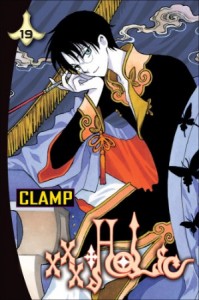
I wish I didn’t have to give it the cover spotlight, but it’s the final volume, and it used to be awesome, so here it is. Del Rey’s last manga series ends with the publication of Vol. 19 of xxxHOLIC. The early volumes of this series were possibly the best thing CLAMP has ever done not named Card Captor Sakura. This last one… is out this week. :)

A trio of new manga from DMP. After much delay, we get the 7th volume of Itazura na Kiss. Featuring everyone’s least favorite hero. Let’s hope he gets a sweet moment or two this time around. There’s also Vol. 3 of the awesomely named Bad Teacher’s Equation, and the more sedately named Border. Both by the same author. I wonder if she did them at the same time?

Midtown comics lists Vol. 4 of cyberpunk series Mardock Scramble as coming in next week. My shop says it is also getting the 13th volume of Sayonara, Zetsubou-sensei, which will answer the all-important question, “Can a translator last longer than 4 volumes on this series without burning out and leaving?”

Vertical has Volume 11 of its brand new series, GTO The Early Years. Yes, both those things are correct. Vol. 1-10 were released by Tokyopop, and Vertical is picking up where they left off. Known in Japan as Shonan Jun’ai Gumi, this series lasted even longer than GTO, and is how the world first got to know Onizuka. This volume should contain Vol. 21-22 of the original. Ed says if sales are good, they may go back to put 1-10 back in print. Get it! Onizuka rules!

Lastly, Midtown lags a week behind everyone else, as most of Diamond’s shops got Vol. 5 of Tenjo Tenge this week. It has kicking! And boobies! It is hard to imagine a more appropriate manga for 13 year old boys. Who, of course, should not be reading it. At least not in North America. M for Mature, folks.

So what appeals to you this week?

Filed Under: FEATURES

BL Bookrack: February 2012

February 18, 2012 by MJ and Michelle Smith 11 Comments

Welcome to the February installment of BL Bookrack! This month, MJand Michelle take a look at two offerings from SuBLime Manga, VIZ Media’s new BL imprint, The Bed of My Dear King and Oku-San’s Daily Fantasies, as well as Rainy Day Love from the Digital Manga Guild. In Brief: volume two of Only Serious About You from Digital Manga Publishing’s Juné imprint, and volume one of Love Pistols from SuBLime.


The Bed of My Dear King | By Sakae Kusama | SuBLime Manga | Rated M (Mature) – This is my first SuBLime title—one of the first batch of digital-only releases, in fact. It appealed to me because it was described as “a suite of emotionally resonant, romantic stories.” Plus, the description included the words “unexpected” and “poignant.” So, does The Bed of My Dear King deliver on its claims? Well, mostly. Although, instead of “emotionally resonant” and “romantic,” the first words I’d use to describe the stories herein would be “quirky” and “memorable.”

The title story is about an electrician named Koga who visits the isolated mountain home of an initially surly sculptor to make a repair. The sculptor, who eventually reveals that his name is Takashi Tohno, gets a little more friendly and helpful as Koga attempts to get to the root of the problem, and when a sudden snow storm traps them together, a bit of booze leads to a “let me feel you up for my art” kind of encounter. I love Kusama’s use of big panels to evoke the wide open spaces around Tohno’s home, and though the pair decide to date pretty durn swiftly, the result is still an unforgettable story.

“Cherry” is about Ueno, an overachieving student council member who only slows down once his glasses get broken, and Tama, a boy who’s friendly to everyone in class but treats Ueno more formally than the rest. Ueno’s near-blind state results in a terribly cute “I’ll take you home by bike” scene and a promise that they can kiss or something after the school festival. You wouldn’t think a bike scene would make a story stand out so much from its BL compatriots, but it does.

The third and final story, “Flowers,” is the weakest of the three. Kumon, a runner, is curious about Ozu, his classmate. Rumors begin swirling that Ozu has impregnated a girl, and when Kumon asks him about it, Ozu trades the details for gradually escalating intimacy. This story has the potential to deal with some weighty issues, but doesn’t delve too deeply, and the ending is just kind of dumb. Kusama writes in her notes that these stories were serialized at different times, and I wouldn’t be surprised if this was an earlier effort.

All in all, this is an intriguing collection of stories and I’m glad I read it.

– Review by Michelle Smith


Oku-San’s Daily Fantasies| By Noboru Takatsuki | SuBLime Manga | Rated M (Mature) – I’ll be honest, here. Looking over the list of SuBLime Manga’s debut offerings, my initial reaction was one of disappointment. As a BL reader whose preferences lean towards thoughtful, carefully-developed romance and long-form storytelling, it was depressing to note that the imprint’s first few titles seemed to fall mainly into the categories of short stories, fluffy comedy, and gratuitous smut. Oku-San’s Daily Fantasies could be described as all three, but to a far more satisfying end than I ever would have imagined.

Oku is a bored office drone, whose single joy in life is fantasizing about Sudo, a local delivery man from a popular shipping company. In order to see Sudo as often as possible, Oku constantly orders things online, each time fantasizing about what might happen when his dream man arrives to deliver the package. Eventually, his orders extend to porn videos and sex toys, which he soon discovers are being sold to him by the company his neighbor works for. Once this discovery has been made, the neighbor, Yokoshima, drops by often, interrupting Oku’s fantasies with overly-exuberant friendliness and requests to try out new products. Though Oku initially finds this annoying, little by little, he finds himself warming up to Yokoshima. But can a real relationship ever live up to Oku’s fantasies?

There are a number of reasons why this manga really works, not the least of which is the fact that Oku’s (often hilarious) fantasies provide the opportunity for the author to include a whole lot of deliberately over-the-top, porno-rific sex scenes that actually serve the story. While even in the most serious romantic tales, sex sequences have a tendency to get in the way of the storytelling more than anything else, here they are actually a significant aspect of Oku’s character development, and even help to forward the plot. Even more surprising, is mangaka Noboru Takatsuki’s ability to write sexually-charged comedy that is actually funny, which is not something I generally associate with humorous BL manga. Takatsuki’s artwork is a highlight as well, serving the story’s comedy and erotica with equal skill.

Though SuBLime may not yet be satisfying my desire for epic, nuanced BL romance, they’ve managed to win me over with this charming bit of humorous smut. Surprisingly recommended.

– Review by MJ


Rainy Day Love | By Satomi Konno | Digital Manga Guild | Rated M (Mature)- One rainy day, Yuta Yoshizawa is working at his family’s senbei shop when Shizuno stops by. Graceful and handsome, Shizuno was a first-year member of the shogi club when Yuta was in his third year, and soon they’ve rekindled their friendship. In the blink of an eye, Yuta confesses his feelings, whereupon Shizuno reveals that he’s been in love with Yuta since sixth grade. After a brief interlude, during which these lovebirds realize that they don’t actually know each other at all, they start focusing their thoughts on consummating their relationship.

It’s not that Rainy Day Love is bad, really. It’s just really superficial. This is what I get for routinely judging BL by its covers—and this is a really nice one—but I somehow expected, from the title, more of a melancholy story. Instead, this is fast-paced and a little frivolous, with love confessions that are so abrupt and unconvincing that they made me go “Pfft!” and many scenes where super-deformed characters have dialogue like “Eep!” There is nothing wrong with a romance being silly—and there’s certainly something to be said for a story that doesn’t take its own drama seriously—but there’s nothing really compelling about it, either.

After Yuta and Shizuno manage to get it on, their story ends and the volume is rounded out with a couple tales about Yuta’s brother, Shoichi, and his friend Seigo, who’s been in love with him since elementary school. There’s really not much to recommend this, either, honestly. I guess if you like comedic BL about horndogs, then you might like Rainy Day Love. If you like more serious BL, like I do, then you’re probably going to be bored and disappointed.

– Review by Michelle Smith


In Brief:

Only Serious About You, Vol. 2 | By Kai Asou | Digital Manga Publishing | Rated YA (16+) – If volume one of Kai Asou’s Only Serious About You impressed me with its ability to craft a real, moving love story out of well-worn genre clichés, what’s most impressive about its second volume is its ability to make me forget that they were ever clichés to begin with. Though this volume’s primary conflict is divorced dad Oosawa’s struggle to maintain custody of his young daughter, the deeper issue here is his decision to accept his feelings for former playboy Yoshioka, and come out as his lover. Though the “only gay for you” syndrome is one of the genre’s least appealing tropes, here, it barely reads as a trope at all. On the negative side, Oosawa’s custody battle is resolved a tad too easily, but this is not nearly enough to sink a title this strong. Enthusiastically recommended. – MJ

Love Pistols | By Tarako Kotobuki | SuBLime Manga | Rated M (Mature) – Among the first four titles offered up by SuBLime Manga, Love Pistols would appear to be the closest to “my kind of BL,” at least on the surface. It’s a steamy, dramatic romance, told in multiple volumes (seven and counting), with some pretty complicated world-building and supernatural themes. Unfortunately so far, it’s also got a dull, controlling love interest, stunningly unappealing sex scenes, and just enough exposition to drown in. And while the tragic rarity of multi-volume BL ensures that I’ll give this series at least one more chance to win me over, there’s no denying the fact that reading its first volume was a distressingly unpleasant chore. Better luck next time, Love Pistols? Let’s hope so. – MJ


Review copies provided by the publishers. Cover art: The Bed of My Dear King © Sakae Kusama 2011, Oku-san’s Daily Fantasies © Noboru Takatsuki 2011, Love Pistols © Tarako Kotobuki 2004

Disclosure: MJ is currently under contract with Digital Manga Publishing’s Digital Manga Guild, as necessitated for her ongoing report Inside the DMG. Any compensation earned by MJin her role as an editor with the DMG will be donated to the Comic Book Legal Defense Fund.

Other recent BL reviews from MJ & Michelle: I Love You, Chief Clerk! (JManga); Only Serious About You, Vol. 2 (Juné).

Filed Under: BL BOOKRACK Tagged With: digital manga guild, digital manga publishing, Juné, love pistols, oku-san's daily fantasies, only serious about you, rainy day love, SuBLime, the bed of my dear king, yaoi/boys' love

Guest Feature: The Geeky Heart of Taipei

February 17, 2012 by Sara K. 16 Comments

If you are a geek, and find yourself in Taipei, know this: you must visit the Huashan-Bade-Guanghua geek complex. They can supply any geek, whether food geek (there is a farmer’s market), korean drama geek (lots of korean drama DVDs) and even the jade geek (yep, there’s a jade market too).

Naturally, it’s the best place to buy comics books in Taipei, and possibly even the best place to buy comic books in all of Taiwan. First, let’s look at Huashan Cultural Park.

A picture of the former factory buildings which are now Huashan Culture Park

Once upon a time, Huashan was a factory. As Taipei de-industrialises, authorities try to repurpose the leftover structures, and Huashan is one of their more successful efforts. It has galleries, trendy cafes/eateries, a yoga center, and hosts various artsy/indy events. Futhermore, it’s a popular location for wedding photos. When I talk to young people about what places in Taipei they recommend visiting, Huashan is one of the places they mention the most often. However, there is not much in the way of comic books around Huashan.

Outside of the exhibit for the M Riders is a cardboard cutout showing all of the main characters from the TV series.

Here is a temporary exhibit at Huashan dedicated to The M Riders, a Taiwanese fantasy TV series. I don’t know much about it, though based on what little I’ve seen, it looks like it has been heavily influenced by Harry Potter.

This is a sign on Bade Road which shows a bunch of circuitry, highlighting Bade Road's techie credentials

Now let’s head to the Bade Rd. market.

Along Bade Road, we se the signs of many tech stores

As you can see by the street signs, this section of Bade Rd. is full of technology stores.

This storefront is quite open, designed to invite people passing by to browse through the various gadgets

This is a typical store-front.

Street stalls selling typical Taiwanese street food mix with the technology stores

Here, in the alleys, tech stores mix with vendors of standard Taiwanese street fare, in case you get hungry while browsing through wares (and it’s the wrong day of the week for the farmer’s market).

This is a picture showing Animate from the outside

Of course, all of the geeks converging on Bade Rd. to get their gadgets also need something to read. Animate, one of Taiwan’s largest comic book stores, is right here to serve them.

Animate carries lots of manga and otherwise geeky magazines.

Here is the magazine section.

Along the staircase of Animate you can see various ads and comments about manga/anime

Here is the staircase.

Unfortunately, they did not want me to take pictures of the second floor (where most of the store is). However, they have a huge selection of (new) manga of all kinds, as well as lots of light novels, and manhwa, and the type of manhua which is styled after Japanese manga. Alas, I have never seen any of the types of manhua which stray further from the Japanese style at Animate. But that’s just the front part of the store. In the back part of the store, they sell lots of anime/manga themed merchandise. And in the very, very back is the “18 and older” section, naturally.

A picture of the 5-floor Guanghua Digital Plaza from the outside

But now it’s time to head to … GUANGHUA DIGITAL PLAZA!

A picture of the various technology-selling stalls on the ground floor of Guanghua Digital Plaza

Here’s a picture of the ground floor of Guanghua Digital Plaza. Though the ground floor has some eateries (which I do not care about) … the real business is selling the big gadgets. Like computers.

Of course, many of the tech stalls at Guanghua Digital Plaza are actually outposts of the (larger) stores in Bade Market. Because everything is much closer together inside Guanghua Digital Plaza, it’s easier to do comparison shopping, or to shop for mutiple items. Therefore Guanghua Digital Plaza gets much more foot traffic. All the stores want a slice of that.

A picture of a stall selling HP computers next to a stall selling Fujitsu computers

This is the stall where I bought the computer I am using to write this post.

One of the features of shopping at Guanghua Digital Plaza is the haggling. It is easier to haggle at Guanghua Digital Plaza than at the Nova Arcade on Chongqing road (the other major spot in Taipei to buy electronic gadgets). It is often said that you should never accept the list price for anything (at least for the tech items). I am not good at haggling, so I can’t give advice, but you should definitely try to get as good a deal as you can.

A view of the types of stall found on the second and third floors of Guanghua Digital Plaza

Let’s go up to the second and third floors – where all the comic books are!

Here are some tall, rolling bookshelves inside a comic book stall.

This is a pretty typical set up for comic book stores / rental shops throughout Taiwan – tall, shifting shelves to pack in as many comics as possible.

A store selling various kinds of outdoor gear

Here’s an outdoor-gear store. I told you this area catered to geeks of all kinds.

A small hole-in-the wall bookstore which manages to stock a lot of used books.

Now here is a little book store that I love. Though it’s small, they have a good selection of comic books:

Comic book series bundled together and stacked on upon the other.

Of course, with all of those comics stacked up on each other, browsing is a bit challenging – how can you know what’s buried under there? That’s why there is a list of all series currently in stock; if you indicate interest in a series, the store keeper will pull it out for you.

Kpop stars are dancing on a bunch of computer screens to show off the quality of the image.

Here are some Korean pop stars showing off the visual quality of these monitors. All things K-pop are very popular in Taiwan (well … manhwa is not very popular in Taiwan, though I suspect it sells much better in Taiwan than in the United States). If you browse the monitors at Guanghua Digital Plaza, you will see a lot of K-pop dancing.

This is a small Mollie's Used Bookstore tucked inside Guanghua Digital Plaza

And here’s Mollie’s outpost at Guanghua Digital Plaza. Mollie’s Used Bookstore is one of the local used bookstore chains. While this Mollie’s merely has a small selection of comics, it’s always worth a look.

A bunch of manhua titles for sale, including Creative Comics Collection, Old Master Q, and various wuxia titles

If you were disappointed that Animate does not sell manhua which veers from the Japanese style, this store has a nice selection of such manhua.

A typical corridor on the third floor

Somewhere on this floor is the store where I bought the camera I’m using to take all these pictures … but I can’t seem to find it.

Yet another hole-in-the-wall comic book store at Guanghua Digital Plaza

Here’s another great comic books store. This place just sells used comics – specifically, it just sells bundled used comic books. It’s great if you want the full run of a semi-popular-thru-somewhat-obscure series without putting your wallet through too much pain.

A typical video store selling DVDs and VCDs at Guanghua Digital Plaza

And here’s a video store. There are a number of these throughout the second and third floor. They sell Hollywood fare, Hong Kong fare, Chinese fare, Japanese live-action fare, anime, lots and lots of Korean dramas, and local idol dramas. Notice that there is a sign on top for the Emma anime.

A hole in the wall bookstore / comic book store which manages to have quite a selection in spite of its size

And here’s Wawa, which has by far the best selection of new comic books in all of Guanghua Digital Plaza. They even have some new comics which I have not seen at Animate.

New copies of a bunch of volumes of (Chinese language) Glass Mask

For example, they have Every Single Volume Of Glass Mask. New. It’s not hard to find a used set of Glass Mask, but having new copies of the entire run in stock? That’s impressive.

A bookstore which is utterly crammed with used books

And here’s another little store that I love.

A stack of comic books outside a bookstore

Again, the comics are stacked up right out front, though there are also many comics inside too (I never understood how this store is organized, and that’s okay – it make is more like a treasure hunt).

The inside of the bookstore, where used books are stuffed into every nook and cranny possible

And here’s the interior. Look at how books are spilling out of every book and cranny. While it’s not so good for the books, I love this kind of used bookstore. It feels so much warmer and cozy than bookstores where everything is neatly and coldly laid out.

So that’s Huashan-Bade-Guanghua. I admit that it’s quite commercial (well, Huashan Cultural Park is less so), but buying, selling, and trading what you love is quite exciting. Every time I visit, I think I already know everything that’s there – yet I always manage to discover something new. And if you visit yourself, I’m sure you’ll disover something new yourself.

Sara K. has previously written Why You Should Read Evyione and a review of Mary Stayed Out All Night for Manga Bookshelf. She now has her own blog, The Notes Which Do Not Fit, though you won’t find much about comic books or Asian culture over there. She currently lives in Taoyuan County, Taiwan.

Filed Under: FEATURES

Combat Commentary: Bakuman Volume 6, Ch. 48-50

February 17, 2012 by Derek Bown 2 Comments

What’s that, you say? What am I doing looking at Bakuman? It’s not even a battle manga. Don’t I know the title of my own column? Well, allow me to explain. I’ve mentioned before that I am interested in looking at non-conventional fight scenes and battles. Not all conflict (or even fights) needs to be physical. Sometimes they can be battles of ideals, or of ideas. They can be mental mindgames, or cleverly constructed traps. One could even say that any form of conflict resolution is a battle.

While I will continue to focus on battles involving actual physical confrontation, every once in a while I plan to slip in a commentary on the more unconventional battles that are found in manga. With this entry at least I hope to show that a manga does not need punching to be shounen. Series like Bakuman are just as shounen, possibly even more so, than series involving a great deal of fighting.

What Happened?
After overworking himself, Mashiro collapses on the floor of his studio. His assistants find him, and he is admitted to the hospital. While Mashiro insists that he can keep working while in the hospital, his friends try to get him to stop until he recovers. But one by one he convinces them all, even Azuki, that he needs to keep drawing, no matter what. Once he finally has everyone on his side, and is finishing up the pages for the next chapter, the Editor in Chief says that their series will be put on hiatus until Mashiro and Takagi graduate from high school.

(click images to enlarge)

What Happens?
Everyone, including several of the editors, and all of Mashiro and Takagi’s manga artist friends, disagree with the Editor in Chief’s decision to put the series on hold, despite the fact that the decision is made with Mashiro’s well-being mind. Fukuda, and the rest of Team Fukuda, decide that they will protest the Editor in Chief’s decision by boycotting the magazine. They meet with their editors, and tell them that they fully intend to withhold their series from the magazine until the decision to put Muto Ashirogi on hiatus is reversed.

The Editor in Chief remains firm in his decision, and despite the next issue being printed without any of Team Fukuda’s manga, he refuses to change his mind. Miura tries to resolve the issue by getting Mashiro and Takagi to accept a hiatus until Mashiro is discharged from the hospital. He manages to do this, and Mashiro convinces Fukuda and Nizuma to put an end to the boycott. But even after getting the boycott resolved, the Editor in Chief refuses to change his mind. It is not until Mashiro leaves the hospital, and he and Takagi and Miura present the Editor in Chief with all the chapters they created while Mashiro was hospitalized, that the Editor in Chief finally relents and allows Trap to continue serialization in the next issue.

What Does it Mean?
Battles do not have to be physical to be battles. Sometimes they can be a mental game between two opponents, such as are found in Death Note. At their most basic, battles are a clash between opposing ideals. In every good battle, the protagonist and the antagonist’s ideals clash, and the battle does not end until one set of ideals has been proven superior. Generally these confrontations are simplified down to the stronger fighter having the correct ideals.

Even better, is when there is no clear right or wrong. Oftentimes the ideals are simplified down to clear black and white, but in the case of Bakuman, a lot of the driving force of the conflict is that both sides have good arguments. In a way, the Editor in Chief’s lone stand against the rest of the cast puts him in quite a heroic role, especially when considering his motivation is to protect Mashiro from sharing his uncle’s fate.

In a series mostly based in the real world, like Bakuman, fantastic physical confrontations are not possible. And while no blows are traded, two ideals are still pitted against each other. The Editor-in-Chief is convinced that if Mashiro keeps working, he will end up like his Uncle, and wants to protect him from this fate. While Mashiro and the rest of the cast believe in the youthful ideals of always working hard, no matter what puts itself in your path.

The battle is fought with sheer willpower. The same willpower that brings other shounen heroes back to their feet, is what keeps Mashiro drawing, despite his body rebelling against him. It is the same willpower that allows his friends to risk their careers to fight what they perceive as an unjust decision. And in the end, it is that exact same willpower that convinces the Editor-in-Chief to reinstate the series before he had intended to.

By digging deep, and finding examples of battles in even a series like Bakuman we find that battles are the core of every good narrative. Whether actual battles are fought or not, a story relies on the clash of ideals that happens when two opposing sides face each other. And it is the resolution of this conflict that gives every story worth reading its bite.

In a way, the series itself manages to focus not only on how manga is created, but it also uses its story as a way to show how to create good manga. Mashiro’s battle against the Editor-in-Chief has all the hallmarks of a good battle scene, and everything else about the manga sets up the ideas used to create good shounen manga. From Mashiro and Takagi’s incredible drive, to their rivalry against Nizuma (which only really started because they decided to make him their rival) which drives them on to become Number One. Not only are meta-battles used in all forms of storytelling, but Bakuman is a rare case in that the entire point of the series is to portray shounen manga in a different setting than normal.

Filed Under: Combat Commentary, FEATURES Tagged With: bakuman

From the Heart, Cocohana

February 16, 2012 by Erica Friedman 4 Comments

It’s not often I’m in the right place at the right time to see the birth of a new magazine. This time, I was. Shueisha’s Cocohana launched in time for January 2012 and I just happened to be at a store that carried it when it hit the shelves.

Cocohana is being positioned as a Shoujo magazine for adults. As a result, the feeling is neither quite Josei, nor Shoujo, but some hybrid creation. From my perspective, it works.

To bump up its appeal to an adult audience, Volume 1 started right off with a few power names on the roster, Higashimura Akiko (known for Kuragehime, known here as Jellyfish Princess,) with “Kakukaku Shikajika,” Yamashita Tomoko (Dining Bar Akira,) with a one-shot, “Biseinen,” and is reprinting some previously serialized stories from Chorus magazine, including Haruno Nanae’s classic Papa Told Me. (This gives me hope that, perhaps we’ll see her Pieta re-serialized. This story is one of my favorite older Yuri series and as the Yuri audience now exists as a thing on its own, I think Pieta‘s time has come.) “Ashi Girl,” by Morimoto Kozuek,o is the kind of fantastic mix of historical rewrite and female experience that I haven’t seen since Akaishi Michiyo’s Amakusa 1637. I’m looking forward to more of it.

Previews of most of the series running in Cocohana are avialable on the website: http://cocohana.shueisha.co.jp/viewer/index.html, as are messages from the manga artists. Uniquely, the Cocohana main page also includes a Twitter stream of messages by the manga
artists, something I haven’t seen any other magazine website include – despite the adoption of Twitter by many manga artists. The website also offers a personalized fortune-telling session, if you send your information in by form.

Scheduled for 28 volumes a year, Cocohana retails for 500 yen ($6.44 at time of writing,) for approximately 450 pages, which puts it at the high end of per-page cost for a manga magazine…another sign that this is for an older audience. Bolstering the idea that the magazine is Shoujo, not Josei, it comes with a giveaway – a small purse – but, with art by Anno Moyocco which confirms that the audience is adults. So far, in image and story, Cocohana is balanced perfectly to present a specific image.

Cocohana, the shoujo magazine for adults, from Shueisha: http://cocohana.shueisha.co.jp


Filed Under: Magazine no Mori Tagged With: Magazine no Mori, Manga Magazine, Shueisha

Manga the Week of 2/22

February 15, 2012 by Sean Gaffney

The fourth week (but really the 3rd) of February gives us quite a few titles to choose from. And for once, none of them are from viz – it’s the other publishers that get a look in.

Dark Horse gives us the 20th volume of Oh My Goddess, which means they have now caught up with the ‘unflipped’ editions. Honestly, it’s a sign of how popular this series is with their fans that they even went to all the trouble of this giant re-release, and I’m impressed. As ever, Carl Horn supplements the releases with letters and endnotes. Going forward, starting with Volume 41, it’s all heading forward into the future, rather than reliving the glorious past.

As always, DMP’s yaoi publications always end up with the best titles. This week we have ‘Gentlemen’s Agreements Between A Rabbit And A Wolf’, which sorely needs a tiger in there as well, but I won’t quibble as I know it would destroy the beautiful seme/uke balance the title provides. And in more sedate titles, we also have the 5th volume of the deluxe reissue of Kizuna.

Kodansha gives us the 4th volume of 24-style thriller Bloody Monday, and the 4th volume of fantastic dinosaur art series Gon. Two series that really are unlikely to ever cross over. (Gon doesn’t appear in Cage of Eden, does he? Cause that would just make my year.)

Seven Seas is giving Midtown the 3rd volume of A Certain Scientific Railgun, which many other Diamond customers – including me – got this week. There is still no sign of the parent series, A Certain Magical Index, but Railgun is entertaining enough.

That’s right, it’s my blog, and so Higurashi gets the image again. The Atonement Arc hits Volume 3, and no doubt will feature increasing paranoia and bloodshed. Can the ircle be broken, or are we in for another depressing reset? Well, we won’t find out yet, but certainly this will ramp up the tension. Also from Yen, we have new volumes of The Melancholy of Haruhi Suzumiya (the normal manga version, not the SD one); ninja manga Nabari no Ou; ecchi harem fantasy catgirl samurai… thing Omamori Himari; the awesomely insane Soul Eater; and a new volume of Sumomomo Momomno, which is still going, to my surprise. it’s hit Volume 11 too! Sheesh, kids these days…

All this and the debut of Soulless: The Manga from artist REM! What interests you this week?

Filed Under: FEATURES

Comic Conversion: Pride and Prejudice

February 9, 2012 by Angela Eastman 2 Comments

Pride and Prejudice | Novel: Jane Austen / Norton Critical Editions | Graphic Novel: Nancy Butler and Hugo Petrus / Marvel Comics

Elizabeth Bennet is happy to see her older sister Jane falling in love with Mr. Bingley, a rich young man who has just taken up residence in a nearby home. Unfortunately, in order to see Bingley, Elizabeth and the rest of the Bennets have to put up with his proud, unsociable friend, Mr. Darcy. After being scorned by him, Elizabeth vows to have nothing to do with the man, and decidedly hates him after finding out about the injustice he’s done to another new acquaintance, Mr. Wickham. But first impressions aren’t always what they seem, and Elizabeth may find that she’s sided with the wrong man.

Pride and Prejudice was originally published in 1813, but despite the nearly 200-year gap between its creation and the present day, Jane Austen’s novel proves itself endlessly popular. There is a plethora of unofficial sequels, as well as several movies and a wonderful mini-series from the BBC. The Victorian novel has even been famously readapted to include zombies in the Bennet sisters’ quest for love. So, despite the distinct lack of action or anything else people expect in a comic, it’s entirely unsurprising that someone tried to make a graphic novel out of Austen’s book.

I won’t hide the fact that, as far as classic novels go, Pride and Prejudice is one of my favorites. Anguished high school students may disagree, but one of the biggest draws of Austen’s novel is the humor. We start right off on a sarcastic note with one of the most famous lines in literature: “It is a truth universally acknowledged, that a single man in possession of a good fortune must be in want of a wife.” Austen spends much of her novel poking fun at society, using characters like Mrs. Bennet (who is basically a caricature) to overemphasize the ideas and expectations of the time, and even by today’s standards her jabs still ring true. But best of all is, of course, the love story: no “love at first sight” garbage, but a gradual shift from hate to affection as misunderstandings and first impressions are slowly overcome.

This may have come from my own warm feelings towards the Elizabeth/Darcy romance, but I had hopes of the graphic novel having a sort of shoujo-manga feel, much like Marvel’s more girl-centered Spider-man Loves Mary Jane comics. The cover in particular tricked me into believing that this would be the case, with its pastel colors and soft shading, along with the cute teen magazine-esque blurbs. The interior art is a different story. The first shot of the Bennet sisters has all five looking awfully sexy and sultry, including Mary, the one often described as plain. Lydia specifically is wearing a heavy-lipped, open-mouthed expression as she talks of the officers in Meryton, as if the artist wants to foreshadow her less-than-desirable behavior still to come. Mrs. Bennet’s large, exaggerated expressions still convey her silliness, and snobby Caroline Bingley wears a suitable pinched expression, but in general the art sucks out much of the lighthearted feeling.

The graphic novel falls victim to over-narration, showing a usual lack of faith in the art to clue readers in to what’s going on. However, there are some cases where the artist shows some sense of how to use a panel layout. When Mr. Collins is proposing to Elizabeth, each row of panels is split between Mr. Collins’ and Elizabeth’s faces; while Mr. Collins is haranguing her, we see on Elizabeth’s face her mounting frustration and annoyance, where in the book we only get her emotions after the speech. We see this similarly again when Mr. Darcy gives his proposal, and her trembling fists show her rage at his pride. But while the graphic novel draws out these scenes, overall the pacing is much too quick. Most of the scenes don’t last beyond a page, if they even get too far, and a lot of very key moments that should have been dwelt on are rushed through.

The characters suffer from the fast pace as well. Many of the main characters escape relatively unscathed—we have a good understanding of Elizabeth’s headstrong personality, and Mrs. Bennet is still satisfyingly absurd. Minor characters do suffer from diminished page time or complete omission: Mary, the middle Bennet sister, only appears on a couple of pages, and Maria and Mrs. Hurst, sisters of other key characters, have been cut out entirely. It’s not big loss, as none of these characters do much to push the plot forward, with Mary only proving an opposite to the rambunctious Lydia and Kitty, and Mrs. Hurst simply echoing Caroline Bingley’s disdain for the Bennets. Unfortunately the downsides of this are greater. We hardly catch sight of Mr. Darcy’s younger sister Georgiana, who doesn’t have a line of dialogue. Even more detrimental to understanding the plot is Mr. Wickham’s diminished page time: his brisk introduction gives us no real clue as to why everyone finds him so initially charming, so the revelation of his past and future immoral behavior isn’t as shocking as in the novel.

Despite the fact that the artist uses some panels to good effect, the two most appealing aspects of Pride and Prejudice—the romance, and the humor—are severely diminished, thanks to a pace that moves too fast and art that just doesn’t match the tone. Marvel’s adaptation is not awful, but it still won’t be appealing to anyone who isn’t already an Austen fan. Even big Pride and Prejudice fans would likely rather chuckle along with Pride and Prejudice and Zombies or spend six hours watching the mini-series than spend the 45 minutes it takes to read this adaptation.

Have any graphic novel adaptations you think do a good job? Or a comic you want me to check out for you? Leave suggestions for future columns in the comments!

Filed Under: Comic Conversion, FEATURES, FEATURES & REVIEWS Tagged With: Hugo Petrus, Jane Austen, Marvel Comics, Nancy Butler, Pride and Prejudice

Combat Commentary: Hellsing Vol. 1, Ch. 4-6, Alucard vs. Alexander Anderson

February 8, 2012 by Derek Bown 2 Comments

Seinen battle manga can be a glorious thing. Once the restrictions of a younger audience are removed, seinen artists can show the brutal reality of battle. Limbs go flying, and blood splatters cover entire pages. That is not to say that shounen manga is sparkly clean. Despite being aimed at younger readers, shounen battle manga can get fairly graphic. However, the truly graphic scenes are saved for moments where they will have the most impact. With seinen manga there is a risk of over-exposure. Once the reader has gotten used to the limbs flying all over the place, the moment it’s meant to matter doesn’t make have the desired impact.

Consider, would Shanks losing his arm in the first chapter of One Piece have the same effect if it had been preceded by twenty pages worth of limb removal? However, where seinen excels is in trading in gravitas with pure, unfettered gore-mageddon. Sometimes you just want to see limbs removed and pages splashed with blood. But only if it’s in black and white—one wouldn’t want to aggravate one’s sensitive temperament.

What Happened?
While the Catholic Church is content to leave Hellsing to deal with the unusual numbers of vampires in England, an incident in Ireland prompts them to send their premier vampire hunter, Father Alexander Anderson. He confronts Alucard and Seras, who have been wiping out a ghoul infestation. He attacks Seras, and while Integra postulates about Anderson’s monster hunting chops, Alucard and the good Father face off, trading quips while they wait for the first strike.

(click on images to enlarge)

What Happens?
Anderson plants two bayonets in Alucard’s throat, but is blown away by a bullet to the head. The fight, however, is not over, as Alucard assumes. Anderson stands right back up and continues to fight, not going down no matter how many bullets Alucard puts into him. He impales Alucard against the wall, as the vampire realizes Anderson is a Regenerator. Anderson runs Alucard through with several more bayonets (where does he keep those?), and cuts off his head.

Seras tries to run, but finds herself surrounded by a barrier erected by Father Anderson. Alucard telepathically tells Seras to drink his blood to become a true vampire. Integra arrives at the scene, and tells Anderson to leave, telling him that the area is under their jurisdiction. Anderson kills her guards, and attacks Integra herself, but his boasts that he killed Alucard are met with derision. Integra says that Alucard cannot be killed as easily as a normal vampire, that he is the ultimate vampire, perfected over one hundred years by the Hellsing family. Realizing that his current gear will not be sufficient to finish Alucard off, Anderson leaves the premises via…magic teleporting bible pages?

I have no idea what is going on here, but it looks cool.

What Does it Mean?
Every battle series has an eternal rival character—someone who can stand toe-to-toe with the protagonist as a respected opponent. And when your protagonist is the ultimate undead, then you need to cheat a little with your rival. Enter Father Alexander Anderson, a Regenerator—the culmination of human anti-monster technology—a man with regeneration powers that render him effectively immortal, and who for some reason fights with an infinite supply of bayonets, because shut-up-it’s-cool. Ladies and gentlemen, to combat our ultimate undead protagonist, we are given Scottish/Irish Catholic Wolverine.

The fight itself is relatively short, with more focus being placed on the build up, presenting Father Anderson as a legitimate threat. And the follow-through is glorious, as Anderson completely overpowers Alucard. The purpose is to present Anderson as a seemingly insurmountable obstacle that Alucard will have to face in the future, so a lot of focus is placed on showing off Anderson’s abilities. His regenerating abilities are quite nifty, but it’s his choice of weapon that really makes him stand out.

A series like Hellsing relies on characters standing out, and one of the best ways to do this is to give the characters gimmicks—just one thing that makes the character iconic. And Anderson’s use of bayonets is especially effective in this regard. Machetes would be just as effective (probably more so, considering they are more firmly mounted to their handles). But seeing Anderson wield his bayonets makes the reader pause and notice. It draws attention to the fact that Anderson is a badass who uses strange weapons simply because he can. Indeed his entire character, along with the way he holds himself, is designed to showcase the bayonets.

The way he holds himself, with his blades held down at his sides, brings to mind a long-armed ancestor of our kind. He seems primordial, and thereby more dangerous. His form represents a primal fury not found in modern, civilized man. Simply his bearing alone, with his elongated arms extended by his weapons, shows that this man is not to be taken lightly.

The glasses reinforce that dehumanization of Anderson. They reflect the light, creating perfectly round eyes that hide any possible humanity. Notice how on the following page your eyes are drawn first to the glasses. Then look closer, to really see the expression on his face. There is fear there, but the glasses partially obscure it. Anderson’s design focuses on making him as inhuman as possible, with just a few moments added in to show there is a man underneath the beastly appearance.

This fight is not quite a full fight, but rather serves as the introduction for the true fight to come later on. Father Anderson is given a chance to show off his abilities by way of introduction to the reader, while Alucard is allowed to present more of his considerable powers. Both have unique abilities that bring a lot to the table. A fight like this is crucial in the first volume. It makes a promise with the reader, that sometime in the future Alucard will face off against the indomitable Anderson. And the battle will be glorious.

Filed Under: Combat Commentary, FEATURES

Manga the Week of 2/15

February 8, 2012 by Sean Gaffney

Next week is not nearly as huge as this week, which is a relief. Especially for people like me, as several titles I ordered did not ship this week. So I get 2 normal weeks for once, as opposed to Viz’s usual CRUSH YOU then nothing type of solicitations.

It is pretty much ALL Viz this Week 2; I was expecting some Yen, but no dice. From Viz we have quite a variety, though. There’s the 15th volume of Haruka: Beyond the Stream of Time, which is getting near its completion. Look at that cover. Doesn’t that just scream romantic fantasy to you? I hear it’s a reverse harem as well. There’s also the 10th VIZBIG edition of Inu Yasha, which should contain Vols. 28-30, meaning it’s over halfway there!

Speaking of titles nearing their end, Kekkaishi hits the big 3-0, meaning after this there’s only five to go. And Maoh: Juvenile Remix hits its penultimate volume, with the Chemical Brothers taking the remix turntable this time around. And just to show we have not one manga this week that’s not over halfway or more to its end, we have the 19th volume of 20th Century Boys.

Lastly, Viz has several tie-ins coming out for The Secret World of Arietty, better known to those of us who grew up in the 1970s (or earlier) as The Borrowers. I saw the preview for it, which looked excellent, and supporting Ghibli is always a worthy endeavor.

Any favorites next week? Or did you get shorted on Nura and Otomen this week as well?

Filed Under: FEATURES

Manga the Week of 2/8

February 1, 2012 by Sean Gaffney

*whine* Mercy!

We’ll start with some manwha, as Dark Horse has Vol. 10 of Bride of the Water God, the story of a girl and her gods.

Kodansha Comics has the 3 manga that came out this week, because Diamond is always one step behind. There’s Negima 33, which contains possibly the funniest joke in the entire series, as well as some of the most tear-jerking moments. Deltora Quest puts out its fourth volume of Emily Rodda-based fantasy. And if you like cute 4-koma goodness, there’s the 2nd volume of Shugo Chara-chan!

I apologize to Vertical, and Onizuka. I love GTO, and next week sees the release of the first volume of GTO: 14 Days in Shonan. It’s basically exactly what GTO fans want to see in terms of new material: Onizuka being an idiot, Onizuka being badass, lots of horrible children that need his special brand of ‘befriending’ (Onizuka and Nanoha would get along great), and a cameo by Urumi for you obsessives. It would absolutely get the picture this week, except my heart belongs to Maria. I hope you understand. Buy this anyway.

I’ve been waiting for this one it seems like forever, and it’s finally here. A Devil and Her Love Song is basically all the things I like in a shoujo manga in one package. Strong heroine without being overly dense. Likeable guys who have depth to them. Bullying being realistic but not dominating the entire series. And Ave Maria. This is my big release of the week.

It comes along with 80 bazillion other releases from Viz. We started with shoujo, so let’s continue with it. Ai Ore! Vol. 4 is now normal volume size, and also now runs in Asuka. Will the romance be any sweeter? … Probably not. Dawn of the Arcana puts out its second volume, which ties together political intrigue and forbidden romance. From Hakusensha, there’s new Kamisama Kiss, Library Wars, Natsume’s Book of Friends and Otomen. Lastly, there’s new Story of Saiunkoku (I’m still bitter about the beard shaving), and new Sakura Hime (because Viz has to publish at least one Tanemura title or they all die from the gypsy’s curse.)

Shonen time. First of all, Hayate, why are you here among all the Jump stuff? Also, why are you out a month earlier than I expected? Not that I’m complaining. Hayate the Combat Butler 19 is still funny, still not cancelled, and still not even close to resolving any romantic pairings. (Yes, it’s back to being funny. I’ll let you know when it gets serious again… around Vol. 23, I believe.)

Jump stuff! Bakuman 9, which will no doubt have lots of great Jump/publishing anecdotes and info mixed with treatment of female characters that makes my skin crawl (though I hear it’s improved. A bit.). There’s Bleach 38, not quite sped up (how does one speed Aizen up? The man has to move at his own pace, I tell you…). The highly underrated Blue Exorcist 6, continuing to flesh out Bon’s backstory. Another volume of Nura, which has been matching Kamisama Kiss and Natsume’s Book of Friends yokai for yokai. (They need to have a Yokai-Off.) Slam Dunk is up to Volume 20, which makes it about 10 volumes ahead of how far I thought it’d get. I sense the hand of Shueisha’s Japanese owners behind this one. Good stuff, though. Tegami Bachi: Letter Bee and Toriko have both hit Volume 8, and… really could not be more different from each other, aside from being shonen.

Lastly, there’s two game tie-ins. Pokemon Diamond and Pearl Platinum Vol. 4 (I presume Platinum is good? Were there silver and gold prequels?), and Yu-Gi-Oh 5DS Vol. 2, a series with so many spinoffs and sequels I cannot possibly make glib jokes about it (I let Medaka Box do that for me).

Something for nearly everyone next week. Anything you plan to buy?

Filed Under: FEATURES

Combat Commentary: One Piece Vol. 3, Ch. 18-20 – Luffy vs. Buggy

January 31, 2012 by Derek Bown 2 Comments

And we save the best for last. Not necessarily the best fight, but most certainly the best series. One Piece is interesting when compared to the others of Jump‘s Big Three. As opposed to starting strong and losing steam as the years passed, One Piece did the exact opposite. It has become a war cry for One Piece fans trying to get new readers into the series, “Just make it past the first nine volumes, make it to the Arlong Arc and you’ll be hooked.” With oddly cartoonish art and stories that fans generally rank among the series’ worst, the early chapters of One Piece belie the powerhouse of a manga it would later become.

But surely there must have been something that drew readers in? After all, every manga fan knows that One Piece is easily the world’s number one manga (at least sales-wise). So what let it survive beyond its infancy? Well, if you’ve been reading this column for the past two weeks, chances are you have an inkling of my answer to this question.

Also, since this column is still new, I’m always testing new ideas for formats. Let me know what you think of this version.

What Happened?
After defeating the tyrannical Axe-hand Morgan, Luffy and Zoro find themselves drifting on the ocean with no food and no way to navigate. Luffy tries to catch a bird to eat, but ends up on an island occupied by the dread pirate Buggy the Clown. Luffy runs into Nami, who initially turns him over to Buggy in order to get to his treasure map, but then saves him at the last second. Luffy beats Mohji the beast trainer, and Zoro beats Cabaji the acrobat, leaving Luffy and Buggy ready for the final battle.

(click on images to enlarge)

What Happens?
Buggy’s devil fruit powers give Luffy a hard time at first, but before long he is able to take advantage of Buggy’s weaknesses. Buggy tells Luffy about the time he was an apprentice on a pirate ship with Luffy’s idol, Red Haired Shanks. After Shanks inadvertently ruin’s Buggy’s plan to sell a valuable devil fruit, Shanks then saves Buggy’s life, but earns his eternal ire. With some help from Nami, Luffy is able to defeat Buggy easily, sending him flying with most of his body parts missing.

What does it mean?
Compared to the straightforward action scenes in Bleach and Naruto, One Piece can often rub fans of those series the wrong way with how it portrays action. The early fights, especially the first three in the series (Alvida, Ax-Hand Morgan, and Buggy) come across as just ways to show off how cool the main character is.

Buggy stands out among the early fights, because he is the only antagonist Luffy faces (before Logue Town) that has devil fruit powers. While later on in the series every villain worth his (or her) salt has devil fruit powers, this early in the game it was a big deal. None of the other characters had powers like Luffy. What makes this fight stand out so much is how creatively these powers are put to use. Luffy always finds ways to make his strange power combat-worthy, but to see another character doing the same thing makes this fight stand out in a sea of sword-swinging and punching fights.

This is what makes Buggy’s status as a “joke villain” so strange. While he is portrayed as a serious threat, the ease with which Luffy deals with him (after some minor set backs) doesn’t quite match up. It feels as if Buggy could have either been taken seriously or written off as a complete joke, and seeing him as a little of both is jarring to say the least—still fun, but a little too much in the middle to make for easy classification.

Though Luffy is still portrayed as an invincible protagonist, Oda manages to throw in some tension by giving Luffy a weakness that Buggy can exploit. Luffy’s hat, given to him by Red Hair Shanks, is the only part of him that can be effectively damaged, and Buggy takes advantage of this.

But Buggy is not the only person who can take advantage of others’ weaknesses. As he learns to his suffering. Luffy takes advantage of Buggy still feeling the pain of his separate body parts. And with only two eyes, Buggy cannot both hunt down Nami (who is getting away with his treasure) and protect his lower half.

After this point, the seriousness of the fight dissipates, and Buggy goes from being a threat to being the the fight’s buttmonkey. While the transition is a little jarring, it helps that Oda does not switch back and forth. When Buggy is threatening, he is threatening, but once his weakness is discovered, Luffy takes full advantage of it, and Buggy becomes a joke. So in its own way, the shift from serious to gag goes as smoothly as it possibly could have.

This fight ranks as one of the best in the East Blue arc, solely because it stands out as the first real threat Luffy faces, as well as only one of two villains that have devil fruit powers. Compared to Kuro and Don Krieg, Buggy is one of the more memorable One Piece villains. The shift from serious threat to comedic foil may be jarring for some, but it’s One Piece in a nutshell. No matter how dangerous the situation, there’s always a good laugh to be had.

Filed Under: Combat Commentary, FEATURES Tagged With: Combat Commentary, One Piece, VIZ

Manga the Week of 2/1

January 25, 2012 by Sean Gaffney

Remember, kids, when the month starts on Wednesday, Viz ignores it. (Mostly). So even though this is the first week of February, don’t expect a Viz blitz just yet. What we do have is a lot of stuff that has been out elsewhere for a while, but is finally hitting Midtown now…

Digital Manga Publishing has a couple of titles left that didn’t come out last week. Vol. 4 of school comedy Great Place High School Student Council (still a very awkward title), and Vol. 2 of Mr. Tiger and Mr. Bunny… sorry, Mr. Wolf. Still not a Tiger & Bunny crossover, sad to say.

Kodansha has the 2nd volume of @ Full Moon, which has gay subtext, vampires *and* werewolves, yet still somehow has not been licensed for a major motion picture starring Justin Timberlake. I wonder why? There’s also Vol. 17 of Fairy Tail, which is about due for the return of Fairy Tail fandom’s least favorite character.

There is a large pile of Vertical releases, almost all of which everyone else has had for months, but which Midtown is getting now. So if you haven’t gotten Chi’s Sweet Home 7, No Longer Human 2, Princess Knight 1 *and* 2, or Twin Spica 9 *and* 10 (but not 11, oddly enough), now would be the time. They’re all recommended.

Lastly, arriving two weeks late for no discernible reason whatsoever, we have Vol. 6 of Cross Game, containing the Japanese Vol. 12 and 13. Akane arrived last volume, and was a somewhat polarizing character among the blogger reviews that I read. Will she get a chance to win people’s hearts? Or will it be 2 more volumes of all baseball again?

Any ideas?

Filed Under: FEATURES

Combat Commentary: Bleach Vol. 2, Ch. 9-12

January 24, 2012 by Derek Bown 3 Comments

Bleach is similar to Naruto, in that it’s a popular series that has lost a lot of fans in recent years. Like Naruto, there is a tendency for people to dismiss Bleach as another overhyped series that has outstayed its welcome. And this would not be entirely untrue, but again, like Naruto, Bleach would not still exist if it had been a bad series to begin with. So it must have done something right. And as with many shounen manga, the answer lies in one of the most crucial aspects of the genre: its fight scenes.

(click on images to enlarge)

As a monster of the week series, it was essential for Bleach in its early days to capture an audience with interesting villains, and to find ways for those villains to be defeated in a manner that showed off its characters’ strengths and got the reader interested in reading the next chapter. To do this, some writers rely on cliffhangers, or introduce a new element at the end of the story to lead readers on to the next. Bleach, on the other hand, enticed the reader back each week by providing well-contained short stories that stood out on their own.

Chapters 9–12 provide the climax to a completely self-contained story. Instead of introducing a new thread at the very end of the story, Kubo instead finishes it and lets it stand on its own. He banks on the story being well-written and well-received enough that the reader will want to read more, not just because he wants to find out what happens next, but because he anticipates the next story being just as good.

Prior to the final battle, Ichigo’s friend Chad has been running from an unseen enemy. Rukia and Ichigo manage to find him, and engage the enemy (a Hollow) in battle. The scale of the fight is small, but even a more intimate fight can take on real gravitas if the author sets the right stakes. In this case, the stakes are the lives of not only Chad (someone Ichigo has a personal connection to), but also that of a small child. In these chapters, the Hollow reveals that he was a serial killer in real life who died after the child, Yuichi, tripped him off a balcony. As revenge, he’s been tormenting Yuichi with false promises of returning his dead mother.

This Hollow is more distinct than the series’ previous enemies. He is not a mindless monster, consuming souls on instinct alone, nor is he fueled by resentment against a loved one. He is the first real monster that Ichigo encounters as a Soul Reaper—one that was evil, even as a human. He is built up by the narrative only to be hated, which makes his eventual defeat all the more cathartic.

Kubo knows well how to represent motion with his drawings and panel layout. He gives the scene an almost cinematic quality, and unlike in his later work, he wastes no space just for the sake of looking good. Still, he knows when to indulge in a little more space to make particular movements dynamic. Ichigo’s final blow against the Hollow easily ranks among the better final blows in manga. His sword itself is not seen. Instead, the entire focus is on the motion, allowing the reader’s mind’s eye to truly see the motion of the blow.

The downside of this fight is that Kubo robs the Hollow’s “leech bomb” attack of some of its threat by allowing Rukia (who has none of her spiritual powers at this time) to survive two blasts, so that later, when Ichigo is covered with these attacks, there is no real sense of danger. He is in so little danger, one can imagine the HP bar hovering above his head. So even though the vision of Ichigo shoving a handful of leeches into the Hollow’s mouth is the epitome of badass, its effect is weakened by our knowledge that he could have just let the blast go off and would have come out of it, at worst, slightly singed.

Kubo knew what he was doing, early on, when he chose to focus on individual fights with their own mini arcs. His style complemented this “all battles all the time” approach. And chapters 9–12 are prime examples of what Kubo looked like at his best. He knew how to put the right stakes on the line, and even if it was clear that Ichigo would not lose, there was still enough “cool” to keep that lack of danger from dampening the enjoyment of the chapters’ climax.

But even the obvious “plot armor” surrounding Ichigo in this fight only served as set up for the next major confrontation he would face…

Remember to check out the awesomeness that is Derek’s Blog. Burning Lizard Studios.

Filed Under: Combat Commentary, FEATURES

BL Bookrack: January 2012

January 22, 2012 by MJ and Michelle Smith 3 Comments

Welcome to 2012’s first installment of BL Bookrack! This month, MJand Michelle take a look at two offerings from the Digital Manga Guild, Love & Trap and My Sempai, as well as Men of Tattoos from Digital Manga Publishing’s Juné imprint.


Love & Trap| By Kotetsuko Yamamoto | Digital Manga Guild | Young Adult (16+) – High school student Mochida Masaki will do anything to keep himself safe from bullies, even if it means using his body to “trap” someone stronger or more powerful into becoming his protector. Having only ever used sex as a tool for persuasion, it’s a tremendous shock to Masaki when he finds himself experiencing real attraction to Aihara, the class loner whose family is rumored to be connected to the Yakuza. Are Masaki’s feelings real, or is he just gravitating towards his next target?

Building a romance manga around real societal or psychological issues is tricky business, especially when one of those issues is as serious as teen prostitution, which is essentially what Yamamoto attempts to tackle with Love & Trap. Regardless of the writer’s knowledge of the subject, it’s incredibly difficult to balance complex reality with the demands of the genre, without either trivializing the issue or doling it out with an insufferably heavy hand. This balance is even more challenging to achieve if one must do so over the course of a single volume (or less).

With all that in mind, it’s not surprising to note that Love & Trap leans towards the former. Despite the manga’s dramatic setup, Yamamoto quickly resolves issues that would take most therapists years to unravel, just in time to grant Masaki his genre-approved happy ending. She fares a little better with the book’s obligatory (unrelated) side-stories, “Love Blood,” a dreamy little tale of sexual awakening that reads like a light-BL letter to Penthouse Forum, and “We’re Blooming,” a breezy workplace love-triangle romance set in a florist’s shop.

Yamamato’s artwork is a highlight throughout, clean and expressive, with an almost-classic sensibility that reflects some impressive influences, including Moto Hagio, whose character “Jeremy” (from A Cruel God Reigns) was Yamamoto’s model for the lead in “Love Blood.” On the strength of this alone, I’d be interested in seeking out her other works. Fortunately, the DMG seems to have licensed quite a few, including Blooming Darling, a two-volume sequel to the charming “We’re Blooming.” Stay tuned!

– Review by MJ


Men of Tattoos | By Yuiji Aniya | Digital Manga Publishing | Mature (18+) – I have recognized in myself a fondness for yakuza-themed BL, so when Deb Aoki named Men of Tattoos her Best New Yaoi Manga of 2011 and described it as “strange, funny, heartbreaking and surreal,” I knew I had to read it for myself.

Deb was absolutely right in her description of the series. The first four stories feature yakuza and are interconnected in various unexpected ways. “My Katagi-kun” is the story of a pair of childhood friends who reconnect and become lovers, “Dog of the Ranunculus” is about a guy who’s relatively high up in the organization falling in love with the boss’s son, “Cinderella and the Mad Shark” is about getting revenge, and “Everyone’s Song” is about dreams that don’t come true. Probably the last one packs the biggest punch, but it needs the other three stories to put it into context.

Rounding out the collection are two stories about a pair of college students who keep having dreams about each other. It’s more interesting than it sounds—and fairly steamy besides—and functions like a mental palate cleanser, as it allows the book to actually end on a happy note.

Even if you’re not a particular fan of yakuza stories or of BL in general, I’d still recommend Men of Tattoos. Aniya does some clever things with storytelling that can be appreciated by any manga fan.

– Review by Michelle Smith


My Sempai | Hebiko Habuyama | Digital Manga Guild | Young Adult (16+) – In terms of premise, My Sempai doesn’t sound terribly unique. A fresh-faced teenager, Hajime Amemiya, is being hassled by some thugs when he is rescued by cool and intimidating Saburo Ninomiya, who turns out to be an upperclassman at Hajime’s school. Immediately, a comedic tone is set when Hajime proceeds to stalk Ninomiya, pouncing on him from time to time while absurdly declaring, “I am a love vulture!!” Saburo attempts to discourage his interest at first, but when faced when Hajime’s inextinguishable belief in his being a better person than rumors suggest, he relents.

The boys start spending time together on the weekends—seeing movies, playing video games—and gradually get closer. Saburo’s not a very communicative guy, so instead of volunteering information about himself, he tells Hajime that he can ask anything he likes. It’s tough for Hajime to do this, though, so he’s pretty uncertain about how Saburo feels about him, and also feels left out when one of Saburo’s obnoxious friends (my least favorite character by far) spills the beans about a post-graduation job offer in Okinawa. They do make a cute couple, though, so I enjoyed their interactions. In addition, the chaste, fade-to-black consummation of their relationship has to be one of the happiest-looking I’ve ever seen in BL.

Habuyama’s artwork takes a bit of getting used to, as screentone (and maybe everything else, who knows?) appears to be rendered by computer. Eventually, though, I discovered that her style is particularly suited for outdoor scenes, especially at night, and there were quite a few wide-shot panels with composition worth admiring. I’m always a sucker for drawings of buildings, and there’s a particular image of a dejected Hajime standing on Saburo’s shadowy front porch that I remember as especially striking.

While some elements of My Sempai are not exactly original, I still found it a pleasant and generally humorous read. Habuyama writes in her afterword, “All that matters is that you laughed and enjoyed yourself. I draw with that intention.” I did both, so I’d call that a success.

– Review by Michelle Smith


Review copies provided by the publisher.

Disclosure: MJ is currently under contract with Digital Manga Publishing’s Digital Manga Guild, as necessitated for her ongoing report Inside the DMG. Any compensation earned by MJin her role as an editor with the DMG will be donated to the Comic Book Legal Defense Fund.

Filed Under: BL BOOKRACK Tagged With: digital manga guild, dmg, love & trap, men of tattoos, my sempai

Wrapping it up with Ribon Magazine

January 19, 2012 by Erica Friedman 2 Comments

If Nakayoshi is the Queen of Shoujo magazines, Ribon is the Grand Duchess. Begun in 1955, Shueisha’s Ribon magazine is one of the unquestionable leaders in shoujo manga, with Kodansha’s Nakayoshi and Shogakukan’s Ciao magazines. Each issue of Ribon is approximately 550 pages. At 480 yen ($6.24 at time of writing), you’re getting more than a page per yen, plus fabulous presents -called furoku – with each magazine. Furoku are commonly stationery and pens or pencils, hair or phone acessories or bags of many shapes and kinds. (We have piles of Ribon furoku in my house. Sometime we get the magazine just for the goo-gaws.)

Ribon was home to the first “magical girl” series, Mahoutsukai Sally and the arguably first Yuri manga series, Shiroi Heya no Futari.

If you’ve been involved in the manga scene for any length of time, Ribon series will be very familiar names. Some notable series from Ribon are Marmalade Boy, Hime-chan no Ribon (now resurrected with a news series, Hime-chan no Ribon Colorful), and those series made so popular in the early days of Tokyopop and Viz Shoujo; Kodomo no Omocha (published in English as Kodocha: Sana’s Stage,) Ultra Maniac, Kamikaze Kaitou Jeanne and many of Arina Tanemura’s most popular series, like Full Moon o Sagashite. Currently running in the pages of Ribon is Tanemura’s “Sakura Hime Kaden,” published in English by Viz as Sakura Hime: The Legend of Princess Sakura. I was reading Ribon myself for Eban Fumi’s Yuri series Blue Friend, which was popular enough to get a second “season” and has recently wrapped up.

Of course Ribon has a website: http://ribon.shueisha.co.jp/ The site includes pages for this month’s issue, next month’s issue – a separate page for the furoku included with this month’s issue (I’m not kidding when I say the furoku is a major player here) – manga currently available in collected volumes, Manga how-to tips, information for the in-house manga competition to find new artists, and extras of many kinds, including cover page wallpapers, games, previews of new manga, profiles of readers, aka “Ribon Girls” and more. All of it surrounded by heart-filled, polka-dotted backgrounds and spinning, moving scrolling ads. It’s fantastic, really. You should take a look.

When most westerners think of “shoujo” style art, they tend to think of the Ribon house style; oval faces with slightly pointed chins, eyes not as large as Nakayoshi‘s house style, held up by long necks. Where Nakayoshi tends toward stories that glitter and shine, Ribon stories are more grounded, with real-life situations and pressures playing a major part of the drama. Think Kodomo no Omocha‘s Sana, mixing stories of being one of the beautiful people with real-life family crises.

Ribon is, to my mind, the paragon of current shoujo sensibility. While monthly readership has dropped in 2010 , 243,334 readers a month is something that few American magazines can boast.

The Grand Duchess of shoujo manga, Ribon magazine: http://ribon.shueisha.co.jp/

Filed Under: Magazine no Mori Tagged With: Manga Magazine

  • « Go to Previous Page
  • Page 1
  • Interim pages omitted …
  • Page 87
  • Page 88
  • Page 89
  • Page 90
  • Page 91
  • Interim pages omitted …
  • Page 114
  • Go to Next Page »
 | Log in
Copyright © 2010 Manga Bookshelf | Powered by WordPress & the Genesis Framework