• Skip to primary navigation
  • Skip to main content
  • Skip to primary sidebar
  • Home
  • About Us
    • Privacy Policy
    • Comment Policy
    • Disclosures & Disclaimers
  • Resources
    • Links, Essays & Articles
    • Fandomology!
    • CLAMP Directory
    • BlogRoll
  • Features & Columns
    • 3 Things Thursday
    • Adventures in the Key of Shoujo
    • Bit & Blips (game reviews)
    • BL BOOKRACK
    • Bookshelf Briefs
    • Bringing the Drama
    • Comic Conversion
    • Fanservice Friday
    • Going Digital
    • It Came From the Sinosphere
    • License This!
    • Magazine no Mori
    • My Week in Manga
    • OFF THE SHELF
    • Not By Manga Alone
    • PICK OF THE WEEK
    • Subtitles & Sensibility
    • Weekly Shonen Jump Recaps
  • Manga Moveable Feast
    • MMF Full Archive
    • Yun Kouga
    • CLAMP
    • Shojo Beat
    • Osamu Tezuka
    • Sailor Moon
    • Fruits Basket
    • Takehiko Inoue
    • Wild Adapter
    • One Piece
    • After School Nightmare
    • Karakuri Odette
    • Paradise Kiss
    • The Color Trilogy
    • To Terra…
    • Sexy Voice & Robo
  • Browse by Author
    • Sean Gaffney
    • Anna Neatrour
    • Michelle Smith
    • Katherine Dacey
    • MJ
    • Brigid Alverson
    • Travis Anderson
    • Phillip Anthony
    • Derek Bown
    • Jaci Dahlvang
    • Angela Eastman
    • Erica Friedman
    • Sara K.
    • Megan Purdy
    • Emily Snodgrass
    • Nancy Thistlethwaite
    • Eva Volin
    • David Welsh
  • MB Blogs
    • A Case Suitable For Treatment
    • Experiments in Manga
    • MangaBlog
    • The Manga Critic
    • Manga Report
    • Soliloquy in Blue
    • Manga Curmudgeon (archive)

Manga Bookshelf

Discussion, Resources, Roundtables, & Reviews

Blog

Don’t Fear the Adaptation: Natsume’s Book of Friends

September 16, 2011 by Cathy Yan 4 Comments

Natsume’s Book of Friends | by Yuki Midorikawa | Manga: Hakusensha / Viz | Anime: Brain’s Base / Crunchyroll

Natsume’s Book of Friends is the kind of series that could only be made in Japan. The same plot set-up (young man learns about demons and ghosts, fights some of them and saves others, befriends a supernatural guardian and learns more about his family and himself) when worked over by the United States, well, became Supernatural. Natsume, on the other hand, is a feel-good, low-key series that would gladly eschew demon-slaying for a chance to show an autumn festival in full sway. Less “monster of the week” and more slice-of-life, Natsume’s Book of Friends’ first season tries to bite off more story than it can chew and ultimately left me wavering between dissatisfaction and well-meaning sentimentality.

The eponymous Natsume is a high school boy named Takashi, who has spent his life being ostracized by his family and peers for seeing ayakashi — monsters that are an intersection of mythical beast, ghost, and evil spirit. Takashi’s grandmother Reiko Natsume left him her belongings, among which is the Book of Friends: an old-fashioned notebook filled with names of ayakashi that Reiko had made her followers. The ayakashi whose names were bound in the book were forced to obey Reiko’s commands and, as we discover later in the series, were often Reiko’s only companions.

But Natsume (Takashi)’s connection with the Book of Friends is different. He’s not interested in getting more names; rather, he wants to return the names to the ayakashi. It’s a grueling process that physically and spirtually taxes him. Guided by Nyanko, a dog demon named Madara stuck in the body of fat cat, Natsume finds himself navigating the tricky waters of interpersonal relationships, both with the humans in his life, the ayakashi who won’t leave him alone, and the ayakashi who, surprisingly, need him to guide them through the world of human feelings.

When Natsume’s Book of Friends does its job well, the stories are truly touching. Tsubame, the sparrow ayakashi of episode six, was for me the early standout in this thirteen episode series. Her story arc marks the first time that Natsume gets overly involved in the plight of an ayakashi to his detriment. In his desire to get Tsubame a chance to see the human she loves, Natsume gets trampled on, pushed around, and almost eaten. It’s the kind of dedication that in other anime would result in a love confession. Here, Natsume’s feelings for Tsubame are deliciously kept in the dark, and paired with Tsubame’s unrequited love for a passing human, the whole episode reads bittersweet and touching. Likewise, Hotaru from episode eight has the same melancholy, literary feel to her character arc, much like a short story from Yasunari Kawabata, but animated. At its best, Natsume’s Book of Friends knows when to play the emotional cards close to heart; the most interesting character relationships tended to be the ones that were neither labeled nor even mentioned by anyone in the series.

But other ayakashi who cross Natsume’s path sometimes seemed downright contrived. The kitsune — fox spirit — whose mother is now a pile of rocks (?) had promise as a loner who aims to befriend Natsume, but instead that story fizzled out into a relatively lukewarm conclusion that had me wondering why I was supposed to remember the kitsune kid when he chose to show up in a later episode. Episode three with the dew god was clearly an early foray into the rustic faith of the countryside, but the really interesting religious question (how can you be a god if you have no powers and no followers?) was passed up without any commentary or exploration, while a passable but ultimately silly love story was chosen to cap off the episode. Let’s not even get into the confused emotional climax of episode five, whose musing about friendship between the ayakashi and ill-fated attempt to show us more about Reiko’s personality had me literally falling asleep, despite my best efforts to stay interested. None of the characters in the first season, besides Natsume, get much depth. Sasada, the homeroom president, and Tanuma, one of the few other people who can see ayakashi, had potential to be great foils for Natsume. Instead, Tanuma languishes as a barely realized ally whom Natsume only manages to reach out to in the last episode, and Sasada goes from possibly-no-wait-maybe-not love interest to laughing stock.

In general I found the manga to be more melancholy and on point with the emotional cues. Natsume himself is more gloomy and isolated in the manga, while in the anime, he seems shockingly well-adjusted, making a major sticking point of the story — Natsume’s attempt to build interpersonal relationships — harder to swallow in the anime. Often the anime seemed to be trying too hard for zany or cute or melodramatic or something. I don’t know if it’s because of the switch in medium, but the manga chapters seemed to have an extra air of easy-going softness that was missing from the anime. In many ways, the manga version of Natsume’s life was incredibly fragile. You felt the stories were just like Tanuma’s view of the ayakashi, like if you scrutinized the stories too much they would disappear a little into the background of Natsume’s life. Not so with the anime, where things felt more grounded, more real. Natsume didn’t seem to be the lonely, slightly withdrawn young man he was under Midorikawa’s pen; instead, you felt strongly in the anime that everyone else had had to be wrong to doubt a boy like Natsume. The world of manga Natsume seemed more Japanese, and the ayakashi were everywhere, not just the guest characters they so often were in the anime.

Yet the anime does have its advantages. The ending theme, “Summer Evening Sky”, is a perfect enka-inspired piece that always warms your heart whenever it starts to fade in during the last few minutes of an episode. Kazuhiko Inoue as Madara a.k.a. Nyanko-sensei is a force to behold, easily switching out of Nyanko’s whiny drawl and into Madara’s gruff, no-nonsense bark. And for all my griping that the secondary characters never get development, it’s still refreshing to see a show starring a male character that is neither testosterone-driven nor filled to the brim with ditzy and well-endowed love interests.

Fans of Mushishi and Yumekui Kenbun might consider giving Natsume’s Book of Friends a try (and likewise, those of you who enjoyed Natsume should check out those other two series!). At thirteen episodes, the first season is easy enough to swallow, and the episodic nature of the story arcs makes it easy to start and stop. As for me, I’d put Natsume’s Book of Friends in the box of anime series that neither wow nor disappoint. And, of course, I can only hope the subsequent seasons of the anime learn from Mushishi rather than Supernatural.

Watch it streaming at Crunchyroll

Filed Under: Don't Fear the Adaptation Tagged With: natsume's book of friends

Ekiben Hitoritabi, Vol. 1

September 16, 2011 by Sean Gaffney

By Kan Sakurai and Jun Hayase. Released in Japan by Futabasha, serialization ongoing in the magazine Manga Action. Released in the United States by Futabasha on the JManga website.

Given that JManga is trying to release various types of manga that would not normally be licensed in North America, it was inevitable that we would get a manga devoted to food. Yes, we’ve seen over the top titles such as Yakitate!! Japan and Iron Wok Jan, and Viz even managed to punch out a few volumes of Oishinbo, but that’s just the tip of the iceberg. Japan loves its food, and loves to read manga about people talking about it. And with Ekiben Hitoritabi, we get cross-pollination with another Japanese obsession… trains.

Our hero, Daisuke, has just celebrated his 10th anniversary, and is quite happy running a bento shop with his wife Yuko. She has noticed, however, that he gets a wanderlust in his eyes when he reads train magazines. And so for an anniversary present, she buys him a railway journey – a trip around Japan, on various slow trains (many of which don’t exist anymore, which shows how fast Japan is modernizing, as this manga began in 2006) which will allow him to see the countryside, obsess about trains, and eat various specialty bentos made by the locals.

Train bentos are genuinely famous in Japan, and each station stop tries to make theirs unique and appealing for the weary traveler. Of course, Yuko is not going with him on this trip – someone has to stay behind and run the business. So we see Daisuke set off alone to marvel at scenery, engines and food. About three chapters in, the author recalls what magazine this runs in, and adds a cute girl reporter, Nana, who is tracking down a story and runs into Daisuke on the train. Coincidentally, she also runs into him later in the volume, and serves the purpose of being the designated female in this manga – as well as being equally obsessed with food. She’s not as obsessed with trains, which allows Daisuke to spout the odd bit of history throughout.

Most manga like this run the risk of being dry, and indeed there were several times in this volume that I wanted something to happen other than talking about trains and food. There’s not really a plot here beyond seeing Daisuke going from station to station. And though he occasionally eyes Nana while sweating slightly, or begs forgiveness of his wife in his head for doing so, there’s honestly no indication that he and Nana are destined to have an affair – a good thing given he’s on an anniversary trip given to him by his wife! No, we aren’t heading forward, we’re meandering.

On the other hand, if you are interested in trains or Japanese train bentos, this is a treasure trove. The food is lovingly depicted and described, and you can tell that the authors had a ball researching this. Enthusiasm for the food is tempered by a melancholy nostalgia when discussing the trains, as invariably they start talking about various trains and lines which are defunct, or have been replaced solely by high speed rail. When we do see a unique train car, it’s drawn with the same attention to detail as the food – there’s honestly quite a good balance between the two obsessions here.

Artwise, aside from the food and the trains, things are fairly stiff. The faces aren’t quite as hard to get used to as Oishinbo, to be fair. Daisuke is a stocky, bearded guy, very appropriate for his profession and love of food. (Another manga by the author in the 1990s, about fishing, also featured a stocky bearded guy with a hot wife – methinks I can guess what the author looks like.) Nana is cute rather than sultry, and I’m hoping in future volumes the two develop a brother-sister type bond – though this does run in Manga Action, which features at least three series I know of with lovingly depicted adultery in them, so who knows?

I enjoyed this manga, but let’s be honest – unless you’re really interested in bentos or trains, you won’t find much here. It’s a narrow market, but plays to that market with all the strength it’s got. And yes, after reading it, you WILL be hungry.

Filed Under: REVIEWS

Off the Shelf: A Little Sunshine

September 15, 2011 by MJ and Michelle Smith Leave a Comment

MJ: *blinks* Oh. Hello Manga Bookshelf world. Wow. I’ve been far, far away from here for the past week. Michelle? Are you still here?

MICHELLE: Oh, sorry. I was just in the back room clearing out some cobwebs. It’s amazing how much time seems to pass between these weekly columns.

MJ: *cough* It’s a little dusty in here, too.

MICHELLE: It is. Shall I open the musty curtains of disuse and allow the sunshine of manga goodness to brighten our dingy surroundings?

MJ: Please do!

MICHELLE: Alrighty, then! It’s going to be a Shonen Sunday week for me, as I take a look at the latest volumes of a pair of series published by VIZ under this imprint.

The first is volume seven of Yuu Watase’s Arata: The Legend and I’m just going to state right up front: as a fan of Watase’s Fushigi Yûgi: Genbu Kaiden and as a fan of shounen series by female creators, you really must read this series. (Conveniently, the first five volumes are available on VIZManga.com!) The general premise of Arata might sound like a typical modern-kid-in-a-fantasy-world adventure, but trust me, the execution makes all the difference.

In a world known as Amawakuni, Princess Kikuri has reigned for 60 years and has maintained control over the hayagami (gods in sword form) wielded by her twelve attendants (known as shinsho). On the day of a ceremony in which she is supposed to transfer power to a successor—played by a boy in drag named Arata for reasons one needn’t go into—she is cut down by one of these shinsho, but manages to hang on to a shred of life. Meanwhile, Arata is blamed and through various plotty means changes places with a modern high-school kid named Arata Hinohara, who is promptly chosen by a super special hayagami that will enable him to save the princess, in a nutshell.

Where the story gets really interesting is with all the complications Watase imposes upon this narrative. Hinohara was tormented by a bully in middle school, and can’t be the kind of sho that goes around making others submit to him, which in this case actually involves giving up one’s life to reside in another’s hayagami. He’s experienced that sort of forced domination, and can’t inflict it on anyone else. Instead, he convinces his opponents to entrust their souls to him, and has become the target of all of those who would stop him and take the throne for themselves. Meanwhile, he’s falling in love with the other Arata’s childhood friend and now his tormentor has arrived in Amawakuni, sending a powerful shinsho to Japan in his place who starts killing off his old classmates.

It might seem like there’s a lot going on in this series and, indeed, there is, but Watase just handles it so well it never feels overwhelming for a second. The world makes sense, characterization is consistent, and she employs a sure hand in dealing out story details on a need-to-know basis. In addition to his quest to save the princess, Hinohara is also battling his own emotional trauma and it’s this (plus the bevy of attractive fellas) that gives Arata something of a shoujo flair.

I look forward to volume eight almost as much as I look forward to you reading this!

MJ: I’ve actually read the first two (maybe three?) volumes, and I agree it’s my kind of story! You’re making me feel very anxious to pick up the later volumes, though. For whatever reason, I really I do love shounen series written by women.

MICHELLE: One issue I had with the first few volumes was that Arata (the one now stuck in Japan) wasn’t given much of anything to do. Now that that’s been addressed, the series seems a bit… invigorated. The same can be said of my conviction to read Genbu Kaiden soon, durnit!

So, what had you been reading this week?

MJ: Well, I’ve been pretty well consumed with my day job over the past few days, so I haven’t read a lot. But I did find time to gobble down the latest volume of CLAMP’s xxxHolic, which was just released in (some) stores this week. I know you haven’t caught up on recent volumes, so I’ll try very hard to avoid spoiling you.

With volume seventeen, we’re now further into the portion of the series that was renamed xxxHolic Rō in Japan, following a major event in the story’s plotline. The ramifications of that event have really settled in, and this volume feels more solid than the previous because of it. It’s mesmerizing, really, to watch Watanuki, now so fully immersed in his new role. One of the things that struck me about this volume, too, is how much we’re learning about Yuuko, simply by watching Watanuki. She’s always been an enigma, and suddenly she’s someone we can truly understand. I really don’t want to spoil you, so I won’t explain further, but really, Michelle, it’s something to see.

This is my first taste of xxxHolic in quite some time, and I found I’d almost forgotten just how stunning the artwork is. I often talk about my love for Tokyo Babylon, and there are a lot of things that endear me to that series in particular. But one of its major draws for me is the artwork, and xxxHolic is the first of CLAMP’s series since then to affect me in the same way, visually. It’s all about the use of black. Now of course, Tokyo Babylon is more heavily toned, so the black isn’t necessarily as stark as it is in xxxHolic, which has such dark blacks and clean, deliberate line work it often looks like it could have been created with woodblock printing. Opening a volume of xxxHolic again was a visually spectacular experience, which I hope to be able to repeat soon.

Michelle, I hope you are able to catch up on this series soon, because I’m dying to be able to discuss it with you in more detail. I know there are people whose interest in xxxHolic waned early on, but I’ve only become more deeply involved as the series has progressed. I really can’t get enough of it.

MICHELLE: Now I feel guilty that I am restraining you from praising it to the extent that you desire! I will read it soon!

What you were saying about the artwork actually brought to mind another series that I’ve been reading lately, and that’s Sayonara, Zetsubou-sensei. These two series could not be more different, and yet they treat the color black in a very similar way, with sleek and stylized results.

Art is cool.

MJ: Funny you should mention that series in particular, since Zetsubou-sensei’s character design has actually always reminded me of Watanuki!

MICHELLE: I can see that!

MJ: So, what’s your other Shonen Sunday pick this week?

MICHELLE: My second Shonen Sunday pick is volume five of Mitsuru Adachi’s Cross Game, which I recently cited as my favorite series beginning with a C for David’s latest Favorites Alphabet column. In short, this is the story of a slackery boy named Ko Kitamura who is motivated to make the most of his baseball skills by the passing of a dear friend who dreamed that he’d make it to Koshien.

I’ve talked at some length about my ardent love of sports manga, and it’s true that I avidly devoured the regional tournament match between Ko’s team and their heavily favored opponents. Adachi doesn’t just depict the action of the game, but recreates the whole experience. The crowd, the clouds, the passageways underneath the stadium that finally emerge behind a row of sunlit seats… It’s about as lovely as a baseball game can ever get, reinforced by a story that prizes sheer love of the game over pride and ego.

But there’s more to Cross Game than baseball. Even though she doesn’t survive beyond the first volume, Ko’s childhood friend Wakaba continues to make her presence felt in this volume, which comprises volumes ten and eleven of the original release. Several of Ko’s teammates are united in their goal because they want to fulfill Wakaba’s dream, and this similar feeling of unity in the face of loss is reinforced when a new girl with an uncanny resemblance to Wakaba moves into the neighborhood. The stunned reactions are conveyed poignantly, and even though Ko has been steadily growing close to Wakaba’s prickly younger sister, Aoba, it makes perfect sense why the presence of this new girl might generate some confusion.

If you like sports manga, you will like Cross Game. And if you don’t like sports manga, you will still like Cross Game.

MJ: As you know, I’ve gotten as far as actually buying the first volume with Viz’s digital app, and every time you and David talk about the series, I think about just how much I need to sit down and read it. Maybe this time I finally will. You make a compelling argument, as always.

MICHELLE: It’s really very very good. And you know I don’t say that lightly. Another great thing about it is that you’re getting at least two volumes at once. It’s hard to believe we’re already over halfway through with the series! I don’t have a clue how well it sells but I am really hoping that VIZ decides to release more Adachi in similar fashion.

MJ: I hope so, too!

Oh, this week has done me in, Michelle. Can I go to sleep now?

MICHELLE: Sure you can! But don’t forget to brush your teefs.

MJ: Cross my heart! ‘Night!

Filed Under: OFF THE SHELF Tagged With: arata: the legend, cross game, xxxholic

Cage of Eden, Vol. 1

September 15, 2011 by Sean Gaffney

By Yoshinobu Yamada. Released in Japan as “Eden no Ori” by Kodansha, serialization ongoing in the magazine Weekly Shonen Magazine. Released in North America by Kodansha Comics.

Sometimes, when reading yet another shonen manga, I do wonder why authors keep going to the same bag of tricks. The same character types, the same plot beats, all cliches. Then you read a title like Cage of Eden and it makes sense. It’s because they’re proven winners. People have succeeded with this plot and these types of characters over and over again. So while originality is totally lacking here, no one is reading Cage of Eden for that. You’re reading it to see how the heroes will possibly get out of this one.

And so we meet our cast: our hero and ‘class clown’ Akira, who acts up in order to cover for his feeling inadequate against his smarter, more handsome friends; his childhood friend Rion, who has grown up to be gorgeous and busty, and he is absolutely not in love with nope uh uh no way; our hero’s cool friend (I bet his teeth glint when he smiles); the computer nerd type who doesn’t want to socialize with people not in his intellectual league; the vaguely psychotic punk looking for a fight; and the useless adult figurehead.

After a brief ‘here is a class returning from their summer vacation school trip’ scene, we get into the plot proper, as the plane crashes. Our hero wakes up in the midst of a seemingly deserted island, quickly meets up with the geek kid and the crybaby stewardess, and sets about trying to figure out where they are, where everyone else is, if they can ever get home, and… wait, why are there prehistoric monsters here?

I should mention first off that the fanservice is really out in force here. Cute teenage girls, hot naked stewardesses, panties flashes galore. Of course, it’s not just sex. There’s a heaping helping of gore and violence here as well, and a large number of cool looking extinct or imaginary animals. If you define fanservice as giving the fans what they want, then the whole volume is basically this.

As for the rest, it’s nice seeing Akira take on the hero role that he clearly owns so early on. Given the situation they’re in, a lot of “Eh!… No way!” is here, but when it’s life or death, Akira proves surprisingly competent, while still remaining a realistic ‘normal guy’ trapped in a horrible situation. As for his companions, Shiro may be a nerd, but his smartness isn’t limited just to books; he looks to be a long-term planner as well. And Kanako, the stewardess… well, she’s the type who will either get killed off next volume or suddenly show she’s been badass all this time. I’m not sure which right now.

The title is rated OT by Kodansha, and with good reason. There’s a scene towards the end that shows mob mentality and panic in action, and not only is there a lot of blood, but several graphic rapes are hinted at. This is clearly meant to show that the heroes are completely cut off from civilization, and it works; it’s quite disturbing.

So this is manga candy, a page-turning thriller that you won’t be going back to over and over to get the hidden depth, but which is a lot of fun as you’re reading it. Hopefully in the next volume our heroes will continue to discover other classmates, battle large animals, and try to discover what the heck is going on. Well, assuming our hero wasn’t just killed on the last page of Volume 1…

Filed Under: REVIEWS

The Favorites Alphabet: C

September 15, 2011 by David Welsh

Welcome to another installment of the Favorites Alphabet, where the Manga Bookshelf battle robot sift through our towering stacks of dog-eared paperbacks to pick a favorite manga title from each letter of the alphabet, whenever possible. We’re trying to stick with books that have been licensed and published in English, but we recognize that the alphabet is long, so we’re keeping a little wiggle room in reserve.

“C” is for…

City Hunter | By Tsukasa Hojo | Gutsoon — One of the saddest parts of the collapse of Raijin Comics and Gutsoon for me was the loss of one of my favorite Shônen Jump titles, City Hunter, which ran in Shueisha’s flagship magazine from 1985 – 1991. A classic action comedy, it focuses on “sweeper” Ryo Saeba, a handsome gun-for-hire who lives in Shinjuku and acts as a private detective for people (invariably young ladies) who need his services, assisted by his spunky young partner Kaori, who is also his love interest. They aren’t together, though, because Ryo is a complete and utter horndog – he will try to sex up any pretty girl he sees (which are many – Hojo draws beautiful women) and his huge erections are not only a running gag, but almost omnipresent – the term “mokkori” is used by City Hunter fans like “baka” or “hai” by other Japanese anime fans, referring to Ryo’s visible manhood (as well as his term for girl hunting). As for Kaori, her anger at Ryo’s antics, short tomboyish persona and use of huge mallets to flatten Ryo into the ground may sound familiar to some fans of Ranma 1/2 – the series ran in rival magazines. The combination of comedy, action and romance was a huge hit in Japan, but less so here, and no one has been able to restart the series. I believe that Hojo has the rights himself. As he’s currently with Shinchosha, perhaps we could ask them if they want to try it as a JManga title? Or even the semi-sequel, Angel Heart? — Sean Gaffney


Club 9 | By Makoto Kobayashi | Dark Horse — If you told me that one of my favorite manga would focus on a country girl-cum-hostess, my inner feminist would have scoffed at you: how could I possibly enjoy a series that celebrated one of the seamier aspects of Japanese business culture? Yet Club 9 is totally, thoroughly winsome, even if it isn’t very progressive. The story focuses on Haruo, a teenager who leaves her backwoods town to attend college in the big city. Through a series of improbable circumstances, she lands a job at a hostess club, disarming salarymen, tycoons, and manga-ka with her direct, down-home manner. Haruo’s innocence is the source of many comic misunderstandings, but Makoto Kobayashi never makes his heroine the butt of cruel jokes; Haruo always gets the last laugh, no matter how outrageous the circumstances. Fabulous caricatures and an imaginative re-write are the frosting on this very tasty cake. – Kate Dacey

Cross Game | By Mitsuru Adachi | Viz Media – I really love sports manga. I love it when it’s kind of juvenile (Eyeshield 21) and I love it when it’s kind of ridiculous (The Prince of Tennis), but mostly I love it when it’s kind of bittersweet, which is where Mitsuru Adachi’s Cross Game comes in. The depiction of the baseball games themselves are a lot of fun, but there is also strong character drama, as lead characters Ko Kitamura and Aoba Tsukushima, united in tragedy by the loss of Aoba’s sister some years ago, butt heads due to their similar personalities but gradually grow closer as they mature and develop a greater appreciation of the other’s worth. Reading this series always makes me sniffle (in a good way), and I am grateful that VIZ has licensed it. Not so grateful that I won’t take this opportunity to beg for more Adachi, however. Might I suggest Rough? — Michelle Smith

Cross Game | By Mitsuru Adachi | Viz Media — There’s a Japanese phrase, mono no aware, that I suspect I probably overuse to the point that I end up sounding pretentious. I actually don’t care, because that phrase, which is often translated as “the pity of things,” frequently pops to mind when I’m really, really loving a given manga. It may seem unlikely to link that phrase, defining a wistful awareness that everything ends eventually, to Adachi’s baseball comedy, but Adachi is about as good at embodying this haunting, preemptive kind of nostalgia as just about any of his peers. So, yes, Cross Game is hilarious, and, yes, it’s about baseball, but it’s also about youth in all of its awful glory, from the off-the-diamond losses you never quite figure out how to endure to the grand possibilities the future presents, even though they scare you a little because you’re not sure you’ll be able to realize them. And there’s a really cute cat. I don’t know what else you could reasonably expect. – David Welsh

Crown of Love | Yun Kouga | Viz Media — Unlike the first two letters we’ve explored here, “C” is a tough one for me. While there are a number of “C” manga I’m very fond of (Cardcaptor Sakura, Chi’s Sweet Home, and Children of the Sea all spring immediately to mind), I don’t have a deeply personal favorite–that kind of manga that just really gets me regardless of its more objectively-measurable qualities.  Except that I totally do. I don’t generally believe in “guilty pleasures” (why feel guilty over taking pleasure in storytelling?), but if I did, this would be at the top of the list. It’s a twisted josei love story that isn’t afraid to explore the possibility that its male protagonist may be genuinely creepy–made even more twisted by the fact that he’s got nothing on the people around him. Though its final chapters are a bit too romantic to suit the story as a whole, at four volumes total, it’s an addictive whirlwind of a series. And sometimes, honestly, that’s “favorite” enough for me. – MJ

What starts with “C” in your favorites alphabet?


Filed Under: FEATURES

Manga the week of 9/21

September 14, 2011 by Sean Gaffney

It’s a typical 3rd week of the month at Midtown, which is to say it’s typified by its untypicalness. (And no, no Kodansha titles, and no Sailor Moon, from Diamond again.)

Viz has the most coming out, including a couple of books that many stores have gotten in a while back. The penultimate volume of Fullmetal Alchemist, which no doubt will be the ‘darkest’ part of ‘it’s always darkest before the dawn’; the 7th Arata the Legend from shoujo turned shonen artist Watase Yuu; new Natsume Ono with House of Five Leaves, which will no doubt have more tortured souls; the penultimate volume of Kurozakuro, which if I recall correctly ended rather abruptly (read: got cancelled), so hopefully gets a good run up to an ending anyway; and two “Educational Biographies” from Shogakukan’s education division. Helen Keller has never looked more like Nanami Kiryuu, nor Thomas Edison more bishie. (The Edison cover in particular is a stitch.)

From other publishers, we have the 4th volume of Blood Alone from Seven Seas. I forget, do volumes with ‘blood’ in the title sell as well as volumes with ‘vampire’? And Midtown is also getting Jiro Taniguchi’s A Zoo in Winter from Fanfare, which I had thought came out ages ago. So it’s not just Kodansha getting shafted by Diamond?

And that’s it. Any titles strike a light?

Filed Under: FEATURES

Oh My Goddess!, Vol. 39

September 14, 2011 by Sean Gaffney

By Kosuke Fujishima. Released in Japan by Kodansha, serialization ongoing in the magazine Afternoon. Released in North America by Dark Horse.

At last we seem to have finished with the dojikko maids and the fluffy pointless cuteness, and are ready to get deep into another heaven vs. hell arc. As has always been the case, Fujishima’s manga excels whenever it’s not actually focused on the romantic comedy it’s supposed to be, either by showing everyone’s love of motorbike racing, or by giving the series’ cosmology a fresh new twist. This is definitely the latter, and leads to a very strong volume.

(I note the cover image above is not quite the one I have on my cover – Dark Horse must have redone it at the last minute. It’s the same image, just less of a close-up.)

When we left off, Hild had been overthrown from her position in Hell by her treacherous underlings, and is now (in chibi form as she prefers) trying to get help from Belldandy and company. Hild is, honestly, one of the best characters in this book, and anytime she’s in the story the quality shoots up. Her scenes with Urd in particular are fraught with that sort of love-hate dichotomy you get when the mother you love is also a demon and trying to get you to turn evil. But by far the best part is how Hild requests Belldandy’s help, getting down on one knee and humbly bowing. As Hild notes, not only does pride NOT come before everything she’s lost, but she has enough pride that she can humbly bow to Bell a hundred times and not have it affect her in the least.

As if that weren’t enough, we then get the discussion of entering the demon realm to fight Hagal, and why Keiichi, against all possible logic, needs to be there. As I noted, K1 and Bell’s best moments tend to be when the series is only obliquely focusing on their love, and that’s what we get here. Keiichi understands his goddess better than anyone, and therefore known that if it’s a true crisis, she’d end up going all out… even if it meant her death. His presence on the trip will mean she has to hold back to protect him and therefore is far less dangerous. As we’ve seen throughout the series, Urd or Skuld on a rampage is as nothing compared to Belldandy when her limiters are off, and it’s to her credit that she immediately gets this, and agrees to let Keiichi come with them.

As always with this series, there’s also some terrific laughs. Lind’s ability to break things, and subsequent inability to reconstruct them, is used to great comic effect throughout the volume, and she also makes a good boke when teamed up with Peorth. (Given Lind’s general stone-faced seriousness, she’s even more amusing than most bokes.) Anytime Mara appears guarantees laughs, of course, and I was highly amused with her explanation of how she got the crap beaten out of her – no, she didn’t lose a fight, she’s just an idiot. I was less amused with the presence of Aoshima, and Hasegawa’s crush on him – yes, it was another demon wish gone bad, but really, I don’t need tit jokes in Oh My Goddess, and Aoshima is a loathsome jerk, so even seeing him knocked out doesn’t quite help.

And so we’re ready to travel to hell – yes, believe it or not, that whole volume was setup. This is a large arc that we’re moving into – it’s still underway in Japan a good 2 years after these chapters appeared – and Fujishima is not about to sacrifice his leisurely pace just because it’s a battle. However, that means we also get lots of great character moments, and shows that Fujishima really knows his characters better than anyone. Everyone was absolutely dead on this volume (even Hasegawa, I will admit, who probably would fall for an ass like Aoshima). Volumes like these are why I’ve been reading OMG for 17 years now. Let’s hope it stays on a high for Volume 40.

Filed Under: REVIEWS

Kamisama Kiss Volume 5

September 13, 2011 by Anna N

Kamisama Kiss 5 by Julietta Suzuki

I’m having a bit of a stressful week so I was happy when the fifth volume of Kamisama Kiss arrived at my house. This manga blends a mystical fish out of water story about a human girl taking on the role of shrine deity with whimsical character designs, producing a perfect comfort reading manga. Nanami is having trouble dealing with her fox spirit helper Tomoe and his new rival the white snake Mizuki. They all attend a summer festival at another shrine and Nanami gets so frustrated at the constant bickering that she squeezes the bickering spirits’ hands together and says that they have to hold hands forever unless they make up. Mizuki and Tomoe are now forced to have an actual conversation, and it is clear that Mizuki’s obnoxiousness stems from his loneliness after being stuck at an abandoned shrine for so long.

The festival at the neighboring shrine makes Nanami think that she has to do something to bring visitors to her own shrine. It has the reputation of being creepy, but she’s determined to put on her own festival to bring the worshipers back. Since it is unusual for a human to be a shrine deity, Nanami has to learn how to do the proper festival dances the hard way. Tomoe is initially discouraging of her efforts, but ultimately comes around to support her. One of things I enjoy about this manga is that minor characters keep reappearing in later chapters, making it easy to picture the odd new social circle Nanami now has surrounding her. Nanami gets help from the swamp deity Himeneko and even the tengu disguised as human idol singer Kurama stops by. Kurama is amazed to see how Nanami’s power as a shrine deity has grown even though she isn’t really aware of it. Tomoe comments to him “she doesn’t realize it herself…but she’s not an ‘ordinary girl’ anymore.”

Suzuki’s manga are always a visual treat and blending the world of shrines and modern day life give plenty of room for her to showcase wonderful costumes and quirky character designs. I liked Karakuri Odette so much that I didn’t think I’d be captured in the same way, but Kamisama Kiss is really growing on me. This manga has all the easily read episodic charm of her other series, but I’m hoping for a bit more of a romantic payoff at the end.

Review copy provided by the publisher

Filed Under: UNSHELVED

Pretty Guardian Sailor Moon, Vol. 1

September 13, 2011 by Michelle Smith

By Naoko Takeuchi | Published by Kodansha Comics | Did I Mention Squee?

I think it’s probably impossible for me to be impartial about Sailor Moon. I just love it so much. The third season of the anime comprised one of my first exposures to shoujo anime, and even though I’m cognizant of its shortcomings, I can’t look back upon it and feel anything other than nostalgic adoration.

I’ve read the manga before. I was warned early on that the TOKYOPOP versions changed some characters’ names and relationships, so I never bothered trying to acquire them. Instead, I remember checking the website for Boston’s Sasuga Books (sadly no longer with us) regularly to see whether the latest volume of the gorgeous tenth anniversary edition was available for order. Reading each volume was a fairly painstaking process of matching a text-only translation to the images in the physical book. But one makes do.

Still, as with Codename: Sailor V, I feel like I got much more out of the experience this time when reading a professionally prepared English translation. It felt more immediate to me. Alas, though I would love to be able to report that Pretty Guardian Sailor Moon is free from the text errors that plagued Sailor V, I can’t. I only spotted four problems, though: two cases of misplaced sound effects (one only noticeable if you read kana) and two where the word “who’s” is used instead of “whose.” Pretty minor, yes, but still disappointing. I can’t be alone in wishing for a flawless edition.

Moving on!

Because Pretty Guardian Sailor Moon came about due to the earlier success of Codename: Sailor V, there are some obvious similarities in their lead characters. Like Minako Aino, fourteen-year-old Usagi Tsuniko is a below-average and perpetually tardy middle-school student with a fondness for video games. Where Minako craves the spotlight and is somewhat more bold, however, Usagi is a crybaby who’s inclined to take the easy way out. Both are informed of their special destiny by a talking cat—white (male) Artemis for Minako (Sailor Venus) and black (female) Luna for Usagi (Sailor Moon)—and both soon find themselves squaring off against “the enemy” whose plans invariably involve sucking energy out of the populace.

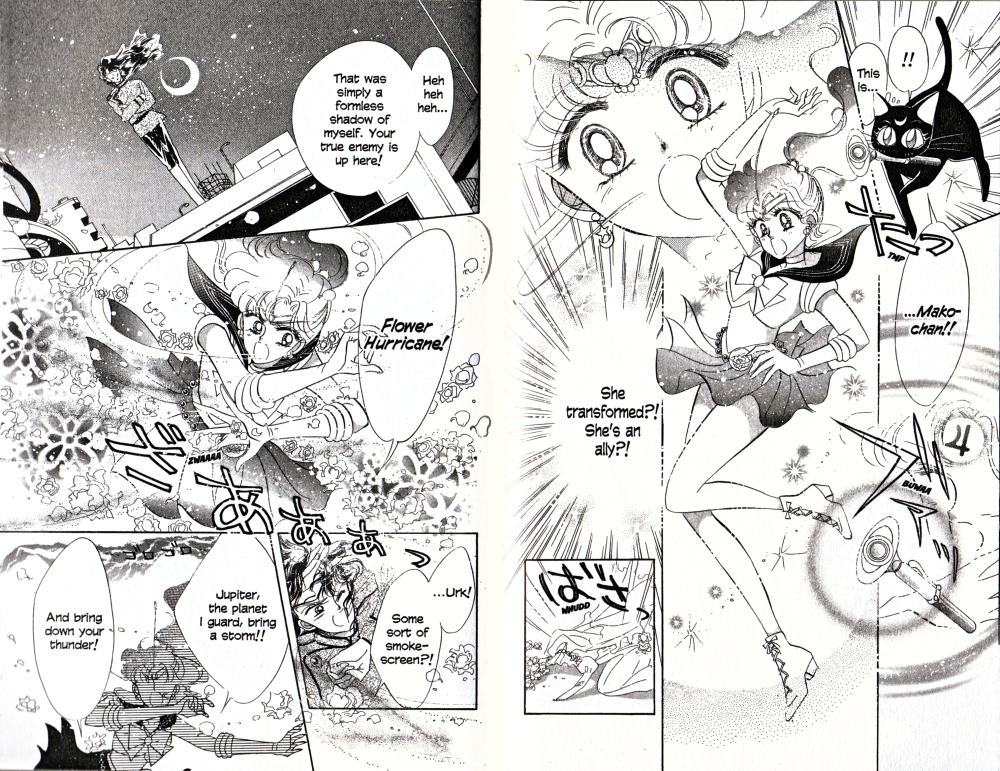
From the start, Usagi handles her duties differently than Minako. She’s more empathetic, but has a tendency to feel overwhelmed and require encouragement. (These are still, of course, early days.) She’s bolstered by her fellow guardians, however, and quickly accumulates three allies: the brilliant Ami Mizuno, guardian of water and wisdom (Sailor Mercury); classy and clairvoyant Rei Hino, guardian of fire and passion (Sailor Mars); and tomboyish yet girlish Makoto Kino, guardian of thunder and courage (Sailor Jupiter). Luna provides them all with information—I enjoy any scene that depicts the kitty in research mode—and handy gizmos that allow them to communicate and transform.

Together they face off against Queen Beryl and her Four Kings of Heaven, who are busily concocting schemes to collect energy to revive their “great ruler” while simultaneously searching for the “legendary silver crystal.” (We learn more about the enemies here than in Sailor V, incidentally, which makes them much more interesting. It’s still slightly disconcerting to see how quickly some of them are defeated, though, considering how long they stick around in the anime. Nephrite, for example, is vanquished after just one chapter!) The Guardians want to find the all-powerful crystal too, and are also searching for “the princess,” whom they are duty-bound to protect.

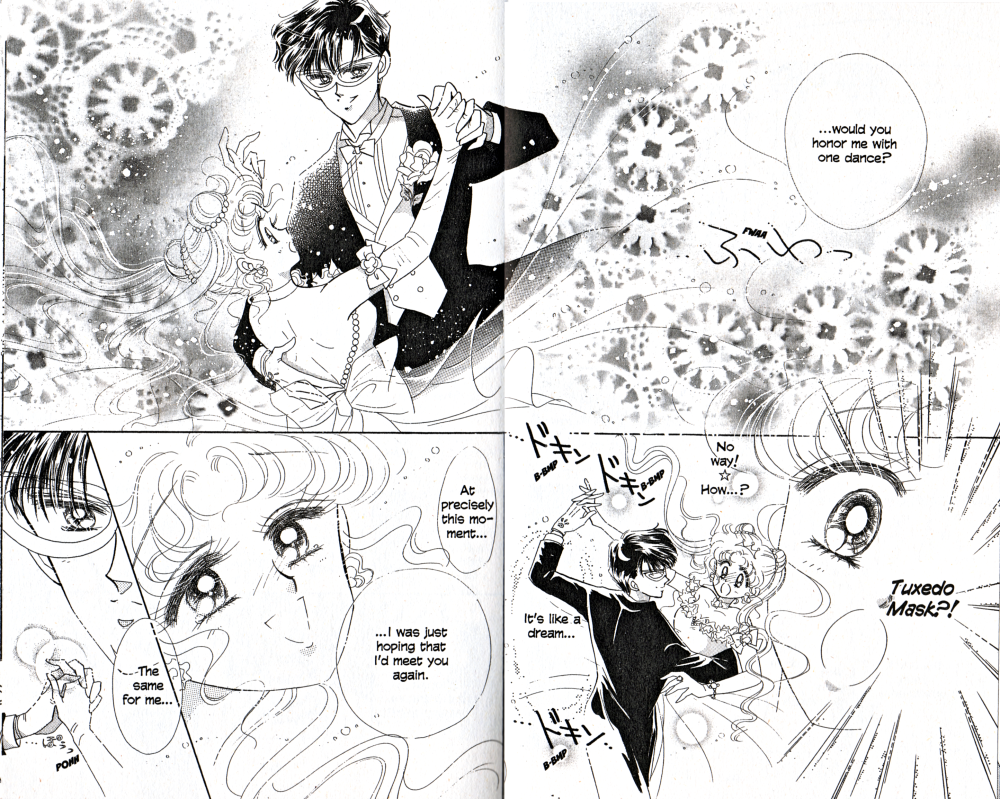
Also searching for the “legendary silver crystal” is a handsome fellow called Tuxedo Mask, two words that efficiently describe his costume. He has dreams wherein a faceless woman begs him to find the crystal, and so he tries to comply. Usually his efforts consist of lurking around when Sailor Moon is busy confronting the enemy, so as to be ready to bolster her confidence. Meanwhile, in his civilian guise of high school student Mamoru Chiba, he and Usagi keep running into each other and exchanging insults. I never much cared about their relationship in the anime, but it actually kind of works for me here. Maybe manga!Mamoru is appreciably more dreamy than his anime counterpart, because I can at least see why Usagi finds him so appealing. In this volume, there’s also some question as to whether he’s friend or foe, which gives Usagi something to worry about. (In general, while I don’t mind hyper Usagi, I like her much more when she’s being serious.)

I would probably still like Sailor Moon if it were merely the story of a band of cute girls in colorful outfits who defeat the enemy with various nifty/goofy attacks like “moon tiara boomerang” and “flower hurricane,” but its feminist message definitely elevates it in my esteem. While Usagi may be drawn to Mamoru and while Makoto may yet pine for the sempai who rejected her, these girls are fully cognizant that they’ve got a mission that’s more important than romance. Consider this exchange in which Makoto is explaining her reason for transferring schools:

Makoto: It seemed there was something far more important… even more important than falling in love… that was waiting for me here.

Rei: You’re right! We don’t have the luxury of the time it takes to cry over a man.

Though normal teens until just recently, these girls are quickly coming to grips with their destiny and the enormous importance of preventing the crystal from falling into the wrong hands. One gets the sense that this experience, though dangerous, is going to be critical in forming who they become as people, especially lazy Usagi, who is now thrust into a leadership role. And even though Mamoru does help her on occasion, it never comes off as condescending, but more like he’s reminding her of the strength that she already possesses. He, after all, has no powers of his own so it’s up to her to save the day.

Thank you, Kodansha Comics, for licensing this series and giving us a proper translation at last. I’m happy for myself and other existing fans, but I also can’t wait to see what Sailor Moon newbies make of the story.

Pretty Guardian Sailor Moon is published in English by Kodansha Comics. They’ve licensed the tenth anniversary edition, which condensed the eighteen-volume series into twelve volumes of the main narrative plus two volumes of short stories. It also has pretty new covers and some retouched art.

Review copy provided by the publisher.

Filed Under: REVIEWS Tagged With: Kodansha Comics, Naoko Takeuchi

Bookshelf Briefs pointer

September 13, 2011 by Sean Gaffney

For those who read my reviews by category (like me), I have reviews of Dengeki Daisy 6, Itazura Na Kiss 6 and Phoenix Wright: Ace Attorney 2 in this week’s Bookshelf Briefs.

Filed Under: REVIEWS

  • « Go to Previous Page
  • Page 1
  • Interim pages omitted …
  • Page 817
  • Page 818
  • Page 819
  • Page 820
  • Page 821
  • Interim pages omitted …
  • Page 1047
  • Go to Next Page »
 | Log in
Copyright © 2010 Manga Bookshelf | Powered by WordPress & the Genesis Framework