• Skip to primary navigation
  • Skip to main content
  • Skip to primary sidebar
  • Home
  • About Us
    • Privacy Policy
    • Comment Policy
    • Disclosures & Disclaimers
  • Resources
    • Links, Essays & Articles
    • Fandomology!
    • CLAMP Directory
    • BlogRoll
  • Features & Columns
    • 3 Things Thursday
    • Adventures in the Key of Shoujo
    • Bit & Blips (game reviews)
    • BL BOOKRACK
    • Bookshelf Briefs
    • Bringing the Drama
    • Comic Conversion
    • Fanservice Friday
    • Going Digital
    • It Came From the Sinosphere
    • License This!
    • Magazine no Mori
    • My Week in Manga
    • OFF THE SHELF
    • Not By Manga Alone
    • PICK OF THE WEEK
    • Subtitles & Sensibility
    • Weekly Shonen Jump Recaps
  • Manga Moveable Feast
    • MMF Full Archive
    • Yun Kouga
    • CLAMP
    • Shojo Beat
    • Osamu Tezuka
    • Sailor Moon
    • Fruits Basket
    • Takehiko Inoue
    • Wild Adapter
    • One Piece
    • After School Nightmare
    • Karakuri Odette
    • Paradise Kiss
    • The Color Trilogy
    • To Terra…
    • Sexy Voice & Robo
  • Browse by Author
    • Sean Gaffney
    • Anna Neatrour
    • Michelle Smith
    • Katherine Dacey
    • MJ
    • Brigid Alverson
    • Travis Anderson
    • Phillip Anthony
    • Derek Bown
    • Jaci Dahlvang
    • Angela Eastman
    • Erica Friedman
    • Sara K.
    • Megan Purdy
    • Emily Snodgrass
    • Nancy Thistlethwaite
    • Eva Volin
    • David Welsh
  • MB Blogs
    • A Case Suitable For Treatment
    • Experiments in Manga
    • MangaBlog
    • The Manga Critic
    • Manga Report
    • Soliloquy in Blue
    • Manga Curmudgeon (archive)

Manga Bookshelf

Discussion, Resources, Roundtables, & Reviews

Blog

Food and feasting

February 24, 2012 by Brigid Alverson

I’m heading out to New Jersey today for MangaNEXT—if you’re going to be there, be sure to say hi! In the meantime, check out my review of Viz manga on the Nook at MTV Geek. And I hope you saw my interview with Robert Newman of JManga right here at MangaBlog.

Jason Thompson writes about foodie manga, including Jiro Taniguchi’s Kodoku no Gourmet, Fumi Yoshinaga’s Not Love But Delicious Foods Make Me So Happy!, and the train station bento-box manga Ekiben Hitoritabi, in his latest House of 1000 Manga column at ANN.

The Tezuka-based Manga Moveable Feast continues with host Kate Dacey rounding up the Day Three and Day Four links, as well as a review of Tezuka’s Lost World, at The Manga Critic. MJ and Michelle Smith discuss Princess Knight in their latest Off the Shelf column at Manga Bookshelf.

Sean Gaffney takes a look at next week’s new manga releases.

Congratulations to Tony Yao on two years of blogging at Manga Therapy.

News from Japan: Details are emerging of the “darker” R.O.D. Rehabilitation, a R.O.D. side story that will start running in Shueisha’s Super Dash & Go! magazine this weekend. Manga Therapy features a manga that is hot in Japan right now, Crimsons, which is about… salmon.

Reviews: Omar reviews a handful of recent releases at About Heroes.

Ash Brown on The Art of Osamu Tezuka: The God of Manga (Experiments in Manga)
Lori Henderson on vols. 16 and 17 of Black Jack (Manga Village)
Connie on vol. 1 of Buddha (Slightly Biased Manga)
Connie on vol. 1 of Claymore (Slightly Biased Manga)
Connie on vol. 1 of Close the Last Door (Slightly Biased Manga)
Leroy Douresseaux on vol. 15 of La Corda D’Oro (The Comic Book Bin)
Connie on Faraway Places (Slightly Biased Manga)
Connie on vol. 1 of Gravitation (Slightly Biased Manga)
Connie on vol. 10 of Mars (Slightly Biased Manga)
David Gromer on vol. 1 of Ninja Girls (Graphic Novel Reporter)
Anna on vol. 1 of Princess Knight (Manga Report)
David Gromer on vol. 3 of Sailor Moon (Graphic Novel Reporter)
Connie on Stargazing Dog (Slightly Biased Manga)
Connie on vol. 6 of Tegami Bachi (Slightly Biased Manga)
Leroy Douresseaux on Uglies: Shay’s Story (I Reads You)

Filed Under: MANGABLOG

Off the Shelf: Princess Knight

February 23, 2012 by MJ and Michelle Smith 15 Comments

MICHELLE: As we occasionally do when the Manga Moveable Feast rolls around, MJand I have opted to dedicate this week’s Off the Shelf column to the topic at hand, which this month is the works of Osamu Tezuka. Specifically for our case, we’re going to be talking about Princess Knight, Tezuka’s shoujo manga about Sapphire, a princess who accidentally receives both a boy’s heart and a girl’s heart at the time of her birth, and who, when we pick up her story as an adolescent, has somewhat of an identity crisis while undergoing many wacky hardships/hijinks.

This is my first time reading the series. Whenever Ed Chavez from Vertical would solicit suggestions for Tezuka titles to license, I would always request Princess Knight. I wanted the series so much I even bought a few of the bilingual Kodansha editions. However, when I finally had both parts of the series in hand, I was content for a while to merely gaze upon them, content. And now that I have finally gotten around to reading it, I must say… I’m a little disappointed.

MJ: Well, as you may recall, I certainly had my issues with volume one, and these didn’t disappear when I read volume two. In some ways, I’d even say they became more pronounced. On the other hand, there were things I liked about it, so though I could characterize my experience as disappointing as well, I’m still glad I read it.

Should we get the least pleasant subjects out of the way straight off?

MICHELLE: Might as well. I guess my big problem with it is that it’s supposed to be so groundbreaking in terms of gender identities, but it actually does very little in this regard. When Sapphire has only a boy heart, she’s swaggering and brave. When she has only her girl heart, she’s weak and fragile. True, some of the growl-inducing comments do come from the villains or from those attempting to fool villains by approximating girlish behavior (“I suddenly want to take up cross-stitching and play the piano.”) but I do have to wonder how much of it Tezuka really believes, since he creates a swordswoman character, only to bedeck her armor with hearts and have her proudly admit that she’s entered a tournament to find a husband.

MJ: Yes, this was definitely the biggest hurdle for me as well. While I might have found it interesting to watch a character struggle with her gender identity in a society where clearly what you describe is set up as the standard for femininity vs. masculinity, that’s not really what Tezuka does here at all. Even when he has his chances to challenge these roles, he passes them up. For instance, the big female revolt that happens during the second volume seems to hinge mainly on the threat of the country’s men being left without anyone to clean their homes or look after their children. Even after it’s over, the only comment made by one of the defeated men is relief that his wife will come home and take care of the laundry that’s piled up.

I completely understand that both Tezuka and Princess Knight are a product of their time, but I’m genuinely confused as to why this seems to be held up as a great example of shoujo manga challenging gender roles.

MICHELLE: It seems very likely that Tezuka never intended it to be so, since so much of it takes a Loony Tunes approach to storytelling. Why, indeed, take a female revolt seriously? Instead, let’s play it for comedy by making the men out to be henpecked morons! That’s not to say there aren’t some darker aspects that I did like and wish could’ve been expounded upon. For example, while I don’t care about or believe in the “true love” that suddenly springs up between Sapphire and Prince Franz Charming, the characters set up as romantic rivals are actually interesting and meet tragic fates. It makes me wonder what kind of story Tezuka could’ve fashioned with Hecate and Captain Blood (aka Heinrich) as the leads!

MJ: Yes! Though I actually quite liked Sapphire, at least until she became completely consumed by her weirdly passive pursuit of Prince Franz, my favorite characters were Captain Blood and Hecate. I would have happily read entire books about them. I rather wished that Sapphire would ditch Franz and fall for Blood, but I suppose it was never meant to be.

MICHELLE: And, really, Hecate is probably the best example of a character who defies gender roles, since she’s perfectly happy defining herself for herself and has no wish to consume Sapphire’s girl heart (which her witch mother, Madame Hell, keeps trying to steal on her behalf) and take up some passive, “feminine” identity. She’s independent, level-headed, and one of the few truly good characters in the story. Plus, she can turn herself into a goat!

MJ: Speaking of all the heart-exchanging business, I’d say that probably the only time I actually appreciated it, was when Plastic ingests Sapphire’s boy’s heart, and suddenly becomes a decent man, instead of a selfish, sniveling boob.

MICHELLE: Oh yes, I quite agree! And he promptly begins championing women’s rights! This makes him the second character in the series (after Hecate) to go his own way and oppose the evil schemes of a parent. I wonder if this is Tezuka’s way of saying that the younger generation is going to get things right regarding equality whereas their parents are hopeless.

MJ: That may be a generous assumption, but I’ll give it to him if you will. You know, I think what’s most disappointing to me about Princess Knight is that I feel like I really could have liked it. Tezuka’s artwork is so much fun here, and so full of life. And I’m really fine with the “Looney Tunes approach,” as you so brilliantly put it. I think this manga could have been a lot of fun. But the gender issues are so profound, they kinda take over the whole thing for me.

MICHELLE: I’m not sure I could’ve liked it even without the gender issues giving me fits. The plotting is just so random sometimes. Early on, there’s a scene where Sapphire is letting herself be collected by Duke Duralumin’s men as a potential consort for his then-still-feeble-minded son, Plastic. And Franz rides in from, like, the next kingdom over to rescue her, and then rides back home again a few panels later. Or then there’s my favorite spot of wtf, the scene where Blood quickly escapes slavery by coercing a nearby beetle into chewing through some ropes. Everything’s so fast, furious, and madcap that poignant things aren’t given time to sink in.

MJ: Hee hee, yeah, it’s like that. Is it wrong that I find that fun? Or maybe I find it fun, because the poignant stuff doesn’t sit right. I can enjoy something that’s silly and madcap for that alone, and Princess Knight works better as that for me. Overall, I’d say I liked the silly, unbelievable parts the most. Also, I love every scene that Blood is in. Heh.

MICHELLE: It’s not wrong for anyone to like what they like! :) I’m just hard to please, comedy-wise, so many of the gags just left me blinking impassively at the page. I feel bad for being so down on Princess Knight, because now that it’s over I find myself growing fond of the idea of it again. And though it may not have lived up to its reputation for me, I nonetheless wonder if it wasn’t the origin of certain shoujo tropes, like, say, all of the guys instantly falling in love with the passive heroine, or the contingent of jealous fangirls.

MJ: As disappointed as I might have been with it, I really am grateful to have had the opportunity to read it. It may not be my favorite of Tezuka’s works (or really even close), but I’m quite enamored of his artwork, as always, and even now as I’m just flipping through, I’m struck by the beauty and flow of what’s on the page.

MICHELLE: Oh, I am definitely exceedingly grateful to the folks at Vertical for licensing the work and producing such a beautiful edition. I’m also pleased to note that I didn’t spot a single typo in their text, and found that the translation actually included some rather sophisticated words without any hint of awkwardness.

MJ: So thanks, Vertical, for giving us the chance to experience Princess Knight!

For more of this week’s MMF bounty, please visit the Osamu Tezuka MMF Archive, hosted by Kate Dacey at The Manga Critic!


More full-series discussions with MJ & Michelle:

Fullmetal Alchemist | Paradise Kiss | The “Color of…” Trilogy | One Thousand and One Nights| Please Save My Earth
Fruits Basket | Wild Adapter (with guest David Welsh)

Full-series multi-guest roundtables: Hikaru no Go | Banana Fish | Gerard & Jacques | Flower of Life

Filed Under: OFF THE SHELF Tagged With: Manga Moveable Feast, MMF, Osamu Tezuka, princess knight

Manga Artifacts: Osamu Tezuka’s Lost World

February 23, 2012 by Katherine Dacey

Reading Osamu Tezuka’s Lost World (1948) reminded me a formative graduate school experience. I was researching George Gershwin’s Porgy and Bess (1935), when I stumbled across a blistering review of a composition I’d never heard: Blue Monday (1922), a one-act “jazz opera” that Gershwin composed for Paul Whiteman’s Scandals of 1922. After attending its premiere, Charles Darnton, critic for the New York Tribune, pronounced the project a disaster, an ill-advised attempt to transplant the conventions of verismo opera to a Harlem setting. Blue Monday, he opined, was “the most dismal, stupid, and incredible blackface sketch that has probably ever been perpetrated. In it a dusky soprano finally killed her gambling man. She should have shot all her associates the moment they appeared and then turned the pistol on herself.” (Darnton, 11)

Ouch.

The review piqued my interest, however, prompting me to track down a recording of Blue Monday. Judged against Porgy and Bess, it was an inferior work; as Gershwin biographer Charles Schwartz observed, the music was several degrees removed from jazz and ragtime, drawing its cues from Alexander’s Ragtime Band and not The Maple Leaf Rag. (Schwartz, 61) The dramaturgy, too, was weak, conveying little of the Harlem setting. Yet in this early experiment, I could hear glimmerings of Gershwin’s mature style, a conscious effort to bring African-American music to the opera stage. And that excited me.

I had a similar reaction to Lost World, an early, problematic work in the Tezuka canon. First published in 1948, Lost World focuses on a scientific expedition to the fictional planet Mamango, a large, egg-shaped rock that, five million years earlier, had been a part of the Earth. When the scientists arrive on Mamango, they discover a Jurassic landscape carpeted in monstrous ferns, populated by hungry dinosaurs, and littered with powerful “energy stones.” The financial and scientific value of their discoveries, however, soon cause a deadly rift within the expedition party.

The execution of Lost World will come as a shock to readers familiar with Tezuka’s mature style. The profusion of subplots, minor characters, and doppelgangers makes the story hard to follow on a moment-to-moment basis; without frequent narrative interventions from the characters, large stretches of Lost World would be incomprehensible. More frustrating still is Tezuka’s over-reliance on dialogue to resolve plot points and reveal motive, even when that information is readily conveyed by the pictures. (“This is payback for you throwing me into the gorge! You get me?!” one character yells as he pummels the person who pushed him off a cliff in the previous scene.) The biggest disappointment, however, is the artwork; most of the panels consist of talking heads, with a handful of dramatic, but disjointed, action scenes interrupting the steady stream of chatter.

Writing about Lost World in the 1980s, Tezuka conceded Lost World‘s shortcomings, attributing them to his age (he was 20) and the circumstances of its publication. As he explained, the work originally ran in an Osaka newspaper, Kansai Yoron, where the target audience was young adults. The two-volume version published by Fuji Shobo, however, was aimed at the children’s market, necessitating substantial changes to the the script. What had been a romance in the original version, for example, was recast as a brother-sister relationship in the Fuji Shobo edition; anything more explicit would have been “absolutely taboo in children’s comics” of the period. (Tezuka, 248)

At the same time, Tezuka touted Lost World as an important milestone in his artistic development. “I thought that at the very least, there was no other comic book like mine, which was like a novel (albeit a very crude one), and had an unhappy ending,” Tezuka explained. (Tezuka 247) A careful inspection of Lost World supports Tezuka’s claim for its significance; whatever its shortcomings, many of the characters and themes of his mature works appear in embryonic form in Lost World.

On the most basic level, Tezuka employs several of his best-known “stars” in Lost World, arranging them in contrasting pairs. Acetylene Lamp, for example, plays an unscrupulous journalist who stows away aboard the expedition’s spaceship so that he can get an exclusive scoop on Mamango — and profit from the mysterious “energy stones” scattered across its surface. Another Tezuka favorite, Shunsaku Ban (a.k.a. Higeoyaji), plays yang to Lamp’s yin; as in many of his other incarnations, Ban is a middle-aged detective whose blustery demeanor camouflages his basic decency. Both characters are motivated by curiosity, but their curiosity compels them in opposite directions: Lamp towards profit, Ban towards truth.

From left to right: Acetylene Lamp, Shunsaku Ban/Hygeoyaji, Kenichi Shikishima

The story’s two scientists are likewise played by major “stars” from the Tezuka troupe. Kenichi Shikishima, hero of New Treasure Island, leads the Mamango expedition. Dr. Shikishima’s youthful spirit, resolve, and courage are contrasted with that of Dr. Butaru Makeru, a mustachioed villain whose cowardice and opportunism precipitate the disaster on Mamango. While Shikishima resolves to visit Mamango “for the sake of world science,” Makeru hints at his selfish motives for participating in the expedition: “If by some chance we meet with something unexpected on that planet, don’t blame me. Heh, heh, heh!” That contrast is also underscored by their terrestrial research as well: while Shikishima’s experiments are intended to help animals achieve human consciousness, Makeru’s experiments are designed for his own personal benefit, with little regard for their greater social or scientific good.

In later works, Tezuka was less schematic in his representations of good and evil, allowing characters to simultaneously embody both. Father Garai, anti-hero of MW, is a good example of this later tendency: Garai is a good man tormented by dark sexual desires, seeking grace even as he sins repeatedly. Black Jack is another, a character whose misanthropy and greed are counterbalanced by a strong reverence for life. As Helen McCarthy observes in The Art of Osamu Tezuka: God of Manga, Black Jack is “sometimes a gentle and compassionate savior, sometimes a cold and unforgiving avenger,” two opposite yet equally human responses to “the inevitability of death.” (McCarthy, 199)

Ayame

Mimio

Lost World also introduces a recurring character type found throughout Tezuka’s work: the artificial life-form. Early in the story, Tezuka introduces us to Mimio, a talking rabbit, and Ayame, a “veggie girl.” Both are the result of scientific experiments: Dr. Shikishima surgically enhanced Mimio’s brain to grant him human intelligence, while Dr. Butamo cultivated Ayame in a laboratory. (Note that Shikishima’s motives seem benevolent; he wants to help animals achieve equal status with humans, whereas Butamo is more interested in making a wife for himself.)

Mimio and Ayame’s quest for humanity is rather baldly presented. In an early chapter, for example, Mimio visits Shikishima’s lab, where a new group of surgically enhanced animals are learning how to think and act like humans. Though the animals’ struggles with language and manners are played for laughs — “Boy, all humans sure do look alike!” exclaims a dog — there’s a definite sense that these creatures’ own desires are being subordinated to Shikishima’s grander mission of animal-human detente. “You’re very being is unique,” one of Shikishima’s colleagues tells his subjects. “Therefore, you should help humans and be a guide to other animals in perpetuum.”

Unlike Mimio, Ayame looks human, even though she is composed entirely of plant material — and that makes her situation more precarious than the rabbit’s. On the one hand, Dr. Butamo wants her to become his wife, threatening to kill her if she refuses to honor his marriage proposal. On the other, some of the characters view Ayame as nothing more than a walking, talking cabbage — and thus a potential food source when the crew’s rations run out. Ayame remains committed to exploring her humanity nonetheless; late in the manga, she and Shikishima have this pointed exchange:

Shikishima: Miss Ayame, surely, you must be surprised to be having so many adventures.You see? The world of humans is full of adventure and wonder!

Ayame: I feel as if I finally understand what things bring the most pleasure and happiness to the hearts of humans!

Shikishima: Well, then, when you return to the laboratory, you should have Mr. Butamo teach you even more, shouldn’t you?

In Mimio and Ayame, it’s not hard to see the inspiration for later characters such as Dororo‘s Hyakkimaru and Black Jack‘s Pinoko, both of whom struggle to reconcile the circumstances of their “birth” with their desire to be fully human.

Perhaps the most striking thing about Lost World is the final act, in which an accident permanently strands Ayame and Shikishima on Mamango. In Tezuka’s original version, Ayame and Shikishima embrace their fate as lovers, but in the Fuji Shobo edition, Tezuka portrayed them as brother and sister. Nonetheless, Tezuka left the final words of the original intact, speculating that in five million years, “when Mamango once again approaches the Earth,” mankind might find a new race of “plant animal people” descended from Ayame and Shikishima.

Similar Adam-and-Eve motifs recur throughout Tezuka’s oeuvre, finding a more sexual and spiritual expression in such mature works as Apollo’s Song and Phoenix: Nostalgia. Nostalgia is a particularly odd and fascinating variation on the theme, as the Adam figure dies early in the story, leaving his pregnant wife alone on a remote space colony. His wife then mates with her own offspring who, in turn, mate with an extraterrestrial life form whose DNA proves essential to rescuing humanity from the brink of extinction. In short, Nostalgia — like Lost World — dares to a imagine a new future for mankind in which other forms of life — terrestrial and extraterrestrial — play an important role in our evolution.

Whether these observations will make Lost World more palatable to a casual reader is debatable; I fully admit that I struggled through its 246 pages, backtracking frequently in a futile effort to understand what was happening. But if you approach Lost World in the same spirit I approached Gershwin’s Blue Monday — as a window into a major artist’s early development — you may find, as I did, a work of astonishing vibrancy, contradiction, and interest.

Works Cited
“Bet Lost on First Opera.” New York Times. 21 July 1935: II1. Print.
Darnton, Charles. “George White’s Scandals’ Lively and Gorgeous.” New York World 29 Aug. 1922: 11. Print.
McCarthy, Helen, and Osamu Tezuka. The Art of Osamu Tezuka: God of Manga. New York: Abrams ComicArts, 2009. Print.
Schwartz, Charles. Gershwin: His Life and Music. New York: The Bobbs-Merrill Company, Inc., 1973. Print.
Tezuka, Osamu, and Kumar Sivasubramanian. Lost World. Milwaukee, OR: Dark Horse, 2003. Print.

Filed Under: Manga, Manga Critic, REVIEWS Tagged With: Lostworld, Osamu Tezuka

Osamu Tezuka’s Lost World

February 23, 2012 by Katherine Dacey 6 Comments

Reading Osamu Tezuka’s Lost World (1948) reminded me a formative graduate school experience. I was researching George Gershwin’s Porgy and Bess (1935), when I stumbled across a blistering review of a composition I’d never heard: Blue Monday (1922), a one-act “jazz opera” that Gershwin composed for Paul Whiteman’s Scandals of 1922. After attending its premiere, Charles Darnton, critic for the New York Tribune, pronounced the project a disaster, an ill-advised attempt to transplant the conventions of verismo opera to a Harlem setting. Blue Monday, he opined, was “the most dismal, stupid, and incredible blackface sketch that has probably ever been perpetrated. In it a dusky soprano finally killed her gambling man. She should have shot all her associates the moment they appeared and then turned the pistol on herself.” (Darnton, 11)

Ouch.

The review piqued my interest, however, prompting me to track down a recording of Blue Monday. Judged against Porgy and Bess, it was an inferior work; as Gershwin biographer Charles Schwartz observed, the music was several degrees removed from jazz and ragtime, drawing its cues from Alexander’s Ragtime Band and not The Maple Leaf Rag. (Schwartz, 61) The dramaturgy, too, was weak, conveying little of the Harlem setting. Yet in this early experiment, I could hear glimmerings of Gershwin’s mature style, a conscious effort to bring African-American music to the opera stage. And that excited me.

I had a similar reaction to Lost World, an early, problematic work in the Tezuka canon. First published in 1948, Lost World focuses on a scientific expedition to the fictional planet Mamango, a large, egg-shaped rock that, five million years earlier, had been a part of the Earth. When the scientists arrive on Mamango, they discover a Jurassic landscape carpeted in monstrous ferns, populated by hungry dinosaurs, and littered with powerful “energy stones.” The financial and scientific value of their discoveries, however, soon cause a deadly rift within the expedition party.

The execution of Lost World will come as a shock to readers familiar with Tezuka’s mature style. The profusion of subplots, minor characters, and doppelgangers makes the story hard to follow on a moment-to-moment basis; without frequent narrative interventions from the characters, large stretches of Lost World would be incomprehensible. More frustrating still is Tezuka’s over-reliance on dialogue to resolve plot points and reveal motive, even when that information is readily conveyed by the pictures. (“This is payback for you throwing me into the gorge! You get me?!” one character yells as he pummels the person who pushed him off a cliff in the previous scene.) The biggest disappointment, however, is the artwork; most of the panels consist of talking heads, with a handful of dramatic, but disjointed, action scenes interrupting the steady stream of chatter.

Writing about Lost World in the 1980s, Tezuka conceded Lost World‘s shortcomings, attributing them to his age (he was 20) and the circumstances of its publication. As he explained, the work originally ran in an Osaka newspaper, Kansai Yoron, where the target audience was young adults. The two-volume version published by Fuji Shobo, however, was aimed at the children’s market, necessitating substantial changes to the the script. What had been a romance in the original version, for example, was recast as a brother-sister relationship in the Fuji Shobo edition; anything more explicit would have been “absolutely taboo in children’s comics” of the period. (Tezuka, 248)

At the same time, Tezuka touted Lost World as an important milestone in his artistic development. “I thought that at the very least, there was no other comic book like mine, which was like a novel (albeit a very crude one), and had an unhappy ending,” Tezuka explained. (Tezuka 247) A careful inspection of Lost World supports Tezuka’s claim for its significance; whatever its shortcomings, many of the characters and themes of his mature works appear in embryonic form in Lost World.

On the most basic level, Tezuka employs several of his best-known “stars” in Lost World, arranging them in contrasting pairs. Acetylene Lamp, for example, plays an unscrupulous journalist who stows away aboard the expedition’s spaceship so that he can get an exclusive scoop on Mamango — and profit from the mysterious “energy stones” scattered across its surface. Another Tezuka favorite, Shunsaku Ban (a.k.a. Higeoyaji), plays yang to Lamp’s yin; as in many of his other incarnations, Ban is a middle-aged detective whose blustery demeanor camouflages his basic decency. Both characters are motivated by curiosity, but their curiosity compels them in opposite directions: Lamp towards profit, Ban towards truth.

From left to right: Acetylene Lamp, Shunsaku Ban/Hygeoyaji, Kenichi Shikishima

The story’s two scientists are likewise played by major “stars” from the Tezuka troupe. Kenichi Shikishima, hero of New Treasure Island, leads the Mamango expedition. Dr. Shikishima’s youthful spirit, resolve, and courage are contrasted with that of Dr. Butaru Makeru, a mustachioed villain whose cowardice and opportunism precipitate the disaster on Mamango. While Shikishima resolves to visit Mamango “for the sake of world science,” Makeru hints at his selfish motives for participating in the expedition: “If by some chance we meet with something unexpected on that planet, don’t blame me. Heh, heh, heh!” That contrast is also underscored by their terrestrial research as well: while Shikishima’s experiments are intended to help animals achieve human consciousness, Makeru’s experiments are designed for his own personal benefit, with little regard for their greater social or scientific good.

In later works, Tezuka was less schematic in his representations of good and evil, allowing characters to simultaneously embody both. Father Garai, anti-hero of MW, is a good example of this later tendency: Garai is a good man tormented by dark sexual desires, seeking grace even as he sins repeatedly. Black Jack is another, a character whose misanthropy and greed are counterbalanced by a strong reverence for life. As Helen McCarthy observes in The Art of Osamu Tezuka: God of Manga, Black Jack is “sometimes a gentle and compassionate savior, sometimes a cold and unforgiving avenger,” two opposite yet equally human responses to “the inevitability of death.” (McCarthy, 199)

Ayame

Mimio

Lost World also introduces a recurring character type found throughout Tezuka’s work: the artificial life-form. Early in the story, Tezuka introduces us to Mimio, a talking rabbit, and Ayame, a “veggie girl.” Both are the result of scientific experiments: Dr. Shikishima surgically enhanced Mimio’s brain to grant him human intelligence, while Dr. Butamo cultivated Ayame in a laboratory. (Note that Shikishima’s motives seem benevolent; he wants to help animals achieve equal status with humans, whereas Butamo is more interested in making a wife for himself.)

Mimio and Ayame’s quest for humanity is rather baldly presented. In an early chapter, for example, Mimio visits Shikishima’s lab, where a new group of surgically enhanced animals are learning how to think and act like humans. Though the animals’ struggles with language and manners are played for laughs — “Boy, all humans sure do look alike!” exclaims a dog — there’s a definite sense that these creatures’ own desires are being subordinated to Shikishima’s grander mission of animal-human detente. “You’re very being is unique,” one of Shikishima’s colleagues tells his subjects. “Therefore, you should help humans and be a guide to other animals in perpetuum.”

Unlike Mimio, Ayame looks human, even though she is composed entirely of plant material — and that makes her situation more precarious than the rabbit’s. On the one hand, Dr. Butamo wants her to become his wife, threatening to kill her if she refuses to honor his marriage proposal. On the other, some of the characters view Ayame as nothing more than a walking, talking cabbage — and thus a potential food source when the crew’s rations run out. Ayame remains committed to exploring her humanity nonetheless; late in the manga, she and Shikishima have this pointed exchange:

Shikishima: Miss Ayame, surely, you must be surprised to be having so many adventures.You see? The world of humans is full of adventure and wonder!

Ayame: I feel as if I finally understand what things bring the most pleasure and happiness to the hearts of humans!

Shikishima: Well, then, when you return to the laboratory, you should have Mr. Butamo teach you even more, shouldn’t you?

In Mimio and Ayame, it’s not hard to see the inspiration for later characters such as Dororo‘s Hyakkimaru and Black Jack‘s Pinoko, both of whom struggle to reconcile the circumstances of their “birth” with their desire to be fully human.

Perhaps the most striking thing about Lost World is the final act, in which an accident permanently strands Ayame and Shikishima on Mamango. In Tezuka’s original version, Ayame and Shikishima embrace their fate as lovers, but in the Fuji Shobo edition, Tezuka portrayed them as brother and sister. Nonetheless, Tezuka left the final words of the original intact, speculating that in five million years, “when Mamango once again approaches the Earth,” mankind might find a new race of “plant animal people” descended from Ayame and Shikishima.

Similar Adam-and-Eve motifs recur throughout Tezuka’s oeuvre, finding a more sexual and spiritual expression in such mature works as Apollo’s Song and Phoenix: Nostalgia. Nostalgia is a particularly odd and fascinating variation on the theme, as the Adam figure dies early in the story, leaving his pregnant wife alone on a remote space colony. His wife then mates with her own offspring who, in turn, mate with an extraterrestrial life form whose DNA proves essential to rescuing humanity from the brink of extinction. In short, Nostalgia — like Lost World — dares to a imagine a new future for mankind in which other forms of life — terrestrial and extraterrestrial — play an important role in our evolution.

Whether these observations will make Lost World more palatable to a casual reader is debatable; I fully admit that I struggled through its 246 pages, backtracking frequently in a futile effort to understand what was happening. But if you approach Lost World in the same spirit I approached Gershwin’s Blue Monday — as a window into a major artist’s early development — you may find, as I did, a work of astonishing vibrancy, contradiction, and interest.

Works Cited
“Bet Lost on First Opera.” New York Times. 21 July 1935: II1. Print.
Darnton, Charles. “George White’s Scandals’ Lively and Gorgeous.” New York World 29 Aug. 1922: 11. Print.
McCarthy, Helen, and Osamu Tezuka. The Art of Osamu Tezuka: God of Manga. New York: Abrams ComicArts, 2009. Print.
Schwartz, Charles. Gershwin: His Life and Music. New York: The Bobbs-Merrill Company, Inc., 1973. Print.
Tezuka, Osamu, and Kumar Sivasubramanian. Lost World. Milwaukee, OR: Dark Horse, 2003. Print.

Filed Under: Manga Critic Tagged With: Lostworld, Osamu Tezuka

Special Edition: Interview with JManga’s Robert Newman

February 23, 2012 by Brigid Alverson

The digital manga portal JManga got off to a slow start, but it has gained traction among manga fans for a number of reasons: Cool, quirky manga, reasonable prices (once the site owners abandoned the original price of $8.99 per volume), and good communication with fans.

We can thank Robert Newman for the latter; from the very beginning, he was out there as the public face of JManga, listening and responding to every review and snarky Tweet–and getting results, such as the price drop. As we mentioned the other day, Newman has been lobbying the 39 Japanese publishers involved in JManga for something else that a lot of people want: Global reach. Currently, JManga is available only to U.S. and Canadian readers, but the demand is worldwide, and Newman has been asking readers to respond to JManga’s Twitter and “Like” their Facebook post on opening the manga portal up to the rest of the world.

I asked Newman if he could talk a little bit about the inner workings of JManga and why they can’t just pull a switch and open it up to the world. As long as I had him, I asked some general questions as well.

Brigid: First of all, what makes you think it would benefit JManga to go global? What sort of demand have you seen from your side?

Robert: We would like to think of JManga going global as being more of a benefit to manga fans than to us as a company. We have received countless comments from manga fans worldwide who have come with high hopes to JManga.com only to be shut out by our sky blue geo-filter screen. Another major merit to manga readers worldwide is that JManga provides a legal and safe alternative to reading manga online that benefits readers, manga artists, and publishers.

Brigid: Why are the publishers reluctant to do it? Is there a general consensus or do opinions differ?

Robert: The main reason is that each publisher has their own policy regarding international development and each publisher’s licensing situation differs. So we have had to develop a system with each policy and licensing situation in mind.

Brigid: Would you consider offering the manga in languages other than English?

Robert: Our system is built to handle multiple languages. We hope to add languages following demand.

Brigid: Are there complications with taking different currencies?

Robert: This is something we gave had to consider carefully. If we can go global, we will start off as a service made for America and Canada, but that can be accessed worldwide. In short a kind if extension of our current service.

Brigid: What are the most popular manga on the site?

Robert: Though we have had a very good reception accross the board, the more niche titles, yuri and foodie titles for example, have been especially well received.

Brigid: Are you noticing any interesting patterns, such as people reading in the evening, geographic distribution, etc.?

Robert: Initially I had expected to see peak views clustered in the evening to night times, but what we have actually found is that readers are enjoying JManga pretty much all day long, from the early morning to the late night!

Another interesting point that we have found is that female readers generally spend more on manga than male readers. This is the same as readers in Japan.

Brigid: How do you see the site evolving over the next year or so?

Robert: Our main goal for the next year is to adapt and enhance our site to the needs of users worldwide and to release as much content as possible.

Filed Under: FEATURES, MANGABLOG

Manga Bookshelf looks to the screen

February 23, 2012 by MJ 2 Comments

You may have noticed that we’re branching out here at Manga Bookshelf, including new columns about East Asian television dramas and (as of yesterday) film!

First, a belated introduction to Bringing the Drama, a new, ongoing roundtable featuring bloggers Anna Neatrour and Emily Snodgrass, super-librarian/writer Eva Volin, and manga editor Nancy Thistlethwaite. They started off strong last week, with a discussion of Korean drama You’re Beautiful (one of my personal faves). Though I expect Korean drama will dominate the roundtable overall, discussion is open to Japanese and Taiwanese dramas legally available in English as well. They’ve already got their next topic lined up, and I can’t wait to see what they have to say!

And yesterday evening saw the debut of our new East Asian film column, Subtitles & Sensibility from my favorite film blogger, Jaci Dahlvang. When I asked Jaci if she’d be interested in writing for Manga Bookshelf, I did not believe she’d actually say “yes,” and I’m so thrilled to be able to introduce her to all of you. Her first column, Three with Ken’ichi Matsuyama should please film buffs and manga fans alike. Jaci blogs regularly at My Sock Are On Fire, and she can be found on Twitter as letterboxed.

Please take a moment to check out our new columns, and join me in welcoming all these brilliant ladies to the Manga Bookshelf family!

Filed Under: UNSHELVED Tagged With: announcements

Subtitles & Sensibility: Three with Ken’ichi Matsuyama

February 22, 2012 by Jaci Dahlvang 4 Comments

Last spring at the Seattle International Film Festival, I discovered Ken’ichi Matsuyama through a sold-out screening of Norwegian Wood. The film came back to Seattle this winter, so I took the opportunity to see it again and then decided to check out a few other Matsuyama films.

An adaptation of the popular Haruki Murakami novel, Norwegian Wood is an overwhelmingly sad picture which played better the second time through.

The film centers on Toru (Matsuyama), a university student who is torn between the tragedy of his past and the possibilities for his future. The past is represented by Naoko, the longtime girlfriend of his best friend Kizuki. After his inexplicable suicide, Naoko and Toru try to process the devastation together. For Naoko, it is impossible to deal with, and as she sinks into depression she threatens to pull Toru down with her.

However, at university Toru meets Midori (the utterly charming Kiko Mizuhara), who gives him the opportunity to choose life.

The first time around I found the film very heavy, unsurprisingly! It is more emotionally intense than the novel, partially because the film is more present, whereas the novel was reflective. The novel left space for humor, like expanding the character of Toru’s roommate Storm Trooper, and it took us out of the potentially-claustrophobic triangle of Toru, Naoko, and Midori by allowing more space for characters like Naoko’s eventual roommate Reiko to develop.

However, I am nothing if not understanding of the limits of adaptation. Tonal departures or character embellishments which work in a novel can easily feel out of place in a film.

More importantly, Norwegian Wood is a gorgeous piece of cinema. I was better able appreciate the unique textures, both visual and aural, when I saw it the second time. Overall the film is very lush, and it was easy for me to get lost in the visuals of everything from the gorgeous landscapes of the countryside to the patterning of fabric, and the excellent sound design between the university and the woods. Toru is swept through the film on waves—waves of sorrow, waves of protesters, and waves of wind through the long grasses on his long walks with Naoko—and I was willing to be swept along with him.

::

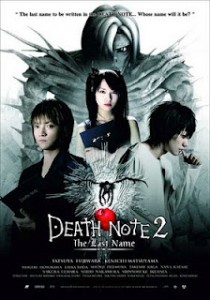
I followed it up with another, rather different adaptation. Death Note, based on the manga of the same name, is the story of Light, a college student with dubious ethics who discovers a notebook. It’s the death note of the title, and it is quite a find. If you write someone’s name in it, they die.

Of course, it isn’t quite that simple. We quickly learn the many rules of the death note, and to the credit of the plot, the rules appear perfectly timed to answer audience questions.

Light (Tatsuya Fujiwara, devilishly creepy) uses the notebook to become a sort of Dexter Morgan from afar, causing the deaths of people who he thinks truly deserve it. However, he quickly begins using it in his own self-interest, killing the innocent, and manipulating the rules to manipulate people. Having not read the manga yet, I don’t know if Light is so unapologetically unpleasant in that as well. I hope so! I like the idea of a main character that the audience is so quickly turns against.

Light is accompanied in his adventures by a Shinigami named Ryuk, a sort of death god who owned the notebook before, dropped it in hopes someone interesting would pick it up, and now is just curious what shenanigans Light might get up to. Ryuk is essentially the world’s worst imaginary friend. The character, delivered via cartoonish CGI, resembles nothing so much a death metal version of the Joker, if the Joker was addicted to apples.

Ken’ichi Matsuyama, offscreen for over half of the film, plays the mysterious L, a reclusive genius detective. He’s an almost-otherworldly character, pale and compact, locked away in a hotel room and outsmarting criminals from afar. He steals the movie with his physicality alone, nearly unrecognizable between this and his role as Toru. Shoulders hunched, he hides behind eye makeup & shaggy hair, living off of sweets.

Both L and Light are childlike, existing very little in the real world and instead hiding away in their respective rooms, playing out a high-stakes game of strategy virtually. With all of the screens (television news, security footage, and the like) it’s almost a video game with real-world consequences.

Speaking of consequences, ladies do not fare well in Death Note despite my early hopes, particularly for Naomi Misora, a stellar FBI agent. One is introduced solely as a set-up for the second film, and others exist to be manipulated by Light via the notebook.

The whole structure of Death Note is frustrating because Light has absolute power with the book. He kills from afar, and after the deaths have been played out we take no pleasure in learning how the manipulations work. We’re seeing the strings of a show we didn’t enjoy the first time around, and as the film progresses and the deaths become more elaborate, I started to despair that anything will stop Light.

Thanks to the cliffhanger ending, I’m going to have to check out the second film to see if it ever happens. I’ll be sure to report back.

::

In contrast, Gantz was also a film based on a manga series and split into two parts, but the first film worked as a complete story on its own. Though clearly there are many unanswered questions regarding the mechanics of the plot and the fate of secondary characters, Kurono undergoes a satisfying character arc. There’s an emotional conclusion if not a technical one.

Gantz is strange, the sort of picture that would play really well with a midnight, cult-film crowd. It opens with the accidental death of two high school students, Kurono (Kazunari Ninomiya) and Kato (Matsuyama). Rather than moving on to any traditional afterlife, they find themselves in an unfurnished apartment along with a few other people and a large black sphere.

The sphere has brought them here to participate in a life-or-death game, fighting against aliens who have been living on Earth. There are some rules to the game, though it seems fewer rules than were involved in Death Note.

Gantz features nice effects, great character design on the aliens, and very stylish cinematography by Taro Kawazu.

The film definitely raised a lot of questions. Are they really dead? Are they in limbo? How are they able to return to their old lives after missions? I have a lot of questions, so I’ll definitely be checking out the second film here as well!


Review copies of Death Note and Gantz provided by New People Entertainment.

Filed Under: Subtitles & Sensibility Tagged With: death note, gantz, norwegian wood

Manga the Week of 2/29

February 22, 2012 by Sean Gaffney

It’s a 5th week that’s really a 4th week, so there’s actually quite a lot of manga shipping.

Dark Horse has a very busy week compared to their usual (their usual being no manga at all lately). A new volume of Gantz, which is at 21 volumes yet still providing the violence and latex outfits everyone wants. Speaking of what everyone wants, Volume 1 of Gate 7, much like its predecessor Kobato, featured CLAMP trying a bit too hard to be CLAMP. I’m hoping Volume 2 goes a little lighter on their standard tropes and heavier on plot and characterization.

I wish I didn’t have to give it the cover spotlight, but it’s the final volume, and it used to be awesome, so here it is. Del Rey’s last manga series ends with the publication of Vol. 19 of xxxHOLIC. The early volumes of this series were possibly the best thing CLAMP has ever done not named Card Captor Sakura. This last one… is out this week. :)

A trio of new manga from DMP. After much delay, we get the 7th volume of Itazura na Kiss. Featuring everyone’s least favorite hero. Let’s hope he gets a sweet moment or two this time around. There’s also Vol. 3 of the awesomely named Bad Teacher’s Equation, and the more sedately named Border. Both by the same author. I wonder if she did them at the same time?

Midtown comics lists Vol. 4 of cyberpunk series Mardock Scramble as coming in next week. My shop says it is also getting the 13th volume of Sayonara, Zetsubou-sensei, which will answer the all-important question, “Can a translator last longer than 4 volumes on this series without burning out and leaving?”

Vertical has Volume 11 of its brand new series, GTO The Early Years. Yes, both those things are correct. Vol. 1-10 were released by Tokyopop, and Vertical is picking up where they left off. Known in Japan as Shonan Jun’ai Gumi, this series lasted even longer than GTO, and is how the world first got to know Onizuka. This volume should contain Vol. 21-22 of the original. Ed says if sales are good, they may go back to put 1-10 back in print. Get it! Onizuka rules!

Lastly, Midtown lags a week behind everyone else, as most of Diamond’s shops got Vol. 5 of Tenjo Tenge this week. It has kicking! And boobies! It is hard to imagine a more appropriate manga for 13 year old boys. Who, of course, should not be reading it. At least not in North America. M for Mature, folks.

So what appeals to you this week?

Filed Under: FEATURES

Tell JManga: It’s time to go global!

February 22, 2012 by Brigid Alverson

First, an important public service announcement: Do you think that the JManga digital manga site should be available to the entire world, not just the U.S. and Canada? Then let them know, via Twitter or by “liking” their globalization post on Facebook, because this is apparently being debated right now in the JManga Secret Headquarters, and your opinion could make a difference.

Here’s my look at this week’s new manga releases at MTV Geek.

It’s a good time to be a yaoi fan, as the new releases, digital and print, just keep on coming. Animate USA announced several new titles, including Kou Yoneda’s one-shot Kanjou Spectrum, and Viz’s brand-new imprint SuBLime Manga announced two more, Youka Nitta’s Kiss Ariki and Hinako Takanaga’s Awkward Silence. Digital Manga announced more new titles, both print and digital, via Twitter.

If that’s not your cup of tea, head over to JManga, which announced five new digital releases this week (including the foodie manga Kodoku no Gourmet) and will have ten more for us next week.

The Manga Moveable Feast continues its focus on Osamu Tezuka this week, and Kate Dacey rounds up all the Day Two commentary at The Manga Critic.

News from Japan: Hikaru Nakamura, who is back from maternity leave, will resume work on Saint Young Men in issue 56 of Morning 2, which is out next month.

Reviews

Carlo Santos on vol. 9 of Bakuman (ANN)
Sean T. Collins on Onward Towards Our Noble Deaths (Attentiondeficitdisorderly)
Erica Friedman on vol. 2 of Princess Knight (Okazu)
Anna on vol. 6 of The Story of Saiunkoku (Manga Report)
Sean Gaffney on vol. 8 of Toriko (A Case Suitable for Treatment)
Joy Kim on Twin Spica (Joy Kim)

Filed Under: MANGABLOG

Toriko, Vol. 8

February 22, 2012 by Sean Gaffney

By Mitsutoshi Shimabukuro. Released in Japan by Shueisha, serialization ongoing in the magazine Weekly Shonen Jump. Released in North America by Viz.

It’s been a while since I did a full review of Toriko, but this is a good volume to talk about, as it’s less fight and more food oriented. After finishing off the cliffhanger from last volume (and getting to meet several of the side-villains face to face), Toriko reunites with Komatsu and goes to Gourmet Town, the #1 town to get fantastic food. While there they meet up with a legendary chef, the elderly but insanely strong and intelligent (as with most elderly manga women) Setsuno, who gives the two of them a taste of a legendary soup. A soup that is still incomplete, and needs one more ingredient. This leads to the cliffhanger of this volume, as both Toriko and Komatsu must journey to “Ice Hell” to find said ingredient…

In general, successful Jump series seem to fall into a pattern of “fighting + friendship + X”, where X is a variable. Plus ninjas, plus pirates, plus mangaka, plus Nisioisin… that type of thing. Here it’s food, and while much of Toriko is sitting back and watching insanely strong men battle each other, the food is not just an added extra to make the story palatable. First of all, even with the occasional ‘reader suggestion’ thrown in, the different types and varieties of food show off the author’s prodigious imagination. But food also controls the plot and the main characters. They live for it. A lot of the scenes in this volume will be familiar to fans of Oishinbo or similar titles – the initial reaction of happiness, followed by a description of what they just ate, possibly delineating the ingredients used. This is Jump foodie manga.

This volume also has several strong scenes between Toriko and Komatsu, including Setsuna, reminiscing on her own partnership with Jiro (who she was also romantically involved with), noting what good partners Toriko and Komatsu make. Now, I don’t think that any Jump title currently running is written primarily for the magazine’s growing BL audience. No, not even Reborn. But certainly a lot of what attracted the BL fandom in the first place is here – men in close friendships, with lots of bonding and fights and befriending former enemies. Komatsu is in many ways the perfect uke, and he’s surrounded by strong partners – not just Toriko, but also Coco and Sunny from previous volumes – all of whom initially see him as rather pathetic but then grow to treasure him as Komatsu’s true talents in food preparation are revealed. There’s also a dearth of women in this story – Rin has been around, and she has a crush on Toriko, but he completely ignores it. So while this isn’t a BL story, it does have everything that drew BL fans to Jump in the first place, and does not go out of its way to disappoint them.

I’m impressed by the world building going on here. A lot of titles like this give off a feeling that the author is making stuff up from week to week, but several of the plot points here seem to be well planned. Komatsu’s naivete is useful in this regard, as Toriko can explain various things to him, but there’s a casualness to it that doesn’t make it seem like exposition. I particularly liked the references to the Colonel sending a duplicate to Ice Hell rather than himself – it’s made mysterious while also being obvious for the reader.

Toriko is great fun, and looks to be starting another big arc. Hopefully it will continue to balance its big fights and male bonding with more delicious food. Recommended for Jump fans.

Filed Under: REVIEWS

  • « Go to Previous Page
  • Page 1
  • Interim pages omitted …
  • Page 781
  • Page 782
  • Page 783
  • Page 784
  • Page 785
  • Interim pages omitted …
  • Page 1055
  • Go to Next Page »
 | Log in
Copyright © 2010 Manga Bookshelf | Powered by WordPress & the Genesis Framework