• Skip to primary navigation
  • Skip to main content
  • Skip to primary sidebar
  • Home
  • About Us
    • Privacy Policy
    • Comment Policy
    • Disclosures & Disclaimers
  • Resources
    • Links, Essays & Articles
    • Fandomology!
    • CLAMP Directory
    • BlogRoll
  • Features & Columns
    • 3 Things Thursday
    • Adventures in the Key of Shoujo
    • Bit & Blips (game reviews)
    • BL BOOKRACK
    • Bookshelf Briefs
    • Bringing the Drama
    • Comic Conversion
    • Fanservice Friday
    • Going Digital
    • It Came From the Sinosphere
    • License This!
    • Magazine no Mori
    • My Week in Manga
    • OFF THE SHELF
    • Not By Manga Alone
    • PICK OF THE WEEK
    • Subtitles & Sensibility
    • Weekly Shonen Jump Recaps
  • Manga Moveable Feast
    • MMF Full Archive
    • Yun Kouga
    • CLAMP
    • Shojo Beat
    • Osamu Tezuka
    • Sailor Moon
    • Fruits Basket
    • Takehiko Inoue
    • Wild Adapter
    • One Piece
    • After School Nightmare
    • Karakuri Odette
    • Paradise Kiss
    • The Color Trilogy
    • To Terra…
    • Sexy Voice & Robo
  • Browse by Author
    • Sean Gaffney
    • Anna Neatrour
    • Michelle Smith
    • Katherine Dacey
    • MJ
    • Brigid Alverson
    • Travis Anderson
    • Phillip Anthony
    • Derek Bown
    • Jaci Dahlvang
    • Angela Eastman
    • Erica Friedman
    • Sara K.
    • Megan Purdy
    • Emily Snodgrass
    • Nancy Thistlethwaite
    • Eva Volin
    • David Welsh
  • MB Blogs
    • A Case Suitable For Treatment
    • Experiments in Manga
    • MangaBlog
    • The Manga Critic
    • Manga Report
    • Soliloquy in Blue
    • Manga Curmudgeon (archive)

Manga Bookshelf

Discussion, Resources, Roundtables, & Reviews

Blog

Manga the Week of 8/28

August 22, 2013 by Sean Gaffney, Michelle Smith, MJ and Anna N Leave a Comment

SEAN: As the month of August draws to a close, it’s a quiet week for manga. Peaceful. Let us see what mild, calming titles we have out. But soft, lest we disturb the young ‘uns!

titan6We have a trio of titles from Kodansha. First is Attack on Titan 6, beginning its speedup! Oh dear, this doesn’t seem quiet and peaceful at all. In fact, it may involve people getting killed messily. Despite that, it really is a fantastic title that deserves your attention. Perhaps if you whispered the dialogue as you read.

MICHELLE: I still haven’t read any of this one, and now six volumes is seeming like quite an investment. I dunno…

MJ: I’m thinking that when I finally get around to restarting this series, I’ll definitely whisper the dialogue in my head.

SEAN: Fairy Tail has proven to be loud and boisterous in the past, and I suspect that Volume 29 will be no different, meaning it’s really not adding to the appeal of this quiet, peaceful week of manga. Still, it has a good heart, and is a great title for those who love a strong sense of loyalty and justice, the bonds of family and friendship, and punching things.

MICHELLE: Hee.

MJ: I *heart* punching things. You know. Quietly.

SEAN: The second volume of Sankarea is also shipping. I’m afraid that zombies are really never mellow and friendly. I blame their upbringing. That said, the first volume was funnier and more heartwarming than I expected, and has a father character who looks to explore a dark side to overprotective anime dads. A very dark side.

MICHELLE: That upbringing line is priceless.

MJ: What can I say? You’re weirdly making me feel like reading this.

chi10SEAN: Seven Seas has the second volume of Crimson Empire. I suspect the main reason this series was licensed is so that the company could release more volumes of the far more popular Alice in the Country of Hearts, whose one-shots tend to have Crimson Empire short stories in the back. Nevertheless, it’s filled with swordplay and battles, so absolutely does not meet our criteria at all.

MICHELLE: Zzzz.

MJ: What she said.

ANNA: I enjoyed the first volume, but I have a high tolerance for reverse harem titles.

SEAN: Lastly, there’s Chi! Yes, perfect! Chi’s Sweet Home 10 from Vertical gives us an adorable cat and her adventures with her family! It’s like floating downstream on a quiet river. Everyone loves Chi.

MICHELLE: I certainly love Chi!

MJ: A lovely addition to the week! Every week could use a little Chi.

SEAN: A perfect way to end this quiet, peaceful week of manga. Well, except for those other four titles. What looks good to you?
Filed Under: FEATURES, manga the week of

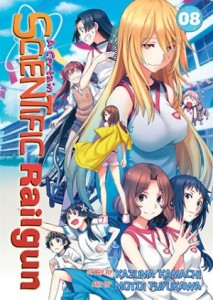
A Certain Scientific Railgun, Vol. 8

August 22, 2013 by Sean Gaffney

By Kazuma Kamachi and Motoi Fuyukawa. Released in Japan as “Toaru Kagaku no Railgun” by ASCII Media Works, serialization ongoing in the magazine Dengeki Daioh. Released in North America by Seven Seas.

It has been noted several times that Academy City, where the events of this series take place, is providing young teens with power development so that they can, in essence, become superheroes. They are ranked all the way from Level 0 (Saten falls here, as well as Touma, though he really doesn’t count) up to Level 5. And our heroine, Misaka, is one of seven people in the entire city strong enough to be a Level 5. Of course, we’ve seen a few other Level 5s along the way. Accelerator. Mugino, leader of ITEM. And we just met Misaki and her mind-controlling in the previous volume. And it has to be said: Misaka is easily the most down-to-earth, sensible, and normal of all these overpowered lunatics.

railgun8

And part of the reason for that is that, unlike most of the folks I mentioned above, Misaka isn’t lonely and doesn’t drive people away. She has a social life. She has her best friends. Yes, OK, Saten teases her, and Kuroko wants to assault her every chance she gets, but they’re still her support system that keeps her going through the tough times. Note how she tried to limit contact to those three during the Sisters Arc, where she was contemplating a) murder, and b) suicide. Unfortunately, Misaki is shaping up to be the next big antagonist, and can manipulate people’s memories. And Misaka finds out what this really means when her friends… no longer remember her.

I give credit to Misaka for taking this in and then quickly dealing with it. She’s in the middle of a crisis, one of her sisters has been kidnapped, and while I’m sure she’d love to argue with Kuroko till she’s blue in the face, there just isn’t time. But her face as she accepts what’s happened is simply depressing. Luckily, Misaki hasn’t had a chance to get to everyone, and Kongou is able to help her and give her a few words of comfort… well, anti-comfort, really. Kongou says she’ll try to get information, but Misaka absolutely shouldn’t trust it, as she may be ‘gotten at’ by the enemy.

Kongou, by the way, has two friends that we met in the previous volume, who are usually referred to as ‘those two guys/girls’ by anime fans. They’re the friends of the person who actually gets the dialogue and situations, there to show that they have their own backup and support system. And Kongou’s friends are sweet, adorable minor characters. They even joke in the first chapter about how they have no idea what it’s like to be really angry. Except… why do those two minor characters have such a large picture on the cover? That’s right, this is foreshadowing. And there are no minor characters in Railgun, there are only a bunch of awesome women who will beat the crap out of you. Watching Wannai and Awatsuki get furious and hand the minor mook (who’s a sexist to boot) his ass is a joyous thing to see.

Things are getting quite complicated as we move further into the school festival. At first we thought Misaki might be behind everything, but now it transpires there are multiple groups of villains (a favorite tactic of the author in the main Index series). Will Misaka be able to rescue her sister, restore her friends’ memories, win the athletic competitions and speak with Touma without n blushing and stuttering? Well, we’re caught up with Japan, so you’ll have to wait till April to find out!

Filed Under: REVIEWS

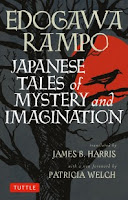
Japanese Tales of Mystery and Imagination

August 21, 2013 by Ash Brown

Author: Edogawa Rampo
Translator: James B. Harris
U.S. publisher: Tuttle
ISBN: 9784805311936
Released: May 2012
Original release: 1924-1950

After reading and enjoying Edogawa Rampo’s novella Strange Tale of Panorama Island I decided to seek out more of his work. What better way to start than with Rampo’s debut in English? Japanese Tales of Mystery and Imagination, translated by James B. Harris and first published in 1956, was reissued in 2012 by Tuttle Publishing with an additional and quite useful foreword by Patricia Welch putting the collection and Rampo into historical and literary context. Despite Rampo’s prolificacy, influence, and popularity in Japan, relatively few volumes of his work are available in English although his short stories can often be found in anthologies. In addition to being Rampo’s introduction to English-reading audiences, Japanese Tales of Mystery and Imagination is particularly interesting in that Rampo worked very closely with Harrison on its translation.

Japanese Tales of Mystery and Imagination collects nine of Rampo’s short stories selected to represent some of his best work. Eight of the nine stories were originally written in the 1920s. The collection opens with what is perhaps Rampo’s most well-known story “The Human Chair.” (At least, it was the story with which I was most familiar before reading the volume.) Next is “The Psychological Test” which features Rampo’s famous detective Kogorō Akechi. “The Caterpillar” is another story I was previously aware of and for a time was even banned in Japan. The collection continues with “The Cliff.” Written in 1950, it is the most recent example of Rampo’s work in the volume. Other tales of mystery include “The Twins,” “The Red Chamber,” and “Two Crippled Men” while other tales of imagination include “The Hell of Mirrors” and “The Traveler with the Pasted Rag Picture.” Though, as Welch points out in the foreword, Rampo frequently blurs the lines of genre and many of the stories have significant crossover.

Rampo is an incredibly clever and imaginative writer. Even when working with similar themes and plot elements, each story in Japanese Tales of Mystery and Imagination exhibits Rampo’s creativity in narrative technique and structure and he throws in enough plot twists that they all feel fresh. Each story is a little peculiar and each story is vaguely disconcerting–the erotic and the grotesque and macabre are no strangers to Rampo’s work–but in the end the tales are all different from one another. The culprits of his crimes stories are often undone by their arrogance, belief in their infallibility, or on occasion their guilty consciences, but the paths to their downfalls vary. Rampo’s more fantastic tales rely on subtle and not so subtle horror, but their thrills and terrors are all distinctive.

Japanese Tales of Mystery and Imagination is a captivating collection of short stories and would make a fine introduction to Rampo’s work for the uninitiated. If I had to choose, I think that I personally prefer Strange Tale of Panorama Island and its outrageousness slightly more, but the selections in Japanese Tales of Mystery and Imagination show evidence of the elements in the novella that I particularly enjoyed: the tight plotting, the light style of narration with slight touches of humor, the unexpected turns in the story, the inherent strangeness of the characters and their accounts. Japanese Tales of Mystery and Imagination has stood the test of time well. Nearly fifty years after it was first released, and more than a half-century since the stories were originally written, the volume remains an intriguing and engaging collection.

Filed Under: REVIEWS Tagged With: Edogawa Rampo, Tuttle

Alice in the Country of Hearts: The Clockmaker’s Story

August 21, 2013 by Sean Gaffney

By Quin Rose and Mamenosuke Fujimaru, based on the game by Quin Rose. Released in Japan as “Anniversary no Kuni no Alice – Tokeiya” by Ichijinsha. Released in North America by Seven Seas.

You would think that I would have run out of things to say about these volumes. Sometimes I have, when they’re particularly pointless – see last month’s batch of Bookshelf Briefs for my opinion of the Ace spinoff – but there always seem to be a few nuggets of interest to keep me going. It also helps that this volume focuses on one of my favorite of Alice’s romantic choices, Julius Monrey, the clockmaker. (In case you’re wondering about the ‘Anniversary’ thing in the Japanese title, it’s what they called the updated PS3 version of Alice in the Country of Hearts.)

clockmaker

The basic premise won’t be a surprise to anyone who’s read the previous spinoffs of this endless otome game series. Alice is trying to get away from an oppressive Peter White at Heart Castle, so she asks Julius if she can stay at the clocktower for a while. He agrees, and they gradually begin to open up to each other. As their relationship deepens, however, Alice has to not only deal with her own feelings, and the fact that her beloved is not the type to take the initiative, but also realize that Julius is hated by a large number of folks throughout Wonderland. Can she come to terms with what his job really entails? And what of her ever-present need to return to her sister?

Julius is a rarity in the set of Wonderland males that Alice runs into. He’s passive, introverted, and taciturn. He will happily stay in his tower for weeks, just working on clocks and sleeping when he remembers to. After several stories with Blood, or Ace, or the twins, or Eliot, or Boris, he feels like a breath of fresh air. He also causes Alice to need to be more proactive, rather than simply have the love interest be aggressive consistently until she gives in. There’s lots of adorable scenes here.

Also, he’s a mortician. Who can resurrect the dead. Only not really. Wonderland’s weird world, where everyone has clocks instead of hearts, and people can be ‘resurrected’ but aren’t quite the same people they were before, makes almost everyone uncomfortable, and that gets taken out on Julius. He’s clearly not doing this for fun, but it’s his role, and he regards it as necessary. But in a way, hanging out with him is keeping Alice in a constant shadow of death – something that I imagine makes Peter quite nervous, given what they’re all trying to make Alice not remember.

This one-shot also has an unusual ending in that, when Alice confesses her love, she chooses to remain in Wonderland and stop trying to return to her own world. Which she’s done before, but in this case the vial filled with people’s feelings that she carries around throughout the game is seen in the final shot to be shattered at her feet. It’s a striking image, showing that there’s no going back. I will admit I’m not entirely happy with the basic premise of the series being ‘if she remembers her traumatic past that makes it a bad end’, which seems to romanticize denial more than I’d like. Still, it does make for a good capper on what has been a fairly enjoyable, if slight, story.

There are also two Crimson Empire stories at the end. Luckily, they are shorter in length than they were in the Ace book. I say luckily as they were incredibly boring and tedious. Alas, you’re better off with Alice than Sheila.

Filed Under: REVIEWS

Otakon roundup

August 20, 2013 by Brigid Alverson

Roland Kelts takes a look at 20 years of Otakon. Otaku USA posted their take on Otakon as well as 20 pieces of Otakon trivia. Vicky Kariolic posts her con report at Graphic Novel Reporter, and at Anime Diet, Linda has posted a writeup of the Vertical panel.

News from Japan: Daphne in the Brilliant Blue creator Satoshi Shiki will be the writer of the Attack on Titan spinoff manga, Attack on Titan: Before the Fall, and THORES Shibamoto, the artist for Trinity Blood, will handle the art.Gakuen Alice, which is approaching its finale, has over 7 million copies in print. Mobile Police Patlabor creator Masami Yuki has a new mystery series that will launch in the 39th issue of Weekly Big Comic Spirits. And a Saint Seiya spinoff launched this week.

Reviews: The Manga Bookshelf readers give quick takes on recent releases in their latest Bookshelf Briefs column.

Justin on vol. 20 of Bakuman (Organization Anti Social Geniuses)
Rebecca Silverman on vol. 1 of Blue Morning (ANN)
Johanna Draper Carlson on vol. 3 of Btooom! (Comics Worth Reading)
Sean Gaffney on vol. 1 of Magi (A Case Suitable for Treatment)
Lesley Aeschliman on vol. 4 of Strobe Edge (Blogcritics)
Erica Friedman on Steps (Okazu)
Carlo Santos on vol. 14 of Tegami Bachi: Letter Bee (ANN)
Danica Davidson on vol. 2 of Thermae Romae (Otaku USA)
Johanna Draper Carlson on vol. 1 of Wolfsmund (Comics Worth Reading)

Filed Under: MANGABLOG

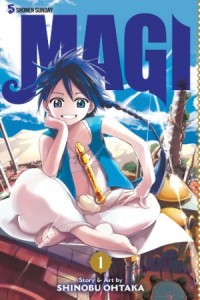
Magi, Vol. 1

August 20, 2013 by Sean Gaffney

By Shinobu Ohtaka. Released in Japan by Shogakukan, serialization ongoing in the magazine Shonen Sunday. Released in North America by Viz.

I like Shonen Sunday series a lot, and I wish they sold better over here, as I’ve noted before. Therefore, when a really good Sunday series debuts, I get a bit excited. Of course, like most really good shonen series, you read the first volume and realize ther4e’s going to be several volumes of setup before we get to the really good stuff. This one is clearly in for the long haul. That said, the worldbuilding is fun, particularly if you are a fan (as I am) of the Arabian Nights stories, which are used as the basis for this series.

magi1

The boy on the cover is Aladdin, one of the two main heroes we meet in this volume (we also meet a third major character, but spoilers). Aladdin is very much cut from Luffy stock (the author notes she grew up in high school reading Jump, which sounds like it was right about when One Piece hit it big, so this isn’t surprising), being naive, upbeat, and generally happy-go-lucky. Unlike Luffy, he also seems to have a thing for busty women, though he’s young enough that no one really minds all that much. He carries a flute with a genie inside, which is generally weak/strong depending on how much food he’s eaten, and gives him most of his cool powers.

The other main lead is Alibaba, who is also another common shonen hero. He’s been slightly trampled down by life, and is trying to make it through this world by being a cynical money-grubber. Sadly, he has a good heart and can’t stand injustice, so that doesn’t work out very well for him. It’s not helping that he runs into Aladdin, who frequently serves as his conscience when Alibaba is trying to drown out its loud voice. Alibaba does NOT have a genie who can grant his every wish, so has to get by on street smarts and some basic fighting skills. He makes an excellent contrast with Aladdin.

After the two of them team up, we hit what seems to be the other main feature of this world, at least in this early part of the series: dungeon crawling. Yes, gamers will feel sympathetic here. There’s a twisty maze of passages (all alike) that have to be marked as ‘bad’ by previous dead explorers. There’s hideous creatures, and deadly traps. And there’s also, allegedly, buttloads of treasure. Treasure that everyone seems to have been waiting for a kid like Aladdin and his genie to show up so they can use him to acquire it. As such, we meet, right near the end, the lord of the territory Jamil and his faithful slave (so faithful she returns to him even after getting freed by Aladdin) Morgiana. It’s not entirely clear if this will be our first bad guy or if his ways will be changed by our heroes’ goodness and niceness. I suppose we must wait till Vol. 2 to find out.

Again, there’s not much that’s original here. But it’s fun! Likeable characters, a lot of fascinating Arabian tropes, some cool fights, and a quest that can go anywhere. Magi is a big hit in Japan, with an anime under its belt already, so I’m very pleased that Viz is taking a chance on it. If you like One Piece or Toriko, give Magi a try.

Filed Under: REVIEWS

Bookshelf Briefs 8/19/13

August 19, 2013 by MJ and Sean Gaffney Leave a Comment

This week, MJand Sean check out recent releases from Yen Press, Viz Media, Kodansha Comics, and Vertical, Inc.


bunnydrop9Bunny Drop, Vol. 9 | By Yumi Unita | Yen Press – So, it’s finally here. Yes, it. You know what I’m talking about, fan of Bunny Drop. In fact, it’s difficult to imagine that any manga fan online has avoided hearing all about the controversial romance between Bunny Drop‘s teenaged Rin and her forty-something guardian, Daikichi, which began brewing out of the blue in the series’ last volume, at least on Rin’s side. Rin’s feelings are revealed fully in this final volume, and though things progress just as reported (feared?), Unita still manages to surprise me. Her ending is both as awkward and as oddly right as I might have wished—emotionally complicated and utterly unsexy (which, for once, is a really good thing). Though it’s still hard for me to buy in to Rin’s sudden feelings, Daikichi’s reaction rings perfectly true, and that makes all the difference, at least for this reader. Still recommended. Honestly. – MJ

devil10A Devil And Her Love Song, Vol. 10 | By Miyoshi Tomori | Viz Media – Well, we’ve been wanting Shin and Maria to finally have a nice long kiss, right? Be careful what you wish for. The scene in the music room with Maria’s breakdown was as raw and shattering as this manga has ever gotten, and I was surprised that it was then topped by Maria in her own apartment, contemplating something unthinkable. Never in this entire series have I been more grateful that Ayu exists. There’s still a lot to work through here, though, and it’s not going to go away due to a sweet hug on the rooftop. I suspect Kurosu just isn’t going to let this go, and it’s hinted that he knows even more about Maria’s past. Altogether, this is one of the best volumes yet of this series, typing together Maria’s past, her friendship with Anna, and her romance with Shin into one big screwed-up package. – Sean Gaffney

kamisama13Kamisama Kiss, Vol. 13 | By Julietta Suzuki | Viz Media – I will confess to being surprised by not one, but two plot twists in this volume. First of all, things were slowly being set up to show that sometimes duty is more important than true love, particularly when it involves a human. Of course, I was then taken aback when true love won out after all, though I appreciated Nishiki’s character growth. More to the point, I was very surprised and happy that Tomoe didn’t immediately cotton on to Nanami’s being ‘fake’. So many fantasy stories have the true love easily able to spot that the one in front of them isn’t the right one, it was great to see that no, Tomoe didn’t get it right away, particularly given it was Nanami’s own body. Another fun volume here, with hints at something darker coming soon, involving Tomoe’s past. – Sean Gaffney

kimi17Kimi ni Todoke, Vol. 17 | By Karuho Shiina | Viz Media – A.K.A. “The Payoff Volume”. Everyone knows that long-running romance series run on ‘will they or won’t they’, but there’s only so long you can hold onto that without frustrating the audience away. And so here we get big payoffs to two of our three couples. (Chizu and Ryu are sweet, but sort of take a back seat here aside from one big present moment.) It’s thematically appropriate, given Japanese customs, that this all happens at Christmas, as Yano finally gives in and opens up to Kento, and Kazehaya finally breaks free from his own chains and admits how much he physically desires Sawako. We also get some nice scenes from Pin, who always gives great advice even if he’s being a complete goofball. Overall, this is a pitch-perfect volume that everyone who follows the series will love. – Sean Gaffney

sidonia4Knights of Sidonia, Vol. 4 | By Tsutomu Nihei | Vertical, Inc. – I find it amusing, given this is a sci-fi action horror thriller sort of story, that I keep focusing on the awkward and goofy romantic comedy love triangle that also is happening within its pages. But it’s just so much fun, and really helps to make the series not just one big depressing angstfest. (Also, the book of Secrets about Sidonia should totally have had Toilet Hinako somewhere.) That said, there’s also a lot of dark tension here as well, as we continue to realize just how much the leaders of the ship seems to have it in for Tanizake. There’s also some rather terrifying body horror towards the end, that startled me quite a bit. The plot is still a bit overly complex for me to take in at times (it may benefit from reading in large chunks), but this is still space opera at its most compelling. – Sean Gaffney

librarywars10Library Wars: Love & War, Vol. 10 | By Kiiro Yumi and Hiro Arakawa | Viz Media – Sometimes it seems that Iku just can’t catch a break. As if it isn’t bad enough coping with her newfound love for Dojo, she also has some buried jealousy of Shibazaki tormenting her (oh, if she only knew how likely it was that the feeling was mutual), more bullying from a new group of girls, and her parents finally becoming aware that she’s a soldier and not merely a simple librarian after all. Of course, all these stress points end up becoming ways to give us compelling, heartwarming and satisfying drama. (We also see more of the still newborn Tezuka/Shibazaki romance, which I love to bits but which will likely be far harder to pull off than simple-minded Iku’s love.) It’s easy to forget this is a spinoff franchise, based on a light novel and with an anime as well It doesn’t read like a cash-in at all. – Sean Gaffney

wallflower31The Wallflower, Vol. 31 | By Tomoko Hayakawa | Kodansha Comics – Yes, in practice this volume ends the same way that the previous 30 have, with minimal forward movement between our heroes. However, I do think there are some very important signposts here towards an endgame, particularly in the 2-parter involving Sunako’s friend Yuki, who we first met in Vol. 6 (so long ago they have to footnote it.) Yuki is dealing with a painful first love, and at first it looks like things may go badly. But when her love is returned, we see her suddenly morph into… a beautiful, normal proportioned shoujo person. It’s always been only Sunako who pulls off the SD vs. normal switch with any regularity, so this is yet another sign that it’s not literal, but a figurative transformation that depends on the self-image of the person. All this, plus a Yuki chapter! (No, the other Yuki.) Recommended to those who still read it. – Sean Gaffney

Filed Under: Bookshelf Briefs

My Week in Manga: August 12-August 18, 2013

August 19, 2013 by Ash Brown

My News and Reviews

Two reviews, and some big news! First up was my review of Blade of the Immortal, Volume 24: Massacre by Hiroaki Samura. As you might suspect from the title, it’s a rather bloody volume. It also features what I think is one of the best visually executed battles in the series. I also reviewed Yukio Mishima’s novel Forbidden Colors which is a bit twisted but extremely engrossing and very good. Like his earlier novel Confessions of a Mask, it deals with homosexual themes and includes autobiographical elements.

As for the big news! Over the weekend Experiments in Manga celebrated it’s third anniversary and I wrote quite a lengthy post about it. If you don’t feel like reading the whole thing, here’s the really important bit: I am delighted to announce that in the very near future Experiments in Manga will be joining the Manga Bookshelf network of blogs!

I was traveling quite a bit last week (a couple of my friends were getting married), so I’m a little out of touch when it comes to some of the most recent manga news. However, there is one thing that I want to be sure to pass along. I personally don’t read much manga digitally, but Organization of Anti-Social Geniuses has a fantastic post looking at all the legal ways to read digital manga in 2013.

Quick Takes

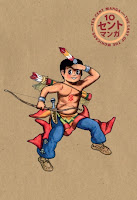
The Last of the Mohicans by Shigeru Sugiura. The Last of the Mohicans is the first volume in editor Ryan Holmberg’s Ten-Cent Manga series, exploring classic manga influenced by popular culture and comics from the United States. In addition to the manga itself, the volume also includes an article by Sugiura and an extensive essay by Holmberg which puts The Last of the Mohicans into context. For me, this was probably the greatest appeal of the volume. I more or less enjoyed the manga, but I valued to an even greater extent learning about its history and Sugiura’s influences. I don’t know that The Last of the Mohicans will necessarily entice casual manga readers, but for those interested in comics history it’s great.

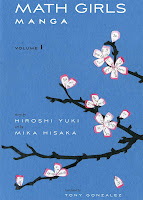
Math Girls Manga, Volume 1 written by Hiroshi Yuki and illustrated by Mika Hisaka. Based on the Math Girls series of novels, the manga focuses a little more on the romance and a little less on the math, but it still can teach a thing or two about it. Unfortunately, errors slipped into the English edition and some of the mathematical symbols are missing. Seeing as Math Girls is about, well, math, this is somewhat problematic. But if you can ignore that, Math Girls is a rather delightful and charming manga. Math lovers in particular will appreciate it, but as with the novels it’s possible to skip over the math-intensive sections and just enjoy the story. I wouldn’t mind seeing more of the Math Girls manga, but I suspect there won’t be another volume released anytime soon.

Strawberry Chan, Volumes 1-2 by Ai Morinaga. I picked up Morinaga’s Strawberry Chan manga on a whim. The series consists of two volumes, The Gorgeous Life of Strawberry Chan and The Super Cool Life of Strawberry Chan. The manga is fairly episodic and each chapter is very short. The titular Strawberry Chan is a small pet frog owned by Taro Akiyoshi, a sadistic high school student who delights in tormenting him. Despite his cruelty, Strawberry Chan adores his master. And then there’s Taro’s roommate who’s legitimately in love with Strawberry Chan and a masochistic classmate who just wants Taro to abuse him instead of the frog. Strawberry Chan is utterly ridiculous, random, and all sorts of wrong. I loved it.

Three Wolves Mountain by Bohra Naono. So far, only two of Naono’s manga have been released in English. Yokai’s Hunger largely frustrated me but I thoroughly enjoyed Three Wolves Mountain; it’s easily my favorite manga out of the two. It’s an odd mix of comedy, drama, and the supernatural, but Naono makes it work this time. Kaya Susugi is a cafe owner by day and a grave keeper by night who ends up taking in Tarou and Jiro Tsukihara, two werewolf brothers. Susugi is used to being alone but becomes very close with both of the brothers, but especially with Jiro who has fallen in love with him. I wasn’t expecting Three Wolves Mountain to become such a family affair, but parents, siblings, and even cousins all have their role to play in the story. Three Wolves Mountain is great stuff.

Filed Under: FEATURES, My Week in Manga Tagged With: Ai Morinaga, Bohra Naono, Hiroshi Yuki, manga, Math Girls, Mika Hisaka, Shigeru Sugiura, Strawberry Chan, Ten-Cent Manga

Pick of the Week: Helter Skelter

August 19, 2013 by Sean Gaffney, Michelle Smith, Anna N and MJ Leave a Comment

helterskelterSEAN: Yeah, it’s Vertical again. Sorry, but josei from Vertical has proven to be something to be cherished in the past, and I’m not expecting that to change with the release of Helter Skelter: Fashion Unfriendly. I expect this to be a somewhat different take on modeling from what we saw in Paradise Kiss. Good times.

MICHELLE: There are a couple of things out next week that I’ll definitely be reading—Bunny Drop 9 and Pandora Hearts 17—but I’ll not miss the chance to rally behind a done-in-one josei release. Count me in for Helter Skelter, too!

ANNA: I’m going to have to pick Helter Skelter too, because new josei from Vertical makes me happy.

MJ: I have to agree with everyone else here. I’ve been interested in this title since Vertical first announced it, and it’s absolutely my must-buy for the week. There’s nothing else that comes close.

What looks good to you this week?

Filed Under: PICK OF THE WEEK

Bunny Drop, Vol. 9

August 19, 2013 by Sean Gaffney

By Yumi Unita. Released in Japan as “Usagi Drop” by Shodensha, serialized in the magazine Feel Young. Released in North America by Yen Press.

You may finally discuss Bunny Drop in the comments. But be polite.

And so here we are. I’d mentioned when reviewing the previous volume of Bunny Drop that there was a certain discomfort with where it was going, even if there wasn’t really anything objectionable besides the basic concept. That feeling continues and is magnified in this volume, which could almost be described as “Yeah, it went there.” It does its best to try to show the thought patterns of the people this decision impacts – though Rin, as always, is harder to read and understand than the others. But in the end, was this trip really necessary? Let’s find out.

bunnydrop9

For most of the volume, the basic conflict is not so much “Rin is in love with Daikichi” – that was dealt with by Vol. 8, mostly. The conflict is that Rin seems to be perfectly content to never deal with this and live in her happy family cocoon forever, denying her own feelings so that things can be the same. And big props to Kouki for pointing out how selfish this is. Honestly, Kouki’s development has probably been written better than Rin’s as this series has gone along – he’s still very much in love with her, and knows that love can’t happen, but is determined to be sure that Rin is happy. What she’s doing now isn’t getting her that way. So, because he’s that sort of person, he simply tells Daikichi everything.

Yumi Unita’s art has always been best when showing feelings of awkward discomfort, and really excels here in the middle part of the book, as Daikichi has to deal with Rin’s feelings, and Rin has to deal with Daikichi knowing about it, and – inevitably – the destruction of their cozy parent-child relationship. I liked that she ended up going to her mother – whose character development has also been good but is mostly off-screen. The mother, of course, is there to provide the “”out” the story needs – Rin isn’t really Soichiro’s daughter, she’s an adopted daughter. Meaning she and Daikichi aren’t related by blood. Which is fine, except, y’know, he’s still raised her as a parent since she was six. Sigh.

Daikichi says to Rin he’s going to wait two years, possibly thinking that Rin might get over this. But of course she does not. Through most of the post-timeskip series we’ve had trouble reading Rin, but right at the end it’s Daikichi who becomes difficult, as his acceptance of Rin’s love and agreement to marry her seems to come less from romantic feelings and more “well, a father can’t say no to his daughter”. Which provides all sorts of deeply wrong reactions. Particularly when Rin brings up children right at the end.

There is a certain odd dilemma with this series. When it began, everyone was enchanted by its warm and loving take on parenting and adopted families, and recommending it to libraries and such. Then the spoiler hit, and suddenly the entire fandom took a darker turn. The anime solved this problem by simply ignoring the timeskip altogether. The difficulty is that if readers had known the manga was going to go down this direction, I don’t think any of them would have bought the series. Most people still reading have a sense of “Well, better see this through to the end, since I’ve invested so much time in it.” Which is not what one really wants from a heartwarming manga series. Bunny Drop could be very well-written, and thoughtful, and have nice art, and I’ve analyzed it more than most other series. But I don’t think I’ve ever felt quite as uncomfortable with an ending as I am with this one.

Of course, there’s Vol. 10 in April of next year. But I hear that’s mostly side-stories from when Rin was a kid. We shall see. (What, drop the series? Nah.)

Filed Under: REVIEWS

  • « Go to Previous Page
  • Page 1
  • Interim pages omitted …
  • Page 655
  • Page 656
  • Page 657
  • Page 658
  • Page 659
  • Interim pages omitted …
  • Page 1048
  • Go to Next Page »
 | Log in
Copyright © 2010 Manga Bookshelf | Powered by WordPress & the Genesis Framework