• Skip to primary navigation
  • Skip to main content
  • Skip to primary sidebar
  • Home
  • About Us
    • Privacy Policy
    • Comment Policy
    • Disclosures & Disclaimers
  • Resources
    • Links, Essays & Articles
    • Fandomology!
    • CLAMP Directory
    • BlogRoll
  • Features & Columns
    • 3 Things Thursday
    • Adventures in the Key of Shoujo
    • Bit & Blips (game reviews)
    • BL BOOKRACK
    • Bookshelf Briefs
    • Bringing the Drama
    • Comic Conversion
    • Fanservice Friday
    • Going Digital
    • It Came From the Sinosphere
    • License This!
    • Magazine no Mori
    • My Week in Manga
    • OFF THE SHELF
    • Not By Manga Alone
    • PICK OF THE WEEK
    • Subtitles & Sensibility
    • Weekly Shonen Jump Recaps
  • Manga Moveable Feast
    • MMF Full Archive
    • Yun Kouga
    • CLAMP
    • Shojo Beat
    • Osamu Tezuka
    • Sailor Moon
    • Fruits Basket
    • Takehiko Inoue
    • Wild Adapter
    • One Piece
    • After School Nightmare
    • Karakuri Odette
    • Paradise Kiss
    • The Color Trilogy
    • To Terra…
    • Sexy Voice & Robo
  • Browse by Author
    • Sean Gaffney
    • Anna Neatrour
    • Michelle Smith
    • Katherine Dacey
    • MJ
    • Brigid Alverson
    • Travis Anderson
    • Phillip Anthony
    • Derek Bown
    • Jaci Dahlvang
    • Angela Eastman
    • Erica Friedman
    • Sara K.
    • Megan Purdy
    • Emily Snodgrass
    • Nancy Thistlethwaite
    • Eva Volin
    • David Welsh
  • MB Blogs
    • A Case Suitable For Treatment
    • Experiments in Manga
    • MangaBlog
    • The Manga Critic
    • Manga Report
    • Soliloquy in Blue
    • Manga Curmudgeon (archive)

Manga Bookshelf

Discussion, Resources, Roundtables, & Reviews

Blog

Manga the Week of 6/10

June 5, 2015 by Sean Gaffney, Michelle Smith, Ash Brown, Anna N and MJ Leave a Comment

SEAN: Thank you for all those who bought manga to bring rain to the Northeast. You can stop now (keep buying manga, I just mean no more flash flood warnings). Meanwhile, what have we in this small week?

sily8

Kodansha gives us an 8th volume of shosei (I just coined it, whaddya think?) romance Say “I Love You”.

MICHELLE: Yay!

ASH: Shosei. I like it.

ANNA: I’m behind on this series, but I do enjoy it!

SEAN: Something that could not remotely be mistaken for an angsty teen romance is the 5th volume of D-Frag! from Seven Seas. Betcha it’ll be funnier, though.

Barring any further spinoff licensing (unlikely, I suspect), we also get the 4th and final volume of sweeter than I expected tank manga Girls Und Panzer.

Sublime is still Starting with a Kiss, but it’s Vol. 3, so perhaps they’ve gone further.

ASH: Perhaps, perhaps…

SEAN: (Amazon lists The World’s Greatest First Love 2 as well, but I understand from a Viz press release that this has been delayed to late July.)

arata22

Viz proper, meanwhile, has the 22nd Arata the Legend volume. Man. So many more volumes than Fushigi Yuugi.

MICHELLE: Yeah, that is really hard to believe. I like Arata, but it’ll never approach Fushigi Yuugi‘s iconic status.

ANNA: I feel bad constantly comparing Arata to Fushigi Yuugi, but I can’t help it.

SEAN: And a 9th volume of slice-of-life prison comedy Deadman Wonderland. (Spoiler: it is not a slice-of-life prison comedy).

MICHELLE: Heh.

MJ: Wow, I have fallen behind!

SEAN: Lastly, Magi hits a dozen volumes. And hasn’t slowed down its release schedule, a major accomplishment for Shonen Sunday titles.

MICHELLE: Yay, Magi! This one is already in my Amazon cart!

ANNA: Nice! I enjoyed the first few volumes of this series a bunch.

SEAN: Do you have a favorite here?
Filed Under: FEATURES, manga the week of

Lucifer and the Biscuit Hammer, Vols. 5-6

June 5, 2015 by Sean Gaffney

By Satoshi Mizukami. Released in Japan by Shonen Gahosha, serialized in the magazine Young King Ours. Released in North America by Seven Seas.

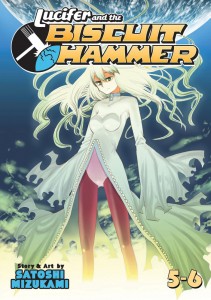
Well, I can’t say I didn’t warn myself in my last review, where I described everything coming to a halt so that the author could do plot setup. And now that it’s set up, the guns are fired, with lots of cool action scenes, character development, and the introduction of Animus’ sibling Anima, who doesn’t talk much and seems to be able to grant even more superpowers. The series also continues to show off the connection between having cool superpowers and teenage angst and grief, which as fans of old school superhero comics know if the classic way to go about things. I have to say, however, that perhaps the most ridiculous yet tragic thing about my last review is when I was discussing Hanako’s oddness and suggested that she might not survive the series. Wow, in hindsight that is the worst thing ever.

biscuithammer56

This is not a series afraid to kill off its main characters, and to be fair I should have realized what was coming. Taro was one of the most ‘normal’ of the cast, and we weren’t sure what his wish was. The one thing we were sure of was that he was totally in love with Hanako and hadn’t told her yet. And, despite what her familiar tells her, he dies in a heroic, amazing way. Yes, he made his wish to resurrect her if she was killed and then tried to stop her getting killed anyway. But that’s love for you, and I thought it was fantastic. I also liked how Taro’s impact was felt on other characters through his food – his other main personality trait besides ‘likes Hanako’. I’m not sure how much I like the observation that his death is Hanako’s punishment for what her wish was, though – I think that’s placing too much of a burden on her.

I’d mentioned above that Anima has started to give powerups to the various Knights, and we see Yuuhi fight to ensure that he gets one… and lose. Yuuhi has always been at the low end of the totem pole when it comes to kicking ass, and I don’t see that changing as I think it’s perhaps the only thing keeping him likeable. We do see his growth here, though, as he encourages Samidare to talk with her estranged mother (who can’t seem to balance work and family well at all) even as he’s still estranged from his own grandfather. I’m still of the opinion that the Earth is not going to be destroyed, and I suspect it will be because he stops being such a nihilist. Leave that to the resident Nihilist Knight… I mean Owl Knight.

In the end, the scene that sticks with me most is the final one of the volume, where Hanako uses her ice powers to take out one of the golems in a fit of suppressed grief and rage, showing the emotions on her face that we haven’t seen since we met her. It extends to the others as well, as the death of Taro’s killer and Hanako’s sobbing allows all the other knights to show their own grief… even Yuuhi. It’s a good sign for the future. I eagerly await the next omnibus.

Filed Under: REVIEWS

D+Q Announces Seven Volumes of ‘Kitaro’

June 3, 2015 by Brigid Alverson

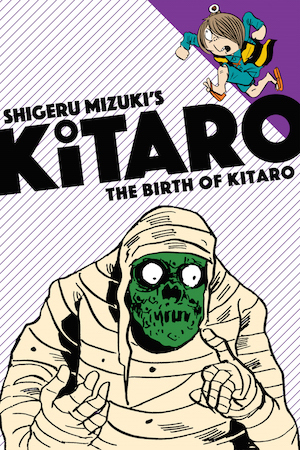
kitaro.cover_vol1

Drawn and Quarterly announced seven new volumes of Shigeru Mizuki’s Kitaro manga today. All will be in a “kid-friendly” format—standard manga trim size, 150 pages, black and white, $12.95 per volume—and each will collect new (to us) short stories from Mizuki’s extensive back catalog, translated by Zack Davisson, who will also contribute an essay to each volume. The first one, Birth of Kitaro, a collection of early stories, will be out in March 2016, and D+Q will issue a new one each season after that.

Also, more digital license rescues from Viz, which has picked up three former Tokyopop titles: Welcome to the NHK, Metamo Kiss, and AiON.

Justin Stroman talks to MangaBlog’s own Kate Dacey at Organization Anti-Social Geniuses. Learn how Kate got her start as a manga blogger, why she took a break, and what she’s doing now that she has jumped back in!

Also at OASG, Justin talks to translator Dan Luffey, who worked on Manga Reborn for a while and has translated over 1,000 chapters of manga.

The Manga Bookshelf team discuss their Picks of the Week. Lori Henderson gives her take on this week’s new releases—just call it shoujo-riffic!—at Manga Xanadu. Lori also says farewell to three series that are drawing to a close.

Laura looks at the new shoujo titles debuting in June at Heart of Manga.

Caitlin McGurk of the Billy Ireland Cartoon Library & Museum at Ohio State University interviews Maureen Donovan, OSU’s Japanese Studies librarian, who is retiring after 37 years on the job, part of which involved establishing one of the premier manga collections in the U.S.

News from Japan: Apparently there’s no such thing as too much Naruto: Saikyo Jump magazine has announced that Kenji Taira, creator of the Naruto spinoffs Rock Lee no Seishun Full-Power Ninden and Uchiha Sasuke no Sharingan Den, will create a manga based on the new movie Boruto -Naruto the Movie- for the September issue. Detective Conan (Case Closed) is going on hiatus for a few weeks. ANN has the latest Japanese comics rankings as well as the top selling manga for the first half of the year by volume and by series.

Reviews: At Brain Vs. Book, Jocelyne Allen takes a peek inside the massive tome that is vol. 1 of Comitia 30th Chronicle, a collection of comics honoring the 30th anniversary of this massive doujinshi festival. Sean Gaffney and Michelle Smith go over some recent releases in the latest Bookshelf Briefs column at Manga Bookshelf. Ash Brown looks back at a week’s worth of manga reading at Experiments in Manga.

Matthew Warner on vols. 2 and 3 of Ani-Imo (The Fandom Post)
Kory Cerjak on vol. 1 of The Devil Is a Part-Timer (The Fandom Post)
Leroy Douresseaux on vol. 5 of Food Wars (The Comic Book Bin)
Ken H on vols. 43-48 of Fairy Tail (Sequential Ink)
Johanna Draper Carlson on vol. 6 of Food Wars (Comics Worth Reading)
Sean Gaffney on vol. 2 of JoJo’s Bizarre Adventure (A Case Suitable for Treatment)
Leroy Douresseaux on vol. 11 of Magi (The Comic Book Bin)
Sakura Eries on vol. 2 of Milkyway Hitchhiking (The Fandom Post)
Johanna Draper Carlson on vol. 3 of Prophecy (Comics Worth Reading)
Julia Smith on vol. 2 of Resident Evil: The Marhawa Desire (The Fandom Post)
John Rose on vol. 3 of Shoulder-a-Coffin Kuro (The Fandom Post)
Anna N on vol. 1 of So Cute It Hurts! (Manga Report)
Lesley Aeschliman on vol. 6 of Terra Formars (Lesley’s Musings… on Manga)
Matthew Alexander on vol. 1 of Trinity Seven (The Fandom Post)
Sean Gaffney on vol. 10 of Umineko When They Cry (A Case Suitable for Treatment)
Erica Friedman on vol. 3 of What Did You Eat Yesterday? (Okazu)
Johanna Draper Carlson on vols. 7 and 8 of What Did You Eat Yesterday? (Comics Worth Reading)

Filed Under: MANGABLOG

Manga Giveaway: Ema Toyama Twosome Winner

June 3, 2015 by Ash Brown

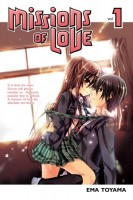
Manga Dogs, Volume 1Missions of Love, Volume 1And the winner of the Ema Toyama Twosome is… Coco!

As the winner, Coco will be receiving two manga by Ema Toyama: Manga Dogs, Volume 1 and Missions of Love, Volume 1. Both of those series feature protagonists who are professional storytellers, a mangaka and cell phone novelist respectively. So, for the manga giveaway, I asked participants to tell me a little about their favorite characters in manga who are writers. Check out the Ema Toyama Twosome comments for all of the characters mentioned, and check out the list below for all of the manga mentioned and then some!

Manga available in English featuring writers of various types:
Author’s Pet by Deathco Cotorino
Awaken Forest by Yuna Aoi
Bakuman written by Tsugumi Ohba, illustrated by Takeshi Obata
Barefoot Waltz by Romuko Miike
Blood Alone by Masayuki Takano
Fairy Tail by Hiro Mashima
Fruits Basket by Natsuki Takaya
Gerard & Jacques by Fumi Yoshinaga
Gravitation by Maki Murakami
Honey Blood by Miko Mitsuki
Junjo Romantica by Shungiku Nakamura
Kiss All the Boys by Shiuko Kano
Kinoko Inu: Mushroom Pup by Kimama Aoboshi
Kodocha: Sana’s Stage by Miho Obana
Liberty Liberty! by Hinako Takanaga
Love Machine by Amayo Tsuge
Manga Dogs by Ema Toyama
Me & My Brothers by Hari Tokeino
Missions of Love by Ema Toyama
Monthly Girls’ Nozaki-kun by Izumi Tsubaki
No One Loves Me by Yugi Yamada
Not Love But Delicious Foods Make Me So Happy! by Fumi Yoshinaga
Otomen by Aya Kanno
R.O.D.: Read or Die written by Hideyuki Kurata, illustrated by Shutaro Yamada
R.O.D.: Read or Dream written by Hideyuki Kurata, illustrated by Ran Ayanaga
The Times of Botchan written by Natsuo Sekikawa, illustrated by Jiro Taniguchi
The Strange Tale of Panorama Island by Suehiro Maruo
Two of Hearts by Kano Miyamoto
Utsubora: The Story of a Novelist by Asumiko Nakamura
La Vie en Rose by Sakurako Yamada
Welcome to the N.H.K. by Kendi Oiwa
Yukarism by Chika Shiomi

The above list isn’t quite comprehensive, but it does include most of the manga available in print that I know of that have characters who are writers. While compiling the list I was struck by how many boys’ love titles feature authors. I’m not entirely sure why that profession seems to be particularly popular in that genre, but there you have it. Thank you to everyone who shared your personal favorites with me; I hope to see you again for the next giveaway!

Filed Under: Giveaways, UNSHELVED Tagged With: Ema Toyama, manga, Manga Dogs, missions of love

So Cute it Hurts! Vol. 1

June 2, 2015 by Anna N

So Cute it Hurts! Volume 1 by Go Ikeyamada

There has been a gap in cross-dressing shoujo series in the current shoujo beat line up recently, so I was intrigued by this series, which features both cross-dressing twins and juvenile delinquents.

The twins in this series are a pair of fraternal twins named Megumu and Mitsuru. Megumu is devoted to history simulation games featuring historical figures with eye patches, and has found a small group of kindred otaku spirits at her all-girls school. Mitsuru has a much more casual approach to studies, a bit of a womanizing personality, and a penchant for fighting thanks to his attendance at an all-male school crawling with juvenile delinquents. Megumu and Mitsuru are an odd kind of opposite gender fraternal twins that might only exist in manga or k-dramas due to their identical appearance that allows them to swap identities. Mitsuru is struggling with make up work in history and proposes a week long switch to Megumu so she can take his tests for him. Megumu is not thrilled with this idea, but she finds herself going along with it when she wakes up one day to find that Mitsuru has stolen her uniform and left his clothes behind.

This volume focuses a bit more on Mitsuru’s undercover operation at Megumu’s school. He is taken aback when he realizes that the girls he usually relates to in superficial ways actually have personalities, and is particularly surprised when he sees the most beautiful girl in the school bullying a deaf student. He has a blunt way of relating to girlish clique problems, and promptly develops a crush on Shino Takenaka, actually deciding to study sign language on his own so he can communicate with her. The bullying plot is a bit standard for a shoujo manga, but it was nice to see Mitsuru deal with mean girl antics with refreshing directness, and when his enemy attempts to shun him, all the otaku girls band together and are not particularly concerned at any loss of social status.

Megumu’s storyline is a bit less dynamic, and more reliant on shoujo plot cliches where she accidentally stumbles into the embrace of Aoi Sanada, the eyepatch-wearing top delinquent at her brother’s school. Aoi is a bit annoyed and bemused at the sudden appearance of an underclassman who seems to not follow the usual social conventions at their school. Her habit of tripping does actually come in handy when she finds herself in the middle of a schoolyard brawl. So far, Megumu and Aoi aren’t given as much page time or character development as Mitsuru and his new friends, and I hope this gets balanced out a little bit in future volumes.

I found it amusing that towards the end of the chapters, there were over-the-top summations of love standing in stark contrast to the gender-bending comedic hijinks in the rest of the manga. Ikeyamada’s art is attractive, if a bit generic, but she portrays the action scenes and the highs and lows of teenage emotions with ease. I found this volume amusing, and there were some interesting hints of a love quadrangle developing that I’m guessing will be explored more in the next volume. So Cute it Hurts! might not have very much depth so far, but the first volume seems like a nice comedic addition to a summer manga reading list.

Filed Under: REVIEWS Tagged With: shojo beat, shoujo, so cute it hurts!, viz media

Bookshelf Briefs 6/2/15

June 2, 2015 by Sean Gaffney and Michelle Smith Leave a Comment

This week, Sean and Michelle look at recent releases from Seven Seas, Dark Horse Comics, SuBLime, Viz Media, and Yen Press.

twinloversAlice in the Country of Clover: Twin Lovers | By QuinRose and Kei Shichiri | Seven Seas – Well, it’s better than the Bloody Twins volume, but I think I’m going to have to accept that I just don’t like the twins enough to enjoy a book where they’re the focus. Not uncommon in a series based off a datesim. But I tend to agree with Blood about their immaturity (he can be just as bad, but isn’t in this volume), and a plotline about Alice trying to choose between them is less ‘we need to see how they differ’ and more ‘they are a package deal’, as they don’t differ – I still can’t tell the two apart. Add to that some toned-down threesome jokes, which are still bothersome as half the time they’re kids, and you have another Alice spinoff that didn’t wow me. – Sean Gaffney

drugdrop2Drug & Drop, Vol. 2 | By CLAMP | Dark Horse Comics – It’s been hinted for some time, but this volume at last gives us the Wish crossover we knew was coming, and flat out tells us that Kakei and Saiga, our two leads’ erstwhile benefactors, are in fact Hisui and Kokuyo from Wish. I’m not sure how much enjoyment is lost if a casual reader is getting this dumped on them – not much, I’d expect – but it’s a nice bonus for fans, just like the Suki and xxxHOLIC cameos were. (Has Miyuki-chan shown up?) As for the manga proper, we get a lot of backstory dump, and ponder whether Kazahaya’s sister Kei was driven mad after being kidnapped, or if she was halfway there already. I’m still not sure where this is really going, but it looks pretty, and will appeal to CLAMP fans. – Sean Gaffney

lovestage1Love Stage!!, Vol. 1 | By Eiki Eiki and Taishi Zaou | SuBLime – It has been ages since I’ve read any BL, especially an over-the-top comedic series like this one. Male Izumi Sena, a shy, frumpy otaku from a family of celebrities, was once drafted to play a flower girl in a commercial ten years ago and now has been bribed (with otaku merchandise) to participate in an anniversary sequel. Meanwhile, his lovestruck costar, Ryoma Ichijo, reels to discover the object of his decade-long affection is actually a guy (though it doesn’t take long for him to decide this isn’t much of an impediment). This is a frivolous, unrealistic series, but I do like Izumi’s character design and some inklings that he might have acting talent after all. I don’t know for how long this series will be capable of sustaining my interest, but I would at least check out volume two. – Michelle Smith

socuteithurtsSo Cute It Hurts!!, Vol. 1 | By Go Ikeyamada | Viz Media – Normally I am all about manga with exclamatory titles, but must regretfully say that So Cute It Hurts!! really didn’t do much for me. It’s the story of the Kobayashi twins, female Megumu and male Mitsuru, who end up switching places because Mitsuru’s busy schedule of Sunday dates is threatened by remedial history classes unless his history otaku sister aces some makeup tests in his stead. Whilst attending the other’s school, they each experience their first love. There are some interesting aspects, like the fact that both love interests have a physical impairment and also seem to know each other, but the two leads just don’t interest me at all. I’m used to cute and fluffy shoujo, but this feels more superficial than most. – Michelle Smith

saogirlsopsSword Art Online: Girls’ Ops, Vol. 1 | By Neko Nekobyou, Reki Kawahara, and abec | Yen Press – Let’s be honest: aside from one short story in Vol. 8, we’re not really going to see Lisbeth, Silica or Leafa as more than cameos in the SAO novels anymore. So it’s nice to see them get their own series, as they participate in a side-quest in ALO and meet a young woman who was also trapped in SAO, and is still dealing with the PTSD that comes from that. (Lisbeth casually notes that they’re the weird ones, and that most SAO players are never going near another MMO). In real life, Hiyori looks eerily like Mugi from K-On! (let’s hope her friend she lost in SAO wasn’t Ritsu). I’m not sure when the next volume will be coming out, but it should be fun for fans of these characters. – Sean Gaffney

Tony TakezakiTony Takezaki’s Neon Genesis Evangelion | By Tony Takezaki and khara | Dark Horse Comics – It’s almost impossible to review something like this, a title that has a very, very specific audience. Do you love Evangelion? Are you OK with the characters behaving in a stupid way for the sake of bad jokes? If not, avoid this volume. But if you are, there’s a lot to love here. As with most gag manga, the jokes are hit and miss, but I think there are more hits than misses. There is a certain “I am seven years old” quality to many of these jokes, but again, this is what you get for buying a gag manga. I will simply enjoy Gendo and Fuyutsuki fighting a sentai battle in cheap costumes, Asuka being so horrified her sound effects turn German, and far too many “congratulations!”.-Sean Gaffney

Filed Under: Bookshelf Briefs

Pick of the Week: Natsume, So Cute It Hurts

June 2, 2015 by Michelle Smith, Sean Gaffney, Ash Brown, Anna N and MJ Leave a Comment

potwMICHELLE: So many of my favorites have new volumes coming out this week! I will definitely be devouring the latest Food Wars! and Voice Over! as quickly as possible, for example. But, as ever, my heart ultimately belongs to Natsume’s Book of Friends, whose eighteenth volume comes out this week, just as I was seriously starting to pine for a new one. I will try not to think about the fact that the next volume isn’t due ’til November.
SEAN: I’m going to go with So Cute It Hurts!. Because twins. Because cross-dressing twins. Because I wanted to see Suki Desu Suzuki-kun!! by the same author licensed, so this is the next best thing. Because cute!

ASH: I’ll admit, cross-dressing twins has me intrigued. Also, juvenile delinquents. So Cute It Hurts! it is!

ANNA: I also agree that the combination of cross dressing and juvenile delinquents has me looking forward to So Cute It Hurts! the most!

MJ: I’m going to have to go with the majority vote here. So Cute It Hurts! looks potentially awesome in a delightfully goofy sort of way, and I’m nothing if not an optimist when it comes to new shoujo manga. Also, I fell off the Natsume wagon a while back (perhaps prematurely). Sorry, Michelle for leaving you all alone this week!

What looks good to you this week?

Filed Under: PICK OF THE WEEK

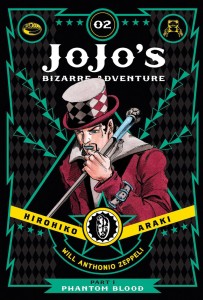
JoJo’s Bizarre Adventure: Phantom Blood, Vol. 2

June 2, 2015 by Sean Gaffney

By Hirohiko Araki. Released in Japan as “Jojo no Kimyou na Bouken” by Shueisha, serialized in the magazine Weekly Shonen Jump. Released in North America by Viz Media.

It is possible, I suppose, that someone out there read the first volume of this series, featuring grandiose over the top histrionics galore, and felt “well that was OK, but it was just far too sedate and naturalistic. What would really make the series take off is if one of the characters came back as an immortal vampire”. Well have I got news for you! Araki ups his game here, turning the amp from 11 to 12 and delivering more action, more histrionics, and a whole lot more death and violence, while also adding a few trickster mentors and loathsome underlings. It’s still not a parody, honest: JoJo’s Bizarre Adventure just is.

jojo2

The highlight of the book may very well be the beginning, where Dio cuts loose and starts to not only kill people and steal their lifeforce but bring them back to life as hideous zombies. JoJo’s still looks up to Fist of the North Star after all, so there’s lots of heads exploding and eyes popping in slow motion here. That said, probably the most grotesque moment of violence comes later on, when Jack the Ripper (yes, that one – Dio takes him on as a disciple) attack the horse and wagon our heroes are in, kills the horses (and driver) by cutting their heads off, and then hides inside a horse corpse so that he can emerge, womb-like, from the neck like your worst nightmare. It’s around that time that you realize how “Tom Brown’s Schooldays” the first volume really was.

If there is any break from the nonstop action and hysteria, it comes in the form of Erina Pendleton, who went to India for several years to study nursing and attend the Tsukasa Hojo School of Heroine Design, and arrives just in time to attend to a dying Jonathan’s wounds. We see once again the steel that’s underneath her soft exterior, and even Speedwagon is forced to withdraw coolly (yes, Viz kept that, thank goodness) in her presence. Sadly, when he starts training and getting attacked by evil minions, Jonathan thinks he can’t let Erina get involved in this, and she vanishes once more. The same cannot be said for Speedwagon, who is both the ‘normal guy’ and Greek Chorus in this series – although how normal someone is when they use the power of their flaming hot abs to heal Zeppeli’s arm is a debate for another time.

I should also probably mention the narrative voice here, or rather the multiple ones. Araki has third person narration drop in from time to time, telling us how glorious everything is in full! blown! CAPSLOCK! But then Jonathan, Speedwagon and Dio also seem to have their own inner monologue, functioning as a narrative voice as well, and just as dramatic. It’s as if you took all the characters and gave them microphones so they could turn to the audience and soliloquize for a while. Honestly, the only normal thing in this entire volume is Zeppeli, whose attitude towards training has been used over and over in so many shonen manga (and yes, he probably got it from Ashita no Joe or something) that you don’t even bat an eye when he threatens Jonathan. But that’s OK, Speedwagon is there to bat them for you.

You can’t really casually read a title like this – you have to leap in full body and drown yourself in it. If you do, not only do you get top notch action and horror, but you also get things like Elizabeth I’s evil face as she condemns two nights to their deaths, where she looks like a yanki punk. I can’t wait for the conclusion of this arc.

Filed Under: REVIEWS

My Week in Manga: May 25-May 31, 2015

June 1, 2015 by Ash Brown

My News and Reviews

Last week was the last week of May, which means the most recent giveaway at Experiments in Manga is currently underway. There are still a couple of days left to enter for a chance to win an Ema Toyama Twosome, i.e. the first volume of both Missions of Love and Manga Dogs. I also posted a couple of in-depth reviews last week. The first review was of Yoshikazu Yasuhiko’s Mobile Suit Gundam: The Origin, Volume 8: Operation Odessa, which is the first volume to take place after the series’ extended flashback arc. It’s not my favorite volume in the series, but Kai gets his moment in the spotlight which I was happy to see. The second review was of Kazuki Sakuraba’s award-winning novel Red Girls: The Legend of the Akakuchibas, which I enjoyed immensely. Sakuraba is probably better known as the creator of Gosick, but Red Girls is a fantastic multi-generational epic.

I was actually at a conference for work most of last week, so I wasn’t able to keep up with news and announcements to quite the same extent that I’m usually able to. However, I still did come across some interesting reading. Aya Kanno, for example, has recently had some interviews posted. Over at Barnes & Noble’s Sci-Fi & Fantasy Blog, Brigid Alverson talked with Kanno about defying expectations and Rebecca Silverman’s interview of Kanno was posted at Anime News Network. A couple of weeks ago I reviewed the first volume of Wayward which I quite enjoyed, so I found Katriel Page’s essay about how Rori embodies liminality to be particularly interesting. And over at Organization Anti-Social Geniuses, Justin wants you all to Meet the Man Who’s Translated a Thousand Manga Chapters—Dan Luffey.

Quick Takes

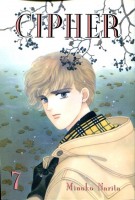
Cipher, Volume 7Cipher, Volumes 7-11 by Minako Narita. Despite being twelve volumes in Japan, for some reason the English-language edition of Cipher was collected in eleven. (It is the complete series, though.) I thoroughly enjoyed the first part of the series, and the sixth volume ends with a fairly dramatic twist, so I was anxious to read the manga’s conclusion. Cipher and Siva, being nearly inseparable growing up and at one point even sharing an identity, are now living apart with the entire country between them. Wracked with guilt, Cipher has moved from New York to Los Angeles, leaving his girlfriend Anise behind along with his twin brother. In general, this second half of Cipher tends to be somewhat more believable than the first, though there are still plenty of parts that aren’t especially realistic. However, Narita does an excellent job of exploring the emotional fallout and the changes in the characters’ relationships with one another that come about as a result of both Cipher and Siva learning to live their lives as individuals and each becoming his own person. New characters are introduced who play a very important role in this evolution, including Cipher’s Los Angeles roommate Hal and Siva’s fellow model Alex. In the end, Anise’s story ends up being secondary to that of the brothers, but she shows growth and development as well.

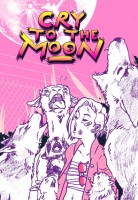
Cry to the MoonCry to the Moon by Various. I discovered Love Love Hill relatively recently, but the collective releases some great comics, so I’ve been making a point to pick up its anthologies. Cry to the Moon, based on the theme of delinquents and animals, is the most recent Love Love Hill comics anthology. The volume includes contributions from eight different creators. I was especially looking forward to Saicoink’s “To My Dear White Dove: A Quiet Love,” a sort of alternate universe side story to her series Open Spaces and Closed Places (which I absolutely love), but I enjoyed the other works that were collected as well. Cry to the Moon has a nice variety of comics that range from the comedic to the bittersweet to the tragic. Many of the stories are based in reality while a few of them incorporate more fantastical elements. Some are only a few pages while others are more lengthy and involved. But no matter the length or the tone of the story, each of the comics collected in Cry to the Moon exhibits heart. What I love about anthologies is the opportunity to experience the different art styles and storytelling techniques of the creators involved. I also appreciate that the individual creators are given space in Cry to the Moon to write about their influences and inspirations for their stories and how they decided to interpret the anthology’s theme.

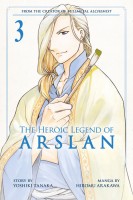
The Heroic Legend of Arslan, Volume 3The Heroic Legend of Arslan, Volume 3 by Hiromu Arakawa. I am largely enjoying The Heroic Legend of Arslan, it’s a great fantasy story with exciting battles and interesting worldbuilding, but I do wish that the characters and plot had a little more complexity and nuance to them. By the end of the third volume, I have some hope that this will eventually happen as the series continues to develop, but right now it’s just not quite there. Characterization in the manga tends to be painted with a fairly broad stroke and heavy hand. Some of the humor, while amusing, doesn’t always mesh well with the overall tone of the series, either. However, there are other things that The Heroic Legend of Arslan is doing well. I particularly like the series’ approach to action scenes and battles. There are plenty of examples of extraordinarily strong fighters showing off their incredibly powerful skills, but strategy and tactics are also incredibly important to how a battle plays out in the end. In the third volume, Arslan and his small contingent of supporters face off against more than a thousand soldiers, but thanks to careful planning, psychological manipulation, and effective use of the geographical terrain, for the most part they are able to come through unscathed.

Showa3Showa: A History of Japan, 1944-1953 by Shigeru Mizuki. This third and penultimate volume of Showa: A History of Japan addresses the time period of that era that I already knew the most about—the end of the Pacific War and the following occupation of Japan by Western forces. Even so, there were things that I learned reading the manga that I never knew before. Showa: A History of Japan continues to be told using two closely intertwined narratives. Mizuki outlines the larger developments of the war and Japan’s reconstruction, but he also incorporates the story of his own experiences and the experiences of his family. It’s this personal touch that makes Showa: A History of Japan especially compelling and hard-hitting as it drives home the tragedy of war and the dire circumstances faced by the soldiers and civilians on both sides of the conflict. Part of the third volume deals with some of the same events found in Mizuki’s Onward Towards Our Noble Deaths, so I was already familiar with some of the story, but that didn’t make its impact any less effective. This volume reveals how Mizuki survived during war against all odds as well as how he survived after the war (another difficult feat), including his beginnings as a kamishibai and manga artist.

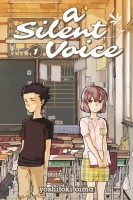
A Silent Voice, Volume 1A Silent Voice, Volume 1 by Yoshitoki Oima. If the volumes that follow the first are anywhere near as strong, A Silent Voice is likely one of the best series to be released this year. (At least in print; technically, the manga started being officially released digitally on Crunchyroll last year.) The first volume of A Silent Voice is both powerful and heartbreaking. The story follows Shoya, a somewhat unlikeable young man and a terrible bully. He learns that his actions have consequences not only for others but for himself as well when he decides to make Shoko, a deaf transfer student, his next target. A Silent Voice doesn’t sugarcoat school bullying, showing just how vicious and cruel kids can be and how quickly they can turn on one another. Perhaps even more tragic is that some of the teachers do very little to put an end to it or to discourage the behavior. In some cases, they seem to even encourage it, or at least allow the bullying to flourish. There is a stunning lack of empathy from almost every character in the series. The majority of A Silent Voice, Volume 1 takes place during Shoya and Shoko’s middle school years. This actually occurs six years before the start of the manga, establishing the complicated nature of Shoya’s feelings toward Shoko and the exploring developments that led him to become the person he now is.

Filed Under: FEATURES, My Week in Manga Tagged With: Cipher, comics, Heroic Legend of Arslan, Hiromu Arakawa, manga, Minako Narita, Showa: A History of Japan, Silent Voice, Yoshitoki Oima

Umineko: When They Cry, Vol. 10

May 31, 2015 by Sean Gaffney

Story by Ryukishi07; Art by Akitaka. Released in Japan in two separate volumes as “Umineko no Naku Koro ni: End of the Golden Witch” by Square Enix, serialized in the magazine Gangan Joker. Released in North America by Yen Press.

While Higurashi was divided into four Question Arcs and four Answer Arcs, Umineko plays it cagier, saying that the last four arcs are ‘Core Arcs’. Getting closer to the truth, but you’ll still have to dig for most of the answers. The first of these arcs, End of the Golden Witch, lives up to that name, as we skip most of the fluff and romance we’ve gotten in earlier arcs and go straight to what’s important: the Epitaph, the Gold, and the Murders. That said, there is one big difference: Lambdadelta and Bernkastel are in charge now, not Beatrice. And, as a result, everything is a bit twisted.

umineko10

Ronove and Virgilia helpfully explain that our replacement game masters can’t do things impossible for Beatrice to do, but they can do things Beatrice WOULDN’T do. We see a bit of that in the scene with Natsuhi and Beatrice having tea together while reminiscing about her honeymoon with Krauss. It’s the sweetest scene in the whole volume, and has absolutely nothing whatsoever to do with solving the game or defeating Beatrice. Yet Bernkastel takes delight in telling us, in Red Truth, that Natsuhi is simply having tea by herself, the conversation never happened. Beatrice used the Red truth to stop Battler going down false paths, or lead him closer to where she wanted him to go. Bern uses the Red Truth to be mean because she finds it hilarious.

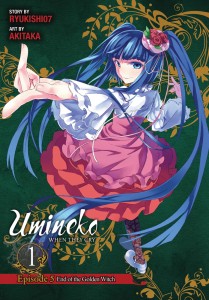
This leads me to the new character that enters the series at this point. That’s her on the cover, Erika Furudo. No, not Rika Furude. No, not Frederica Bernkastel. Ryukishi said in a recent interview that he regards Rika looking like Bern to be similar to Tezuka’s ‘star system’, where Rock or Lamp might show up in any work as a “different” but similar character. Fans of Rika were already a bit surprised that Bern turned out to be a heartless villain (though honestly, they can’t have been TOO surprised… go read Higurashi’s darker moments again). Erika, though, is written entirely to irritate, to annoy, and to make the reader hate her.

I was wondering how Yen Press would handle translation for the scene where Erika sums herself up best, and I am very pleased it’s 100% as fans of the game will remember: Erika, fantasizing about seeing Jessica in tears after the epitaph is solved, leers as she describes herself as an “intellectual rapist” who enjoys wreaking havoc for the sake of it. Which makes sense, given that she’s basically Bernkastel imposing herself on the island as a self-insert. Even when Erika tries to make nice and simply be a goofy, slightly off-kilter young girl, it looks calculated and wrong.

There is another new character we see here, of course, which is the mysterious “man from 19 years ago” who keeps calling Natsuhi on the phone and driving her into hysterics. Natsuhi is accused of the murders by Erika in a sort of flashforward at the start of the book, so we know she’s in for a terrible arc. And indeed, as we’ll see in the next omnibus in September, she is not without horrible crimes in her past. But honestly, Krauss, Natsuhi and Jessica are probably my favorite of the four families, if only as they all clearly love each other and they’re all so BAD at showing it. (Krauss’ foray into Moon Tourism also doesn’t help.) Taking Natsuhi, who has trouble communicating even the most basic feelings of love and affection, and putting her through this is vicious.

We end this volume with what appears to be the First Twilight, so let me briefly discuss the manga adaptation here: it’s excellent. As with all other adaptations, things have been removed and shuffled around, but more than any other this one takes care to include everything important and show how important it is (such as the maid and baby being “lured” off a cliff to their death by golden butterflies and witches). The faces are also nicely done, particularly when Erika, Lambda or Bern is going creepy and horrible on us. And the cliffhangers are well-timed, driving you forward to see what happens next. As far as I can tell, the artist hasn’t really done much other manga, which is a shame; they do a bang up job here.

Umineko is still a wonderfully tense and intricate read, if you can get past the fact that everyone in it is a horrible person. We’ll see how things go once Erika gets to play The Detective next time.

Filed Under: REVIEWS

  • « Go to Previous Page
  • Page 1
  • Interim pages omitted …
  • Page 542
  • Page 543
  • Page 544
  • Page 545
  • Page 546
  • Interim pages omitted …
  • Page 1049
  • Go to Next Page »
 | Log in
Copyright © 2010 Manga Bookshelf | Powered by WordPress & the Genesis Framework