• Skip to primary navigation
  • Skip to main content
  • Skip to primary sidebar
  • Home
  • About Us
    • Privacy Policy
    • Comment Policy
    • Disclosures & Disclaimers
  • Resources
    • Links, Essays & Articles
    • Fandomology!
    • CLAMP Directory
    • BlogRoll
  • Features & Columns
    • 3 Things Thursday
    • Adventures in the Key of Shoujo
    • Bit & Blips (game reviews)
    • BL BOOKRACK
    • Bookshelf Briefs
    • Bringing the Drama
    • Comic Conversion
    • Fanservice Friday
    • Going Digital
    • It Came From the Sinosphere
    • License This!
    • Magazine no Mori
    • My Week in Manga
    • OFF THE SHELF
    • Not By Manga Alone
    • PICK OF THE WEEK
    • Subtitles & Sensibility
    • Weekly Shonen Jump Recaps
  • Manga Moveable Feast
    • MMF Full Archive
    • Yun Kouga
    • CLAMP
    • Shojo Beat
    • Osamu Tezuka
    • Sailor Moon
    • Fruits Basket
    • Takehiko Inoue
    • Wild Adapter
    • One Piece
    • After School Nightmare
    • Karakuri Odette
    • Paradise Kiss
    • The Color Trilogy
    • To Terra…
    • Sexy Voice & Robo
  • Browse by Author
    • Sean Gaffney
    • Anna Neatrour
    • Michelle Smith
    • Katherine Dacey
    • MJ
    • Brigid Alverson
    • Travis Anderson
    • Phillip Anthony
    • Derek Bown
    • Jaci Dahlvang
    • Angela Eastman
    • Erica Friedman
    • Sara K.
    • Megan Purdy
    • Emily Snodgrass
    • Nancy Thistlethwaite
    • Eva Volin
    • David Welsh
  • MB Blogs
    • A Case Suitable For Treatment
    • Experiments in Manga
    • MangaBlog
    • The Manga Critic
    • Manga Report
    • Soliloquy in Blue
    • Manga Curmudgeon (archive)

Manga Bookshelf

Discussion, Resources, Roundtables, & Reviews

Blog

Bookshelf Briefs 4/6/16

April 6, 2016 by Michelle Smith and Sean Gaffney Leave a Comment

Presented with apologies for the delay.

bloody2Bloody Mary, Vol. 2 | By Akaza Samamiya | VIZ Media – For a moment there, I thought I could grow to really like Bloody Mary. Perhaps it was all the slashy situations that were happening, but the atmosphere briefly coalesced into something equal parts nifty and creepy. Unfortunately, this didn’t last long, and I was soon irritated by the nebulous nature of the narrative. Perhaps just a couple more explanatory panels would help, as I kept going, “Wait, why are they breaking into that mansion again?” Why is this happening? Why is that happening? A revelation that should be big lands with a squelchy plop. There’s potential here, for sure, and I’m not ready to give up, but I’m still underwhelmed for the time being. – Michelle Smith

haganai13Haganai: I Don’t Have Many Friends, Vol. 13 | By Yomi Hirasaka and Itachi | Seven Seas – The latter half of this book is merely OK, setting up what promises to be the next big arc by introducing a student council girl with a grudge against Sena, and teasing Sena and Kodaka’s engagement. But let’s face it, this volume’s big, big reason to read it is that first chapter with Rika, as we hear her run up against Kodaka’s hardcore determination to ignore any forward development in this series, and it nearly causes her to snap. The elephants in the room—that the group is already friends (and thus the club’s purpose is complete), and that he has at least 3 girls in love with him, is something Kodaka is desperately trying to forget, and it can’t last much longer. Very well done. – Sean Gaffney

onlyvamp6He’s My Only Vampire, Vol. 6 | By Aya Shouoto | Yen Press – I have to admit, Aya Shouoto continues to have a slight pacing problem that I can’t quite put my finger on but bothers me. I think it’s typified in this volume by Kana’s escape and training, which happens completely offscreen through a character we had no idea was on her side. Sadly, we don’t see that; we see Aki angst instead. Which is fine, I mean, it’s quality angst, but I have to admit I wanted to read something different than the author was giving me. Kana does get more to do in the second half, but for the wrong reasons—amnesia has reared its ugly head, as it always does whenever a shoujo couple dares to resolve its feelings before the series can end. This is still good, but highly uneven. – Sean Gaffney

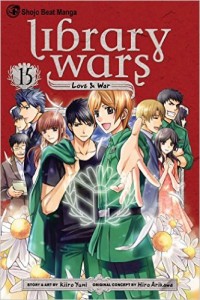
lw15Library Wars: Love & War, Vol. 15 | Original Concept by Hiro Arikawa, Story and Art by Kiiro Yumi | VIZ Media – Library Wars hasn’t been the most brilliant series ever, but its characters consistently put a smile on my face. That is especially true of this satisfying final volume, in which Iku completes a solo mission admirably well (while drawing on the attributes of her team for comfort and inspiration) and finally clearly communicates her feelings to Dojo. A three-year fast-forward shows us some glimpses of what’s become of the cast, and it’s all pretty great. (Avoiding most spoilers, I will only say the photograph at the end cracked me up.) There is a spinoff/sequel of sorts out there, and I really hope VIZ licenses it at some point, because these are characters I’d like to revisit someday. – Michelle Smith

mlm13My Little Monster, Vol. 13 | By Robico | Kodansha Comics – Let’s face it, this manga is a victory lap. But it’s well-deserved, and I greatly enjoyed most of it (the fanbook section, while nice to have, featured a lot of 4-komas and profiles that didn’t add much.) Loved the Natsume and Sasayan story, of course, but Iyo’s was also very good. I was less enamored with Oshima and Takaya, but you can’t say it wasn’t signposted. Best of all, though, we get a wedding, which I figured after the ending to twelve would get skipped over. It’s almost a sideplot to Takaya trying to get his love taken seriously, but Shizuka is amazing as always—the shot of her in her bridal gown chugging tea is marvelous. I will miss you, My Little Shoujo Series. Though at thirteen volumes, not too little. – Sean Gaffney

ofthered2Of the Red, the Light, and the Ayakashi, Vol. 2 | By nanao and HaccaWorks* | Yen Press – The pacing of this second volume is somewhat slow, and at times it becomes easy to tell that this is based off a visual novel, and is trying to keep a lot of the basics. I also admit that I have trouble telling two of the three leads apart, both being blonds with hair about the same length. That said, as with the first volume, the title works best when establishing a creepy and unsettling mood, as you gradually realize that this is not your typical Japanese town, and that a lot of people know what’s going on here more than our three heroes. I’m not sure how well this will end—certainly if the cute little sister gets ‘erased’ I think I’m out—but right now it’s intriguing enough to keep going. – Sean Gaffney

rosegun1-3Rose Guns Days Season One, Vol. 3 | By Ryukishi07 and Soichiro | Yen Press – Well, I suppose I asked for this, as I said last time that I wish Rose’s shiny idealism would get some more depth. And so we get this volume, in which all is in ruins, our heroes are scattered to the four winds, and Rose is literally tortured for her beliefs, and emerges almost completely broken. The keyword being almost, of course—she still has Leo and a few others, and even Stella and Meryl admit that while they were planning on double-crossing Rose before, that’s not happening now. I expect the final volume of this ‘season’ will be wall-to-wall action, but how cynical will Rose get? We shall see. Also, see if you can spot the Higurashi in-jokes this time. Recommended only for fans of Ryukishi07’s work. – Sean Gaffney
Filed Under: Bookshelf Briefs

Manga Giveaway: Princess Jellyfish Giveaway Winner

April 6, 2016 by Ash Brown

Princess Jellyfish, Omnibus 1And the winner of the Princess Jellyfish manga giveaway is… Laura!

As the winner, Laura will be receiving a copy of the first omnibus in Kodansha Comic’s English-language edition of Akiko Higashimura’s Princess Jellyfish. There are quite a few manga releases that I’m looking forward to in 2016, but the debut Princess Jellyfish in English was one of my most highly-anticipated. I was curious to know what other upcoming manga people were excited about, so for this giveaway I asked participants to tell me a little about some of the manga they’re looking forward to. Check out the giveaway comments for the detailed responses, and check out below for the compiled list of manga mentioned (plus a few more that I’ve added for good measure).

Some upcoming manga releases to look forward to in English:
Blame! by Tsutomu Nihei
Don’t be Cruel by Nekota Yonezou
Dissolving Classroom by Junji Ito
A Distant Neighborhood by Jiro Taniguchi
The Gods Lie by Kaori Ozaki
Guardians of the Louvre by Jiro Taniguchi
Haikyu!! by Haruichi Furudate
I Am a Hero by Kengo Hanzawa
In/Spectre written by Kyo Shirodaira, illustrated by Chasiba Katase
Magia the Ninth by Ichiya Sazanami
Neo Parasyte F by Various
Nichijou by Keiichi Arawi
The Osamu Tezuka Story by Toshio Ban
Princess Jellyfish by Akiko Higashimura
Orange by Ichigo Takano
Otherworld Barbara by Moto Hagio
Queen Emeraldas by Leiji Matsumoto
Rose of Versailles by Riyoko Ikeda
Sherlock: A Study in Pink by Jay
A Silent Voice by Yoshitoki Oima
Sweetness and Lightning by Gido Amagakure
That Wolf-Boy Is Mine! by Yoko Nogiri
Tsubasa: Reservoir Chronicle by CLAMP
Welcome to the Ballroom by Tomo Takeuchi
Yona of the Dawn by Mizuho Kusanagi

Thank you to everyone who took the time to share their excitement with me; quite a few of the manga that were mentioned are releases that I’m looking forward to a great deal as well. This should be a great year for manga!

Filed Under: Giveaways, UNSHELVED Tagged With: Akiko Higashimura, manga, Princess Jellyfish

Shoulder-a-Coffin Kuro, Vol. 5

April 5, 2016 by Sean Gaffney

By Satoko Kiyuduki. Released in Japan as “Hitsugi Katsugi no Kuro – Kaichu Tabi no Wa” by Houbunsha, serialization ongoing in the magazine Manga Time Kirara. Released in North America by Yen Press.

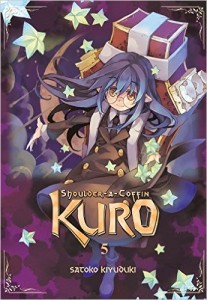
It can at times be rather hard to believe that this mostly dark and surreal fantasy series can come from the same author as GA Art Design Class, a 4-koma series about the adventures of five girls in art college. But there are moments when the two series seem to connect more than you’d expect. Kiyuduki frequently believes in “show, don’t tell” in regards to not only her plot but also her characterization, leaving the reader to guess much of what’s going on; we sometimes see this with The Professor in GA. Likewise, Kisaragi’s surreal and sometimes unnerving dream sequences could easily fit into Kuro – indeed, Kisaragi and Kuro look similar enough that you could headcanon this as one long nightmare she’s having. Because it does feel more and more like a nightmare – Kuro’s not getting as many fluffy stories as it did back in Volume 1.

kuro5

Part of the reason for that might be that this volume gives us a lot more background on the witch that has supposedly cursed Kuro – we see what may be a sort of origin story for her, and a story where we see her own journeys, which appropriately mirror Kuro’s. But I think it’s simply that almost all the stories in this volume deal with death and being unable or unwilling to move on. Three very different young women meet unfortunate ends but want to leave something behind. A balloon race seems to literally end up in heaven. Kuro, Nijuku and Sanju end up in a valley where perspective and illusions seem like an optional extra, and Kuo once again cannot let go of what she regards as the things that make her what she is – her hat and coffin. Even the happiest story in this volume involves a cursed painter whose subjects all seem to die right after they’re painted. Luckily, Kuro can’t seem to die, so that’s one problem solved.

The second half of the book gets even more chilling, at times almost seeming to descend into pure horror. Two sisters are offered a grim bargain by the Witch, and Kuro has to deal with the consequences, once again taking on someone else’s suffering into her own body. b The last story introduces us to what seems like another in Kuro’s long line of spunky female merchant girls she seems to run into, only to find that reality is murderously different. And this also gives us the reason for Kuro’s journey. Yes, she’s trying to seek death, but in order to do that, she has to take in life as well, because without life death is meaningless. It’s something that the witch doesn’t quite understand, and even Kuro isn’t really confident in her feelings till the end of this book. But it’s true, and also a reminder of the depth and quality of the stories in this volume. Anyone who likes dark, thoughtful fantasy should be reading this, no exceptions.

Filed Under: REVIEWS

Pick of the Week: Love & War

April 4, 2016 by Michelle Smith, Sean Gaffney, Anna N and Ash Brown 1 Comment

lw15MICHELLE: Having a series finale in the mix makes my pick so much easier! I am eager for more Food Wars! and Honey So Sweet especially, but the one can’t-delay title for me this week is volume 15 of Library Wars. It has occasionally been a bit frustrating, but its charms have kept me hooked ’til the end.

SEAN: It is absolutely Library Wars for me. It has romance, it has action, it has resolution, it has epilogues, it has character growth, and it has amusing facial expressions. Who could ask for anything more?

ANNA: I have to agree, I love Library Wars in general for being a series that is so much better than its premise about librarians fighting censorship with guns, but I also love it as a librarian. Never has my profession been so cool in popular culture.

ASH: Likewise, I’m all about Library Wars this week! The series can at times be somewhat ridiculous, but as another librarian and as a fan, I enjoy its action, comedy, and romance tremendously.

Filed Under: PICK OF THE WEEK

My Week in Manga: March 28-April 3, 2016

April 4, 2016 by Ash Brown

My News and Reviews

A couple of different things were posted at Experiments in Manga last week. For starters, since it’s the end of one month and the beginning of another, it’s time for another manga giveaway! There’s still an opportunity to enter for chance to win the first omnibus of Akiko Higashimura’s wonderful Princess Jellyfish. I also posted an in-depth review last week of The Autobiography of Yukichi Fukuzawa, which is an engaging work in addition to being surprisingly entertaining and humorous. Fukuzawa helped to shape modern-day Japan; I was inspired to pick up his autobiography after reading Minae Mizumura’s The Fall of Language in the Age of English.

Quite a few Kickstarter projects have caught my attention over the last week or so. I’m especially excited to see that Sparkler Monthly has launched a campaign to release the first volume of Jenn Doyle’s Knights-Errant in print. The Comic Book Legal Defense Fund launched a project for She Changed Comics, a book that will profile women comics creators from around the world, including Moto Hagio, Machiko Hasegawa, Rumiko Takahashi, the Year 24 Group, and others. There’s an illustration zine inspired by and dedicated to gay manga called Burl & Fur that looks like it will be amazing. As promised, Digital Manga’s most recent classic manga Kickstarter is for a non-Tezuka title—Izumi Matsumoto’s Kimagure Orange Road. Finally, I wanted to take the opportunity to mention the campaign for the North American release of the Skip Beat! anime again. The series needs financial support in order to be dubbed, which is a requirement by the licensor for its release.

Quick Takes

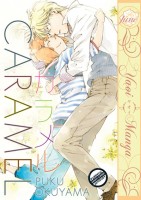
CaramelCaramel by Puku Okuyama. The cover art of Caramel makes it look like a cute and sweet boys’ love one-shot, and at times that’s exactly what it is, but there’s enough about the story and the leads’ relationship that’s dubious and questionable that overall I can’t say that I really enjoyed it all that much. Part of the point of Caramel is the contrast between the two main characters, Roku and Iori, each of whom is childish in his own way. Roku is a successful businessman who is afraid of the dark and picky about his food. Iori has just moved to Tokyo to begin his first year of university, and being younger has had less experience in life and love. I think most of my annoyance with Caramel stems from Roku—I have little patience for and a difficult time sympathizing with adults who exhibit such an astounding lack of self-responsibility, not to mention that he’s an utter creep at first. I have no idea how he even survived before Iori became his roommate and eventual lover. Iori, on the other hand, I found to be much more likeable. He’s the oldest of four siblings and so has developed into a very responsible young adult. Iori also loves to cook and I liked how food was incorporated into Caramel.

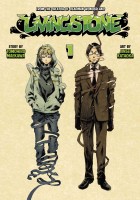
Livingstone, Volume 1Livingstone, Volume 1-2 written by Tomohiro Maekawa and illustrated by Jinsei Kataoka. I’m not especially familiar with Maekawa, a respected playwright and director, but I recognized Kataoka as one of the creators of the manga series Deadman Wonderland. One of Maekawa’s short plays provides the inspiration for Livingstone, a largely episodic manga exploring themes of life, death, and the human soul. The series follows Sakurai and Amano who help to collect and preserve psycholiths, stones that are the physical manifestations of human souls after they have left their respective bodies. Though at this point frustratingly incomplete, I find the worldbuilding in Livingstone to be one of the most fascinating aspects of the manga, especially in regards to souls. There are a limited number of souls and the world is beginning to run out so that some people, like Amano, are born without them, which is one reason that the work of psycholith collectors is so important. Additionally, souls that are irrevocably damaged at the end of a person’s life will shatter, leaving behind psychic stains that will continue to contaminate others unless the cycle can be stopped.

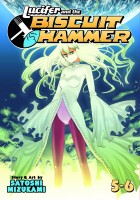
Lucifer and the Biscuit Hammer, Omnibus 3Lucifer and the Biscuit Hammer, Omnibuses 3-4 (equivalent to Volumes 5-8) by Satoshi Mizukami. I’m definitely behind in reading Lucifer and the Biscuit Hammer but I do enjoy the manga. It’s a rather peculiar series with oddball characters who are in the position to either save the world or destroy it—the line between heros and villains can be very thin. Most of the characters have something dark or tragic about their pasts, so their feelings about the world and the other people in it are understandably conflicted. Tragedy isn’t limited to their pasts, either. These two omnibuses include multiple deaths that have great impact, as well as other moments of pain and devastation. But the characters also grow and overcome many of these challenges, becoming stronger mentally and emotionally as well as physically. There are betrayals, both real and imagined, as well as love confessions as friendships and relationships change, some characters drifting apart while others are realizing that people might not be so bad after all. All of this interpersonal drama plays out against the backdrop of a literal battle against monsters as the series ramps up the danger in preparation for its finale.

Filed Under: FEATURES, My Week in Manga Tagged With: Jinsei Kataoka, Livingstone, Lucifer and the Biscuit Hammer, manga, Puku Okuyama, Satoshi Mizukami, Tomohiro Maekawa

Library Wars: Love & War, Vol 15

April 3, 2016 by Anna N

Library Wars: Love & War Volume 15 by Kiiro Yumi and Hiro Arikawa

When I started reading this series, I admit I was drawn to it more due to the premise than the execution, because it is a rare thing for there to be a manga about librarians organized as a fighting force to combat censorship. But as the series continued to grow, the simple slowly developing romance between Kasahara and Dojo became more and more interesting, and the supporting characters began to be more multidimensional, causing Library Wars to be one of the most emotionally satisfying Shojo Beat series, even if it doesn’t have terribly flashy art.

There’s never really any question where this series will end up, and with the ending telegraphed from the start the focus is much more on how the characters all get a version of a happy ending. For a character that struggles with being competent, with her main advantage being on improvisation and action, Kasahara’s strategic thinking is the main focus of the final story as she ably plots a way for an author to defect and save himself from censorship. She’s all alone, and manages her mission capably, finally showing that she’s grown up and can take care of herself and others. It is fitting that the final romantic confession and resolution only happens after Kasahara has fully realized her true potential.

lw15

The resolution is everything that fans of the series would have hoped for, and there are enough cameo appearances from the supporting cast that everything feels nicely wrapped up. Library Wars will always have a special place on my bookshelf not only for the awesome but slightly silly images of librarians fighting off censorship with automatic weapons, but also because the romance in the manga is genuinely heartwarming.

Filed Under: REVIEWS Tagged With: library wars, shojo beat, shoujo, viz media

Nichijou, Vol. 1

April 3, 2016 by Sean Gaffney

By Keiichi Arawi. Released in Japan by Kadokawa Shoten, serialized in the magazine Shonen Ace. Released in North America by Vertical Comics.

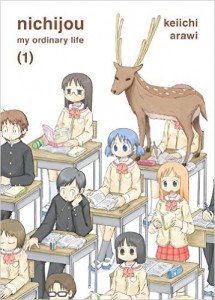
I have a weakness for gag manga, as some of you may have noticed, and also a weakness for high school slice-of-life starring a bunch of quirky high school girls. It should be no surprise, therefore, to learn that I have been awaiting the release of Nichijou for some time. It was initially licensed by Bandai Entertainment about 5 years ago, but they folded their US manga division before it could even get a volume out. That said, the anime did appear over here, and was quite popular – in fact, arguably far more popular than it ended up being in Japan. And so Vertical, which has been dipping its toes into the surreal gag world with titles like My Neighbor Seki, now introduces us to a very unordinary manga.

nichijou1

Nichijou has quite a large ensemble cast, but for the most part is the adventures of five girls. Three of them, Yuuko, Mio, and Mai, are classmates at the local high school. Yuuko is peppy, somewhat dense, and very fond of attempting to make jokes that no one finds funny but her. Mio is the “normal” girl in the csat, but that’s only a matter of degrees, as we discover when she realizes her secret yaoi manga doodle is about to be discovered and becomes Superwoman. Mai is my personal favorite, a quite and shy girl who loves to bait and get reactions from Yuuko, I suspect as it’s the only way she can really show her feelings. There are apparently fans of Nichijou who dislike Mai for her gadfly nature, but these people are objectively wrong, so there’s no need to worry about them.

The other two main cast members are Nano, a robot girl who also attends class and her child genius inventor Professor, who’s a genius at making robots but an immature child in almost every other sense. Those familiar with the anime might be taken aback by Nano appearing in class right away – the anime decided to move all the stories with her in class to the second half of the series, the better to separate the ‘school’ and ‘Professor’s house’ segments of the show. We also meet a few other amusing minor characters here, like the farmer’s son who acts like a stereotypical rich boy, and the parody of tsunderes who can be seen literally blowing people’s brains out (though they’re fine a panel later – this is essentially a cartoon, in the Western Looney Tunes sense).

There’s not a lot to review in Nichijou beyond the gags, which I don’t want to spoil if you haven’t seen them. As with most manga of this sort, the humor can be found in facial reactions, and Arawi is very, very good at these – check out Chapter 9 for the best example. The girls are cute as well, but there is a blissful lack of fanservice that I also greatly appreciate, and there don’t seem to be any obvious romances besides the one-sided crushes Mio and the tsundere parody have. Nichijou is content to make jokes and be strange, and if it has to choose between being funny or being strange, it will pick the latter. If you like laughing, or if you like tilting your head and going “wuh?”, either way you’ll enjoy this.

Filed Under: REVIEWS

The Autobiography of Yukichi Fukuzawa

April 1, 2016 by Ash Brown

The Autobiography of Yukichi FukuzawaAuthor: Yukichi Fukuzawa
Translator: Eiichi Kiyooka
U.S. publisher: Columbia University Press
ISBN: 9780231139878
Released: January 2007
Original release: 1897

Yukichi Fukuzawa—scholar, translator, author, and educator, among many other things—is one of Japan’s most influential historical figures of the modern era, helping to shape the country as it is known today. As the founder of Keio University whose writings continue to be taught and whose likeness appears on the 10,000 yen banknote, there are very few Japanese to whom Fukuzawa is entirely unknown. Fukuzawa’s life was recently brought to my attention while reading Minae Mizumura’s The Fall of Language in the Age of English which discussed some of his influence and included excerpts of his autobiography. Intrigued by this, I decided to read the work in its entirety. The Autobiography of Yukichi Fukuzawa was originally dictated by Fukuzawa in 1897. The first English translation by Eiichi Kiyooka, Fukuzawa’s grandson, appeared in 1934 and was later revised in 1960. Many editions of The Autobiography of Yukichi Fukuzawa have been released in English, but the most recent was published in 2007 by Columbia University Press.

The Autobiography of Yukichi Fukuzawa originated from a request by a foreigner interested in Fukuzawa’s account of the time period leading up to and surrounding the Meiji Restoration in 1868. Fukuzawa narrated the story of his life fairly informally in 1897 and soon after edited, annotated, and published the transcribed manuscript. He intended to write a more formal and comprehensive companion volume, but he died in 1901 before it was completed. The Autobiography of Yukichi Fukuzawa begins with Fukuzawa’s childhood and follows his life into his old age. Fukuzawa was born in 1835 in Osaka into a samurai family originally from Nakatsu, where he grew up. From an early age, Fukuzawa showed interest in Western learning, first studying Dutch (at the time the only foreign influence permitted within Japan) and the eventually English. He was very passionate about language as a tool to access new knowledge and understanding, and he served on multiple missions to America and Europe as an interpreter and translator. But his interest in the West also put him in danger during a time when anti-foreign sentiment was rampant in Japan.

The various editions of The Autobiography of Yukichi Fukuzawa available in English are primarily distinguished by the accompanying materials included to supplement Fukuzawa’s main text. The most recent release from Columbia University Press offers several useful additions, some of which were available in previous editions or which were published elsewhere. Albert Craig, an academic and historian whose work focuses on Japan, provides the volume’s foreword as well as its lengthy afterword “Fukuzawa Yukichi: The Philosophical Foundations of Meiji Nationalism.” Originally published in 1968 in the the volume Political Development in Modern Japan, the afterword places Fukuzawa and his ideals into greater historical and political context. Also included in Columbia’s recent edition of The Autobiography of Yukichi Fukuzawa are two appendices—a chronological table outlining the events in Fukuzawa’s life and in world history and a translation of Fukuzawa’s influential essay “Encouragement of Learning”—as well as copious notes and an index.

The Autobiography of Yukichi Fukuzawa is a surprisingly engaging, entertaining, and even humorous work. In his autobiography, Fukuzawa comes across as very amicable, down-to-earth, and forward-thinking. I particularly enjoyed Fukuzawa’s invigorating account of his experiences as a young man who was devoted to his studies, but who would also willingly participate in the revelry, antics, and pranks of his fellow students. Speaking of how drunken “nudeness brings many adventures” and such other things greatly humanizes a person primarily known for his impressive accomplishments. As Fukuzawa matured, he played a pivotal role in the development of the Japanese education system. While he introduced many Western concept and ideas in his pursuit of knowledge, at heart Fukuzawa was a nationalist who abhorred the violent methods of many of his contemporaries. The Autobiography of Yukichi Fukuzawa provides not only a fascinating look into the life of Fukuzawa, it provides a glimpse into a particularly tumultuous and transformative period of time in Japan’s history.

Filed Under: REVIEWS Tagged With: Nonfiction, Yukichi Fukuzawa

Manga the Week of 4/6

March 31, 2016 by Sean Gaffney, Ash Brown, Michelle Smith, Anna N and MJ Leave a Comment

SEAN: This is it, folks. We’ve hit peak manga boom. Every week of next month has at least 15 titles out. All you can do is whimper, really. What’s out next week? Well…

Kodansha gives us an 18th volume of Attack on Titan, which is such an obscure title with very few readers. To try to pump up that readership, there’s also a limited edition with a DVD!

And there’s a 4th volume of oddball shoujo romance Kiss Him, Not Me!.

ASH: I’ve already fallen behind, but I do enjoy oddball shoujo!

SEAN: Seven Seas gives us a third volume of Ten Little Lesbians sitting down to dine, aka Akuma No Riddle.

Haganai: I Don’t Have Many Friends has an unlucky 13th volume. We left off with Kadota and Sena engaged. I suspect that won’t last.

zombie1

Seven Seas is debuting a zombie title, Hour of the Zombie. This runs in Comic Ryu, and is apparently a pure horror series.

Udon has a 2nd volume of clothes and fanservice battle manga Kill La Kill.

And Vertical gives us a 4th omnibus of Tokyo ESP.

MICHELLE: Yay! I enjoyed part one of the series quite a lot and am looking forward to more of the story.

SEAN: Viz, believe it or not, has no debut titles this month. But that doesn’t stop them from giving us many, many volumes of its ongoing series, like the 9th Assassination Classroom.

The Demon Prince of Momochi House gives you more Aya Shouoto with a 4th volume.

ANNA: I enjoy this series, as you might expect.

SEAN: And Food Wars! is still having intense food competitions in Vol. 11.

MICHELLE: I delayed on reading volume 10 just so I could enjoy a two-volume binge. Looking forward to it!

SEAN: Honey So Sweet has a 2nd volume. How sweet is it? You’ll just have to read.

ANNA: Pretty darn sweet!

SEAN: The 15th volume of Library Wars: Love & War wraps up the story, despite hints of some side-story volumes that don’t appear to have materialized. Luckily, the final volume is immensely satisfying, and will make fans very happy.

MICHELLE: I’m looking forward to this, too!

ASH: As am I!

ANNA: Me too, although I have an odd habit of postponing reading the final volumes of series I really like, so I can lie to myself that the series hasn’t actually ended.

mls8

SEAN: Speaking of immensely satisfying, that’s how you can describe every volume of My Love Story!! really, and I suspect the 8th is no different.

ANNA: Yes! I always read this right away when a new volume shows up at my house.

ASH: My Love Story!! is the best.

MJ: Yes!!

SEAN: Naruto has a 14th 3-in-1, meaning it’s still nowhere near done.

Nisekoi Vol. 14 does what ever fan of harem manga hates – introduces a new main candidate late in the series.

School Judgment has a 2nd volume of chibi-Ace Attorney antics, and hopefully will continue to be slightly ridiculous.

And I have no doubts as to the ridiculousness of So Cute It Hurts!! 6, though I fear I must give up my vow of adding exclamation points with each book.

Toriko is up to Vol. 33, and I am starting to hear mutterings of people who wish it would be more about food and less about battles, to which I remind them this runs in Shonen Jump, concurrently with Food Wars!, which IS more about food than battles.

Twin Star Exorcists is getting an anime very soon, so it’s a perfect time for its 4th volume.

Lastly, Yu-Gi-Oh 5D’s 9 continues to look like some sort of World War II secret code.

Are you prepared for SO MUCH MANGA? No? Well, tough.

MICHELLE: No. However, I must say it’s lovely to see all of this activity in a once-troubled publishing sector.

ASH: True that!

Filed Under: FEATURES, manga the week of

Log Horizon: Game’s End, Part 2

March 31, 2016 by Sean Gaffney

By Mamare Touno and Kazuhiro Hara. Released in Japan by Enterbrain. Released in North America by Yen On.

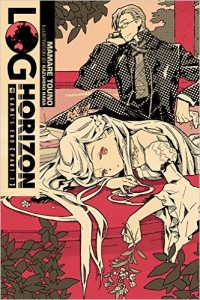
As I’ve said many times before, Log Horizon has a bit of a fandom war with a similar series, Sword Art Online. It’s something of a one-sided war, given that SAO has about 10 times the number of fans LH does, but being #2, Log Horizon fans try harder. And one thing that comes up in complaining about SAO is how Kirito is the sort of self-insert perfect hero type who always gets all the attention and the girls. This contrasts with Shiroe in Log Horizon… somewhat. Shiroe’s not a front-line combatant, being more of a general and tactician. And there are many girls in the series who seem totally uninterested in him. This is perhaps balanced by the events at the end of this book, in which he reveals that with a properly written contract, he appears to have the power to resurrect the dead and create life. Which is something Kirito could never do. (Isn’t it sad, Sachi?)

lh4

Of course, Shiroe’s role in this book is not as big as it has been, mostly as the cast continues to be fleshed out and expanded. On the cover we have Crusty and Reinesia, two similar characters who are able to project a veneer of serenity and competence even though they’d rather be doing something else. And, as we find in this book, both are able to supporess their lazy impulses when the need arises. Reinesia impressed me the most in this entire book, showing off impressive political acumen in cutting through all the red tape and ego tripping of the Council arguments and realizing what had to be done. And then she goes and does it, despite being forced to dress in a revealing Valkyrie costume “for morale reasons” and getting exposed to horrific battles (and, even more terrifying, Crusty loving those battles). I really hope to see more of her soon.

Meanwhile, we discover the terrible secret of Rundelhaus, though admittedly we don’t get the extensive background story I was expecting. He’s an NPC who desperately wants to be a hero, and has tried even harder than the others, despite the fact that the game itself won’t let him level up as much. So, naturally, he’s killed in combat, which leads to Shiroe doing what I said he did in the first paragraph. I had sort of hoped that this would lead to Isuzu finally treating him like a man instead of a big dog, but to no avail. Actually, shippers will be happy-yet-left-wanting with the ending, in which no less than four ships get teases but that’s about it. Also, I am amused that it became so obvious Akatsuki had done next to nothing since the first book that she actually whines about it here.

Log Horizon continues to do a very good job of building a world logically based on “what if we were trapped in a game” mechanics, with the plot of these two books being particularly clever, as it relies on the adventurers not doing something due to the crisis, and the consequences being horrible. I do wonder if we’ll ever see the original core trio battling together again, though. Perhaps next time.

Filed Under: REVIEWS

  • « Go to Previous Page
  • Page 1
  • Interim pages omitted …
  • Page 494
  • Page 495
  • Page 496
  • Page 497
  • Page 498
  • Interim pages omitted …
  • Page 1049
  • Go to Next Page »
 | Log in
Copyright © 2010 Manga Bookshelf | Powered by WordPress & the Genesis Framework