• Skip to primary navigation
  • Skip to main content
  • Skip to primary sidebar
  • Home
  • About Us
    • Privacy Policy
    • Comment Policy
    • Disclosures & Disclaimers
  • Resources
    • Links, Essays & Articles
    • Fandomology!
    • CLAMP Directory
    • BlogRoll
  • Features & Columns
    • 3 Things Thursday
    • Adventures in the Key of Shoujo
    • Bit & Blips (game reviews)
    • BL BOOKRACK
    • Bookshelf Briefs
    • Bringing the Drama
    • Comic Conversion
    • Fanservice Friday
    • Going Digital
    • It Came From the Sinosphere
    • License This!
    • Magazine no Mori
    • My Week in Manga
    • OFF THE SHELF
    • Not By Manga Alone
    • PICK OF THE WEEK
    • Subtitles & Sensibility
    • Weekly Shonen Jump Recaps
  • Manga Moveable Feast
    • MMF Full Archive
    • Yun Kouga
    • CLAMP
    • Shojo Beat
    • Osamu Tezuka
    • Sailor Moon
    • Fruits Basket
    • Takehiko Inoue
    • Wild Adapter
    • One Piece
    • After School Nightmare
    • Karakuri Odette
    • Paradise Kiss
    • The Color Trilogy
    • To Terra…
    • Sexy Voice & Robo
  • Browse by Author
    • Sean Gaffney
    • Anna Neatrour
    • Michelle Smith
    • Katherine Dacey
    • MJ
    • Brigid Alverson
    • Travis Anderson
    • Phillip Anthony
    • Derek Bown
    • Jaci Dahlvang
    • Angela Eastman
    • Erica Friedman
    • Sara K.
    • Megan Purdy
    • Emily Snodgrass
    • Nancy Thistlethwaite
    • Eva Volin
    • David Welsh
  • MB Blogs
    • A Case Suitable For Treatment
    • Experiments in Manga
    • MangaBlog
    • The Manga Critic
    • Manga Report
    • Soliloquy in Blue
    • Manga Curmudgeon (archive)

Manga Bookshelf

Discussion, Resources, Roundtables, & Reviews

Blog

Yona of the Dawn, Vol. 1

August 13, 2016 by Sean Gaffney

By Mizuho Kusanagi. Released in Japan as “Akatsuki no Yona” by Hakusensha, serialization ongoing in the magazine Hana to Yume. Released in North America by Viz. Translated by JN Productions, Adapted by Ysabet Reinhardt MacFarlane.

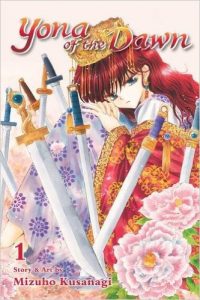
The cover to this first volume features our heroine, Yona, surrounded by swords, and on the back cover we see her confidently wielding one. But on the front she’s looking at them with a look of melancholy, and I feel that this fits the tone of the volume. For although this is the story of a princess who will take up the sword and become a warrior, we’re not there yet. Instead, what we get here is a sweet, sheltered young girl with a crush on her cousin and childhood friend and an antagonistic relationship with her bodyguard and other childhood friend. In other words, were it not for the fantasy castle setting, this could easily be any other shoujo high school romantic comedy. Then… things happen.
yona1

The layout of this volume actually ends up being very odd. We start off with the love triangle setup, and then things rapidly turn serious and deadly with the murder of Yona’s father, the king. We’re told that, as a king, he wsa rather conciliatory, so it’s no great surprise that someone wishes to replace him, but it’s still a chapter of Yona avoiding also being put to death and running for her life. The second half of the book is a series of flashbacks, told as Yona and Hak (the aforementioned bodyguard) hide in the woods and deal with things like leeches and snakes, things that Yona is clearly totally unfamiliar with. The flashbacks show us more of the relationship between Yona, Hak and Su-won (said cousin she’s in love with, and again it’s really sweet and shoujo-ey, as she turns to Hak for advice on how to deal with suitors she doesn’t want, and how they all get colds as kids after a snowball fight and the King tries to make broth for them, which is ridiculously awful but makes her happy.

In other words, we are shown a tragedy, then we get to see why it was so tragic after the fact. Yona’s father does indeed seem to be a rather ineffectual king most of the time, though there’s a hint or two that this is all just a facade. There’s also some backstory that I’m sure will be developed more later, with Su-Won’s father having been killed before the book began, and various tribes (there are five, and one is the “wind tribe”, so I won’t be surprised if we see a water and fire tribe at some point down the road) all jostle for political influence. And then there’s Hak, who is apparently an incredibly strong warrior, but is also devoted to Yona, both because he was “tricked” into doing it by her father, and also because he clearly loves her, though he keeps that hidden for now.

Yona of the Dawn’s first volume is good setup, with an interesting story structure, and I look forward to seeing how its naive and sheltered heroine becomes the confident swordslinger on the back cover. Oh, and we also have a serious dark-haired good guy and a nice but secretly evil blond bad guy as rivals for Yona’s affection, for those of you who play shoujo manga bingo.

Filed Under: REVIEWS

Random Musings: Wrapping Up the Horror Manga Monthly Review Project

August 12, 2016 by Ash Brown

MushishiLiveActionOver the last few years one of the features at Experiments in Manga has been a monthly manga review project. What makes these reviews any different from the rest found on the site? Not much, really, except that the readers of Experiments in Manga actually helped to choose the manga that would be featured. The subject of my third monthly manga review project was put up for a vote about a year and a half ago. I narrowed down the genre to horror–using a very broad definition of horror–and selected five options from which readers could pick: After School Nightmare by Setona Mizushiro, Dorohedoro by Q Hayashida, Mushishi by Yuki Urushibara, Nightmare Inspector by Shin Mashiba, and Tokyo Babylon/X by CLAMP.

Much to my surprise, there ended up being a tie between After School Nightmare and Mushishi. So, instead of trying to come up with some arbitrary way to choose one series over the other, I decided that I would simply review both of them. Between December 2014 and July 2016 I alternated between the two series until I had reviewed every volume of the manga. I also wrote a bonus Adaptation Adventures feature for Mushishi which provided a brief overview comparing and contrasting some of the series’ adaptations. One thing that I personally found interesting about this particular review project was that while I already knew that I loved Mushishi (I simply hadn’t previously written much about it at Experiments in Manga), After School Nightmare was a manga that I had started but never finished and so didn’t know what my overall impression of the series would be.

As was the case with my past two review projects (namely Blade of the Immortal and the Year of Yuri), I greatly enjoyed delving into After School Nightmare and Mushishi as part of the horror manga review project. Though both series share some similarities, such as strong psychological elements, a unsettling atmospheres, and an ominous sense of foreboding, they are still very different from each other. One particularly notable difference between the two is how each manga approaches and treats themes of life and death. Life in Mushishi is something that is held as sacred in which one person is part of a much greater whole; in After School Nightmare, life consists of trials and tribulations that must be personally overcome and is something that must be actively claimed as one’s own.

Found below are the links to the individual in-depth reviews and features associated with the horror manga monthly review project. Though not specific to the review project itself, tags for both After School Nightmare and Mushishi are also available for browsing.

After School Nightmare
After School Nightmare, Volume 1
After School Nightmare, Volume 2
After School Nightmare, Volume 3
After School Nightmare, Volume 4
After School Nightmare, Volume 5
After School Nightmare, Volume 6
After School Nightmare, Volume 7
After School Nightmare, Volume 8
After School Nightmare, Volume 9
After School Nightmare, Volume 10

Mushishi
Adaptation Adventures: Mushishi
Mushishi, Volume 1
Mushishi, Volume 2
Mushishi, Volume 3
Mushishi, Volume 4
Mushishi, Volume 5
Mushishi, Volume 6
Mushishi, Volume 7
Mushishi, Volumes 8, 9, and 10

Filed Under: UNSHELVED Tagged With: after school nightmare, manga, mushishi, Setona Mizushiro, Yuki Urushibara

Manga the Week of 8/17

August 12, 2016 by Sean Gaffney, Michelle Smith, Ash Brown and Anna N Leave a Comment

SEAN: The dog days of August are here, but there’s still manga to keep you cool.

If you like Neon Genesis Evangelion but wish there was less drama and more high school harems, then Dark Horse has you covered with an omnibus re-release of the first 3 volumes of The Shinji Ikari Raising Project. At 16+ volumes, this spinoff is actually longer than the original manga.

Kodansha gives us a 6th volume of reverse harem comedy Kiss Him, Not Me!.

wolfboy1

The debut this week is also shoujo, from Kodansha’s breakaway hit magazine Aria. It’s called That Wolf-Boy Is Mine! No prizes for guessing what the lead boy’s amazing secret is, and I’ve heard it compared to Fruits Basket a bit.

MICHELLE: I’ll be checking this one out, and the Fruits Basket comparison is reassuring, since I was worried it’d feel more like Twilight or something.

ASH: I’ll admit, I’m a bit curious about this one.

ANNA: I’m curious too, but I will reserve judgement until after you guys read it!

SEAN: One Peace gives us another omnibus of not-really-yuri license rescue Maria Holic. I think this catches us up, so volumes after this should be new.

Vertical has a 2nd volume of To the Abandoned Sacred Beasts.

Viz gives us a 19th volume of Dorohedoro, which I always look forward to, even if I still am a bit lost on the whole Caiman/Kai/Ai thing.

ASH: This week may have relatively few releases, but it does still have Dorohedoro!

SEAN: And an 8th volume of Tokyo Ghoul, still popular.

Lastly, for all your tokusatsu needs, there’s a 5th volume of Ultraman.

Is there a title here that piques your interest?

Filed Under: FEATURES, manga the week of

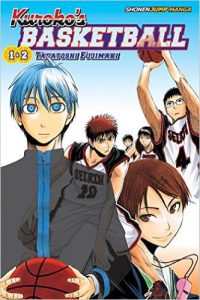
Kuroko’s Basketball, Vols. 1-2

August 11, 2016 by Sean Gaffney

By Tadatoshi Fujimaki. Released in Japan as “Kuroko no Basket” by Shueisha, serialized in the magazine Weekly Shonen Jump. Released in North America by Viz. Translated by Caleb Cook.

I’ll be honest with all of you. Of the ‘big four’ North American sports, I’ve always found basketball the least interesting. Sure, I’ll get excited by March Madness, but the pros do nothing for me, and watching the games on TV just makes me want to do something else. That said, I can’t deny that the sport has an allure that attracts a lot of people, particularly high school kids and promising young manga artists. And now that it appears Viz has vanquished the curse of sports manga in the States once and for all (with the possible exception of baseball – sorry, Adachi), we can see why this series was absolutely huge. The only reason it wasn’t licensed sooner, I expect, is that Viz was still releasing Slam Dunk, the ur-basketball manga, and didn’t want the two to compete.

kuroko1

Kuroko is the blue-eyed stoic on the cover, and the title is pretty telling, as Kuroko’s style of basketball is very much not like the rest of the team, as it’s designed around his own lack of a personality. While this is, for the most part, a typical fiery sports manga, it has its fair share of humor, and a great deal of it revolves around Kuroko’s stoicness and ability to not be noticed even when he’s literally standing in front of someone. Most other basketball manga would star the redhead behind him – indeed, Slam Dunk did, as Kagami is very clearly modeled after that character. But it’s Kuroko that makes this interesting, as he uses his quasi-invisibility to the team’s advantage. He can’t make shots, of course, but it makes him a near-perfect passer. And with Kagami on the team, who is driven by the desire to compete against the strongest teams and win, they become well-nigh unstoppable.

Basketball does not appear to be all that big in Kuroko’s school itself. The manager, also pictured on the cover, is the coach as well, and they sometimes have trouble with school discipline. Riko, by the way, seems to be the sole female in the manga so far, and there’s no hint of romance. Because the other big reason that this manga is getting licensed is that, like many other recent Jump series, it has an absolutely huge BL fandom. There’s none of that in the actual manga itself, of course, but you do get an awful lot of handsome guys sweating and being athletic, and combined with the usual Jump goals of friendship, training and victory the combination can be irresistible. Heck, Kise, Kuroko’s old teammate from middle school introduced as the first semi-antagonist, seems to behave very much like the ex-boyfriend who wants to get back together really badly.

I haven’t talked much about the basketball itself, mostly because, as I said, it’s not my thing. But it’s the majority of the book, and it’s exciting, well-told and well-drawn – I was never confused or bored. Still, you read this for the characters, and I greatly look forward to more of Kuroko and his quiet, eccentric linefaced self.

Filed Under: REVIEWS

Bookshelf Overload: July 2016

August 10, 2016 by Ash Brown

I was weak in July and succumbed to temptation. Barnes & Noble had its big 3-for-2 manga sale which, when combined with already discounted prices and additional coupons, meant I was able to get a ton of manga for an average of more than 50% off the cover price. So, I tragically took the opportunity to catch up on a bunch of series like Dorohedoro, Food Wars!, Haven’t You Heard? I’m Sakamoto, Monthly Girls’ Nozaki-kun, My Love Story!!, and more. While I was rather happy about this, my wallet was less than pleased (even if it did comparatively take less of a beating than it normally would otherwise). Oh, and then I somewhat unintentionally ended up with a used set of Yakitate!! Japan for an outrageously good price. None of that was really planned, though, so I’ll have to to keep my purchasing better in check over the next few months.

As for July’s manga preorders, I was especially excited for the second omnibus of Akiko Higashimura’s Princess Jellyfish (which was technically released at the end of June), the return of Kohske’s Gangsta, the absolutely enormous edition of Toshio Ban’s The Osama Tezuka Story: A Life in Manga and Anime, and the first volume of Leiji Matsumoto’s Queen Emeraldas. I was also excited to see that my copy of Yona of the Dawn, Volume 1 by Mizuho Kusanagi showed up early  (its official release date was in August), and I ended up enjoying Haikyu!!, Volume 1 by Haruichi Furudate even more than I thought I would. Netcomics’ two most recent releases–the full-color His House by Hajin Yoo (the creator of Totally Captivated) and Intense by Kyungha Yi–are some of the most beautifully designed and presented books that I’ve seen from the publisher. I’m also really looking forward to watching The Empire of Corpses, which is based on a novel by Project Ito and Toh Enjoe that hasn’t been translated into English. Considering that I love the work of both authors, I do hope that one day it will be, though!

Manga!
Ajin: Demi-Human, Volume 7 by Gamon Sakurai
The Ancient Magus’ Bride, Volume 5 by Kore Yamazaki
Dorohedoro, Volume 17-18 by Q Hayashida
Emma, Omnibus 4 by Kaoru Mori
Food Wars!: Shokugeki no Soma, Volume 10-12 written by Yuto Tsukuda, illustrated by Shun Saeki
FukuFuku: Kitten Tales, Volume 1 by Kanata Konami
Gangsta, Volume 7 by Kohske
Haikyu!!, Volume 1 by Haruichi Furudate
Haven’t You Heard? I’m Sakamoto, Volumes 2-4 by Nami Sano
Horimiya, Volume 2 by Hero
Knights of Sidonia, Volume 15 by Tsutomu Nihei
Monthly Girls’ Nozaki-kun, Volumes 2-3 by Izumi Tsubaki
My Love Story!!, Volumes 8-9 by Kazune Kawahara
My Neighbor Seki, Volumes 5-7 by Takuma Morishige
Mysterious Girlfriend X, Omnibus 1 by Riichi Ueshiba
Nichijou: My Ordinary Life, Volume 1 by Keiichi Arawi
Of the Red, the Light, and the Ayakashi, Volume 3 by Nanao
One-Punch Man, Volumes 4-7 written by One, illustrated by Yusuke Murata
The Osama Tezuka Story: A Life in Manga and Anime by Toshio Ban
Ouran High School Host Club, Volume 17 by Bisco Hatori
Princess Jellyfish, Omnibus 2 by Akiko Higashimura
Prison School, Omnibus 4 by Akira Hiramoto
QQ Sweeper, Volumes 2-3 by Kyousuke Motomi
Queen Emeraldas, Volume 1 by Leiji Matsumoto
Sweetness & Lightning, Volume 1 by Gido Amagakure
Wandering Island, Volume 1 by Kenji Tsuruta
Yakitate!! Japan, Volumes 4-26 by Takashi Hashiguchi
Yona of the Dawn, Volume 1 by Mizuho Kusanagi

Manhwa!
His House, Volume 1 by Hajin Yoo
Intense, Volume 1 by Kyungha Yi

Comics!
Alphabet edited by Jon Macy and Tara Madison Avery
Cook Korean! by Robin Ha
Dirty Diamonds, Volumes 1-6 edited by Claire Folkman and Kelly Phillips
Fantasy Sports, Volume 2: The Bandit of Barbel Bay by Sam Bosma
Kamikaze, Volume 1: Run, Rabbit, Run by Alan Tupper, Carrie Tupper, and Havana Nguyen
The Meat Cake Bible by Dame Darcy
Monstress, Volume 1: Awakening by Marjorie Liu and Sana Takeda
Southern Cross, Volume 1 by Becky Cloonan, Andy Belanger, and Lee Loughridge
Stand Still, Stay Silent, Volume 1 by Minna Sandberg
Summerland by Paloma Dawkins
We All Wish for Deadly Force by Leela Corman

Novels!
Legend of the Galactic Heroes, Volume 2: Ambition by Yoshiki Tanaka
The Vegetarian by Han Kang

Anime!
The Empire of Corpses directed by Ryoutarou Makihara

Filed Under: Bookshelf Overload, UNSHELVED

Yona of the Dawn, Vol. 1

August 9, 2016 by Anna N

Yona of the Dawn Volume 1 by Mizuho Kusanagi

It is no surprise that I was eagerly anticipating Yona of the Dawn. I feel like there’s been a little bit of a gap in currently translated shoujo fantasy, so I was very much looking forward to this manga. I have a feeling that Yona of the Dawn is one of those manga that will be easier to evaluate once the second volume comes out, because the first volume was mostly set-up. I did enjoy the worldbuilding and some of the plot twists that I wasn’t expecting.

Yona is a sheltered princess whose main issues involve fretting over her red hair. She’s watched over by her guard Hak, and she nurses an intense crush on her cousin Su-won. As she’s getting older the question of her marriage is starting to come up, and her father the king seems to be determined to get her married to anyone but Su-won. Yona is a bit headstrong and pampered, but she still comes across as a sympathetic heroine in the early pages of the manga.

One thing I was dreading a bit is the development of a fairly typical love triangle, because it seemed like that’s the way things might be headed for Yona, Hak, and Su-won at the start of the manga. I was extremely happy when my expectations were foiled within the first couple chapters, and the story took an abrupt turn as Yona has to flee the palace with only Hak by her side. I’ve heard that this series features awesome archery, which is nowhere in evidence yet. I’m much more intrigued by the potential storyline of Yona having to toughen up and learn how better to fend for herself, so I’m eagerly awaiting the next volume.

yona1

Filed Under: REVIEWS Tagged With: shojo beat, shoujo, viz media, yona of the dawn

Legend of the Galactic Heroes: Ambition

August 9, 2016 by Sean Gaffney

By Yoshiki Tanaka. Released in Japan as “Ginga Eiyū Densetsu” by Tokuma Shoten. Released in North America by Haikasoru. Translated by Daniel Huddleston.

In the first volume, we saw the Galactic Empire and the Free republic spend most of the book at war with each other. This time around, they spend most of the book at war with themselves. Reinhard is not the best at making friends and influencing people, and so the aristocracy decide to take him out in a coup. Meanwhile, knowing that he needs the republic to be distracted while this is going on, Reinhard plants a traitor in order to start a coup on the republic side, which will keep Yang Wen-Li busy doing what he hates the most – fighting military battles. By the end of the book, both Yang and Reinhard have suffered grievous losses, though you could argue that Yang’s is merely sad, while Reinhard’s amounts to a grand tragedy of epic proportions.

galactic2

This series has a huge cast, to be frank, bordering on the ridiculous. I will not blame the reader from getting completely lost among the Empire’s admirals, not knowing their Wittenfelds from their Mecklingers. That said, I never felt lost, mostly because, with the exceptions of the obvious main characters, the book is more about the plot than the characters. And it still has its obvious agenda – war is a tragic, horrible thing that devastates everyone. As with the first book, neither side comes off very well. The Empire is filled with arrogant scheming aristocrats who regard ‘the people’ as their toys, and indeed most of the latter half of the book hinges on such a jaw-droppingly heinous incident that I am reluctant to spoil further. As for the Republic, we see the dangers of the military assuming that they know what’s best for the people – sure, there’s martial law and no freedom of speech now, but freedom will return. really. Any day now.

If LOGH has a huge cast, it also has a reputation for killing that cast off. The aforementioned heinous incident leads directly to the most astonishing one, but (again trying not to spoil) its main purpose is also to show us that Reinhard is still stunningly immature at times, and can react just the way the aristocrats that he’s trying to put down do. I think the nest volume will be very important in seeing whether he manages to mature as a leader, or if he’s going to be the villain of the series. (The author is being very even-handed about both sides being tremendously flawed, though I suspect most Western readers will automatically side with Yang Wen-Li.) Speaking of Yang, he’s forced to admit at the end of the book that the republic’s own leader is a dangerous tyrant – and Yang feels a great desire to do something about it, something that goes against his very nature.

Having introduced most of the backstory in book 1, the second book does not feel quite as much like a history lesson. The translation can still get pompous and didactic, but again, I’m fairly sure the original was exactly like that as well. And the space battles are described well enough that even those uninterested in such things will be drawn in. I suspect the third volume will be a giant signpost as to where the rest of the series is heading – I highly look forward to it.

Filed Under: REVIEWS

Pick of the Week: Otherworld Barbara

August 8, 2016 by Sean Gaffney, Ash Brown, Michelle Smith, Anna N and MJ 1 Comment

otherworld1SEAN: Another week, another really obvious pick. I’ve loved the other Moto Hagio volumes we’ve seen over here, and so absolutely cannot wait for the first volume of Otherworld Barbara, a story so good it won the Japan SF Grand Prize, the Japanese equivalent of a Nebula Award. It’s from Fantagraphics, so should look great too. And an omnibus to boot!

ASH: Yup, no question about it. It’s Otherworld Barbara for me, for all of the reasons that Sean has already described and more.

MICHELLE: Count me in, as well!

ANNA: Is this a unanimous pick? I agree too!

MJ: This, this, this, THIS.

Filed Under: PICK OF THE WEEK

Bookshelf Briefs 8/8/16

August 8, 2016 by Sean Gaffney and Michelle Smith Leave a Comment

dangan2Danganronpa: The Animation, Vol. 2 | By Spike Chunsoft and Takashi Tsukimi | Dark Horse – For a survival game manga, Danganronpa is even more theatrical and over-the-top than most examples of the genre. What’s more, it seems to love mocking itself, and sometimes also breaking the fourth wall—one character makes a Black Jack reference, and Monokuma responds, “Naw, that’s Vertical. They also do Astro Boy!” (It will surprise no one to see Carl Horn is editing this.) As for the characters themselves, and the murders, this is still a cut above—I was impressed the cast reacted mostly positively to Chihiro’s secret, and the murder was again impulsive yet sympathetic. The biggest objection is this feels far too rushed—given we’re halfway done, it likely is. – Sean Gaffney

foodwars13Food Wars!: Shokugeki no Soma, Vol. 13 | By Yuto Tsukuda and Shun Saeki | VIZ Media – I think I loved this volume even more than the last one! As expected, Yukihira does not ultimately win the Fall Classic, but he does gain the respect of his classmates as well as a determination to find his own cooking, instead of always following in his dad’s footsteps. Seeing him invigorated by serious rivals his own age is quite exciting. Of course, there’s always some event going on at Totsuki, so the students begin interning at various restaurants, where they must make a visible contribution. This was a nice way to humble Yukihira a little, giving him enthusiasm for learning new stuff while simultaneously not dialing back how good he is. And hey, no fanservice this volume! – Michelle Smith

haikyu2Haikyu!!, Vol. 2 | By Haruichi Furudate | VIZ Media – I am a huge fan of the monthly release schedule for Haikyu!!, because it means we didn’t have to wait long to see a practice game in which Hinata and Kageyama’s combined attack stuns their opponents. The volume has several cool moments, like Hinata finally getting a glimpse of “the view from the top” and a neat match-winning sequence, but it also kind of amuses me that we’re rolling right along with some sports manga tropes, like the inter-high qualifiers being just around the corner, and the heretofore unmentioned members of the team who, if they can be coaxed back, make the faraway dream of reaching nationals seem within reach. I readily admit this isn’t anything new, but I am still enjoying it immensely and expect I will continue to do so. – Michelle Smith

sakamoto4Haven’t You Heard? I’m Sakamoto, Vol. 4 | By Nami Sano | Seven Seas – I was, I admit, expecting a bigger finale than we got here. For the most part, the majority of this final volume was devoted to the usual antics—Sakamoto is amazing at something and others react to same, be it in admiration or petty jealousy. I could have done without the chapter where Yoshinobu’s mother disguises herself as her son to get at Sakamoto, which turns more disturbing than I’d like. The ending was quite well done, though, with the series ‘villain’ manipulating an attack on Sakamoto during graduation that he inevitably turns into a production that makes everyone look better than they are. Is he an alien? It doesn’t really seem to matter. He’s just Sakamoto. -Sean Gaffney

horimiya4Horimiya, Vol. 4 | By Hero and Daisuke Hagiwara | Yen Press – For all that Horimiya is sweet and enjoyable as a romance, it’s not winning any originality awards, even in characterization. Hori is a textbook tsundere, and her fretting and waffling over Miyamura’s bedside confession drives much of the volume. And Miyamura himself seems to suffer from supreme self-deprecation, and needs to be reminded that Hori would be angry if he implied she fell for a “loser.” It takes the arrival of Hori’s father, who seems to be very similar to his daughter, to get them to agree to be an actual couple, and even then it’s indirect. So this volume can be frustrating at times, and you need to accept Hori is a cartoon violent anime girl, but if you do it’s still sweet and fun. – Sean Gaffney

log3Log Horizon: The West Wind Brigade, Vol. 3 | By Koyuki and Mamare Touno | Yen Press – This spinoff series is being written after several of the light novels, and thus can toss in things that become more relevant later in the series. That doesn’t mean it handles them well, though—first we get Magus confessing his love to Soujiro, with all the shattered horror that comes from when the target audience is not meant to say “oooh, yaoi!” Then we find out Magus is actually a girl in reality, but a male character in the games, something we’ll see more of later but mostly tossed off for another ‘surprise’ gag here. Apart from that frustration, Soujiro’s guild of haremettes work well together, and we also see Shiroe and company arrive to end book one. Still okay for Log Horizon fans. – Sean Gaffney

hitomi4Nurse Hitomi’s Monster Infirmary, Vol. 4 | By Shake-O | Seven Seas – This series continues to be light as air, with an occasional shot at depth but mostly being content to make jokes about the various supernatural qualities of the students, as well as Hitomi’s breasts and general dojikko qualities. We see more of the grumpy angel girl and her crush on the Bigfoot PE instructor, as well as Hitomi’s sister and her three-eyes three-personalities. And we also get some explanation for Tatara’s odd relationship with Hitomi, and see that he’s not quite a lolicon, at least not in relation to his father. Still, for a gag series this volume really is on the fanservice and the otaku end of the spectrum, and can be rather disturbing. Merely okay this time. – Sean Gaffney

yamada9Yamada-kun and the Seven Witches, Vol. 9 | By Miki Yoshikawa | Kodansha Comics – There’s a ray of hope here, which no doubt will lead to everything going back to normal, but honestly that’s really what I want to see. When Yamada kisses Odagiri, her memory returns. And it tuns out that the memory erasure doesn’t work twice. Of course, the other problem is that Shiraishi also sees this, and is trying to storm off in a huff despite being emotionally devastated for reasons that she can’t work out. Of course, it’s because she loves Yamada, but doesn’t remember him—true love always wins out in the end. That said, we’re not there yet—the president is still trying to screw everything up, and may yet succeed. This is the longest arc of the series to date, and it’s proving riveting. – Sean Gaffney

Filed Under: Bookshelf Briefs

My Week in Manga: August 1-August 7, 2016

August 8, 2016 by Ash Brown

My News and Reviews

Last week brought some very good news! Sparkler Monthly‘s Kickstarter campaign for its fourth year was successfully funded, so we’ll all be getting another twelve months of phenomenal new content in addition to all of marvelous the Sparkler Monthly content that already exists, most of which is freely available online. Somewhat related to that, last week the winner of Experiments in Manga’s Sparkler Monthly Year 4 giveaway was announced. I was hoping to post the wrap up to my horror manga review project last week, too, but it looks like that should be going up sometime this week, instead.

Speaking of Kickstarters, there were two recently launched projects that specifically caught my attention last week. The first is a project to publish the second volume of Moonshot, a comics anthology featuring indigenous creators. The first volume was very impressive and earned multiple awards and honors, so I expect the second volume will be great, too. The other campaign is for the first print volume of Der-shing Helmer’s webcomic The Meek. I haven’t actually read The Meek myself yet, but I’ve heard very good things about the series.

Elsewhere online (well, I guess specifically at Anime News Network), it was a Seven Seas sort of week: Deb Aoki interviewed Okayado, the creator of the massively successful Monster Musume, at Anime Expo, the transcript of which has now been posted. I haven’t had time to listen to it yet, but the most recent ANNCast featured Jason DeAngelis, Adam Arnold and Lissa Patillo from Seven Seas. And in licensing news, Seven Seas will be releasing Atami Michinoku’s The High School Life of a Fudanshi.

Quick Takes

Fairy Tail, Volume 52Fairy Tail, Volumes 52-54 by Hiro Mashima. Despite its immense popularity, for me Fairy Tail fairly tends to be fairly hit-or-miss. Mashima readily admits that he doesn’t always know where he’s going with the story and characters, but every once in a while he manages to pull it all together to form something truly grand and epic. I have to admit, I’m really liking the most recent story arc of Fairy Tail. Once again, the members of the Fairy Tail guild are responsible for trying to save the world, but the enemies that they face this time are so strong that it’s not something that they will be able to do alone. To me, this showdown feels more personal than some of the previous world-altering battles. Granted, that impression may in part be because my reading of Fairy Tail has been somewhat fragmented. However, I greatly appreciate the more character-driven arcs of Fairy Tail. These three volumes explore the past of Fairy Tail and the guild’s connection to Zeref, the dark wizard cursed to live forever who is trying to find a way to end it all. (This I believe is all explored in greater depth in the Fairy Tail Zero spinoff, which I suspect I would likely enjoy.) The battles in this story arc are well-paced in addition to being suitably dramatic and over-the-top, fitting for a conflict that will determine the fate of the world.

Haikyu!, Volume 1Haikyu!!, Volumes 1-2 by Haruichi Furudate. Due to my increasingly busy schedule, I’ve only managed to watch the first few episodes of the Haikyu!! anime adaptation, but that was more than enough to determine that I wanted to read the original manga when it was released in English. I find that even though I’m not especially interested in sports, I really enjoy sports manga, and so far Haikyu!!, about a boys’ high school volleyball team, doesn’t disappoint. Like many other sports-oriented manga, Haikyu!! features characters who are in one way or another exceptionally skilled or naturally talented athletes. What makes Haikyu!! stand out from other sports manga that I’ve read is that it emphasizes teamwork in a way that I’ve not usually seen–the manga’s not just about great players who are simply part of the same team, it’s about teammates bringing out the best in one another, finding ways to effectively complement their strengths and weaknesses to form a group that’s more capable than any one individual. The characterization is pretty great in Haikyu!!, too, which is particularly important for a series which will likely have a fair number of characters to keep track of. I really like the characters in Haikyu!!; they all have very distinctive personalities. If Haikyu!! continues as strongly as it begins, I’m definitely in for the long haul with this series.

UQ Holder!, Volume 7UQ Holder!, Volumes 7-8 by Ken Akamatsu. There’s something about UQ Holder! that rubs me the wrong way. Frustratingly, I haven’t been able to identify exactly what it is about the series, especially as there are parts of the manga that I actually like. I do wonder if part of this dissonance is caused by the fact that I’ve never read Negima! Magister Negi Magi. Although UQ Holder! initially seemed to be a stand-alone spinoff, lately it seems to be tying itself back to the original to a greater extent; I feel like I’m missing some important context. Much of the humor in UQ Holder! seems to fall flat for me, too, even when I can tell that what I’m reading is intended to be funny. The series also seems to have a bit of an identity crisis, as though Akamatsu can’t quite decide what type of story it’s supposed to be. At this point, UQ Holder! has now suddenly veered into becoming a martial arts tournament; previous incarnations of the series included a murder mystery, among other things. The martial arts tournament was a good choice, though–the battles in UQ Holder! are generally the most entertaining aspect of the series. The tournament also gives the characters an actual, definitive goal to focus on rather than their more ambiguous ambitions. These volumes also delve more into Evangeline’s backstory, which was good to see.

Filed Under: FEATURES, My Week in Manga Tagged With: Fairy Tail, Haikyu!!, Haruichi Furudate, Hiro Mashima, Ken Akamatsu, manga, UQ Holder

  • « Go to Previous Page
  • Page 1
  • Interim pages omitted …
  • Page 477
  • Page 478
  • Page 479
  • Page 480
  • Page 481
  • Interim pages omitted …
  • Page 1048
  • Go to Next Page »
 | Log in
Copyright © 2010 Manga Bookshelf | Powered by WordPress & the Genesis Framework