• Skip to primary navigation
  • Skip to main content
  • Skip to primary sidebar
  • Home
  • About Us
    • Privacy Policy
    • Comment Policy
    • Disclosures & Disclaimers
  • Resources
    • Links, Essays & Articles
    • Fandomology!
    • CLAMP Directory
    • BlogRoll
  • Features & Columns
    • 3 Things Thursday
    • Adventures in the Key of Shoujo
    • Bit & Blips (game reviews)
    • BL BOOKRACK
    • Bookshelf Briefs
    • Bringing the Drama
    • Comic Conversion
    • Fanservice Friday
    • Going Digital
    • It Came From the Sinosphere
    • License This!
    • Magazine no Mori
    • My Week in Manga
    • OFF THE SHELF
    • Not By Manga Alone
    • PICK OF THE WEEK
    • Subtitles & Sensibility
    • Weekly Shonen Jump Recaps
  • Manga Moveable Feast
    • MMF Full Archive
    • Yun Kouga
    • CLAMP
    • Shojo Beat
    • Osamu Tezuka
    • Sailor Moon
    • Fruits Basket
    • Takehiko Inoue
    • Wild Adapter
    • One Piece
    • After School Nightmare
    • Karakuri Odette
    • Paradise Kiss
    • The Color Trilogy
    • To Terra…
    • Sexy Voice & Robo
  • Browse by Author
    • Sean Gaffney
    • Anna Neatrour
    • Michelle Smith
    • Katherine Dacey
    • MJ
    • Brigid Alverson
    • Travis Anderson
    • Phillip Anthony
    • Derek Bown
    • Jaci Dahlvang
    • Angela Eastman
    • Erica Friedman
    • Sara K.
    • Megan Purdy
    • Emily Snodgrass
    • Nancy Thistlethwaite
    • Eva Volin
    • David Welsh
  • MB Blogs
    • A Case Suitable For Treatment
    • Experiments in Manga
    • MangaBlog
    • The Manga Critic
    • Manga Report
    • Soliloquy in Blue
    • Manga Curmudgeon (archive)

Manga Bookshelf

Discussion, Resources, Roundtables, & Reviews

Blog

Bookshelf Briefs 3/6/17

March 6, 2017 by Michelle Smith and Sean Gaffney Leave a Comment

A Certain Scientific Accelerator, Vol. 5 | By Kazuma Kamachi and Arata Yamachi| Seven Seas – A lot of the Science side of the Index series involves trying to break past impossibilities, and death is always one of the biggest of those. We get some villain motive here with Hishigata, who is doing all this to make sure his dead little sister can return to life. Of course, as Estelle tries and fails to get across, that is NOT his dead sister but an evil force possessing her corpse (the reader knows this as she grins evilly when he’s not looking). As for Accelerator himself, he finally manages to save Misaka 10046 with only massive property damage in his wake, but we still have the final fight. Which Estelle will be joining as well. Excitement and adventure and really wild things, as always. – Sean Gaffney

Masamune-kun’s Revenge, Vol. 4 | By Hazuki Takeoka and Tiv | Seven Seas – Masamune makes great strides here, but a lot of it is by accident, and he’s got absolutely nothing on Neko when it comes to manipulation, mostly as despite his professed motive of horrible revenge on Aki, he’s still a nice guy for the most part who you know is never going to be able to go through with it. Indeed, he’s poking at Aki’s memories trying to see if she recalls “Pig-Legs,” though the cliffhanger suggests that will backfire on him spectacularly. The scene in Neko’s bedroom between her and Masamune is the best in the manga so far, and shows off the hero at his best. As for humor, there’s Aki’s foul-mouthed secretary and a hysterical test of courage gone wrong. Better than it looks. – Sean Gaffney

Miss Kobayashi’s Dragon Maid, Vol. 2 | By coolkyousinnjya | Seven Seas – It’s honestly hard to find much to say about this even in brief format, as it’s light as air. That’s not to say it’s not good—I actually enjoyed it quite a bit—but it wears its slice-of-life monster series agenda on its sleeve. We do get to hear a bit about how, even if this series does end up with a yuri relationship between Kobayashi and her dragon, it’s still only transitory, owing to the lifespan of dragons and humans. We’re also reminded that Tohru is not the typical dragon by the appearance of her father, which allows Kobayashi to actually take a stand and show some real emotion for a change. But for the most part we get equal amount of comedy, heartwarming, cute monsters, and yuri tease. For fans of those. – Sean Gaffney

Natsume’s Book of Friends, Vol. 20 | By Yuki Midorikawa | VIZ Media – I hope describing a manga as “lovely” doesn’t suggest that it is also dull, because this volume of Natsume’s Book of Friends is very much the former and not at all the latter. In this installment, Natsume and Nyanko-sensei (who is looking especially adorable!) help a yokai with a jar stuck on his head, find a lost hairpin for a heartbroken mountain god, protect a house from scarecrow yokai who want to make it their own, and beautify a tiny shrine to entice a traveling god to visit. I continue to love how sympathetic Natsume is to the plight of yokai—a trait that earns him the notice of a mysterious man Natori consults on the scarecrow case—as well as how he’s still so grateful to have friends who know his secret and help him out. I hope we don’t have to wait another year for the next volume! – Michelle Smith

The Prince in His Dark Days, Vol. 3 | By Hico Yamanaka | Kodansha Comics – After spending some time with Itaru in volume two, volume three brings us back to Atsuko’s point of view. After learning her secret, a rich guy named Daigo demands that Ryo let him have her for the night. Ryo agrees, but luckily Daigo is only trying to be a rich jerk, and is utterly undone by Atsuko’s tears. Ryo, meanwhile, is obviously being changed by his association with Atsuko, for even though he still puts Itaru first and foremost—as demonstrated by his zeal in tracking down the parties responsible for spreading vicious rumors about Itaru online—he still feels an impulsive need to rescue her that he ultimately heeds. I can only assume they will end up a couple, since the next volume is also the last, but covering that much ground in one volume will probably be tricky. We shall see! – Michelle Smith

Rose Guns Days Season Two, Vol. 2 | By Ryukishi07 and Nana Natsunishi | Yen Press – We continue to deal with the fallout from Season One, as it becomes clear that the Chinese are moving in on Rose and company, even if it means going against Lee. And what’s more, they have a pawn in Rapunzel, who has regained her memories after a traumatic incident, though she’s keeping that from the rest of our gang of Roaming Wolves. Of course, that doesn’t mean that she’s suddenly turned evil, and in any case Rose’s empathy means that any attempted assassinations are not going to be happening regardless. I suspect the next volume will involve a lot more violence and more things going wrong, and it’s questionable if our new protagonists will even survive. Gripping at times, but very variable. – Sean Gaffney

Sweetness & Lightning, Vol. 4 | By Gido Amagakure | Kodansha Comics – The approachable-yet-delicious fare featured in this volume includes pork shougayaki (which looks amazing), sweet potato crepes, kinpira gobou, okonomiyaki, and beef stew. I like how, almost in the background, we see Kotori making friends at school, as they’ve noticed her love of food and ask her to help with their festival booth. Tsumugi, too, navigates some pre-school friendship drama, and I predict that one grumpy-looking little boy will be cheered by food in the next volume. What I love best, though, is how conscientiously Inuzuka-sensei takes his role as father, carefully demonstrating for Tsumugi that you don’t give up when things are hard, and always explaining why she’s being scolded. Another lovely title for me this week! – Michelle Smith

Filed Under: Bookshelf Briefs

My Week in Manga: February 27-March 5, 2017

March 6, 2017 by Ash Brown

My News and Reviews

Last week at Experiments in Manga the winner of the Tokyo ESP manga giveaway was announced. The post also includes a list of some of the manga available in English about psychics and/or espers. That was it for the blog, but as I previously mentioned, I had an all-day job interview last week which took up a fair amount of my time and attentions. Well, it turns out that they liked me, and I liked them, so it looks like I’ll be starting in a new position at a different library in May. It’s both very exciting and very nerve-wracking, but I think (hope!) it’s a good move for me. My day job will still have absolutely nothing to do with manga, though.

Elsewhere online last week there was ICv2’s annual Manga Week. A number of interesting manga-focused articles and interviews were posted, including a mention of some of Vertical Comics’ most recent licensing announcements: Arakawa Under the Bridge by Hikari Nakamura (the one I’m most excited for), Gundam Wing: The Glory of Losers by Tomofumi Ogasawara, Helvetica Standard by Keiichi Arawi, and Voices of a Distant Star by Makoto Shinkai and Mizu Sahara (technically a rescue as the manga was originally published in English by TokyoPop back in the day). Kodansha Comics recently made some announcements at ECCC. In addition to adding even more fantastic series to its digital initiative, Kodansha Comics is working on a Ghost in the Shell anthology similar to the Attack on Titan Anthology released last year. Should be interesting!

Quick Takes

Anonymous Noise, Volume 1Anonymous Noise, Volume 1 by Ryoko Fukuyama. I will pretty much give any manga a try if it’s even tangentially related to music, so it shouldn’t be too much of a surprise that I would be interested in Anonymous Noise. The series follows Nino Arisugawa (called Alice, by some) who loves to sing. Expressing herself through music is an important part of who she is, but perhaps more importantly it’s how she connects to the people who mean the most to her. First there was Momo, Nino’s close childhood friend with a proclivity for making bad puns, and then there was Yuzu, who helped soothe Nino’s heartbreak with his own music when Momo’s family unexpectedly moves away. But after developing feelings for Nino, Yuzu suddenly disappears from her life, too. Fast forward a few years and the three of them are attending the same high school, although initially they don’t realize it. Most of the first volume feels like a prologue more than anything else, so I’m curious to see the direction the story proper will take from here. In addition to music, it seems that unrequited love will also be a major theme of Anonymous Noise. Complicated feelings of love, longing, loss, and loneliness set the tone for the series.

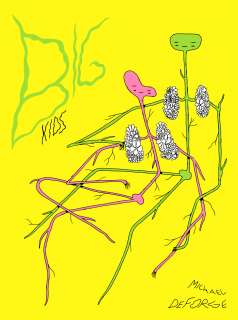
Big KidsBig Kids by Michael DeForge. Due to my interest in alternative and independent comics, I’ve been aware of DeForge’s work for quite some time. However, I’ve never actually read any of DeForge’s comics until picking up Big Kids. To be honest, I think I was probably a little intimidated since DeForge is such a highly acclaimed and well-regarded artist. I recently came across Big Kids on display at my local comic book shop where flipped through a few pages before putting it back. But I couldn’t stop thinking about it and so ultimately brought a copy home with me. The small volume’s bright yellow cover burned itself onto my retinas, and it’s content has burned itself onto my soul. I’ve read through the comic several times now and I still can’t stop thinking about it. I don’t know that I completely understand everything about it, but Big Kids is a work that is both surreal, verging on abstract, and powerful. In part, the comic about growing up. After being dumped by his boyfriend, Adam wakes up one day to discover that he has become a tree. The world itself is still the same, it’s just that Adam now views it from a vastly different perspective. But while being a tree has its benefits, there’s also a sense of sadness and loss associated with it.

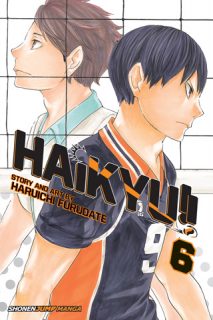
Haikyu!!, Volume 6Haikyu!!, Volumes 6-9 by Haruichi Furudate. Out of all of the sports manga currently being released in print in English, Haikyu!! is definitely one of my favorites. Admittedly, I was a little worried that as the series entered its first tournament arc and became more focused on the games themselves I would lose some of my enthusiasm (I’m not especially interested in volleyball), but my fears appear to have been mostly unfounded. Occasionally Haikyu!! will get a little bogged down in the particulars of volleyball, but this is usually completely offset by the series’ incredibly engaging characters. I’m immensely enjoying seeing them grow and evolve not just as players, but as people. I absolutely love the manga’s approach to and emphasis on teamwork. Some of the characters are prodigies, but it is made very clear that a single person cannot win on their own. Often it’s the unassuming, “ordinary” players who dramatically shift the course and tone of a game. Everyone has their own talents and abilities and everyone has an important role to play. Haikyu!! may be a series about volleyball, but its themes and message are much more universal than that. The manga has great positivity and energy which makes it fun to read, too.

Filed Under: FEATURES, My Week in Manga Tagged With: Anonymous Noise, comics, Haikyu!!, Haruichi Furudate, manga, Michael DeForge, Ryoko Fukuyama

How a Realist Hero Rebuilt the Kingdom, Vol. 1

March 6, 2017 by Sean Gaffney

By Dojyomaru and Fuyuyuki. Released in Japan by Overlap, Inc. Released in North America digitally by J-Novel Club. Translated by Sean McCann.

There is a certain variety of story that has been seen more and more often lately. It usually is fanfiction, but as we’ll see, doesn’t always have to be. It usually involves the author (almost always a young male in their late teens or early 20s) reading a work and liking the general idea, but feeling the execution just wasn’t… badass enough. Or the main character was friends with the wrong people. Or the world was run in a nonsensical way, and things would be far better if everyone just had more common sense and thought things through. (These stories also usually involves a large number of heroines deciding they’re OK with sharing the love of the hero in happy polyamory, possibly as they were mostly written by late teen-early 20s boys.) The most famous example is probably Harry Potter and the Methods of Rationality, but if you’re looking for something along those lines but in an original work, Realist Hero may be right up your alley.

“But wait,” you say, “I thought you said this wasn’t fanfiction!” Indeed, it’s an original story in the isekai genre, of a young man summoned to another world to defeat a demon king, but who instead puts his college learning to good use teaching modern politics, economic theory, and the essentials of running a city to good use, becoming the king and ending up engaged to the crown princess seen in the cover. “But… that’s Saber, right? Saber Red, to be precise.” Don’t be silly, that is not Saber Red. It merely looks just like her. Not a surprise, as the illustrator’s pixiv page basically contains the cover for Realist Hero 1 and a ton of Fate/GO art. That is Princess Liscia, who warms to our hero over the course of the book, acts as a student for all the modern ways he’s teaching them, and in return teaches him about the little known facts of their fantasy kingdom, like the polyamory. Which is probably fortunate as he also gets a hot elf bodyguard and singer/temptress/big sister figure to fall for him (I’m ignoring the loli for the moment), and seems to be adding a feisty young dragonet noble, manipulative princess of the country next door, and tsundere thief to the mix in future books.

I’ve been fairly glib in this review, but I will happily admit the book is something of a hoot to read. It wears its heart on its sleeve, and while I wish it would tone down the Machiavelli (using The Prince as a guidebook on how to run a country is never, IMO, a good idea, especially as some scholars think The Prince was meant to be satire), the lead is actually likeable and not the massive jerk you sometimes see in these sorts of stories. His suggestions are sensible, but don’t always work out perfectly, and I like the fact that we move forward over several months as the book progresses. (There’s also a narrative device where sometimes we hear “little did they know that in thirty years time, this would become etcetcetc.”, which I also liked.) If you’re looking for an isekai that’s light, breezy fun (though the second volume implies there may be war on the horizon), this should fit the bill nicely.

Filed Under: how a realist hero rebuilt the kingdom, REVIEWS

Erased, Vol. 1

March 5, 2017 by Sean Gaffney

By Kei Sanbe. Released in Japan in two separate volumes as “Boku Dake ga Inai Machi” by Kadokawa Shoten, serialized in the magazine Young Ace. Released in North America by Yen Press. Translated by Sheldon Drzka.

I didn’t really know much about this going into it at all. The author is known for dark psychological stuff, and this title certainly qualifies. It also had an anime, which I also haven’t seen. I was thus unprepared for what a good, solid mystery series this would be, with several surprising fake-outs, both plot and character based, and a likeable but very flawed lead hero. It also seems to be examining child abuse, something I’m always pleased to see in Japanese manga, though sometimes I feel it only glosses over the root issues. That doesn’t seem to be the case here, though, and Erased is not only well-written but emotionally raw – it took me a while to finish the volume as it was hard to read in one sitting.

Our hero is Satoru, a wannabe manga artist who unfortunately is somewhat withdrawn and reserved – his manga fails because he doesn’t put enough of himself into his work. We gradually discover this is partly due to a tragedy that happened to him as a child, which he has been repressing memories of. His non-manga job is pizza delivery boy, where he has somewhat stilted conversations with his cute co-worker, who he feels is too young for him and in any case isn’t interested in him anyway. He also has a strange ability to “fix” things that are about to happen, which may or may not be tied into the past tragedy he had. When a tragedy is about to occur, he times loops for a few minutes till he can identify and fix what’s going to happen. Of course, sometimes he’s not there to fix things. And when his mother is murdered, partly as a result of something he thought he’d fixed, he collapses and finds himself back in elementary school, reliving his childhood to try to erase the original tragedy.

Satoru is not all that likeable a hero, but in a character development sort of way rather than an aggravating way. He’s our POV character, so for a time we tend to agree with him – in the early pages, his mother comes across as rather pushy and annoying, and it’s only as the series goes on that we see how smart and together she really is. As a kid he still has the memories of his 29-year-old self, but manages to act like a child most of the time anyway – I particularly liked his thinking something blunt and saying it aloud without realizing it at the same time. We also meet the truculent and reserved Kayo, who was the girl whose murder was the start of the tragedy he’s now trying to prevent. His attempts to stop the murder, save her from an abusive household and bring her out of her shell are awkward yet heartfelt, and seem true to life – or at least as true to life as a Peggy Sue time travel mystery can be.

This is being released here, I believe, in four omnibuses, and I’ll definitely be picking up the second one. It makes for unnerving and difficult reading at times, but it does what you want a new series to do – it makes me want to read on to find out what’s happening next.

Filed Under: erased, REVIEWS

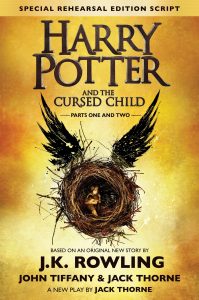
Harry Potter and the Cursed Child, Parts One and Two by J. K. Rowling, John Tiffany, and Jack Thorne

March 5, 2017 by Michelle Smith

Note: This is the rehearsal script edition. A definitive collectors’ edition will be released at a later date.

hp8Harry Potter and the Cursed Child joins Buffy the Vampire Slayer Season Eight in the category of “ostensibly canon series continuations that I shall henceforth pretend do not exist.”

The play begins with an abbreviated version of the Deathly Hallows epilogue. Albus Potter, Rose Granger-Weasley, and Scorpius Malfoy head off for their first year at Hogwarts, where Albus and Scorpius are soon sorted into Slytherin. That’s an interesting development and I was still rather optimistic at this point, but sadly there’s hardly any exploration of this event before Albus is in his second year. Then third. Along the way there are brief episodes of scorn and failure and glimpses of his strong friendship with Scorpius—along with lines like “he’s all I need” that make me want to see them fall in love—but it’s all very cursory.

On the eve of his fourth year, Albus happens to overhear Cedric Diggory’s family asking Harry (now head of Magical Law Enforcement) to use a recently confiscated time-turner to go back and save Cedric. Harry declines, and Albus—who has become a surly teen full of angst and bitterness—decides that he and Scorpius are going to show up his uncaring father by saving the day themselves. Of course, they end up screwing up the timeline (though not before successfully accomplishing some things that really ought to have been made more difficult) and the adult characters must help them set things right. Meanwhile, Harry’s scar has started hurting again and he’s hearing whispers of parseltongue.

I would’ve liked this a lot more if it was a book about the boys and their time at school. As it is now, the plot’s too accelerated and simplistic, and there are some scenes with the adult characters that I really could have done without (though I did like seeing Harry and Draco work together to save their sons). That said, probably the best thing about Harry Potter and the Cursed Child is its treatment of Slytherins. Not only does Draco show himself to be a decent, wounded person, but he’s raised a truly adorable, geeky son who has his share of heroic moments. Too, one of the timeline variants allows us another glimpse at Snape, still honoring Lily by fighting for the cause she believed in even when all seems lost.

Ultimately, I’m glad I read it, because I do really, truly love Scorpius. I’d love a whole book about Scorpius, in fact, provided it was a proper book written by Rowling and not more of this.

Filed Under: Books, Children's Fiction, Fantasy, Plays, REVIEWS Tagged With: J. K. Rowling

Grimgar of Fantasy and Ash, Vol. 2

March 4, 2017 by Sean Gaffney

By Ao Jyumonji and Eiri Shirai. Released in Japan by Overlap, Inc. Released in North America digitally by J-Novel Club. Translated by Sean McCann.

As I have observed many times in the past in my reviews, I am not all that much of a gamer. Sometimes this makes it hard to follow various aspects of Japanese light novels, many of which depend on knowledge of how RPG systems work. But it also means that I may not have the patience for the sort of level-raising behavior that these games, and subsequently these light novels, involve. This second volume does a lot of character building work, and by “a lot” I mean that Haruhiro, Ranta, and to a lesser extent Merry get more development. It’s good development too, as this series has a lot of reflection on the best way to act like a leader or a team player. This does not obscure the fact, however, that the plot of this second volume involves “kill things” for the entire length of the book.

For all that I complain about Ranta, sometimes Haruhiro can also be annoying fro different reasons. He’s never really had to lead before, and has no idea how the mindset of a leader works, and so is constantly doubting himself and criticizing his decisions when things go wrong. He seems to think that this is just him rather than the norm, but I think the problem may simply be that “leader” types never get the inner monologue that we get from him here, and in fact also think about these things all the time. Stepping back and looking at things from an outside perspective, we see he is getting better at making decisions, takes responsibility, and his battle skills are also improving. I think Merry can see this best (I don’t see this series as having much romance, but if it did, they’re the obvious pair).

Speaking of Merry, she’s able to put a few of her own demons to rest in this book, though she notably does not get an inner monologue. Ranta does, though, which confirms a lot of what we already know about him. He’s hotheaded and stubborn, but also tends to act this way as a pose half the time, and is frustrated that the rest of the group doesn’t understand him better – especially as Haruhiro seems to understand the other party members fine. But Haruhiro and Ranta have a complex relationship, more than just boke and tsukkomi, and only time is going to fix that. Luckily, the near loss of Ranta at the climax of the book seems to have united them a bit more closely (if he gets paired with anyone, it’ll be Yume, who’s already sparring with him in best Ranma and Akane tradition).

So good characterization, and the fights are pretty good. That said, if we don’t get something actually happening in the third book besides “kill things, level up”, I may let this series go. It’s a good examination of how “trapped in an RPG world” would go if it were realistic, but it’s sometimes simply too realistic, i.e. it’s a slog.

Filed Under: grimgar of fantasy and ash, REVIEWS

The Full-Time Wife Escapist, Vol. 1

March 3, 2017 by Sean Gaffney

By Tsunami Umino. Released in Japan as “Nigeru wa Haji da ga Yaku ni Tatsu” by Kodansha, serialization ongoing in the magazine Kiss. Released in North America digitally by Kodansha Comics. Translated by Rose Padgett.

It is a rare series that can immediately win me over within the first five pages. In fact, I’ve long been an advocate of giving series a chance beyond one volume, especially if they are of the “horrible person is changed by the plotline of the manga” type stories. But sometimes I start a manga and I know immediately I’m going to fall in love with it. This is that sort of manga – when I saw Mikuri being “interviewed” about the difficulties she’s having with her life, and realized that she was imagining this in her head, I grinned. And when I saw this would actually be a recurring thing, I cheered. Not only are these segments some of the funniest in the volume, but they also serve to help deepen the characterization of the main heroine, who is otherwise very matter-of-fact and calm. It’s a great device.

The premise is laid out right at the start. Mikuri kept doing college because it was hard to find a job, but now she’s post-grad and still can’t find work, and even temp agencies aren’t working out. She’s living with her parents as well, which proves to be problematic when they decide to retire to the country, meaning she needs work and a place to stay NOW. Luckily, she’s been doing a part-time job cleaning house and basically functioning as a wife-figure for Tsuzaki, an introverted guy who tends to say what he thinks and has minimal social skills. They get on fairly well (it helps that Mikuri’s degree is in psychology, so she’s much better at reading people than the average manga protagonist), and suddenly it becomes apparent that this is a solution to her problems. They could marry on paper, and she could function as a full-time wife (minus wifely duties, so to speak) and get health benefits and the like.

In case you hadn’t already guessed, this is a josei series. It is, in fact, the sort of josei we don’t usually see brought over here – a lot of the josei we’ve seen in the past few years I’ve defined as “shoujo with adults”, as you find the same love misunderstandings, fretting, and breakups that you would in a high school shoujo magazine. This seems more grounded in the real world – indeed, a big surprise for me is how little romance there is in this first volume. Clearly the endgame will be getting these two quirky kids together for real, but I like how it’s a slow burn, and that we’re starting to see it on his end but not on hers. In fact, it’s even bluntly laid out in their agreement that they can see other people as long as they’re discreet. That may be tested soon, as it appears that Tsuzaki’s co-worker may be starting to fall for Mikuri, and his other co-worker seems to have realized their marriage is not a genuine one.

The supporting cast is also good – I particularly liked Mikuri’s aunt, who shows that you can regret not having a romance when you’re in your fifties but still have a happy and fulfilling life. Tsuzaki’s friend Numata is also gay, and occasionally acts the stereotype, but even this is subtler than I was expecting. What I’m left with is a good story with great characters and an interesting style, one that I really want to see play out in future volumes. It also has a live-action series under its belt, so apparently did pretty well in Japan as well. Read this, you’ll love it.

Filed Under: full-time wife escapist, REVIEWS

Manga the Week of 3/8/17

March 2, 2017 by Sean Gaffney 2 Comments

SEAN: There’s been a lot of digital-only releases lately – first from Yen, and now from Kodansha and J-Novel Club. Kodansha in particular is picking up a lot of old Del Rey series that I haven’t been mentioning here and finishing them in digital mode. For example, Gakuen Prince is getting a rush release of new volumes for fans of trash – um, I mean dramatic shoujo. I’ll try to keep up, but may forget – apologies if I miss your favorite.

Meanwhile, let’s talk new volumes rather than rescues.

Ichi-F: A Worker’s Graphic Memoir of the Fukushima Nuclear Power Plant is the important release of next week, being pretty much what its title says, though it’s a memoir of someone involved in the cleanup, not the initial disaster. It should be fascinating.

ASH: I got my hands on an early copy and it is indeed fascinating. Important, too, as you mentioned, and it strongly resonates with what I’ve heard about Fukushima and the recovery efforts from my friends who live in the area.

MJ: Wow, this sounds intense.

SEAN: Interviews with Monster Girls has become popular now that its anime is running, good timing for Vol. 3.

We also get a 4th volume of Ninja Slayer Kills!.

And a 2nd digital-only volume of fluffy Nakayoshi series A Springtime with Ninjas.

Kodansha finishes up with a 3rd volume of sports manga Welcome to the Ballroom. (Everything is sports manga if you squint enough.)

MICHELLE: I’m super happy that sports manga seems to be having its day, and I look forward to more Welcome to the Ballroom in particular.

ANNA: Me too!

MJ: When the sport is dancing, I’m always more interested.

SEAN: Seven Seas has a 5th volume of popular spinoff A Certain Scientific Accelerator, which features even more property damage.

And a 4th Masamune-kun’s Revenge, also the winner of the “it has an anime this season” sweepstakes.

More Nichijou from Vertical! A 7th volume that will make you want to draw sharks.

And now Viz. So much Viz. Starting with the debut of Anonymous Noise, a new manga from Hana to Yume by the author of Nosatsu Junkie and Monochrome Boys and Girls. I’ve heard it leans heavy on the drama.

MICHELLE: I haven’t read her other titles, but I’m looking forward to this one.

ANNA: The cover looks great. It is at the top of my to-read pile.

ASH: The cover is great and I can’t resist the music connection.

MJ: I’m very much on board with this.

SEAN: Bleach has a 69th volume, though any readers who might make a dirty joke have long since abandoned it, I suspect.

ASH: Heh.

SEAN: Bloody Mary recently announced it’s finishing in Japan. Here’s Vol. 6.

Everyone’s Getting Married has a 4th volume of no one getting married, or at least that’s my guess.

ANNA: I love this series, it is much more thoughtful than the title suggests.

MJ: Maybe I should check this out after all?

SEAN: Haikyu!! has a 9th volume. Expect grueling training montages.

MICHELLE: I’m always happy to get a new volume of Haikyu!!.

ANNA: Yay!

ASH: Woo!

SEAN: A mere three years after the last volume, we get a new volume of Hunter x Hunter. I try not to mock the mangaka as much, as I know he’s got tremendous back issues, but still. That’s a long time between volumes.

Kimi ni Todoke’s 26th volume. Will we approach a climax soon?

Naruto: Sasuke’s Story: Sunrise is another in the series of Naruto novels we’ve been getting.

Speaking of delays, it’s been over a year since the last Natsume’s Book of Friends, so this 20th volume is very, very welcome.

MICHELLE: Man, so much good stuff this week! I need a Natsume fix.

ASH: I really need to get caught up with Natsume.

SEAN: Nisekoi’s 20th volume is starting the climax, so we need to start letting down the other heroines gently.

One Piece has a 19th 3-in-1, and I think is reaching the three year time skip.

I’m torn. I love One-Punch Man, but am always bored by tournament arcs. Which will prevail with Vol. 11?

ASH: If nothing else, at least the artwork will be great.

SEAN: Platinum End has a second volume to try to convince me to read more of it.

ANNA: I will approach reading this cautiously.

MJ: Same. Ugh. I wish Takeshi Obata would pair up with someone new so I didn’t have to feel so sketchy about it.

SEAN: Skip Beat! has a 38th volume, which features, be warned, the dreaded “let’s explain why the parent was abusive” flashback.

MICHELLE: I’m still so happy to see it, and finally deal with this aspect of the story.

ANNA: Me too. Always happy to see a new volume of Skip Beat!

SEAN: Tegami Bachi finally comes to an end with the 20th and final volume.

Lastly, a title I sometimes forget, we have a 7th Yo-Kai Watch!.

Want a whole lotta Viz? Next week is your week. What’re you getting?

Filed Under: FEATURES, manga the week of

Editorial: How not to honor women in comics

March 2, 2017 by MJ 2 Comments

UPDATE: The CBLDF has since removed The Color Trilogy from its list.

It was a mistake. It was very obviously a mistake.

I’m always a bit leery of publicly criticizing institutions that generally deserve support. I’m aware of how damaging bad press really can be, and that mistakes are unavoidable when you’re running on a tight budget. So before I even state my complaint, I’d like to preface it with the fact that I know this was a mistake, and that nothing I’m going to say here is intended to undercut the importance of this institution and the work that they do. Are we clear on that? Okay.

So, when I say that I was thoroughly appalled to see the following in my Facebook newsfeed this afternoon, please remember that it is not my intent to belittle the Comic Book Legal Defense Fund or the important First Amendment work that they do.

I was thoroughly appalled to see the following in my Facebook newsfeed this afternoon.

Those who are regular readers of Korean comics will recognize immediately that this post, originally entitled “Fifteen Banned and Challenged Comics by Women,” is accompanied by the cover image from First Second’s publication of The Color of Earth, the first book in the series commonly known as The Color Trilogy by a male author, Kim Dong Hwa. That the CBLDF realized their mistake at some point is clear upon clicking the link, where the title has been changed to “Fifteen Banned and Challenged Comics by or About Women.” The mistake, perhaps, was made by a blogger unfamiliar with “Kim” as a common surname and perhaps, too, the fact that Korean names (when they haven’t been deliberately switched around for western readers) are written surname first. But hey, the series’ main characters are, in fact, women, so one could make an argument that it is, as the revised title suggests “about women.” “Good save,” one might say, and move on.

I’m having a hard time moving on. Yes, it was a mistake. But, wow, it’s an unfortunate one. The post is intended to honor Women’s History Month by presenting a list of comics by (or about) women that have been frequently banned or challenged. It’s a noble cause to be sure. And, in his own way, the author of the series I think does believe he’s honoring women. But he does so from a perspective so steeped in male fantasies about what is good and beautiful about women, and SO thoroughly rooted in the male gaze, that it is, in my opinion, nearly the worst choice possible to appear on a list like this, let alone at #1.

It was a mistake, but really so avoidable, as even a search in the CBLDF’s own archives reveals that at least someone at the organization already knows that the book was written by a man. And while the series has gotten a lot of praise in the general comics press, a little jaunt through the manga blogosphere (which historically tends to include more female voices) reveals a less universally enthusiastic view. Here are a few from Manga Bookshelf bloggers alone:

MJ (me) & Michelle Smith, Off the Shelf: MMF Edition

I think what you’re reacting to (and I mentioned this in comments, but I’ll reiterate it here) is not the story’s historical context, but the author’s own sexism which he reveals in the way he portrays the realities of the period. My immediate thought upon finishing the series was that I found it inexpressibly sad. Ehwa’s mother spends almost the entire series teaching her daughter about what a woman’s life is in their world and helping her learn how to endure a lifetime of waiting and heartache that can only be relieved by the companionship of a beloved man. And I suspect there is quite a bit of historical accuracy in this sense of utter helplessness and lack of worth placed on a single woman in that period.

But despite the bleakness of their circumstances, Kim portrays it all with a loving nostalgia. Even when expressing the sadness and longing felt by Ehwa and her mother as they wait for their men, he portrays it all as beautiful and even romantic. This isn’t matter of being true to the period. These are Kim’s own values being revealed here, and that’s what we’re reacting to. The same story could be told without that veil of fond nostalgia and it would read very, very differently. If this series had actually been written during that time period, that would be different matter as well, but Kim is a contemporary writer, and as such, he’s responsible to contemporary readers for the story he’s chosen to tell and how he tells it.

… while it’s true that coming-of-age stories do tend to revolve around sexual awakening, it’s notable I think that though we experience Ehwa’s sexual development in meticulous detail, there’s very little attention given to the development of her romantic attachments. In fact, I’d say out of Ehwa’s romantic episodes, the one that’s best-developed is actually her early crush on the young monk. That’s played out very realistically for a crush–all shy meetings with a heavy spark, leading to lots of mooning about. By contrast, her true love story with Duksam is barely developed at all.

I think it’s partially this strong bias towards Ehwa’s sexual development that leads me to distrust the author’s feelings about women. He’s quoted as saying (in an interview at Newsarama), “I consider the process of a girl becoming a woman one of the biggest mysteries and wonders of life.” But he appears to regard that process as being primarily about sexuality. Not only are we shown very little in terms of Ehwa’s emotional development, but she never shows interest in really anything besides learning about sex and men, though she carefully remains a virgin throughout. That seems like such an exclusively male fantasy.

David Welsh, Good girls don’t

I’m not a cultural historian, so I have no idea what things were like for women in pre-industrial Korea. I just know that I don’t really care for its portrayal of “good” women as passive and patient, no matter how elegantly drawn it is. “I think that the process of a girl becoming a woman is one of the biggest mysteries and wonders of life,” the creator said in an interview. I wish he had thought harder about that mystery and hadn’t imposed what strikes me as such a male notion of wonder upon it.

Young Ehwa lives with her widowed mother, who keeps a tavern in the countryside. Mom advises Ehwa on womanhood, pounding in the notion of the woman as flowering shrub, patiently waiting and gently blossoming until a male pollinating insect will deign to settle upon her, and all will be well. Just look at Ehwa’s friend, the porcine Bongsoon, who actually lets curiosity lead to action. Bongsoon is less attractive than Ehwa, and her mother clearly isn’t giving her the lecture on the botany of desire or instructing her that true love waits. You can be damn sure that, should Bongsoon find a man stupid enough to marry damaged goods, birds won’t fly from the trees and every bell in the countryside won’t ring when that marriage is consummated. Bognsoon is an object of ridicule and contempt because she has the nerve to act on her desires.

Erica Friedman, The Color of Heaven

Laced heavily with unrealistic platitudes that are increasingly heaped upon our heads, many of them about the “lot of women,” I began to find the dialogue burdensome. Women, we are told, are plain trees in the winter that wait for a butterfly man to alight on our branches to adorn us. Waiting is punishment for women’s love. Women are, in fact, nothing without men. While the language is beautiful, it fails the Bechdel Test completely. The women do nothing but discuss men. As David Welsh so cogently summed it up, “not a fan of the notion that the power and mystery of women lies in their ability to wait for men.” When I read a few of these “us poor women” lines to my wife, she asked quite sincerely, if the mother hated her daughter. It was depressing to tell her that she did not, she was just indoctrinating Ehwa into life as a woman …

The series has a happy ending, which redeemed much of the “woe is us” feel of the early pages, but I absolutely could not recommend this book to a young woman…

Most likely, had this series not been mistakenly attributed to a woman by the CBLDF’s blogger, it never would have appeared on this list at all, and rightfully so. Though it’s a work worth discussing for both its flaws and its merits (and certainly none of us would suggest that it should be banned), it honestly has no place on a list that is intended to shine a light on books by or about women. Yes, the artwork is beautiful. Yes, the author is well-respected. But, at its core, it’s a series dedicated to male fantasy, not unlike a million other comics, and for that, not particularly remarkable.

It was a mistake. And it’s too bad.

Filed Under: FEATURES & REVIEWS, Manhwa Bookshelf

Wave, Listen to Me!, Vols. 1-2

March 2, 2017 by Michelle Smith

By Hiroaki Samura | Published digitally by Kodansha Comics

In the opening scene of Wave, Listen to Me! we meet Minare Koda, an attractive twenty-something drinking too much and pouring her heart out to a guy she just met forty minutes prior. She’s ranting about her ex, Mitsuo, and after a certain point, she has no recollection of events. To her surprise, when she’s at work the next day (as a waitress in a curry shop), she hears her own voice being played over the radio. Turns out, the guy she met was Kanetsugu Mato, who works for a radio station and recorded their conversation. (One of the things she’d forgotten was drunkenly giving her consent.) Minare is temperamental and feisty, so when she marches down to the station to give him a piece of her mind, she ends up going live on the air and impressing Mato with her facility for impromptu eloquence.

Bored with doling out radio spots to local idols and placating sponsors, Mato decides that he’s going to mentor Minare and turn her into a radio personality. Of course, the only shift on offer is in the wee hours of the morning once a week, so she can’t quit her waitressing job yet. (She’s always on the verge of being fired as it is.) Still, she begins to truly contemplate her future for the first time. Coworker Nakahara is interested in her, but more in the “one day I’ll have my own shop and I want you there beside me” kind of way. But after she witnesses him offering a new (female) hire a place to stay, her gaze turns ever more resolutely to her new gig.

Volume two is where things really get great. Mato has inventive ideas for Minare’s show, and I think I will let readers discover those for themselves. What I really loved, though, was the continued exploration of Minare’s personality. For example, when she has the jitters and receives reassurance, she cries, “I can feel it rushing back! My usual baseless, overflowing confidence!” She might have come off as an unsympathetic and abrasive character, but that line shows that she’s fully aware of her flaws. Later, after a brief (and awesome) reunion with Mitsuo, she displays a knack for more self-analysis, reflecting that while she usually doesn’t take shit from anyone, she has a certain weakness for pathetic guys who need someone to dote over them. I expect that this capacity for reflection will allow her to make the most of the opportunity she’s been given.

Her path toward achieving success and truly making a name for herself doesn’t proceed in a straight trajectory, especially with financial realities keeping her tethered to the restaurant, but it’s very satisfying to see a formerly unambitious character discover a goal to strive for. The second volume ends in the middle of a show designed to put thoughts of Mitsuo firmly behind her. I am very much looking forward to seeing what lies ahead!

Wave, Listen to Me! is ongoing in Japan, where it is currently up to three volumes.

Review copies provided by the publisher.

Filed Under: Manga, REVIEWS, Seinen

  • « Go to Previous Page
  • Page 1
  • Interim pages omitted …
  • Page 443
  • Page 444
  • Page 445
  • Page 446
  • Page 447
  • Interim pages omitted …
  • Page 1048
  • Go to Next Page »
 | Log in
Copyright © 2010 Manga Bookshelf | Powered by WordPress & the Genesis Framework