• Skip to primary navigation
  • Skip to main content
  • Skip to primary sidebar
  • Home
  • About Us
    • Privacy Policy
    • Comment Policy
    • Disclosures & Disclaimers
  • Resources
    • Links, Essays & Articles
    • Fandomology!
    • CLAMP Directory
    • BlogRoll
  • Features & Columns
    • 3 Things Thursday
    • Adventures in the Key of Shoujo
    • Bit & Blips (game reviews)
    • BL BOOKRACK
    • Bookshelf Briefs
    • Bringing the Drama
    • Comic Conversion
    • Fanservice Friday
    • Going Digital
    • It Came From the Sinosphere
    • License This!
    • Magazine no Mori
    • My Week in Manga
    • OFF THE SHELF
    • Not By Manga Alone
    • PICK OF THE WEEK
    • Subtitles & Sensibility
    • Weekly Shonen Jump Recaps
  • Manga Moveable Feast
    • MMF Full Archive
    • Yun Kouga
    • CLAMP
    • Shojo Beat
    • Osamu Tezuka
    • Sailor Moon
    • Fruits Basket
    • Takehiko Inoue
    • Wild Adapter
    • One Piece
    • After School Nightmare
    • Karakuri Odette
    • Paradise Kiss
    • The Color Trilogy
    • To Terra…
    • Sexy Voice & Robo
  • Browse by Author
    • Sean Gaffney
    • Anna Neatrour
    • Michelle Smith
    • Katherine Dacey
    • MJ
    • Brigid Alverson
    • Travis Anderson
    • Phillip Anthony
    • Derek Bown
    • Jaci Dahlvang
    • Angela Eastman
    • Erica Friedman
    • Sara K.
    • Megan Purdy
    • Emily Snodgrass
    • Nancy Thistlethwaite
    • Eva Volin
    • David Welsh
  • MB Blogs
    • A Case Suitable For Treatment
    • Experiments in Manga
    • MangaBlog
    • The Manga Critic
    • Manga Report
    • Soliloquy in Blue
    • Manga Curmudgeon (archive)

Manga Bookshelf

Discussion, Resources, Roundtables, & Reviews

Blog

Manga the Week of 5/17/17

May 10, 2017 by Sean Gaffney 1 Comment

SEAN: Thanks to Kodansha’s INCREDIBLY AGGRESSIVE digital plan, there’s a large amount to talk about in what would normally be a very small week.

MICHELLE: I’m not complaining, but it is pretty overwhelming.

ANNA: I think I would be buying more of these if they were coming out at a slower pace. I feel like I can’t keep up. But I’m not complaining about more manga!

SEAN: J-Novel Club starts us off, though, with the third volume of I Saved Too Many Girls and Caused the Apocalypse. There’s only one girl on the cover this time – is he slipping?

And they also have the 3rd My Little Sister Can Read Kanji.

Kodansha takes up a great deal of what follows. First, there’s new volumes of Alive (15) and Yozakura Quartet (11) for your Del Rey rescue needs.

The first of THREE new digital debuts next week, Aoba-kun’s Confessions is from Ema Toyama, the author of Missions of Love, which I hate and also love. This is her new Nakayoshi series.

Meanwhile, some may remember Cage of Eden, which put out 20 volumes before dropping off the face of the earth. It’s back with its final, 21st volume. Will they get off the island? Will they find out the truth? Will the girls show off their large breasts? One of these things is sure to be true!

Chihayafura gets a 2nd digital-only volume, and I cannot wait for more HOT KARUTA ACTION.

MICHELLE: Yaaaaaay!

ANNA: I am here for this!!!!

SEAN: Clockwork Planet also gets a 2nd volume.

And there’s a 2nd volume of sports manga DAYS (digital-only). Remember when those were rare?

MICHELLE: Vaguely!

SEAN: The 2nd digital debut is Drowning Love (Oboreru Knife), a more mature, dramatic shoujo from Betsufure. Its author, George Asakura, had A Perfect Day For Love Letters out here eons ago.

MICHELLE: The art style (at least on the cover) is not the most appealing, but I’ll be checking this out.

MJ: I’m looking forward to this, It think.

ANNA: Me too.

SEAN: GTO: Paradise Lost has a 2nd digital volume of Onizuka antics.

The last digital debut is Our Precious Conversations (Boku to Kimi no Taisetsu na Hanashi), a Dessert series from Robico, the author of My Little Monster. I loved that series, so really look forward to this one.

MICHELLE: Same here!

ASH: I love the huge variety in these digital titles! I do hope that some eventually make their way into print, though, since I don’t really read digital manga. That may have to change soon.

ANNA: This sounds intriguing.

SEAN: On to other publishers. One Peace has a 6th volume of the Rise of the Shield Hero manga, which they oddly still keep calling “Manga Companion”, which makes it sound like a guidebook to me.

Seven Seas has a 2nd volume of Bloom Into You, a more dramatic yuri title than the cute fluffy ones we’ve seen recently.

MICHELLE: I enjoyed the first volume.

ASH: The first volume intrigued me; I’m very curious to see how the story unfolds.

SEAN: They also have a 2nd volume of spooky supernatural fantasy The Girl from the Other Side: Siúil, A Rún.

MICHELLE: <3 <3 <3 <3

MJ: Michelle tells me I’d like this!

MICHELLE: You would!

ASH: You really, really would! This series is already one of my absolute favorites for the year.

MICHELLE: I enjoyed your review, Ash. And your perfect image choice. I sent just that one picture to a friend—pointing out the flower crown—and it convinced her to want to read the series.

ANNA: I also love this series, going to be picking this up for sure!

SEAN: Viz gives us a 2nd volume of the Gangsta spinoff Cursed.

ASH: Though I haven’t actually read the first volume yet, I do plan on picking this one up.

ANNA: I need to pick up both, and I will!

SEAN: There’s also a 3rd Mobile Suit Gundam Thunderbolt.

Lastly, they have an 8th volume of Ultraman. For all your tokusatsu needs.

Which of these will you be getting next week? And how many will be digital?

Filed Under: FEATURES, manga the week of

The Emperor and I

May 10, 2017 by Katherine Dacey

The Emperor and I reads like a Sunday comic strip: it has a faintly absurd premise that’s easy to grasp, a small cast of characters, and a well-honed repertoire of jokes that it trots out with clockwork precision.

The story begins with Kaho, an ordinary teenage girl, discovering an extraordinary thing in the refrigerator: a penguin. Without a second thought, she coaxes him out of the crisper drawer, feeds him a snack, and persuades her mom to let him stay. Emperor turns out to be less a pet than a weird houseguest, however, doggedly pursuing penguin behaviors — carrying eggs on his feet, sliding across the floor on his belly — while assiduously ignoring his human companions.

What gives the series its odd comic energy is the artist’s fierce commitment to depicting Emperor as a wild animal. Emperor doesn’t talk or have a winsome face with big, soulful eyes; he’s a silent, hulking presence who molts and sleeps standing up. The gulf between Emperor and his human hosts is further underscored by the full-color artwork. As Mato draws him, Emperor looks like an illustration from a biology textbook, with every patch of orange and feather rendered in meticulous detail. By contrast, Kaho and her family look like stock characters from a Shonen Sunday manga; you’d be forgiven for thinking they were part of Kagome Higurashi’s extended clan. Color also enables Mato to conceal Emperor in plain sight so that he’s visible to the reader but plausibly hidden from the characters, a gimmick that proves essential to one of the series’ better running gags: Emperor’s talent for disappearing inside Kaho’s very small house. (That’s no small feat, considering he stands four feet tall and reeks of mackerel.)

Perhaps the best thing about The Emperor and I is that it wears its conceit lightly. We learn a lot about penguin behavior and anatomy over the course of the series, but other critical details are left to the readers’ imagination. Although Kaho and her family acknowledge the bizarreness of their situation — remember, they found a penguin in the crisper drawer — none of them seem particularly bothered by it, or curious to discover how Emperor arrived there. By keeping the focus on Emperor’s natural avian behaviors, Mato mines a richer comic vein of material, highlighting the incongruity between the setting and Emperor’s attempts to carry on as if he were still living in Antarctica.

Like any Sunday strip, The Emperor and I is best in small doses, as the “Where’s Emperor?” jokes grow tiresome when read in rapid succession. Consumed in weekly doses of three to nine pages, however, The Emperor and I works well; the routine jokes have a pleasantly familiar ring that brings the genuinely novel gags into sharper relief. You won’t forget the silent encounter between Emperor and a neighborhood cat, or Kaho’s frantic efforts to turn her bathtub into a salt-water pool, even if the comic bits that surround these sequences are pat.

How to read The Emperor and I: VIZ is serializing this manga on its website, making a new chapter available every week. Access is free, though expect to see at least one or two pop-up ads for VIZ’s digital edition of Weekly Shonen Jump.

THE EMPEROR AND I • BY MATO • VIZ MEDIA • RATING: ALL AGES

Filed Under: Manga, Manga Critic, REVIEWS Tagged With: Comedy, mato, Penguin, VIZ

The Irregular at Magic High School: Nine School Competition Arc, Part 2

May 10, 2017 by Sean Gaffney

By Tsutomu Sato and Kana Ishida. Released in Japan as “Mahouka Koukou no Rettousei” by ASCII Mediaworks. Released in North America by Yen On. Translated by Andrew Prowse.

I’ve been very nice to Irregular at Magic High School in my last three reviews, despite being well aware that the series is very polarizing, and that there are many, many people who vehemently dislike it – not as much as Sword Art Online, I mean, let’s not get crazy, but a whole lot. This is the first volume that, while I still enjoyed it to a degree, I’m beginning to see their point. Everything that’s normally annoying about Mahouka is just that much more so here, and the book even has a huge page count to get it all in there. Tatsuya’s perfectness, the vague incestuous implications, the cartoon nature of the villains, who make even other anime Chinese mafia cringe. And most of all, the endless, endless “magicbabble”, as the reader begins to suspect that without each detailed explanation of what magic is used and how it works in that context, this book would be about 70 pages long.

The games themselves show off our first-years to the best of their abilities, and their are few surprises – there is one game-breaking injury (literally – we’re told she won’t be able to use magic anymore), but it’s to a minor character we haven’t seen much of, and it’s never even brought up again. What we mostly see is First High’s girls beating the snot out of their competitors (the rookie guys don’t have Tatsuya as their engineer, so of course they do badly and seethe at him all the time for being so Tatsuya). Indeed, the competition with the most tension is the one between Shizuka and Miyuki – it’s over far too quickly, and I’d like to have seen more of it, but again, Miyuki is so far above everyone else, I suppose there’s not much we can do. The Honor Student side manga should help.

Of course, Tatsuya is forced to compete himself due to various circumstances, and of course he is amazing, though Leo and Mikihiko are also allowed to show off their chops a bit. (Erika, sadly, gets very little to do beyond be jealous of her brother’s relationship with Mari, though that does give us the funniest moment in the book, as Miyuki teases Erika about her brother complex, and Erika just loses it because it’s MIYUKI doing this. The student council for the most part are there to be a Greek chorus, with Mayumi occasionally showing off her crush on Tatsuya and Azusa gradually realizing Tatsuya’s secret identity due to his complete inability to hide his amazing engineering skills (though he tries, multiple times in the book, not to take credit for things.)

The book is not bad per se, despite my complaining – the action sequences are well paced and work despite all the magic explanations woven into them. Tatsuya’s past and his devotion to Miyuki makes the book take a very dark tone towards the end, as he shows no mercy towards anyone who would hurt Miyuki, and the narrative points out – perhaps a bit too much – that it’s ONLY Miyuki he cares about, not anyone else. So it’s still a good series to read for fans, but I can easily see casual readers deciding that this is the point they may want to abandon ship.

Filed Under: irregular at magic high school, REVIEWS

Peach Heaven Vol. 1

May 10, 2017 by Anna N

So far, I’m having a mixed experience with Kodansha’s digital line. I like Chihayafuru and The Full-Time Wife Escapist (review of that coming soon), but I am not thrilled with A Springtime With Ninjas or Peach Heaven. In a way this is good, because I’m not having to set aside funds for so many digital series!

Peach Heaven treads familiar ground as the hapless heroine Momoko is blackmailed into being a slave to an evil male model – is there any other type of model in shoujo manga? Momoko has taken over her father’s writing persona and is cranking out erotica books in order to support her sick mother and younger brother. She toils on her writing all night, only to fall asleep in school the next day. Her friends think she’s hopelessly addicted to online gaming. Through a series of events that I no longer remember, Ranmaru the male model finds out about her double life and starts blackmailing her. Momoko is forced to bring Ranmaru lunch every day at school, and he continues to berate her for her life choices and makes fun of her for being a virgin.

Of course, various situations come up when Ranmaru has to rescue or intervene in Momoko’s life, indicating that he might be not so terrible after all. There isn’t really any suspense or dramatic tension in this manga. While I generally enjoy trashy romance manga, that’s usually only in cases where there’s a bit of a sense of humor or some over the top soap opera element to the storylines, and I don’t see anyone in Peach Heaven, say, abruptly deciding to become a priest or dealing with the aftereffects of personality-changing hypnotism. I was hoping that Peach Heaven would be another fun guilty pleasure manga, but it is just not very interesting. The rote plotting isn’t really complimented by the art, which is competent but doesn’t exhibit any individual sense of style.

Filed Under: Manga Reviews, REVIEWS Tagged With: kodansha, peach heaven, shoujo

JoJo’s Bizarre Adventure: Stardust Crusaders, Vol. 3

May 9, 2017 by Sean Gaffney

By Hirohiko Araki. Released in Japan as “Jojo no Kimyou na Bouken” by Shueisha, serialized in the magazine Weekly Shonen Jump. Released in North America by Viz. Translated by Evan Galloway, original translation and adaptation by Alexis Kirsch and Fred Burke.

This is a stronger volume of JoJo than the previous two, and don’t think I haven’t noticed that Jotaro is barely in it. Instead, this focuses on Joseph for an extended period, and coincidentally has some of its more exciting, amusing, and terrifying fights. Indeed, terrifying may be a good word for most of the volume, as this book reminds you that as much as JoJo’s Bizarre Adventure is an action manga, it could also be classified as horror. Leaving aside the obvious gore, which is horrific enough, we get body possession/disguise (it’s not actually clear which it is), and the villain being able to appear only in reflections as he advances slowly on our hero, something that is right out of the horror movie handbook. Araki is very good at this sort of thing.

I suspected I would enjoy this volume more than the previous two right from the start, as everyone worries about the cliches they’ve heard about India, and Avdol reassures them that those are just stereotypes… only to enter the city and see exactly what they were afraid of. Stereotypes are there for a reason, after all. Sadly, Avdol doesn’t last very long in this book, sacrificing his life to protect the dumbass Polnareff, who is hell-bent on revenge and so therefore not listening very well. To be fair, Polnareff has a good reason for revenge, and the villain Centerfold (changed from the original J. Geil – we should be grateful Nena wasn’t renamed 99 Red Balloons, I suppose) is a loathsome creep, bringing up Polnareff’s sister (who he raped and murdered) again and again. You’re happy when he dies.

The second half of the book, as I said, mostly deals with Joseph and his battle against Centerfold’s evil mother, who was disguised (or possessed?) as Nena and has now taken control of his arm via a gruesome “bug bite” that turns into a Basket Case-esque monster. Fans of the 2nd arc will find a lot to smile about here, as Joseph runs all over the city trying out various plans that don’t work very well (and also being framed for murder) before finally getting the upper hand and saying his trademark “you’re thinking” line. And we end up in the middle of the Himilayas, as our heroes battle what appears to be a guy whose car is a Stand, and also pick up the annoying 11-year-old girl they had dumped the book before – she’s back, and she’s still comic relief. There’s even some amusing meta, as the villain, who has seemingly burned Jotaro alive, shouts that this is the end of Part 3!

It’s not, of course, and Jotaro points out that no one is going to be replacing him anytime soon, much as I might want them to. In the meantime, this is a good comeback volume for Stardust Crusaders, which does what I always like best about JoJo’s Bizarre Adventure, in that it has an equal amount of both bizarre and adventure. But will we ever get to Dio again?

Filed Under: jojo's bizarre adventure, REVIEWS

Pick of the Week: Requiem Æternam

May 8, 2017 by Sean Gaffney, Michelle Smith, Katherine Dacey, Ash Brown, MJ and Anna N 2 Comments

MICHELLE: Probably I should be casting my vote for the third volume of Tokyo Tarareba Girls. It’s josei and it’s kind of brilliant, but it’s also devastating in its own kooky way. Instead, I think I’ll pick something really comforting, like the third volume of Ace of the Diamond.

SEAN: My pick is the new My Neighbor Seki, whose variations on a theme have yet to get old.

KATE: I second Michelle’s enthusiasm for Tokyo Tarareba Girls. It will make you laugh, cry, and cringe in equal measure — that’s how good it is!

ASH: I’m certain that I would absolutely love Tokyo Tarareba Girls, but this week I only have eyes for the next volume of Requiem of the Rose King. The series is a fascinating and heart-wrenching reimagining of history with strong Shakespearean influences and gorgeous artwork.

MJ: Requiem of the Rose King 4evah. That’s just the way things are.

ANNA: Any week that Requiem of the Rose King comes out makes it an automatic pick for me too. This is one of the most compelling series currently coming out and every new volume is a treat. A treat of emotional anguish and surrealism!

Filed Under: PICK OF THE WEEK

My Week in Manga: May 1-May 7, 2017

May 8, 2017 by Ash Brown

My News and Reviews

Last week at Experiments in Manga, the winner of the Queen Emeraldas manga giveaway was announced. The post also includes a list of some of the manga available in English which are at least partially set in space. Otherwise, it was a fairly quiet week. I’m still very busy at work, training for the new job, but things are largely going well on that front. Later this week I’ll be leaving for a long weekend in Toronto for the Toronto Comic Arts Festival, so hopefully I’ll still be able to remember everything that I’ve been learning when I get back.

Elsewhere online, Brigid Alverson recently reported back on manga at the C2E2 conference for Publishers Weekly. The Anime Feminist continues to host interesting features on manga; most recently freelance translator Jenny McKeon took a look at yuri manga. The San Diego Comic-Con is fast approaching which means that this year’s Eisner Award nominations have been announced. As usual, most of the nominated manga are found in the Best U.S. Edition of International Material—Asia category (Goodnight Punpun by Inio Asano, Orange by Ichigo Takano, The Osamu Tezuka Story by Toshio Ban, Princess Jellyfish by Akiko Higashimura, and Wandering Island by Kenji Tsuruta) but Takeshi Obata’s artbook Blanc et Noir was also nominated for Best Comics-Related Book.

Quick Takes

Cigarette GirlCigarette Girl by Masahiko Matsumoto. Although touted as the first collection of Matsumoto’s work in English (which may technically be true), Cigarette Girl is actually the second volume of manga by Matsumoto to be translated. Granted, Cigarette Girl was likely to be the first licensed (it was first announced by Top Shelf back in 2010), but it didn’t end up being released until 2016, two years after The Man Next Door was published by Breakdown Press. Matsumoto, like Yoshihiro Tatsumi (who provides the introduction to Cigarette Girl), worked in the gekiga tradition of manga. Cigarette Girl collects eleven of Matsumoto’s short gekiga manga, originally created for several different magazines in the early 1970s. Most of the stories could be considered romances of one sort or another. While an exploration of love isn’t necessarily the focus of the volume, the manga are all about relationships between people and often those relationships between men and women have a romantic bent to them. The stories in Cigarette Girl tend to be fairly quiet and focus on the everyday life of everyday people, but they’re also rather quirky and surprisingly funny, too. I enjoyed Cigarette Girl a great deal and would definitely be interested in reading more of Matsumoto’s work.

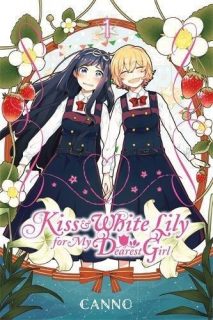
Kiss and White Lily for My Dearest Girl, Volume 1Kiss & White Lily for My Dearest Girl, Volume 1 by Canno. Lately, most of the yuri and other lesbian-themed manga translated in English are currently being released by Seven Seas, but other publishers have been starting to explore (or re-explore) the genre as well. One of Yen Press’ most recent yuri offerings is Canno’s Kiss & White Lily for My Dearest Girl, an ongoing series about the lives and loves of the students at an all-girls school. So far two main couples have been introduced and the short manga between chapter breaks implies that most of the background characters are in one way or another paired off together as well. As for the lead couples, first there is Ayaka and Yurine, the school’s top students. Ayaka is used to being first academically but finds that no matter how hard she tries, Yurine’s natural genius is tough to beat. Yurine, bored with how easy everything is for her, is delighted to finally have someone that she can consider a rival. While Ayaka and Yurine currently have something of a love-hate relationship going on, the affections of the second main couple are much sweeter and more clearly romantic–Ayaka’s tomboyish cousin Mizuki has been in a close relationship with Moe for years.

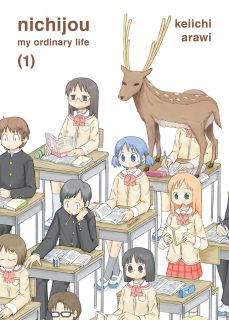
Nichijou: My Ordinary Life, Volume 1Nichijou: My Ordinary Life, Volumes 1-2 by Keiichi Arawi. I’ve heard great things about Nichijou, both the original manga and it’s anime adaptation and so I was fully expecting to enjoy the series. But while I tend to like absurd humor, for whatever reason the offbeat comedy found in the first two volumes of Nichijou just didn’t work for me. Or at least not consistently. While many of the gags fell flat, there were definitely individual bits that I found to be extremely funny. Some even made me laugh out loud. I was frequently amused by the manga as well as delightfully bemused. But as a whole, Nichijou seems to lack real substance. Granted, that’s not necessarily a bad thing and may very well be part of the point. The series mixes the mundane with the strange and completely unexpected,  but that randomness can be difficult to follow at times. On top of the nearly nonexistent narrative logic, action and movement isn’t always conveyed clearly by Arawi’s artwork. As a result, the series’ humor can be difficult to interpret. Even so, Nichijou is admittedly silly and entertaining. But I was very surprised to discover that I didn’t enjoy the manga more than I actually did; it seems like it should haven been a series I loved.

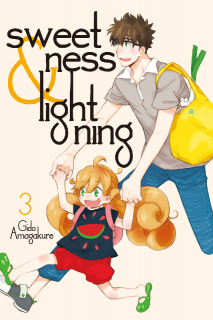
Sweetness and Lightning, Volume 3Sweetness & Lightning, Volumes 3-5 by Gido Amagakure. As I’ve mentioned many times previously, I love food manga and Sweetness & Lightning is no exception. The series is an absolute delight. There’s the food, of course, which I find appealing, but perhaps even more so I enjoy the manga’s focus on friendship and family. Granted, all of this is all tied together in the story–food is what brings people together, creates connections, and deepens relationships. Preparing and sharing a meal is shown as a way of expressing love for another person. Food can also help keep memories alive. Inuzuka keenly feels the loss of his wife and their daughter Tsumugi misses her mother dearly. But as they learn to cook together, recreating family dishes and traditions, they can still be close to her even though she is gone. There are moments of intense sadness but there is also a tremendous amount of joy in Sweetness & Lightning. Amagakure’s illustrations are very expressive, finding an easy balance between these moods. In addition to more exaggerated expressions, the artwork also captures subtle changes. As Tsumugi grows older, for example, her character design matures slightly as well. Sweetness & Lightning is a wonderful series.

Filed Under: FEATURES, My Week in Manga Tagged With: Canno, Gido Amagakure, Keiichi Arawi, Kiss and a White Lily for My Dearest Girl, manga, Masahiko Matsumoto, Nichijou, Sweetness and Lightning

Bookshelf Briefs 5/8/17

May 8, 2017 by Michelle Smith and Sean Gaffney Leave a Comment

Arpeggio of Blue Steel, Vol. 10 | By Ark Performance | Seven Seas – Even as this volume gives us a lot more badass combat, it also shows us the closeness between mental models and humanity, as well as the giant gulf that still separates then. Gunzou wants to bridge that gulf, which means he needs them to see humanity as an equal rather than as a plaything. Hence the threats, and the battles. There’s lots of good back and forth here, though like many Japanese military otaku manga, it sometimes sounds like it was written by a far-right conservative. I am wondering if things are going to start turning against our heroes soon. If you have to read one manga where girls are anthropomorphic personifications of something, this is still the one to read. – Sean Gaffney

Cells at Work!, Vol. 4 | By Akane Shimizu | Kodansha Comics – Red Blood Cell is back in focus this time around, and is allowed to grow in competence a bit, to the point where she gets a kohai to lead around—though she’s still ditzy, causing the kohai to wonder what on earth she’s gotten into. Like most manga protagonists, even red blood cells, she makes up for it with GUTS! and determination. We also get some new characters thanks to a transfusion, which gives us a kansai-ben red blood cell. (I would wonder if he’s a romantic rival to White Blood Cell before recalling that this manga has no romance.) Mostly it’s got what you came here for—cells being badass and yet human, showing off the human body and the many things that try to constantly destroy it. Well worth reading. – Sean Gaffney

Haikyu!!, Vol. 11 | By Haruichi Furudate | VIZ Media – The Tokyo training camp continues and Karasuno is beginning to see some results. I love seeing Tsukishima’s actually trying. He’s listening to advice, asking questions, etc. Meanwhile, Hinata is learning some new tricks and Kageyama is starting to treat him as an equal. When their improved “freak quick” makes its debut, I couldn’t help but smile. There aren’t any miracle wins here, as Karasuno loses every game they play, but by the end of the week they’ve begun to close the gap and, more importantly, gained confidence in their ability to face off against national-level teams. “Spring tournament preliminaries arc begins now,” says on narrative box, but it lies. We’ll have to wait for next time. I’ll just be over here, sulking. – Michelle Smith

Miss Kobayashi’s Dragon Maid, Vol. 3 | By coolkyousinnjya | Seven Seas – I wasn’t as impressed with this volume of Dragon Maid, which continues to introduce more and more dragon girls, sometimes within reason (Elma, whose chapter on joining the office-lady workforce was one of the better ones) and sometimes not (Ilulu, whose “look at my crotch” pose for the cliffhanger made me want to drop the book immediately). There’s also, to my surprise, less yuri tease in this than the previous two books, and it feels a bit like the filler volume you get when a manga writer realizes his series is actually more popular than expected and therefore he’ll have to come up with more plot. Whether he’s successful or not is something we’ll see next time; till then, for monster girl fans only. – Sean Gaffney

My Love Story!!, Vol. 12 | By Kazune Kawahara and Aruko | Viz Media – I will admit that the first half of this book, which resolves the transfer student story, was not really my cup of tea, so I will brush right past it and move on to what is likely to be the final arc of My Love Story!!, which involves Yamato’s family moving to Spain. Needless to say, there’s “we can have a long distance relationship” and then there’s this, which causes Yamato to nearly have a nervous breakdown, running off to Okinawa with a concerned Takeo (who basically is such a nice guy that her parents are OK with him getting her home over the course of several nights in a hotel). The cliffhanger has her seemingly accepting that this is going to happen, but we’ll see how the final volume shakes out. Happily, I assume. – Sean Gaffney

Nichijou: My Ordinary Life, Vol. 8 | By Keiichi Arawi | Vertical Comics – This is the first volume that mostly appeared after the anime came out, so if you wanted to read only new material, this is the place to start. It’s also a terrific Mai volume, which pleases me tremendously—she not only faces off against Mio’s sister in a prank war, but we also get a flashback as to how she and Yukko first met, and it’s actually quite heartwarming, and shows us how much of Mai’s interaction with others is overcompensation for shyness. And there are dream sequences, and weird character designs, and chapters simply stop rather than come to a conclusion. Nichijou is not afraid to wear its gag manga heart on its sleeve, which means it’s never going to be a belly laughter, but it makes you smile quirkily. – Sean Gaffney

Nisekoi: False Love, Vol. 21 | By Naoshi Komi | Viz Media – It’s Marika’s turn to get written out, though it’s not clear if she’s going to be married off or killed off. But it does give an excuse for Nisekoi to turn into an action manga, as Raku and company try to infiltrate Marika’s huge family compound and get her away from the clutches of her over-controlling mother. My favorite part of the book is where Chitoge assumes that if Marika and her mother just talk things over, all will be well, and Marika’s like “yeah, my mom’s not your mom, OK?” We still get the heavy hints that Marika is slowly dying of something, but it’s not clear how far the author is going to take it—not that far, I expect. In any case, next time we will no doubt get a thrilling rescue, though Marika is certainly not end girl. – Sean Gaffney

Requiem of the Rose King, Vol. 6 | By Aya Kanno | VIZ Media – Wow, what a volume. Catesby shows up to bring Richard home from the forest where he’s been holed up with Henry. He clearly knows who Henry really is, but doesn’t tell Richard. Richard, meanwhile, now has a goal: kill Henry and finally succeed in avenging his father so he can live happily ever after with… Henry. They’ve even sworn a promise. In addition to the lovely angst and dramatic irony, there’s treachery, a huge battle, lots of death, Margaret being extremely creepy regarding the consummation of her son’s marriage, and an absolutely horrible flashback to the consummation of her own. Not even several doses of white boar cuteness can make up for the sense of oncoming dread, but it’s all absolutely riveting, especially the final few pages. This’ll be Kanno’s masterpiece, methinks. – Michelle Smith

Filed Under: Bookshelf Briefs

In Another World With My Smartphone, Vol. 2

May 8, 2017 by Sean Gaffney

By Patora Fuyuhara and Eiji Usatsuka. Released in Japan as “Isekai wa Smartphone to Tomo ni” by Hobby Japan. Released in North America digitally by J-Novel Club. Translated by Andrew Hodgson.

First of all, yes, as expected, this volume is not quite as gloriously readable as the last one. It’s hard to keep lightning in a bottle, especially when it’s trying to hit that sweet spot of “awful yet immensely readable”. (I am aware the author is not going for awful, but just work with me here.) And so there are moments where the reader rolls their eyes rather than smiles, and one large section at the end where the reader may be actively pissed off. But given the absolute low bar this series is trying to clear, it manages pretty well, and occasionally even evolves by pointing out its own silliness. Smartphone will never be good, but it can still be fun.

Despite the presence of the not-Fujibayashi twins on the cover, this is still very much an ensemble work, though the ensemble mostly watches Touya show his stuff. Let’s see here… first of all, the smartphone is in fact used more in this book, as promised. Mostly what he does is combine it with his magic so that he can take out multiple enemies via the map function. He’s also rewarded for the events of the first book by the King, which means moving to the royal city and setting up house in a giant mansion, complete with butler, two maids, a gardener and cook, and two security guards. The maids are combat ninja maids, because of course they are. The gardener and cook are married, because of course they are. The two security guys are called Tom and Huck, something so amazing that even Touya can’t look past it and comments on it. Given the book also features characters named Linze, Lim, Leon, Laim, Leim, Lapis, Lyon, Leen, and Renne (who I can only imagine is romanized with an R because the translator finally got completely fed up) we should count ourselves lucky.

The book works best when it revels in its cliches. Touya is overpowered as all hell, though even he needs a tiny bit of help to take down a giant dragon (but only a tiny bit). He gets a mansion to live in with his harem, but is oblivious to all of them. (They at least seem to have come to terms with their feelings for him, and Yumina seems to be organizing them.) His magic impresses even the Queen of the Fairies, he can defeat the battle-crazy King of Beasts (who looks like Prince Phil from Slayers if he were a giant snow leopard), he can invent email in his spare time, and he can also take in adorable orphan thief girls who are clearly also long-lost royalty and make them maids. The reason this works, for once, is because Touya is such a blank. If he were confident he’d be insufferable, if he were mopey he’d be unreadable. It’s only because he’s casual about literally everything that he gets away with it.

That said, when he ISN’T like that things go south fast. There are two short stories at the end of the book. My guess is they were taken from the early days of the webnovel, and it shows. Leaving aside the fact that the premise of the second story is “let’s melt the clothing off all the female cast”, Touya is actively seeking this, thinking that he’d actually like to see their semi-naked bodies. This flies in the face of the rest of the book, where Touya’s lack of awareness of his harem as anything but family is lampshaded repeatedly by Yumina and the others. I get that sometimes you need to pad the novel out, but not at the expense of the main character. Skip this story. But otherwise, Smartphone 2 is pretty much a lot like Smartphone 1: cliche-ridden but fun to read.

Oh yes, and he makes an extendable gun sword from scratch. Because of course he does.

Filed Under: in another world with my smartphone, REVIEWS

One Piece, Vol. 82

May 7, 2017 by Sean Gaffney

By Eiichiro Oda. Released in Japan by Shueisha, serialization ongoing in the magazine Weekly Shonen Jump. Released in North America by Viz. Translated by Stephen Paul.

This is another one of those volumes of One Piece in which so much happens that you begin to wonder where to begin when writing the review. There’s revelations about Sanji’s family’ discussion of Gold Roger and Raftel, the final destination where One Piece lies; the aftermath of what happens on Zou, and the splitting of the crew (again!) to deal with the myriad problems; a meeting of fifty Kings and Rulers from all over the Grand Line, which means we get to see Vivi sailing again; and starting off a new arc as the reader, of course, follows Luffy, who takes his merry band to rescue Sanji from his impending wedding. Which, amusingly, Sanji wants to have no part of, though seeing the amazingly pretty bride to be might change his mind. And this is all mixed in with the usual One Piece humor and fighting.

It is rather interesting seeing Vivi on the cover in the background there, given she doesn’t really get all that much screentime (though she certainly flaunts the time she gets). One of the drawbacks of Oda writing a constant pirate’s journey is that it’s very difficult to go back and visit anyone again, which is why we only see Kaya, Nojiko, etc. in occasional “what are they doing now?” scenes. But the upcoming meeting will, I suspect, give an opportunity for Vivi at least to rejoin the Straw Hat Crew, which would be awesome, even though the crew itself continues to be unwieldy. In Dressrosa we had Nami, Sanji, Chopper and Brook sidelined for volumes at a time. Therefore, for this new adventure, Luffy takes Nami, Chopper, and brook with him to go bring back Sanji, leaving the others behind to deal with the other threads of plot that will involve less of Luffy rushing in where rubber doesn’t really to treat. And what’s more, he adds some people from Zoul, some on purpose (Pedro, Pekoms), and some by accident (Carrot, who I suspect is there for comic relief).

But Sanji and his family are currently where Oda is directing attention, and luckily that coincides with the arrival of the Big Mom Pirates. Big Mom may be stereotypical, but she’s certainly dangerous, especially given the final vision of the volume, as she parties along with the Worst Teletubbies Episode Ever. We also meet two of Sanji’s siblings (one outrageous, one sensible, in the best tradition of meeting siblings), and find out a bit more about their family, including their being used as the basis for a group of comic strip villains popular all over the Grand Line. And we meet Charlotte Pudding, Sanji’s fiancee, who seems nice and sweet and makes chocolate, and I think I’ll leave it at that, as the volumes are a good year behind the Weekly Shonen Jump chapters released every Monday.

So it’s all over the place, but in a good way, and Luffy gets to be monumentally stupid, which we haven’t seen for a while, and Nami upgrades her weapon in a very amusing scene and… look, it’s just a good volume of One Piece, OK? That said, read the other 81 first, as this is a bad volume to jump off from.

Filed Under: one piece, REVIEWS

  • « Go to Previous Page
  • Page 1
  • Interim pages omitted …
  • Page 431
  • Page 432
  • Page 433
  • Page 434
  • Page 435
  • Interim pages omitted …
  • Page 1048
  • Go to Next Page »
 | Log in
Copyright © 2010 Manga Bookshelf | Powered by WordPress & the Genesis Framework