• Skip to primary navigation
  • Skip to main content
  • Skip to primary sidebar
  • Home
  • About Us
    • Privacy Policy
    • Comment Policy
    • Disclosures & Disclaimers
  • Resources
    • Links, Essays & Articles
    • Fandomology!
    • CLAMP Directory
    • BlogRoll
  • Features & Columns
    • 3 Things Thursday
    • Adventures in the Key of Shoujo
    • Bit & Blips (game reviews)
    • BL BOOKRACK
    • Bookshelf Briefs
    • Bringing the Drama
    • Comic Conversion
    • Fanservice Friday
    • Going Digital
    • It Came From the Sinosphere
    • License This!
    • Magazine no Mori
    • My Week in Manga
    • OFF THE SHELF
    • Not By Manga Alone
    • PICK OF THE WEEK
    • Subtitles & Sensibility
    • Weekly Shonen Jump Recaps
  • Manga Moveable Feast
    • MMF Full Archive
    • Yun Kouga
    • CLAMP
    • Shojo Beat
    • Osamu Tezuka
    • Sailor Moon
    • Fruits Basket
    • Takehiko Inoue
    • Wild Adapter
    • One Piece
    • After School Nightmare
    • Karakuri Odette
    • Paradise Kiss
    • The Color Trilogy
    • To Terra…
    • Sexy Voice & Robo
  • Browse by Author
    • Sean Gaffney
    • Anna Neatrour
    • Michelle Smith
    • Katherine Dacey
    • MJ
    • Brigid Alverson
    • Travis Anderson
    • Phillip Anthony
    • Derek Bown
    • Jaci Dahlvang
    • Angela Eastman
    • Erica Friedman
    • Sara K.
    • Megan Purdy
    • Emily Snodgrass
    • Nancy Thistlethwaite
    • Eva Volin
    • David Welsh
  • MB Blogs
    • A Case Suitable For Treatment
    • Experiments in Manga
    • MangaBlog
    • The Manga Critic
    • Manga Report
    • Soliloquy in Blue
    • Manga Curmudgeon (archive)

Manga Bookshelf

Discussion, Resources, Roundtables, & Reviews

Blog

Pick of the Week: Is This The Real Life? Is This Just Fudanshi?

May 29, 2017 by Sean Gaffney, Katherine Dacey, Michelle Smith, Ash Brown, MJ and Anna N 1 Comment

SEAN: It’s an odd week with the majority of titles being digital ones. I’m not blown away by anything, but I guess I’ll go with the debut of Real Girl, a Dessert series that almost seems to be a genderbent version of a very common shoujo trope.

KATE: That’s some slim pickings… oof. If I had to choose a title — and death was not an option — I’d cast my vote for The High School Life of a Fudanashi. After reading several relentlessly grim books, I could use a silly palette cleanser. Fudanashi looks like it fits the bill: it’s a 4-koma title about a straight boy who likes BL but feels weird about telling his friends. It will either be a hoot or a dreary compendium of “But I’m not gay!” jokes. Let’s hope it’s the former.

MICHELLE: I intend to check out Kasane and Real Girl, but of all the options, I’m most happy that the digital release of Nodame Cantabile continues briskly, so I’ll pick volume twenty of that series this time.

ASH: Like Kate, my pick this week goes to The High School Life of a Fudanshi. The premise has promise, but it also has the potential to go completely off the rails (and not in a good way). I’m curious to see which direction the series takes!

MJ: There’s not a lot for me this week, but I’m cautiously edging towards The High School Life of a Fudanshi, with the understanding that it could turn out to be either awesome or horrifyingly offensive. I’m open to finding out which.

ANNA: There really isn’t much that’s an automatic pick for me, so like Sean, I’ll go with Real Girl as I enjoy genderbent shoujo from time to time.
Filed Under: PICK OF THE WEEK

Random Musings: Toronto Comic Arts Festival 2017

May 28, 2017 by Ash Brown

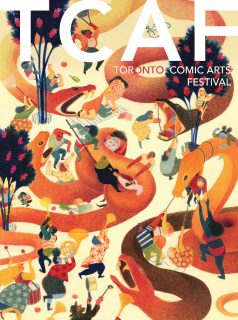
TCAF 2017 Poster - Sana Takeda

©Sana Takeda

I didn’t actually realize it until I started writing up my random musings for the 2017 Toronto Comic Arts Festival (TCAF), but this year was actually my five-year TCAF anniversary! For the first two years I coordinated the trip with a friend (a different one each year), but for the last three years my TCAF adventures have been combined with a Toronto family vacation. 2017’s TCAF trip leaned a little more heavily towards family activities than in years past, but I still found the opportunity to enjoy what the festival had to offer. And seriously, TCAF has a tremendous amount to offer. It’s the only comics-related event that I currently attend, and it’s absolutely worth challenging my social anxiety and general awkwardness.

Although there are TCAF-related events throughout May, the festival-proper usually takes place on Mother’s Day weekend which was May 13th and 14th this year. As mentioned, much of the emphasis of my trip this year was on family vacationing. We made a long weekend of it, leaving on Thursday and returning on Sunday. On Thursday, after treating ourselves to breakfast at a favorite local restaurant and taking the young one to a weekly language development play group (which I hadn’t actually had the opportunity to visit before since I’m usually working when the class is held), the four of us (three adults and a toddler) piled into the car on headed out.

If we were to drive straight through from where we live in Michigan to Toronto, it would take about four and a half hours but we arrived a little over six hours after we left. Things always seem to take a bit longer when kids are involved, not to mention the fact that we also happened to stop for a leisurely picnic lunch once we were in Canada and well on our way. I don’t remember exactly what time we finally pulled into Toronto, but it was late enough that I missed the book launch party for Jane Mai and An Nguyen’s newest collaboration So Pretty / Very Rotten: Comics and Essays on Lolita Fashion and Culture which I had hoped to attend. Instead, we all took our time settling into the room for our stay and then ordered tasty takeout from a place that was a surprising combination of pizzeria and Asian fusion.

On Friday, the whole family spent most of the day at the Ontario Science Centre, which was fantastic. We mainly focused on the interactive areas geared towards younger ages and so certainly didn’t see everything there was to see; I would like to go back sometime and explore even more of the centre because we all had a great time. After resting up in our room for a bit, we eventually made our way down to The Distillery Historic District for dinner, drinks, and other diversions. In the past, Friday night would have been the night that I would take off for the Sparkler Monthly mixer, but this year that party was held on Saturday evening instead. (Sadly, this also meant Sparkler’s party conflicted with the annual queer mixer.)

After spending most of Thursday and Friday with the family, I was mostly off on my own on Saturday enjoying the first day of TCAF. As in years past, I started my morning off wandering the exhibitor areas before they got super crowded. I mostly explored the Toronto Reference Library,  which had three floors of exhibitors this year, but eventually made my way to the exhibitors situated in the Masonic Temple as well. I wasn’t quite as social as I have been at previous festivals, but I did make a point to at least say hello to the creator’s that I recently supported through Kickstarter who were at the festival. I spent a fair amount of time going through all of the exhibitor’s online portfolios before arriving in Toronto, making notes to myself of the tables that I wanted to be sure to stop by, but in the end I really did try to see everything there was to see. One of the things I love about TCAF is the wide variety of comics at the event, but I especially appreciate the number of queer creators and the amount of queer content present.

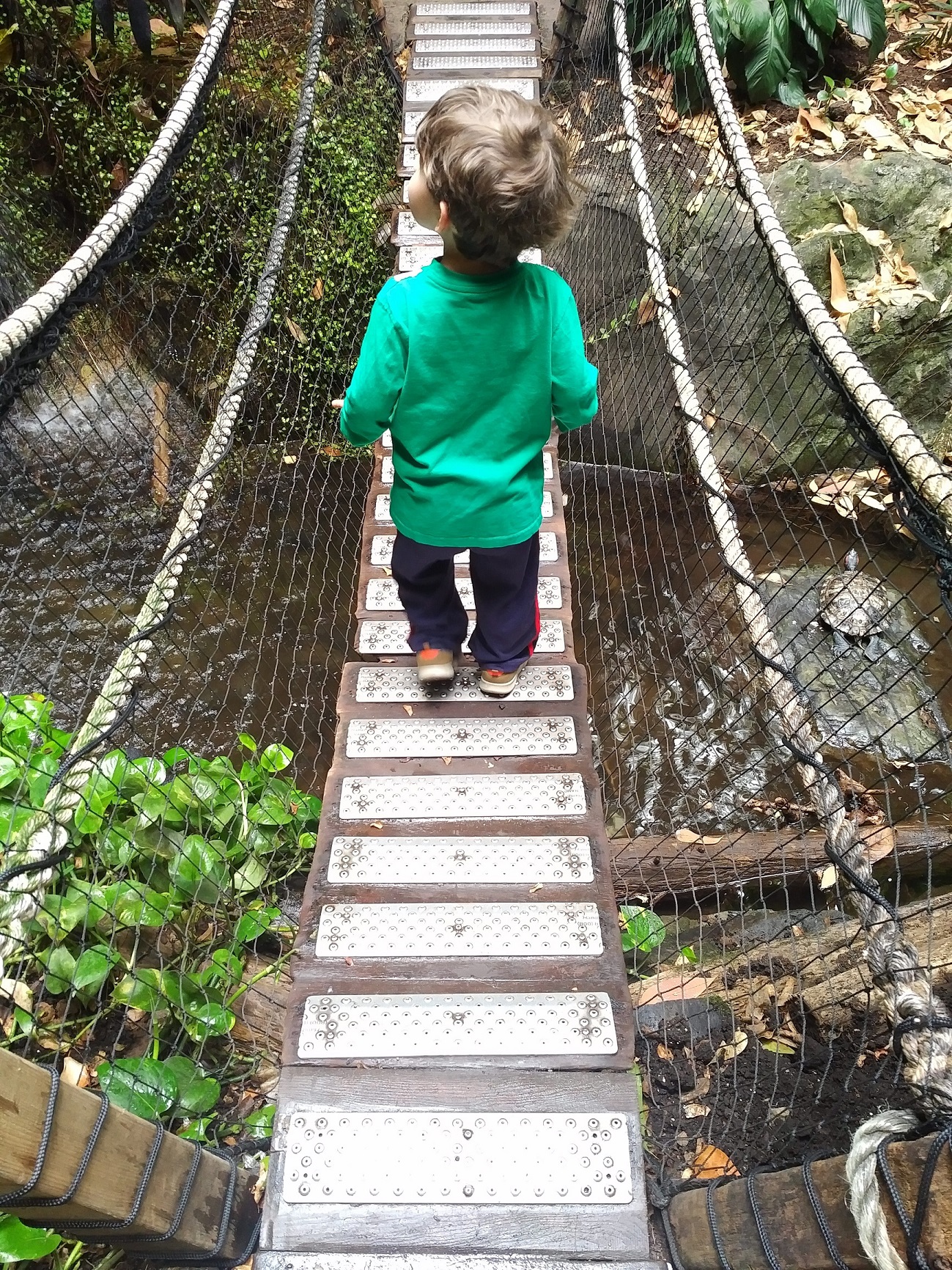
Ontario Science Centre Rainforest

Exploring the rainforest at the Ontario Science Centre

In addition to all of the phenomenal exhibitors, TCAF also has a strong lineup of panels, workshops, and creator spotlights. As usual, it was a tremendous challenge deciding which events I wanted to go to, especially as so many of the conflict with one another. In the end I settled on six, all but one of which were held on Saturday. There were definitely others that I wanted to attend, too, but for one reason or another (such as waking up with a migraine on Sunday morning or a cranky toddler) I wasn’t ultimately able to fit them all into my schedule.

Since I’m a musician on top of being a huge fan of comics, one of the panels that immediately caught my interest was “Sounds and Vision: Music in Comics,” moderated by Phillipe Leblanc, which explored how artists portray and convey music and sound in a visual medium. Although I haven’t actually read any of their comics (yet), I did recognize the panelists by name–Dave Chisholm, Nick Craine, Anya Davidson, Sandrine Revel, and Eric Kostiuk Williams. All of the creators on the panel had at least some musical background, formal or otherwise (Chisholm even has a doctorate in jazz trumpet), and consider music to be one of their passions. In some ways the two artforms, music and comics, are incompatible since each one requires so much time to master as an artist, but they can still be brought together. If nothing else, creators’ experiences as musicians can inform and influence the stories they want to tell. Effectively incorporating music into a comic requires more than just putting music notes on a page. As Chisholm pointed out, musical notation isn’t really music either–it’s simply ink on paper, a visual shorthand (much like comics themselves). In order to convey the intended feeling of the music, comic creators must instead rely on page and panel design to capture a sense of tempo, movement, and flow. Creative use of typography can also be effective, especially when lyrics are involved, and imaginative onomatopoeiae can serve as a device to form a visual soundscape. Often a literal representation of music isn’t what is demanded by a narrative, it’s the emotional resonance and impact of that music that needs to be seen, whether it’s the focus of a comic or simply being used as a background element to help set a scene.

After spending a little more time browsing the exhibitor areas, the next panel that I attended was simply titled “Sports!” which included Michael Nybrandt, Ngozi Ukazu, Sonam Wangyal, and Jarrett Williams as panelists and RJ Casey as a moderator. While in Japan sports comics have been immensely successful, the subgenre hasn’t thrived in the same way in the North American comics industry. Although there have been some independent sports comics with impressive followings, such as Ukazu’s Check, Please!, in general sports comics continue to be a hard sell for many major publishers. In the 1990s there were some unsuccessful mainstream attempts that basically tried to turn sports comics into superhero narratives rather than focusing on the underlying human story, something that didn’t work well at the time. There’s also the question of audience since there is a lingering and inaccurate stereotype that “nerds don’t like sports.” (Ukazu commented that it might actually be more difficult to sell sports comics to sports fans than to comics fans.) Sports stories provide ready-made and easily understood narratives which allow the incorporation and exploration of other subjects such as politics, religion, and performance of gender, making those issues more acceptable or palatable for readers. Emotional highs and lows are inherent to the stories, often directly tied to the athletes’ successes and failures in competition. Sports comics can risk becoming repetitive since the most basic story arc is the often same–someone will win and someone will lose–but while the ending may be already be determined, how the comic arrives at that ending is not. Changing the implications of winning and losing can introduce new dynamics and not all the conflict and drama has to happen within the context of the sport itself.

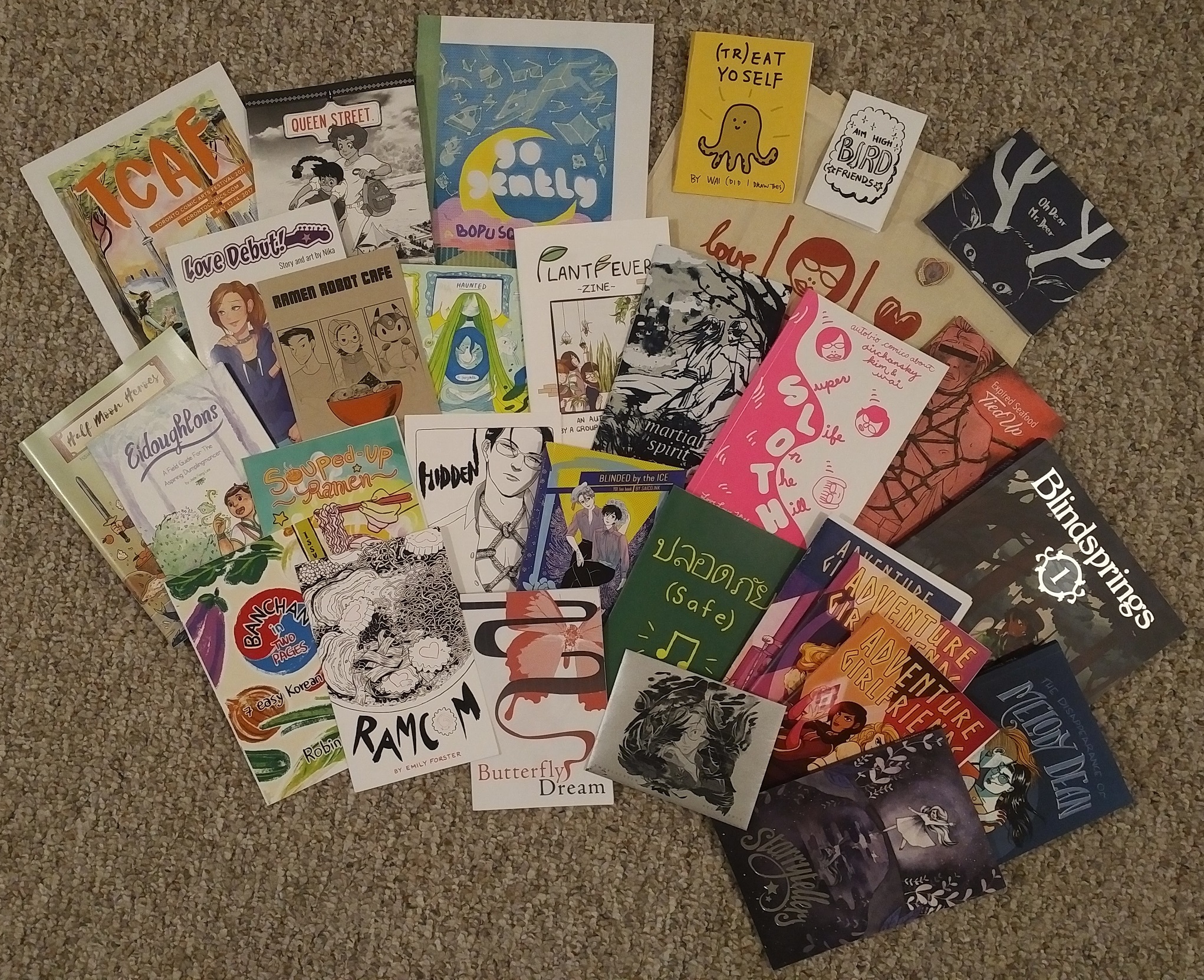
TCAF 2017 Haul

TCAF Haul 2017!
(minus a t-shirt and poster)

While the first two panels I went to were both held at the Stealth Lounge at The Pilot, my next three panels were located at another of TCAF’s primary event locations, the Toronto Marriott Bloor Yorkville Hotel which allows for larger gatherings. It’s a good thing, too. Glen Downey, who was moderating “Creating While Depressed,” noted that it was one of the most well-attended TCAF panels with which he has been involved. The subject matter being discussed appeared to strike a very personal chord with many of the people in the audience, myself included. The panelists–Meredith Gran, Tara Ogaick, Meredith Park, and Shivana Sookdeo–were all very candid and open, sharing their own experiences as creators who have to carefully balance their mental health with their creative work. They talked about how damaging the idealized stereotype of the “tortured artist” is and how the romanticized portrayal of depression found in popular culture is often vastly different from actual experience. In reality, people with depression are creating despite depression rather than because of it. For them, comics can be an outlet for expression and a way to alleviate some of the symptoms of depression, but at their lowest points it may be impossible for them to produce any work at all. It is at those times when communication and honesty are particularly crucial in order to clearly delineate limitations and establish realistic expectations not only for themselves but for the people with whom they might be working. The panelists also emphasized the importance of finding a supportive, close-knit community. Although they were specifically speaking as artistic creators with depression, I found that their experiences strongly resonated with my own and could be more broadly relatable.

My fourth panel of the day was “21st Century Webcomics,” featuring Michael DeForge, Blue Delliquanti, Priya Huq, Matt Lubchansky, and moderated by Tom Spurgeon. I don’t actually follow as many comics online as I used to–I find reading digital content difficult and/or frustrating for a wide variety of reasons–but I am still a huge supporter of webcomics, frequently buying print editions if they exist. As with any medium, webcomics have evolved over time especially as advances in the creation of digital artwork have also been made. Likewise, the relationship between webcomics and print comics have changed and there is less of a sense that they are at war these days. Instead, webcomics are often used to support their print equivalents. Because they are online, webcomics are inherently more discoverable and more widely accessible which helps to build an audience and further promote a creator’s work. Webcomics can also give a creator the opportunity to experiment with new methods and formats of expression that simply aren’t realistically feasible or even possible in print, such as the use of infinite canvass, animation techniques, or interactive elements. Creators have a tremendous amount of freedom when it comes to webcomics, allowing personal or experimental works to be produced and distributed that more traditional or mainstream comic publishers might initially be reluctant to take a risk on. However, while it was hoped that the Internet would allow creators to more directly deliver their content to readers and flatten out publishing hierarchies (which to some extent has occurred), the reality is that there has been a rise in intermediaries. More and more, creators find they frequently have to rely on multiple external systems and platforms like Kickstarter, Patreon, and social media to sustain their work.

“LGBTQ Comics Abroad,” moderated by Justin Hall, was the one panel that I wanted to be sure to make it to above all others not just because the subject matter had to do with queer comics but because Gengoroh Tagame was participating. (Even if someone isn’t a fan of Tagame’s works, his immense historical knowledge and experience as a gay comics creator makes his panels well-worth seeking out.) The other panelists included A.C. Esguerra, Molly Ostertag, Tommi Parrish, and Martina Schradi. Anne Ishii was also there, technically to assist with interpretation for Tagame, but she also had her own thoughts and experiences to bring to the discussion. The panelists talked about their work and the state of queer comics within their own countries (Japan, United States, Australia, and Germany) but also the challenges presented when considering international audiences. Queer identities are formed differently from culture to culture, and some of the nuances of those differences can be difficult to convey or translate, however there are still some shared and common experiences that are not limited by borders; social mores and contexts will often vary, but universal themes can still be found. The online environment has presented an opportunity for queer comics to be successful in ways that are currently difficult through traditional publishing, although the mainstream comics industry has been slowly making progress. The Internet allows for an unprecedented ease of global access to and distribution of queer content; it has been possible for numerous communities and support networks to be established which aren’t limited by geographic boundaries. But along with the good, there is also the bad–the piracy, scanlations, and extreme levels of fan entitlement present online can be hugely damaging.

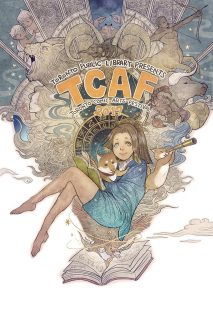
TCAF 2017 Poster - Eleanor Davis

©Eleanor Davis

As mentioned, Saturday night I went to the Sparkler TCAF Mixer. I brought the little one along with me to allow the family’s other two adults to have a child-free dinner date. A good time was had by all and I had the chance to catch up with not only the Chromatic Press/Sparkler Monthly folks but some of Seven Seas’ people as well. There’s a bit of an overlap between the two groups even though the demographics of each company’s audience are currently the inverse of each other. (Interesting tidbit: According to a recent Sparkler Monthly survey, while women form the core readership, at present Chromatic Press has more nonbinary readers than male readers.) Expect some really great things and exciting announcements to come from both publishers in the near future.

Sunday ended up being a much shorter day than was originally planned (I was really hoping to attend the So Pretty / Very Rotten discussion on Lolita culture at the Japan Foundation, for one). However, I and one of my partners were able to at least make it to The Pilot for the panel “Looks Good Enough to Eat: Comics and Food” before we all headed back to Michigan. We sadly missed out 2016’s food comics panel, so we were particularly happy to be there this year. Perhaps unsurprisingly considering my well-known love of food comics, I was already familiar with the work of most of the panelists: Sarah Becan, Emily Forster, Robin Ha, Jade Feng Lee, and Kat Verhoeven. Along with moderator Lauren Jorden, the group discussed what appealed to them about creating and reading comics that prominently feature or incorporate food. The subgenre of food comics is actually quite diverse, including comics explicitly about food (recipe comics, autobiographical works, or journalistic reviews) as well as comics that use food as a theme or aesthetic. Everyone has to eat, which can make food comics particularly accessible; it’s a shared experience that can serve as a gateway into comics. Food is a multisensory experience, so it can be challenging when working in a medium that primarily relies on one. However, an important part of eating is the visual experience, so to that extent comics are a natural fit. Comics can evoke a feeling or mood that can’t be captured in the same way with photography or other visual artforms. Often there is a strong emotional component to food comics. Even when the subject matter is specifically about food, food itself isn’t just food–it’s history, community, culture, relationships, and personal expression. And comics can be all of those things, too.

And with that,  and after one last tour through the exhibitor areas, the whole family prepared to depart for home. Though I didn’t end up doing everything that I had originally planned or hoped to do,  but I still had a fantastic trip. Toronto is a terrific city and TCAF is a phenomenal festival. However inadequately, I’ve tried to convey some of that greatness here by highlighting a little of what I learned and experienced. However, there’s so much more that I could have (and perhaps should have) written about because there’s so much more to the festival. I definitely plan on attending TCAF for the foreseeable future.

Filed Under: FEATURES, Random Musings Tagged With: comics, Gengoroh Tagame, manga, TCAF

Death March to the Parallel World Rhapsody, Vol. 2

May 28, 2017 by Sean Gaffney

By Hiro Ainana and shri. Released in Japan by Fujimi Shobo. Released in North America by Yen On. Translated by Jenny McKeon.

There is a bit of a cliche about the typical isekai hero. The abbreviation used, I believe is ‘OP’, as in ‘overpowered’. In fact, it gets applied to light novels heroes whether it’s an isekai or not, but generally tends to mean that the hero wins most of his fights with ease, has very little difficulty amassing a group of girls who like him, and wanders through the story being a cool wish-fulfillment character. Of course, when you examine the works more closely, no one here is ever QUITE that bad. Taking the two most obvious examples, Kirito has various issues in both his real and gaming life (which admittedly the author does not emphasize as much as he should), and Tatsuya has genuine issues communicating properly with people much of the time due to literally being engineered to not have strong emotions. Hell, even Arifureta’s hero spends almost half the book suffering as a bullied loser before he goes through hell and becomes Grimdark Araragi. And then there’s Death March’s Satou.

Even Satou’s very name, one of the most common last names in Japan, screams generic. The author seems to have this misguided opinion that being above the age of 25 somehow manages to let you control all your emotions perfectly, and so Satou strides through situations with barely a raised eyebrow. His briefly getting mildly annoyed at the villain at the end of this volume is a major breakthrough, something he even lampshades. Hell, you know the scene in KonoSuba where Kazuma goes through hell in order to get laid with a brothel employee only for everything to conspire against him? Here, Satou can simply go to a brothel, level up in many erotic ways (which he refuses to tell us), and suffer no punishment other than being briefly yelled at by his loli slave, who he spends most of the book chastising in any case. You could argue that Touya from Mixed Bathing and Touya from Isekai Smartphone are generic nice guys too, but at least they have normal reactions and are somewhat fresh-faced and shiny. Satou is “been there, done that”.

Oh yes, speaking of that loli, Arisa is the major new cast addition this time around, and is also from Japan, though we don’t know the details yet. Given her behavior, I suspect that she’s much older than her fantasy appearance here. But on that note, can we dial down Satou reminding us he’s not a lolicon just a bit? I realize he’s surrounded by young girls (most of whom he owns – the slavery aspect to this work is still very uncomfortable, especially as his reaction is along the lines of “well, that’s the way it is”) but it’s annoying given that the author clearly IS a lolicon and is happy to give us lots of service whether asked for or not. Other new characters include Arisa’s companion, who is painfully shy except when discussing Arisa, and also cursed to look ugly to everyone (except Satou), a generic mook villainess who is #7 of a group of eight, so is naturally named Nana by Satou because he is awful, and a cute realtor who seems to want to be ravished by her boss. Oh, and an elf princess, also very young.

Is there anything in this book that isn’t painful? The last third or so, where he’s battling his way up a huge tower full of monsters, shows the author can be decent when he’s writing fight scenes. At one point, Satou has to literally breakdance his way past the villains, the only time in the entire volume I laughed out loud. But for the most part, if you’re interested in an isekai published in North America, literally any other novel is better than this. Congrats, Death March, you’re the first light novel I’m dropping for simply being bad, rather than dark (Black Bullet, Goblin Slayer, Grimgar) or offensive (Siskan).

Filed Under: death march to the parallel world rhapsody, REVIEWS

Girls’ Last Tour, Vol. 1

May 27, 2017 by Sean Gaffney

By Tsukumizu. Released in Japan as “Shoujo Shuumatsu Ryokou” by Shinchosha, serialization ongoing in the magazine Kurage Bunch. Released in North America by Yen Press. Translated by Amanda Haley.

As I read this manga, I kept wondering which of the many slice-of-life series starring young girls drawn in a moe style it reminded me of. I’d said on twitter that it was like a post-apocalyptic Yotsuba&!, but at times it also reminds me of Strawberry Marshmallow, Sunshine Sketch, and Non Non Biyori. The key thing that connects all of those titles is that they’re all slice-of-life – note that Girls’ Last tour doesn’t really remind me of other post-apocalyptic mangas where survivors wander the remains of the Earth. Because while that’s the gimmick here, it’s not what keeps people coming back to the title week after week. You come back to see Chito and Yuuri, the two leads, discuss reading, or find hot water so they can take a bath, or meet up with other survivors who help them get up to higher levels of the wasted world they drive their small, cute tank through. It’s… relaxing.

It’s never really made clear, at least not in this volume, exactly what happened to the world that the two girls are wandering through, and honestly it’s not all that important yet. All we know is that there are multiple levels, they are decaying and falling apart, and that for the first 2/3 of the book or so, the girls are the only two survivors we meet. Their concerns are basic: food, heat, shelter, and finding a way to get to a level where there might be more of all three. As you’d expect with a slice of life title, the girls have contrasting personalities. Chito is serious, studious, and does most of the thinking for the two; Yuuri is cheery, dazed, a bit of an idiot, and provides the muscle and shooting skills. And yes, they drive around in a tank and have guns, though we don’t really run into much of anything in this first volume that would require them. Unlike a lot of the slice-of-life seinen titles out recently, there’s not even any faux yuri tease in this – the girls are simply friends, with one perhaps finding the other one more aggravating than she’d like.

About 2/3 of the way through, they meet an older man who is trying to map out the desolate landscape they’re both exploring. Sadly, thanks to a malfunctioning elevator, his maps end up scattered to the four winds (this is even lampshaded right before it happens, with one of the girls talking about the poor design of the freight elevator they’re riding and how it needs railings). This also shows off that even if the girls can slide into moe sameness a bit (I still tend to forget their names), they both have a drive to explore more, to find out what’s beyond the next level, and they convince the understandably distraught mapmaker to do the same thing. Girls’ Last Tour is exploring a landscape quietly and peacefully with two cute young girls. It’s not just a slice-of-life moe manga, it’s trying to be the last slice-of-life moe manga you’d read before the end times cast the universe into heat death. And for the first volume, at least, that’s not too bad.

Filed Under: girls' last tour, REVIEWS

Manga the Week of 5/31

May 26, 2017 by Sean Gaffney, Ash Brown, Anna N, Michelle Smith and MJ 1 Comment

SEAN: Believe it or not, under 20 releases is now a quiet week. Welcome to the Manga Boom, here’s your accordion. So what’s out next week?

J-Novel Club has an odd license. Despite being available to them, no one thought the company would license Invaders of the Rokujouma!? for two reasons: 1) It’s 23 volumes and counting in Japan, and 2) it already had a well-regarded fan translation of the first 22 volumes. But J-Novel has licensed that fan translation, is giving it an edit, and doing a fast release of the first three volumes of the series, with more to come monthly, apparently. As for the title itself, it’s a harem comedy, so moving on…

ASH: It’s probably not a series that I’ll ever pick up, but that’s an interesting publication history!

SEAN: Kodansha has more digital Del Rey rescues. Alive 16, Nodame Cantabile 20, and Yozakura Quartet 12.

…and I guess that Kodansha has Battle Angel Alita 1-3 out digitally too. I knew it was coming, but not so soon. This is the original BAA (as opposed to the Last Order reboot), with a new translation.

Their lone print release this week is the 60th volume of Fairy Tail, which should be wrapping up in Japan soon.

Kodansha also has new digital releases. Kasane is an award-winning work, and runs in the magazine Evening. It appears to be a dark thriller with lots of bullying and abuse overtones. But, magic lipstick!

Real Girl (3D Kanojo) is a shoujo/josei title from Dessert, involving a nerdy outcast type who ends up working with a cool beauty, the sort he hates, but gradually comes to realize that cool beauties are people too.

ANNA: I have mixed feelings about these digital releases, I’m so happy that more shoujo/josei is coming out, but having been burned before by the crash and burn of digital manga programs in the past, I’m concerned about some of these titles actually being finished. Also, it would be great to have some more josei print manga! Even with these handy reminders for the Manga Bookshelf team, I’m having a hard time keeping track of all the digital releases that I’m interested in.

MICHELLE: There certainly are a lot of them! That said, I will give these two new ones a try. And yay for more Nodame, as well!

ASH: I’m glad that these titles are being licensed at all, but I’d definitely like to see more of the released in print, too.

MJ: I share Anna’s concerns. I’m glad these are being released, but I’m still reeling from the loss of some JManga series I was really invested in (that have not, to my knowledge, been picked up by anyone else), and I admit I still mistrust digital.

SEAN: If it helps, the JManga title To All Corners of the World was rescued by Seven Seas and will be out in November in one (print) omnibus.

Seven Seas has a few new titles next week, starting with a (gasp!) novel, The Disappearance of Hatsune Miku, based on the seemingly unstoppable Vocaloid idol.

The manga debut is The High School Life of a Fudanshi (Fudanshi Koukou Seikatsu), a comedy title from Zero-Sum Online about a straight guy obsessed with BL, and his drive to find someone else to share his obsession with.

ASH: Knowing a few straight fudanshi myself, I’m rather curious to see how the series handles the topic.

MJ: Cautiously interested.

SEAN: And there’s a 5th volume of Shomin Sample, which must have run out of girls showing us their panties on the cover by now. (checks) Sadly, apparently not.

Vertical has the 8th Ninja Slayer, for all your Ninja needs.

They also have a light novel based on the Seven Deadly Sins manga, subtitled Seven Scars They Left Behind. Judging by that title, I wouldn’t expect a lot of laughs.

Yen Digital has some new volumes for us, as we get the 10th Aphorism, the 10th Crimson Prince, and the 10th Sekirei.

And while it’s not Vol. 10, Yen On does have the first four Sword Art Online novels now available digitally, for those obsessed with reading light novels on their phones (like me).

Are you taking a week off? Or getting something here?

Filed Under: FEATURES, manga the week of

Strike the Blood, Vol. 6

May 26, 2017 by Sean Gaffney

By Gakuto Mikumo and Manyako. Released in Japan by ASCII Mediaworks. Released in North America by Yen On. Translated by Jeremiah Bourque.

Sigh. And here we are again, blank screen. It’s you vs. me, as I try to fill you up with another 500 or so words about the latest volume of Strike the Blood. The goal, as always, is not to simply cut and paste from the previous five reviews. As always, this goal tends to be thwarted by the plot, characterization, and writing in Strike the Blood, whose cookie-cutter quality means that the same things happen over and over again. Let’s face it, the big surprise in this volume was that for once Kojou is not biting a different girl to gain more superpowers… though in an icky way, I suppose that his possessed younger sister may count. I’d prefer to think that it does not. Other than that, though, it’s business as usual at Strike the Blood, Inc.

Even the covers depress me, as you can’t even get the ‘new harem member gets the cover’ cliche that you do with most other series of this sort. No, Strike the Blood now has 16 volumes out in Japan, and it’s Yukinas all the way down. The ‘new girl’ this time, sort of, is Nina Adelard, an immortal alchemist with a tragic past that’s tied into Kanon’s own tragic past. She spends most of the book either occupying Asagi’s body or taking on her appearance, and I suspect her ending up as a “fairy-like” creature will allow her to take on a role in future books similar to a magical girl mascot. (It also reminds me of Index, as much of this series does, though for once I believe that Strike the Blood actually did this first.) The plot involves lots of alchemy and liquid metal, and a few guards end up dead in horrible ways, but aren’t dwelled on.

Asagi also ends up dead briefly, which might have had more impact if there was any chance that it would stick. We do get more concrete proof that as long as she’s on the island she’s effectively immortal. Unfortunately, with no computer problems to solve this time, Asagi is in full on “tsundere anime girl” mode, which means wacky cooking antics and exploding stoves. (Yukina, of course, is also in cliche mode, reacting any time Koujo even briefly pays attention to another attractive female.) Everyone else fills their function: Kanon is waifish and still somewhat broken, Natsuki flits around saving the day and being the cute loli teacher. and Yaze continues to get hints that he may one day be relevant to the plot without actually being so in this book.

And so as ever I’m left with saying the same thing. The writing is good, moves quickly, the fights are exciting. But this could be written by the Light Noveltron 3000. And there’s still no real sign of any developing main plot, anything that might carry over from book to book. Things are neatly wrapped up, and I suspect Book 7 will have another danger to the island that is also neatly wrapped up. Strike the Blood is, when you get down to it, Strike the Blood. It is shaped like itself, and can’t really be reviewed as anything but that.

Filed Under: REVIEWS, strike the blood

Monthly Girls’ Nozaki-kun, Vol. 7

May 25, 2017 by Sean Gaffney

By Izumi Tsubaki. Released in Japan as “Gekkan Shoujo Nozaki-kun” by Square Enix, serialization ongoing in the online magazine Gangan Online. Released in North America by Yen Press. Translated by Leighann Harvey.

The danger of most comedy titles is that they aren’t funny all the time. Not every joke can land, and sometimes you find yourself merely smiling and them moving on to the next page. That’s why it’s satisfying when you come across a volume that has an even greater number of hits than misses. I won’t say every page is fall-down funny, but the seventh volume of Nozaki-kun has an even higher ratio of laughing out loud than its previous volumes, which says something given that this is one of two manga where I can’t read it on public transit as I do laugh out loud too much. (The other is Oresama Teacher, by the same author.) By now we know the characters so well that we can anticipate what’s going to happen, but that doesn’t make the jokes any less funny. And, as always with this title, everyone plays the straight man or funny man depending on the situation.

The first chapter is a good example, dealing with cell phones and how manga that runs for a long time finds technology moving beyond it. We get gags about the fickleness of shoujo heroines and Nozaki and Sakura’s general ignorance of modern tech themselves (they still have flip phones, and react to smartphone discussion with what can only be called “dull surprise”). You’d think the punchline to the chapter would be Nozaki’s deranged idea of having him and Sakura communicate using cans on a string, the ultimate in low tech. But then Sakura’s general adoration of Nozaki adds to the gags, as does the class reacting to her doing this while having her normal phone sitting on her desk. The capper is two random students jokingly testing the can-and-string phone… and falling in love. Amping up the ridiculous is one of Tsubaki’s strengths.

Elsewhere, we see Miyako going out with her friends drinking for once rather than working on her manga, which actually rebounds on her later when she comes close to missing a deadline. (It’s hilarious but also personally terrifying for her, as she worries that she’ll be given back to Maeno for editing as a punishment.) Seo/Waka shippers get a chapter that is a gift from God, as Wakamatsu, at the advice of his team (who are trying to defuse her in some way), tries confessing to Seo, only to find her reaction to be very un-Seo like. This is the one chapter that defies our expectations a bit, as we expect some sort of ‘non-romance’ reason for Seo running off and getting embarrassed by the whole thing, but no: it’s just that she apparently has difficulty with directness. It’s really, really adorable. Though not as adorable as Sakura “bullying” Nozaki so he can get manga ideas, and getting a bit too much into her role.

Humor is subjective, and I’m sure some people won’t even giggle at any of these. But I found this to be one of the most rewarding volumes of Nozaki-kun to date, and it’s always one of the first things I read when it comes out. Great stuff.

Not many tanukis this time, but they are well-deployed and caught me by surprise.

Filed Under: monthly girls' nozaki-kun, REVIEWS

your name.

May 24, 2017 by Sean Gaffney

By Makoto Shinkai. Released in Japan by Kadokawa Shoten. Released in North America by Yen On. Translated by Taylor Engel.

I’m coming at this novel from a somewhat unique perspective, I think, as I am one of the few people reading it who hasn’t already seen the movie first. In fact, the author states he initially wasn’t going to write a novel at all (novelization might be more accurate), feeling that it was a story he felt best told through the medium of the animated movie (in particular, the music used for it). But the novel kept niggling at him, and he finally buckled down and wrote it. It’s from the perspective of its two leads, Mitsuha and Taki, which gives an opportunity to better get inside their heads, but also means we only see scenes they’re involved in. So if people are asking me whether your name. is worth reading if you’ve seen the movie, I can’t tell you that. I can say that by the end of the book I was enjoying it enormously, and I’m very happy I read it.

That said, the book comes with a warning from me to my readers: if you are bothered by second-hand embarrassment in your reading, them parts of this book are going to be like crawling through glass. The main premise involves a bodyswap between a boy and a girl, so we already get the normal ‘I’m acting weird and everyone is puzzled’ scenes, but the kids are also teenagers, meaning there’s lots of weird body issues and teen crushes, leading to the most awkward date ever. That said, both kids are nice, and the contrast between the way-out countryside and the middle of Tokyo was a nice contrast. Mitsuha’s perspective takes up a lot of the beginning and near the end of the book, while Taki’s has most of the middle for obvious plot reasons.

There is romance as well, of course, though it’s done so subtly that it almost crept up on me. At one point during the aforementioned awkward date, Taki’s crush says she can tell he’s in love with someone else, and he’s honestly as puzzled as the reader is by this point. But as things snowball, you can see the depth of feelings grow deeper and deeper, and by the end of the book we are quite content to actually not see the final familial confrontation because we’ve gotten what we wanted. More surprisingly, and without wanting to spoil too much, the ending is not quite as bittersweet as some of Shinkai’s other works, even though it still remains somewhat ambiguous. I have a sneaking suspicion that this may be one of the reasons that this movie has been a bigger hit than any of his other movies – bittersweet is lovely, but doesn’t sell as well.

There are a few niggles – The book may be a bit TOO fast and short, for one. I’d also like to have seen more of Mitsuha vs. her father, and the side characters are not as developed as our leads. There’s also a side story volume coming out in the fall (by a different author) that may expand on this, as it apparently shows the story from other perspectives. But your name. is an emotional journey, and as the book goes on you’ll find yourself turning the pages faster and faster. I can’t speak for those who’ve seen the movie, but if you like romance with a touch of sci-fi, this is definitely worth a buy.

Filed Under: REVIEWS, your name

Platinum End, Vol. 2

May 23, 2017 by Anna N

Platinum End Volume 2 by Tsugumi Ohba and Takeshi Obata

This is a series that I want to like a little more than I actually do in practice after reading each volume. I thought that the first volume had a lot of potential, but I was a bit worried about some of the themes being a rehash of Death Note. I had a mixed experience with the second volume, finding the first few chapters more interesting than some of the main action depicted in the latter portion of the manga.

Mirai gets struck by a red arrow by a girl who he already had a crush on! This was the part of the manga that I found the most compelling as a reader, because Mirai has been dealing with manipulating people and the complications that ensue in the first volume, but then the situation is reversed in the second volume. This change of dynamic was interesting, and I thought the emotional aspects of being in thrall to someone were well-portrayed as Mirai is suddenly enthusiastic about protecting Saki at all costs, but he clearly would have been willing to help her without being coerced. Saki meanwhile seems to like him well enough but is still signaling her disinterest in a romantic relationship with Mirai in a diplomatic way.

The bulk of the manga deals with a confrontation with Metropoliman in a stadium, where a variety of coerced god-candidates and audience plants end up in a series of revelations and double-cross maneuverings that play out while Mirai and Saki have to sit in the stands like regular audience members, so they don’t end up being a target for the god candidates too. There wasn’t as much dramatic tension in these scenes because most of the time people were yelling variations of “gotcha!” and played out over multiple pages, it got to be a bit too one-note for me. I didn’t very much care for the way an under-aged girl with the god-power of wings was portrayed, with some of the panels like one showing the way she got struck by a red arrow are uncomfortably sexualized.

The art is always a highlight of any Obata title, and for the most part I’m enjoying that, but I’m hoping that the story ends up being a bit more compelling in future volumes. I’m still not finding this title as compelling as Death Note, but that’s a high bar to measure anything by. Although I’m not enjoying Platinum End as much as I hope to, it is still more interesting than many shonen titles.

Filed Under: Manga Reviews, REVIEWS Tagged With: Platinum End, Shonen, viz media

DAYS, Vols. 1-2

May 23, 2017 by Michelle Smith

By Tsuyoshi Yasuda | Published digitally by Kodansha Comics

Fifteen-year-old Tsukushi Tsukamoto doesn’t have any friends. He’s always rushed home after school to be there for his disabled mother, who is raising him on her own after his father passed away. After an eccentric fellow named Jin Kazama saves Tsukushi from bullies, Tsukushi is more than willing to grant Kazama the favor of playing a game of futsal with him. In fact, he runs six miles through the rain in order to fulfill his promise, and though he’s spectacularly awful at the game, he’s also a gutsy idiot and something about his enthusiasm rubs off on his teammates.

As it happens, Tsukushi and Kazama are attending the same high school, Seiseki, which is renowned for its soccer club. They both join, but whereas Kazama is the best of the incoming first years, Tsukushi is the worst, frequently causing the rest of his yearmates to run extra laps due to his ineptitude. The other guys get frustrated, but Tsukushi just works harder than ever. This is the first time he’s ever been part of a group moving in the same direction toward a shared dream, and he’s never had so much fun. The stoic, pro-bound captain, Mizuki, admires this dedication and predicts, “Two years down the road, he’s going to be our captain.” We eventually learn that Mizuki himself started off just as awful.

Little by little, Tsukushi manages to not completely suck, albeit only for brief moments at a time. Because of his ability to rekindle the joy of soccer in others, he is surprisingly chosen for the Interhigh team. Though he makes an error that costs them a penalty kick, he also makes a valiant save that rallies everyone’s spirits. I’m a sucker for those moments when the underdog first hears the crowd cheering for them so, predictably, this moment made me verklempt.

I did, however, have a few doubts about DAYS in the beginning. There are some gags with the bullies that are extremely unfunny, and a recurring bit where Kazama keeps handing Tsukushi panties with which to dry his tears. Too, there was one instance of girls’ boobs appearing (with requisite “boing” sound effect) a panel before we see their faces. I realize that this is a shounen sports manga, but most are, and they’re usually not as juvenile as DAYS is in its opening chapter. Thankfully, it gets better. I especially appreciate Yasuda-sensei’s skill with the poignant two-page spread and the organic way the supporting characters are beginning to be fleshed out. DAYS definitely won me over in the end.

DAYS is ongoing in Japan, where volume 22 has just been released.

Review copies provided by the publisher.

Filed Under: Manga, REVIEWS, Shounen

  • « Go to Previous Page
  • Page 1
  • Interim pages omitted …
  • Page 428
  • Page 429
  • Page 430
  • Page 431
  • Page 432
  • Interim pages omitted …
  • Page 1048
  • Go to Next Page »
 | Log in
Copyright © 2010 Manga Bookshelf | Powered by WordPress & the Genesis Framework