• Skip to primary navigation
  • Skip to main content
  • Skip to primary sidebar
  • Home
  • About Us
    • Privacy Policy
    • Comment Policy
    • Disclosures & Disclaimers
  • Resources
    • Links, Essays & Articles
    • Fandomology!
    • CLAMP Directory
    • BlogRoll
  • Features & Columns
    • 3 Things Thursday
    • Adventures in the Key of Shoujo
    • Bit & Blips (game reviews)
    • BL BOOKRACK
    • Bookshelf Briefs
    • Bringing the Drama
    • Comic Conversion
    • Fanservice Friday
    • Going Digital
    • It Came From the Sinosphere
    • License This!
    • Magazine no Mori
    • My Week in Manga
    • OFF THE SHELF
    • Not By Manga Alone
    • PICK OF THE WEEK
    • Subtitles & Sensibility
    • Weekly Shonen Jump Recaps
  • Manga Moveable Feast
    • MMF Full Archive
    • Yun Kouga
    • CLAMP
    • Shojo Beat
    • Osamu Tezuka
    • Sailor Moon
    • Fruits Basket
    • Takehiko Inoue
    • Wild Adapter
    • One Piece
    • After School Nightmare
    • Karakuri Odette
    • Paradise Kiss
    • The Color Trilogy
    • To Terra…
    • Sexy Voice & Robo
  • Browse by Author
    • Sean Gaffney
    • Anna Neatrour
    • Michelle Smith
    • Katherine Dacey
    • MJ
    • Brigid Alverson
    • Travis Anderson
    • Phillip Anthony
    • Derek Bown
    • Jaci Dahlvang
    • Angela Eastman
    • Erica Friedman
    • Sara K.
    • Megan Purdy
    • Emily Snodgrass
    • Nancy Thistlethwaite
    • Eva Volin
    • David Welsh
  • MB Blogs
    • A Case Suitable For Treatment
    • Experiments in Manga
    • MangaBlog
    • The Manga Critic
    • Manga Report
    • Soliloquy in Blue
    • Manga Curmudgeon (archive)

Manga Bookshelf

Discussion, Resources, Roundtables, & Reviews

Blog

Girls’ Last Tour, Vol. 1

June 8, 2017 by Katherine Dacey

Was Tsukumizu an architect in a previous life? That question lingered with me as I read volume one of Girls’ Last Tour, a sci-fi manga that unfolds in a not-too-distant future filled with crumbling infrastructure and empty cities. Tsukumizu details the physical environment with precision, from sagging girders and abandoned cranes to pockmarked skyscrapers, broken trestles, and rusting water tanks. The sense of loss is palpable on every page, whether the principal characters are surveying an airplane “graveyard” filled with rusting turboprops, or searching for safe passage through a partially flooded city. Though we don’t learn what caused the devastation, Tsukumizu’s vivid illustrations suggest that the world we’re seeing was torn apart by violence.

If only the characters were rendered with such specificity! Yuuri and Chito — the “girls” of the title — are opposites: Yuuri is the brawn, Chito the brain. Both are so focused on their own survival that we have little sense of who they were before the apocalypse, or what brought them together. That in itself isn’t a fatal flaw; Robert Redford’s character in All Is Lost, for example, had no obvious backstory to explain why he was sailing by himself, or who might miss him if he drowned at sea. Yet the movie was compelling, as Redford’s character was painfully aware of his own vulnerability, and the unlikeliness of being rescued. In Girls’ Last Tour, by contrast, the dramatic stakes are low; many chapters revolve around simple activities — jerry building a hot tub, finding a place to sleep — that don’t reveal much about either girl’s personality, or the dangers they face.

The one exception is a story arc spanning chapters six, seven, and eight, in which Yuuri and Chito meet a cartographer who’s been diligently mapping an unnamed city. When an accident scatters Kanazawa’s maps to the wind, his anguish at their loss generates a visceral jolt of emotion. “I may as well fall with them,” he declares, a statement that Chito and Yuuri forcefully reject before dragging Kanazawa to safety atop a tower. As they peer out over the city, their bodies dwarfed by sky and buildings, the darkness gives way to a brilliant patchwork of lights that illuminate their faces and the rooftops around them — a potent reminder that the city once teemed with life.

Tsukumizu frustrates the reader’s efforts to make sense of the characters, however, by drawing Chito and Yuuri as a pair of affectless automatons. Yuuri’s comments about the lights indicate that she’s genuinely moved, but her face and her body don’t register any emotion; she might as well be discussing what she had for dinner, or whether railroad ties make good firewood. Perhaps the flatness of her delivery is meant to convey just how weary she is, or how pragmatic she must be to survive, but the banality of her conversations with Chito suggest that Tsukumizu had some difficulty creating characters as sharp and memorable as the world they inhabit.

The bottom line: Your mileage will vary: some people may appreciate the series’ absence of dramatic conflict, while others may find it a little too measured to be engrossing. I’m on the fence about this one; on the strength of the final story arc, however, I’ll be picking up volume two.

GIRLS’ LAST TOUR, VOL. 1 • STORY AND ART BY TSUKUMIZU • TRANSLATION BY AMANDA HALEY • YEN PRESS • RATED T, FOR TEEN (13+) • 162 pp.


Filed Under: Manga, Manga Critic, REVIEWS Tagged With: Post-Apocalyptic Sci-Fi, Tsukumizu, yen press

Manga the Week of 6/14/17

June 8, 2017 by Sean Gaffney, Michelle Smith and Ash Brown Leave a Comment

SEAN: Traditionally this is the small week of the month, but tradition can go hang: there are no small weeks anymore.

MICHELLE: At least there is no shortage of choices for Picks of the Week!

ASH: What a time to be alive!

SEAN: Dark Horse has the 5th volume of Fate/Zero, which will likely be as gruesome as ever.

J-Novel Club has In Another World With My Smartphone on the fast track, as we have Vol. 3 already. It’s the bouncy puppy of isekai.

And Paying to Win in a VRMMO also has its 3rd volume.

Kodansha has a pile of digital only Del Rey rescues: Alive 17, Nodame Cantabile 22, and Yozakura Quartet 13.

In new digital titles, we have a 4th Ace of the Diamond.

MICHELLE: Woot!

SEAN: Air Gear is down to one volume per year, but Kodansha can take heart that the 36th is the 2nd to last one.

Chihayafuru gets a 3rd volume digitally as well, and I will definitely be reading it.

MICHELLE: Super woot!

SEAN: There is a 5th Complex Age, a very realistic take on cosplay and aging – a bit too realistic for my taste.

MICHELLE: I’m wary, since I hated the new character in volume four so vehemently, but the series concludes with volume six, and it’d be a shame not to finish it.

ASH: I haven’t read the fourth volume yet, but the first three left a strong impression on me.

SEAN: And Fire Force has a 4th volume of supernatural firefighting.

One Peace has an 8th volume of its light novel series Rise of the Shield Hero.

Seven Seas has a 12th volume of Dragonar Academy, which I hear some people buy and enjoy.

There is also a 5th Masamune-kun’s Revenge, which I have been enjoying with reservations.

A debut! Red Riding Hood and the Big Sad Wolf (Akazukin-chan wa Ookami-san o Nakasetai!) is a Zero-Sum series which seems to have a less grim take on Grimm.

ASH: That could be interesting.

SEAN: Species Domain was more fun than I expected, and a 2nd volume should hopefully be as fun.

The other Seven Seas debut is Tales of Zestria, a manga version of the RPG game. It’s also a Zero-Sum title.

SuBLime has a spinoff of the Don’t Be Cruel manga called Don’t Be Cruel: plus+. Do you pronounce both pluses?

We also see the first volume of the Finder Deluxe Edition (from SuBLime, I think – hasn’t this series had more re-releases than I can keep track of?).

ASH: This is only the second release, I promise. Digital Manga used to have the license, but SuBLime has it now. And this edition has additional content not previously released!

SEAN: Vertical has the 6th and final Mysterious Girlfriend X omnibus.

Viz has the debut of After Hours, their own entry into the burgeoning yuri manga market. It runs in Hibana magazine, and I understand it does not take place in a school! Gasp!

MICHELLE: Looking forward to this one!

ASH: Same! (Even more now that I know it isn’t a school romance.)

SEAN: There is also a 24th Magi, for all you Magi fans (including me, though I wish Morgiana did more).

Lastly, we have the 8th Monster Hunter: Flash Hunter.

Do any of these series excite you? Depress you? Irritate you?

Filed Under: FEATURES, manga the week of

Invaders of the Rokujouma!?, Vols. 1-3

June 8, 2017 by Sean Gaffney

By Takehaya and Poco. Released in Japan as “Rokujouma no Shinryakusha!?” by Hobby Japan. Released in North America digitally by J-Novel Club. Translated by Warnis.

This series has an unusual history, at least in terms of translation. It’s 24+ volumes in Japan, so no one was seriously considering it as a possible license. Plus it had a fan translation already. But J-Novel Club reached out to the fan translator and made a deal, and so what we have here is that translation, newly edited for published release. It’s available for free on J-Novel’s site, or you can buy it on Amazon and the usual suspects as a normal light novel. As for why you’d want to? Well, do you like Strike the Blood? Do you enjoy its blinding obvious cliches but wish that it was less action oriented and more of a harem comedy? If so, then Rokujouma may be the series for you! It’s cliched as heck, but rarely actively irritating, and at times even can be heartwarming and amusing.

If you are wondering what Rokujouma means, well, I’m a little unclear on that myself, but the basic premise is that this young man, living alone as he starts high school, has found a dirt-cheap apartment. It’s dirt-cheap because, as the landlady tells him, it’s haunted and everyone’s been driven out of it. This does not bother our hero, though, as he’s a deep sleeper. After an accident he gets into while at work (which is, somewhat frustratingly, never followed up on in any of the three books), he comes home and finds he can now see the ghost, a cute young girl trying to get him out as this is HER apartment. And then suddenly we get a self-proclaimed magical girl, a member of an underground tribe, and an alien princess and her retainer, all of whom have designs on the room for their own reasons. And it’s not even a big apartment! Hijinx, as they say, ensue.

The author notes in the afterword of Volume 1 that this is only his second book, and his first series. It shows a bit – the flaws in this series are the sort you see in a new writer’s work, with some stuff explained too much, some not explained enough, and the occasional reliance on stereotypes to take the place of characterization, though that improves as the series goes on. The first book is the weakest, since it has to introduce the cast all at once and can’t really do much else. Stronger was the second book, which involves a school athletic festival and is filled with lots of opportunities for wacky comedy – the anime version of this is likely quite amusing. The best reason to read the series is Yurika, the magical girl who absolutely no one believes. I suspect the author was watching Haruhi Suzumiya when he wrote her, as she’s basically Mikuru, but the sheer amount of abuse and contempt heaped upon her by our hero, the other girls, and even the narration is so overblown it becomes hilarious.

This is absolutely a standard harem comedy, and doesn’t really do much of anything to set itself up above the pack so far. That said, it also doesn’t really do too much to really make it horrible, either. The ghost girl gets a lot of character development in the third book, and I suspect future books will do the same for the others. If you like this genre, and haven’t already read the series online, Rokujouma is worth checking out.

Filed Under: invaders of the rokujouma!?, REVIEWS

Manga Giveaway: Anonymous Noise Giveaway Winner

June 7, 2017 by Ash Brown

Anonymous Noise, Volume 1And the winner of the Anonymous Noise manga giveaway is… Chris!

As the winner, Chris will be receiving a copy of the first volume of Ryoko Fukuyama’s Anonymous Noise as published in English by Viz Media. Since the lead character of Anonymous Noise loves to sing, for this giveaway I asked that participants tell me a little about their favorite vocalist from a manga. The individual responses can be found in the giveaway comments, but (as usual) I’ve also compiled a list which includes additional titles as well.

Some of the manga released in English with notable vocalists:
Age Called Blue by est em
Anonymous Noise by Ryoko Fukuyama
Black Bard by Ichiya Sazanami
Beck: Mongolian Chop Squad by Harold Sakuishi
Cardcaptor Sakura by CLAMP
Clover by CLAMP
A Devil and Her Love Song by Miyoshi Tomori
Gravitation by Maki Murakami
Hatsune Miku: Mikubon by Ontama
Hatsune Miku: Rin-chan Now! written by Sezu, illustrated by Hiro Tamura
K-ON! by Kakifly
Kobato by CLAMP
Love Com by Aya Nakahara
Monthly Girls’ Nozaki-kun by Izumi Tsubaki
Nana by Ai Yazawa
One Piece by Eiichiro Oda
Otomen by Aya Kanno
Popcorn Romance by Tomoko Taniguchi
Pretty Guardian Sailor Moon by Naoko Takeuchi
Sensual Phrase by Mayu Shinjo
Solanin by Inio Asano
Utahime: The Songstress by Aki
Wanted by Matsuri Hino
Yokan by Makoto Tateno

The above certainly isn’t a comprehensive list but it does have an interesting mix of titles. I particularly appreciate the fact that not all of the manga included are necessarily considered to be music manga–characters with notable singing voices (both good and bad) make appearances in all sorts of stories. Thank you to everyone who participated in the giveaway; I hope to see you again for the next one!

Filed Under: Giveaways, Lists, UNSHELVED Tagged With: Anonymous Noise, manga, Ryoko Fukuyama

Descending Stories: Showa Genroku Rakugo Shinji, Vol. 1

June 6, 2017 by Sean Gaffney

By Haruko Kumota. Released in Japan by Kodansha, serialized in the magazine Itan. Released in North America by Kodansha Comics. Translated by Matt Alt.

Just as there is a big difference between having the Great American Novel in your head and actually being able to turn it into an actual book, there is a difference between being able to tell a great story when you’re in a bar or with your friends and being able to tell a great story in front of an audience who is there to be entertained by your stories. And in Japan there is a tradition devoted to just such a thing: Rakugo, where the performer sits on a cushion and tells a long, involved story, usually involving multiple people, and has to make sure to differentiate between the characters, not make everything too complicated to follow, and entertain the audience. This is the sort of thing that ex-con Yotaro wants to do, and he persuades one of the last rakugo masters (it’s a dying art) to take him on as an apprentice. But of course, it’s not as easy as that.

The thing that struck me most about this series as I read it is the way that the three main characters are both sympathetic and yet very difficult to like. Yotaro is obnoxious in the sort of way that you’re glad he’s just a character in a story and not your actual friend, and his apprenticeship at times seems like he’s more of a puppy that was picked up off the streets (this is actually lampshaded). Yakumo, the rakugo master, is a cranky and aging man who is upset that his art is dying and troubled by a tragic past, including the death of his best friend, whose art he sometimes tries to show in his own work. He’s unpleasant in just the right ways to make him fascinating yet really irritating, and it’s still not quite clear why he picked Yotaro to be an apprentice when he never has before – I don’t think he really knows either, though Yotaro does have some raw talent.

The third main character is Konatsu, Yakumo’s “ward” and the daughter of the dead best friend I mentioned before. She is deeply bitter and angry about the death of her parents, which she suspects Yakumo was actually involved in more than he admits, and is also deeply angry and bitter about the fact that women are not allowed to perform rakugo – a shame as she’s really, really good at it, and she knows it. She ends up teaching Yotaro most of the basic skills, mostly as his actual master is far too busy using him as an actual dogsbody. The anguished and dark conversation between her and Yakumo, where he wishes out loud that the gods had let her be born a man, and she says she feels the same, is heartbreaking. Basically, Konatsu is a walking timebomb, and I’m curious how many volumes it will take for her to go off.

Descending Stories ran in Itan, one of Kodansha’s ‘sui generis’ manga magazines that, like many other ‘sui generis’ manga magazines, tends to get classified as josei when people try to slap a genre on it anyway. I can see why this story falls into that genre, though – the art style reminds me of Ooku, and not just because of the period kimonos and hair. Descending Stories didn’t bowl me over, but it’s a strong start, and I definitely want to say where these characters go next.

Filed Under: descending stories, REVIEWS

Pick of the Week: Are You Lesbian Experienced?

June 5, 2017 by Sean Gaffney, Michelle Smith, Ash Brown, Katherine Dacey, Anna N and MJ Leave a Comment

MICHELLE: I suspect that most of my compatriots are going to pick something else, but I can’t deny that what I am most looking forward to this week is the sixth Kuroko’s Basketball omnibus. I fell a little behind on the series, and so the prospect of reading two of these 2-in-1s back-to-back sounds like sports manga paradise.

SEAN: No question, absolutely, my pick this week is My Lesbian Experience with Loneliness, which was simply one of the best autobiographical manga I’ve read.

KATE: Sean and Erica Friedman’s reviews of My Lesbian Experience with Loneliness have put it on the top of my list for this week, too. I’m also looking forward to the sixth installment of Sweetness & Lighting, a manga which always makes me feel happy and hungry in equal measure.

ASH: The obvious choice for my pick of the week is My Lesbian Experience with Loneliness but I’m definitely looking forward to giving Manga in Theory and Practice a read as well. Of course there’s the newest volumes of Haikyu!! and Yona of the Dawn, too… so many great manga this week!

ANNA: If Yona of the Dawn is coming out, there can be no other pick for me, as I’m captivated as always by this great shoujo fantasy series.

MJ: I’m definitely in the My Lesbian Experience with Loneliness crowd this week. This is, by far, the book that most interests me on the list. Also, I must now immediately go and read Sean and Erica’s reviews.

Filed Under: PICK OF THE WEEK

Bookshelf Briefs, 6/5/17

June 5, 2017 by Michelle Smith and Sean Gaffney Leave a Comment

Genshiken: Season Season, Vol. 10 | By Shimoku Kio | Kodansha Comics – When Genshiken rebooted itself as a female-driven series, and adding Hato’s gender-driven issues, it acquired a big audience that it hadn’t had before. I suspect most of that audience gradually moved away once Madarame returned and the entire plot became “who will he end up with?” And clearly it wasn’t going to be Hato, but credit to Kio here for treating Hato’s attraction to Madarame, and Madarame’s growing awareness of feelings within himself, with seriousness and sympathy, despite both parties being drunk. The rest of the volume comes off as an afterthought in comparison, though it is a bit stunning to see Keiko’s temper tantrum when she realizes Madarame is just not that into her. A bit of a train wreck, but good. – Sean Gaffney

In/Spectre, Vol. 4 | By Kyo Shirodaira and Chashiba Katase | Kodansha Comics – The murder of Saki’s police colleague amps things up tremendously for our heroes, as it’s becoming increasingly hard to shut down the legend of Steel Lady Nanase. And it becomes clear that someone else is pulling strings on the other side—someone well known to both Kotoko and Kuro. While I’m not sure the title needed the addition of an evil mastermind, she works well as a dark mirror to Kuro, and also as a threat to Saki—even now. As with previous volumes, the main reason to read it continues to be Kotoko, who is clever and earnest when working towards their goal, but remarkably petty and insecure otherwise. This is not quite as good as it used to be, but still enjoying it. – Sean Gaffney

Kamisama Kiss, Vol. 24 | By Julietta Suzuki | VIZ Media – Suzuki-sensei does a fabulous job again, first resolving the Akura-Oh plot in a way that makes me feel sorry for Yatori and then really delving into what it means for Tomoe to become human. Nanami starts working herself to exhaustion to save for their eventual life together—unwilling to leave things to chance, which makes sense after a childhood with her gambling father—but the real heartbreak of this volume is Mizuki’s reaction to her eventual departure. He tries to hold in his feelings and be happy for her, but he can’t do it, particularly after she explains that she’s human and has no choice but to grow old. I fully get what it’s like to want something impossible with all your heart, so the panel of him sobbing “Don’t get old. Don’t grow up.” really got to me. I now chiefly wish for a happy ending for Mizuki! Sniff. – Michelle Smith

Kase-san and Bento | By Hiromi Takashima | Published by Seven Seas- Last week, Sean called this series “cuteness personified” and I really cannot quibble with that description. In this installment, Yamada and Kase begin their final year of high school in the same class. A trip to Okinawa provides opportunities to be accosted by creepy drunks in the airport, angst about communal bathing, fret about relationship doubts at the aquarium, and work everything out on the beach. Maybe all the insecurity is a bit much—I wished for someone to call out Yamada’s friend, Mikawa, who was constantly stirring the pot—and it’s true Yamada looks and acts like a seventh grader sometimes, but her innocence also leads to some nice moments. All in all, this is much more my style of yuri than some I’ve seen. Is it because it runs in a “pure yuri” anthology? Perhaps. I look forward to Kase-san and Shortcake! – Michelle Smith

Kiss & White Lily for My Dearest Girl, Vol. 2 | By Canno | Yen Press – A second volume gives us focus on more girls, though as with the first, things remain somewhat ambiguous throughout. This title presents a nice balance between the fluffy sweetness of Kase-san and the turmoil of Bloom Into You. It also shows us that not all of these couples are going to be simply put-the-jigsaw-together types, as Chiharu’s crush here is unrequited, though halfway through the book we get a new contender anyway. I don’t really have much to say about the volume, but that’s because these stories feel realistic and true, at least to the extent this genre can. The weak point may be the final side-story, which ties back to the angry lead from volume one meeting the sister of her “girlfriend,” with much sister crushing ensuing. Fun. – Sean Gaffney

Log Horizon: The West Wind Brigade, Vol. 5 | By Koyuki and Mamare Touno | Yen Press – Unfortunately, this continues to be a very frustratingly inconsistent series. At its best, it’s riffing on the events of the main series and showing us how they affect and are observed by the West Wind Brigade—we wrap up the Hamelin story here, and Soujirou’s admiration for Shiroe shines through. And the side story with Kawara is excellent, especially her tears when she thinks of her dad, and her backstory. The other half of the volume, though, is pure fanservice, with discussions of peeping on Soujirou in the bath, potions turning Soujirou female, and even uniform measuring—almost all of it involving Nazuna, who is in full-on ‘drunken big-breasted cliche’ mode here. For Log Horizon fans only. – Sean Gaffney

Missions of Love, Vol. 14 | By Ema Toyama | Kodansha Comics – One thing I really enjoy about Missions of Love, despite its soap-opera dramatics and basically horrible cast, is that it shows us over and over again that manipulating others in order to achieve your love is always wrong and will always fail. Hisame’s arrival may have merely been to extend this series out for a few more volumes, but we’re really getting to know what makes him tick here, and seeing how his own series (which sells better than Yukina’s at the moment) may be just as ignorant of love. The dangers of cell-phone writing for teens. Meanwhile, there’s still a Mami and Akira plot that’s happening, as Mami is trapped in a romantic triangle she’s not even really cognizant of. Still excellent trash. – Sean Gaffney

Monthly Girls’ Nozaki-kun, Vol. 7 | By Izumi Tsubaki | Yen Press – I’m hard-pressed to identify what, if anything, was different about this volume of Monthly Girls’ Nozaki-kun. Maybe it simply hit the spot for me or something, because I loved it even more than usual. This time around the chapters are focused on things like keeping up with changing technology over the course of a long-running series, how to lose weight, playing Kokkuri-san (a game like a Ouija board), and the basketball team trying to figure out what to do about Seo. Actually, there was a fair amount of Seo/Wakamatsu and Hori/Kashima in this volume, with each pair making some incremental progress, so perhaps it was that which really made it feel special. Regardless, this series is always a breath of fresh air. Only one more volume ’til we’re caught up with Japan! – Michelle Smith

Welcome to the Ballroom, Vol. 5 | By Tomo Takeuchi | Kodansha Comics – Fujita is back to classes—and it’s nice to see a brief scene showing him not rejecting his studies—but lacks a partner again, and so a lot of this volume is devoted to introducing a new girl, seemingly harsh on the very idea of ballroom dancing but in reality a huge fan of Sengoku and his partner—I suspect we’ll see her partnering with Fujita before too long. As for Fujita, his mind is moving faster than his body, and he really has to understand that the basics are important and can’t be skipped. Of course, fundamentals are frustrating, and we feel that in everything he tries to do. Not perfect (more sudden weight loss magically making women pretty, a trope I hate), but still a good shonen series. – Sean Gaffney

Filed Under: Bookshelf Briefs

My Week in Manga: May 29-June 4, 2017

June 5, 2017 by Ash Brown

My News and Reviews

The most recent manga giveaway at Experiments in Manga was posted last week. This month everyone participating has a chance to win Anonymous Noise, Volume 1 by Ryoko Fukuyama. The winner will be announced on Wednesday, so there’s still time to enter. Simply tell me about your favorite singer or vocalist from a manga! In other giveaway news, Taneeka Stotts is sponsoring a tremendous Queer Comics Giveaway for Pride Month. I’ve read and/or own a fair number of the comics in the giveaway and they’re all great. Even if you don’t enter or win, the list itself is still well-worth checking out!

As for other interesting things that I’ve recently come across online: Terry Hong (creator of the Smithsonian Asian Pacific American Center’s BookDragon review blog, which I greatly enjoy) compiled a list of fourteen Japanese thrillers for The Booklist Reader which includes both novels and manga. (I’ve read most of the books on the list and they’re great; here are my in-depth reviews of some of the titles mentioned: The Devotion of Suspect X, Malice, and Salvation of a Saint by Keigo Higashino, The Kurosagi Corpse Delivery Service by Eiji Otsuka and Housui Yamazaki, and Nijigahara Holograph by Inio Asano.) Matt Thorn has re-posted an old article from The Comics Journal on The Magnificent Forty-Niners. Also, my Manga Bookshelf cohort Brigid Alverson is now writing for ICv2 as well. Her first post is a roundup of recent manga news.

Quick Takes

Boogiepop Doesn't Laugh, Volume 1Boogiepop Doesn’t Laugh, Volumes 1-2 written by Kouhei Kadono and illustrated by Kouji Ogata. The Boogiepop franchise began as a series of light novels but would eventually expand to include music, a live-action film, an anime, and two short manga series among other things. Boogiepop Doesn’t Laugh is actually the second of the two manga series to be released but it’s an adaptation of Boogiepop and Others, the very first Boogiepop light novel. Although the manga does include a few additional scenes, for the most part it’s a very close adaptation. Like the original novel, the narrative of Boogiepop Doesn’t Laugh is deliberately fragmented–the supernatural mysteries surrounding the serial disappearances of a number of high school girls are explored through multiple perspectives taken from before, after, and during the events. Sadly, the technique isn’t nearly as effective in the manga as it was in the novel and the adaptation never quite reaches the same depth as the original, but the story remains and interesting and curious one. Perhaps obviously what makes the manga stand apart from its predecessor is its artwork. The first quarter or so of the series isn’t especially impressive, but then Ogata switches to a style reminiscent of ink wash paintings which is quite lovely.

Persona 3, Volume 1Persona 3, Volumes 1-3 by Shuji Sogabe. Having read and largely enjoyed what has so far been translated of Sogabe’s Persona 4 manga adaptation, I was looking forward to giving the Persona 3 manga a try as well. (Especially as I’ve actually played some of Persona 3, unlike Persona 4. Granted, I still haven’t actually finished the video game.) I really wanted to like the manga, but I was very disappointed with the first three volumes of Sogabe’s Persona 3. Apparently, it was Sogabe’s first professional manga, which may explain some of the series problems. The Persona 3 manga will likely work best for readers who are already very familiar with the original, and even then I suspect that most would rather just play the game again. The manga has no clear or coherent narrative to it, jumping around in the story and in an out of battles without reason. Considering the number of fight sequences included, it’s particularly unfortunate that conveying action is one of Sogabe’s weakest areas. Characterization is largely lacking in the manga and most of the cast members are never fully or adequately introduced, but at least their designs are attractive enough. Overall, I didn’t enjoy the Persona 3 manga much at all, mostly because it didn’t make much sense at all. Some of the more comedic moments were admittedly amusing, though.

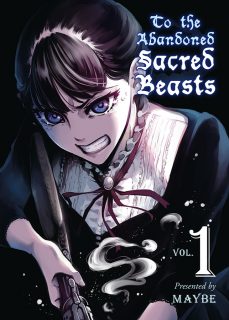
To the Abandoned Sacred Beasts, Volume 1To the Abandoned Sacred Beasts, Volumes 1-2 by Maybe. Before reading To the Abandoned Sacred Beasts I was under the impression that the series used the American Civil War as the foundation of its story. It turns out that’s not really the case, although the worldbuilding and character designs take obvious inspiration from nineteenth-century United States and the setting of the manga is a country recovering from a great war between the North and the South. (I suppose To the Abandoned Sacred Beasts could be some sort of alternative historical fantasy, but for the moment at least it doesn’t read that way to me.) In order to emerge victorious from the war, the North relied on soldiers known as Incarnates–humans who were granted tremendous abilities and battle prowess but at a great cost; they were literally turned into monsters. The metaphor may not be particularly subtle, but how To the Abandoned Sacred Beasts tackles the psychological ramifications and ravages of war is certainly engaging. Now that the conflict is over and an uneasy peace has been established, there is no longer any need for creatures of war and the Incarnate soldiers largely find themselves feared and despised. As the last of their humanity slips from their grasp, the Incarnates ultimately become the targets of the Beast Hunters.

Filed Under: FEATURES, My Week in Manga Tagged With: Boogiepop, Kouhei Kadono, Kouji Ogata, manga, Maybe, Persona, Shin Megami Tensei, Shuji Sogabe, To the Abandoned Sacred Beasts

Flying Witch, Vol. 1

June 4, 2017 by Michelle Smith

By Chihiro Ishizuka | Published by Vertical Comics

Makoto Kowata is a novice witch who, in the tradition of witches, has left home at the age of fifteen to become independent. Her parents are concerned about her safety, though, so she’s staying with relatives in Aomori, located in the Tohoko region where it’s easier to perform magic thanks to abundant wilderness and natural resources. Accompanying her is her familiar, a black cat named Chito who is indisputably my favorite character.

Flying Witch is a calm, slice-of-life tale depicting Makoto’s attempts to fit in to her new surroundings. Makoto’s young cousin, Chinatsu, is scared of her at first, but changes her opinion to “so cool!” after a ride on a broomstick. Makoto starts high school and forgets that she’s not supposed to be talking about witchy matters with people who aren’t family. She tries to give a mandrake to an ordinary girl as a present. She starts a vegetable garden. She receives a visit from “the harbinger of spring” and another from her world-traveling sister.

It’s all very peaceful, but there are some amusing moments scattered throughout. I love that Chinatsu’s dad has a heavy regional accent (rendered as Southern in the translation) and that, after everyone else has tried and failed to capture a pheasant, he gives it a shot himself, comically muttering, “Dang it!” But what I really love is anything to do with Chito. Ishizuka-sensei does a terrific job at conveying Chito’s facial expressions, including an adorable panel of the kitty sticking out her tongue and going “pbbt.” The best, though, occur during the chapter in which Chito leads direction-challenged Makoto for a walk in the neighborhood. She assures her they’re going to a good spot, but it ends up being a location where Chito can taunt a dog on a tether, remaining disdainfully out of reach as he goes berserk.

Even though the premise is very different from Yotsuba&!, that gentle, slice-of-life feeling summons a similar response. I ended up enjoying this a lot more than I expected to, and now eagerly await volume two, albeit mostly for more Chito.

Flying Witch is ongoing in Japan, where five volumes have been released so far. Vertical will release the second volume in English later this month.

Review copy provided by the publisher.

Filed Under: Fantasy, Manga, REVIEWS, Shounen

A Certain Magical Index, Vol. 11

June 4, 2017 by Sean Gaffney

By Kazumi Kamachi and Kiyotaka Haimura. Released in Japan as “To Aru Majutsu no Index” by ASCII Mediaworks. Released in North America by Yen On. Translated by Andrew Prowse.

The Index series is very fond of building on previous volumes and showing us that nothing takes place in a vacuum – there are no “stand alone” novels, everything impacts something else. And so this volume ends up being something of a direct sequel to the 7th volume, as Touma and Index win a trip to Italy (that was clearly rigged, though that’s not made explicit) and barely manage to arrive in a small city near Venice before they are once again embroiled in the Roman Orthodox’s attempts to regain power whatever the cost. This also follows up on events from Vols. 9 and 10 = Lidvia failed, and so the church is even more desperate, and looking for scapegoats. And what better scapegoats than the group of nuns who failed in the 7th book, led by Agnes Sanctis, who it turns out is far too similar to Touma and Orsola for her own good. For a book that goes to Italy and back in under 24 hours, there’s a lot going on here.

Introduced in this volume: Biagio Busoni, Itsuwa, Pope Matthai Reese, Vento of the Front. The latter two are not explicitly named. Busoni is the villain of the volume, but like Lidvia he ends up being another in a series of failures. Itsuwa is the most important introduction here, but you wouldn’t guess it from her small and pointless appearance in this volume, where she spends the entire time handing Touma hot towels and harboring an obvious crush on him, which the other Amakusa Catholics encourage and get frustrated by. (So she clearly saw Touma in action in Book 7, even if she wasn’t named – the anime adding her makes total sense.) The Pope and Vento appear in the final cliffhanger scene, and make it clear that the Church is not going away. Timeline-wise, it’s the end of September, and the festival has mostly ended but school hasn’t started up yet, which is why Touma and Index can go to Italy. In the Railgun timeline, we’re starting the Dream Ranker arc, though honestly at this point it gets harder to mesh timelines – Railgun hasn’t hit books after this one yet.

As you might be able to tell by the cover, Index gets significant time in this book, even though Agnes is the heroine that Touma is saving this time around, and arguably Orsola gets more to do. I have a bit of a reputation as an Index apologist, but even her detractors would have to admit that she’s at her best in this book, showing off her knowledge of Europe and ability to speak multiple languages, saving Touma and Orsola from a sniper attack, and continuing to use magic despite characters literally saying she can’t use magic mere pages later. (I understand what they’re trying to say – Index herself has no magic ability, she’s just using the books within her. But it’s semantics at this point, given she’s speaking spells that alter the trajectory of bullets and the like.) Actually, the one big flaw in this book is Touma, who spends most of it being far grumpier and angrier than he has any right to be – Index does bite him a couple of times, but the prose makes it very clear that he was asking for it heavily.

And once again we have the Roman Orthodox Church as villains, though Orsola exists to show off the goodness that can still exist within them. Of course, she’s off to join the English Puritans, and from a strictly religious standpoint, this could be disquieting – but this is a fantasy where magic is thrown around like candy, so there’s no need to examine it too hard. As always, the book goes out of the way to avoid using the word “Catholic” in regards to this church, even though we have the Russian Catholic Church mentioned. Indeed, for a book with as much religion as this one has, Jesus Christ is never named explicitly – which could be a simple translation choice, but also makes sense, given that these Roman Catholics seems to place far more faith in powerful tools, such as the Cross that Jesus died on (Crossist is used a lot) than Jesus’ teachings, which only Orsola seems to take to heart. Again, Index is fascinating in many ways, but devout Catholics may want to skip it.

This volume ends with a cliffhanger, but I’m not sure that we’ll see it resolved in the next book, as Touma’s punishment game should take center stage. Also, isn’t it about time we see Accelerator again? In any event, this is a very good volume that will please casual light novels readers.

Filed Under: a certain magical index, REVIEWS

  • « Go to Previous Page
  • Page 1
  • Interim pages omitted …
  • Page 426
  • Page 427
  • Page 428
  • Page 429
  • Page 430
  • Interim pages omitted …
  • Page 1048
  • Go to Next Page »
 | Log in
Copyright © 2010 Manga Bookshelf | Powered by WordPress & the Genesis Framework