By Akihito Tsukushi. Released in Japan by Takeshobo, serialized in the online magazine Manga Life Win +. Released in North America by Seven Seas. Translated by Beni Axia Conrad. Adapted by Jake Jung.
The idea of doing serious and sometimes dark and deadly plotlines with adorably cute characters is not new to manga – in fact, one might argue it’s been around since manga first began. The last few years, though, particularly since the advent of Puella Magi Madoka Magica, we’ve seen a number of series that deliberately want the dissonance to be part of the point, showing us young happy people and then having very bad things happen to them. In general in some prior reviews I’ve tended to be more annoyed at the plotline than the art style; I tend to like happy endings, as people know, and don’t like characters put through the ringer just for the sake of being mean. Fortunately, Made in Abyss is not that series. You can tell there’s a lot of care put into the basic concept of the world, and the darkness of the first volume is balanced out by the cheerfulness of the heroine.
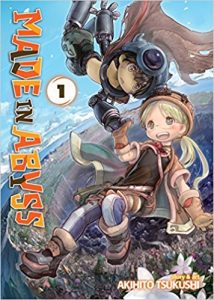
We are in a fantasy world that exists on the edge of a giant pit, wherein are treasures beyond compare but which is also super lethal, especially as you get further down. Our heroine is Riko, who delves to the shallowest depths of the pit with her fellow orphan children in order to be trained to be an actual adventurer and go deeper. She’s an orphan as both of her parents went into the pit and haven’t returned… that is, until the city gets a message from Riko’s mother. Most of the city chooses to treat this as confirmation of her death, since she was clearly in the “if you go to this level you will die” area. Riko, though, takes it as a sign that she needs to disregard the slow, filled-with-rules training and go down the pit to find her mother, accompanied by Reg, an amnesiac robot boy who wants to find out who he really is. The volume ends with their illegal descent.
Riko and Reg are the best reason to read the series. Riko is a great heroine, being impulsive and bratty but without tipping over into obnoxious, and she’s balanced well by the thoughtful, withdrawn Reg. You sense that her descent is clearly a bad idea and I have no doubt things will get much worse, but she’s the heroine and I want to root for her anyway. Also, the concept of the pit and the levels therein is quite well drawn, being overly complex without requiring the reader to actually remember all of it. If there’s one big drawback, it’s that this time around I *am* more annoyed at the art style than the plotline. I think the series might have worked better for me if the cast looked a bit more realistic and a bit less, well, Madoka Magica. It does not help that the artist at one point as a gag shows us Riko naked and strung up as “punishment” for rule breaking; it’s not as explicit as I feared, but please, do not show naked children in your fantasy adventures, PLEASE. Especially for the lulz.
Despite that, I will be trying another volume of this, mostly as I am very curious to see what happens next, and I hope Riko succeeds.





 KATE: I suspect I’m not the only one who’s eager to read orange: future; I still get the sniffles just thinking about orange, and am eager to see how Ichigo Takano continues the story. Looking over this week’s new arrivals, though, I’m also curious about Made in Abyss, which sounds like a dark fantasy-adventure with an interesting heroine. And I’ll also give a plug for PTSD Radio, despite its unfortunate title and godawful covers. It’s a solid horror series that benefits from unique artwork and an unusual narrative structure.

 I had heard good things about Frau Faust and figured I would probably like it too, but I wasn’t prepared for the “OMG, I love this!” feeling that overtook me after the first dozen pages or so. I loved it so much, in fact, that the first seven volumes of Yamazaki’s other published-in-English series, The Ancient Magus’ Bride, are currently on their way to my branch of our awesome local library. If Frau Faust is going to be this original and entertaining, clearly I need to read more of Yamazaki’s work!
 After the errand is complete, Marion refuses to let his memories of the encounter be wiped, and tags along with Johanna on her journey to gather the rest of Mephisto, whom she refers to as “my adorable, detestable, unfathomable idiot of a dog.” As the trail leads Johanna to a town where the church is protecting Mephisto’s leg, we learn more about why the demon has been quartered and his parts kept under guard—his only charge is performing an immortality curse upon the dead—and what this means for Johanna. Whenever she sustains an injury, she is able to heal herself, but has a finite supply of physical material to work with, thus she ends up looking younger each time.