• Skip to primary navigation
  • Skip to main content
  • Skip to primary sidebar
  • Home
  • About Us
    • Privacy Policy
    • Comment Policy
    • Disclosures & Disclaimers
  • Resources
    • Links, Essays & Articles
    • Fandomology!
    • CLAMP Directory
    • BlogRoll
  • Features & Columns
    • 3 Things Thursday
    • Adventures in the Key of Shoujo
    • Bit & Blips (game reviews)
    • BL BOOKRACK
    • Bookshelf Briefs
    • Bringing the Drama
    • Comic Conversion
    • Fanservice Friday
    • Going Digital
    • It Came From the Sinosphere
    • License This!
    • Magazine no Mori
    • My Week in Manga
    • OFF THE SHELF
    • Not By Manga Alone
    • PICK OF THE WEEK
    • Subtitles & Sensibility
    • Weekly Shonen Jump Recaps
  • Manga Moveable Feast
    • MMF Full Archive
    • Yun Kouga
    • CLAMP
    • Shojo Beat
    • Osamu Tezuka
    • Sailor Moon
    • Fruits Basket
    • Takehiko Inoue
    • Wild Adapter
    • One Piece
    • After School Nightmare
    • Karakuri Odette
    • Paradise Kiss
    • The Color Trilogy
    • To Terra…
    • Sexy Voice & Robo
  • Browse by Author
    • Sean Gaffney
    • Anna Neatrour
    • Michelle Smith
    • Katherine Dacey
    • MJ
    • Brigid Alverson
    • Travis Anderson
    • Phillip Anthony
    • Derek Bown
    • Jaci Dahlvang
    • Angela Eastman
    • Erica Friedman
    • Sara K.
    • Megan Purdy
    • Emily Snodgrass
    • Nancy Thistlethwaite
    • Eva Volin
    • David Welsh
  • MB Blogs
    • A Case Suitable For Treatment
    • Experiments in Manga
    • MangaBlog
    • The Manga Critic
    • Manga Report
    • Soliloquy in Blue
    • Manga Curmudgeon (archive)

Manga Bookshelf

Discussion, Resources, Roundtables, & Reviews

Blog

Pick of the Week: Wandering Off the Map

July 30, 2018 by Sean Gaffney, Michelle Smith, Katherine Dacey, Ash Brown and Anna N Leave a Comment

MICHELLE: There’s not much on the manga front this week that really calls to me, so instead I’ll devote my pick to a charming graphic novel that came out a couple weeks ago. The Adventure Zone: Here There Be Gerblins is adapted from a great podcast in which three brothers play Dungeons & Dragons with their dad. The graphic novel cuts out most of the out-of-character interaction and presents as more of a straightforward fantasy story, but with loads of jokes (and profanity). Also, it’s the first graphic novel to score the #1 position on the New York Times Paperback Trade Fiction list! Check it out, won’t you?

KATE: I’m with Michelle: this week’s manga list is just not ringing my bell. So I’ll use today’s column to shamelessly plug one of my favorite ongoing series, Hiromu Arakawa’s Silver Spoon. It’s funny, wise, and surprisingly serious at times, but so well done that you will laugh AND cry at least once per volume. The first three volumes are available right now, giving you a chance to catch up before volume four arrives in August. Not convinced? Here’s what I had to say about volume one.

SEAN: I will stick with the actual list, but I’ll go with prose this time around. I keep waiting for it to get so dark I lose interest, but through the last two volumes, The Saga of Tanya the Evil has proven to be an excellent, if very long, read. I look forward to the third novel.

ASH: While I certainly have plenty of reading to catch up on, it is an extremely rare week that there isn’t at least one release I’m looking forward to getting my hands on. This week that release is the most recent omnibus of I Am a Hero. Even having grown tired of the inundation of zombie media, I still find this series to be one heck of a ride.

ANNA: There isn’t much coming out this week that I’m interested in, which is good, as I’m going to use the time to get caught up on my reading. One recent release that is non-manga that I think is cool is Viz getting into translated amigurumi books! San-X Crochet Patterns is my pick.

Filed Under: PICK OF THE WEEK

Umineko: When They Cry, Vol. 18

July 29, 2018 by Sean Gaffney

Story by Ryukishi07; Art by Eita Mizuno. Released in Japan in three separate volumes as “Umineko no Naku Koro ni: Requiem of the Golden Witch” by Square Enix, serialized in the magazine Shonen Gangan. Released in North America by Yen Press. Translated by Stephen Paul.

Last time we finally got the answer to the riddle of the Epitaph, as well as the revelation of who Beatrice is, though that answer required jumping through a few hoops to avoid showing us a face. For the conclusion of this penultimate arc, however, the answers come fast and furious. In fact, one complaint of the audience that had read the original visual novels is that they’re a bit too much like looking at the answer sheet. When Clair and Will face off, we get her declarations, and we see his sword bluntly cutting them off. But the floating words literally stating what happened in the first four arcs was added to the manga especially. Apparently fans had started to get a bit over the top about how there was no real answer to the arcs, and this was Ryukishi07’s response (he worked closely with the mangaka for the last two arcs especially). And here we also find out the truth of what REALLY happened in 1986. Though, like Ange, I don’t think you’re going to like it.

One of the things that was made very clear was that Kinzo’s magic was money. Money is what has the power to make miracles. And so the solution to what really happens, once you realize that the parents actually put their heads together and all solved the epitaph together, is depressingly obvious. What’s more, it mirrors some of the battles in the prior arcs. Jessica’s fistfights against Kyrie and Ronove contrast with her pathetic demise here, having her face literally being beaten to a pulp. (There’s always a gore warning for Umineko, by the way, but this volume is particularly bad.) Natsuhi also doesn’t get a chance to fight back, and her death starts the chain of everyone else’s. As for the identity of the culprit, I’ll avoid mentioning it here, but I will say that we discover, as the reader was well aware, that Bernkastel’s goal is to see everyone suffer for her own entertainment, and given who she’s been “helping” for so long, you can probably hazard a guess. That said, I’m not sure EVERYTHING we see is exactly what happened. There’s a conversation between two characters about Ange that seems a bit too on the nose to not be “dialogue provided by Bernkastel”, to be honest.

Even Lion doesn’t manage to escape Bern’s mass slaughter, as Bern reveals that even in the ONE universe where Lion exists, their fate is also preordained. That said, three cheers for Will, who says what we all want to hear: mysteries that just end unhappily for everyone are not fun to read. Will is there to bring the reader hope, even if it means losing an arm and fighting along with Lion against Bern and her nightmarish army of cats. (Lambdadelta is there too, but honestly she’s more a passive audience member than anything else. She enjoys it, but it’s all Bernkastel’s show.) But still… we’ve got one big arc to go. We know what really happened in 1986. Is there any way to give Ange a happy ending in 1998? Bern says no, and she says it in red, so it’s going to be tough. (I recommend the digital version for that page, by the way, as the color red is actually used for the statement, and it gives it a lot of impact.)

Clearly the answer, however, is not to take the opposite tack either. We should not see an arc that shows us how everything was all happiness, sunshine and rainbows in 1986, not after everything we’ve seen involving the Ushiromiya family. But there’s no way anyone’s motivations would be that misguided. Right? Tune in next time for Twilight of the Golden Witch, aka “don’t mention this arc in the presence of an Umineko fan”. Same time, same publisher!

Filed Under: REVIEWS, umineko

Manhwa 100

July 27, 2018 by Katherine Dacey

As a reviewer, I’ve found Manga: The Complete Guide (Del Rey), Dreamland Japan: Writings on Modern Manga (Stonebridge Press), and Manga: 60 Years of Japanese Comics (Laurence King Publishing) indispensable references, whether I’m searching for information about a series’ publication history or looking for insight into a particular artist’s style. I hoped that Manhwa 100: The New Era for Korean Comics would provide a similar perspective on the Korean comics industry. Unfortunately, Manhwa 100 turned out to be an ambitious but poorly executed attempt to highlight the medium’s most popular, influential series.

In terms of organization and metholodgy, Manhwa 100 falls somewhere between Manga: The Complete Guide and Dreamland Japan, offering summaries of one hundred books, some of which have been translated into English. Each entry includes basic information about the series’ print run (e.g. number of volumes, magazine of serialization), its author, and its crossover into other media (e.g. videogames, television programs), as well as a plot summary and an assessment of the work’s artistic merit. Entries are grouped according to audience, with sections devoted to sunjeong (girls’) comics, boys’ comics, adult comics, and “webtoons,” comics that debuted online but were later anthologized in print.

We learn in the introduction that a committee of thirty industry professionals chose the books featured in Manhwa 100. The exact selection criteria are never satisfactorily explained, though it’s obvious the committee made a concerted effort to represent a broad spectrum of styles and subjects; no artist has more than one entry devoted to her work. Most books are of recent vintage, with only a smattering of titles released in the 1970s and 1980s.

And here I have a confession to make: I was sorely tempted to call my review “Manhwa 100: Cultural Learnings of Comics for Make Benefit Glorious Nation of Korea.” Why? The text is awash in awkward phrases, grammatical errors, egregious typos, and ill-advised attempts to keep it real with slangy, conversational phrases that clash violently with the prevailing tone. The entry for Blue, a title by Lee Eun-hye, is typical of the book:

Comic book characters are used in many character merchandises now, but it was [sic] not very actively used in the 1990s. However, the comics of Lee Eun-hye were widely used in character merchandises, even in the 1990s. This is because the author has the knack of using colors as one of her main themes. As she said in her own words, “color in itself is a story.”

As she proclaims in Jump Tree A+, her previous work to Blue, the teenage years are the “Green Age.” Her new story, Blue, represents the young adult age. The color blue in the comic has two sides. It represents a bright fresh side of youth, and it also represents sadness and gloom. The twenty-somethings in the comic are both fresh and youthful, but at the same time lonely and nostalgic.

A rich man’s illigitemate [sic] son Seung-pyo, passionate dancer Hae-joon, his faithful follower Yeon-woo, smart but cold Hyun-bin, and strong charismatic rocker Ha-yun: Blue revolves around these five characters. The loneliness in Blue was sprouted from self-pity and narcissism. Like in many of her other comics, author Lee Eun-hye pushes her characters into their own narcissistic world disconnected from each other.

That is why Blue is beautiful. The earnest characters express their life honestly. And the poetic narration and symbolic monologues add to its beauty. In 1997, an OST disc, inspired by the comic, was…

Yes, the entry really does end with an incomplete sentence.

If I’m reading the text correctly, this confusing verbiage could be boiled down to three talking points: (1) Lee’s manhwa was among the first to inspire “character goods” (phone cards, figurines, stationery, keychains, etc.); (2) her books feature beautifully drawn, emotionally stunted characters; and (3) her books are popular enough to be adapted into TV shows, CD dramas, and the like. Though it’s obvious she views color as a metaphor for age and mood, it’s not clear how or if she uses color in her work–a crucial point, given the increasingly important role that color is beginning to play in manhwa. It’s also unclear what distinguishes Lee’s work from other sunjeong titles, as symbolism, emotionally-charged conversation, and interior monologues are staples of the medium, not personal idiosyncrasies.

If the book synopses are frustrating, the contextual essays are downright obtuse. With titles such as “Open a Manhwa Book, Become a Friend of Korea” and “Manhwa in America: The New World of Charms Yet to be Discovered,” their stilted language and boastful claims for manhwa’s international importance make them sound like Pravda articles. Anyone hoping for insight into the differences between manhwa and manga (or other sequential art traditions, for that matter) will be frustrated by the maddeningly vague, jingoistic text which acknowledges stylistic similarities between manhwa and manga while arguing for significant differences in subject and approach. As manhwaga Lee Hyun-se explains:

While the Japanese samurai pulls out his sword for the completion of his skill, the Korean warrior draws his sword in revenge of his family or to fight against his or her sworn enemy. The Japanese hero walks the glorified path of the hero, which is as clear as the blood he spills, but the Korean hero trudges, stumbling upon his own defects.

Lee attributes the difference in approach to Korea’s lengthy history of occupation, contrasting it with Japan’s long period of isolationism and political intrigue. “The endless internal strife of the Japanese builds up a sense of hubris and elitism,” he argues, “while being on the defense instills a sense of humility and compassion for others… The hero of Japanese manga is ‘I’ while the hero in Korean manhwa is ‘We.’” It’s an interesting but flawed thesis, akin to suggesting that Howard’s End and Finnegan’s Wake are utterly different because one was written by a British imperialist and the other by a downtrodden Irishman. Lee seems to forget that avenging one’s family (or village, or sweetheart, or mentor) is one of the most basic manga plotlines, transcending genre and time period. He also overlooks the important role of community in manga; for every Lone Wolf, there are just as many characters who discover their purpose when they join a particular group, whether it be the school council (a la Love Master A) or the Shinsengumi (a la Kaze Hikaru).

Given Manhwa 100‘s limitations, I’m reluctant to recommend it; anyone hoping for an indispensable reference or an introduction to Korean comics will find this book baffling. For those already enchanted with manhwa, however, I’d suggest reading Manhwa 100 in the same spirit that our grandparents and parents flipped through the Sears Roebuck catalog: as a book of possibilities, a wish list for readers who enjoyed Shaman Warrior, One Thousand and One Nights, Bride of the Water God, or Dokebi Bride. I’ve already spotted dozens of great candidates for licensing, from Be Good, a comedy about a gangster who goes back to high school at 40, to Buddy, a sports drama set inside the ultra-competitive world of women’s golf.

POSTSCRIPT, 2/3/09: I corresponded with the editorial staff at NETCOMICS, who explained that they had a contract with the Korea Culture and Content Agency (KOCCA) to distribute Manhwa 100 in North America. The book was written and produced by C&C Revolution, a private company. (No individuals are named as authors.) NETCOMICS is not responsible for the book’s editorial content, just for its distribution.

This review originally appeared at The Manga Curmudgeon on February 2, 2009.

Filed Under: Books, Manga Critic, Manhwa, REVIEWS Tagged With: KoCCA, manhwa

Sayonara, Zetsubou-Sensei: The Power of Negative Thinking, Vol. 1

July 27, 2018 by Katherine Dacey

Sayonara, Zetsubou-Sensei: The Power of Negative Thinking may not be as relentlessly intertextual as Ulysses, but this Japanese import is nearly as rich in puns, social commentary, pop-culture parody, and allusions to TV shows, novels, movies, and manga. I can’t imagine adapting such a culturally specific text for Western audiences, yet the folks at Del Rey have made a game effort to do just that. Given the scope and complexity of the task, I think translator Joyce Aurino has produced an eminently readable script that captures the darkness and absurdity of Koji Kumeta’s original. I just wish it were, y’know, funnier.

The premise seems ripe with comic potential. High school teacher and profound pessimist Nozomu Itoshiki lands the gig from hell: an all-female class of stalkers, hikokimori, obsessive text-messagers, bossy perfectionists, panty-flashers, and perky optimists. Try as he might to escape his obligations, his students foil his repeated suicide attempts, compounding his sense of despair and driving him to more extreme, ridiculous measures.

Through a series of interconnected vignettes, we begin to grasp the true extent of Itoshiki’s negativity as well as the sheer nuttiness of his students. In “Zetsubou-Sensei Returns,” for example, Itoshiki instructs his students to complete a “Post Graduation Career Hope Survey” by listing the three dreams they’re least likely to realize, e.g. playing baseball for Yomiuri Giants, recording a best-selling pop album. His sour-spirited effort quickly backfires, however, when the school’s guidance counselor reads the responses and praises Itoshiki for encouraging his students to dream big. In “Before Me, There’s No One; Behind Me, There’s You,” Matoi Tsunetsuki, a.k.a. “super-love-obsessed stalker girl,” develops an unhealthy attachment to Itoshiki. Matoi pursues her teacher with steely determination, adopting his trademark yukata, building a shrine to him, and following him everywhere. The chapter ends with a brilliant stroke, as one of Matoi’s former love interests begins tailing her to find out who’s replaced him, only to discover a chain of stalkers trailing in Matoi and Itoshiki’s wake.

Unfortunately, many of the stories require too much editorial intervention to elicit real laughs, as Kumeta’s panels abound in the kind of small but important details that resist easy translation: brand name parodies, puns on famous literary works, misspelled words, and so forth. The story titles, too, require explanation; “Behind Me, There’s No One,” for example, is a riff on a poem by Kotaro Takamura, while “Beyond the Tunnel Was Whiteness” appropriates a line from Yasanuri Kuwabata’s Snow Country. Absent this rich network of cultural references, Kometa’s comedy loses some of its fizz, playing more like a mild satire of shojo manga conventions than a scathing commentary on contemporary Japan.

If the text sometimes disappoints, the artwork does not. Kumeta uses a stark palette with large patches of pure black and plenty of white space. His highly stylized character designs have a pleasing, geometric quality about them, as do the patterns in their clothing. Though his faces are the essence of simplicity— just a few lines and two dark coals for eyes—Kumeta animates them with skill, registering the full gamut of emotions from anger to joy. His students are virtually interchangeable, save for their accessories and hairstyles: a black eye and a sling for the class masochist, blonde hair and strawberry-print underpants for the class exhibitionist. Again, Kumeta’s economy of form works beautifully, underscoring the extent to which Itoshiki views all of the girls in the same light: as nuisances.

I wish I liked Sayonara, Zetsubou-Sensei better, as I think Kumeta is a terrific artist with a fertile imagination. But it’s awfully hard to laugh when 70% of the jokes require footnotes. (If you disagree, try this exercise: watch an episode of Seinfeld, The Chapelle Show, or South Park with someone who’s new to the United States. Then try explaining why the jokes work. You’ll quickly realize the degree to which the creators rely on your knowledge of literature, politics, movies, and pop music for laughs.) I’m also a little uncomfortable with the way Kumeta depicts the female students, as he skates a thin line between poking fun at stock manga characters and portraying teenage girls as desperate, manipulative, boy-crazed hysterics. I wouldn’t go as far as to label the text misogynist—that term seems much too strong—but I would feel more at ease with the material if Kumeta’s cast was comprised of troublesome girls and boys—equal opportunity neurosis, if you will.

That said, I’m not ready to declare Zetsubou-Sensei a dud; I’m just not sure how invested I am in a series that requires its own set of cultural Cliff Notes to decode.

This review originally appeared at The Manga Curmudgeon on March 4, 2009.

Filed Under: Manga, Manga Critic, REVIEWS Tagged With: Comedy, del rey, Zetsubou-Sensei

The Horror! The Horror! Comic Books the Government Didn’t Want You to Read

July 27, 2018 by Katherine Dacey

In the early 1950s, horror comics were big business. Out of the eighty million floppies sold each month, nearly one in three featured a vampire, a zombie, a cannibal, a werewolf, a parasitic alien, or a vengeful spirit. The comics were as sensational as their titles and were popular with kids—that is, until the Comics Code Authority effectively banned them in 1954 with its prohibition against “lurid, unsavory, gruesome illustrations.”

The Horror! The Horror! Comic Books the Government Didn’t Want You to Read focuses on horror’s brief renaissance in the 1950s. The first third of the book provides a historical overview of the genre, tracing horror comics’ roots back to the popular crime serials of the 1940s. The rest of the book explores the numerous subgenres and tropes found in series such as Tales from the Crypt, Tomb of Terror, The Thing, and Dark Mysteries. Each chapter is organized around a theme—vampirism, werewolves, zombies—and copiously illustrated with full-color reproductions of covers as well as complete stories ranging in length from one to twelve pages. Rounding out the volume is a 25-minute DVD containing “Confidential File,” a 1955 television documentary meant to show the harmful effects of comics on children.

Author Jim Trombetta is an excellent curator, selecting some of the era’s most memorable stories for inclusion in the book, from “Foul Play” (1953), a short piece in which a baseball team punishes its uppity pitcher, to “Some Die Twice” (1954), a longer story about a modern-day slave trader who falls prey to a tribe of cannibals. Through short but trenchant analyses of each story, Trombetta makes a persuasive case that horror comics gave readers a way to thumb their noses at polite society. Authors challenged the social emphasis on conformity, normalcy, and knowing one’s place by depicting all sorts of taboo behavior, from garden-variety criminal acts (e.g., extortion, robbery) to necrophilia. The stories were lurid, exciting, and decidedly un-PC, often reinforcing racist and sexist stereotypes, even as they lashed out at traditional authority figures.

Trombetta’s writing is lively and full of interesting observations, especially in his efforts to show the connection between America’s emerging military might and civilian reservations about the Korean War. His chapters on brainwashing and zombies, in particular, reveal the extent to which the plight of American POWs captured the popular imagination. Stories like “The Brain-Bats of Venus” (1952), for example, depicted pilots falling victim to a race of mind-controlling aliens—a thinly veiled allegory for the kind of reprogramming that Chinese captors allegedly conducted on American prisoners. Likewise, Trombetta’s chapter on vampirism does an excellent job of examining the way in which latent fears of miscegenation were embodied in the vampire’s unique mode of reproducing: swapping blood with the victim.

The only drawback to Trombetta’s approach is that his interpretations aren’t always as explicit or convincing as they could be. By lumping vampirism and cannibalism under the common heading of “The Hunger,” for example, Trombetta misses an opportunity to explore the very different ways in which these two categories reflected American anxieties about racial integration. His critique of horror comics’ not-so-latent sexism, too, would have benefited from more historical context, given the large numbers of women displaced from wartime jobs.

On the whole, however, The Horror! The Horror! is a beautifully designed, carefully researched book that chronicles one of the most important, vital genres in American comics while capturing its pulpy spirit.

This review originally appeared at The Graphic Novel Reporter on November 1, 2010.

Filed Under: Books, Manga Critic, REVIEWS Tagged With: Abrams ComicArts, Horror/Supernatural, Jim Trombetta

Manga the Week of 8/1/18

July 26, 2018 by Sean Gaffney, Michelle Smith, Ash Brown and Anna N Leave a Comment

SEAN: Remember, it’s not really August 1st but July 32nd! Treat this as a 5th week, which means expect oddball stuff.

ASH: I rather appreciate oddball stuff.

ANNA: Maybe time to make a dent into my unread manga piles!

SEAN: Cross Infinite World has another debut. Despite not being your “standard” light novel, it’s a mouthful. Dawn of the Mapmaker: The Surveyor Girl and the Forbidden Knowledge.

Dark Horse gives us a 7th omnibus of I Am A Hero.

ASH: This is such an intense series!

SEAN: Kodansha Comics is pleased to announce that finally, after nineteen months, thanks to the sacrifice of twenty-thousand Kodansha editors who valiantly gave their lives so that you, the reader, might experience it, we finally have the 5th and final omnibus of Attack on Titan Junior High. (salutes, cries)

ASH: Indeed, a great achievement.

SEAN: In other Kodansha print titles, we have the Attack on Titan Season 2 Box set, the 8th Clockwork Planet manga, a 5th volume of Ninja Slayer KILLS!, and the 14th UQ Holder.

Perhaps sensing the market begging for mercy, Kodansha has only one digital title this week, another debut: The Prince’s Romance Gambit. Not to be confused with The Prince’s Black Poison, I’ve heard this title (which ran in Aria, then Nakayoshi – or possibly the other way around) is very silly.

MICHELLE: Hm. Better silly than cringey, I suppose.

ANNA: Glad there are no new digital titles I want to read since there are so many digital titles I haven’t read!

SEAN: Seven Seas’ new debut is also very silly: Precarious Woman Executive Miss Black General. This runs in Fujimi Shobo’s Dragon Age, always a strike against a new title for me, but I found its attempts to be ecchi fairly harmless. At heart this title would rather be ridiculous. Also, that’s totally not Batman. You must be imagining things.

They also have a 7th Dreamin’ Sun, the 3rd Made in Abyss, the 3rd Magical Girl Spec-Ops Asuka (which just got an anime announcement), the 10th Non Non Biyori, The Testament of Sister New Devil 9, and a print release of the 3rd Occultic;Nine novel which J-Novel Club already released.

MICHELLE: I need to catch up on Dreamin’ Sun. It’s been a little while.

ASH: I really like this J-Novel Club/Seven Seas partnership.

SEAN: Yen Digital has a couple ongoing series, with the 16th Saki and the 17th Sekirei.

They also have three light novels, one of which is a debut. The title – and I am not making this up – is WorldEnd: What Do You Do at the End of the World? Are You Busy? Will You Save Us?. A human is the sole survivor of an apocalyptic future. There’s various new races around, but they don’t need him. And when he joins the military he finds they’re training girl fairies as weapons. I’ll be honest, this sounds FAR too dark for me, but we shall see.

There’s also The Saga of Tanya the Evil 3 (also fairly dark) and So I’m a Spider, So What? 3 (not quite as dark).

Does this interest you? Or is there simply too much manga still?

ASH: Never too much! Mwahaha!

ANNA: There is, indeed, a lot.

Filed Under: FEATURES, manga the week of

Fruits Basket another, Vol. 1

July 26, 2018 by Sean Gaffney

By Natsuki Takaya. Released in Japan by Hakusensha, serialization ongoing in the magazine Bessatsu Hana to Yume. Released in North America by Yen Press. Translated by Alethea and Athena Nibley.

There are some stories that cry out for sequels, leaving loose ends and plotlines that would easily carry a new series forward with exciting, fresh ideas. Then there are series that ended nearly perfectly, with pretty much everything resolved, and the idea of a sequel fills you with foreboding and a sense that it’s going to ruin the franchise. Such a series, I’m afraid, it’s Fruits Basket another, the next-generation sequel to one of the most beloved manga of all time. Note I said next-gen: apart from one or two minor characters in small roles (Hanajima’s brother is a teacher, for example), don’t expect any of the original cast in this first volume. Instead we see the sons and daughters of Sohma, who are blissfully not cursed, happy and content, and living the good life at the same high school their parents went to. There’s even a Sohma fan club run by the daughter of the Yuki fan club president. Into this lovely arrangement comes Sawa, our heroine.

The late, lamented Sayonara, Zetsubou-sensei introduced a girl named Ai Kaga, who thinks everything that she does is a bother to someone else and makes her feel tremendous guilt. It’s meant to be a parody. That said, if you took Ai and made her 100% serious, you’d come close to Sawa in this first volume. Sawa lives alone with her mother, whose absence is hinted to veer towards actual neglect. She suffers from amazingly low self-esteem, not helped by various childhood incidents that have only reinforced it. Now she’s in high school, but she’s late her first day because her landlord yelled at her for something that’s her mother’s fault. If Tohru was a ray of sunshine and hope into everyone’s lives, then Sawa is a black cloud floating overhead. Fortunately, she soon runs into Mutsuki and Hajime Sohma, the sons of Yuki and Kyo respectively. Soon she’s blackmailed into being on the Student Council and hanging out with more and more Sohmas, incurring the wrath of the girls of the school even as she wonders “why her?”.

The biggest question I have with this series is “why was it written?”. No, seriously. What new story needed to be told here beyond “oh look, Sohma kids!”? If Fruits Basket sometimes felt a bit like “every new Sohma gets to reveal their backstory and angst before being healed by the power of Tohru”, this is meant to be the exact opposite – despite the occasional stab at Mutsuki and Hajime having a “rivalry”, the fact is that the next-gen Sohmas are happy and content. Which is good, y’know, because we don’t exactly want to Fruits Basket main characters to be horrible parents, but it’s also fairly boring. As for Sawa, you can tell that Takaya is trying not to simply write Tohru Mk. 2, but her self-hatred really is through the roof – she’s not plucky like Tohru (or, for that matter, Sakuya and Liselotte) and so she simply grates.

There is a hint in the cliffhanger ending that we may see a Sohma who is not happy and content (Shigure and Akito’s kid – gosh, what a surprise), but for the most part the first volume of Fruits Basket another commits the cardinal sin of being deadly boring. And while normally I wouldn’t be pissed off about that sort of thing, the fact that it’s a sequel to one of my favorite shoujo series AND it’s also put Liselotte & Witch’s Forest (which I’d rather be reading) on hiatus just makes me more annoyed. If you loved the original Fruits Basket, preserve your memories and give this half-baked sequel a miss.

Filed Under: fruits basket, REVIEWS

Kenka Bancho Otome, Vol. 2

July 24, 2018 by Anna N

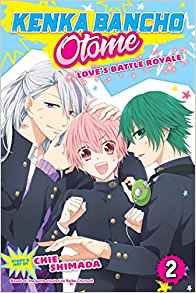
Kenka Bancho Otome Volume 2 by Chie Shimada

Kenka Bancho Otome, with a storyline about a girl who is forced to dress up as a boy and attend a high school for juvenile delinquents, is an excessively silly manga, which one would expect from an otome game adaptation, but in just two volumes it manages to pull off being a fun summer read as long as the reader isn’t looking for deep thoughts.

In the concluding volume Hinako continues her misadventures at Shishiku Academy, where most of her new friends seem to be on the verge of falling in love with her in her top-secret disguise as her brother Hikaru. Yet another emotional minefield is introduced with the arrival of Houou Onigashima, an upperclassman with a tough-guy jacket that he constantly wears slung over his shoulders like a cape. Houou just happens to be Hikaru’s older brother and Hinako is overcome at the idea that she has yet another brother! But when she returns to tell Hikaru about her discovery he inexplicably becomes extremely upset. The rest of the volume consists of a summer vacation episode with plenty of shirtlessness, school sports day, where Hinako has to cross-dress as a cheerleader with provocative results and a bonus giant schoolyard fight where Hinako further strengthens her platonic friendships with Kira and Totomaru, much to their mystified chagrin. At two volumes long, this series wraps up more nicely than most two volume series, which sometimes suffer from the author being forced to resolve a bunch of plot points quickly in a final chapter. I would have been fine with 3 instead of 2 volumes, if there might have been a little more time to delve into the hints about Hinako’s unconventional family and have her embark on an actual romance. Overall, the art was attractive if a bit generic. I enjoyed the story enough that I would totally play the Otome game that the manga was based on if it came out on android!

kenka bancho otome 2

Filed Under: Manga Reviews, REVIEWS Tagged With: kenka bancho otome, shojo beat, shoujo, viz media

The Voynich Hotel, Vol. 1

July 24, 2018 by Sean Gaffney

By Douman Seiman. Released in Japan by Akita Shoten, serialized in the magazine Young Champion Retsu. Released in North America by Seven Seas. Translated by Alethea & Athena Nibley. Adapted by David Lumsdon.

I had heard buzz about The Voynich Hotel before it was licensed, mostly that it was dark and funny. Weird probably also came up, but I wasn’t really paying attention. I probably should have been. Before it is dark or funny (though it is both of those things), The Voynich Hotel is STRANGE. A lot of the time it’s content to be a mild gag comic about the staff and residents of a hotel in the South Pacific, but then people start getting killed, or selling drugs, or investigating the secret legend of the three sisters from this island’s past (one of whom seems very familiar). And in amongst this we manage to have the start of a vaguely sweet romance between a guest who’s hiding from… something, and one of the maids, who is cute and innocent and one of those is a lie. I’m not even sure where this series is going, save the fact that I suspect there will be more deaths soon.

Our hero is Taizou, a Japanese man who arrives at the hotel hiding from his old way of life. He ends up passing out, but is taken care of by the two maids who run the day-to-day affairs of the hotel: Helena is cute and spunky and excitable and also Maria from Zetsubou-sensei, and Berna is stoic and deadpan also also a Rei Ayanami clone. The cook is trying to kill herself and anyone else she can get to go with her, the owner wears a Mexican wrestling mask, and the residents are equally eccentric – you might say the manga artist was normal, except he’s trying to write a manga and make deadlines while living on this island. There’s also an assassin, and three more arrive during the course of the first book. The assassins are mostly what drive what there is of a plot, but for the most part you’re here to see weird people be funny.

Fortunately, I found it very funny, though you’ll need to set your sense of humor dial to ‘sick’. Leaving aside all the deaths, I have to say that Berna’s ringtone grossed me out but also had me in hysterics – let’s leave it at that. There are also a lot of “shout out” references in this volume, most of them blatant. Helena takes Taizou’s temperature with her head, which he says is so cliched even Mitsuru Adachi wouldn’t do that anymore… wait, no, he would. The police officers who parody Isaac Azimov’s Bailey and Olivaw are also a hoot, though they remind me that Seven Seas has once again rated this series T when it clearly isn’t – there’s no nudity, but reader beware. Possibly the strangest thing in the book, though, is that Taizou and Helena’s growing relationship is rather sweet – well, once she puts on a different shirt, that is.

The Voynich Hotel was very popular scanlated, so I worry that it will suffer the fate of other popular scanlated series licensed over here (I’m looking at you, Franken Fran). It requires a strong stomach at times, but the skewed tone of this series tickled me, and at only three volumes, I’m quite willing to read more.

Filed Under: REVIEWS, voynich hotel

Bookshelf Briefs 7/23/18

July 23, 2018 by Michelle Smith, Sean Gaffney and Ash Brown Leave a Comment

Anonymous Noise, Vol. 9 | By Ryoko Fukuyama | Viz Media – The tour begins, but it’s already on the verge of falling apart. Nino simply isn’t playing very well, and Yuzu is falling apart because of his love for Nino, something that he is trying desperately to hide from her. Indeed, he ends up getting in such a swivet he loses his voice, prompting a trip to the doctor that may lead to him missing the start of the concert. And then there is Momo, dealing with his own career, and irritated as he waits for In No Hurry to reach the level they sho0uld be able to achieve. I was frequently frustrated by this volume, but the book’s last chapter works exactly like a great song, pushing closer and closer to a climax until it finally hits the last chorus in triumph. And then there’s a cliffhanger. End of song next book! – Sean Gaffney

The Bride & the Exorcist Knight, Vol. 1 | By Keiko Ishihara | Seven Seas – I wasn’t too sure about this premise. Anne is a young woman destined to be the bride of a demon. Instead, she’s saved by Haru, who is a male exorcist. He’s also twelve, and he says he’s going to marry her instead. The book, fortunately, emphasizes over and over not only that he’s too young to be talking about marriage but also that he really is an immature kid, despite being an amazing exorcist. Anne too is a good character, not content to be a helpless damsel but fighting in her own way to change fate. We don’t see much of Mephisto, her intended groom—though the cliffhanger suggests that will change. But provided you don’t mind the age issue too much, this is a cute and action-filled debut. – Sean Gaffney

Gabriel Dropout, Vol. 4 | By Ukami |Yen Press – the majority of this volume involves our four leads returning to heaven/hell (delete where applicable) in order to report on their time down in the world of humans. The gags are predictable but still fun—Gabriel is unable to bring her games to heaven, which proves rather dull, but at least she can bullshit her way past an easily suckered God. Meanwhile, Vignette is dealing with her adorable little pet being a lot bigger than she remembers (I was reminded of Gintama here), and Satanya has to deal with being herself—she tries to break into heaven and fails. Fortunately, we find out that the rest of her family (bar the “normal” younger brother) are just like her. This remains a very silly but amusing series. – Sean Gaffney

Go For It, Nakamura! | By Syundei | Seven Seas – Although there have already been several BL-adjacent manga released by Seven Seas, Go for It, Nakamura! is the publisher’s first real foray into the genre. The volume is an absolute delight. Nakamura is a gay high school student who has developed a crush on his classmate Hirose, but Nakamura’s introverted nature and general awkwardness mean that the two of them have barely even talked to each other. Go for It, Nakamura! is the perfect title for this manga–I couldn’t help but root for Nakamura as his friendship with Hirose slowly develops. The story is funny and charming and the characters immensely likeable. A bigger deal is made out of Nakamura being a fan of octupi than out of him being gay, a refreshing twist that is also resolved sweetly. Nakamura does occasionally have a dirty daydream, but overall, Go for It, Nakamura! is rather chaste and wholesome. I loved it. – Ash Brown

Haikyu!!, Vol. 25 | By Haruichi Furudate | Viz Media – Last time I commented on how delighted I was with Hinata’s character development and growth. That continues here, but as the training camps end and we resume practice it’s Kageyama who’s given a volume to really show off. In this case it’s not just that he’s grown, but the series also looks at the attitude that got him in trouble in middle school—the whole arrogant “King” thing—and wonders if it was the attitude or the rest of the team? After all, the Haikyu!! kids are unlikely to be cowed by Kageyama at this point. Particularly Tsukishima, who may need enough people being jerks towards him in order to really take off. Good stuff, though I suspect we may be getting more tournament games soon. – Sean Gaffney

Little Devils, Vol. 1 | By Uuumi | Seven Seas – This is supposed to be more than one volume, though I do wonder where it’s going to go from here. The premise is that the hero has defeated the demon king… which is now split into eleven adorable and bratty children (and one egg). Each chapter of this first volume introduces one of the children, shows off their eccentricities, and moves on. Some of the cast make reappearances (Asuka is clearly the “star” of the children), but for the most part this reads very much like an anthology. Fortunately, the kids’ eccentricities are enough to disguise the fact that the hero is super boring. The said, this really feels like it could have ended with the first volume, after the egg hatches and we get our twelfth devil. Can it keep up being sort of cute? – Sean Gaffney

Log Horizon: The West Wind Brigade, Vol. 9 | By Koyuki and Mamare Touno | Yen Press – We continue to deal with the odd golem creation that was introduced in the last book here—turns out Kuroe is part of a pair, and is not all that excited to join up with her other half, which is filled with hatred and despair, now that she’s gotten kindness from Soujiro and company. The evil golem creature is a pretty nasty opponent, eating Isaac’s black sword among other things, and the fact that it sort of looks like Soujiro with cat ears doesn’t help. I suspect this may be the final arc of this spin-off title, so I’m pleased it’s emphasizing the family aspect of the series rather than the comedy. Also, really nice fights. – Sean Gaffney

My Hero Academia: Vigilantes, Vol. 1 | By Hideyuki Furuhashi, Betten Court, and Kohei Horikoshi | VIZ Media –I was a little wary of this My Hero Academia offshoot, but it turned out to be more enjoyable than I expected. Nineteen-year-old Koichi Haimawari has a modest quirk—the ability to glide along surfaces—and has been spicing up his boring life by doing good deeds. One night, he runs into a grizzled old vigilante who calls himself Knuckleduster and becomes his apprentice. Knuckleduster is on a mission to track down the source of a drug called Trigger, which causes users to spontaneously undergo monstrous transformations. I didn’t expect this much plot, and Betten Court really nails Horikoshi’s art style. My only complaint is the fanservicey costume for the female vigilante, Pop-Step, who ends up in villainous clutches more than once, but I definitely like the family vibe the trio have going by volume’s end. I will surely be checking out volume two. – Michelle Smith

My Solo Exchange Diary, Vol. 1 | By Nagata Kabi | Seven Seas – One of the most critically acclaimed manga released last year was Kabi’s My Lesbian Experience with Loneliness. The sequel series My Solo Exchange Diary was therefore a welcome and perhaps obvious addition to Seven Seas’ catalog. Like its predecessor, My Solo Exchange Diary is an autobiographical work that will resonate strongly with many readers. Through the short essay manga collected in the series, Kabi continues to explore her experiences with anxiety, depression, and intense feelings of loneliness and how they impact her relationships and day-to-day life. Each chapter is framed as a diary entry written to her past self, at times offering advice and encouragement while at other times seeming to despair that she couldn’t have done some things differently. My Solo Exchange Diary can be brutally honest as Kabi struggles to find love, happiness, and self-worth, but it’s that honesty and authenticity that makes the series so compelling. – Ash Brown

Spirit Circle, Vol. 4 | By Satoshi Mizukami | Seven Seas – Spirit Circle has an overarching plot, but the way it’s being told also makes it feel like an excuse to do a series of short anthologies with a wraparound. Once again, the majority of this book is devoted to another of Fuuta’s past lives… and this one seems to be a future life, as he’s now Lafalle, a young man in charge of cleaning the chambers in a giant monolithic tower that house the brains of those that were killed but may one day be revived. As he gets older we see him interact with Kouko’s other self Lapis, and the two of them continue to have an odd bond that seems to lack any romantic feeling whatsoever—they even get married here, but it’s never consummated. This is well-written, but where is it going? – Sean Gaffney

Filed Under: Bookshelf Briefs

  • « Go to Previous Page
  • Page 1
  • Interim pages omitted …
  • Page 362
  • Page 363
  • Page 364
  • Page 365
  • Page 366
  • Interim pages omitted …
  • Page 1053
  • Go to Next Page »
 | Log in
Copyright © 2010 Manga Bookshelf | Powered by WordPress & the Genesis Framework