• Skip to primary navigation
  • Skip to main content
  • Skip to primary sidebar
  • Home
  • About Us
    • Privacy Policy
    • Comment Policy
    • Disclosures & Disclaimers
  • Resources
    • Links, Essays & Articles
    • Fandomology!
    • CLAMP Directory
    • BlogRoll
  • Features & Columns
    • 3 Things Thursday
    • Adventures in the Key of Shoujo
    • Bit & Blips (game reviews)
    • BL BOOKRACK
    • Bookshelf Briefs
    • Bringing the Drama
    • Comic Conversion
    • Fanservice Friday
    • Going Digital
    • It Came From the Sinosphere
    • License This!
    • Magazine no Mori
    • My Week in Manga
    • OFF THE SHELF
    • Not By Manga Alone
    • PICK OF THE WEEK
    • Subtitles & Sensibility
    • Weekly Shonen Jump Recaps
  • Manga Moveable Feast
    • MMF Full Archive
    • Yun Kouga
    • CLAMP
    • Shojo Beat
    • Osamu Tezuka
    • Sailor Moon
    • Fruits Basket
    • Takehiko Inoue
    • Wild Adapter
    • One Piece
    • After School Nightmare
    • Karakuri Odette
    • Paradise Kiss
    • The Color Trilogy
    • To Terra…
    • Sexy Voice & Robo
  • Browse by Author
    • Sean Gaffney
    • Anna Neatrour
    • Michelle Smith
    • Katherine Dacey
    • MJ
    • Brigid Alverson
    • Travis Anderson
    • Phillip Anthony
    • Derek Bown
    • Jaci Dahlvang
    • Angela Eastman
    • Erica Friedman
    • Sara K.
    • Megan Purdy
    • Emily Snodgrass
    • Nancy Thistlethwaite
    • Eva Volin
    • David Welsh
  • MB Blogs
    • A Case Suitable For Treatment
    • Experiments in Manga
    • MangaBlog
    • The Manga Critic
    • Manga Report
    • Soliloquy in Blue
    • Manga Curmudgeon (archive)

Manga Bookshelf

Discussion, Resources, Roundtables, & Reviews

Blog

The Asterisk War: The Steps of Glory

July 2, 2020 by Sean Gaffney

By Yuu Miyazaki and okiura. Released in Japan by MF Bunko J. Released in North America by Yen On. Translated by Haydn Trowell.

There’s good news and bad news in this new volume of The Asterisk War. The bad news is that this is the start of the series’ THIRD tournament arc, and with a few exceptions, battle scenes are what we’re going to get. The good news is that this author is quite good at writing battle scenes, particularly with a lot of young men and women kicking ass in various kinds of ways. We do get more at the start of the book showing the growing relationship between our villain, Madiath Mesa, and Ayato’s mother Sakura, whose real name seems to be Akari. It’s no surprise by now that she’s a girl shunned by the rest of her family due to “out of control” powers and forced to essentially live in a shed for most of her childhood, given what we’ve seen of this world to date. We do also get a bit of Kirin investigating, though that’s mostly her almost getting killed. The rest is fighting and foreshadowing of more fighting to come.

Saya is on the cover this time, and does get a bit to do, as she’s in the tournament. I was amused that chaotic, unpredictable fighters are her weakness, which makes perfect sense given her own personality and her love for Ayato. Ayato actually gets the most troublesome fights, not a big surprise given he’s the main character, and learns the hard way that the nature of this tournament (one-on-one, as opposed to pairs or groups) means everyone is far more brutal – several characters are hospitalized and the narrative has to tell us “it’s OK, they’re going to live”. He fights a big guy who has a few surprise Luxes that he can bring out, which shows off that there are various factions trying to influence this tournament as much as possible. He also fights a very nice girl and is very nice back at her, and it’s a good thing their battle is fierce otherwise I suspect the audience watching these fights would have been rather bored.

For those wanting more Julis, sorry to say you will have to wait – she’s barely in this book, and we don’t get to see any of her preliminary bouts. Instead we get a large number of characters, some of whom we’ve seen before and some we haven’t, but I can guarantee you I’ve mostly forgotten who they are. That’s fine, we’re not here for character development, we’re here to read some nice fights. Hilda’s battle was excellent, and I look forward to seeing the Mad Scientist fight, even though the narrator for some reason wants to tell me I won’t be able to get it. I was also amused at the student council presidents of the various schools trying to figure out how to explain the various borderline-illegal things their students have done. Next volume promises us the start of the real Tournament proper – in other words, battles where we may NOT guess the outcome in advance.

This is apparently the final arc in the series, per the author, which doesn’t surprise me given the main cast is about to graduate. I am assuming that many good fights will be had, all the remaining women in love with Ayato will confess to him, and he will end up with Julis, because in the end Asterisk War is well-written cliche but still very, very cliche. Still, I’ll be back next time.

Filed Under: asterisk war, REVIEWS

Manga the Week of 7/8/20

July 2, 2020 by Sean Gaffney, Anna N, Ash Brown, Michelle Smith and MJ 1 Comment

SEAN: Well, while things are not yet back to normal in the world around us, they’re back to normal in regards to manga. Which means there’s a LOT next week.

ASH: Woohoo, manga!

SEAN: Drawn and Quarterly have a collection of stories by feminist manga pioneer Kuniko Tsurita, called The Sky Is Blue with a Single Cloud. A single-volume collection of her best works, this sounds absolutely amazing.

ASH: It really does; I’ll definitely be checking it out.

MJ: Wow, yes, this sounds fantastic.

SEAN: J-Novel Club has a number of print releases coming out. We get An Archdemon’s Dilemma 6; the 9th and final volume of If It’s for My Daughter, I’d Even Defeat a Demon Lord; the 7th Infinite Dendrogram; the 3rd Marginal Operation manga; and the 2nd My Next Life As a Villainess.

In digital releases we see Arifureta Zero 4, the 4th Discommunication manga, I Refuse to Be Your Enemy! 2, Infinite Dendrogram 12, Seirei Gensouki 10, and the 3rd manga volume for The Unwanted Undead Adventurer.

Kodansha has one print title out next week, the 2nd volume of Knight of the Ice.

ANNA: I am extremely excited about this!

ASH: Looking forward to it, especially after all of the delays!

SEAN: The digital debut is Cells at Work: Bacteria! (Hataraku Saikin), another in a long line of spinoffs. This one runs in Nakayoshi, though, and so is a shoujo manga about good bacteria battling bad bacteria. It’s already got 6 volumes.

ASH: Some of the spinoffs can be hit-or-miss, but I liked the original and I like the sound of this one.

SEAN: Also out digitally… (deep breath)… All-Rounder Meguru 15, A Condition Called Love 5, Knight of the Ice 3, My Boss’s Kitten 5, Orient 4, Pretty Guardian Sailor Moon Eternal Edition 7, Pumpkin Scissors 23, Saint Young Men 5 & 6, A Sign of Affection 2, Smile Down the Runway 11, To Be Next to You 7, and Wotakoi: Love Is Hard for Otaku 4. (Yes, we mentioned the last one before – it got bumped.)

MICHELLE: I’ll be reading quite a few of those!

SEAN: Seven Seas has a large number of titles that are coming out in print. The 8th Arifureta light novel, A Certain Scientific Railgun 15, the debut of the Kuma Kuma Kuma Bear light novels, the debut of the PENGUINDRUM light novels, I Had That Same Dream Again – the novel AND the manga, My Senpai Is Annoying 1, The Legend of Dororo and Hyakkimaru 1, and the 9th Didn’t I Say To Make My Abilities Average?!. We’ve discussed the debuts when they came out digitally, but it’s nice to see them in print.

ASH: That it is! I’m particularly looking forward to giving The Legend of Dororo and Hyakkimaru and PENGUINDRUM a try.

SEAN: Digital-first, there is a new debut light novel: Yes, No or Maybe? (Yes ka No ka Hanbun ka). This is a done-in-one BL title, and it’s about a news anchorman and a stop-motion animator. It’s gotten great buzz, and is getting an anime.

ASH: Oh, I had missed the anime news, but I am interested.

MICHELLE: I don’t read many light novels, but this sounds kind of fun.

MJ: Huh, interesting.

SEAN: Also digital first is the 7th Mushoku Tensei novel.

Sol Press has a digital release of the 4th Chivalry of a Failed Knight.

And then there’s Viz, who have a full slate of releases. The debut is act-age, a Weekly Shonen Jump title that seeks to do for acting what One Piece did for pirates. Unfortunately, its star, Kei, is all about method acting. This is 11+ volumes to date, so it’s a proven winner by Jump standards. Still… method acting. Ugh. The drama major in me rears back and hisses.

ANNA: Ha, I have to admit I am curious about this based on the description.

MICHELLE: The music major in me hasn’t got a lot of opinions about method acting, so I’m looking forward to this. :)

MJ: Agree on method acting, but also, I’m gonna have to read this.

SEAN: Also debuting in Bleach: Can’t Fear Your Own World, the first of a 3-volume light novel sequel to the popular/controversial Jump title written by Ryohgo Narita, the creator of Baccano! and Durarara!!. Given that pedigree, he knows how to handle huge casts, but Bleach may be a bigger challenge. This stars Hisagi, aka “that guy with 69 tattooed on his cheek’.

There’s also Demon Slayer: Kimetsu no Yaiba 14, Dr. STONE 12, Haikyu!! 39, Kaguya-sama: Love Is War 15, One-Punch Man 20, and Seraph of the End 19.

ASH: I’m behind with Haikyu!!, but I have been dutifully collecting volumes in preparation for a marathon read.

MICHELLE: I’m a couple of volumes behind, so I can have a mini-marathon, which will probably be extremely enjoyable.

SEAN: On the Shojo Beat tip, we have Daytime Shooting Star 7, An Incurable Case of Love 4, Love Me Love Me Not 3, Prince Freya 2, Snow White with the Red Hair 8, and Takane and Hana 15.

ANNA: Yay, it is a WEEK FOR ANNA!

ASH: Despite some of the pacing issues of the first volume, I am curious to see how Prince Freya continues to develop.

MICHELLE: Yeah, it didn’t really live up to the awesomeness of its cover, but I’m not ready to give up on it just yet. I’m actually reading everything in that Shojo Beat list except for the one of them that is not actually shojo.

SEAN: Something for everyone here. What’s for you?

Filed Under: FEATURES, manga the week of

The Saga of Tanya the Evil: Ut Sementem Feceris, ita Metes

July 1, 2020 by Sean Gaffney

By Carlo Zen and Shinobu Shinotsuki. Released in Japan by Enterbrain. Released in North America by Yen On. Translated by Emily Balistrieri.

This book came out just before the anime began in Japan, and right about the time the manga started. As such, it’s the first one to be possibly influenced by both of those sources. I’ve talked before about how I don’t think Tanya’s pragmatism is usually as evil as the author wants us to believe, but sometimes he digs deep and shows us that there really is a difference in the way she (and her soldiers) think and everyone else. This book has an Ildoan Colonel observe her unit during a Federation attack, and is horrified that the soldiers not only plan to attack a town but also to bomb a church. Tanya’s cheerful explanation of how this is all perfectly fine due to the rules of war (and the fact that the Federation hasn’t signed any agreements) can be chilling as you realize how she’s not thinking of morality in a general sense at all. And then you remember that this is meant to be an anti-war series, and it all makes sense.

Tanya is all smiles on the cover, partly as she’s entertaining the observer and tries to be on her best behavior, but also has there’s a very real chance that we may be achieving peace again. Lergen spends most of the book in Ildoa, negotiating a peace with excellent terms for the Empire. And the generals (and Tanya) make sure that those terms are acceptable by absolutely trouncing the Federation, who have stronger weapons, better shields and well-trained men now but still lack aerial mages, and that’s making all the difference. Unfortunately, peace is not decided by the generals. We get another look at the ruling government of the Empire, and it’s chilling. By the end of this book, you realize that there’s no way the series can possibly end with anything but total, 100% defeat for the Empire. That’s a ways down the road, but… get used to war is what I’m saying.

The last volume was mostly talk and little fight, and this one goes in the other direction, being mostly filled with battle after battle. Our core team stays alive, and wins each battle, but there’s no mistake – things are getting harder. The enemy is starting to prepare for Tanya’s pyrotechnics, and she’s stunned when, for the first time, one of her “blow everything to hell” attacks does not blow everything to hell. Even when they do win due to clever tactics and overwhelming mage superiority, the Federation are able to make their retreat to fight another day. Even worse, they do so in an orderly fashion – discipline is winning. These are not the enemies Tanya wants to fight, as they’ll only lead to bad things for her and her fellow soldiers. That’s why she’s so happy at the end of the volume, not knowing what’s been happening with her government. I expect a big freak out from her at the start of the eighth book.

So a good, strong Tanya volume, better than the last, and reminding you again that when war is being fought, no one wins. The title’s translation, “As you sow, so shall you reap” could not be more appropriate.

Filed Under: REVIEWS, saga of tanya the evil

Pick of the Week: Love and Sports

June 29, 2020 by Michelle Smith, Sean Gaffney, Ash Brown and MJ Leave a Comment

MICHELLE: There’s not much that I’m especially excited about this week. I have enjoyed what I’ve read of Farewell, My Dear Cramer, though, and we don’t get much sports manga about girls’ teams over here, so I will award its tenth volume my pick this week.

SEAN: When it was out digitally I was distracted by Spy x Family, so now I definitely want to make Love Me for Who I Am my pick. A terrific look at LGBTQ identity, from multiple viewpoints.

ASH: While I am sorely tempted by the new hardcover deluxe edition of Clover, this week my pick aligns with Sean – I’ve been waiting for Love Me for Who I Am to be released in print, so I’m glad it’s finally here!

MJ: Like Ash, I’m interested in the hardcover edition of Clover, but I have to give a cautious vote to Love Me for Who I Am—cautious only after I saw the kind of weird cover. But I’m going to trust Sean that it’s more to my taste than its “infantilized sexy maid” cover suggests. But also, it’s got a nonbinary lead, and that’s enough for me. I must read it.

Filed Under: PICK OF THE WEEK

My Next Life As a Villainess: All Routes Lead to Doom!, Vol. 6

June 29, 2020 by Sean Gaffney

By Satoru Yamaguchi and Nami Hidaka. Released in Japan as “Otome Game no Hametsu Flag Shika Nai Akuyaku Reijou ni Tensei Shite Shimatta…” by Ichijinsha Bunko Iris. Released in North America by J-Novel Club. Translated by Marco Godano.

At last, our cast has managed to graduate from school and become real adults. That said, working at the Ministry seems to be giving Katarina and company the same opportunities that they had in the 3nd and 4th books, which is to say going around investigating magical problems. More importantly, though, Katarina has discovered that Fortune Lover had a sequel that came out after her death (courtesy Sophia’s still unconscious memories – Sophia herself sadly seems to function only as a plot device this book) which features the return of villainous, one-note Katarina Claes… and this time there’s no exile involved, it’s jail or death. Now she has to charm new characters (read: new love interests) all while dealing with being put into the Magical Department that all the weirdos go into… not that Katarina is weird, of course. Oh no.

So yes, be reassured that the plot is moving forward at last. That said, I’m not sure how I feel about Fortune Lover II, which seems like a convenient way to simply have the same stuff happen. It certainly widens the cast, albeit at the expense of the original “harem”, who all get far less to do this time around, with the exception of Maria, who is in Katarina’s group for the practical exam they’re taking. (She does not end up in the department of weirdos.) This includes a trans character, though I’m not quite sure how we’re supposed to read her. The “girly macho” type is a Japanese stereotype mined for comedy, and there’s quite a bit of that here as well – she clearly makes Katarina uncomfortable. That said, Katarina does at least gender her correctly and use her preferred name, which the rest of the cast does not. (I’m not sure how much of that is down to translation, though.) It remains to be seen if this is progressive or just awkward.

As for the new “love interest” we meet in this book, Dewey, he’s meant to compare and contrast with Maria, being a younger boy from her hometown, also poor and relatively unloved, who studied hard and got into the Ministry at a young age and is not fond of a) people who pity him, b) asking for help, or c) nobility. Naturally, Katarina rubs him the wrong way. Fortunately, their practical exams blows up into a major crisis which turns out to involve a dragon (something thought to be mythical, even in this “magic exists!” world) and Katarina knows the best way to deal with it… throw rocks and sticks at it. OK, that didn’t work, but it distracted the dragon long enough for her magical darkness puppy (from Book 4) to get REALLY BIG and defeat it. (Katarina’s relationship with dark magic is something I hope we get into in future books… there’s already Ministry officials wanting to examine her.) I’m not sure Dewey has fallen in love with Katarina like everyone else in her orbit, but at least he knows she cares.

Despite the gimmicky Fortune Lover II jumpstarting the plot, this is a good volume in the series, and I’m happy we’re away from school life. Whether the author can handle the huge cast is another question – Jeord gets a chapter to himself here (and it’s good – the anime did him no favors, frankly) but I suspect we’ll be dealing with Katarina’s workplace friends more and more. Fans of the anime should still enjoy it, however.

Filed Under: my next life as a villainess, REVIEWS

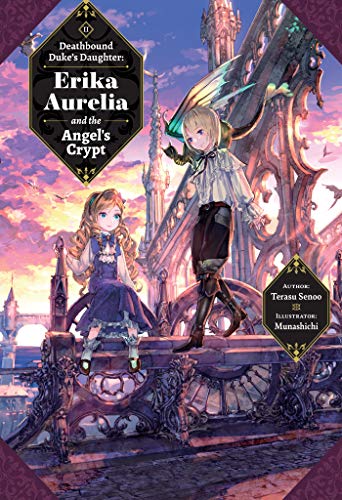
Deathbound Duke’s Daughter: Erika Aurelia and the Seafarer’s Ruins

June 28, 2020 by Sean Gaffney

By Terasu Senoo and Munashichi. Released in Japan as “Shini Yasui Koushaku Reijou to Shichi-nin no Kikoushi” by M Novels (Futabasha). Released in North America digitally by J-Novel Club. Translated by Roy Nukia.

We’ve had isekais for years now, and are used to “so what is the slight difference that makes this one worth reading”. Otome Game Villainesses, though, is still a relatively recent genre. That said, the fact that it seems to be exploding in popularity means that we can start to compare and contrast them that much faster. So, for those who would like a far more intelligent protagonist than Bakarina, or for those who want less emphasis on the romance aspect of these sorts of books, here’s a really nice choice for you. That said, Erika lacks Katarina’s empathy and emotional well of kindness, mostly because one was a happy-go-lucky high school girl who got hit by a truck while thinking about an otome game, and the other is a young OL who’s spent her entire life being slutshamed and the subject of rumors, and who finally was murdered by someone with a “grudge” against her for existing. It’s no surprised that Erika is a bit more jaded – even as an eight-year-old.

So you know the drill, she’s woken up as a villainess – a bratty young woman whose death kickstarts the plot of the game she was playing. That said, this is years earlier, and the event that makes her so loathed is one she knows – don’t let the younger sister of one of the “targets” die because of her neglect. She succeeds in making young Anne a fan of her right away, but Claus is dealing with inferiority complexes and preconceived biases, so is a tougher nut to crack. He’s interested in the ruins that her kingdom is known for – and so is the sister, which makes it more annoying when they both deliberately vanish one evening, leaving Erika to try to catch them so that Anne’s death doesn’t lead to her own demise. Unfortunately, Erika reckons without her super, super bad luck in general, and also her past life making her more than a little death-seeking, even if it’s only unconsciously.

As you can see, the bulk of this is not so much “otome game villainess tries to stop dying” as “kids go on a big underground adventure”, and it’s all the better for it. They’re mysterious moving labyrinths, deathtraps galore, golems, and a big bad with a big grudge. Erika and Claus work well together, and you can see why he ends up falling for her despite their young ages. Though Anne is the one who can tell that she’s not really looking for any romance, especially after her last life. As for Erika herself, despite seemingly being weak in terms of alchemy, she’s actually quite the savant, something noted by her older brother in a side story, where he worries that she’s going to take after their shady (and now dead) mother. (Amusingly, Erika was wondering if HE was the evil one earlier, but they both seems to be OK.) Most importantly, the book is simply fun, a short, quick read that will please most fantasy readers as well as “otome game villainess” fans.

Each book in the series has a Harry Potter-style title, so we’ll see what Erika Aurelia and the _______________” gets up to next time. In the meantime, this is an excellent addition to J-Novel Club’s Heart line.

Filed Under: deathbound duke's daughter, REVIEWS

Ascendance of a Bookworm: I’ll Do Anything to Become a Librarian!, Part 2: Apprentice Shrine Maiden, Vol. 4

June 27, 2020 by Sean Gaffney

By Miya Kazuki and You Shiina. Released in Japan as “Honzuki no Gekokujou: Shisho ni Naru Tame ni wa Shudan wo Erandeiraremasen” by TO Books. Released in North America digitally by J-Novel Club. Translated by quof.

(This review contains more spoilers than usual. I’ll try to keep the big ones to after the cover art.)

To my annoyance, the book starts off with a scene between the villains, each trying to prove that among the sneering evil bastards, they are the MOST sneering evil bastards. To my relief, it’s all uphill from there – as always, Bookworm’s books are long but they feel like they’re too short. Myne is trying to get her kid’s picture books off the ground, which involves experimenting with colored ink as well as getting new wax for their stencils. the second quarter of the book has a lot of the arts and crafts we’ve come to love from this series. (It also has the author, in probably the funniest part of the book, write in “Myne and Lutz as an adult married couple” and have it be DEAD ON.) Unfortunately, right at the start of the book an abandoned baby arrives at the orphanage, and Myne, trying to convince a reluctant Delia to care for it with the others, makes a big deal of Delia being the child’s big sister. This sets off a terrifying change of events that will shake up the lives of everyone – and result in a major fatality.

Though we’re not quite going to be leaving the temple yet, I suspect this may be the last we see of Delia as a major character. I had wondered if Myne would ever manage to win her over to betraying the high bishop, and sadly the answer is “not really”, though this isn’t helped by everyone keeping secrets from Delia because… well, she’s a spy. At least she avoids execution. Indeed, this book is filled with executions and threats of executions galore, and it’s a reminder of just how dark this world can be when it’s not about “hey, let’s make paper!”, and when the archduke is pondering whether it would be easier to simply have Myne’s family executed, you get the chills. Fortunately, Myne has her fingers in too many pies to make this really feasible, especially given that her printing press is the proverbial genie that cannot be put back in the bottle. No, instead of everyone around Myne getting executed, the simplest thing is for Myne to die.

And so we end this arc, with Myne dead. Fortunately, we have a new heroine in Rozemyne, who is the hidden daughter of a noble adopted by the archduke, and who happens to look, talk and act just like… OK, yes, Rozemyne is Myne, something most people are immediately made aware of. But the cover story is very important, and the scene where Myne has to say goodbye to her family as a family is heartbreaking. We know they’ll meet again (if anything else, I’ve seen Tulli on a few book covers coming up), but it’s not the same. Indeed, the cover story is magical, to the point where even Myne’s magical contracts change names. As for the Archduke himself… well, I admit, I didn’t see the reveal coming, though others may disagree. Certainly he helps to rescue Myne in the nick of time from a hideous fate. We’ll see how the double act holds up in the next arc. (The book proper ends about 2/3 in, and we get some very good post-Myne short stories, including some subtleties in regards to the High Priest’s aide, and how his seething cauldron of anger is not as secret as he’d like.)

The next arc is titled ‘Adopted Daughter of an Archduke’, and as such I expect a lot of noble life, probably some bullying – Rozemyne will likely find it hard. That said, she’s now in a majorly important position, the daughter of the MOST important man, and as we saw here, has enough mana in her to whip up a prayer to 5 or 6 gods, all at once, and have it work fine. No need to worry, even if Myne has left us, Rozemyne should be just fine. This was an excellent volume in the series, despite the “I am eviler than the most evil person!” villains.

Filed Under: ascendance of a bookworm, REVIEWS

A Triple Dose of Terrible Titillation

June 26, 2020 by Sean Gaffney

This week three titles came out all at once that made Manga Bookshelf collectively groan and hold their heads. I decided, in a rare masochistic moment, to read all three of the new volumes. It rapidly became apparent that I’d have to review them together, as they all defied my ability to spin a large number of words. So let’s get started with title #1, which is easily the scuzziest of the three.

(Please note: all three of these titles are various degrees of sexually explicit. Reader discretion is advised.)

Peter Grill and the Philosopher’s Time. By Daisuke Hiyama. Released in Japan as “Peter Grill to Kenja no Jikan” by Futabasha, serialization ongoing in the magazine Monthly Action. Released in North America by Seven Seas. Translated by Ben Tretheway. Adapted by David Lumsdon.

First off, a brief summary: a guy wins a worldwide fighting tournament, and is recognized as the strongest in the land. He wants to marry his pretty but naive fiancee, but unfortunately as he’s the strongest every woman around wants to have sex with him. He attempts to resist, but fails. Rinse and repeat. As for a review… at least it’s not hiding what it wants to be. About 15 pages into this book, I had read as euphemisms “man yogurt”, “down-low mayo”, “cream filling”, and “man mucus”, to the point where I wanted to beg the translators to just say “cum” over and over like a normal person. They say they want to bear his strong children, but honestly, it’s all about the sex. We get two ogres and an elf in this book, and I’m sure as the series goes on more fantasy creatures will show up. As for Peter, he’s the sort of guy that creators think is likeable but is really teeth-grindingly irritating. It certainly has an audience, but that audience is “80s sex comedy”. I’m amazed the pages didn’t stick together… and I read it on a tablet.

Breasts Are My Favorite Things in the World!. By Wakame Konbu. Released in Japan as “Sekai de Ichiban Oppai ga Suki!” by Media Factory, serialization ongoing in the magazine Comic Cune. Released in North America by Yen Press. Translated by Alexandra McCullough.

This was not as offensive as Peter Grill, but does have the problem that I kept checking to see how many pages to the end. It’s possibly the most boring “sexy” manga I’ve ever seen. The premise: Chiaki is the school “prince”, an archery master and all the girls love her. Harumi, who goes to a different school, has a not-very-hidden crush on Chiaki. Chiaki has a very not hidden crush on Harumi’s large breasts. She likes to grope them, and if she can’t do so, she loses motivation in terms of her archery. It’s basically Knight of the Ice with boobs. Theoretically this is a yuri title, but honestly you end up simply angry after seeing Chiaki say over and over, in about fifteen different ways, that she loves Harumi’s boobs, not Harumi. There are various boob-grabbing situations… buying new bras, etc… but really, nothing happens but boob-groping for about 150 pages. It’s certainly a very narrow fetish. I can’t even imagine yuri fans would be pleased, as they’d no doubt tell Harumi to find someone – anyone – better than Chiaki. And the breast-grabbing, given we’re constantly told it’s not about lust or arousal, is not even sexy.

Lust Geass. By Osamu Takahashi. Released in Japan by Kadokawa Shoten, serialization ongoing in the magazine Young Ace. Released in North America by Yen Press. Translated by Sheldon Drzka.

When I started reading these three, I was not expecting the erotic mind control porn story to be the best of the three – by far – but here we are. Souta and Rikka are childhood friends, and he’s in love with her, but can’t quite get the words out. Then one day he finds a mysterious bookstore with occult tomes. Rikka loves occult stuff, so he gets one for her birthday. Now, suddenly, she’s really, really horny, and needs his help to get off… though won’t go all the way. The premise of “cursed book that makes us have sex” is not really new, and you can see the direction this is going. The second volume will no doubt pull in the respectable class president girl, the volume after that the hot teacher, etc. And we also get the “if you have sex with the one you truly love, you’ll die” curse to keep the main pairing apart till death or cancellation do us part. But… honestly? This had the only likeable cast in these three books. Consent is occasionally mentioned, which is surprising given the premise. You get the sense that Souta and Rikka would likely have gotten together relatively soon even without the book. Now, don’t get me wrong, this is not great. It’s possible I’m making it sound better than it is because I read it after the other two. And, well, it’s erotic mind control porn. But this is the only one of these where I though “I might actually get Vol. 2 just to see if the leads stay likeable”. It’s not terrible.

So Lust Geass is worth getting if you’re into that sort of thing, Peter Grill will likely please its very, very narrow demographic of horny teenage boys (likely why Seven Seas rated it Older Teen and not Mature), and Breasts Are My Fav… zzzzzzzz… hm? where was I? Oh, right. No.

Filed Under: breasts are my favorite things in the world!, lust geass, peter grill and the philosopher's time, REVIEWS

Manga the Week of 7/1/20

June 25, 2020 by Sean Gaffney, Michelle Smith, Ash Brown, Anna N and MJ 1 Comment

SEAN: It’s the first of July! Or the last day of June, technically, as most books ship Tuesdays. As a result, this July 1st is more of a grab bag than most weeks.

Bookwalker has a 12th volume of shogi light novel series The Ryuo’s Work Is Never Done!.

Cross Infinite World debuts another shoujo light novel. Hello, I Am a Witch and My Crush Wants Me to Make a Love Potion! should serve as the perfect description, really.

MICHELLE: Yep.

ASH: Haha, it does!

ANNA: There is great clarity as to the contents of that book.

SEAN: Dark Horse has the 5th Berserk Deluxe Edition.

ASH: I’ll be picking this up. The deluxe edition of Berserk is quite an upgrade from the original release.

SEAN: Ghost Ship has, digital-first, Vol. 16 of To-Love-Ru Darkness.

J-Novel Club has two manga and two light novels. The manga are Infinite Dendrogram 4 and The Magic in This Other World Is Too Far Behind!! 5.

The novels are Full Metal Panic! 7 and My Next Life As a Villainess 6, which I have been reliably informed does actually get the story moving once more.

Kodansha has a couple of debuts, some with print coming later, some not. Clover is a title CLAMP fans should be familiar with, and it’s getting a Hardcover Collector’s Edition release… but for now, enjoy it digitally.

MICHELLE: I don’t think I ever finished this one.

ASH: Clover is one of my favorites from CLAMP. (And is another example of one of the group’s manga that ended earlier than originally intended.) I have the Dark Horse omnibus edition, but I’m tempted to pick this one up, too.

ANNA: I’ve got the old Tokyopop paperbacks!

MJ: I also have the Dark Horse omnibus, but this is tempting!

SEAN: When We Shout for Love (Bokura ga Ai wo Sakebu Toki) is a 3-volume shoujo manga series from Betsufure, and is about a boy and girl who find themselves growing closer because of their mutual love of AKB48… (cough) pardon me, KBF47.

ASH: That sounds like it could be fun!

SEAN: Digital first titles include Kiss Me at the Stroke of Midnight 11, Real Account 12-14 (a three volume omnibus), and Sweat and Soap 3.

Digital-only titles next week include Fairy Tail: City Hero 3, Farewell My Dear Cramer 10, The Great Cleric 5, and Love Massage: Melting Beauty Treatment 5.

MICHELLE: I need to get caught back up on Farewell My Dear Cramer.

SEAN: Seven Seas, in print, has the debut of Love Me for Who I Am. We talked about this when it came out digitally, but it deserves to be talked about again, because the first volume impressed me greatly. A must for LGBTQ fans.

ASH: I was waiting for the print release to read it; I’m looking forward to the manga.

MJ: I never did pick up the digital version, so this is my chance!

SEAN: In early-digital releases, we also have a debut light novel. The Hidden Dungeon Only I Can Enter (Ore Dake Haireru Kakushi Dungeon: Kossori Kitaete Sekai Saikyou) is about a boy with minimal talents and, well, a dungeon that’s all for him. Seems very light novel-ey. Also he’s named Noir, so I hope he quickly gains companions named Madlax and El Cazador.

There’s also Haganai: I Don’t Have Many Friends 18, Magical Girl Spec-Ops Asuka 9, and the 3rd Neon Evangelion ANIMA light novel, where we see once more how many times they can use the phrase ‘pillar of salt’.

Tokyopop has a debut. Koimonogatari: Love Stories is not, sad to say, starring Hitagi Senjogahara. It’s a BL series from Gentosha’s Rutile, and actually looks quite sweet.

Tokyopop also has an 8th volume of yuri fox girl series Konohana Kitan.

Finally, Udon gives us a 7th Otherworldly Izakaya Nobu, which always leaves me hungry (admittedly, most foodies manga/novels do these days).

ASH: I read some of the early volumes, so I’ve some catching up to do.

SEAN: Anything catch your eye?

Filed Under: FEATURES, manga the week of

Toradora!, Vol. 10

June 25, 2020 by Sean Gaffney

By Yuyuko Takemiya and Yasu. Released in Japan by Dengeki Bunko. Released in North America by Seven Seas. Translated by Jan Cash & Vincent Castaneda. Adapted by Will Holcomb.

It might come as a surprise to those who have read the last three or four volumes of Toradora!, but there was, at one point, a large element of comedy in this series. As things have turned far more serious that’s mostly been repressed, but there’s a wonderful moment here where it returns… and yet we also don’t let go of the soul-crushing despair that both leads are going through. This leads to my favorite scene in the book, where, after having accidentally thrown 24,000 yen into the river, Ryuuji and Taiga finally kiss… then he jumps back onto the edge of a bridge, and she suddenly thinks he’s trying to kill himself, so she grabs at him, but slips and accidentally sends him over the bridge into the river (it’s winter), and then he asks her to marry him, and then SHE jumps off the bridge, and then the two have a giant screaming fight/confession scene in the rover while slowly freezing to death. It’s a bit unnerving to read… but also very like these two.

The first half of the book made me worry that the two of them might actually make good on their running away, which is, let’s be very clear here, a VERY BAD IDEA. Their friends have gotten so invested in giving up on their own denied love and supporting the couple that they’re willing to go along with this, though at least Ami is there to point out the foolishness before giving in anyway. Even their teacher, who literally bets her job that the two won’t run away, can’t stop them from making their escape. In the end, what stops them is actually the actions of Ryuuji’s mother, herself estranged from her parents after a high school relationship ended in pregnancy, who has ALSO run away from home. This leads to Ryuuji reuniting with his grandparents, and he and Taiga seeing that nothing is unrecoverable.

One thing I very much appreciated about this final book is that it does not try to redeem Taiga’s own parents, who have both been portrayed as emotionally and mentally abusing Taiga most of her life. Her dad is finally unable to run from his creditors, and I feel grateful we don’t see him. We do see her mother, who is there to remove Taiga entirely from her friends and love. Their teacher at one point can’t help but compare mother and daughter – they have similar mannerisms, and you can certainly see the family resemblance. But, thankfully, Taiga has emotional depth and the ability to care for others that we really don’t see in her mother here, and it’s why you feel so pained when she finally gives in and leaves with her. Of course, this story is not going to have an unhappy ending, fear not. But I do like how, in the end, Taiga is able to stand up for herself and demand her own right to be happy rather than being yanked around by her parents.

Toradora! is a relatively old series in light novel years, and at times it did feel rather quaint compared to some more modern examples of the genre, which certainly would have added three or four more girls to the Ryuuji mix. But even if it did, no one would be able to get past the destiny of the main pairing. It’s literally in the title. It’s also a terrific read.

Filed Under: REVIEWS, toradora!

  • « Go to Previous Page
  • Page 1
  • Interim pages omitted …
  • Page 269
  • Page 270
  • Page 271
  • Page 272
  • Page 273
  • Interim pages omitted …
  • Page 1060
  • Go to Next Page »
 | Log in
Copyright © 2010 Manga Bookshelf | Powered by WordPress & the Genesis Framework