• Skip to primary navigation
  • Skip to main content
  • Skip to primary sidebar
  • Home
  • About Us
    • Privacy Policy
    • Comment Policy
    • Disclosures & Disclaimers
  • Resources
    • Links, Essays & Articles
    • Fandomology!
    • CLAMP Directory
    • BlogRoll
  • Features & Columns
    • 3 Things Thursday
    • Adventures in the Key of Shoujo
    • Bit & Blips (game reviews)
    • BL BOOKRACK
    • Bookshelf Briefs
    • Bringing the Drama
    • Comic Conversion
    • Fanservice Friday
    • Going Digital
    • It Came From the Sinosphere
    • License This!
    • Magazine no Mori
    • My Week in Manga
    • OFF THE SHELF
    • Not By Manga Alone
    • PICK OF THE WEEK
    • Subtitles & Sensibility
    • Weekly Shonen Jump Recaps
  • Manga Moveable Feast
    • MMF Full Archive
    • Yun Kouga
    • CLAMP
    • Shojo Beat
    • Osamu Tezuka
    • Sailor Moon
    • Fruits Basket
    • Takehiko Inoue
    • Wild Adapter
    • One Piece
    • After School Nightmare
    • Karakuri Odette
    • Paradise Kiss
    • The Color Trilogy
    • To Terra…
    • Sexy Voice & Robo
  • Browse by Author
    • Sean Gaffney
    • Anna Neatrour
    • Michelle Smith
    • Katherine Dacey
    • MJ
    • Brigid Alverson
    • Travis Anderson
    • Phillip Anthony
    • Derek Bown
    • Jaci Dahlvang
    • Angela Eastman
    • Erica Friedman
    • Sara K.
    • Megan Purdy
    • Emily Snodgrass
    • Nancy Thistlethwaite
    • Eva Volin
    • David Welsh
  • MB Blogs
    • A Case Suitable For Treatment
    • Experiments in Manga
    • MangaBlog
    • The Manga Critic
    • Manga Report
    • Soliloquy in Blue
    • Manga Curmudgeon (archive)

Manga Bookshelf

Discussion, Resources, Roundtables, & Reviews

Blog

Fushi no Kami: Rebuilding Civilization Starts with a Village, Vol. 3

April 15, 2021 by Sean Gaffney

By Mizuumi Amakawa and Mai Okuma. Released in Japan as “Fushi no Kami: Henkyou kara Hajimeru Bunmei Saiseiki” by Overlap. Released in North America by J-Novel Club. Translated by Maurice Alesch.

It’s rare that you suspect that an author feels that his series has too many readers, but that seems to be the case with Fushi no Kami, which is really going to be pushing the limits of reader tolerance here in just how much the cast can praise every single thing Ash does. It really is ridiculous, and that’s not even counting Maika and Arthur, who are in love with Ash, or the maid that he gains in this book, who clearly is also falling in love with Ash. Now, to be fair, in their eyes Ash is this weird combination of Thomas Edison, Abraham Lincoln, and God, so I suppose it is perfectly reasonable in some ways. Adn yes, Ash is trying to bring back many of the ancient civilization’s conveniences, as well as ruthlessly fending off assassination attempts. Still, I would love it if in future books he gets a complete failure or two under his belt.

We start off with Ash finding a new outlet for his creativity, and this time he isn’t alone. Fellow study group friend Hermes turns out to have an obsession with planes, and has built a model that is being made fun of by the local bullies. Naturally, Ash is over the moon about this, and decides to help him build, if not a full-sized passenger plane, at least a working model. Ash is also getting rewarded, as he gets a medal for taking out the demon monster in the previous book… which promptly gets stolen, leading a vengeful Maika to do some investigating. In the most serious story in the book, some spies have been snooping around from the capital city, and they are looking for a girl. Given this is happening at the same time as Ash’s class is doing survival training, he has to protect said girl while also drawing away the spies turned assassins who have been ordered to kill her. Which… sounds like a fairly sedate book for Ash, given the previous two.

Frustratingly, we still don’t quite get all of Arthur’s backstory here, but we get enough to know why they have to unfortunately return to the capital, though I’m sure we’ll be seeing them again in the future. Much is made near the end of their rivalry with Maika, and I agree they share wonderful moments of closeness, but let’s face it, Maika is going to be married to Ash eventually, he just doesn’t know it yet. I would not necessarily call her a yandere, as she doesn’t really fit the criteria, but she’s certainly obsessed with Ash to the point where it’s almost disturbing, and moves heaven and earth to make sure that he stays by her side for future books. The book’s chapter titles all deal with planes, which makes it a bit frustrating that we only get proper plane building in the first section – I hope they return to this again. More to the point, the cast have now graduated and are essentially adults… how much more can Ash actually pull off now?

As noted, these books require a lot of patience in terms of the cast calling Ash the greatest thing since sliced bread. There’s also what amounts to a torture scene about 3/4 through the book, and the fact that Ash does not realize what he’s doing does not really make it any less (deliberately) creepy. That said, Fushi no Kami remains resolutely readable, which is one of the best qualities in a book.


Filed Under: fushi no kami, REVIEWS

Outbreak Company, Vol. 17

April 14, 2021 by Sean Gaffney

By Ichiro Sakaki and Yuugen. Released in Japan by Kodansha Light Novels. Released in North America by J-Novel Club. Translated by Kevin Steinbach.

One thing that has always remained reliably on brand about this series is how all in it goes on its otaku evangelism. The author is clearly just as bad if not worse than his lead character, and it shows, as the books are littered with references to anime, manga, books, films, games, etc. And what’s more, this is shown in a (mostly) very positive light, with people who would otherwise be indifferent to if not hate each other bonding over their shared obsessions. This particular volume seems to really lay the references on thick – it trusts that readers will not only know what Area 88 is, but also buy into the extended Star Wars riff that comes at the climax of the book. It even affects the plot, as the Americans who show up in Eldant towards the end are somewhat stunned to see the princess swearing at them, as she’s quoting the cliched stock American from Japanese media. That said, the guys who show up in Eldant very much DO feel like stock characters – Outbreak Company is not only a huge fan of cliches, it’s also a client.

We pick up where the last book left off, after a brief prologue from the POV of Shinichi’s family showing how things are going back in Japan. Not well. The hyperspace tunnel is starting to really go to pieces, which is leading to lots of natural disasters. As such, Japan has decided to punt, and tells Shinichi and company they’re pulling out of Eldant in five days. Needless to say, the cast are varying levels of upset by this – Minori is pretty cool with just going back, Hikaru suddenly realizes his own feelings for someone else in the cast, and of course Shinichi is still waffling about what love really is and if he’s in it with anyone. If he stays behind, lacking any ability to either import or create anime and manga, isn’t he just useless? If he takes a girl back with him to Japan, won’t they just be captured and experimented on? And then suddenly the USS Nimitz appears on top of a forest in rival nation Bahairam, and everything gets blown to hell.

As is typical of this series, Shinichi can be thick or clever when the situation demands it, as with his being unable to understand why Petralka seems to be OK with him leaving forever, missing the subtleties of her response as well as her own true feelings. We’ve still got one volume to go, and it’s possible that he won’t pick anyone, but I’d still lay odds on Myusel, who also has a bit of a love revelation in this book. As for the subplot, it’s basically pure action movie – the book makes many references to the 1980 movie The Final Countdown, as our heroes have to infiltrate Bahairam – again – and try to stop the war breaking out between their country, already upset about losing the Dragons Den, and some very jumpy naval officers. Can Shinichi talk everyone down? Can they figure out how to return a battle carrier to its proper place in the world? And can we actually get anyone to confess their love at all without being under the influence?

The next volume is the last, though there’s also a short story collection that I’m not sure is licensed. Fans of the series should enjoy it, though I suspect, like me, they’re happy it’s finally drawing to a close.

Filed Under: outbreak company, REVIEWS

Tearmoon Empire, Vol. 4

April 13, 2021 by Sean Gaffney

By Nozomu Mochitsuki and Gilse. Released in Japan as “Tearmoon Teikoku Monogatari” by TO Books. Released in North America digitally by J-Novel Club. Translated by David Teng.

We’ve now had three books filled with Princess Mia doing something for either selfish or silly reasons (or, increasingly, because she is a very nice person) that ends up misinterpreted by everyone around her as pure brilliance, and we get plenty of that here as well. But we’re starting to also see the rest of the cast accomplish things away from Mia and have their own subplots. No, alas, I don’t mean Miabel, who’s still pretty much the mascot character of the series, and gets left behind for the second half of the book while the rest of the cast have a cruise. Instead, it’s Ludwig, thinking of some offhand remarks of Mia’s as well as what he thinks she would be doing in his place, that leads him to uncover a web of political intrigue that could end up crippling the Empire if things do end up happening the way that Mia predicts they will. His investigation and detective work is a refreshingly sedate part of this book. That said, rest assured there’s still a lot of Mia vs. reality here to love.

As with a couple of other Tearmoon books, the main plot is divided into two large chunks. The first picks up where the previous book left off: the school Mia had planned to start up is floundering, as ,most of the teachers and the headmaster have left. The answer is sadly obvious: Mia may be a very atypical noble now, but most nobles are far more like what Mia was in her previous “life”, and they are not having which this school where horrible farmers will be taught. To solve this, Ludwig suggests bringing in his former mentor, an eccentric old man whose grumpy tendencies and dislike of most nobles play right into Mia’s hands. After this, she is invited on a sea cruise to a tropical island by fellow noble Esmeralda, who IS like most nobles are – you will expect her maid to stab her in the face before the book finishes. Accompanied by Sion, Abel and Keithwood, all of whom supposedly go to “guard” Mia, they sadly run into a typhoon, leaving them stranded on an island that no longer looks as fun.

To get a big negative out of the way first, there is a subplot here about Mia getting a swimsuit for the cruise and realizing that she has tummy bulge, which unfortunately leads to a bunch of fat jokes, though Mia does end up losing most of the weight before the cruise itself. It’s not welcome. The rest of the book is filled with Tearmoon shenanigans, as most of the cast are content to listen to what she says and then make the most amazingly wrong conclusion imaginable, usually to the benefit of everyone involved. The semi-exception here is Keithwood, who knows Mia can be a flake, and is irritated with her mushroom obsession (especially as most of them are poisonous), but still regards her as a force for good. Which, honestly, she is. The narrative may frame Mia’s actions much of the time as self-interest or cowardice, but more and more we’re seeing Mia just be really nice to everyone – and get irritated when other nobles are not, as her anger towards Esmeralda’s treatment of her servant shows. Mia may be no Great Sage, but if things continue to go like this, she may make a very good leader.

The books are getting quite popular in Japan – the author talks about a stage play being made, and a 2nd one is due out this year – and it’s not hard to see why. Mia is fun, the books are exciting, there’s some good politics, and each book is long enough that you get a lot of bang for your buck. Hopefully fewer fat jokes next time, but otherwise still essential.

Filed Under: REVIEWS, tearmoon empire

Holmes of Kyoto, Vol. 4

April 12, 2021 by Sean Gaffney

By Mai Mochizuki and Shizu Yamauchi. Released in Japan by Futabasha. Released in North America by J-Novel Club. Translated by Minna Lin.

Rarely have I had to eat my words quite so much as I have in the gap between my review of the third volume and this one, and I urge readers to absolutely not go back and read it. Still, it does mean we have to confront the elephant in the room, though admittedly the book is doing it as well. This series features a man just out of college in love with a girl still in high school, and Japan sure has no issues with this whatsoever given the sheer number of titles out lately featuring age-gap romances, but Western readers tend to dig in their heels a lot more. Now, let’s not kid ourselves, things are not going anywhere anytime soon. Indeed, I will be very surprised if anything happens before Aoi turns 18. Mostly as Aoi continues to delude herself about Holmes’s feelings towards her, which are not only obvious to the reader but are starting to be obvious to everyone else as well. Fortunately by the end of the book, Aoi has at least come to a different realization.

As with other books in this series, we get a short story and three longer ones. The short story is simply Holmes taking Aoi on a date, though she doesn’t actually realize that’s what it is. We then get to meet Holmes’ grandmother, who has a bisque doll that strangely is the distaff counterpart to one they have in the antique shop… and one which might be haunted! After that, despite the author’s assurances in previous afterwords, we get what amounts to a murder mystery, albeit one where the victim survived, and Holmes is forced to deal with a case whose only artwork is the books of an author. Lastly, we meet the owner’s stepson Rikyu, who idolizes Holmes and who clearly is NOT loving Aoi at all. Will she be able to win him over by being a quasi-appraiser at an event thrown by Rikyu’s grandfather to determine who gets his inheritance?

As noted, the second case, while quite well done, feels a bit different to the other “cases” we’ve read, even though we’ve dealt with death and attempted assault in previous books. Possibly for this reason, it also feels a bit overdone, with Holmes’ talents not feeling as natural as they do when he’s looking at antiques. The third story was the best, as Rikyu is a fun addition to the cast, basically being a sullen teen who’s unhappy that his favorite relative is being taken away from him by another woman. I will admit that Aoi’s preternatural progress in learning about artwork and antiques is almost as unrealistic as Holmes turning into Hercule Poirot, but the moment is set up really well and you feel so happy for her I’ll grant it. And we do get an awful lot about Holmes clear feelings for Aoi and mistrust of other men (he’s right, she is awfully naive) as well as Aoi’s tendency towards self-loathing cropping up, thinking that Holmes is “far beyond her”… but at least, right at the end, she can admit to herself she’s fallen in love with him.

So yes, last time I said this wasn’t one for romance fans, and I will have to take that back, but I do think that mystery fans will get more out of this. We’ll see what happens in the next volume, this is a long-running series.

Filed Under: holmes of kyoto, REVIEWS

Pick of the Week: Brides, Princesses, and Vampires

April 12, 2021 by Sean Gaffney, Michelle Smith, Anna N and Ash Brown Leave a Comment

MICHELLE: There are new volumes of several series I enjoy coming out, and I’ll definitely be picking those up, but what grabs my attention the most is a josei debut. Nina the Starry Bride doesn’t have the most original-sounding plot, it seems, but a) it’s josei and b) I can’t help it—that cover is just really neat! I look forward to checking it out.

SEAN: I love josei manga, and will certainly check out Nina. But my pick(s) are the one-two punch of Shonen Sunday titles, as Komi Can’t Communicate and Sleepy Princess in the Demon Castle are two of my top favorites right now.

ANNA: I’m interested in Nina the Starry Bride but I’m also curious about Call of the Night because I generally like Shonen Sunday titles and vampires!

ASH: Since it’ll be the last time that I can choose it, I Hear the Sunspot: Limit gets my official pick this week. I’ve been greatly enjoying the series and its predecessors from the beginning, so I don’t expect that to change with the ending.

Filed Under: PICK OF THE WEEK

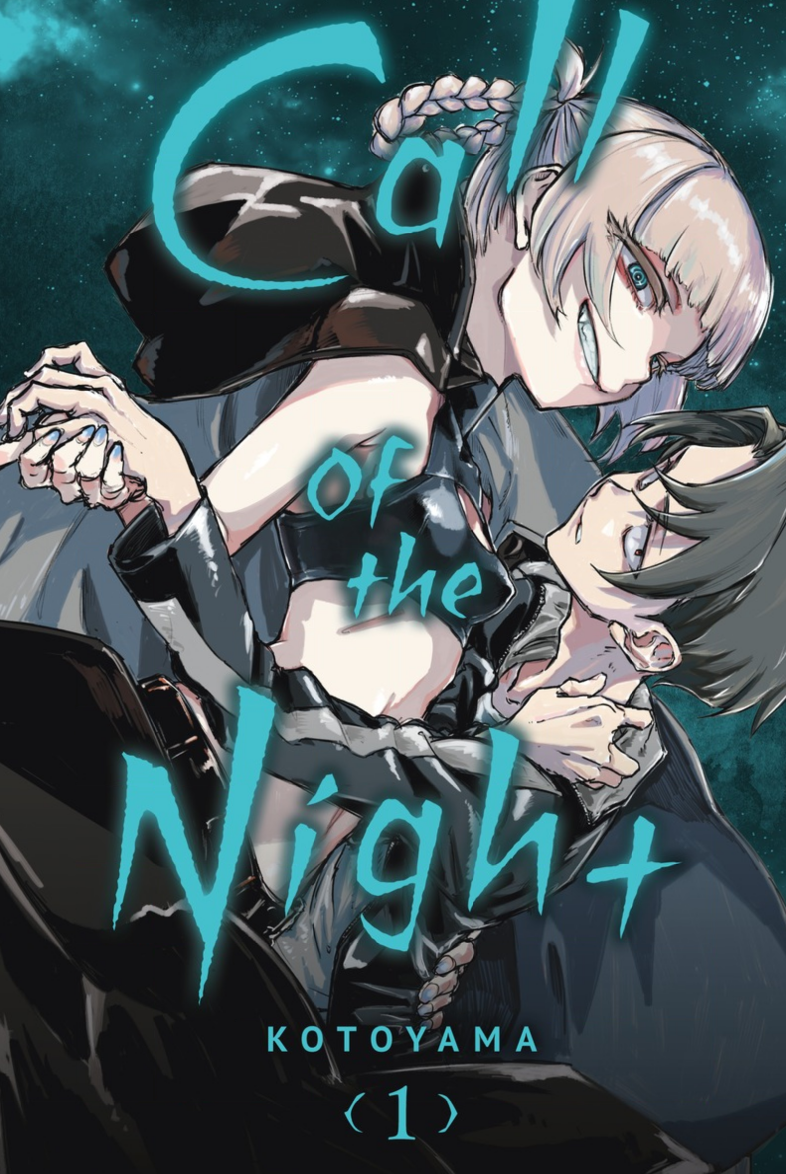
Call of the Night Vol 1

April 11, 2021 by Anna N

Call of the Night Volume 1 by Kotoyama

I’m always a little curious about Shonen Sunday titles, as they tend to be a little more sophisticated than Shonen Jump manga so I was intrigued by the idea of a shonen vampire romance like Call of the Night. Ko Yamori starts out by being the typical hapless shonen protagonist but he’s isolated and has just started having terrible insomnia. He’s not attending school regularly and one night he slips out of his house and starts wandering around in the middle of the night while searching up ideas for insomnia cures on his phone. Seeing many people posting about the benefits of alcohol he stands in front of a vending machine contemplating buying a beer when he’s suddenly accosted by a mysterious blond girl in a cloak who says she can help him if he’s having trouble sleeping. She brings Ko back to her place to crash, and he quickly discovers that his new acquaintance is a vampire named Nazuna.

Call of the Night

Ko finds the idea of becoming a vampire immediately intriguing but Nazuna finds the topic incredibly embarrassing because the only way for a human to become a vampire is to fall in love with one and let that vampire drink from them. Ko is determined to make this happen, and while Nazuna likes to joke about sex, the idea of any type of emotional intimacy is something that she shies away from. Ko and Nazuna keep finding each other in the middle of the night and hanging out. There’s an undercurrent of loneliness to this manga that makes it a little more interesting and poignant than I was expecting, as Ko and Nazuna keep seeking each other out. Ko’s not done with the human world though, as he reconnects with an old friend of his who encourages him to go back to school. Kotoyama’s art is stylized and angular, making the world of the night seem more mysterious. I definitely felt intrigued by the end of the first volume and I’m curious to see how this relationship will develop over time.

Filed Under: Manga Reviews, REVIEWS Tagged With: call of the night, Shonen, viz media

The Reincarnated Prince and the Hero of Light

April 11, 2021 by Sean Gaffney

By Nobiru Kusunoki and Arico. Released in Japan as “Herscherik” by M Novels. Released in North America by J-Novel Club. Translated by afm.

The last two volumes of the Herscherik books have had the subtitle refer to a new vassal that is the focus of that particular book, so you might be coming into this one wondering who the Hero of Light is going to be. But no, Herscherik has a full army of weapons in his cache now, both in terms of the men he has at his side and also his family, who are increasingly rebelling more and more against the chains of Marquis Barbosse. He has tried assassinating the royal family to depress the King into doing his bidding, he has tried introducing lethal drugs into the kingdom, and he has tried using his own daughter in a plot to kill Herscherik, one that ends in her own death instead. And yet here is Herscherik, a literal seven-year-old running rings around him. Of course, the reader knows that’s because he has the mind of a brilliant Japanese middle manager in hi, but no one ELSE knows that. So there’s only one thing left to do: send Herscherik off to die in war.

Yes, in an incredibly convenient coincidence, the country next door has decided to amass a huge invasion force at the border, so the army needs to take their much smaller force and go investigate. Barbosse suggests that Herscherik should go, despite being seven, as … well, he comes up with excuses over and over as to why no one else in the family should go, to the point where by now everyone in the room is aware he’s doing his best Snidely Whiplash imitation. But that’s fine by Hersch, who has also decided to stop pretending to be an innocent seven-year-old and act his age + his reincarnated age. As a result, they head off into an obvious trap and, well, get ambushed. Surprise! That said, Herscherik is a good two or three steps ahead of Barbosse here, and, of course, has Kuro, Orange, and Weiss, who together are the equal of at LEAST one invading army.

The book reads as if the editor said “you know those scenes you always get near the end of a book that make the reader punch the air? Could you fill the book with them?”. Every confrontation is a joy, and while sometimes the plot does verge on the ridiculous (I will give the fall from the cliff a pass because every book needs at least one hand wave) other parts are very well crafted, bringing in events from the first three books and tying them together, and also answering the very obvious question we’ve had for some time: given Barbosse can kill off the royal family with impunity, why hasn’t he done away with the youngest prince? The book is also very good about talking about the difference between doing what’s right for the nation and doing what you personally want to do, and how even Hersch finds that hard to handle at times. And, as I mentioned before, the dramatic confrontations are to die for. (Literally, sometimes.)

The series is not over, and reassuring us that we’re still only in the prologue of the Tales of the Prince (though we do meet the author of the books here, a scrub in the army trying to survive so he can send his pay back to his family), but this book definitely closes the book on the plot that’s run through the previous three. Where does it go from here? We shall see. Till then, enjoy a fantastic light novel series that makes the reincarnation isekai bits work well and also not be overused.

Filed Under: reincarnated prince herscherik, REVIEWS

Days on Fes, Vol. 1

April 9, 2021 by Katherine Dacey

Like many Gen-Xers, I cut my musical teeth at rock concerts. I didn’t have much experience going to festivals—they were rare in the 1980s—but I did catch the first Lollapalooza tour as it passed through the Boston area in 1991. My memories of that day are impressionistic; it was hot, dirty, and loud, and I considered leaving when I learned that Siouxsie and the Banshees had cancelled their appearance. I’m glad I didn’t, though, as the festival helped expand my musical horizons, introducing me to the sound of rap-metal and the Rollins Band, and reminding me just how phenomenal Living Colour was. Reading Days on Fes reminded me of that formative experience, though not in the way I’d expected. I imagined that a manga about rock festivals would focus on the music, but Days on Fes is equally concerned with food stalls, merch, and concert-going logistics, even dedicating one chapter to finding the perfect campsite at an outdoor festival.

The first volume follows two characters: Otoha, a goofy high school student, and Gaku, her thirty-something brother. In the first half of the book, Otoha persuades her classmate Kanade to attend the Meteorock Festival with her, while in the second Gaku drags his Eeyore-esque employee Ritsuru to the Fries & Sushi Festival. Both siblings face predictable hurdles in getting to the venue, from lack of interest—Kanade confesses that she doesn’t like rock—to lack of funds—Ritsuru bemoans the fact that he’s too poor to afford a ticket. Once at the festivals, however, both Kanade and Ritsuru succumb to the excitement of eating good food, wandering the grounds, drinking beer, sleeping under the stars, and—yes—hearing some concerts.

The most satisfying passages in volume one focus on getting ready for a festival. Oka vividly captures the feeling of pre-concert anticipation, carefully documenting the small but important rituals that festival-goers observe, from picking out an outfit to deciding what to bring; he even includes a two-page spread detailing the contents of Kanade and Otoha’s backpacks. Though this illustration serves a legitimate educational purpose, showing the festival n00b what they’ll need—suncreen, snacks—it also speaks volumes about the two girls’ personalities and expectations for the festival itself. Less satisfying are the performances. Oka relies on reaction shots and close-ups of musicians’ faces to convey the excitement of hearing live music, but the blandness of the illustrations undercuts the efficacy of this time-honored strategy for showing what can’t be heard: whoops, claps, whistles, boos, sing-alongs. The dialogue provides the only clue that these performances were good; characters spend more time talking and thinking about how the music effects them then they do listening to music.

For anyone old enough to remember the original Lollapalooza tour, the contrast between the lackluster performance scenes and the rhapsodic discussions of festival foods may be jarring; it often feels like Oka has channeled too much energy into depicting the things you can buy and do at a festival rather than what you might hear. For younger readers, however, Days on Fes offers a safe but tantalizing glimpse of what it might be like to attend Coachella or Bonnaroo, as well as a down-to-earth reminder that festivals are an expensive habit—a message that’s sure to be music to parents’ ears.

DAYS ON FES, VOL. 1 • ART AND STORY BY KANAKO OKA • TRANSLATED BY AJANI OLOYE • LETTERING BY ALEXIS ECKERMAN • YEN PRESS • RATED TEEN • 208 pp.

Filed Under: Manga, Manga Critic, REVIEWS Tagged With: Musical Manga, Rock, yen press

Yona of the Dawn, Vol. 28

April 9, 2021 by Sean Gaffney

By Mizuho Kusanagi. Released in Japan as “Akatsuki no Yona” by Hakusensha, serialization ongoing in the magazine Hana to Yume. Released in North America by Viz Media. Translated by JN Productions, Adapted by Ysabet Reinhardt MacFarlane.

As many have noticed, this has gradually become a light novel review site, with the manga that I read generally being reviewed in Manga Bookshelf’s Briefs columns. There are one or two exceptions, though, the most obvious of which is Yona of the dawn, a series I keep finding new things to say about (even though I’m still one volume behind in my reviews). This volume is an excellent example of why I keep coming back to it. There’s really big goofy comedy, as Kyo-Ga is knocked unconscious due to Happy Hungry Bunch antics and essentially becomes a giant comedy prop for a while. There’s romance, as we see in the scene where Yona and Hak take comfort in being each other’s strength. There’s politics, as Keishuk has arrived at the absolute worst time, and we get more of “what is Yona’s goal”. There’s cool action sequences. And there’s intrigue, as the cliffhanger makes you wonder if Ogi is going to be selling Yona out. There’s SO MUCH GOING ON.

Yona of the Dawn sometimes has a Shakespearean feel to it, particularly with everyone being worried about where Yona is and what she’s doing. Su-Won’s position as leader is fairly secure, and yet… everyone assumes that as long as Yona is alive, she can easily lead a rebellion to take over. This is very Richard II/Henry IV stuff here. It does not help that Yona is wandering around the land with a bunch of superheroes/monsters (delete where applicable), who could and have taken out entire armies on their own when at full power. But no one knows what Yona’s real goal is. Well, the reader might have a clue. The highlight of the volume is Yona’s big speech where she talks about how everyone is expecting her to get revenge for the death of her father, and… she doesn’t have to? She doesn’t have to forgive Su-Won, and won’t, but she can simply go around doing good things? Sadly, I suspect forces will continue to stop her doing that.

We also get a glimpse of Kyo-Ga and Tae-Jun’s mother here, and I enjoyed her showing off another classic comedy stereotype, the regal woman with the fan over her face who (almost) never speaks… until she does, as her fury at how Keishuk treats her son forces her to complete entire sentences, to the surprise of her attendants. She’s a very different kind of powerful woman from Yona, and doesn’t exactly clash with her, but she does worry that Yona is not doing what the traditional woman should. Putting herself in danger every day, after all, is dangerous. But this is what Yona has chosen to do, and she’s not backing down now. (Yona in general is filled with women wielding power in very different and varied ways, and I really appreciate that. This is not to say that Yona is not vulnerable, but for the most part that’s a side of herself that she tries to show only to Hak.

As you can see, there are always new things to discover about one of the best shoujo manga currently being published in English. Always a must-read.

Filed Under: REVIEWS, yona of the dawn

Manga the Week of 4/14/21

April 8, 2021 by Sean Gaffney Leave a Comment

SEAN: There certainly is a lot of manga coming out. Remember years ago when some weeks had three or four titles?

ASH: It’s almost unimaginable any more.

SEAN: Airship has the 11th Arifureta: From Commonplace to World’s Strongest in print, and the 4th volume of The Invincible Shovel in early digital.

Cross Infinite World has another villainess reincarnation story with Since I Was Abandoned After Reincarnating, I Will Cook with My Fluffy Friends: the Figurehead Queen Is Strongest At Her Own Pace (Tenseisaki de Suterareta no de, Mofumofu-tachi to Oryouri Shimasu: Okazari Ouhi wa My Pace ni Saikyou desu). A woman newly shunned by her fiance, the prince, finds herself now married to a different prince – one who hates women! But… his kingdom is filled with adorable creatures, and she doesn’t have to do anything but her hobby – cooking! No death flags here, just fluff.

ASH: I mean, I do like cooking stories?

SEAN: Denpa’s website lists femme fatale: The Art of Shuzo Oshimi for next week. An artbook dedicated to the creator of Flowers of Evil, Blood on the Tracks and more.

J-Novel Club has a veritable plethora of digital releases. Are You Okay with a Slightly Older Girlfriend? 2, Banner of the Stars 6, Black Summoner 4, Der Werwolf 11, The Ideal Sponger Life 2, Slayers 7, Sorcerous Stabber Orphen: the Wayward Journey 11, The Tales of Marielle Clarac 6, and Tearmoon Empire 4.

Kodansha Manga has one print release, which is Witchcraft Works 15. Kodansha Books also has the 3rd volume in the Pretty Boy Detectives Club series. Thus all the Kodansha print releases next week are ex-Vertical.

MICHELLE: I didn’t love the first Pretty Boy Detective Club as a novel, but I’m still looking forward to the forthcoming anime!

SEAN: The digital debut next week is a full-blown josei title. It even runs in Be Love! Nina the Starry Bride (Hoshi Furu Oukoku no Nina) is an orphan girl who ends up being sold as a slave… to the royal family? Turns out she looks a lot like the recently deceased princess. Now she has to live her new princess life… no matter how much she does NOT want to. I’m interested in this, despite the well-worn premise.

ANNA: I am too, but I have a very poor track record with digital titles.

ASH: Likewise.

SEAN: Also out digitally: the final 16th volume of GE: Good Ending, Peach Boy Riverside 6, Shojo FIGHT! 16, Tokyo Revengers 20, and the 27th and final volume of Yozakura Quartet, whose first volume was put out by Del Rey in 2008.

ASH: Oh, wow, Yozakura Quartet is a series I haven’t thought about in a long while.

SEAN: One Peace has the third and final volume of I Hear the Sunspot: Limit.

MICHELLE: Oooh.

ASH: It’s a big one, too! (I got my hands on an early copy.)

SEAN: Seven Seas has some debuts, both based on light novels they’ve also released. Failure Frame: I Became the Strongest and Annihilated Everything With Low-Level Spells (Hazure Waku no [Joutai Ijou Skill] de Saikyou ni Natta Ore ga Subete wo Juurin Suru Made) runs in Overlap’s Comic Gardo, and Muscles Are Better Than Magic (Mahou? Sonna Koto Yori Kinniku da!) runs in Kadokawa’s Comic Walker.

ASH: For some reason I was expecting Failure Frame to be about windows and defenestration.

SEAN: We also get Gal Gohan 7, The Girl from the Other Side 10, Harukana Receive 7, How Heavy Are the Dumbbells You Lift? 6, Love Me for Who I Am 3, My Next Life As a Villainess! 5 (manga version), and Reincarnated As a Sword 5 (also manga version).

ASH: Always glad to see a new volume of The Girl from the Other Side (although I will admit to being behind in my reading).

SEAN: And there’s three more Alice books – Nightmare, The Lizard Aide, and Toy Box – that get digital releases.

SuBLime has a 5th Candy Colored Paradox and The World’s Greatest First Love 14.

ASH: I’ve largely been enjoying Candy Colored Paradox.

SEAN: Viz debuts a new Shonen Sunday series, a phrase not heard often these days. Call of the Night (Yofukashi no Uta) seems to combine romcom and vampire stories together, and looks fun.

ANNA: Always up for more manga vampires.

SEAN: Viz also has more Shonen Sunday! Case Closed 78, Komi Can’t Communicate 12, Persona 5 6, Pokemon Adventures Collector’s Edition 7, Pokemon Adventures: Black 2 and White 2 3 (that title hurts me to type), Sleepy Princess in the Demon Castle 14, and Splatoon: Squid Kids Comedy Show 3.

ASH: Yay, Sleepy Princess!

SEAN: Lastly, Yen Press debuts the manga version of the beloved light novel In Another World with My Smartphone. This early in the series there’s far less genocide to worry about, so I will cautiously recommend it. It runs in Kadokawa Shoten’s Comp Ace.

What manga will you read while waiting for your vaccination appointment?

Filed Under: FEATURES, manga the week of

  • « Go to Previous Page
  • Page 1
  • Interim pages omitted …
  • Page 244
  • Page 245
  • Page 246
  • Page 247
  • Page 248
  • Interim pages omitted …
  • Page 1072
  • Go to Next Page »
 | Log in
Copyright © 2010 Manga Bookshelf | Powered by WordPress & the Genesis Framework