 Bloom Into You, Vol. 2 | By Nakatani Nio | Seven Seas – While there is a lot of yuri out there that can be defined by the words “what is this strange feeling in my heart?,” I’m not sure if any of them are quite as fascinating as Yuu. I’m not entirely sure if this manga is going to go with “Yuu is asexual,” but the first couple of volumes can certainly be read at that. She’s not really aromantic, though, and her relationship with Touko is complicated—and becoming known to others, who may also be asexual. Touko, meanwhile, is the ever-popular “problematic” we see in so many yuri titles as well, and is having trouble balancing that line between consent and just giving in to her desires. Bloom Into You may start like typical yuri, but it’s not headed that way. Good stuff. – Sean Gaffney
 Chihayafuru, Vol. 2 | By Yuki Suetsuki | Kodansha Comics (digital only) – Oh, happy sigh. I do love Chihayafuru so much. In this volume, we see the conclusion to the elementary tournament Chihaya, Taichi, and Arata have entered. Sadly, they lose and Arata moves away not long after. Chihaya is certain that they’ll meet again, but as we skip ahead three years to high school, it’s clear that they haven’t really kept in contact. She’s determined to start a karuta club and makes Taichi promise to join if she finally achieves class A ranking. Seeing her compete rekindles his own love of karuta, but when she calls Arata to tell him the good news, she learns he’s stopped playing for a really awful reason. I actually got sniffly when they came face to face again at last. This is the kind of manga where I wish I had dozens of volumes stacked up to marathon. Unequivocally recommended. – Michelle Smith
 The Full-Time Wife Escapist, Vol. 3 | By Tsunami Umino | Kodansha Comics (digital only) – Although I enjoy a good cliffhanger as much as the next person, I’m not normally as invested in their outcome as I was for the one at the end of volume two of this series. Before we find out exactly what Tsuzaki and Kazami mean by “sharing” Mikuri, however, there’s an interlude where she and her fake husband must field questions from relatives about their procreation plans. I really enjoy the way Umino is plotting this series—it makes sense why Mikuri would want to take Kazami up on his arrangement, and neatly dovetails into her aunt finding out about it, prompting her to be concerned about the nature of her niece’s marriage. Mikuri doesn’t engage in any flights of fancy this time, but she does do a lot of psychoanalyzing her husband, which is interesting. Definitely looking forward to volume four! – Michelle Smith
 Girls’ Last Tour, Vol. 1 | By Tsukumizu | Yen Press – I’m not entirely sure what to make of Girls’ Last Tour. Chito and Yuuri are two chibi-faced young women roaming a post-apocalyptic wasteland on their Kettenkrad motorbike, just trying to survive. There are parts of this series I really liked. I love the depictions of desolate cities, or cavernous interiors… it reminds me a little of BLAME! in that respect, which is a major compliment. Too, I like their brief interaction with a guy named Kanazawa, who has found meaning for his life in creating maps, and that other levels exist where conditions might be different. I find that I really want to know how things turned out this way. That said, I strenuously dislike Yuuri, and there are some really unfunny gags featuring her that I guess are supposed to be moe or something but just piss me off. Still, I’ll be continuing! – Michelle Smith
 Golden Time, Vol. 7 | By Yuyuko Takemiya and Umechazuke | Seven Seas – Linda is mostly absent from this volume, which allows us to focus on the odd triangle between Kouko, Banri, and Banri’s old self, which seems to literally be sabotaging his relationship, though he’s also being helped by coincidental disaster and bad choices, particularly “don’t drive home when you’re all sleepy,” which leads to Kouko, understandably, having a complete nervous breakdown as several of her long-standing issues combine with nightmares she’s having about the car accident. Fortunately, Bari gets over his own issues to an extent in time to be there for her, and much to my surprise we get a ‘girlfriend’s dad’ who’s supportive and not a caricature. As good as ever. – Sean Gaffney
 Kase-san and Bento | By Hiromi Takashima | Seven Seas – After getting together in the first volume, this second in the “Kase-san and” series continues to show off the awkwardness that comes with having just gotten together. Both girls still don’t know each other that well, and misunderstandings abound. But they’re all relatively easy to resolve misunderstandings, which is good, because no one is reading this for overwrought lesbian drama. We’re reading it because Yamada is adorable, Kase-san is spunky, and the two of them together are wonderful. There are a few more kisses, and Yamada is slowly gaining confidence. And there are bentos. Which, you know, you would expect thanks to the title. Cuteness personified. – Sean Gaffney
 Maid-sama!, Vols. 15-16 | By Hiro Fujiwara | Viz Media – I had thought Maid-sama ended with volume sixteen, but I was wrong. And indeed, much of this volume is about reminding me that it’s not just as simple as “Misaki admits she likes him, the end.” Usui comes with baggage, though, and we learn a lot about that baggage in this volume, including the story of how his parents met—it’s steeped in class issues and tragedy. And as such Misaki, who is as common as they come, has it hammered into her that she can never be with him as she can’t cross those class barrier. Misaki, of course, is ready to kick your class barrier down with her best quality—her sheer stubbornness. Oh yes, and Misaki’s father returns. Please ignore that entire plotline; it’s awful. – Sean Gaffney
 Requiem of the Rose King, Vol. 6 | By Aya Kanno | Viz Media – There’s a lot of good stuff going on in this volume, not the least of which is the tragic death of a major character, but it’s sort of hard to get past THAT SCENE. I said “poor Anne” at the end of my last review, and boy, I wasn’t kidding, though frankly she takes it far better than I expected. But man, Margaret. She’s always been one of my favorite Shakespeare villains, as well as one of his best female characters, and BOY HOWDY does Kanno convey that in a fantastic way. You want to recoil from the page. As for Henry and Richard, I think by necessity we are headed to the end of that relationship soon, unless there’s some rewriting of canon beyond what we’ve already seen. Riveting. -Sean Gaffney
 Toriko, Vol. 38 | By Mitsutoshi Shimabukuro | Viz Media – Thankfully, this volume was considerably more interesting than the previous one, though I am still grateful we’re heading for the end. Most of the volume focuses on Komatsu and the other cooks, and I am reminded that this is really Komatsu’s story as much as Toriko’s, and he’s had a lot farther to develop. Beyond that, we have the usual impressive shone n stunts, monsters galore, and a decent amount of food, though I miss the days when food was the only thing driving this manga. And again, the relationship between Toriko and Komatsu may not be explicitly gay, but it’s certainly far deeper than any relationships the two of them have with their love interests. Keep at it if you’ve been reading it. – Sean Gaffney
 Welcome to the Ballroom, Vol. 5 | By Tomo Takeuchi | Kodansha Comics – The Tenpei Cup has come to an end, and Tatara Fujita must return to normal life. After successfully getting into high school, he is upfront about his love of dancesport in his self-introduction, earning the mockery of the girl who sits in front of him, Chinatsu Hiyama. However, it soon becomes apparent that not only is Chinatsu a big fan of Sengoku and his partner, Chizuru Hongo, but she has some experience with ballroom dance. Hey, how convenient that such a character shows up right when Tatara is in need of a new partner! Imagine that. Anyway, this is mostly a transitional volume, and featured a couple of people saying unkind things about their overweight friend, so I didn’t enjoy it as much as previous volumes. I’m still on board for the next one, though. – Michelle Smith


 Fifteen-year-old Tsukushi Tsukamoto doesn’t have any friends. He’s always rushed home after school to be there for his disabled mother, who is raising him on her own after his father passed away. After an eccentric fellow named Jin Kazama saves Tsukushi from bullies, Tsukushi is more than willing to grant Kazama the favor of playing a game of futsal with him. In fact, he runs six miles through the rain in order to fulfill his promise, and though he’s spectacularly awful at the game, he’s also a gutsy idiot and something about his enthusiasm rubs off on his teammates.
 Little by little, Tsukushi manages to not completely suck, albeit only for brief moments at a time. Because of his ability to rekindle the joy of soccer in others, he is surprisingly chosen for the Interhigh team. Though he makes an error that costs them a penalty kick, he also makes a valiant save that rallies everyone’s spirits. I’m a sucker for those moments when the underdog first hears the crowd cheering for them so, predictably, this moment made me verklempt.


 Mikuri Moriyama is a 25-year-old licensed clinical psychologist who hasn’t been able to find a job after grad school. She’s been living with her parents and working for a temp agency, and when she’s laid off her father arranges for her to assume housekeeping duties for a guy he used to work with. Hiramasa Tsuzaki is 36 and single. He seems humorless and particular at first, but Mikuri finds that working for a hard-to-please guy makes it easier to know when she’s been successful. She performs her duties well, even managing to nurse Tsuzaki through an illness in such a business-like way that it’s not awkward for him. Things go well for a few months, then Mikuri’s father prepares to retire and move to the countryside. Rather than lose their mutually beneficial arrangement, Mikuri and Tsuzaki decide that she’ll move in with him and, for the sake of propriety, become his common-law wife. They proceed to perpetuate the ruse that they’re actually a real couple.
 As Tsuzaki’s coworkers learn that he’s gotten married, his social calendar suddenly fills up in a way it never did before, while Mikuri notices that her aunt Yuri, with whom she’s very close, has been hesitant to invite her out as much as she used to before Mikuri got married. Spending time with Numata and Kazami is enjoyable for the couple, but it’s also risky, because nosy Numata snoops and learns there’s only a twin bed in the bedroom, and by volume two, Kazami is convinced that they’re faking it. Kazami is perhaps as equally developed as Tsuzaki himself, as we hear a great deal about his reservations about marriage, which all leads up to the big cliffhanger ending of volume two (which I shan’t spoil). Tsuzaki, meanwhile, is attempting in vain to keep from developing feelings for Mikuri. She persists in being business-like, and he 100% believes there’s no chance she’d ever reciprocate, so he often looks emotionless in front of her, only revealing his feelings when he’s alone. I love that neither one of them is spazzy; they’re in a somewhat trope-y arrangement, but they’re handling it like adults.


 Even without knowing much about Dreamin’ Sun, I was sold by the fact that it’s an earlier series from Ichigo Takano, creator of orange, which I loved dearly. Dreamin’ Sun is more of a straightforward and comedic shoujo story in which characters do not contend with letters from their future selves or how to save a suicidal friend, but it still has a few poignant moments.
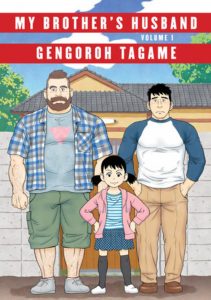 Yaichi is a single dad who works from home managing the rental property his parents left to him and his brother, Ryoji, after being killed in a car accident when the boys were teenagers. He considers his real job to be providing the best home he can to his daughter, Kana. On the day the story begins, Yaichi is expecting a guest—Mike Flanagan, the burly Canadian whom Ryoji married after leaving Japan ten years ago. Ryoji passed away the previous month and Mike has come to Japan to try to connect with Ryoji’s past and see for himself the many things he’d heard stories about from his husband.
 It’s the story of Minare Koda, a waitress with a gift of fluency that catches the attention of a local radio producer, Mato. After secretly recording her drunken rant about her thieving ex and playing it over the air, he eventually takes the chance of giving her her own weekly show in a late-night time spot where she has the freedom to do some really kooky things. The first episode, for example, is a surreal audio drama about murdering said ex, Mitsuo. The next week, it’s time to bury the body on Mt. Fuji!
 Yaichi is a single dad, earnestly raising his young daughter, Kana, whose life is upended by the arrival of Canadian visitor, Mike, husband to Yaichi’s estranged twin brother, Ryoji, who has just passed away. Yaichi greets Mike with awkwardness and not just a little homophobia, but is forced to invite him to stay after Kana, blissfully unaware of her father’s discomfort, insists that he must be welcomed into their home. Mike, stricken with grief, but anxious to connect with Ryoji’s family and childhood, gratefully accepts Yaichi’s grudging hospitality and settles into Ryoji’s old room.
  Asahi is spending a pleasant afternoon with her parents and she’s just about to go in and have some cookies when the backyard pond reaches out and ensares her, transporting her to another world. There, she meets a friendly boy named Subaru who unfortunately has some very ruthless parents, who immediately decide to offer Asahi to the water dragon god to obtain prosperity.
 In elementary school, Shoya Ishida often engaged in foolhardy stunts to stave off boredom. When hearing impaired transfer student Shoko Nishimiya joins his class and causes disruption within the class, she becomes Shoya’s target. Initially, the other kids laugh at Shoya’s antics but when he goes too far and destroys several hearing aids to the tune of $14,000, they swiftly condemn him. Now he’s the one who’s ostracized and this status continues into high school, long after Shoko transferred out again. Full of self-loathing, he’s preparing to commit suicide, but a chance reunion with Shoko inspires him to try to change.
 Back and forth things go, with this group continuing to try to establish themselves as friends without seeming to genuinely like each other much. Eventually, they decide to film a movie together. For one scene, they need to acquire permission to film at their old elementary school. Shoya is the unwilling emissary, and an encounter with his odious former teacher leaves him feeling so awful about himself that he ends up lashing out at all his friends, seemingly trying to drive them away as he feels he deserves. This has the unintended side effect of causing Shoko to feel like she’s the cause of his unhappiness, prompting a desperate act.
 Less clear is what Oima was aiming for with their group of friends. Even though Naoka was far more outwardly nasty to Shoko, at least she was open about it and expressed a great deal of self-loathing because of her behavior. With the help of another friend, Miyoko, she is encouraged to have a bit more optimism, and will probably end up doing okay. Even though she could’ve been fleshed out further, I do like Naoka as a character. But man oh man, do I hate Miki. She makes everything about herself—at one point revising the bullying narrative so that she and Shoko were co-victims—and doesn’t seem to grow at all. Everything she does seems fake, because most of it is, and I was baffled when the boy she fancies declared her to be “kind” after some weepy episode. Miki should get hit by a bus.


