• Skip to primary navigation
  • Skip to main content
  • Skip to primary sidebar
  • Home
  • About Us
    • Privacy Policy
    • Comment Policy
    • Disclosures & Disclaimers
  • Resources
    • Links, Essays & Articles
    • Fandomology!
    • CLAMP Directory
    • BlogRoll
  • Features & Columns
    • 3 Things Thursday
    • Adventures in the Key of Shoujo
    • Bit & Blips (game reviews)
    • BL BOOKRACK
    • Bookshelf Briefs
    • Bringing the Drama
    • Comic Conversion
    • Fanservice Friday
    • Going Digital
    • It Came From the Sinosphere
    • License This!
    • Magazine no Mori
    • My Week in Manga
    • OFF THE SHELF
    • Not By Manga Alone
    • PICK OF THE WEEK
    • Subtitles & Sensibility
    • Weekly Shonen Jump Recaps
  • Manga Moveable Feast
    • MMF Full Archive
    • Yun Kouga
    • CLAMP
    • Shojo Beat
    • Osamu Tezuka
    • Sailor Moon
    • Fruits Basket
    • Takehiko Inoue
    • Wild Adapter
    • One Piece
    • After School Nightmare
    • Karakuri Odette
    • Paradise Kiss
    • The Color Trilogy
    • To Terra…
    • Sexy Voice & Robo
  • Browse by Author
    • Sean Gaffney
    • Anna Neatrour
    • Michelle Smith
    • Katherine Dacey
    • MJ
    • Brigid Alverson
    • Travis Anderson
    • Phillip Anthony
    • Derek Bown
    • Jaci Dahlvang
    • Angela Eastman
    • Erica Friedman
    • Sara K.
    • Megan Purdy
    • Emily Snodgrass
    • Nancy Thistlethwaite
    • Eva Volin
    • David Welsh
  • MB Blogs
    • A Case Suitable For Treatment
    • Experiments in Manga
    • MangaBlog
    • The Manga Critic
    • Manga Report
    • Soliloquy in Blue
    • Manga Curmudgeon (archive)

Manga Bookshelf

Discussion, Resources, Roundtables, & Reviews

Michelle Smith

Let’s Get Visual: Warm-Up Exercises

August 28, 2010 by Michelle Smith

MICHELLE: Welcome to a brand-new Feature here at Soliloquy in Blue: Let’s Get Visual! Each month, Manga Bookshelf‘s MJ and I will select a page or sequence of pages from our recent manga reads that we find intriguing and attempt to develop our visual-critiquing muscles by sharing our thoughts about it. Neither of us is particularly adept at this, but it’s our hope that by a little regular exercise, we’ll get better.

MJ: Should we talk a little about why we each decided to do this?

MICHELLE: Personally, I’ve always felt that my attempts to discuss comic or manga art have been desultory at best. Usually, they take the form of an afterthought paragraph tacked at the end of the review after I’ve said everything I have to say about the plot and characters. I’ve read a few things about pacing and paneling online and, in general, would simply like to be stronger in this area and train myself to think more about it while I read.

MJ: I think my motivation is very similar. I know what works for me as a reader and I can even take a stab at expressing why, but I don’t really have the vocabulary necessary for discussing the visual aspects of comics, despite my love for them. I’m hoping I’ll get some help with that from the folks who read this column, and that it might give me a greater understanding of this medium that I spend so much of my time thinking and talking about.

MICHELLE: Yes, I’m hoping we’ll get some (hopefully benevolent) guidance, too! With that, shall we get started?

MJ: Yes, let’s!

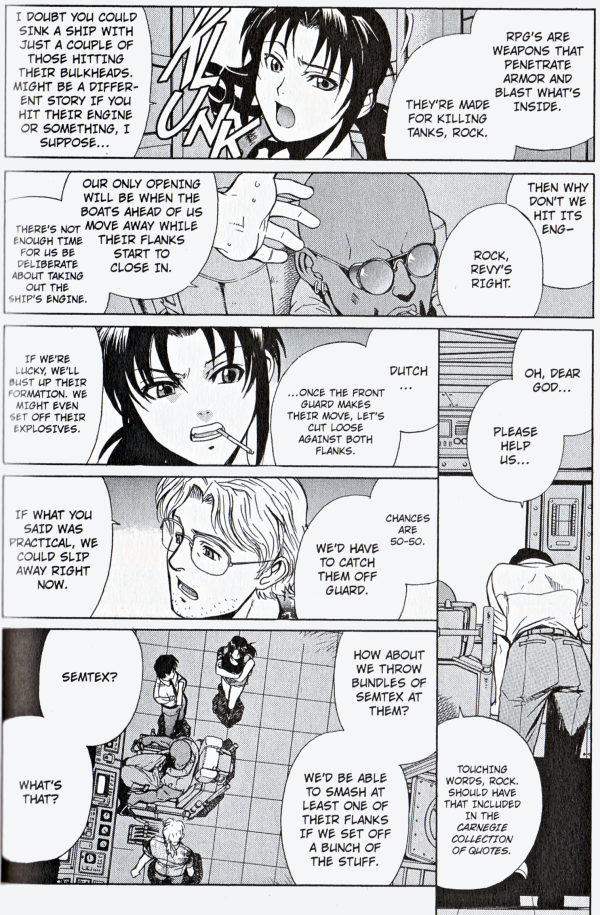
MICHELLE: For our first attempt, we’ve started simply; I’ve picked one page from volume three of Rei Hiroe’s Black Lagoon while MJhas chosen a sequence of pages from the game-changing fifteenth volume of Yumi Hotta and Takeshi Obata’s Hikaru no Go. All images can be enlarged by clicking on them.

Black Lagoon, Volume 3, Chapter 17, Page 112 (VIZ Media)

MICHELLE: A little background information is required to explain why I found this page from Black Lagoon so interesting. The protagonists of this series are the Lagoon Traders, operating in the waters of South Asia. They routinely accept dangerous jobs, but the one they’re currently on—attempting to deliver detailed Hezbollah plans to a CIA agent—is more fraught with peril than most. They’re being pursued by a number of other vessels and their chances of getting away are slim.

The basic layout of this page—two long horizontal pages on top, one long vertical column on the far right, then some shorter panels on the bottom left—is one that Hiroe has used a few times in the series so far. What struck me in this particular instance is how the flow of the panels directs one’s eye, and how that direction mirrors the characters’ spirits.

In that vertical panel in the bottom right, Rock is dejected. He has finally acknowledged that they’re doomed, and the trailing bottom edge of that panel and placement of Dutch’s dialogue bubble pulls our eyes just about as low as they can go, just like Rock’s hopes. But then Revy has an idea, and our eyes locate her halfway up the page, like a cautious rebound of hope. The rest of the page involves the whole team expanding upon her plan, including the mention of the explosives that will be their ticket to escape.

This may look like a very simple page, but its execution is nothing short of elegant.

MJ: Oh, that is nicely done! I’ll make a comparison here using a medium I do have the vocabulary to discuss intelligently. Your observation here reminds me of something I frequently talk about with my voice students (I used to be a singer, and I still teach) regarding various composers’ level of skill in writing for singers. The best composers tell you everything you need to know about what you should be feeling in any particular moment—whether you’re singing opera, art song, musical theater, whatever—using music only. Pitch, rhythm, dynamics–everything is there if you just pay enough attention, and as long as you use those tools given to you, your audience will understand, whether they speak the language you’re singing in or not.

This visual language reminds me very much of that, and I feel like even if we were looking at this in Japanese, though we’d certainly lack specifics, we’d still comprehend the emotional trajectory of the story here.

MICHELLE: That’s a very apt comparison. Rock’s body language being so easy to read helps, too.

MJ: So, what else do you like about this? I was wondering if you had particular thoughts about the final panel, which suddenly zooms high above them.

MICHELLE: I think this is meant to emphasize how much of a team solution it is. I also love that although the original suggestion about the Semtex does not have a tag on it to designate the speaker, the way everyone else is turned toward Revy suggests that she was the one who spoke.

MJ: Oh, you’re much smarter than I am, though I did have a thought as well. I was thinking about what you said in your original paragraph about the rest of the panels being about the whole team expanding on Revy’s idea, and I thought “expand” was just the word I’d use to describe that final panel. Most of the rest of the page is made up of close-ups, and then that one just zooms way out, suddenly lending a real sense of space.

MICHELLE: Ooh, that’s a very clever point! Go you! Anyway, that’s all I’ve got this time. Why don’t you tell us about the pages you chose?

Hikaru no Go, Volume 15, Chapter 124, Pages 74-77 (VIZ Media)

MJ: Okay, so I’m not even going to introduce these pages, because part of what I think is so brilliant about them is that I don’t have to.

So, you’ve got Hikaru, who is obviously really tired, in that sort of raw way that can only really exist when you’re forcing yourself to be awake. His entire body expresses this, and he’s pretty much holding up his head with his hand. Someone’s talking to him (readers of the series will understand it to be Sai), but Hikaru’s so out of it, he’s not even really with him. Hikaru’s unmoving, frame after frame, in a kind of zone of nothingness.Then something happens at the bottom of the first page and *wham* the door behind Hikaru is sharp again, like the world has shifted from a half-dream state into the harsh light of day.

The real awakening, though, happens on the next page, when Obata widens the lens to make the empty space in the room the focus of panel. This is accented perfectly by the curtains blowing the breeze and the bright sun lighting up the room. Everything is set to evoke a feeling of wide, empty space in this tiny little room. I can almost hear the sounds of everyday life outside that might be wafting in to this quiet room through Hikaru’s open window.

My favorite touch, though, is the way this ends. That wide shot could have easily been the last image in the chapter, and probably it would have had even more impact if it had been. But rather than leave readers with the dramatic lack of Sai, the next two panels bring us back to the *presence* of Hikaru. He’s small, he’s bewildered, and he’s just been awakened in a really harsh way, but there’s a warmth and poignancy in those last two panels that reminds me why I love this series so much.

MICHELLE: There are two things in what you’ve said that really resonate with me. Firstly, I’m struck with the import of the door. I almost feel like I’m back in tenth grade, analyzing poetry, but now that you’ve mentioned its abrupt clarity, I’m convinced that there’s some pretty heavy symbolism behind that door being so conspicuously and firmly shut.

Also, I had the exact same reaction to the open window and billowing curtain—I felt like I could hear the sounds of everyday life carrying on even after something immense has happened. This reminds me of the scene in “The Body,” the fifth-season Buffy the Vampire Slayer episode in which Buffy comes home to find her mother dead on the couch. At one point she steps outside and there’s the world, carrying on as normal while she is going through something devastating.

Lastly, the one thing in that scene that draws my attention in a strange way is the reflection of the books on the floor opposite Hikaru. It’s such a small detail, yet it seems to emphasize the emptiness even more.

MJ: I actually thought of that scene from “The Body” when I was writing here, and I wondered if you’d bring it up! Yes, that’s exactly the kind of thing I mean. I love your observations about the door and the reflection of the books, too. I think you’re absolutely right on both counts.

MICHELLE: I can always be counted on to reference Buffy! It’s interesting that we both chose examples wherein someone has their back to the audience; it seems like that’s something that may not happen too often, though I’ll have to pay more attention from now on to see whether that’s really true. Why do you think Obata decided not to show Hikaru’s expression right away?

MJ: I think he didn’t need to. I think Hikaru and the reader are feeling the same thing in that moment, so illustrating it is totally unnecessary, and doing so might actually lessen the panel’s impact.

MICHELLE: I think so, too. It would place a limit on Hikaru’s comprehension of the situation, as well.

MJ: I also like the fact that when we do see Hikaru’s face in the next panel, it’s not straight-on. The vantage point and slight distance makes it clear that he’s still processing what’s in front of him (or not) . It also makes him appear small and vulnerable, but not in an overly cartoonish way. It’s perfect.

MICHELLE: I agree! Well, how do you think we did, our first time out? We might be a bit sore tomorrow, but it certainly felt good to stretch some little-used muscles.

MJ: I think we did all right… hopefully scoring relatively low on the scale for potential embarrassment. Heh. I’m really looking forward to seeing what kind of wisdom we might glean from our more knowledgeable readers!

MICHELLE: As am I. We look forward to your feedback, and hope that you’ll join us again next month for the next installment of Let’s Get Visual!

Filed Under: FEATURES Tagged With: Takeshi Obata, VIZ

Off the Shelf: Stop Making Sense

August 25, 2010 by MJ and Michelle Smith 19 Comments

Welcome to another edition of Off the Shelf with MJ & Michelle! I’m joined, once again, by Soliloquy in Blue‘s Michelle Smith.

This week, we discuss titles from Viz Media, Yen Press, Square Enix and eManga (Digital Manga Publishing).


MICHELLE: MJ, I don’t mean to alarm you but I have some bad news. This column is going to self-destruct in five seconds unless you tell me about a manga that you read this week.

MJ: Gah, the pressure! The pressure! I can’t work like this, Michelle! Must… calm… down.

*breathe*

Okay. I had a bit of an odd week which kept me away from home a lot, so I didn’t have an opportunity to read any of the piles of manga I have staring down at me, day after day. To make up for this, I decided to check out some of the free manga I’ve mostly ignored online. Much of what I read was single chapters, but my cyberjourney first took me to Viz’s SigIKKI site, where I finally read the first volume of Natsume Ono’s House of Five Leaves, which is coming out in print next month.

I’ve had mixed reactions to Natsume Ono’s work so far. I liked Ristorante Paradiso, but had issues with Not Simple. *This*, however, I loved. It’s really my kind of manga in so many ways.

The story revolves around a samurai, Akitsu, who is dedicated to his vocation, but whose mild, even shy, personality has lost him his place among his kind. His timid manner is such a detriment, he can’t even hold a position as a bodyguard, so he’s often left with no money, scraping by on odd jobs which he finds fairly humiliating. Then he meets Yaichi, a powerful, charismatic guy who hires him for a one-time job. Akitsu is drawn to Yaichi’s personal qualities–the same ones he most painfully lacks–but his illusions are shattered when he discovers that Yaichi’s line of business is a sort of twisted vigilante kidnapping racket. Disgusted, Akitsu tries to distance himself from Yaichi and his group, but he’s undeniably drawn in by the warm relationship they all have with one another, which he finds difficult to let go….

Read More

Filed Under: OFF THE SHELF Tagged With: aron's absurd armada, expecting the boss's baby, Himeyuka & Rozione's Story, house of five leaves, moon boy, off the shelf, record of a fallen vampire

BL Bookrack: August Mix

August 18, 2010 by MJ and Michelle Smith 12 Comments

Welcome to the second installment of BL Bookrack, a new, monthly feature co-written with Soliloquy in Blue‘s Michelle Smith.

This month we take a look at series from BLU Manga and Digital Manga Publishing, specifically
Calling and Scarlet from BLU and Midnight Bloom and Under Grand Hotel from DMP.


Calling | By Miu Otsuki | Published by BLU | Rated Mature | Buy this book – Kazuaki is a mild-mannered young salaryman in a passionless job whose world is turned upside-down when he (literally) runs into Kira, a successful porn actor, who is filming in a nearby park. Kira falls for Kazuaki in the moment, and though Kasuaki initially rejects his romantic advances, the two pursue a friendship that gradually turns to love.

At first glance, this one-shot seems much like any other, with two pretty-boy male leads who look more like teenagers than working adults, and who fall predictably into typical seme and uke roles. Even the premise (a porn actor? really?) seems like an unbelievable construct put into place simply to facilitate easy sex scenes.

In truth, however, Calling is a surprisingly sweet story about two lonely young men discovering love for the first time. Even the story’s obvious cliches are handled with nuance and care.

Though inexperienced Kazuaki is a classic uke in most ways, his conflicted feelings as he begins to understand passion for the first time in his life bring a sense of poignant reality to his journey that is quite refreshing. Additionally, the contrast between the hours he spends hanging out with Kira and the dull apathy he feels all day at his job help make the rapid progression of their relationship genuinely believable.

Meanwhile, Kira’s stark surprise over the realization that he can actually feel love, a concept he’d long abandoned, makes the relationship easy to root for from the very beginning.

Both characters are well-developed in a remarkably short period of time. And though the volume isn’t at all ambitious in terms of plot, it’s nice to see the mangaka address the complications of Kira’s job, particularly its impact on his relationships with both his lover and his parents. The manga doesn’t delve too deep here, and perhaps Kira’s conflicts are resolved a bit too easily, but it’s a nice touch.

Despite an overuse of wide, tear-filled eyes and pouting lips, Miu Otsuki’s artwork is nicely expressive. Her understanding of body language, in particular, helps to highlight the story’s emotional depth.

If Calling is more warm than it is profound, that’s really not something to complain about. It’s the story’s focus on small moments that make it work so well in just a single volume. In a sea of disappointing BL one-shots, Calling is a welcome oasis indeed.

-Review by MJ


Midnight Bloom | By Rico Fukiyama | Published by Doki Doki | Rated 16+ | Buy this book – I don’t always like the stories Digital Manga Publishing issues under their DokiDoki imprint (like, say, Millennium Prime Minister), but I usually do. That’s where less explicit boys’ love stories reside and, indeed, the title story of this collection, “Midnight Bloom,” fits the bill quite well.

It’s the story of Tatsuki, an actor, and Haruka, the florist with whom he falls in love. The author’s end notes reveal that Tatsuki was originally a character in another story who was jilted in the end. “Midnight Bloom” exists chiefly to give Tatsuki a happy ending, and this it does. He and Haruka fall in love quickly, swiftly divulge their deepest feelings, and work companionably to put Tatsuki’s painful past behind him. Although everything’s a little too easy, it’s still pretty cute and I liked that the characters were finding true happiness with other than their first loves.

Alas, the rest of the stories in the collection are quite disappointing. “The Big Shiba” is about a spoiled rich kid named Hana whose father never let him have a dog. When his umpteenth step-mom kicks out her chauffeur/lover, Shirou, Hana takes him in. After a few weeks of Shirou playing nice doggy his more wolfish instincts take over. I’m sure you can guess where this goes. “Now and Then, My Heart Pounds” tells the story of an eighteen-year-old heir to a family inn who’s sort of apprenticed to another inn as appeasement for an arranged marriage agreement gone wrong and ends up in a relationship with a pervy thirty-year-old guy.

As if that wasn’t bad enough, the absolute worst story in the volume is “Scratch That Itch,” a particularly creepy student-teacher romance. Sometimes these kinds of stories can be handled without ickiness—perhaps only when the student is physically mature, self-assured, and the instigator—but that is definitely not the case here. The teacher entertains extremely off-putting thoughts like, “I want to see him shamed and filthy” and “All I have to do is catch him off-guard” and makes the first move on his student. I always wish for the kid to be properly traumatized when an older authority figure suddenly turns the tables on them in this way, but no, his only objection is that they should wait until they’re officially dating. Fukiyama writes that this scenario was especially requested by readers, that but she put the kid in a baseball uniform to spice things up. Ugh.

In the end, Tatsuki and Haruka’s story is bland but inoffensive and everything else is even worse than that. This one’s not worth your time.

-Review by Michelle Smith


Scarlet | by Hiro Madarame | Published by BLU | Rated Mature | Buy this book – When I reviewed Hiro Madarame’s Cute Devil back in May, I mentioned that while I liked her frequently cute (and amusing) art, I’d like to see what she could do with more sympathetic characters. Scarlet is actually her first comic but it ended up providing the answer.

Technically, this is a collection of short stories, but since only three couples are featured it feels less disconnected than others of its ilk. The title story and its follow-up, “Scarred,” depict the love story of Akio and Ryo. Ryo’s a transfer student whose European good looks make him somewhat of an idol at school, but he’s actually very lonely, very impressionable, and not too bright. He becomes attached to his first friend, Akio, and soon declares his love. The two begin a relationship, but Ryo is unable to refuse advances from others and cheats on Akio often. Obviously, Akio’s not happy about this, but Ryo is so genuinely, abjectly sorry every time that Akio keeps forgiving him.

When Ryo falls into the clutches of a manipulative girl who wants Akio out of the way for good, Ryo goes along with her plans, resulting in a disturbing attack on Akio. Nonconsensual scenes are lamentably de rigeur in boys’ love, but I do have to give kudos to mangaka who don’t shirk from depicting how awful the act truly is. Some will be infuriated by what happens next with this couple, but I don’t think it’s necessarily supposed to be romantic. At least, I hope not.

In addition to two merely decent stories about a couple with seemingly mismatched personalities, the volume is rounded out with a pair of stories called “One Night Stand” and “One Night Stand Again,” which are my personal favorites. Harumi is a gay man working in a repressive environment where he does his best to fade into the background. Every morning he rides the elevator with Toki, a charismatic coworker for whom he pines helplessly, but never speaks to him. One night, when Harumi spots Toki at a gay bar, he can’t believe his luck. Seizing the chance, and confident that his bar-hopping appearance is different enough from his workplace garb to avoid being recognized, he proposes a one night stand and the curious Toki accepts.

It’s a bittersweet evening for Harumi, and he has regrets afterwards. Toki does not and it doesn’t take him long to equate the guy from the bar with the guy in the elevator. Because Harumi’s so shy, however, Toki is content to take things at his speed. “Take all the time you need to get close to me,” he narrates as their tale comes to a close. Really, their story is simultaneously mature, sexy, and sweet, which is pretty impressive feat for a first-time mangaka!

I mentioned Madarame’s cute art, and it’s certainly put to good use here. True, sometimes her art can be a little messy-looking, but there are quite a few passages with great comedic timing and an amusingly simplistic style. Most often this appears in “Scarlet” and “Scarred,” used in good effect to depict how Ryo lights up when Akio looks his way, but there’s a really cute sequence between Toki and Harumi as well in which the latter dares to dream they might actually go out for lunch together. I also appreciate that the explicit scenes don’t feel as if they’ve simply been shoehorned in to fit some quota; they’re steamy without feeling smutty, if that makes sense.

All in all, I’m very impressed by Scarlet, though it’s rather disappointing to realize she followed this up with Cute Devil, a story of a power-imbalanced couple. Oh well. Can’t win ’em all.

-Review by Michelle Smith


Under Grand Hotel, Vol. 1 | By Mika Sadahiro | Published by 801 Media | Rated 18+ | Buy this book – Having been convicted of murdering his lover’s husband, Sen is sentenced for life to an underground prison buried in the depths of Long Island, nicknamed “Under Grand Hotel” by those who live there. It’s a rough introduction for Sen, who is beaten, raped with mop, and stuffed in a dryer by a child-molesting cannibal (no, really) all within the first 24 hours or so of his imprisonment.

He’s rescued from all this by Sword, a prison badass who has a reputation for dominating guys like Sen. The two become cellmates, and eventually enter into a sort of strange, desperate relationship.

Okay, let’s be honest here. Under Grand Hotel is a fantasy in the most complete sense of the word. It is, from its very first pages, elaborately constructed to sweep yaoi fans off their feet in the most dramatic way possible. It is violent, melodramatic, deeply unbelievable, and one of the most effective examples of romantic pornography I’ve ever seen.

This thing is epic, no less so than the likes of Korean favorite Let Dai, but without any flowery speeches or extended internal monologues standing in the way of its true mission–a whole lot of rough, manly sex. “Manly” really is the key here. This story isn’t populated by any of the wispy little bishonen found in most of the BL manga that’s been imported to the west. These men are big, heavily-muscled, and actually kind of terrifying much of the time. They are also angry and aggressive, regardless of whatever roles they play in the sack.

What’s most impressive about this manga in a narrative sense is how intense its world is, and how real Sadahiro is able to make it feel, at least while immersed. Reading this manga is like falling into the thrall of a very strong painkiller–the world reduced to a feverish bubble that both heightens and dulls the senses at the same time. It’s a dark world, to be sure, but one so far from the reader’s reality, it simply whets the appetite for more. “More darkness!” the mind cries out. “More pain!” Even the constant barrage of rape is somehow acceptable and even enticing in this utterly fantastical world.

Does that sound like hyperbole? Well, it may be. But this story begs for ridiculous description, just as it begs to be read, at least by the genre’s hard-core fans.

-Review by MJ


Review copies provided by the publishers.

Filed Under: BL BOOKRACK Tagged With: bl bookrack, under grand hotel, yaoi/boys' love

There’s Something About Sunyool 2-3 by Youngran Lee: B+

August 13, 2010 by Michelle Smith

Sunyool Lee’s life is full of disreputable accomplishments. If only she had something to show for them!

Volume two picks up four years after the dissolution of Sunyool’s six-month marriage to Sihyun Park, a wonderful guy with whom she was perfectly compatible. After a two-year stay in Paris, where she attempted to forget her pain and honed her pastry chef skills, she returned to Korea. A one-year stint running her own bakery ended in failure and now she works as an assistant at a bakery owned by a foul-tempered but gorgeous (aren’t they all?) novelist named Kangjae Lee.

When Kangjae first meets Sunyool, he’s willing to overlook the fact that she has just destroyed his laptop because she’s totally his type. Once he puts his contacts in, however, his illusions are shattered and they begin an adversarial relationship. Kangjae has the dubious talent of being able to enrage anyone within five seconds of meeting them, but Sunyool is able to hold her own against him, even while she’s working off her debt by working as his housekeeper. Most of the second volume consists of Kangjae acting like a spoiled child—“He’s a toddler who has no regard for anyone else’s feelings,” Sunyool decrees at one point—and Sunyool learning about his crappy childhood from his assistant/cousin, Byungman.

Things pick up a great deal in volume three with the return of Sihyun. In a nutshell: he still loves Sunyool and wants to be with her. Sunyool’s pride is stung because he didn’t stand up for their marriage four years ago and she knows that nothing has changed as far as his disapproving family is concerned. Various family members/wannabe fiancées show up to accuse Sunyool of ruining Sihyun’s life, and this is where she really shines as a character.

Although she, and members of the supporting cast, comment often on the storyline’s resemblance to a violent soap opera, Sunyool counters the over-the-top bitchiness of her accusers with a profound level-headedness that’s extremely satisfying. She has no expectations of a happy reunion with Sihyun, and makes that clear time and time again. Seeing a woman depicted as both in love and sensible is truly a lovely thing to behold, and though some of these twists are silly (though I did love the scene where she snaps and assaults someone) they also serve to show what makes her such a unique and interesting character.

Complicating matters is Kangjae. He begins hanging around the bakery more and more, getting antsy when Sunyool is not there and feeling jealous of Sihyun when he shows up. According to his cousin, Kangjae (whose real name also happens to be Sunyool Lee) was neglected by his parents in favor of his talented brother, so to see Sunyool all hung up on Sihyun when she could be basking in his hotness instead really bothers him. Initially, I was sort of annoyed that I was supposed to take the horrible Kangjae seriously as a love interest, but maybe this will shape up to be a Boys Over Flowers kind of scenario where the tough-as-nails commoner girl is able to help the immature rich guy become a better person.

In the end, There’s Something About Sunyool offers a lot of crackalicious drama that is extremely fun to read. Volume two is a bit slow, as all of the bickering grows tiresome, but don’t let that dissuade you from continuing on to volume three, which is much better and ends on quite a cliffhanger. That’s a little worrisome, since there haven’t been any new updates on the NETCOMICS site lately, but I choose to believe we’ll get more of this story in the future.

Volumes two and three of There’s Something About Sunyool are currently available only at NETCOMICS.com, though a print version for volume two is scheduled for a September release. No cover image is currently available.

Review copies provided by the publisher.

Filed Under: Uncategorized Tagged With: netcomics, Youngran Lee

Off the Shelf: Damnably Dubious

August 11, 2010 by MJ and Michelle Smith 12 Comments

Welcome to another edition of Off the Shelf with MJ & Michelle! I’m joined, as always, by Soliloquy in Blue‘s Michelle Smith.

This week’s installment includes titles from Yen Press, Viz Media, Tokyopop, Del Rey Manga, and Digital Manga Publishing.


MJ: The air is like soup here in western Massachusetts this week, which means there’s been nothing for me to do but huddle against the air conditioner with a volume of manga. What about you?

MICHELLE: I’ve certainly been staying inside as much as possible, though in the South central air conditioning is a must so there’s no actual huddling required. :)

This weekend, for example, I passed a lovely afternoon binging on Spiral: The Bonds of Reasoning, the first of the series I sampled in our Shounen Sundays experiment that I have managed to continue (though I promise not to abandon the rest!).

MJ: Oh, really? Has your opinion of the series changed after a bit of total immersion?

MICHELLE: Mm, a bit, though I liked it to begin with. It began as a mystery series in which high schooler Ayumu Narumi gets involved in investigating the Blade Children, the same topic that his genius detective brother was looking into before his disappearance. Then it morphed into what the author called a “showdown manga,” in which various members of the Blade Children issue challenges (at his brother’s orders) designed to awaken Ayumu’s potential.

This weekend I read volumes four through six. As volume four begins, Ayumu has just been duped by one of the Blade Children and is feeling pretty crappy about it, but his clever and useful sidekick, Hiyono, arranges to get herself taken hostage, knowing that when someone *else* is on the line, Ayumu will forget his worries and do his best to save her. What follows is a really awesome challenge in which Ayumu and the Blade Children engage in a game to see who can secure both Hiyono *and* a tape containing evidence of crimes committed by the Blade Children. There are a lot of clever twists and it’s a lot of fun to read; even the character who in earlier volumes screamed moe to me is revealed to be a lot smarter and stronger than previously suspected….

Read More

Filed Under: OFF THE SHELF Tagged With: Alice the 101st, bakuman, Code: Breaker, off the shelf, Songs to Make You Smile, Spiral: The Bonds of Reasoning, Ugly Duckling’s Love Revolution

Dead Until Dark by Charlaine Harris: B-

August 5, 2010 by Michelle Smith

From the back cover:
Sookie Stackhouse is a small-time cocktail waitress in Bon Temps, Louisiana. She’s quiet, keeps to herself, and doesn’t get out much. Not because she’s not pretty. She is. It’s just that, well, Sookie has this sort of “disability.” She can read minds. And that doesn’t make her too datable. Then along comes Bill. He’s tall, dark, handsome—and Sookie can’t hear a word he’s thinking. He’s exactly the type of guy she’s been waiting for all her life…

But Bill has a disability of his own: he’s a vampire with a bad reputation. But he is an interesting addition to the town, and Sookie can’t help but listen to what everyone else thinks about Bill… especially since she’s starting to fall for the buff bloodsucker. But when a string of murders hits town—along with a gang of truly nasty vampires looking for Bill—Sookie wonders if having an undead boyfriend is such a bright idea.

And when one of her coworkers is killed, Sookie realizes that Bill and his friends may have some special plans for a woman who can read minds…

Review:
I’ve had the first few books in the Southern Vampire series for a long time, but ever since acquiring them I’ve had doubts about whether I’d actually like them. My doubts appeared justified when an attempt to watch an episode of True Blood, the HBO series based on the novels, ended in about five minutes. Still, I can usually tolerate “blood and boobies” (description credit to Felicia Day) better in print than on screen, so I thought I’d give the books a shot.

As most probably know by now, this is the story of Sookie Stackhouse, a waitress in small-town Bon Temps, Louisiana. Sookie is telepathic, which has made dating difficult, but when she meets vampire Bill Compton and cannot read his thoughts, she’s intrigued. Eventually they become a couple, but as Sookie learns more about Bill’s world she realizes that most vampires are quite unpleasant and that the hierarchy in their society means that Bill’s “superior,” Eric, can command her attendance as he chooses and there’s nothing Bill can do to prevent it.

Their relationship struggles play out against a rural backdrop that’s presently plagued by a string of murders for which Bill and Sookie’s brother, Jason, are individually suspected. This mystery fades into the background at times, but its resolution was a genuine surprise to me, though in retrospect it really shouldn’t have been. There is a good deal of sex once Sookie and Bill get together, but it stops short of being so explicit that it offends my prudish sensibilities.

As a Southerner, I can tell this book was written by “one of us.” Although I live in a fairly urban city, we’re surrounded by rural counties where the residents of Bon Temps would fit right in. I don’t live a life like these characters do, but I bet that some of my coworkers do.

Sookie herself strikes me as quite Southern in that she’s somewhat apathetic about her lack of education and go-nowhere job and extremely tolerant of some of Bill’s peculiar behavior. She’s got flaws—the adjectives vain, naïve, petulant, and complacent all describe her at one point or another—but she’s also got common sense and is resourceful in emergencies. Bill, so far, is kind of dull. The most interesting thing about him is that he became a vampire in the Civil War era, and so must try to get over some old-fashioned notions about women.

Ultimately, my feelings for this series are similar to those for the Demon-Hunting Soccer Mom series by Julie Kenner: there are things that bug me, and they’re not the greatest books on the planet, but I am still strongly compelled to keep reading them. Maybe one day I’ll even give True Blood another try.

Filed Under: Books, Supernatural Tagged With: Charlaine Harris

Off the Shelf: Herky-Jerky, Kinda Girly

August 4, 2010 by MJ and Michelle Smith 7 Comments

Welcome to another edition of Off the Shelf with MJ & Michelle! I’m joined once again by Soliloquy in Blue‘s Michelle Smith.

This week we offer up an array of girls’ manga and manhwa from Viz Media, Tokyopop, and Yen Press.


MICHELLE: It seems like forever since we’ve done a regular Off the Shelf column! It’s actually kind of soothing! What goodies did you read in preparation for this frabjous day?

MJ: Well, I heard you were getting a little bit girly, so I decided to do the same! This week, I delved into the latest volumes of two sunjeong manhwa titles from Yen Press and one Viz shojo title. I’ll begin here with the first of the manhwa, volume nine of Goong.

For those who don’t know, Goong is the story of an ordinary middle-class girl who, thanks to a long-forgotten agreement made by her grandfather, is plucked from her exceedingly normal life to be the new Crown Princess of her country. The premise is pretty standard girls’ comics fare, but what makes this series particularly enjoyable (and unusually fresh) is its setting and characters.

Set in an alternate version of present-day South Korea, with a constitutional monarchy firmly in place, manhwa-ga Park SoHee is able to weave a modern-day romance right alongside all the fantastic historical goodies that would usually be part of a big costume drama. Though the story’s heroine, Chae-Kyung, is thoroughly ensconced in the modern, everyday world, her sudden relocation to the isolation of the royal palace almost makes her seem like the anachronism at times, rather than the other way around. It’s brilliantly executed, really, and this constant conflict serves both the story and its characters very effectively. …

Read More

Filed Under: OFF THE SHELF Tagged With: off the shelf

Betsy-Tacy by Maud Hart Lovelace: A

July 31, 2010 by Michelle Smith

From the back cover:
There are lots of children on Hill Street, but no little girls Betsy’s age. So when a new family moves into the house across the street, Betsy hopes they will have a little girl she can play with. Sure enough, they do—a little girl named Tacy. And from the moment they meet at Betsy’s fifth birthday party, Betsy and Tacy become such good friends that everyone starts to think of them as one person—Betsy-Tacy.

Betsy and Tacy have lots of fun together. They make a playhouse from a piano box, have a sand store, and dress up and go calling. And one day, they come home to a wonderful surprise—a new friend named Tib.

Review:
Although I’ve been meaning to read the Betsy-Tacy series for several years, I didn’t really know what to expect. That is, I knew it was the story of two life-long friends, but I didn’t know that it would be written so fondly, so amusingly, or depict life as anything but rosy for these two girls.

Betsy Ray has no girls her age to play with until bashful Tacy Kelly moves in across the street. Tacy’s shyness prevents them from becoming friends immediately, but once they bond at Betsy’s fifth birthday party, they’re inseparable. A lot of the book is devoted to the various imaginative ideas they come up with to entertain themselves, whether it’s coloring sand to sell to other children or pretending to drive the family surrey to the exotic realm of… Milwaukee.

Much of the book is quite amusing, especially the stories Betsy makes up. I’m particularly fond of the one featuring a talking horse with a hankering for some doughnuts. I was pleasantly surprised when things took a more serious turn: Tacy is one of many children and the youngest, “Baby Bee,” dies after an illness. There’s a really wonderful scene where Betsy’s storytelling abilities help cheer Tacy up. Later, when Betsy is upset over the birth of a new, “perfectly unnecessary” sibling, Tacy takes up the role of comforter. It might not sound like much by way of drama, but both instances manage to be charming and a little bittersweet at the same time.

Betsy-Tacy would be a great book to read aloud to elementary students, particularly an audience comprised of girls. My brother and his fiancée need to hurry up and give me a niece so I can read this to her.

Filed Under: Books, Children's Fiction, Historical Fiction Tagged With: Betsy-Tacy Series, Maud Hart Lovelace

Off the Shelf: ParaChara!

July 28, 2010 by MJ and Michelle Smith 8 Comments

Welcome to another edition of Off the Shelf with MJ & Michelle! As always, I’m joined by Soliloquy in Blue‘s Michelle Smith.

Once again, the Manga Moveable Feast is upon us, this month focusing on Ai Yazawa’s short josei series, Paradise Kiss (see Michelle’s introductory post here). As has become our habit (if, in fact, twice constitutes a habit), Michelle and I took the opportunity to discuss the series together, here in this week’s column!


MJ: As you might imagine, I’m quite thrilled with this month’s choice for the Manga Moveable Feast. Since we’ve each reviewed this series as a whole (me almost a year ago and you just this week), perhaps for today’s discussion we can take a moment to explore each of its main characters in-depth. I know I could talk about them for hours, and I’m curious to see how our impressions match up (or not). I certainly have my favorites and I bet you do too. Perhaps I’ll ask you to begin with yours?

MICHELLE: I think with Ai Yazawa there’s always a distinction to be made between characters who are excellently developed, three-dimensional people with fascinating flaws and characters who are one’s favorites by virtue of being just plain likeable. In the latter category, for example, I would place Isabella. She’s warm and nurturing, and completely devoted to George for accepting her as she is. If I had a problem, I’d like to pour my heart out to her while she made me some tasty stew.

But in terms of a character that one could simply talk about for days, I think I’d have to go with George. He’s maddening and unpredictable, but man, those moments when he looks hurt and vulnerable really pull at one’s heartstrings. It’s easy to see why Yukari fell for him….

Read More

Filed Under: OFF THE SHELF Tagged With: MMF, off the shelf

Apollo 23 by Justin Richards: B

July 26, 2010 by Michelle Smith

From the back cover:
An astronaut in full spacesuit appears out of thin air in a busy shopping centre. Maybe it’s a publicity stunt.

A photo shows a well-dressed woman in a red coat lying dead at the edge of a crater on the dark side of the moon—beside her beloved dog ‘Poochie.’ Maybe it’s a hoax.

But as the Doctor and Amy find out, these are just minor events in a sinister plan to take over every human being on Earth. The plot centres on a secret military base on the moon—that’s where Amy and the TARDIS are.

The Doctor is back on Earth, and without the TARDIS there’s no way he can get to the moon to save Amy and defeat the aliens.

Or is there? The Doctor discovers one last great secret that could save humanity: Apollo 23.

Review:
In the run of the Doctor Who: New Series Adventures books, this one comes in at number 37. At some point I’ll go back and read the earlier ones, but I’m really enjoying the new season with the eleventh doctor and couldn’t resist the temptation to check out the first book to feature him and his spunky Scottish companion, Amy.

I’m used to media tie-in books being fairly crappy, so Apollo 23 was a pleasant surprise. Oh, it’s not great literature or anything, but the characterization of Eleven and Amy is very solid, with dialogue that I can easily hear the actors delivering and several lines that elicit a grin. The basic plot is somewhat reminiscent of Dollhouse: there’s a secret base on the moon where experiments are being carried out on prisoners. The goal of the experiment is ostensibly to remove memories of bad experiences that led to criminal activity, but the technology winds up being used to create “Blanks” whose personalities are stored elsewhere while alien minds are imprinted upon them.

There’s more involving quantum links between Earth and the moon, but it’s really a sort of alien invasion/body snatchers story. The Doctor gets to zip around impressing people with his brilliance while Amy does a lot of snooping about. If this were an episode of the show, I’m sure it would be a disappointment, but in this format, it’s a quick and enjoyable read that might help ease the pain of the long wait ’til the Christmas special. I’ll be reading more!

Filed Under: Books Tagged With: Doctor Who

Roundtable: Gerard & Jacques

July 23, 2010 by MJ, Michelle Smith, Danielle Leigh, Eva Volin, Robin Brenner and David Welsh 14 Comments

Fumi Yoshinaga’s Gerard & Jacques is a two-volume boys’ love manga that tells the story of Jacques, a young aristocrat swept into a new, terrifying world following the death of his father, and Gerard, the unlikely man who eventually becomes his new family.

Published in English by BLU Manga (Tokyopop’s BL imprint) Gerard & Jacques was recommended highly to me when I first began reading yaoi, but I’ll admit I had some difficulty with it my first time around, due to some specific content in the manga’s opening chapter which kept me from enjoying it at all at the time.

When I began to make plans for this special week of Yoshinaga, I decided to give Gerard & Jacques another try. I was also interested to hear what some of my favorite critics (and BL fans) thought of the work, so I invited a few of them along for the ride.

Joining me in discussion are …

Read More

Filed Under: FEATURES Tagged With: fumi yoshinaga, roundtables

BL Bookrack: Yoshinaga Special

July 21, 2010 by MJ and Michelle Smith 7 Comments

Welcome to the first edition of BL Bookrack, a new, monthly feature co-written with Soliloquy in Blue‘s Michelle Smith. Once a month, in place of our weekly Off the Shelf column, we’ll be presenting reviews of a handful of boys’ love titles, both old and new. It is our particular pleasure to launch this feature with a focus on the works of Fumi Yoshinaga as part of Manga Bookshelf’s week-long tribute to one of our favorite mangaka.

In this month’s column, Michelle starts us off with a look at Don’t Say Any More, Darling, deeming it enjoyable, if not quite the best of Yoshinaga’s work. I follow up with two favorites, Ichigenme… The First Class is Civil Law and The Moon and the Sandals. Michelle then wraps things up with a thoughtful take on Solfege.

We hope you’ll enjoy this special Yoshinaga edition of BL Bookrack. We’ll return next week with another Off the Shelf!


Don’t Say Any More, Darling | By Fumi Yoshinaga | Published by Juné (DMP) | Rated M (Mature 18+) | Buy this book –

Don’t Say Any More, Darling is a collection of five stories by Fumi Yoshinaga—two of them not actually BL—that show glimmers of her future greatness but which are, at least in several cases, pretty durn weird.

The title story is the most straightforward boys’ love offering in the group. Kouhei and Tadashi have been friends since their school days, but the former has gone on to be a successful doctor while the latter is an impoverished lyricist who would probably starve if Kouhei didn’t stop by every once in a while. Kouhei’s parents are after him to meet a prospective bride—there’s a very amusing scene where they harangue him for being a “parasite single”—but when he meets his date, she only reminds him of Tadashi! Like most cheerful BL stories, this one ends with the boys in bed, but Yoshinaga gives this outcome a little twist by depicting Kouhei as comically traumatized by the experience.

“My Eternal Sweetheart” is the first of the weirder stories in the collection. Initially, it appears to be the story of an ailing teenager named Arthur whose immune deficiency syndrome prevents him from going outside and whose brother has built him a maternal android for a caretaker. It takes a turn when Arthur requests a male “sexaroid” to relieve his boredom, and a few other surprising twists follow. While I admire the plot of this story, it does contain an underaged sexaroid and quasi-incest, so things get a little creepy.

The two non-BL stories in the collection both have to do with making and then losing a connection with another person. In “Fairyland,” a bullied boy named Kaoru seems to have successfully wished all of humanity away. This gets rid of his tormentors, but also his family. When Kaoru meets another rare survivor, Ryohei, it seems he’s finally found someone who can understand and forgive his actions. In “One May Day,” a widower finds new love with a restaurant proprietor, only to quickly tire of her subservience and constant apologizing. This one is particularly short and odd.

My very favorite story in the collection is the last one, “The Pianist.” As a younger, haughtier man, Takayuki Date had some moderate success as a pianist and songwriter, but was never able to make it big. At the time, he never lacked for men, but now that he is older he’s having a hard time finding handsome younger guys willing to sleep with him. One day, he’s approached by a friendly college student and must figure out whether the young man is actually interested in him. The whole vibe of this story is wonderful—I really love how Yoshinaga handles the revelation that Date is not really the “debauched fallen genius” he pretends to be but rather simply lacked the talent necessary to achieve lasting success—and feels the most like Yoshinaga’s later works to me.

While Don’t Say Any More, Darling is not the best Yoshinaga manga available, it’s still intriguing and definitely worth a read.

– Review by Michelle Smith.


Ichigenme… The First Class is Civil Law, Vols. 1-2 | By Fumi Yoshinaga | Published by 801 Media (DMP) | Rated 18+ (Mature Content) | Buy volumes one & two –

Kensuke Tamiya is a serious law student who finds himself in a zemi (a small, professor-led seminar) filled entirely with lazy rich kids who have come up through the university’s affiliated schools. It is there he meets Taka-aki Tohdou, the playboy son of a politician who kisses Tamiya at their zemi‘s drunken welcome party.

Later, when Tohdou makes a serious attempt to pursue him, Tamiya protests adamantly that he’s not gay, while secretly suppressing the truth he’s known for years. As Tamiya slowly comes to terms with his sexuality, his classmates struggle with school, scandal, and the often ugly workings of the social hierarchy set up for them by their elders.

Though advertised as a “campus love story,” Ichigenme is really so much more. It is, at once, a thoughtful take on a young man’s struggle with his sexuality, an idiosyncratic romance, a jaded commentary on sexual double-standards applied to female students in Japan, and a fairly scathing look at the Japanese affiliate school system.

One of the most gratifying elements of Yoshinaga’s yaoi works is the fact that she is not afraid to write about characters who identify as gay. With Ichigenme…, she takes that one step further by actually exploring what that means for her protagonist, who, even after admitting that he could never have sex with a woman, is reluctant to accept the truth of it. Tamiya’s anxieties follow him even into the bedroom, where, though he learns to discuss what he’s doing with surprising frankness, he is unable to be open about his feelings.

With Tamiya, Yoshinaga turns two yaoi tropes on their heads–the shy, reluctant uke and the genre’s resistance to the word “gay”– transforming them from myopic clichés into realistic neuroses that actually add dimension to the character. As a result, Tamiya and Tohdou’s relationship is wonderfully awkward and slow to develop, with its sexual and romantic progression never quite in the same place.

This is particularly significant to the series’ second volume, which might otherwise be just a series of increasingly explicit sex scenes. Thankfully, the complexity of both these men and their relationship drives the story all the way through to the end. Though a second couple is introduced halfway through the second volume, presumably to add fresh romantic momentum, this diversion is hardly necessary.

As always, Yoshinaga’s gift for dialogue creates a uniquely intimate feel, bringing life and complexity even to the story’s minor characters, especially Miho Terada, a smart, studious female classmate whose place at the university is called into question after her boyfriend sends a nude photo of her to a magazine. Despite the fact that this is essentially a romance manga, one of its most affecting scenes takes place between Terada and Tamiya, in which he reveals his naiveté regarding her circumstances.

“You’re the victim here, Terada-san … it’s the guy who’s in the wrong,” Tamiya protests, to which she responds, “You’re the only one who would say that, Tamiya-chan. My father said that it was more shameful than being raped. And hearing that felt worse than being raped.”

Though Ichigenme… was released under DMP’s more explicit 801 Media imprint (and rightfully so), its sex scenes are so artful and so essential to the characters’ emotional journey, I’d consider it suitable for any adult reader, male or female, fan or non-fan.

If any of this sounds like over-praise, I promise you it’s not. Ichigenme… is a true favorite, and I recommend it with pleasure.

-Review by MJ


The Moon and the Sandals, Vols. 1-2 | By Fumi Yoshinaga | Published by Juné (DMP) | Rated M (Mature 18+) | Buy volumes one & two –

Kobayashi has a massive crush on his history teacher, Mr. Ida, but just as he’s about to confess, he discovers that Mr. Ida is embroiled in a stormy love affair of his own. As Ida pursues a future with his long-time lover, Hashizume, Kobayashi is left to find new love on his own.

When Kobayashi’s good friend and English studies savior, Rikuko, is injured in a traffic accident, she convinces her older brother, Toyo, to replace her as Kobayashi’s English tutor.

Toyo is arrogant and demanding, but working with Kobayashi seems to soften him, and in no time at all, Kobayashi has transferred his crush on Mr. Ida to his new English tutor. But can Toyo return his feelings? And what about Rikuko, who harbors the same feelings for Kobayashi?

Though this was her debut manga, Yoshinaga was already playing around with standard yaoi fantasies (in this case, the teacher/student relationship), working them ’round until they become genuinely true-to-life. As a result, Kobayashi’s crush on his teacher, Mr. Ida, reads as a poignant tale of unrequited first love rather than romantic fantasy.

This relationship rings true throughout the series, especially in a scene late in the first volume, when Kobayashi seeks out his teacher, the only gay adult he knows, to ask for information on gay sex. Ida’s discomfort with the question leaves Kobayashi pretty much to fend for himself, but it’s the reaction from Ida’s lover that makes the whole thing worthwhile.

“You’re clearly the one in the wrong here,” Hashizume says. “Homosexuals are a social minority. There aren’t many with whom we can discuss our problems, either … If he can’t ask you, who else can he ask?”

Another area where Yoshinaga really shines here is in her treatment of Kobayashi’s friend, Rikuko. One of several general complaints that can be made about yaoi as a whole is a lack of female characters in a genre written largely by women, for women. Though it wouldn’t be reasonable to expect female characters in the lead in a genre specifically portraying romance between males, it’s rather depressing to note just how often women and girls are dismissed entirely as people of worth in yaoi manga, occasionally to the point of outright misogyny. Fortunately, Yoshinaga frequently writes women into her yaoi, and she writes them well.

Not only is Rikuko a rich, nuanced character with real hopes and dreams (including a promising future as a doctor, as shown in volume two), but her confession to (and rejection by) Kobayashi is written with a level of subtlety and understanding that speaks honestly to generations of high school girls (past and present) who have had the misfortune to fall in love with their gay best friends.

Click each to enlarge, right-to-left.

Images © Fumi Yoshinaga. English translation © Digital Manga Publishing.

The series’ second volume, a series of vignettes designed primarily to accommodate sex scenes, lacks the cohesion and depth of the first. Yet even these scenes are emotionally driven and rooted firmly in the rich character development established during the first volume. Though the first volume can be enjoyed entirely on its own, readers who seek out the second volume will find some real gems scattered within, such as a scene late in the volume regarding Toyo’s plans to come out to his parents.

Simply put, The Moon and the Sandals is utterly charming, recommended for any fan of smart, romantic manga.

– Review by MJ


Solfege | By Fumi Yoshinaga | Published by Juné (DMP) | Rated YA (16+) | Buy this book –

The important thing to remember about Solfege is that it’s not actually a love story. Instead, it’s the portrait of an unsympathetic music teacher named Kugayama who is a wretched human being but is still capable of bringing something positive into the world by fostering a life-long love of music in his students.

The story begins with Kugayama imparting the basics of music unto Tanaka, a youth who looks like a delinquent but loves singing and dreams of attending a music high school. Kugayama doesn’t have very high hopes for Tanaka’s chances, but is surprised when his student ends up exceeding his expectations. When Tanaka’s mother collapses and ends up spending over a year in the hospital, Kugayama allows the boy to stay with him and pays for Tanaka to study voice with another teacher named Gotoh.

Once Tanaka’s mother recovers, he moves back home, but she promptly begins bringing men home and he turns up at Kugayama’s house again just when his former teacher is drunk and feeling horny. Kugayama proceeds to use his position as the most-admired person in Tanaka’s life to seduce his impressionable young student, and this is where I really started to hate the guy. I wished for Yoshinaga to accurately portray how traumatized a physically mature but emotionally vulnerable kid like Tanaka would be by this experience. Instead, he’s completely okay with the arrangement and the two continue to sleep together. I was disappointed.

I should’ve had faith in Yoshinaga, though, because once Gotoh finds out what’s going on, he takes immediate steps to remove Tanaka from Kugayama’s clutches. While Tanaka heads abroad to study music in Italy—and eventually becomes a success—Kugayama starts up a relationship with a Tanaka lookalike named Jun and, again, gets what’s coming to him for being such a screwed-up jerk. Scandal ensues, and it’s up to a grown-up Tanaka to meet with Kugayama again—as equals this time—and remind him of what it is that he does best.

I did not find Solfege to be in the least little bit romantic—and I’m honestly not sure how anyone could—but I did find it a complex and fascinating character study as well as a refreshing alternative to student-teacher romances that carry no repercussions for persons in a position of authority.

– Review by Michelle Smith


Filed Under: BL BOOKRACK Tagged With: fumi yoshinaga, yaoi/boys' love

Afterschool Charisma 1 by Kumiko Suekane: B-

July 16, 2010 by Michelle Smith

Sigmund Freud. Florence Nightingale. Napoleon Bonaparte. These are not merely the names of eminent historical figures. They are also the names of students at a certain high school. These children are the fruit of leading-edge genetic engineering technology. In other words… they are clones.

It’s the year 2XXX A.D. and St. Kleio Academy is home to many students, all clones of famous historical figures. All, that is, except for Shiro Kamiya, son of a professor at the school and the only regular kid in attendance.

The students are expected to not only live up to the “monumental legacies of [their] originals,” but to strive to surpass their achievements. While some students are seemingly content with this arrangement, others strive to be their own person. Marie Curie, for example, lacks passion for scientific study and instead wants to be a pianist. When the school’s first graduate, a clone of John F. Kennedy, is assassinated while dutifully following in his original’s footsteps and campaigning for president, the astute Sigmund Freud does some digging and confirms the existence of a group whose agenda is to kill all of the clones.

Like me, you might find this concept very intriguing. Like me, then, you’ll likely be disappointed to discover that the tone of this volume is quite erratic. After some ominous hinting that Marie Curie—who the students believe has been allowed to transfer to music school—has been scrapped (“Another do-over,” according to Shiro’s dad), the story abruptly veers into fanservice territory, with Shiro and Freud shoved into the girls’ changing room by their friends. So, now we’ve gone from “Ooh, creepy!” to “Ooh, boobies!”

As the story progresses, it wanders seemingly without direction. There are still some hints about the anti-clone organization sprinkled throughout, but the focus becomes more on a sort of cult operating within the school whose members carry around plush toys in the likeness of Dolly, the famous cloned sheep. Also, because Mozart disdained Marie Curie’s musical ambitions, Shiro decides he needs to get fit so he can challenge him to a fencing match after which Mozart seemingly hangs himself to teach Shiro what it’s like to be a clone. Or something. It’s very odd.

In the end, I’m still interested enough in the story to read the next volume. I have suspicions about Shiro’s origins, for one thing, and the fact that the anti-clone folks have their faces hidden can only be significant. There’s a lot of potential here—I just hope the various elements coalesce into something more purposeful.

This review was originally published at Comics Should Be Good.

Afterschool Charisma is published in English by VIZ and serialized on their SigIKKI website. One volume’s available in print so far while in Japan the fourth volume has just been released.

Filed Under: Manga, Sci-Fi, Seinen Tagged With: VIZ, VIZ Signature

Dengeki Daisy 1 by Kyousuke Motomi: B+

July 15, 2010 by Michelle Smith

From the back cover:
After orphan Teru Kurebayashi loses her beloved older brother, she finds solace in the messages she exchanges with DAISY, an enigmatic figure who can only be reached through the cell phone her brother left her. Meanwhile, mysterious Tasuku Kurosaki always seems to be around whenever Teru needs help. Could DAISY be a lot closer than Teru thinks?

One day at school, Teru accidentally breaks a window and agrees to pay for it by helping Kurosaki with chores around school. Kurosaki is an impossible taskmaster, though, and he also seems to be hiding something important from Teru…

Review:
Dengeki Daisy, from the creator of the charming Beast Master, is the latest series to debut under VIZ’s Shojo Beat imprint. It’s the story of orphan Teru Kurebayashi, whose older brother recently passed away, but not before giving her a cell phone that will enable her to contact “Daisy,” who will always be there to protect Teru in her brother’s place.

Due to her status as a scholarship student, Teru faces bullying at school, but pretends like everything is fine when text messaging Daisy. Little does she know that Tasuku Kurosaki, the delinquent school custodian, is actually Daisy and has been watching over her all this time. When Teru accidentally breaks a window at school, Kurosaki uses it as an excuse to keep an eye on her while he plays mahjong on his laptop and she does all the work.

There are definitely some familiar elements to this story. You’ve got the impoverished heroine being called a pauper, the all-powerful student council, and the somewhat-jerky-but-really-kind male lead. What makes Dengeki Daisy stand out from the pack are the original twists Kyousuke Motomi employs. Student-teacher romances are fairly common, but I’ve never seen a student-custodian one before. I like that Kurosaki is in love, but Teru is oblivious (though she does suspect right away that he might be Daisy, which he denies). And I genuinely like the characters and the way they interact, especially Teru’s group of misfit friends and the scene in which Kurosaki wields an edger as a weapon!

I really don’t have any complaints about this volume—it’s light, cute fun—but I can see how Kurosaki’s protectiveness and occasional dispeasure with Teru’s actions could possibly be viewed as patronizing. It honestly didn’t come across this way to me, but I wouldn’t be surprised if others took issue with it.

All in all, I really enjoyed this debut and am looking forward to continuing the series. Thanks, VIZ, for bringing us something else from this talented mangaka!

Volume one of Dengeki Daisy is available now. The series is still ongoing in Japan—volume seven will be coming out there in a couple of weeks.

Review copy provided by the publisher.

Filed Under: Manga, Shoujo Tagged With: Kyousuke Motomi, shojo beat, VIZ

Off the Shelf: Not Loafing

July 14, 2010 by MJ and Michelle Smith 11 Comments

Welcome to another edition of Off the Shelf with MJ & Michelle! I’m joined once again by Soliloquy in Blue‘s Michelle Smith.

This week, we pull a few shojo titles off the shelf from Viz Media and Tokyopop, mixed in with shonen and seinen favorites from Viz, Del Rey Manga, and Vertical, Inc.


MICHELLE: It was a dark and stormy blog. Intrepid manga reviewer MJ was braving the elements in order to get home in time to read some books! Did she make it? Oh God, did she?!?!

MJ: Never fear, because she did! And quite joyfully, too! This was actually an incredibly pleasurable week for me, because I spent my time with the latest volumes of three of my favorite series.

First, I finally sat down with the second volume of Twin Spica, my favorite new manga series so far this year. The story is about a teenaged girl, Asumi, who vies to be part of Japan’s re-emerging space program, just fourteen years after a deadly accident stopped the program in its tracks. The first volume was fairly stunning (you can read my review here), setting the bar for the second impossibly high, or so one would think. With an introduction so strong, I was quite surprised to find that I liked the second volume even better.

The first volume spent a lot of time setting up the universe of the story and introducing its main players, including Asumi, her “imaginary” friend Lion-san (which I’ve put in quotes because I simply don’t know), her widowed father, and two girls entering the space program at the same time. This was all done beautifully, leaving readers full of warmth and wonder. …

Read More

Filed Under: OFF THE SHELF Tagged With: Dengeki Daisy, hikaru no go, off the shelf, twin spica, xxxholic

  • « Go to Previous Page
  • Page 1
  • Interim pages omitted …
  • Page 148
  • Page 149
  • Page 150
  • Page 151
  • Page 152
  • Interim pages omitted …
  • Page 182
  • Go to Next Page »
 | Log in
Copyright © 2010 Manga Bookshelf | Powered by WordPress & the Genesis Framework