 The next time someone dismisses manga as a “style” characterized by youthful-looking, big-eyed characters with button noses, I’m going to hand them a copy of AX, a rude, gleeful, and sometimes disturbing rebuke to the homogenized artwork and storylines found in mainstream manga publications. No one will confuse AX for Young Jump or even Big Comic Spirits; the stories in AX run the gamut from the grotesquely detailed to the playfully abstract, often flaunting their ugliness with the cheerful insistence of a ten-year-old boy waving a dead animal at squeamish classmates. Nor will anyone confuse Yoshihiro Tatsumi or Einosuke’s outlook with the humanism of Osamu Tezuka or Keiji Nakazawa; the stories in AX revel in the darker side of human nature, the part of us that’s fascinated with pain, death, sex, and bodily functions.
Founded in 1997, AX was a direct descendant of Garo (1964-2002), Katsuichi Nagai’s seminal avant garde manga magazine. As historian Paul Gravett explains in his introduction to A Collection of Alternative Manga, both publications served an essential purpose, providing artists a place to break free of the influence of commercial manga publishing — its rigid house styles, tight deadlines, strong editorial presence, and reader polls — and find more idiosyncratic forms of expression. At the same time, Gravett argues, Garo and AX gave artists a platform for speaking out against the dominant culture, to loudly question the truth that everyone can and should be “doing one’s best” while trying hard to fit in.
…
 Reading The Times of Botchan reminded me of watching Alexander Sakurov’s cryptic 2002 film
  If I’ve learned anything from my long love affair with science fiction, it’s this: there’s no place like home. You can boldly go where no man has gone before, you can explore new worlds and new civilizations, and you can colonize the farthest reaches of space, but you risk losing your way if you can’t go back to Earth again.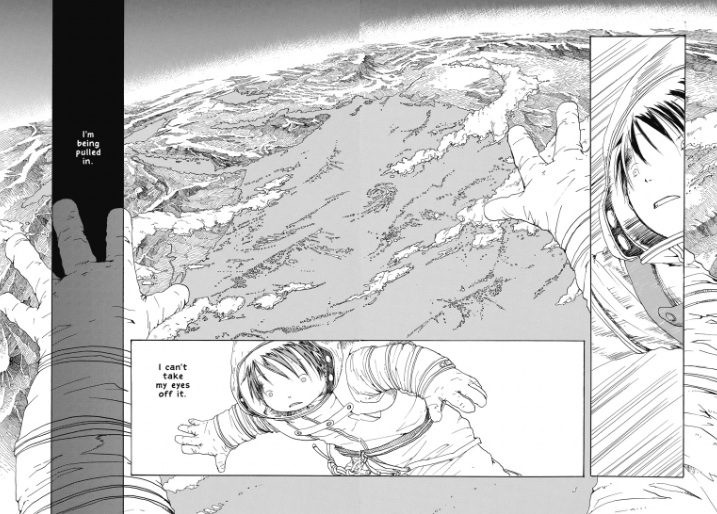
 The frog who appears to be a prince is a staple character in romantic comedies: what Jane Austen novel didn’t feature a handsome, wealthy suitor who, in the final pages of the story, turned out to be ethically challenged, penniless, or engaged to someone else? My Girlfriend’s a Geek offers a more up-to-the-minute version of Mr. Willoughby, this time in the form of a nice young woman who looks like a dream and holds down a responsible job, but has some rather unsavory habits of mind.
 Asumi Kamogawa is a small girl with a big dream: to be an astronaut on Japan’s first manned space flight. Though she passes the entrance exam for Tokyo Space School, she faces several additional hurdles to realizing her goal, from her child-like stature — she’s thirteen going on eight — to her family’s precarious financial position. Then, too, Asumi is haunted by memories of a terrible fire that consumed her hometown and killed her mother, a fire caused by a failed rocket launch. Yet for all the pain in her young life, Asumi proves resilient, a gentle girl who perseveres in difficult situations, offers friendship in lieu of judgment, and demonstrates a preternatural awareness of life’s fragility.
 Among the most discussed scenes in the new Kick-Ass film is one that pits a tweenage assassin against a roomful of grown men. To the strains of The Banana Splits theme song, thirteen-year-old Hit Girl dispatches a dozen gangsters with a gory zest that has divided critics into two camps: those, like Richard Corliss, who found the scene shocking yet exhilarating, a purposeful, subversive commentary on superhero violence, and those, like Roger Ebert, who found it morally reprehensible, a kind of kiddie porn that exploits the character’s age for cheap thrills. What’s at issue here is not children’s capacity for violence; anyone who’s run the gauntlet of a junior high cafeteria or cranked out an essay on Lord of the Flies is painfully aware that kids can be beastly when the grown-ups aren’t looking. The real issue is that Hit Girl seems to be enjoying herself, raising the far more uncomfortable question of how children understand and wield power.
 Kobato Hanato has a job to do: if she can fill a magic bottle with the pain and suffering of people whose lives she’s improved, she’ll have her dearest wish come true. There’s just one problem: Kobato is completely mystified by urban life, and has no idea how to identify folks in need of her help. Lucky for her, Ioryogi, a blue dog with a foul mouth and fierce temper, has been appointed her sensei and guardian angel, tasked with helping Kobato develop the the street smarts necessary for completing her mission.