• Skip to primary navigation
  • Skip to main content
  • Skip to primary sidebar
  • Home
  • About Us
    • Privacy Policy
    • Comment Policy
    • Disclosures & Disclaimers
  • Resources
    • Links, Essays & Articles
    • Fandomology!
    • CLAMP Directory
    • BlogRoll
  • Features & Columns
    • 3 Things Thursday
    • Adventures in the Key of Shoujo
    • Bit & Blips (game reviews)
    • BL BOOKRACK
    • Bookshelf Briefs
    • Bringing the Drama
    • Comic Conversion
    • Fanservice Friday
    • Going Digital
    • It Came From the Sinosphere
    • License This!
    • Magazine no Mori
    • My Week in Manga
    • OFF THE SHELF
    • Not By Manga Alone
    • PICK OF THE WEEK
    • Subtitles & Sensibility
    • Weekly Shonen Jump Recaps
  • Manga Moveable Feast
    • MMF Full Archive
    • Yun Kouga
    • CLAMP
    • Shojo Beat
    • Osamu Tezuka
    • Sailor Moon
    • Fruits Basket
    • Takehiko Inoue
    • Wild Adapter
    • One Piece
    • After School Nightmare
    • Karakuri Odette
    • Paradise Kiss
    • The Color Trilogy
    • To Terra…
    • Sexy Voice & Robo
  • Browse by Author
    • Sean Gaffney
    • Anna Neatrour
    • Michelle Smith
    • Katherine Dacey
    • MJ
    • Brigid Alverson
    • Travis Anderson
    • Phillip Anthony
    • Derek Bown
    • Jaci Dahlvang
    • Angela Eastman
    • Erica Friedman
    • Sara K.
    • Megan Purdy
    • Emily Snodgrass
    • Nancy Thistlethwaite
    • Eva Volin
    • David Welsh
  • MB Blogs
    • A Case Suitable For Treatment
    • Experiments in Manga
    • MangaBlog
    • The Manga Critic
    • Manga Report
    • Soliloquy in Blue
    • Manga Curmudgeon (archive)

Manga Bookshelf

Discussion, Resources, Roundtables, & Reviews

Archives for January 2020

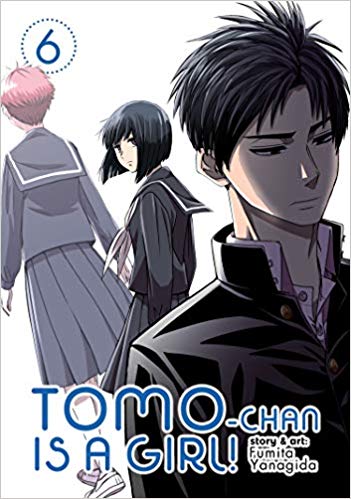
Tomo-chan Is a Girl!, Vol. 6

January 3, 2020 by Sean Gaffney

By Fumita Yanagida. Released in Japan as “Tomo-chan wa Onnanoko!” by Star Seas Company, serialized on the online site Twi 4. Released in North America by Seven Seas. Translated by Jennifer and Wesley O’Donnell. Adapted by T Campbell.

After the first volume, as I do with most series I follow, Tomo-chan Is a Girl! moved to Bookshelf Briefs. But sometimes you have things to say that cannot be condensed into 150 words, and this volume is a very good example – it’s almost the perfect Tomo-chan volume. We resolve Carol and Misaki’s romance, and given Carol possibly the best material she’s ever gotten, as Misuzu’s attempts to “break” her work all too well. The marathon chapter is one big long take on the Japanese saying “idiots don’t catch colds”, which Tomo proves wrong, to everyone’s shock and horror. And we get two chapter’s worth of flashbacks, showing how we got to the present setup – Tomo and Jun’s middle-school years, Jun’s own realization of his feelings, and possibly the most disastrous couple in the history of manga. If you love this manga series, this may be the pinnacle – there’s two more volumes after this, but it’s hard not to argue that this is the high point.
Carol has sort of been the breakout star of Tomo-chan, and her default reaction is, of course, smiles and good cheer. Now we, as the reader, and also Misuzu, have seen that cheer fall sometimes – notably when thugs were threatening Misuzu and she tried to protect Carol by saying they weren’t friends. But Misaki doesn’t see this, partly as Carol will never deliberately show that side to him, and partly as he’s scared to look further for fear there’s nothing behind her smile. Now, arguably Misuzu’s action here are appalling – something she realizes immediately. But they do work, and we get, as Tomo says, a wonderful few pages that show us that Carol can have real human emotions as well. (I was also amused at Carol’s mother cutting her off before she can go in for a kiss – given Ferris had Carol when she was thirteen, you can see why she’s going to step in. That said, given the omake chapter at the end, Ferris has little to worry about on Misaki’s end.)

I will admit that the two flashback chapters do run on a very old and creaking cliche, which is that Jun does not realize, for years, that Tomo was a girl, despite seeing her literally using the girls’ bathrooms at events. It always makes the main lead feel a bit too stupid, and it does here as well. But what follows is all too real and familiar, as Jun cuts himself off from Tomo after he doesn’t know how to be around her, and she too is hurt and retreats. Jun then realizes he needs to make an effort here, and does so… in a bizarre way. The brief, a few days relationship between Jun and Misuzu feels so wrong you want to scream, and both of them know it. Despite that, I loved that even though they knew that, both acknowledged that dating another person, having those feelings, felt good.

So we now have all the backstory, all we need to do is get Tomo and Jun on the same page and confessing. This has taken 6 volumes and we’re still not there yet, but the good news is that the end is in sight. Till then, Tomo-chan Is a Girl! is one of the best 4-komas I’ve read in some time. Funny and sweet.

Filed Under: REVIEWS, tomo-chan is a girl!

Junji Ito’s No Longer Human

January 2, 2020 by Katherine Dacey

Of all the famous works of literature to get the Classics Illustrated treatment, Osamu Dazai’s No Longer Human is an odd choice. Its protagonist is Oba Yozo, a tortured soul who never figures out how to be his authentic self in a society that places tremendous emphasis on hierarchy, self-restraint, and civility. Over the course of the novel, he binges, gambles, seduces a string of women, joins a Communist cell, attempts suicide, and succumbs to heroin addiction, all while donning the mask of “the farcical eccentric” to conceal his “melancholy” and “agitation” from the very people whose lives he ruins.

Though the novel is filled with incident, its unreliable narrator and relentless interiority make it difficult to effectively retell in a comic format, as Junji Ito’s adaptation demonstrates. Ito’s No Longer Human is largely faithful to the events of Dazai’s novel, but takes Dazai’s spare, haunting narrative and transforms it into a phantasmagoria of sex, drugs, and death. In his efforts to show us how Yozo feels, Ito leans so hard into nightmarish imagery that the true horror of Yozo’s story is overshadowed by Ito’s artwork—a mistake, I think, as Ito’s drawings are too literal to convey the nuance of what it means to exist, in Peter Selgin’s words, in a state of “complete dissociation… yet still capable of feeling.”

In Ito’s defense, it’s not hard to see what attracted him to Dazai’s text; Yozo’s narration is peppered with the kind of vivid analogies that, at first glance, seem ideally suited for a visual medium like comics. But a closer examination of the text reveals the extent to which these analogies are part of the narrator’s efforts to beguile the reader; Yozo is, in effect, trying to convince the reader that his mind is filled with such monstrous ideas that he cannot be expected to function like a normal person. There’s a tension between how Yozo describes his own reactions to the ordinary unpleasantness of interacting with other people, and how Yozo describes the impact of his behavior on other people—a point that Ito overlooks in choosing to flesh out some key events in the novel.

Nowhere is that more evident than in Yozo’s brief affair with Tsuneko, a destitute waitress. After hitting rock bottom financially and emotionally, Yozo persuades her to join him in a double suicide pact. Dazai’s summary of what happens is shocking in its brevity and matter-of-factness:

As I stood there hesitating, she got up and looked inside my wallet. ‘‘Is that all you have?” Her voice was innocent, but it cut me to the quick. It was painful as only the voice of the first woman I had ever loved could be painful. “Is that all?” No, even that suggested more money than I had — three copper coins don’t count as money at all. This was a humiliation more strange than any I had tasted before, a humiliation I could not live with. I suppose I had still not managed to extricate myself from the part of the rich man’s son. It was then I myself determined, this time as a reality, to kill myself.

We threw ourselves into the sea at Kamakura that night. She untied her sash, saying she had borrowed it from a friend at the cafe, and left it folded neatly on a rock. I removed my coat and put it in the same spot. We entered the water together.

She died. I was saved.

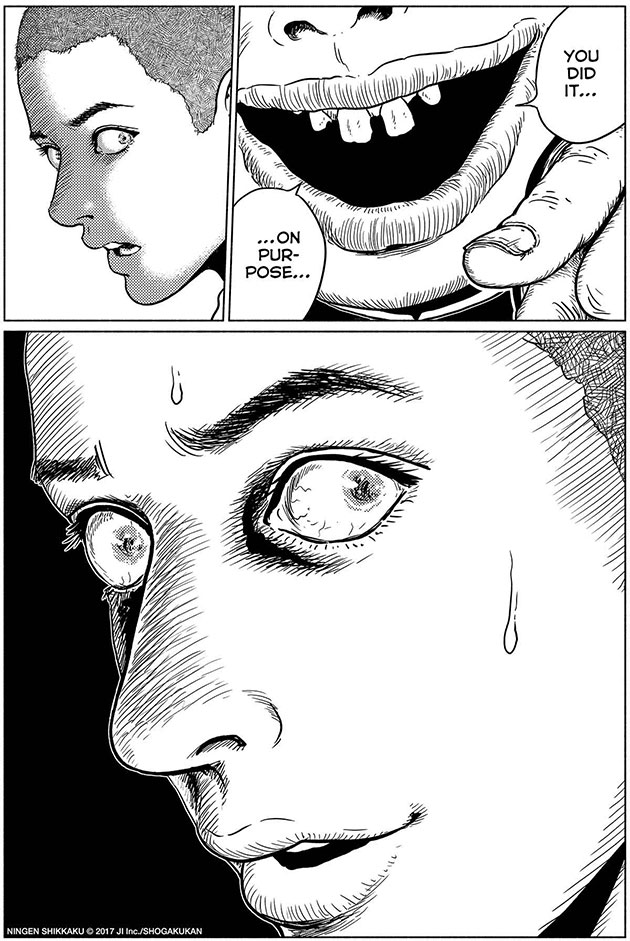
As Ito recounts this event, however, Tsuneko’s death is caused by a poison so painful to ingest that she collapses in a writhing heap, eyes bulging and tongue wagging as if she were in the throes of becoming a monster herself. Yozo’s reaction to the poison, by contrast, is to plunge into a hallucinatory state in which a parade of ghostly women mock and berate him, an artistic choice that suggests Yozo feels shame and guilt for his actions—and a reading of Dazai’s text that makes Yozo seem more deserving of sympathy than he does in Dazai’s novel:

Throughout this vignette, Yozo’s contempt for Tsuneko creeps into the narrative, even as he assures the reader that she was the first woman he truly loved. Yozo’s disdain is palpable, as is evident in the way he off-handedly introduces her to the reader:

I was waiting at a sushi stall back of the Ginza for Tsuneko (that, as I recall, was her name, but the memory is too blurred for me to be sure: I am the sort of person who can forget even the name of the woman with whom he attempted suicide) to get off from work.

Only a few episodes capture the spirit of Dazai’s original novel, as when Yozo’s father gives an inept speech to a gathering of businessmen and community leaders. Ito skillfully cross-cuts between three separate conversations, allowing us to step into Yozo’s shoes as he eavesdrops on the attendees, servants, and family members, all of whom speak disparagingly about each other, and the speech. By pulling back the curtain on these conversations, Ito helps the reader appreciate the class and power differences among these groups, as well as revealing that this episode was a turning point for Yozo: the moment when he first realized that adults maintain certain masks in public that they discard in private. Though such a moment would undoubtedly trouble a more observant child—one need only think of Holden Caulfield’s obsession with adult “phoniness”—this discovery plunges Yozo into a state of despair, as he cannot imagine how anyone reconciles their public and private selves in a truthful way.

Ito also wisely restores material from Dazai’s novel that other adaptors—most notably Usamaru Furuya—trimmed from their versions. In particular, Ito does an excellent job of exploring the dynamic between Yozo and his classmate Takeichi, the first person who sees through Yozo’s carefully orchestrated buffoonery:

Just when I had begun to relax my guard a bit, fairly confident that I had succeeded by now in concealing completely my true identity, I was stabbed in the back, quite unexpectedly. The assailant, like most people who stab in the back, bordered on being a simpleton — the puniest boy in the class, whose scrofulous face and floppy jacket with sleeves too long  for him was complemented by a total lack of proficiency in his studies and by such clumsiness in military drill and physical training that he was perpetually designated as an ‘‘onlooker.” Not surprisingly, I failed to recognize the need to be on my guard against him.

As one might guess from this passage, Yozo’s terror at being discovered is another critical juncture in the novel. “I felt as if I had seen the world before me burst in an instant into the raging flames of hell,” he reports, before embarking on a campaign to win Takeichi’s trust by “cloth[ing his] face in the gentle beguiling smile of the false Christian.” Though Ito can’t resist the temptation to draw an image of Yozo engulfed in hell fire, most of Yozo’s fear is conveyed in subtler ways: a wary glance at Takeichi, an extreme close-up of Yozo’s face, an awkwardly placed arm around Takeichi’s shoulder:

What happens next in Ito’s version of No Longer Human, however, is indicative of another problem with his adaptation: his decision to add new material. In Dazai’s novel, Takeichi simply disappears from the narrative when Yozo moves to Tokyo for college, but in Ito’s version, Yozo cruelly manipulates Takeichi into thinking that Yozo’s cousin Setchan is in love with him—a manipulation that ultimately leads to Takeichi’s humiliation and suicide. That violent death is followed by a gruesome murder, this time prompted by a love triangle involving Yozo, his “auntie,” and Setchan, who becomes pregnant with Yozo’s child. Neither of these episodes deepen our understanding of who Yozo really is; they simply add more examples of how manipulative and callous he can be, thus blunting the impact of the real tragedy that unfolds in the late stages of his story.

Ito’s most problematic addition, however, is Osamu Dazai himself. Ito replaces the novel’s original framing device with the events leading up to Dazai’s 1948 suicide, encouraging us to view No Longer Human as pure autobiography through reinforcing the parallels between Dazai’s life and Yozo’s. And while those parallels are striking, the juxtaposition of the author and his fictional alter ego ultimately distorts the meaning of the novel by suggesting that the story documents Dazai’s own unravelling. That’s certainly one way to interpret No Longer Human, but such an autobiographical reading misses Dazai’s broader themes about the burden of consciousness, the nature of self, and the difficulty of being a full, authentic, feeling person in modern society.

VIZ Media provided a review copy. You can read a brief preview at the VIZ website by clicking here. For additional perspectives on Junji Ito’s adaptation, see Serdar Yegulalp‘s excellent, in-depth review at Ganriki.org, Reuben Barron‘s review at CBR.com, and MinovskyArticle’s review at the VIZ Media website.

JUNJI ITO’S NO LONGER HUMAN • ORIGINAL NOVEL BY OSAMU DAZAI • BASED ON THE ENGLISH TRANSLATION BY DONALD KEENE • TRANSLATED AND ADAPTED BY JOCELYNE ALLEN • VIZ MEDIA • RATED M, FOR MATURE AUDIENCES • 616 pp.

Filed Under: Manga, Manga Critic, REVIEWS Tagged With: Junji Ito, no longer human, Osamu Dazai, VIZ, VIZ Signature

Manga the Week of 1/8/20

January 2, 2020 by Sean Gaffney, Ash Brown, Anna N, Michelle Smith and MJ Leave a Comment

SEAN: OK, now it’s actually January. You can tell as the Viz books are all pouring in. But first…

J-Novel Club has a giant pile of things due out. For print books, we have Animeta! 2, An Archdemon’s Dilemma 3, Ascendance of a Bookworm 3, and Infinite Dendrogram 4.

ASH: I’ve been meaning to give Animeta! a try now that it’s available in print.

MICHELLE: I thought the first volume was pretty fun.

SEAN: On the digital side, there’s Animata! 3, Demon Lord Retry! 2, Der Werwolf 6, In Another World with My Smartphone 18, the 2nd Marginal Operation manga, Otherside Picnic 2, and There Was No Secret Evil-Fighting Organization (srsly?!), So I Made One MYSELF! 2.

From Kodansha Comcis, we get, in print, Grand Blue Dreaming 9 and Tales of Berseria 2.

There’s a lot more digitally. The debut is That Blue Summer (Ao Natsu), a Betsufure series from the creator of To Be Next To You, which we saw debut digitally this week. That’s a big grin that girl has on the cover.

And we get All-Rounder Meguru 12, Chihayafuru 18, Magical Sempai 6, My Sweet Girl 10, Smile Down the Runway 5, and To Write Your Words 2.

ASH: Both J-Novel Club and Kodansha Comics have some great digital offerings this week.

ANNA: Nice, maybe I’ll use my remaining week of vacation to get more caught up on Chihayafuru.

MICHELLE: Yay for more shoujo and super yay for more Chihayafuru!

SEAN: Seven Seas has quite a bit, including a couple of debuts. Dungeon Builder: The Demon King’s Labyrinth is a Modern City! (Maou-sama no Machizukuri! ~Saikyou no Danjon wa Kindai Toshi~) is a manga adaptation of a light novel (which I don’t believe is licensed) that runs in Overlap’s Comic Gardo. Demon Lords create labyrinths to trap people and consume their despair… but this one just wants to be super nice.

ASH: That actually sounds kind of amusing.

SEAN: My Room Is a Dungeon Rest Stop (Boku no Heya ga Dungeon no Kyuukeijo ni Natteshimatta Ken) is also based on a light novel… which again I don’t think we have here… that runs in Takeshobo’s Web Comic Gamma. A guy buys a dirt-cheap apartment, then finds that it also leads to a fantasy dungeon. Can he help adventurers in trouble and show them the wonders of modern plumbing?

Also out from Seven Seas: Akashic Records of Bastard Magical Instructor 8, the print edition of the 2nd Arifureta ZERO novel, the print edition of Vol. 1 of Magic User: Reborn in Another World as a Max Level Wizard, the print version of the 4th Mushoku Tensei novel, and Tomo-chan Is a Girl! 6.

Vertical has a 2nd volume of the Bakemonogatari story, which finishes up Senjogahara’s story and starts Hachikuji’s.

Viz has no debuts next week, but it does have the 18th and final volume of Anonymous Noise. Will the romantic triangle resolve?

MICHELLE: I mean, it’s gotta, right?

SEAN: We also get, on the shonen/seinen side, Black Clover 19, Demon Slayer: Kimetsu no Yaiba 10, Dr. STONE 9, Haikyu!! 36, Kaguya-sama: Love Is War 12, and The Promised Neverland 13.

ANNA: Good stuff!

On the shoujo/josei side, we get Daytime Shooting Star 4, An Incurable Case of Love 2, and Snow White with the Red Hair 5.

ASH: I’ll read all of those, honestly.

ANNA: Nice! It is a week for Anna!

MICHELLE: I enjoy quite a few of these but am most excited about Snow White with the Red Hair and Haikyu!!.

MJ: I can’t believe this is the first time I’m speaking up here with all this manga, but I’m here for Snow White with the Red Hair!

SEAN: Lastly, Yen has two stragglers that got delayed from December. Yen On gives us the 18th and NOT final volume of Sword Art Online, though this does wrap up the giant massive-10-volume Alicization arc.

For manga, we get Chio’s School Road 7.

Some interesting stuff there. What are you picking up?

Filed Under: FEATURES, manga the week of

Beatless, Vol. 1

January 2, 2020 by Sean Gaffney

By Satoshi Hase and redjuice. Released in Japan by Kadokawa Bunko. Released in North America digitally by J-Novel Club. Translated by Ben Gessel.

This is a doorstopper of a book, and I think my largest issue with it is that it could easily have been split into two normal-sized books. There’s a lot going on in it, yes, with a large number of very cool action set-pieces, but the book also wants you to know that it’s going to be talking about what hakes a human and what makes an artificial intelligence, and it does. In great detail. It’s quite interesting, but after a while it can be exhausting. I also wish we had spent a bit more time with hIEs (that’s the series name for the artificial intelligences mankind has built) other than the five main modern units, as they’re clearly meant to be more special and more human than the usual shopkeeper hIEs and the like. It’s a bit difficult to hear one of the cast talking about them as if they’re cars that can be sold when you get to see their POV briefly and see they do have wants and needs beyond their owners.

This takes place almost a century from now, where humanoid intelligences (hIEs) have gotten to the point where they’ve started doing the “drudge” jobs for humanity and also are hard to tell apart from humanity. Our hero is Arato, who at times almost seems a parody of “generic anime protagonist”. He’s aggressively normal, except for the fact that he always wears his heart on his sleeve and tries to think of everyone as basically kind. He’s also kind to hIEs, seeing them as people, which his friends Ryo and Kengo certainly don’t. His father is a major player in the hIE world, but we barely meet him. His sister is even a classic anime little sister. That said, it all changes when, coming across a bizarre flower attack on the hIEs in the street, he’s rescued by Lacia, a clearly far more advanced than the usual hIE who asks him to become her “owner”. He agrees, but she also has a lot of secrets – like how she’s connected to five hIEs who broke out of a lab and are being hunted down.

This book does get a lot of things right. Arato is simple and earnest without being boring, and you get why people naturally like him. Yuka is a spoiled little sister but also not annoying. Ryo, his best friend and the heir to a hIE organization, is probably the most interesting and nuanced character in the book, and we watch him slowly go from being Arato’s best friend to a villain in stages so gradual you barely notice it. The action movie set pieces are fantastic, the best being a massive firefight at an airport that also involves one of the cast trapped in a slowly burning limo. It does, however, love to have everyone and their brother talk about the role of hIEs in society, and whether they are like people (Arato’s view) or like toasters (seemingly everyone else’s view). Towards the end the book even becomes a zombie survival novel, but never lets go of the nature of hIEs even then.

Given its length, there’s a lot more I didn’t get into here, like Lacia’s modeling career, or the somewhat abbreviated terrorist career of Arato’s other best friend Kengo (who is then mostly removed from the rest of the book, presumably as his function is finished). I think it might read better if you pace it out over several days. I do recommend it for fans of action-filled works, near-future SF what-ifs, and of course those who have seen the anime.

Filed Under: beatless, REVIEWS

Silver Spoon, Vol. 12

January 1, 2020 by Sean Gaffney

By Hiromu Arakawa. Released in Japan as “Gin no Saji” by Shogakukan, serialized in the magazine Weekly Shonen Sunday. Released in North America by Yen Press. Translated by Amanda Haley.

You can tell that the new year is starting in Silver Spoon because there’s a new freshman, and she’s interested in horses. This despite being in the dairy program. Again, it’s great to see that even at an agricultural school like Ezo, you don’t have to necessarily be slotted into the drawer that your family farm and/or business puts you in. It also once again shows the value of trying even after failure (she tried to get in on the science track, failed, and tried again on the ‘general’ track), which is good, as Hachiken is also dealing with some repeated failures in his life as well. On the positive side, his father is reading his business proposals and taking them seriously. On the negative side, they’re still not good enough, and he’s still not investing any money in them. That could change as we see the start of something that seems obvious but was never thought of much before: Hachiken needs to earn money and invest in his own business.

Of course, sometimes taking that once-in-a-lifetime chance can also lead to failure in the end – there’s a two-week student program in France that’s offered to Hachiken but he passes it on to cheese-loving Yoshino, who jumps at it… and then finds that for the two weeks, she’s at a high school specializing in fish. And yet, even with this obvious punchline, she manages to eat lots of French cheese and has a better idea about the direction she wants to go in. Any experience is good experience if it can show you a better way forward. That also applies to Komaba, who9 still has everyone telling him not to simply give up and abandon all his dreams, including his own family, and Mikage – indeed, the scene between him and Mikage is possibly the best in the volume.

As for Hachiken, he’s sticking with what he knows best – which is to say, pigs. Pigs and pizza. The section of the book dealing with pasturing pigs, free-range style, is fascinating, as with most of the “here is how you do agriculture” stuff in this series. He’s also found a way to solve the problem of Ookawa’s ongoing awfulness – hire him as company president, as when he’s working he’s far more reliable. It’s a character development that makes sense and is hilarious. As for romance, well, it’s pretty much on the back burner until Mikage manages to get into college – though that’s not stopping others (Sakae) from trying to get them to “go all the way”. And there’s also a suggestion that more equestrian action may be in his future – this despite the fact that he’s not picked for the preliminaries. They’re saving him! Again, seeing Hachiken from Vol. 1 and comparing him to this Hachiken is like night and day.

I’m not sure what to add. Another very good volume in a stellar series. Read it.

Filed Under: REVIEWS, silver spoon

  • « Go to Previous Page
  • Page 1
  • Page 2
  • Page 3
  • Page 4
 | Log in
Copyright © 2010 Manga Bookshelf | Powered by WordPress & the Genesis Framework