• Skip to primary navigation
  • Skip to main content
  • Skip to primary sidebar
  • Home
  • About Us
    • Privacy Policy
    • Comment Policy
    • Disclosures & Disclaimers
  • Resources
    • Links, Essays & Articles
    • Fandomology!
    • CLAMP Directory
    • BlogRoll
  • Features & Columns
    • 3 Things Thursday
    • Adventures in the Key of Shoujo
    • Bit & Blips (game reviews)
    • BL BOOKRACK
    • Bookshelf Briefs
    • Bringing the Drama
    • Comic Conversion
    • Fanservice Friday
    • Going Digital
    • It Came From the Sinosphere
    • License This!
    • Magazine no Mori
    • My Week in Manga
    • OFF THE SHELF
    • Not By Manga Alone
    • PICK OF THE WEEK
    • Subtitles & Sensibility
    • Weekly Shonen Jump Recaps
  • Manga Moveable Feast
    • MMF Full Archive
    • Yun Kouga
    • CLAMP
    • Shojo Beat
    • Osamu Tezuka
    • Sailor Moon
    • Fruits Basket
    • Takehiko Inoue
    • Wild Adapter
    • One Piece
    • After School Nightmare
    • Karakuri Odette
    • Paradise Kiss
    • The Color Trilogy
    • To Terra…
    • Sexy Voice & Robo
  • Browse by Author
    • Sean Gaffney
    • Anna Neatrour
    • Michelle Smith
    • Katherine Dacey
    • MJ
    • Brigid Alverson
    • Travis Anderson
    • Phillip Anthony
    • Derek Bown
    • Jaci Dahlvang
    • Angela Eastman
    • Erica Friedman
    • Sara K.
    • Megan Purdy
    • Emily Snodgrass
    • Nancy Thistlethwaite
    • Eva Volin
    • David Welsh
  • MB Blogs
    • A Case Suitable For Treatment
    • Experiments in Manga
    • MangaBlog
    • The Manga Critic
    • Manga Report
    • Soliloquy in Blue
    • Manga Curmudgeon (archive)

Manga Bookshelf

Discussion, Resources, Roundtables, & Reviews

Archives for February 2016

My Week in Manga: February 1-February 7, 2016

February 8, 2016 by Ash Brown

My News and Reviews

I posted a few different things at Experiments in Manga last week. For starters, the Love at Fourteen Giveaway Winner was announced. The post also includes a list of some of the manga available in English which feature a bit of romance. Last week I also reviewed Tokyo Decadence: 15 Stories by Ryu Murakami which in some ways is about love, or at least lust. Due to be published later this year, the collection is engaging but definitely not for everyone as some of the stories are quite disturbing. Over the weekend January’s Bookshelf Overload was posted for those of you curious about what made it onto my shelves last month. I also had a taiko gig over the weekend that took up a fair amount of time. As a result of that and other some other life stress, I’ve fallen a bit behind on my writing (just when I thought I’d finally gotten ahead!), so there’ll likely only be one review coming this week instead of the two that were originally planned.

Quick Takes
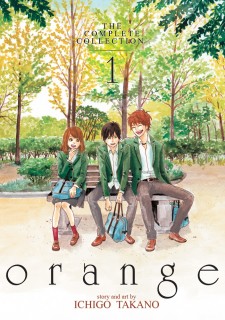
Orange, Omnibus 1Orange, Omnibus 1 by Ichigo Takano. I had heard very good things about Orange and so was greatly looking forward to reading the manga, but I honestly didn’t anticipate that the series might become one of my favorite releases of the year. (It all depends on exactly how the story plays out in the second and final omnibus.) Orange sensitively deals with some fairly heavy subject matter, including suicide and crippling regret, but at the same time the manga also has a lighter sweetness to it. The manga is both heartwrenching and heartwarming, a melancholic story about close relationships and human connection. Admittedly, Naho is incredibly dense when it comes to recognizing other people’s feelings for her, even when they basically come right out and tell her, which can be a bit exasperating. But overall, the feelings and emotions in Orange ring true, especially as the series progresses and it’s revealed just why everyone is behaving in the ways that they are. I can see Orange ending either in tragedy or in happiness and I’m very curious to see which it will be.
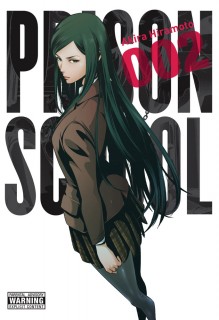
Prison School, Omnibus 2Prison School, Omnibus 2 by Akira Hiramoto. The first omnibus of Prison School established the manga as a series that is simultaneously appalling and strangely engaging. This of course assumes that readers aren’t immediately offended by its highly sexualized and incredibly vulgar nature to begin with. Prison School is definitely not a series for everyone even if, surprisingly, it has its sweet moments. The second omnibus very much continues in the same vein, so the initial shock caused by the manga’s obscenity, over-the-top fanservice, and ridiculous premise has diminished some. Even so, Prison School is a page-turner. The series has been building up to Kiyoshi’s escape attempt, resulting in a situation that gets progressively worse as time goes by. Seeing just how bad things can possibly get (which is pretty bad) is one of Prison School‘s major draws. That and Hiramoto’s impressive skills as an artist. The manga’s content will certainly not be to everyone’s taste, but it’s hard to deny Hiramoto’s talent.
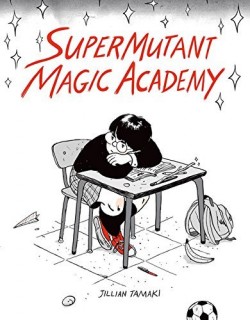
SuperMutant Magic AcademySuperMutant Magic Academy by Jillian Tamaki. Originally a webcomic, the best of SuperMutant Magic Academy has now been collected into a single volume along with newly-created content. I hadn’t actually read any of the comic while it was being released online, but I was obviously missing out—SuperMutant Magic Academy is great stuff. The comic takes place in a high school where students study magic and learn to control their superpowers (sort of an odd mix between Harry Potter and X-Men that bizarrely works), all while dealing with the more normal sorts of teenage angst and anxiety. Except for the series’ lengthy finale, created specifically for the collected volume, most of SuperMutant Magic Academy consists of single-page, and in some cases single-panel, gag comics.There’s no real overarching plot, but there are recurring characters and running jokes. Some of the social commentary can be fairly biting, but SuperMutant Magic Academy is very funny, frequently absurd, and wholly enjoyable.


Filed Under: FEATURES, My Week in Manga Tagged With: Akira Hiramoto, comics, Ichigo Takano, Jillian Tamaki, manga, Orange, Prison School

Bookshelf Overload: January 2016

February 7, 2016 by Ash Brown

Another month has passed and my manga collection continues to grow and evolve. The nice thing about December and January is that I usually end up with at least a few gift cards (and gifts), so I can splurge a bit even though I’m actively reducing the number of manga and books I’m buying at the moment. There are a few things that I definitely didn’t want to miss out on though, such as  Requiem of the Rose King, Volume 3 by Aya Kanno (review to come soon!) and Orange, Omnibus 1 by Ichigo Takano, which at the moment is a strong candidate for becoming one of my favorite series of the year. Also released in January, though I’m not sure when I’ll be able to actually get around to reading it, was Casey Brienza’s Manga in America: Transnational Book Publishing and the Domestication of Japanese Comics, one of the very few works about the North American manga industry. I also managed to snag an early copy of Tokyo Decadence, a “best of” collection of short stories by Ryu Murakami due to be released in March. (I recently posted my review of the volume which, though engaging, definitely won’t be to everyone’s taste.) Also arriving in January, though technically I believe it was released in December, was one of Chromatic Press’ most recent paperbacks, KaiJu’s delightful Mahou Josei Chimaka . (Unsurprisingly, I reviewed that one, too!)

Manga!
Aldnoah.Zero: Season One, Volume 1 by Olympus Knights
Brave Dan by Osamu Tezuka
Clockwork Apple by Osamu Tezuka
Even So, I Will Love You Tenderly by Kou Yoneda
A Girl on the Shore by Inio Asano
Kamisama Kiss, Volumes 2-4 by Julietta Suzuki
Kaze Hikaru, Volumes 8-11 by Taeko Watanabe
My Love Story!!, Volume 7 written by Kazune Kawahara, illustrated by Aruko
Natsume’s Book of Friends, Volumes 4-8 by Yuki Midorikawa
Of the Red, the Light, and the Ayakashi, Volume 1 written by HaccaWorks*, illustrated by Nanao
Orange, Omnibus 1 by Ichigo Takano
Requiem of the Rose King, Volume 3 by Aya Kanno
The Tyrant Falls In Love, Volume 9 by Hinako Takanaga

Comics!
Bug Boys, Volume 1: Welcome to Bug Village by Laura Knetzger
Mahou Josei Chimaka by KaiJu
Shades After by T. A. Kimpton
The Tipping Point edited by Various

Novels!
A Little Life by Hanya Yanagihara

Anthologies!
Biogenesis by Tatsuaki Ishiguro
Tokyo Decadence: 15 Stories by Ryu Murakami

Nonfiction!
Manga in America by Casey Brienza
Sake Confidential by John Gauntner

Anime!
Ouran High School Host Club directed by Takuya Igarashi

Filed Under: Bookshelf Overload, UNSHELVED

How To Raise A Boring Girlfriend, Vol. 1

February 7, 2016 by Sean Gaffney

By Fumiaki Maruto and Takeshi Moriki. Released in Japan as “Saenai Kanojo no Sodatekata” by Kadokawa Shoten, serialization ongoing in the magazine Dragon Age. Released in North America by Yen Press.

I think you have to be very careful when part of your work has “boring” in the title. I’m not sure if the original Japanese conveys quite the same meaning, but if the core of the work is that you feature a heroine who is meant to be uninteresting, then you’re already climbing up a larger hill than normal. Now, of course, this is something of a comedy, and the point of the whole exercise is that we have a hero who is surrounded by stereotypes of the standard light novel girl, and yet he decides to take the average, nebbish girl and turn her into heroine material. Unfortunately, at least by the end of this first volume, most of what I get from it is that the other two girls really *are” more interesting.

saekano1

That is not, of course, the boring girl in the foreground – it’s Eriri, the hero’s tsundere childhood friend who’s a famous doujinshi artist who has at least four different traits for a harem romance. The actual boring girl is sitting in the seat at the back. Our hero’s other close friend is Utaha, who is a bestselling novelist and fills the ‘cool yet snarky’ part of the otaku equation. Naturally, they dislike each other hovering over our hero Tomoya, who is something of an otaku who has grand ideals for a dating sim, but no actual talent to turn them into anything beyond cliches. He needs his two friends to actually do the work and make it good… particularly since his heroine in this dating sim is based on Megumi, who is simply there.

This is one of those series where Yen On did not pick up the light novel it’s based on, and I suspect that it would do better without the manga format. The writer of the original story jokes about the fact that the titular heroine “will never be in the center of the panel frame”, but even a cursory glance can tell you that’s not true – Megumi is present and paid attention to throughout, she’s just dull. This is the sort of series that cries out for exaggeration, and I could see her being drawn in a way like Sunako from The Wallflower, who only appears out of “superdeformed” mode in cool moments. Instead, Megumi’s presence and the delivery of the lines feel like the author explaining a joke that isn’t as good as they think it is. The premise is that we’re meant to wonder why this obvious visual novel hero is pulling away from the two cliched girls to find the ordinary one. But as a reader, I know why – cliched or not, Eriri and Utaha are far more interesting than Megumi is, and I’d like to actually know about *them*. Saekano (not to be confused with apocalyptic romance Saikano) sells its tedium a bit too well.

Filed Under: REVIEWS

Tokyo Decadence: 15 Stories

February 5, 2016 by Ash Brown

Tokyo Decadence: 15 StoriesAuthor: Ryu Murakami
Translator: Ralph McCarthy
U.S. publisher: Kurodahan Press
ISBN: 9784902075786
Released: March 2016
Original release: 1986-2003

Ryu Murakami is a fairly prolific and multi-talented creator. In addition to being an author, he is also a filmmaker and has been involved in the music industry as well. Several of Murakami’s novels have been translated into English, many of them by Ralph McCarthy, including Audition and Popular Hits of the Showa Era which were my introduction to Murakami’s work. McCarthy is also responsible for compiling and translating Tokyo Decadence: 15 Stories, a sort of best-of collection bringing together fifteen of Murakami’s short stories originally published in Japan between 1986 and 2003. Nine of the stories had previously been translated and released in a variety of different periodicals, but the translations have been revised for their inclusion in Tokyo Decadence. The remaining six are being published in English for the first time. Published by Kurodahan Press in 2016, I was fortunate enough to be selected to receive an advanced copy through LibraryThing’s Early Reviewers program.

The fifteen stories included in Tokyo Decadence are selected from five of Murakami’s short story collections and are presented chronologically. “Whenever I Sit At a Bar Drinking Like This,” “I Am a Novelist,” “It All Started Just About a Year and a Half Ago,” and “Each Time I read Your Confession” are from Run, Takahashi! and are all at least tangentially related to the baseball player Takahashi Yoshihiko. (It was this collection that seems to have ignited McCarthy’s passion for Murakami’s work.) The stories from Topaz—”Topaz,” “Lullaby,” and “Penlight”—are about call girls while the stories from Ryumiko’s Cinematheque—”The Last Picture Show,” “The Wild Animals” and “La Dolce Vita”—would appear to be at least semi-autobiographical. “Swans,” “Historia de un Amor.” “Se Fué,” and “All of Me” are taken from Swan, and most have something to do with Cuban dance and music and even share a few characters. Tokyo Decadence closes with the titular story from the collection At the Airport.

Having previously read some of Murakami’s work, I was rightfully prepared for Tokyo Decadence to be engaging while revealing a viciously dark sense of humor and dealing in gut-churning blood and gore. What I didn’t expect was that some of the stories, or at least parts of those stories, would be legitimately charming, compelling, and even occasionally heartwarming. Among the tales of gruesome murder, insanity, lust, obsession, and a myriad types of abuse are moments of love and humanity. That being said, Tokyo Decadence is very much a graphic and explicit collection of mature short stories, often disturbing and dark with very few characters who are anything but self-absorbed or self-indulgent. The stories are well-written, but the warped depravity and intensely twisted psychology exhibited will certainly not be to every reader’s taste and will likely offend or be found off-putting by many.

Surprisingly, Tokyo Decadence starts in a fairly lighthearted vein before delving into its more devastating and grotesque aspects. The portrayals of the various characters in the collection aren’t particularly flattering. Many of them are rather disturbed individuals, making Murakami’s use of first-person narration especially discomfiting. Interestingly, quite a few of the stories are actually seen from a woman’s perspective. This of course doesn’t soften the seedier nature of Tokyo Decadence which is quite frank in its exploration of sex and violence, the two subjects often closely intertwined with each other. Although some of the stories arguably lose some of their impact out of context from their original collections, overall I found Tokyo Decadence to be an interesting, engaging, and varied anthology; I would be very curious to read more of Murakami’s short fiction in translation.

Thank you to Kurodahan Press for providing a copy of Tokyo Decadence for review.

Filed Under: REVIEWS Tagged With: Kurodahan Press, Ryu Murakami

Manga the Week of 2/10

February 4, 2016 by Sean Gaffney, Ash Brown, Michelle Smith, MJ and Anna N 1 Comment

SEAN: Next week and the week after are blissfully small, allowing most of us to recover from the hideous amount of manga that we still have to read. This does not mean there are not some interesting things coming out, however.

Fans of Berserk might be interested in the new science fiction manga by its creator, called Giganto Maxia. Kate Dacey already gave it a review here.

ASH: As a fan of Berserk, I’m definitely interested in this, but Miura’s other manga have been pretty hit-or-miss for me.

SEAN: Seven Seas has a third volume of fantasy parody-ish manga 12 Beast.

angelbeats

Their new title this week is Angel Beats! Heaven’s Door, based on the visual novel by Key. Whenever I see the words ‘visual novel’ and ‘Key’ together, I know I’m in for some tear-jerking, heartwarming tragedy, and I suspect that will be the case here as well.

There’s a 2nd volume of fantasy Mushoku Tensei.

SubLime, which has been awfully quiet recently, has a 5th volume of Awkward Silence, which is what happens when I ask out loud why they’ve been so quiet recently.

ASH: Not my favorite Takanaga manga, but it does have it’s charm.

SEAN: Udon gives us the debut of the Persona 4 manga in North America, and get ready for me to be saying ‘Persona’ quite a bit this year, as other companies are also dipping their toe into those waters.

ASH: I know quite a few Persona fans, so I’m actually rather curious about this release despite never having played the game myself.

SEAN: Viz time. We have reached the end of Deadman Wonderland with the 13th volume, and I can only assume they’re out of prison at last?

Hayate the Combat Butler continues to not sell well enough to have more than 2 volumes a year, but well enough not to be cancelled. Here’s a 27th volume.

Lastly, there’s a 16th volume of one of my favorites, Magi.

MICHELLE: I guess this is the only thing I’m buying this week. This’ll make my pick of the week easy!

MJ: And I guess I’ll just have to live vicariously through you. Wow.

ANNA: Magi is also the only thing I’m enthusiastic about this week. I’ve even started reading through some of my stockpiled volumes, although I have a long way to go before I get to the 16th volume.

SEAN: What’s your manga valentine?

Filed Under: FEATURES, manga the week of

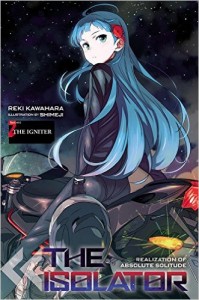
The Isolator, Vol. 2

February 4, 2016 by Sean Gaffney

By Reki Kawahara and Shimeji. Released in Japan by ASCII Mediaworks. Released in North America by Yen On.

The first volume of this series introduced us to Minoru, a broken young man who wishes to live his live with minimal emotional contact with anyone – and has secret suicidal thoughts. In this second book, he seems much better, even if the reason for that is because he hopes to achieve his goal, which is to erase the memory of him from everyone who knows him. Of course, as he finds out, this is not going to be as easy as he thought. Even those who already had their memories erased, such as last volume’s victim Tomomi, still feel drawn to him for reasons other than memory. And, as he grows closer and bonds with the new Superhero Organization he’s a part of, he finds that new emotional experiences are just impossible to avoid.

isolator2

It’s rather surprising how serious-minded this book is. Sword Art Online has lots of amusing comedy bits sprinkled throughout, and even Accel World throws in some light relief from Haru’s worrying and low self-esteem. The Isolator is grim, though, and even the odd joke or two (such as Olivier’s otaku-ish jokes) highlights how depressing everything here is. We meet the team leader of the troop, and she’s… a fourth-grader whose black gem gave her super analysis powers, so she’s now a scientific genius. Bored as I am of the ‘loli genius with an adult’s mindset’ type in this sort of series, the book does not let you forget that this was still an elementary school girl, and due to the nature of how gem powers work my guess is she was doing badly in school as well. I suspect she’s not a happy camper.

But the winner of the bleakest past here goes to Yumiko, who I had mentioned last time looked like she had hidden depths. Indeed, I think Kawahara overeggs the pudding here, as we get not one but *two* tragic backstories. It does serve to show Minoru, though, that he is not a special tragedy snowflake, and remind him that there are other ways to cope with grief and loss besides isolation. As with the first volume, the villain also gets a well-thought out backstory. Sadly, though, his personality is identical to all of Kawahara’s other psychopaths – you can give depth and tragic history all you want, but when the villain in the end is still laughing madly and going on about fools and his grand plan to destroy the world, it’s still not working.

The best reason to read this series is still the action scenes, which cry out to be animated at some point in the future. I’m not sure where the series is going from here – the book ends very abruptly, as if the author was working to a set page count. But I do know that while it’s gripping and a quick read, I wish it were more fun. I feel like isolating myself after reading it.

Filed Under: REVIEWS

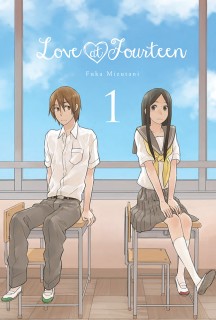
Manga Giveaway: Love at Fourteen Giveaway Winner

February 3, 2016 by Ash Brown

Love at Fourteen, Volume 1And the winner of the Love at Fourteen Giveaway is… wandering-dreamer!

As the winner, wandering-dreamer (whose writing I happen to follow at both Narrative Investigations and TheOASG) will be receiving a copy of Fuka Mizutani’s Love at Fourteen, Volume 1 as published in English by Yen Press. Love at Fourteen features a sweet story of first love, so for this giveaway I asked participants to tell me a little about some of their favorite romantic manga. Be sure to check out the giveaway comments for the detailed responses!

Some favorite manga love stories released in English:
Apothecarius Argentum by Tomomi Yamashita
Black-Winged Love by Tomoko Yamashita
A Bride’s Story by Kaoru Mori
Emma by Kaoru Mori
Hide & Seek by Yaya Sakuragi
Horimiya written by HERO, illustrated by Daisuke Hagiwara
Kare Kano: His and Her Circumstances by Masami Tsuda
Kamisama Kiss by Julietta Suzuki
Love at Fourteen by Fuka Mizutani
My Love Story written by Kazune Kawahara, illustrated by Aruko
Nana by Ai Yazawa
Orange by Ichigo Takano
Sand Chronicles Hinako Ashihara
Strobe Edge by Io Sakisaka
Tramps Like Us by Yayoi Ogawa

So, if you’re looking for something a little romantic to read, the above manga may give you a good place to start. Thank you to everyone who shared your favorites with me; I hope to see you all around again for the next giveaway!

Filed Under: Giveaways, UNSHELVED Tagged With: Fuka Mizutani, Love at Fourteen, manga

Log Horizon: The West Wind Brigade, Vol. 1

February 2, 2016 by Sean Gaffney

By Mamare Touno and Koyuki. Released in Japan by Fujimi Shobo, serialization ongoing in the magazine Dragon Age. Released in North America by Yen Press.

Given that Log Horizon contains a huge cast with at least a dozen named guilds, set over a wide area, it is not particularly surprising that we’re seeing spinoffs about some of those guilds. This also allows the series to show the same events, such as the moment when everyone realized they were in the game, with different viewpoints, and see how crises are solved when the lead is not Shiroe. Most importantly, it also allows us to try out a different genre, as Shiroe, as a harem protagonist, fails miserably. Soujiro, meanwhile, is not only an excellent oblivious harem protagonist, but he even has a guild that has become famous as a “harem guild”.

wwb1

In many ways this is played absolutely straight. The guild is almost entirely female, with the one non-Soujiro exception appearing to be a gay man (or is he trans? it’s unclear, and I doubt the manga will bother to get into that sort of thing anyway). The girls all have various feelings of love for Soujiro, none of which he acknowledges in the slightest, at least romantically – he’s the sort to charge in, say he will protect everyone, etc. the polar opposite of someone like Shirou, in fact. When they first discover they’re trapped in the game, we see his reaction, and it’s one of complete and total delight, contrasting with almost everyone else. As for the girls, the two that get the most attention are Isami, who is the cute girl with no confidence type, and Nazuna, who is the cool big sis type.

But I doubt readers are reading this for harem antics – or if they are, they’ll be disappointed. Where the series succeeds is in showing off new aspects of Elder Tales, or in giving us different perspectives on the same events. Sometimes this can be chilling – we see Touya and Minori getting taken into the Hamelin guild, with none of our heroes really seeming to notice the danger yet. There’s also a moment when Soujiro, defending his teammate against a guard who’s trying to dole out justice, is killed, and everyone has to frantically rush to the temple to see if they can be revived like they were before.

Mostly it’s what you’d want to see – a band of adventurers bonding like a family and looking out for each other. One of the maid NPCs, Sara, is fleshed out as well, and we see her perspective on things – these adventurers, who used to barely give them the time of day, are suddenly opening up and being friendly and rescuing them from attempted rape. (I am starting to get weary of the hints that attempted rape is rather common in this world, though I agree that this would be depressingly realistic. Thankfully, it is averted here.) If you enjoy Log Horizon and want to see a simpler, more shonen take on the world, this is a very good place to start.

Filed Under: REVIEWS

Bookshelf Briefs 2/1/16

February 1, 2016 by Sean Gaffney and Michelle Smith Leave a Comment

Behold: briefs!

akuma2Akuma no Riddle, Vol. 2 | By Yun Kouga and Sunao Minakata | Seven Seas – Now that we’ve set up the And Then There Were None-style premise, it’s time to start firing off the assassins one by one to see how they will fail at taking out Haru. This volume comes in both evil and good flavors; the evil is a truly insane modern-day Jack the Ripper girl who simply loves killing; she’s actually taken out pretty easily by Haru, who is a lot better at avoiding death than Tokaku had expected. The other is more skilled, and has grown up being a scapegoat, but fails just the same. Given that next volume involves a production of Romeo and Juliet, I expect the Takarazuka assassins will get taken out then. Not as good as the first volume, but still readable. – Sean Gaffney

golden2Golden Time, Vol. 2 | By Yuyuko Takemiya and Umechazuke | Seven Seas – Say what you will about Taiga in Toradora!, but she proved to be very likable and understandable right off the bat, despite her anger issues. Kouko is a much tougher nut to crack, and a lot of Golden Time‘s second volume might be spent with the reader wondering why we’re supposed to root for this couple in the first place. Luckily Banri is a far more fascinating protagonist, with his amnesia and honest attempts to show Kouko where she’s going wrong. I have a sneaking suspicion that he’s going to regain those memories before long, and it won’t be good for anyone involved. In the meantime, enjoy Kouko’s desperate flailing attempts to hold onto the past, and how it all crumbles around her. – Sean Gaffney

horimiya2Horimiya, Vol. 2 | By Hero and Daisuke Hagiwara | Yen Press – I suspect the resemblance to Kare Kano is not going to be going away anytime soon, so accepting that, this is another cute and likable volume of romantic goodness. Hori deals with being ‘the capable one,’ meaning everything is foisted onto her, as well as a new somewhat immature rival. Miyamura is simply having difficulty understanding the concept of friendship at all. As a result, while the two have clearly fallen for each other hard, neither one is in a position to actually admit it, even to themselves. As for Yoshikawa and Ishikawa, they make the cover, and Ishikawa gets a lot to do, but I suspect their subplot hasn’t really started yet. I am really enjoying this series. – Sean Gaffney

roseprincess8Kiss of the Rose Princess, Vol. 8 | By Aya Shouoto | VIZ Media – Series-ending battles don’t get much more shoujo than this! Kaede gets not one but two “awakenings” due to his feelings for Anise, which she rather awesomely does not have time to deal with right now, then two villains are dealt with through the power of love and general shoujo empathy. Anise’s knights fight their hardest on her behalf, while she hurries on to the solo showdown with her villainous dad that we’ll have to wait until the final volume for. Anyone want to bet she wins him over with love and understanding? This is far from the best series I’ve ever read, and I doubt I’ll read it again, but I’m at least looking forward to seeing it through to its conclusion. – Michelle Smith

seki6My Neighbor Seki, Vol. 6 | By Takuma Morishige | Vertical Comics – There’s never going to be much plot progression in a series like this—the closest this volume gets is a chapter where, due to various circumstances, Seki’s sister sits in with that day’s class. That said, the draw of this manga is as always Seki’s flights of fancy and Yokoi’s reactions to them, and there are some excellent ones here. Some might be funnier with knowledge of Japanese period art, I admit, but others are universal, like the foosball table, or the paper airplanes. Yokoi is less invested in studying than ever, and I fear for her future, but it can’t be denied that her reactions are what makes everyone want to come back to this series. – Sean Gaffney

roseking3Requiem of the Rose King, Vol. 3 | By Aya Kanno | Viz Media – If we’re still reasonably sticking to the basic plot of Shakespeare, then it makes sense that there’s so much of Henry and Richard in this volume; it may be the last of it that we ever see. It’s good, showing off both characters’ good and weak points, as well as the bond that they both feel (a bond that immensely frustrates Henry’s son, who is losing both in regal and romantic power). Meanwhile, the political part of this manga still excites, with Margaret’s rage knowing no bounds, and Elizabeth raising the stakes with several lovely insane grins. It may be turning into a bit of a bizarre harem manga, but make no mistake about it, tragedy is never going to be very far away from Richard. – Sean Gaffney

Requiem of the Rose King, Vol. 3 | By Aya Kanno | VIZ Media – I think this is my favorite volume of the series yet! Richard has been trying to convince himself that he needs neither love nor light in his life, seeking the clarity of the battlefield, but when he miraculously meets up with Henry once more, he begins to think “perhaps with him.” And, indeed, there are several tantalizing near-kisses here. Alas, their time together is short, and Richard tries to forget it when back at court, where Edward’s impromptu marriage has alienated his most ardent supporter and ticked off France, to boot. The blend of history and emotion is nicely balanced in this volume, and there’s a heck of a cliffhanger. Oh so ardently recommended! – Michelle Smith

saogirls2Sword Art Online: Girls’ Ops, Vol. 2 | By Neko Nekobyou and Reki Kawahara | Yen Press – Having tried to balance action, fanservice, and some touching analysis of post-Sword Art Online syndrome, the second volume leans a bit harder towards the comedy and fanservice, with a beach setting providing lots of opportunities for bikinis, and the monster that needs to be vanquished being of the tentacle variety. Much of the interesting parts of this otherwise slight volume involve the new original character, Lux, and her self-esteem issues, something the other three girls mostly have no issue with. The last chapter brings Sinon into the group, which makes sense, as the main books still stick to Kirito, sometimes Asuna, and not much else. Forgotten heroines welcome here. – Sean Gaffney

Filed Under: Bookshelf Briefs

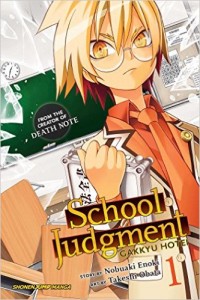
School Judgement, Vol. 1

February 1, 2016 by Anna N

School Judgement Volume 1 by by Nobuaki Enoki and Takeshi Obata

This was a series that I expected to be wildly enthusiastic about, just for the Takeshi Obata art factor alone, so I was surprised to have a more measured reaction once I read the first volume. There were aspects of the setting and execution that didn’t sit well with me, but as always Obata’s art is beyond excellent.

School Judgement is set in an elementary school where conflicts are resolved by formal classroom arbitration, along with child prosecutors and defense attorneys. Two transfer students are introduced at the start of the volume. Abaku Inugami is a defense specialist whose hobby is arguing. He establishes his skills in an epic cross examination of his new teacher that results in her lifting the ban on video games at school. Pine Hanzuki is a prosecuting attorney who enjoys dressing up in magical girl outfits and is accompanied everywhere she goes by a rotund sidekick.

The new students are put to work promptly in “The Suzuki Dismemberment and Murder Case” where the Suzuki in question is a classroom fish. Tento Nanahoshi is the hapless student accused of fish murder, and when he is acquitted, he sticks around to provide a normal sidekick counterpoint to Inugami’s intensity. School Judgement is very entertaining when it sticks to power courtroom poses and mystery unraveling. I thought it was hilarious that the judges of the cases are babies who have prematurely aged due to their judicial duties, looking like wizened old men. Obata made Go dynamic and filled with suspense, so I was fully expecting dynamic courtroom scenes. There were some unexpected artistic choices too – when an adult is unmasked as evil, she’s suddenly rendered with a greater level of detail and rictus-like facial expressions that wouldn’t be out of place in a horror manga.

sj1

It could be that I didn’t like many of the characters due to their single-minded obsession with arguing, but both Inugami and Hanzuki aren’t particularly sympathetic. Hanzuki’s a spoiled rich girl, and while it seems that Inugami’s obsession with the law is due to a tragic event in his past, he’s too abrasive to root for. Nanahoshi is around to be a counterpoint to all the lawyering, but for the most part he’s also bland and forgettable.

The aspects of School Judgment that I didn’t care for were the contrast of the lower school setting and the art, which looked more like Hikaru no Go Obata in style with some of the darker or more mature themes. In a shonen manga set in a high school, I’d not really care about random bath scenes for example, but in School Judgement when the character is 12, that creeps me out a bit. Also, another story line is an extended drug metaphor, which also seems to be a bit much with the current setting. I think I would have enjoyed this manga much more if it had either aged down and just been an all ages title with cases to solve that invoked lighter themes, or if was aged up and set in a high school with the same type of stories. As it was, I found the manga entertaining in spots, a bit unsettling here or there, and I didn’t really care about what happens to the characters at all. My quibbles are mostly with the writing, because I think any manga by Obata ends up being a master class in illustration. So I’d recommend this for the art alone, even though I didn’t enjoy the story.

Filed Under: REVIEWS Tagged With: school judgement, Shonen Jump, viz media

Pick of the Week: Selling the Drama

February 1, 2016 by Sean Gaffney, MJ, Michelle Smith, Anna N and Ash Brown Leave a Comment

behind1SEAN: As always with Viz weeks, there’s a terrifying amount of stuff coming out I’m interested in. But as a drama major, I’d be remiss if I did not pick Behind the Scenes!!, Bisco Hatori’s new shoujo series about a college drama club. I’m a sucker for Hatori anyway, so the drama club is just the icing on the cake.

MJ: Considering the fact that I train young people in the performing arts for a living, I feel like my pick this week is a bit of a betrayal. But though I’m definitely interested Behind the Scenes, I find that I can’t resist the draw (drawings?) of one of my favorite artists, Takeshi Obata. Though I’ve had issues with his collaborations of late, I admit to having high hopes with Tsugumi Ohba out of the picture this time. I guess we’ll see! Meanwhile, count me in for School Judgment. I wouldn’t miss it for the world.

MICHELLE: Both of the above are my most intense desires this week, but I am going to give the edge to the shoujo goodness of Behind the Scenes!!. I also harbor a secret desire that Tamaki turns up in some capacity.

ANNA: Shoujo for the win! Behind the Scenes!! is also my pick of the week. Drama club hijinks from Bisco Hatori sounds like just the thing to beat the wintertime blues.

ASH: While Behind the Scenes!! is definitely of great interest to me, I’ll have to admit that I’m actually more in the mood for some epic over-the-top face-punching ridiculousness this week (January was rough), so bring on the next volume of Battle Tendency for me!

Filed Under: PICK OF THE WEEK

My Week in Manga: January 25-January 31, 2016

February 1, 2016 by Ash Brown

My News and Reviews

A couple of different things were posted at Experiments in Manga last week in addition to the usual My Week in Manga feature. First up was the first manga giveaway of the year, and there’s still time to enter for a chance to win Fuka Mizutani’s Love at Fourteen, Volume 1. Last week I also reviewed the first omnibus of Hiroaki Samura’s Die Wergelder, which is brutal and intense to say the least. The manga is greatly influenced by violent, erotic Japanese films from the 1970s and it shows. And speaking of explicit manga, Digital Manga’s Project-H imprint is currently running a Kickstarter campaign to publish Yamatogawa’s Vanilla Essence hentai collection. It seems like Digital Manga is now relying on Kickstarter projects for just about everything, and I have no idea how long the publisher will be able to last like that; it’s a bit concerning.

Quick Takes

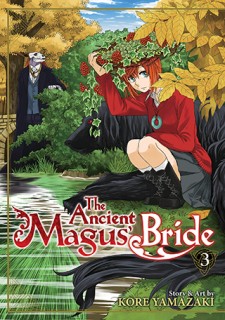
The Ancient Magus' Bride, Volume 3The Ancient Magus’ Bride, Volume 3 by Kore Yamazaki. I continue to love The Ancient Magus’ Bride and look forward to future volumes a great deal. The series has this sort of atmospheric melancholy to it that I really like along with touches of horror and darkness that have yet to become overwhelmingly bleak. In large part, The Ancient Magus’ Bride seems to be dealing with loneliness and the intense longing and need to belong somewhere. It’s only after being purchased by Elias that Chise feels as though she’s actually wanted and that is a dangerously enticing feeling to have. Their relationship is a peculiar one, but it is also compelling. For better or for worse, Chise still knows very little about Elias. He seems very reluctant to reveal his true nature to her, whether out of fear that he will be rejected or for some other reason entirely. What is clear is that Elias is very powerful, very dangerous, and not entirely honest. Despite this and despite the warnings of others, Chise remains devoted to him. She, too, is powerful and dangerous, though she has yet to learn how to completely control and claim that power for her own.

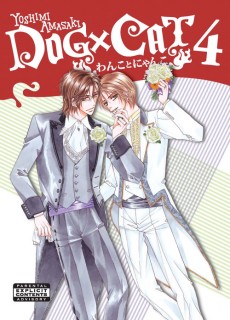
Dog X Cat, Volume 4Dog X Cat, Volume 4 by Yoshimi Amasaki. I believe Dog X Cat is up to six volumes or so and still ongoing in Japan, but it seems unlikely that more of the series will be released in English any time soon if ever. It’s been a few years since I read the first three volumes of the boys’ love series, but it didn’t take very long to get reoriented with the manga. The fourth volume is actually a fairly self-contained story, too. Atsu and Junya used to only be best friends but now they’re also well-established lovers. Junya is the more adventurous and demanding when it comes to sex to the point of ignoring Atsu’s needs and desires which is unfortunate; otherwise their relationship is quite good and they obviously love each other. Keeping with the rest of the series, Amasaki finds plenty of opportunities to include sex scenes. However, their vacation-cum-research trip to the mountains takes an extremely unfortunate turn when an earthquake traps them under a burning building. Though there are sweet moments, most of the forth volume of Dog X Cat deals with this traumatizing event and its lasting aftermath.

Library Wars: Love & War, Volume 11Library Wars: Love & War, Volumes 11-14 by Kiiro Yumi. I’ll readily admit to enjoying Library Wars and its dramatic and fantastical portrayal of librarianship. I don’t think that librarians will militarize themselves any time soon in the fight for freedom of expression and information, but it does make for an interesting story that does actually explore some of the complexities of the debates surrounding censorship. Library Wars has two sides to it that don’t always mesh with each other very well, but I do like them both. There’s the romantic and comedic side of things as many of the characters come to terms with their evolving feelings for their colleagues and then there’s the more action-oriented part of the story, complete with shootouts and attempted kidnappings. These particular volumes have some pretty exciting developments on both fronts. Although Iku’s ineptitude is often emphasized, which is something that I dislike about the series, she continues to prove her reliability in dangerous situations when it really counts. I didn’t realize that there is only one more volume left in this series, but I’m really looking forward to it; it should be a good one.

Filed Under: FEATURES, My Week in Manga Tagged With: Ancient Magus' Bride, Dog X Cat, Kiiro Yumi, Kore Yamazaki, library wars, manga, Yoshimi Amasaki

  • « Go to Previous Page
  • Page 1
  • Page 2
  • Page 3
 | Log in
Copyright © 2010 Manga Bookshelf | Powered by WordPress & the Genesis Framework