• Skip to primary navigation
  • Skip to main content
  • Skip to primary sidebar
  • Home
  • About Us
    • Privacy Policy
    • Comment Policy
    • Disclosures & Disclaimers
  • Resources
    • Links, Essays & Articles
    • Fandomology!
    • CLAMP Directory
    • BlogRoll
  • Features & Columns
    • 3 Things Thursday
    • Adventures in the Key of Shoujo
    • Bit & Blips (game reviews)
    • BL BOOKRACK
    • Bookshelf Briefs
    • Bringing the Drama
    • Comic Conversion
    • Fanservice Friday
    • Going Digital
    • It Came From the Sinosphere
    • License This!
    • Magazine no Mori
    • My Week in Manga
    • OFF THE SHELF
    • Not By Manga Alone
    • PICK OF THE WEEK
    • Subtitles & Sensibility
    • Weekly Shonen Jump Recaps
  • Manga Moveable Feast
    • MMF Full Archive
    • Yun Kouga
    • CLAMP
    • Shojo Beat
    • Osamu Tezuka
    • Sailor Moon
    • Fruits Basket
    • Takehiko Inoue
    • Wild Adapter
    • One Piece
    • After School Nightmare
    • Karakuri Odette
    • Paradise Kiss
    • The Color Trilogy
    • To Terra…
    • Sexy Voice & Robo
  • Browse by Author
    • Sean Gaffney
    • Anna Neatrour
    • Michelle Smith
    • Katherine Dacey
    • MJ
    • Brigid Alverson
    • Travis Anderson
    • Phillip Anthony
    • Derek Bown
    • Jaci Dahlvang
    • Angela Eastman
    • Erica Friedman
    • Sara K.
    • Megan Purdy
    • Emily Snodgrass
    • Nancy Thistlethwaite
    • Eva Volin
    • David Welsh
  • MB Blogs
    • A Case Suitable For Treatment
    • Experiments in Manga
    • MangaBlog
    • The Manga Critic
    • Manga Report
    • Soliloquy in Blue
    • Manga Curmudgeon (archive)

Manga Bookshelf

Discussion, Resources, Roundtables, & Reviews

Archives for June 2012

Short Takes: Olympos and Utahime: The Songstress

June 22, 2012 by Katherine Dacey 8 Comments

When I first spotted the cover for Olympos, I had a nagging feeling I’d read something else by Aki, but couldn’t remember the title. A quick surf of the internet and presto! I had my answer: Aki also wrote Utahime: The Songstress, which DMP released in 2009 to strong reviews. In preparation for reading Olympos, I tracked down a new copy of Utahime. I had a vague notion of reviewing both books, then decided that the two-books-one-author concept would make a swell basis for a Short Takes column.

Which title did I like better? The answer might surprise you.

OLYMPOS

BY AKI • YEN PRESS • RATING: OLDER TEEN (16+)

Have you ever spotted a stunningly attractive person at a party, only to discover that he or she was a crashing bore? (Or worse, a boor?) If so, you may experience a few pangs of deja-vu while reading Olympos, a beautiful manga with a shapeless script.

Early in the story, the Sun God Apollo kidnaps Heinz, a human whose dearest wish is to marry his childhood sweetheart. Apollo offers Heinz a chance to perform a task in exchange for Maria’s hand — a task far more difficult than it initially seems. That sounds like a decent starting point for a cat-and-mouse game between Apollo and a plucky mortal, but Heinz soon disappears from the narrative altogether, creating a vacuum that’s never satisfactorily filled. Other figures from Greek mythology wander in and out of the story — Zeus, Poseidon, Artemis, and Hades all pop by for a cup of coffee and a little prophecy — but the endless stream of chatter grows tiresome.

That’s a pity, because Aki’s sensual linework is ideally suited to the material. Olympos is one of the few graphic novels in which the gods are so physically perfect, so pansexual in their appeal, that one can imagine why the gods bristled at the suggestion that any mortal might surpass them in beauty. Consider Hades, god of the underworld: Aki renders him as lithe man with goat horns, cloven feet, and a long mane of hair. For all his animal parts, however, Hades is undeniably attractive, moving with the grace of a Bolshoi dancer and meeting the other characters’ gazes with eyes that are both terrifying and alluring. The other gods are executed with similar care; even Poseidon, who’s portrayed as a bearded buffoon, has a handsome, agreeable face.

Some readers may find these drawings so appealing that the aimless script won’t spoil their enjoyment of Olympos. Others may find — as I did — that no amount of sensual imagery can hold their interest while the gods hold forth on the meaninglessness of their existence.

Review copy provided by Yen Press.

UTAHIME: THE SONGSTRESS

BY AKI • DIGITAL MANGA PUBLISHING • RATING: OLDER TEEN (16+)

Is gender destiny? That’s the question at the heart of Utahime: The Songstress, which takes place in a kingdom in which utahime, or “song princesses,” preserve the fragile peace through the power of their singing.

The story focuses on a trio of characters: fraternal twins Kain and Maria, whose mother is an utahime, and Thomas, whose father is the head of the nearby village. Kain, Maria, and Thomas’ relationship is shown at several stages, beginning with Kain’s return from a self-imposed exile of ten years. We then jump back in time to explore the characters’ childhoods, watching them come to terms with the ugly truth about Kain and Maria’s mother: she’s a virtual prisoner, jealously guarded by the local townspeople to ensure that their village remains safe and prosperous.

If you can soldier through the first few pages — which, I grant, are a mess — you’ll find an intimate story that focuses as much on the characters’ interior states as their actions. Aki allows her characters room for growth and reflection; though Kain and Thomas have a predictably antagonistic relationship as children, their shared concern for Maria overrides that hostility in adulthood. Aki also makes good use of her setting to explore the relationship between gender and destiny; if only women are allowed to be songstresses, what happens when a young man is born with the requisite voice?

If the artwork isn’t as lush as Olympos‘, it nonetheless makes a strong impression. Aki devotes the most attention to character designs, giving each cast member a distinctive appearance and an elastic, expressive face capable of registering subtle shifts in mood and energy. Her backgrounds, by contrast, are very sparse, making use of an occasional prop to establish the setting: a table and a few rickety chairs for a saloon, a high window and a iron frame bed for the utahime’s home.

That artistic restraint serves her story well, firmly establishing the characters’ emotional states without excessive reliance on dialogue and thought balloons. As a result, Utahime‘s script is leaner and more focused than Olympos‘, gently but insistently leading the reader through a series of effective (and affecting) scenes that help us appreciate the utahime’s plight. Recommended.

Filed Under: Manga Critic Tagged With: Aki, DMP, Greek mythology, Josei, yen press

TV Will Break Your Heart

June 21, 2012 by Aja Romano 5 Comments

My very favorite thing in all the world is a bowl of raw blackberries on a hot July day, but a very close second to blackberries (never cooked, straight off the vine) is a good Stephen Sondheim musical. And my very favorite quote about Stephen Sondheim is a quote from Frank Rich, who, writing in the NY Times of the flop that was Merrily We Roll Along, said:

“To be a Sondheim fan is to have one’s heart broken at regular intervals.”


I’ve held this quote close to my heart, but I never equated it to the actual act of being a fan until a month ago, when I was reading about creator Dan Harmon’s exit from NBC’s Community, scrolling past endless wailing and wearing of sackcloth on Tumblr (read: gifs of Abed and Troy having freakouts).


If you’ve never watched Community, then you’ve probably still heard from Community fans talking about how great it is. The diverse cast includes PHDs, Oscar-winners, rap stars, Betty White, and Omar from The Wire, and if that isn’t enough to sell you, it’s also an ongoing geek dream in meta-riffic serial narrative form. It’s every bit as good a show as you’ve heard it is, but what’s most important to its ultimate success or failure as a tv product is that its tailor-made for you. Yes, you, the person reading this article. You like smart, savvy stories that are steeped in meta-awareness of their own conventions but still have a deep emotional core. You access shows via all kinds of methods, and you never pay attention to ads on the rare occasion you’re accidentally suckered into watching one. At any given time, you’re probably mainlining 2 or 3 shows at once. Community knows this about you, and it loves you just as you are.

Which, of course, is the problem.

Tumblr has a large swathe of die-hard Community fans who’ve only recently gotten over the trauma of cancellation rumors, and the eleventh-hour notice that Community would return for at least a final half-season, and perhaps more. In the middle of celebrating a truly flawless 3-ep season finale that many feared would be a series finale, fans learned that Harmon, the show’s creator and show runner, who exerts a huge influence over the show and its direction, had been fired and replaced by two dudes from another statistically “quirky” show called Happy Endings. The immediate fan feeling was that the departure of Harmon, who’s spoken in the past of his incredibly hands-on relationship with the show, would kill everything that makes it special and unique. Writing bitterly on his Tumblr Saturday morning after the season finale, Harmon said, “I’m not saying you can’t make a good version of Community without me, but I am definitely saying that you can’t make my version of it unless I have the option of saying “it has to be like this or I quit” roughly 8 times a day.”

NBC and Sony view Harmon’s forced departure as a chance to “broaden” the show’s appeal to a “wider” audience.


“Wider Audience” is a Lie


These are words that will send every Community fan into a blind panic, because if you’ve ever been on the internet, you know that Community already has a huge audience. On May 17 during the finale, two show references trended worldwide on Twitter; Saturday during the outcry over Harmon’s departure, “Dan Harmon” trended for hours in the USA and even worldwide.

The internet tells me that even though Twitter has roughly half a billion users, it only takes somewhere between 1200-1500 people tweeting about a topic for it within a short period of time to become a “trend,” and that specifically the topic has to reach people who haven’t normally tweeted about it before. So the famous Community hashtag #sixseasonsandamovie can only become a worldwide trend if it starts reaching a new segment of Twitter’s active population. Presumably, all of this makes a “trend” in roughly the same way that a Nielsen rating makes up a quantifiable percentage of America’s tv-watching population: that is, if 1500 people are tweeting about watching Community, then presumably at least that many millions of people are watching Community.

The problem with this analogy is that the people tweeting about Community are not the same group of people Nielsen is tracking. There are 115 million tv owners in the US, but that doesn’t mean that all of us actually watch tv. In fact, recently released Nielsen data reveals that 17% of Americans never watch tv at all. I’ll be the first to admit that my own ambivalent relationship to my tv has created a bit of a cultural gap for me, but that gap shrinks all the time, because with the advent of the internet there’s been a huge generational shift in how people use a tv set. It’s become just another tool for many people. It’s one of many ways in which we control access to what we want to watch, and how/when we watch it:

People use television sets for watching tv, screening films, for surfing the web, recording things, listening to music, and for gaming.

People get access to television shows from Hulu, from iTunes, from Netflix, from their Roku, from the dvd-rs their friend burnt, from TIVO, from live streaming sites, from tv sets, from the box sets they bought at Best Buy, from Amazon, from torrenting and file-sharing hubs, from Youtube, from network websites, from Crunchyroll, from other sources that are probably being invented as I type this.

How many of these avenues make it into Nielsen ratings? Two–Live + Same Day: the viewing from your actual tv set, and the TIVO, or “time-shifted” view (but only if the time-shifted viewing occurs before 3am the day the show airs). According to the Nielsen website, it has an “extended screen rating” that allows it to track certain streaming sites, but this is a dubious claim with very little affect on ratings numbers. So 115 million people owning a tv set no longer means that 115 million people are going to be using it as their primary source of access to shows, but even though Nielsen hasn’t figured out how to quantify this huge cultural behavior change, Nielsen ratings are the only things networks care about.

The reason for this, of course, is advertising.


Advertising and Content Control.


Along with the huge disconnect that goes along with the assumption that means of access haven’t changed is that the means of control over content hasn’t changed. A TIVO-less or DVR-less television set gives you no control over when you view the show. While I have fond memories of college Thursday nights when my BFF & I would convene for Will & Grace come hell or high water, it’s no longer possible for everyone to carve out weekly, regularly scheduled time for sessions with their favorite TV shows. And what’s more, the number of people I want to watch tv with is also expanding. For the last several months a few of my online friends and I have been gathering in Campfire chat to watch Avatar, Korra, and Due South whenever we have free moments. It’s harried, irregular, and tv-set free. Of these three shows, only Legend of Korra is currently airing. We streamed Avatar from Netflix, and bought DVDs of Due South. Each of the networks who provide these shows has profited from our consumption of them; but none of these modes of access are part of an advertiser’s business model.

It’s not as if any of us made a conscious choice to reject exposure to ads in these shows when we got together to watch them. But we are located, respectively, in Philadelphia, Indiana, and Glasgow. We’re not going to prioritize company ad revenue over our ability to watch shows easily together–to form a community and have amazing bonding experiences around those shows. A Nielsen-compliant, advertising-friendly distribution model literally can’t give us that. We are part of the generation of people who, along with rejecting corporate-controlled content, are also rejecting advertiser-dictated content, as well as the ads themselves.

On the rare occasions I find myself watching tv–usually when I’m home visiting–I always mute commercials. This actually has caused fights with family members before, because even though turning the radio dial when commercials come on is something they don’t question, they don’t understand why I don’t want to watch the ads. The reason for me is that advertising is sexist, homophobic, gendered, ethnically profiled and stereotypical. When I watch tv, I have control over what I listen to and am exposed to, in a way that I don’t when bombarded with highway billboards, wall flyers, pamphlets on my car, and other advertisements in public spaces. And I have no problem with making the choice to filter the kinds of ads and harmful messages I’m exposed to. Why not? I make it in every other area of my life.

This fight family members and I keep having over my refusal to listen to advertisements is directly relevant to why Dan Harmon was fired. The networks and the advertisers who sponsor their shows want my mom to believe the only content she can have is the content that’s filtered through the box in her living room. But the price of accepting that content is that it comes with regular advertising that reinforces all kinds of harmful heteronormative shit about the world we live in–that girls like pink and baking and boys like action figures and building things; that women want to lose weight and find a better laundry detergent and wear makeup, and men want to objectify women, drink beer, bulk up, and live charmingly privileged lives. That queer characters don’t exist except as comic relief, and genderqueer and disabled people don’t exist at all.

It’s a bit wondrous that shows that actively question these types of stereotypes are able to sell to advertisers at all. (Mad Men is undoubtedly genius in this regard, with real-world companies lining up for ad space and major product placement on a show that’s actively critiquing everything their marketing companies are meant to do to begin with.) It’s possible that Community‘s ability to exist at all in these circumstances is a modern miracle, because as a show it sits at the crux of an entire generational and cultural gap. People who’ve killed our figurative television sets have also rejected the world advertisers try to sell us, because it doesn’t line up with reality, and because we actively operate within this culture of questioning and scrutinizing the content we intake–ads included. This description definitely applies to the audience of Community, which is a show that is 100% built around the concept that pop-culture-savviness and a pervasive rejection of outdated sociocultural values go hand in hand. As hard as NBC tries to make Community fit the mold that will allow advertisers to reach its audience in real time on Thursday Friday nights, it’s never going to happen.

To put it bluntly, you can get TV-set-controlled culture to watch bland, unironic, problematic shows like Whitney and Big Bang Theory, and you can get those shows to land significant advertising revenue, because the vast majority of people who still watch tv, much like the vast majority of people who use Facebook, are not a part of the culture of consumer-controlled content, genre savviness, remix culture, talking back, and active participation that makes up the rest of internet culture, the culture of fans who watch Community. Producer-controlled, ad-controlled-media is only as sustainable as the unreflective, unthinking, passive “couch potato” mentality people have about the act of media consumption, and that culture that is fast eroding. Community represents a paradigm shift. Community‘s success lies with an entire generation of people who don’t even register on Nielsen ratings because they don’t intake shows in ways that expose themselves to advertisers.

In order to make sure their message gets across to this “invisible” group of people, advertisers are demanding product placements directly within shows. When Community had to do this, it lampshaded the whole thing by naming a character “Subway,” turning him into a villain, and promptly disposing of him. The show that NBC wants Community to become is a more broad, bland, “mainstreamed” comedy, one that the Facebook set, the passive box-in-living-room-watching audience, can enjoy. That show is dying. That show is unsustainable. That show is dreck.

That show looks like this.


TV Shows Will Break Your Heart


I was watching the incredible outpouring of grief on Tumblr over the loss of Dan Harmon to Community, and thinking about how one of my internet friends has this tag for the media posts she makes on her journal, and it’s called “tv shows will break your heart.” For years this tag has puzzled me, because my own tv-less background has left me extremely disconnected from the culture built around following and investing in a tv series. In addition to Avatar, the only other Western television series I’ve watched until the end of their runs are Buffy and Gilmore Girls, and I discovered both series late in their runs and caught up after the fact. For a long time, it was just so utterly foreign to me, this concept that you could invest so heavily in a serial tv storyline that it could impact you this way. That tag made me want to understand what television had to offer that I’d somehow missed all my life. I’ve watched a lot of tv shows since in an attempt to plug into that feeling.

Then I watched Community. And then I spent most of April and all of May in a frenzy of dvd-buying, reading about Nielsen ratings, trying to understand why this show that’s so popular isn’t popular at all, trying to race home from work on Thursday nights to make sure my measly little tv set is turned on at 8pm, ready to mute commercials, but mostly just wanting to be counted.

And I understand, now, that it’s not the serial storytelling that breaks your heart. It’s the mode of storytelling. It’s the knowledge that a story being packaged and produced this way is only as good as the advertisers who support it and the execs who allow it to have its own voice without stifling it because of their fears that it won’t appeal to the “mainstream.”

It’s the knowledge that you aren’t who they think they’re making this show for. It’s the knowledge that your active, questioning, challenging, critique-filled, collectively-tuned-in fannishness are all qualities that the show’s producers don’t want you to have, because they’re the same qualities that drive you to want control over your own content, that drive you to reject shitty advertising, that drive you to seek alternative avenues of content consumption. “Being a fan of Community is so emotionally draining,” one frustrated fan said the night after the season finale. And I’m remembering all the outrage that still exists over shows like Beauty and the Beast, Firefly, Stargate: Atlantis–how it’s not just that the storylines were killed, but that the fanbase wasn’t the right fanbase–too female, too geeky, too old, too all of the above.

And maybe this gets at the heart of what being a fan is about, ultimately: holding your heart in your hands and investing in something that’s ultimately out of your control–with trepidation, because maybe your faith is totally misplaced, maybe the thing you’re allowing yourself to love will let you down, maybe the creator will go on a bender or fuck off for 6 years mid-series *cough* or quit halfway through the best arc, or die before it’s done; and maybe, perhaps even more likely, the people on the other side of that ugly consumer/production wall will let you down by refusing to see your value, or even refusing to acknowledge that you exist, that you matter.

________

MB, I have a confession to make: you could have had this post 5 weeks ago when I originally wrote it if I hadn’t been angstily sitting on it all this time, as if I hoped the circumstances would change and Dan Harmon would magically return to Community, and television networks would realize that the way to get people to watch tv again is to stop treating tv like it’s still a cultural source and start treating it like it’s just another tool for people to access media they want to watch.

But we live in a world where constant innovations in technology and an increasingly savvy, selective consumer culture are constantly battling corporate interests who are just trying to get the shows you love in front of your dad’s football buddies and your stay-at-home grandma–i.e., the only people who still watch tv like tv is the only thing they have to watch.

Several times during the furor over Dan Harmon’s firing, fans only-half-jokingly suggested, “Can we start a Kickstarter for Community?” Oddly enough, that’s what this conflict may boil down to: will fans of creative projects be able to directly support those projects financially in the future? Or will they continue to see the artistic and cultural merits of shows they love pitted against the priorities of advertisers who want “brand-safe content”?

The positives here may be that when push comes to shove, we can start a Kickstarter for Community–or, at the very least, for shows like it. (There actually already is a Kickstarter for a Community spinoff, the adorable Dr Who parody Inspector Spacetime.) The nature of creative consumption and production/distribution/profit from creative works is shifting so quickly that it’s difficult to say what the limits are. In fact, let’s just go ahead and assume there are no limits. As bleak as the current outlook for Community‘s future as a network television franchise may be, the outlook for consumer-generated content is brighter than ever.

And although the outlook for television and advertising companies is arguably bleaker than ever, this is the kind of cultural paradigm shift that can pave the way for a whole new kind of marketing, based on entirely new ways of reaching people where they live. And maybe the simple solution is for television networks to stop asking shows to conform to an idea of what’s “mainstream,” and instead start thinking of all streams of human contact, creativity, identity; to stop insisting that consumers of shows be advertiser-ready and start insisting that advertisers be consumer-ready: ready to deliver products for all people and speak to all people, without attempting to fit them into binaries, stereotypes, and socio-cultural pigeon-holes.

Maybe then advertisers would understand exactly how valuable a show like Community, with its ability to embrace diversity and still deliver a quality narrative product that everyone loves, can be.

Filed Under: FANBATTE Tagged With: community, fandom, fannish travails, musical theater, western media

Love Hina Omnibus, Vol. 3

June 21, 2012 by Sean Gaffney

By Ken Akamatsu. Released in Japan by Kodansha, serialized in the magazine Weekly Shonen Magazine. Released in North America by Kodansha Comics.

Things are beginning to pick up a bit in this third volume of Love Hina. Yes, there is still a lot of Keitaro seeing people naked and Keitaro getting hit, but it’s far less than in the first few volumes. Akamatsu is finding he can indeed do things other than ecchi comedy, and is also starting to realize something important: he has no idea where to go with this once his heroes achieve their goal.

Yes, surprise, Keitaro, Naru and Mutsumi all make it into Todai in this collection. Admittedly, it takes 2/3 of the omnibus for this to happen, including a visit to another turtle-infested South Sea island. The reason for this being that Keitaro, convinced he failed, has run away. Except… he didn’t fail. He’s in… provided he submits his paperwork on time. This is what drives most of the comedy here, a fast-paced race against time chase with increasingly ludicrous situations. Something that should be very familiar to Negima readers. Yes, Ken can still bring the ecchi comedy, but the difference between this and the start of the series is the *pacing*. The first volume is glacial, and you only realize how much after seeing these volumes.

Speaking of realization, as I noted, Akamatsu has realized he does not really want Keitaro in college stories. This is what leads to the broken leg that keeps him sidelined most of the last third of the book. And kudos to Akamatsu for lampshading this heavily, given the amount of abuse he’s taken from Naru. Everyone jokes that they had thought he was immortal. Admittedly, making him physically vulnerable does undercut the ‘comedic sociopathy doesn’t hurt’ rules of this universe… I suppose I should be lucky he didn’t get the broken leg via a Naru punch. Anyway, getting back to my point, Keitaro as a hapless college student, worrying he and Naru are growing further apart is kinda boring. But Keitaro the competent archaeologist, using his bad luck for good rather than for evil? That works. Keitaro on the island is the most likeable we’ve ever seen him. (Akamatsu will go too far with this, but we aren’t quite there yet.)

On the romance front, Keitaro has at last confessed to Naru. Who takes her own sweet time in answering him, mostly as she’s just as bad as he is in most respects. This gets contrasted with Seta and Haruka, who not only turn out to have dated when they were students, but also have many similarities to the current Keitaro and Naru. In fact, Haruka’s enraged beating of Seta after embarrassing her one too many times could easily have been a typical Keitaro/Naru farce. It’s a really sweet chapter, though, and one hopes that they can resolve things soon… especially as our heroes seem to realize the parallels with their own situation.

Motoko and Shinobu also get some short arcs towards the end. Shinobu proves to be a fairly mediocre student, and most of her story is spent trying to teach her to study properly while showing off her crush on Keitaro. (Naru doesn’t help by still being in the ‘who likes that idiot?’ phase of her life.) And Motoko’s sister, Tsuruko shows up, supposedly to test Motoko’s allegiance to her sword art, but in reality to try to make her mature more and get over some of her worst hangups. Of course, this being Love Hina, Tsuruko goes about this via some tough love. This gives us an iconic image of Motoko dressed as a maid, determined to become the perfect feminine woman since she can’t please her sister by her sword mastery. The anime would take this and run with it, I seem to recall.

So things look almost ready to wrap up here. Keitaro and Naru aren’t together, but both know their feelings for each other. And they got into Todai. Looks as if this series is ready to wrap up. Of course, it’s not. There’s 2 more omnibuses to go. Join us next time when we introduce the second most controversial character in all of Love Hina (Naru being first, of course.)

Filed Under: REVIEWS

New licenses, new releases

June 20, 2012 by Brigid Alverson

Deb Aoki takes a closer look at two recently announced manga: Knights of Sidonia, from Vertical, and Kitaro, from Drawn and Quarterly.

Digital Manga has confirmed some new yaoi and hentai licenses.

Lissa Pattillo looks at this week’s new manga releases in her On the Shelf column at Otaku USA. Lissa also has the PR on Viz’s newest shoujo manga, Jiu Jiu.

At Blog of the North Star, Milo continues his look at wrestling manga with a peek at the historical series Cestvs.

News from Japan: Kotaku reports the results of a recent poll asking people what their favorite manga was. Ultimate Venus manga-ka Takako Shigematsu is launching a new series, Nekozuka-san’chi no Gokyōdai, in the July issue of Gekkan Princess. ANN has word of two new Shonen Jump series: Ansatsu Kyōshitsu (Assassination Classroom) by Yusei Matsui (Neuro – Supernatural Detective) and Takamagahara by Jūzō Kawai.

Reviews: Carlo Santos rounds up the best, the worst, and the meh in his latest Right Turn Only!! column at ANN. Other reviews of note:

Kate Dacey on vol. 1 of Drifting Net Cafe (The Manga Critic)
Ken Haley on vols. 8 and 9 of Erementar Gerade (Sequential Ink)
Ed Sizemore on NonNonBa (Comics Worth Reading)
Anna on vol. 28 of Skip Beat! (Manga Report)
Sesho on Tekkonkinkreet (Sesho’s Anime and Manga Reviews)
Lissa Pattillo on Three Wolves Mountain (Kuriousity)

Filed Under: MANGABLOG

Drifting Net Cafe, Vol. 1

June 19, 2012 by Katherine Dacey

It takes nerve — nay, stones — to update Kazuo Umezu’s bat-shit classic The Drifting Classroom. That’s exactly what Shuzo Oshimi (The Flowers of Evil) has done in Drifting Net Cafe, however, substituting a nebbishy salaryman for Sho, the original series’ twelve-year-old protagonist, and an Internet cafe for Sho’s school. The results are a decidedly mixed bag, suggesting that some texts lend themselves to revision, while others are too much the product of particular author’s imagination to warrant re-telling.

As in the original series, the story begins with a snapshot of the hero’s daily life: 29-year-old Toki has an argument with his pregnant wife, Yukie, then goes to an office job he dislikes. On impulse, he stops in an Internet cafe on his way home from work, where he bumps into Tohno, a girl he loved in middle school. The two begin comparing notes on their current lives when an earthquake plunges the building into darkness. When no one arrives to lead Toki, Tohno, and their fellow customers to safety, the group makes a terrifying discovery: the cafe has been transported from Tokyo to a wasteland from which all evidence of human civilization — roads, buildings, people — has been expunged.

To his credit, Oshimi takes enough time to establish Toki’s routine and personality for the reader to appreciate what’s at stake if Toki doesn’t find a way to return to his old life. None of the other characters, however, are fleshed out to the same degree. Yukie is portrayed as a howling grotesque, at the mercy of her hormones; Tohno is saintly and brave; and the other cafe customers are assigned one or two defining traits, depending on their gender and age. Thin characterizations are a common problem in disaster stories; authors are often reluctant to bestow too much humanity on characters who are destined to become monster food or cannon fodder, lest the audience find the story too dispiriting. Oshimi, however, takes that indifference to an extreme, creating a supporting cast of repellant, one-note characters whose comeuppance elicit cheers, not tears.

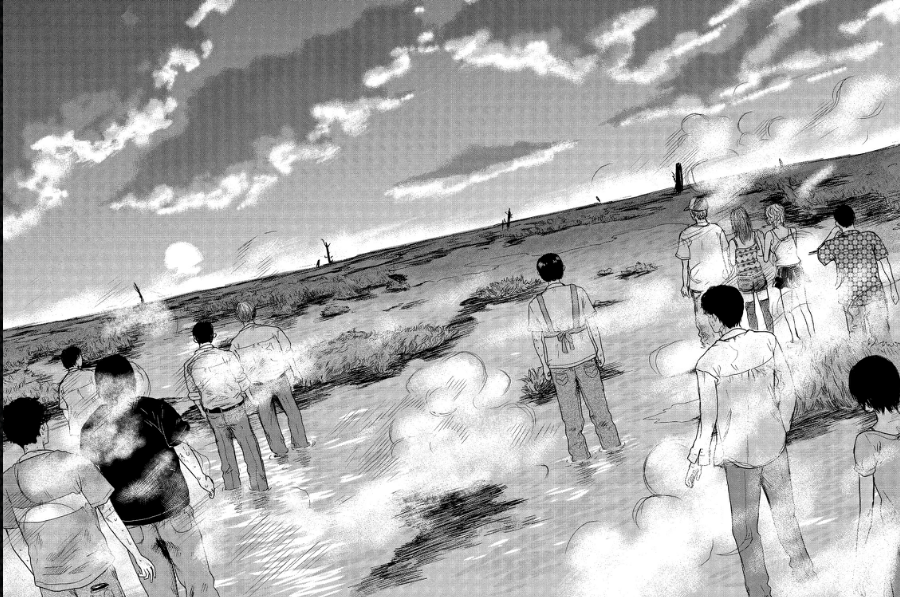
The other great drawback to Drifting Net Cafe is Oshimi’s lack of imagination. Though Oshimi is a competent draftsman, he shows little of Umezu’s flair for nightmarish imagery. Consider the way Oshimi renders the cafe’s final destination:

The wasteland, as imagined by Shuzo Oshimi in Drifting Net Cafe.

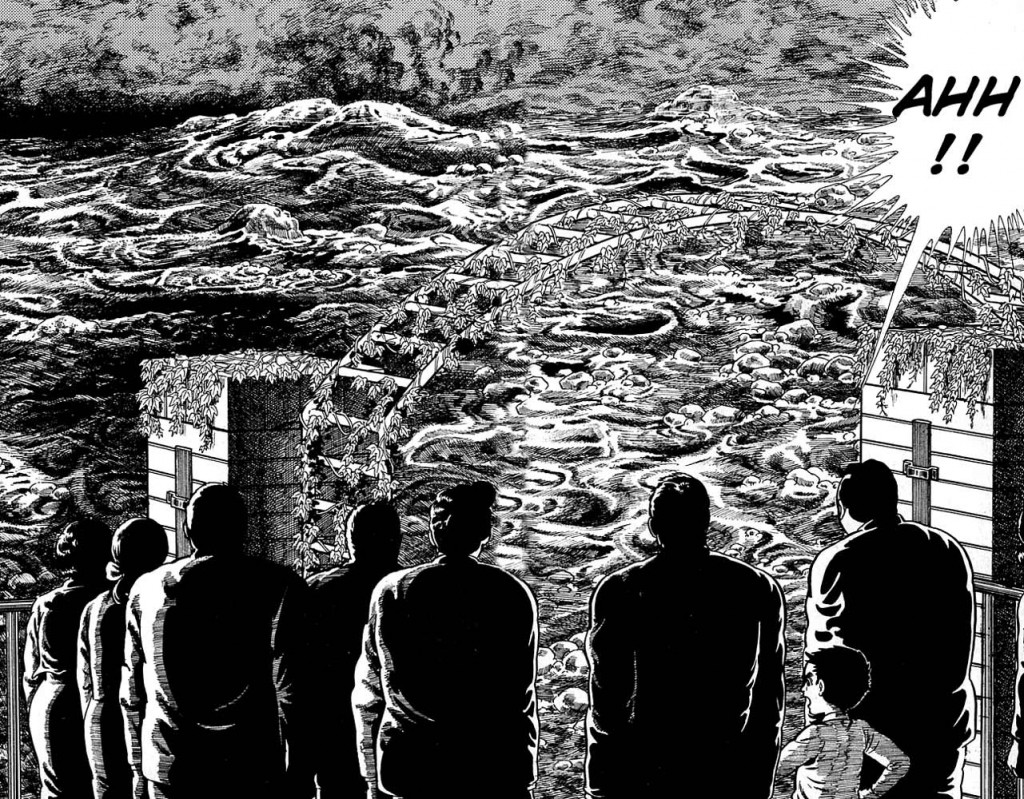
It’s not a badly composed image; Oshimi makes effective use of the tilted camera angle to convey the characters’ disorientation, and uses a few charred trees to suggest that something powerful scoured the landscape clean. When contrasted with the original version, however, it’s clear that Oshimi’s image elicits a much tidier, less emotional response than the repulsive, molten moonscape that Sho and his teachers discover just beyond the school gates:

Umezu’s vision of the wasteland, from The Drifting Classroom.

Oshimi’s monsters, too, betray his tendency to favor blandly polished imagery over inspired, if crudely rendered, boogeymen. Late in volume one of Drifting Net Cafe, for example, a creature resembling a typical Star Trek parasite attacks a female character, latching onto her thigh. It’s a memorable scene, tapping a similar vein of body-violation horror as Alien and Prometheus, but the monster’s quick defeat makes it seem more like a pretext for fanservice than a genuine menace. Umezu’s monsters, by contrast, take a variety of forms — giant insects and lizards, creepy aliens with bulbous foreheads, giant metallic serpents with grasping hands — all of which seem like the products of a feverish child’s imagination, rather than something copied from a TV show or straight-to-DVD movie.

The characters’ conflicts, too, seem smaller and less compelling than they did in Umezu’s original, which pitted Sho and his classmates against their teachers. The Drifting Classroom‘s adults quickly become deranged with grief and fear, leaving the children to fend for themselves in a hostile environment. Sho and his classmates spend several agonizing chapters struggling to accept the fact that none of the adults are in charge anymore; the students’ first attempts to defend themselves against crazed teachers and giant bugs end in catastrophe, a gruesome reminder of their misplaced trust in the adults.

In Oshimi’s version, however, all the characters are adults. They challenge one another’s leadership, squabble over resources, and indulge their worst impulses, sexual and otherwise. Though some of these scenes pack a visceral punch, most simply reinforce the idea that Toki and Tohno are the only decent folk among a group of unpleasant, self-interested urbanites — not exactly the stuff of high-stakes drama, even if one character finds himself on the business end of a pocket knife.

Where Drifting Net Cafe improves on the source material is pacing. The Drifting Classroom unfolds at a furious clip; characters are maimed or menaced in every chapter, and speak at decibel levels better suited for the Bonnaroo Music Festival than everyday conversation. Oshimi, on the other hand, varies the narrative tempo of Drifting Net Cafe: some chapters are packed with important revelations and dramatic confrontations, while others are more leisurely. These quieter chapters are among the most unnerving, however, as we watch the characters size up each others’ weaknesses, like sharks circling a wounded seal.

Though conceived as a tribute to The Drifting Classroom, Oshimi’s work is more likely to appeal to readers who haven’t read the original, or who find Umezu’s distinctive artwork dated and ugly. Long-time fans of Classroom are likely to find Oshimi’s update slick but soulless, as it relies more heavily on low-budget disaster movies than the original source material for its characters and conflicts.

DRIFTING NET CAFE, VOL. 1 • BY SHUZO OSHIMI • JMANGA • 251 pp. • RATING: MATURE (18+)

Filed Under: Manga, Manga Critic, REVIEWS Tagged With: Drifting Classroom, JManga, Kazuo Umezu, Seinen, Shuzo Oshimi

Drifting Net Cafe, Vol. 1

June 19, 2012 by Katherine Dacey 6 Comments

It takes nerve — nay, stones — to update Kazuo Umezu’s bat-shit classic The Drifting Classroom. That’s exactly what Shuzo Oshimi (The Flowers of Evil) has done in Drifting Net Cafe, however, substituting a nebbishy salaryman for Sho, the original series’ twelve-year-old protagonist, and an Internet cafe for Sho’s school. The results are a decidedly mixed bag, suggesting that some texts lend themselves to revision, while others are too much the product of particular author’s imagination to warrant re-telling.

As in the original series, the story begins with a snapshot of the hero’s daily life: 29-year-old Toki has an argument with his pregnant wife, Yukie, then goes to an office job he dislikes. On impulse, he stops in an Internet cafe on his way home from work, where he bumps into Tohno, a girl he loved in middle school. The two begin comparing notes on their current lives when an earthquake plunges the building into darkness. When no one arrives to lead Toki, Tohno, and their fellow customers to safety, the group makes a terrifying discovery: the cafe has been transported from Tokyo to a wasteland from which all evidence of human civilization — roads, buildings, people — has been expunged.

To his credit, Oshimi takes enough time to establish Toki’s routine and personality for the reader to appreciate what’s at stake if Toki doesn’t find a way to return to his old life. None of the other characters, however, are fleshed out to the same degree. Yukie is portrayed as a howling grotesque, at the mercy of her hormones; Tohno is saintly and brave; and the other cafe customers are assigned one or two defining traits, depending on their gender and age. Thin characterizations are a common problem in disaster stories; authors are often reluctant to bestow too much humanity on characters who are destined to become monster food or cannon fodder, lest the audience find the story too dispiriting. Oshimi, however, takes that indifference to an extreme, creating a supporting cast of repellant, one-note characters whose comeuppance elicit cheers, not tears.

The other great drawback to Drifting Net Cafe is Oshimi’s lack of imagination. Though Oshimi is a competent draftsman, he shows little of Umezu’s flair for nightmarish imagery. Consider the way Oshimi renders the cafe’s final destination:

The wasteland, as imagined by Shuzo Oshimi in Drifting Net Cafe.

It’s not a badly composed image; Oshimi makes effective use of the tilted camera angle to convey the characters’ disorientation, and uses a few charred trees to suggest that something powerful scoured the landscape clean. When contrasted with the original version, however, it’s clear that Oshimi’s image elicits a much tidier, less emotional response than the repulsive, molten moonscape that Sho and his teachers discover just beyond the school gates:

Umezu’s vision of the wasteland, from The Drifting Classroom.

Oshimi’s monsters, too, betray his tendency to favor blandly polished imagery over inspired, if crudely rendered, boogeymen. Late in volume one of Drifting Net Cafe, for example, a creature resembling a typical Star Trek parasite attacks a female character, latching onto her thigh. It’s a memorable scene, tapping a similar vein of body-violation horror as Alien and Prometheus, but the monster’s quick defeat makes it seem more like a pretext for fanservice than a genuine menace. Umezu’s monsters, by contrast, take a variety of forms — giant insects and lizards, creepy aliens with bulbous foreheads, giant metallic serpents with grasping hands — all of which seem like the products of a feverish child’s imagination, rather than something copied from a TV show or straight-to-DVD movie.

The characters’ conflicts, too, seem smaller and less compelling than they did in Umezu’s original, which pitted Sho and his classmates against their teachers. The Drifting Classroom‘s adults quickly become deranged with grief and fear, leaving the children to fend for themselves in a hostile environment. Sho and his classmates spend several agonizing chapters struggling to accept the fact that none of the adults are in charge anymore; the students’ first attempts to defend themselves against crazed teachers and giant bugs end in catastrophe, a gruesome reminder of their misplaced trust in the adults.

In Oshimi’s version, however, all the characters are adults. They challenge one another’s leadership, squabble over resources, and indulge their worst impulses, sexual and otherwise. Though some of these scenes pack a visceral punch, most simply reinforce the idea that Toki and Tohno are the only decent folk among a group of unpleasant, self-interested urbanites — not exactly the stuff of high-stakes drama, even if one character finds himself on the business end of a pocket knife.

Where Drifting Net Cafe improves on the source material is pacing. The Drifting Classroom unfolds at a furious clip; characters are maimed or menaced in every chapter, and speak at decibel levels better suited for the Bonnaroo Music Festival than everyday conversation. Oshimi, on the other hand, varies the narrative tempo of Drifting Net Cafe: some chapters are packed with important revelations and dramatic confrontations, while others are more leisurely. These quieter chapters are among the most unnerving, however, as we watch the characters size up each others’ weaknesses, like sharks circling a wounded seal.

Though conceived as a tribute to The Drifting Classroom, Oshimi’s work is more likely to appeal to readers who haven’t read the original, or who find Umezu’s distinctive artwork dated and ugly. Long-time fans of Classroom are likely to find Oshimi’s update slick but soulless, as it relies more heavily on low-budget disaster movies than the original source material for its characters and conflicts.

DRIFTING NET CAFE, VOL. 1 • BY SHUZO OSHIMI • JMANGA • 251 pp. • RATING: MATURE (18+)

Filed Under: Manga Critic Tagged With: Drifting Classroom, JManga, Kazuo Umezu, Seinen, Shuzo Oshimi

It Came from the Sinosphere: Divine Melody

June 19, 2012 by Sara K. 4 Comments

The cover of volume three of Divine Melody, showing Caisheng in female form.

Overview

This is going to seem weird and complicated, but take my word for it, this all makes sense when you read the manhua itself.

The story starts with a tribe of húli jīng, which means “fox spirits.” These fox spirits were born as ordinary foxes, but by magic they had been transformed into yāoguài. If that seems similar to the word ‘yōkai’, it’s because the Japanese borrowed the word from Chinese. The fox spirits now have the shape of beautiful human maidens and a lifespan of 500 years. But after 500 years, they will disappear. For this reason, they want to have children so that their tribe will last forever. Yet … they are all female, which makes reproduction a little tricky. If they use human males as studs, their children will only have a human lifespan. However, they have a special child in their care—Qin Caisheng, a fox spirit with xiān blood (xiān, is usually translated into English as “fairy” or “celestial,” but since this manhua is based on Chinese, not European, mythology, I am going to stick with the word “xiān“). Qin Caisheng is currently a girl, but in 200 years will have the ability to change between female and male forms (from this point forward, I am going to refer to Qin Caisheng with the pronouns “ze” and “hir”). The fox spirits looks forward to having Caisheng’s babies so that their tribe can last into perpetuity.

Caisheng, however, at the beginning of the story is just a young child. Caisheng feels that the only fox spirit who actually loves hir and does not see hir as just a future stud is Huiniang, who practically raises Caisheng. Huiniang is one of the tribe leader’s favorites, along with Yuniang. Yuniang is determined to be the one to bear Caisheng’s babies. Caisheng sees and talks to some of the human boys Yuniang captured, and decides to leave the fox spirits’ mountain to see the places the boys talked about. While in the human village, Caisheng meets a human boy and girl and plays with them. When a wolf attacks, the boy and girl bravely defend Caisheng’s life. When Huiniang comes to rescue Caisheng, she recognizes their service and puts a mark on the boy and girl so that they can later repay the kindness. Yuniang, meanwhile, is expelled from the tribe.

Two hundred years later, Caisheng finally has the ability to turn into a male, yet ze is hiding the truth from all but Huiniang. Caisheng only wants to have children with hir one true love, and ze is not in love with the fox spirits. Huiniang, meanwhile, fell in love with a human, and left the tribe to marry him and have his children. Caisheng figures that Huiniang is the person ze loves the most, so Caisheng wants to have hir children with Huiniang once Huiniang’s husband has died. Huiniang, on the other hand, wants to become human so that she can grow old with her husband.

On a trip to visit Huiniang in the human village, Caisheng meets the reincarnations of the boy and girl who saved hir from the world two hundred years ago. One of them, Han Yunshi, is an apprentice to a Daoist priest who tracks down and kills yāoguài (hmmm, is there some potential conflict there?). The other, Su Pinger, is a girl from a noble family who is afflicted by some kind of yāoguài. Caisheng expels the yāoguài and discovers it is a cat spirit called Gu Mao.

A xiān called Wei Ziqiu comes looking for Caisheng. His task is to bring hir back to the place where the xiān live to make hir a full xiān. Wei Ziqiu was originally human, but transformed into an immortal after suffering great tragedy. If Caisheng has children with the fox spirits or with a human, ze would be unable to ever become a xiān.

It also turns out that Gu Mao is in the service of none other than Yuniang, the outcast fox spirit who has since turned into a yāomó (which is like a yāoguài but more evil).

This is only the beginning of the story, but it is actually not that hard to keep track of what it going on.

Background

This is a 9-volume work by Yi Huan, one of Taiwan’s most delightful manhua artists. It ran in Star Girls, Taiwan’s girls’ manhua anthology, from 2003 to 2009.

Star Girls is a manhua anthology which is heavily, heavily influenced by shoujo manga. Even though I generally have little trouble distinguishing from Korean sunjeong from Japanese shoujo, I cannot distinguish between Star Girls manhua and Japanese shoujo until I recognize a specific artist’s style (for example, Yi Huan’s style is very distinct). Taiwan’s local manhua tradition was pretty much killed by censorship (by “censorship,” I mean “people did not dare create/publish manhua because they were afraid of going to prison”). After the democratization of Taiwan, Taiwanese manhua experienced a revival, but the new generation’s role models are from Japan, not from the golden age of Taiwanese manhua. Some artists are trying to piece together a new distinctly Taiwanese tradition of manhua, but those artists are not the artists who get published in Star Girls.

Artwork

Yuniang is thinking about something while looking fabulous in long, black, wavy hair.

I’ll start with the obvious—THIS MANHUA IS PRETTY!!!

An encounter between the yaoguai hunter and the leader of the fox spirits.

The style is defined by long, vertical, slightly curved, lithe lines. Long flowing dresses, long flowing hair, long flowing flourishes, and so forth. The artwork consists of fine lines without much screentone—which means it is really hard to take good pictures of it with my cheap camera, but on paper it looks really nice. I dig it. I can even forgive it for having jewel-eyes (note: I am not a fan of jewel-eyes).

(male) Caisheng and Wen Ziqiu in nice outfits

The costumes are one of the most detailed parts of the artwork. Yi Huan clearly has fun with the clothing. Of course, just as clothing is a way humans express themselves, costumes done right ought to express the characters. Yi Huan does costumes right.

(female) Caisheng with the fox spirits

Look at the dresses of the fox spirits. Notice how the waistlines are so high. When a woman wears clothing with a high waistline, it makes her look a bit pregnant. Considering that the fox spirits are obsessed with making babies, it is appropriate that their attire would have such a high waistline (it’s also appropriate that Caisheng has such attire, since throughout much of the story ze is wondering who to make babies with). Of course there is more that could be said about this, but this is comic book criticism, not a discussion of costume theory.

Busy artwork with meaningful glances

I actually did not realize that the later volumes were so crowded with talking heads and reaction shots until I actually started thinking about the artwork from a critical point of view. But the later part of the story is pretty much an angstfest, and angstfests tend to look pretty busy, artwork-wise.

Caisheng in female and male forms

The manhua is punctuated with pages like this which show off the characters’ graceful figures.

(female) Caisheng and Wen Ziqiu stare at each other in a flower field

These pages are meant to make the reader sigh. And it works. I am trying to come up with more insightful observations about the artwork, but as I’m flipping through the pages, all I am thinking is “pretty … pretty.”

More On the Story

The story sets up a world based on Chinese mythology. I bought into the alternative logic. Indeed, I got caught up in the love polygons and the drama and all that angst.

This story is ultimately about choosing between love and longevity. If Caisheng gets the fox spirits pregnant, the tribe will live on forever. But Caisheng does not love the fox spirits. Huiniang does not want to live without her beloved husband, so she seeks to become human so they will die together. Wei Ziqiu has become immortal, yet he is losing the passionate feelings he had as human, and trying to hold onto them might cost him his immortality. Caisheng wants both love and longevity, but having both is impossible—either the lovers will change so much that they will no longer be the people they fell in love with, or they will stay the same forever, and that would merely be death of a different kind.

When I put it that way, it makes the story seem really deep. So I am wondering why I didn’t have a deeper experience.

Hmmm.

I think it’s because the second half of the manhua is too rushed. I sometimes do not understand why characters make certain choices because their motivations have not been sufficiently illustrated for me. And I think that’s it—the second half of the story needs more supporting plots to illustrate its points. While the point of Huiniang’s subplot in the early part of the manhua is quite clear, the point of the subplot around Huiniang’s clone is not. So while I understood the plot … understanding the plot is not the same as being moved by the plot. The last part of the manhua is less moving than the first part.

That said, the story overall is still good. My main complaint is that, even though it could have been a masterpiece, it is not.

Availability in English

The first 5 volumes were published in English by Dr Master. While it is a pity they did not publish the full run, at least the volumes they did publish are the better volumes.

They can be obtained for low prices at many websites. At the Cubic Mall Manga Outlet, they can be obtained at 2 USD per volume. At that price, it’s worth buying just for the artwork alone. Buyers can also pick up some volumes of The Legendary Couple at the same time, which was previously reviewed here.

Conclusion

Good artwork and good story. What more can one ask for?

Okay, I ask for great stories and great artwork. On the other hand, I’ve read Divine Melody twice, and enjoyed it both times. It held up well on the second reading, something which cannot be said of many comics.

The most important thing is Yi Huan’s distinctive style, both the drawing and the storytelling. I have not read any other comics quite like hers. That is why you should read Divine Melody.

Next Time: My Queen (idol drama)


Sara K. is listening to birds right now. Yes, even in the heart of a industrialized Taiwanese city, there are songbirds, though it is remarkable that she can hear them more clearly than the scooters. Sara K. is impressed with how few pigeons there are in Taiwan – possibly because Taiwan has a zillion birds, so there is not much room for pigeons. Some people come to Taiwan just for bird-watching. Taiwan also has the world’s prettiest butterflies (well, at least the prettiest butterflies Sara K. has ever seen).

Filed Under: It Came From the Sinosphere Tagged With: chinese mythology, manhua, star girls, taiwan, yi huan

Barrage, wrestling, Cyborg 009

June 19, 2012 by Brigid Alverson

I reviewed the first two chapters of Barrage, the new Shonen Jump series, at MTV Geek, and Justin at OASG is way ahead of me with his look at chapter 3, which just came out yesterday in the newly weekly Shonen Jump Alpha.

The Manga Bookshelf bloggers (myself included) discuss our Pick of the Week.

David Brothers talks about why he likes the classic Cyborg 009.

At Blog of the North Star, Milo discusses wrestling manga.

Matt Blind calculates the manga best-sellers for the week ending April 22. It’s always Sailor Moon, isn’t it?

News from Japan: It looks like the magazine to pick up is Asahi Shimbun’s Nemuki; the latest issue features new stories by Gekidan Inu Curry (one of the production designers on the Puella Magi Magica Madoka TV anime), Reraku and Kiriko Yumeji (Le Chevalier d’Eon), and Junji Ito (Uzumaki). Manga-ka Tohru Fujisawa is working on a new GTO spinoff that will focus on Onizuka’s pal Ryūji Danma. The series, titled GT-R, will run in Kodansha’s Weekly Shōnen Magazine. Hideki Ohwada, creator of The Legend of Koizumi, just started another new series, Fūhyō Hakai Tenshi Lovekyuri, in Akita Shoten’s Champion RED.

Reviews: The Manga Bookshelf bloggers post some short takes in their latest Manga Bookshelf column. Ash Brown looks at another week of manga at Experiments in Manga.

Leroy Douresseaux on vol. 10 of Arata: The Legend (The Comic Book Bin)
Danica Davidson on vol. 1 of AX (Graphic Novel Reporter)
Lori Henderson on vols. 1-3 of Black Gate (Manga Xanadu)
Rebecca Silverman on vols. 4 and 5 of Cage of Eden (ANN)
Kristin on vol. 6 of Dorohedoro (Comic Attack)
AstroNerdBoy on vols. 21 and 22 of Hayate the Combat Butler (AstroNerdBoy’s Anime and Manga Blog)
Rebecca Silverman on Honey Darling (ANN)
Danica Davidson on vols. 1-4 of Library Wars: Love and War (Graphic Novel Reporter)
Erica Friedman on vol. 2 of Magic Knight Rayearth (Okazu)
Manjiorin on vols. 1-4 of Please, Please Me (Organization Anti-Social Geniuses)
Sean Gaffney on vol. 1 of Puella Magi Madoka Magica (A Case Suitable for Treatment)
Rebecca Silverman on vol. 8 of Rin-Ne (ANN)
Lesley Aeschliman on vol. 5 of Sailor Moon (Blogcritics)
Rebecca Silverman on vol. 1 of Starry Sky (ANN)

Filed Under: MANGABLOG

Manga Bestsellers: 2012, Week Ending 22 April

June 18, 2012 by Matt Blind 1 Comment

Comparative Rankings Based on Consolidated Online Sales

last week’s charts
about the charts

##

Manga Bestsellers

1. ↔0 (1) : Sailor Moon 4 – Kodansha Comics, Mar 2012 [463.0] ::
2. ↔0 (2) : Sailor Moon 3 – Kodansha Comics, Jan 2012 [433.3] ::
3. ↔0 (3) : Sailor Moon 5 – Kodansha Comics, Apr 2012 [424.5] ::
4. ↑1 (5) : Sailor Moon 2 – Kodansha Comics, Nov 2011 [390.5] ::
5. ↑2 (7) : Black Butler 9 – Yen Press, Jul 2012 [380.8] ::
6. ↓-2 (4) : Sailor Moon 1 – Kodansha Comics, Sep 2011 [379.8] ::
7. ↓-1 (6) : Naruto 55 – Viz Shonen Jump, Mar 2012 [346.0] ::
8. ↑6 (14) : Negima! 34 – Kodansha Comics, Apr 2012 [344.0] ::
9. ↔0 (9) : Rosario+Vampire Season II 8 – Viz Shonen Jump Advanced, Apr 2012 [316.0] ::
10. ↑21 (31) : The Betrayal Knows My Name 3 – Yen Press, Apr 2012 [305.3] ::

[more]

Top Imprints
Number of volumes ranking in the Top 500:

Viz Shonen Jump 72
Yen Press 67
Viz Shojo Beat 61
DMP Juné 60
Kodansha Comics 42
Viz Shonen Jump Advanced 37
Viz 21
Vizkids 16
Dark Horse 15
DMP 14

[more]

Series/Property

1. ↔0 (1) : Sailor Moon – Kodansha Comics [1,128.7] ::
2. ↑1 (3) : Black Butler – Yen Press [764.9] ::
3. ↓-1 (2) : Naruto – Viz Shonen Jump [726.0] ::
4. ↔0 (4) : Maximum Ride – Yen Press [577.7] ::
5. ↑4 (9) : Highschool of the Dead – Yen Press [577.2] ::
6. ↓-1 (5) : Bleach – Viz Shonen Jump [528.5] ::
7. ↓-1 (6) : Warriors – HC/Tokyopop [521.4] ::
8. ↑2 (10) : Negima! – Del Rey/Kodansha Comics [505.2] ::
9. ↓-1 (8) : Rosario+Vampire – Viz Shonen Jump Advanced [497.0] ::
10. ↓-3 (7) : Blue Exorcist – Viz Shonen Jump Advanced [488.3] ::

[more]

New Releases
(Titles releasing/released This Month & Last)

1. ↔0 (1) : Sailor Moon 4 – Kodansha Comics, Mar 2012 [463.0] ::
3. ↔0 (3) : Sailor Moon 5 – Kodansha Comics, Apr 2012 [424.5] ::
7. ↓-1 (6) : Naruto 55 – Viz Shonen Jump, Mar 2012 [346.0] ::
8. ↑6 (14) : Negima! 34 – Kodansha Comics, Apr 2012 [344.0] ::
9. ↔0 (9) : Rosario+Vampire Season II 8 – Viz Shonen Jump Advanced, Apr 2012 [316.0] ::
10. ↑21 (31) : The Betrayal Knows My Name 3 – Yen Press, Apr 2012 [305.3] ::
11. ↔0 (11) : Bleach 39 – Viz Shonen Jump, Apr 2012 [303.6] ::
15. ↔0 (15) : Skip Beat! 27 – Viz Shojo Beat, Apr 2012 [282.4] ::
17. ↔0 (17) : Highschool of the Dead 6 – Yen Press, Apr 2012 [258.5] ::
21. ↓-5 (16) : Blue Exorcist 7 – Viz Shonen Jump Advanced, Apr 2012 [237.3] ::

[more]

Preorders

5. ↑2 (7) : Black Butler 9 – Yen Press, Jul 2012 [380.8] ::
20. ↔0 (20) : Sailor Moon 6 – Kodansha Comics, Jun 2012 [239.4] ::
28. ↓-4 (24) : Sailor Moon 7 – Kodansha Comics, Sep 2012 [212.3] ::
32. ↔0 (32) : Naruto 56 – Viz Shonen Jump, May 2012 [205.3] ::
35. ↑13 (48) : Finder Series 6 Passion within the View Finder – DMP Juné, Jul 2012 [191.9] ::
44. ↑10 (54) : Sailor Moon 8 – Kodansha Comics, Nov 2012 [170.9] ::
81. ↑52 (133) : Only the Ring Finger Knows (novel) 5 – DMP Juné, Sep 2012 [115.8] ::
82. ↑6 (88) : Dance in the Vampire Bund 12 – Seven Seas, Jun 2012 [113.0] ::
83. ↑7 (90) : Negima! 36 – Kodansha Comics, Oct 2012 [109.8] ::
84. ↓-2 (82) : Negima! 35 – Kodansha Comics, Jul 2012 [109.7] ::

[more]

Manhwa

294. ↑64 (358) : Bride of the Water God 9 – Dark Horse, Oct 2011 [41.1] ::
727. ↑63 (790) : Bride of the Water God 10 – Dark Horse, Jan 2012 [11.4] ::
752. ↑182 (934) : Color Trilogy 1 The Color of Earth – Macmillan First Second, Apr 2009 [10.5] ::
755. ↑ (last ranked 5 Feb 12) : XS 1 – Dark Horse, Jun 2007 [10.4] ::
786. ↓-285 (501) : JTF-3 Counter Ops – RealinterfaceStudios.com, Mar 2011 [9.7] ::
918. ↑118 (1036) : March Story 3 – Viz Signature, Oct 2011 [6.8] ::
982. ↑223 (1205) : Toxic (anthology) 1 – Udon, Jul 2012 [5.6] ::
1049. ↑620 (1669) : Black God 16 – Yen Press, Apr 2012 [4.5] ::
1283. ↓-172 (1111) : Color Trilogy 2 The Color of Water – Macmillan First Second, Jun 2009 [1.8] ::
1327. ↑177 (1504) : Bride of the Water God 1 – Dark Horse, Oct 2007 [1.5] ::

[more]

BL/Yaoi

35. ↑13 (48) : Finder Series 6 Passion within the View Finder – DMP Juné, Jul 2012 [191.9] ::
75. ↓-7 (68) : Candy – DMP Juné, Aug 2008 [120.0] ::
77. ↓-10 (67) : Happiness Recommended – DMP Juné, May 2008 [119.5] ::
81. ↑52 (133) : Only the Ring Finger Knows (novel) 5 – DMP Juné, Sep 2012 [115.8] ::
88. ↑84 (172) : Ai no Kusabi (novel) 7 – DMP Juné, Sep 2012 [107.6] ::
90. ↑12 (102) : Private Teacher 3 – DMP Juné, May 2012 [106.7] ::
99. ↑28 (127) : Our Kingdom 1 – DMP Juné, Nov 2005 [101.5] ::
100. ↓-25 (75) : Necratoholic – DMP Juné, Apr 2008 [100.3] ::
124. ↑180 (304) : Wagamama Kitchen – DMP Juné, Mar 2007 [83.3] ::
127. ↑23 (150) : Don’t Worry Mama (novel) – DMP Juné, Jun 2006 [82.1] ::

[more]

Ebooks

7. ↓-1 (6) : Naruto 55 – Viz Shonen Jump, Mar 2012 [346.0] ::
13. ↓-3 (10) : Maximum Ride 5 – Yen Press, Dec 2011 [300.2] ::
23. ↔0 (23) : Maximum Ride 1 – Yen Press, Jan 2009 [226.7] ::
31. ↑9 (40) : Blue Exorcist 1 – Viz Shonen Jump Advanced, Apr 2011 [205.4] ::
32. ↔0 (32) : Naruto 56 – Viz Shonen Jump, May 2012 [205.3] ::
33. ↓-5 (28) : Naruto 54 – Viz Shonen Jump, Mar 2012 [203.7] ::
45. ↑1 (46) : Soulless 1 – Yen Press, Mar 2012 [170.1] ::
47. ↓-9 (38) : Maximum Ride 4 – Yen Press, Apr 2011 [167.3] ::
50. ↓-9 (41) : Naruto 53 – Viz Shonen Jump, Dec 2011 [162.7] ::
52. ↓-8 (44) : Maximum Ride 3 – Yen Press, Aug 2010 [156.3] ::

[more]

Filed Under: Manga Bestsellers Tagged With: Manga Bestsellers

Bookshelf Briefs 6/18/12

June 18, 2012 by Sean Gaffney, Michelle Smith and MJ Leave a Comment

This week, Sean, MJ, and Michelle look at recent releases from Kodansha Comics, VIZ Media, and Vertical, Inc.


Fairy Tail, Vol. 19 | By Hiro Mashima | Kodansha Comics – I suspect that this arc will wrap up in the next volume, which is good. Of course, that means that this volume is all fighting, which is bad. Not that it makes for a bad volume, it’s just harder to know what to say about it. Our heroes get an assist from the Blue Pegasus Guild, who arrive to tell everyone how to defeat the bad guy. Jellal starts to remember some things – particularly Natsu hating him, which is sort of amusing. And Erza gets to kick ass, which is probably the main reason anyone reads Fairy Tail. There’s a cute little short story right near the end which shows Lucy putting Fairy Tail over love, to no one’s surprise. Overall, though, it’s a fighting volume, so sit back and watch the punches and magic as we crawl closer to a climax. –Sean Gaffney

A Devil and Her Love Song, Vol. 3 | By Miyoshi Tomori | VIZ Media – Certain situations in stories (no matter the medium) never fail to make me feel antsy, and right at the top is “misunderstandings that could be cleared up by communication,” followed closely by “no no no, don’t trust that girl, something terrible is going to happen!” The third volume of A Devil and Her Love Song had me on edge because both elements are in play, as a superficially sunny student returns to class and proceeds to make herself appear to be Maria’s victim. One really does feel for Maria throughout, as she is honestly confused, and there are some great scenes where she gets support from the three friends she has thus far managed to make. Maria may be prickly, but she’s always honest and never fake, and this volume really makes it clear how much potential she has to be a truly fabulous friend. Heartily recommended. – Michelle Smith

The Earl and the Fairy, Vol. 2 | By Mizue Tani and Ayuko | VIZ Media – This volume of EaF is a bit darker than the first one, and there seems to be an air of melancholy about the whole thing. When one of our protagonists betrays Edgar, he seems less surprised than simply resigned. Unfortunately, we still don’t have a lot of his backstory yet. Which, while it adds to the air of mystery around him, makes him hard to take seriously as an ‘antagonist’. He’s not really bad enough for Lydia to be doubting him as much as she is, so we just end up frustrated with her. That said, the volume’s climax, with Lydia displaying some amazing gumption *and* cleverly resolving the whole ‘title’ thing, is well-handled, and actually makes the rewards feel earned. The volume ends with a brief tease for the future two volumes, but it also marks a good stopping place for those who find this series OK, but not great. –Sean Gaffney

GTO: 14 Days in Shonan, Vol. 3 | By Toru Fujisawa | Vertical, Inc. – It’s no secret that the first two volumes of GTO: 14 Days in Shonan were an unexpected success with me, so it should be no surprise that I had a similar experience with the third. Onizuka continues to be my new favorite shounen anti-hero even when he’s creepy, which is certainly the case in this volume. Thankfully, Onizuka’s creepiness is easily trumped by his badass brand of insightful compassion, though it’s worth mentioning that this volume’s most poignant moments belong to the White Swan kids themselves, whose tragic histories are laid out for us with honesty and true pathos. Less successful is a middle chapter revolving around the White Swan’s perverted headmaster, rendered tolerable only by its brevity. Fortunately, no amount of questionably tasteful vagina metaphors can cancel out this series’ general awesomeness. Still recommended. – MJ

Filed Under: Bookshelf Briefs

Pick of the Week: Abundance

June 18, 2012 by MJ, Katherine Dacey, Michelle Smith, Sean Gaffney and Brigid Alverson 3 Comments

MJ: There’s quite a bit manga on its way to Midtown Comics this week, but despite the wide range of tasty-looking titles, making my pick is astonishingly easy. Natsume Ono’s House of Five Leaves is one of my very favorite titles currently running, and a new volume of that trumps nearly anything else the industry could put before me. I love this series’ idiosyncratic artwork, its passive protagonist, its ambiguous morality, and its meandering style. For me, this series is always a must-buy.

KATE: I second MJ’s recommendation; House of Five Leaves is my favorite Natsume Ono manga (it beats out Ristorante Paradiso by a whisker), and I never miss an opportunity to sing its praises. The other series on my mind this week is Alice in the Country of Hearts, which Yen Press rescued from licensing purgatory. I missed out on Alice when Tokyopop was publishing it, so I’m grateful for the opportunity to read it without bankrupting myself or resorting to scans. I’ve heard nothing but good things about this title’s shojolicious riff on Alice in Wonderland, so I go into the new two-in-one editions with high hopes.


MICHELLE: I’ll cast my vote for Yen Press’s license rescue of Alice in the Country of Hearts, which is hitting stores complete in three omnibus editions. Yes, I’ve read it already, but I had to rely on a somewhat dodgy translation for the final volume, so I’m looking forward to checking it out and seeing whether it makes any more sense (hopefully!) when handled by professionals!

SEAN: I know very little about Olympos other than that it’s a josei manga from Ichijinsha, and is apparently about Apollo and Ganymede. It’s always fascinating to see how Japan handles Western mythology, and the art for this series looks absolutely gorgeous. (The author also did Utahime, which DMP has.) It’s also nice to get a manga that’s complete in one, which this is, by virtue of it being an omnibus collecting both Japanese volumes. But I have to say, in a week which already features a lot of high-minded and worthy manga, Olympos simply looks *classy*. Looking forward to it.

BRIGID: Well, you guys grabbed the obvious choices, so let me chime in with a recommendation for a manga that is near the end of its run: Vol. 32 of Kekkaishi. I have only started reading this series, but what I have read I have liked a lot—it’s a shonen battle manga with a lot of personality. It has the usual ingredients—teenage boy with special powers, girl who is a childhood friend—but it also has some nice quirks (the main character longs to be a pastry chef) and the art is clear and easy to follow—even the fight scenes, which often lose me in shonen manga. It’s hard to jump in over 30 volumes into a series, but Viz has started issuing the earlier volumes as 3-in-1 omnibus editions, and the first 27 volumes are also available digitally. It’s a nice alternative if you’re just in the mood for some straight-up shonen manga.


Readers, what looks good to you this week?

Filed Under: PICK OF THE WEEK

Attack on Titan creator speaks!

June 18, 2012 by Brigid Alverson

Over at MTV Geek, the Kodansha folks allowed us to post an interview with Attack on Titan creator Hajime Isayama that first appeared in Bessatsu Shonen magazine, along with a preview of the book, which is due out this week.

Shaenon Garrity introduces us to the goofy 1980s wrestling manga Ultimate Muscle (and its sequel, which was published by Viz) in the latest House of 1000 Manga column at ANN.

MJ and Michelle Smith discuss Attack on Titan, Until Death Do Us Part, and other new releases in their latest Off the Shelf column at Manga Bookshelf.

Erica Friedman interviews Girl Friends manga-ka Milk Morinaga at Okazu, and she also has the latest Yuri Network News for us.

Lissa Pattillo looks at the best of the past week’s new releases in her latest On the Shelf column at Otaku USA, and back at her own site, Kuriousity, she shows off the latest additions to her Swag Bag.

Three Steps Over Japan checks out the manga magazine Comic @Bunch.

News from Japan: Katsuya Takahashi, the last fugitive from the Aum Shinrikyo cult, surrendered to authorities after being spotted in a manga cafe in Tokyo. Apparently police were aware that Takahashi was a manga reader and had been keeping an eye on manga cafes.

Reviews:

Leroy Douresseaux on vol. 11 of Bakuman (The Comic Book Bin)
Ash Brown on vol. 10 Blade of the Immortal (Experiments in Manga)
Leroy Douresseaux on vol. 6 of Bokurano: Ours (The Comic Book Bin)
Danica Davidson on vols. 4-6 of The Drifting Classroom (Graphic Novel Reporter)
Sweetpea616 on vols. 3-5 of Eternal Sabbath (Organization Anti-Social Geniuses)
Kristin on Honey Darling (Comic Attack)
Leroy Douresseaux on Honey Darling (I Reads You)
Kristin on vol. 1 of Kamen (Comic Attack)
Anna on vol. 14 of Kimi ni Todoke (Manga Report)
TSOTE on Onward Towards Our Noble Deaths (Three Steps Over Japan)
Lesley Aeschliman on vol. 12 of Ranma 1/2 (Blogcritics)
Milo on Tough (Blog of the North Star)

Filed Under: MANGABLOG

Puella Magi Madoka Magica, Vol. 1

June 18, 2012 by Sean Gaffney

By Magica Quartet and Hanokage. Released in Japan by Houbunsha, serialized in the magazine Manga Time Kirara Forward. Released in North America by Yen Press.

This is another in a series of media tie-in manga where I have not actually seen the original medium. With Haruhi Suzumiya’s manga I can at least tell you how the manga falls down when compared to the anime and light novels. And Higurashi is the interesting case where most fans agree the manga *is* better than the anime. Madoka Magica, though, is a big phenomenon, one I know through cultural osmosis more than anything else. And while this manga adaptation was perfectly pleasant and didn’t have anything hideously wrong with it (except maybe the usual art style problems), I came away from it with the desire to see the anime and see how it improved on the story. Which, admittedly, may be the reason for many media tie-in adaptations – to get you to seek out the anime/game/novel/toy.

The manga adaptation of this series ran in a seinen magazine for young men, Manga Time Kirara Forward (one of Houbunsha’s many ‘Manga Time’ variations, though unlike most other series that run there Madoka Magica is not a 4-koma). And indeed, despite the cute magical girl plot, young men seems to very much be its target audience. Not that there’s a huge amount of fanservice or adult situations – there isn’t, really. But a lot of this reads like how a male anime fan would want magical girl shows to work. Darker, more weaponized, with a lot less shining optimism. As for me, a person who loves his shining optimism, I’m not sure how I feel about it. Forming a contract to become a magical girl is presented as something you can’t turn back from, and the cliffhanger for this volume fills you with dread rather than inspiring you.

And then there’s Kyubey. As I said, cultural osmosis has led me to know several things about this work without actually seeing it, and Number One With A Bullet was that everyone hates Kyubey. Kyubey looks cute and adorable, like many mascots in similar shows, but his lack of real expression and determination to make magical girls give the whole thing an ominous undertone. Even if I didn’t know about him, I suspect I’d find him creepy.

Our heroine is a bright and shiny optimist in the Usagi mode, and she’s contrasted here with Homura, who is cynical, grumpy, and clearly has a horrific past we don’t know about yet. There’s a yuri fandom associated with this series, and it’s no surprise that these two are a big part of it. Homura is a girl with a mission, and that mission seems to be to stop Madoka becoming a magical girl. Well, so far so good… but with her best friend giving in, I’m not sure how long that’s going to hold up. As for Mami, well, she fills her function. And she does have one of the better lines in the book when she notes that “magical girls don’t always have to be allies”. That line more than anything else shows this is not a shoujo magical girl manga.

As I said at the start, this is pretty solid for the most part. The art is a bit generic (I really couldn’t tell they were designed by Ume Aoki of Sunshine Sketch fame, which I could when I saw the odd anime screencap), but the beats all seem to be there. If you are like me, and can deal with emotional wreckage better on the printed page than on the screen, then this may be the Madoka Magica for you. Anime fans, though, I suspect won’t find much here that’s new.

Filed Under: REVIEWS

Off the Shelf: Full of surprises

June 14, 2012 by MJ and Michelle Smith 2 Comments

MICHELLE: Hey, MJ! What does a vegan zombie eat?

MJ: I don’t know, Michelle. What *does* a vegan zombie eat?

MICHELLE: Graaaaaaaaaaaaaaaains!

MJ: You know, my husband actually predicted that one just now after I told him. :D

MICHELLE: Good job, hubby!

MJ: So, whose turn is it to start this week? Mine? Yours? I’m all turned around.

MICHELLE: I think it’s mine.

So, to start with… I wanted to talk about volumes 40 and 41 of Tite Kubo’s Bleach. You might wonder, “What else is there to say about Bleach at this point?” Well, I suppose what I have to say boils down to, “It’s actually kind of interesting again!”

There were definitely some volumes in this Hueco Mundo arc that were rather dull, but now that it feels we’re actually getting somewhere, I find that I’m pretty entertained. I still don’t care much at all about Ichigo, but I like his companions (Uryu and Orihime, most notably) and several of the Soul Reaper captains, who have also joined in the fighting. Plotwise, it’s your typical shounen fare—wherein people with special powers fight to protect those they care about—but it’s got momentum, it’s got a few themes that remind me of Angel (our friend occasionally becomes a monster but we will bring him back to himself), and it’s got some pretty striking visuals.

I think Tite Kubo must’ve had a lot of fun drawing these chapters, and also was probably in a fairly grisly mood, as the fights are easier to follow than normal and involve an excessive amount of limb loss. It’s shocking each time it happens, but still not quite as gross as what happened to Rangiku a couple of volumes ago thanks to the most genuinely terrifying manga monster critter I’ve ever seen.

Possibly I am not being critical enough. Bleach clearly has a lot of faults, chief among them that this whole Hueco Mundo arc is basically just a retread of the Soul Society arc. But I enjoyed these two volumes and look forward to the next pair, which will be here next month! In fact, we’ll be getting two new volumes of Bleach each month through December, which will bring us up to volume 53, just two behind Japan. A pretty smart move by VIZ, methinks.

MJ: Well, and is there really a point to being critical of Bleach anymore? Yes, it’s repetitive, and yes, it stopped having much new to do or say many volumes ago, but there are reasons we keep reading it. I find it interesting that we’re basically reading for the same two characters (Orihime and Uryu) along with some of the other Soul Reapers (I’m partial to Yumichika and Ikkaku, for various reasons), and we cling to these loyalties and to the bits of enjoyable characterization that still crop up from time to time.

MICHELLE: Exactly. I like Yumichika too, incidentally, and was happy to see him and Hisagi again. The fact that they’re both bishounen has a lot to do with that, I must admit.

Anyway, enough fangirling. What have you been reading this sweek?

MJ: Well, my first selection for the evening is the debut volume of Attack on Titan by Hajime Isayama, due out in a week or so from Kodansha Comics. I will admit that I had low expectations going into this volume, based mainly on its cover art, of all things. When it arrived, I took it over to my husband, showed it to him, and said, “So does this look like my kind of manga?” He agreed that it decidedly did not, and I really had to force myself to pick it up later to actually read. And I’m glad that I pushed myself to do so, because as it turns out, Attack on Titan is my kind of manga after all.

So, the premise! The world has been overtaken by man-eating giants called Titans, and for the past one hundred years, what is left of the human race has been isolated in a single city, protected from the Titans by a series of three circular walls. The most powerful citizens (including the city’s king) live within the innermost wall, with everyone else spread out in neighborhoods within the more vulnerable outer walls.

As the story opens, the city’s garrison has become complacent, with no real threat coming from the Titans outside, thanks to the city’s very tall walls. Meanwhile, the few humans who venture outside the walls—the “survey corps”—are regularly massacred by the Titans. These people are generally considered to be fools. Why risk their lives, when they’re so safe and comfortable in their self-made prison?

Our hero, a young boy named Eren, dreams of joining the survey corps—an idea his family thoroughly rejects. But it isn’t long before a huge Titan manages to break through the wall, destroying Eren’s family life and leading him towards that dangerous path anyway. I won’t reveal more here, for fear of spoiling you, but suffice it to say that mankind’s one hundred years of relative peace and seclusion are pretty much over.

As I said, I enjoyed this volume, though it does have its weak points. While it seems clear that there are some characters here who will eventually be great, they aren’t great yet, and the opening chapters feel a bit sluggish and shallow because of that. Isayama also has a habit of creating a lot of small, single-face panels (especially when characters are arguing), which diminishes the tension of several scenes and makes them somewhat awkward to read. Furthermore, I found many of the action shots to be difficult to follow.

On the other hand, there’s a lot of really compelling stuff here, and regardless of any issues I might have had, I left the volume feeling anxious for more. Isayama’s world-building is genuinely intriguing, and though the volume ends on a fairly dark note, it plays as exciting rather than simply grim.

MICHELLE: Interesting! It actually kind of reminds me of Battlestar Galactica, in that “we think we’re safe because they haven’t OMG we’re most of us dead now!” kind of way.

MJ: That’s a good point! It does have that vibe, though without the spectacular characterization. But I’m hopeful that will develop here, too.

So, what else have you got for us this week?

MICHELLE: Actually, I had a very similar experience with the first volume of Until Death Do Us Part! I didn’t really think it wasn’t my type of manga, but I certainly didn’t know anything about it and was a little dubious about the premise. I admit that I haven’t quite finished the chunky omnibus (comprising the first two volumes of the Japanese release) but it’s very intriguing so far!

The story begins when a blind guy (whom we later learn is named Mamoru), testing out some tech that projections 3D renderings of his surroundings onto his retina, is hailed as a savior by a girl (Haruka) who has been held captive by yakuza types because she possesses precognitive abilities that allow her to win the lottery a bunch of times. Turns out, he’s a swordsman with a special molecule-cutting katana (naturally), and saves her, beats up the yakuza, etc. So far, so standard.

What’s really neat is that this whole time, Mamoru’s communicating with someone back at headquarters, and it turns out the two of them are part of a vigilante group called the “element network.” This group has been put together by the victims of crimes—funded by wealthy ones, supplied with gadgets by scientific ones…—and recruited Mamoru to be its agent. While he’s out and about, they observe his video feed to make sure he stays within crime-hunting parameters.

True, we’ve not learned much about the characters so far, but the premise is nifty enough to sustain me! Plus, I like the art (by DOUBLE-S). It’s not terrifically unique, but the fight scenes are easy to follow (yes, this is another manga with swords and blood and tendon-slicing) and the character designs distinct. I’m looking forward to seeing how this develops.

MJ: You know, I’m really glad you brought this book to the table this week, because I kind of had decided that it wasn’t my kind of manga, and you’ve encouraged me to reconsider. That actually sounds like a lot of fun.

MICHELLE: I’m glad you think so! I mean, again, I have no idea where the story is going from here and, like you, have no idea if deeper characterization will emerge, but it’s definitely got potential.

What else have ya got?

MJ: Standing in stark contrast against my first title for the evening, this week I also read Norikazu Akira’s Honey Darling from Viz Media’s new BL imprint, SuBLime. I don’t think it would have been possible for me to choose something less like Attack on Titan than Honey Darling, and I’m surprised to have liked them both.

As I mentioned in Monday’s Pick of the Week, as happy as I am to see Viz taking on the BL market, I have to admit that their titles so far have not been at all to my taste. Even the surprisingly delightful Oku-san’s Daily Fantasies is, fundamentally, everything I like least about BL manga (unless you count Love Pistols, which is apparently everything I like even less). So when I was greeted by a cover featuring one angry looking dude alongside a very feminine-looking dude in cat ears, I was not optimistic. I’m not even sure I would have opened the book at all had the cover not also featured an actual (really cute) cat as well.

Nor does this manga have a promising start. Carefree drifter Chihiro, on his way home from his low-pressure job in a casino, finds an abandoned kitten on the street and impulsively takes her home. Of course, he quickly finds himself in over his head as the kitten becomes ill, and he ends up wandering the streets aimlessly, asking strangers for directions to the nearest animal hospital. Fortunately for him, one of these strangers turns out to be Kumazawa, a handsome, broody guy who also happens to be a veterinarian. Kumazawa takes Chihiro and the cat back to his clinic and scolds Chihiro for not being a responsible pet owner, at which point Chihiro starts to cry, leading Kumazawa to suddenly offer him a job… as his “wife.”

As you might imagine, my confidence in Honey Darling plummeted even further at this point. Yet somehow, by the end of the next chapter, I was completely won over.

Though this story strays not even a little bit from standard BL ridiculousness (including all the maddening seme/uke business), it somehow also manages to be really, really charming. Chihiro and Kumazawa’s relationship develops slowly and sweetly, and though everything is just a bit too easy and pat, it’s so warm and dear, it hardly matters. Akira’s characters are a pleasure to get to know, and by the end, I was wishing I could spend yet more time with them. And despite the cat-eared cover, the story’s humor lands just right as well, achieving genuine chuckles without descending into camp.

Honey Darling may not ever become a long-standing favorite, but it was certainly a pleasure.

MICHELLE: That’s good to know! I feel that you’ve encouraged me in kind to try something I might otherwise have been dubious about!

MJ: It’s an evening of surprises all around, I guess!

MICHELLE: Perhaps this would be a good time to tell you that I’m really a man.

MJ: *faints*

Filed Under: OFF THE SHELF

Otaku USA goes mass market

June 14, 2012 by Brigid Alverson

Sean Gaffney looks ahead to a bumper crop of new manga releases next week.

Matt Blind has posted another list of manga best-sellers, this one for the week ending April 15.

Tony Yao posts some results of a survey that show that Japanese readers still prefer print to pixels.

Three Steps Over Japan takes a look at Monthly Comic Birz.

Wal-Mart will carry Otaku USA in the slot formerly occupied by Shonen Jump, which is no longer published in print form.

News from Japan: Translator Tomo Kimura shows off the variant cover for vol. 14 of Black Butler. Hajime no Ippo creator George Morikawa has is launching a new series, Ai ni Iku yo, which was inspired by Nobumi’s book about the March 11 earthquake and tsunami, Ue wo Muite Arukō! (I look up when I walk down). Yellow Tanabe (Kekkaishi) will draw a one-shot titled “Mori no Naka” for Shogakukan’s Gessan magazine. Gaku – Minna no Yama has come to an end, but creator Shinich Ishizuka already has another series in the works. Shueisha’s Young Jump magazine has launched a free spinoff website, for which Eyeshield 21 manga-ka Yuusuke Murata and web manga creator ONE are collaborating on a remake of ONE’s Onepunch-man. Manga creator Jun Hatanaka has died at the age of 62. And ANN has the latest Japanese comics rankings.

Reviews

Sean Gaffney on Alice in the Country of Clover: Bloody Twins (A Case Suitable for Treatment)
Leroy Douresseaux on vol. 41 of Bleach (The Comic Book Bin)
Anna on vol. 10 of Dengeki Daisy (Manga Report)
Rob McMonigal on issue 4 of Gen Manga (Panel Patter)
Manjiorin on vol. 1 of Hikaru no Go (Organization Anti-Social Geniuses)
Michael Buntag on vol. 1 of Sailor Moon (NonSensical Words)

Filed Under: MANGABLOG

  • « Go to Previous Page
  • Page 1
  • Page 2
  • Page 3
  • Page 4
  • Go to Next Page »
 | Log in
Copyright © 2010 Manga Bookshelf | Powered by WordPress & the Genesis Framework