• Skip to primary navigation
  • Skip to main content
  • Skip to primary sidebar
  • Home
  • About Us
    • Privacy Policy
    • Comment Policy
    • Disclosures & Disclaimers
  • Resources
    • Links, Essays & Articles
    • Fandomology!
    • CLAMP Directory
    • BlogRoll
  • Features & Columns
    • 3 Things Thursday
    • Adventures in the Key of Shoujo
    • Bit & Blips (game reviews)
    • BL BOOKRACK
    • Bookshelf Briefs
    • Bringing the Drama
    • Comic Conversion
    • Fanservice Friday
    • Going Digital
    • It Came From the Sinosphere
    • License This!
    • Magazine no Mori
    • My Week in Manga
    • OFF THE SHELF
    • Not By Manga Alone
    • PICK OF THE WEEK
    • Subtitles & Sensibility
    • Weekly Shonen Jump Recaps
  • Manga Moveable Feast
    • MMF Full Archive
    • Yun Kouga
    • CLAMP
    • Shojo Beat
    • Osamu Tezuka
    • Sailor Moon
    • Fruits Basket
    • Takehiko Inoue
    • Wild Adapter
    • One Piece
    • After School Nightmare
    • Karakuri Odette
    • Paradise Kiss
    • The Color Trilogy
    • To Terra…
    • Sexy Voice & Robo
  • Browse by Author
    • Sean Gaffney
    • Anna Neatrour
    • Michelle Smith
    • Katherine Dacey
    • MJ
    • Brigid Alverson
    • Travis Anderson
    • Phillip Anthony
    • Derek Bown
    • Jaci Dahlvang
    • Angela Eastman
    • Erica Friedman
    • Sara K.
    • Megan Purdy
    • Emily Snodgrass
    • Nancy Thistlethwaite
    • Eva Volin
    • David Welsh
  • MB Blogs
    • A Case Suitable For Treatment
    • Experiments in Manga
    • MangaBlog
    • The Manga Critic
    • Manga Report
    • Soliloquy in Blue
    • Manga Curmudgeon (archive)

Manga Bookshelf

Discussion, Resources, Roundtables, & Reviews

Archives for October 2011

I speak up at CBLDF

October 6, 2011 by MJ 5 Comments

A while ago, I was asked to write something up for the Comic Book Legal Defense Fund about what the Canada Customs case meant to me.

I was pretty pleased to be asked, but when I thought about it the case, honestly my mind was just flooded with fear. That’s how I feel when I think about anybody being arrested or prosecuted for owning comics. So as I worked on the piece, that’s what I tried to express. I hope I made my point.

You can read the post, Voicing an Opinion: Manga Bookshelf’s MJ Talks Canada Customs Case at the Comic Book Legal Defense Fund website, to find out what I’m so afraid of.

Filed Under: UNSHELVED Tagged With: cbldf

The Favorites Alphabet: F

October 6, 2011 by David Welsh

Welcome to the Favorites Alphabet, where the Manga Bookshelf battle robot gaze upon our respective manga collections to pick a favorite title from each letter of the alphabet, whenever possible and ever fearful of the mournful bitterness of the runners up. We’re trying to stick with books that have been licensed and published in English, but we recognize that the alphabet is long, so we’re keeping a little wiggle room in reserve.

“F” is for…

Firefighter! Daigo of Company M | By Masahito Soda | Viz – On one level, Firefighter! is meat-and-potatoes shônen: it’s got a young, brash lead who wants to be the best at what he does; a rival who excels at pushing the hero’s buttons; and a sexy big sister character whom the hero adores. On another level, however, Firefighter! is a classic procedural, showing us how firemen practice their trade, interact at the house, and respond to conditions at every fire. The series definitely cants more towards shonen tournament manga than procedural; as Jason Thompson observed in Manga: The Complete Guide, Daigo’s company fights more dangerous fires in a week than most firemen will see in an entire career. Still, the series’ brisk pacing and sense of dramatic urgency make it one of the most entertaining titles in VIZ’s vast shônen library, even when the story strains credulity. -Katherine Dacey

Flower of Life | By Fumi Yoshinaga | Digital Manga Publishing – Although it works perfectly well as the amusing story of a forthright (perhaps overly so) teen named Harutaro who has just returned to school after a bout with leukemia, Flower of Life also offers many subtle meditations and musings on the nature of friendship. Seamlessly woven into stories in which a memorable cast of characters enlivens even the most tired manga clichés (school cultural festival, anyone?), these themes imbue the work with insight and depth, just as one would expect from Fumi Yoshinaga. On top of all this goodness, you’ve got Harutaro’s personal journey, where he discovers both an abiding love for manga and the ability to lie. This extraordinary series is not one to be missed. – Michelle Smith

Fruits Basket | By Natsuki Takaya | Tokyopop – This was a tough letter, especially with Fullmetal Alchemist just sitting there, but once again I went with the obvious pick.  Fruits Basket was something I discussed with my friends constantly while it was still coming out, and remains a beloved favorite.  Tohru’s struggles – first to try to bond with the Sohmas, then to try to break their curse, then to resolve her feelings towards Kyo, all wrapped up in a surprisingly deep cover of guilt and self-hatred – are fascinating to watch, and it helps that the side characters are just as fascinating if not more so.  And so much of Fruits Basket is about forgiveness – something the readers sometimes had a lot more trouble with than the characters, especially when it came to Akito.  But in the end, as a manly male who will also happily read First President of Japan and other manly titles, Fruits Basket is my pick as it’s made me cry more than any other manga. – Sean Gaffney

Fullmetal Alchemist | By Hiromu Arakawa | VIZ – Though I’ve often credited Hikaru no Go with getting me into manga, it was Fullmetal Alchemist that guaranteed I’d stay.  With its deeply relatable characters, impressively tight plot, and clean, well-paced storytelling, Fullmetal Alchemist proved to me that my new love for the medium was much more than a fling. Alternately heartbreaking and jubilant without ever feeling strained, Fullmetal Alchemist is a deceptively smooth read, even in its most emotionally and visually-packed moments. I often feel like a broken record when I sing this series’ praises. But the truth is, I just never stop being wowed by Arakawa’s discipline and skill. She makes epic look easy. – MJ

Future Lovers | By Saika Kunieda | Deux Press – All of the letters in this alphabet have posed a certain degree of difficulty, but “F” is a positive bloodbath. After serious consideration, I’ve decided to go with the fact that this two-volume series offers something very unique: it’s the gayest yaoi I’ve ever read. In a lot of comics in this category, you’re as likely to encounter issues of sexual orientation as you are concepts of particle physics, so some recognizable context is always welcome. In the case of Future Lovers, that context is layered over a wonderful, messy, evolving romance between two very likable, believable characters. Beyond the tricky issue of their feelings for each other, stalwart Kento and cynical Akira deal with the way their relationship will fall out at work (they teach at the same school) and with their families (particularly Kento’s traditional – but very funny – grandparents). It’s real-world romance, and it just plain works on every level. – David Welsh

What starts with “F” in your Favorites Alphabet?

Filed Under: FEATURES

Manga the week of 10/12

October 5, 2011 by Sean Gaffney

Hallelujah, hallelujah. Midtown Comcis has finally taken the first step, admitted they had a Kodansha problem, and is getting in 3-4 months worth of titles next week. I won’t list them here as I’ve been listing them here in previous weeks while whining. No more whining! Hooray!

As for non-Kodansha things, there’s a new Vampire Hunter D novel out. It’s the 17th, showing that the difficulty selling Japanese novels here in North America does not particularly extend to novels with Vampire in their names.

And Viz has their typical 2nd week, aka ‘non-Jump or Beat stuff’. We get the 15th Battle Angel Alita: Last Order, which may be the final one depending how the author’s contract reads. He moved from Shueisha to Kodansha, acrimoniously, and is continuing the series there in the magazine Evening. What this means here… we don’t know yet.

Cross Game Vol. 5 gives us Vols. 10 & 11 of the original Japanese release, and introduces a character who’s guaranteed to shake things up… though this being Adachi, that generally means their eyes widen somewhat.

We also have the 40th (!) Volume of Case Closed, The 6th Hyde & Closer, the 28th Kekkaishi, and the 7th Maoh Juvenile Remix (this volume remixed by Frankie Knuckles) from our friends at Shonen Sunday, an imprint which NEEDS MORE LOVE AND SALES. But is, admittedly, probably not getting either anytime soon. Sigh. I don’t get North American readers.

Lastly, we have the new March Story, a manga by a Korean artist that runs in Sunday Gene-X; the 17th volume of Urasawa’s 20th Century Boys (hasn’t Bolan had his car crash by now?), and Yen is putting out the 2nd Twilight graphic novel, hopefully to get more money from readers so they can license other things.

What are you buying so you can read it on your way to Comic-Con next week?

Filed Under: FEATURES

JManga Slashes Prices! (Well, Temporarily at Least)

October 4, 2011 by Michelle Smith

Even though I grumbled a little at JManga’s prices, I was mostly okay with paying the equivalent of $8.99 for a manga that would likely never get licensed for a North American print release. Still, because I wanted them to do well enough to stick around for a long time, I hoped they would reduce their prices, perhaps emulating VIZ’s $4.99-per-volume pricing strategy.

Well, happy news! JManga is having a “sale” where they’re doing exactly that. Not only that, they’re making the surprising goodwill gesture of refunding users 50% of the credits they spent under the old pricing structure. “Holy crap!” I said aloud, when I read that part.

The one drawback to this is that they haven’t been adding many new series lately. I’ve pretty much bought all the ones I wanted and am waiting for either new stuff or some second volumes to become available. I now have a hefty points balance without much to spend it on.

Anyway, if you’ve been holding back on JManga before, now’s a great time to check it out. And hopefully increased interest will show JManga that $4.99 is the way to go and this will become a permanent thing.

Filed Under: NEWS, UNSHELVED Tagged With: JManga

Show Us Your Stuff: Burning Lizard’s Collection

October 4, 2011 by Katherine Dacey 5 Comments

Welcome to the third installment of Show Us Your Stuff, now back at The Manga Critic! If you missed Daniella Orihuela-Griber’s contribution, click here. I’ve also created an archive for this feature here at The Manga Critic, which you can access from the “Features” menu or by clicking here. Today’s contributor is Derek Bown, a writer, student, and shonen manga enthusiast who runs the review site Burning Lizard Studios. Without further ado, here’s Derek in his own words.

Hey, I’m Derek, sometimes known as Burning Lizard. I run an anime, manga, and anything-that-catches-my-fancy review blog. I’m an avid reader and collector of manga, and in the past few years my manga collection has doubled several times. (Especially since the Borders liquidation.) I figured that since I’m like every collector out there: I’m just not satisfied unless I show my collection off to someone. So here you go internet, here is my manga collection.

What was your first manga?
Either One Piece or Ranma 1/2. Both were series that I originally experienced as anime. After my local TV stations started airing only reruns, I turned to the manga to get the rest of the story — which turned out to be crucial for One Piece, since there was an actual story to continue. Ranma 1/2 just managed to both entertain and piss me off towards the later volumes….

Read More

Filed Under: Manga Critic Tagged With: Awesome Manga Collections, One Piece, Shonen

My Girlfriend’s a Geek, Vols. 1-3

October 4, 2011 by Michelle Smith

By Rize Shinba (manga) and Pentabu (story) | Published by Yen Press

The good news is that I liked My Girlfriend’s a Geek more than I expected to. The bad news is that I’m not sure if I should feel particularly good about that.

Taiga Mutou is a penniless college student in need of a part-time job. When he spots Yuiko Ameya—who fits his ideal of the “big sis-type”—in the office of one prospective employer, he devotes himself to getting hired and thereafter attempts to find opportunities to engage her in conversation. He’s largely unsuccessful until a bit of merchandise goes missing and she helps him look for it. They talk a bit more after that, but it’s not until she sees him in a pair of glasses that she really begins to take notice.

At first, Taiga is puzzled but pleased that certain things about him meet with Yuiko’s approval—in addition to the glasses she also appreciates his cowlick and has an unusual level of interest in his methods for marking important passages in his textbooks. When he finally asks her out and she confesses that she’s a fujoshi (“Is that okay with you?”) he’s so exuberant that he agrees without really understanding what that entails.

From that point on, My Girlfriend’s a Geek is essentially a series of situations in which Yuiko’s fujoshi ways make Taiga uncomfortable, and here is where my conflicted feelings begin. On the one hand, it’s absolutely true that Yuiko did try to warn him and that she shouldn’t have to pretend to be someone she isn’t. On the other hand, she is so caught up in her BL fantasizing that she never considers Taiga’s feelings, and even ceases to refer to him by his actual name. Taiga is always the one doing the compromising, and when it seems like Yuiko might be on the verge of doing something nice for him, it usually turns out that she has some self-serving motive.

And what if Yuiko’s character was male? How would this read then? She frequently concocts scenarios in which Taiga is getting it on with his friend Kouji and expresses the desire to take pictures of them together. If she was a male character saying such things to his girlfriend this would be the epitome of skeavy behavior! I seriously wonder whether she likes Taiga for himself at all, but that’s not to say he’s blameless here, either, because it’s hard to see what he could like about her except that she fits the bill for the cute older woman he’s always wanted to date.

All that said, there is still quite a bit to like about this series. For one thing, it’s often quite amusing, especially Taiga’s reactions to Yuiko’s flights of fangirl and the fictional shounen sports manga (with shades of Hikaru no Go and The Prince of Tennis) that Yuiko is obsessed with. For another, it does occasionally touch on what it’s like to discover that someone you fancy has this bizarre secret that you’ve got to try to cope with if you want to stay together. Taiga occasionally laments how far apart they are emotionally, and though we’ve yet to really see inside Yuiko’s head, her attempts to sustain a real-life relationship remind me some of Majima in Flower of Life, another hard-core otaku with a moe fixation.

There’s only two more volumes of this series and I plan to keep reading, but I hope that these characters will manage to achieve more of an equal relationship. Even if Yuiko could just learn to see Taiga’s exasperation and take some genuine step to engage him on a serious personal level, then I’d be happy.

My Girlfriend’s a Geek is published in English by Yen Press. The fourth volume has just come out (to be featured in this week’s Off the Shelf!) and the fifth and final volume is due in December 2011. They have also released the two-volume novel series upon which the manga is based.

Review copies provided by the publisher.

Filed Under: REVIEWS Tagged With: Rize Shinba, yen press

Upcoming 10/5/2011

October 4, 2011 by David Welsh

It’s a huge week of eagerly anticipated arrivals on the ComicList, so let’s get right to it!

Drawn & Quarterly releases the collection of Kate Beaton’s super-smart, super-funny Hark! A Vagrant strips. I’ve read some of these online, mostly in the context of someone linking to individual strips and rightly noting how super smart and super funny they are, but I’ve resisted reading all of them, because I wanted to hold the book in my hands and enjoy all of these comics in dead-tree form.

NBM delivers Takashi Murakami’s Stargazing Dog, which is about a down-on-his-luck guy who gets through tough times with the help of his loyal canine companion. Early word on this is that it’s lovely but will probably make me cry buckets, so I’ve stocked up on handkerchiefs. Here’s a preview.

If you missed it in hardcover (as I did), Emblem Editions gives you a paperback opportunity to enjoy Scott Chantler’s Two Generals, which portrays World War II through the eyes of average soldiers. Chantler is a marvelous cartoonist, as evidenced by his Northwest Passage from Oni Press, so I’m really excited about this one.

Osamu Tezuka’s The Book of Human Insects (Vertical) reaches comic shops. I reviewed the book last week; it’s excellent, particularly for fans of Tezuka’s unique brand of noir.

Viz is also dumping a ton of new titles on the market, many of which were discussed in the current Manga Bookshelf Pick of the Week and Bookshelf Briefs. Of the series I’ve not yet personally mentioned, I would highlight the fourth volume of Kazue Kato’s increasingly excellent Blue Exorcist and the ninth volume of Yuki Midorikawa’s always lovely Natsume’s Book of Friends. I’m also led to believe, by a reliable source, that Toshiaki Iwashiro’s Psyren becomes a lot better than the first volume would suggest, which is certainly possible; most of the first volume of Blue Exorcist was flat-out awful, and that’s become one of my favorite shônen titles.

But enough about my incipient poverty; what looks good to you?


Filed Under: DAILY CHATTER

Shocking Pink

October 4, 2011 by Sean Gaffney

By Yasuiriosuke. Released in Japan as “Pink Shock!” by Max Corporation Tokyo, serialized in the magazine Comic Potpourri Club. Released in North America by Project-H Books.

(This review is of an explicit title, be warned.)

You’ll note there’s no picture of the cover in this review, and with good reason – it’s covered in nude women. Shocking Pink is the first in Digital Manga Publishing’s Project H line, a chance to see if folks will actually pay for pornography for guys the way they shell out if it’s BL for girls. They announced 3 titles to start with, and this is the first, a harem version of Romance of the Three Kingdoms, finished in one volume.

The plot is actually quite busy for porn. Takaaki is a grumpy 20-something, working 3 different jobs to try and escape the debt his parents got into after their business failed. Then one day a busty pink-haired girl named Ryuubi shows up at his door, pays off all his debt, and announces that she’s the reincarnation of Gentoku Ryuubi from Romance of the Three Kingdoms. She’s here to take over the world, and wants Takaaki – who is apparently the reincarnation of Koumei Shokatsu – to be her chief strategist.

Of course, not much battling goes on. Our hero is reluctant to believe the words of a clearly insane women. However, once she strips and starts to seduce him, he ends up going along fairly quickly (if grumpily). We quickly meet her two compatriots, Kan’u and Chouhi, both of whom are different personality types and also quite willing to sex him up at the drop of a hat. And then we discover he also has a large-breasted childhood friend, Moutoku, who’s been tsundere for him for years but has never done anything about it. Is she going to just accept all these new women in his life?

The characters are right out of a typical hentai dating sim, though there are a few interesting variations. The adorable shy girl has a split personality that turns her into an evil sadist, a nice way to fit two types into one girl. And Moutoku’s sister not only doesn’t have sex with the lead male (she’s happily married, and does have sex with her husband, fear not), but also has an eyepatch and a backstory more interesting than most of the other girls. Eventually we do have a battle of sorts, as our heroine and her new harem face off against Moutoku and her family to see who gets to keep screwing Takaaki.

The sex is, with one exception, fairly tame, and also fairly consensual. The girls are all sex-starved, and Takaaki is the sort of guy who is reluctant to do anything until people are naked in front of him, then just goes along. The exception is during the competition, where Moutoku’s twin cousins kidnap Chouhi and plan to blackmail her into giving up. Of course, they had to pick the girl who has an evil split personality. She quickly turns the tables, ties the siblings up, and then forces them to have sex with each other. It’s the only non-consensual scene in the book, and also involved incest and urination, as well as the implication of mind-control (the two love what Chouhi does to them so much they become her slaves). I note they’re also supposed to be in “prep school”, and are clearly the youngest of the entire cast. However, for the sake of legality, they are of course over the age of 18.

In the end, this is what it is. 200-odd pages of nonstop sex with a thin plot wrapped around it. That said, it could have been much worse. This lacks the faceless gangrapes seen so often in many Japanese hentai manga and doujinshi, and the Romance of the Three Kingdoms plot, though never actually used well, at least attempts to make things interesting. In fact, the main argument against it is the heroine, a shallow Haruhi Suzumiya-alike who never gets to be remotely likeable, unlike almost every other woman in the book. Nevertheless, I have to say this book delivers what Project-H promised to give us.

Filed Under: REVIEWS

Pick of the Week: Festival of Viz

October 3, 2011 by David Welsh, Katherine Dacey, Sean Gaffney, Michelle Smith and MJ 9 Comments

There’s a flood of Viz titles coming in to Midtown Comics this week. Check out the Battle Robot’s picks of the bunch below!


DAVID: It’s the first week of the month, so Viz follows its customary practice of flooding the shelves with new volumes of shônen and shôjo series. While they could certainly learn to pace themselves, I won’t complain if it means I can get my hands on the fifth volume of Julietta Suzuki’s Kamisama Kiss. This series is turning into a fine example of Suzuki’s ability to balance antic comedy and nuanced emotion, which is always a good recipe for satisfying shôjo. One of the things I particularly like about Suzuki’s work is that she respects her readers’ intelligence and doesn’t need to underline every romantic beat, choosing instead to highlight unexpected moments rather than dwell on the ones we can all recite by heart. The result is a series that fluxes confidently between sweet, silly, urgent, sad, and suspenseful. I’m always happy to spend more time with these characters.

KATE: My vote goes to the fourth volume of Blue Exorcist. I’d be the first to admit that the series covers well-trod territory: it’s got combatants of the cloth, a magical academy where exorcists learn their trade, and a tortured hero who straddles the demon and human worlds. But Kazuo Kaito’s elegant art and quick wit bring this very tired premise to life, making it easy to forgive the frequent capitulations to shonen cliche: characters declaring they’ll “do their best,” sloppy but talented fighters winning the grudging respect of their more disciplined peers. I’m not convinced I want forty more volumes of Blue Exorcist, but what I’ve read so far is good, solid fun.

MICHELLE: There’s a lot on this week’s list—which includes the final volumes of both Eyeshield 21 and Seiho Boys’ High School—that I personally plan on purchasing, but the one I look forward to with the most glee is volume 25 of Yoshiki Nakamura’s Skip Beat!. Although our heroine Kyoko Mogami is still fueled largely by the desire for revenge, she gets more serious about the craft of acting every day while remaining believably oblivious to the romantic feelings of her biggest mentor, renowned actor Ren Tsuruga. Somehow, Nakamura is able to make all of this feel fresh and new, and in volume 24 revisited the well-trod shoujo territory of Valentine’s Day with truly amusing results. I look forward to seeing what happens next!

SEAN: As always with Viz blitz weeks, there’s any number of titles I could talk about, including the aforementioned final volume of Seiho (I love Eyeshield, but it should have ended 3 volumes before it did). And I really want to pick Hark! A Vagrant as well, but it manages to not be manga. So my pick this week goes to a new Weekly Shonen Jump series, the first from Viz in quite some time. PSYЯEN sounds like a standard battle manga, with the only difference being the tournament arc starts right away as opposed to 9-10 volumes in. But I’ve been pleasantly surprised by many of the more recent Jump efforts (Nura, Blue Exorcist), and the art looks good. I’m hoping for another fun, exciting series that manages to have fights without letting the manga get overwhelmed by them. And Volume 1s are the best place for that!

MJ: Well, it’s been mentioned a few times, but I’ll be the one to come down firmly on the side of volume eight of Seiho Boys’ High School. This is the final volume of the series, which has managed to remain as brash and funny as ever, while also presenting one of the most moving, realistic portrayals of teen romance I’ve seen in a while. I’ll be discussing this more in this week’s off the shelf, but it’s not that often that shoujo manga successfully balances both the all-consuming heart-burst of young love right alongside its inevitable transience, without degenerating into serious melodrama. This fun, light-hearted series has turned out to be much more poignant than I ever expected, and at just eight volumes, it’s a nice, easy-to-collect length, too. Definitely recommended.


Readers, what looks good to you this week?

Filed Under: PICK OF THE WEEK Tagged With: blue exorcist, kamisama kiss, psyren, seiho boys high school, Skip Beat!

Bookshelf Briefs, 10/3/11

October 3, 2011 by Katherine Dacey, David Welsh, MJ, Sean Gaffney and Michelle Smith 10 Comments

This week, Kate, MJ, David, Sean, & Michelle take a look at recent releases from Digital Manga Publishing, Yen Press, Kodansha Comics, Viz Media, and Vertical, Inc.


Acting on Impulse | By Natsue Ogoshi, Original Text by Vicki Lewis | Digital Manga Publishing – Opposites attract in this silly but charming romance about a farm girl from Virtue, KS who falls for a reformed playboy from Manhattan’s Upper West Side. When Trudy takes a job in New York City, her friends Meg and Peter appoint Linc to be her “bodyguard” and romance coach. Trudy wants to become a Sex-in-the-City sophisticate, having wild flings and meeting exotic men, while Linc wants to settle down. Their initial compromise — friends with benefits — proves more difficult than either anticipated, as each begins developing strong feelings for the other. (Didn’t they see When Harry Met Sally?!) I’m not giving away much by revealing that Acting on Impulse ends at the altar, but the story earns points for snappy dialogue and a heroine who’s hell-bent on preserving her independence, even if it means turning down a marriage proposal. -Katherine Dacey

Bakuman, Vol. 7 | By Tsugumi Ohba and Takeshi Obata | Viz Media – Things continue to go wrong for our heroes in this volume as their first series is canceled, and this may be the best thing that’s ever happened to Bakuman. Most of this volume focuses on the team’s power struggle with their editor, whose opinion about what direction the boys should pursue with their next series differs drastically from their own. This is one of the most interesting looks into the editorial process we’ve been shown thus far, ultimately coming to a conclusion I did not anticipate. Less interesting are Takagi’s potential girl issues, as he begins a professional but intense telephone relationship with female writer Aoki, but even this has its moments. The undeniable truth about Bakuman, is that it continues to be fascinating regardless of its shortcomings. Honestly, I can’t put it down. Still recommended.– MJ

Bamboo Blade, Vol. 10 | By Masahiro Totsuka and Aguri Igarashi | Yen Press – In the last volume, we spent most of the time on the awesome kendo battles, showing how much our team of determined girls has grown over the course of the series. Now we have to set up the next plot arc, featuring Tama matching up against her new rival. That is, if the opposing side can get the new rival onto the show. This volume may be low on kendo action (though there are some nice bouts in flashback), but it reminds you how funny this series can be when it’s on a roll. Chapter 82 and 85 are simply amazing, with Osaka-style overreaction to everything and a manga-within-a-manga parody that hits all the cliched genre conventions. We’re now about 3/4 through the series, and it’s good to see it can still make me laugh like this.-Sean Gaffney

Bloody Monday, Vol. 1 | By Ryou Ryumon and Kouji Megumi | Kodansha Comics – As a story, there’s nothing really novel about Bloody Monday, but the execution is so solid that I’m not bothered. A high-school computer hacker, Fujimaru Takagi, divides his time between the newspaper club and helping is secret-agent father decode sensitive computer files. Takagi, the senior, ends up on the wrong side of a conspiracy, leaving Fujimaru to try and clear his dad’s name, protect his sickly sister, and defend Japan against a mysterious disaster involving a virus of the organic kind. Ryumon piles on the plot twists but manages to keep things both orderly and suspenseful. Megumi’s art is very much in the crisp, Takeshi Obata vein, which always suits material of this nature. The visual fan service is certainly in evidence, but it’s pretty benign and hardly surprising considering that this is a story created for high-school boys that stars high-school boys. Overall, Bloody Monday is more than solid enough on all fronts to make me want to know what happens next. – David Welsh

Codename: Sailor V, Vol. 1 | By Naoko Takeuchi | Kodansha Comics –The thing I like best about this precursor to Sailor Moon is the fun its heroine has being a “champion of justice.” Lots of contemporary super-girls tend to mope over the necessity for secrecy and the burdensome nature of heroic duty, but Minako Aino seems to be having a ball. And why shouldn’t she? She gets to be glamorous, powerful, and popular, all while saving the day. Takeuchi also manages to tweak a lot of fan-culture mainstays along the way, from teen idols to spin-off merchandise to hunky juvenile delinquents. On the down side, the stories here tend to get a little repetitive, and it would be nice if Takeuchi relied a little less on the fact that Minako is kind of a dingbat to generate comedy. It’s fun to watch Sailor V kick ass and look fabulous doing it, but it would be more satisfying if she seemed to take more genuine pride in her work. – David Welsh

Kekkaishi, Vols. 7-9 (omnibus edition) | By Yellow Tanabe | Viz Media – There’s more classic shonen situations in these three volumes of Kekkaishi. We see the tragic backstory of Gen, whose life before joining the Shadow Organization is shown to be pretty much awful. A nasty villain is shown treating his fellow villainous colleagues as pawns, and sacrificing them just because he’s in a bad mood. A new teacher arrives to beat some sense into our heroes, and she turns out to be a hot dark-skinned girl (shades of Bleach). But it’s a sign of Yellow Tanabe’s craft that these cliches don’t feel worn, and I’m still enjoying the byplay between everyone as more of the plot is uncovered. Yoshimori gets less to do here, but this is made up for with a great sequence involving Tokine, who shows why she iss ruthless and not to be underestimated. A very good series, which I will now sadly have to get single volumes of.-Sean Gaffney

A Liar in Love | By Kiyo Ueda | Published by Digital Manga Publishing – On the surface, A Liar in Love looks like generic BL, featuring as it does a handsome playboy named Hiroki who makes a game out of seducing his brother’s timid and kind coworker, Yasuyuki. Actually, though, it’s pretty great, as Hiroki quickly finds himself out of his depth in this new relationship. It’s often difficult to sympathize with him, as he tends to treat Yasuyuki shabbily when confronted with his own shortcomings, but his journey from an inveterate player clinging to the notion that it’s all just a game to a person who can actually be genuine about his feelings is believable and compelling. Yasuyuki’s no slouch, either, especially when he’s able to stand his ground against Hiroki when the latter is at his most callous. With true-to-life characters in a realistic and difficult situation and lovely, expressive art, A Liar in Love is a gem. Highly recommended. – Michelle Smith

Psyren, Vol. 1 | By Toshiaki Iwashiro | Viz Media – Psyren is pretty much equal parts Gantz, The Drifting Classroom, and The Hunger Games, though it lacks the specific urgency of any of those entertainments. A dumb-but-decent, fight-happy boy named Ageha winds up sucked into a game-conspiracy where survival means victory and failure equals death in a dessicated, dystopian landscape. Ageha has a slight edge over his fellow competitors in the form of his desire to protect a classmate, Sakurako, who seems to have been suffering under the game’s random rules for some time. Sakurako, with her combination of ferocity and fragility, is the most interesting thing Psyren has to offer, and the prospect of getting to know her better is the most compelling reason to keep up with the series. Other than that, it’s competent enough as mayhem-survival drama goes. With so much really good survival-mayhem drama at your disposal, Psyren ends up feeling kind of inessential. Recommended for readers who like their body counts high and can withstand a lot of déjà vu. – David Welsh

Twin Spica, Vol. 9 | By Kou Yaginuma | Vertical – This volume of Twin Spica is not necessarily filled with warmth and good cheer, and certainly has many sad and wistful moments, but did not seem quite as melancholy as Volume 8 was. Our cast is now in its third year, and things get tougher as you would expect, but the praise is also coming more easily, even from their hardest instructors. Moreover, even as he’s seen less and less, Mr. Lion’s storyline continues to fascinate me. As Asumi grows older and more confident, and the actual reasons behind the fatal crash begin to slowly be revealed, we see him start to wonder if it’s finally time for him to move on. The fact that this is done with minimal dialogue is another tribute to the craft we see exhibited here. There may be trouble on the horizon for Marika, though, which is a shame as we also see her open up a bit more here. A nice peaceful ride, with lots of scenery. -Sean Gaffney

Filed Under: Bookshelf Briefs

A Zoo in Winter

October 3, 2011 by David Welsh

As gifted and versatile as Jiro Taniguchi is, I do find myself ambivalent about some of his work. I can sometimes find it too cerebral (The Times of Botchan), too burly and stoic (The Ice Wanderer), or even too sentimental (A Distant Neighborhood). I always appreciate his comics, particularly for their flawless draftsmanship, but there can be those nagging reactions to tone that keep me from admiring it without reservation.

A Zoo in Winter, Taniguchi’s latest translated offering from Fanfare/Ponent Mon, ends up being one of his titles that ends up working for me without qualification. It starts out a bit on the stoic side, but it ends up being thoughtfully sentimental in just the right way, at least by my standards.

Taniguchi reveals his early days in the manga industry, working as an assistant to a popular shônen artist. When we first meet him, or at least his avatar, Hamaguchi, he’s working in an unsatisfying job at a textile concern, making deliveries and wondering if he’ll ever get a promised chance at design work. An awkward series of events involving the owner’s daughter leads him from Kyoto to Tokyo, where a high-school friend sets him up with a job in a manga-ka’s studio.

Hamaguchi learns the assistant’s trade on the job, finding the workplace dynamics somewhat trickier than he expected. He’s jealous when a co-worker seems to be on the verge of his professional debut, and he’s quietly alarmed by the news that his superior had his shot at a solo career and went back to supporting someone else’s work. Hamaguchi also hits that wall any cartoonist faces: what kinds of stories does he want to tell?

He also gradually starts taking advantage of life in Tokyo. The studio is sort of a wheel-spoke for the kind of weird, low-grade arty types that congregate in cities. Between Kikuchi, the ne’er-do-well friend of Hamaguchi’s manga-ka boss, and his high-school buddy, Hamaguchi begins to develop something resembling a social life. Those two threads intersect when Kikuchi asks Hamaguchi to hang out with his girlfriend’s sickly sister.

The waif ends up inspiring Hamaguchi merely by expressing an interest in what happens next in one of Hamaguchi’s half-formed stories. His fondness for the girl (and probably the ego boost her admiration provides) prompts Hamaguchi to take his own work more seriously. After a rather clinical starting point, the narrative goes to some shamelessly romantic places, and I’m surprised at how well it works. There are few things quite as clichéd as the sickly inspiring the hale to make the most of their lives, but Taniguchi pulls it off by acknowledging that this is what’s happening but keeping his protagonist sweetly in the dark about what a stereotype he’s executing. It ends up being lovely rather than gooey, though the gooey mien gives it all an extra something. Taniguchi gets to frost his cake and eat it, too.

As a tale of a young artist, A Zoo in Winter is generally understated, which is a blessing. Taniguchi is in his best kind of thoughtful, restrained mode with this material, which results in some very astute observations about the hothouse quality of artists in collaboration. I think that restraint and understatement also give Taniguchi license to tug at the heartstrings a bit more than otherwise might be palatable. It strikes a very nice balance overall, and it’s certainly among my favorites of Taniguchi’s licensed works.


Filed Under: REVIEWS

Negima! Magister Negi Magi, Vol. 31

October 3, 2011 by Sean Gaffney

By Ken Akamatsu. Released in Japan as “Mahou Sensei Negima!” by Kodansha, serialization ongoing in the magazine Weekly Shonen Magazine. Released in North America by Kodansha Comics.

When I reviewed the previous volume of Negima, I noted that our heroes would start kicking ass in this next one. Which is true, but we do have about 50 pages before that happens. And in that 50 pages, a whole lot more sympathetic characters get killed off by our suddenly body-count happy author.

Of course, this is a shonen romantic comedy manga, despite occasional drama, and the people killed off are being turned into magical feathers and dissipated, not having huge bloody chunks cut out of them. Thus, it is not particularly a surprise when, just a few chapters later, it’s revealed we may be able to get all of them back. Still, for the chapters where it’s happening, it’s horrible to see. Yue’s rival Emily, Jerk with a Heart of Gold Tosaka, and even the giant Teddy Bear woman all get taken out. Least surprising but most devastating of all, Fate takes out Jack Rakan, who manages to briefly resurrect himself from the dead (because he’s just that awesome – no, really, that’s the canon explanation) and give our heroes a brief pep talk. Even Chisame ends up in tears.

Of course, not everyone takes this lying down. Yue’s reaction to Emily’s death is to turn into MAGICAL PSYCHO BERSERKER, and it works for about 10 seconds till Mana talks her down. Then there’s Nodoka. Remember a few months ago, when I posted my top 10 Negima moments, and hinted more would be in future books? This is the one I was thinking of. Nodoka, having seen two of her companions killed in front of her, snaps out of her funk and proceeds to kick the bad guy’s ass with her pactio powers, cleverness, and a few magical dodging skills she picked up in case stuff like this happened. Afterwards, the entire cast’s jaw drops when they hear about it. Normally when an author has the characters lampshade how awesome something was, it seems self-serving, but here, it’s more acknowledgement.

And so, after Chachamaru takes care of the giant Chtulhu monster with her new pactio weapon, we pause to briefly run away and regroup. Which is good, as Rakan noted something else that our heroes are finally clued in on (even if the reader has known for some time): the Asuna they’re with is a fake, and the reason the villains are able to do all this damage is they’re using the real Asuna’s power. So it’s time to interrogate the false Asuna… which is a bit of a problem, as the fake doesn’t know she’s a fake. Luckily, Negi has his secret weapon. (cough) Hey, when all you have is a hammer…

As the volume ends, Luna is no longer Asuna, and tells them what she knows (which isn’t a lot), without even needing enhanced interrogation (kudos to the Nibleys for that phrase, by the way). So Negi needs to power up again, and must call on imaginary Evangeline once more to draw out his inner beast… which may not be able to be put down after all this is over. This is the trouble with siding with dark magic.

Much as I enjoyed the volume as a story, I would be remiss if I did not point out that it was even more riddled with typos than usual. In previous Kodansha/Del Rey reviews, I asked who was editing the books and if they knew what continuity was; in this one, I wonder if they even use editors at all anymore, or just have the translators edit their own work. “Nodoka56…” was particularly egregious. It also seems to be missing the character commentary on Asuna. I realize that there was a rush to get out Negima every 2 months to catch up after the hiatus, but come on, shoddy product does not help you at all, Kodansha.

That said, another great volume of Negima, and I do look forward to seeing how this battle continues to play out. Surely Akamatsu can’t introduce anything more surprising than what we’ve already had…

Filed Under: REVIEWS

Detroit Metal City Volume 10

October 3, 2011 by Anna N

The final volume! I’ve missed a couple volumes leading up to the grand conclusion of Detroit Metal City, but since most volumes of DMC are fairly similar it was easy to get into the story. DMC is broken up, and there’s a new metal king in town, “Lord God.” Lord God is a wannabe male model who has taken to death metal instead, turning his catwalk posing into a stage move called the “God Walk.” Negishi has run off to Paris to indulge his dream of producing syrupy sweet romantic music, but it seems like the French hate his true self. He is resolutely ignored whenever he plays his music on the streets of Paris to the point where when he gets hit in the face with a raw egg, he responds with thanks for getting some sort of reaction from someone. The remaining members of DMC want to put on one final show, but will Negishi come back from Paris in time?

Of course, there is never any doubt that Lord Krauser will make a final appearance in the last volume of DMC and he makes his entrance in grand style, after sending along video of him systematically violating every single symbol of Paris he can find. Krauser and Lord God have an epic showdown, and Negishi’s attempt to show his other side to his love Aikawa goes just as well as one might expect. My main problem with Detroit Metal City is that it was never as funny and shocking as the first volume. Once the reader knows the set-up, the subsequent volumes were all very similar. Still, I’m glad that a series this gleefully profane was brought over here. I will certainly never be able to think the same way about the national monuments of many countries, after seeing what Lord Krauser did to them.

Review copy provided by the publisher.

Filed Under: UNSHELVED

Thanks, but no thanks

October 2, 2011 by David Welsh

For this weekend’s random question, what have you read recently that just wasn’t for you, for whatever reason?

For me, I’d have to pick Jiro Matsumoto’s Velveteen & Mandala, though it feels like blasphemy to say that I didn’t enjoy a book from Vertical. Matsumoto is clearly very talented, but this particular brand of comic is just… not for me.

How about you?


Filed Under: DAILY CHATTER

Let’s Get Visual: Celebrating the Pretty

October 2, 2011 by Michelle Smith

MICHELLE: The long-awaited return of Sailor Moon has inspired us to devote this month’s column to classic shoujo art, focusing on a celebration of its sheer prettiness. Normally, we try to be astute in these columns—their whole purpose is to provide experience in seriously considering the artistic merits of manga—but it’s possible that this time we’ll be reduced to just sighing happily.

MJ: Yes, it’s quite possible indeed. But honestly, I think that’s valuable in its own way, and maybe we’ll end up learning a little something about why these things make us sigh happily.

MICHELLE: Perhaps so!

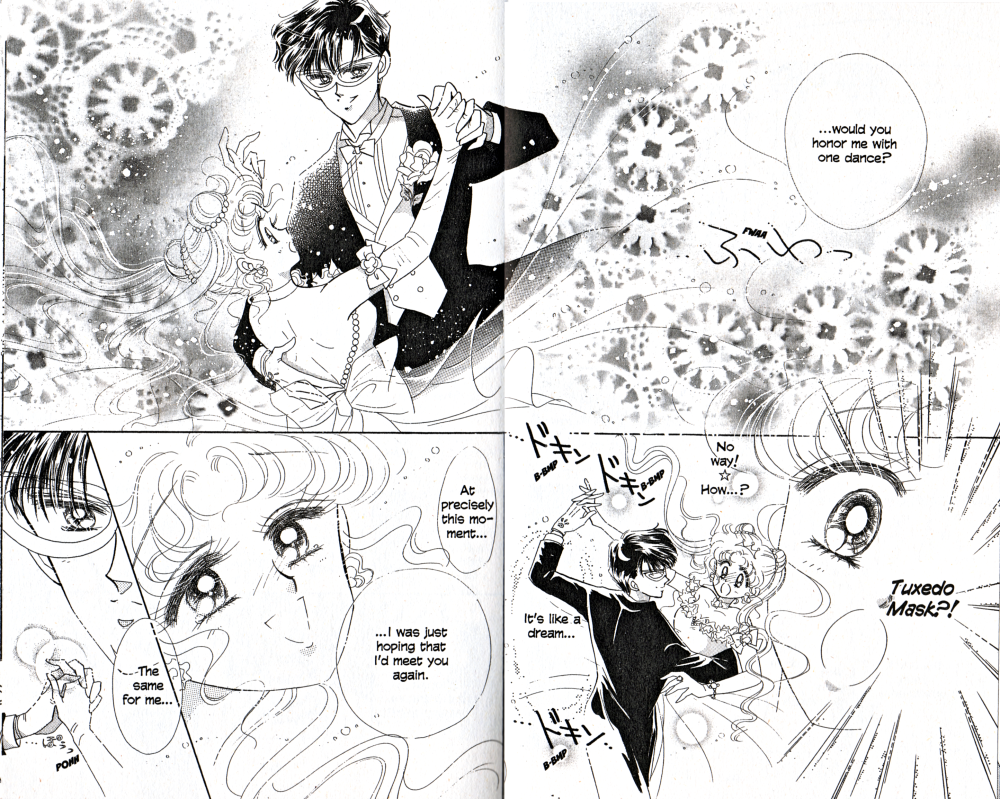
So, for my contribution I’ve chosen two memorable moments from the first volume of Naoko Takeuchi’s Pretty Guardian Sailor Moon. The first one comes from a chapter in which the protagonist, Usagi Tsukino, has infiltrated a masquerade ball in an effort to determine whether the Legendary Silver Crystal might be found there. Possible foe/possible ally Tuxedo Mask is also on the crystal’s trail, but pauses to give Usagi a twirl on the dance floor.

Pretty Guardian Sailor Moon, Volume 1, Chapter 4, Pages 142-143 (Kodansha Comics)

Takeuchi’s art perfectly captures the sheer dreaminess of this encounter for Usagi. In the top panel, the lacy screentone mimics the flare of her skirts, and the way that the smaller panels are framed focuses attention on facial expressions and reinforces the feeling that no one and nothing is capable of intruding upon this perfect moment for them.

And, of course, her dress is purty.

MJ: This sequence truly is dreamy. What particularly pulls me in here is the screentone. Its texture brings a 3D quality into this 2D world, as though the moment was preserved and wrapped up in an elaborate scrapbook that I could reach out and touch—as though it was someone’s real memories of the moment. Even just looking at something that has such a familiar texture stimulates my sense of touch, bringing me more fully into the scene. I think this kind of tangible decoration not only lends a fairy-tale dreaminess to the scene, but also makes it feel more personal for the reader.

MICHELLE: Ooh, you’re right, it does feel like a page from a scrapbook! In that sense, the screentone almost seems like it represents a snippet of the actual material of Usagi’s dress.

In addition, Usagi has used her transformation gadget for this chapter and is supposed to appear a little older than usual. I think her expression on the lower left page captures that subtle distinction nicely.

MJ: I’ll note too, that while this particular brand of big-eyed shoujo tends to get a lot of flack outside shoujo fandom, that it’s Usagi’s big, shining eyes that really let us know how she feels here, and just how dreamy this moment really is for her (and subsequently for us).

MICHELLE: You know, I think I’ve become inured to the big-eyed thing, except with extreme cases, because I don’t even notice it anymore. It just seems like such an obvious way to convey youth and wonder.

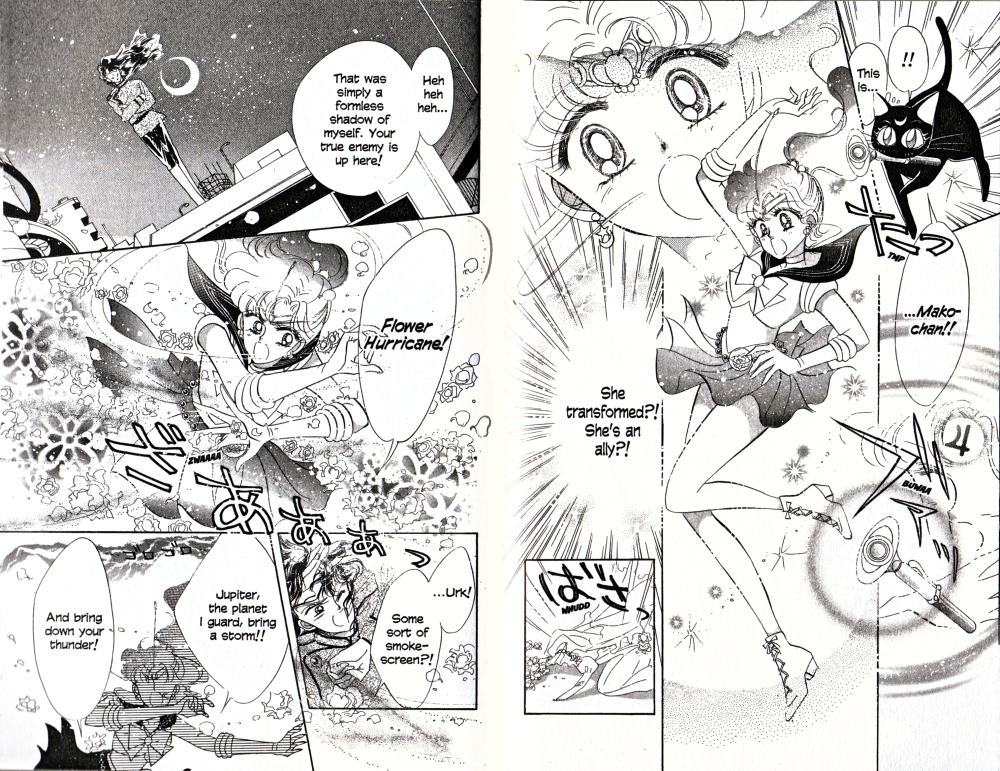
My second “memorable moment” is an example of a Sailor Moon action sequence.

Pretty Guardian Sailor Moon, Volume 1, Chapter 5, Pages 188-189 (Kodansha Comics)

In its way, this selection is just as pretty as the other one. Luna tosses Makoto her transformation pen, which glows in an appealingly magical girl fashion, transforming the girl—who is somewhat insecure about her physique—into Sailor Jupiter, someone both beautiful and powerful. Meanwhile, the enemy lurks on a nearby rooftop, and I’m impressed how this single panel so effectively establishes setting and atmosphere when one doesn’t have the preceding pages to furnish that information. Makoto’s first attack is simultaneously feminine and effective, giving her the opportunity to vanquish the enemy with her thunder bolt on the next page.

Looking back at some of the adjectives used in the paragraph above, I find that they aptly convey what it is I like about this moment: beauty and power, femininity and effectiveness. Sailor Moon shows that these things need not be mutually exclusive.

MJ: Those are great adjectives, Michelle, and actually this brings up a point I’ve been wanting to make since I listened to the podcast you participated in about Sailor Moon.

When male manga fans are trying to explain why something written for girls might be appealing to them as well, they will often attribute this to what they perceive as male or “shounen” elements in the story, like team-building or action sequences. And while I appreciate their enthusiasm for the work, I’m a bit perplexed as to why these would be considered exclusively “shounen” to begin with. Sure, certain genres of shoujo manga might share these things in common with certain genres of shounen manga, but I honestly don’t see what’s not inherently shoujo about them. Girls enjoy things like action, adventure, teamwork, and battling evil just as much as anyone, and there’s nothing odd or incongruous about these elements standing alongside things like beauty and femininity. These things naturally coexist in the minds of many girls, and when they’re all put together, they are not only exciting and inspiring, but really freaking pretty.

MICHELLE: You’re right, and though I agreed with them that there were some “shounen” elements to Sailor Moon, I didn’t mean to imply that they’re not just as easily shoujo elements, but simply story aspects that are more common to shounen manga. If that makes sense.

MJ: I guess what I’m saying is, though maybe there are more shounen action series than there are shoujo action series, it’s not as if it’s uncommon in shoujo. The entire magical girl genre pretty much exists in that realm, and those series share as much or more in common with fantasy, adventure, or sci-fi shoujo like Basara, X/1999, or They Were Eleven as they do with shounen manga—all of it very shoujo and very pretty.

I don’t mean to derail this discussion with my shoujo manifesto, though, so please forgive me. I’m just happily overwhelmed by the sparkly loveliness of this action sequence.

MICHELLE: No worries; I agree with you. But perhaps we should move on. What pretty shoujo have you chosen?

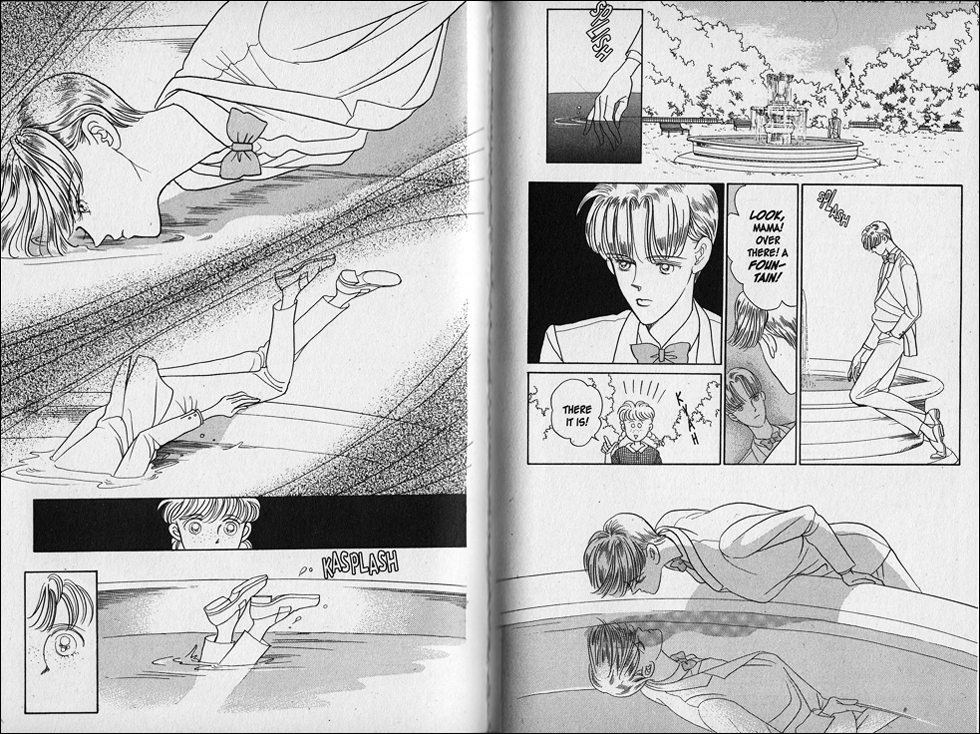
MJ: Well, it may seem like an odd choice, given the vast pool of classic pretty to choose from, but I’ve chosen an 8-page scene from volume three of Reiko Shimizu’s Moon Child, and there are a number of reasons why.

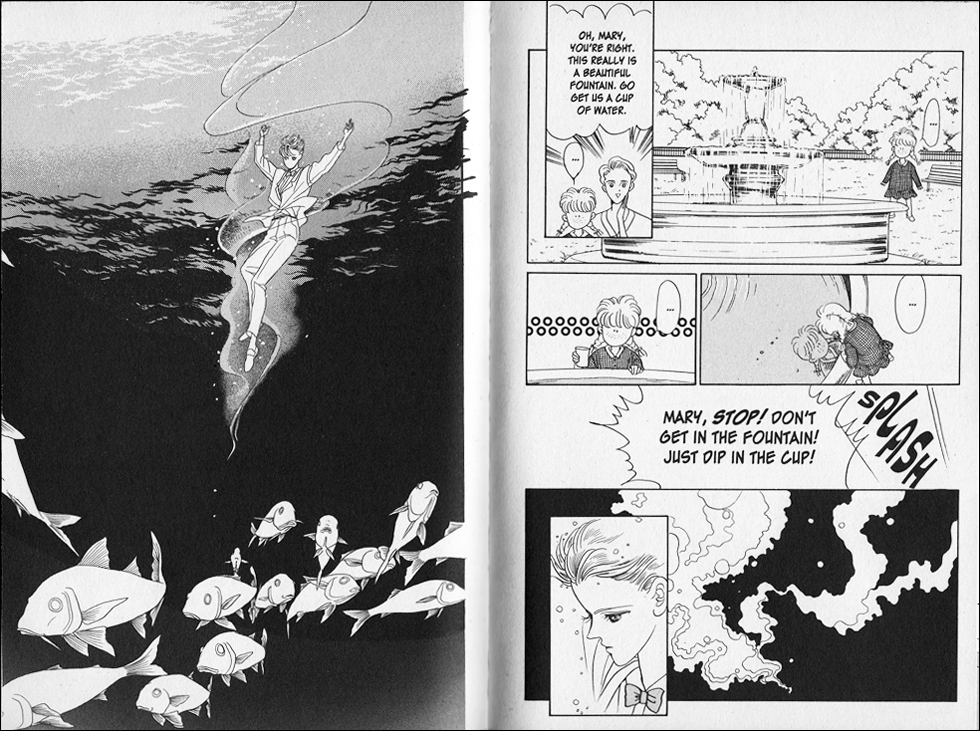
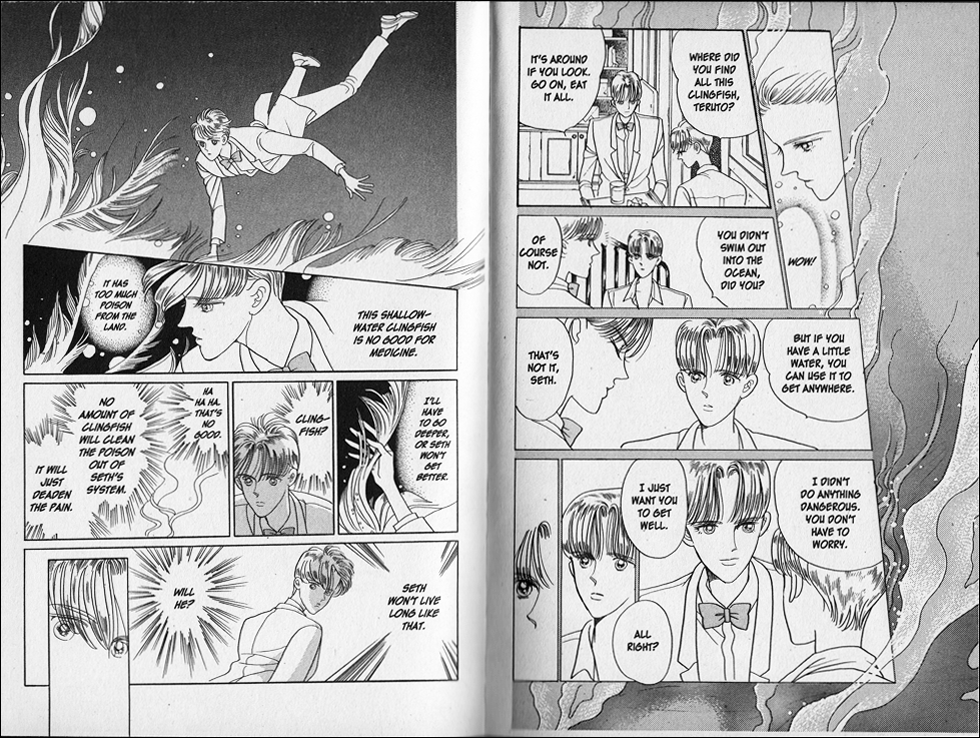
Moon Child, Volume 3, Pages 146-153 (CMX)

First, of course, there is quite a bit of objectively lovely imagery in the later panels of the scene, including rippling water, a flowing seascape, and a billowy-haired mermaid, all rendered with a perfect balance of simplicity and detail. I’m particularly fond of Shimizu’s style of character design as well, which is very much in step with most of the ’80s and early ’90s manga I’ve read. For whatever reason, this is probably my very favorite period for shoujo character design.

Most of all, though, there is an eerie, vaguely melancholy tone throughout the entire scene, particularly the first two pages, which I will admit are my favorite. I even consider them the prettiest of the whole sequence, though they have none of the flowing seascape that decorates the rest of the scene. They are, however, beautifully strange, and a perfect example of what I personally find prettiest in shoujo manga. This may seem like an odd thing to say, but I find the strangeness—this particular brand of strangeness—to be really, really beautiful. When I look at the first two pages of this sequence, I can feel the smooth surface of the water as the character brings his face near, touching the ends of his hair and the tips of his nose and chin. That smooth pool of water and the way he just falls slowly into it—it’s difficult for me to articulate exactly why I find it beautiful, but I really do.

Yes, I love these character designs, and the pretty page layouts, but sometimes what I find most beautiful about older shoujo manga is its strangeness. It brings to mind a dreamworld, I guess—one that looks like our world but somehow just isn’t in a way that engages the most obscure, most beloved corners of my imagination. These stories make themselves part of my private world, and I find them beautiful for it. If that makes any sense at all.

MICHELLE: It absolutely makes sense. And for what it’s worth, I studied the pages before I read your commentary and also felt that the exquisitely slow descent into the fountain was the loveliest part. I like, too, how Teruto slips into the fountain with such grace and barely a ripple and how this is contrasted off-panel by the little girl who has observed what happened. The inability of an everyday person to access the same magic only reinforces its strangeness.

MJ: Yes, exactly! It seems so clear that he exists in a different state of being from the regular people around him, which is part of what makes it feel so dreamlike, I think. There is a lot of that kind of thing in this series, which is really, exquisitely strange. I think the dreamlike tone makes it easier to suspend disbelief as well.

MICHELLE: From the examples we’ve both chosen, it seems that, to some extent, it’s the dreaminess of pretty scenes that is at least partly responsible for the happy sighing. Of course, we realize that real life is seldom so lovely, but it’s nice to abandon oneself for a while in a reality where that sort of thing really can happen.

MJ: I think where I often find solace in shoujo manga, is that it offers exactly what you describe—a reality that contains the stuff of dreams—but held together by real human feeling, such that even the wildest tale can often shine much-needed light on our real-life emotional turmoil. At the heart of all this strange, sparkly fantasy, there is a solid base of real emotional truth, which is sometimes easier to face when it’s presented in a pretty, dreamlike package.

MICHELLE: Well put! I think that’s one of the major strengths of genre fiction in general, actually, no matter the media.

MJ: Agreed! Of course, nothing does “pretty” quite like classic shoujo.

MICHELLE: Indeed not. That’s just icing on the cake!

Filed Under: FEATURES, Let's Get Visual Tagged With: cmx, Kodansha Comics, Naoko Takeuchi

  • « Go to Previous Page
  • Page 1
  • Interim pages omitted …
  • Page 4
  • Page 5
  • Page 6
  • Page 7
  • Go to Next Page »
 | Log in
Copyright © 2010 Manga Bookshelf | Powered by WordPress & the Genesis Framework