• Skip to primary navigation
  • Skip to main content
  • Skip to primary sidebar
  • Home
  • About Us
    • Privacy Policy
    • Comment Policy
    • Disclosures & Disclaimers
  • Resources
    • Links, Essays & Articles
    • Fandomology!
    • CLAMP Directory
    • BlogRoll
  • Features & Columns
    • 3 Things Thursday
    • Adventures in the Key of Shoujo
    • Bit & Blips (game reviews)
    • BL BOOKRACK
    • Bookshelf Briefs
    • Bringing the Drama
    • Comic Conversion
    • Fanservice Friday
    • Going Digital
    • It Came From the Sinosphere
    • License This!
    • Magazine no Mori
    • My Week in Manga
    • OFF THE SHELF
    • Not By Manga Alone
    • PICK OF THE WEEK
    • Subtitles & Sensibility
    • Weekly Shonen Jump Recaps
  • Manga Moveable Feast
    • MMF Full Archive
    • Yun Kouga
    • CLAMP
    • Shojo Beat
    • Osamu Tezuka
    • Sailor Moon
    • Fruits Basket
    • Takehiko Inoue
    • Wild Adapter
    • One Piece
    • After School Nightmare
    • Karakuri Odette
    • Paradise Kiss
    • The Color Trilogy
    • To Terra…
    • Sexy Voice & Robo
  • Browse by Author
    • Sean Gaffney
    • Anna Neatrour
    • Michelle Smith
    • Katherine Dacey
    • MJ
    • Brigid Alverson
    • Travis Anderson
    • Phillip Anthony
    • Derek Bown
    • Jaci Dahlvang
    • Angela Eastman
    • Erica Friedman
    • Sara K.
    • Megan Purdy
    • Emily Snodgrass
    • Nancy Thistlethwaite
    • Eva Volin
    • David Welsh
  • MB Blogs
    • A Case Suitable For Treatment
    • Experiments in Manga
    • MangaBlog
    • The Manga Critic
    • Manga Report
    • Soliloquy in Blue
    • Manga Curmudgeon (archive)

Manga Bookshelf

Discussion, Resources, Roundtables, & Reviews

Archives for October 2011

Manga Artifacts: The Legend of Mother Sarah

October 9, 2011 by Katherine Dacey

Most American manga fans know Katsuhiro Otomo as the creative force behind AKIRA and Domu: A Child’s Dream, but Otomo’s catalog also includes works like The Legend of Mother Sarah, in which Otomo penned the script but relinquished the illustration duties to another manga-ka. And while Mother Sarah isn’t quite as visually dazzling as AKIRA or Domu, this post-apocalyptic adventure is every bit as fun to read, thanks to its vivid characterizations and dynamic action sequences.

Set in the not-too-distant future, Mother Sarah begins in space — or, more accurately, space stations, where the survivors of a nuclear holocaust have sought refuge from the Earth’s extreme climate changes. When riots threaten the peace aboard these floating cities, the military evacuates civilians back to the surface, in the process separating thousands of children from their parents. Sarah, the story’s eponymous heroine, is on a quest to find her own family, all of whom disappeared in the chaos aboard the space stations. Traveling with Tsue, a trader, she wanders a desolate landscape of crumbling cities, slave-labor camps, religious compounds, and hardscrabble farms, karate-chopping anyone who threatens the honest folk she meets along the way.

Given its classic premise and cool, resourceful heroine, it’s curious that Mother Sarah had such a short shelf life here in the United States. As tempting as it may be to chalk up fan indifference to sexism, or antipathy towards Otomo’s other (read: not AKIRA) projects, I think the real reason lies with the way Mother Sarah was released. Dark Horse published the series from 1995-98, but only collected the first eight issues into a trade paperback. When read in thirty-page installments, The Legend of Mother Sarah: Tunnel Town is engaging but frustrating. Otomo and artist Takumi Nagayasu’s sense of pacing, in particular, is too leisurely for a stand-alone booklet: they establish a new setting with a dozen wordless panels, luxuriate in an explosion, or depict a fist-fight over five or six pages, gobbling up real estate that might otherwise be advancing the story. Contrast an issue of Tunnel Town with that of a long-running American series and the incompatibility of format and story becomes more apparent. In each issue of The Walking Dead, for example, one important event is dramatized: the characters make a critical discovery about their zombie foes or confront a troublemaker within their ranks. Though the issue may end on a cliffhanger, there’s a sense of closure that’s missing from an issue of Mother Sarah, even though both stories are clearly intended to extend beyond the confines of a single pamphlet.

When read in trade paperback form, however, Tunnel Town has a more satisfying rhythm. Those establishing shots and slow-mo fight scenes draw the reader deeper into the story; we feel like we’re actually part of the scene, rather than passive witnesses to the action. The continuity between events is easier to appreciate as well. Sarah’s skirmishes with authority no longer seem like a string of isolated incidents, but a steadily escalating pattern of violence that demands resolution. And what a finale! Coming at the end of two hundred pages, the denouement is less a cool stunt than a thrilling affirmation of Sarah’s courage and smarts, an emphatic punctuation mark at the end of a long but well-reasoned paragraph.

I’m guessing that someone at Dark Horse must have thought Mother Sarah was ill-served by the thirty-page format, as the next two arcs — City of the Children and City of the Angels — were published in forty-eight page installments, a development highlighted on the front covers of each issue:
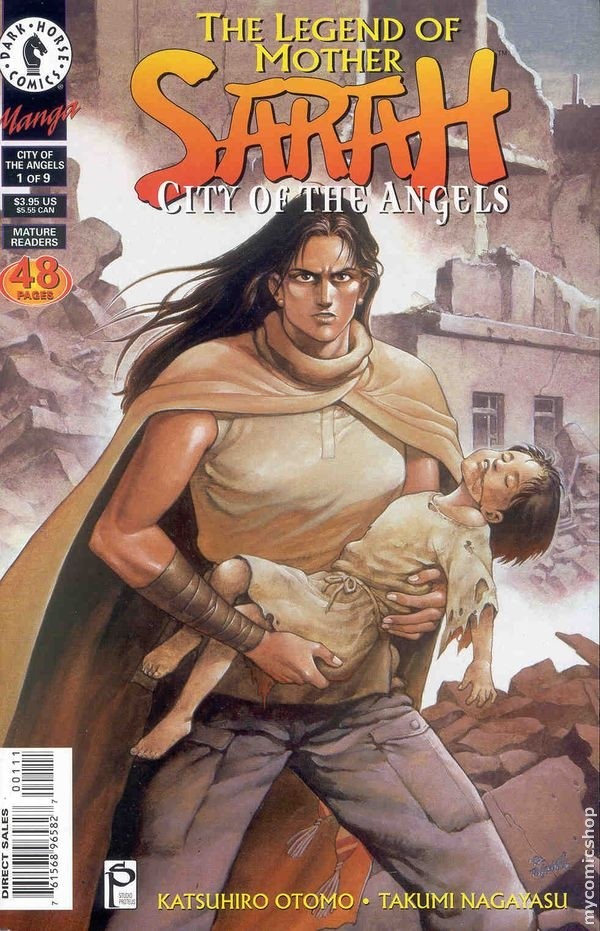
As a result, the later mini-series are more engaging; we’re treated to a larger, more satisfying chunk of story in each installment, a chunk that I suspect corresponds more closely to the way the manga was serialized in Young Magazine. Alas, neither Children nor Angels were collected in bound form, making it harder for a new generation of manga fans to discover the series for themselves.

For all my grumbling about format and scarcity, however, all three story arcs are worth owning, both for the art and the story. Takumi Nagayasu’s crisp visuals are pleasingly reminiscent of Otomo’s. Nagayasu’s characters are drawn in a naturalistic fashion, with plenty of attention given to hands, facial hair, posture, wrinkles, and muscles; even the most inconsequential soldier or civilian is given a unique face and a thoughtfully constructed costume. Nagayasu also shares Otomo’s love of vehicles and decaying urban landscapes, rendering both in a fine, evocative fashion; one can almost hear the steel structures rusting from neglect.

Otomo’s writing is as strong as Nagayasu’s artwork. Though Sarah is a certifiable bad-ass, capable of kicking and stabbing her way out of a tight situation, she relies on her wits just as frequently as her fists. Her maternal instincts, too, inform much of her decision-making; throughout the series, Sarah is drawn to conflicts involving exploited or abused children, offering her a chance to symbolically “save” the family she lost ten years earlier. In short, Sarah is a woman warrior in the Lt. Ellen Ripley/Sarah Connor mold: fierce, strong, principled, and, above all else, a mama grizzly who sides with the young and the helpless. Oh, and she looks good while dispensing justice, too. Now that’s my kind of escapism, no matter how it’s packaged.

THE LEGEND OF MOTHER SARAH • STORY BY KATSUHIRO OTOMO, ART BY TAKUMI NAGAYASU • DARK HORSE • NO RATING

Filed Under: Manga, Manga Critic, REVIEWS Tagged With: Dark Horse, Katsuhiro Otomo, Post-Apocalyptic Sci-Fi, Takumi Nagayasu

Manga Artifacts: The Legend of Mother Sarah

October 9, 2011 by Katherine Dacey 15 Comments

Most American manga fans know Katsuhiro Otomo as the creator of AKIRA, and perhaps of Domu: A Child’s Dream and Hipira. But did you know that Otomo was also the author of The Legend of Mother Sarah, a criminally under-appreciated sci-fi epic that’s equal parts Mad Max and Terminator II?

Set in the not-too-distant future, Mother Sarah begins in space — or, more accurately, space stations, where the survivors of a nuclear holocaust have sought refuge from the Earth’s extreme climate changes. When riots threaten the peace aboard these floating cities, the military evacuates civilians back to the surface, in the process separating thousands of children from their parents. Sarah, the story’s eponymous heroine, is on a quest to find her own family, all of whom disappeared in the chaos aboard the space stations. Traveling with Tsue, a trader, she wanders a desolate landscape of crumbling cities, slave-labor camps, religious compounds, and hardscrabble farms, putting the hurt on anyone who threatens the honest folk she meets along the way.

Given its classic premise and cool, resourceful heroine, it’s curious that Mother Sarah had such a short shelf life. As tempting as it may be to chalk up fan indifference to sexism, or antipathy towards Otomo’s other (read: not AKIRA) projects, I think the real reason lies with the way Mother Sarah was released.

Dark Horse published the series from 1995-98, but only collected the first eight issues into a trade paperback. . When read in thirty-page installments, The Legend of Mother Sarah: Tunnel Town is engaging but frustrating. Otomo and artist Takumi Nagayasu’s sense of pacing, in particular, is too leisurely for a stand-alone booklet: they establish a new setting with a dozen wordless panels, luxuriate in an explosion, or depict a fist-fight over five or six pages, gobbling up pages that might otherwise be advancing the story.

Contrast an issue of Tunnel Town with that of a long-running American series and the incompatibility of format and story becomes more apparent. In each issue of The Walking Dead, for example, one important event is dramatized: the characters make a critical discovery about their zombie foes or confront a troublemaker within their ranks. Though the issue may end on a cliffhanger, there’s a sense of closure that’s missing from an issue of Mother Sarah, even though both stories are clearly intended to extend beyond the confines of a single pamphlet. Put another way, each issue of Walking Dead has a clear beginning, middle, and end, whereas Sarah simply stops; it’s as if the author pressed “pause,” rather than set the table for the next chapter.

When read in trade paperback form, however, Tunnel Town has a more satisfying rhythm. Those establishing shots and slow-mo fight scenes draw the reader deeper into the story; we feel like we’re actually part of the scene, rather than passive witnesses to the action. The continuity between events is easier to appreciate as well. Sarah’s skirmishes with authority no longer seem like a string of isolated incidents, but a steadily escalating pattern of violence that demands resolution. And what a finale! Coming at the end of two hundred pages, the denouement is less a cool stunt than a thrilling affirmation of Sarah’s courage and smarts, an emphatic punctuation mark at the end of a long but well-reasoned paragraph.

I’m guessing that someone at Dark Horse must have thought Mother Sarah was ill-served by the thirty-page format, as the next two arcs — City of the Children and City of the Angels — were published in forty-eight page installments, a development highlighted on the front covers of each issue:

As a result, the later mini-series are more engaging; we’re treated to a larger, more satisfying chunk of story in each installment, a chunk that I suspect corresponds to the way the manga was serialized in Young Magazine. (I don’t know that for a fact, however, so feel free to politely educate me on this point if I’m off base here.) Alas, neither Children nor Angels were collected in bound form, making it harder for a new generation of manga fans to discover the series for themselves.

For all my grumbling about format and scarcity, however, all three story arcs are worth owning, both for the art and the story. Takumi Nagayasu’s crisp visuals are pleasingly reminiscent of Otomo’s. Nagayasu’s characters are drawn in a naturalistic fashion, with plenty of attention given to hands, facial hair, posture, wrinkles, and muscles; even the most inconsequential soldier or civilian is given a unique face and a thoughtfully constructed costume. Nagayasu also shares Otomo’s love of vehicles and decaying urban landscapes, rendering both in a fine, evocative fashion; one can almost hear the steel structures rusting from neglect.

Otomo’s writing is as strong as Nagayasu’s artwork. Though Sarah is a certifiable bad-ass, capable of kicking and stabbing her way out of a tight situation, she relies on her wits just as frequently as her fists. Her maternal instincts, too, inform much of her decision-making; throughout the series, Sarah is drawn to conflicts involving exploited or abused children, offering her a chance to symbolically “save” the family she lost ten years earlier. In short, Sarah is a woman warrior in the Lt. Ellen Ripley/Sarah Connor mold: fierce, strong, principled, and, above all else, a mama grizzly who sides with the young and the helpless. Oh, and she looks good while dispensing justice, too. Now that’s my kind of escapism, no matter how it’s packaged.

THE LEGEND OF MOTHER SARAH • STORY BY KATSUHIRO OTOMO, ART BY TAKUMI NAGAYASU • DARK HORSE • NO RATING

Filed Under: Manga Critic Tagged With: Dark Horse, Katsuhiro Otomo, Post-Apocalyptic Sci-Fi, Takumi Nagayasu

‘Tis Pity She’s A Whore

October 9, 2011 by Sean Gaffney

By John Ford. First published in 1633 (approximately 7-8 years after its first performance) by Nicholas Oakes for Richard Collins. Current edition published by Arden Shakespeare in 2011.

Sometimes I think that the current generation on the internet likes to believe that they were the ones who made incest cool, what with all the squee and the Ouran and Harry Potter fanfics out there. But incest has been around since pretty much the dawn of mankind, and has been written about in the greatest works of literature just as much. Almost every high schooler has to read Oedipus Rex these days, though I suspect their local church likely skips over all the Old Testament fooling around.

Thus, in terms of being a play about incest, John Ford was not breaking exciting new ground. The new ground was in how he dealt with it. This is not the usual wacky comedy uncle lusting after his sweet young niece as we’ve seen in other Jacobean plays, nor are the siblings royalty (incest is always more acceptable when they’re kings, strangely enough). No, we have a merchant family here, and their son, Giovanni, is no slavering neanderthal. Not for him the baseless lust approach. He is madly in love with his sister and so he tries to rationalize it intellectually, coming up with all sorts of arguments he can present to his local friar. The friar’s position can basically be summed up by this ellipsis: “…” Luckily for Giovanni, his sister Annabella has fallen madly for him as well, and they declare, then consummate their love in Act II.

The next three acts are everything going to hell, as you can imagine. This is a tragedy, and there will not be door slamming and talk of sardines here. A lot of modern productions of this play apparently want to focus purely on the main couple, and cut out a lot of the other stuff going on, which mostly involves Annabella’s many suitors and a whole lot of plotting of revenge. Which is a shame, as it helps to show that, despite what many critics have said over the years (usually in the process of condemning the play), Ford is *not* sympathizing with the leads. He does not regard their love as Romeo and Juliet, and the way the production plays out shows this. He does not, however, portray either Giovanni or Annabella as monsters. This is the difference.

Annabella actually shows remorse for her mistakes of passion, right about when she realizes that her troublesome suitor, Soranzo, actually does love her. She is also not the instigator of the relationship (which makes it harder to blame the evil woman seducing the poor innocent man, a common enough reasoning in this time period), and ends up having her heart gouged out of her by a now insane Giovanni. Nevertheless, while the play was very popular at the time it was first written and performed, it was condemned by critics for years afterwards, with the compilers of Ford’s Complete Works choosing to omit the play entirely rather than sully the book with this heathenism. It also was thought unsuitable for the stage and unperformed for about 250 years, only being revived consistently after 1940 or so.

This is not exactly a fun play to read, but I think it’s very well-written. And, as with Shakespeare, I think it’s a lot more ambiguous than usually ends up being presented on the stage in modern productions. Ford is not saying the incestuous lovers are right, but he is saying that they are human, and that we can understand their all too human failings. Thus the title, which aptly sums up those two dichotomies: ‘Tis Pity She’s A Whore.

Filed Under: REVIEWS

Going Digital: October 2011

October 9, 2011 by MJ 4 Comments

Welcome to Going Digital, Manga Bookshelf’s monthly feature focusing on manga available for digital viewing or download. On the first weekend of each month, the Manga Bookshelf bloggers review comics we’ve read on our computers, phones, or tablet devices, to give readers a taste of what’s out there, old and new, and how well it works in digital form.

This month, we take a look at manga published for viewing on an iOS device and in your web browser. Device, OS, and browser information is included with each review as appropriate, to let you know exactly how we accessed what we read.

iOS

Cross Game, Omnibus Vol. 1 (Japanese vols. 1-3) | By Mitsuru Adachi | Viz Manga app | iPad 2, iOS 4.3 – For quite some time now, I’ve stood by quietly as my esteemed colleagues raved about Mitsuru Adachi’s Cross Game. I meant to catch up, truly I did, but as more time (and more volumes) passed me by, the idea of catching up at $15-$20 a pop seemed more than a bit daunting. Fortunately, the Viz iPad app has changed all that, offering me the opportunity to buy these volumes for half their print price, and on a terrific platform to boot!

It’s difficult to know what to say about Cross Game that hasn’t already been said (and better) by my cohorts, two of whom selected it as their favorite “C” manga. Probably the best I can do is to just say, “they’re right.” This is sports manga as it should always be done—moving, character (and relationship)-driven, and as deeply rooted in the lives of its characters as it is in the sport that brings them together. And while it doesn’t require a background or interest in baseball to enjoy Cross Game, Adachi doesn’t trivialize the sport either. The series is dazzling thanks to spectacular emotional resonance rather than super-human displays of athleticism.

This triple-length volume, spanning the first three Japanese volumes, was both sadder and funnier than I expected. Adachi broke my heart completely within the first third of the volume, while consistently making me smile with his warm humor and occasional breaks in the fourth wall. It’s exactly my kind of manga, blessed with strong female characters and lots of emotional messiness, while pleasantly lacking in melodrama. Three volumes is a terrific amount to start with, too, and certainly helped me to fall in love with the series.

Cross Game looks beautiful on the iPad 2, so crisp and detailed, there’s no need to zoom in, panel-to-panel. I mainly read in vertical single-page mode, which offers the biggest image, but this series reads well in the horizontal two page-spread as well. Reading manga on the iPad is really a joy, and definitely a habit I could get into, as long as the pricing remains reasonable. I’ll certainly be picking up more of Cross Game. (also available at vizmanga.com) – MJ

Veronica Presents: Kevin Keller, Issue 2 | By Dan Parent | Archie Comics App | iPad 2, iOS 4.3 – Comic creators who work in a shared universe face specific, conjoined responsibilities when adding a new character to that universe: they have to simultaneously generate interest in the addition while reassuring the existing audience that they aren’t going to go too far off of the ranch. The situation poses some interesting challenges, and success stories aren’t exactly numerous. One noteworthy example is the addition of a gay teen, Kevin Keller, to the wholesome solar system that is Archie Comics.

Like the rest of the teens in Riverdale, Kevin is basically a nice kid with his own set of hobbies and interests. Unlike the rest of the teens in Riverdale, Kevin is romantically interested in members of the same sex. That’s not the core way that Kevin is different, though. What really makes him stand out is that he has a specific goal in mind for his future: he wants to serve in the military, just like his beloved father, and his family and friends recognize that this might be more complicated for an openly gay person than it would be for, say, Archie or Betty. (The military would love to have Betty; she’s frugal, hard-working, cooperative, and can repair automobiles.)

It’s an interesting choice that the ostensible problem with Kevin’s sexuality isn’t interpersonal. Nobody in his family or circle of friends gives his gayness a second thought, and why would they? Aside from Betty, he’s probably the nicest, most thoughtful student at Riverdale High. Of course, that’s the problem with Kevin in the narrative sense; Riverdale teens don’t age and haven’t since their introduction, so career-anxiety-related storylines will always be somewhat of a dead end. With the future not really in play, the publisher needs to give the character some individual spark that can generate the kind of in-the-moment stories that the rest of his classmates enjoy.

It’s great that Archie has thoughtfully and successfully made their student body more diverse. Now they just need to make Kevin a fun, funny, functional member of the cast rather than just a Nice Young Man Who Happens to Crush on Other Nice Young Men. – David Welsh


Web Browser

Girlfriends, Vol. 1 | By Miruku Morinaga | Futabasha, via the JManga website | Windows XP, Firefox 7.0 – It’s not just salaryman manga about ninjas and bento lovers at Futabasha, they also have a close eye on the typical “otaku” reader as well. The magazine Comic High! began in 2006, and basically advertised itself as shoujo stories for young men. Titles that already fit this genre, such as Towa Oshima’s High School Girls, were brought over from other magazines, and several new titles were commissioned from up and coming talents who knew how to draw cute girls being cute.

One of the more famous names, at least to yuri fans, was “Morinaga Milk”, a mangaka who had a short yuri series running in Ichijinsha’s Comic Yuri Hime, a magazine devoted to “Girls’ Love” manga, usually of the Story A variety (I like this girl, hey she likes me back, look we like each other) as mentioned several times by Erica Friedman on her Okazu site. Many of these stories tended to feature a meek, dark-haired girl and her more outgoing, lighter-haired girlfriend; indeed, that describes Kisses, Sighs, and Cherry-Blossom Pink, her Yuri Hime series as well.

Now that Morinaga has moved to Comic High and is given a broader canvas, she is able to develop things in a slower and more realistic way. And that’s what we get for the first volume of her series Girlfriends, which in this volume might better be written “Girl Friends”, as despite the occasional “what is this strange feeling in my chest” moment, and the cliffhanger ending, there’s very little yuri here, the story being content with developing its two leads and their group of friends. Mariko is a quiet, studious girl who doesn’t have many friends, at least not until she is dragged into a social life by vivacious Akiko, and the first volume is mostly taken up with Mariko’s wonder at the things that everyday girls do – they actually go out after school! And shop!

This volume starts slow, as I noted. If you’re here to see girls confessing to each other and becoming a couple, be warned it doesn’t happen here. But it’s cute. Indeed, Girlfriends Vol. 1 pretty much fulfills the mission statement of many of Comic High‘s titles – cute girls behaving cutely. If you’re a fan of that, this title should appeal to you. – Sean Gaffney

Gokudou Meshi, Vol. 1 | By Shigeru Tsuchiyama | Futabashi/JManga | Windows 7, SeaMonkey 2.4.1 – When Shunsuke (or possibly Junsuke—the translation is inconsistent) Aida is sentenced to three years of hard labor for assault and kidnapping charges related to his host club empire, he finds that his eight fellow cellmates at Naniwa South Prison have an interesting tradition: every Christmas Eve, they have a storytelling contest about the best meal they ever ate. The winner gets to take one item from everyone else’s special osechi meal that the prisoners receive as a New Year’s treat.

Aida’s not so much the main character, though, as simply our entry point into the competition. While he listens to the others’ stories—focusing on dishes like soba, sushi, okonomiyaki, and “tear-inducing gyoza”—he works on his own strategy, learning which sorts of stories and foods work best, and hearing about some of the failures from last year (“stewed achilles heel of a deer…!?”). Primarily, however, this manga is all about the food, which is lovingly depicted in all its regional varieties. One learns a little about the characters through their stories, but nothing about prison life. Mostly, the guys just sit around the table and attempt to entrance each other with their culinary tales. Since I happen to really like food manga, I enjoyed Gokudou Meshi quite a bit, but I can see how it wouldn’t be everyone’s cup of sake. (Haha. I kill me.)

JManga’s manga reader is very easy to use and navigate, and I primarily read using the full-screen option. Occasionally, I’d have to zoom in to catch some of the smaller sound effects (lots of munching and even some “nom”s), but otherwise the images and text were clear. Despite the confusion over Aida’s first name, the translation was actually somewhat smoother than the previous JManga title I read (Ekiben Hitoritabi), with one typo and one instance where “it’s” was used instead of “its.”

Gokudou Meshi is up to eight volumes in Japan, so readers may be in for several years’ worth of competitions with very little action in between. Hopefully volume two will be available soon so I can confirm that suspicion! – Michelle Smith

So I Married an Anti-Fan, Vol. 1 | By Wann | NETCOMICS | iPad, iOS 4.3, Safari – MJand Michelle’s recent Off the Shelf column prompted me to visit the NETCOMICS site, something I haven’t done in well over a year. I’m pleased to report that not much has changed since my last visit. The basic distribution model remains the same, with readers paying 25 cents per chapter to rent a title for forty-eight hours. The catalog has been updated, however, with new chapters of fan-favorites as well as brand new titles.

Among those new arrivals is So I Married an Anti-Fan, a romance in the Full House mode. Like Full House, Anti-Fan features a feisty, down-on-her-luck young woman who becomes financially and romantically entangled with a handsome celebrity. The heroine of Anti-Fan is Geunyoung Lee, an aspiring writer stuck in a dead-end newspaper job covering celebrity gossip. When she snaps a pic of popular actor Joon Hoo in a less-than-flattering light, Geunyoung loses her job, sending her into a tailspin of destructive behavior: she builds a website declaring herself to be Joon Hoo’s number one “anti-fan,” sends him a blackmail letter, and protests outside his apartment building. Eager to quell rumors about Geunyoung’s motivation for hating him, Joon Hoo extends an olive branch: if she agrees to play his manager on a reality television show, he’ll make sure she’s compensated for lost wages.

Though the premise is credulity straining, the execution is surprisingly nimble. Geunyoung initially seems like a stereotypical manhwa heroine, all bluster and impulse, but Wann digs deeper below the surface to explain the source of Geunyoung’s rage. She’s a believable mixture of bravado and self-doubt, mustering the courage to publicly reject Joon Hoo’s offer of a handout while privately castigating herself for her reckless spending and foolish behavior. By the end of volume one, Joon Hoo, too, seems more like a flesh-and-blood person than a standard-issue sadist who delights in seeing Geunyoung suffer. He’s nasty — there wouldn’t be a plot if he were nice from the get-go — but, like Geunyoung, his anger is rooted in real pain, making it a little easier to imagine how these two characters might eventually fall for each other.

If I had any criticism of the series, it’s that the artwork is very uneven. The lead characters are expertly rendered, but many of the bit players seem to have been assembled from scraps: eyes from here, noses from there, plaids from leftover sheets of screentone. The backgrounds are flat-out lazy, relying heavily on Photoshop and simple, geometric renderings of buildings and furniture to convey a sense of place. Still, the plainness of the artwork isn’t a major obstacle to enjoying this opposites-attract story, as the script and the lead characters make a lasting impression. – Katherine Dacey


Some reviews based on digital copies provided by the publisher.

Filed Under: FEATURES, Going Digital

Cry me a river

October 9, 2011 by David Welsh

I have a review of a beautifully sad comic in the queue, and it got me wondering. What are some of your favorite tear-jerking comics? Which ones push your sad button in the right way?


Filed Under: DAILY CHATTER

Hark! A Vagrant

October 8, 2011 by Sean Gaffney

By Kate Beaton. Released in North America by Drawn & Quarterly.

Kate Beaton is a very funny woman. This is the main reason to buy this collection. Her words are funny, her situations are funny, and her art is funny. That’s a triple-funny combo, folks, and it’s rare these days. People have been reading Hark! A Vagrant as an online webcomic for some time now, and I even have her original self-published book Never Learn Anything from History as well. This is the one to get, though, a handsome hardcover with a larger collection of stories, including all of her high points.

You should still go and check out the HAV archives at her website (here), as this is cherry picked to collect the best of her historical and literary humor, rather than the more random strip we see every week. We don’t get the strips about her own life, or a lot of the dashed-off sketches and earlier comics. There’s fun stuff there as well, including punchlines I don’t even have to look up to laugh about again. “It’s okay, you’re upset.” “Sometimes I pretend to be Neptune!” My own personal favorite, where Kate Beaton reads the letters of James Joyce, is also absent here.

But this strip is an excellent collection, and I have no issues with how it was cherry-picked. I mentioned remembering Kate’s punchlines, and that’s because she has an ear for dialogue that almost begs to be read aloud. It’s not necessarily accurate to its period – Dude Watching with the Brontes is funny *because* of the dissonance, and most of the historical sequences are done in modern tones – but its cadences are funny in and of themselves. They stick in your head, like the best kind of humor. “Jam!” is a classic example of a punchline that’s since become a meme.

Of course, this is helped along by the subject matter. Kate’s a smart cookie, and does not stop to explain the joke as she goes along. She trusts that you will know why Pearson vs. Diefenbaker is fun, and that you have already read The Great Gatsby in high school like the rest of us had to. I had worried all the Canadian strips would be gone, but there’s a large chunk of Canada here. Don’t get me wrong, the strips are funny even if you don’t know who Raskolnikov is, but if you *have* read Crime and Punishment it’s even funnier.

Lastly, Kate’s art is funny. This is sometimes forgotten in a medium where it’s frequently OK to just have funny words and have bland talking heads impart them. The art is caricature, but expressions are conveyed easily and succinctly. Anger and rage are particularly fun, as she draws an open mouthed angry moan that just elicits a giggle. Faces are clearly the emphasis here – Kate’s arms sometimes owe their influence to Mickey Mouse cartoons from the early 1930s – and the cartoons wouldn’t work without the words, but the art helps to accentuate each comic and bring out its best.

Drawn and Quarterly has done an excellent job here as well, with a nice handsome hardcover with a fantastic index at the back for the true history nerd in all of us who wants to skip straight to the strip about The Perfect Joy of St. Francis. It even has a sketch of a portly Napoleon on the cover, his attempt to look menacing somewhat undercut by also looking like he will squeak when he hits the ground like a child’s toy. If you haven’t experienced the fun of Hark! A Vagrant, this is the starting point. Go get it.

Filed Under: REVIEWS

Inside the DMG: BoysLoveBangBang

October 8, 2011 by BoysLoveBangBang 8 Comments

Editor’s note: While my own DMG experience has been stalled due to the disintegration of my localizing group (soon to be restarted, more on this soon!), the active group BoysLoveBangBang has agreed to share with us their Guild experience! Thanks, BLBangBang! – MJ


BoysLoveBangBang: Our Digital Manga Guild Experience

When I’m excited, my thoughts bubble up, suddenly exploding en masse. The result? Reader confusion. Today, not only am I excited about Digital Manga Publishing’s (DMP) unprecedented business model, the Digital Manga Guild (DMG), but I also want to share my personal experience so far with my localizing team, BoysLoveBangBang, and DMG. So, I’m gonna strap on the leather restraints and divide this journey into four categories: group formation; DMG interaction; the working process; and group interaction and beliefs.

Group Formation

BoysLoveBangBang, or the shortened version BLBangBang, was not without its set up discouragements, both from DMG itself and from within our group.

After announcing their—somewhat vague—comic guild idea, DMG needed time to define both their potential and procedures before attempting to clear the air for everyone interested in joining the guild. Understandable, but incredibly frustrating! Here was a brave and exciting promise: one that demonstrated awareness and appreciation of fan motivation and wanted to work with the long proven power of active enthusiasts!

Our original group members were all part of the experimental first wave of people applying to DMG. After submitting our qualifying tests, we had a considerable wait. I reread my grammar and style books and went through three shelves of my favourite manga before our individual approvals were completed and our members were linked. Finally, we were sent our contracts; BLBangBang put on its serious hat for contract discussions and group planning.

Next queue: DMG requires each member to send in their contract as a hard copy. Combined, our contracts flew over waving whitecaps, trucked down dusty roads, and weaved through rocky escarpment forests. DMG staff had to reunite all these lonely contracts into the BLBangBang family before any project assignments. Yup. Tick tock. We were ready for any genre, any mangaka–we just wanted to help with quality English manga availability.

We had trouble firming up our group roles. For a spell, we even had no translator. (Sounds kinda dismal so far, no?) We were saddened, but in comparison to setting up even the most conventional of new businesses, BLBangBang’s formation and partnership with DMG was bliss–full of eager people from both parties and reasonably smooth transitions. Oh yes, and a bit of luck…

This autumn, Apricotsushi, our translator, landed in our laps with a deliciously alluring squeal, and we gelled into who we are today: a fun-spirited, supportive, working team of: Alexandra Gunawan (Al), our group leader and letterer from the United States; Kimberly Lammens (Dutchie), our editor from Canada; and Anne Whittingham (Apricotsushi), our translator from Australia.

During our period sans translator, Al didn’t bow to Lady Luck; rather, she kept vigilant herself. When DMG offered a special project–a single title, already translated–she swiftly thrust herself up, and, over the sound of her chair clattering to the floor, she screeched happily: “PICK US! PICK US!” This project was Healing Music by Kaiya Tatsumi; it proved positively perfect for us. Not only did it breath fire back into our dampened spirits, but it also allowed us to learn the pitch and tone for our unique BLBangBang procedure.

Healing Music gave us clarity toward: our roles as editor and letterer; our needs regarding our new translator; and finally, our expectations of DMG. With the arrival of our first full package of three titles–Tweeting Love Birds volumes one and two by Yamamoto Kotetsuko and Want to Depend on You by Kinoshita Keiko–we’re now go-go-go, like a wild seme on an unsuspecting uke. Rawr! We’re approaching our three new titles with confidence, but we’re open to strengthening our fresh procedure with the addition of Apricotsushi!

DMG Interaction

Interaction with DMG holds two components: direct emails between BLBangBang and DMG; and the bimonthly teleconferences between DMG and the localizing group collective.

Direct Interaction

Al, our go-between for DMG and BLBangBang, gathers any questions or concerns, such as security issues, or technical and procedural problems, and sends them off pronto. At first, DMG’s responses, although still professional and friendly, retained a “slow and vague” modus operandi. Thankfully, that was short-lived. DMG administrators are now excellent, in both efficiency and clarity; they respond with reasonable promptness and satisfactory, respectful answers.

Al says: Group leaders must stay proactive in communication and follow up with DMG. If an email is sent that requires DMG response, I make sure I get it. It’s easy to get lost in DMG’s shuffle, so finding ways to politely assert and reassert our team’s agenda has been paramount. As group leader, it’s also been important to anticipate the paperwork DMG sends us. For example, the bundle of Schedule As we expected to receive following Healing Music was lost in a computer glitch on DMG’s end. If I hadn’t followed up immediately with our DMG contact when that email went astray, BLBangBang would have looked rather negligent!

Teleconferences

When DMG decided to maintain a regular time allotment for a live exchange with their localizers, I was pleased. We took turns listening in, working around our personal needs. At the conclusion of each meeting, the minutes would be shared with the rest of the group. Teleconferences were a useful channel at the beginning—it was a forum for DMG to share business information and status updates, and for localizers to raise concerns and questions. Perhaps because we started with DMG from the beginning, the teleconferences dwindled from useful to irritating repetition.

Encouragingly, DMG recently announced that they are holding themed teleconferences now. What a relief! With this focusing agenda and DMG’s growing activity, we’re returning to the live meetings with renewed interest.

The Working Process

The general procedures provided by DMG, although comprehensive, are somewhat tedious and disorganized from my perspective. “Wah!” I thought, rubbing my bleeding eyes and saying, “Calm down; type up your own version. You can own this monster!” And voila–a checklist that includes all of DMG’s fairly exacting requirements but now reshaped into my eye-friendly standards!

Onward to the project itself!

Roles

Apricotsushi is transforming Tweeting Love Birds from Japanese to English as I type! I’m willing myself to patience. I don’t want to be that child who whines: “Are we there yet?” Well done translations are not rushed translations–please ignore this brat, Apricotsushi!

I whip the script into shape and then fine tune it some more: a semi colon added here, a conversion to active tense there, and… would an em-dash clarify this dialogue, make it more expressive…? Add insightful team discussions on image-word flow choices and various translations we wish to grasp better in order to deliver smoother, and we finally arrive at the polished version of the script.

Al has enormous image and font files to juggle and manipulate. She does marvelously, with nary a complaint (that isn’t slathered in funny). Each project is going to be different: she informed me with a happy tinkle in her voice that the Japanese files for Healing Music were wonderfully sharp and mostly clean, but then she harrumphed, stating that the files for Tweeting Love Birds must be coaxed into submission with a lot of patience. I feel technical skills are not the only part of her lettering work; she’s also handles many aesthetic judgments.

After several quality checks for each chapter, the whole team is happy with the comic’s English flow and look.

Technology

Each localizing group has varying technological resources—hardware, operating systems, software–and varying ways they utilize their resources. For me, an agonizing death would await me without my two monitor set up: I read the translated script while looking at the Japanese images, making sure nothing is missing and all the image-word choices jive effectively; later, I view the cleaned and edited images at the same time as I type up quality control comments. As for my hardware, at first, my computer blew up when I tried to shove too much at it (those beautiful but beleaguering image files!). I may be old, but I can recognize the sound of a computer’s processor weeping: “Please stop. It hurts.” Being an anger management graduate, I stopped. My operation is now well-oiled: I only open one or two programs with one or two files displayed at a time.

Al: Uploads of updated files are done!
Dutchie: And they’ve begun their race to download into my computer! (“Race” may be the wrong word.” -_-)

Downloads and uploads on DMG’s FTP server are often s-l-o-w, but with our “rolling” procedure, all of us are constantly productive.

Finding Our Look

More than half way through Healing Music, we realized–after taking a look at how the manga files displayed on a variety of portable devices–that the font we were using was too small. We wisely talked it over, keeping our sailor curses to a minimum. With what I imagine was a charmingly profane gesture, Al finally huffed, “No problem—I’m fixing the files NAO.” (She later clarified: “It was less profane gestures and more irritated mouse smashing.”) I did my quality checks once again, and there you have it! Trés dramatic improvement! Trouble to worth ratio? Immeasurable!

Before we sent the final project in, we both read it from beginning to end once more. I tweaked style and grammar flow and made sure nothing was amiss. Al decided to stun me at the last minute: she took some of the artful Japanese sound effects and made her English subtitles into striking mimics!

As soon as the last page of Healing Music transferred into DMG’s final submissions folder, nervousness assailed me. My focus has long been researching and writing about the comic form and comic history–I’ve never actually helped a comic come to life! We had made quite a few independent choices and, although I firmly believed in the quality of our final work, I also hoped that our seniors in the comic industry would look on it with approval. We didn’t wait long for a response: production sent us a couple critiques to consider for next time; and both DMP and DMG representatives sent us encouraging words on the professionalism of our work and our ability to meet DMG’s high standards. After this fantastic feedback, I’m inspired and reinvigorated for our next project!

Less than two weeks after we finished our English version of Kaiya Tatsumi’s Healing Music, it’s a wonderful feeling to see it flashed about on DMP’s websites, and especially on emanga.com itself. (Kindle and Nook versions will be available mid to late November.)

Group Beliefs and Interaction

Al: . . . idk we could use “pervert” –is that less powerful of a word to you than “slut”?
Dutchie: . . . I dunno, but it’s just so RANDOM in the scene. No lead up and BLAM! Especially shocking word choice for this cute set of innocent lovers…
Dutchie: Uke’s eyes would be more like @_@ or T_T
Al: >_< yeah. It's pretty bad.
Dutchie: I’m sure the smexy times would be flat lined. LOL
Al: LOL poor limp dick

The above conversation regarding an extra story at the end of Healing Music may seem like an inessential, crass conversation, but it’s not. For all titles, as we absorb the characters, wishing to reflect the mangaka’s intent, we figure out what sort of flow is required. From the smallest “haa” to the biggest “smash,” we try to consider the impact of all the available choices. (I’ll let you know how that particular conversation turned out!)

Beliefs

All three of us have careers and/or are pursuing academic studies in addition to our DMG activities. We also have families that include long term partners. My partner, although not fully initiated in the esoteric world of self lubricating… erm… manga, is supportive of my passion and also technologically savvy, so that’s a boon for me! Al’s partner is… wondering how the hell she spent over $3,000 on manga so far this year. (Just wait until Yaoi Con…) Apricotsushi’s partner has her back, too!

We’re treating BoysLoveBangBang as if we’ve formed a small business together—as indeed we have from one perspective. It’s hard to find the right terms to use with DMG’s new business model. It’s a liminal place, for sure, but out of scary change often comes enrichment.

Everything we do we take seriously: from maintaining the comic’s artistic integrity, accuracy, tone and aesthetics to respecting one another. Each of us feels we are part of a whole; although we have individual roles to perform, we don’t “own” any one part of the process. This results in a solid piece! From the book blurb to the emotional impact of the polished final pages, we’re in it together.

Interaction

Groups operate best with tight communication between members, including awareness of each member’s personal life commitments. What else is involved in communicating? A heck of a lot of fortifying affirmation, constructive criticism, honesty, and humour.

Because we are not within a tangible distance of one another, and operate entirely over the internet, we’ve shared our personal contact information and set up a back-up emergency procedure. We use regular emails, Twitters, and scheduled Skype meetings (sometimes even with an agenda!) to connect.

Al has tackled the social networking and promotion for BLBangBang like a football star, utilizing both Twitter and Tumblr to add pretty colour and important information to our lives on a daily basis. Apricotsushi efficiently set BLBangBang up with a new Facebook page. What does Dutchie do? Blabs. Excessively and explosively.

We want to know what you’re thinking and talking about too! After all, this is a community effort, so why not chat with us! We can support one another, either as fellow localizers or simply as comic appreciators. In celebration of our first DMG release, we just had a manga giveaway. We’re planning more giveaways and other fun events! Please follow us at any of these sites!

And here’s the condensed conclusion to our completely practical, somewhat sensational, dirty talk discussion:

Al: “Dirty slut” may brain the readers. . . basically the Japanese literally says “[uke name] really erotic” and then “[seme name] is more erotic.”
Dutchie: So, they’re playfully arguing about who is more “ero.” “Dirty slut” replacement: “No, you’re the erotic/passionate/sensual one.”
Al: Preference?
Dutchie: Hmm. The seme is like an eager puppy… Passionate? Wait. Let me just go check the dictionary…
Dutchie: Passionate: “easily aroused or ruled by intense emotions.” We done step right, boy.
Al: ha ha –with a brofist!

Later…

Al: We’re done! Now I can start cleaning up the next one,Tweeting Love Birds! It’s been deadly! lol kiss kiss

Now, lifting my glass of sake, I make two toasts: first, to all localizers and DMG — may we continue striving for accomplished titles and effective guild dynamics, never forgetting our enjoyment that puts sparkle into everything; and second, to my fellow comic enthusiasts – may you all find comics that connect with your hearts and minds, regardless if you read them via traditional formats or this new, exciting electronic format!

Filed Under: FEATURES Tagged With: digital manga guild, dmg, Inside the DMG

Manga Bestsellers: 2011, Week Ending 02 October

October 8, 2011 by Matt Blind Leave a Comment

Comparative Rankings Based on Consolidated Online Sales

last week’s charts
about the charts

##

Manga Bestsellers

1. ↔0 (1) : Sailor Moon 1 – Kodansha Comics, Sep 2011 [460.0] ::
2. ↔0 (2) : Sailor Moon 2 – Kodansha Comics, Nov 2011 [428.0] ::
3. ↑13 (16) : Naruto 52 – Viz Shonen Jump, Jul 2011 [383.9] ::
4. ↓-1 (3) : Fullmetal Alchemist 26 – Viz, Sep 2011 [366.8] ::
5. ↑5 (10) : Black Bird 10 – Viz Shojo Beat, Sep 2011 [356.6] ::
6. ↓-2 (4) : Sailor Moon Codename: Sailor V 1 – Kodansha Comics, Sep 2011 [346.5] ::
7. ↑21 (28) : Sailor Moon Codename: Sailor V 2 – Kodansha Comics, Nov 2011 [341.1] ::
8. ↑7 (15) : Maximum Ride 1 – Yen Press, Jan 2009 [332.2] ::
9. ↑3 (12) : Finder Series 4 Prisoner in the View Finder – DMP Juné, Aug 2011 [331.7] ::
10. ↑4 (14) : Black Butler 1 – Yen Press, Jan 2010 [329.3] ::

[more]

Top Imprints
Number of volumes ranking in the Top 500:

Yen Press 86
Viz Shojo Beat 81
Viz Shonen Jump 70
Kodansha Comics 38
Viz Shonen Jump Advanced 33
Vizkids 29
DMP Juné 18
Seven Seas 18
Tokyopop 17
HC/Tokyopop 15

[more]

Series/Property

1. ↔0 (1) : Sailor Moon – Kodansha Comics [1,031.3] ::
2. ↑1 (3) : Naruto – Viz Shonen Jump [748.9] ::
3. ↑1 (4) : Maximum Ride – Yen Press [716.2] ::
4. ↑4 (8) : Fullmetal Alchemist – Viz [663.7] ::
5. ↓-3 (2) : Negima! – Del Rey [656.4] ::
6. ↔0 (6) : Black Butler – Yen Press [621.7] ::
7. ↑3 (10) : Vampire Knight – Viz Shojo Beat [609.7] ::
8. ↓-1 (7) : Bleach – Viz Shonen Jump [577.5] ::
9. ↑4 (13) : Pokemon – Vizkids [569.2] ::
10. ↓-1 (9) : Black Bird – Viz Shojo Beat [558.6] ::

[more]

New Releases
(Titles releasing/released This Month & Last)

1. ↔0 (1) : Sailor Moon 1 – Kodansha Comics, Sep 2011 [460.0] ::
4. ↓-1 (3) : Fullmetal Alchemist 26 – Viz, Sep 2011 [366.8] ::
5. ↑5 (10) : Black Bird 10 – Viz Shojo Beat, Sep 2011 [356.6] ::
6. ↓-2 (4) : Sailor Moon Codename: Sailor V 1 – Kodansha Comics, Sep 2011 [346.5] ::
13. ↓-4 (9) : Negima! 31 – Kodansha Comics, Sep 2011 [319.3] ::
14. ↓-9 (5) : One Piece 58 – Viz Shonen Jump, Sep 2011 [314.3] ::
15. ↓-9 (6) : Bleach 36 – Viz Shonen Jump, Sep 2011 [303.7] ::
16. ↓-9 (7) : xxxHolic 17 – Kodansha Comics, Sep 2011 [297.1] ::
20. ↓-12 (8) : Dengeki Daisy 6 – Viz Shojo Beat, Sep 2011 [283.3] ::
24. ↑56 (80) : Vampire Knight 13 – Viz Shojo Beat, Oct 2011 [243.2] ::

[more]

Preorders

2. ↔0 (2) : Sailor Moon 2 – Kodansha Comics, Nov 2011 [428.0] ::
7. ↑21 (28) : Sailor Moon Codename: Sailor V 2 – Kodansha Comics, Nov 2011 [341.1] ::
11. ↑7 (18) : Sailor Moon 3 – Kodansha Comics, Jan 2012 [322.0] ::
26. ↓-7 (19) : Sailor Moon 4 – Kodansha Comics, Mar 2012 [231.1] ::
40. ↑21 (61) : Sailor Moon 5 – Kodansha Comics, Apr 2012 [192.4] ::
62. ↑41 (103) : Negima! 32 – Kodansha Comics, Nov 2011 [139.1] ::
72. ↑20 (92) : An Even More Beautiful Lie – DMP Juné, Jan 2012 [129.6] ::
74. ↓-6 (68) : Finder Series 5 Truth in the View Finder – DMP Juné, Dec 2011 [126.7] ::
91. ↑59 (150) : Negima! 33 – Kodansha Comics, Jan 2012 [111.2] ::
104. ↑43 (147) : xxxHolic 18 – Kodansha Comics, Dec 2011 [98.0] ::

[more]

Manhwa

179. ↓-81 (98) : Jack Frost 4 – Yen Press, Dec 2010 [61.8] ::
274. ↑113 (387) : Evyione: Ocean Fantasy 2 – Udon, Sep 2008 [43.9] ::
320. ↓-205 (115) : Jack Frost 3 – Yen Press, Jul 2010 [38.5] ::
401. ↓-241 (160) : Angel Diary 13 – Yen Press, Dec 2010 [31.1] ::
446. ↑new (0) : Heavenly Executioner Chiwoo 3 – Yen Press, Nov 2006 [28.0] ::
456. ↑new (0) : Heavenly Executioner Chiwoo 2 – Yen Press, Jul 2006 [27.5] ::
467. ↑new (0) : Heavenly Executioner Chiwoo 4 – Yen Press, May 2008 [26.5] ::
480. ↑185 (665) : Goong 12 – Yen Press, Sep 2011 [25.5] ::
496. ↑18 (514) : Bride of the Water God 8 – Dark Horse, May 2011 [24.2] ::
521. ↓-109 (412) : Laon 2 – Yen Press, May 2010 [22.7] ::

[more]

BL/Yaoi

9. ↑3 (12) : Finder Series 4 Prisoner in the View Finder – DMP Juné, Aug 2011 [331.7] ::
72. ↑20 (92) : An Even More Beautiful Lie – DMP Juné, Jan 2012 [129.6] ::
74. ↓-6 (68) : Finder Series 5 Truth in the View Finder – DMP Juné, Dec 2011 [126.7] ::
86. ↑5 (91) : Maelstrom (Kindle ebook) 1 – Yaoi Press, Jun 2011 [116.6] ::
126. ↑78 (204) : About Love – DMP Juné, Nov 2011 [86.0] ::
141. ↑90 (231) : Secrecy of the Shivering Night – DMP Juné, Dec 2011 [76.3] ::
148. ↑99 (247) : Mr. Convenience – DMP Juné, Nov 2011 [74.0] ::
198. ↑43 (241) : Maelstrom (Kindle ebook) 3 – Yaoi Press, Jul 2011 [58.1] ::
228. ↑103 (331) : Maelstrom (Kindle ebook) 4 – Yaoi Press, Jul 2011 [51.9] ::
237. ↑157 (394) : Private Teacher 2 – DMP Juné, Jan 2012 [50.1] ::

[more]

Filed Under: Manga Bestsellers Tagged With: Manga Bestsellers

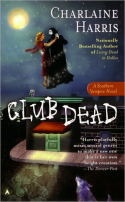
Club Dead by Charlaine Harris

October 8, 2011 by Michelle Smith

From the back cover:
There’s only one vampire Sookie Stackhouse is involved with (at least voluntarily) and that’s Bill. But recently he’s been a little distant—in another state, distant. His sinister and sexy boss Eric has an idea where to find him. Next thing Sookie knows, she is off to Jackson, Mississippi to mingle with the under-underworld at Club Dead. It’s a dangerous little haunt where the elitist vampire society can go to chill out and suck down some type O. But when Sookie finally finds Bill—caught in an act of serious betrayal—she’s not sure whether to save him… or sharpen some stakes.

Review:
It’s been more than a year since I promised “Club Dead, coming soon!” at the end of my review of Living Dead in Dallas. I didn’t forget the pledge; it just took me that long to be in the mood for another round of salacious vampire shenanigans. But what better time to revisit the series than Halloween Week? This one was such an improvement over the last, however, that I’m going to make a sincere effort to get caught up on the series.

Part of what makes Club Dead interesting is that there is so little Bill and when there is Bill, he’s wronging Sookie in ways that culminate with her disinviting him from her home. As the book begins, he is working on a top-secret assignment for “the queen of Louisiana” (there’s a lot of detail about the vampire hierarchy in this book) and tells Sookie he’s heading to Seattle to work on it. This turns out to be a lie, as she learns later that Bill is being held captive in Jackson and that he was preparing to pension her off and return to his vampire love, Lorena.

Despite the betrayal, Sookie agrees to help Eric (Bill’s superior, in a manner of speaking) find Bill and is matched up with a brawny werewolf named Alcide Herveaux, who can introduce her to the supernatural element in Jackson. Alcide’s got baggage of his own, so in addition to treading lightly around “the king of Mississippi” and the werewolves the king has hired to search for Bill’s girlfriend (thankfully, he never got her name), they’ve also got to avoid Alcide’s crazy ex, Debbie Pelt.

All of this is fairly entertaining—even if a large amount of the plot is contingent upon guys finding Sookie extremely hawt and wanting to boff her—but it did seem randomly strung-together at times. For example, after Bill is rescued the gang must next prevent the crucifixion of “Bubba” (Elvis in vamp form) and foil a convenience store robbery. I really liked the ending, though, and once again find myself hoping that Sookie will not forgive Bill’s transgressions, now weightier than ever before. Sure, it’s a little ridiculous how many guys are hot for her, but her steamy encounters with both Alcide and Eric are more fun to read than detailed sex scenes starring Bill. (The fact that Eric gets fleshed out a great deal is one of the best aspects of the book, actually.) Plus, Sookie’s reaction to these tempting guys is pretty amusing. “I was not pleased with my moral fiber!”

I find that I haven’t much to say about the book beyond this. It’s diverting and amusing and has even rekindled my curiosity about True Blood. It’s not fair to compare something like this against oh, say, Price and Prejudice, but for this particular genre, it exceeds expectations.

Filed Under: Books, Supernatural Tagged With: Charlaine Harris

License request day: Barbara

October 8, 2011 by David Welsh

Reading a deranged drama by Osamu Tezuka always makes me want to read another deranged drama by Osamu Tezuka. They’re like peanuts. So the recent arrival of Tezuka’s The Book of Human Insects from Vertical (which is awesome) has triggered this craving and sent me on the hunt for the next possible gekiga license from the God of Manga. Fortunately, there’s one that’s already been published outside of Japan that sounds like it would be an excellent follow-up to Insects.

I’m not sure where Tezuka’s two-volume Barbara originated, other than that Kodansha originally published it, but it’s been released in French by the Akata imprint. Like Insects, it’s about a novelist, but that’s pretty much where the similarities end.

The novelist, Yosuke Mikura, is really popular, and two power brokers want to marry him off to their daughters to raise their own profiles. Little do they know that Mikura is kind of a super freak when it comes to amour, and he finds his own romantic prospect in the form of our titular gamin.

Of course, Barbara has her own baggage. She’s described as a “young hippie alcoholic,” which is more than enough on its own to sell me on the title. Tezuka’s weird blend of sympathy and contempt for counter-culture characters is always riveting to read, and it usually results in a number of mean-spirited giggles, at least wherever I happen to be reading.

Better still, translations indicate that Barbara is kind of a bitch and gives our sex-crazed auteur a run for his money. Insects also left me eager to see another complex, difficult woman character emerge from Tezuka’s pen, and Barbara seems to fit the bill. (If she’d just been an inspiring waif, I’d have probably picked Gringo or something like that.)

Don’t get me wrong. I’d still love to read lots and lots of Tezuka’s general-audience work (Rainbow Parakeet comes to mind), but his whack-job seinen will always jump to the top of my to-read pile.

This brings us to a mini-contest. I happen to have a clean, extra copy of The Book of Human Insects, so here’s the deal: email me at davidpwelsh at yahoo dot com with your choice for a Tezuka license request by midnight Saturday, Oct. 15, and your name will go into the hopper to receive said copy of Insects. If you don’t need a copy but still want to weigh in on your Tezuka wish list, leave a comment! Or do both!

Filed Under: LICENSE REQUESTS

Edo Nekoe Jubei Otogizoshi, Vol. 1

October 7, 2011 by Sean Gaffney

By Maru Nagao. Released in Japan by Shonen Gahosha, serialized in the magazine Nekopanchi. Released in the United States by Shonen Gahosha on the JManga website.

I’m not sure I’ve come across a title at JManga that so typifies what I wanted from the site – at least intellectually. This is a cat manga. From a magazine devoted entirely to cat mangas. About supernatural cat stories in the Edo period. And no, it’s not particularly adorable, though the cats can be cute. It’s not meant for a casual fan. It’s meant for hardcore manga readers who buy this magazine for cats and by god, they will have cats. (It also has one of the flaws of the site, which is the title is in Japanese with no English translation. I don’t mind the Japanese title, but at least tell me what it means. I think Jubei, Cat-Painter of Edo is close to an approximation.)

The plot is basically a series of supernatural mysteries, wrapped around our hero and his yokai cat-spirit. Jubei is a wandering painter, who specializes in painting cats – more specifically, a painting of a cat that will terrify the nice and other creatures from the Edo home. One reason his paintings are so good is they are semi-sentient, thanks to the magic of Nita, the aforementioned cat-spirit, who infuses the painting with some of his essence. We learn a little bit about Jubei as we go through this first volume, but for the most part the stories are about various cat owners, and the trials and tribulations they are going through with their pet. Jubei happens to be around at the time, and takes it upon himself to solve the mystery.

It was hard when I first read this not to think of Natsume’s Book of Friends. The art style is very similar, and a man and his wandering cat spirit solving mysteries, many of them featuring ghosts, also rings very close to home. But we aren’t really all that connected to Jubei the way we are to Natsume. Jubei seems to drift through the manga as he does through Edo. He has several admirers (a few women throughout are clearly attracted to him, but nothing comes of it), and is in fact the Edo Period’s version of a bishonen, complete with the hair, which the artist mentions is out of period but she didn’t want to cut it. I expect as we get more volumes we’ll learn about his backstory with Nita and see some depth, but the lead character is not the reason to read this manga.

On the other hand, the stories themselves are very well done. Sometimes a bit melodramatic, and designed to pull on the heartstrings of cat lovers, but that’s okay. You’re hear to read about cats being adorable, so some extent. Admittedly, there’s a lot more of cats being mysterious or aloof than there is adorable, but that’s okay. We see a cat who sacrifices his life to save his owner’s sight; a young man who realizes his cat may be MORE than just a cat; a pretty tea-shop worker with a tragic cat past; a stoic courtesan whose cat never leaves her side; and a samurai who is terrified of cats due to a haunting from when he was a child. Even the last story, which is mostly about a young man who’s about to be disinherited and is sent to Jubei’s master to try to find a profession, ends up being about how to paint cats, and how cat’s bodies move. You can’t say this doesn’t cater to its audience.

This is, I believe, the first Shonen Gahosha title we’ve ever seen over here that is not from their seinen otaku magazine Young King OURS. They really only have a few demographics as a publisher: Young King/Ours readers, porn readers (their Young Comic titles), and Nekopanchi, the magazine this title runs in. I’m happy to see something from the latter, which, as has been noted, is a classic example of something that would never otherwise have been licensed in Japan. Recommended, even if you’re not a cat lover.

Filed Under: REVIEWS

Gandhi: A Manga Biography

October 6, 2011 by Katherine Dacey

British historian Phillip Guedalla famously described biography as “a very definite region bounded on the north by history, on the south by fiction, on the east by obituary, and on the west by tedium.” Were I to locate Gandhi: A Manga Biography on Guedalla’s map, its longest borders would be to the south and west: it’s both contrived and dull, a series of historical tableaux that do little to reveal Gandhi’s true humanity.

Most of the book’s problems stem from its scope, as author Kazuki Ebine attempts to cover Gandhi’s entire life in a mere 192 pages. Ebine treats us to brief glimpses of Gandhi’s childhood, when Gandhi was first exposed to the injustices of India’s caste system; his time in England, where he studied law; his time in South Africa, where he challenged the government’s classification of Indians as second-class citizens; and his time in India, where he used strikes, boycotts, and other forms of non-violent resistance to protest English rule.

Though Ebine carefully inserts major historical figures into the narrative, none of them are treated as individuals. Some are straw men, representing unenlightened points of view, while others are apostles, converted to the cause through the power of Gandhi’s words. Even Gandhi’s wife is relegated to a minor supporting role; her primary function within the narrative is to patiently reflect on her husband’s inherent courage and goodness, rather than interact with him as a partner, friend, confidante, or lover. (“Your duty is to lead people in a right direction,” she solemnly informs Gandhi.) Ebine attempts to portray her as the one person who truly knew Gandhi, but the relentless pace of the story prevents him from showing the natural evolution of their relationship.

The script is equally problematic, abounding in typos and grammatical errors. (“Pease enjoy this humble farewell party for you,” one character tells Gandhi.) The problems extend beyond mere editorial sloppiness: the dialogue would have benefited from a vigorous re-write, as it sounds more like a poorly translated Power Point presentation than natural conversation. In one crucial scene, for example, a young South African man confronts Gandhi with what amounts to an eighth grader’s gloss on the crisis in South Africa. “When I first heard your speech, I was so inspired as if you boiled in my blood!” he declares. “No one else has tried to rise up against the whites. As Indians, we have decided to fight together beyond the differences in religions.” Another character tells Gandhi, “By revoking Indians’ right to vote, they try to shut our mouth up regarding sovereignty” — an indignity up with which he will not put.

The biggest disappointment, however, is that Ebine makes such uninspired use of the comics medium. The artwork is plain and lifeless, relying too heavily on computer shortcuts and pre-fab backgrounds to create a genuine sense of place or time. Though Ebine depicts numerous violent confrontations, most of the layouts are an unvaried parade of talking heads addressing assemblies and conducting back-room negotiations. To judge from the characters’ facial expressions, these scenes are meant to be as dramatic as the brawls and massacres, but the monotony of the presentation robs these scenes of specificity and urgency.

The bottom line: readers who want an overview of Gandhi’s life and work may find this slim volume helpful, but readers hoping to move beyond what Mark Twain called the “clothes and the buttons of the man” will be sorely disappointed.

Review copy provided by Penguin Books.

GANDHI: A MANGA BIOGRAPHY • BY KAZUKI EBINE • PENGUIN BOOKS • 192 pp. • NO RATING

Filed Under: Manga, Manga Critic, REVIEWS Tagged With: Biography, Gandhi, Penguin

Gandhi: A Manga Biography

October 6, 2011 by Katherine Dacey 7 Comments

British historian Phillip Guedalla famously described biography as “a very definite region bounded on the north by history, on the south by fiction, on the east by obituary, and on the west by tedium.” Were I to locate Gandhi: A Manga Biography on Guedalla’s map, its longest borders would be to the south and west: it’s both contrived and dull, a series of historical tableaux that do little to reveal Gandhi’s true humanity.

Most of the book’s problems stem from its scope, as author Kazuki Ebine attempts to cover Gandhi’s entire life in a mere 192 pages. Ebine treats us to brief glimpses of Gandhi’s childhood, when Gandhi was first exposed to the injustices of India’s caste system; his time in England, where he studied law; his time in South Africa, where he challenged the government’s classification of Indians as second-class citizens; and his time in India, where he used strikes, boycotts, and other forms of non-violent resistance to protest English rule.

Though Ebine carefully inserts major historical figures into the narrative, none of them are treated as individuals. Some are straw men, representing unenlightened points of view, while others are apostles, converted to the cause through the power of Gandhi’s words. Even Gandhi’s wife is relegated to a minor supporting role; her primary function within the narrative is to patiently reflect on her husband’s inherent courage and goodness, rather than interact with him as a partner, friend, confidante, or lover. (“Your duty is to lead people in a right direction,” she solemnly informs Gandhi.) Ebine attempts to portray her as the one person who truly knew Gandhi, but the relentless pace of the story prevents him from showing the natural evolution of their relationship….

Read More

Filed Under: Manga Critic Tagged With: Biography, Gandhi, Penguin

Library Wars Volume 6

October 6, 2011 by Anna N

Library Wars is a predictable yet cozy series. There’s no doubt that Iku and Dojo are going to wind up together, and the plot does meander around their relationship with some cursory treatment of intellectual freedom and censorship issues. What I’ve really liked about the past two volumes is that instead of setting up predictable and artificial plot devices to keep the hero and heroine apart (Sudden Fiance! Artificial Misunderstanding! Evil Male Model!) the focus is on some of the secondary characters, giving us a chance to get to know the other characters better. The last volume focused on Komaki and this volume highlights Iku’s roommate Shibazaki.

Shibazaki has always been an interesting foil for Iku. She’s incredibly intelligent and self-possessed, which serves as a contrast to Iku’s impulsive and emotional behavior. Hikaru Asahina, a library patron, abruptly asks Shibazaki out and she agrees to see him after being pushed into the situation by a co-worker who is worried that her own crush is nursing some feelings for Shibazaki as well. Shibazaki thinks Asahina is a nice young man, but she becomes more interested when he mentions that he’s involved in studying issues centered around book burning. Asahina manages to crack through Shibazaki’s well-rehearsed facade. Some of his qualities remind Shibazaki a little bit of Iku, and we learn why she has a tendency to become attached to people who conduct their lives without pretense. Shibazaki was targeted by a bunch of mean girls in junior high, so in high school she dedicated herself to becoming popular with a cool and intellectual approach that resembled the practices of an undercover agent. Shibazaki’s personality traits of teasing reserve and constant deflection suddenly make a lot of sense!

Sibazaki’s slow approach to making another genuine friend is set against another storyline where everyone else in the library forces deals with a censorship issue. I thought this was a strong volume of Library Wars. The Shibazaki storyline was fresh and interesting, but there was plenty of Iku and Dojo action when they were dealing with the latest crisis of the week. I’m looking forward to the next volume.

Filed Under: UNSHELVED

Off the Shelf: Bakuman, Seiho, Geek

October 6, 2011 by MJ and Michelle Smith 5 Comments

MJ: *Brrrrr* It’s cold up here!

MICHELLE: It is extremely nice down here! Long-sleeve-shirt weather at the most.

MJ: *whimper*

MICHELLE: Don’t feel too bad; at least you’ve got takoyaki. Fat chance of ever finding that down here!

MJ: I will cling to fried octopus as the one virtue of my region. So, read any manga this week? With or without takoyaki?

MICHELLE: I read a fair bit, but it was takoyaki-free. This included volumes six and seven of Bakuman。, a series about two boys’ quest to achieve manga stardom that I seem to enjoy more and more with each installment.

In volume six, Moritaka Mashiro and Akito Takagi are working hard on their manga series when Mashiro suddenly collapses. His ailment is treatable but requires three months in the hospital, during which time their series goes on hiatus. Pretty much this entire volume is people arguing whether Mashiro should be allowed to draw while in the hospital, then whether the terms for the series coming off hiatus are fair. Mashiro eventually regains his health, but in the beginning of volume seven, they receive the bad news that the hiatus has dealt a blow to the popularity of their series and it has been canceled. Dubious about the advice they’re getting from their editor, the boys dive into the process of getting a second series serialized. This volume is mostly full of arguments about which one they want to do, what their editor wants them to do, etc.

And you know what? It’s all awesome. I love that Bakuman。 is able to achieve such dramatic tension over concepts like “What if the series that gets the go-ahead is not the one they really want to do?” or “Is Mashiro actually right to insist on a serious story? Is their editor right? Or is he incompetent?” I suppose these might not sound like riveting plots to some, but they kept me turning pages like a mad fiend and when I finished I wished there were more, which brings Bakuman。 into the elite company of series like Slam Dunk, which leave me actively pining for another volume.

The characters have also matured a great deal, both intellectually and physically, which is something this series has in common with another title with art by Takeshi Obata, the much-loved Hikaru no Go. Their attitudes toward women are much different now, for example, and I especially like how Takagi is now so candid about how much he values his girlfriend Miyoshi’s advice and includes her in everything that’s going on. Mashiro, meanwhile, is getting somewhat feistier, and if I had a nickel for every time the antics of kooky rival/friend Eiji Nizuma made me smile fondly, I could at least afford a taco.

MJ: I really enjoyed this volume as well. I wasn’t as keen on the subplot with Aoki and possible girl complications for Takagi, but in a way this is a positive sign. It’s taken me a while to care a lot about Takagi and Mashiro’s fates as artists (instead of gravitating towards supporting characters), but that’s what I was focused on here. I love the conflict with their editor, and I can’t wait to see how their final decision pans out.

MICHELLE: Y’know, one of the critiques Eiji tosses off about their work is that the characters they create lack heart, and I think that in some respects Mashiro and Takagi did, too, at first. Now I’m beginning to see them more as fully realized characters and that makes all the difference.

MJ: Well, I started off my week with the final volume of Kaneyoshi Izumi’s Seiho Boys’ High School! This was, in fact, my pick of the week, and there are a number of reasons why.

The focus of this volume is Maki’s relationship with Erika, which is on the rocks, particularly as Maki begins to suspect that she’s seeing Kamiki on the side. This kind of thing is nothing new in shoujo (or anywhere else), but what’s really refreshing is the way it all plays out. Nothing is as simple as it seems, and love can’t possibly conquer all, especially for two kids just barely figuring out who they are. Most high school romance tends to pretend like young love is forever, and those that don’t usually lean towards either intense cynicism or melodramatic angst.

Seiho goes in none of these directions. It acknowledges the inherent transience of most teen romances while really giving the characters their due. Maki and Erika are both hurting and both wrong, but they’ve got real futures in front of them, with or without each other.

This series really has been a surprise from start to finish. Originally, it was fresh, funny, and surprisingly candid about the true personalities of teen boys. It’s still those things, but also it’s become really poignant, in the manner of some of the best recent shoujo, like Sand Chronicles and We Were There. I wish it was a bit longer, so we could see what happens when Maki gets out of school, but ending here does make this a nice, relatively short series.

The extra story included at the end of the book is less my cup of tea, so I was pretty sad to realize that it would take up a full quarter of the volume. But it’s not like I would have gotten more Seiho without it, so I can handle the disappointment.

MICHELLE: I have been terribly remiss regarding Seiho, but there just came a point where six of the eight volumes were already out and I figured, “Might as well wait.” Seeing it compared to such standouts as Sand Chronicles and We Were There makes me even more eager to experience it. I really adore strong, subtle shoujo like this that manages to transcend all those shoujo clichés without ever once sacrificing its essential shoujoness.

MJ: I do too, and I didn’t really expect that in Seiho. The series was really a surprise.

So, we’ve both read the next selection, and given your opinion of the first three volumes, which I think was a bit different than mine, I’m pretty interested to see what you think of volume four of My Girlfriend’s a Geek. Wanna hit us with a quick summary?

MICHELLE: I’ll do my best!

So, college student Taiga has been dating his fujoshi girlfriend Yuiko for a while now and has gotten to know her well enough to realize that she will immerse herself in scandalous BL fantasies if he tells her he’s begun to tutor a middle-school boy who embodies the very definition of an uke. So, he keeps this quiet, and the evasions plus his distance while he works to get into his desired program at school finally prompts some genuine response from Yuiko’s part. They have a long-overdue conversation in which Taiga is able to get some things off his chest, and finally it seems like there may be some genuine hope for their relationship.

What I most wanted from the first three volumes was to see Yuiko and Taiga really engage each other, for Yuiko to seem fully present in the real world, and we finally get that here. Her attempts to get Taiga’s attention, when all she’s doing is irritating him by distracting him from her studies, were extremely sympathetic, and I felt I was finally getting a glimpse at her perspective of their relationship. I had previously read it like she was going overboard with her fujoshi tendencies, but now I realize that she’s just been teasing him half the time, hoping to get an amusing rise out of him. Okay, this still isn’t much fun for Taiga, but it helps me to understand her.

MJ: I think I enjoyed the first three volumes more than you did, or maybe just as someone who has been heavily involved in a similar type of fandom as Yuiko, I could relate to it all on some level. What was missing for me, though, was some sense of what they really meant to each other—that they were really boyfriend and girlfriend—and I finally feel like I got that here. With both of them feeling insecure in the relationship but also anxious to save it, I finally feel like I really know where they stand with each other.

I think where we may not quite see eye-to-eye here, though, is on what Taiga gets from the relationship. I appreciated that he actually *said* in this volume that he found indulging her whims “kind of fun” because, honestly, it’s felt like that to me from the start. Sure, he complains about it all, but he gets genuinely caught up in it sometimes, and I can’t help but feel that he wouldn’t keep up with it all if he didn’t enjoy being pushed into her fantasies a bit. And I’m glad to see that in him, because it’s a lot more interesting than a story about a guy who just has what we might expect to be typical straight boy reactions to everything she does. It makes the relationship feel more real to me, too.

MICHELLE: I see that in Taiga now, but I interpreted his behavior in earlier volumes as sort of… mollifying Yuiko because he wanted to have a hot older girlfriend. He wasn’t repulsed, but he was puzzled and overwhelmed by her fervor. Now, though, it seems more like he really gets Yuiko as a person. I love the scene near the end where he’s studying and she compliments him—possibly for the first time without a personal agenda—and he reveals he’s working on the BL novel for her again. How her face lights up! It’s not as if I would ever expect her to not be herself, but it seems like she’s going to take her friend’s example to heart and really appreciate having found a guy who’s willing to actively indulge her.

What it boils down to is that they just make a lot more sense to me now as a couple. I look forward to the final volume!

MJ: I agree, I’m really looking forward to the final volume, and I may even wish there were more! I’m interested in digging into the novels as well. My original expectations for this series were very low, and it has easily exceeded them.

MICHELLE: I was originally more interested in the novels, but having seen the excerpt at the end of the first manga volume, now I’m not so sure. The Taiga equivalent seems awfully spazzy.

I should note here, too, that mangaka Rize Shinba’s BL manga is also enjoyable. You and I have reviewed Intriguing Secrets and My Bad for BL Bookrack with favorable results.

MJ: Well, you know me, I’ve never had a problem with “spazzy.” And yes, I do recall that we’ve enjoyed Shinba’s BL. I guess she’s probably got some personal insight to offer to these adaptations.

MICHELLE: Seems like!

Filed Under: OFF THE SHELF

  • « Go to Previous Page
  • Page 1
  • Interim pages omitted …
  • Page 3
  • Page 4
  • Page 5
  • Page 6
  • Page 7
  • Go to Next Page »
 | Log in
Copyright © 2010 Manga Bookshelf | Powered by WordPress & the Genesis Framework