• Skip to primary navigation
  • Skip to main content
  • Skip to primary sidebar
  • Home
  • About Us
    • Privacy Policy
    • Comment Policy
    • Disclosures & Disclaimers
  • Resources
    • Links, Essays & Articles
    • Fandomology!
    • CLAMP Directory
    • BlogRoll
  • Features & Columns
    • 3 Things Thursday
    • Adventures in the Key of Shoujo
    • Bit & Blips (game reviews)
    • BL BOOKRACK
    • Bookshelf Briefs
    • Bringing the Drama
    • Comic Conversion
    • Fanservice Friday
    • Going Digital
    • It Came From the Sinosphere
    • License This!
    • Magazine no Mori
    • My Week in Manga
    • OFF THE SHELF
    • Not By Manga Alone
    • PICK OF THE WEEK
    • Subtitles & Sensibility
    • Weekly Shonen Jump Recaps
  • Manga Moveable Feast
    • MMF Full Archive
    • Yun Kouga
    • CLAMP
    • Shojo Beat
    • Osamu Tezuka
    • Sailor Moon
    • Fruits Basket
    • Takehiko Inoue
    • Wild Adapter
    • One Piece
    • After School Nightmare
    • Karakuri Odette
    • Paradise Kiss
    • The Color Trilogy
    • To Terra…
    • Sexy Voice & Robo
  • Browse by Author
    • Sean Gaffney
    • Anna Neatrour
    • Michelle Smith
    • Katherine Dacey
    • MJ
    • Brigid Alverson
    • Travis Anderson
    • Phillip Anthony
    • Derek Bown
    • Jaci Dahlvang
    • Angela Eastman
    • Erica Friedman
    • Sara K.
    • Megan Purdy
    • Emily Snodgrass
    • Nancy Thistlethwaite
    • Eva Volin
    • David Welsh
  • MB Blogs
    • A Case Suitable For Treatment
    • Experiments in Manga
    • MangaBlog
    • The Manga Critic
    • Manga Report
    • Soliloquy in Blue
    • Manga Curmudgeon (archive)

Manga Bookshelf

Discussion, Resources, Roundtables, & Reviews

Archives for August 2011

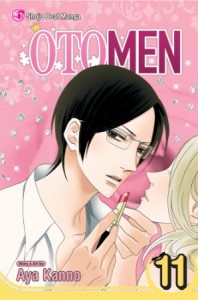
Otomen, Vol. 11

August 8, 2011 by Sean Gaffney

By Aya Kanno. Released in Japan by Hakusensha, serialization ongoing in the magazine Bessatsu Hana to Yume (“Betsuhana”). Released in North America by Viz.

Well, in my review of Volume 10 I asked for an end to these ‘minor villains’ coming in to try to de-Otomen our hero, and do a degree I got that. But that’s because the series main villain makes her big return. Asuka’s mother is back, and she is not about to let her boy do anything girly whatsoever. But that’s not till 2/3 of the way through this volume. First we have to finish off the cycle of teachers who were brought in to clean up the school.
When we left our heroes, they were on a field trip to learn to become perfect samurai and geisha. Unfortunately, a landslide has destroyed the only way out to get food and supplies, and trapped them. Luckily, our heroes are not content to let gender stereotypes get in their way! Asuka creates festival decorations to distract the class, while Ryo goes hunting for giant fish, having earlier proven that she can’t be trusted with mushroom gathering. She also rescues an injured Tonomine, and in general is pretty badass. (Given I’ve whined about her so much in the past, I will grant her this.) She also cleans up nicely when she goes dancing with Ryo later.

The best chapters in the manga are the ones back at school dealing with Valentine’s Day, which naturally leads to another Otomen challenge, this one disguised as it’s based around punishing an anonymous person who wrote soppy romantic poetry. Asuka steps in to stop the punishment, and finds himself battling the school nurse, Oji, who is not only handsome and sexy, but also exudes pheromones to make all the girls fall for him. Asuka has merely his natural charm, handsomeness, and politeness to fall back on.

It’s a tough battle, especially as Ryo has seemed distant and keeps brushing him off. (If you’ve guessed what she’s doing, you’re right – this is Otomen. Surprises in the plot are for other manga.) But in the end, Asuka realizes that the shallowness of this competition is not for him, and throws it by giving all the chocolates back (notes he grabs each chocolate from a huge pile and remembers who gave it to him exactly), as the only ones he can accept are from Ryo, who of course has spent the last few days making her lethal chocolate for him. Awwwwww.

Unfortunately, after this we hit our Worst Case Scenario – Asuka’s mother is back, taking over the school as Kasuga and his squad of teachers failed. So Asuka is back to desperately hiding everything, which is even more unfortunate given there’s a class in teaching men how to bake cakes going on! This is the most cliched of the chapters, but does continue to lean on some heavy foreshadowing, and of course I can’t hope for his mother to give in right away, as otherwise where would the plot tension be?

The manga ends with a sample of the first chapter of Love Chick, Juta’s manga based on Asuka and Ryo only gender reversed. It’s a good thing it’s only fictional, as I found it quite dull. Oh well. More importantly, Otomen has now caught up with Japan, which mean we won’t get another volume for 6 months. So I hope you didn’t mind the cliffhanger. As ever, I want slightly more out of Otomen than what it gives, but an reasonably happy with it regardless.

Filed Under: REVIEWS

Comics Poll. List. Thing.

August 8, 2011 by MJ 14 Comments

If you’re a regular reader of comics blogs, I’m sure you’ve heard the news!

According to a consensus of 0.000003 % of the world’s population (no, really, I looked it up) these 115 titles are the best (or perhaps most universally favored) comics. That’s 211 of the 6,954,167,299 estimated people in the world, who of course don’t actually even agree with each other, since no single comic received more than 50 votes. Whether any one person who voted has read every comic that was nominated between all 211 people (or even every single comic in the top 115) let alone every comic ever published in the world is anyone’s guess, but I’m going to go with “probably not.”

So what we really have here is an extremely tiny subset of the world’s population reporting that, of the comics they’ve read, these are the ones that no more than a quarter of them agree might be the best.

Don’t get me wrong. I’m not trying to ridicule this process, by any means. I am one of the 0.000003 %, after all! I’m just offering my perspective, and perhaps some insight on why I don’t personally place a lot of value on lists like these, at least as a tool for evaluating art. Lists like these can be interesting and even revealing (I think this one is both), but ultimately they tell us more about the people who voted than they do about whatever it is that’s being voted on. And though I’m all for creating opportunities for people to discuss their favorite or most admired comics, I will say outright that I don’t believe that it is actually possible to determine the 10 (or 100 or 1000) best comics, or the best anything that must be subject to human opinion alone. There are no scientific benchmarks by which to measure creative work—no speed tests to run or performance goals to reach. Just as each person who creates comics brings his or her individual passions and values to the work, each person who considers comics does the same, which is why even among a minuscule 211 people, no more than 50 can agree on the relative value of a single work, or probably even what “value” means in the first place.

So, let’s clarify again. What this poll represents is an extremely tiny subset of the world’s population reporting that, of the comics they’ve read, these are the ones that no more than a quarter of them agree might be the best, based on their individual backgrounds, values, artistic sensibilities, ages, genders, philosophical mindsets, and personal standards for the medium.

Personally, I think this is great. For me, this lack of agreement is meaningful in itself, and goes a long way towards illustrating why I think art, in all its forms, is so valuable in the first place. But it also illustrates why I value individual opinion more than group consensus, both personally and as a tool for posterity, as difficult as those may be to retain over time. While it’s interesting to note the results of a poll like this, and I’ll probably take a look at a few of the recommended works I’ve missed, as a whole, I can’t help feeling that this list has very little to do with me. That’s not a reflection on this list (I’m quite enjoying the discussion around this list), but rather on all lists of this kind. Because when it comes to art, in the end, I’m interested in pursuing the threads most meaningful to me, which I’m more likely to discover with the help of like-minded individuals than I am through majority opinion, even when that majority consists of only fifty or so people.

With that in mind, it should come as no surprise that my real interest in this poll is in the individual results, which have begun to be published today! Check out the first group of individual lists at the Hooded Utilitarian here—a group which, thanks to the power of alphabetical order, happens to include mine.

Given my relatively narrow background in comics (almost exclusively manga & manhwa, and even then just what I’ve been able to read over the course of a few years), it would have been ludicrous for me to attempt a list of “best” comics, so I went for “favorite” (as allowed by the poll’s rules). And since “favorite” is an incredibly fluid thing with me, based on an ever-shifting multitude of factors, I must also qualify this as “favorites in the moment.”

Here was my list (including attached notes):

A fairly arbitrary list of ten of my favorite comics, subject to change at any particular moment, and in no particular order:

Hikaru no Go by Yumi Hotta & Takeshi Obata
Please Save My Earth by Saki Hiwatari
Banana Fish by Akimi Yoshida
Paradise Kiss by Ai Yazawa
Flower of Life by Fumi Yoshinaga
Ode to Kirihito by Osamu Tezuka
Wild Adapter by Kazuya Minekura
Fullmetal Alchemist by Hiromu Arakawa
Tokyo Babylon by CLAMP
Maison Ikkoku by Rumiko Takahashi

With one major exception, I restricted this list to completed series (or, at least, completed in Japan, and very nearly completed here).

I might also note that, with one and a half exceptions, my choices were all created by women. Make of that what you will. Possible twinge of regret: not including Bloom County.

Whatever you think about “best of” polls, comics, or any of this at all, the conversation is lively at The Hooded Utilitarian, so do check it out! And keep an eye out at HU over the next week or so, for more essays (look, Shaenon Garrity’s posted one about female cartoonists just today!) and individual results!

Edited to add: In the event anyone’s interested, here’s where I talk (sometimes with others) about some of the comics on my list: Hikaru no Go, Please Save My Earth, Banana Fish, Paradise Kiss, Flower of Life, Ode to Kirihito, Wild Adapter, Fullmetal Alchemist, Tokyo Babylon. It’s interesting to note that the one series on the list I’ve never written anything substantial about (Maison Ikkoku) is the only one that made the top 115. I guess I’d better fix that!

Filed Under: UNSHELVED Tagged With: best comics, polls, the hooded utilitarian

Pick of the Week: 13th Boy & More

August 8, 2011 by Michelle Smith, Sean Gaffney, MJ, David Welsh and Katherine Dacey 4 Comments

It’s a Yen-heavy week at Midtown Comics! See how the Manga Bookshelf blogger picks stack up below!


MICHELLE: Although VIZ Media and others make a decent showing on this week’s release list from Midtown Comics, the majority of the titles hail from Yen Press. Unfortunately, most of them are the latest volumes in series I don’t personally follow, but there is one shining gem, the eighth volume of the quirky and fun manhwa, 13th Boy. I recently indulged in a binge and got caught up on the series, so I’m looking forward to keeping current with new releases. When we left off, Beatrice, heroine Hee-So’s talking cactus, was stuck in his human form and living with his creator lest he burden his beloved owner with his troublesome presence. I never thought I’d be rooting for a cactus to win the girl of his dreams, but it’s to 13th Boy‘s credit that this seems like an entirely rational thing to do.

SEAN: I already pimped Book Girl and the Captive Fool on my Manga The Week Of post, so will stop myself doing so again, even though it’s a fantastic novel series that everyone should be getting. Instead, I’ll go for the 4th and last of Higurashi When They Cry: Eye Opening Arc, which concludes the ‘Shion’ arc of the manga based on visual game series. This particular arc has a reputation of being one of the bloodiest and most off-putting, and therefore I expect getting through the last volume will be quite a haul for me, as generally speaking I tend to avoid gore. As always, though, Higurashi’s intense plot and taut emotions pull me in, and if it upsets me too much, I’ll remind myself of the reset button and Rena’s arc beginning in October.

MJ: I’d like to say that I’m torn this week, with the latest volume of Blue Exorcist on the way, but I’m not. I’m with Michelle, all the way. 13th Boy is one of my favorite girls’ comic series being published today, and one of the few series I’ll put aside everything to read the moment it lands on my doorstep. It’s just that charming. SangEun Lee has managed to create a heroine who really is just an “ordinary” girl, while reminding us how idiosyncratic and genuinely relatable “ordinary” can be. Also, as Michelle mentioned, it’s the first time ever I can recall actively ‘shipping someone with a cactus. I wholeheartedly recommend 13th Boy.

DAVID: I’m going to be predictable and take up the Blue Exorcist mantle. You can see my specific opinion of the third volume in this week’s Bookshelf Briefs, but I will note that Kazue Kato becomes more assured with this material with each new volume. It’s not perfect fantasy adventure, but it’s certainly the best example to debut lately, and it’s got some great, root-worthy characters.

KATE: Though I also share the group’s enthusiasm for Blue Exorcist and 13th Boy, I’m going to recommend the latest omnibus of InuYasha. Readers familiar with the anime will want to pick us this particular volume, as it features the beginning of the series’ best-loved story arc: The Band of Seven. There’s also a plotline involving Sesshomaru — always a plus in my book — and a memorable showdown between InuYasha and a faceless demon. And if you still need persuading, let me praise VIZ for giving InuYasha the deluxe treatment it deserves, printing it on good quality, over-sized paper, retouching the artwork, and reproducing the original Japanese covers in full color.


Readers, what looks good to you this week?

Filed Under: PICK OF THE WEEK Tagged With: 13th boy, blue exorcist, higurashi why they cry, inuyasha

Bookshelf Briefs 8/8/11

August 8, 2011 by MJ, Michelle Smith, David Welsh, Katherine Dacey and Sean Gaffney 4 Comments

This week, MJ, Michelle, David, Kate, & Sean check out recent releases from Viz Media, Vertical, Kodansha Comics, Dark Horse, & Yen Press.


13th Boy, Vol. 8 | By SangEun Lee | Published by Yen Press – At my age, it isn’t often that a teen romance comic can really make me angst over which potential suitor its heroine should ultimately end up with. Most of the time, these conclusions are obvious, and even when they’re not, it’s difficult for a writer to make even one romantic prospect interesting enough for this jaded forty-something to genuinely root for, let alone two or three of them. Not so with manhwa-ga SangEun Lee, whose love interests each suit her quirky heroine uniquely, even if one of them is actually a sentient cactus. That said, here in volume eight, it’s hard not to root pretty exclusively for the cactus. Charming and idiosyncratic as always, 13th Boy remains one of the freshest, most imaginative girls’ comics currently in publication. Highly recommended. – MJ

13th Boy, Vol. 8 | By SangEun Lee | Published by Yen Press – I feel like I’ve talked a lot about the inventive whimsy of 13th Boy, and been derelict in extolling its dramatic virtues. This volume is more of a setup for future fallout, but readers can still anticipate the inevitable (and major) repercussions to come. Hee-So begins the volume so worried and depressed about her missing cactus, Beatrice, that she can’t even summon the energy to bathe. When Won-Jun visits, he gets the impression that Hee-So feels she can’t rely on him for help, and so turns toward the desperately dependent Sae-Bom, who is being sent to live with her father in America and asks him to come along. I love that, despite its fanciful elements, 13th Boy can serve up realistic drama like this wherein it’s the characters’ choices and personalities that have led to the deterioration of a relationship. I am seriously pining for volume nine already. – Michelle Smith

Black Jack, Vol. 15 | By Osamu Tezuka | Published by Vertical, Inc. –For my money, every volume of Black Jack has a “price of admission” story, and I always like to identify them. This time around, it’s “A Cholera Scare.” The title alone is endearing, and the story has plenty of other aspects working in its favor. First and foremost is the fact that it heavily features Black Jack’s creepy assistant and ward, Pinoko. While Black Jack worries that he’s contracted a potentially deadly contagion, Pinoko is left to deal with a walk-in patient at the clinic. The story is constructed and timed in some really imaginative way, and Tezuka packs an awful lot into a mere 20 pages. While individual Black Jack stories can vary in quality, there’s always at least one that justifies the purchase. – David Welsh

Blue Exorcist, Vol. 3 | By Kazue Kato | Published by Viz Media –Like so many of my favorite fictional institutions of learning, the True Cross Academy displays a reckless disinterest in the safety of its student body, especially the ones pursuing the exorcist track. In this volume, our principle characters deal with an aggressive new instructor and a potentially deadly field trip. Relationships are tested! Secrets are revealed! A kitty joins the supporting cast! In other words, Blue Exorcist continues to improve. Kato even works up the nerve to invoke the events of the first, terrible chapter of the series, and she gets away with it. The underlying plot of the series is probably its least successful element, but that hardly matters chapter by chapter. I like the characters and the scenarios Kato invents for them, and the art is always clean and interesting. – David Welsh

Blue Exorcist, Vol. 3 | By Kazue Kato | Published by Viz Media – Blue Exorcist is an interestingly mixed bag. Like Joss Whedon’s television epic, Buffy the Vampire Slayer, the series uses an over-the-top supernatural premise as a metaphor for the real horrors of a troubled teen, struggling to overcome his personal demons so that he might finally have a taste of life’s most precious treasures—friends, family, and a sense of real belonging. Unlike Whedon, mangaka Kazue Kato fails to make her story’s supernatural plotline genuinely compelling, but the rest works so well, this hardly matters. This volume gets off to a particularly strong start, as brothers Rin and Yukio work together to quell the grief of Father Fujimoto’s abandoned familiar, and continues to gain momentum throughout. Extra points to Kato for clear, readable action scenes and saving the life of a cat. Recommended. – MJ

Fairy Tail, Vol. 14 | By Hiro Mashima | Published by Kodansha Comics –First off, I’m pleased that the ‘take out all the female members and turn them into hostages’ plot died fast. If only as it leads to a lot of great moments for the female characters in this volume. Erza, of course, gets to show her badassery and why you should never try to outbluff or outthreaten her. Lucy gets to show she’s more than simple fanservice with the help of Loke. Juvia shows she’s still worried about everyone trusting her now that she’s a new member, and gives a good reason why they should. And Levy gets to show that it’s not just hitting really hard that wins these fights.But really, the big climax here is seeing Mirajane lose it, and discovering both what she’s like at full power, and why she tries to avoid it. She’s quite terrifying. Fairy Tail still isn’t the very best shonen out there, but it’s comfortably in the bracket below it.– Sean Gaffney

Fairy Tail, Vol. 14 | By Hiro Mashima | Published by Kodansha Comics – Something I’ve long wished for from Fairy Tail is more information about the members of the guild who aren’t the main characters. Happily, Mashima has concocted an arc that seems specifically designed to provide just that. Laxus, one of the most powerful members of Fairy Tail, has launched a takeover attempt, which involves forcing the guild members to fight each other. It’s unfortunate that many of the female members are sidelined at first, having been turned to stone while competing in a beauty pageant (sigh), but when they are eventually freed, they proceed to kick ass, so that makes up for it a bit. Highlights include seeing Mirajane’s abilities at last and some noble self-sacrifice from Juvia, a reformed enemy who has recently joined the guild. I hope this increased level of involvement from the supporting cast continues in future volumes! – Michelle Smith

I Am Here!, Vol. 2 | By Ema Toyama | Published by Kodansha Comics – When it was announced that Kodansha Comics would be taking over the release of manga they’d licensed to Del Rey, I was really hoping we would get the second half of I Am Here!, an earnest shoujo romance that I found to be surprisingly enjoyable. Happily, it made the cut and now I know for sure that a) Ema Toyama can draw some seriously cute bunnies (seriously) and b) the plot does, in fact, eschew an obvious outcome. It’s too bad Toyama had to utilize a random mean girl as drama instigator at one point, but at least Hikage, the painfully shy heroine, was able to blossom at last and become strong enough to follow her heart. Getting the whole story in two omnibus editions is also pretty durn awesome. – Michelle Smith

Magic Knight Rayearth | By CLAMP | Published by Dark Horse –First of all, unlike the souped up, fancy Card Captor Sakura reprints, there’s no reason for fans who own Tokyopop’s 2nd release of Rayearth to get this one. It’s a very good, decent reproduction and translation – but it’s not the huge advance CCS is. As for the content, it’s still a lot of fun, especially if you aren’t already familiar with the ending. One of CLAMP’s first titles to mix the shoujo and shonen genres, this story of three high-school girls who find themselves called on to save a fantasy world takes itself seriously when it wants to, and makes fun of itself the other times. There’s no amazing characterization here, though I am quite fond of Caldina and her “I’m doing this for the money” attitude. (Note her lack of obsession lets her survive.) But really, it’s the ending that made everyone remember Rayearth, and led to its sequel – it’s a gut punch if you don’t know it’s coming.– Sean Gaffney

Ugly Duckling’s Love Revolution, Vol. 4 | By Yuuki Fujinari | Yen Press – Ugly Duckling’s Love Revolution may be the most tepid reverse-harem manga ever written. The series drifts aimlessly from one uneventful scene to the next, as the characters perfect their swimming technique and attend tag sales. Not only does the story lack dramatic shape, it also lacks memorable characters; each of the boys in Hitomi’s circle is so faultlessly polite and supportive of her weight-loss goals that he comes across as a paid consultant, not a friend. There’s nothing wrong with a manga about nice guys, of course, but authors like edgy characters for a reason: bad boys make more compelling subjects than goody-goodies. Even Hitomi remains a cipher; she’s kind and determined to lose weight, but those two characteristics alone aren’t enough to make her seem like a real girl struggling with a real problem, a shortcoming made all the more obvious by the abrupt, wish-fulfillment ending. – Katherine Dacey

Filed Under: Bookshelf Briefs Tagged With: 13th boy, black jack, blue exorcist, Fairy Tale, i am here, Magic Knight Rayearth, ugly ducking's love revolution

Previews review August 2011

August 8, 2011 by David Welsh

Okay, I normally don’t dwell on this sort of thing, but I just have to make an observation about the covers in the DC section of the current Previews catalog. These are mostly the second issues of the publisher’s big re-launch of its super-hero line presumably to make it more accessible to people who wouldn’t normally pick up a comic about Superman or Batman or Green Lantern. Here’s my observation: the covers of these comics look exactly like these comics have looked for the last twenty years, possibly pinpoint-able right to the late 1990s. So this should be interesting, since it really does seem like an example of the scientific method. If all other things are equal, and DC changes one thing – the volume of back story in play to theoretically confuse or bar a casual reader from entry – will people who did not previously care about the Justice League suddenly start caring about the justice league? Time will tell! Let’s move on to things I will actually purchase!

Princess Knight vol. 1, written and illustrated by Osamu Tezuka, Vertical, Inc., AUG11 1232: The most actually exciting thing in the catalog is the English-language debut of Tezuka’s game-changing shôjo classic. Some of us have been waiting years for this to happen. Years.

Hark! A Vagrant, written and illustrated by Kate Beaton, Drawn & Quarterly, AUG11 1018: Beaton’s super-smart comics “takes readers on a romp through history and literature — with dignity for few and cookies for all — with comic strips about famous authors, their characters, and political and historical figures, all drawn in Beaton’s pared-down, excitable style. This collection features favourite stories as well as new, previously unpublished content. Whether she’s writing about Nikola Tesla, Napoleon, or Nancy Drew, Beaton brings a refined sense of the absurd to every situation.”

Two Generals, written and illustrated by Scott Chantler, Emblem Editions, AUG11 1060: This is the soft-cover edition of Chantler’s acclaimed historical graphic novel.

Tesoro: Short Stories 1998-2008, written and illustrated by Natsume Ono, Viz Media, AUG11 1256: This volume collections some of the earliest professional work by the gifted creator of series like Gente and The House of Five Leaves. So you should probably buy it.

There’s also the 2011 edition of The Best American Comics from Houghton Mifflin. I’ve made it this long without reading one of these, so I doubt my streak will be broken, though the guest editorial duties of Alison Bechdel may make me waver.

And here are new volumes of ongoing series that you should seriously consider buying:

  • Wandering Son vol. 2, written and illustrated by Takako Shimura, Fantagraphics, AUG11 1048
  • Sayonara, Zetsubou-Sensei vol. 11, written and illustrated by Koji Kumeta, Kodansha Comics, AUG11 1107
  • Salvatore vol. 2: An Eventful Crossing, written and illustrated by Nicholas De Crécy, NBM, AUG11 1134
  • Chi’s Sweet Home vol. 7, written and illustrated by Kanata Konai, Vertical, Inc., AUG11 1233
  • Twin Spica vol. 10, written and illustrated by Kou Yaginuma, Vertical, Inc., AUG11 1234
  • Kimi ni Todoke: From Me to You vol. 11, written and illustrated by Karuho Shiina, Viz Media, AUG11 1245
  • The Story of Saiunkoku vol. 5, by Kairi Yura and Sai Yukino, Viz Media, AUG11 1247
  • Real vol. 10, written and illustrated by Takehiko Inoue, Viz Media, AUG11 1255
  • A Bride’s Story vol. 2, written and illustrated by Kaoru Mori, Yen Press, AUG11 1266
  • Yotsuba&! vol. 10, written and illustrated by Kiyohiko Azuma, Yen Press, AUG11 1274

That’s… like… a lot.


Filed Under: FEATURES

Monthly Comic Alive

August 7, 2011 by Sean Gaffney

I’ve spent the past few days down with a nasty cold, one of the worst I’ve had in years. Nausea, coughing, slight fever, weakness, the works. As a result, reviews have been thin on the ground. So I figured that, since I’m *already* ill, what better time to take a look at the August issue of Monthly Comic Alive, from the folks at Media Factory?

Usually whenever I go into NYC I try to get a different manga magazine to try out. Lately I’ve been limited as they’ve stopped carrying some of the really obscure ones, and the choices seem to be limited to the old classics – all the big 3 shonen, Morning/Afternoon/Evening, Big Comic/Original/Superior/Spirits, and Young ______. The remainder, down on the bottom shelf of Kinokuniya’s seinen section, tend to be what I call ‘media tie-in boobie magazines’, where the manga caters to people who like franchises and fanservice. Here you’ll find Kadokawa’s Shonen and Young Ace, for example, or Shonen Gahosha’s Young King Ours. And Champion Red goes here, despite its lack of tie-ins, by its sheer skeeziness.

Media Factory is in general known as an anime company first and foremost. In 1999 they started to put out a manga magazine Comic Flapper, which is still running, and was the home of Dark Horse’s incomplete series Translucent. In 2006 they noted the growing otaku market and started Comic Alive, which oozes otaku from its every pore. I picked up the August issue with trepidation. I mean, look at this cover.

So, knowing I was in for a rough ride, I started to glance through the contents. Let’s see…

It needs to be said, if you want to know what the current otaku kinks are, Comic Alive is a great place to go. Catgirls are in here, of course. As are maids. A lot of maids. Panties, of course. Gotta have lots of underwear. And of course lots of nudity as well. There’s also witches, mainly as half the magazine seems to be fantasy of some sort. Fans of current anime series will find a lot of this familiar, as many of these are current animes, past animes, or future animes. Sacred Blacksmith. Zero no Tsukaima. Sasameki Koto. Boku wa Tomodachi ga Sukunai. MM! Maria Holic. Stein’s Gate. In addition, a good number of those I just mentioned are based off of light novels or games, making it even more franchise bait. And a few of them have ‘side stories’ running in other magazines from other companies.

As I wrote short notes about each chapter I read, one thing kept coming up over and over. ‘Ecchi fantasy’. Not porn, of course, as that would require anyone actually getting lucky, which isn’t going to happen here. But… well, I could probably write a synopsis that would fit 75% of Comic Alive’s stories.

“Kenji, a nondescript ordinary guy, is going to school at Elite Academy, where he finds he is one of only 10 boys in a school almost entirely populated by girls. One day, he discovers that he is the bearer of an awesome power (magic/swordsmanship/being really nice, delete where appropriate), but one that can only be used if he gains power by earning the love and/or affection (really, rubbing against him will do) of at least five different 13-16 year old girls of varying personalities and body types, as long as you have one girl who’s flat-chested and angry and one who is buxom and seductive. Of course, Kenji is a nice guy, so these girls have nothing to fear. As the series goes on, he will come up against bigger villains and more girls, all of whom fall for him and most of whom he meets when he walks in on them changing, or in the shower, or hell, when they wake up naked in his bed. What’s Kenji going to do? How can he possibly decide which girl is his true love and which he just needs to use their affection to power himself up? Especially as he represents so many readers, none of whom will agree. (He’ll probably end up with the angry girl, but let’s hedge our bets and do a side-story in Shonen Ace where he doesn’t.) Soon to be a new anime in the Fall of 2012!”

There are a few bright spots. Sasameki Koto may be a bit more serious than it once was, but its relatively realistic look at a budding yuri couple is a breath of fresh air amidst all the panty shots elsewhere in the magazine. Likewise Himawari-san, another low-key series with a dash of yuri. I was also quite pleased with Suugaku Girl, which is apparently in its third incarnation, and is designed to teach difficult math concepts through the power of moe cat-eared girls. It has some service, but not a lot, and seems to be pretty dedicated to teaching its math (at least from the one chapter I read).

But really, the thing that struck me most about Comic Alive, a magazine devoted to being the go-to point for otaku who like to read more of the same, it’s that there were 4 different series that had 4-koma comedy spinoffs later in the magazine. Zero no Tsukaima, Mayo Chiki, Infinite Stratos, an Aria the Scarlet Ammo *all* have cutesy superdeformed 4-koma series to keep milking the same thing. Presumably as if they had to rely on series that weren’t part of a light novel/manga/anime/game franchise, it would be a very short magazine indeed.

Filed Under: REVIEWS

Uncontested races

August 7, 2011 by David Welsh

I’m sad to announce that there won’t be any Previews-related polls this month. The boys’-love category offered a clear winner, and there weren’t enough dubious debuts to populate that slate. But here are the two books that might have “won” those contests, both of which will be dutifully pre-ordered and reviewed.

About Love, written by Narise Konohara, illustrated by Tomo Ootake, Digital Manga Publishing, originally published as Koi ni Tsuiete by Souryuusha, one volume:

Wedding co-ordinator Asaka could never forget his very first clients. When he meets up once more with that very same client, the man who spends his life arranging weddings for others unexpectedly learns a few things about love himself. Heartwarmingly bittersweet, this is the eagerly awaited English-language debut of mangaka Tomo Ootake!

I know nothing about how eagerly anticipated Ootake’s debut is or isn’t, but that cover is so pretty and expressive that it almost makes me cry. Plus, wedding planner manga! A dream fulfilled!

Love Hina Omnibus Volume 1, written and illustrated by Ken Akamatsu, Kodansha Comics, originally serialized in Kodansha’s Weekly Shounen Magazine, originally published in English by Tokyopop:

When Keitaro Urashima fails his entrance exams to get into Tokyo University for the second time, he’s officially an unemployed and uneducated slacker. To make things worse, his parents have kicked him out of his house. Fortunately, his grandmother owns the fabulous Hinata Lodge and has agreed to take Keitaro in as caretaker. What he doesn’t know is that the lodge is actually a girl’s dorm and he’s the only guy around! Most guys would kill to live with five sexy ladies, but if Keitaro’s not careful, this job will kill him.

I know this series probably counts as a classic in terms of licensed manga, but I just never bothered with it. Now, Kodansha gives me a cheap-ish chance to introduce myself to this well-liked harem comedy. And I seriously didn’t want to run the risk of having to read the Tokyo Mew Mew omnibus. Cat-ears give me hives, unless they’re on an actual cat.

I’ll go through the rest of the month’s highlights tomorrow.


Filed Under: FEATURES

Saturday Spotlight: revisiting NANA

August 6, 2011 by MJ 2 Comments

There are a couple of factors influencing my choice for this week’s Saturday Spotlight. First, following last week’s news regarding the return of Wild Adapter and today’s announcement that CLAMP is resuming Legal Drug, Michelle asks on Twitter, Can we hope for NANA?

Secondly, as some of you may know, I moonlight as a singing/acting coach, and this week I had the unique pleasure of experimenting with some cross-discipline learning while coaching a group of very talented young women. As part of a week-long acting intensive, we spent a day working with scripts pulled from some of my favorite manga—beginning with dialogue only, and then later studying the ways in which the mangaka used the artwork to “direct” the scenes, from one emotional beat to the next, emphasizing the importance of body language and the spaces between the dialogue.

One of these scenes came from the fourth volume of NANA, reawakening my love for the series, and inspiring me to recommend it, at least to the 17+ crowd. Of course, even today, the best tool I have for this is an older post from 2008, Why you should read NANA.

Still the most-viewed post on the site, this “persuasion post” was responsible for my introduction to quite a number of folks in the manga blogosphere, and my feelings for the series have remained mostly unchanged since that time. If you’ve never been sold on NANA, check it out!

Filed Under: Saturday Spotlight Tagged With: nana

License request day: Dragon Zakura

August 5, 2011 by David Welsh

I’ve taken a shine to this week’s license request precisely because it doesn’t really resemble any of my recent wish-list items. It’s also part of an under-a-cloud subcategory, manga that explores the life of the delinquent. A wee handful of the 25 volumes of Hiroshi Takahashi’s Worst ever saw publication in English from Digital Manga. Beloved though it may be by tastemakers, Eiji Nonaka’s Cromartie High School still hasn’t found a new home since the shuttering of ADV.

So what makes me think the commercial prospects are any better for Norifusa Mita’s Dragon Zakura? I actually don’t think it would sell like gangbusters, and I can’t even clearly articulate why I’m eager to read it. All I can say is that I like its magazine provenance – Kodansha’s Morning – and that I find the covers ugly in kind of a mesmerizing way.

But what’s this 21-volume series about? It follows a former motorcycle gang leader turned lawyer decide to turn teacher. He joins the faculty at an on-the-brink-of-bankruptcy school and declares that he will lead at least five of its students to the academic Promised Land: admission to Tokyo University. That the kids are kind of stupid and downtrodden apparently doesn’t bother this academically inclined opportunist.

I can’t quite tell if this is a comedy or a drama, though it seems to lean on the serious side. This is probably a good thing, as the comedic stories of this stripe tend to be things like School of Rock, while the dramas are more like To Sir, with Love, and I can tell you which one I’d rather watch without even a soupcon of hesitation. And Dragon Zakura has won a couple of major manga awards: the Kodansha and the Japan Media Arts Festival Excellence Prize, both in 2005.


Filed Under: LICENSE REQUESTS

Manga on the Big Screen: Love*Com, NANA, and Ping Pong

August 5, 2011 by Katherine Dacey

As anyone who’s seen Green Lantern or Captain America can attest, adapting a comic for the silver screen is an art, not a science. Done poorly, comic book movies alienate fans with the omission of favorite characters and glossing of seminal plotlines, or confuse newcomers with in-jokes and choppy storytelling. Done well, however, comic book movies can appeal to just about anyone who’s receptive to the genre and the characters. VIZ Pictures may not have released as many comic-book movies as DC or Marvel, but its catalog includes adaptations of several popular manga, including Aya Nakahara’s Love*Com, Ai Yazawa’s NANA, and Taiyo Matsumoto’s Ping Pong. These three films make an instructive case study, as they illustrate the pitfalls and potentials of bridging the gap between page and screen.

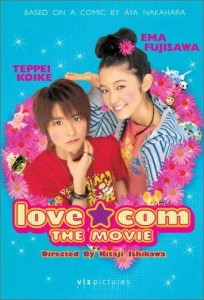
Love*Com: The Movie
VIZ Pictures • 100 minutes • No Rating
Risa, the tallest girl in the seventh grade, develops a crush on Otani, the shortest boy in her class. Though superficial opposites, the two are really kindred spirits, sharing an enthusiasm for Umibozu (a Japanese rap artist that their classmates detest), swapping good-natured insults, and bonding over memories of rejection for being too tall and too short, respectively.

Whether you’ve read Aya Nakahara’s charming manga or not, you won’t have too much difficulty guessing how the story will end. The problem, however, is that Risa and Otani’s journey from bickering classmates to boyfriend and girlfriend seems utterly contrived. The scriptwriter borrows two romantic rivals from different volumes in the series’ run, but only succeeds in making Mr. “Mighty” Maitake, Risa’s handsome homeroom teacher, an integral part of the story. Even then, Mighty’s arrival is a bolt from the blue, and is never satisfactorily explained; he’s simply inserted into the final act of the story so that he and Otani can compete for Risa’s affections. (And when I say “compete,” I mean it: the two play a pick-up basketball game in front of the entire school.)

The other major drawback to Love*Com is its superficial treatment of the principal characters. Though Aya Nakahara’s manga charts the ups and downs of Risa and Otani’s friendship in minute detail, the movie’s frantic pace never allows us to get to know the characters or understand why they’re drawn to each other; we simply see them walk through a variety of stock scenes — cultural festivals, school trips — without actually seeing the evolution of their feelings dramatized.

It’s a pity that the Love*Com script feels so hastily assembled, as the film has the potential to appeal to both long-time fans and newcomers. The button-cute leads have some chemistry, even if the script doesn’t give them much to do. And the script shows flashes of inspiration; a “director” surrogate periodically interrupts the proceedings to explain certain peculiar-to-manga conventions (most notably the nosebleed-as-sign-of-arousal), intoning this information over strains of Beethoven’s Moonlight Sonata. These digressions occur just a few times, but add some much-needed humor to a film that lacks the wit and honesty of the source material.

The verdict: Skip it. This flat, uninspired retelling of Risa and Otani’s courtship will bore all but the most devoted Love*Com fans.

This review originally appeared at PopCultureShock on 3/24/08.

Nana
VIZ Pictures • 114 minutes • No Rating
I admire Kentaro Otani’s chutzpah in bringing NANA to the big screen, as it’s the kind of story that inspires intense devotion to the characters; make a poor casting decision or cut a beloved character and you run the risk of angering the manga’s most devoted fans. Otani steers clear of those hazards, however, assembling an appealing cast that look and sound like their cartoon doppelgangers. The movie offers a somewhat streamlined account of the manga’s first five volumes, beginning with the two Nanas’ fateful encounter on a Tokyo-bound train and ending with Trapnest’s first visit to the girls’ apartment. Most of the dramatic juice is supplied by Hachi’s relationship with the feckless art student Shoji, and by Nana O.’s relationship with Trapnest bassist Ren.

As much as I enjoy the manga, I’ve always found Hachi’s relentless enthusiasm and boy-crazy antics irritating and couldn’t imagine why the fierce, scornful Nana O. didn’t feel the same way about her. As portrayed by Aoi Miyazaki, however, the character makes more sense. Miyazaki does a superb job of convincing us that Nana O. would befriend someone who seems too ditzy, too dependent, and too femme to hang with an up-and-coming punk act. Mika Nakashima, as Nana O., also turns in a solid performance, playing her character as a believable mixture of belligerence, determination, and vulnerability.

The other great advantage of the movie is its soundtrack. All of the rock-n-roll shoptalk and song lyrics seemed a little preposterous on the page; I had a hard time imaging why Trapnest or Black Stones commanded loyal followings, as they seemed like pallid imitations of Siouxsie and the Banshees. Seeing and hearing these acts in the film, however, transported me back to my college years, reminding me how passionately I felt about certain musicians, and how much their songs felt like an expression of my own identity. The film’s two lengthy concert scenes are highpoints of the film, offering us a window into both girls’ complicated emotional lives — their dreams, their disappointments, their improbably close relationship.

I had a few small bones to pick with the scriptwriters — what happened to Junko and Kyosuke? — but on the whole, I found NANA immensely entertaining. The true measure of the film’s appeal, however, is that my sister, who isn’t a manga maven, loved it too, and wanted to know if there was a sequel. Thank goodness the answer is yes.

The verdict: Rent it. Some die-hard fans may take issue with the casting and script, as the film isn’t as faithful to the manga as the anime adaptation is.

This review originally appeared at PopCultureShock on 3/24/08.

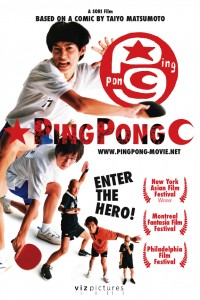
Ping Pong
VIZ Pictures • 114 minutes • No Rating
Based on Taiyo Matsumoto’s manga of the same name, Ping Pong focuses on a pair of friends: Peco (Yosuke Kubozuka), a flamboyant table tennis star who’s obsessed with the game, and Smile (Arata), a reticent young man whose primary motive for playing is to spend time with Peco, whom he quietly regards as a hero. Peco’s swaggering style — complete with acrobatic leaps, trash talk, and frequent dives — makes for good theater, but he’s trounced in a tournament by long-time rival Demon (Koji Ohkura). Despondent over the loss, Peco quits the team and burns his paddle. The coach, himself a former champion known as “Butterfly Joe” (Naoto Takenaka), then turns to Smile to lead his peers to victory in the next major competition, a responsibility Smile is reluctant to accept.

Like Hoosiers, Rocky, Rudy, or A League of Their Own, Ping Pong sticks close to the sports movie playbook, delivering epiphanies with clockwork precision. Smile discovers his inner competitor. Peco discovers that he can’t live without ping pong. “Butterfly Joe” imparts wisdom to Smile. And so on.

Yet for all its sports-movie posturing, Ping Pong is weirdly thrilling, thanks, in large part, to the colorful cast of supporting characters: there’s Peco’s chain-smoking grandmother (Mari Natsuki), a fierce devotee of the sport who runs a table tennis dojo; China (Sam Lee), a washed-up Chinese champion seeking a fresh start in Japan; and Dragon (Shidou Nakamura), a competitor who shaves his eyebrows in an effort to look more intimidating. The other key to Ping Pong‘s success is its fidelity to Taiyo Matsumoto’s original vision. Director Fumihiko Sori’s painstaking efforts to recreate the look and feel of the manga are evident throughout the film, from the casting decisions to the extreme camera angles, jump shots, and fleeting fantasy sequences; Sori manages to capture Ping Pong‘s heightened reality without becoming too arch or mannered.

Fans wanting a behind-the-scenes look at the table tennis action or a few pointers for their own game will want to view the omake on this two-disc set, which includes a 54 minute “making of” documentary, a short “how to” feature reviewing ping pong techniques, and the usual assortment of trailers, tv spots, and cast profiles. All in all, Ping Pong makes a great addition to your library, especially if you still have dog-eared copies of No. 5 kicking around the attic.

The verdict: Rent or buy it. The film captures the arch, surreal quality of Taiyo Matsumoto’s writing even better than the animated version of Tekkonkinkreet.

This review originally appeared at PopCultureShock on 8/28/07.

Filed Under: Manga Critic, Movies & TV, REVIEWS Tagged With: Ai Yazawa, love*com, nana, Ping Pong, Taiyo Matsumoto, VIZ Pictures

Manga on the Big Screen: Love*Com, NANA, and Ping Pong

August 5, 2011 by Katherine Dacey 1 Comment

As anyone who’s seen Green Lantern or Captain America can attest, adapting a comic for the silver screen is an art, not a science. Done poorly, comic book movies alienate fans with the omission of favorite characters and glossing of seminal plotlines, or confuse newcomers with in-jokes and choppy storytelling. Done well, however, comic book movies can appeal to just about anyone who’s receptive to the genre and the characters. VIZ Pictures may not have released as many comic-book movies as DC or Marvel, but its catalog includes adaptations of several popular manga, including Aya Nakahara’s Love*Com, Ai Yazawa’s NANA, and Taiyo Matsumoto’s Ping Pong. These three films make an instructive case study, as they illustrate the pitfalls and potentials of bridging the gap between page and screen.

LOVE*COM: THE MOVIE

VIZ PICTURES • 100 MINUTES • NO RATING

Risa, the tallest girl in the seventh grade, develops a crush on Otani, the shortest boy in her class. Though superficial opposites, the two are really kindred spirits, sharing an enthusiasm for Umibozu (a Japanese rap artist that their classmates detest), swapping good-natured insults, and bonding over memories of rejection for being too tall and too short, respectively.

Whether you’ve read Aya Nakahara’s charming manga or not, you won’t have too much difficulty guessing how the story will end. The problem, however, is that Risa and Otani’s journey from bickering classmates to boyfriend and girlfriend seems utterly contrived. The scriptwriter borrows two romantic rivals from different volumes in the series’ run, but only succeeds in making Mr. “Mighty” Maitake, Risa’s handsome homeroom teacher, an integral part of the story. Even then, Mighty’s arrival is a bolt from the blue, and is never satisfactorily explained; he’s simply inserted into the final act of the story so that he and Otani can compete for Risa’s affections. (And when I say “compete,” I mean it: the two play a pick-up basketball game in front of the entire school.)

The other major drawback to Love*Com is its superficial treatment of the principal characters. Though Aya Nakahara’s manga charts the ups and downs of Risa and Otani’s friendship in minute detail, the movie’s frantic pace never allows us to get to know the characters or understand why they’re drawn to each other; we simply see them walk through a variety of stock scenes — cultural festivals, school trips — without actually seeing the evolution of their feelings dramatized.

It’s a pity that the Love*Com script feels so hastily assembled, as the film has the potential to appeal to both long-time fans and newcomers. The button-cute leads have some chemistry, even if the script doesn’t give them much to do. And the script shows flashes of inspiration; a “director” surrogate periodically interrupts the proceedings to explain certain peculiar-to-manga conventions (most notably the nosebleed-as-sign-of-arousal), intoning this information over strains of Beethoven’s Moonlight Sonata. These digressions occur just a few times, but add some much-needed humor to a film that lacks the wit and honesty of the source material.

The verdict: Skip it. This flat, uninspired retelling of Risa and Otani’s courtship will bore all but the most devoted Love*Com fans.

This review originally appeared at PopCultureShock on 3/24/08.

NANA

VIZ PICTURES • 114 MINUTES • NO RATING

I admire Kentaro Otani’s chutzpah in bringing NANA to the big screen, as it’s the kind of story that inspires intense devotion to the characters; make a poor casting decision or cut a beloved character and you run the risk of angering the manga’s most devoted fans. Otani steers clear of those hazards, however, assembling an appealing cast that look and sound like their cartoon doppelgangers.

The movie offers a somewhat streamlined account of the manga’s first five volumes, beginning with the two Nanas’ fateful encounter on a Tokyo-bound train and ending with Trapnest’s first visit to the girls’ apartment. Most of the dramatic juice is supplied by Hachi’s relationship with the feckless art student Shoji, and by Nana O.’s relationship with Trapnest bassist Ren.

As much as I enjoy the manga, I’ve always found Hachi’s relentless enthusiasm and boy-crazy antics irritating and couldn’t imagine why the fierce, scornful Nana O. didn’t feel the same way about her. As portrayed by Aoi Miyazaki, however, the character makes more sense. Miyazaki does a superb job of convincing us that Nana O. would befriend someone who seems too ditzy, too dependent, and too femme to hang with an up-and-coming punk act by showing us what the girls have in common. Mika Nakashima, as Nana O., also turns in a solid performance, playing her character as a believable mixture of belligerence, determination, and vulnerability.

The other great advantage of the movie is its soundtrack. All of the rock-n-roll shoptalk and song lyrics seemed a little preposterous on the page; I had a hard time imaging why Trapnest or Black Stones commanded loyal followings, as they seemed like pallid imitations of Siouxsie and the Banshees. Seeing and hearing these acts in the film, however, transported me back to my college years, reminding me how passionately I felt about certain musicians, and how much their songs felt like an expression of my own identity. The film’s two lengthy concert scenes are highpoints of the film, offering us a window into both girls’ complicated emotional lives — their dreams, their disappointments, their improbably close relationship.

I had a few small bones to pick with the scriptwriters — what happened to Junko and Kyosuke? — but on the whole, I found NANA immensely entertaining. The true measure of the film’s appeal, however, is that my sister, who isn’t a manga maven, loved it too, and wanted to know if there was a sequel. Thank goodness the answer is yes.

The verdict: Rent it. Some die-hard fans may take issue with the casting and script, as the film isn’t as faithful to the manga as the anime adaptation is.

This review originally appeared at PopCultureShock on 3/24/08.

PING PONG

VIZ PICTURES • 114 MINUTES • NO RATING

Based on Taiyo Matsumoto’s manga of the same name, Ping Pong focuses on a pair of friends: Peco (Yosuke Kubozuka), a flamboyant table tennis star who’s obsessed with the game, and Smile (Arata), a reticent young man whose primary motive for playing is to spend time with Peco, whom he quietly regards as a hero. Peco’s swaggering style — complete with acrobatic leaps, trash talk, and frequent dives — makes for good theater, but he’s trounced in a tournament by long-time rival Demon (Koji Ohkura). Despondent over the loss, Peco quits the team and burns his paddle. The coach, himself a former champion known as “Butterfly Joe” (Naoto Takenaka), then turns to Smile to lead his peers to victory in the next major competition, a responsibility Smile is reluctant to accept.

Like Hoosiers, Rocky, Rudy, or A League of Their Own, Ping Pong sticks close to the sports movie playbook, delivering epiphanies with clockwork precision. Smile discovers his inner competitor. Peco discovers that he can’t live without ping pong. “Butterfly Joe” imparts wisdom to Smile. And so on.

Yet for all its sports-movie posturing, Ping Pong is weirdly thrilling, thanks, in large part, to the colorful cast of supporting characters: there’s Peco’s chain-smoking grandmother (Mari Natsuki), a fierce devotee of the sport who runs a table tennis dojo; China (Sam Lee), a washed-up Chinese champion seeking a fresh start in Japan; and Dragon (Shidou Nakamura), a competitor who shaves his eyebrows in an effort to look more intimidating. The other key to Ping Pong‘s success is its fidelity to Taiyo Matsumoto’s original vision. Director Fumihiko Sori’s painstaking efforts to recreate the look and feel of the manga are evident throughout the film, from the casting decisions to the extreme camera angles, jump shots, and fleeting fantasy sequences; Sori manages to capture Ping Pong‘s heightened reality without becoming too arch or mannered.

Fans wanting a behind-the-scenes look at the table tennis action or a few pointers for their own game will want to view the omake on this two-disc set, which includes a 54 minute “making of” documentary, a short “how to” feature reviewing ping pong techniques, and the usual assortment of trailers, tv spots, and cast profiles. All in all, Ping Pong makes a great addition to your library, especially if you still have dog-eared copies of No. 5 kicking around the attic.

The verdict: Rent or buy it. The film captures the arch, surreal quality of Taiyo Matsumoto’s writing even better than the animated version of Tekkonkinkreet.

This review originally appeared at PopCultureShock on 8/28/07.

Filed Under: Manga Critic Tagged With: Ai Yazawa, love*com, Movie Reviews, nana, Ping Pong, Taiyo Matsumoto, VIZ Pictures

Harlequin Manga Quick Takes – Married by Mistake!, Caribbean Desire, and Marriage Wanted

August 4, 2011 by Anna N

All titles available on emanga.com.

Married by Mistake by Takako Hashimoto and Renee Roszel Wilson

I didn’t realize when I started this that it is a further book in a series with a harlequin manga I read earlier, To Marry a Stranger. In this book, the heroine of To Marry a Stranger has been impregnated by her husband with an eye patch. Helen starts having contractions near the infamous “Mansion of Love” so of course she and her sister Lucy are stuck with having to deal with a sudden home birth in the romantically cursed house. Lucy manages to assist her sister with having twins in the space of a panel. Let me tell you, I’ve had twins and it doesn’t happen that quickly! Lucy is exhausted after assisting her sister and thinks back about her fiance Stader, who kept postponing their marriage. This Stadler guy is no prize as in Lucy’s memory he appears with wavy hair and an odd sort of cravat. Do not trust a man wearing a cravat unless you live in the early 19th century, ladies. Lucy is woken by Jack, a man with intense eyebrows and a decent suit who is wearing a tie instead of a cravat. This looks promising.

Lucy mentions the legend that if a woman spends the night of her birthday at the mansion of love, the first man she sees the next day will be her destined love. It is the day after her birthday, and Jack looks both befuddled and horrified. He’s Lucy’s ex-stepbrother and he has loved her for a long time. It turns out that Lucy’s horrible cravat-wearing fiance has decided to get engaged to an actress and travel to Lucy’s hometown in a fit of cravat-inspired cruelty. Lucy’s family promptly decides that Lucy has to pretend to have a fiance for revenge and Jack is just the person for the job. The art in this adaptation is really much better than the typical Harlequin manga title. The backgrounds might be sparse, but the character designs are distinct and attractive. What I found most amusing was the wacky facial expressions of Lucy’s family as they cheer on her fake romance. I was especially amused by the antics of Lucy’s one-eyed brother-in-law Damian who was the tortured hero in To Marry a Stranger, as he keeps popping up in chibi form with a big grin to cheer on his sister-in-law. In conclusion, men with cravats are bad, but men with eye patches or suits are good. This is what I’m taking away from this Harlequin manga.

Caribbean Desire by Cathy Williams and Takane Yonetani

The cover for this looks good, because it appears that there are wind machines blowing the male and female leads’ hair in opposite directions. Unfortunately the inside of this manga doesn’t feature the goofy fun I tend to prefer in my Harlequin manga adaptations. Emma arrives on an island to interview the rich businessman Alastair for his biography. She develops an intense dislike for the Conrad, the man currently running Alastair’s company. Emma has a secret connection with Alastair’s family, but will she reveal her secret before it is too late? And what will she do with her growing attraction to Conrad? The storyline was as predictable as Harlequins usually are, but there wasn’t really any humor to lighten things up. The art and adaptation were pretty typical, with stiffly posed characters and sketchy backgrounds. This wasn’t a good title to read right after Married by Mistake!, because it really suffered in comparison.

Marriage Wanted by Debbie Macomber and Eve Takigawa

Savanna is a wedding coordinator with an injured leg. Dash is a divorce attorney who has given up on love. Together they find love through a marriage of convenience, as one always does in Harlequin romance world. I tend to enjoy Harlequin manga very much when the art has a vaguely 1980s aesthetic. Even though this adaptation was produced in 2005, I still see a bit of a retro feel to the art with Dash’s square jaw and Emma’s bright eyes. Savanna is convinced the she’ll never find love because her limp makes her unattractive to men. Dash comes into Savanna’s store and proceeds to lecture her about the meaninglessness of weddings when he finds out that she’s planning his little sister’s wedding. Dash and Savannah spend more time with each other and decide to enter into a marriage of convenience when he needs a wife to get a promotion and she needs a husband to get her parents to stop being so overprotective. There wasn’t much humor in this title, but the art was better than average and it was fun seeing Dash and Savanna argue with each other over the value of marriage.

Access to electronic copies provided by the publisher.

Filed Under: UNSHELVED

Off the Shelf: CLAMP & More

August 3, 2011 by MJ and Michelle Smith 3 Comments

MJ: So. Hi!

MICHELLE: Yo.

MJ: I’m feeling extremely frazzled and not at all witty. How about you?

MICHELLE: Kind of sleepy, actually. Maybe readers should just think up a joke here and pretend one of us said it.

MJ: Good call. So. Read anything lately?

MICHELLE: Indeed I have! I decided to make it a CLAMP week, and first up is volume four of Kobato., currently being released by Yen Press.

I wasn’t very impressed with the first three volumes of this series, which follows the dim-witted titular heroine in her attempts to fill a magic bottle with wounded hearts so that her wish can be granted. Kobato is very compassionate, so she heals hearts pretty well when given the opportunity, but has been spending a lot of time with two particular wounded people—Sayaka, the proprietor of a kindergarten, and Fujimoto, her part-time assistant—and so hasn’t made much progress on filling her bottle. In this volume her guide, the irascible Ioryogi (some kind of supernatural being currently stuck in the body of a stuffed dog) learns that she’s only got six more months in which to complete her task. If she fails, her wish can’t be granted and he can’t regain his original body.

Getting background information on Ioryogi and his motives—mostly revealed in conversations between serious-faced animals—at last is very welcome, making this volume an improvement over the last, but I still can’t say I am enjoying Kobato. all that much. I wish I could like someone, but I just don’t. Kobato would be okay, especially as she works out her burgeoning feelings for Fujimoto, except CLAMP seems to have a fixation with her falling down as much as possible. Ioryogi is always yelling, and not even a mysterious background can make him a compelling character for me. The kindergarten employees seem to have one default emotion each. Heck, the most interesting character in the whole series is the yakuza who’s trying to close the kindergarten down. Let’s jettison everything else and just follow him for a while, eh?

Still, there are a few mysteries that will keep me reading. What is the precious thing in the Heavenly World that Ioryogi is after? What is Kobato’s wish? And why is it so important that she not remove her hat? With either two or three volumes remaining, I figure I can stick around long enough to at least see whether these questions are answered.

MJ: I haven’t gotten as far in to this series as you have, though I think I might like it a bit more. Mostly because I actually do like the title character. But I admit I rather wish CLAMP were spending their time continuing Legal Drug instead. Is that terrible of me to say?

MICHELLE: Not at all. And, in fact, they just finished Kobato. in Japan, so at least it’s not actively consuming any more of their time.

It’s not that I hate Kobato, either, but more like I feel CLAMP is doing her a disservice, if that makes sense.

Annnyways, what have you been reading this week?

MJ: Well, earlier this week, I dug into the first issue of GEN Manga, a new “indie” manga magazine available online or in print from GEN Manga Entertainment. I happened to have the print version, provided in a small, red volume about the same trim size as a standard volume of manga in the US.

GEN‘s promotional material is pretty up-front about their artists being unknown. “GEN puts on no airs about how grand their authors are. In fact, they readily admit that their authors are underground. GEN is manga the way it should be without the flash, for the fans, raw and fresh.” They make a lot of noise about the magazine’s “indie” feel, too. “This original work of graphic fiction boldly challenges the industry while breaking new ground. It presents what manga readers are hungry for, the release of fresh underground work from Japan.”

Trouble is, the stories don’t really read as ground-breaking so much as amateurish. Each of the volume’s four stories has its strengths, certainly, but it’s rarely enough to compensate for its flaws. Both Nakamura Shige’s “Wolf” and Suzuki Yu’s “VS Aliens” suffer from convoluted plotlines that fail to live up to an initial, fairly ambitious premise. Karino Arisa’s “Souls” is intriguing, but artistically immature. Mihara Gunya’s “KAMEN,” the story of a man controlled by a mask he can’t remove, holds up the best, but offers just the barest glimpse of what the story might be.

On the other hand, the volume is currently free for download, ($9.95 in print), which renders it worth checking out at the very least. Don’t get me wrong. I really like what GEN is going for, as a concept anyway, and I’ll definitely be watching to see what kind of work might come out of it in the future. There’s just not much there for me so far.

MICHELLE: I’ve certainly been interested to see what happens with GEN, but admit that I haven’t personally been tempted to try it out. I guess I’m less hungry for “fresh underground work,” especially in short story format, than I am for “much-loved classics” that offer multiple volumes to enjoy.

MJ: I admit I’d be more interested in some of these stories if I knew they were first chapters of something that’s going to be serialized. But that’s not what the promo material suggests, sadly.

So, what’s your other CLAMP selection this week?

MICHELLE: My second CLAMP selection is the Magic Knight Rayearth Omnibus Edition, which was recently released by Dark Horse.

I’ve seen the Rayearth anime, and read TOKYOPOP’s second edition of the manga (with unflipped art), so this was really my third time through the material. I’d never previously counted this as among my favorite CLAMP series, so I thought a reread might be kind of a slog, but I ended up really enjoying it! The first story arc (originally comprising three volumes) benefits greatly from being contained in one volume, where momentum propels one through the adventure at a steady clip and doesn’t let up until the not-exactly-what-one-expects ending. The remastered art looks great, the color pages are beautiful, and, in the end, Rayearth has vaulted up several levels in my esteem.

Another really neat thing about the series is how CLAMP subverts demographic expectations. (Which they continue to do with series like Kobato., which has a shoujo-sounding premise but is, if anything, seinen.) Consider this description of the plot:

Three junior high students are visiting Tokyo Tower on a school trip when they are suddenly summoned to Cefiro by its princess, Emeraude. Emeraude has been kidnapped and the students are tasked becoming the Magic Knights of legend, rescuing the princess, and saving Cefiro, which has plunged into chaos in her absence. They agree, and are outfitted with magical armor and weaponry. As they head out on various tasks, their abilities grow and weapons evolve even as they forge a tight friendship. They are absolutely determined to save Cefiro, vanquish many menacing monsters along the way, and are frequently depicted in fierce and badass poses. Eventually, they awaken some giant mecha and defeat Zagato, the high priest who is holding Emeraude captive.

Now cast the students as girls and remind yourself that this ran in a shoujo magazine. The shounen-style fantasy flare makes for a fun adventure, but there’s a pretty powerful shoujo punch waiting in the final pages. I really enjoyed this series on a reread—though I’m not too enamored of the silly comedy—and eagerly await the omnibus of the second half.

MJ: Well, wow, you’ve inspired me to want to read this as well! I have to admit that despite being a CLAMP fan, I bogged down in the first volume of the TOKYOPOP editions. But you make this sound genuinely fascinating and fun!

MICHELLE: I remember bogging down myself when I first started the anime, but this time I breezed right through the story and ended up with a greater appreciation of the characters and the art, which is often quite pretty. I’d definitely say it’s worth another look. Plus, any Tsubasa or xxxHOLiC fan should enjoy seeing where Mokona originally came from!

What’s your second pick this week?

MJ: Well, It’s a bit of a strange one, or at least strange for me. While I’m used to receiving a variety of manga for review from Viz, I admit to being quite surprised when my latest review package contained volume one of Pokémon Black and White. I can say with complete honesty that I’ve never had the slightest interest in Pokémon, and really I missed its initial craze entirely, but there it was, in my apartment, Pokémon Black and White. So without any real knowledge of the Pokémon universe, I decided to sit down and read it.

Thankfully, as a series for kids, it wasn’t as difficult as it might have been to try to pick up the basic premise, though I can’t say I actually understand what Pokémon are, or why they are being raised up for “trainers” to have battles, but that indeed is what is going on. The main character being introduced here is “Black,” a guy who is so deeply obsessed with winning the “Pokémon League,” that in order to think about anything else at all, a creature named Musha must empty his brain— literally wipe it completely clean—so that new information can be introduced into it.

Though this all sounds a bit creepy, I admit I find the concept pretty compelling (I could use a Musha of my own, these days). Unfortunately, very little is made of Black’s periodically emptied brain at the time, and the rest of the volume is pretty much devoted to his first “trainer battle” with a guy who can’t tolerate heat.

Obviously, I am not the audience for this series, and I’d be hard pressed to find a reason to buy volumes of it on my own, but it does contain some surprisingly interesting elements, along with a slew of genuinely cute creatures. I developed a particular fondness for one called a “cottonee,” that was so distressed by its inability to protect its heat-intolerant trainer from fire, that it put itself in harm’s way to try to overcome its weakness.

MICHELLE: You win the gold star for diversity in this column!

I actually do know a little bit about Pokémon because I was teaching piano at the height of its craze and, of course, wanted to get the best stickers with which to motivate my students. At one point, I could even tell you which creatures morphed into which, but now all I really remember is that Snorlax is adorable. I even had a plushie.

Anyway, even though I can’t say I want to rush out and read this for myself, it sounds like kids are for in for a treat.

MJ: I do think it is pretty vital for kids to have at least some introduction to Pokémon before trying to make sense of this bit of the series, which is actually why I didn’t end up sending it off to our own Jia Li for review, but yes, kids who are interested in the franchise should find quite a bit to enjoy in this volume, I’d think.

MICHELLE: I think kids would probably find Rayearth a lot of fun, too, actually. Dark Horse lists the age range as twelve and up (there are a few ladies in butt-floss garb) but the real issue would be whether a kid could actually lift the durn thing.

MJ: Heh, that’s good to know. I’d say that Pokémon skews younger, but it’s always nice to see manga out there that the under-13 crowd can enjoy.

MICHELLE: Definitely!

Filed Under: OFF THE SHELF Tagged With: GEN Manga, kobato, Magic Knight Rayearth, Pokémon Black and Whilte

Manga the week of 8/10

August 3, 2011 by Sean Gaffney

You know, for a 2nd week of the month, it’s pretty packed with stuff. There’s a lot here for almost any type of fan. Let’s get started.

First off, non-manga releases that interest me. There’s a new Complete Peanuts coming out from Fantagraphics. It may have hit the 1980s, but the quality still seems to be quite high. Can’t wait. Also, IDW is releasing a new Archie hardcover. Unlike their previous ‘Best of ‘ collections, this one focuses on a single weird Archie title from the 1960s: Archie’s Mad House. As you might guess, this comic started out with the Archie gang, focusing on really bizarre adventures. After about 20 issues or so, it dropped them and began running its own stories, including the debut of Sabrina the Teenage Witch. I’m quite interested to see what IDW does with this.

Now back to manga. Dark Horse may be delaying every other manga title in its catalogue from now till doomsday, but its bestsellers keep coming out like clockwork. This week we have Vol. 18 of Gantz, from our friends at Shueisha’s Young Jump. For a more media-oriented title, there’s The Shinji Ikari Raising Project, now up to Vol. 9. It runs in Shonen Ace and will be sure to please Evangelion fans. Well, most. Well, some. A few? All right, it will inspire arguments. But it’s popular!

Bandai has a debut this week with Tales of the Abyss: Asch the Bloody. It’s based on a video game, and is one of about 10,000 manga spinoffs of said game. Given all that, can you guess where it originally ran? If you said Comp Ace, you’re a true Manga Geek! I suspect it will be tie-in-tastic.

Kodansha is, as ever, absent from Midtown’s list. Again. However, my local shop indicates two titles coming in next week. The debut of Deltora Quest, a fantasy manga that ran in the late Comic BonBon, a magazine geared towards elementary school boys. You know, like Shonen Magazine should be but isn’t. and the 2nd and final omnibus volume of I Am Here!, which saw Vol. 1 from Del Rey and is thankfully getting a conclusion. Like all Kodansha shoujo these days, it ran in Nakayoshi.

Udon has the 2nd volume of Megaman Gigamix, which is based on a video game as well. Though, despite its name, it’s not from Konami.

Viz has the 3rd volume of Blue Exorcist, which I think most of us got this week from Diamond. There’s a new Inu Yasha omnibus, the 27th volume of the energetic and likeable Kekkaishi, and the 6th Maoh: Juvenile Remix, which this time I believe is remixed by Saint Etienne. Blue Exorcist is from Jump, the other three from Sunday. And there’s the 7th volume of Ikigami, for fans of Bokurano who want to see more series where people die nobly over and over again.

And there’s a huge pile from Yen. The biggie for me this week is the 3rd Book Girl novel, Book Girl and the Captive Fool. I’ve been thrilled with the first two in the series, a dark high school thriller with an intriguing backstory, and definitely want more. Aside from that, there’s the conclusion of the Eye-Opening Arc in Higurashi (Gangan Wing), which will no doubt be filled with gore. But don’t worry, kids, a new arc starts in October! And I have it on good authority that the Eye-Opening arc is the low ebb. It’s all uphill from here! … mostly. There’s new K-On! (Manga Time Kirara Carat), Haruhi Suzumiya (Shonen Ace), AND Haruhi Suzumiya-chan (ditto) for all your moe needs. Oh yes, and Omamori Himari 4 (Dragon Age), which I don’t read, but certainly looks moe as well. There’s the 9th volume of Sumomomo Momomo, which lost me after the first volume but I understand gets better. And there’s the 4th and last volume of Ugly Duckling’s Love Revolution, the reverse harem manga from Enterbrain’s B’s Log. I found its comedic antics more annoying than heartwarming, but admit I was not remotely its target audience. Also (last time this week, I promise) based on a game!

See what I mean? That’s a lot. What are you getting?

Filed Under: FEATURES

Now You’re One of Us

August 3, 2011 by Katherine Dacey

Noriko, the young heroine of Asa Nonami’s Now You’re One of Us, initially thinks she’s hit the marriage jackpot. Not only are her in-laws wealthy and well regarded by their neighbors, they’re also quick to embrace her as a member of the family. Her husband Kazuhito is handsome and utterly devoted; her mother-in-law Kimie, generous and uncritical; and her sister-in-law Ayano, solicitous to everyone in the household, including Kazuhito’s oddly child-like brother Takehami. Even the Shito matriarch, ninety-eight-year-old Ei, welcomes Noriko to the clan by declaring her the family’s “treasure” and “future.”

Shortly after Noriko arrives at the Shitos’ Tokyo home, a strange, slightly disheveled neighbor approaches her while she works in the garden. Though Kimie is quick to dismiss him as a troubled tenant who’s fallen on hard times, Noriko can’t shake the feeling that the neighbor was about to divulge something damning — a feeling intensified by his mysterious death in a fire several days later. The Shitos’ oddly muted, impersonal response to his death further arouses Noriko’s suspicion, as do the family’s clandestine midnight meetings. Though the Shitos offer reasonable, measured responses to Noriko’s inquiries, she begins wondering if the Shitos run an illicit business… or worse.

Thanks to a fluid translation by Michael and Mitsuko Valek, Asa Nonami’s simple, unfussy prose draws the reader into Noriko’s insular world, showing us how a simple girl from a working class family is lured into the Shitos’ web. In this passage, for example, Nonami reveals Kazuhito to be a deft manipulator, appealing to Noriko’s vanity by suggesting that Ei’s endorsement carries special significance:

“Great Granny’s been watching people for ninety-eight years — she can see through them at a glance, so lots of people in the neighborhood come to ask her for advice.” He explained how delighted he was that Great Granny had taken a liking to her; it showed that he hadn’t been blinded by attraction. He felt like the luckiest man in the world for having found someone of whom his family approved.

Unfortunately, Nonami is never content to let a passage like this one stand alone; she feels compelled to explain how Kazuhito’s words swayed Noriko by telling us exactly what Noriko is thinking at the moment he gives this speech. The obviousness of Noriko’s interior monologues is especially frustrating; Nonami does a competent job of revealing her characters’ motivations and feelings through their actions without resorting to such editorial interventions.

The other drawback to Nonami’s storytelling is that she begins telegraphing the ending just a few chapters into the book. Savvier readers will quickly figure out what the Shitos’ secret is — and it’s a doozy — though they probably won’t mind wading through another hundred pages to have their ickiest suspicions confirmed, especially since Nonami manages a few surprises in the final pages.

The bottom line: Now You’re One of Us is an entertaining, atmospheric potboiler that’s probably best read in the privacy of one’s own home.

This review originally appeared at PopCultureShock on 2/8/08.

NOW YOU’RE ONE OF US • BY ASA NONAMI, TRANSLATED BY MICHAEL AND MITSUKO VALEK • VERTICAL, INC. • 240 pp.

Filed Under: Books, Manga Critic, REVIEWS Tagged With: Mystery/Suspense, Novel, Vertical Comics

  • « Go to Previous Page
  • Page 1
  • Interim pages omitted …
  • Page 4
  • Page 5
  • Page 6
  • Page 7
  • Go to Next Page »
 | Log in
Copyright © 2010 Manga Bookshelf | Powered by WordPress & the Genesis Framework