• Skip to primary navigation
  • Skip to main content
  • Skip to primary sidebar
  • Home
  • About Us
    • Privacy Policy
    • Comment Policy
    • Disclosures & Disclaimers
  • Resources
    • Links, Essays & Articles
    • Fandomology!
    • CLAMP Directory
    • BlogRoll
  • Features & Columns
    • 3 Things Thursday
    • Adventures in the Key of Shoujo
    • Bit & Blips (game reviews)
    • BL BOOKRACK
    • Bookshelf Briefs
    • Bringing the Drama
    • Comic Conversion
    • Fanservice Friday
    • Going Digital
    • It Came From the Sinosphere
    • License This!
    • Magazine no Mori
    • My Week in Manga
    • OFF THE SHELF
    • Not By Manga Alone
    • PICK OF THE WEEK
    • Subtitles & Sensibility
    • Weekly Shonen Jump Recaps
  • Manga Moveable Feast
    • MMF Full Archive
    • Yun Kouga
    • CLAMP
    • Shojo Beat
    • Osamu Tezuka
    • Sailor Moon
    • Fruits Basket
    • Takehiko Inoue
    • Wild Adapter
    • One Piece
    • After School Nightmare
    • Karakuri Odette
    • Paradise Kiss
    • The Color Trilogy
    • To Terra…
    • Sexy Voice & Robo
  • Browse by Author
    • Sean Gaffney
    • Anna Neatrour
    • Michelle Smith
    • Katherine Dacey
    • MJ
    • Brigid Alverson
    • Travis Anderson
    • Phillip Anthony
    • Derek Bown
    • Jaci Dahlvang
    • Angela Eastman
    • Erica Friedman
    • Sara K.
    • Megan Purdy
    • Emily Snodgrass
    • Nancy Thistlethwaite
    • Eva Volin
    • David Welsh
  • MB Blogs
    • A Case Suitable For Treatment
    • Experiments in Manga
    • MangaBlog
    • The Manga Critic
    • Manga Report
    • Soliloquy in Blue
    • Manga Curmudgeon (archive)

Manga Bookshelf

Discussion, Resources, Roundtables, & Reviews

Archives for March 2011

My Bad! by Rize Shinba

March 31, 2011 by Michelle Smith

I didn’t think I was interested in reading My Bad! at first, since I typically don’t enjoy BL comedies, but after reading Shinba’s Intriguing Secrets, I changed my mind.

I’m glad I did, because the stories in this collection are quirky and often genuinely funny. “Stamp Please!,” the story of a guy who falls in love with his amiable postman, is a particular favorite.

You can find my review—as part of this month’s BL Bookrack column at Manga Bookshelf—here.

Review copy provided by the publisher.

Filed Under: Uncategorized Tagged With: digital manga publishing, Juné, Rize Shinba

BL Bookrack: March

March 31, 2011 by MJ 12 Comments

Welcome to the March installment of BL Bookrack, a monthly feature co-written with Soliloquy in Blue‘s Michelle Smith.

This month, we take a look at four offerings from Digital Manga Publishing’s Juné imprint, Honey Chocolate Pancakes, Intense Rain, My Bad!, and Then Comes Love.


Honey Chocolate Pancakes | By Keiko Kinoshita | Published by Juné | Rated Mature (18+) | Buy at Akadot – The two-part title story in this collection by Keiko Kinoshita (Kiss Blue) is alone worth the price of admission. When famous actor Tougo Kijima takes a sudden sabbatical from his job and claims to be unemployed and homeless, he’s taken in by pasty chef Chiharu Abe, whose creations Tougo adores. They soon begin fooling around, with prickly Chiharu gradually lowering his defenses towards his uncouth houseguest.

Of course, when he finds out Tougo’s secret and realizes he’s been lied to, Chiharu feels like a fool. Tougo claims that it wasn’t his intention to trick Chiharu, but the damage has been done. Kinoshita handles this scene extremely well, especially in the way she allows silence to hang between them when there’s nothing more to be said. The second part of their story is a little less polished, since we don’t learn exactly why Chiharu allows Tougo back into his life, only that he does and that Tougo is a pretty jealous guy.

Subsequent stories are less successful. The best of the remainder is “For Love,” in which a businessman named Miyasaka, who has nurtured an unrequited love for his friend Minami for ten years, believes the time has come to wish Minami happiness as he embarks on a relationship with a woman. Miyasaka’s pain and Minami’s confusion are nicely conveyed, though the abrupt ending is somewhat of a disappointment.

Neither of the other stories in the collection impressed me much. “Tomorrow Will Be Rosy” is about the efforts of a teenaged couple to consummate their relationship while “A Clever Man at Work” features a very manipulative character who purposefully acts incompetent on the job in order to frustrate his mentor into making cute expressions. He also lies about his background to elicit sympathy and is just overall very unappealing.

In the end, it’s a fairly uneven collection, but not a bad read by any means.

-Review by Michelle Smith


Intense Rain | By Shinri Fuwa | Published by Juné | Rated Mature (18+) | Buy at Akadot – It’s been five years since smooth operator Takaaki lost his college boyfriend, Ryuji, as a consequence of his own chronic infidelity. But when Ryuji turns up as a substitute at the high school where Takaaki teaches, old feelings rush back on both sides. Though Ryuji resists falling back into a relationship that was once so painful, confusing signals from Takaaki beg the question, can people really change?

If there’s one thing about this manga that deserves high praise, it would be the cover. The book’s cover image describes and contextualizes its contents more accurately than any review ever could. The tall, masculine aggressor, his tiny, disheveled prey, the melodramatic pose struck between their rain-soaked bodies, framed by flowers and dark desire–all these things together provide a pretty succinct overview of Shinri Fuwa’s Intense Rain. Perhaps the only the book’s inner cover could go one better.

If this sounds a bit snide, well, maybe it is, but there’s an element of reluctant praise that I simply can’t deny. For a book to be so forthright about what it hopes to accomplish (and so utterly successful in accomplishing it!) is something rare indeed. Intense Rain is, in execution, exactly as advertised, no more, no less. And if I might have hoped for more, can I really complain?

From the very beginning, Intense Rain exemplifies BL in its most surface terms. Seme Takaaki is dark, mysterious, vaguely brutal, and a predator of men and women alike. Uke Ryuji is delicate, emotionally frazzled, perpetually blushing, and helpless in his man’s arms. As maddening as these baseline characterizations may be, however, it’s the characters’ “growth” that is the story’s primary weakness. Takaaki’s transformation from classic rake to caring lover is left too much offscreen to be believed, while Ryuji’s acceptance of his lover’s sudden reformation is enough to send one’s book flying across the room. A secondary story involving the romance between a 30-something salaryman and a high school student fares a little bit better, though it is no less shackled by standard BL tropes.

What Intense Rain does offer is a strong dose of romantic melodrama and some pretty, pretty pictures, for those who have the craving. Then again, you could just stick with the cover.

-Review by MJ


My Bad! | By Rize Shinba | Published by Juné | Rated YA (16+) | Buy at Akadot – I’m generally not one for BL comedies, much less those that center on underwear thievery, so I initially did not think I’d be reading My Bad!. That changed after I checked out Intriguing Secrets, another title by the same creator which was favorably reviewed by MJin a Bookrack of yore. I liked it very much, which prompted me to give My Bad! a shot.

It turns out that My Bad! is a quirky and amusing collection of short stories that share some common themes and flaws. I appreciate how often the younger, smaller men are actually the driving force in the relationship. They haven’t merely been sought out by some horny seme whose advances they initially resist, but are shown to have their own drives and desires.

In “Lovely Beast,” for example, it’s teenage Hiroki who is obsessed by Izumi, a tenant in the building Hiroki’s grandparents oversee. He goes so far as to let himself into Izumi’s place and make off with a pair of his boxers. Smutty discovery ensues. “Won’t You Be My Wife?” and “Miracle Voice,” in turn feature younger men falling in love with a housekeeper and the guy who makes the announcements on the subway, respectively.

My favorite in this line is “Stamp Please!” in which a huge, genial postal worker named Yuji Kikkawa delivers a letter to Ayato Mashiba. Ayato is instantly smitten, and sends a letter to himself just so he can see Kikkawa again. Throughout the story, he puts himself in Kikkawa’s path while simultaneously avoiding the desperate pleas of a stalkery ex-lover. The plot takes a dark turn, but I ended up liking it a lot. Shinba writes in her notes that she regards this as a serious story, even though others perceived it as comedy, and I quite agree.

Where some of the stories fail is in making the reciprocation scenes believable. I’m not sure if blame should be laid at the feet of the short-story format or if Shinba just couldn’t communicate the characters’ true emotions clearly, but there are a few stories in which I found the happy moment extremely abrupt. Probably the biggest culprit here is “Won’t You Be My Wife?” where a surly character is suddenly revealed to care about his housekeeper far more than was ever previously suggested.

On the whole, I enjoyed the collection and feel pretty certain now that I’ll like anything Shinba produces.

-Review by Michelle Smith


Then Comes Love | By Riyu Yamakami | Published by Juné | Rated Mature (18+) | Buy at Akadot – When happy-go-lucky college student Takahiro approaches aloof loner Midori to try to gain an introduction for a smitten female friend, it’s surprising to both of them that this would eventually lead to close friendship. But things get complicated fast when an encounter with another student forces Midori to admit to himself and his friend that he’s gay. Though Takahiro claims not to be bothered by this new information, he’s also clearly angry about Midori’s new relationship, calling his own feelings for Midori into question.

While this type of love triangle is a pretty standard setup in the “best friends turned lovers” BL sub-genre, Riyu Yamakami makes better use of it than most. Though there’s never any question about where the story’s primary relationship is headed, its journey is surprisingly believable and comparatively un-rushed. Even the characters’ “popular guy” and “aloof guy” stereotypes work in the story’s favor here, allowing Yamakami to thoroughly explore the way two contrasting personalities process all the various difficulties and emotions common to falling in love.

Yamakimi’s only real misstep is in her use of the love triangle’s third party, a smooth talker named Soejima who alternates between promiscuous playboy and sneaky matchmaker. Though technically no less a BL cliché than the story’s two leads, Soejima unfortunately crosses over into uglier real-life stereotypes, spouting lines like, “Gay men are always looking for the chance to have sex with tons of other guys,” as he works on seducing a desperate Takahiro during the book’s single descent into truly absurd fantasy.

Yakamimi’s artwork, though awkward in some of the characters’ more physical encounters, is generally a highlight, providing much of the contrast and emotional nuance that make her characters so compelling.

Though not without its minor stumbles, Then Comes Love is a genuinely refreshing addition to Juné’s BL one-shot catalogue.

-Review by MJ


Review copies provided by the publisher.

Filed Under: BL BOOKRACK Tagged With: yaoi/boys' love

Any opening will do

March 31, 2011 by David Welsh

There’s apparently some big professional baseball event going on today. While I don’t care even a little bit, I will take any opportunity to mention Mitsuru Adachi’s Cross Game (Viz), which is about baseball. It’s an incredible series, so if you’re reading this, enjoy comics, and enjoy baseball, even the kind not played for millions of dollars, you could observe Opening Day by picking up the first omnibus of the series, which collects three volumes, or the second, which collects two. You can read the first chapter for free at Viz’s Shonen Sunday site. The third two-volume collection comes out in a couple of weeks.

I promise you, as someone who would not watch professional or amateur baseball under any circumstances and has harbored a bitter grudge against the sport since conscripted participation during my elementary school days, this is an empirically excellent series. While I can’t get myself into the head space of someone who loves baseball, I believe that this series takes the sport very seriously and is packed with details of interest and consequence to people who care about that sort of thing, but those details aren’t at all essential to or obstructive of the ability to enjoy the series for people who don’t care either way, routinely ask if baseball is “that game with the rackets,” and just want a good story with great characters. Which they get.


Filed Under: DAILY CHATTER

Blind date

March 31, 2011 by David Welsh

What’s the point of having a blog if you don’t use it to needlessly complicate your life from time to time? The newest edition of Diamond’s Previews catalog has arrived, and while I plan to do my usual “make me suffer” poll later in the week, I’ve decided to add a new wrinkle to the process.

You see, I feel like I should read more boys’ love titles, but I like to do a certain amount of investigation prior to investing, because sometimes something sounds good and ends up embodying everything that makes me uncomfortable about books in the category. So I’m going to ask for your help, and your vote, in winnowing out the listed title that best matches my taste.

For the record, those tastes include: adult characters with interesting lives outside of their romantic relationships; a sprinkling of issues related to sexual identity; and no forced sex, or at least as little as possible. I also tend to prefer a light touch, though high drama is fine if it’s persuasively done. I don’t think that’s asking for too much, and if none of these candidates pass the test, I make no promises that I’ll suffer through one, but if enough of you make the case for a particular work, keeping my preferences in mind, then I’m on board.

So here are the candidates:

Tonight’s Take-Out Night, written and illustrated by Akira Minazuki: Matsumoto was sent from his company’s planning department to assist in the expansion of a fast food restaurant. Little did he expect to encounter sexual harassment from Iwakiri Kiyoshi, the extremely competent manager of this successful shop. How should he respond? And is it all in jest?

Okay, they have jobs, but sexual harassment is right there in the solicitation, so I’m leery. It ran in Taiyo Tosho’s Hertz.

Entangled Circumstances, written and illustrated by Kikuko Kikuya: Himeko and Shibui not only work for the same company, but had also attended university together. Himeko was wildly popular, and nicknamed “The Prince.” But whatever Shibui may be trying not to recall about their shared past, one thing is certain. Their present and future are tangled together, with the past knotting it quite firmly. Seeing Himeko everyday, Shibui finds his feelings ever more swayed. “Whatever it takes to get you…”

I absolutely love the cover art for this one, though I would vote for a moratorium on any character ever being nicknamed “The Prince” again. It also ran in Hertz.

A Liar in Love, written and illustrated by Kiyo Ueda: After receiving an interesting phone call from his brother, Tatsuki Hiroshi decides to go for a visit. There he encounters Miura, and as the two get to know each other, they begin dating. It is not supposed to be for anything but fun with no strings attached. So when did Tatsuki become a fool for love? What is he to do? As he finds out, affairs of the heart are complicated!

My ears perked up at the use of the word “dating.” This is not a word I usually see in BL solicitations. It’s apparently Hertz month.

I Give to You, written and illustrated by Ebishi Maki: Reeling from betrayal at the hands of his lover who left him in incredible debt, Ryouichi finds himself aimlessly wandering in the midst of a storm. Suddenly finding himself standing at the door of a teahouse. He goes in, and soon finds himself indebted to the owner. Helping out around the shop to pay back the owner’s kindness. Ryouichi finds that he’s looking forward to it, and not just to pay back the debt either. Has Ryouichi found where he belongs?

Again, it’s a gorgeous cover, but that blurb is kind of tortured. I know that doesn’t reflect on the book, but it is a little irksome. This one ran in Taiyo Tosho’s Craft.

This Night’s Everything, written and illustrated by Akira Minazuki: A certain politician has his own private security group. In that group is someone special. That man, Aoi, is someone who is extremely capable at his job, handling even dirty work with ease. But in that heart lies not only cold reason, but passion. Can love survive in such circumstances, and light a path out of the darkness?

Drama, drama, drama. I’m leaning backwards, because it’s getting really intense and all up in my face. We’re back to Hertz to wrap things up.

All right, those are the choices. Advice? Insights? Revealing tea leaves or possibly coffee grounds?


Filed Under: DAILY CHATTER

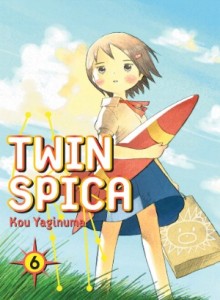
Twin Spica, Vols. 5-6

March 30, 2011 by Katherine Dacey

If you spend any time surfing the mangasphere, you don’t need me to tell you that Twin Spica is about a group of teenagers who are training to become Japan’s first astronauts. You probably know — or have heard from other readers — that it’s poignant. And you may have heard pundits declare it one of the best new series of 2010. (It made my best-of list.) Rather than re-hash plot points or tell you how awesome it is, therefore, I thought I’d share what I like best about Twin Spica: every volume makes me want to look up at the sky.

I’m not talking about the simple act of looking through a telescope or watching clouds drift in the wind — I’m talking about the way the act of looking at the sky makes me feel. Reflecting back on my childhood, that act elicited very specific emotions: the sky represented the future, a large canvas on which I could project my most cherished dreams of traveling to distant places, having adventures, and doing things that, from a six or eight-year-old’s perspective, seemed important. Kou Yaginuma clearly remembers that feeling from his own childhood, because his characters are at their most optimistic and thoughtful when they’re looking up at the sky and thinking about their own experiences.

There’s a lovely moment in volume six, for example, when Fuchuya’s grandfather tells six-year-old Asumi to cherish the memory of gazing up at the sky, as the sky will look different to her as she reaches adulthood. He explains:

You might as well spend your time looking up, at the sky. Me, I’ve spent decades staring up the sky in this town. I only thought the sky was very high when I was your age. When you’re old, it doesn’t seem quite that way. The sky you see as a kid is a lifelong treasure. I mean it. Value what you can see now, and only now.

Reading this passage reminds me of “Feldeinsamkeit” (“In Summerfields”), a beautiful piece of juvenilia from Charles Ives’ 114 Songs. The lyrics, taken from German poet Hermann Allmers, describe the experience of lying in a meadow on a summer’s afternoon and watching the sky. The sight of drifting clouds induces melancholy in his poem’s narrator, who — in typical nineteenth-century fashion — sees the clouds’ gentle, unfettered progress across the sky as a symbol of release from earthly burdens:

I’m resting quietly in tall green grass,
and cast my eyes far upwards;
around me crickets chirp unceasing,
the sky’s blue magically encloses me.

The beautiful white clouds float past
through the deep blue, like lovely silent dreams.
It is as if I had been long dead,
and flew in bliss with them through unending space.

Ives’ setting, by his own standards, is rather tame; there’s a running accompaniment figure that suggests fast-moving clouds, and a fleeting moment of bitonality, but it falls squarely within the nineteenth-century Stimmungslied tradition with its rounded binary form and gentle chromaticism. The song has an undeniably haunting quality, however. Its rapid modulation to harmonically distant key signatures and achingly sad melodic line suggest that the singer isn’t simply describing the act of watching clouds, as the lyrics alone might imply, but remembering what she was thinking and feeling as she did so.

That may sound like a minor distinction, but memory — or, more accurately, the act of remembering — is an important motif in the 114 Songs. “At the River,” for example, initially sounds like a straightforward rendition of “Shall We Gather At the River,” only to deviate from the melody as the singer “forgets” the proper tune, while “Memories” re-enacts a child’s enthusiasm at attending a concert. “In Summerfields” is less self-consciously modernist than either of these songs, but all three rely heavily on the illusion that the performer is reliving one of her own memories.

And that’s exactly the quality I find so compelling about Twin Spica: it’s a manga about living with vivid memories — some haunting, some happy — about reconciling past and present, about recognizing the value in both joy and pain, about negotiating the transition from youthful innocence to adulthood. In that scene with Fuchuya’s grandfather, we’re given a powerful reminder of just how much symbolic importance the sky holds for all of us, even if it doesn’t fill us with the same sense of wonder that it did when we were small.

Review copies provided by Vertical, Inc.

TWIN SPICA, VOLS. 5-6 • BY KOU YAGINUMA • VERTICAL, INC. • RATING: TEEN (13+)

Filed Under: Manga, Manga Critic, REVIEWS Tagged With: Seinen, vertical

Twin Spica, Vols. 5-6

March 30, 2011 by Katherine Dacey 14 Comments

If you spend any time surfing the mangasphere, you don’t need me to tell you that Twin Spica is about a group of teenagers who are training to become Japan’s first astronauts. You probably know — or have heard from other readers — that it’s poignant. And you may have heard pundits declare it one of the best new series of 2010. (It made my best-of list.) Rather than re-hash plot points or tell you how awesome it is, therefore, I thought I’d share what I like best about Twin Spica: every volume makes me want to look up at the sky.

I’m not talking about the simple act of looking through a telescope or watching clouds drift in the wind — I’m talking about the way the act of looking at the sky makes me feel. Reflecting back on my childhood, that act elicited very specific emotions: the sky represented the future, a large canvas on which I could project my most cherished dreams of traveling to distant places, having adventures, and doing things that, from a six or eight-year-old’s perspective, seemed important. Kou Yaginuma clearly remembers that feeling from his own childhood, because his characters are at their most optimistic and thoughtful when they’re looking up at the sky and thinking about their own experiences.

There’s a lovely moment in volume six, for example, when Fuchuya’s grandfather tells six-year-old Asumi to cherish the memory of gazing up at the sky, as the sky will look different to her as she reaches adulthood. He explains:

You might as well spend your time looking up, at the sky. Me, I’ve spent decades staring up the sky in this town. I only thought the sky was very high when I was your age. When you’re old, it doesn’t seem quite that way. The sky you see as a kid is a lifelong treasure. I mean it. Value what you can see now, and only now.

Reading this passage reminds me of “Feldeinsamkeit” (“In Summerfields”), a beautiful piece of juvenilia from Charles Ives’ 114 Songs. The lyrics, taken from German poet Hermann Allmers, describe the experience of lying in a meadow on a summer’s afternoon and watching the sky. The sight of drifting clouds induces melancholy in his poem’s narrator, who — in typical nineteenth-century fashion — sees the clouds’ gentle, unfettered progress across the sky as a symbol of release from earthly burdens:

I’m resting quietly in tall green grass,
and cast my eyes far upwards;
around me crickets chirp unceasing,
the sky’s blue magically encloses me.

The beautiful white clouds float past
through the deep blue, like lovely silent dreams.
It is as if I had been long dead,
and flew in bliss with them through unending space.

Ives’ setting, by his own standards, is rather tame; there’s a running accompaniment figure that suggests fast-moving clouds, and a fleeting moment of bitonality, but it falls squarely within the nineteenth-century Stimmungslied tradition with its rounded binary form and gentle chromaticism. The song has an undeniably haunting quality, however. Its rapid modulation to harmonically distant key signatures and achingly sad melodic line suggest that the singer isn’t simply describing the act of watching clouds, as the lyrics alone might imply, but remembering what she was thinking and feeling as she did so.

That may sound like a minor distinction, but memory — or, more accurately, the act of remembering — is an important motif in the 114 Songs. “At the River,” for example, initially sounds like a straightforward rendition of “Shall We Gather At the River,” only to deviate from the melody as the singer “forgets” the proper tune, while “Memories” re-enacts a child’s enthusiasm at attending a concert. “In Summerfields” is less self-consciously modernist than either of these songs, but all three rely heavily on the illusion that the performer is reliving one of her own memories.

And that’s exactly the quality I find so compelling about Twin Spica: it’s a manga about living with vivid memories — some haunting, some happy — about reconciling past and present, about recognizing the value in both joy and pain, about negotiating the transition from youthful innocence to adulthood. In that scene with Fuchuya’s grandfather, we’re given a powerful reminder of just how much symbolic importance the sky holds for all of us, even if it doesn’t fill us with the same sense of wonder that it did when we were small.

Review copies provided by Vertical, Inc.

TWIN SPICA, VOLS. 5-6 • BY KOU YAGINUMA • VERTICAL, INC. • RATING: TEEN (13+)

Filed Under: Manga Critic Tagged With: Seinen, vertical

A Kid’s View: Beauty and the Squat Bears

March 30, 2011 by Jia Li 7 Comments

Jia Li is in second grade and enjoys ballet, singing, and jumping on her trampoline. Her favorite subject in school is science and she also enjoys playing the piano and violin. She would like to grow up to be a veterinarian, a teacher or a star. This is her first book review.

Beauty and the Squat Bears | By Émile Bravo | Published by Yen Press – There is a princess named Snow White who is getting chased by her step mother because Snow White is the prettiest princess in the world and the stepmother would like to be the prettiest. Snow White finds a house in the woods but it is the house of seven bears. The bears come home and Snow White begs them to stay. They ask her if she will do chores but she says she does not do chores and that princesses are supposed to marry a prince. So the bears have a talk, and one of the bears goes out to find her a prince.

The bear goes walking in the woods and comes across a blue bird who claims to be a prince. The bear agrees to take the bird with him to see the fairy godmother to change him back into a prince. The bear then sees a castle and goes in to look for a prince. He finds one, and that prince agrees to come with him as well. As the bear is in the castle, the bird changes back into a prince. So now the bear has two princes fighting over the princess.

While the three are on the way to see the princess they come across another character who claims to be a prince but looks like a monster. As the bear and three princes are talking, an old woman comes out of the wood. They tell her she’s too ugly to kiss the monster to turn him back into a prince when suddenly the old lady goes *poof* and becomes the fairy godmother. The monster grabs a kiss from the fairy godmother and turns back into a prince. The fairy godmother gets angry and a very bad thing happens. In the end, the bear comes home empty handed, Snow White has to do chores, and the stepmother gets her wish.

I liked the story and it is very funny. I like princesses and fairy godmothers, and the bears are very cute and say funny things. The funniest part was when the bear walks into the ball, Cinderella’s clothes turn back into rags in front of the prince, and then he walks out with the squat bear. I did not like the sad ending. I also did not think that it should have ended there. I would have liked there to be more to the story.

There were some things I did not understand because it was a kids’ book but had some things written for adults. There were a couple of words that I could not read, and I did not understand some of the big words like “bewitched” and “conferred”.

I liked the detail of the artwork, especially the dresses. I did not like some of the bears’ expressions. They seemed strange to me.

I really liked this book. I would recommend this book to kids who like princes and princesses and tiny, cute bears but who also can read big words.


Review copy provided by the publisher. For a grownup look at Beauty and the Squat Bears, check out Kate’s review here.

Filed Under: A Kid's View Tagged With: beauty and the squat bears

The Josei Alphabet: I

March 30, 2011 by David Welsh

“I” is for…

Ice Age, written and illustrated by Akiko Monden, originally serialized in Shueisha’s Chorus, ten volumes. There are no wooly mammoths here, but there is the whiff of extinction. Smelling the death of traditional journalism well ahead of time, Eiji quits his job as a reporter to teach English. Published in French by Kana under the title Professeur Eiji. Its sequel, Ice Age 2, is up to three volumes in Chorus.

Ice Forest, written and illustrated by Chiho (Revolutionary Girl Utena) Saitou, currently running in Shogakukan’s Flowers, up to 8 volumes. In this weekend’s random question, there was great enthusiasm for figure skating, which is the subject of this series. A former solo skater thinks her career is over until she’s paired with a Canadian-Japanese ice dancer.

Ichiya dake no Princess, based on a novel by Marion Lennox, written and illustrated by Takako Hashimoto, originally published by Harlequinsha, one volume. Tragedy! Royalty! Yarn! A fashion designer travels to a European principality for its fabulous yarns, gets into a traffic accident that kills the prince’s fiancée, and winds up staying with the royal family. Tangled! (I know that this is available in English as Princess of Convenience, but I couldn’t wait until I got to that letter. Yarn!)

Imagine, written and illustrated by Satoru Makimura, originally serialized in Shueisha’s Chorus, 11 volumes. This one’s about two working women, a mother and a daughter. The mother is an architect, and the daughter is an office lady. I suspect Makimura’s Imagine 29 may be a sequel of sorts. It ran in Shueisha’s Young You for 3 volumes and focuses on the relationship between two very different sisters.

IS: Otoko demo Onna demo Nai Sei, written and illustrated by Chiyo Rokuhana, originally serialized in Kodansha’s Kiss, 17 volumes. This series takes an apparently episodic look at intersex people and the various challenges they face. It does seem to have long arcs focusing on individual characters, though the point of view seems to change over the course of the series.

Licensed josei:

  • IC in a Sunflower, written and illustrated by Mitsukazu Mihara, originally serialized in Shodensha’s Feel Young, published in English by Tokyopop, one volume.
  • Idol Dreams, based on a novel by Charlotte Lamb, written and illustrated by Youko Hanabusa, originally serialized in Ohzora Shuppan’s Harlequin, published in English by Dark Horse, one volume.

What starts with “I” in your josei alphabet?

Reader recommendations and reminders:

  • Itadakimasu, written and illustrated by Yuki (Butterflies, Flowers) Yoshihara, originally serialized in Shogakukan’s Petit Comic, four volumes, published in French by Soleil.

Filed Under: FEATURES

Ai Ore!, Vol. 1

March 29, 2011 by Katherine Dacey

Androgyny is as much a part of rock-n-roll as sex, drugs, and three-minute guitar solos, so it seems only natural that a music-obsessed manga-ka would write about a female guitarist who struts like Mick Jagger, or a male singer who can wail like Whitney Houston. Putting two such androgynous rock-n-rollers together in the same manga seems like a stroke of genius — think of what Moto Hagio could do with those characters! — until you realize that Ai Ore! is written by the author of Sensual Phrase, quite possibly the silliest manga ever written about rock musicians.

Ai Ore! begins promisingly enough. Mizuki — a tall, masculine girl — reluctantly allows Akira — a short, feminine boy — to join her band Blaue Rosen. At first, Mizuki seems to be the dominant one; not only is she taller and stronger than Akira, she’s also more charismatic, commanding her friends’ loyalty through the strength of her personality, rather than her sexual allure. (Akira, by contrast, relies on his delicate good looks to get what he wants.) Mizuki claims to hate men, but it doesn’t take long before her cover is blown: she’s besotted with Akira.

So far, so good: Mizuki is a believable character, embracing a masculine persona to camouflage how uncomfortable she feels in her own skin. (As someone who was also tall and broad-shouldered in high school, I can attest to the special misery of being bigger than many of my female peers: I vacillated between striding the halls like General MacArthur and secretly wishing I was four inches shorter.) Even Mizuki’s desire to be softer and prettier for Akira makes sense; she can’t imagine that a boy would be interested in a girl who was unconventionally feminine, despite abundant evidence that both her female and male peers find her attractive.

No, where the story really goes off the rails is in its dogged insistence on including every shojo cliche in the Hana to Yume playbook. A few chapters into the series, for example, we learn that Mizuki’s ambivalence about men stems from a distressing childhood experience in which she became so infatuated with a cute boy that she felt physically ill. (In a line straight out of Guys and Dolls, Mizuki declares, “Men are bad for your health!”) Shinjo doesn’t bother to conceal the mystery prince’s identity from readers, nor does she use that revelation to bring her leads closer together; the whole episode feels completely perfunctory, as if Shinjo were ticking off plot points from a checklist. The same goes for a story line that sends Mizuki, Akira, and a bus full of girls on a retreat. You probably don’t need me to tell you that their destination is a resort with hot springs, or that Akira infiltrates the group by pretending to be girl, or that Mizuki’s virtue is threatened by one of Akira’s classmates who’s tagged along for the express purpose of putting the moves on Mizuki.

It’s too bad that the story settles for such predictable plot twists; there’s a germ of a good idea in here, a chance to challenge the way teenagers define “feminine” and “masculine” by celebrating kids who can’t be neatly pegged as either. Instead, Mizuki and Akira revert to stereotypical female and male roles in the drama, with Mizuki sobbing and trembling and needing rescues, and Akira playing the hero. Now where’s the rock-n-roll in that?

Review copy provided by VIZ Media, LLC. Volume one will be available on May 3, 2011.

AI ORE!, VOL. 1 • BY MAYU SHINJO • VIZ • 300 pp. • RATING: OLDER TEEN (16+)

Filed Under: Manga, Manga Critic, REVIEWS Tagged With: Mayu Shinjo, Musical Manga, shojo beat, VIZ

Ai Ore!, Vol. 1

March 29, 2011 by Katherine Dacey 22 Comments

Androgyny is as much a part of rock-n-roll as sex, drugs, and three-minute guitar solos, so it seems only natural that a music-obsessed manga-ka would write about a female guitarist who struts like Mick Jagger, or a male singer who can wail like Whitney Houston. Putting two such androgynous rock-n-rollers together in the same manga seems like a stroke of genius — think of what Moto Hagio could do with those characters! — until you realize that Ai Ore! is written by the author of Sensual Phrase, quite possibly the silliest manga ever written about rock musicians.

Ai Ore! begins promisingly enough. Mizuki — a tall, masculine girl — reluctantly allows Akira — a short, feminine boy — to join her band Blaue Rosen. At first, Mizuki seems to be the dominant one; not only is she taller and stronger than Akira, she’s also more charismatic, commanding her friends’ loyalty through the strength of her personality, rather than her sexual allure. (Akira, by contrast, relies on his delicate good looks to get what he wants.) Mizuki claims to hate men, but it doesn’t take long before her cover is blown: she’s besotted with Akira.

So far, so good: Mizuki is a believable character, embracing a masculine persona to camouflage how uncomfortable she feels in her own skin. (As someone who was also tall and broad-shouldered in high school, I can attest to the special misery of being bigger than many of my female peers: I vacillated between striding the halls like General MacArthur and secretly wishing I was four inches shorter.) Even Mizuki’s desire to be softer and prettier for Akira makes sense; she can’t imagine that a boy would be interested in a girl who was unconventionally feminine, despite abundant evidence that both her female and male peers find her attractive.

No, where the story really goes off the rails is in its dogged insistence on including every shojo cliche in the Hana to Yume playbook. A few chapters into the series, for example, we learn that Mizuki’s ambivalence about men stems from a distressing childhood experience in which she became so infatuated with a cute boy that she felt physically ill. (In a line straight out of Guys and Dolls, Mizuki declares, “Men are bad for your health!”) Shinjo doesn’t bother to conceal the mystery prince’s identity from readers, nor does she use that revelation to bring her leads closer together; the whole episode feels completely perfunctory, as if Shinjo were ticking off plot points from a checklist. The same goes for a story line that sends Mizuki, Akira, and a bus full of girls on a retreat. You probably don’t need me to tell you that their destination is a resort with hot springs, or that Akira infiltrates the group by pretending to be girl, or that Mizuki’s virtue is threatened by one of Akira’s classmates who’s tagged along for the express purpose of putting the moves on Mizuki.

It’s too bad that the story settles for such predictable plot twists; there’s a germ of a good idea in here, a chance to challenge the way teenagers define “feminine” and “masculine” by celebrating kids who can’t be neatly pegged as either. Instead, Mizuki and Akira revert to stereotypical female and male roles in the drama, with Mizuki sobbing and trembling and needing rescues, and Akira playing the hero. Now where’s the rock-n-roll in that?

Review copy provided by VIZ Media, LLC. Volume one will be available on May 3, 2011.

AI ORE!, VOL. 1 • BY MAYU SHINJO • VIZ • 300 pp. • RATING: OLDER TEEN (16+)

Filed Under: Manga Critic Tagged With: Mayu Shinjo, shojo, shojo beat, VIZ

Upcoming 3/30/2011

March 29, 2011 by David Welsh

The Manga Bookshelf crew took a slightly different approach to the current Pick of the Week, so go take a look. While you’re there, take a look at our new feature, Bookshelf Briefs, capsule reviews of current volumes with some wild cards thrown in from time to time. Now, on to this week’s ComicList!

Several books from Yen Press have already arrived via other suppliers, but Diamond catches up on Wednesday with some very appealing books. First and foremost is the third volume of Yumi Unita’s excellent Bunny Drop, the tale of a bachelor who takes his grandfather’s illegitimate daughter into his home and learns the ins and outs of parenting. Here’s my review of the first volume, and here’s a look at some other works by Unita that have yet to be licensed.

There’s also the second volume of Kakifly’s very popular, four-panel look at a high-school music club, K-On. I liked the first volume well enough, though it didn’t change my life or anything.

I’m ashamed to admit that I’m a bit behind on Time and Again, an alluring supernatural series from JiUn Yun. The fifth volume arrives Wednesday, which gives me added incentive to catch up.

Marvel’s Secret Avengers still hasn’t given me the Valkyrie story arc that I so desperately desire, but I’m enjoying the series in spite of this glaring deficiency and will pick up the 11th issue. It begins a two-issue arc that provides back story about characters I don’t know who aren’t Valkyrie, so I’m not promising any deep investment on my part, but I have yet to feel like I need to buy other comics for reference.

What looks good to you?


Filed Under: DAILY CHATTER, Link Blogging

Don’t Fear the Adaptation: House of Five Leaves

March 29, 2011 by Cathy Yan 27 Comments

House of Five Leaves | by Natsume Ono | Manga: Shogakukan/Viz Media | Studio: Manglobe/Funimation

Watch streaming from Funimation

House of Five Leaves cast

Regular readers of Manga Bookshelf will need no introduction to House of Five Leaves. MJlisted it as one of her best new seinen series of 2010, Kate has reviewed all three volumes, and David himself wrote a smart little ode to it recently when he reviewed volume two. For those of you still new to the series, House of Five Leaves is Natsume Ono’s seven volume samurai story. The main character, Akitsu Masanosuke, referred to in the series as Masa, is a masterless samurai determined to change himself while looking for work in Edo. One afternoon, Masa is hired by a suspicious man named Yaichi as a bodyguard. But all is not as it seems: Yaichi is actually the leader of a band of kidnappers who call themselves “Five Leaves”, and he doesn’t just want Masa to be his bodyguard — he wants Masa to join them as a comrade in crime. Masa, by nature a righteous and naïve man, resists Yaichi’s attempts to draw him in. However, he soon finds himself entangled in the fate of Five Leaves and, more importantly, in the mystery of Yaichi.

There are so many wonderful things about the anime adaptation of House of Five Leaves that it’s hard to know where to start. Thankfully, Natsume Ono’s distinct art style makes my job easier. Manglobe and the series director Tomomi Mochizuki transferred Ono’s art effortlessly into animation. The character designs are instantly recognizable, especially in Masa’s wide, childish eyes and Otake’s playful lipsticked smile. The sweatdrops, stray hairs, and blush lines of Ono’s characters are rendered in loving detail in every episode. There are even moments — the candy pieces of episode four, the pillars of the bridge in episode twelve — where the lines look like calligraphy, as if they were penned by Ono herself.

Often anime simplifies manga artwork. House of Five Leaves, the anime, does the opposite. While the manga tends to be very “white” on the page, full of negative space, the anime is full of textures: the unpolished wood of Goinkyo’s home, the tatami mat of the Katsuraya house, the smooth rice paper doors of Ume’s restaurant. Even more impressive is the interplay of light and shadow in the anime. Characters constantly move in and out of candlelight, open doors to let in sunlight, or sit with their backs to a window, hiding their faces in the dark. Ono is no slob herself when it comes to lighting in the manga, but the anime takes full advantage of its color palette — earthy browns and subdued gray-greens — to make Edo come alive.

The soundtrack features a combination of rumbling drums, wistful koto melodies, and reedy flute-like tunes that helps ground us in a historical Edo that, amazingly, never comes off as antiquated or forced. Likewise, the voice actor choices are almost flawless. Daisuke Namikawa as Masa is exactly the kind of guy who wears his heart on his sleeve and never says anything less than what he means. Veteran voice actor Takahiro Sakurai’s performance as Yaichi is by turns teasing, seductive, spiteful, and, at his best, all three at once. A shout out must be given to Masaya Takatsuka, who never misses a beat conveying Ume’s my-bark-is-worse-than-my-bite personality, especially in episode three when Ume makes a crack at Matsu. But the anime adaptation goes that extra mile: if you listen carefully, you can hear Edo in the background, in the soft drone of water boiling in a kettle, or the river streaming past, or the birds of Goinkyo’s backyard, or the shuffling of Yaichi’s wooden shoes. Ono’s manga might not think to comment on the “shaaa chhk” sound of a rice door sliding open or the faint crackle of straw as Ume unloads their latest hostage out of a basket, but it would be a pity to go through this anime without appreciating these little details.

At first glance, House of Five Leaves is about the journey Five Leaves takes from a ragtag group of misfits to a family who looks out for their own, even when there’s no money involved. For lack of a more nuanced, less cheesy word, the story is heart-warming. The more you uncover the crisscrossing ties of responsibility that connect the Five Leaves members, whether it be the reluctant life debts Matsu shoulders or the reason Ume remains in Five Leaves, the more you enjoy seeing them together at Ume’s restaurant, making fun of each other as they drink sake. Sadly, the anime does cut out one of my favorite scenes from the manga so far (Ume and Matsu bickering in volume one), and I imagine the later episodes similarly streamline forthcoming volumes. But the heart of the story comes through unscathed, which is a testament both to the strength of Ono’s writing and Manglobe’s talent at adaptation.

Underlying this story, though, is another tried and true theme: appearances are deceiving. Yaichi shows up in the first episode as a sage and benefactor to Masa, so naturally Masa, along with the viewer, looks upon Yaichi as a voice of authority. When we meet Yagi, the police chief who seems to know more about Yaichi than he lets on, we’re immediately suspicious of him because Yaichi tells us to be. But the more that’s uncovered about Yaichi, the more we realize Yaichi is the unreliable one. Just as Ume, Matsu, and Otake are more virtuous than the criminals we first meet them as, Yaichi is not at all the kind-hearted character we first encounter. In fact, he’s the most dangerous one of them all.

The anime has restructured the pacing of Ono’s series, favoring episodes that end on jarring cliffhangers and jumps in the timeline, often through flashbacks. Some might prefer the more measured pacing Ono shows in the manga; others might find the anime benefits from a more coherent focus, especially when it comes to Yaichi’s storyline. I for one felt like I could guess the events of episode twelve from the flashback sequence in episode one — a flashback sequence, I should add, that does not exist in the manga. But anime being the inherently action-based medium it is, I can’t fault Manglobe for wanting to ratchet up the tension just a little on what is, overall, a slow-moving story.

In the end House of Five Leaves is one of those series that I enjoy for reasons I can’t put into words. It’s not plot driven, and the characters never really change, even if they become more well-rounded. Certainly Masa never learns to get over his fear of being watched and remains the clumsy, shy samurai we first meet. But there is a marvelous je ne sais quoi to House of Five Leaves, an atmosphere of rambling down a countryside path on a late autumn afternoon, knowing that you’ll get to your destination eventually but not really knowing when. The anime luxuriates in that feeling. You could spend your time trying to piece together all the threads of the story, but you’d be missing the point. It’s meant to be savored, like a dango shared with a friend while hungry.

P.S. Next month’s anime adaptation will be Antique Bakery, just in case you haven’t had enough of stories about people making their own families. As always, if you have any anime you’d like taste-tested, drop me a line.

Filed Under: Don't Fear the Adaptation Tagged With: anime, house of five leaves

Pick of the Week: Persuasion

March 29, 2011 by Katherine Dacey, MJ and David Welsh 8 Comments

With very little new manga shipping this week, we’ve decided to do something a little different. Instead of choosing something fresh off the presses, each of us will recommend a title we’ve reviewed in the past six months that we feel deserves a moment in the spotlight. Check out our Picks below!


KATE: I’m glad I’m going first this week, because that allows me to recommend a Manga Bookshelf staff favorite: The Secret Notes of Lady Kanoko. The first volume of this delightful, snarky comedy arrived in the final weeks of December, too late to make my Best Manga of 2010 list, but just in time to redeem my opinion of Tokyopop’s recent licensing choices. Many critics have been making favorable comparisons between Lady Kanoko and Harriet the Spy, not least because both stories feature young girls who fill notebooks with observations about their peers. What makes Kanoko so appealing, however, isn’t just that it shares plot points with Louise Fitzhugh’s famous story; it’s Kanoko herself, who uses her position as a neutral observer to help her classmates better understand their own behavior. Kanoko refuses to be pulled into their power struggles and romantic travails, making her an uncommonly independent, powerful shojo heroine. (She’s also blisteringly funny.) Assuming Tokyopop’s recent layoffs haven’t had a significant impact on their release calendar, volume two will arrive in stores next week.

MJ: I’m going to go in a bit of an unexpected direction here and recommend Seven Days: Monday-Thursday, the first of a two-volume BL series by Rihito Takarai & Venio Tachibana, released rather quietly on DMP’s Juné imprint last year. Though the second volume won’t come out here for months still, I have to admit it’s been lurking around in the back of my mind since I reviewed it in November. It’s not a showy series by any means, and its primary charm is in its emotional messiness, something I know I tend to appreciate more than most. Though it starts with an unbelievable premise (a boy offers himself up as a joke to a classmate with a reputation for dating any girl who asks him) the plot is just an excuse to explore adolescent confusion and awkwardness in the very best way possible. This was one of my favorite new BL series last year, and I can’t wait to see how it turns out.

DAVID: My pick is a book that seemed to slide in under the radar: Oji Suzuki’s A Single Match from Drawn & Quarterly. It’s an intriguing and challenging collection of short stories that were originally published in Garo, and Suzuki has a sensibility that’s simultaneously dreamlike and gritty. Chris Mautner did a fine job describing the creator’s approach in a review for The Comics Journal, saying “Perhaps the key is that Suzuki isn’t as interested in telling stories, per se, as much as he is in capturing certain moments — of memory, of awareness — and the emotions that roil underneath.” If all of the stories collected here aren’t equally successful, the majority of them are certainly intellectually and emotionally striking enough to merit close reading (and rereading). If you’re looking for an ambitious change of pace, A Single Match would be a fine choice. I reviewed the book back in February.


Amazon.com Widgets


Readers, recent title would you recommend?

Filed Under: PICK OF THE WEEK

Bookshelf Briefs 3/28/11

March 28, 2011 by MJ, David Welsh, Katherine Dacey and Michelle Smith 12 Comments

Welcome to the first installment of Bookshelf Briefs, a new, weekly collection of short reviews from the Manga Bookshelf crew covering both recent releases and some blasts from the past. This week, David, Kate, and MJlook at ongoing series from Viz Media and Yen Press, while guest Michelle Smith chimes in with an oldie from Dark Horse.


Black Butler, vol. 5 | by Yana Toboso | Yen Press – The fifth volume of Black Butler pits Sebastian against a rival butler in a curry cook-off reminiscent of an Iron Chef episode. (Queen Victoria stands in for Chairman Kaga as the ultimate arbiter of whose curry reigns supreme.) As inspired a development as the curry battle may be, it reveals the biggest problem with Black Butler: the story relies so heavily on gruesome supernatural plot twists that the narrative comes to a grinding halt whenever Yana Toboso depicts more mundane situations. The supporting characters are two-dimensional at best, doomed to sound the same notes over and over, while Sebastian is so relentlessly perfect that the outcome of every conflict is never in doubt. About the best I can say for volume five is that Toboso pulls out all the stops while drawing the interior of the Crystal Palace; every steel arch and palm tree are rendered with loving precision. – Katherine Dacey

Itsuwaribito vol. 2 | by Yuuki Iinuma | Viz Media – This series has such a terrific premise – an habitual liar decides to use his inherent dishonesty to help people – that I keep hoping it will start to make the most of it. Unfortunately, Utsuho is a rather inscrutable protagonist, and there aren’t enough hints at hidden depths to give his adventures the kind of weight the premise promises. It’s pleasant and attractively drawn, but it doesn’t really go any farther than that. Iinuma could build an interesting and novel mythology with the underlying idea, which could transform the series into something quite special. I’ll probably stick with it for a bit longer to see if that happens. – David Welsh

Kimi ni Todoke, vol. 7 | by Karuho Shiina | Viz Media – Sawako’s slowly burgeoning relationship with Kazehaya leaps boldly forward in this installment, leaving Sawako finally certain of her own feelings. Unfortunately, insecurity prevents her from recognizing that those feelings are returned. Though the pace of this series remains as leisurely as the growth of its heroine’s self-confidence, its unabashed sweetness saves this from ever becoming stale. Shiina’s smart, honest writing and expressive artwork serve as a how-to manual for creating effective shoujo manga, with a touch of wry humor as a special bonus. A scene in which Chizu and Ayane give Sawako a whirlwind makeover is worth the cover price, alone. Still recommended.– MJ

Seiho Boys’ High School!, vol. 4 | by Kaneyoshi Izumi | Viz Media -Though Seiho Boys’ High School pretends to be a soap opera about hunky, horny guys trapped at a geographically isolated boarding school, it’s actually a smart comedy about teenage dating rituals. Male and female characters alike struggle mightily to impress the opposite sex: they pretend to be easygoing, or feign indifference, or mistake friendship for romantic attraction, embarrassing themselves in the process. In keeping with the realistic spirit of the comedy, Kaneyoshi Izumi doesn’t always find a way to unite her would-be couples; their interactions are as messy and complicated as real-life relationships, even if her characters are handier with snappy one-liners than most teenagers. Only the dorm room hijinks fall flat, with predictable jokes about the slovenly habits of the adolescent male — a minor complaint about an otherwise entertaining series. Recommended. – Katherine Dacey

Seiho Boys’ High School!, vol. 5 | by Kaneyoshi Izumi | Viz Media – A series of ghost sightings at Seiho High force Maki to confront his lingering feelings for the love of his past, while his present girlfriend pushes for some understanding of where she stands. Meanwhile, Hana finds a new calling in providing photos of his classmates to a nearby girls’ school, and townie Fuyuka makes unexpected progress with her crush, Kamiki. Kaneyoshi Izumi may not be revolutionizing the genre, but she’s surely livening it up with this decidedly indelicate, humorous look at the inner lives of boys left to wallow in each others’ company. As a die-hard fan of shoujo, it’s hard not to be charmed as she alternately mocks and pacifies her readers, and her increasing focus on deeper characterization only makes the series stronger. Five volumes in, Seiho continues to be one of Shojo Beat’s most enjoyable current reads. – MJ

Toriko, vol. 3 | by Mitsutoshi Shimabukuro | Viz Media – It’s hard to imagine a manga that both Ted Nugent and Michael Pollan could agree on, but Toriko comes pretty close: while it celebrates the manly valor of hunting game, it also focuses on the importance of eating “real” food. (Or what counts for “real” food in the fantasy-universe of the manga.) The tonal shifts can be dramatic, with characters waxing poetic about the delicate properties of puffer whale meat in one panel and engaging in brutal, hand-to-hand combat with rival gourmet hunters in the next, but the prevailing spirit is exuberant; every line of dialogue is delivered with emphatic punctuation, and every character seems thoroughly committed to the pursuit of delicacies. I’d be the first to admit that many of the game animals seem more ferocious than delicious, but Mitsutoshi Shimabukuro’s feverish energy and imagination help sell the more improbable story lines. Recommended.
– Katherine Dacey

From the Archives

Metropolis | by Osamu Tezuka | Dark Horse – According to the back cover, the 1949 Tezuka work Metropolis inspired an “astonishing” animated film. Alas, it didn’t inspire me much. For the most part, the narrative consists of a band of vertically challenged middle-aged sleuths pursuing an over-the-top villain who is himself pursuing Michi, an artificial being who is neither male nor female. Later, the villain’s robot slaves, led by Michi, stage a revolt. True, one could talk about the themes present in the work, most notably that life is sacred, no matter if it’s biological or artificial, but the story zooms by too quickly for anything to make much of an impact. I’m left wondering what Naoki Urasawa could make of this one. – Michelle Smith

Filed Under: Bookshelf Briefs

From the stack: Kingyo Used Books vol. 3

March 28, 2011 by David Welsh

Seimu Yoshizaki’s Kingyo Used Books (Viz) has been rightly (if harshly) criticized for its reliance on formula and simplistic sentimentality, so I thought it was worth noting that the third volume expands the boundaries of the series in some successful and satisfying ways.

For those who haven’t sampled the series online, it’s about a bookstore that specializes in manga. Customers come in and reconnect with an old favorite in ways that resonate with something that’s going on in their lives. It’s very affirming of fandom across the lifespan, and a little of that can go a long way, particularly in a fairly rigidly episodic format.

There’s a nice two-part story in the third volume that steps away from Kingyo and its customer-of-the-month fixation. In it, a salaryman leaves the corporate world to take over a manga rental library. Remembering a youthful transgression, he sets out to collect the books that were never returned to the library. He’s not punitive about it, but he’s willing to go to rather ridiculous extremes to reclaim some of the lost volumes.

It’s a nice change of pace. It also features (or possibly creates) another kind of shared fan touchstone that’s pleasant to see, even if Yoshizaki has manufactured it entirely. (Do Japanese people actually swap manga when they chance to meet each other abroad? I have no idea, but it’s a nice notion.) And the chapters give me fodder for another license request. (Jiro Taniguchi worked on a food manga? The mind reels.)

On the down side, an episodic structure sometimes promises a predictable number of duds. For me, the biggest disappointment in this volume was a piece spun around the manga of the wonderful Kazuo Umezu. It’s about a ladies’ man who sets his sights on a hardcore Umezu fan in spite of his aversion to horror. Given how distinctive Umezu’s work is, you’d think Yoshizaki might have tried to incorporate some of Umezu’s iconic weirdness into the piece. You’d think wrong. Nobody even wears a striped shirt.

But, stumbles and sentiment aside, Kingyo Used Books is never less than gently likable. I’m not sure it benefits from reading in big chunks, but you don’t have to, what with the SigIKKI serialization.


Filed Under: REVIEWS

  • Page 1
  • Page 2
  • Page 3
  • Interim pages omitted …
  • Page 6
  • Go to Next Page »
 | Log in
Copyright © 2010 Manga Bookshelf | Powered by WordPress & the Genesis Framework