• Skip to primary navigation
  • Skip to main content
  • Skip to primary sidebar
  • Home
  • About Us
    • Privacy Policy
    • Comment Policy
    • Disclosures & Disclaimers
  • Resources
    • Links, Essays & Articles
    • Fandomology!
    • CLAMP Directory
    • BlogRoll
  • Features & Columns
    • 3 Things Thursday
    • Adventures in the Key of Shoujo
    • Bit & Blips (game reviews)
    • BL BOOKRACK
    • Bookshelf Briefs
    • Bringing the Drama
    • Comic Conversion
    • Fanservice Friday
    • Going Digital
    • It Came From the Sinosphere
    • License This!
    • Magazine no Mori
    • My Week in Manga
    • OFF THE SHELF
    • Not By Manga Alone
    • PICK OF THE WEEK
    • Subtitles & Sensibility
    • Weekly Shonen Jump Recaps
  • Manga Moveable Feast
    • MMF Full Archive
    • Yun Kouga
    • CLAMP
    • Shojo Beat
    • Osamu Tezuka
    • Sailor Moon
    • Fruits Basket
    • Takehiko Inoue
    • Wild Adapter
    • One Piece
    • After School Nightmare
    • Karakuri Odette
    • Paradise Kiss
    • The Color Trilogy
    • To Terra…
    • Sexy Voice & Robo
  • Browse by Author
    • Sean Gaffney
    • Anna Neatrour
    • Michelle Smith
    • Katherine Dacey
    • MJ
    • Brigid Alverson
    • Travis Anderson
    • Phillip Anthony
    • Derek Bown
    • Jaci Dahlvang
    • Angela Eastman
    • Erica Friedman
    • Sara K.
    • Megan Purdy
    • Emily Snodgrass
    • Nancy Thistlethwaite
    • Eva Volin
    • David Welsh
  • MB Blogs
    • A Case Suitable For Treatment
    • Experiments in Manga
    • MangaBlog
    • The Manga Critic
    • Manga Report
    • Soliloquy in Blue
    • Manga Curmudgeon (archive)

Manga Bookshelf

Discussion, Resources, Roundtables, & Reviews

Archives for January 2011

From the stack: The Secret Notes of Lady Kanoko

January 13, 2011 by David Welsh

The world isn’t populated exclusively with loving optimists, so it’s only appropriate that the world of shôjo manga occasionally reflects that. The surly and the cynical, it seems, can be as worthy of the spotlight as the open-hearted and the gracious, at least in Ririko Tsujita’s The Secret Notes of Lady Kanoko (Tokyopop).

The titular lady, junior high student Kanoko Naeoko, is rather like animated MTV legend Daria in that she’d rather observe human behavior than engage with actual humans. Kanoko is also like Daria in that she finds herself dragged into the woes and schemes of her classmates, whether she likes it or not. Since Kanoko is generally the smartest person in the room, you can see why she’s a go-to resource when things get tricky.

And things do get tricky. Kanoko has standards for her eavesdropping, naturally fixating on the juicier specimens — the hypocrites, the schemers, the egotists. As much as Kanoko objects to interpersonal connection, she seems to appreciate a challenge, and guiding these fools out of their misfortunes provides that.

In a more average comic, it might be safe to assume that she’s really a softy under her isolating exterior, but really, she’s not. That’s what’s pretty great about her. There are a few people that she genuinely likes, but she’s sincere in her general indifference. It isn’t a defense, except in the way that she’s protecting herself from… well… catching stupidity or dullness.

Tsujita plays around with shôjo tropes in her storytelling. There’s the plain girl oppressed by her prettier classmate, except the plain girl is flat-out nuts, and she’s as prone to bullying as her rival. There’s the girl with big dreams who’s actually an obnoxious narcissist with self-confidence so impenetrable as to have possible military applications. There are bratty students and awful teachers at every turn, and Kanoko briskly revels in putting them in line.

For my taste, the art isn’t quite up to the standards of the writing. The best of the illustrations exist in extremes, either in the hyper-stylized bits, where Kanoko can look demonic with glee, or in the glamour shot moments, the relatively realistic close-ups of characters in the grip of emotion. The in-between stuff is mostly serviceable, never exactly bad, but it feels obvious where Tsujita has devoted the bulk of her effort.

Of course, the standards of the writing are very, very high. Tsujita isn’t content to overturn expectations just once in a story, opting to flip things around at least a few times before she’s done. And she’s really good at making harsh personalities into likeable characters without going soft. The Secret Notes of Lady Kanoko offers a great start to the year in shôjo – sneaky, funny storytelling that keeps you guessing and smiling.

Filed Under: REVIEWS

Off the Shelf: Sweet Surprises

January 12, 2011 by Michelle Smith and MJ 4 Comments

Welcome to another edition of Off the Shelf with MJ & Michelle! I’m joined, as always, by Soliloquy in Blue‘s Michelle Smith.

This week, we take a look at new releases from Viz Media and Tokyopop, as well as a continuing series fromYen Press.


MJ: Greetings from the land of mountainous snow!

MICHELLE: Salutations from the land of Floridians feeling put out because they have to wear gloves!

MJ: I hate you people.

MICHELLE: Fine. Then we’re taking back all our sweet tea.

MJ: I didn’t mean it! I didn’t mean it! Please bring back the tea!

MICHELLE: Thought so. *smugs*

MJ: So, while you’re feeling smug, wanna tell me what you’ve been reading?

MICHELLE: First up for me this week is Arina Tanemura’s Mistress Fortune, a one-shot due out from VIZ on February 1st. I haven’t had the best luck with Tanemura—early on, I enjoyed the anime version of Kamikaze Kaito Jeanne and the manga Full Moon o Sagashite, but was disappointed by the overpopulated and abruptly truncated Time Stranger Kyoko as well as what little I read of The Gentlemen’s Alliance Cross. Quite frankly, I expected not to like this.

At first, it seemed like I’d be right, since I rolled my eyes several times during the opening pages. The gist of the plot is thus: Kisaki is a fourteen-year-old psychic who works for a government agency fighting adorable aliens. She’s partnered with Giniro, a boy her own age, with whom she is in love but about whom she’s forbidden to ask any personal questions. Their code names are Fortune Quartz and Fortune Tiara and they focus their psychic powers by affixing cheerful star-shaped stickers to their target.

Really.

But, y’know, somehow this story managed to grow on me! I think part of it must be that Tanemura is simply better when dealing with smaller casts of characters, as in those series I mentioned liking above. Secondarily, because it’s a very relaxed, three-chapter love story it isn’t as if I went into it really expecting any sort of depth. Kisaki loves Giniro. Giniro is fixated on Kisaki’s boobs. She discovers he has angst. A very brief misunderstanding ensues. They declare their love. Spoilers? Not really; it was inevitable.

One thing that genuinely pleased me is that Tanemura’s attempts at humor are actually amusing this time. I still shudder in horror at a theoretically comical side character from Time Stranger Kyoko, but the plushie-looking alien, EBE-ko, whose dreams is to be a socialite with designer bags, is actually lively and cute. There are also a couple of fun “reaction shots” from eyewitness animals, like if something slightly naughty happens, you’ll cut to a nearby frog who says, “I saw it!”

No, Mistress Fortune is not great, but it’s certainly much better than I’d expected.

MJ: I actually read this recently as well, and my experience was very similar to yours. I started out rolling my eyes, but was mostly won over by the end, mainly thanks to the whimsical charm of EBE-ko. Though it’s a pretty shallow romance overall, it’s also very appropriate to the age of the characters and the tone of this short manga. I wasn’t wowed or anything, but I was pleasantly surprised.

MICHELLE: Exactly. It gave me some hope that Sakura Hime, Tanemura’s other new VIZ series (due April 5th), might be kind of fun. The Heian Era setting is encouraging, at least.

MJ: Agreed!

MICHELLE: Read any pleasantly surprising things this week?

MJ: Yes I did, actually! You know, despite your recommendation, I still wasn’t quite prepared for the utter sweetness that is Yuuki Fujimoto’s The Stellar Six of Gingacho.

For those who don’t know, the series revolves around 13-year-old Mike (pronounced “Mee-kay”) and five friends she grew up with, all from families who own food stands in a busy street market. Over the past year, as they entered middle school, the six have quietly drifted apart, each making new friends and becoming increasingly awkward with each other. Feeling the loss, Mike tries to bring the gang back together by inviting them to enter a traditional dance contest at their market’s summer festival. Though her efforts are unsuccessful at first, a mutual enemy finally puts them all on the same page.

The story is simple and not particularly suspenseful, but Mike and her friends are so likable and fun to be with, it’s a real pleasure to watch things play out.

The series’ first volume focuses mainly on Mike and her best buddy, Kuro, son of the market’s fishmonger, from whom she was inseparable until puberty came along to make their friendship more complicated. Their story is nothing new, but there’s something so fresh about the telling of it, you’d swear it was the first of its kind. The secret to this may be the fact that neither their affection nor their awkwardness is overplayed, leaving smaller moments to stand out with real poignance. A panel, for instance, in which Mike first notices that Kuro’s hands have gotten bigger than hers, is actually quite touching, though it comes and goes in the blink of an eye.

Fujimoto’s artwork is spare and not especially distinctive, though like this story, it’s surprisingly expressive. And the fact that one of the Six is a genuinely lovely, overweight girl earns about a hundred points from me.

Though the others of the Six are yet defined by fairly surface characteristics, I expect they’ll each find their moments in upcoming volumes of the series. I honestly can’t wait.

MICHELLE: Oh, I’m so glad you liked it! You mention several of the things I liked best, myself—the moment about Kuro’s hands and the overweight character who is not written off as “fat girl” and given no face or personality—and captured the appeal of the story well when you said that though the story isn’t new, something about the telling feels fresh. I do get the feeling each of the friends will receive more attention as we go along, but I like Mike a lot, so I hope we never stray too far from her perspective.

MJ: Yes, Mike is a lot of fun, and really it’s Fujimoto’s characterization of her that has me so looking forward to getting to know the other four kids. I have a lot of confidence that they’ll all be equally as special. Also, Mike and Kuro have such a sweet backstory, I feel certain we’ll see more of the bonds between the others as well.

So, what else have you got for us this week?

MICHELLE: I read the third and fourth volumes of Yana Toboso’s Black Butler. Despite some terrifically unfunny supporting characters, I’ve enjoyed this series from the beginning, but the third volume really takes things to a whole new level.

In this series, a thirteen-year-old named Ciel Phantomhive is the head of his family after a fire claimed the lives of his parents. To assist him in his plans for revenge he has entered into a contract with a devil who is serving him in the guise of his butler, Sebastian. The Earls of Phantomhive have always served as a “watch dog” for the crown, a duty Ciel is now expected to perform for Queen Victoria. When she sends him to London to find Jack the Ripper, he duly complies, not realizing someone from within his own family is involved.

There are probably a million historical inaccuracies in this setting, but I don’t care. I’m a sucker for Victorian England, and it’s simply a lot of fun watching Sebastian get into a fight with a chainsaw-wielding corrupt shinigami on a cobblestone street. Moreover, the change of scenery provides some respite from the entirely
incompetent servants at the Phantomhive manor.

They return in volume four, alas, along with a pretty self-proclaimed Indian prince with an impressive butler of his own. This time Ciel is in London to investigate assault crimes against Englishmen who’ve recently returned from India, but developments in the case somehow prompt the leads to contemplate entering a curry competition. I didn’t enjoy this volume as much as the third, but the emphasis on solving mysteries is pretty fun and Toboso’s art is very easy on the eyes.

MJ: I’m heartened a bit to hear your take on volume three, since I let this series go after the first two volumes which did very little for me. The third volume actually sounds like it might be genuinely fun. Maybe I’ll give it another look. Do you find yourself looking forward to the next volume?

MICHELLE: I do! In fact, I even pondered checking out the anime, which is a rare thing for me. If you’ve let the series lapse, I definitely recommend checking out at least volume three because it shows the potential of this series to become something genuinely fascinating.

MJ: I’m genuinely surprised to hear it!

MICHELLE: Now I’m genuinely hoping “fascinating” wasn’t an overstatement. I’ve at least become invested in a way I wasn’t before, which is really all one can ask for.

MJ: That’s good enough for me!


Join us again next week, when we’ll be discussing Karakuri Odette for a special MMF edition of Off the Shelf!

Filed Under: OFF THE SHELF Tagged With: black butler, mistress fortune, the stellar six of gingacho

Great Graphic Novels for Teens 2011

January 12, 2011 by David Welsh

They just announced the results of one of my favorite awards programs, the Young Adult Library Services Association’s Great Graphic Novels for Teens list. Here’s the full roster. Here are the top ten from that pool.

The number of Japanese comics in the top ten has dropped from three last year to one this year (Hisae Iwaoka’s Saturn Apartments from Viz), and I suspect this is simply a reflection of the fact that the indigenous young-adult comic market seems to get stronger every year.

I’m very fond of a lot of the Japanese comics on the list: Natsume Ono’s House of Five Leaves and not simple, Mitsuru Adachi’s Cross Game, Yuki Midorikawa’s Natsume’s Book of Friends (all from Viz), and Nobuaki Tadano’s 7 Billion Needles and Kou Yaginuma’s Twin Spica (both from Vertical), and Kaoru Tada’s Itazura na Kiss (Digital Manga). I’ve also really enjoyed what I’ve read of JiUn Yun’s Time and Again (Yen Press), the only Korean title on the list.

Since I’m always looking for things that give a little structure to blogging, I think I’ll use the top ten list as an impetus. Just for fun, I think I’ll read and review everything on it that I haven’t already read and reviewed. Any suggestions as to where I should start?

And what are your thoughts on the list overall? Are you delighted by any particular inclusions or aghast at any omissions?

Filed Under: DAILY CHATTER

The Seinen Alphabet: X

January 12, 2011 by David Welsh

“X” is for…

xxxHOLic, written and illustrated by CLAMP, originally serialized in Kodansha’s Young, now wrapping up its run in Bessatsu Shonen Magazine, and published in English by Del Rey. It’s a fairly complicated series to describe, but it’s ultimately about a young man who can see troublesome spirits and falls into the circle of a gorgeous witch.

X-Western Flash, written and illustrated by Masashi Tanaka, serialized in Kodansha’s Afternoon and Morning, three volumes total. I can only guess what it’s about, but Tanaka created Gon (CMX), so how can you not at least be curious?

Xavier Yamada no Ai no Izumi, written and illustrated by Yamada Xavier, published in four volumes by Shueisha, though I’m not sure which magazine was home to it. Again, I have no clue what it’s about, but I liked the cover.

Xenos, written and illustrated by Mio Murao, originally serialized in Akita Shoten’s Young Champion, four volumes. It’s a mystery about a reporter whose wife disappears. Murao also did a four-volume sequel, Xenos 2: Room Share, for Young Champion.

What starts with “X” in your seinen alphabet?

Filed Under: FEATURES

Kamisama Kiss Giveaway

January 11, 2011 by Anna N

To celebrate the upcoming (Next week! Are you ready and excited to talk about android girls?) Manga Moveable Feast for Julietta Suzuki’s Karakuri Odette, I’m giving away a copy of the first volume of her latest series, Kamisama Kiss. Just leave a comment in this post answering the question:

How would you force your hot fox-spirit familiar to bend to your will?

Snorgles? Bungee cord? Making an excellent moussaka? Leave your comment and I’ll select a random winner, to be announced at the close of the MMF.

Filed Under: UNSHELVED

Links instead of lists

January 11, 2011 by David Welsh

It’s a good thing that we use Midtown Comics for our Pick of the Week round robin, as the Diamond-focused ComicList is a barren wasteland this week.  So, instead, I will look back through my Twitter archives to point you at some fun and enlightening things to read online:

  • Two of my favorite discussions in Tom Spurgeon’s Comics Reporter Holiday Interview series were with Brigid Alverson and Dirk Deppey.
  • Christopher (Comics212) Butcher celebrates Japan’s extremely advanced, even daring Kit Kat culture.
  • Anna at Manga Report will be hosting the next Manga Moveable Feast starting Sunday, Jan. 15, and featuring Julietta Suzuki’s Karakuri Odette (Tokyopop).
  • Jason Thompson takes a meaty look at a previous MMF topic, Yuki Urushibara’s Mushishi, in his latest “House of 1,000 Manga” column.
  • At Robot 6, Kevin Melrose reveals his choices for the 50 best comic covers of 2010.
  • I always enjoy Monkey See’s Pop Culture Happy Hour podcast, and this week the participants have a bracing discussion of that Patton Oswalt piece on the death of geek culture, which is interesting even if, like me, you can’t be bothered to read the Oswalt piece that triggered the conversation. (There’s also some perfectly needless sports blather, which I always find disproportionately irritating in this context. Is it just me, or should there be more reliably sports-free zones, particularly when the focus is ostensibly pop and/or geek culture?)

Filed Under: DAILY CHATTER, Link Blogging

PotW Showdown: Cross Game vs. InuYasha

January 11, 2011 by David Welsh, MJ, Katherine Dacey and Michelle Smith 6 Comments

David leads us off this week, in our second group Pick of the Week with the Manga Bookshelf gang & special guest Michelle Smith! This week comes down to a showdown between a new series and a long-running favorite. Who will come out on top?


From David: I’m very happy to go first this week, because I’m fairly sure I won’t be the only person to choose the second volume of Mitsuru Adachi’s Cross Game (Viz), and I don’t want to seem like a copycat. I was so pleasantly surprised by the first multi-volume collection, with its slice-of-life blend of comedy and drama. If the prospect of a story about sports (baseball, in this case) triggers your fight-or-flight instinct, and I would be very much in sympathy if it does, I urge you to try and suppress the response. Adachi is the real deal as a manga-ka: a versatile original who earns laughs and tears with equal facility and surprising subtlety. Come to think of it, I don’t care if I seem like a copycat. The more people who sing this book’s praises, the merrier. Looking at Cross Game‘s inclusion in Deb Aoki’s round-up of the Critics’ Choice: Best Manga of 2010, it seems like the merriment is off to a great start.

From MJ: I expect you’re right, David, though it won’t be me (only because I haven’t read the first volume!), and in fact, it’s a bit of a difficult week for me, with nothing from ComicList piquing my interest, though I did find an exciting item elsewhere. I took a peek at Comicopia’s list where they claim to be expecting the second volume of Yumemakura Baku and Jiro Taniguchi’s Summit of the Gods from Fanfare-Ponent Mon. The series’ first volume was stunningly beautiful, and despite the fact that it sometimes feels like an illustrated novel rather than a comic (I’ll point to Kate’s review for a thoughtful discussion of the series’ strengths and flaws), it’s definitely a must-read. This volume has been due out for quite a while, so I was surprised to see it on the list. I’ll definitely be looking to pick one up!

From Kate: Cross Game and Summit of the Gods are both on my must-read list, but I’m going with a sentimental favorite this week: InuYasha. The final volume — that’s number 56, for folks who are still keeping track after all these years — arrives in stores on Wednesday. After so many story arcs, villains, and recovered jewel shards, it will be interesting to see how Rumiko Takahashi brings the whole thing to a close. I suspect that many readers have expectations for how and with whom the characters ride off into the sunset, making it a sure bet that someone will be disappointed in the conclusion. (Look for a surge in InuYasha fan-fic in the coming weeks…) I’m confident, however, that Takahashi will deliver a satisfying finale. InuYasha gets kicked around a lot by manga cognescenti– “It’s not as good as Lum or Ranma or Maison Ikkoku,” they insist — but InuYasha represents Takahashi at the top of her game, not least for its terrific cast of characters. There are manga I like more than InuYasha, but there are few fictional characters — in comics, anyway — that have as strong a claim on my loyalty as InuYasha and Sango.
From Michelle: For me it’s a toss-up between Cross Game—the bittersweet first volume of which I truly loved—and the final volume of InuYasha, a series I’ve been following for years. Mitsuru Adachi versus Rumiko Takahashi… who will reign supreme? While I love both equally, I think in the end I’m also going to have to come down on the side of InuYasha. Like Kate, it’s the characters that have earned my loyalty here rather than ingenious plotting—indeed, the series is rather notoriously repetitive—but I am looking forward to the storyline actually coming to a point where the nefarious villain is finally unable to escape. Perhaps the best testament I can make in favor of this series is that, even though it’s 56 volumes long, I can still easily imagine the day when I will undertake a marathon reread and enjoy luxuriating in its comfy goodness.


Readers, what’s your Pick of the Week?

Filed Under: PICK OF THE WEEK Tagged With: cross game, inuyasha, summit of the gods

The Best Manga You’re Not Reading: Blue Spring

January 11, 2011 by Katherine Dacey

As depicted in most shojo and shonen manga, the Japanese high school is the epitome of order, with students in neat, military-style uniforms diligently studying for exams, tidying up classrooms, staging plays, and participating in cultural festivals. Students who don’t fit into the school’s established pecking order — social, athletic, or academic — quickly find themselves ostracized by their peers for lack of purpose.

Taiyo Matsumoto, however, offers a very different image of the Japanese high school in his anthology Blue Spring. His subjects are the kids with “front teeth rotten from huffing thinner,” who “answer to reason with their fists and never question their excessive passions” — in short, the delinquents. Kitano High School, the milieu these kids inhabit, is a crumbling eyesore with graffiti-covered walls, trash-filled stairwells, and indifferent faculty. Students cut class and fill their after-school hours with girlie magazines, petty crime, and smack-talk at the local diner, marking time until they join the world of adult responsibility.

Gangs, bullies, disaffected teens playing at thug life — it’s familiar territory, yet in Matsumoto’s hands, these potentially cliche stories acquire a new and strange quality. Matsumoto eschews linear narrative in favor of digressions and fragments; as a result, we feel more like we’re living in the characters’ heads than reading a tidy account of their actions. Snatches of daydreams sometimes interrupt the narrative, as do jump cuts and surreal imagery: sharks and puffer fish drift past a classroom window where two teens make out, a UFO languishes above the school campus. Even the graffiti plays an integral part of Matsumoto’s storytelling; the walls are a paean to masturbation, booze, and suicide, cheerfully urging “No more political pacts—sex acts!”

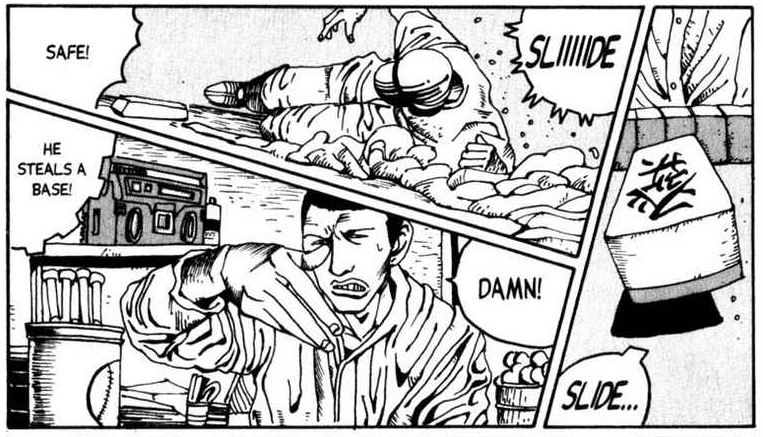
One of the most arresting aspects of Blue Spring is Matsumoto’s ability to manipulate time. In one of the book’s most visually stunning sequences, for example, Matsumoto seamlessly blends two events — a baseball game and a mahjong game — into a single sequence:

Matsumoto makes it seem as if the gambler’s action precipitated the slide into second base. It’s an elegant visual trick that establishes the simultaneity of the two games while suggesting the intensity of the mahjong play; the discarding of a tile is portrayed with the same explosive energy as stealing a base.

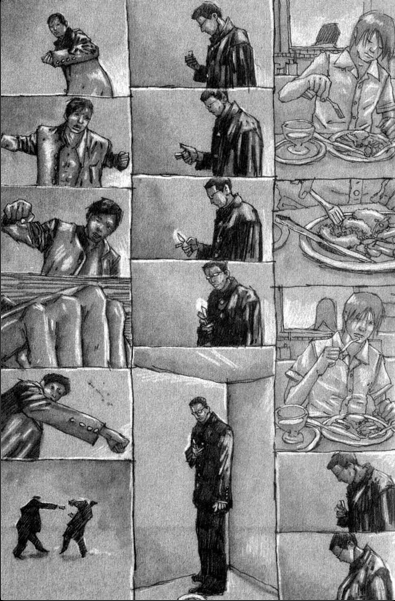
Some of Matsumoto’s time-bending sequences are more cinematic, evoking the kind of split-screen technique popularized in the 1960s by filmmakers like John Frankenheimer and Richard Fleischer. The prologue, for example, contains a series of short, vertical strips in which we see unnamed teenagers preparing for a day at school. Matsumoto deliberates re-frames the activity in each panel, drawing back to show the full scene in some, and pulling in close to reveal the blankness of a characters’ face in another:


It’s an effective montage, largely for the way it juxtaposes the banal with the violent; the fist-fight is presented in the same, matter-of-fact fashion as the student eating breakfast, suggesting that conflict is as routine for some of Blue Spring‘s characters as catching the train to school. The transitions, too, are handled deftly; the eye can process these little vignettes in a sequence while the brain grasps the entire prologue as a simultaneous collage of events, a representative cross-section of high school students going about their business on a typical day.

Matsumoto’s stark, black-and-white imagery won’t be to every reader’s taste; I’d be the first admit that many of the kids in Blue Spring look older and wearier than Keith Richards, with their sunken eyes and rotten teeth. But the studied ugliness of the character designs and urban settings suits the material perfectly, hinting at the anger and emptiness of the characters’ lives. Matsumoto offers no easy answers for his characters’ behavior, nor any false hope that they will escape the lives of violence and despair that seem to be their destiny. Rather, he offers a frank, funny and often disturbing look at the years in which most of us were unformed lumps of clay — or, in Matsumoto’s memorable formulation, a time when most of us were blue: “No matter how passionate you were, no matter how much your blood boiled, I believe youth is a blue time. Blue — that indistinct blue that paints the town before the sun rises.”

This is an expanded version of a review that appeared at PopCultureShock on 4/30/07.

BLUE SPRING • BY TAIYO MATSUMOTO • VIZ • 216 pp. • RATING: MATURE (18+)

Filed Under: Manga, Manga Critic, Recommended Reading, REVIEWS Tagged With: Seinen, Taiyo Matsumoto, VIZ

The Best Manga You’re Not Reading: Blue Spring

January 11, 2011 by Katherine Dacey 5 Comments

As depicted in most shojo and shonen manga, the Japanese high school is the epitome of order, with students in neat, military-style uniforms diligently studying for exams, tidying up classrooms, staging plays, and participating in cultural festivals. Students who don’t fit into the school’s established pecking order — social, athletic, or academic — quickly find themselves ostracized by their peers for lack of purpose.

Taiyo Matsumoto, however, offers a very different image of the Japanese high school in his anthology Blue Spring. His subjects are the kids with “front teeth rotten from huffing thinner,” who “answer to reason with their fists and never question their excessive passions” — in short, the delinquents. Kitano High School, the milieu these kids inhabit, is a crumbling eyesore with graffiti-covered walls, trash-filled stairwells, and indifferent faculty. Students cut class and fill their after-school hours with girlie magazines, petty crime, and smack-talk at the local diner, marking time until they join the world of adult responsibility.

Gangs, bullies, disaffected teens playing at thug life — it’s familiar territory, yet in Matsumoto’s hands, these potentially cliche stories acquire a new and strange quality. Matsumoto eschews linear narrative in favor of digressions and fragments; as a result, we feel more like we’re living in the characters’ heads than reading a tidy account of their actions. Snatches of daydreams sometimes interrupt the narrative, as do jump cuts and surreal imagery: sharks and puffer fish drift past a classroom window where two teens make out, a UFO languishes above the school campus. Even the graffiti plays an integral part of Matsumoto’s storytelling; the walls are a paean to masturbation, booze, and suicide, cheerfully urging “No more political pacts–sex acts!”

One of the most arresting aspects of Blue Spring is Matsumoto’s ability to manipulate time. In one of the book’s most visually stunning sequences, for example, Matsumoto seamlessly blends two events — a baseball game and a mahjong game — into a single sequence:

Matsumoto makes it seem as if the gambler’s action precipitated the slide into second base. It’s an elegant visual trick that establishes the simultaneity of the two games while suggesting the intensity of the mahjong play; the discarding of a tile is portrayed with the same explosive energy as stealing a base.

Some of Matsumoto’s time-bending sequences are more cinematic, evoking the kind of split-screen technique popularized in the 1960s by filmmakers like John Frankenheimer and Richard Fleischer. The prologue, for example, contains a series of short, vertical strips in which we see unnamed teenagers preparing for a day at school. Matsumoto deliberates re-frames the activity in each panel, drawing back to show the full scene in some, and pulling in close to reveal the blankness of a characters’ face in another:


It’s an effective montage, largely for the way it juxtaposes the banal with the violent; the fist-fight is presented in the same, matter-of-fact fashion as the student eating breakfast, suggesting that conflict is as routine for some of Blue Spring‘s characters as catching the train to school. The transitions, too, are handled deftly; the eye can process these little vignettes in a sequence while the brain grasps the entire prologue as a simultaneous collage of events, a representative cross-section of high school students going about their business on a typical day.

Matsumoto’s stark, black-and-white imagery won’t be to every reader’s taste; I’d be the first admit that many of the kids in Blue Spring look older and wearier than Keith Richards, with their sunken eyes and rotten teeth. But the studied ugliness of the character designs and urban settings suits the material perfectly, hinting at the anger and emptiness of the characters’ lives. Matsumoto offers no easy answers for his characters’ behavior, nor any false hope that they will escape the lives of violence and despair that seem to be their destiny. Rather, he offers a frank, funny and often disturbing look at the years in which most of us were unformed lumps of clay — or, in Matsumoto’s memorable formulation, a time when most of us were blue: “No matter how passionate you were, no matter how much your blood boiled, I believe youth is a blue time. Blue — that indistinct blue that paints the town before the sun rises.”

This is an expanded version of a review that appeared at PopCultureShock on 4/30/07.

BLUE SPRING • BY TAIYO MATSUMOTO • VIZ • 216 pp. • RATING: MATURE (18+)

Filed Under: Manga Critic Tagged With: Seinen, Taiyo Matsumoto, VIZ

Biomega Volumes 2 and 3

January 10, 2011 by Anna N

Biomega Volume 2 by Tsutomu Nihei

Biomega continues to be one of the most stylish action manga I’ve read. There might not be a whole lot of substance there, but the style is dialed up so high that I find myself not caring so much that Nihei’s vision of a dystopian future seems like it has been cobbled together from a variety of sources. Zoichi is determined to rescue the captured Eon Green. We get a little more background about Zoichi and his world in this volume – Zoichi seems to be a rogue synthetic human developed by Toa Heavy industries, and now we see that he isn’t the only person with those unique abilities as Nishu Mizunoe is shown to be pursing the talking bear Kozlov Grebnev. There’s plenty of zombie splattering action, but my favorite part of this book came relatively early when Nihei displays a spectacular example of manga physics.

Zoichi is on the run from a group of fighter planes. From his motorcycle, he shoots one down with his handgun. He dodges missiles on the highway, then jumps the motorcycle into the air while holding an axe. He then proceeds to pilot the plane, anchored by the axe, as he sends his always helpful computer program into the cockpit to take over the plane. Honestly, I was so happy with the handful of panels in that action sequence the rest of the book could have been a 188 page instruction booklet on mumblety-peg and I still would have found it a satisfying reading experience.

Biomega Volume 3 by Tsutomu Nihei

The third volume doesn’t feature an action sequence as iconic as riding on a plane with an axe, but there’s plenty of action as the synthetic humans from Towa Heavy Industries confront the Data Research Foundation and their plans for transforming the earth. There’s a synthetic compound that dramatically reacts with the infected zombie/drones, giving the DF foundation a chance to remake the earth and ensure their own immortality. There’s mecha fights, fleshy monsters, motorcycles with handy claw tools, and Zoichi finally manages to get to Eon Green.

Part of the reason why I like this manga so much is that it is the only seinen science fiction title I’m actively collecting. So it functions as a nice palate cleanser when I’ve read too much shoujo. I can certainly see why some people might find not very compelling due to the somewhat erratic nature of Nihei’s storytelling. Biomega sometimes seems like a pastiche of many similar manga and anime. I find though that the artwork in Biomega compensates for the storytelling. Nihei’s character designs are sometimes really unsettling, as many of the characters are hidden behind creepy-looking masks to prevent infection. The synthetic humans are the perfect action heroes, the sometimes display some unsettling powers as their bodies react to injuries or extrude biomechanical parts to make climbing up giant mecha that much easier. For all the non-stop action in Biomega, the most memorable images I found in the third volume were a few panels of Zoichi’s dream after he’s been poisoned. He’s standing in an alien landscape in outer space, looking out at the stars when a man with his skull half caved in comments that there are no humans left. Nihei is great at juxtaposing moments of stillness with his inventive action sequences, and that’s why I’m going to be looking for the next few volumes in this series.

Filed Under: UNSHELVED

Manhwa Monday: 12 Creators & the Milky Way

January 10, 2011 by MJ Leave a Comment

Welcome to another Manhwa Monday!

After last week’s whining about the lack of new manhwa licenses, we’ve discovered at least one, though we don’t know for sure whether there are plans to release it in print.

The December issue of Yen Plus advertises an upcoming manhwa series from Sirial (One Fine Day), called Milkyway Hitchhiking, about a cat with a pattern that looks like the Milky Way on his back. The series will be in full color, and is also Yen Press’ first simultaneous serialization. Let’s hope it sees print publication as well! Lori Henderson has some thoughts on the series in her write-up of December’s issue of Yen Plus. (Thanks to Michelle Smith for the tip!)

Robot 6 has an exclusive look at cover art for TOKYOPOP’s new Priest Purgatory series. And on the subject of Priest, 411 mania lists the upcoming film adaptation as one of its Biggest Comic Book Movies of 2011 .

iSeeToon continues their series on different types of manhwa with a look at Korean webtoons in their blog this week.

Blog of Asia attempts to explain the difference between manga and manhwa, drawing some interesting conclusions about both.

Here at Manhwa Bookshelf, Hana Lee translates the list of winners from Korea’s Reader Awards for manhwa in 2010.

This week in reviews, both Ed Sizemore of Manga Worth Reading and Richard of Forbidden Planet International take a look at Korea as Viewed by 12 Creators (Fanfare/Ponent Mon), offering a nice break from our usual cluster of Yen Press titles.

That’s all for this week!

Is there something I’ve missed? Leave your manhwa-related links in comments!

Filed Under: Manhwa Bookshelf, Manhwa Monday

Two from Yoshinaga

January 10, 2011 by David Welsh

One of the fascinating things about Fumi Yoshinaga’s Ôoku: The Inner Chambers (Viz) is watching the core elements of the series refine themselves. The fifth volume brings the level of emotional savagery to new heights, which is saying something.

In Yoshinaga’s gender-reversed imagining of the halls of power of feudal Japan, none of the shoguns have fared well in terms of emotional satisfaction. The demands of power and the palpable unease with societal reversals leave everyone at least a little undone, no matter how assiduously they try to adapt (or pretend that they’ve adapted). This time around, conniving Sir Emonnosuke, Senior Chamberlain of the Inner Chambers, continues his sly but ultimately joyless schemes, while the Shogun, Tsunayoshi, is torn between competing demands.

There’s undeniable cruelty in Tsunayoshi’s plight. She’s forced to choose between the demands of governance and succession, and her internal conflict has dire consequences for the kingdom. She’s also divided between the demands of the next generation and the previous, beholden to an elderly father wrestling with his own traumas. Since Ôoku isn’t about triumphing over adversity, readers are left to watch the spiral and marvel in the ways it spreads out, both in terms of specific character and the culture they inhabit.

By comparison, Emonnosuke’s travails seem trivial, but flashbacks provide context for his functional present. And it all contributes to the notion of the personal and political blurring beyond recognition, which really is the defining concern of the series.

Much as I love the title, it would be dishonest not to acknowledge its flaws. The adaptation is sometimes flowery, though its excesses have leveled off over time. Another issue is Yoshinaga’s sometimes repetitive character design. She definitely has aesthetic types she favors, which can make things confusing in a cast so large. (On the bright side, she favors attractive people, so at least the confusion is easy on the eye.)

On the opposite end of the Yoshinaga spectrum is Not Love But Delicious Foods Make Me So Happy! (Yen Press). This is Yoshinaga being aimlessly charming and indulging in one of her favorite obsessions, cuisine. It’s a semi-autobiographical restaurant crawl for the readers of Ohta Shuppan’s intriguing Manga Erotics F and features a Yoshinaga avatar, Y-Naga, dragging her friends and colleagues from eatery to eatery.

Reviewing it is kind of like conducting a serious critical evaluation of chatty emails from a particularly funny, endearing friend. The stories benefit from already knowing and liking Yoshinaga, though I’d wager the food obsession would be an independent draw. As someone who’s read everything of Yoshinaga’s that’s available in English and yearns for someone to publish everything that isn’t, I was perfectly delighted with the book, and I find it hard to imagine the kind of person who wouldn’t be a least a little smitten.

Yoshinaga’s self-portrait is hilariously self-deprecating. The contrast between her grubby working persona to her done-up, out-on-the-town self is never not funny, and her shameless exposure of her idiosyncrasies almost certainly made me like her more. She’s unafraid to admit that she’s more than a little selfish and certainly a glutton, but those qualities make her all the more winning, just as the flaws make her entirely fictional characters more absorbing.

And the restaurant guide, while probably useless to most North American readers, is great fun, partly for the things you learn about Japanese food culture and partly for the cast of dining companions Yoshinaga assembles. The gay friend, the depressingly attractive woman friend, the too-close-for-comfort male assistant and roommate, and the rest all bring distinct and engaging qualities to the party.

Filed Under: REVIEWS

Tidbits: Four by Hinako Takanaga

January 9, 2011 by Michelle Smith

This installment of Tidbits is devoted to the BL stories of Hinako Takanaga! Today I’m focusing on some shorter works, but look for Little Butterfly and Challengers in future columns. A trio of one-shots is up first—A Capable Man, CROQUIS, and Liberty Liberty!—followed by the second volume of You Will Drown in Love. That series is still ongoing in Japan, where the third volume was released in July of last year. All are published in English by BLU Manga.

A Capable Man: C-
Looks are mighty deceiving with this one. Because the cover is bright and cute I expected a sweet one-volume romance, but what I got instead was a collection of short stories featuring unappealing characters.

Things got off to a bad start when, barely a dozen pages into the first story, “I Like Exceptional Guys,” a teenager forces himself onto his childhood friend. It’s a very disturbing scene, complete with a gag for the victim. Ugh. Afterwards, the attacker (Koji) cries and apologies and aw, gee, it’s so hard to be mad at someone who’s assaulted you when they obviously love you so much! Even Koji thinks it’s weird to be forgiven so quickly.

Another problematic story is “Something to Hide,” about a teacher who’s having an affair with his student. The student is about to graduate and wants them to move in together but the teacher has reservations. Is it because he’d be betraying the trust of his student’s parents, which he has worked hard to cultivate? Nope. It’s because he’s embarrassed about his unruly hair.

The collection is rounded out by “How to Satisfy Your Fetish,” about a trainee chef with a voice fetish who gets off on provoking disgusted reactions from his instructor, and “Kleptomaniac,” about a guy who compulsively steals objects that have been used by his crush. The latter is rather dull, but the kinky former could have been fun if I wasn’t already weary of “semi-sickos,” as Takanaga herself describes these characters.

CROQUIS: B
When Nagi Sasahara—a young man who works in drag at a gay bar and is saving up for gender-reassignment surgery—seeks to augment his income by modeling for an art class, he senses something different in the gaze of a student named Shinji Kaji. Ever since the age of ten, Nagi has fallen only for guys, so he’s both accepted his sexuality and become accustomed to rejection. Kaji surprises him by returning his feelings and the two become a couple, though the fact that they make it four months into their relationship without sleeping together causes Nagi to doubt whether Kaji is really okay with the fact that Nagi is male. Frequently comedic and happily short-lived angst ensues.

There are things to like and to dislike about CROQUIS. First off, I love that Nagi has known he was gay since childhood and that the story makes at least a passing reference to the existence of homophobia. I also like that he and Kaji interact essentially as equals, even though Kaji is underdeveloped and Nagi has a tendency to be high-maintenance. Where the story falters, though, is in its depiction of Nagi’s reasons for wanting to undergo surgery. Does he wish to become a woman because he feels like he’s trapped in a body of the wrong gender? Nope. He just thinks that’s the only way he’ll be able to score a boyfriend.

This volume also contains a one-shot about a pair of childhood friends and their conflicting opinions on the value of wishing upon stars and a pair of stories called “On My First Love.” The latter two are actually better than the title story, in my opinion, and tell the bittersweet tale of former classmates who had feelings for each other in the past but never managed to act on them. Now both have moved on with their lives while secretly nursing painful yet precious memories. I’m a sucker for sad stories like these, so it was a treat to discover them after the pleasant but not oustanding title story.

Libery Liberty!: B+
“In a corner of Osaka, one young man lies atop a heap of trash.” That unfortunate fellow is drunken twenty-year-old Itaru Yaichi who, in the course of being discovered by a cameraman on stakeout, breaks an expensive piece of equipment belonging to a local cable TV station and finds himself heavily in debt. The cameraman, Kouki Kuwabara, agrees to let Itaru stay at his place until he can find a job. In the meantime, Itaru helps out at the station and eventually reveals what circumstances led to his present predicament.

At first, Liberty Liberty! seems like it will be cute but utterly insubstantial love story, but the narrative offers many more complexities than I initially expected. For one, before anything romantic transpires between Itaru and Kouki, they first must become friends and do so by talking about their professional goals and setbacks. Kouki was a film student when he learned that nerve damage was impairing the sight in his left eye. He thought he was through but when a friend offered him a job at the TV station, he rediscovered his passion. Similarly, Itaru had a story concept stolen (and improved upon) by an upperclassman, so a crisis of confidence made him go on a leave of absence from school.

Gradually, by working at the station and witnessing Kouki’s example, Itaru takes the first steps towards writing again. He wants to become a person he can be proud of. His feelings for Kouki develop after this point, and his accidental confession results in a pretty amusing scene:

Again, their relationship evolves slowly, largely because Kouki has been alone for such a long time (and nursing some unrequited feelings for his cross-dressing friend, Kurumi) that it takes him a while to accept the possibilities of new love. I love that both characters are vulnerable and hesitant, and that Takanaga took the time to develop the friendship between them first before bringing them to the verge of something more. And “to the verge” it is, because the story ends before the boys have done more than smooch. As a result, Liberty Liberty! perfectly deserves its Young Adult rating and would probably be a hit in a library’s manga collection.

You Will Drown in Love 2: B-
Reiichiro Shudo and Kazushi Jinnai—both employed at a fabric store, where the younger Reiichiro is the boss and Jinnai his subordinate—have been dating for a while but Jinnai is feeling uneasy. He’s unsure whether Reiichiro really loves him or is just being compliant. When Kijima from headquarters arrives to help the store get ready for a trade show, he begins to put the moves on the oblivious Reiichiro, which sends Jinnai into a tizzy.

Even though this is written just about as well as the introduction of an aggressively sexual new love rival can be, it’s still a pretty tired plot device. In Takanaga’s hands, Kijima isn’t as over-the-top as he might otherwise have been, but he’s still more of a catalyst than a character in his own right. Scenes in which Jinnai freaks out become a bit repetitive, but once the twist comes—it’s Jinnai that Kijima is really after—it actually allows for a pretty satisfying ending.

No, the twist is not very dramatically surprising, and no, having competition doesn’t compel Reiichiro to boldly confess his love—that would be quite out of character—but it does prompt him to object to Jinnai getting close to any other man, which Jinnai happily accepts as proof at last of Reiichiro’s affections.

This may have been a somewhat disappointing volume, but I still like these characters and this setting so I’ll be back for volume three, whenever it makes its way over here.

Review copies for CROQUIS and Liberty Liberty! provided by the publisher.

Filed Under: REVIEWS Tagged With: BLU Manga, Hinako Takanaga

Random Sunday question: alternatives

January 9, 2011 by David Welsh

There’s been some lively discussion of reactions to the Ax anthology from Top Shelf (and here’s the solicitation for the second volume), which inspired this weekend’s query. What I’m  basically wondering is what three titles in the pile of manga you’ve read do you consider alternative? I ask this with the understanding that everyone’s tastes in comics are different and that “alternative” is an entirely relative term as a result.

Since I’m using Ax as a baseline, I’ll leave it off of my list, which consists of:

  • Little Fluffy Gigolo Pelu, written and illustrated by Junko Mizuno, Last Gasp
  • The Box Man, written and illustrated by Imiri Sakabashira, Drawn & Quarterly
  • Secret Comics Japan, written and illustrated by various artists, Viz

What are your choices?

Filed Under: REVIEWS

Buffy the Vampire Slayer Season Eight 4 by Joss Whedon: B

January 8, 2011 by Michelle Smith

From the back cover:
Buffy Summers unlocked the power of the Slayer in hundreds of young women, but in the future only one Slayer remains. Melaka Fray—introduced by Buffy creator Joss Whedon and artist Karl Moline in 2001—returns to comics in Season Eight of Buffy the Vampire Slayer.

When Buffy attempts to solve the mystery of her scythe, she’s propelled into the future, and into the path of Fray. In order to save their worlds, the two Slayers must fight against a threat more powerful than the two of them combined, while back in the twenty-first century, the Scottish Slayer base falls prey to a mystical bomb courtesy of the Biggest Bad—Twilight.

Review:
It’s been a long time since I reviewed any of the Season Eight comics. I’ve been keeping up with the individual issues, but just haven’t felt inclined to reread them when the collected editions come out. I still haven’t liked any arc as much as Brian K. Vaughan’s “No Future for You” (issues 6-10), and somewhere along the way things have gotten so ridiculous that I just refuse to admit/believe that any of these events can be considered canon. Season Eight will be ending soon—the fortieth and final issue is due on January 19 (Buffy’s birthday)—so it seems like a good time to get caught up with reviews and potentially air a few gripes.

Volume four collects issues 16-20 of the series, comprising the Whedon-penned arc “Time of Your Life” as well as Jeph Loeb’s one-shot, “After These Messages… We’ll Be Right Back!” And, actually, this arc is pretty good. Warning: spoilers ahead!

Following up on a message she received while in Japan, Willow concludes that she and Buffy need to go to New York because of some timey-wimey ripple of a future event that’s going to occur there. Once they arrive, a portal opens, sending Buffy two hundred years into the future (and leaving a slavering beastie in her place), into the path of a Slayer named Melaka Fray. Fray, some may remember, once had a comic series of her own and fans were curious how Fray’s future (where there’s only one Slayer) would tie in with the series’ continuity, in which Buffy essentially activates all the potential Slayers in the world.

Fray’s main foe is her twin brother, Harth. A vampire, he’s got tons of minions and has recently been linked to a dark-haired madwoman who speaks in riddles. One assumes this is hinting at Drusilla, but it’s actually Dark Willow, still alive and planning something unspecific with Harth. Stuff happens—my favorite bits demonstrate how the two Slayers approach their job differently—but the basic gist is that present-day Willow reopens the portal and Buffy is determined to go back to her own time, even if it means that Fray and her future will cease to exist. When Dark Willow blocks her way, Buffy stabs her with the scythe.

Now, this is pretty interesting and reads much better when collected all together than as single issues. My major problem with it, though, is that I have no idea what Willow’s motivation was. Why was she working with Harth? What was she helping him to achieve? Vampire dominion over earth? Why would she do that? If I had to guess I’d say that maybe she wanted the future to look as shitty as possible so that Buffy would be determined not to let things turn out like that. But the final page of the arc shows that Melaka and her version of the future didn’t disappear at all. It’s quite a sad end for Willow, all alone and dead on some dingy futuristic rooftop.

Coming off the end of this arc is the fluffy but fun “After These Messages,” in which Buffy has a dream in the style of the cartoon series version of the show that never panned out. It takes place during high school, so Joyce is there, and reminds Buffy of how simple her life used to be. It’s not just a throwaway piece, though, as Buffy gets some advice from Dream Angel that convinces her that she shouldn’t tell Willow about what happened in the future.

If I recall rightly, this is the last arc that I enjoyed, but we shall see. It could be that the others will also fare much better when read back-to-back instead of in monthly installments. Stay tuned!

Filed Under: REVIEWS Tagged With: Buffy the Vampire Slayer, Dark Horse

  • « Go to Previous Page
  • Page 1
  • Interim pages omitted …
  • Page 4
  • Page 5
  • Page 6
  • Page 7
  • Page 8
  • Go to Next Page »
 | Log in
Copyright © 2010 Manga Bookshelf | Powered by WordPress & the Genesis Framework