• Skip to primary navigation
  • Skip to main content
  • Skip to primary sidebar
  • Home
  • About Us
    • Privacy Policy
    • Comment Policy
    • Disclosures & Disclaimers
  • Resources
    • Links, Essays & Articles
    • Fandomology!
    • CLAMP Directory
    • BlogRoll
  • Features & Columns
    • 3 Things Thursday
    • Adventures in the Key of Shoujo
    • Bit & Blips (game reviews)
    • BL BOOKRACK
    • Bookshelf Briefs
    • Bringing the Drama
    • Comic Conversion
    • Fanservice Friday
    • Going Digital
    • It Came From the Sinosphere
    • License This!
    • Magazine no Mori
    • My Week in Manga
    • OFF THE SHELF
    • Not By Manga Alone
    • PICK OF THE WEEK
    • Subtitles & Sensibility
    • Weekly Shonen Jump Recaps
  • Manga Moveable Feast
    • MMF Full Archive
    • Yun Kouga
    • CLAMP
    • Shojo Beat
    • Osamu Tezuka
    • Sailor Moon
    • Fruits Basket
    • Takehiko Inoue
    • Wild Adapter
    • One Piece
    • After School Nightmare
    • Karakuri Odette
    • Paradise Kiss
    • The Color Trilogy
    • To Terra…
    • Sexy Voice & Robo
  • Browse by Author
    • Sean Gaffney
    • Anna Neatrour
    • Michelle Smith
    • Katherine Dacey
    • MJ
    • Brigid Alverson
    • Travis Anderson
    • Phillip Anthony
    • Derek Bown
    • Jaci Dahlvang
    • Angela Eastman
    • Erica Friedman
    • Sara K.
    • Megan Purdy
    • Emily Snodgrass
    • Nancy Thistlethwaite
    • Eva Volin
    • David Welsh
  • MB Blogs
    • A Case Suitable For Treatment
    • Experiments in Manga
    • MangaBlog
    • The Manga Critic
    • Manga Report
    • Soliloquy in Blue
    • Manga Curmudgeon (archive)

Manga Bookshelf

Discussion, Resources, Roundtables, & Reviews

VIZ

A Devil and Her Love Song, Vol. 1

January 15, 2012 by Katherine Dacey

Maria Kawai, heroine of A Devil and Her Love Song, is a cool customer. Not only is she beautiful, talented, and smart, she’s also tough — so tough, in fact, that she was expelled from a hoity-toity Catholic school for beating up a teacher. Her blunt demeanor further cements her bad-girl impression; within minutes of enrolling at a new high school, she antagonizes all the girls in her class with a few sharp observations about their behavior. Only two boys — Yusuke, a cheerful, popular student who avoids conflict at all costs, and Shin, a moody outsider — try defending Maria from her peers’ nasty comments and pranks.

So far, so good: Maria is spiky and complicated, a truth-teller who lacks the ability to censor herself, even though she’s aware of the potential consequences of speaking her mind. Throughout volume one, there are some wonderful comic moments as Maria struggles to put a “lovely spin” — Yusuke’s term — on her acid comments. Alas, Maria’s sideways head-tilt and doe-eyed gaze look more sinister than cute; not since Kazuo Umezu’s Scary Book has a manga-ka made a doll-like character look so thoroughly menacing, even when superimposed atop a backdrop of flowers and sparkles.

Having created such a vivid character, however, Miyoshi Tomori isn’t sure where to go with the story. In several scenes, Maria does things that contradict what we know about her: would someone as perceptive as Maria willingly attend a party hosted by the class mean girls, especially after they’d harassed her on a daily basis? And why would someone as outspoken as Maria refrain from pointing out her teacher’s judgmental behavior — especially when it’s plainly obvious to both the characters in the story and the reader? These kind of abrupt reversals might make sense if we knew more about Maria’s past, but at this stage in the story, they feel more like authorial floundering than a conscious revelation of character.

From time to time, however, Tomori convincingly hints at Maria’s softer side. Midway through volume one, for example, Maria makes tentative overtures towards Tomoya “Nippachi” Kohsaka, a fellow bullying victim. (“Nippachi” means “twenty-eight,” and is a mean-spirited reference to Tomoya’s poor academic performance.) That scene is both sad and real; anyone who’s ever seen two ostracized kids turn their classmates’ scorn on one another will immediately appreciate the dynamic between Maria and Nippachi. Maria’s exchanges with Shin, too, reveal a different side of her personality; though the pair frequently engage in the kind of rapid, antagonistic banter that’s de rigeur for romantic comedies, their quieter conversations suggest a grudging mutual respect.

Maria’s interactions with Nippachi and Shin fill me with hope that A Devil and Her Love Song will find its footing in later chapters. If Tomori can find a way to reveal Maria’s fundamental decency without compromising her heroine’s tart, outspoken personality, A Devil and Her Love Song will be a welcome addition to the Shojo Beat catalog, an all-too-rare example of a story in which the heroine isn’t the least bit concerned with being nice or popular. If Tomori can’t, Devil runs the risk of devolving into a YA Taming of the Shrew, with Shin (or, perhaps, Yosuke) playing Petruchio to Maria’s Katherina.

Review copy provided by VIZ Media, LLC. Volume one will be released February 7, 2011.

A DEVIL AND HER LOVE SONG, VOL. 1 • BY MIYOSHI TOMORI • VIZ MEDIA • 200 pp. • RATING: TEEN (13+)

Filed Under: Manga, Manga Critic, REVIEWS Tagged With: shojo, shojo beat, VIZ

Fluffy, Fluffy Cinnamoroll, Vol. 1

January 6, 2012 by Katherine Dacey 1 Comment

Critic proof: that’s my two-word assessment of Fluffy, Fluffy Cinnamoroll, a new all-ages manga starring one of Sanrio’s lesser-known characters. The story is a mixture of sincere sentiment and calculated product placement that’s been carefully designed to appeal to the under-ten crowd; an adult can practically hear the cha-ching of the cash register every time a new character or magical object is introduced.

The Cinnamaroll of the title is described in the introduction as a “boy puppy” with a tail like a bun. Unhappy among his litter mates — all of whom are big, puffy clouds — he finds his calling at a terrestrial bakery that specializes in breakfast treats. There he befriends an assortment of other dogs: Mocha, a “stylish chatterbox” who accessorizes with ribbons and flowers; Cappuccino, an easygoing pup who likes to nap and eat; Chiffon, a high-energy dog with ears that faintly resemble a chiffon cake; Espresso, a talented know-it-all who boasts a “distinguished Mozart hairstyle”; and Milk, a baby whose entire vocabulary consists of the all-purpose word “baboo.”

Volume one features a dozen or so stories involving picnics, treasure maps, trips to the beach, and letters to Santa Claus. Though there’s a strong element of fantasy in the gang’s adventures, there’s an even stronger whiff of didacticism: in one chapter, for example, Cinnamoroll must set aside his fear of the dark to rescue his friends, who are being held captive in a haunted house, while in another, Cinnamoroll learns to embrace the fact he’s different from the other “cloud kids.” Every conflict is neatly resolved in a few pages, with Cinnamoroll learning an important lesson about friendship, loyalty, or selflessness; only Cavity, a dark cloud with a devil’s tail, seems impervious to the other characters’ warmth and energy.

As an adult reader, it’s impossible not to feel a little jaded reading Fluffy, Fluffy Cinnamoroll. The stories have predictable scripts that have been carefully designed to stimulate the reader’s awwwww reflex at regular intervals. The artwork, too, lacks personality; though no one would deny its fundamental cuteness, the art looks prefabricated, as if each character had been assembled from interchangeable parts from the Sanrio plant. More puzzling still is that none of the pups look particularly canine; the artist could easily have described all of them as long-eared rabbits without compromising the story.

Yet for all the cynicism a project like Fluffy, Fluffy Cinnamoroll might inspire, I also understand its appeal: it looks like someone took the contents of my childhood sticker album and turned it into a story featuring puppies, unicorns, sweets, and rainbows. The stories, like the character designs, have a definite child logic to them, as the plots touch on a variety of pre-teen fantasies: being rich and famous, eating a diet of sweets, spending all your time playing with friends (no one goes to school), and learning that yes, indeed, you were born into the wrong family. If those stories aren’t executed with the grace or imagination of the best kids’ comics, they’ll still please the under-ten crowd with their whimsical settings and earnest characters. Just don’t be surprised when they ask the inevitable question: where can I get a Cinnamoroll doll?

Review copy provided by VIZ Media, LLC.

FLUFFY, FLUFFY CINNAMOROLL, VOL. 1 • STORY AND ART BY YUMI TSUKIRINO, ORIGINAL CONCEPT BY CHISATO SEKI • VIZ MEDIA • 160 pp. • RATING: ALL AGES


Filed Under: Manga Critic Tagged With: All-Ages Manga, Cinnamoroll, Sanrio, VIZ, VIZ Kids

Fluffy, Fluffy Cinnamoroll, Vol. 1

January 6, 2012 by Katherine Dacey

Critic proof: that’s my two-word assessment of Fluffy, Fluffy Cinnamoroll, a new all-ages manga starring one of Sanrio’s lesser-known characters. The story is a mixture of sincere sentiment and calculated product placement that’s been carefully designed to appeal to the under-ten crowd; an adult can practically hear the cha-ching of the cash register every time a new character or magical object is introduced.

The Cinnamaroll of the title is described in the introduction as a “boy puppy” with a tail like a bun. Unhappy among his litter mates — all of whom are big, puffy clouds — he finds his calling at a terrestrial bakery that specializes in breakfast treats. There he befriends an assortment of other dogs: Mocha, a “stylish chatterbox” who accessorizes with ribbons and flowers; Cappuccino, an easygoing pup who likes to nap and eat; Chiffon, a high-energy dog with ears that faintly resemble a chiffon cake; Espresso, a talented know-it-all who boasts a “distinguished Mozart hairstyle”; and Milk, a baby whose entire vocabulary consists of the all-purpose word “baboo.”

Volume one features a dozen or so stories involving picnics, treasure maps, trips to the beach, and letters to Santa Claus. Though there’s a strong element of fantasy in the gang’s adventures, there’s an even stronger whiff of didacticism: in one chapter, for example, Cinnamoroll must set aside his fear of the dark to rescue his friends, who are being held captive in a haunted house, while in another, Cinnamoroll learns to embrace the fact he’s different from the other “cloud kids.” Every conflict is neatly resolved in a few pages, with Cinnamoroll learning an important lesson about friendship, loyalty, or selflessness; only Cavity, a dark cloud with a devil’s tail, seems impervious to the other characters’ warmth and energy.

As an adult reader, it’s impossible not to feel a little jaded reading Fluffy, Fluffy Cinnamoroll. The stories have predictable scripts that have been carefully designed to stimulate the reader’s awwwww reflex at regular intervals. The artwork, too, lacks personality; though no one would deny its fundamental cuteness, the art looks prefabricated, as if each character had been assembled from interchangeable parts from the Sanrio plant. More puzzling still is that none of the pups look particularly canine; the artist could easily have described all of them as long-eared rabbits without compromising the story.

Yet for all the cynicism a project like Fluffy, Fluffy Cinnamoroll might inspire, I also understand its appeal: it looks like someone took the contents of my childhood sticker album and turned it into a story featuring puppies, unicorns, sweets, and rainbows. The stories, like the character designs, have a definite child logic to them, as the plots touch on a variety of pre-teen fantasies: being rich and famous, eating a diet of sweets, spending all your time playing with friends (no one goes to school), and learning that yes, indeed, you were born into the wrong family. If those stories aren’t executed with the grace or imagination of the best kids’ comics, they’ll still please the under-ten crowd with their whimsical settings and earnest characters. Just don’t be surprised when they ask the inevitable question: where can I get a Cinnamoroll doll?

Review copy provided by VIZ Media, LLC.

FLUFFY, FLUFFY CINNAMOROLL, VOL. 1 • STORY AND ART BY YUMI TSUKIRINO, ORIGINAL CONCEPT BY CHISATO SEKI • VIZ MEDIA • 160 pp. • RATING: ALL AGES


Filed Under: Manga, Manga Critic, REVIEWS Tagged With: All-Ages Manga, Cinnamoroll, Sanrio, VIZ, VIZ Kids

Let’s Get Visual: The Jibblies

December 3, 2011 by Michelle Smith

MICHELLE: So, in our last installment of Let’s Get Visual we celebrated the pretty, so it seems only fitting that this time we devote our attentions to images that make us shudder with a feeling I like to call “the jibblies.” Just like beauty, creepy is a subjective thing, so we’ve each chosen a variety of images that get our personal hackles rising.

MJ, you want to go first this time?

MJ: Sure!

So, as I was perusing my manga collection for things that creep me out, it became increasingly clear to me that I’m very simple when it comes to what scares me. All it takes to really get to me is a single disturbing image–especially one that distorts something human into something sinister. I’m apparently not scared of monsters so much as I am of monsters in human clothing.

My first example comes from Setona Mizushiro’s After School Nightmare. In this series, a group of teenagers is regularly drawn into a shared dreamworld in which they each appear as physical manifestations of their own worst fears. Some of these are visually more disturbing than others. The series’ main character, Ichijo, for instance, most fears his own confusion about gender, so his skirt-wearing dream self is really horrifying only to him. Some of the other students, however, wear their fears in a much more visually distorted manner. This short spread features two of those students.

After School Nightmare, Vol. 1 (Go! Comi)

First, you’ll see a student who appears only as an arm and hand, twisting itself around Ichijo. Second, a girl appears with giant cavities replacing her face and chest. While the second of these has the most stunning, immediate affect on my psyche, the first creeps up on me as I try to move away from the page. Both images stick with me long after I’ve put the book down, and this seems to be the real key to scaring the bejeezus out of me. If I can’t get the image out of my mind, it easily haunts me for days. That’s the power of a single, shocking image.

MICHELLE: My first thought upon hearing of your aversion to “a single disturbing image” is that you shouldn’t read Junji Ito’s Uzumaki, followed by the thought that you should read it.

My reaction to the image above differs from yours, though, in that while these images certainly provoke in me an “ew” reaction, they aren’t the type that haunt me. I definitely think that the slinky arm creature is the more creepy in the image you displayed. For me, it’s because the gaping images of emptiness are immediately recognizable as symbols for what that character is feeling, but what on earth is causing that other student to appear like a grasping, creeping arm?! I feel like their circumstances in life might ultimately be the more disturbing! (This comes from someone who’s read only one volume of After School Nightmare, so I don’t know if this turns out to be the case.)

MJ: I think part of what makes the gaping holes in the second student so horrifying for me, is that (for whatever reason) I’m strongly affected by a lack of face. I have the same reaction to images of people with blank faces. It creeps the hell out of me when I can’t assess a person’s feelings/personality from their expression. It feels very threatening to me.

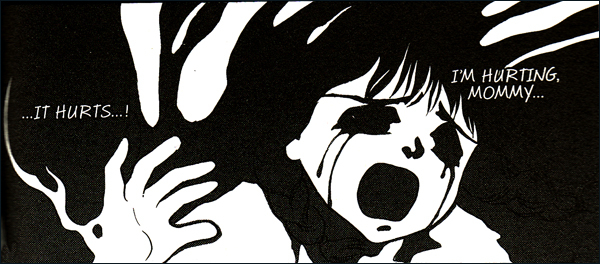
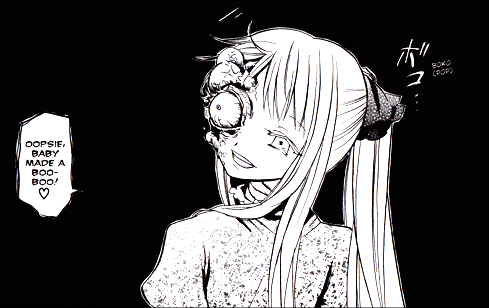
Perhaps it’s further evidence of how much a face means to me, actually, that both of my follow-up images are pretty much face-only. First, from CLAMP’s Tokyo Babylon, we have the face of a dead child who pleads with her mother to avenge her, and secondly, from Jun Mochizuki’s Pandora Hearts, the face of a girl that reveals itself to be a monster underneath.

Tokyo Babylon, Vol. 4 (TOKYOPOP)

Pandora Hearts, Vol. 1 (Yen Press)

I actually find both of these to be creepier than the images from After School Nightmare, though they are much simpler. Something they have in common is that they are presented against a stark, black background, giving the distorted expressions full focus. After that, though, they are nearly opposites of each other. The face of the girl in Tokyo Babylon is all too real, distorted by the power of raw emotion, while the character in Pandora Hearts is revealed to have no emotion at all, or at least none that matched what was on her false human face. Yet in the end, which is more monstrous?

MICHELLE: It’s interesting how much the things that creep us out reveal about us, isn’t it? I’d wager you get the same threatening feeling from the girl who is revealed to be a monster underneath as you do the girl with no face at all. People pretending to be what they’re not, hiding their real selves, etc. That’s definitely something all of us have experienced at one time or another.

Getting back to actual attempts at visual analysis, those deep black backgrounds really do focus the reader’s eye on what the mangaka wants them to see. It’s as if they’re saying, “I don’t want you to be distracted by anything else.”

MJ: Your analysis of me is spot-on, that’s for sure!

And yes, I think the black backgrounds achieve exactly that, while also evoking our natural fear of the dark, or what we can’t see. It’s a powerful tool for both showing us something and not showing us something, if that makes sense.

MICHELLE: It definitely does.

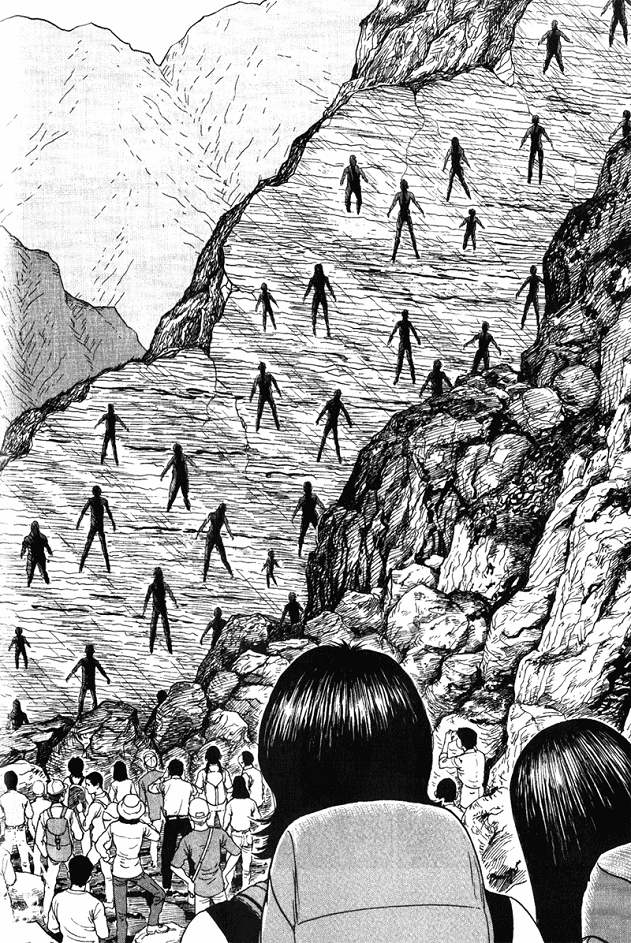
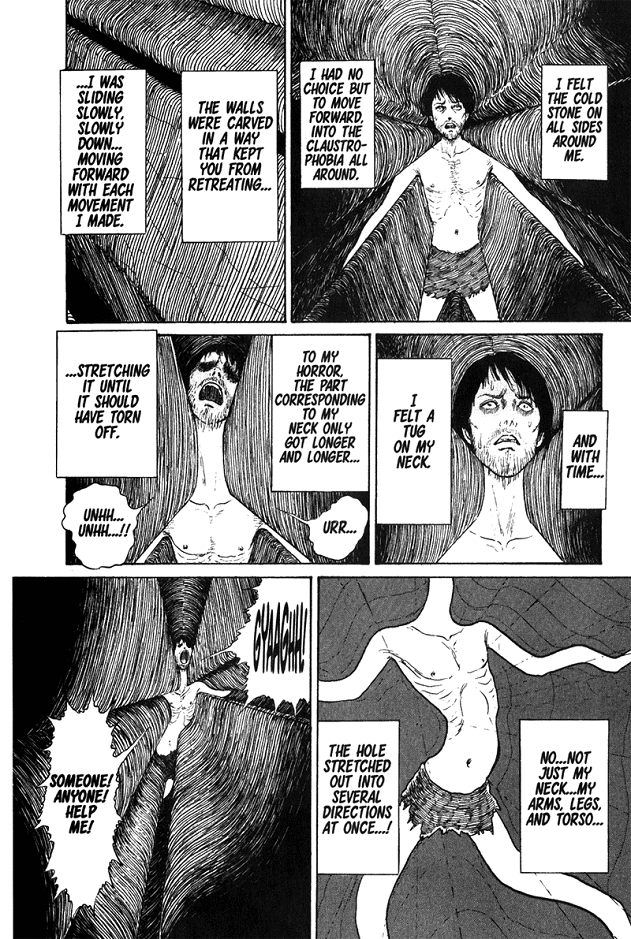
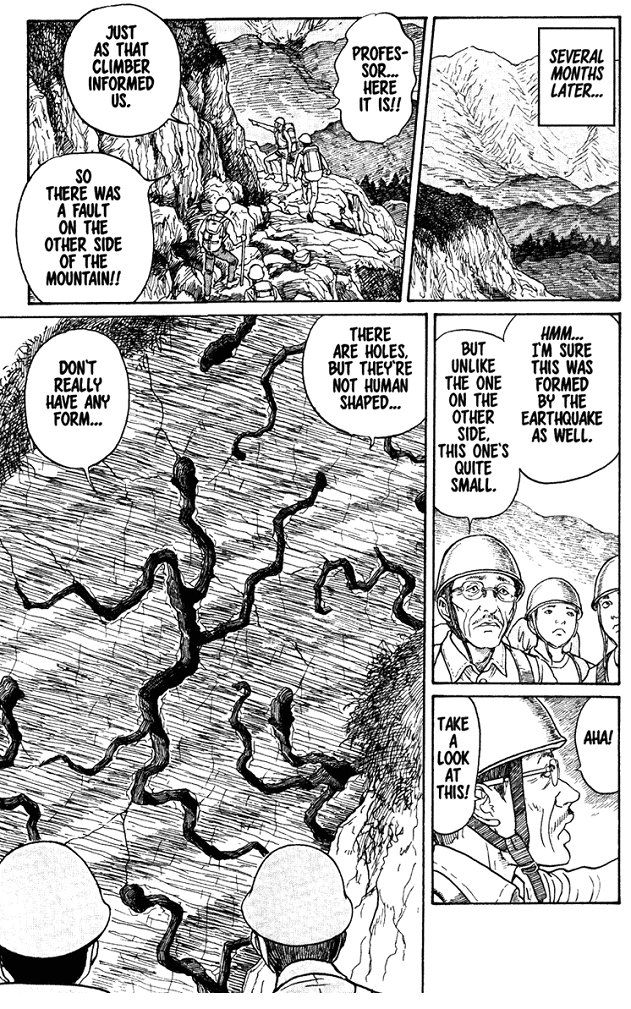
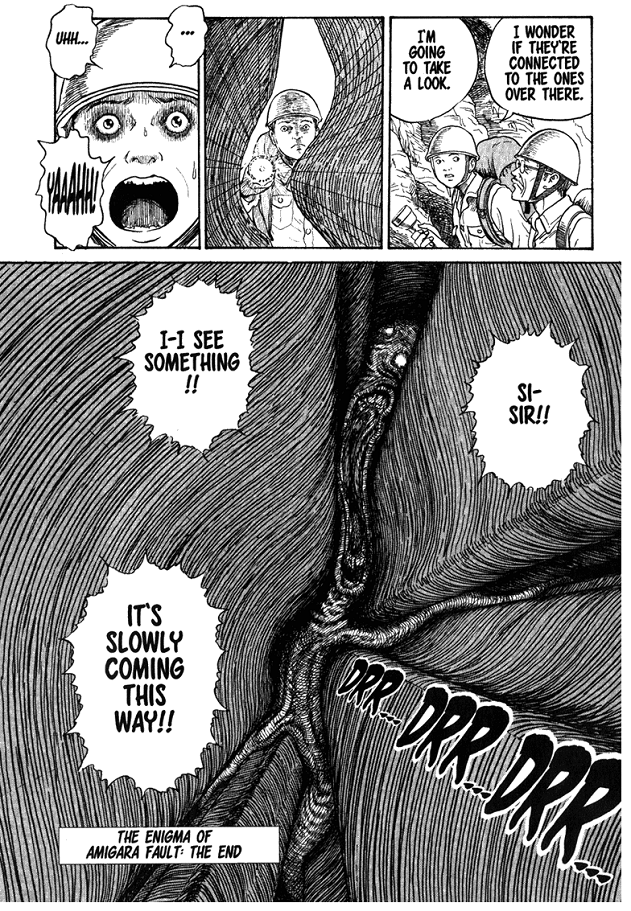
Now I’m reflecting on what the images I’ve chosen say about me. There’s hardly a face among them, for one thing, because I am less creeped out by shocking images than I am by imagining an experience, specifically an experience during which one is forced to endure something horrible for a really, really long period of time with no means of escape. Ugh, just thinking about the short story my images come from—”The Enigma of Amigara Fault” by Junji Ito—has given me the jibblies while typing this paragraph!

Gyo, Volume 2, “The Enigma of Amigara Fault” (VIZ Media)

Page 178

Page 185

Page 198

Page 203

Page 204

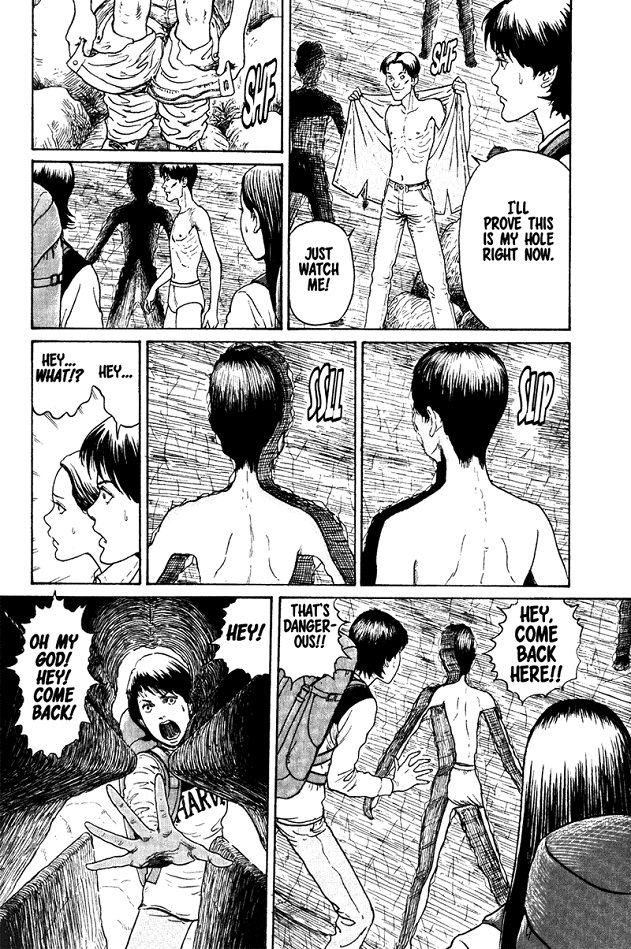
I’ve chosen this particular sequence of images from this short story because they illustrate the entire plot without me needing to introduce it beforehand. By now you probably don’t need me to explain that when the TV news reports on a mountainside full of people-shaped holes revealed by a recent earthquake, people flock to the site and can’t be dissuaded from climbing into their personal holes, where long, icky agony awaits them. At first the site seems innocent enough, if a bit strange, but soon people are walking into holes, having nightmares about what happens to you in a hole, and eventually discovering the exit and…. Holy crap, it’s terrifying. This is the kind of thing that will haunt me for ages.

I’m honestly trying to analyze Ito’s artistic techniques dispassionately here, but I find that the disturbing power of the images is so great that it is affecting my ability to reason even now!

MJ: Hmmm, I’m wondering if what it’s saying is that while I’m terrified of people betraying me, you’re terrified of your environment betraying you. Or something like that.

In any case, these panels are undeniably creepy. Even if they creep me out in a less personal way, I can certainly see what’s giving you the jibblies! Interestingly, we again see the human form distorted, though in this case it’s happening sort of *to* the character we’re relating to rather than in front of him. (Maybe I’m afraid of the people I trust being compromised, and you’re afraid of yourself being compromised?)

This has a Twilight Zone feel to me, where some unexplained supernatural phenomenon is turning the lives of ordinary people into a nightmare. The artist does a great job of evoking the real terror of what’s happening, too. The texture of the stone walls around the man gives the images a three-dimensional look that makes it feel more real than a lot of what we see in manga. It’s the only thing that has that kind of thick texture, too, so it really stands out.

MICHELLE: More like I’m terrified of taking a step that can’t be undone and ending up in eternal torment because of it!

And yes, now that I’ve regained my senses, I agree that it’s the realistic three-dimensional detail that really makes it so disturbing. The details of the setting itself establish it firmly in the here and now, and then we’re shown that within the here and now exists something completely alien and unexplainable! Regarding the texture of the stone walls… it’s that bit of dialogue about how they’re carved to prevent backtracking that really gets to me. It’s mute, immobile stone, and it’s going to be your tormentor for the next several months, slowly inflicting more gruesome horrors upon you than something living could ever do. Uh-oh… jibblies.

MJ: There, there!

MICHELLE: Thanks. I also really love the bottom left panel on page 185, when you see the outside world from inside the tunnel. Interestingly, this is an angle from which the guy who just entered the hole could never have seen the characters. He’s got his back turned to this world, and is resolutely leaving it behind. And, too, I love the “less is more” approach here. We don’t see the distorted figure actually emerge from the mountain and thrash around terrorizing people. One glimpse is enough to confirm what has happened. It’s almost kind of elegant in its structure.

MJ: Yeah, I agree, the threat of what is about to happen is actually scarier by itself than it might be if we actually saw it happen. Or at least it’s creepier that way.

MICHELLE: Well, I fear this column has actually been more about us than the art, but it’s been the art that made us feel that way, and that’s something, isn’t it?

MJ: It is!

MICHELLE: So, that’s it for us this month. What gives you the jibblies?

Filed Under: FEATURES, Let's Get Visual Tagged With: Junji Ito, VIZ, VIZ Signature

Dawn of the Arcana, Vol. 1

November 19, 2011 by Katherine Dacey 15 Comments

“Today, I belong to the enemy” — so begins Dawn of the Arcana, a medieval fantasy in which a feisty princess marries into a neighboring country’s royal family. Nakaba characterizes herself as “a lamb,” sacrificed by her people to help two warring kingdoms maintain a fragile peace. Her husband, the handsome but insolent Prince Caesar, initially snubs his new wife; not only does she have red hair — a commoner’s color — but she also flouts palace conventions, wearing the traditional dress of her homeland, employing a male Ajin (humanoid) as her valet, and excoriating Caesar in front of his servants.

Adding fuel to this combustible situation are Caesar’s mother, a Lady Macbeth figure who urges her son to seek the throne; King Guran, her husband; Cain, Caesar’s half-brother; and Louise, Cain’s flirty fiancee. Nakaba is keenly aware of their contempt for her, and struggles to maintain her composure as they openly mock her and threaten her faithful servant Loki. Though Loki is devoted to his mistress, he, too, poses a danger to Nakaba, as he quickly antagonizes Caesar and Guran with his impulsive behavior….

Read More

Filed Under: Manga Critic Tagged With: Rei Toma, shojo, shojo beat, VIZ

Dawn of the Arcana, Vol. 1

November 19, 2011 by Katherine Dacey

“Today, I belong to the enemy” — so begins Dawn of the Arcana, a medieval fantasy in which a feisty princess marries into a neighboring country’s royal family. Nakaba characterizes herself as “a lamb,” sacrificed by her people to help two warring kingdoms maintain a fragile peace. Her husband, the handsome but insolent Prince Caesar, initially snubs his new wife; not only does she have red hair — a commoner’s color — but she also flouts palace conventions, wearing the traditional dress of her homeland, employing a male Ajin (humanoid) as her valet, and excoriating Caesar in front of his servants.

Adding fuel to this combustible situation are Caesar’s mother, a Lady Macbeth figure who urges her son to seek the throne; King Guran, her husband; Cain, Caesar’s half-brother; and Louise, Cain’s flirty fiancee. Nakaba is keenly aware of their contempt for her, and struggles to maintain her composure as they openly mock her and threaten her faithful servant Loki. Though Loki is devoted to his mistress, he, too, poses a danger to Nakaba, as he quickly antagonizes Caesar and Guran with his impulsive behavior.

As predictable as the plot may be — would you be surprised to learn that Caesar soon becomes smitten with his ginger-haired bride? — Dawn of the Arcana proves engaging nonetheless, a heady mixture of palace intrigue and romance. Nakaba, in particular, is a winning heroine: she’s tough and principled, but savvy enough to appease Caesar and his family when it suits her own agenda. (Early in volume one, for example, Nakaba slaps Loki after a tense stand-off between the prince and the valet, telling Loki, “Disciplining my husband is my duty!”) Nakaba’s enemies are two-dimensional at best, but each displays a Joan Collinesque flair for making Nakaba’s life miserable, spitting out their lines with gusto. (“You look wretched!” the queen exclaims upon seeing Nakaba in her people’s native costume. “Typical red-hair!”)

What gives Dawn of the Arcana its real dramatic juice, however, is the way in which Rei Toma draws parallels between Nakaba’s situation and everyday teenage experience. Anyone who’s ever transferred to a new school, run the gauntlet of a junior high school cafeteria, or been hassled for wearing the “wrong” clothes will immediately recognize herself in Nakaba’s shoes. Sitting at a royal banquet, for example, Nakaba squirms under the withering stares of her new subjects. “I can feel it,” she thinks. “The hatred. The curiosity. The sneers.” In an added note of realism, Toma depicts Caesar as two-faced, the sort of fair-weather friend who openly mocks Nakaba in public — where nasty comments score points with his family —while privately acknowledging her sincerity and courage.

If I had any criticism of Arcana, it’s that the artwork is unimaginative. The character designs are attractive, with careful attention to costumes and hairstyles, but lack personality; I’d have difficulty distinguishing Rei Toma’s work from other popular shojo manga artists’. The minimalist backgrounds are likewise disappointing, doing little to situate the story in a particular time or place. Perhaps that’s a deliberate decision on Toma’s part, an attempt to make Nakaba’s story seem more universal. Given the sloppiness with which the establishing shots are rendered, however, it seems more likely that architectural details and landscapes aren’t her forte.

Still, that’s a minor criticism of an engaging story — one that benefits from a terrific premise, an intelligent heroine, and a supporting cast that wouldn’t be out of place in a juicy historical soap opera like Rome or The Tudors. Recommended.

Review copy provided by VIZ Media, LLC.

DAWN OF THE ARCANA, VOL. 1 • BY REI TOMA • VIZ • 192 pp. • RATED: TEEN (13+)

Filed Under: Manga, Manga Critic, REVIEWS Tagged With: Rei Toma, shojo, shojo beat, VIZ

Yurara, Vols. 1-5

November 3, 2011 by Michelle Smith

By Chika Shiomi | Published by VIZ Media

Yurara Tsukinowa can see spirits and sense their painful emotions, but she can’t actually do anything to help them. Or so she thinks. When a new school year finds her in the same class as Mei Tendo and Yako Hoshino, two hunky boys who use their spiritual powers to ward off vengeful spirits, she ends up helping them out, but not entirely alone. You see, Yurara has a guardian spirit—also named Yurara—and it’s this spirit who manifests when spiritual nasties are afoot, causing regular Yurara to adopt the spirit’s good looks and feisty personality until the threat is dealt with. “That was awesome!” Mei proclaims after spirit!Yurara’s first appearance. “She’s beautiful and strong!”

At first, the series is pretty episodic. Before Yurara came along it seems the boys simply drove off the spirits—Mei possesses offensive powers of fire while Yako’s water-based abilities lean toward the defensive end—but now that she’s around to actually communicate with the ghosts the encounters typically end with the spirit being able to pass on peacefully. The exception is the case of Mei’s mother, a ghost who claims to be hanging around so that her husband and sons can’t bring chicks over, but who is really worried about protecting her son from an evil spirit.

As time goes on, Yurara begins to learn more about the boys and is especially intrigued by cheerful, glompy Mei, whose skirt-chasing demeanor is really a way to hide his sorrow over the spirit-induced death of his first love. When Yako asks whether there’s someone Mei loves, Mei replies, “You should know. There is… but she’s not here.” I didn’t realize it at the time, but looking back on it now, the plight of loving someone who is gone and will never return actually comes full circle, alighting upon Yako by the end of the series. Because the more he’s around Yurara, the more Mei falls in love with her. She returns his feelings in her normal guise, but when under the influence of spirit!Yurara, she’s drawn to Yako instead. This makes for much confusion, as you might imagine.

The latter half of the series is primarily focused on this romantic triangle/square, and I ate up all of the attendant angst with a spoon. I sighed a bit when a contingent of mean girls harrasses Yurara for hogging the boys’ attention, but was pleased when she actually ended up befriending one of them. Really, this shoujotastic twist on a supernatural tale was exactly what I was craving when I began Yurara, and so I found it very satisfying. My one quibble is that early on, Yako seems to acknowledge the fact that he’s in love with “a phantom of a person no longer of this world,” but later seems surprised to realize that it’s the guardian spirit who loves him and not Yurara herself. Perhaps that’s not so much a flaw, though, as it is something to ponder over.

I shan’t spoil the ending except to say that I liked it and that it paves the way for Rasetsu (now released in its nine-volume entirety by VIZ), in which a slightly older Yako meets a girl who reminds him very much of spirit!Yurara.

Ultimately, Yurara is not a masterpiece, but it was exactly what I wanted it to be and I enjoyed it very much. Now on to Rasetsu!

Yurara was published in English by VIZ. All five volumes were released.

Filed Under: REVIEWS Tagged With: Chika Shiomi, shojo beat, VIZ

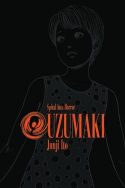
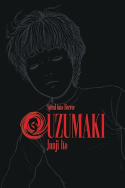
Uzumaki, Vols. 1-3

October 25, 2011 by Michelle Smith

By Junji Ito | Published by VIZ Media

As with Ito’s two-volume work, Gyo, the best word to describe Uzumaki—despite a back cover blurb promising “terror in the tradition of The Ring”—is “weird.”

High school student Kirie Goshima lives in Kurôzu-Cho, a small coastal town nestled between the sea and a line of hills. She narrates each chapter in an effort to share the strange things that happened there. It all begins when, on the way to meet her boyfriend Shuichi Saito at the train station, she spots his father crouching in an alley, staring intently at a snail. Shuichi confirms that his dad has indeed been acting odd lately, and suggests that the entire town is “contaminated with spirals.”

Mr. Saito’s fixation with spirals grows to the point where he dies in an attempt to achieve a spiral shape, which drives his wife insane with spiral phobia. She too eventually passes away, leaving Shuichi alone to become a recluse who is able to resist the spiral menace while being more perceptive to it than most. Other episodic incidents fill out the first two volumes, including unfortunate events involving Kirie’s classmates (boys who turn into snails, a bizarre rivalry over spiralling hair, etc.), her father’s decision to use clay from the local pond in his ceramics, a mosquito epidemic that leads to icky goings-on at a hospital, and an abandoned lighthouse that suddenly begins producing a mesmerizing glow. Things come to a head in volume three when six successive hurricanes are drawn to Kurôzu-Cho, leaving it in ruins. Rescue workers and volunteers flock to the area, but find themselves unable to leave. Dun dun dun!

Creepy occurrences mandate creepy visuals, but I wouldn’t say that anything depicted herein is actually scary. Oh, there are loads of indelible images that made me go “ew” or “gross,” but was I frightened by them? No. The real horrors of Uzumaki are more subtle: the suggestions that there are ancient and mysterious forces against which humans are utterly powerless and that the spiral’s victims will live in eternal torment. Many tales of horror involve bloodthirsty monsters, but a menace that forces you to live and endure something horrific is much more capable of giving me the jibblies. It’s the ideas behind Uzumaki, therefore, and not the surfeit of disturbing images, that evoke dread.

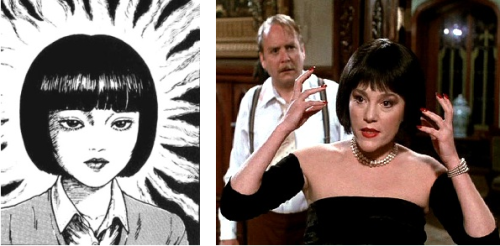
Uzumaki has a much larger cast than Gyo, which prompted me to notice that Ito actually draws some really cute and realistic-looking female characters. Kirie is a prime example, but her classmates and TV reporter Chie Maruyama also fit the bill. I was pretty distracted by Ito’s rendering of a girl named Azami, though, because she reminded me so much of Madeline Kahn as Mrs. White in Clue. Observe:

Flames... FLAMES on the side of my face!

Uzumaki definitely delivers an unforgettable story with memorable art, but I would’ve liked to get to know the characters more. Kirie is a reasonably accessible lead and is smart, strong, and kind, but I felt at times that she was too strong. If anything gross is going on in town, Kirie is the one who’s going to discover it, and though she reacts in the moment, there wasn’t much emphasis on the cumulative effect of having witnessed all this madness. She keeps going and being shocked by things right until the very end, but a more normal person would’ve broken down long before. And why weren’t more people fleeing, I wonder? True, once the storms hit, nobody could leave, but for a while there plenty of crazy stuff is happening and folks are just sticking around.

I also would’ve liked to spend more time with Shuichi. He’s a pretty interesting guy, who wants to get out of town from the very start but remains because of Kirie. He seems to have inherited equal parts fascination with and fear of the spiral from his parents, which keeps him alive if not entirely sane, and is able to function at times when others are mesmerized, allowing him to come to Kirie’s aid on several occasions. Through these actions we see how much he cares for her, but I actually had no idea they were supposed to be a couple until he was specifically referred to as her boyfriend a couple of chapters in. Okay, yes, this isn’t a romance manga and I shouldn’t expect a lot of focus on their relationship, but even just a little bit of physical affection would’ve gone a long way.

Uzumaki is grim, gruesome, and a whole host of synonyms besides. This isn’t jump-out-of-your-skin horror, but a psychological tale with a decidedly grisly bent. I’m not sure I’d universally recommend it—I think I know several people who definitely shouldn’t read it, actually—but if it sounds intriguing to you, give it a whirl.

Uzumaki was published in English by VIZ Media. It is complete in three volumes.

For more entries in this month’s horror-themed MMF, check out the archive at Manga Xanadu.

Filed Under: REVIEWS Tagged With: Junji Ito, VIZ, VIZ Signature

X, Vol. 1

October 16, 2011 by Katherine Dacey 19 Comments

As a child of the 1970s, I appreciate a good disaster flick, whether the devastation is local or global, natural or man-made. There’s something immensely satisfying about watching the world go up in flames, only to walk outside the theater and be reassured by the presence of stop lights, busses, coffee shops, and pedestrians going about their business. Small wonder, then, that I adored CLAMP’s X back in 2003. Not only did it have an impossibly large cast of attractive characters, it also boasted awesome scenes of destruction — scenes worthy of a Hollywood blockbuster.

When VIZ announced that it would be reissuing X in a deluxe edition, however, I had misgivings about the project: would the apocalypse be as good the second time around?

In 2003, I’d swooned over the illustrations, re-read favorite scenes, and marveled at the fact that all the characters dressed like refugees from a 1980s music video. Though my inner snob normally disdained anything so purple, I secretly loved the all-caps dialogue, the swirling lines and wind-swept hairdos, and the melodramatic death scenes, not to mention the eerie, post-apocalyptic dream sequences that were sprinkled throughout the series. X read like a hybrid of The Seventh Sign (not to be confused with The Seventh Seal, a much classier flick), Götterdämmerung, and Captain EO, and I couldn’t get enough of it.

At the time I was collecting X, I hadn’t read much else, save a handful of manga by CLAMP and Rumiko Takahashi. The very qualities that drew me to X — angstful conversations, tortured characters — soon had the opposite effect on me: I started to avoid comics in which the emotional volume was cranked up to eleven on every page, as I found them exhausting, the manga equivalent of Tristan and Isolde. Re-reading Tokyo Babylon, for example, I was mortified by my initial enthusiasm for the story, which now seemed hopelessly overripe to me; not since I’d re-read The Lion, The Witch, and The Wardrobe had I been so disappointed by a favorite text.

Revisiting X proved a more rewarding experience, though the series’ structural flaws were more readily apparent on a second reading. The dialogue, for example, is often unintentionally hilarious: bystanders comment on the main characters, helpfully telling us how wonderful they are (“Last week, he saved my son from drowning in the river,” one anonymous mother says of Fuma), while the main characters introduce themselves to one another as if they’re networking, not preparing to kill each other. (Sample: “The name’s Sorata Arisugawa! A cute ‘n’ fun-lovin’ high school senior!” “Allow me to return the favor. I am Yuto Kigai. A humble public servant in the local ward office.”) Kotori, the first major female character to be introduced, embodies the Mary Sue concept to a tee; not only is she beautiful, kind, and long of hair, but she’s also very delicate, beset with a heart so weak that she collapses whenever someone frowns. More amusing still are the characters who materialize at the very moment they’re needed: witness the introduction of Tokiko Magami, a school nurse who just so happens to be Kamui’s sole surviving relative, and a fount of information about Kamui’s mother.

Yet these moments of narrative clumsiness are overpowered by the sheer force of the imagery. The battle scenes are kinetic and violent, as characters leap across rooftops, level buildings, and plunge their swords into one another; few licensed shojo or shonen titles can match the gory zest with which CLAMP executes these moments of hand-to-hand combat. The dream sequences, too, are shockingly graphic: characters are dismembered, crucified, impaled, and engulfed in flames, often right before their loved ones’ eyes. Though these images teeter on the brink of kitsch — in one dream, Kamui cradles Kotori’s severed head in his arms — they underscore one of the series’ most important points: sacrifice and loss are a fundamental part of becoming an adult, whether that sacrifice means leaving one’s family (as Sorata and Lady Arashi have done) or losing them (as Kamui, Fuma, and Kotori do in the early chapters of the manga).

The series’ other major theme — that humans are poor stewards of Mother Earth — is less successfully illustrated; three volumes in, it still isn’t clear what, exactly, the Seven Seals are charged with doing: preventing nuclear war? staving off pollution? protecting spotted owls? What will happen if the Seals fail, however, is evocatively rendered; CLAMP draws a post-apocalyptic Tokyo worthy of Katsuhiro Otomo, a landscape of twisted skyscrapers and rotting corpses slowly engulfed by sand dunes.

The fact that these images appeared in Monthly Asuka and not Young Magazine is what makes X so remarkable: it may not be the best shojo fantasy ever written, but it certainly is one of the bloodiest, a fierce, angry blast of emotion that scorches everything in its path. I hesitate to suggest that X‘s body count is an achievement, but it is sharp and welcome rebuke to the idea that female readers strongly prefer conversation and character development to butt-kicking and carnage. Count me in for volume two.

Review copy provided by VIZ Media, LLC.

X, VOL. 1 • BY CLAMP • VIZ MEDIA • 580 pp. • RATING: OLDER TEEN (16+)

Filed Under: Manga Critic Tagged With: clamp, shojo, VIZ, X/1999

X, Vol. 1

October 16, 2011 by Katherine Dacey

As a child of the 1970s, I appreciate a good disaster flick, whether the devastation is local or global, natural or man-made. There’s something immensely satisfying about watching the world go up in flames, only to walk outside the theater and be reassured by the presence of stop lights, busses, coffee shops, and pedestrians going about their business. Small wonder, then, that I adored CLAMP’s X back in 2003. Not only did it have an impossibly large cast of attractive characters, it also boasted awesome scenes of destruction — scenes worthy of a Hollywood blockbuster.

When VIZ announced that it would be reissuing X in a deluxe edition, however, I had misgivings about the project: would the apocalypse be as good the second time around?

In 2003, I’d swooned over the illustrations, re-read favorite scenes, and marveled at the fact that all the characters dressed like refugees from a 1980s music video. Though my inner snob normally disdained anything so purple, I secretly loved the all-caps dialogue, the swirling lines and wind-swept hairdos, and the melodramatic death scenes, not to mention the eerie, post-apocalyptic dream sequences that were sprinkled throughout the series. X read like a hybrid of The Seventh Sign (not to be confused with The Seventh Seal, a much classier flick), Götterdämmerung, and Captain EO, and I couldn’t get enough of it.

At the time I was collecting X, I hadn’t read much else, save a handful of manga by CLAMP and Rumiko Takahashi. The very qualities that drew me to X — angstful conversations, tortured characters — soon had the opposite effect on me: I started to avoid comics in which the emotional volume was cranked up to eleven on every page, as I found them exhausting, the manga equivalent of Tristan and Isolde. Re-reading Tokyo Babylon, for example, I was mortified by my initial enthusiasm for the story, which now seemed hopelessly overripe to me; not since I’d re-read The Lion, The Witch, and The Wardrobe had I been so disappointed by a favorite text.

Revisiting X proved a more rewarding experience, though the series’ structural flaws were more readily apparent on a second reading. The dialogue, for example, is often unintentionally hilarious: bystanders comment on the main characters, helpfully telling us how wonderful they are (“Last week, he saved my son from drowning in the river,” one anonymous mother says of Fuma), while the main characters introduce themselves to one another as if they’re networking, not preparing to kill each other. (Sample: “The name’s Sorata Arisugawa! A cute ‘n’ fun-lovin’ high school senior!” “Allow me to return the favor. I am Yuto Kigai. A humble public servant in the local ward office.”) Kotori, the first major female character to be introduced, embodies the Mary Sue concept to a tee; not only is she beautiful, kind, and long of hair, but she’s also very delicate, beset with a heart so weak that she collapses whenever someone frowns. More amusing still are the characters who materialize at the very moment they’re needed: witness the introduction of Tokiko Magami, a school nurse who just so happens to be Kamui’s sole surviving relative, and a fount of information about Kamui’s mother.

Yet these moments of narrative clumsiness are overpowered by the sheer force of the imagery. The battle scenes are kinetic and violent, as characters leap across rooftops, level buildings, and plunge their swords into one another; few licensed shojo or shonen titles can match the gory zest with which CLAMP executes these moments of hand-to-hand combat. The dream sequences, too, are shockingly graphic: characters are dismembered, crucified, impaled, and engulfed in flames, often right before their loved ones’ eyes. Though these images teeter on the brink of kitsch — in one dream, Kamui cradles Kotori’s severed head in his arms — they underscore one of the series’ most important points: sacrifice and loss are a fundamental part of becoming an adult, whether that sacrifice means leaving one’s family (as Sorata and Lady Arashi have done) or losing them (as Kamui, Fuma, and Kotori do in the early chapters of the manga).

The series’ other major theme — that humans are poor stewards of Mother Earth — is less successfully illustrated; three volumes in, it still isn’t clear what, exactly, the Seven Seals are charged with doing: preventing nuclear war? staving off pollution? protecting spotted owls? What will happen if the Seals fail, however, is evocatively rendered; CLAMP draws a post-apocalyptic Tokyo worthy of Katsuhiro Otomo, a landscape of twisted skyscrapers and rotting corpses slowly engulfed by sand dunes.

The fact that these images appeared in Monthly Asuka and not Young Magazine is what makes X so remarkable: it may not be the best shojo fantasy ever written, but it certainly is one of the bloodiest, a fierce, angry blast of emotion that scorches everything in its path. I hesitate to suggest that X‘s body count is an achievement, but it is sharp and welcome rebuke to the idea that female readers strongly prefer conversation and character development to butt-kicking and carnage. Count me in for volume two.

Review copy provided by VIZ Media, LLC.

X, VOL. 1 • BY CLAMP • VIZ MEDIA • 580 pp. • RATING: OLDER TEEN (16+)

Filed Under: Manga, Manga Critic, REVIEWS Tagged With: clamp, shojo, VIZ, X/1999

Arata: The Legend, Vols. 1-6

September 11, 2011 by Michelle Smith

By Yuu Watase | Published by VIZ Media

As a fan of Yuu Watase’s shoujo classic, Fushigi Yûgi, I expected that I would like Arata: The Legend, her first shounen series. Turns out, I had underestimated my enjoyment: I really like it!

The story begins in a world known as Amawakuni, where the child-like princess is preparing to yield the thrown to her successor after reigning for 60 years. There are no suitable females in the royal (Hime) clan to take her place, however, and so a fifteen-year-old boy named Arata is coerced into passing himself off as a girl until another suitable candidate can be found. During the ceremony, the twelve retainers of the princess—known as the shinsho, because they are masters of powerful sword-gods known as hayagami—revolt and the princess is cut down before Arata’s eyes. The shinsho pin the deed on him and his flight to evade capture takes him to the mysterious Kando Forest, where he is swallowed up and exchanged with his counterpart from another world: Arata Hinohara.

Hinohara has been having a tough time lately. In middle school, he was bullied so much that he eventually stopped going altogether. Now it’s his first year of high school, and at first everything seems to be going okay. He purposefully chose a school far away, where no one would know his old self, and is able to make friends quickly, thanks to his quick actions in capturing a train groper. After a month, however, his former nemesis Kadowaki arrives and the torment starts anew, capped off by the betrayal of Arata’s closest new friend, Suguru.

When he arrives in Amawakuni—and is taken for Arata by everyone he meets—Hinohara is thrust into Arata’s role as a wanted criminal. When his touch awakens a slumbering family artifact—what turns out to be a legendary hayagami known as Tsukuyo—he is suddenly recognized as a sho, which means he’s part of the battle for the the throne. The shinsho overthrew the princess because they were tired of the control she exerted over their powers, but now they must battle and dominate each other until one stands supreme. Like it or not, as a sho, Arata is swept up in the conflict and has two choices: submit himself (this essentially means death) or force others to submit. (Meanwhile, Arata contends with life in modern Japan, including going to school and eventually beating up Kadowaki.)

I really love how Watase fleshes out Hinohara’s complex character here, because everything he does makes sense based on what he’s been through. When he first arrives, he refuses to trust anyone, but when Arata’s childhood friend, Kotoha, makes good on her promises to stick by him no matter what, it has a profound effect on him. Too, the prospect of forcing others to submit reminds him too much of the domination he suffered.

Because of his experiences—and because of the unique property that allows Tsukuyo to safeguard the souls of other sho without actually causing their death—he is gradually able to win over a few sho by sympathizing with their own suffering, whether it be betrayal, isolation, or loneliness. In a conversation with the princess—courtesy of the special necklace that also occasionally allows him to converse with Arata—he promises to unite the hayagami under Tsukuyo and return to her before she dies completely. He’s got a long road ahead, and it’s one that can only be won by changing the hearts of others.

It is this mission of Hinohara’s—not unlike those usually assigned to magical girls—that makes me want to apply the demographic label “jounen” to this series. It’s definitely shounen in scope and feel, but it’s also attuned to its shoujo side. The slowly developing romance between Hinohara and Kotoha is very well done, for example, with Hinohara cognizant of Kotoha’s love for the real Arata and Kotoha confused because “Arata” is responding to her in a way he never did before. I also like that Kadowaki eventually arrives in Amawakuni because a) that is so very Yuu Watase, for two outsiders to come into a fantasy world and immediately assume powerful destinies and b) the ultimate test of Hinohara’s newfound bravery and purpose is for him to be able to sustain it in the face of Kadowaki’s unrelenting hostility.

The pacing of the series is also outstanding. There’s just enough foreshadowing of significant things—the gravestone that connects one of the shinsho, Kannagi, with his reasons for rebelling against the princess—to make the eventual reveal more significant, but one never has to wait too long for the answer to a question. Similarly, Hinohara frequently actually comes out and says what he’s thinking, so misunderstandings are not allowed to perpetuate for long. In fact, revealing the truth behind things—like when Hinohara finally convinces Kotoha that he is not her beloved Arata—gives the story more places to go rather than reducing all dramatic options.

My one complaint about the series is largely rectified by Kadowaki’s entrance into Amawakuni, and that’s that Arata is given very little to do. At first, there’s only a chapter or two from his point of view every once in a while, but once he meets an intriguing girl named Oribe—who can tell he’s an entirely different person than Hinohara—things begin looking up, especially when one of the shinsho is transplanted to Japan in Kadowaki’s place. Suddenly, Arata is in genuine peril, which is bad for him but good for the story!

In the end, while there’s a lot going on in Arata, it never feels like too much, always makes sense, and yet always leaves one wondering what is going to happen next. Not only am I genuinely excited about continuing the series, it has also rekindled my determination to read Fushigi Yûgi: Genbu Kaiden, of which I have heard good things.

Arata: The Legend is still in serialization in Japan; the twelfth collected volume was released there in August 2011.

Review copies for volumes one, two, four, and five provided by the publisher.

Filed Under: REVIEWS Tagged With: shonen sunday, VIZ, Yuu Watase

Magazine no Mori

July 21, 2011 by Erica Friedman 2 Comments

Welcome to the newly named Magazine no Mori, where I will try to guide you through the dark tangled forest of Japanese Manga magazines and, hopefully, we’ll discover some wondrous manga truffles along the way. (Was that pushing the metaphor a little too far? I think it might have been.)

As much as I consume a ridiculous amount of manga and of manga magazines, my tastes run to the fringes of all typical categories of manga. Of shounen, shoujo, seinen and josei, the manga I read the least is the most popular – the shounen.

So it was some suprise to me that Shounen Sunday really is all that and a bag of chips.^_^

Of course I had heard of Shounen Sunday. I just hadn’t ever given it any thought. When I finally cracked the covers, I was instantly greeted by series that I, and you, will be familiar with.

First published in 1959, Shounen Sunday has a 2010 monthly circulation of 678,917. At a cover price of 260 yen per volume ($3.31 at the time of writing) for more than 450 pages, you’re getting a page and a half of manga per cent spent.

And, oh, what you are spending those cents on! The names that write for Shounen Sunday are, well, legendary. Prominent among them are Adachi Mitsuru (Asaoka Kouko Yakyuubu Nisshi), Takahashi Rumiko (Rinne), Watase Yuu (Arata Kangatari ~Engaku Kougatari~). These run alongside series that are probably better known over here by title than by their creators’ names, such as Takashi Shiina’s Zettai Karen Children, Hata Kenjiro’s Hayate no Gotoku (known in the west as Hayate the Combat Butler), Wakaki Tamiki’s Kami nomi zo Shiru Sekai (known as The World Only God Knows) and Aoyama Gosho’s Detective Conan (known here as Case Closed).

Weekly Shounen Sunday has a website in Japanese with news, interviews and “backstage” with the manga artists, links to collected volumes, and other typical magazine “stuff.” In addition, Viz has an English-language site for “Shonen Sunday” where you can find downloads, creator profiles and series synopses.

Despite the somewhat irksome persistence of misogynistic “service” (breast groping, nipples visible under clothes and crotch shots), this magazine is undoubtedly targeted to boys who plan on becoming immature man-boys in the future. I’d love to love Sunday, but it’s hard to see past the “Boys Only, Girlz Stay Away” sign on the treehouse door.

This is particularly frustrating, as Sunday’s pages are replete with very cool baseball, soccer and other non-dating sim-esque manga inside. If the service was notched back a few degrees, I might add this to my monthly rotation. As it is, I think I’ll pass.

As a box of chocolates, while there are a whole lot of caramel and peanut treats inside, there’s just a few too many yucky jellies for my taste. But your taste may vary. ^_^

Weekly Shounen Sunday, by Shogakukan

Filed Under: Magazine no Mori Tagged With: manga, Manga Magazine, Shounen, VIZ

The Best Manga You’re Not Reading: Samurai Crusader

July 9, 2011 by Katherine Dacey 19 Comments

Whenever I see Ryoichi Ikegami’s name attached to a project, I know two things: first, that the manga will be beautifully illustrated, and second, that the plot will be completely nuts.

Samurai Crusader, a globe-trotting, name-dropping adventure from the early 1990s, provides an instructive example. The story revolves around a young martial artist who teams up with struggling novelist Ernest Hemingway — yes, that Ernest Hemingway — to prevent an unscrupulous Japanese general from invading Shanghai with Nazi assistance. And if the thought of Hemingway as a butt-kicking action hero isn’t crazy enough, Ikeda and writer Hiroi Oji populate the story with such colorful bit players as a sadistic female military general, a bare-breasted priestess, an axe-wielding Aryan warrior, a demon whisperer, and a ninja with razor-sharp teeth. Ikeda and Oji don’t skimp on the cameos, either; Pablo Picasso, Joseph Goebbels, and Hermann Goering all have brief but memorable walk-on roles, as do Hitler and Emperor Akihito.

This motley assortment of characters are all chasing Kusanagi, a Japanese sword so expertly crafted that it can sever a canon in two. But Kusanagi isn’t just an elegant weapon; it’s a mystical object, capable of bestowing great power on its owner. The Nazis and the Japanese military alike believe that Kusanagi is the key to world domination, and double-cross each other in hopes of stealing it from the Oritsuin clan, a noble Japanese family. Kumomaru, the youngest member of the Oritsuins, is determined to stop both parties from abusing Kusanagi’s power, racing from Paris to Shanghai in a valiant effort to foil Japanese imperial ambitions in China. Along the way Kumomaru befriends Hemingway, beds a sexy French cat burglar, and falls in with a gang of Chinese warriors who disguise themselves as cooks. (As a sign of just how badass these cook-warriors are, each high-ranking solider in the organization has a dragon tattoo… on his tongue.)

As awesomely silly as the plot may be, the real attraction of Samurai Crusader is the art. The period settings provide Ikegami a swell excuse to draw zeppelins and biplanes, Nazi uniforms and samurai formal wear, French ballrooms and Chinese dives. No detail goes overlooked; even the most inconsequential characters’ clothing is meticulously rendered, and the street lamps in every city are drawn with such care as to distinguish a Parisian boulevard from a Shanghai corner.

The character designs, too, are arresting in their specificity; Ikegami’s great strength as an artist is his ability to convey character through odd facial features and posture, whether he’s drawing a crooked industrialist or a street urchin. Though his lead characters are impossibly attractive, Ikegami’s best creation, by far, is Juzo, a stealthy martial artist with the most distinctive set of choppers since James Bond crossed paths with Jaws. Juzo’s shark-like teeth, wild hair, and demonic squint make him an excellent foil for the handsome Kumomaru; Juzo moves with the lethal precision of a cobra, twisting his body into extraordinary positions to better deploy his arsenal of knives, wires, words, and pistols. Oh, and those teeth? They make swell weapons, too.

The only downside to Samurai Crusader is the dialogue. Though the story unfurls at a furious pace, the story grinds to a halt whenever Kumomaru crosses paths with his arch-nemesis, the deluded General Kamishima. Their all-caps exchanges feel more like policy discussions than real arguments, despite Ikegami’s best efforts to stage the scenes as dramatically as possible. Sweat drops bead, veins pulse and pop, but Ikegami can’t disguise the fact that these speeches are kind of a drag. (Sample: “Independence for all of Asia should be the way of Japan! We need national self-determination!”) What redeems these windy passages are the shoot-outs, tank fights, and sword play that proceed and follow them; aside from John Woo and Andrew Lau, few people can make bloodletting look as elegant as Ikegami does.

Perhaps the best way to summarize Samurai Crusader‘s appeal is to say that it has all the virtues of Crying Freeman and Wounded Man — crazy action scenes, sexy leads, mustache-twirling villains — without the copious nudity and sexual violence that can give even the most committed manga fan pause. Readers interested in tracking down copies should note that all three volumes of Samurai Crusader are out of print, though reasonably priced copies are readily available on Amazon and eBay. Highly recommended.

SAMURAI CRUSADER: THE KUMOMARU CHRONICLES, VOLS. 1-3 • STORY BY HIROI OJI, ART BY RYOICHI IKEGAMI • VIZ COMMUNICATIONS, INC. • NO RATING

Filed Under: Manga Critic Tagged With: Hiroi Oji, Ryoichi Ikegami, Shonen, VIZ

The Best Manga You’re Not Reading: Samurai Crusader

July 9, 2011 by Katherine Dacey

Whenever I see Ryoichi Ikegami’s name attached to a project, I know two things: first, that the manga will be beautifully illustrated, and second, that the plot will be completely nuts. Samurai Crusader, a globe-trotting, name-dropping adventure from the early 1990s, provides an instructive example. The story revolves around a young martial artist who teams up with struggling novelist Ernest Hemingway — yes, that Ernest Hemingway — to prevent an unscrupulous Japanese general from invading Shanghai with Nazi assistance. And if the thought of Hemingway as a butt-kicking action hero isn’t crazy enough, Ikeda and writer Hiroi Oji populate the story with such colorful bit players as a sadistic female military general, a bare-breasted priestess, an axe-wielding Aryan warrior, a demon whisperer, and a ninja with razor-sharp teeth. Ikeda and Oji don’t skimp on the cameos, either; Pablo Picasso, Joseph Goebbels, and Hermann Goering all have brief but memorable walk-on roles, as do Hitler and Emperor Akihito.

This motley assortment of characters are all chasing Kusanagi, a Japanese sword so expertly crafted that it can sever a canon in two. But Kusanagi isn’t just an elegant weapon; it’s a mystical object, capable of bestowing great power on its owner. The Nazis and the Japanese military alike believe that Kusanagi is the key to world domination, and double-cross each other in hopes of stealing it from the Oritsuin clan, a noble Japanese family. Kumomaru, the youngest member of the Oritsuins, is determined to stop both parties from abusing Kusanagi’s power, racing from Paris to Shanghai in a valiant effort to foil Japanese imperial ambitions in China. Along the way Kumomaru befriends Hemingway, beds a sexy French cat burglar, and falls in with a gang of Chinese warriors who disguise themselves as cooks. (As a sign of just how badass these cook-warriors are, each high-ranking solider in the organization has a dragon tattoo… on his tongue.)

As awesomely silly as the plot may be, the real attraction of Samurai Crusader is the art. The period settings provide Ikegami a swell excuse to draw zeppelins and biplanes, Nazi uniforms and samurai formal wear, French ballrooms and Chinese dives. No detail goes overlooked; even the most inconsequential characters’ clothing is meticulously rendered, and the street lamps in every city are drawn with such care as to distinguish a Parisian boulevard from a Shanghai corner.

The character designs, too, are arresting in their specificity; Ikegami’s great strength as an artist is his ability to convey character through odd facial features and posture, whether he’s drawing a crooked industrialist or a street urchin. Though his lead characters are impossibly attractive, Ikegami’s best creation, by far, is Juzo, a stealthy martial artist with the most distinctive set of choppers since James Bond crossed paths with Jaws. Juzo’s shark-like teeth, wild hair, and demonic squint make him an excellent foil for the handsome Kumomaru; Juzo moves with the lethal precision of a cobra, twisting his body into extraordinary positions to better deploy his arsenal of knives, wires, words, and pistols. Oh, and those teeth? They make swell weapons, too.

The only downside to Samurai Crusader is the dialogue. Though the story unfurls at a furious pace, the story grinds to a halt whenever Kumomaru crosses paths with his arch-nemesis, the deluded General Kamishima. Their all-caps exchanges feel more like policy discussions than real arguments, despite Ikegami’s best efforts to stage the scenes as dramatically as possible. Sweat drops bead, veins pulse and pop, but Ikegami can’t disguise the fact that these speeches are kind of a drag. (Sample: “Independence for all of Asia should be the way of Japan! We need national self-determination!”) What redeems these windy passages are the shoot-outs, tank fights, and sword play that proceed and follow them; aside from John Woo and Andrew Lau, few people can make bloodletting look as elegant as Ikegami does.

Perhaps the best way to summarize Samurai Crusader‘s appeal is to say that it has all the virtues of Crying Freeman and Wounded Man — crazy action scenes, sexy leads, mustache-twirling villains — without the copious nudity and sexual violence that can give even the most committed manga fan pause. Readers interested in tracking down copies should note that all three volumes of Samurai Crusader are out of print, though reasonably priced copies are readily available on Amazon and eBay. Highly recommended.

SAMURAI CRUSADER: THE KUMOMARU CHRONICLES, VOLS. 1-3 • STORY BY HIROI OJI, ART BY RYOICHI IKEGAMI • VIZ COMMUNICATIONS, INC. • NO RATING

Filed Under: Manga, Manga Critic, REVIEWS Tagged With: Hiroi Oji, Ryoichi Ikegami, Shonen, VIZ

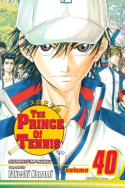
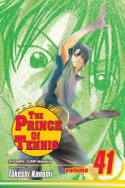
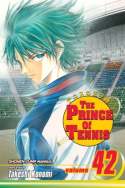
The Prince of Tennis 40-42 by Takeshi Konomi

July 8, 2011 by Michelle Smith

Although the final three volumes of The Prince of Tennis contain many ridiculous things and are, objectively speaking, really not that good, I still think the story wraps up reasonably well.

Volume 40 begins with the tail end of the set between Seishun’s captain, Tezuka, and Sanada of the Rikkai team. Tezuka is dragging things out to buy time for absentee Ryoma to arrive, and ultimately ends up losing. Then Momoshiro and Kaidou lose, but not before we get this sentence that has never been written before at any time in the course of human history: “The tornado snake won’t work against a player with red eyes.” Good to know, that.

Fuji is up next, taking on a player with the ability to mimic anyone’s ability. And who should he emulate but Tezuka, so we get a match that is drawn like the two of these guys playing against each other. Somehow I think this was intended to appeal to the fujoshi, but I’m certainly not complaining. “Maybe we’ve both been avoiding facing off against each other. Because we’re afraid of finding out who’s better,” Fuji thinks at one point. Too bad the promise of a real face-off between them is not realized before the end of the series.

Fuji wins, so we move briskly on to the second doubles round, and somewhere around here Ryoma arrives with, and I am quoting the back cover here, “a wicked case of amnesia.” It’s completely stupid, and while Oishi and Eiji stall for time, various players (including rivals) go reacquaint Ryoma with his tennis memories by playing him off-camera. Why even employ an amnesia plot if it’s going to be cured so simply? It just makes me shake my head.

Anyway, it should be no surprise to anyone at all that Ryoma regains his memory and, though he starts off his match at a disadvantage, he soon summons the ultimate skill—“the pinnacle of perfection”—with which to vanquish his opponent. (Everyone can tell that he has achieved this because white light bursts from his body. As it often does in tennis.) And Ryoma’s dad drops by to tell everyone this is happening because Ryoma is playing simply for the joy of the game, and so that everyone can finally learn that Ryoma is the son of the famous Samurai Nanjirou. So, Seishun wins and there’s a montage while the lyrics of a song penned by Takeshi Konomi scroll by. It’s all very silly. There’s also a brief prose epilogue depicting the third years’ graduation.

I just really don’t know what to say about The Prince of Tennis at this point. In the pursuit of ways to make games even more exciting, Konomi crossed my personal “suspension of disbelief” border with all these physically observable glowy states. Somehow, I was willing to accept Inui making instant probability calculations or Tezuka being able to control his spin so well that all return shots come directly to his location, but make a guy sparkly and have someone in the stands cry, “L-look at that! All his aura’s concentrated around his left arm!!” and it’s suddenly too much for me to take. Still, it’s not like the series was ever so fabulous that I’m actively disappointed. Just resigned.

Anyway, thus concludes The Prince of Tennis. The sequel, Shin Prince of Tennis (“Shin” means “new”), is currently serialized in Jump SQ magazine. The fifth collected volume came out in March of this year. It lamentably remains unlicensed for US release.

Filed Under: REVIEWS Tagged With: Shonen Jump, VIZ

  • « Go to Previous Page
  • Page 1
  • Interim pages omitted …
  • Page 5
  • Page 6
  • Page 7
  • Page 8
  • Page 9
  • Interim pages omitted …
  • Page 26
  • Go to Next Page »
 | Log in
Copyright © 2010 Manga Bookshelf | Powered by WordPress & the Genesis Framework