• Skip to primary navigation
  • Skip to main content
  • Skip to primary sidebar
  • Home
  • About Us
    • Privacy Policy
    • Comment Policy
    • Disclosures & Disclaimers
  • Resources
    • Links, Essays & Articles
    • Fandomology!
    • CLAMP Directory
    • BlogRoll
  • Features & Columns
    • 3 Things Thursday
    • Adventures in the Key of Shoujo
    • Bit & Blips (game reviews)
    • BL BOOKRACK
    • Bookshelf Briefs
    • Bringing the Drama
    • Comic Conversion
    • Fanservice Friday
    • Going Digital
    • It Came From the Sinosphere
    • License This!
    • Magazine no Mori
    • My Week in Manga
    • OFF THE SHELF
    • Not By Manga Alone
    • PICK OF THE WEEK
    • Subtitles & Sensibility
    • Weekly Shonen Jump Recaps
  • Manga Moveable Feast
    • MMF Full Archive
    • Yun Kouga
    • CLAMP
    • Shojo Beat
    • Osamu Tezuka
    • Sailor Moon
    • Fruits Basket
    • Takehiko Inoue
    • Wild Adapter
    • One Piece
    • After School Nightmare
    • Karakuri Odette
    • Paradise Kiss
    • The Color Trilogy
    • To Terra…
    • Sexy Voice & Robo
  • Browse by Author
    • Sean Gaffney
    • Anna Neatrour
    • Michelle Smith
    • Katherine Dacey
    • MJ
    • Brigid Alverson
    • Travis Anderson
    • Phillip Anthony
    • Derek Bown
    • Jaci Dahlvang
    • Angela Eastman
    • Erica Friedman
    • Sara K.
    • Megan Purdy
    • Emily Snodgrass
    • Nancy Thistlethwaite
    • Eva Volin
    • David Welsh
  • MB Blogs
    • A Case Suitable For Treatment
    • Experiments in Manga
    • MangaBlog
    • The Manga Critic
    • Manga Report
    • Soliloquy in Blue
    • Manga Curmudgeon (archive)

Manga Bookshelf

Discussion, Resources, Roundtables, & Reviews

Tokyopop

A Pair of TOKYOPOP Stragglers

July 4, 2011 by Michelle Smith

Just when it seemed like none of those May TOKYOPOP titles was going to materialize, Diamond Distributors revealed that it still had a few surprises up its figurative sleeve. Stragglers, originally scheduled for an early May release, began to trickle into comic shops. I managed to acquire several, including two books—volume eight of Happy Cafe and volume three of The Stellar Six of Gingacho—that I had lost all hope of ever seeing. Although I’m still incredibly sad about TOKYOPOP’s demise, I can’t help looking upon these last releases as an unexpected gift.

Happy Cafe 8 by Kou Matsuzuki

The eighth volume of Happy Cafe offers more cheerful yet insubstantial slice-of-life episodes revolving around the staff of Cafe Bonheur. We check back in with sixth-grader Kenji, Uru’s cousin, and meet the girl who likes him. We see Shindo apologize for making Uru cry, meet Ichiro’s doppelganger/father, and watch as two different guys try and fail to express their feelings for the oblivious Uru.

There are actually four guys now who fancy Uru, mostly because of her bright smile and talent at offering sunny advice as necessary. It’s a little much, but at least doesn’t feel as implausible as with series in which the heroine has no redeeming qualities whatsoever and yet seems to attract a bevy of hunky admirers. It also seems like Matsuzuki draws Uru in a regular style more often this volume—because she’s so childlike and spazzy, she’s usually in some state of super deformity but here we get a few, albeit fleeting, moments in which she looks genuinely pretty.

As a warning, however, readers of this volume are at risk of contracting the dreaded festitis (extreme irritability brought on by manga depictions of school festivals of any sort, including athletic). On the heels of Uru’s school festival in volume seven we first have Kenji’s athletic meet and then the school festival of Sou Abekawa, one of Uru’s suitors. I would seriously be happy if I never had to read about another school festival ever again.

So, how does this fare as the final volume (most likely) of Happy Cafe to be produced in English? Pretty well, actually. The episodic nature of the story precludes any sort of cliffhanger ending, and though Uru continues to be utterly clueless about the feelings she’s inspiring in the guys around her, it’s easy to imagine that, after several more volumes of cheerful yet insubstantial happenings, she will realize her feelings for someone (Shindo seems the most likely candidate) and a happy ending will ensue.

The Stellar Six of Gingacho 3 by Yuuki Fujimoto

Like Happy Cafe, The Stellar Six of Gingacho has so far been comprised of warm and fuzzy episodic stories featuring a childlike heroine who is “very dense when it comes to romance.” The third volume is no different, but takes the first tentative steps at fleshing out the other members of the group—while continuing to focus on Mike (Mee-kay) and her pal/partner Kuro, whose love for Mike is a secret to no one but her—and hinting a little at complications to come.

Chapters in this volume feature plots like “Mike and Kuro rescue a stray puppy,” “Mike insists that her friends go dig up a treasure they buried when they were five,” and “a photo of the boys appears in a teen magazine and fangirls descend.” But boiling them down in this way does them a disservice, because each chapter usually has at least one really nice moment, like Mike realizing that Kuro has always been there for her or the boys defending the honor of the girls when some punk insults them. In fact, the theme of the series could be summed up as “friends are precious and special.” If you don’t want to read stories in which this idea gets established over and over again, then The Stellar Six of Gingacho probably isn’t for you.

Although the volume doesn’t end on a cliffhanger, some glimpses of where the story might go make the lack of future releases particularly disappointing. Who is the object of ladies’ man Ikkyu’s (aka “Q”) unrequited love? (I hope it’s ultra-sensible Iba-chan.) Should I be expecting the six friends to form up into three tidy couples for a happy ending, or will messiness ensue when Sato’s feelings for Kuro come to light?

Sato provides the parting thought as we get a glimpse of an older Kuro. “To me you were special. But back then none of us truly understood what that “special” feeling really was. Not yet.” If you really want to get me hooked to a series, pepper it with retrospective narration like that. Jeez. Talk about bad timing.
Filed Under: REVIEWS Tagged With: Tokyopop

Let’s Get Visual: Wild Adapter

June 25, 2011 by Michelle Smith

MICHELLE: Hey, MJ, did you know there was a Wild Adapter MMF going on?

MJ: I’ve heard rumors to that effect. Terrific series, Wild Adapter. Whoever is hosting it must have great taste!

MICHELLE: I’m relieved you think so, because in honor of the Feast, we’re devoting this month’s Let’s Get Visual column to that series!

MJ: We are? Oh! Yes, we are!

MICHELLE: One of the hosts has already done an admirable job scanning some of the many significant images from the series (at great personal cost) but that won’t stop us from talking about a few more.

In Wild Adapter, creator Kazuya Minekura tells her story through the eyes of observers. Sometimes these figures are opposed to our main protagonists—Makoto Kubota and Minoru Tokito—in some way, such as the detective in volume four or the new youth gang leader in volume six, and sometimes they are with them, either in a personal way (their young neighbor Shouta in volume five) or a more business-like fashion (Takizawa the journalist in volume three). In every case, though, we rely on their interactions with Kubota and Tokito to learn more about said fellows, since we are denied access to their thoughts.

As I reread the series, I noticed that Minekura also uses her art to support this narrative choice, and that she, in particular, uses a similar device several times where Kubota is concerned. (Click on images to enlarge.)

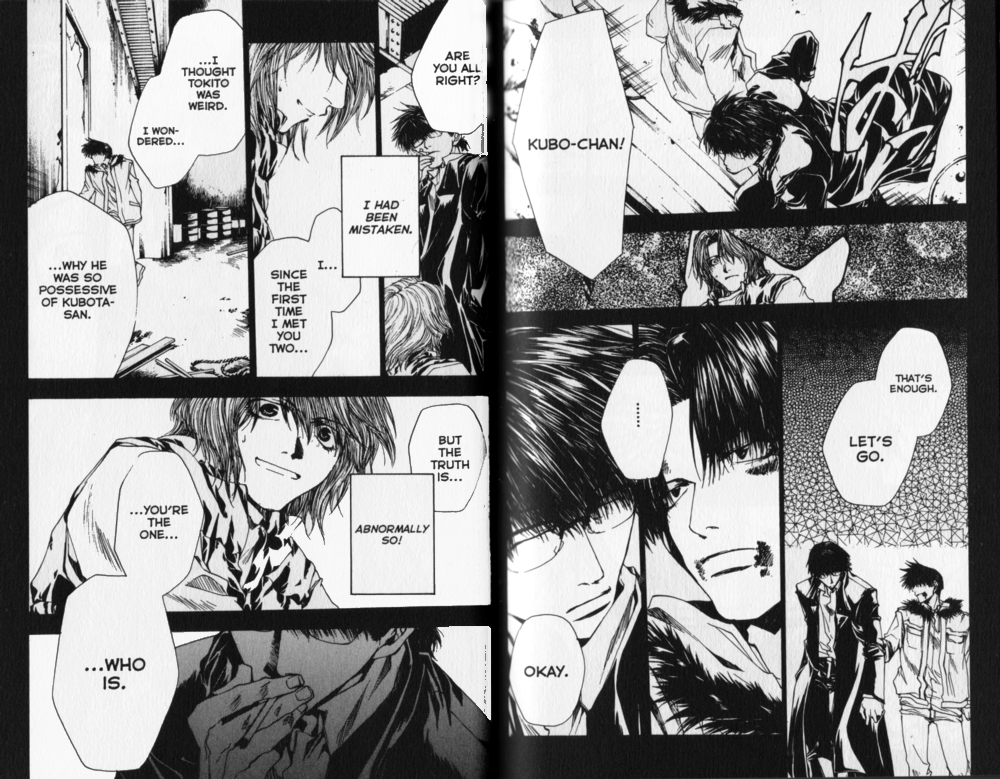
Volume 2, Chapter 11 (TOKYOPOP)

Here, Tokito stops Kubota, who has violently come to his rescue. Kubota instantly sheds any vestige of excitement, and throughout this two-page spread, his eyes, like his thoughts, feelings, and motivations, remain shielded. He’s distant and aloof. Yet when Saori suddenly realizes that Kubota is the one who’s possessive of Tokito, he offers her a small smile. She finds the experience scary, and I agree that it could be construed as an ominous expression, but it’s also a stunning moment of access to what Kubota feels.

MJ: I agree that it’s a stunning image, and while I can appreciate Saori’s response, like you, I’m mostly fascinated. As you say, Kubota is a character who deliberately shuts himself off from other people, and now, as we’re granted this tiny moment of access, it becomes really clear why. In these rare moments, with just a small smile and a real look into the eyes, he’s suddenly wide open to us, and the guy that we see in there is nothing like the person he displays the rest of the time. And that’s a guy he really doesn’t want people to know. Maybe he thinks that guy is scary, I don’t know. But it’s clear that when he does grant access, he’s pretty much an open book—probably more so than characters who are generally open to begin with. Does any of that make sense?

MICHELLE: It does, and you’ve provided me with an excellent introduction for my next example!

Volume 3, Chapter 18 (TOKYOPOP)

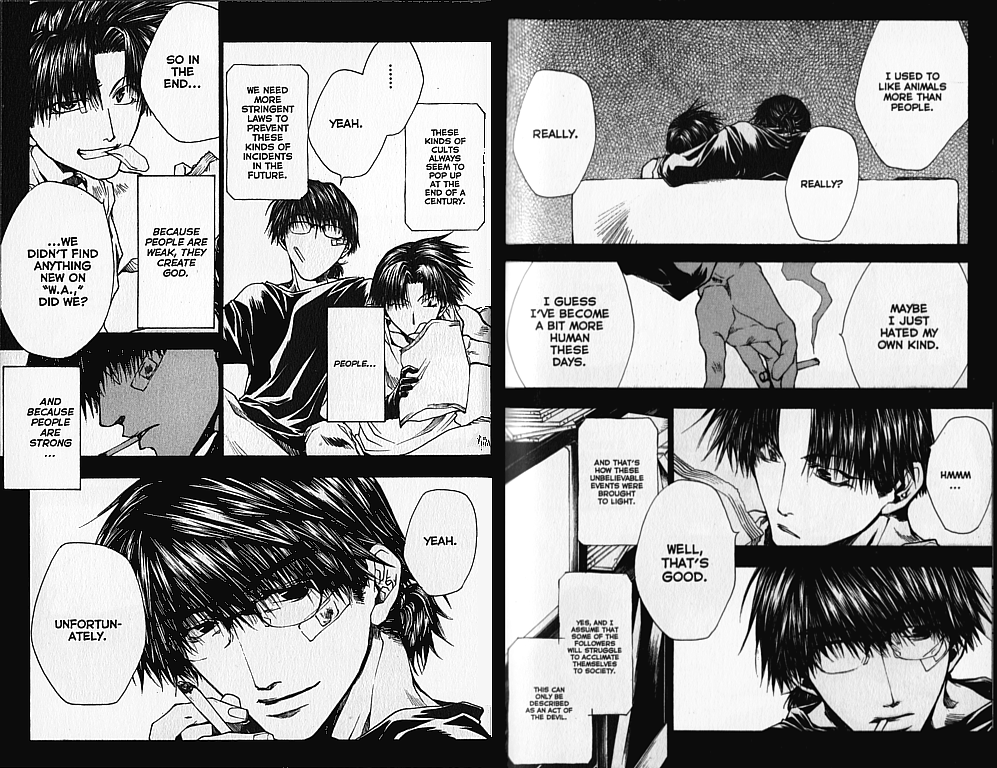
This scene takes place near the end of volume three, during which Kubota and Tokito have infiltrated a cult that they erroneously believe is connected to Wild Adapter. Here, the guys are looking very casual and cozy, and while Kubota admits to Tokito that he has become more human, he does it while facing away from the audience. We see the back of his head and a hand holding a cigarette as he speaks. This is a moment reserved for he and Tokito alone.

Kubota doesn’t say it outright, but it’s clear that it’s Tokito making him feel this way. And when Tokito goes on to lament their progress in their investigation, the warm and open-eyed smile of Kubota’s at the bottom of page two makes it clear he hasn’t yet changed mental gears. He’s still thinking about Tokito.

MJ: To me, these soft, openly caring eyes are just as much of a shock as the more terrifying look we see in your first example. It’s clear that both of these looks are genuinely Kubota, but you get the feeling that Tokito is the first thing that’s ever inspired the feelings behind this look.

I have to really admire Minekura’s skill with expression here, too. Though some aspects of her artwork are very detailed, she actually doesn’t include a lot of detail when it comes to eyes. Yet what she’s able to do with just the barest nuance is, frankly, incredible.

MICHELLE: But wait, there’s more! Minekura uses this technique again in volume four, with very different results!

Volume 4, Chapter 22 (TOKYOPOP)

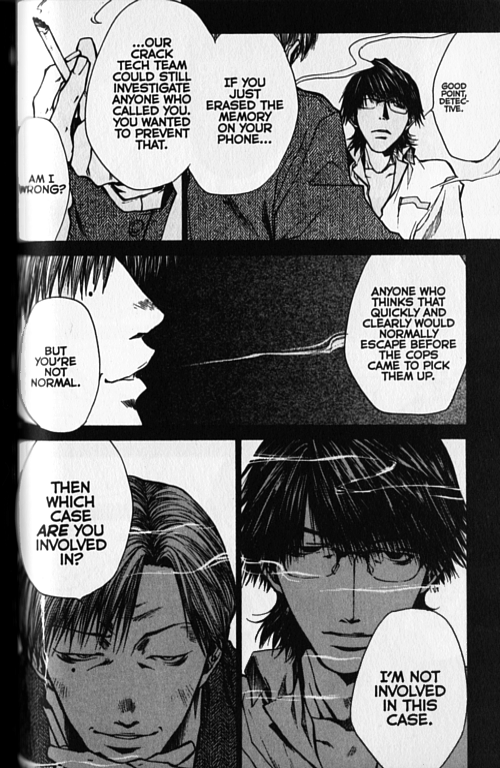
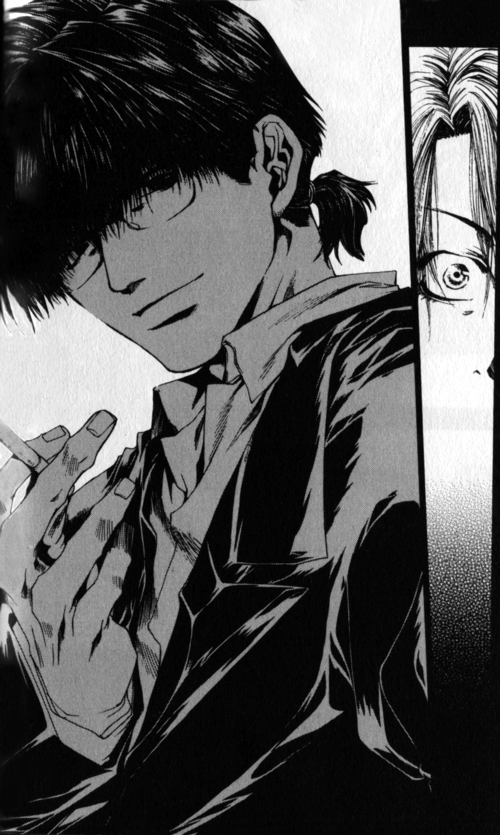
Here, we see Kubota being interrogated by Hasebe for a murder that was committed in a hotel. Kubota’s not giving up any information, so it makes perfect sense that he would be evasive, as indicated by the closed eyes on the first page. Hasebe continues to push, however, and Kubota finally gives up pretense and opens his eyes, allowing us access once more. Only this time, we’re not seeing a warm and friendly Kubota; we’re seeing a coldly resolute one. The grey screentone over his face emphasizes that this is just a partial disclosure—he’s revealing the extent of his determination, but anything else is still off-limits.

MJ: It’s the narrowness of his gaze that really achieves this effect, but again, it’s done with most subtle detail. And you’re right, he’s giving the detective just exactly as much as he wants to give him, no more, no less. It really gives you a strong sense of how carefully he controls everything about himself, and just how rare the two previous examples really are.

MICHELLE: Yes, you’re quite right! The amount of openness Kubota will permit with other people is infinitesimal compared to what Tokito is allowed to see.

Well, that’s it for me and Kubota’s eyes. What images did you want to talk about?

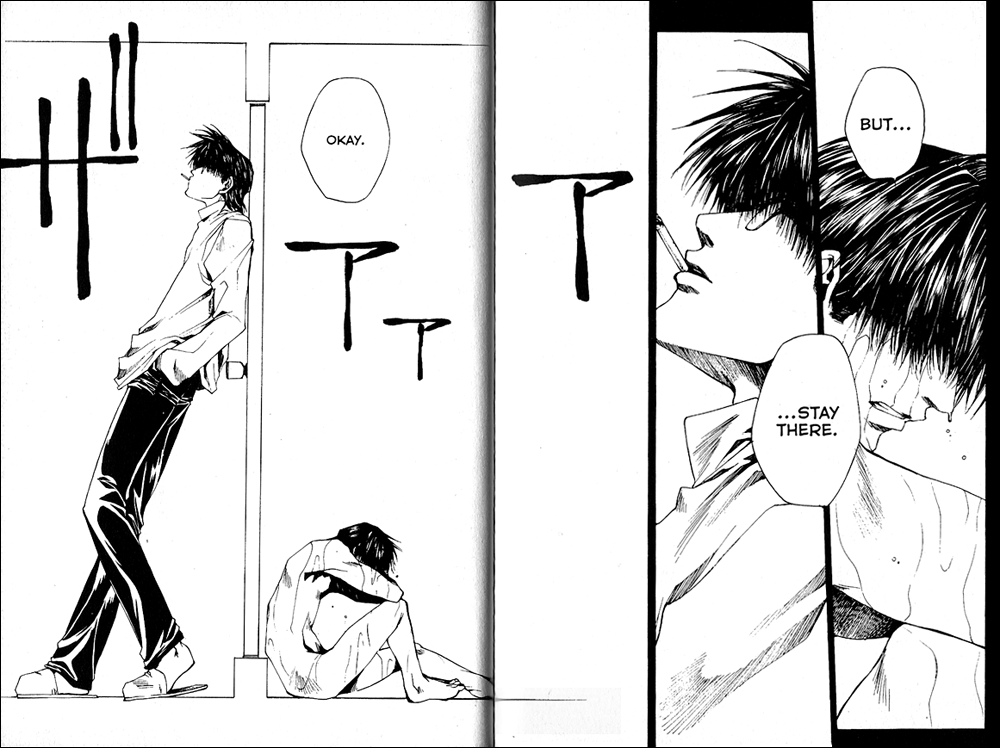
MJ: I’d like to talk about a scene from the end of volume two. It’s one I’ve discussed a couple of times before, both in my initial review of the series and in my infamous post on “intimacy porn.” It’s one of my favorite scenes in the series, and I’ve already explained quite a bit about why.

Volume 2, Chapter 12 (TOKYOPOP)

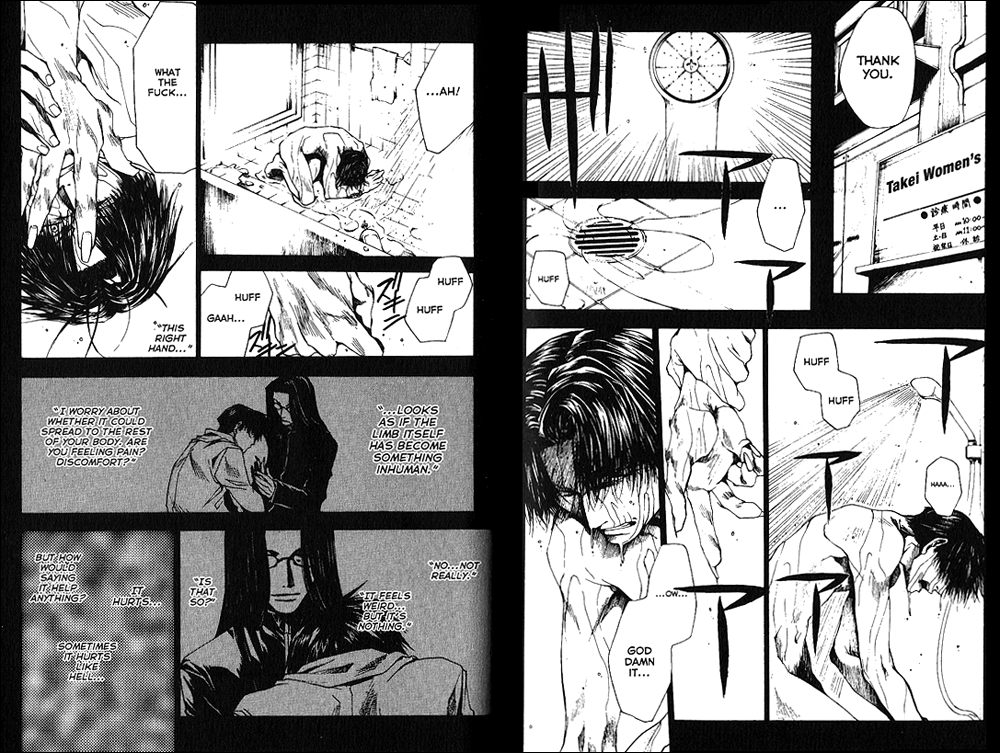
As you can see, Tokito has hidden himself away in the shower to deal with pain in his claw hand, and as he wrestles with both the physical pain and emotional turmoil the hand causes him, he realizes that Kubota is on the other side of the shower door, doing laundry.

When I’ve talked about this scene before, my focus has always been on the incredible intimacy of it, and how beautifully Minekura creates this intimacy while putting a physical barrier between them. What I’ve never discussed before, however, is the detail that, in my view, is almost solely responsible for bringing us into the scene as readers, and that would be the sound effects.

I have no idea what the sound effects really say. I don’t read Japanese, and I haven’t asked anyone to interpret them for me, but really, I don’t have to. It’s actually the visual effect of the Japanese sound effects that makes them so effective.

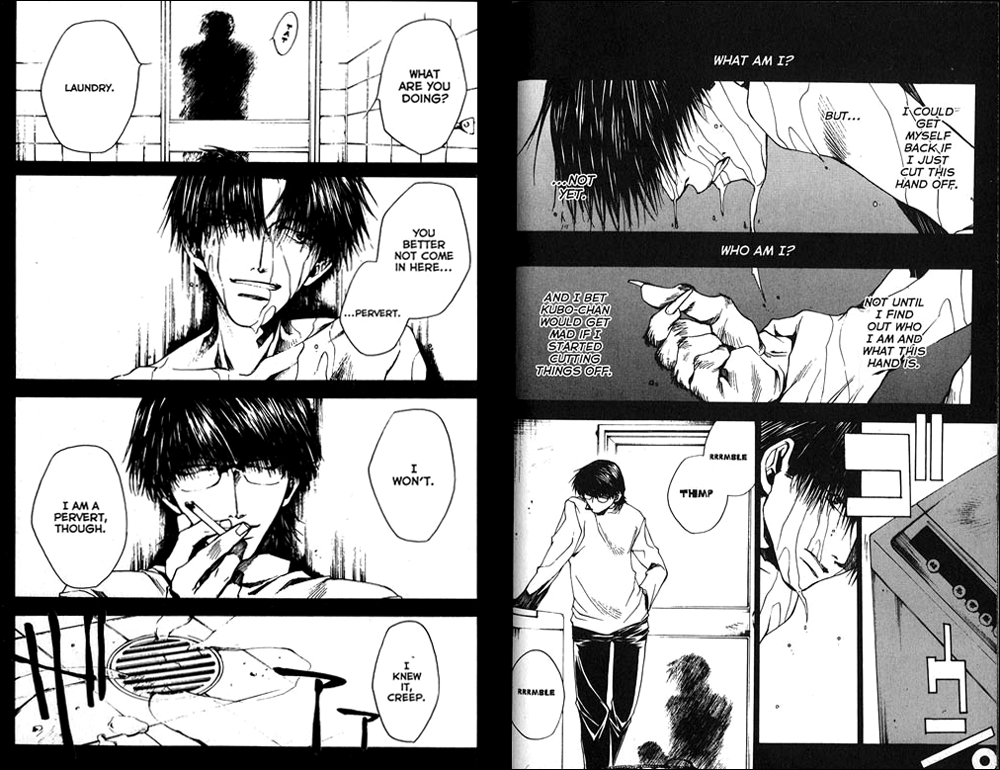
We feel it from the beginning, with just Tokito—the soft sounds of the shower accompanying his thoughts. Then the rumble of the washing machine joins in as Kubota enters the scene. By the end, we’re surrounded by it all, the soft shower and the muffled rumbles of the machine, creating a shell of sound around the characters, isolating them from the rest of the world, but including us as intimate onlookers.

I’m always impressed by writers and artists who can create a real sense of place on the page, and Minekura has done this by surrounding us in these familiar sounds. We can imagine ourselves in the room—feel the rumble of the washing machine under our feet and the thick humidity of the steam as it wafts out around the edges of the shower door. It’s so beautifully done.

MICHELLE: Oh, I love the image of a shell of sound. I like, too, how the initial thump of the washing machine literally intrudes onto Tokito’s thoughts in the way that the sound effect bleeds over the edge of its panel and onto the next, where Tokito, with water streaming down his face, has now been momentarily distracted.

MJ: Yes, I love that frame you’re talking about, where the sounds of the washing machine suddenly intrude into Tokito’s thoughts. It’s as though the washing machine has spoken up to say, “We can hear what you’re thinking in there, and yes, he would be angry if you cut off your hand.”

MICHELLE: Do you actually want me to tell you what the sound effects say? Or is it better not to know?

MJ: Sure, tell me!

MICHELLE: The first one you see, and the one that appears most often and prominently, is “zaa,” which is frequently used alongside rain or falling water. It’s the “a” sound that travels down that first page and drifts across the final two-page spread. On the second page, when Tokito clenches his hand in pain, the sound effects say “zukin zukin,” or “throb throb.”

I was unfamiliar with the “goun” sound accompanying the first image of the washing machine, so consulted Google and found a site that helpfully describes “goun” as “the sound of a washing machine.”

MJ: Ah, helpful indeed.

MICHELLE: One of my motivations for teaching myself kana in the first place was to be able to decipher untranslated sound effects. It slows me down, reading each and every one, but it does add something to the atmosphere, I find.

Another thing I notice in this example is how Minekura treats the “zaa” sound effect, allowing it to trickle down the page along with the water in the first instance, and in the last, depicting it wafting laterally past Kubota, almost like escaping steam.

MJ: What’s really amazing to me, is how successfully this effect is achieved even without understanding the kana. The visual representation of the sound is so powerful all on its own.

MICHELLE: Definitely. Even if the sound effects weren’t there at all, one would still imagine the sound of running water. Their presence emphasizes the sound and its insular quality, though. I’m reminded of an earlier column, where we talked about the sound effects in Banana Fish. There, an image of a passing train automatically conjured the associated sounds, but the sound effects, through their domination of the page, took it to the next level by mirroring how the sound dominated the moment for the characters.

MJ: Here, the sound sort of cradles the moment, creating a sense of comfort and familiarity around something extremely vulnerable.

MICHELLE: Ooh, good verb. In both cases, the sound effects define the sound in some way, rather than simply reiterating that it’s there.

MJ: When I first started reading manga, I found sound effects distracting. I was so new to comics, I had a lot of trouble digesting all the visual information on the page, and sound effects just made that more difficult. Over time, however, I’ve come to appreciate just how much they contribute to the atmosphere of a scene, and how powerful they can be in the right hands.

MICHELLE: It’s like this whole other tool in the mangaka’s kit, and one that we don’t automatically think about.

MJ: Well said!

MICHELLE: Which brings us back around to the inescapable truth that Kazuya Minekura is brilliant and everyone should read Wild Adapter.

MJ: Yes, they should!

For more reviews, roundtables, and essays on Wild Adapter, check out the complete MMF archive.

Filed Under: FEATURES, Let's Get Visual Tagged With: Tokyopop

Review Redux: Gosick, Vol. 1

May 5, 2011 by Katherine Dacey 16 Comments

American publishers have been trying to market light novels to manga fans for close to a decade, with mixed results. Though Dark Horse’s Vampire Hunter D books have sold more than 300,000 units, few other companies can claim similar success with light novels. TOKYOPOP, for example, launched its Pop Fiction imprint in 2006 with several high-profile series, among them The Twelve Kingdoms and Trinity Blood, but poor sales doomed the line to obscurity; by the time TOKYOPOP announced that it would be shuttering its North American publishing operation, it had scrapped its Pop Fiction imprint and drastically curtailed its light novel production.

Part of the problem was logistics: light novels pose a unique problem for retailers, who must decide whether the books should be shelved with graphic novels — where manga fans are more likely to find them — or with science fiction and fantasy books — where a broader readership might discover them. And part of the problem was quality: many of the light novels TOKYOPOP published were poor-to-middling, rendered in flat, functional prose that conveyed little of the energy or imagination of the best manga TOKYOPOP licensed. There were some genuine stand-outs in the Pop Fiction catalog, however, among them Kino’s Journey, a wistful travelogue about a young woman who wanders the globe on a talking motorcycle; Welcome to the NHK, a rude, hilarious expose on Japan’s hikokimori subculture; and Gosick, an old-fashioned murder mystery that’s equal parts Arthur Conan Doyle and Scooby Doo.

Described as a “modern twist on Holmes and Watson,” Gosick adheres to a tried-and-true formula in which a cold but brilliant detective is paired with a sincere but slightly dim sidekick who’s always a few clues behind the audience. In the case of Gosick, the Holmes stand-in is Victorique, the resident eccentric at the Saint Marguerite Academy in Sauville (a fictional European country, just in case you were about to visit the Wikipedia), while the Watson surrogate is Kazuya Kujo, the school’s sole Japanese student. Victorique is a little less degenerate than Conan Doyle’s greatest creation, favoring a pipe over a glass of absinthe; nonetheless, she shares Holmes’s contempt for small minds, superstitions, and emotionally driven decision-making. Her reputation for deductive reasoning leads the nearby town’s pretty-boy inspector to seek her advice whenever there’s a murder – which, given the size and geographical remoteness of the town, occurs with rather alarming frequency.

In the course of investigating a fortune teller’s death, Victorique and Kazuya board the Queen Berry, a ship which supposedly sank ten years earlier with a cargo of murdered children. The two endure a night of extreme violence and seemingly supernatural events as they comb the ship for clues about the old woman’s past. These scenes play like Ten Little Indians crossed with Battle Royale: the ship’s other passengers visit horrific deaths on one another, usually with sharp objects or booby traps. Interspersed with the carnage – which, despite my description, is pretty tame – are numerous conversations in which Victorique patiently debunks the notion that the Queen Berry is haunted, culminating in the kind of “if it wasn’t for those meddling kids I would have had my revenge!” ending familiar to Scooby Doo fans.

What sets Gosick apart from most of the light novels I’ve read — admittedly, a small and unscientific sampling — is the prose. As Carlo Santos noted in his review of volume one, “we get real paragraphs and sentences, with a good mix of description, dialogue and action to keep the story moving” instead of the “clipped, telegraphic sentences” characteristic of the Code Geass and Full Metal Panic novels. To be sure, no one will confuse Gosick with the stark lyricism of Snow Country or the biting snarl of Kamikaze Girls, but the prose is adequate to the task at hand. Aside from a few fussy and oft-repeated details about the characters’ appearance, most of the description focuses on the setting and the elaborate death-traps aboard the Queen Berry, keeping the readers’ attention squarely focused on the mayhem.

The plot may disappoint some contemporary mystery buffs; if you’re an ardent fan of Alexander McCall Smith or Tony Hillerman, you may find Gosick‘s parlor-room denouement too pat and old-fashioned to be genuinely satisfying. Readers who enjoyed Case Closed, The Kindachi Case Files, and Higurashi When They Cry, however, will find Gosick‘s exaggerated characters, Baroque murders, and slick illustrations right in their wheelhouse.

This is an expanded version of a review that originally appeared at PopCultureShock on 4/8/08.

GOSISCK, VOL. 1 • STORY BY KAZUKI SAKURABA, ART BY HINAKO HIRATA • TOKYOPOP • 192 pp.

Filed Under: Manga Critic Tagged With: Gosick, Mystery/Suspense, Review Gosick Light Novel, Tokyopop

My 10 Favorite TOKYOPOP Titles

April 19, 2011 by MJ 54 Comments

Like many other readers who first discovered manga in the mid-2000s, TOKYOPOP played a major role in introducing me to to the medium. Tokyo Babylon was the first TOKYOPOP title I ever read, followed soon after by Legal Drug, The Legend of Chun-Hyang, and — God help me — Model, a manhwa about a Korean art student who lives in a crumbling mansion with two European vampires. (I should add that the vampires are male and the student is female, and both vampires appear to have bought their wardrobes at Hot Topic.) Though I’d be the first to admit that some of the manga I read were terrible, what I remember most about them was their romanticism: these were big, bold stories featuring impossibly beautiful characters in ridiculous situations, and I couldn’t get enough of them.

Over the years, my tastes have changed considerably, but I still feel a special allegiance to TOKYOPOP: its catalog is so large and diverse that I found plenty of other series to read when I outgrew my initial infatuation with overripe shojo. I had a hard time confining myself to just ten titles; I agonized about whether to include Mitsuhazu Mihara’s Doll, and Erica Sakakurazawa’s Between the Sheets, and Kenji Sonishi’s Neko Ramen, and Minetaro Mochizuki’s Dragon Head, all excellent series that still have pride of place in my manga library. In the end, however, I decided I had to put a cap on the number of titles to prevent my list from swelling to unmanageable proportions. Below are my ten favorite TOKYOPOP manga.

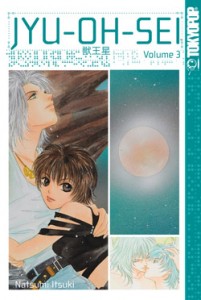
10. JYU-OH-SEI (Natsumi Itsuki)

After their parents are assassinated, twin brothers Rai and Thor are exiled to the penal colony of Kimaera, where they discover extreme weather, man-eating plants, and an elaborate tribal system in which women call the shots. Their only hope of escaping the planet’s inhospitable surface is for one of them to fight his way up the social ladder to become The Beast King, or supreme ruler of Kimaera. Like Invasion of the Body Snatchers and District 9, Jyu-Oh-Sei addresses social taboos and scientific issues while serving up generous portions of what audiences crave most: action, romance, monsters, and explosions. Best of all, Jyu-Oh-Sei comes in a neat, three-volume package that’s long enough to allow for world-building and character development but short enough to stay fresh and surprising until the end. –Reviewed at The Manga Critic on 8/14/09

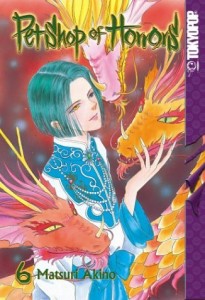
9. PETSHOP OF HORRORS (Matsuri Akino)

You won’t mistake Count D’s emporium for PETCO—the animals he sells are, in fact, demons, demi-gods, and shape-shifters who assume various guises. (One of the series’ running jokes is that some pets take human form, arousing the landlord’s suspicions that Count D actually runs a brothel.) Count D selects a pet for each customer that will help its owner realize a long-repressed dream. Of course, Count D’s services don’t come cheap; each character suffers an unexpected and often terrible consequence for seeking a magical solution to her problems. What sets Petshop apart from other examples of comeuppance theater is the writing. The characters’ plights elicit genuine sympathy from the reader; though we want these mothers and writers and lovesick twenty-something to find happiness, we can see that their own wishes are sometimes selfish, unwise, or genuinely harmful. –Reviewed at PopCultureShock on 2/13/08

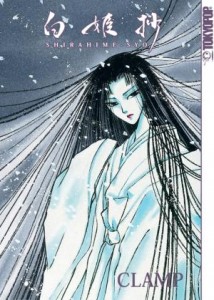
8. SHIRAHIME-SYO: SNOW GODDESS TALES (Clamp)

This lovely anthology is a radical departure for CLAMP. Gone are the super-detailed costumes and fussy character designs of their early, post-doujinshi work; in their place are spare, simply-drawn figures that seem consciously modeled on examples from eighteenth- and nineteenth-century scroll paintings. The stories themselves are told directly without embellishment, though CLAMP infuses each tale with genuine pathos, showing us how the characters’ anger and doubt lead to profound despair. As a result, the prevailing tone and spirit are reminiscent of Masaki Kobayashi’s 1964 film Kwaidan, both in the stories’ fidelity to the conventions of Japanese folklore and in their lyrical restraint. My favorite work by CLAMP.

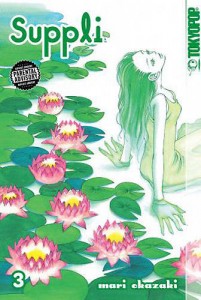
7. SUPPLI (Mari Okazaki)

After being dumped by a long-term boyfriend, twenty-seven-year-old ad executive Minami carves a new identity for herself, accepting more challenging work assignments, forging friendships with her office mates, and exploring her feelings for two very different men: Ishida, a blunt co-worker with bad-boy sex appeal, and Ogiwara, a Tokyo University grad who looks great on paper, but has some nasty romantic baggage of his own. Suppli vividly and humorously evokes office life, from the unproductive meetings and grueling all-nighters to the horseplay and flirtatious banter between co-workers. The denizens of Minami’s office are colorful, if one-dimensional, characters: a salty old maid, two flamboyant karaoke fiends, and a tart-tongued temp who offers sound relationship advice to her officemates while sleeping with a married man. Anyone who’s watched Ally McBeal, The Office, or Ugly Betty has encountered these types before, but Mari Okazaki breathes fresh life into her scenario with stylish artwork, sharp dialogue, and a heroine who occasionally doubts herself, but isn’t neurotic . —Reviewed at PopCultureShock on 12/5/07

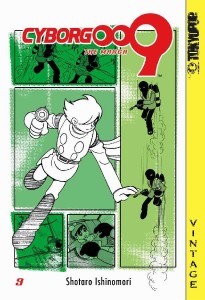
6. CYBORG 009 (Shotaro Ishimontori)

Cyborg 009 was one of TOKYOPOP’s few forays into classic manga — a pity, because TOKYOPOP did a solid job translating and packaging Shotaro Ishimonori’s best-known work. For readers unfamiliar with this iconic series, the plot revolves around a group of people who have been kidnapped and brought to the lair of the Black Ghost organization, where surgeons transform them into robot-human fighting machines. The cyborgs soon turn on their creators and escape, intent on preventing armaggedon. I’d be the first to admit that Cyborg 009 is dated: the Black Ghost’s world-domination schemes have the same quaintly outdated ring as Dr. Evil’s, and several characters embody unfortunate gender and racial stereotypes. (As Shaenon Garrity dryly observes, “Cyborg 003 is a French girl with enhanced senses. Her duties are to hold the baby and occasionally hear things.”) Yet Ishimonori’s crisp cartooning, imaginatively staged battle scenes, and fundamental — if fumbling — humanism remain as arresting now as they did when the series first debuted in 1964.

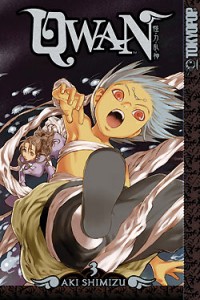
5. QWAN (Aki Shimizu)

Meet Qwan, a child-like figure who possesses super-human strength and speed. Though Qwan realizes he isn’t human, he’s never questioned his origins or abilities — that is, until he meets Shaga, a courtesan who urges him to seek the Essential Arts of Peace, a sutra that will reveal where Qwan came from and why he was sent to live among humans. Questing boys and magical scrolls are de rigeur in fantasy-adventure stories, but Qwan distinguishes itself in two crucial areas: terrific characters and gorgeous artwork. Aki Shimizu’s hero is far more quirky and interesting than the typical shonen lead — Qwan never promises to do his best, or to put friends before himself — while Shimizu’s fight scenes are among the most beautifully choreographed in any licensed manga. TOKYOPOP never finished this one-of-a-kind series, but it’s still worth seeking out, if only to get acquainted with a criminally under-appreciated artist. –Reviewed at The Manga Critic on 3/3/11

4. PARADISE KISS (Ai Yazawa)

Ai Yazawa knows how to have her cake and eat it, too: though she loves to write stories about such fantasy professions as runway model and rock star, she populates those stories with characters whose relationships and values are firmly rooted in everyday life. Consider Yukari (a.k.a. “Caroline”), the heroine of Paradise Kiss: Yukari becomes the muse for a group of aspiring fashion designers, modeling their clothing at a big design-school show and inspiring their most talented member, George, to new creative heights. In most manga, Yukari and George would bicker like teenage versions of Beatrice and Benedict until they finally admitted their mutual feelings of attraction; in Paradise Kiss, however, Yukari and George’s relationship unfolds in a more haphazard, organic way that reflects the fact that George is far more worldly and romantically experienced than Yukari. For my money, Paradise Kiss is Yazawa’s best work to date.

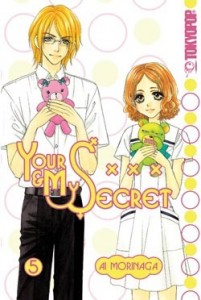
3. YOUR & MY SECRET (Ai Morinaga)

Your & My Secret focuses on Nanako, a swaggering tomboy who lives with her mad scientist grandfather, and Akira, an effeminate boy who adores her. With the flick of a switch, Akira becomes the unwitting test subject for the grandfather’s latest invention, a gizmo designed to transfer personalities from one body to another. Nanako revels in her new-found freedom as a boy, enjoying sudden popularity among classmates, earning the respect of Akira’s contemptuous little sister, and discovering the physical strength to dunk a basketball. Akira, on the other hand, finds his situation a mixed bag: for the first time in his life, his sensitive personality endears him to both male and female peers, but many of the things his maleness had previously exempted him from turn out to be much worse than he’d imagined. There are plenty of gender-bending hijinks — and the inevitable blackmail scene in which someone threatens to reveal Akira’s secret — but Morinaga still allows her characters moments of vulnerability and decency, preventing the humor from curdling into pure meanness. –Reviewed at The Manga Critic on 4/25/10

2. TRAMPS LIKE US (Yayoi Ogawa)

Twenty-eight-year-old Sumire Iwaya is frustrated: though she’s a successful journalist with degrees from Tokyo U. and Harvard, she’s hit the glass ceiling at her job and has just been dumped by her fiance. When she discovers a cute but dissheveled young man sleeping in a box outside her apartment, Sumire “adopts” him, allowing Takeshi to stay in her apartment as her “pet.” You don’t need a PhD in manga to guess the outcome of their unusual arrangement, but romantic triangles and workplace intrigue prevent Tramps Like Us from spinning into complete silliness or offensive gender stereotyping. But what really stayed with me was the depiction of Sumire’s romance with her handsome senpai Hasumi; almost every woman I know has had a relationship like theirs — perfect on paper, but stressful and unhappy in practice — and Yayoi Ogawa captures Sumire and Hasumi’s awkward dynamic in pitch-perfect detail. Now that’s good writing.

1. PLANETES (Makoto Yukimura)

Planetes is that rarest of manga: a human interest story that just happens to have some sci-fi trappings.Planetes focuses on a motley crew of junk collectors that includes Hachimaki, a young astronaut who aspires to join a pioneering mission to Jupiter; Yuri, a Russian astronaut with a Tragic Past; Tanabe, a sensitive but emotionally resilient trainee; and Fee, the ship’s balls-to-the-wall captain. Makoto Yukimura skillfully uses of each of his principal characters’ personal histories to explore meaty issues such as eco-terrorism, space pollution, and good old-fashioned racism. I know, I know — I’m making Planetes sound like Star Trek: Deep Space Waste Removal Station, but Yukimura is a more graceful storyteller than Gene Rodenberry every was, allowing the characters’ actions to speak louder than their words. Vivid, detailed artwork brings the terrestrial and extra-terrestrial settings to life.

* * * * *

So I turn the floor over to you: which titles were your favorites? Which ones deserve to be rescued and finished by another publisher? Inquiring minds want to know!

POSTSCRIPT, 4/20/11: Readers seeking a list of titles published by TOKYOPOP may wish to consult the ANN database entry on TOKYOPOP, the Comic Book DB entry on TOKYOPOP, or Wikipedia’s list of titles published by TOKYOPOP. I can’t vouch for their accuracy, but a quick glance at all three website suggests that these lists are comprehensive. Special thanks to all the folks on Twitter who pointed me towards these resources: @skleefeld, @yuriboke, @Funkgun, and @andrecomics.

Filed Under: Manga Critic Tagged With: Ai Morinaga, Ai Yazawa, Aki Shimizu, clamp, Comedy, Josei, Matsuri Akino, Natsumi Itsuki, Sci-Fi, shojo, Shonen, Shotaro Ishimontori, Tokyopop

My 10 Favorite TOKYOPOP Titles

April 19, 2011 by Katherine Dacey

Like many other readers who first discovered manga in the mid-2000s, TOKYOPOP played a major role in introducing me to to the medium. Tokyo Babylon was the first TOKYOPOP title I ever read, followed soon after by Legal Drug, The Legend of Chun-Hyang, and — God help me — Model, a manhwa about a Korean art student who lives in a crumbling mansion with two European vampires. (I should add that the vampires are male and the student is female, and both vampires appear to have bought their wardrobes at Hot Topic.) Though I’d be the first to admit that some of the manga I read were terrible, what I remember most about them was their romanticism: these were big, bold stories featuring impossibly beautiful characters in ridiculous situations, and I couldn’t get enough of them.

Over the years, my tastes have changed considerably, but I still feel a special allegiance to TOKYOPOP: its catalog is so large and diverse that I found plenty of other series to read when I outgrew my initial infatuation with overripe shojo. I had a hard time confining myself to just ten titles; I agonized about whether to include Mitsuhazu Mihara’s Doll, and Erica Sakakurazawa’s Between the Sheets, and Kenji Sonishi’s Neko Ramen, and Minetaro Mochizuki’s Dragon Head, all excellent series that still have pride of place in my manga library. In the end, however, I decided I had to put a cap on the number of titles to prevent my list from swelling to unmanageable proportions. Below are my ten favorite TOKYOPOP manga.

10. Jyu-Oh-Sei
By Natsumi Itsuki
After their parents are assassinated, twin brothers Rai and Thor are exiled to the penal colony of Kimaera, where they discover extreme weather, man-eating plants, and an elaborate tribal system in which women call the shots. Their only hope of escaping the planet’s inhospitable surface is for one of them to fight his way up the social ladder to become The Beast King, or supreme ruler of Kimaera. Like Invasion of the Body Snatchers and District 9, Jyu-Oh-Sei addresses social taboos and scientific issues while serving up generous portions of what audiences crave most: action, romance, monsters, and explosions. Best of all, Jyu-Oh-Sei comes in a neat, three-volume package that’s long enough to allow for world-building and character development but short enough to stay fresh and surprising until the end. —Reviewed at The Manga Critic on 8/14/09

9. Petshop of Horrors
By Matsuri Akino
You won’t mistake Count D’s emporium for PETCO—the animals he sells are, in fact, demons, demi-gods, and shape-shifters who assume various guises. (One of the series’ running jokes is that some pets take human form, arousing the landlord’s suspicions that Count D actually runs a brothel.) Count D selects a pet for each customer that will help its owner realize a long-repressed dream. Of course, Count D’s services don’t come cheap; each character suffers an unexpected and often terrible consequence for seeking a magical solution to her problems. What sets Petshop apart from other examples of comeuppance theater is the writing. The characters’ plights elicit genuine sympathy from the reader; though we want these mothers and writers and lovesick twenty-something to find happiness, we can see that their own wishes are sometimes selfish, unwise, or genuinely harmful. —Reviewed at PopCultureShock on 2/13/08

8. Shirahime-Syo: Snow Goddess Tales
By CLAMP
This lovely anthology is a radical departure for CLAMP. Gone are the super-detailed costumes and fussy character designs of their early, post-doujinshi work; in their place are spare, simply-drawn figures that seem consciously modeled on examples from eighteenth- and nineteenth-century scroll paintings. The stories themselves are told directly without embellishment, though CLAMP infuses each tale with genuine pathos, showing us how the characters’ anger and doubt lead to profound despair. As a result, the prevailing tone and spirit are reminiscent of Masaki Kobayashi’s 1964 film Kwaidan, both in the stories’ fidelity to the conventions of Japanese folklore and in their lyrical restraint. My favorite work by CLAMP.

7. Suppli
By Mari Okazaki
After being dumped by a long-term boyfriend, twenty-seven-year-old ad executive Minami carves a new identity for herself, accepting more challenging work assignments, forging friendships with her office mates, and exploring her feelings for two very different men: Ishida, a blunt co-worker with bad-boy sex appeal, and Ogiwara, a Tokyo University grad who looks great on paper, but has some nasty romantic baggage of his own. Suppli vividly and humorously evokes office life, from the unproductive meetings and grueling all-nighters to the horseplay and flirtatious banter between co-workers. The denizens of Minami’s office are colorful, if one-dimensional, characters: a salty old maid, two flamboyant karaoke fiends, and a tart-tongued temp who offers sound relationship advice to her officemates while sleeping with a married man. Anyone who’s watched Ally McBeal, The Office, or Ugly Betty has encountered these types before, but Mari Okazaki breathes fresh life into her scenario with stylish artwork, sharp dialogue, and a heroine who occasionally doubts herself, but isn’t neurotic . —Reviewed at PopCultureShock on 12/5/07

6. Cyborg 009
By Shotaro Ishimontori
Cyborg 009 was one of TOKYOPOP’s few forays into classic manga — a pity, because TOKYOPOP did a solid job translating and packaging Shotaro Ishimonori’s best-known work. For readers unfamiliar with this iconic series, the plot revolves around a group of people who have been kidnapped and brought to the lair of the Black Ghost organization, where surgeons transform them into robot-human fighting machines. The cyborgs soon turn on their creators and escape, intent on preventing armaggedon. I’d be the first to admit that Cyborg 009 is dated: the Black Ghost’s world-domination schemes have the same quaintly outdated ring as Dr. Evil’s, and several characters embody unfortunate gender and racial stereotypes. (As Shaenon Garrity dryly observes, “Cyborg 003 is a French girl with enhanced senses. Her duties are to hold the baby and occasionally hear things.”) Yet Ishimonori’s crisp cartooning, imaginatively staged battle scenes, and fundamental — if fumbling — humanism remain as arresting now as they did when the series first debuted in 1964.

5. Qwan
By Aki Shimizu
Meet Qwan, a child-like figure who possesses super-human strength and speed. Though Qwan realizes he isn’t human, he’s never questioned his origins or abilities — that is, until he meets Shaga, a courtesan who urges him to seek the Essential Arts of Peace, a sutra that will reveal where Qwan came from and why he was sent to live among humans. Questing boys and magical scrolls are de rigeur in fantasy-adventure stories, but Qwan distinguishes itself in two crucial areas: terrific characters and gorgeous artwork. Aki Shimizu’s hero is far more quirky and interesting than the typical shonen lead — Qwan never promises to do his best, or to put friends before himself — while Shimizu’s fight scenes are among the most beautifully choreographed in any licensed manga. TOKYOPOP never finished this one-of-a-kind series, but it’s still worth seeking out, if only to get acquainted with a criminally under-appreciated artist. —Reviewed at The Manga Critic on 3/3/11

4. Paradise Kiss
By Ai Yazawa
Ai Yazawa knows how to have her cake and eat it, too: though she loves to write stories about such fantasy professions as runway model and rock star, she populates those stories with characters whose relationships and values are firmly rooted in everyday life. Consider Yukari (a.k.a. “Caroline”), the heroine of Paradise Kiss: Yukari becomes the muse for a group of aspiring fashion designers, modeling their clothing at a big design-school show and inspiring their most talented member, George, to new creative heights. In most manga, Yukari and George would bicker like teenage versions of Beatrice and Benedict until they finally admitted their mutual feelings of attraction; in Paradise Kiss, however, Yukari and George’s relationship unfolds in a more haphazard, organic way that reflects the fact that George is far more worldly and romantically experienced than Yukari. For my money, Paradise Kiss is Yazawa’s best work to date.

3. Your & My Secret
By Ai Morinaga
Your & My Secret focuses on Nanako, a swaggering tomboy who lives with her mad scientist grandfather, and Akira, an effeminate boy who adores her. With the flick of a switch, Akira becomes the unwitting test subject for the grandfather’s latest invention, a gizmo designed to transfer personalities from one body to another. Nanako revels in her new-found freedom as a boy, enjoying sudden popularity among classmates, earning the respect of Akira’s contemptuous little sister, and discovering the physical strength to dunk a basketball. Akira, on the other hand, finds his situation a mixed bag: for the first time in his life, his sensitive personality endears him to both male and female peers, but many of the things his maleness had previously exempted him from turn out to be much worse than he’d imagined. There are plenty of gender-bending hijinks — and the inevitable blackmail scene in which someone threatens to reveal Akira’s secret — but Morinaga still allows her characters moments of vulnerability and decency, preventing the humor from curdling into pure meanness. —Reviewed at The Manga Critic on 4/25/10

2. Tramps Like Us
By Yayoi Ogawa
Twenty-eight-year-old Sumire Iwaya is frustrated: though she’s a successful journalist with degrees from Tokyo U. and Harvard, she’s hit the glass ceiling at her job and has just been dumped by her fiance. When she discovers a cute but dissheveled young man sleeping in a box outside her apartment, Sumire “adopts” him, allowing Takeshi to stay in her apartment as her “pet.” You don’t need a PhD in manga to guess the outcome of their unusual arrangement, but romantic triangles and workplace intrigue prevent Tramps Like Us from spinning into complete silliness or offensive gender stereotyping. But what really stayed with me was the depiction of Sumire’s romance with her handsome senpai Hasumi; almost every woman I know has had a relationship like theirs — perfect on paper, but stressful and unhappy in practice — and Yayoi Ogawa captures Sumire and Hasumi’s awkward dynamic in pitch-perfect detail. Now that’s good writing.

1. Planetes
By Makoto Yukimura
Planetes is that rarest of manga: a human interest story that just happens to have some sci-fi trappings.Planetes focuses on a motley crew of junk collectors that includes Hachimaki, a young astronaut who aspires to join a pioneering mission to Jupiter; Yuri, a Russian astronaut with a Tragic Past; Tanabe, a sensitive but emotionally resilient trainee; and Fee, the ship’s balls-to-the-wall captain. Makoto Yukimura skillfully uses of each of his principal characters’ personal histories to explore meaty issues such as eco-terrorism, space pollution, and good old-fashioned racism. I know, I know — I’m making Planetes sound like Star Trek: Deep Space Waste Removal Station, but Yukimura is a more graceful storyteller than Gene Rodenberry every was, allowing the characters’ actions to speak louder than their words. Vivid, detailed artwork brings the terrestrial and extra-terrestrial settings to life.

* * * * *

So I turn the floor over to you: which titles were your favorites? Which ones deserve to be rescued and finished by another publisher? Inquiring minds want to know!

POSTSCRIPT, 4/20/11: Readers seeking a list of titles published by TOKYOPOP may wish to consult the ANN database entry on TOKYOPOP, the Comic Book DB entry on TOKYOPOP, or Wikipedia’s list of titles published by TOKYOPOP. I can’t vouch for their accuracy, but a quick glance at all three website suggests that these lists are comprehensive. Special thanks to all the folks on Twitter who pointed me towards these resources: @skleefeld, @yuriboke, @Funkgun, and @andrecomics.

Filed Under: Manga, Manga Critic, Manhwa Tagged With: Ai Morinaga, Ai Yazawa, Aki Shimizu, clamp, Comedy, Matsuri Akino, Natsumi Itsuki, Sci-Fi, Shotaro Ishinomori, Tokyopop

TOKYOPOP Is Shutting Down

April 15, 2011 by Michelle Smith

It’s with a heavy heart that I direct you to this piece at The Beat, which reports that TOKYOPOP is shutting down at the end of May. I have a feeling the worst of the sadness is yet to come, as I start to fully process which beloved series will be left in limbo.

Rather than dwell on that depressing thought, I figured I’d outline what is left on TOKYOPOP’s production calendar through the end of May, according to Amazon. Hopefully we will still get all these books. Maybe we won’t.

APRIL RELEASES:
(already in stock)
V.B. Rose 12
Silver Diamond 9
Gakuen Alice 16
Ratman 4
The Secret Notes of Lady Kanoko 2
Future Diary 10
Karakuri Odette 6 (at least this one got an ending!)
NG Life 9
Shinobi Life 7
Neko Ramen 4
Priest Purgatory (Volume one? There’s another one in May…)

(forthcoming)
Saving Life 1
Foxy Lady 4 (still says pre-order though its release date has passed)

MAY RELEASES:
Hetalia: Axis Powers 3
Maid Sama! 9
.hack//G.U. 4 (novel)
Priest: Purgatory
Happy Cafe 8
Fate/Stay Night 11
Sgt. Frog 21
Maid Shokun 1
Sakura’s Finest 1
Samurai Harem 8
Deadman Wonderland 5
AiON 3
Hanako and the Terror of Allegory 4 (an ending!)
Butterfly 2
Ghostface 1
The Stellar Six of Gingacho 3
Clean Freak, Fully Equipped 2 (another ending!)
The Qwaser of Stigmata 2 (see comments)

Series finales that had been scheduled but will now not materialize include V. B. Rose, Portrait of M & N, Alice in the Country of Hearts, and The Secret Notes of Lady Kanoko.

UPDATE: Sean Gaffney of A Case Suitable for Treatment has compiled a similar list, but also rounded up releases that will now never come to pass. You can find his post here.

UPDATE 2: A look at the (extremely depressing) list of removed items at RightStuf suggests that those May titles are not going to be released after all. This means that Karakuri Odette and NG Life were the last series TOKYOPOP actually managed to complete.

UPDATE 3: Several of the releases originally scheduled for early May have begun to appear in comic shops. No Hetalia or Maid Sama!, unfortunately, but we’ll at least get the final volume to Hanako and the Terror of Allegory.

Filed Under: NEWS Tagged With: Tokyopop

TOKYOPOP shuts down US publishing

April 15, 2011 by MJ 23 Comments

Having just entitled a post “WTF Friday,” it was tempting to name this “The REAL WTF Friday.” And as I find I have little stomach for reporting this news, I’ll do it as simply as possible.

Reported by Heidi McDonald at The Beat this afternoon: End of an era: Tokyopop shutting down US publishing division

The news was confirmed by ANN.

There will surely be a great many opinion posts & essays in the wake of this, and probably more news as well. I’ll plan to add particularly worthwhile links here. Expect a more thorough news post later on from Kate.

Readers, thoughts on this unpleasant development?

ETA: Michelle Smith, level-headed as always, takes a look at what books we might hope to see through the end of May.

ETA 2: Brigid Alverson asks an important question about OEL creators’ rights at Robot 6.

ETA 3: Kate’s terrific piece is up, and Heidi McDonald rounds up links, which means I don’t have to.

Filed Under: UNSHELVED Tagged With: Tokyopop

Butterfly, Vol. 1

April 11, 2011 by Katherine Dacey 6 Comments

Reading Butterfly won’t change your life, make you a better person, or cause subtle but significant changes to South American weather patterns, but it may just restore your faith in Tokyopop’s ability to suss out smart, entertaining series that quietly subvert genre conventions.

The genre in question is what I call “seeing dead people,” in which a teenager struggles to cope with the unwanted ability to interact with ghosts. Normally, these long-suffering teens see spirits everywhere, but Genji Ishikawa, Butterfly‘s protagonist, sees only one ghost: his older brother, who committed suicide after pushing a girl into the path of an oncoming train. Though Genji would like nothing better than to have a girlfriend, his tragic past and rumored ability to speak to the dead proves irresistible to classmates with an interest in the paranormal.

Genji has another problem: he’s ¥600,000 in debt, more than he could hope to earn through an after-school job. When a peculiar girl approaches him with a money-making proposition, he reluctantly accepts, only to renege on their agreement when he realizes what he’s being asked to do: tangle with ghosts. Or, more accurately, tangle with what Ageha’s clients believe are ghosts; she has the ability to make people’s fears take corporeal form, and expects Genji to “kill” these projections for her clients’ benefit.

Though Ageha is a type we’ve seen before — manipulative, preternaturally calm, faintly androgynous — her abilities put an interesting twist on the “seeing dead people” premise. She clearly profits from her deceptions, but her fraud is, at bottom, a useful public service, one that allows shopkeepers, frightened swimmers, and hotel chambermaids to resume their normal routines after a catastrophic event, even if these “exorcisms” don’t actually help the dead cross over to the afterlife. As mercenary as Genji finds Ageha, her success forces him to to consider the possibility that his own spiritual powers are less a bane than a blessing, that he has an obligation to develop and use them, rather than deny their value.

The only downside to such an ambitious premise is that Yu Aikawa needs almost every page of volume one to establish the basic parameters of her story. Some of the exposition is handled gracefully; the details of the brother’s death, for example, are revealed slowly and casually, forcing the reader to piece together what happened to him with little authorial guidance. Some of the exposition is handled clumsily, however; Ageha and Genji’s first few encounters seem more like job interviews than spontaneous exchanges of information, an impression that isn’t thoroughly dispelled until one of their ghostbusting gigs goes awry.

Narrative hiccups aside, the story that’s beginning to emerge in the later chapters of volume one is compelling, a supernatural mystery that explores its characters troubled emotional lives with the same thoroughness as it dispenses with pesky spooks. Recommended.

BUTTERFLY, VOL. 1 • BY YU AIKAWA • TOKYOPOP • 208 pp. • RATING: TEEN (13+)

Filed Under: Manga Critic Tagged With: butterfly, Seinen, Tokyopop, Yu Aikawa

Butterfly, Vol. 1

April 11, 2011 by Katherine Dacey

Reading Butterfly won’t change your life, make you a better person, or cause subtle but significant changes to South American weather patterns, but it may just restore your faith in Tokyopop’s ability to suss out smart, entertaining series that quietly subvert genre conventions.

The genre in question is what I call “seeing dead people,” in which a teenager struggles to cope with the unwanted ability to interact with ghosts. Normally, these long-suffering teens see spirits everywhere, but Genji Ishikawa, Butterfly‘s protagonist, sees only one ghost: his older brother, who committed suicide after pushing a girl into the path of an oncoming train. Though Genji would like nothing better than to have a girlfriend, his tragic past and rumored ability to speak to the dead proves irresistible to classmates with an interest in the paranormal.

Genji has another problem: he’s ¥600,000 in debt, more than he could hope to earn through an after-school job. When a peculiar girl approaches him with a money-making proposition, he reluctantly accepts, only to renege on their agreement when he realizes what he’s being asked to do: tangle with ghosts. Or, more accurately, tangle with what Ageha’s clients believe are ghosts; she has the ability to make people’s fears take corporeal form, and expects Genji to “kill” these projections for her clients’ benefit.

Though Ageha is a type we’ve seen before — manipulative, preternaturally calm, faintly androgynous — her abilities put an interesting twist on the “seeing dead people” premise. She clearly profits from her deceptions, but her fraud is, at bottom, a useful public service, one that allows shopkeepers, frightened swimmers, and hotel chambermaids to resume their normal routines after a catastrophic event, even if these “exorcisms” don’t actually help the dead cross over to the afterlife. As mercenary as Genji finds Ageha, her success forces him to to consider the possibility that his own spiritual powers are less a bane than a blessing, that he has an obligation to develop and use them, rather than deny their value.

The only downside to such an ambitious premise is that Yu Aikawa needs almost every page of volume one to establish the basic parameters of her story. Some of the exposition is handled gracefully; the details of the brother’s death, for example, are revealed slowly and casually, forcing the reader to piece together what happened to him with little authorial guidance. Some of the exposition is handled clumsily, however; Ageha and Genji’s first few encounters seem more like job interviews than spontaneous exchanges of information, an impression that isn’t thoroughly dispelled until one of their ghostbusting gigs goes awry.

Narrative hiccups aside, the story that’s beginning to emerge in the later chapters of volume one is compelling, a supernatural mystery that explores its characters troubled emotional lives with the same thoroughness as it dispenses with pesky spooks. Recommended.

BUTTERFLY, VOL. 1 • BY YU AIKAWA • TOKYOPOP • 208 pp. • RATING: TEEN (13+)

Filed Under: Manga, Manga Critic, REVIEWS Tagged With: butterfly, Seinen, Tokyopop, Yu Aikawa

3 Things Thursday: TOKYOPOP

March 3, 2011 by MJ 33 Comments

It’s been a rough week in the blogosphere for TOKYOPOP, whose latest round of layoffs has inspired quite a bit of talk about the company’s less positive history, including this frank commentary from Brigid Alverson at Robot 6 and this ongoing round-up from Johanna Draper Carlson at Manga Worth Reading. My own history as a reader has been sketchy at times. Though TOKYOPOP’s titles have inspired some of my most passionate fangirling over the years, they’ve occasionally left me baffled, and some of their unfinished business has rendered me truly heartbroken.

For today’s 3 Things, let’s examine that a bit more closely.

3 faces of TOKYOPOP:

1. The Fangirling – From Paradise Kiss to Fruits Basket, from Tokyo Babylon to Wild Adapter, TOKYOPOP has offered up to me some of the most beloved series in my manga library. Read any of those linked reviews, and you’ll understand what I love about manga–that’s how well these series represent my personal feelings about the best of the medium, particularly when it comes to manga written and published for women and girls. Some of their newer shoujo acquisitions (like Demon Sacred and The Secret Notes of Lady Kanoko) look to be joining their ranks someday as well.

What can we expect now from a company whose owner has seemingly given up on books? It’s hard to say.

2. The Bafflement – Don’t get me wrong. It’s not that I’m baffled why a series like KimiKiss (pictured to the right) was published, or even why it might be popular. A buxom teen removing her blouse on the cover is, I expect, money in the bank! What was baffling to me in particular about this release, was that it was apparently being marketed as shoujo, according to a little pamphlet I received along with one of the later volumes of Fruits Basket.

From my review summary at the time: “Kouchi and Mao have been friends since childhood, but now that they are in high school, Kouchi is depressed that he hasn’t managed to attract a girlfriend. Mao offers to help him become a “real stud” by teaching him how to be attractive to girls, beginning with lessons in kissing. The lessons start to get a bit steamy, especially after Mao is invited to sleep over with Kouchi’s little sister, resulting in a late-night tryst in Kouchi’s bed.” Sound like shoujo to you?

3. The Heartbreak – Everyone’s got their own tale of woe over a series that TOKYOPOP has canceled, but my broken heart belongs to Off*Beat, an almost finished series by OEL creator Jen Lee Quick. With just one volume remaining of its original 3-volume commission, fans like me were left to weep and weep, never knowing what finally happens to sweet Tory and his revealing obsession.

From my review: “Everything about this comic is a winner–the intriguing plot line, the wonderfully rich characters, the unique, expressive artwork, the subtle treatment of a gay teen’s sexual awakening that is refreshingly not played up or made “sexy” to please its female audience–and the fact that it languishes in cancellation limbo is honestly heartbreaking. This is a comic I would wholeheartedly recommend to anyone. It truly deserves to be read.” *snif*


So readers, what are your 3 faces of TOKYOPOP?

Filed Under: 3 Things Thursday Tagged With: Tokyopop

The Best Manga You’re Not Reading: Qwan

March 3, 2011 by Katherine Dacey 33 Comments

I have a bad habit of falling in love with commercially doomed series. Satsuma Gishiden, for one: Dark Horse published the first three volumes of this manly-man samurai manga, only to put the series on ice in 2007. Duck Prince, for another: Ai Morinaga’s awesomely weird comedy also bit the dust three volumes into its run, a victim of CPM’s perpetual cash flow problems.

I’m dedicating today’s column to another lost cause: Qwan, a fantasy-adventure that draws heavily on Chinese history and folklore for its inspiration. Between 2005 and 2007, Tokyopop released four volumes of what would eventually be a seven-volume series in Japan. After the English-language edition caught up with the Japanese, Qwan went on hiatus. The series never resumed production, however, leaving its few ardent fans stranded in the middle of a crucial story arc.

Normally, I shy away from recommending incomplete series; there’s nothing quite as frustrating as beginning a manga with the knowledge that you will never, ever know how the story ends. I’m going to recommend Qwan anyway, because the four volumes that were published are awesome — Scout’s honor.

The story focuses on Qwan, a child-like figure whose naivete and enthusiasm belie super-human strength and speed. Though Qwan realizes he isn’t human, he’s never questioned his origins or abilities — that is, until he meets Shaga, a courtesan who urges him to seek the Essential Arts of Peace, a sutra that will reveal where Qwan came from and why he was sent to live among humans. He’s not the only one who wants the sutra, however; various political factions vie for the scrolls, hoping to unlock the scrolls’ power and hasten the Han Dynasty’s demise.

Questing boys and magical scrolls are de rigeur in fantasy-adventure stories, but Qwan distinguishes itself in two crucial areas. The first: well-rounded characters. Qwan isn’t a classic Shonen Jump hero, kind-hearted and dedicated to self-improvement, but a more ambiguous figure; he’s guileless and self-centered in the manner of a nine- or ten-year-old, unable to feel genuine sympathy for others. Early in volume one, for example, Qwan encounters a mysterious girl traveling in the company of a demon. Daki proves more a formidable opponent than Qwan anticipates, successfully countering his attack with powerful insect magic. Though it’s clear to the reader that Daki, like Qwan, is a supernatural being, caught between the human and demon worlds, Qwan himself never sees the parallels between their situations, repeatedly attacking Daki until he resigns himself to the futility of his efforts.

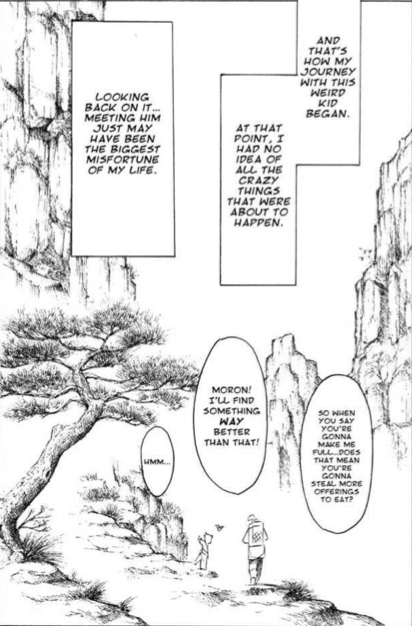
The second distinguishing feature of Qwan is Aki Shimizu’s gorgeous artwork, which draws on anime, guo hua (classical Chinese painting), and wuxia films for its aesthetic. Though Shimizu usually blends these different styles into a seamless whole, she occasionally makes explicit, almost self-conscious quotations of her influences. In this panel, which appears in the very first chapter, she gracefully echoes the undulating lines and shapes of Chinese landscape paintings, even adding a delicately stylized pine tree in the foreground:

Her fight scenes, too, are steeped in Chinese influences. Using dramatic angles, she makes her characters look as weightless as the wire-fu acrobats in Curse of the Golden Flower and House of Flying Daggers; her fight scenes verge on ballet, beautifully choreographed sequences of tumbling bodies and arcing swords. In this sequence, for example, Qwan goes mano-a-mano with a tiger demon, eventually gaining the upper hand by vaulting onto the monster’s back:

Qwan then consumes the demon at the end of their protracted battle, the demon’s body dissolving into an inky swirl:

Oh, and Shimizu draws some pretty nifty monsters, too. This one suggests a Maltese-water buffalo hybrid with prehensile toes:

So why wasn’t Qwan a bigger hit? I think narrative complexity was a factor. Though the story is a rich tapestry of political history and myth, Shimizu refuses to spoon feed information to the reader; we’re just as confused and disoriented as Qwan himself is. That kind of reading experience can be quite rewarding, but the absence of an omniscient narrator demands more of the audience, forcing us to pore over the text and make connections on our own. Shimizu’s artwork and characterizations are up to the task, but impatient readers will easily miss crucial details in their haste to get to the fight scenes.

I also think timing was a factor: Qwan‘s fourth volume appeared in 2007, at the height of the manga boom. If you remember that heady period, publishers were releasing more than 1,200 new volumes of manga per year. Titles that didn’t have an obvious hook — say, a popular anime adaptation or a cast of hot male vampires — faced an uphill battle, with bookstores unwilling to continue stocking series whose first or second volumes sold poorly. With little support from the publisher, and few fans blogging about it, Qwan was all but consigned to the remainder bin.

I’m under no illusion that my paean to Qwan will save it from licensing purgatory; for every Yotsuba&!, there are two Tactics, manga that didn’t gain much traction even after a well-publicized rescue. But Qwan is so good that I can’t help but wish that someone will complete the series — perhaps in a digital-only format, or print-on-demand, or an author-sanctioned scanlation. It’s a manga for readers — for people who love great stories and vivid characters, who care more about the quality of the storytelling than the coolness of the concepts and costumes.

QWAN, VOLS. 1-4 • BY AKI SHIMIZU • TOKYOPOP • RATING: OLDER TEEN (16+)

Filed Under: Manga Critic Tagged With: Aki Shimizu, Shonen Jump, Tokyopop

The Best Manga You’re Not Reading: Qwan

March 3, 2011 by Katherine Dacey

I have a bad habit of falling in love with commercially doomed series. Satsuma Gishiden was my first great disappointment: Dark Horse published three volumes of this manly-man samurai manga, only to put the series on ice in 2007. Duck Prince was another, with Ai Morinaga’s awesomely weird comedy getting the axe midway through its run, a victim of CPM’s perpetual cash flow problems. But the cancellation that really broke my heart was Qwan, a fantasy-adventure that drew heavily on Chinese history and folklore for its inspiration. Between 2005 and 2007, Tokyopop released four volumes before putting the series on hiatus, leaving Qwan‘s few die-hard fans stranded in the middle of a crucial story arc.

While I’d be the first to admit that reading an unfinished story can be an exercise in frustration, I’m going to recommend Qwan anyway because the four volumes that were published are awesome — Scout’s honor.

The story focuses on Qwan, a child-like figure whose naivete and enthusiasm belie super-human strength and speed. Though Qwan realizes he isn’t human, he’s never questioned his origins or abilities — that is, until he meets Shaga, a courtesan who urges him to seek the Essential Arts of Peace, a sutra that will reveal where Qwan came from and why he was sent to live among humans. He’s not the only one who wants the sutra, however; various political factions vie for the scrolls, hoping to unlock the scrolls’ power and hasten the Han Dynasty’s demise.

Questing boys and magical scrolls are de rigeur in fantasy-adventure stories, but Qwan distinguishes itself in two crucial areas. The first is well-rounded characters. Qwan isn’t a classic Shonen Jump hero, kind-hearted and dedicated to self-improvement, but a more ambiguous figure; he’s guileless and self-centered in the manner of a nine- or ten-year-old, unable to feel genuine sympathy for others. Early in volume one, for example, Qwan encounters a mysterious girl traveling in the company of a demon. Daki proves more a formidable opponent than Qwan anticipates, successfully countering his attack with powerful insect magic. Though it’s clear to the reader that Daki, like Qwan, is a supernatural being, caught between the human and demon worlds, Qwan himself never sees the parallels between their situations, repeatedly attacking Daki until he resigns himself to the futility of his efforts.

The second distinguishing feature of Qwan is Aki Shimizu’s gorgeous artwork, which draws on anime, guo hua (classical Chinese painting), and wuxia films for its aesthetic. Though Shimizu usually blends these different styles into a seamless whole, she occasionally makes explicit, almost self-conscious quotations of her influences. In this panel, which appears in the very first chapter, she gracefully echoes the undulating lines and shapes of Chinese landscape paintings, even adding a delicately stylized pine tree in the foreground:

Her fight scenes, too, are steeped in Chinese influences. Using dramatic angles, she makes her characters look as weightless as the wire-fu acrobats in Curse of the Golden Flower and House of Flying Daggers; her fight scenes are balletic, beautifully choreographed sequences of tumbling bodies and arcing swords. In this sequence, for example, Qwan goes mano-a-mano with a tiger demon, eventually gaining the upper hand by vaulting onto the monster’s back:

Qwan then consumes the demon at the end of their protracted battle, the demon’s body dissolving into an inky swirl:

Oh, and Shimizu draws some pretty nifty monsters, too. This one suggests a Maltese-water buffalo hybrid with prehensile toes:

So why wasn’t Qwan a bigger hit? I think narrative complexity was a factor. Though the story is a rich tapestry of political history and myth, Shimizu refuses to spoon feed information to the reader; we’re just as confused and disoriented as Qwan himself is. That kind of reading experience can be quite rewarding, but the absence of an omniscient narrator demands more of the audience, forcing us to pore over the text and make connections on our own. Shimizu’s artwork and characterizations are up to the task, but impatient readers will easily miss crucial details in their haste to get to the fight scenes.

I also think timing was a factor in Qwan’s cancellation, as Qwan‘s fourth volume appeared in 2007 at the height of the manga boom. If you remember that heady period, publishers were releasing more than 1,200 new volumes of manga per year. Titles that didn’t have an obvious hook — say, a popular anime adaptation or a cast of hot male vampires — faced an uphill battle, with bookstores unwilling to stock series whose first or second volumes sold poorly. With little support from the publisher, and few fans blogging about it, Qwan was all but consigned to the remainder bin.

I’m under no illusion that my paean to Qwan will save it from licensing purgatory; for every Yotsuba&!, there are two Tactics, manga that didn’t gain much traction even after a well-publicized rescue. But Qwan is so good that I can’t help but wish that someone will complete the series. It’s a manga for people who love great stories and vivid characters, who care more about the quality of the storytelling than the coolness of the concepts and costumes.

QWAN, VOLS. 1-4 • BY AKI SHIMIZU • TOKYOPOP • RATING: OLDER TEEN (16+)

Filed Under: Manga, Manga Critic, Recommended Reading, REVIEWS Tagged With: Aki Shimizu, Shonen Jump, Tokyopop

7 Short Series Worth Adding to Your Manga Bookshelf

February 23, 2011 by Katherine Dacey 37 Comments

I like getting lost in a long, twisty story as much as the next person, but I often lose interest in a manga around the five- or ten-volume mark. As a service to other people afflicted with Manga ADHD, therefore, I’ve compiled a list of seven shorter series that enjoy pride of place on my shelves.

There were a few ground rules that guided my list-making. First, the series needed to be complete in five volumes or fewer. Second, every volume of the series needed to be readily available through a major retailer like Amazon. Third, the list needed to be diverse, covering a range of genres and demographics. Had I expanded the list to include out-of-print favorites — Antique Bakery, Apocalypse Meow, Club 9, Domu: A Child’s Dream, The Name of the Flower, Planetes — it would have been an unwieldy beast, and one sure to disappoint: why recommend a book that’s selling for $100 on eBay?

So without further ado… here are seven short series worth adding to your manga bookshelf.

A DISTANT NEIGHBORHOOD

JIRO TANIGUCHI • FANFARE/PONENT MON • 2 VOLUMES

A Distant Neighborhood is a wry, wistful take on a tried-and-true premise: a salaryman is transported back in time to his high school days, and must decide whether to act on his knowledge of the past or let events unfold as they did before. We’ve seen this story many times at the multiplex — Back to the Future, Peggy Sue Got Married — but Taniguchi doesn’t play the set-up for laughs; rather, he uses Hiroshi’s predicament to underscore the challenges of family life and the awkwardness of adolescence. (Hiroshi is the same chronological age as his parents, giving him special insight into the vicissitudes of marriage, as well as the confidence to cope with teenage tribulations.) Easily one of the most emotional, most intimate stories Taniguchi’s ever told. (A Distant Neighborhood was one of my picks for Best Manga of 2009; click here for the full list.)

ICHIGENME… THE FIRST CLASS IS CIVIL LAW

FUMI YOSHINAGA • DMP • 2 VOLUMES

One of the things that distinguishes Fumi Yoshinaga’s work from that of other yaoi artists is her love of dialogue. In works like Antique Bakery and Solfege, she reminds us that conversation can be an aphrodisiac, especially when two people are analyzing a favorite book or confessing a mutually-shared passion for art, cooking, or manga. True to form, the sexiest scenes in Ichigenme: The First Class Is Civil Law are conversations between law professors and their students. We feel the erotic charge of more experienced scholars engaging their proteges in intense debates over legal procedure and philosophy, even when the topics themselves are rather dry. Not that Yoshinaga skimps on the smut: there’s plenty of bedroom action as the carefree Tohdou helps his uptight, closeted classmate Tamiya explore his sexuality, but the series’ best moments are fully clothed. An entertaining manga that gets better with each reading. (Reviewed at PopCultureShock on 3/14/08.)

ODE TO KIRIHITO

OSAMU TEZUKA • VERTICAL, INC. • 2 VOLUMES

While investigating an outbreak of a mysterious disease, an earnest young doctor contracts it himself, becoming a hideous dog-man who craves raw meat. Kirihito’s search for the cause — and the cure — is the backbone of this globe-trotting adventure, but Kirihito’s quest to reclaim his humanity is its heart and soul; his travels bring him into contact with hustlers, racists, and superstitious villagers, each of whom greets him with a mixture of suspicion and fear. As its dog-man premise suggests, Ode to Kirihito is Tezuka at his bat-shit craziest: in one storyline, for example, Kirihito befriends a nymphomaniac circus performer who transforms herself into human tempura. But for all its over-the-top characters and plot developments (see “nympho human tempura,” above), Ode to Kirihito is one of Tezuka’s most moving stories, a thoughtful meditation on the the fluid boundaries between man and animal, sanity and insanity, good and evil. (Reviewed at The Manga Critic on 4/7/10.)

THE SECRET NOTES OF LADY KANOKO

RIRIKO TSUJITA • TOKYOPOP • 3 VOLUMES

Kanoko, the sardonic heroine of The Secret Notes of Lady Kanoko, is a student of human behavior, gleefully filling her notebooks with detailed observations about her classmates. Though Kanoko would like nothing more than to remain on the sidelines, she frequently becomes embroiled in her peers’ problems; they value her independent perspective, as Kanoko isn’t the least bit interested in dating, running for student council, or currying favor with the alpha clique. Kanoko’s sharp tongue and cool demeanor might make her the mean-girl villain in another shojo manga, but Ririko Tsujita embraces her heroine’s prickly, opinionated nature and makes it fundamental to Kanoko’s appeal. The perfect antidote to shojo stories about timid good girls and boy-crazy spazzes. UPDATE 4/16/11: TOKYOPOP announced that it would be shutting down its US publishing operations on May 31, 2011. Unfortunately, that means that Lady Kanoko will likely remain incomplete at two volumes. The stories are largely self-contained, so it is still possible to enjoy Lady Kanoko without reading the last volume.

7 BILLION NEEDLES

NOBUAKI TADANO • VERTICAL, INC. • 4 VOLUMES

Nobuaki Tadano gives Hal Clement’s Needle a manga makeover, moving the action from a remote island in the South Seas to Japan, and replacing Clement’s wholesome, Hardy Boy protagonist with a sullen teenage girl who’s none too pleased to discover that an alien bounty hunter has taken control of her body. The decision to make Hikaru a troubled loner with a difficult past is a stroke of genius; her social isolation proves almost as formidable an obstacle for her to overcome as the monster that she and Horizon (as the bounty hunter is known) are pursuing. Her personal struggles also add a level of raw, emotional authenticity to the story — something that was largely absent from the fascinating, though clinically detached, original. Oh, and the monster? It’s a doozy. (7 Billion Needles was one of my picks for Best Teen-Friendly Comic of 2010; see Good Comics for Kids for the full list. Volumes one and two were reviewed at The Manga Critic on 11/21/10; volume three was reviewed on 2/17/11. The fourth and final volume will arrive in stores on April 26, 2011.)

TO TERRA

KEIKO TAKEMIYA • VERTICAL, INC. • 3 VOLUMES

If Richard Wagner wrote space operas, he might have composed something like Keiko Takemiya’s To Terra, an inter-generational drama about a race of telepathic mutants who’ve been exiled from their home world. Under the leadership of the charismatic Jomy Marcus Shin, the Mu embark on a grueling voyage back to Terra to be reunited with their human creators. Their principle foe: an evil supercomputer named Mother. Takemiya’s richly detailed artwork makes To Terra an almost cinematic experience, suggestive of 2001: A Space Odyssey and Star Wars. But don’t be fooled by those blinking computers and blazing starships: To Terra is an unabashedly Romantic saga about two ubermensch locked in a struggle of cosmic proportions. No doubt Richard would approve. (To Terra was one of my picks for Best Manga of 2007; read the full list at PopCultureShock. For more information on To Terra‘s history, click here.)

TOTO! THE WONDERFUL ADVENTURE

YUKO OSADA • DEL REY • 5 VOLUMES

Shonen series often run to 10, 20, or 40 volumes, but Toto! The Wonderful Adventure proves that good stories come in shorter packages, too. Yuko Osada brazenly steals ideas from dozens of other sources — Castle in the Sky, One Piece, Last Exile, The Wizard of Oz — to produce a boisterous, fast-paced story about a tyro explorer who crosses paths with sky pirates, military warlords, and a high-kicking senjutsu expert named Dorothy. Though the jokes are hit-or-miss, Toto! boasts crisp artwork, strong female characters, and an infectious sense of bonhomie among the series’ protagonists; Kakashi and his traveling companions are impossible to dislike. (Reviewed at The Manga Critic on 9/16/10.)

HONORABLE MENTIONS

CAT-EYED BOY (Kazuo Umezu • VIZ • 2 volumes): Readers looking for an introduction to Kazuo Umezu’s work could do a lot worse than this two-volume collection of stories about a strange little boy who’s half-human, half-demon. Umezu gives free reign to his imagination, conjuring some of the most bizarre monsters in the J-horror canon. The results aren’t always as shocking as they might be, but Cat-Eyed Boy is by turns funny, scary, and sad. (Reviewed at The Manga Critic on 10/3/10.)

LADY SNOWBLOOD (Kazuo Koike and Kazuo Kimimura • Dark Horse • 4 volumes): Now that everyone’s forgotten Kill Bill, the epic mess “inspired” by Kazuo Koike’s Lady Snowblood, it’s possible to read this series for what it is: a deliciously trashy story about a beautiful assassin who manipulates, cajoles, seduces, and stabs her way through Meiji-era Japan. Expect copious nudity, buckets of blood, and fight scenes so outrageous they have to be seen to be believed.

ONE POUND GOSPEL (Rumiko Takahashi • VIZ • 4 volumes): In this charming sports comedy, a struggling boxer is torn between his love for food and his love for a pretty young nun who wants him to lay down his fork, lose some weight, and win a few matches. The series is a little episodic (Takahashi published new chapters sporadically), but the dialogue and slapstick humor have a characteristically Takahashian zing.

For additional suggestions, see:

  • 5 Underrated Shojo Manga, which includes Setona Mizushiro’s X-Day;
  • My 10 Favorite CMX Titles, which includes such short series as Astral Project, Chikyu Misaki, Kiichi and the Magic Books, The Name of the Flower, and Presents. Note that many of these series are out of print and may be hard to find through retailers like Amazon;
  • My 10 Favorite Spooky Manga, which includes such short series as Dororo, Gyo, Mail, and School Zone.

Filed Under: Manga Critic Tagged With: Dark Horse, del rey, DMP, fumi yoshinaga, Historical Drama, Horror/Supernatural, Kazuo Koike, Kazuo Umezu, Keiko Takemiya, Osamu Tezuka, Romance/Romantic Comedy, Rumiko Takahashi, Sci-Fi, Seinen, shojo, Shonen, Tokyopop, vertical, VIZ, Yaoi

7 Short Series Worth Adding to Your Manga Bookshelf

February 23, 2011 by Katherine Dacey

I like getting lost in a long, twisty story as much as the next person, but I often lose interest in a manga around the five- or ten-volume mark. As a service to other people afflicted with Manga ADHD, therefore, I’ve compiled a list of seven shorter series that enjoy pride of place on my shelves.

There were a few ground rules that guided my list-making. First, the series needed to be complete in five volumes or fewer. Second, every volume of the series needed to be readily available through a major retailer like Amazon. Third, the list needed to be diverse, covering a range of genres and demographics. Had I expanded the list to include out-of-print favorites — Antique Bakery, Apocalypse Meow, Club 9, Domu: A Child’s Dream, The Name of the Flower, Planetes — it would have been an unwieldy beast, and one sure to disappoint: why recommend a book that’s selling for $100 on eBay?

So without further ado… here are seven short series worth adding to your manga bookshelf.

A Distant Neighborhood
By Jiro Taniguchi • Fanfare/Ponent Mon • 2 volumes
A Distant Neighborhood is a wry, wistful take on a tried-and-true premise: a salaryman is transported back in time to his high school days, and must decide whether to act on his knowledge of the past or let events unfold as they did before. We’ve seen this story many times at the multiplex — Back to the Future, Peggy Sue Got Married — but Taniguchi doesn’t play the set-up for laughs; rather, he uses Hiroshi’s predicament to underscore the challenges of family life and the awkwardness of adolescence. (Hiroshi is the same chronological age as his parents, giving him special insight into the vicissitudes of marriage, as well as the confidence to cope with teenage tribulations.) Easily one of the most emotional, most intimate stories Taniguchi’s ever told. (A Distant Neighborhood was one of my picks for Best Manga of 2009; click here for the full list.)

Ichigenme: The First Class
By Fumi Yoshinaga • DMP • 2 volumes
One of the things that distinguishes Fumi Yoshinaga’s work from that of other yaoi artists is her love of dialogue. In works like Antique Bakery and Solfege, she reminds us that conversation can be an aphrodisiac, especially when two people are analyzing a favorite book or confessing a mutually-shared passion for art, cooking, or manga. True to form, the sexiest scenes in Ichigenme: The First Class Is Civil Law are conversations between law professors and their students. We feel the erotic charge of more experienced scholars engaging their proteges in intense debates over legal procedure and philosophy, even when the topics themselves are rather dry. Not that Yoshinaga skimps on the smut: there’s plenty of bedroom action as the carefree Tohdou helps his uptight, closeted classmate Tamiya explore his sexuality, but the series’ best moments are fully clothed. An entertaining manga that gets better with each reading. (Reviewed at PopCultureShock on 3/14/08.)

Ode to Kirihito
By Osamu Tezuka • Vertical, Inc. • 2 volumes
While investigating an outbreak of a mysterious disease, an earnest young doctor contracts it himself, becoming a hideous dog-man who craves raw meat. Kirihito’s search for the cause — and the cure — is the backbone of this globe-trotting adventure, but Kirihito’s quest to reclaim his humanity is its heart and soul; his travels bring him into contact with hustlers, racists, and superstitious villagers, each of whom greets him with a mixture of suspicion and fear. As its dog-man premise suggests, Ode to Kirihito is Tezuka at his bat-shit craziest: in one storyline, for example, Kirihito befriends a nymphomaniac circus performer who transforms herself into human tempura. But for all its over-the-top characters and plot developments (see “nympho human tempura,” above), Ode to Kirihito is one of Tezuka’s most moving stories, a thoughtful meditation on the the fluid boundaries between man and animal, sanity and insanity, good and evil. (Reviewed at The Manga Critic on 4/7/10.)

The Secret Notes of Lady Kanoko
By Ririko Tsujita • Tokyopop • 3 volumes
Kanoko, the sardonic heroine of The Secret Notes of Lady Kanoko, is a student of human behavior, gleefully filling her notebooks with detailed observations about her classmates. Though Kanoko would like nothing more than to remain on the sidelines, she frequently becomes embroiled in her peers’ problems; they value her independent perspective, as Kanoko isn’t the least bit interested in dating, running for student council, or currying favor with the alpha clique. Kanoko’s sharp tongue and cool demeanor might make her the mean-girl villain in another shojo manga, but Ririko Tsujita embraces her heroine’s prickly, opinionated nature and makes it fundamental to Kanoko’s appeal. It’s the perfect antidote to shojo stories about timid good girls and boy-crazy klutzes.

7 Billion Needles
By Nobuaki Tadano • Vertical, Inc. • 4 volumes
Nobuaki Tadano gives Hal Clement’s Needle a manga makeover, moving the action from a remote island in the South Seas to Japan, and replacing Clement’s wholesome, Hardy Boy protagonist with a sullen teenage girl who’s none too pleased to discover that an alien bounty hunter has taken control of her body. The decision to make Hikaru a troubled loner with a difficult past is a stroke of genius; her social isolation proves almost as formidable an obstacle for her to overcome as the monster that she and Horizon (as the bounty hunter is known) are pursuing. Her personal struggles also add a level of raw, emotional authenticity to the story — something that was largely absent from the fascinating, though clinically detached, original. Oh, and the monster? It’s a doozy. (Volumes one and two were reviewed at The Manga Critic on 11/21/10.)

To Terra
By Keiko Takemiya • Vertical, Inc. • 3 volumes
If Richard Wagner wrote space operas, he might have composed something like Keiko Takemiya’s To Terra, an inter-generational drama about a race of telepathic mutants who’ve been exiled from their home world. Under the leadership of the charismatic Jomy Marcus Shin, the Mu embark on a grueling voyage back to Terra to be reunited with their human creators. Their principle foe: an evil supercomputer named Mother. Takemiya’s richly detailed artwork makes To Terra an almost cinematic experience, suggestive of 2001: A Space Odyssey and Star Wars. But don’t be fooled by those blinking computers and blazing starships: To Terra is an unabashedly Romantic saga about two ubermensch locked in a struggle of cosmic proportions. No doubt Richard would approve. (To Terra was one of my picks for Best Manga of 2007; read the full list at PopCultureShock. For more information on To Terra‘s history, click here.)

Toto! The Wonderful Adventure
By Yuko Osada • Del Rey • 5 volumes
Shonen series often run to 10, 20, or 40 volumes, but Toto! The Wonderful Adventure proves that good stories come in shorter packages, too. Yuko Osada brazenly steals ideas from dozens of other sources — Castle in the Sky, One Piece, Last Exile, The Wizard of Oz — to produce a boisterous, fast-paced story about a tyro explorer who crosses paths with sky pirates, military warlords, and a high-kicking senjutsu expert named Dorothy. Though the jokes are hit-or-miss, Toto! boasts crisp artwork, strong female characters, and an infectious sense of bonhomie among the series’ protagonists; Kakashi and his traveling companions are impossible to dislike. (Reviewed at The Manga Critic on 9/16/10.)

HONORABLE MENTIONS

Cat-Eyed Boy (Kazuo Umezu • VIZ • 2 volumes): Readers looking for an introduction to Kazuo Umezu’s work could do a lot worse than this two-volume collection of stories about a strange little boy who’s half-human, half-demon. Umezu gives free reign to his imagination, conjuring some of the most bizarre monsters in the J-horror canon. The results aren’t always as shocking as they might be, but Cat-Eyed Boy is by turns funny, scary, and sad. (Reviewed at The Manga Critic on 10/3/10.)

Lady Snowblood (Kazuo Koike and Kazuo Kimimura • Dark Horse • 4 volumes): Now that everyone’s forgotten Kill Bill, the epic mess “inspired” by Kazuo Koike’s Lady Snowblood, it’s possible to read this series for what it is: a deliciously trashy story about a beautiful assassin who manipulates, cajoles, seduces, and stabs her way through Meiji-era Japan. Expect copious nudity, buckets of blood, and fight scenes so outrageous they have to be seen to be believed.

One Pound Gospel (Rumiko Takahashi • VIZ • 4 volumes): In this charming sports comedy, a struggling boxer is torn between his love for food and his love for a pretty young nun who wants him to lay down his fork, lose some weight, and win a few matches. The series is a little episodic (Takahashi published new chapters sporadically), but the dialogue and slapstick humor have a characteristically Takahashian zing.

For additional suggestions, see:

  • 5 Underrated Shojo Manga, which includes Setona Mizushiro’s X-Day;
  • My 10 Favorite CMX Titles, which includes such short series as Astral Project, Chikyu Misaki, Kiichi and the Magic Books, The Name of the Flower, and Presents. Note that many of these series are out of print and may be hard to find through retailers like Amazon;
  • My 10 Favorite Spooky Manga, which includes such short series as Dororo, Gyo, Mail, and School Zone.

Filed Under: Manga, Manga Critic, Recommended Reading Tagged With: Dark Horse, del rey, DMP, fumi yoshinaga, Historical Drama, Horror/Supernatural, Kazuo Koike, Kazuo Umezu, Keiko Takemiya, Osamu Tezuka, Romance/Romantic Comedy, Rumiko Takahashi, Sci-Fi, Tokyopop, Vertical Comics, VIZ

Eensy Weensy Monster 1 by Masami Tsuda: B

January 31, 2011 by Michelle Smith

From the back cover:
Nanoha Satsuki, an average, plain-Jane high school student, comfortably spends her time in the shadow of her two beautiful, popular friends. But new guy Hazuki Tokiwa, with his snobbish, arrogant demeanor, has a way of getting under Nanoha’s skin, and releasing her inner monster!

Is this the beginning of an ugly relationship, or does Hazuki have his own hidden qualities?

Review:
I feel a little guilty that I’ve started another Masami Tsuda series rather than actually finish Kare Kano, but this one is so short and cute and I really will finish the other one this year, I swear!

Nanoha Satsuki is normally a calm, friendly girl. Even the attention paid to her childhood friends—princely Nobara, dubbed the “Lady Oscar” of the school, and genius Renge—doesn’t get her down. For some reason, though, a superficial boy named Hazuki and his snobby ways really get her goat. Nanoha attributes these mysterious feelings of anger to a “little parasite” and does her best to keep a lid on them, but one day she’s had enough and lays into Hazuki for being arrogant and narrow-minded.

Should it be a surprise to anyone that these two will eventually end up together? No, but how they get there is actually pretty interesting. After the outburst, Nanoha lives in fear of some kind of retribution, but her words have actually shocked Hazuki out of his reverie. Bratty vanity, as it turns out, is his little monster to overcome. He realizes he has no real friends or goals and comes to appreciate her hard-working qualities. In time, Nanoha is able to relax when he’s around, and by the end of the first volume—after the passage of several months—they’ve become friends.

Tsuda is very good at depicting the opening stages of a couple’s relationship—the first two volumes of Kare Kano are still my favorite part—and puts those skills to good use here. One technique she’s fond of is putting the girl’s perspective of events on the right-side page, and the boy’s on the left, and it works nicely here. For all of the moments when Nanoha catches Hazuki looking at her and thinks he’s plotting something dastardly or contemplating her lack of academic prowess, we see that he’s usually thinking things like, “If I want to be a better person, I should learn from someone like her.”

The overall tone is lighthearted, but one does come to like the leads a good deal by the end. Nanoha’s friends are quirky, too, and I’d like to know more about them, but if the couple gets together in the first two volumes and then we spend loads of time on their friends, I guess this would just turn into a clone of Tsuda’s more famous series.

As a final note, I must mention how much I love what Tsuda does with Hazuki’s fangirls. Immediately after being told off by Nanoha, Hazuki goes to them for sympathy. Instead, they all laugh in his face. “She sees right through you! I mean, we all like you, but we wouldn’t go out with you or anything.” Later, when Hazuki and Nanoha have gotten friendly, a few girls decide that they ought to bully her, but they’re rotten at it. At one point a cluster of girls follows Nanoha after school with the intention of threatening her, only to instinctively end up rallying to her defense when it looks like she’s been accosted by a creepy dude. Then they all find a new prince to swoon over. The end.

In the end, Eensy Weensy Monster is a totally cute and sweet shoujo romance. It probably won’t convert anyone to either the demographic or the genre, but it will provide an afternoon’s pleasant amusement to existing fans of both.

Filed Under: REVIEWS Tagged With: Masami Tsuda, Tokyopop

  • « Go to Previous Page
  • Page 1
  • Page 2
  • Page 3
  • Page 4
  • Page 5
  • Interim pages omitted …
  • Page 7
  • Go to Next Page »
 | Log in
Copyright © 2010 Manga Bookshelf | Powered by WordPress & the Genesis Framework