• Skip to primary navigation
  • Skip to main content
  • Skip to primary sidebar
  • Home
  • About Us
    • Privacy Policy
    • Comment Policy
    • Disclosures & Disclaimers
  • Resources
    • Links, Essays & Articles
    • Fandomology!
    • CLAMP Directory
    • BlogRoll
  • Features & Columns
    • 3 Things Thursday
    • Adventures in the Key of Shoujo
    • Bit & Blips (game reviews)
    • BL BOOKRACK
    • Bookshelf Briefs
    • Bringing the Drama
    • Comic Conversion
    • Fanservice Friday
    • Going Digital
    • It Came From the Sinosphere
    • License This!
    • Magazine no Mori
    • My Week in Manga
    • OFF THE SHELF
    • Not By Manga Alone
    • PICK OF THE WEEK
    • Subtitles & Sensibility
    • Weekly Shonen Jump Recaps
  • Manga Moveable Feast
    • MMF Full Archive
    • Yun Kouga
    • CLAMP
    • Shojo Beat
    • Osamu Tezuka
    • Sailor Moon
    • Fruits Basket
    • Takehiko Inoue
    • Wild Adapter
    • One Piece
    • After School Nightmare
    • Karakuri Odette
    • Paradise Kiss
    • The Color Trilogy
    • To Terra…
    • Sexy Voice & Robo
  • Browse by Author
    • Sean Gaffney
    • Anna Neatrour
    • Michelle Smith
    • Katherine Dacey
    • MJ
    • Brigid Alverson
    • Travis Anderson
    • Phillip Anthony
    • Derek Bown
    • Jaci Dahlvang
    • Angela Eastman
    • Erica Friedman
    • Sara K.
    • Megan Purdy
    • Emily Snodgrass
    • Nancy Thistlethwaite
    • Eva Volin
    • David Welsh
  • MB Blogs
    • A Case Suitable For Treatment
    • Experiments in Manga
    • MangaBlog
    • The Manga Critic
    • Manga Report
    • Soliloquy in Blue
    • Manga Curmudgeon (archive)

Manga Bookshelf

Discussion, Resources, Roundtables, & Reviews

Shonen Jump

Blue Exorcist, Vol. 1

April 22, 2011 by Katherine Dacey

Have you ever seen the pilot episode of Law & Order? Most of the regular characters are present, and the script follows the three-act structure familiar to anyone who’s watched an episode of any Law & Order series, but the pacing is slack; the dialogue fizzles where it should crackle; and the actors struggle to create believable relationships between the characters, even as the script demands that they explain things to one another that, presumably, they’d already know from working together. Small wonder that “Everybody’s Favorite Bagman” languished for nearly a year before NBC rescued the show from limbo and ordered a full season of episodes.

So it is with Blue Exorcist, which has a first chapter that might charitably be described as a “pilot episode.” In these opening thirty pages, Kato introduces orphan Rin Okimura, a hot-tempered young man; Yukio, Rin’s snot-nosed fraternal twin; and Father Fujimoto, their guardian. Rin, we learn, is a direct descendant of Satan, and is in imminent danger of going over to the dark side. Father Fujimoto, however, has kept this information from his young charge, seeing fit only to explain the complexities of Rin’s lineage when Satan’s minions try to spirit Rin back to Gehenna, the demon realm. (Like all manga priests, Father Fujimoto spends more time fighting demons than preparing Sunday sermons or ministering to the sick, hungry, and bereaved.) An epic confrontation between Satan and Father Fujimoto leaves Rin’s mentor dead, forcing the boy to decide whether to cast his lot with Satan or with humanity.

There’s no reason why this opening prelude has to be such a bumpy, predictable ride, but Kato seems so intent on relating Rin’s entire Tragic Past in one installment that she trades naturalism for economy. (Sample: “I see you’ve returned. An overnight trip to the job center? How diligent of you.” And how helpful of Father Fujimoto to ask Rin a question to which he already knows the answer!) In the second chapter, however, Kato finds her stride with the material: the dialogue is looser and funnier; the characters’ relationships are more firmly and plausibly established; and she introduces her first genuinely memorable character, Mephisto Pheles. The plot is stock, with Rin vowing to avenge Father Fujimoto by enrolling in an exorcism “cram school,” but Kato enlivens the proceedings with humorous twists and nifty artwork.

And oh, the artwork! It’s crisp and expressive, filled with small but suggestive details. Mephisto, for example, carries a patched umbrella and wears a polka-dot cravat — two minor flourishes that help establish him as a slightly decadent figure, elegant but down at the heels. The not-very-imaginatively named True Cross Town provides another instructive example of Kato’s meticulous and thoughtful draftsmanship: she lavishes considerable attention on architectural details and infrastructure, stacking layers of houses and buildings on top of one another to form a giant urban ziggeraut:
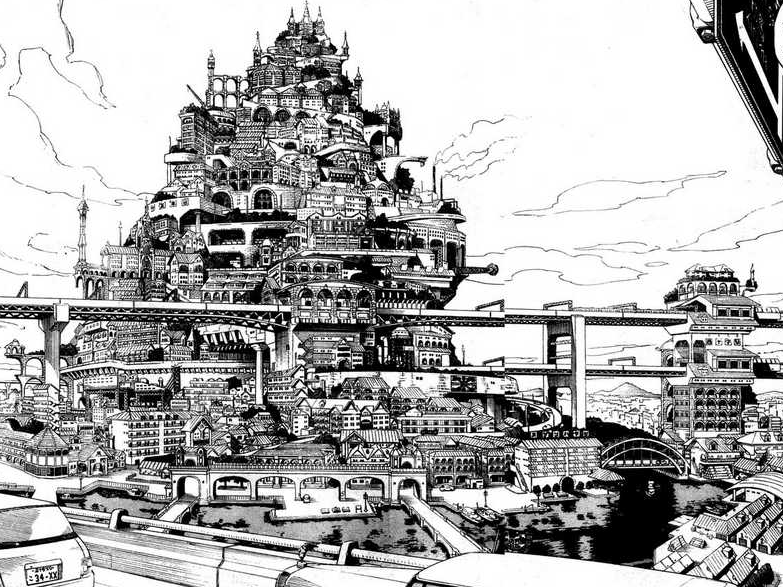
In short, Kato has created an imaginary urban landscape that seems to have evolved naturally over time, with old and new buildings side-by-side and modern modes of transport straddling canals and rivers. That kind of thoroughness may not serve much purpose in the context of a manga about demon fighters, but it lends Blue Exorcist a temporal and geographic specificity that’s sometimes missing in other areas of the story — like the religious bits.

Whatever my reservations about the first chapter, I freely admit that I’d fallen head-over-heels for Blue Exorcist by the end of the second. The brisk pacing, sharp artwork, and cheeky tone of these later chapters convinced me that Kazue Kato is in firm control of her story, and has successfully laid the foundation for the series’ first major story arc. Bring it on, I say!

BLUE EXORCIST, VOL. 1 • BY KAZUE KATO • VIZ MEDIA • 198 pp. • RATING: OLDER TEEN (16+)

Filed Under: Manga, Manga Critic, REVIEWS Tagged With: blue exorcist, Kazue Kato, Shonen, Shonen Jump, VIZ

Tidbits: Shonen Jumpin’ Jehosaphat

April 11, 2011 by Michelle Smith

Sometimes I just crave some shounen manga! Here, then, are a few short reviews of some shounen I have lately read: the third volume of Bakuman。, the 31st through 34th of Bleach, the second of Genkaku Picasso, and the thirteenth through fifteenth of Slam Dunk. All are fairly recent releases and all published under VIZ’s Shonen Jump imprint; Bakuman。 and Genkaku Picasso also have new volumes due out in May.

Bakuman。3 by Tsugumi Ohba and Takeshi Obata
This was my favorite volume of Bakuman。 so far!

It begins with Mashiro and Takagi struggling to create a mainstream battle manga, over the objections of their editor, because they believe this is the ticket to popularity in Shonen Jump. They improve a lot between attempts, but in the end, Takagi requests some time alone over summer break to think of a new story, leaving Mashiro free to work as an assistant for Eiji Nizuma, their rival.

MJ adores Eiji, and when he first appeared in this volume I was wondering how that could be, since he comes across as bratty and weird. Once you get to know him, though, it turns out he’s actually kind of endearing. He simply says what he thinks, and is incapable of being malicious or devious. After watching him happily and genuinely soak up feedback from his assistants—apparently his editor at Jump is too in awe of his genius to offer any useful guidance—I kind of love him, too!

To top it off, we see some growth from the female characters. Miho makes some progress in her dream of becoming a voice actress, although right now she seems to be succeeding mostly on account of her good looks. Miyoshi comes up with the goal of being a novelist, though her primary function in this volume is to captivate Takagi with her general awesomeness and make Mashiro doubt that his partner is working on the promised story at all.

In the end, the future of the partnership appears to be in jeopardy, even though both guys have independently hit upon the idea of a detective manga as the way to go. I’ve always found this series interesting for its inside glimpse into the publication process, but now I’m starting to find it interesting for the characters, as well. I eagerly await volume four!

Bleach 31-34 by Tite Kubo
You might not think that battles against creepy supernatural foes with bizarre powers could be boring, but it turns out that Bleach somehow manages it.

Volumes 31 through 33 are chiefly comprised of fights against weird-looking dudes during which nearby structures often go “boom” and crumble. It’s pretty much impossible to tell what’s going on, so I just sort of coast along until there’s a panel that shows someone actually being hurt by something. There are but two bright spots in these volumes. One is the predictable but still gratifying revelation that Nel, the toddler who’s been accompanying Ichigo in his journey across Hueco Mundo, is actually a badass (and buxom) former Espada. The second is an honestly riveting scene in which a hollowfied Ichigo appears before Orihime for the first time and terrifies her.

Things improve a bit in volume 34 with the timely arrival of some Soul Reaper captains. Okay, yes, their explanation for their arrival is pretty flimsy, but I will accept any excuse if it means Byakuya will be around. This also leads to a crazy battle of one-upsmanship between one of the stranger Soul Reapers, Kurotsuchi, and his Arrancar opponent. It goes something like this:

Arrancar: Fear my leet skills! I will turn your innards into dust!

Kurotsuchi: Oh, actually, I infected [Uryuu] with surveillance bacteria the last time we were fighting, so I’ve been watching your battle and, aware of your abilities, have replaced all my insides with fakes. Too bad. Now my gloopy pet will eat you.

Arrancar: Lo, I have been et. But before that happened I implanted [Nemu] with my egg, which will hatch and grow a new me! Plus, there are bits of me still in your pet, which will allow me to use it to attack you.

Gloopy pet: *splat*

Kurotsuchi: Oh, but before you did that I programmed my pet to self-destruct if anyone ever tried to use it against me. Also, I filled Nemu’s body full of drugs for the same reason, so now you’re going to see everything in extreme slow mo while I kill you.

Arrancar: Crap.

Honestly, it’s so outrageous one kind of can’t help admiring it!

Genkaku Picasso 2 by Usamaru Furuya
I really wish I could like Genkaku Picasso more. Mostly this is because Usamaru Furuya’s art is really impressive—true, in their normal states the characters don’t look all that exciting (and the lip-glossy sheen on the boys’ lips is somewhat distracting) but the illustrations created by artistic protagonist Hikari Hamura are detailed and gorgeous, and I like that Furuya continues drawing in that style when Hikari and his ghostly advisor, former classmate Chiaki, enter into the drawings in order to help solve the problems plaguing their classmates.

The problem is that I just don’t like any of the characters! Hikari is creepy, anti-social, and perverted, and is always reluctant to help out his classmates, putting Chiaki in the role of always being the one who reminds him that he has to help them, otherwise he’s going to rot away. (He cheated death in volume one and this is the manner in which he must pay for that.) I could possibly like Chiaki if she were given something to do besides pester Hikari all the time, but that’s not the case.

The manner in which the classmates are helped by Hikari and Chiaki is also odd. The pair enters a drawing based on the “heart” of said classmate and attempts to figure out what is worrying them. One boy has created a fictional girlfriend, for example, while another girl sees herself as a mecha rather than an actual girl. While inside the drawing, Hikari and Chiaki attempt to reason with the classmate, while in the real world, the classmate answers them aloud, making them look totally freaking crazy to the people who happen to be around. If I was hanging out with my friend and he began to break up with his imaginary girlfriend right in front of me, I think I would be quite alarmed.

That said, there is one bright spot in this volume—the tale of Yosuke, a girl born in a body of the wrong gender. Perhaps it’s a little too optimistic, but I liked it anyway, especially the fact that the “heart” of the transgender kid is the calmest and healthiest place we’ve seen yet.

If Genkaku Picasso were any longer, I might not continue it, but since there’s only one volume left, I shall persevere.

Slam Dunk 13-15 by Takehiko Inoue
Ordinarily, if a series took two-and-a-half volumes to cover less than an hour of action, I might be annoyed. Not so with Slam Dunk, which takes that long to finish Shohoku High’s exciting prefectural tournament match against Kainan, a team that has made it to Nationals every year in recent memory.

There’s an interesting phenomenon that occurs when one reads Slam Dunk. Hanamichi Sakuragi, the hot-headed protagonist, has matured somewhat since the beginning of the series, though he’s still inclined to proclaim himself a genius at every opportunity. Hence, it’s pretty satisfying to see him humbled, and to watch him realize that he hasn’t yet got the skills to carry the team or hog the spotlight. And yet, there comes a point where the humbling has been sufficient, and one wants to see him triumph.

When Captain Akagi sprains his ankle during the game, Sakuragi, realizing how immensely important this game is to Akagi, does his best to fill the captain’s shoes. How can you not root for someone trying so hard to make someone else‘s dream come true? Yes, it’s the talented Rukawa who is single-handedly responsible for tying up the game by halftime, but Sakuragi is just trying so damned hard that his bluster actually becomes a source of strength for his teammates. When he finally makes an impressive slam dunk in front of a cheering crowd, I convince that I got a little sniffly.

Shohoku ends up losing the game, though this doesn’t put them out of the running for Nationals just yet. The disappointing experience makes Sakuragi more serious than ever before and he returns to school with a shaved head (as penance for an unfortunate mistake during the final seconds of the game) and a fierce desire to improve.

Why do I love sports manga so much? I’m honestly not sure I can articulate it, but with Slam Dunk part of it is the fact that the hero, who previously had no goals in life, has found a place to belong and something to care about. That kind of story pushes my personal buttons in a big way.

Review copies for Bakuman。, Genkaku Picasso, and volume fourteen of Slam Dunk provided by the publisher.

Filed Under: REVIEWS Tagged With: Shonen Jump, Takehiko Inoue, Takeshi Obata, VIZ

The Best Manga You’re Not Reading: Qwan

March 3, 2011 by Katherine Dacey

I have a bad habit of falling in love with commercially doomed series. Satsuma Gishiden was my first great disappointment: Dark Horse published three volumes of this manly-man samurai manga, only to put the series on ice in 2007. Duck Prince was another, with Ai Morinaga’s awesomely weird comedy getting the axe midway through its run, a victim of CPM’s perpetual cash flow problems. But the cancellation that really broke my heart was Qwan, a fantasy-adventure that drew heavily on Chinese history and folklore for its inspiration. Between 2005 and 2007, Tokyopop released four volumes before putting the series on hiatus, leaving Qwan‘s few die-hard fans stranded in the middle of a crucial story arc.

While I’d be the first to admit that reading an unfinished story can be an exercise in frustration, I’m going to recommend Qwan anyway because the four volumes that were published are awesome — Scout’s honor.

The story focuses on Qwan, a child-like figure whose naivete and enthusiasm belie super-human strength and speed. Though Qwan realizes he isn’t human, he’s never questioned his origins or abilities — that is, until he meets Shaga, a courtesan who urges him to seek the Essential Arts of Peace, a sutra that will reveal where Qwan came from and why he was sent to live among humans. He’s not the only one who wants the sutra, however; various political factions vie for the scrolls, hoping to unlock the scrolls’ power and hasten the Han Dynasty’s demise.

Questing boys and magical scrolls are de rigeur in fantasy-adventure stories, but Qwan distinguishes itself in two crucial areas. The first is well-rounded characters. Qwan isn’t a classic Shonen Jump hero, kind-hearted and dedicated to self-improvement, but a more ambiguous figure; he’s guileless and self-centered in the manner of a nine- or ten-year-old, unable to feel genuine sympathy for others. Early in volume one, for example, Qwan encounters a mysterious girl traveling in the company of a demon. Daki proves more a formidable opponent than Qwan anticipates, successfully countering his attack with powerful insect magic. Though it’s clear to the reader that Daki, like Qwan, is a supernatural being, caught between the human and demon worlds, Qwan himself never sees the parallels between their situations, repeatedly attacking Daki until he resigns himself to the futility of his efforts.

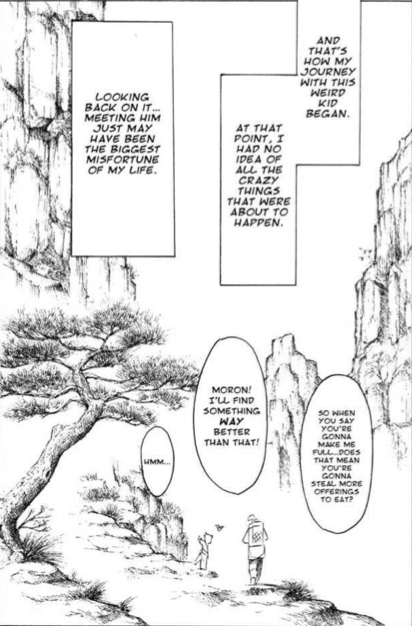
The second distinguishing feature of Qwan is Aki Shimizu’s gorgeous artwork, which draws on anime, guo hua (classical Chinese painting), and wuxia films for its aesthetic. Though Shimizu usually blends these different styles into a seamless whole, she occasionally makes explicit, almost self-conscious quotations of her influences. In this panel, which appears in the very first chapter, she gracefully echoes the undulating lines and shapes of Chinese landscape paintings, even adding a delicately stylized pine tree in the foreground:

Her fight scenes, too, are steeped in Chinese influences. Using dramatic angles, she makes her characters look as weightless as the wire-fu acrobats in Curse of the Golden Flower and House of Flying Daggers; her fight scenes are balletic, beautifully choreographed sequences of tumbling bodies and arcing swords. In this sequence, for example, Qwan goes mano-a-mano with a tiger demon, eventually gaining the upper hand by vaulting onto the monster’s back:

Qwan then consumes the demon at the end of their protracted battle, the demon’s body dissolving into an inky swirl:

Oh, and Shimizu draws some pretty nifty monsters, too. This one suggests a Maltese-water buffalo hybrid with prehensile toes:

So why wasn’t Qwan a bigger hit? I think narrative complexity was a factor. Though the story is a rich tapestry of political history and myth, Shimizu refuses to spoon feed information to the reader; we’re just as confused and disoriented as Qwan himself is. That kind of reading experience can be quite rewarding, but the absence of an omniscient narrator demands more of the audience, forcing us to pore over the text and make connections on our own. Shimizu’s artwork and characterizations are up to the task, but impatient readers will easily miss crucial details in their haste to get to the fight scenes.

I also think timing was a factor in Qwan’s cancellation, as Qwan‘s fourth volume appeared in 2007 at the height of the manga boom. If you remember that heady period, publishers were releasing more than 1,200 new volumes of manga per year. Titles that didn’t have an obvious hook — say, a popular anime adaptation or a cast of hot male vampires — faced an uphill battle, with bookstores unwilling to stock series whose first or second volumes sold poorly. With little support from the publisher, and few fans blogging about it, Qwan was all but consigned to the remainder bin.

I’m under no illusion that my paean to Qwan will save it from licensing purgatory; for every Yotsuba&!, there are two Tactics, manga that didn’t gain much traction even after a well-publicized rescue. But Qwan is so good that I can’t help but wish that someone will complete the series. It’s a manga for people who love great stories and vivid characters, who care more about the quality of the storytelling than the coolness of the concepts and costumes.

QWAN, VOLS. 1-4 • BY AKI SHIMIZU • TOKYOPOP • RATING: OLDER TEEN (16+)

Filed Under: Manga, Manga Critic, Recommended Reading, REVIEWS Tagged With: Aki Shimizu, Shonen Jump, Tokyopop

The Best Manga You’re Not Reading: Qwan

March 3, 2011 by Katherine Dacey 33 Comments

I have a bad habit of falling in love with commercially doomed series. Satsuma Gishiden, for one: Dark Horse published the first three volumes of this manly-man samurai manga, only to put the series on ice in 2007. Duck Prince, for another: Ai Morinaga’s awesomely weird comedy also bit the dust three volumes into its run, a victim of CPM’s perpetual cash flow problems.

I’m dedicating today’s column to another lost cause: Qwan, a fantasy-adventure that draws heavily on Chinese history and folklore for its inspiration. Between 2005 and 2007, Tokyopop released four volumes of what would eventually be a seven-volume series in Japan. After the English-language edition caught up with the Japanese, Qwan went on hiatus. The series never resumed production, however, leaving its few ardent fans stranded in the middle of a crucial story arc.

Normally, I shy away from recommending incomplete series; there’s nothing quite as frustrating as beginning a manga with the knowledge that you will never, ever know how the story ends. I’m going to recommend Qwan anyway, because the four volumes that were published are awesome — Scout’s honor.

The story focuses on Qwan, a child-like figure whose naivete and enthusiasm belie super-human strength and speed. Though Qwan realizes he isn’t human, he’s never questioned his origins or abilities — that is, until he meets Shaga, a courtesan who urges him to seek the Essential Arts of Peace, a sutra that will reveal where Qwan came from and why he was sent to live among humans. He’s not the only one who wants the sutra, however; various political factions vie for the scrolls, hoping to unlock the scrolls’ power and hasten the Han Dynasty’s demise.

Questing boys and magical scrolls are de rigeur in fantasy-adventure stories, but Qwan distinguishes itself in two crucial areas. The first: well-rounded characters. Qwan isn’t a classic Shonen Jump hero, kind-hearted and dedicated to self-improvement, but a more ambiguous figure; he’s guileless and self-centered in the manner of a nine- or ten-year-old, unable to feel genuine sympathy for others. Early in volume one, for example, Qwan encounters a mysterious girl traveling in the company of a demon. Daki proves more a formidable opponent than Qwan anticipates, successfully countering his attack with powerful insect magic. Though it’s clear to the reader that Daki, like Qwan, is a supernatural being, caught between the human and demon worlds, Qwan himself never sees the parallels between their situations, repeatedly attacking Daki until he resigns himself to the futility of his efforts.

The second distinguishing feature of Qwan is Aki Shimizu’s gorgeous artwork, which draws on anime, guo hua (classical Chinese painting), and wuxia films for its aesthetic. Though Shimizu usually blends these different styles into a seamless whole, she occasionally makes explicit, almost self-conscious quotations of her influences. In this panel, which appears in the very first chapter, she gracefully echoes the undulating lines and shapes of Chinese landscape paintings, even adding a delicately stylized pine tree in the foreground:

Her fight scenes, too, are steeped in Chinese influences. Using dramatic angles, she makes her characters look as weightless as the wire-fu acrobats in Curse of the Golden Flower and House of Flying Daggers; her fight scenes verge on ballet, beautifully choreographed sequences of tumbling bodies and arcing swords. In this sequence, for example, Qwan goes mano-a-mano with a tiger demon, eventually gaining the upper hand by vaulting onto the monster’s back:

Qwan then consumes the demon at the end of their protracted battle, the demon’s body dissolving into an inky swirl:

Oh, and Shimizu draws some pretty nifty monsters, too. This one suggests a Maltese-water buffalo hybrid with prehensile toes:

So why wasn’t Qwan a bigger hit? I think narrative complexity was a factor. Though the story is a rich tapestry of political history and myth, Shimizu refuses to spoon feed information to the reader; we’re just as confused and disoriented as Qwan himself is. That kind of reading experience can be quite rewarding, but the absence of an omniscient narrator demands more of the audience, forcing us to pore over the text and make connections on our own. Shimizu’s artwork and characterizations are up to the task, but impatient readers will easily miss crucial details in their haste to get to the fight scenes.

I also think timing was a factor: Qwan‘s fourth volume appeared in 2007, at the height of the manga boom. If you remember that heady period, publishers were releasing more than 1,200 new volumes of manga per year. Titles that didn’t have an obvious hook — say, a popular anime adaptation or a cast of hot male vampires — faced an uphill battle, with bookstores unwilling to continue stocking series whose first or second volumes sold poorly. With little support from the publisher, and few fans blogging about it, Qwan was all but consigned to the remainder bin.

I’m under no illusion that my paean to Qwan will save it from licensing purgatory; for every Yotsuba&!, there are two Tactics, manga that didn’t gain much traction even after a well-publicized rescue. But Qwan is so good that I can’t help but wish that someone will complete the series — perhaps in a digital-only format, or print-on-demand, or an author-sanctioned scanlation. It’s a manga for readers — for people who love great stories and vivid characters, who care more about the quality of the storytelling than the coolness of the concepts and costumes.

QWAN, VOLS. 1-4 • BY AKI SHIMIZU • TOKYOPOP • RATING: OLDER TEEN (16+)

Filed Under: Manga Critic Tagged With: Aki Shimizu, Shonen Jump, Tokyopop

Toriko, Vol. 1

February 3, 2011 by Katherine Dacey

Imagine, if you can, an extreme sports edition of Iron Chef, one in which the contestants have to catch and cook the show’s theme ingredient. That’s essentially what Toriko is: an over-the-top food manga in which a hunter and a chef find — and eat — the world’s rarest delicacies.

Toriko, the titular character, is a peculiar mix of id and super-ego. On the one hand, he’s pure instinct: he hunts with his nose, uses brute strength to overwhelm his opponents, and gobbles every meal with animalistic gusto. On the other, he’s a hunter-philosopher who disdains slaughter for sport; Toriko may wrestle six-armed gorillas into submission, but he only kills creatures for food.

His sidekick, Komatsu, is a small, nervous chef who plays Chester to Toriko’s Spike, twitching and talking up a storm whenever they embark on a new mission or face danger. Komatsu is initially assigned to supervise Toriko; Komatsu’s boss, head of the International Gourmet Organization (IGO), wants to make sure that Toriko successfully fulfills an order for garara gator, an eight-legged, bus-sized monster prized for its delicate meat. Though Komatsu spends most of their expedition screaming, cowering, and clinging to Toriko, Komatsu is moved by Toriko’s passion. “When I saw you on the hunt close up,” Komatsu tells Toriko, “I decided it’s worth risking my life to follow you.” He elaborates:

I want to understand where those ingredients come from and what they look like in their natural habitat. By the time the high-level prey are shipped to us, they’re already slaughtered and just pieces of meat.

I never thought I’d see a Shonen Jump character extol the value of slow foods, but that’s a big part of Toriko‘s appeal: the concept screams Ted Nugent, but the underlying philosophy says Michael Pollan. Toriko still barks like a shonen manga, of course, with lengthy fight scenes, colorful opponents, and jokes a-plenty. But there’s a more thoughtful dimension to the story than is warranted by the material; many of the characters’ soliloquies wouldn’t be out of place in Oishinbo or The Omnivore’s Dilemma, as Toriko and Komatsu wax poetic about the flavor and succulence of freshly-caught meat.

Toriko‘s other strength is the artwork; look past that god-awful cover, and what you’ll find is some excellent cartooning. The monsters are fierce and slightly repulsive but plausibly edible, while the humans run the gamut from ridiculously virile — Toriko looks like a youthful Sylvester Stallone — to thoroughly decadent — the IGO’s Bureau Chief wears a leisure suit, aviator shades, and an ill-advised shag. Artist Mitsutoshi Shimabukaro renders each setting with enough detail to make it feel like a distinctive habitat; his mangrove swamp, where the garara gator lives, looks just pre-historic enough to harbor a pterodactyl or two. Not all of the visual gambits work: Toriko lives in a candy house, for example, a choice that seems out of character for a manly meat-eater, while a rainbow fruit tree falls flat in grayscale. Shimabukaro never belabors a sight gag, however, nimbly moving to the next set-piece before the failures even register.

I’d be the first to admit that Toriko won’t be every locavore’s idea of fun. I nearly lost my appetite watching Toriko lay waste to an entire banquet’s worth of food, and found some of the hunting scenes too protracted. If you’ve got a hearty constitution and a deep, abiding love of cooking competitions, however, this macho food-fest might just tickle your taste buds.

TORIKO, VOL. 1 • BY MITSUTOSHI SHIMABUKARO • VIZ MEDIA • 207 pp. • RATING: TEEN (13+)

Filed Under: Manga, Manga Critic, REVIEWS Tagged With: Shonen, Shonen Jump, VIZ

Toriko, Vol. 1

February 3, 2011 by Katherine Dacey 12 Comments

Imagine, if you can, an extreme sports edition of Iron Chef, one in which the contestants have to catch and cook the show’s theme ingredient. That’s essentially what Toriko is: an over-the-top food manga in which a hunter and a chef find — and eat — the world’s rarest delicacies.

Toriko, the titular character, is a peculiar mix of id and super-ego. On the one hand, he’s pure instinct: he hunts with his nose, uses brute strength to overwhelm his opponents, and gobbles every meal with animalistic gusto. On the other, he’s a hunter-philosopher who disdains slaughter for sport; Toriko may wrestle six-armed gorillas into submission, but he only kills creatures for food.

His sidekick, Komatsu, is a small, nervous chef who plays Chester to Toriko’s Spike, twitching and talking up a storm whenever they embark on a new mission or face danger. Komatsu is initially assigned to supervise Toriko; Komatsu’s boss, head of the International Gourmet Organization (IGO), wants to make sure that Toriko successfully fulfills an order for garara gator, an eight-legged, bus-sized monster prized for its delicate meat. Though Komatsu spends most of their expedition screaming, cowering, and clinging to Toriko, Komatsu is moved by Toriko’s passion. “When I saw you on the hunt close up,” Komatsu tells Toriko, “I decided it’s worth risking my life to follow you.” He elaborates:

I want to understand where those ingredients come from and what they look like in their natural habitat. By the time the high-level prey are shipped to us, they’re already slaughtered and just pieces of meat.

I never thought I’d see a Shonen Jump character extol the value of slow foods, but that’s a big part of Toriko‘s appeal: the concept screams Ted Nugent, but the underlying philosophy says Michael Pollan. Toriko still barks like a shonen manga, of course, with lengthy fight scenes, colorful opponents, and jokes a-plenty. But there’s a more thoughtful dimension to the story than is warranted by the material; many of the characters’ soliloquies wouldn’t be out of place in Oishinbo or The Omnivore’s Dilemma, as Toriko and Komatsu wax poetic about the flavor and succulence of freshly-caught meat.

Toriko‘s other strength is the artwork; look past that god-awful cover, and what you’ll find is some excellent cartooning. The monsters are fierce and slightly repulsive but plausibly edible, while the humans run the gamut from ridiculously virile — Toriko looks like a youthful Sylvester Stallone — to thoroughly decadent — the IGO’s Bureau Chief wears a leisure suit, aviator shades, and an ill-advised shag. Artist Mitsutoshi Shimabukaro renders each setting with enough detail to make it feel like a distinctive habitat; his mangrove swamp, where the garara gator lives, looks just pre-historic enough to harbor a pterodactyl or two. Not all of the visual gambits work: Toriko lives in a candy house, for example, a choice that seems out of character for a manly meat-eater, while a rainbow fruit tree falls flat in grayscale. Shimabukaro never belabors a sight gag, however, nimbly moving to the next set-piece before the failures even register.

I’d be the first to admit that Toriko won’t be every locavore’s idea of fun. I nearly lost my appetite watching Toriko lay waste to an entire banquet’s worth of food, and found some of the hunting scenes too protracted. If you’ve got a hearty constitution and a deep, abiding love of cooking competitions, however, this macho food-fest might just tickle your taste buds.

TORIKO, VOL. 1 • BY MITSUTOSHI SHIMABUKARO • VIZ MEDIA • 207 pp. • RATING: TEEN (13+)

Filed Under: Manga Critic Tagged With: Shonen, Shonen Jump, VIZ

Tidbits: Sports Manga for the Win!

January 2, 2011 by Michelle Smith

Welcome to another installment of Tidbits! This time I turn my attention to sports manga, a genre for which I nurture an inexplicable adoration. First up is Crimson Hero, a shoujo tale that attempts to balance volleyball and romance, followed by six early volumes of Eyeshield 21 and four later ones from The Prince of Tennis, in which the Seishun Academy tennis team finally makes it to the semifinals of Nationals.

Crimson Hero 14 by Mitsuba Takanashi: B
I’m not entirely sure it’s accurate to classify Crimson Hero as sports manga. Ostensibly, it’s about Nobara Sumiyoshi and the rest of the girls on the volleyball team at Crimson High as they pursue their goal of winning the Spring Tournament. In reality, there are only a dozen pages of volleyball in this volume, and only half of those feature the girls.

When last we left off, Haibuki, one of the aces on the guys’ team, had run off because he learned that Nobara was secretly going out with his teammate, Yushin. Also, some other guy named Kaz was spreading rumors about Nobara that caused her to break up with Yushin. It was really a mess, which I ranted about in more detail here.

Thankfully, Takanashi almost immediately addresses all of the things I found so annoying! Kaz abruptly apologizes and disappears. It was totally random, but whatever; I’m glad he’s gone. Yushin and Nobara discover where Haibuki is and both implore him to return. When Yushin goes to great lengths to win Haibuki back from another school that’s been attempting to recruit him, Haibuki realizes that Yushin kept his relationship with Nobara a secret only because he thought it would be best for the team and finally stops being a petulant brat. Hooray!

Though I mock some of the emotional moments in this volume, the truth is that when done well, it’s honestly very entertaining. It’s not the most original story in the world—earnest but academically challenged girl is sought after by two boys with contrasting personalities—but I like it. I still wish they would just play some volleyball already, though.

Eyeshield 21 4-9 by Riichiro Inagaki and Yusuke Murata: B
In addition to his fearsome talent for gathering information and blackmailing others to get his way, Hiruma, the demonic captain of the Deimon Devil Bats football team, also excels at motivation and promotion. It’s through his efforts that a crowd of Deimon students turns out to watch the Devil Bats defeat the Zokugaku Chameleons, which in turn leads to a record turnout at the next recruitment meeting.

A handful of new players joins the team, including the absolutely adorable Komusubi, who looks like a muppet and idolizes Kurita, and the Devil Bats proceed to a tie game against their next opponent, which earns them a spot in a televised face-off against a visiting American team. A summer training trip to America soon follows, with the all-important fall tournament season only a few weeks away.

At this point, Eyeshield 21 is following the sports manga formula pretty closely: the team gets better, important positions are filled, and everyone tries hard to get stronger as they face increasingly more formidable opponents. Just because it’s formulaic, though, doesn’t make it any less good. There’s a certain amount of satisfaction to be derived from watching someone earnestly work hard to achieve their goals, and even if much of what happens in this series is completely over-the-top, it’s still a fun read.

My favorite aspect of the story, though, is how those with less inate talent are not forgotten. This is best exemplified by what’s going on with “The Hah?! Brothers.” These three thugs were originally blackmailed into playing by Hiruma, but have gradually become genuinely invested in the team’s goals. Jumonji, their leader, was particularly upset to see his friends’ contributions belittled in an article, and works hard to help them improve themselves. I’m not sure why, but I find the idea of a former delinquent finally finding something to care about and strive for really moving. A scene in which the crowd cheers them for the first time actually made me teary-eyed!

Now if only there were fewer poop jokes…

The Prince of Tennis 36-39 by Takeshi Konomi: C+
When one is a long-time fan of The Prince of Tennis, as I am, one becomes accustomed to and can forgive a lot of the ridiculousness that goes on in the series. For example, it’s a given now that characters will be introduced who are supposed to be in junior high, even though they look thirty, and who have at their disposal an arsenal of highly improbable shots with silly names like “Super Ultra Delicious Swinging Mountain Storm.” Sets will also almost always end at 7-6, after a grueling tie-break, and characters frequently are one point away from defeat when they suddenly “evolve” and rally valiantly. It’s repetitive, but hey, how much variation can one really expect?

For the National Tournament, mangaka Takeshi Konomi kicks things up a notch with the introduction of a technique so eyeroll-inducing that even I can’t refrain from snerking. It’s called “the selfless state,” and manifests as a glowing aura that spectactors can detect instantly. “There it is!!” cries the peanut gallery, “The selfess state!!” It enables the player to instinctively recreate any opponent’s move that he’s ever seen, which results in even more shouting from the sidelines as familiar shots are recognized by the crowd. Our hero Ryoma Echizen can do it, naturally, but he’s been doing so for ten volumes or so now so it’s time to tweak it still further.

Volumes 36 through 39 of the series focus on Seishun’s semifinal match-up against a school from Osaka called Shitenhoji. After Fuji loses the first singles match, Seishun retaliates with a doubles victory followed by a singles win via forfeit. If they win the next doubles match, they’re going to the finals. Enter Seishun’s captain, Kunimitsu Tezuka, who not only can achieve the selfless state, but a special variation thereof called “the pinnacle of mastery.” Not to be outdone, Shitenhoji puts up Senri Chitose, whose ability to access “the pinnacle of brilliance” makes him go all sparkly.

Stoic Tezuka is my favorite character, so I don’t begrudge him the opportunity to be a badass, particularly since he missed most of the Kanto Tournament due to injury, but there’s only so much ridiculousness I can take. I mean, there’s one two-page spread where these guys just stand there and glow at one another! Tezuka ultimately wins, of course. After a brief interlude provided by a yakiniku eating contest, the finals begin, but Ryoma is nowhere to be found and Tezuka seems poised to reinjure himself in pursuit of victory.

These volumes make me sigh heavily. And yet… for all my complaining, I will eagerly buy the last three volumes of the series and be bummed out if the sequel isn’t licensed soon.

Review copy for volume 39 of The Prince of Tennis provided by the publisher.

Filed Under: Manga, Shoujo, Shounen, Tidbits Tagged With: Mitsuba Takanashi, Riichiro Inagaki and Yusuke Murata, shojo beat, Shonen Jump, Takeshi Konomi, VIZ

The Best Manga You’re Not Reading: Gun Blaze West

December 31, 2010 by Katherine Dacey 6 Comments

Let me begin this review with a disclaimer: Ken Burns would not approve of the historical liberties taken by Gun Blaze West creator Nobuhiro Watsuki. The dialogue, for example: the characters speak in a distinctly modern patois, filled with phrases never uttered by Sitting Bull or General Custer. The scenery, for another: verdant Eastern forests abut rugged desert canyons, even though the story begins in Illinois. (I particularly liked Watsuki’s rendering of Saint Louis as a kind of Budapest on the Mississippi, complete with majestic buildings.) Even the saloon names feel a little off-kilter, as one group of outlaws patronize a joint called Bella Donna. Such incongruities may offend Mr. Burns, but they’re just part of this boisterous series’ charm. (Did I mention the knife-throwing samurai girl? Oh, Mr. Burns, the horror!)

Gun Blaze West focuses on Viu Bannes, a ten-year-old boy who dreams of visiting Gun Blaze West, a mythical city populated by the world’s greatest gunslingers. (On the map, it appears to be located in Seattle, making me wonder if Gun Blaze West is, in fact, populated by the West’s most caffeinated gunslingers.) When a down-on-his-luck cowboy wanders into town, Viu pesters him for shooting lessons. Marcus reluctantly agrees to show Viu the gunslinging ropes, but before Viu can complete his training, the notorious Kenbrown gang arrives in Winston Town, terrorizing the citizens and threatening Viu’s older sister. Viu and Marcus’s standoff with the Kenbrown gang ends with an unexpected turn of events — one that sets the stage for Viu’s subsequent cross-country odyssey.

As in many shonen adventure series, the hero is the least interesting member of the cast. Viu seems to have been ordered straight from the SJ catalog: he’s fast, strong, and so single-minded in pursuit of his dreams that he often comes across as stupid. He also spends a lot of time declaring that he’ll “do his best” and extolling the value of friendship — two other perennial Shonen Jump themes.

In spite of the numerous capitulations to formula, however, Gun Blaze West is one of the most enjoyable shonen titles that VIZ has published. The Western setting proves a welcome change of pace from feudal Japan, modern-day Tokyo, and fantasy realms where teens go mano-a-mano with demons and undead souls. Though the characters possess exaggerated skill and strength, there’s nothing supernatural about Viu and his friends; they come by their talents honestly, through practice, hard work, and mistakes. The story, too, proves surprisingly adult at times, exploring the consequences of violence and rash behavior more realistically than many titles in the Shonen Jump canon.

What really makes Gun Blaze West tick, however, is its playful intermingling of shonen and Western tropes. Gun Blaze West actually feels like a Western, minus some of the obvious anachronisms and geographical gaffes. Marcus is a classic oater type, the gunslinger who’s developed a strong distaste for violence; he’s reluctant to participate in a shoot-out of any kind, adopting a foolish persona to camouflage his skill. When the bullets start flying — and there several lengthy gun battles sprinkled throughout the series — the tone shifts dramatically to underscore Marcus’ abhorrence of fighting. The supporting cast, too, is filled with familiar Wild West archetypes: salty saloon keepers, feisty young women, straight-arrow lawmen, sadistic villains, and traveling circus performers. Even the plots stick closely to the John Ford playbook, whether a small town is under siege from criminals or a local business owner is being harassed by a rival’s private army of thugs.

If you’re a fan of Buso Renkin or Rurouni Kenshin, you know what to expect from Watsuki’s art: dynamic fight scenes, villains with memorable mugs, and nonstop sight gags. The art’s relentless, antic quality wears a little thin towards the end of the series; I found myself wishing that Watsuki would pause to savor the landscape or linger at the sight of a lonely gunslinger’s tombstone instead of uncorking another fart joke or chase scene. Yet for all the artwork’s implied dynamism, the images themselves are never too busy; like Eiichiro Oda and Akira Toriyama, Watsuki relies primarily on lines and evocative shapes to convey the physicality of the people and objects in his stories, rather than heavy patches of screentone. Watsuki isn’t quite Oda or Toriyama’s peer when it comes to backgrounds and peripheral characters — his repertory of towns and bit players is more limited — but his pages exude the same boisterous energy as theirs do.

Best of all, Gun Blaze West is short, clocking in at just three volumes. Given how many shonen titles overstay their welcome with repetitive, drawn-out story arcs, that kind of brevity is admirable; that Gun Blaze West finishes on a high note makes its brevity seem like a stroke of creative genius.

This is an expanded version of a review that originally appeared at PopCultureShock on 3/31/08.

GUN BLAZE WEST, VOLS. 1-3 • BY NOBUHIRO WATSUKI • VIZ • RATING: TEEN (13+)

Filed Under: Manga Critic Tagged With: Shonen, Shonen Jump, VIZ, Western

3 Reasons to Read One Piece

December 2, 2010 by Katherine Dacey 19 Comments

Why would any sane person commit to reading a series that’s still going strong after sixty volumes? I can think of three compelling reasons why you should set aside your shonophobia — that’s Latin for “fear of incredibly long series with interminable fight scenes and characters who do their best” — and give Eiichiro Oda’s One Piece a shot.

1. THE ARTWORK

Though many shonen manga-ka love to populate their stories with flamboyantly ugly villains, Eiichiro Oda’s character designs are more memorable than his competitors’. That’s because Oda doesn’t just add a few scars and a crazy hairdo to distinguish the bad guys from the good; he creates every villain from scratch, making each garment, prop, tattoo, wart, and weapon a direct reflection of the character’s personality and personal history. The same goes for other supporting players: Oda emphasizes the greenness of one pirate’s kiddie followers by giving them vegetal hairdos, and the isolation of a pirate castaway by stuffing the character’s body into an empty treasure chest, with only Gaimon’s unkempt hair and feet poking out. (Gaimon gets one of the series’ best lines: “I used to have two eyebrows!” he exclaims, musing on his twenty years stranded on a remote island.)

Oda’s entire approach to drafting shows a similar thoughtfulness: his pirate ships, tropical islands, and sea coast villages are rendered in clean lines, with a minimum of screen tone. Oda relies instead on playful shapes to help set the stage, from a sea-going restaurant that looks like a cross between a carp and a Hong Kong dim sum parlor, to an island populated by rabbit-cobras, pig-lions, and rooster-foxes.

The only blind spot in Oda’s artwork is his female characters. Though he can draw a marvelous, gnarled pirate queen, as gloriously repulsive as any of the series’ other villains, his young, attractive girls are blandly interchangeable. Even as more female characters are introduced in later story arcs, their appearance seems more calculated to satisfy the male gaze than reveal much about their personality — besides, of course, the near-universal tendency among shonen artists to make a girl’s bust- and neckline a reliable predictor of her villainy.

2. THE LOVING SEND-UPS OF SHONEN CLICHES

One of the reasons I don’t read more shonen manga: I find the characters’ compulsion to shout the name of their fighting techniques kind of silly. (OK, a lot silly.) If anything, it brings back memories of the old Super Friends TV show in which the Wonder Twins clinked rings and announced that they’d be taking “the form of an ice sled!” or “the form of a green-striped tiger!” (If that was meant to be comedy and not a complete abdication of imagination on the writer’s part, I missed it.) Granted, InuYasha and Naruto boast cooler-sounding and more effectual powers, but the minute InuYasha yells “Wind Scar!”, I’m ripped out of the scene, pondering the need for such verbal displays.

In One Piece, however, Oda pokes fun at the practice by assigning his characters goofy powers with goofy names that are fun to say. Monkey D. Luffy’s Gum-Gum attacks are the most frequent and obvious example, as he pretzels himself into a Looney Tunes assortment of weapons and shields, but his crew mates also have a few tricks up their sleeves. The best of them, by far, is Tony Tony Chopper, a blue-nosed reindeer who also happens to be the ship’s doctor. His Human-Human powers enable him to assume a variety of forms, including a gargantuan were-reindeer that wouldn’t be out of place in the pages of Lycanthrope Leo.

Oda also walks a fine line between openly mocking his hero and using him to exemplify the “friendship, effort, and victory” motto that undergirds every Shonen Jump title. Monkey is, to put it nicely, one of the dumbest shonen heroes in the canon — and that’s part of his charm. Unlike, say, Naruto or Lag Seeing (of Tegami Bachi fame), Monkey’s single-minded pursuit of treasure is portrayed as a kind of insanity, not a sign of a stellar character. Monkey goes to extreme lengths to prove himself — not unusual for a shonen hero — but his behavior is clearly meant to be ridiculous. (In the very first pages of the series, he stabs himself in the face with a knife to demonstrate his imperviousness to pain, much to the horror of the assembled pirates.) Yet for all his ill-advised bravado, he’s a kind-hearted goof; anyone who demonstrates valor or integrity is invited to join his crew, regardless of the original circumstances under which they met Monkey. Again, those qualities don’t make Monkey unique, but they do make him appealing; he’s an indestructible hero who’s utterly fallible.

3. THE EXCELLENT ADAPTATION

Any text as thick with puns and pirate-speak as One Piece runs the risk of falling flat in translation, but the English-language adaptation is fluid, funny, and eminently readable. I can’t gauge how faithfully the VIZ edition adheres to the original Japanese, but the script’s buoyant, goofy tone complements the artwork perfectly, leading me to think that VIZ’s editorial team has given American audiences a reasonable approximation of the Japanese-language reading experience. Heck, they’ve even made Oda’s reader correspondence sound like a real, mischievous person answered those fan letters. Now that’s a good adaptation.

Filed Under: Manga Critic Tagged With: Comedy, One Piece, Pirates, Shonen, Shonen Jump, VIZ

3 Reasons to Read One Piece

December 2, 2010 by Katherine Dacey

Why would any sane person commit to reading a series that’s still going strong after sixty volumes? I can think of three compelling reasons why you should set aside your shonophobia — that’s Latin for “fear of incredibly long series with interminable fight scenes and characters who do their best” — and give Eiichiro Oda’s One Piece a shot.

1. THE ARTWORK

Though many shonen manga-ka love to populate their stories with flamboyantly ugly villains, Eiichiro Oda’s character designs are more memorable than his competitors’. That’s because Oda doesn’t just add a few scars and a crazy hairdo to distinguish the bad guys from the good; he creates every villain from scratch, making each garment, prop, tattoo, wart, and weapon a direct reflection of the character’s personality and personal history. The same goes for other supporting players: Oda emphasizes the greenness of one pirate’s kiddie followers by giving them vegetal hairdos, and the isolation of a pirate castaway by stuffing the character’s body into an empty treasure chest, with only Gaimon’s unkempt hair and feet poking out. (Gaimon gets one of the series’ best lines: “I used to have two eyebrows!” he exclaims, musing on his twenty years stranded on a remote island.)

Oda’s entire approach to drafting shows a similar thoughtfulness: his pirate ships, tropical islands, and sea coast villages are rendered in clean lines, with a minimum of screen tone. Oda relies instead on playful shapes to help set the stage, from a sea-going restaurant that looks like a cross between a carp and a Hong Kong dim sum parlor, to an island populated by rabbit-cobras, pig-lions, and rooster-foxes.

The only blind spot in Oda’s artwork is his female characters. Though he can draw a marvelous, gnarled pirate queen, as gloriously repulsive as any of the series’ other villains, his young, attractive girls are blandly interchangeable. Even as more female characters are introduced in later story arcs, their appearance seems more calculated to satisfy the male gaze than reveal much about their personality — besides, of course, the near-universal tendency among shonen artists to make a girl’s bust- and neckline a reliable predictor of her villainy.

2. THE LOVING SEND-UPS OF SHONEN CLICHES

One of the reasons I don’t read more shonen manga: I find the characters’ compulsion to shout the name of their fighting techniques kind of silly. (OK, a lot silly.) If anything, it brings back memories of the old Super Friends TV show in which the Wonder Twins clinked rings and announced that they’d be taking “the form of an ice sled!” or “the form of a green-striped tiger!” (If that was meant to be comedy and not a complete abdication of imagination on the writer’s part, I missed it.) Granted, InuYasha and Naruto boast cooler-sounding and more effectual powers, but the minute InuYasha yells “Wind Scar!”, I’m ripped out of the scene, pondering the need for such verbal displays.

In One Piece, however, Oda pokes fun at the practice by assigning his characters goofy powers with goofy names that are fun to say. Monkey D. Luffy’s Gum-Gum attacks are the most frequent and obvious example, as he pretzels himself into a Looney Tunes assortment of weapons and shields, but his crew mates also have a few tricks up their sleeves. The best of them, by far, is Tony Tony Chopper, a blue-nosed reindeer who also happens to be the ship’s doctor. His Human-Human powers enable him to assume a variety of forms, including a gargantuan were-reindeer that wouldn’t be out of place in the pages of Lycanthrope Leo.

Oda also walks a fine line between openly mocking his hero and using him to exemplify the “friendship, effort, and victory” motto that undergirds every Shonen Jump title. Monkey is, to put it nicely, one of the dumbest shonen heroes in the canon — and that’s part of his charm. Unlike, say, Naruto or Lag Seeing (of Tegami Bachi fame), Monkey’s single-minded pursuit of treasure is portrayed as a kind of insanity, not a sign of a stellar character. Monkey goes to extreme lengths to prove himself — not unusual for a shonen hero — but his behavior is clearly meant to be ridiculous. (In the very first pages of the series, he stabs himself in the face with a knife to demonstrate his imperviousness to pain, much to the horror of the assembled pirates.) Yet for all his ill-advised bravado, he’s a kind-hearted goof; anyone who demonstrates valor or integrity is invited to join his crew, regardless of the original circumstances under which they met Monkey. Again, those qualities don’t make Monkey unique, but they do make him appealing; he’s an indestructible hero who’s utterly fallible.

3. THE EXCELLENT ADAPTATION

Any text as thick with puns and pirate-speak as One Piece runs the risk of falling flat in translation, but the English-language adaptation is fluid, funny, and eminently readable. I can’t gauge how faithfully the VIZ edition adheres to the original Japanese, but the script’s buoyant, goofy tone complements the artwork perfectly, leading me to think that VIZ’s editorial team has given American audiences a reasonable approximation of the Japanese-language reading experience. Heck, they’ve even made Oda’s reader correspondence sound like a real, mischievous person answered those fan letters. Now that’s a good adaptation.

Filed Under: Manga, Manga Critic, Recommended Reading, REVIEWS Tagged With: Comedy, One Piece, Pirates, Shonen, Shonen Jump, VIZ

Short Cuts and Genkaku Picasso

November 18, 2010 by Katherine Dacey

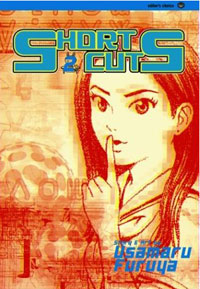
Short Cuts has the unique distinction of being one of the first manga I ever loathed. In fairness to Usamaru Furuya, I read it early in my relationship with manga, when the only titles I knew were Lone Wolf and Cub, Tokyo Babylon, InuYasha, Mermaid Saga, and X/1999. I found Short Cuts bewildering, frankly, as I knew very little about ko-gals — one of Furuya’s favorite subjects — and even less about the other cultural trends and manga tropes that Furuya gleefully mocked. Then, too, Furuya’s fascination with teenage girls, panties, casual prostitution, and incest grew tiresome: how many times can you play the am-I-shocking-you card before the shtick gets old? With the release of Genkaku Picasso, however, I thought it was a good time to revisit Short Cuts and see if I’d unfairly dismissed a great artist or correctly judged him as an unrepentant perv.

What I found was a decidedly mixed bag, a smorgasbord of jokes about girl cliques, lecherous salarymen, Valentine’s Day gift-giving, travel guides for foreigners, and, yes, sex. Some of the best strips tackle obvious targets in unexpected ways. Mr. Pick-on-Me, a recurring character, is one such example: he’s a robot whose sole job is to endure harassment from school kids, providing them a more attractive target for bullying than each other. He proves so effective, however, that the school administrators begin bullying him, too, necessitating the purchase of more robots. Another recurring character, Mitsu Cutie, is an assassin who assembles lethal weapons from bento boxes and Hello Kitty paraphernalia. Though Furuya is hardly the first person to wring laughs from a sweet-faced character’s degenerate behavior, the gag is surprisingly funny, not least for the way in which it carefully filters spy thriller conventions through the lens of shojo manga; it’s as if Takao Saito and Arina Tanemura teamed up to produce a story about a twelve-year-old hit girl.

Furuya is also a first-class mimic, capable of channeling just about any other artist’s style in service of a good joke. In one gag, for example, he twists a TV-addled teen’s face into a perfect imitation of Hitoshi Iwaaki’s parasite aliens, while in another, he shows a woman with ridiculously long eyelashes performing her daily grooming routine, revealing her true identity only in the final panel: she’s Maetel, the heroine of Leiji Matsumoto’s Galaxy Express 999. Even Tezuka take his lumps: in Furuya’s version of Astro Boy, the iconic robot looks like the rotund, bespectacled Dr. Ochanomizu, while his maker resembles Astro, though in Furuya’s telling, the mad scientist likes baggy knee socks, a hallmark of ko-gal fashion.

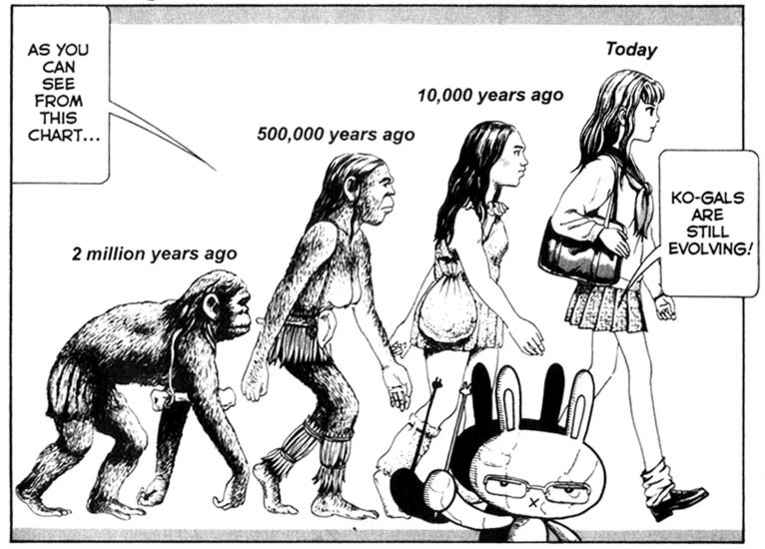
The Astro Boy strip is one of many poking fun at ko-gals, Japan’s own answer to the Valley Girl. Like their Orange County counterparts, kogals are an easy target: their speech and attire are distinctive and easily parodied, as are their devotion to shopping, brand names, and hanging out in the Shibuya district. That’s not to say that Furuya’s jokes are bad; to the contrary, there are some genuinely inspired panels. In one strip, for example, we see a shrine featuring monumental sculptures of ko-gals attended by elderly male priests in short skirts and baggy socks, while in another, a balding, middle-aged man apprentices himself to become a ko-gal, applying himself with the steely resolve of a samurai or geisha-in-training.

A lot of the ko-gal humor is rather mean-spirited, however, portraying girls as hopelessly dim, materialistic, and uninterested in sex unless it comes with a financial reward. Though the male characters are ridiculed for their willingness to pay teenage girls for sexual favors, Furuya allows the reader to have his cake and eat it, too, laughing with recognition at his weakness for panty flashes while being treated to… panty flashes. From very cute girls. Furuya even pokes fun at himself, punishing one of his female characters for her dawning awareness of his “Lolita complex.” (He first attempts to white her out, then resorts to drawing her as a monster.) In the final panel of the “cut,” he’s asserted control over the character again, blackmailing her into silence. The whole sequence is done with a nudge and a wink, as if to make us complicit in Furuya’s predilection for teenage girls; it’s a classic non-apology, the equivalent of saying, “No offense, but sixteen-year-olds are hawt, dude!”

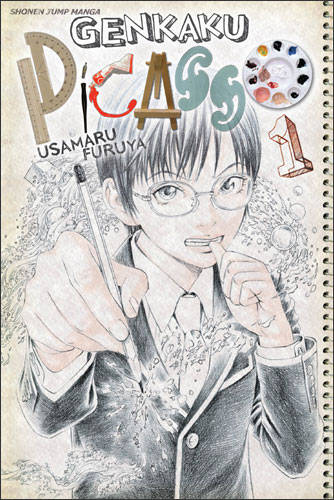
In many ways, Genkaku Picasso seems like one of the two-page “cuts” dragged out to epic lengths. The story focuses on Hikari Hamura, a weird, asexual twit who becomes so involved with his sketch book that he finds a beautiful girl’s attention a nuisance. While sitting on the bank of a river with his classmate Chiaki, a bizarre disaster kills them both. She’s reincarnated as a pocket-sized angel; he’s reborn with a new supernatural gift, the ability to draw other people’s dreams. The central joke of the series is that Hikari is a terrible dream interpreter, reading even darker intent into other students’ nightmares than is implied by the imagery.

The need to show where Hikari’s interpretations go astray proves Genkaku Picasso‘s biggest weakness. Consider “Manba and Kotone,” the third story of volume one, in which one of Hikari’s classmates is plagued by images of a teenage girl being tortured and tied up. As Ng Suat Tong points out in his review of Genkaku, the punchline is squicky: these images aren’t a dark fantasy, but pictures from a magazine shoot in which the girl volunteered to pose for her father, a professional photographer. Handled in two panels, the joke would hit like a nasty rim shot, but as the driving force behind the chapter’s storyline, it becomes… well, seriously creepy, pushing the material into the decidedly unfunny territory of incest and parent-child power dynamics.

I actually liked Genkaku Picasso more than Tong did, partly because I think Furuya is having a ball subverting shonen cliches; it’s the kind of series in which doing your best means staving off body rot, not winning a tournament, and a quiet, philosophical moment between two teens is interrupted by a fiery helicopter crash. I also liked some of the dream sequences, which showcase Furuya’s incredible versatility as an artist. However pedestrian the script may be in explaining the images’ meaning — and yes, there are some borderline Oprah moments in every story — the dreams are nonetheless arresting in their strange specificity.

After reading Short Cuts and Genkaku Picasso, I’m convinced of Usamaru Furuya’s ability draw just about anything, and to tell a truly dirty joke. I’m not yet persuaded that he can work in a longer form, but perhaps if he’s adapting someone else’s story — say, Osamu Daizi’s No Longer Human — he might find the right structure for containing and directing his furious artistic energy.

Review copy of Gengaku Picasso provided by VIZ Media, LLC.

SHORT CUTS, VOLS. 1-2 • BY USAMARU FURUYA • VIZ • NO RATING (MATERIAL BEST SUITED FOR MATURE READERS)

GENKAKU PICASSO, VOL. 1 • BY USAMARU FURUYA • VIZ • 192 pp. • RATING: OLDER TEEN (16+)

Filed Under: Manga Critic Tagged With: Shonen, Shonen Jump, Usamaru Furuya, VIZ

Short Cuts and Genkaku Picasso

November 18, 2010 by Katherine Dacey

Short Cuts has the unique distinction of being one of the first manga I ever loathed. In fairness to Usamaru Furuya, I read it early in my relationship with manga, when the only titles I knew were Lone Wolf and Cub, Tokyo Babylon, InuYasha, Mermaid Saga, and X/1999. I found Short Cuts bewildering, frankly, as I knew very little about ko-gals — one of Furuya’s favorite subjects — and even less about the other cultural trends and manga tropes that Furuya gleefully mocked. Then, too, Furuya’s fascination with teenage girls, panties, casual prostitution, and incest grew tiresome: how many times can you play the am-I-shocking-you card before the shtick gets old? With the release of Genkaku Picasso, however, I thought it was a good time to revisit Short Cuts and see if I’d unfairly dismissed a great artist or correctly judged him as an unrepentant perv.

What I found was a decidedly mixed bag, a smorgasbord of jokes about girl cliques, lecherous salarymen, Valentine’s Day gift-giving, travel guides for foreigners, and, yes, sex. Some of the best strips tackle obvious targets in unexpected ways. Mr. Pick-on-Me, a recurring character, is one such example: he’s a robot whose sole job is to endure harassment from school kids, providing them a more attractive target for bullying than each other. He proves so effective, however, that the school administrators begin bullying him, too, necessitating the purchase of more robots. Another recurring character, Mitsu Cutie, is an assassin who assembles lethal weapons from bento boxes and Hello Kitty paraphernalia. Though Furuya is hardly the first person to wring laughs from a sweet-faced character’s degenerate behavior, the gag is surprisingly funny, not least for the way in which it carefully filters spy thriller conventions through the lens of shojo manga; it’s as if Takao Saito and Arina Tanemura teamed up to produce a story about a twelve-year-old hit girl.

Furuya is also a first-class mimic, capable of channeling just about any other artist’s style in service of a good joke. In one gag, for example, he twists a TV-addled teen’s face into a perfect imitation of Hitoshi Iwaaki’s parasite aliens, while in another, he shows a woman with ridiculously long eyelashes performing her daily grooming routine, revealing her true identity only in the final panel: she’s Maetel, the heroine of Leiji Matsumoto’s Galaxy Express 999. Even Tezuka take his lumps: in Furuya’s version of Astro Boy, the iconic robot looks like the rotund, bespectacled Dr. Ochanomizu, while his maker resembles Astro, though in Furuya’s telling, the mad scientist likes baggy knee socks, a hallmark of ko-gal fashion.

The Astro Boy strip is one of many poking fun at ko-gals, Japan’s own answer to the Valley Girl. Like their Orange County counterparts, kogals are an easy target: their speech and attire are distinctive and easily parodied, as are their devotion to shopping, brand names, and hanging out in the Shibuya district. That’s not to say that Furuya’s jokes are bad; to the contrary, there are some genuinely inspired panels. In one strip, for example, we see a shrine featuring monumental sculptures of ko-gals attended by elderly male priests in short skirts and baggy socks, while in another, a balding, middle-aged man apprentices himself to become a ko-gal, applying himself with the steely resolve of a samurai or geisha-in-training.

A lot of the ko-gal humor is rather mean-spirited, however, portraying girls as hopelessly dim, materialistic, and uninterested in sex unless it comes with a financial reward. Though the male characters are ridiculed for their willingness to pay teenage girls for sexual favors, Furuya allows the reader to have his cake and eat it, too, laughing with recognition at his weakness for panty flashes while being treated to… panty flashes. From very cute girls. Furuya even pokes fun at himself, punishing one of his female characters for her dawning awareness of his “Lolita complex.” (He first attempts to white her out, then resorts to drawing her as a monster.) In the final panel of the “cut,” he’s asserted control over the character again, blackmailing her into silence. The whole sequence is done with a nudge and a wink, as if to make us complicit in Furuya’s predilection for teenage girls; it’s a classic non-apology, the equivalent of saying, “No offense, but sixteen-year-olds are hawt, dude!”

In many ways, Genkaku Picasso seems like one of the two-page “cuts” dragged out to epic lengths. The story focuses on Hikari Hamura, a weird, asexual twit who becomes so involved with his sketch book that he finds a beautiful girl’s attention a nuisance. While sitting on the bank of a river with his classmate Chiaki, a bizarre disaster kills them both. She’s reincarnated as a pocket-sized angel; he’s reborn with a new supernatural gift, the ability to draw other people’s dreams. The central joke of the series is that Hikari is a terrible dream interpreter, reading even darker intent into other students’ nightmares than is implied by the imagery.

The need to show where Hikari’s interpretations go astray proves Genkaku Picasso‘s biggest weakness. Consider “Manba and Kotone,” the third story of volume one, in which one of Hikari’s classmates is plagued by images of a teenage girl being tortured and tied up. As Ng Suat Tong points out in his review of Genkaku, the punchline is squicky: these images aren’t a dark fantasy, but pictures from a magazine shoot in which the girl volunteered to pose for her father, a professional photographer. Handled in two panels, the joke would hit like a nasty rim shot, but as the driving force behind the chapter’s storyline, it becomes… well, seriously creepy, pushing the material into the decidedly unfunny territory of incest and parent-child power dynamics.

I actually liked Genkaku Picasso more than Tong did, partly because I think Furuya is having a ball subverting shonen cliches; it’s the kind of series in which doing your best means staving off body rot, not winning a tournament, and a quiet, philosophical moment between two teens is interrupted by a fiery helicopter crash. I also liked some of the dream sequences, which showcase Furuya’s incredible versatility as an artist. However pedestrian the script may be in explaining the images’ meaning — and yes, there are some borderline Oprah moments in every story — the dreams are nonetheless arresting in their strange specificity.

After reading Short Cuts and Genkaku Picasso, I’m convinced of Usamaru Furuya’s ability draw just about anything, and to tell a truly dirty joke. I’m not yet persuaded that he can work in a longer form, but perhaps if he’s adapting someone else’s story — say, Osamu Daizi’s No Longer Human — he might find the right structure for containing and directing his furious artistic energy.

Review copy of Gengaku Picasso provided by VIZ Media, LLC.

SHORT CUTS, VOLS. 1-2 • BY USAMARU FURUYA • VIZ • NO RATING (MATERIAL BEST SUITED FOR MATURE READERS)

GENKAKU PICASSO, VOL. 1 • BY USAMARU FURUYA • VIZ • 192 pp. • RATING: OLDER TEEN (16+)

Filed Under: Manga, Manga Critic, REVIEWS Tagged With: Shonen, Shonen Jump, Usamaru Furuya, VIZ

Tidbits: Shonen Jumping for Joy

October 17, 2010 by Michelle Smith

Welcome back to Tidbits, a new feature for shorter reviews! This time I take a look at three continuing series from VIZ’s Shonen Jump imprint. First up, it’s volumes 28-31 of One Piece, followed by volumes 9-12 of Slam Dunk and a single volume (the third) of the aesthetically pleasing Tegami Bachi: Letter Bee.

One Piece 28-31 by Eiichiro Oda: B+
Volumes 28-30 consist almost entirely of fighting, as the forces of the all-powerful “Kami” of Skypiea, Eneru, clash with the Shandians (fighting to regain their lost city), while the Straw Hat pirates (just lookin’ for some gold) are caught in the middle. Eneru, as it turns out, has staged the whole thing as a survival game, and figures that after three hours, only five of the original 81 combatants will survive. After this, we get periodic updates as to how many remain, a device I found strangely satisfying.

Although some of the battles are between characters we’ve never seen before, those encounters are usually brief. While Luffy spends the entirety of volume 29 stuck inside a giant serpent, many of the other Straw Hats get a chance to shine, especially Chopper and Robin, whose battles with Eneru’s minions show off the versatility of their respective powers. Nami, too, gets more experience using her new weapons and Conis, a resident of Skypiea, marshals her courage to defy the Kami and warn the people of his plans to destroy the island. There’s been some discussion lately about manga that passes the Bechdel Test, and these volumes exemplify why One Piece does so with flying colors.

Speaking of Robin, I am liking her more and more. This is the first time we’ve really seen her on her own and though it’s always been evident how intelligent and competent she is, it’s nice to see she’s also trustworthy and kind of a badass. She’s generally reserved but is passionate about archaeology, and through her we begin to get hints about a 100-year gap in the history of the world, something that could turn out to be huge. At one point she references “the unspoken history that the land below has ceased to talk about,” and later discovers that Shandora “fought against the enemy.” Thirty volumes in and we’re just starting something so big and potentially awesome? Oda, I think I love you.

After Eneru puts in motion his plan to destroy Skypiea, a mass exodus of its residents ensues. Volume 31 departs from the present panic to flesh out the history of the island and how it ties in with Mont Blanc Noland. This is actually the best part of the Skypiea arc so far and explains quite a few things while being a durn good story in and of itself. The arc doesn’t quite wrap up here, but now that I fully understand the significance of the golden bell in the city of Shandora, I care a lot more about the outcome than I have done in recent volumes!

Slam Dunk 9-12 by Takehiko Inoue: B+
It takes some willpower not to devour each new release of Slam Dunk, but it’s so immensely satisfying to read multiple volumes back-to-back that the wait is worth it!

Volume nine marks the start of the Kanagawa Prefectural Tournament, in which the Shohoku team is able to take part thanks to Hanamichi’s friends taking responsibility for the on-court brawl that occurred in the previous volume. Shohoku is underestimated at first, but the return of Miyagi and Mitsui to the team—both of whom are greeted with somewhat awed recognition from the crowd—makes them a force to be reckoned with. They progress steadily through the tournament, eventually ending up in the final four against Kainan, a school that has made it to Nationals sixteen years in a row.

Hanamichi is his usual annoying self to begin with, demanding that the ball be passed to him and proclaiming himself a genius at every opportunity. After fouling out in each of the first four games, and after recognizing the skills and strengths of his teammates, he finally realizes that he’s not such hot stuff after all. Despite occasional relapses, this marks a real turning point for Hanamichi, as he is able to accept tutelage more readily and function better as a part of the team. For example, though he originally harbored dreams of outscoring Rukawa, once he makes snagging rebounds his focus instead, he’s able to contribute a great deal to Shohoku’s success. His progress and maturation combined with a slightly more humble attitude go a long way toward making him more likable, and it’s quite touching when he gets his first rousing cheer from the crowd.

Structurally, Slam Dunk is very similar to The Prince of Tennis. Though I love the latter a lot, Slam Dunk is the more exciting read, a fact I’d chalk up to the nature of the sport. In tennis, our lead characters battle either singly or in pairs against their foes, while the rest are relegated to commentary until it’s their turn. Here, all the principle characters are on the court at the same time, which gives more immediacy to the way they’re able to motivate each other. True, the characters in Eyeshield 21 all play simultaneously, too, but because basketball moves at a faster pace than football, the effect here is exhilarating, bordering on addictive.

Unfortunately, there’s no more Slam Dunk due until December! Perhaps I’ll investigate whether Inoue’s more dramatic basketball manga, REAL, can help stave off the cravings.

Tegami Bachi: Letter Bee 3 by Hiroyuki Asada: C+
Tegami Bachi: Letter Bee is the story of Lag Seeing, a twelve-year-old boy who has just become a Letter Bee (government mail carrier) in the perpetually dark country of Amberground, inspired by Gauche Suede, a Letter Bee he met five years ago. Lag had hoped to reunite with Gauche, but after learning that his hero disappeared six months after he last saw him, he meets with Gauche’s sister, Sylvette, and promises to find out what happened to her brother.

Gauche was by far the more interesting of the two characters featured in volume one, so it’s nice to get a few glimpses of him here. These tibits—and the bonus story about reuniting an aging dingo (animal companion) with the Letter Bee he faithfully served—are the best things about the volume. Lag is still not a very interesting protagonist and I’ve grown to pretty much hate his dingo, Niche. I’m sure she’s intended to be comic relief, but the story would be better served by cutting her unfunny antics and devoting that page space to clarifying the narrative, which is still going on and on about the importance of “heart.”

Back in January when I reviewed volume two, I said I’d give Tegami Bachi one more chance to win me over. As problematic as the series continues to be, after what we learn about Gauche’s disappearance and mysterious memory loss in this volume, I can’t imagine myself stopping without learning what happened to him. I don’t think this counts as “won over” so much as “minimally intrigued,” but either way, I’ll probably keep reading.

Review copies for volumes nine, eleven, and twelve of Slam Dunk provided by the publisher.

Filed Under: Manga, Shounen, Tidbits Tagged With: Eiichiro Oda, Hiroyuki Asada, Shonen Jump, Takehiko Inoue, VIZ

Bakuman。 2 by Tsugumi Ohba and Takeshi Obata: B+

October 11, 2010 by Michelle Smith

From the back cover:
Average student Moritaka Mashiro enjoys drawing for fun. When his classmate and aspiring writer Akito Takagi discovers his talent, he begs Moritaka to team up with him as a manga-creating duo. But what exactly does it take to make it in the manga-publishing world?

After Moritaka and Akito collaborate on a manga together, they venture to publishing house Shueisha in hopes of capturing an editor’s interest. As much potential as these two rookies have, will their story impress the pros and actually get printed?

Review:
The second volume of Bakuman。 picks up where the first left off, with artist Moritaka Mashiro and writer Akito Takagi taking the final draft of their one-shot manga to Jump headquarters for consideration. This kicks off a series of fascinating meetings (spanning from summer vacation to the start of the next school year the following spring) in which the boys receive feedback from their editor, Hattori, and try to create a story that will be popular enough to merit serialization.

I loved all the meetings with Hattori, especially how specific he was about story and art requirements for Jump and how, as the boys improved, he went over their storyboards panel-by-panel with useful suggestions. As befits shounen protagonists, Mashiro and Akito are both very talented, but they’re not instantly the best around and go through many ideas and an immense amount of work before they’re able to craft something that is worth publishing.

When they finally do manage to get a story published, it takes third place in the popularity poll for that issue. The winner is Eiji Nizuma, a fifteen-year-old mangaphile who has been drawing since the age of six and practically does nothing else. He’s an exceedingly weird kid, but he fulfills the Akira Toya role here of “genius rival of comparable age.” He’s the first obstacle our leads will have to overcome, and I think it’s pretty fun how this is shaping up to be a sort of tournament manga.

Unfortunately, I’m still bored and fairly annoyed by Mashiro’s relationship with classmate Miho Azuki. They’ve pledged to marry once their dreams come true, but in the meantime aren’t even going to date. To some extent I understand—it’s suggested that Miho’s in favor of this because she wants to be able to focus on her dream without being distracted by Mashiro—but they still hardly know each other. Thankfully, Miho’s friend, Miyoshi, finds this just as bizarre. Also, while the overt, spoken sexism is absent from this volume it’s not exactly absent from the characters’ behavior. At one point Mashiro informs Miho that they’re going to be together when he becomes a manga artist, whether she’s realized her dream (to be a voice actress) or not. Nice, kid.

Though Bakuman。 has some flaws, it’s still an utterly captivating look at the manga-creating experience. I can overlook a banal relationship plotline if it means getting a glimpse inside the editorial process at Jump!

Review copy provided by the publisher.

Filed Under: REVIEWS Tagged With: Shonen Jump, Takeshi Obata, VIZ

Bakuman。1 by Tsugumi Ohba and Takeshi Obata: B+

September 3, 2010 by Michelle Smith

Moritaka Mashiro is bored. For his fourteen years of life he’s merely gone along with the flow, a path which is destined to end with him becoming a normal white-collar worker. He doesn’t want this, but sees no alternative until Akito Takagi, the top student in class, notices Moritaka’s artistic skills and proposes that the two team up to create a manga. Moritaka is resistant at first—he’d much rather loaf around and play video games—but when the object of his affections (and aspiring voice actress), Miho Azuki, agrees to marry him when his manga becomes an anime, he is suddenly unstoppable.

Moritaka expects resistance from his family—after all, his uncle essentially killed himself by trying to become a successful manga artist—but they’re surprisingly supportive and it turns out that his uncle’s studio has been preserved, untouched, since his death. I absolutely adore the chapter where Moritaka and Akito rush to the studio for the first time—it is seriously a manga-lover’s dream. Not only are there plenty of artistic supplies, but there are shelves upon shelves of manga (“for reference”) as well as neatly organized boxes of storyboards and final drafts. All of the scenes with the boys working on their story—they decide to submit a final draft for consideration by the end of summer break—are absolutely fascinating and bring home just how grueling creating comics can be.

There are a couple of problematic things about Bakuman, however. Moritaka and Azuki’s pledge to get married when they achieve their dreams—without dating in the meantime—is pretty silly, but not out-of-character for a couple of fourteen-year-olds. The fact that they’ll be encouraging each other via e-mail, just like Moritaka’s uncle was encouraged by letters from his classmate, who just so happens to be Azuki’s mother, is a coincidence I could’ve done without. In general, this whole subplot failed to interest me; I was much more interested in the boys’ efforts to get their manga off the ground, but I suppose listless Moritaka needed to find motivation somewhere.

More significantly, many reviewers have taken issue with the displays of sexism in Bakuman. Having now read it for myself, I get the impression that certain characters are sexist but I’d stop short of applying that label to the series as a whole. This makes me wonder, though… why, when characters in Bakuman say things like “She knows by instinct that the best thing for a girl is to get married and become somebody’s wife” or “Men have dreams that women will never be able to understand” does it not piss me off as righteously as when characters make very similar comments in The Color Trilogy by Kim Dong Hwa?

I think it depends, for me, on who’s saying it. If, as in the case of The Color Trilogy, a male author puts such words into the mouths of female characters, I can’t seem to help getting peeved about it. In Bakuman, the speaker of the first line above is Akito—in other words, just an overconfident teen who thinks he knows everything. He goes on to say he doesn’t like a particular girl in class because she’s proud of how well she does in school, but when Azuki’s mother later tells him she doesn’t like smart guys, he flails about and says, “But that’s just your taste.” Perhaps what he earlier presented as deep insight about Azuki was really his own taste coming through. The second line above, about men’s dreams, though technically spoken by Moritaka’s mother, is actually a quote from his off-camera father and was easy for me to dismiss as, “Oh, he’s just an older man with outdated opinions.”

I’m not trying to argue that these characters aren’t sexist, but they don’t succeed in getting my dander up and certainly will not deter me from reading more of the series.

Bakuman is published in English by VIZ. One volume’s been released here so far, while the ninth volume of this still-running series came out in Japan last month.

This review was originally published at Comics Should Be Good.

Review copy provided by the publisher.

Filed Under: Manga, Shounen Tagged With: Shonen Jump, Takeshi Obata, VIZ

  • « Go to Previous Page
  • Page 1
  • Page 2
  • Page 3
  • Page 4
  • Page 5
  • Page 6
  • Go to Next Page »
 | Log in
Copyright © 2010 Manga Bookshelf | Powered by WordPress & the Genesis Framework