• Skip to primary navigation
  • Skip to main content
  • Skip to primary sidebar
  • Home
  • About Us
    • Privacy Policy
    • Comment Policy
    • Disclosures & Disclaimers
  • Resources
    • Links, Essays & Articles
    • Fandomology!
    • CLAMP Directory
    • BlogRoll
  • Features & Columns
    • 3 Things Thursday
    • Adventures in the Key of Shoujo
    • Bit & Blips (game reviews)
    • BL BOOKRACK
    • Bookshelf Briefs
    • Bringing the Drama
    • Comic Conversion
    • Fanservice Friday
    • Going Digital
    • It Came From the Sinosphere
    • License This!
    • Magazine no Mori
    • My Week in Manga
    • OFF THE SHELF
    • Not By Manga Alone
    • PICK OF THE WEEK
    • Subtitles & Sensibility
    • Weekly Shonen Jump Recaps
  • Manga Moveable Feast
    • MMF Full Archive
    • Yun Kouga
    • CLAMP
    • Shojo Beat
    • Osamu Tezuka
    • Sailor Moon
    • Fruits Basket
    • Takehiko Inoue
    • Wild Adapter
    • One Piece
    • After School Nightmare
    • Karakuri Odette
    • Paradise Kiss
    • The Color Trilogy
    • To Terra…
    • Sexy Voice & Robo
  • Browse by Author
    • Sean Gaffney
    • Anna Neatrour
    • Michelle Smith
    • Katherine Dacey
    • MJ
    • Brigid Alverson
    • Travis Anderson
    • Phillip Anthony
    • Derek Bown
    • Jaci Dahlvang
    • Angela Eastman
    • Erica Friedman
    • Sara K.
    • Megan Purdy
    • Emily Snodgrass
    • Nancy Thistlethwaite
    • Eva Volin
    • David Welsh
  • MB Blogs
    • A Case Suitable For Treatment
    • Experiments in Manga
    • MangaBlog
    • The Manga Critic
    • Manga Report
    • Soliloquy in Blue
    • Manga Curmudgeon (archive)

Manga Bookshelf

Discussion, Resources, Roundtables, & Reviews

Shonen Jump

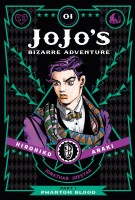
JoJo’s Bizarre Adventure, Part 1: Phantom Blood, Vol. 1

March 27, 2015 by Ash Brown

JoJo's Bizarre Adventure, Part 1: Phantom Blood, Volume 1Creator: Hirohiko Araki
U.S. publisher: Viz Media
ISBN: 9781421578798
Released: February 2015
Original release: 1987-1988

Hirohiko Araki’s multi-generational epic JoJo’s Bizarre Adventure is one of the longest-running manga series in Japan. Araki began the series in 1986 and the manga is still ongoing at well over a hundred volumes. Between 2005 and 2010, Viz Media published the sixteen volumes of the third story arc, Stardust Crusaders, arguably on of the most popular, or at least well-known, parts of the series. In 2012, NBM Publishing released Rohan at the Louvre, a largely standalone manga related to Diamond Is Unbreakable, the fourth arc of JoJo’s Bizarre Adventure. Finally, in 2015, the first part of the epic, Phantom Blood was released in print in English by Viz in a beautiful, deluxe hardcover edition. Phantom Blood was originally published in Japan in five volumes between 1987 and 1988, but was reissued in three volumes in 2002. That release is the basis for Viz’s English-language edition. JoJo’s Bizarre Adventure, Part 1: Phantom Blood, Volume 1 includes the entirety of the first volume and the majority of the second volume of the original Japanese release.

Jonathan Joestar, known as JoJo, is the son of a wealthy 19th-century English nobleman. He lost his mother while still an infant when the entire family was involved in a tragic carriage accident. JoJo survived, but his mother and the driver died and his father was severely injured. Years later, a young man named Dio Brando is sent to live with the Joestars. His father, who recently passed away, was the first person upon the scene of the carriage accident. Lord Joestar believes himself to be in Brando’s debt, under the mistaken impression that he saved his life, and so welcomes Dio with open arms. But Dio isn’t the upright character he often portrays himself to be. His intention is to destroy the Joestar family and take its wealth for his own using anyone and any means necessary, including a mysterious stone mask that grants vampiric powers. JoJo is the only person to suspect Dio isn’t all that he seems, and Dio is determined to make his life miserable. The two of them are raised as brothers, but despite JoJo’s initial attempts at friendship, there is no love lost between them.
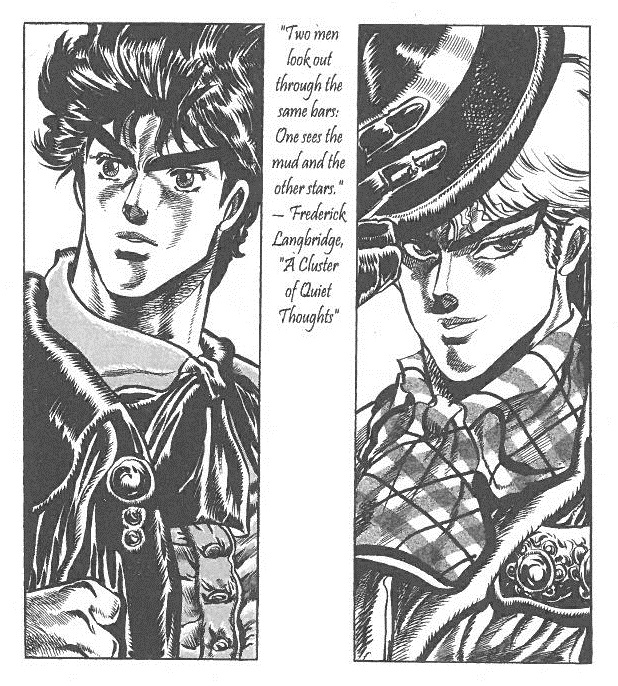
Phantom Blood, Volume 1, page 80JoJo’s Bizarre Adventure is a very aptly named series. Phantom Blood is strange and outlandish, proceeding at a breakneck pace with a tremendous amount of drama and flying fists. It’s not subtle by any means, but the series’ uninhibited, over-the-top nature is part of Araki’s style. Heightened action and drama often take precedence over logical consistencies or realism in the manga’s artwork and story. Devastating injuries that would maim or kill most people are easily disregarded or overcome by the series’ heroes and villains, although the pain and suffering they incur certainly leave an impression. JoJo and Dio fight it out on several different occasions in the first volume of Phantom Blood, each battle becoming increasingly more violent and destructive, and they are pretty bloody to being with. And that’s not even taking into account the psychological damage that also results. JoJo’s Bizarre Adventure can be brutal.

Dio is one of the most fabulous antagonists that I’ve come across in manga. Extraordinarily charismatic and completely without scruples, he makes an extremely dangerous opponent. But Dio does have flaws, and he is a much more interesting character because of them. While he is often unable to control his intense anger and arrogance, even at a young age he is able to hold people under his thrall. JoJo on the other hand, especially in comparison to Dio, is astoundingly honest, naive, and kindhearted, a gentleman through and through in both mind and deed. He uses his strength of character and impressive physical fortitude to protect his family and other people he cares about. JoJo’s repeated confrontations with Dio force hem to become even stronger as the series progresses. He grows into a formidable opponent in his own right with a firm sense of and desire for justice. The stark contrast between the two young men and the extreme dynamics of their relationship are a large part of what makes Phantom Blood such an engaging manga.
Filed Under: REVIEWS Tagged With: Hirohiko Araki, JoJo's Bizarre Adventure, manga, Shonen Jump, viz media

Assassination Classroom Vol 1

December 26, 2014 by Anna N

Assassination Classroom Volume 1 by Yusei Matsui

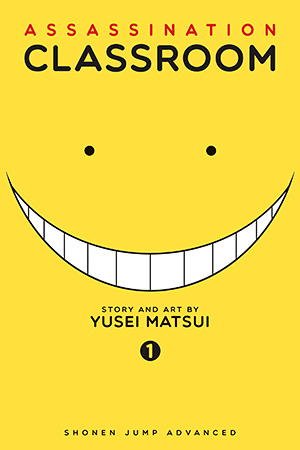
To be perfectly honest, I would have bought this manga for the title alone. The fact that it is a story about a mysterious tentacled alien teacher looking after a classroom of misfit teenage assassins is just a bonus. The premise of the manga is set up in an effective way, with some elements explained and others just left for the reader to simply accept and move on with the story. The manga opens as the happy face octopus stands in front of the classroom wearing an academic hood and gown. As the day opens the entire class leaps up from their desks with guns and begins to fire away. Their assassination attempts are fruitless, because their teacher can move at super speed and has amazing healing abilities. The assassination classroom is a room full of misfits held in the annex of a normal middle school. One day their teacher showed up, disintegrated a large portion of the moon and said that he would do the same to Earth in one year. Kuro Sensei inexplicably wants to spend a year educating the youth of Earth before he destroys it. The government has offered up a bounty to the member of class 3-E who succeeds in killing their teacher.

Assassination Classroom is filled with humorous elements interspersed with dynamic scenes of assassinations being foiled with ease. For poetry class, Kuro Sensei requires everyone to end their poem with the word “tentacles” and he is always using his supersonic flying power to randomly buy himself treats from around the world. The standout student is Sugino, who spends his days making careful observations of his teacher, slowly gathering intelligence that might eventually lead to a successful assassination. As the volume progresses, more members of the class 3-E are introduced, all of whom have unique abilities. The most amusing aspect of the volume is the fact that for all Kuro Sensei plans on wiping out all of humanity in a year, he is really dedicated to being an excellent teacher. He intervenes in the lives of his troubled students and actually does manage to teach them some useful life lessons. The uplifting aspects of the manga contrast with Earth’s imminent doom in an interesting way. The art is well-executed but somewhat generic. It is amusing to see the variety of expressions on Kuro Sensei’s face, and the unexpected ways his alien powers manifest. I think this series would really appeal to fans of Death Note. So far, Assassination Classroom seems like an ideal pick for people who enjoy manga with a healthy side of dark cynicism on the side.

Filed Under: REVIEWS Tagged With: assassination classroom, Shonen, Shonen Jump, viz media

Review: Assassination Classroom, Vol. 1

December 18, 2014 by Katherine Dacey

1421576074Assassination Classroom, Vol. 1
By Yusei Matsui
Rated T+, for Older Teens
VIZ Media, $9.99

Americans steadfastly believe that all students need to succeed are a few good teachers—think of how many movies you’ve seen about an unorthodox educator who helps a group of misfits, losers, or underachievers realize their full potential against all odds. Perhaps that’s why American publishers hesitated before licensing Assassination Classroom, a comedy that outwardly conforms to the tenets of the genre while poking fun at its hoariest cliches.

Assassination Classroom‘s star teacher is Koro-sensei, a super-powered alien who can wipe out an army with a swish of a tentacle. His students are class 3-E, the troublemakers and flunkies of Kunugigaoka Junior High School. Instead of studying calculus or Shakespeare, however, Koro-sensei’s charges are learning how to kill him and save Earth in the process—in other words, it’s To Sir With Lethal Force.

If the script isn’t quite as edgy as my summary suggests, Assassination Classroom scores points for the sheer ridiculousness of the premise. Koro-sensei’s relentless enthusiasm and high standards match those of other fictional educators—Michelle Pfeiffer in Dangerous Minds, Robin Williams in Dead Poets Society—but are applied to such activities as shooting and stabbing. He gives the same kind of inspirational speeches that you’d find in those movies, too, reminding his charges that he specifically requested the job because he knows the students’ true potential.

In one scene, for example, timid student Okuda presents Koro-sensei with three deadly potions, imploring him to sample them. “I’m not good at surprise attacks!” she tells him. “But I love chemistry! And I really put my heart and soul into this!” Koro-sensei cheerfully obliges, offering to help Okuda “research a poison that can kill me.” When Okuda proves more skillful at mixing chemicals than persuading her target to drink them, Koro-sensei reminds her that “in order to kill someone, you need to understand how they feel,” skills that she can cultivate through—what else?—reading and writing.

The exchange between Okuda and Koro-sensei is complemented by some of the best visual gags in volume one. One of the poisons, for example, neutralizes Koro-sensei’s Cheshire grin into a flat line, prompting a student to exclaim, “You look like an emoticon!” Although Koro-sensei’s face is the essence of simplicity—a circle with pin-dot eyes and a toothy smile—this subtle tweak of his appearance yields a big pay-off laugh-wise.

At the same time, however, the poison episode illustrates Assassination Classroom‘s biggest flaw: Yusei Matsui wants to have his cake and eat it, too, soft-pedaling the humor with an uplifting, awwww-worthy moment in almost every chapter. Students unironically vow to do their best after Koro-sensei points out the flaws in their technique, saves them from harm, or gives them a pep talk. None of the students harbor a grudge against him—at least not for very long—or question the value of Koro-sensei’s lessons. (Makes you wonder: is Koro-sensei guilty of grade inflation?)

Still, I enjoyed volume one enough to continue with the series, even if Matsui’s efforts to express the Shonen Jump dictum of “friendship, effort, victory” sometimes blunt the edge of his satire.

Filed Under: MANGABLOG, REVIEWS Tagged With: Shonen Jump, viz media

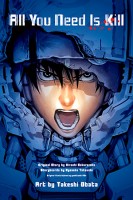
All You Need Is Kill

November 30, 2014 by Ash Brown

All You Need Is KillAuthor: Ryosuke Takeuchi
Illustrator: Takeshi Obata
Original story: Hiroshi Sakurazaka

U.S. publisher: Viz Media
ISBN: 9781421576015
Released: November 2014
Original release: 2014

It’s been a few years since I’ve read Hiroshi Sakurazaka’s novel All You Need Is Kill but I distinctly remember enjoying it, perhaps even more than I initially thought that I would. And so, I was very excited to learn that Takeshi Obata would be working on the manga adaptation not only because I like the original All You Need Is Kill but because I also enjoy Obata’s illustrations. (Hikaru no Go, which he worked on, actually happens to be one of my favorite manga series.) I was even more excited when Viz Media licensed the All You Need Is Kill manga for an English-language release. In Japan, the series was published in 2014 in two volumes. Viz’s digital release was also two volumes, but its 2014 print edition was released as a single-volume omnibus under the Shonen Jump Advanced imprint complete with color pages and a larger trim size. While Obata provided the artwork for the manga adaptation of All You Need Is Kill, it was Ryosuke Takeuchi who outlined the script and storyboards.

Humankind has been at war with the Mimics for years, but it seems like it may be a losing battle. The Mimics, alien creatures that continue to evolve with each confrontation, have begun to close in on Japan, the only country remaining that has the ability to produce the high-tech battle jackets used in the war. If Japan is lost, the rest of the world will soon follow. Keiji Kiriya is a young jacket jockey about to face his first battle. He, like so many others, is killed in action, except that he then revives in his bunk, thirty hours before his death. At first Keji thinks he’s dreaming, but then it happens again. And then again. Time after time, Keiji lives and dies fighting against the Mimics. Doing all that he can to survive just a little bit longer each round, Keiji focuses part of his attention on Rita Vrataski, considered to be the best jacket solider in the world. Following her example, Keiji might actually have a chance to escape the time loop alive.

Because I haven’t recently read Sakurazaka’s original All You Need Is Kill it is difficult for me to make a detailed comparison between it and the manga adaptation. Generally though, I feel that the novel is the stronger work of the two, but the manga has quite a bit going for it as well. Most of the resigned humor and social commentary found in the novel and even Keiji’s internal development have been downplayed in the manga in favor of the story’s external spectacle, action, and battles. As manga is a visual medium it makes sense to have this slight change of focus, but as a result All You Need Is Kill does lose some of its emotional impact. As for the artwork itself, Obata does an excellent job conveying the drama of the plot. The jackets and heavy action sequences look great, too. The Mimics’ design does leave something to be desired though–they aren’t as terrifying as they should be–and some readers may find the occasional fanservice more distracting than anything else.

Although it may not have the same substantive weight of the original, All You Need Is Kill makes for an entertaining and exciting, action-packed manga that reads quickly. Though not without flaws, it succeeds well as an adaptation and as its own work. Particularly effective is how Obata emphasizes the time loop by utilizing very similar panels but with slightly different page layouts with each rewind, keeping the manga from becoming too repetitive. The way Obata draws Keiji changes as well. The young soldier becomes stronger and harder with each loop, but also more haunted and battle-weary. An explanation for the time abnormality is eventually given that at least makes sense superficially and sets up a nice plot twist, but it starts to fall apart if given too much critical thought. Still, the All You Need Is Kill is a great read for anyone interested in military science fiction and action. For the most part I was pleased with the adaptation; I’d still recommend that readers give the original novel a try, too, though.

Filed Under: REVIEWS Tagged With: All You Need Is Kill, Hiroshi Sakurazaka, manga, Ryosuke Takeuchi, Shonen Jump, Takeshi Obata, viz media

World Trigger, Vols 1 and 2

October 7, 2014 by Anna N

World Trigger Volumes 1 and 2 by Daisuke Ashihara

World Trigger starts out with a very Attack on Titanesque set-up, expressed simply in one page. Monsters from another dimension are invading the earth. A paramilitary force shows up to fight the monsters. Daily life for the rest of humanity is often interrupted by these “Neighbors” who look a bit like giant eels and the humans who fight back against the invasion.

Osamu is a bit of an unassuming student, but he finds his life complicated when a mysterious new transfer student named Yuma shows up. Yuma seems to not know very much about basic human behavior. When a Neighbor attacks outside of the usual boundaries, Osamu reveals that he’s actually a trainee for the Border Defense Agency, with a small amount of power that he’s determined to use to protect everyone in his city. Yuma turns out to have some extraordinary powers himself. He claims to also be a Neighbor, from the dimension where the monsters come from. He also has the ability to use a trigger, the weapon/body exchange protocol that allows users to fight off the monsters.

In the ensuing battle, Yuma fends off a powerful monster after Osamu proves not to have the level that he needs in order to destroy his enemy. Osamu turns to helping out however he can, by evacuating residents and helping everyone stay safe. Members of the Border Protection Agency turn up, suspicious of the recent events and determined to follow correct bureaucratic procedure. The cast of the book gradually expands beyond Osamu and Yuma to include many of the typical foils for a shonen protagonist. There’s a cool older male mentor, a type A overachiever warrior girl, and a host of bureaucrats in the Border Protection Agency that will surely make life difficult for Osamu.

The Border Protection Agency seems more chaotic than a force for either good or evil, as a squad starts to hunt down Yuma. Osamu tries to intercede, but Yuma’s level of power is such that he’s able to evade attack from multiple agents at once with only some slight injuries. One interesting aspect of the story is that Osamu keeps getting promoted within the Border Protection Agency simply because he is often in the right place at the right time and occasionally forced to take credit for some of Yuma’s actions in order to maintain his new friend’s cover. Osamu’s leveling up though being an unassuming nice guy who is incredibly lucky is a bit unexpected for a reader expecting a more typical brash shonen hero, and this was one aspect of the book that I found intriguing.

There’s a fair amount of world building as the characters go into details about the alien tech infused battle system, but I didn’t find this very interesting. The art is workmanlike and easy to follow, but it doesn’t have that extra bit of style or distinct quality that would make me want to pick up the manga just to see some fabulously paneled battle scenes. The story is solid, but there isn’t much that’s surprising about it so far. The anime for this series is starting to air, so I imagine that will fuel interest for this title. I didn’t find myself inspired to keep reading the series, simply because there are other titles out there that are much more entertaining. I can read One Punch Man if I want something funny, Attack on Titan if I want to read about a dystopian future where humanity is fighting off giant invaders, or Seraph of the End for more attractive art and interesting world building. Overall, this is a solid if not super compelling shonen title, and I imagine that someone less picky about shonen manga than me will enjoy it.

Filed Under: REVIEWS Tagged With: Shonen, Shonen Jump, viz media, world trigger

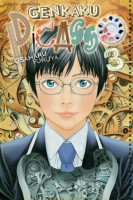
Genkaku Picasso, Vol. 3

January 24, 2014 by Ash Brown

Genkaku Picasso, Volume 3Creator: Usamaru Furuya
U.S. publisher: Viz Media
ISBN: 9781421539201
Released: May 2011
Original release: 2010

The third and final volume of Usamaru Furuya’s short manga series Genkaku Picasso was originally published in Japan in 2010. Viz Media released the English-language edition of the volume in 2011 under its Shonen Jump imprint. Genkaku Picasso was initially serialized in the manga magazine Jump SQ. Furuya mentions in the series’ afterword that he was somewhat surprised to have been approached to create a manga by one of the Jump SQ editors since he didn’t consider his previous work to have had much popular, mass appeal. (Furuya made his debut in the alternative manga magazine Garo and is particularly well-known for some of his more avant-garde work.) Genkaku Picasso was originally intended to be only two volumes long. Happily, Furuya was able to expand the series to three volumes, which allowed him to tie everything together in the way that he wanted. Although I enjoyed the first volume of Genkaku Picasso the manga starts out a little unsteady. But by the end, Furuya has created a fantastic series.

For most of his life, Hikari Hamura has been content to keep to himself and concentrate on his drawing. He’s earned himself the nickname of Picasso from his classmates (much to his dismay as he greatly prefers the work of Leonardo da Vinci), but up until recently they have mostly ignored him. Picasso is as strange and gloomy as he ever was, if not more so, but many of his classmates are beginning to feel drawn to him for some unknown reason. What they don’t realize is that Picasso has been helping to solve their personal problems. After nearly dying in a bizarre accident Picasso has gained a strange ability that allows him to see and draw the darkness that exists in another person’s heart. He can enter into those sketches, and by changing them he influences his classmates lives, hopefully for the better. This power is something that Picasso has tried to keep hidden from the others but it becomes difficult for them to disregard his increasingly odd behaviour, especially when he seems to know things that they would never reveal to someone else.

Genkaku Picasso starts out as a fairly episodic series. Generally, I found the longer stories–those lasting several chapters–to be more successful than the shorter ones as they feel less rushed and more thoroughly developed. It’s only really during the second volume that it becomes clear that there is also an overarching plot. The details of that larger story are completely reveled in the third volume of Genkaku Picasso. With a little bit of a lead in, “Hikari’s Story” takes up nearly half of Genkaku Picasso, Volume 3. It’s the longest story in Genkaku Picasso and is what pulls together the entire series. Up until this point in the manga, while Picasso has certainly been the protagonist, the stories have largely focused on his classmates and the issues that they are struggling with. But in “Hikari’s Story” their roles are reversed and it’s Picasso who needs help. It’s an extremely effective turn of events that brings the series full circle quite nicely.

The ending of Genkaku Picasso is actually a little heart-wrenching. Picasso starts the series almost a complete loner. Except for Chiaki, who hung out with him despite his protests, most of his classmates simply took no notice of him. Picasso was perfectly fine with this, or at least that’s what he told himself. As Genkaku Picasso progresses, Picasso slowly gathers people around him as he helps them with their problems. But it’s not until the third volume that he actually admits that he has friends and that he actually wants friends. Picasso has to be completely honest with himself and with the others, which in reality is a very terrifying thing to have to do. With “Hikari’s Story” the entire series becomes about Picasso and shows the tremendous amount of growth that he has gone through. I’m very glad that Furuya was able to extend Genkaku Picasso and give it a marvelous conclusion. Even considering its somewhat awkward start, Genkaku Picasso is a wonderful series. I thoroughly enjoyed its quirky humor and characters, its engaging artwork, and its somewhat peculiar but ultimately heartfelt story.

Filed Under: REVIEWS Tagged With: genkaku picasso, manga, Shonen Jump, Usamaru Furuya, viz media

Genkaku Picasso, Vol. 2

January 21, 2014 by Ash Brown

Genkaku Picasso, Volume 2Creator: Usamaru Furuya
U.S. publisher: Viz Media
ISBN: 9781421537542
Released: February 2011
Original release: 2009

Genkaku Picasso was the second multi-volume manga series by Usamaru Furuya to be released in English. The first was a seinen gag manga called Short Cuts which, like Genkaku Picasso, was published by Viz Media. Genkaku Picasso is very different from Short Cuts. It’s an example of one of Furuya’s few shōnen manga and is currently his only shōnen series available in English. Furuya is an extremely versatile artist, changing styles, genres, and demographics to suit his needs. He had his start in alternative manga, but Genkaku Picasso, while quirky, is a more mainstream title. Initially serialized in Jump SQ, the second volume of Genkaku Picasso was released in Japan in 2009. Viz Media published Genkaku Picasso, Volume 2 under its Shonen Jump imprint in 2011. I found the first volume of Genkaku Picasso to be intriguing, but more uneven and less compelling than some of the other manga by Furuya that I had read. But with the second volume, the series finds its footing.

After a bizarre near-death experience, Hikari Hamura, given the nickname Picasso by his classmates, finds himself in an even stranger predicament. Chiaki Yamamoto, a victim of the same accident that nearly killed Picasso, is now small enough to fit in his pocket and is sporting angel wings. Picasso himself has gained the ability to see into people’s hearts and minds. Compelled to draw what he sees, he can literally enter into the psyches of others through his illustrations. Using this newfound power, Picasso is able to help his fellow classmates. Not that he really wants to go to all that effort. In fact, he’d much rather be left alone to concentrate on his artwork. But unless he wants to let his arm rot away–another peculiar consequence of his accident–Picasso must do what he can to help those around him. With Chiaki’s assistance and prodding he has successfully resolved some of his classmates problems and has even gained a few friends in the process, but Picasso is still incredibly reluctant to get involved.

Although there has always been an ongoing story in the series, the beginning of Genkaku Picasso felt fairly episodic. However, with the second volume the series starts to become a bit more cohesive. The stories in the first volume seemed to be resolved a little too simply and cleanly, but as Genkaku Picasso progresses it becomes apparent that it’s not really that easy. Picasso has helped some of his classmates (though they are only aware of that subconsciously) but they continue to have problems; he hasn’t solved everything for them. The first volume’s stories had a “one and done” sort of feel to them while the issues in the second volume, even after they are initially resolved, are long-lasting challenges. They are things that the characters may very well struggle with for the rest of their lives. I much prefer this approach since realistically matters of the heart and mind are not so easily mended. I think Genkaku Picasso becomes a stronger, better series with the inclusion of these more complicated and nuanced narratives.

From the very beginning one of Genkaku Picasso‘s strengths has been its artwork, something that continues to be a highlight in the second volume. Furuya uses a variety of art styles in the series. Picasso enters the drawings he creates of other people’s hearts. They are filled with beautiful, surreal, and even disturbing imagery, allowing Furuya to creatively illustrate and explore the characters’ internal states of mind. But probably the greatest reason that I find the second volume of Genkaku Picasso to be more effective than the first is that the problems that Picasso must help to try to solve happen to be more relevant to me personally. For me, many of the stories in the first volume were little far-fetched while those in the second volume are a bit more realistic and universal. Most of them focus on love, romance, gender, or sexuality which are themes that I have a particular interest in. I could personally identify with the characters in Genkaku Picasso, Volume 2 in ways that I previously couldn’t. I did enjoy the first volume of Genkaku Picasso, but I was able to appreciate the second volume even more.

Filed Under: REVIEWS Tagged With: genkaku picasso, manga, Shonen Jump, Usamaru Furuya, viz media

Barrage, Vols. 1- 2

March 3, 2013 by Anna N

Barrage Vols 1 and 2 by Kouhei Horikoshi

Barrage is a bit of a rarity, a two volume complete shonen series. I tend to read less shonen than shoujo just because of my interests as a reader, but I also have a certain hesitation to commit to a long-running shonen series when there are so many shoujo series that I’m following. I think I enjoyed Barrage more just because at two volumes the story didn’t start to get spun out to the point where the manga overstayed its welcome.

Barrage is very loosely based on The Prince and the Pauper. Astro is a plucky slum kid in a futuristic world called Industria where the humans have completely been overrun by aliens, who function as a version of the mafia on the poor stressed planet. Astro has adopted other orphan kids and tries to hold down a job despite his difficult boss just so he can feed his adopted family. One day an arrogant prince named Barrage gets his attention called to Astro and proposes a switch in identities because the boys look so similar. A stray laser blast promptly sends the prince to his death, and a group of handlers take Astro to the palace. Astro agrees to serve as the prince, and he’s given help in the form of the Knight Tiamat, who is aces at fighting and incredibly frightened of women. Astro also demonstrates an uncanny ability to weild the weapon of the royal house, a bracelet called the Orgue which can transform into a powerful energy weapon based on the wielder’s intentions. The first volume mostly serves as set-up, as Astro takes his place in the palace despite his misgivings, and he learns that he has to travel from town to town to fight off the invading aliens. Astro’s motivation stems mainly from his desire to protect families in any form, and the stress that the aliens place on normal people trying to live their lives is almost unbearable to him. Tiamat is filled with exasperation at having to train a newly minted Prince imposter, but he also has some hope for the new state of affairs as Astro takes his responsibilities much more seriously than the previous prince.

The second volume settles in to more of an in-depth storyline as Astro and Tiamat head to a new town and meet Tiko, a young girl determined to avenge the death of her parents at the hands of the alien invaders. The art for Barrage is generally detailed and interesting, with plenty of variation in the aliens’ character designs. Barrage takes down a mountainous rock-like alien and one that looks a bit like a tadpole. Astro’s past is filled in a bit as he gears up to fight an alien who he previously knew in his life as an orphan. While by the end of the second volume I felt like there could have been at least one more volume of story, things were wrapped up nicely and I enjoyed being able to read a complete, short, shonen series. While there might not be anything super innovative about Barrage, it was fun to read and I thought that using the Prince and the Pauper as a set up made the basic story a bit more interesting that I would otherwise expect.

Filed Under: REVIEWS Tagged With: barrage, Shonen Jump, viz media

A First Look at Cross Manage

October 13, 2012 by Katherine Dacey 3 Comments

For a series whose plot hinges on a mammary collision, Cross Manage is better than it has any right to be: it’s interesting, funny, and populated with appealing characters who rise above type.

The collider and the collidee are, respectively, Sakurai, an aimless second-year student, and Misora, captain of the girls’ lacrosse team. Though Sakurai has joined and quit twelve clubs, he has yet to discover an activity at which he excels; he scoffs at the idea that anyone would play a sport or pursue a hobby simply for enjoyment. Misora is his diametric opposite, an enthusiast who can describe the history of lacrosse in voluminous detail, but can’t make a shot to save her life. When Sakurai accidentally grabs Misora’s chest during an impromptu coaching session, she offers him a choice: become the manager of the girls’ lacrosse team, or risk public humiliation.

Yikes! The “whoops-I-touched-your-boob!” gag is one of the most overused and least amusing “comic” bits in shonen manga, not least because it portrays boys as the victims of mammary collisions, rather than the other way around. I admit that my heart sank a little when I read that scene: surely Kaito could have found a more creative way to set the plot in motion, perhaps one that didn’t scream Love Hina: The Lacrosse Years. But I soldiered on for another chapter, and was pleasantly surprised to discover that Cross Manage wasn’t evolving into a panty-fest or a string of lecherous, Benny Hill-style gags, but an amusing character study of two charmingly screwed-up teens.

Anyone who’s read more than two shonen rom-coms will recognize Sakurai and Misora as familiar types, but artist/author Kaito has invested them with more personality than is called for by the genre. Misora, for example, is a classic Shonen Spaz Dream Girl, but she’s an interesting variation on the type; though she’s utterly incompetent at everything, she’s clearly knowledgeable about lacrosse. She freely admits that she’s terrible, but she doesn’t care because playing the game gives her a sense of accomplishment and purpose.

Sakurai embodies another classic type, the Cool Reader Surrogate. As portrayed in the first two chapters of Cross Manage, Sakurai is a natural at everything — photography, shogi, sports — even though he never practices. Sakurai is a sympathetic character nonetheless, one who’s both moved and puzzled by Misora’s dedication to a sport at which she… well, sucks. And while Misora has a lot to learn from Sakurai about how to handle the stick and pass the ball, Sakurai clearly has a lot to learn from Misora as well — not the least of which is how to enjoy doing things at which he’s not an expert. (Also how to comport himself around girls, of whom he has a deep, unnatural phobia that’s sure to be explained in a future chapter.)

As with many Shonen Jump titles, the artwork is crisp if not terribly distinctive; I’d have a hard time picking Sakurai and Misora out of a line-up of recent Jump characters, though both are memorable enough within the context of the story. Kaito has the artistic chops to populate Cross Manage with a diverse supporting cast — a key skill in a series that promises to have a bumper crop of comic relief characters. Though he hasn’t had many opportunities to showcase this skill just yet, a throwaway scene involving the “prince” of the shogi club hints at Kaito’s ability to establish personality through a few well-chosen details.

If Kaito can steer clear of excessive fanservice, and provide both Sakurai and Misora room for personal growth, I could see myself following Cross Manage; if not, it will join the large pile of shonen romantic comedies that I’ve abandoned after the fifth — or fifteenth — “misunderstanding” involving groping, nudity, or panties. Stay tuned.

CROSS MANAGE, CHAPTERS 1-2 • BY KAITO • VIZ MEDIA • CURRENTLY RUNNING IN WEEKLY SHONEN JUMP ALPHA

Filed Under: Manga Critic Tagged With: Lacrosse, Shonen, Shonen Jump, Sports Manga, VIZ

A First Look at Cross Manage

October 13, 2012 by Katherine Dacey

For a series whose plot hinges on a mammary collision, Cross Manage is better than it has any right to be: it’s interesting, funny, and populated with appealing characters who rise above type. The collider and the collidee are, respectively, Sakurai, an aimless second-year student, and Misora, captain of the girls’ lacrosse team. Though Sakurai has joined and quit twelve clubs, he has yet to discover an activity at which he excels; he scoffs at the idea that anyone would play a sport or pursue a hobby simply for enjoyment. Misora is his diametric opposite, an enthusiast who can describe the history of lacrosse in voluminous detail, but can’t make a shot to save her life. When Sakurai accidentally grabs Misora’s chest during an impromptu coaching session, she offers him a choice: become the manager of the girls’ lacrosse team, or risk public humiliation.

Yikes! The “whoops-I-touched-your-boob!” gag is one of the most overused and least amusing “comic” bits in shonen manga, not least because it portrays boys as the victims of mammary collisions, rather than the other way around. I admit that my heart sank a little when I read that scene: surely Kaito could have found a more creative way to set the plot in motion, perhaps one that didn’t scream Love Hina: The Lacrosse Years. But I soldiered on for another chapter, and was pleasantly surprised to discover that Cross Manage wasn’t evolving into a panty-fest or a string of lecherous, Benny Hill-style gags, but an amusing character study of two charmingly screwed-up teens.

Anyone who’s read more than two shonen rom-coms will recognize Sakurai and Misora as familiar types, but artist/author Kaito has invested them with more personality than is called for by the genre. Misora, for example, is a classic Shonen Spaz Dream Girl, but she’s an interesting variation on the type; though she’s utterly incompetent at everything, she’s clearly knowledgeable about lacrosse. She freely admits that she’s terrible, but she doesn’t care because playing the game gives her a sense of accomplishment and purpose.

Sakurai embodies another classic type, the Cool Reader Surrogate. As portrayed in the first two chapters of Cross Manage, Sakurai is a natural at everything — photography, shogi, sports — even though he never practices. Sakurai is a sympathetic character nonetheless, one who’s both moved and puzzled by Misora’s dedication to a sport at which she… well, sucks. And while Misora has a lot to learn from Sakurai about how to handle the stick and pass the ball, Sakurai clearly has a lot to learn from Misora as well — not the least of which is how to enjoy doing things at which he’s not an expert. (Also how to comport himself around girls, of whom he has a deep, unnatural phobia that’s sure to be explained in a future chapter.)

As with many Shonen Jump titles, the artwork is crisp if not terribly distinctive; I’d have a hard time picking Sakurai and Misora out of a line-up of recent Jump characters, though both are memorable enough within the context of the story. Kaito has the artistic chops to populate Cross Manage with a diverse supporting cast — a key skill in a series that promises to have a bumper crop of comic relief characters. Though he hasn’t had many opportunities to showcase this skill just yet, a throwaway scene involving the “prince” of the shogi club hints at Kaito’s ability to establish personality through a few well-chosen details.

If Kaito can steer clear of excessive fanservice, and provide both Sakurai and Misora room for personal growth, I could see myself following Cross Manage; if not, it will join the large pile of shonen romantic comedies that I’ve abandoned after the fifth — or fifteenth — “misunderstanding” involving groping, nudity, or panties. Stay tuned.

CROSS MANAGE, CHAPTERS 1-2 • BY KAITO • VIZ MEDIA • CURRENTLY RUNNING IN WEEKLY SHONEN JUMP ALPHA

Filed Under: Manga, Manga Critic, REVIEWS Tagged With: Lacrosse, Shonen, Shonen Jump, Sports Manga, VIZ

Genkaku Picasso, Volume 1

January 27, 2012 by Ash Brown

Creator: Usamaru Furuya
U.S. publisher: Viz Media
ISBN: 9781421536750
Released: November 2010
Original release: 2009

After a seven year drought, Genkaku Picasso became the first in a (very small) flood of new titles by Usamaru Furuya to be translated into English. The first volume of Genkaku Picasso was released in Japan in 2009; the entire series was originally serialized in the manga magazine Jump SQ between 2008 and 2010. The English edition of Genkaku Picasso started publication in 2010. Once again, it was Viz Media that brought Furuya’s work to English-reading audiences, having previously published Short Cuts and excerpts from his debut manga, Palepoli. I’ve had Genkaku Picasso sitting on my shelf for quite some time, but it’s only now for the Usamaru Furuya Manga Moveable Feast that I’ve finally gotten around to reading it. Furuya is well known for his work in underground and alternative manga, but Genkaku Picasso is one of his more mainstream series.

Hikari Hamura, nicknamed Picasso by his classmates (much to his frustration), would much prefer that everyone would just leave him alone to his drawing. However, after a strange accident leaves him with the even stranger ability to visualize the contents of another person’s heart, Picasso must learn to use his artistic talents to help others or else he’ll rot away. Drawing what he sees, he can dive into the artwork and their subconscious. The problem is that the visions aren’t particularly straightforward. That and Picasso doesn’t really feel like reaching out to others and is much more comfortable keeping to himself. It’s not easy, and there tends to be quite a few misunderstandings, but Picasso doesn’t seem to have much of a choice. He might not want to, but he has to get to know his classmates better even if he does find them and the prospect terribly annoying.

One of the things that impresses me the most about Furuya’s work as whole is that he deliberately creates a particular aesthetic to fit an individual manga and story. In the case of Genkaku Picasso, Furuya primarily uses two different art styles. The first, representing reality, is a more mainstream, slightly stylized manga style which utilizes screentone and such. The other is based on the approach of pencil sketches and includes hand shading techniques and crosshatching. Used for Picasso’s artwork and the characters’ subconsciouses, it is also a reflection of Furuya’s own fine arts background. I find it interesting that the more realistic style is used to capture the unreal in Genkaku Picasso while the comic style is used to show the ordinary. Granted, even Picasso’s “ordinary” is slightly off-balance and surreal, which the artwork helps to show.

I wouldn’t exactly say that I was disappointed with the first volume of Genkaku Picasso, but I didn’t find it nearly as captivating or compelling as the other works of his that I have read. I really like the premise of the series, but after one volume I haven’t been convinced by the manga itself, yet. I feel like it wants to be deep and profound, but the first volume somehow comes across as superficial, even when Picasso is delving into the supposed darkness of other people’s hearts. The problems are resolved too quickly and easily. Still, there are plenty of elements in Genkaku Picasso that I enjoy. Although there hasn’t been much real development yet, I do like the characters. Picasso and his classmates Sugiura and Akane make an amusing trio (quartet if you count Chiaki). Genkaku Picasso also has a quirky sense of humor that shows up frequently. Picasso’s social awkwardness (mostly self-imposed) and bluntness is delightfully endearing. So while I may not have been overwhelmed by the first volume of Genkaku Picasso, it does intrigue me and I do want to continue on with the series.

Filed Under: REVIEWS Tagged With: genkaku picasso, manga, Manga Moveable Feast, Shonen Jump, Usamaru Furuya, viz media

Combat Commentary: Naruto Vol. 2, Ch. 12–15

January 17, 2012 by Derek Bown 5 Comments

Fight scenes are practically synonymous with manga and anime. Few people can think of anime without thinking of two over-muscled men throwing energy beams and punches at each other while screaming for minutes on end.

These people are wrong, and most likely stopped paying attention to anime and manga back when Dragonball Z first came out in the west. Not only is there obviously much more to manga than fighting, but even shounen manga, the posterboys for fighting series, go beyond two muscled mastodons beating the crap out of each other.

Fight scenes in manga can range from straightforward, brutal beatings to calculated strategic encounters between two opponents. The purpose of this column is to explore the many flavors of fight scenes found in shounen manga, as well as some shoujo and seinen manga.

For many manga fans, Naruto was one of the first series they ever read. And while the series’ value is hotly debated among the various camps of manga fans, it cannot be denied that in its early run, Naruto was very different from the typical shounen battle manga. Fights were developed and executed in a much more cerebral way, making them far more interesting to read.

(click images to enlarge)

The most indicative of this style is in volume two, chapters twelve to fifteen—the first fight against Zabuza. The fight begins with Zabuza being set up as a serious threat, both through his actions and the words of others. He is shown as being on par with (and momentarily superior to) Kakashi, who until this point has been the strongest ninja in the series. With Kakashi (a ninja who has already bested Naruto and his team) incapacitated, the protagonists find themselves facing an opponent they cannot best physically.

So they do what they did not do when fighting Kakashi; they use teamwork and tactics. The climax of the fight involves Naruto using a complex strategy involving turning into a throwing star to get get behind Zabuza and free Kakashi.

Some might say that Naruto and Sasuke failed, as Zabuza was taken down by Kakashi in the end. And they would be correct, if not for the fact that the purpose of the fight was not to defeat Zabuza, but instead to free Kakashi so that he could defeat Zabuza. With this goal accomplished, the fight was a success for Naruto and Sasuke. And since two twelve year olds taking out an adult is ludicrous, this is essentially one of the only ways to have resolved the fight while remaining believable, or as believable as any shounen manga ever gets. Masaki Kishimoto understood his characters’ limitations, and set up a battle in which they could be victorious while still remaining true to those limitations.

The fight focuses on intelligence over brute force, and if one thinks of fight scenes as a mystery plot in which the mystery to be solved is how the opponent can be defeated, then it becomes easier to determine what makes a good fight scene. No one would ever consider a mystery story where the protagonist stumbles upon the answer rather than working it out for themselves to be a good example of the genre.

Likewise, sudden powerups only work to a fight’s detriment. What sets Naruto apart in the early chapters is that most of the fight scenes progress like the fight against Zabuza did, with focus being given to fighting tactics rather than power levels. The way opponents are defeated involves intelligent solutions more often than not, which makes the fights more intellectually stimulating than their cousins.

Derek Bown writes anime and manga reviews at Burning Lizard Studios. If you have any fight scenes from manga you want him to look at, mention them in the comments. 

Filed Under: Combat Commentary, FEATURES Tagged With: Combat Commentary, manga, naruto, Shonen, Shonen Jump, VIZ

The Prince of Tennis 40-42 by Takeshi Konomi

July 8, 2011 by Michelle Smith

Although the final three volumes of The Prince of Tennis contain many ridiculous things and are, objectively speaking, really not that good, I still think the story wraps up reasonably well.

Volume 40 begins with the tail end of the set between Seishun’s captain, Tezuka, and Sanada of the Rikkai team. Tezuka is dragging things out to buy time for absentee Ryoma to arrive, and ultimately ends up losing. Then Momoshiro and Kaidou lose, but not before we get this sentence that has never been written before at any time in the course of human history: “The tornado snake won’t work against a player with red eyes.” Good to know, that.

Fuji is up next, taking on a player with the ability to mimic anyone’s ability. And who should he emulate but Tezuka, so we get a match that is drawn like the two of these guys playing against each other. Somehow I think this was intended to appeal to the fujoshi, but I’m certainly not complaining. “Maybe we’ve both been avoiding facing off against each other. Because we’re afraid of finding out who’s better,” Fuji thinks at one point. Too bad the promise of a real face-off between them is not realized before the end of the series.

Fuji wins, so we move briskly on to the second doubles round, and somewhere around here Ryoma arrives with, and I am quoting the back cover here, “a wicked case of amnesia.” It’s completely stupid, and while Oishi and Eiji stall for time, various players (including rivals) go reacquaint Ryoma with his tennis memories by playing him off-camera. Why even employ an amnesia plot if it’s going to be cured so simply? It just makes me shake my head.

Anyway, it should be no surprise to anyone at all that Ryoma regains his memory and, though he starts off his match at a disadvantage, he soon summons the ultimate skill—“the pinnacle of perfection”—with which to vanquish his opponent. (Everyone can tell that he has achieved this because white light bursts from his body. As it often does in tennis.) And Ryoma’s dad drops by to tell everyone this is happening because Ryoma is playing simply for the joy of the game, and so that everyone can finally learn that Ryoma is the son of the famous Samurai Nanjirou. So, Seishun wins and there’s a montage while the lyrics of a song penned by Takeshi Konomi scroll by. It’s all very silly. There’s also a brief prose epilogue depicting the third years’ graduation.

I just really don’t know what to say about The Prince of Tennis at this point. In the pursuit of ways to make games even more exciting, Konomi crossed my personal “suspension of disbelief” border with all these physically observable glowy states. Somehow, I was willing to accept Inui making instant probability calculations or Tezuka being able to control his spin so well that all return shots come directly to his location, but make a guy sparkly and have someone in the stands cry, “L-look at that! All his aura’s concentrated around his left arm!!” and it’s suddenly too much for me to take. Still, it’s not like the series was ever so fabulous that I’m actively disappointed. Just resigned.

Anyway, thus concludes The Prince of Tennis. The sequel, Shin Prince of Tennis (“Shin” means “new”), is currently serialized in Jump SQ magazine. The fifth collected volume came out in March of this year. It lamentably remains unlicensed for US release.

Filed Under: REVIEWS Tagged With: Shonen Jump, VIZ

Hikaru no Go 21-23 by Yumi Hotta and Takeshi Obata

May 5, 2011 by Michelle Smith

Nearly seven years after it began, the English edition of Hikaru no Go has finally reached the final volume. I was originally both curious and skeptical about the final arc of the series, in which Hikaru and long-time rival Akira Toya represent Japan in the first Hokuto Cup (against China and Korea), but this was mostly because I’d liked where the anime chose to bring the story to a close. Having now finished the manga, though, I find it comes to quite a satisfying conclusion, after all.

Volume 21 wraps up the qualifying rounds, with a few final moments of character insight for Ochi—who, even though he wins his game, can’t stand the thought that he’d be the weak link on the team—and Waya, who realizes he hasn’t got Ochi’s pride, and was relieved not to have to play against tougher opponents. Once the Japanese team is set, consisting of Hikaru and Akira plus Yashiro, a player from the Kansai go Association, they spend the days leading up to the tournament crashing at Akira’s house, staying up all night studying game records and devouring the bento boxes Hikaru’s sweet mother prepared for them. (Hikaru treats his mother somewhat dismissively here, but after learning that Yashiro receives no support from his parents regarding his career, he has a change of heart and sort of, kind of invites her to watch him play.)

Right before the tournament begins, Hikaru learns that one of the Korean players, the handsome Ko Yong Ha, has made disparaging remarks about Shusaku, who was actually, of course, Sai. While Akira wonders why Hikaru takes the insult so personally (he will never actually learn the answer), Hikaru gets all fired up and ends up getting in a tough spot in his first game against China. There’s a nice moment where he realizes he’s going to have to stage his own comeback—“There’s nobody else here to do it”—and though he fails, his performance is impressive enough to convince Kurata, the Japanese team leader, to agree to Hikaru’s request to play in first position against Korea, so he can challenge Ko Yong Ha head-on.

For Hikaru, of course, this isn’t about personal glory. It’s about honoring Sai’s legacy. “The whole reason I play Go is…” he starts to say, but he doesn’t complete this thought until later. While he and Ko Yong Ha play a riveting game—and how awesome is it to see a packed crowd raptly following the analysis of the game, including familiar faces like Tsutsui (looking rather foxy, I must add)?—Toya Meijin and Yang Hai, the leader of the Chinese team, talk about Sai, the mysterious player who appeared on the Internet a few years ago, and indulge in some fanciful speculation that he might’ve been the spirit of Shusaku.

It’s kind of neat that they got it right, but will never know it, and it’s wonderful that Sai was responsible for reinvigorating a genius player like the Meijin, and inspiring who knows how many others. Indeed, though Hikaru ends up losing the game by a close margin (I actually love that the Japanese team didn’t cruise to an unlikely victory), his performance is shown to inspire a pair of insei and in this way, Sai’s legacy continues.

As Hikaru explains, he began playing go “so I could link the distant past to the far future.” The conclusion of the series, though open-ended, shows that he is succeeding in this goal, even though his current match ended in defeat. As Akira wisely points out, “It doesn’t end here, y’know. In fact, it’s barely started.” This idea is echoed by the lovely cover to the final volume, on which Hikaru and Akira gaze with clear eyes at the path that lies ahead.

For more discussion of Hikaru no Go, please check out the commemorative roundtable at Manga Bookshelf!

Filed Under: REVIEWS Tagged With: Shonen Jump, Takeshi Obata, VIZ

Blue Exorcist, Vol. 1

April 22, 2011 by Katherine Dacey 14 Comments

Have you ever seen the pilot episode of Law & Order? Most of the regular characters are present, and the script follows the three-act structure familiar to anyone who’s watched an episode of any Law & Order series, but the pacing is slack; the dialogue fizzles where it should crackle; and the actors struggle to create believable relationships between the characters, even as the script demands that they explain things to one another that, presumably, they’d already know from working together. Small wonder that “Everybody’s Favorite Bagman” languished for nearly a year before NBC rescued the show from limbo and ordered a full season of episodes.

So it is with Blue Exorcist, which has a first chapter that might charitably be described as a “pilot episode.” In these opening thirty pages, Kato introduces orphan Rin Okimura, a hot-tempered young man; Yukio, Rin’s snot-nosed fraternal twin; and Father Fujimoto, their guardian. Rin, we learn, is a direct descendant of Satan, and is in imminent danger of going over to the dark side. Father Fujimoto, however, has kept this information from his young charge, seeing fit only to explain the complexities of Rin’s lineage when Satan’s minions try to spirit Rin back to Gehenna, the demon realm. (Like all manga priests, Father Fujimoto spends more time fighting demons than preparing Sunday sermons or ministering to the sick, hungry, and bereaved.) An epic confrontation between Satan and Father Fujimoto leaves Rin’s mentor dead, forcing the boy to decide whether to cast his lot with Satan or with humanity.

There’s no reason why this opening prelude has to be such a bumpy, predictable ride, but Kato seems so intent on relating Rin’s entire Tragic Past in one installment that she trades naturalism for economy. (Sample: “I see you’ve returned. An overnight trip to the job center? How diligent of you.” And how helpful of Father Fujimoto to ask Rin a question to which he already knows the answer!) In the second chapter, however, Kato finds her stride with the material: the dialogue is looser and funnier; the characters’ relationships are more firmly and plausibly established; and she introduces her first genuinely memorable character, Mephisto Pheles. The plot is stock, with Rin vowing to avenge Father Fujimoto by enrolling in an exorcism “cram school,” but Kato enlivens the proceedings with humorous twists and nifty artwork.

And oh, the artwork! It’s crisp and expressive, filled with small but suggestive details. Mephisto, for example, carries a patched umbrella and wears a polka-dot cravat — two minor flourishes that help establish him as a slightly decadent figure, elegant but down at the heels. The not-very-imaginatively named True Cross Town provides another instructive example of Kato’s meticulous and thoughtful draftsmanship: she lavishes considerable attention on architectural details and infrastructure, stacking layers of houses and buildings on top of one another to form a giant urban ziggeraut:

In short, Kato has created an imaginary urban landscape that seems to have evolved naturally over time, with old and new buildings side-by-side and modern modes of transport straddling canals and rivers. That kind of thoroughness may not serve much purpose in the context of a manga about demon fighters, but it lends Blue Exorcist a temporal and geographic specificity that’s sometimes missing in other areas of the story — like the religious bits.

Whatever my reservations about the first chapter, I freely admit that I’d fallen head-over-heels for Blue Exorcist by the end of the second. The brisk pacing, sharp artwork, and cheeky tone of these later chapters convinced me that Kazue Kato is in firm control of her story, and has successfully laid the foundation for the series’ first major story arc. Bring it on, I say!

BLUE EXORCIST, VOL. 1 • BY KAZUE KATO • VIZ MEDIA • 198 pp. • RATING: OLDER TEEN (16+)

Filed Under: Manga Critic Tagged With: blue exorcist, Kazue Kato, Shonen, Shonen Jump, VIZ

  • « Go to Previous Page
  • Page 1
  • Page 2
  • Page 3
  • Page 4
  • Page 5
  • Page 6
  • Go to Next Page »
 | Log in
Copyright © 2010 Manga Bookshelf | Powered by WordPress & the Genesis Framework