• Skip to primary navigation
  • Skip to main content
  • Skip to primary sidebar
  • Home
  • About Us
    • Privacy Policy
    • Comment Policy
    • Disclosures & Disclaimers
  • Resources
    • Links, Essays & Articles
    • Fandomology!
    • CLAMP Directory
    • BlogRoll
  • Features & Columns
    • 3 Things Thursday
    • Adventures in the Key of Shoujo
    • Bit & Blips (game reviews)
    • BL BOOKRACK
    • Bookshelf Briefs
    • Bringing the Drama
    • Comic Conversion
    • Fanservice Friday
    • Going Digital
    • It Came From the Sinosphere
    • License This!
    • Magazine no Mori
    • My Week in Manga
    • OFF THE SHELF
    • Not By Manga Alone
    • PICK OF THE WEEK
    • Subtitles & Sensibility
    • Weekly Shonen Jump Recaps
  • Manga Moveable Feast
    • MMF Full Archive
    • Yun Kouga
    • CLAMP
    • Shojo Beat
    • Osamu Tezuka
    • Sailor Moon
    • Fruits Basket
    • Takehiko Inoue
    • Wild Adapter
    • One Piece
    • After School Nightmare
    • Karakuri Odette
    • Paradise Kiss
    • The Color Trilogy
    • To Terra…
    • Sexy Voice & Robo
  • Browse by Author
    • Sean Gaffney
    • Anna Neatrour
    • Michelle Smith
    • Katherine Dacey
    • MJ
    • Brigid Alverson
    • Travis Anderson
    • Phillip Anthony
    • Derek Bown
    • Jaci Dahlvang
    • Angela Eastman
    • Erica Friedman
    • Sara K.
    • Megan Purdy
    • Emily Snodgrass
    • Nancy Thistlethwaite
    • Eva Volin
    • David Welsh
  • MB Blogs
    • A Case Suitable For Treatment
    • Experiments in Manga
    • MangaBlog
    • The Manga Critic
    • Manga Report
    • Soliloquy in Blue
    • Manga Curmudgeon (archive)

Manga Bookshelf

Discussion, Resources, Roundtables, & Reviews

Seinen

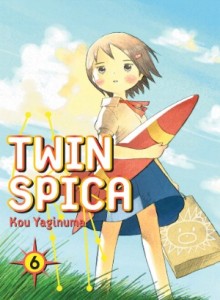
Twin Spica, Vols. 5-6

March 30, 2011 by Katherine Dacey 14 Comments

If you spend any time surfing the mangasphere, you don’t need me to tell you that Twin Spica is about a group of teenagers who are training to become Japan’s first astronauts. You probably know — or have heard from other readers — that it’s poignant. And you may have heard pundits declare it one of the best new series of 2010. (It made my best-of list.) Rather than re-hash plot points or tell you how awesome it is, therefore, I thought I’d share what I like best about Twin Spica: every volume makes me want to look up at the sky.

I’m not talking about the simple act of looking through a telescope or watching clouds drift in the wind — I’m talking about the way the act of looking at the sky makes me feel. Reflecting back on my childhood, that act elicited very specific emotions: the sky represented the future, a large canvas on which I could project my most cherished dreams of traveling to distant places, having adventures, and doing things that, from a six or eight-year-old’s perspective, seemed important. Kou Yaginuma clearly remembers that feeling from his own childhood, because his characters are at their most optimistic and thoughtful when they’re looking up at the sky and thinking about their own experiences.

There’s a lovely moment in volume six, for example, when Fuchuya’s grandfather tells six-year-old Asumi to cherish the memory of gazing up at the sky, as the sky will look different to her as she reaches adulthood. He explains:

You might as well spend your time looking up, at the sky. Me, I’ve spent decades staring up the sky in this town. I only thought the sky was very high when I was your age. When you’re old, it doesn’t seem quite that way. The sky you see as a kid is a lifelong treasure. I mean it. Value what you can see now, and only now.

Reading this passage reminds me of “Feldeinsamkeit” (“In Summerfields”), a beautiful piece of juvenilia from Charles Ives’ 114 Songs. The lyrics, taken from German poet Hermann Allmers, describe the experience of lying in a meadow on a summer’s afternoon and watching the sky. The sight of drifting clouds induces melancholy in his poem’s narrator, who — in typical nineteenth-century fashion — sees the clouds’ gentle, unfettered progress across the sky as a symbol of release from earthly burdens:

I’m resting quietly in tall green grass,
and cast my eyes far upwards;
around me crickets chirp unceasing,
the sky’s blue magically encloses me.

The beautiful white clouds float past
through the deep blue, like lovely silent dreams.
It is as if I had been long dead,
and flew in bliss with them through unending space.

Ives’ setting, by his own standards, is rather tame; there’s a running accompaniment figure that suggests fast-moving clouds, and a fleeting moment of bitonality, but it falls squarely within the nineteenth-century Stimmungslied tradition with its rounded binary form and gentle chromaticism. The song has an undeniably haunting quality, however. Its rapid modulation to harmonically distant key signatures and achingly sad melodic line suggest that the singer isn’t simply describing the act of watching clouds, as the lyrics alone might imply, but remembering what she was thinking and feeling as she did so.

That may sound like a minor distinction, but memory — or, more accurately, the act of remembering — is an important motif in the 114 Songs. “At the River,” for example, initially sounds like a straightforward rendition of “Shall We Gather At the River,” only to deviate from the melody as the singer “forgets” the proper tune, while “Memories” re-enacts a child’s enthusiasm at attending a concert. “In Summerfields” is less self-consciously modernist than either of these songs, but all three rely heavily on the illusion that the performer is reliving one of her own memories.

And that’s exactly the quality I find so compelling about Twin Spica: it’s a manga about living with vivid memories — some haunting, some happy — about reconciling past and present, about recognizing the value in both joy and pain, about negotiating the transition from youthful innocence to adulthood. In that scene with Fuchuya’s grandfather, we’re given a powerful reminder of just how much symbolic importance the sky holds for all of us, even if it doesn’t fill us with the same sense of wonder that it did when we were small.

Review copies provided by Vertical, Inc.

TWIN SPICA, VOLS. 5-6 • BY KOU YAGINUMA • VERTICAL, INC. • RATING: TEEN (13+)
Filed Under: Manga Critic Tagged With: Seinen, vertical

Twin Spica, Vols. 5-6

March 30, 2011 by Katherine Dacey

If you spend any time surfing the mangasphere, you don’t need me to tell you that Twin Spica is about a group of teenagers who are training to become Japan’s first astronauts. You probably know — or have heard from other readers — that it’s poignant. And you may have heard pundits declare it one of the best new series of 2010. (It made my best-of list.) Rather than re-hash plot points or tell you how awesome it is, therefore, I thought I’d share what I like best about Twin Spica: every volume makes me want to look up at the sky.

I’m not talking about the simple act of looking through a telescope or watching clouds drift in the wind — I’m talking about the way the act of looking at the sky makes me feel. Reflecting back on my childhood, that act elicited very specific emotions: the sky represented the future, a large canvas on which I could project my most cherished dreams of traveling to distant places, having adventures, and doing things that, from a six or eight-year-old’s perspective, seemed important. Kou Yaginuma clearly remembers that feeling from his own childhood, because his characters are at their most optimistic and thoughtful when they’re looking up at the sky and thinking about their own experiences.

There’s a lovely moment in volume six, for example, when Fuchuya’s grandfather tells six-year-old Asumi to cherish the memory of gazing up at the sky, as the sky will look different to her as she reaches adulthood. He explains:

You might as well spend your time looking up, at the sky. Me, I’ve spent decades staring up the sky in this town. I only thought the sky was very high when I was your age. When you’re old, it doesn’t seem quite that way. The sky you see as a kid is a lifelong treasure. I mean it. Value what you can see now, and only now.

Reading this passage reminds me of “Feldeinsamkeit” (“In Summerfields”), a beautiful piece of juvenilia from Charles Ives’ 114 Songs. The lyrics, taken from German poet Hermann Allmers, describe the experience of lying in a meadow on a summer’s afternoon and watching the sky. The sight of drifting clouds induces melancholy in his poem’s narrator, who — in typical nineteenth-century fashion — sees the clouds’ gentle, unfettered progress across the sky as a symbol of release from earthly burdens:

I’m resting quietly in tall green grass,
and cast my eyes far upwards;
around me crickets chirp unceasing,
the sky’s blue magically encloses me.

The beautiful white clouds float past
through the deep blue, like lovely silent dreams.
It is as if I had been long dead,
and flew in bliss with them through unending space.

Ives’ setting, by his own standards, is rather tame; there’s a running accompaniment figure that suggests fast-moving clouds, and a fleeting moment of bitonality, but it falls squarely within the nineteenth-century Stimmungslied tradition with its rounded binary form and gentle chromaticism. The song has an undeniably haunting quality, however. Its rapid modulation to harmonically distant key signatures and achingly sad melodic line suggest that the singer isn’t simply describing the act of watching clouds, as the lyrics alone might imply, but remembering what she was thinking and feeling as she did so.

That may sound like a minor distinction, but memory — or, more accurately, the act of remembering — is an important motif in the 114 Songs. “At the River,” for example, initially sounds like a straightforward rendition of “Shall We Gather At the River,” only to deviate from the melody as the singer “forgets” the proper tune, while “Memories” re-enacts a child’s enthusiasm at attending a concert. “In Summerfields” is less self-consciously modernist than either of these songs, but all three rely heavily on the illusion that the performer is reliving one of her own memories.

And that’s exactly the quality I find so compelling about Twin Spica: it’s a manga about living with vivid memories — some haunting, some happy — about reconciling past and present, about recognizing the value in both joy and pain, about negotiating the transition from youthful innocence to adulthood. In that scene with Fuchuya’s grandfather, we’re given a powerful reminder of just how much symbolic importance the sky holds for all of us, even if it doesn’t fill us with the same sense of wonder that it did when we were small.

Review copies provided by Vertical, Inc.

TWIN SPICA, VOLS. 5-6 • BY KOU YAGINUMA • VERTICAL, INC. • RATING: TEEN (13+)

Filed Under: Manga, Manga Critic, REVIEWS Tagged With: Seinen, vertical

The Manga Hall of Shame: Wounded Man

March 8, 2011 by Katherine Dacey 41 Comments

Nicholas Cage, I have a swell idea for your next project: option the rights to Wounded Man. This mid-eighties schlockfest is tailor made for you. It has a hero with extravagantly bad hair, bad guys so charismatic they beg for Christopher Walken or Sharon Stone to play them, and copious amounts of acrobatic sex and violence. And while it lacks the evil Nazis and mad scientists of Offered, another Kazuo Koike gem set in South America, Wounded Man does Offered one better: the series’ main villain is a pornographer. But not the sleazy, sad-sack type who might be the prime suspect on a Law & Order: SVU episode — no, the chief villain in Wounded Man runs a studio called God’s Pornographic X-Rated Films, a.k.a. GPX. She also wears a caftan and carries a parasol.

You know she’s evil.

Wounded Man begins in Brazil, where Yuko Kusaka, an ambitious young NHK reporter, is pursuing a story about a modern-day gold rush in the Amazon basin. Yuko is intent on finding “Rio Baraki,” a prospector who’s rumored to be Japanese. Baraki finds her first, however, savagely attacking her in a city park. “You’d better thank me because this could be much worse!” he tells Yuko. “Go back to Japan if you don’t want anymore trouble!” (He also talks to her at great length about the unsavory eating habits of Amazonian fish, dialogue that’s so unsafe for work I’ll do the honorable thing and not reprint it here.)

What Baraki doesn’t count on is that Yuko falls madly in love with him, following him deep into the jungle in spite of his dire warnings. She and her camera crew are ambushed by bandits, tied up, and sexually tortured; Baraki rescues them. She then jettisons her crew and tags along with Baraki. Once again, she’s ambushed, tied up, and sexually tortured; once again, Baraki rescues her. Baraki and Yuko then fight; they have sex; and Baraki tells Yuko his sad story, a story even more screwed up than all crazy, non-con antics that preceded it.

Baraki, it turns out, was once Keisuke Ibaraki, star quarterback at USC. After a big game, a group of thugs kidnapped him and his high school sweetheart, threatening them with death if Baraki refused to make an X-rated film with a famous female tennis player. Baraki turned GPX down; his heart belonged to Natsuko, and no amount of money would compromise his resolve. Not even the prospect of starvation undermined his commitment to Natsuko — naked and locked in a dungeon, the two survived by drinking each other’s urine before Natsuko finally died. Baraki lived, and has been plotting his revenge ever since he escaped GPX’s clutches.

I’m not making this up.

You’d be forgiven for thinking that a couple of porn-addled teenagers were responsible for the script, however; the whole story feels like something concocted by Dirk Diggler in one of his pitiful bids for movie-actor legitimacy. Though the ostensible genre is action/adventure, the story’s epic sex scenes take up more than half the first volume alone, with only the occasional fist-fight or manly swim through piranha-infested waters to relieve the tedium. The most reprehensible aspect of all the fornicating, however, is how little of it is genuinely consensual. Yuko is molested by Baraki, by random smugglers and poachers, even by members of her own television crew in a scene unpleasantly reminiscent of Deliverance, yet Koike and artist Ryochi Ikegami play these episodes for maximum titillation, trotting out one of the hoariest, most offensive cliches from the rape culture playbook: the victim who falls for her attacker because the sex is so amazing.

I wish I were making this up.

Koike and Ryoichi Ikegami find other ways to offend as well. The Brazilian characters are drawn as crude caricatures, with hulking physiques, gap-toothed smiles, and leering eyes; their primary role in the story is menacing Yuko. The few female characters are equally ridiculous, shunning clothing the way six-year-olds shun brussell sprouts; I’ve never seen so much laughably gratuitous nudity in a manga before. (The naked tennis player is kind of disconcerting, however, as she looks an awful lot like Martina Navatarola.)

The series’ greatest offense, however, is the way Yuko is portrayed. She may be a judo champ, capable of delivering a high-flying kick, and a rising star at the NHK, scoring high ratings with her investigative journalism, but her behavior is so petulant, so dumb, and so completely contradictory that Koike undermines her identity as a competent, strong woman. “That’s right, I hate you,” she tells Baraki during one of their numerous fights. “But at the same time, I love you so much! I’m so in love with you and I get so weak just being touched by you.” Her frequent hysterical outbursts would be comical if they didn’t serve to infantilize and diminish her, robbing her of any meaningful agency or identity outside of sex object.

Really, I wish I were making this up.

I’d be the first to admit that Wounded Man is luridly fascinating. It’s hard to imagine who thought any of it was a good idea, though it unfolds in such a fast, furious, and utterly unironic fashion that readers may be swept up in the story despite their better judgment. In short, Wounded Man is perfect fodder for a Nick Cage movie. Agents, are you listening?

WOUNDED MAN, VOLS. 1-9 • STORY BY KAZUO KOIKE, ART BY RYOICHI IKEGAMI • COMICSONE • RATING: MATURE (COPIOUS NUDITY AND VIOLENCE, VIOLENCE AGAINST WOMEN, STRONG LANGUAGE, INANE PLOT TWISTS)

Filed Under: Manga Critic Tagged With: Bad Manga, ComicsOne, Kazuo Koike, Seinen

7 Short Series Worth Adding to Your Manga Bookshelf

February 23, 2011 by Katherine Dacey 37 Comments

I like getting lost in a long, twisty story as much as the next person, but I often lose interest in a manga around the five- or ten-volume mark. As a service to other people afflicted with Manga ADHD, therefore, I’ve compiled a list of seven shorter series that enjoy pride of place on my shelves.

There were a few ground rules that guided my list-making. First, the series needed to be complete in five volumes or fewer. Second, every volume of the series needed to be readily available through a major retailer like Amazon. Third, the list needed to be diverse, covering a range of genres and demographics. Had I expanded the list to include out-of-print favorites — Antique Bakery, Apocalypse Meow, Club 9, Domu: A Child’s Dream, The Name of the Flower, Planetes — it would have been an unwieldy beast, and one sure to disappoint: why recommend a book that’s selling for $100 on eBay?

So without further ado… here are seven short series worth adding to your manga bookshelf.

A DISTANT NEIGHBORHOOD

JIRO TANIGUCHI • FANFARE/PONENT MON • 2 VOLUMES

A Distant Neighborhood is a wry, wistful take on a tried-and-true premise: a salaryman is transported back in time to his high school days, and must decide whether to act on his knowledge of the past or let events unfold as they did before. We’ve seen this story many times at the multiplex — Back to the Future, Peggy Sue Got Married — but Taniguchi doesn’t play the set-up for laughs; rather, he uses Hiroshi’s predicament to underscore the challenges of family life and the awkwardness of adolescence. (Hiroshi is the same chronological age as his parents, giving him special insight into the vicissitudes of marriage, as well as the confidence to cope with teenage tribulations.) Easily one of the most emotional, most intimate stories Taniguchi’s ever told. (A Distant Neighborhood was one of my picks for Best Manga of 2009; click here for the full list.)

ICHIGENME… THE FIRST CLASS IS CIVIL LAW

FUMI YOSHINAGA • DMP • 2 VOLUMES

One of the things that distinguishes Fumi Yoshinaga’s work from that of other yaoi artists is her love of dialogue. In works like Antique Bakery and Solfege, she reminds us that conversation can be an aphrodisiac, especially when two people are analyzing a favorite book or confessing a mutually-shared passion for art, cooking, or manga. True to form, the sexiest scenes in Ichigenme: The First Class Is Civil Law are conversations between law professors and their students. We feel the erotic charge of more experienced scholars engaging their proteges in intense debates over legal procedure and philosophy, even when the topics themselves are rather dry. Not that Yoshinaga skimps on the smut: there’s plenty of bedroom action as the carefree Tohdou helps his uptight, closeted classmate Tamiya explore his sexuality, but the series’ best moments are fully clothed. An entertaining manga that gets better with each reading. (Reviewed at PopCultureShock on 3/14/08.)

ODE TO KIRIHITO

OSAMU TEZUKA • VERTICAL, INC. • 2 VOLUMES

While investigating an outbreak of a mysterious disease, an earnest young doctor contracts it himself, becoming a hideous dog-man who craves raw meat. Kirihito’s search for the cause — and the cure — is the backbone of this globe-trotting adventure, but Kirihito’s quest to reclaim his humanity is its heart and soul; his travels bring him into contact with hustlers, racists, and superstitious villagers, each of whom greets him with a mixture of suspicion and fear. As its dog-man premise suggests, Ode to Kirihito is Tezuka at his bat-shit craziest: in one storyline, for example, Kirihito befriends a nymphomaniac circus performer who transforms herself into human tempura. But for all its over-the-top characters and plot developments (see “nympho human tempura,” above), Ode to Kirihito is one of Tezuka’s most moving stories, a thoughtful meditation on the the fluid boundaries between man and animal, sanity and insanity, good and evil. (Reviewed at The Manga Critic on 4/7/10.)

THE SECRET NOTES OF LADY KANOKO

RIRIKO TSUJITA • TOKYOPOP • 3 VOLUMES

Kanoko, the sardonic heroine of The Secret Notes of Lady Kanoko, is a student of human behavior, gleefully filling her notebooks with detailed observations about her classmates. Though Kanoko would like nothing more than to remain on the sidelines, she frequently becomes embroiled in her peers’ problems; they value her independent perspective, as Kanoko isn’t the least bit interested in dating, running for student council, or currying favor with the alpha clique. Kanoko’s sharp tongue and cool demeanor might make her the mean-girl villain in another shojo manga, but Ririko Tsujita embraces her heroine’s prickly, opinionated nature and makes it fundamental to Kanoko’s appeal. The perfect antidote to shojo stories about timid good girls and boy-crazy spazzes. UPDATE 4/16/11: TOKYOPOP announced that it would be shutting down its US publishing operations on May 31, 2011. Unfortunately, that means that Lady Kanoko will likely remain incomplete at two volumes. The stories are largely self-contained, so it is still possible to enjoy Lady Kanoko without reading the last volume.

7 BILLION NEEDLES

NOBUAKI TADANO • VERTICAL, INC. • 4 VOLUMES

Nobuaki Tadano gives Hal Clement’s Needle a manga makeover, moving the action from a remote island in the South Seas to Japan, and replacing Clement’s wholesome, Hardy Boy protagonist with a sullen teenage girl who’s none too pleased to discover that an alien bounty hunter has taken control of her body. The decision to make Hikaru a troubled loner with a difficult past is a stroke of genius; her social isolation proves almost as formidable an obstacle for her to overcome as the monster that she and Horizon (as the bounty hunter is known) are pursuing. Her personal struggles also add a level of raw, emotional authenticity to the story — something that was largely absent from the fascinating, though clinically detached, original. Oh, and the monster? It’s a doozy. (7 Billion Needles was one of my picks for Best Teen-Friendly Comic of 2010; see Good Comics for Kids for the full list. Volumes one and two were reviewed at The Manga Critic on 11/21/10; volume three was reviewed on 2/17/11. The fourth and final volume will arrive in stores on April 26, 2011.)

TO TERRA

KEIKO TAKEMIYA • VERTICAL, INC. • 3 VOLUMES

If Richard Wagner wrote space operas, he might have composed something like Keiko Takemiya’s To Terra, an inter-generational drama about a race of telepathic mutants who’ve been exiled from their home world. Under the leadership of the charismatic Jomy Marcus Shin, the Mu embark on a grueling voyage back to Terra to be reunited with their human creators. Their principle foe: an evil supercomputer named Mother. Takemiya’s richly detailed artwork makes To Terra an almost cinematic experience, suggestive of 2001: A Space Odyssey and Star Wars. But don’t be fooled by those blinking computers and blazing starships: To Terra is an unabashedly Romantic saga about two ubermensch locked in a struggle of cosmic proportions. No doubt Richard would approve. (To Terra was one of my picks for Best Manga of 2007; read the full list at PopCultureShock. For more information on To Terra‘s history, click here.)

TOTO! THE WONDERFUL ADVENTURE

YUKO OSADA • DEL REY • 5 VOLUMES

Shonen series often run to 10, 20, or 40 volumes, but Toto! The Wonderful Adventure proves that good stories come in shorter packages, too. Yuko Osada brazenly steals ideas from dozens of other sources — Castle in the Sky, One Piece, Last Exile, The Wizard of Oz — to produce a boisterous, fast-paced story about a tyro explorer who crosses paths with sky pirates, military warlords, and a high-kicking senjutsu expert named Dorothy. Though the jokes are hit-or-miss, Toto! boasts crisp artwork, strong female characters, and an infectious sense of bonhomie among the series’ protagonists; Kakashi and his traveling companions are impossible to dislike. (Reviewed at The Manga Critic on 9/16/10.)

HONORABLE MENTIONS

CAT-EYED BOY (Kazuo Umezu • VIZ • 2 volumes): Readers looking for an introduction to Kazuo Umezu’s work could do a lot worse than this two-volume collection of stories about a strange little boy who’s half-human, half-demon. Umezu gives free reign to his imagination, conjuring some of the most bizarre monsters in the J-horror canon. The results aren’t always as shocking as they might be, but Cat-Eyed Boy is by turns funny, scary, and sad. (Reviewed at The Manga Critic on 10/3/10.)

LADY SNOWBLOOD (Kazuo Koike and Kazuo Kimimura • Dark Horse • 4 volumes): Now that everyone’s forgotten Kill Bill, the epic mess “inspired” by Kazuo Koike’s Lady Snowblood, it’s possible to read this series for what it is: a deliciously trashy story about a beautiful assassin who manipulates, cajoles, seduces, and stabs her way through Meiji-era Japan. Expect copious nudity, buckets of blood, and fight scenes so outrageous they have to be seen to be believed.

ONE POUND GOSPEL (Rumiko Takahashi • VIZ • 4 volumes): In this charming sports comedy, a struggling boxer is torn between his love for food and his love for a pretty young nun who wants him to lay down his fork, lose some weight, and win a few matches. The series is a little episodic (Takahashi published new chapters sporadically), but the dialogue and slapstick humor have a characteristically Takahashian zing.

For additional suggestions, see:

  • 5 Underrated Shojo Manga, which includes Setona Mizushiro’s X-Day;
  • My 10 Favorite CMX Titles, which includes such short series as Astral Project, Chikyu Misaki, Kiichi and the Magic Books, The Name of the Flower, and Presents. Note that many of these series are out of print and may be hard to find through retailers like Amazon;
  • My 10 Favorite Spooky Manga, which includes such short series as Dororo, Gyo, Mail, and School Zone.

Filed Under: Manga Critic Tagged With: Dark Horse, del rey, DMP, fumi yoshinaga, Historical Drama, Horror/Supernatural, Kazuo Koike, Kazuo Umezu, Keiko Takemiya, Osamu Tezuka, Romance/Romantic Comedy, Rumiko Takahashi, Sci-Fi, Seinen, shojo, Shonen, Tokyopop, vertical, VIZ, Yaoi

LIVES, Vol. 1

January 21, 2011 by Katherine Dacey 7 Comments

Everything you need to know about LIVES is summed up by the following category tags: “big breasts,” “meteor,” “stranded,” “strategically torn clothing,” and “survival.” (Kudos to the Baka-Updates moderator who felt the need to give “strategically torn clothing” its due as a category. But what, no “hungry predators”?)

Plot-wise, LIVES resembles Battle Royale, Gantz, and King of Thorn in using a catastrophic event — in this case, a meteor shower — to deposit normal people into a hostile environment — here, a dense jungle inhabited by carnivorous monsters. It doesn’t take long for the refugees to discover the particularly nasty secret behind these beasties: they were originally human beings as well, and some can still transform back into their bipedal selves, with no memory of terrorizing their fellow survivors.

Art-wise, Taguchi delivers the goods, with scene after scene of expertly staged carnage. His monsters are perhaps a little too neat, lightbox chimaeras that originated in the pages of National Geographic, but they’re agile and vicious enough to be convincing. His humans also offer balm for tired eyes: the hero, Shingo, has abs that would shame The Situation’s, and the harem of doe-eyed, big-bosomed ladies wear just enough clothing to prevent the story from shading into pornography. (In a hilarious touch, all of the women’s shoes are in immaculate condition, even though their tops and skirts have been reduced to scraps. Paging Imelda Marcos!)

What’s missing is subtext. LIVES is the umpteenth manga to suggest when man lives in a “state of nature” — no rulers, no rules of law — that a “war of all against all” prevails, creating an environment where lives are “solitary, poor, nasty, brutish, and short.” While other manga-ka have attempted to explore what happens to the human psyche when all social constraints disappear, Masayuki Taguchi focuses exclusively on those consequences that Thomas Hobbes forget to mention in The Leviathan: costume failures, near-rapes, faintly incestuous relationships, and hyper-violent showdowns between monsters and would-be meals. There’s nothing wrong with carnage and cheesecake; I’m all for brainless fun. But when the narrative falls into an all-too-predictable pattern of grope-chase-chomp-regroup in the very first volume, a little subtext goes a lot farther than a cool monster or a torn shirt in making things interesting.

Review copy provided by Tokyopop. Volume one will be released on February 1, 2011.

LIVES, VOL. 1 • BY MASAYUKI TAGUCHI • TOKYOPOP • 196 pp. • RATING: MATURE (18+)

Filed Under: Manga Critic Tagged With: Seinen, Tokyopop

Manga Artifacts: Hotel Harbour View

January 14, 2011 by Katherine Dacey 12 Comments

Back in 1990, before anyone had hit on the magic formula for selling manga to American readers, VIZ tried a bold experiment. They released a handful of titles in a prestige format with fancy covers, high-quality paper, and a large trim size, and called them “Viz Spectrum Editions.” Only three manga got the Viz Spectrum treatment: Yu Kinutani’s Shion: Blade of the Minstrel, Yukinobu Hoshino’s Saber Tiger, and Natsuo Sekikawa and Jiro Taniguchi’s Hotel Harbour View. While neither the imprint nor the format survived, these three titles helped pave the way for VIZ’s later efforts to establish its Signature line.

Hotel Harbour View, by far the strongest of the three, is a stylish foray into hard-boiled crime fiction. In the title story, a man patronizes a once-elegant bar in Hong Kong, telling the bartender that he’s waiting for the person who’s supposed to kill him, while in the second story, “A Brief Encounter,” an assassin returns to Paris, where his former associates — including his protege — lie in wait for him.

As editor Fred Burke observes in his afterword, both stories are as much about style and genre as they are about exploring what motivates people to kill. The characters in both stories are deeply concerned with scripting their own lives, of behaving the way hit men and high-class call girls do in the movies. None of them wear simple street clothes; all of them are in costume, wearing gloves and suits and garter belts. (In one scene, for example, an assassin asks a bystander to hand him his hat, even though he lies dying in a pool of blood. “Just don’t feel right without it,” he explains.) Their words, too, are carefully chosen; every conversation has the kind of pointed quality of a Dashiell Hammett script, with characters trading quips and telling well-rehearsed stories about their past. A brief surveillance operation, for example, yields this tersely wonderful exchange between two female assassins:

“She’s French, isn’t she? Parisienne.”
“How can you tell?”
“She looks arrogant and stubborn. The sort who ruins men.”
“He loves her. That’s why he came back to Paris.”
“And how can you tell?”
“I’m a Parisienne, too.”

[As an aside, I should note that Gerard Jones and Matt Thorn’s excellent translation brings Sekikawa’s script to life in English; each character has a distinctive voice, and the dialogue is thoroughly idiomatic.]

The violence has a cinematic flavor as well; Taniguchi’s balletic gunfights call to mind the kind of technically dazzling shoot-outs that became a staple of John Woo’s filmmaking in the late 1980s and early 1990s. Taniguchi uses many of the same tricks. He follows a bullet’s trajectory from the gun barrel to its point of impact, showing us the victim’s terrified face as the bullet closes in on its target; stages elaborate duels in which passing trains demand split-second timing from the well-armed participants; and shows us a hit gone bad from dozens of different angles. In one the book’s most stylish sequences, we see a gunman’s reflection in a shattered mirror; as the “camera” pulls back from that initial image, we realize that we’re seeing things from the killer’s point of view, not the gunman’s. A dramatic cascade of glass destroys his reflection as he slumps to the floor — a perfect movie ending for a character obsessed with orchestrating his own death.

Like Taniguchi’s other work, there’s a slightly stiff quality to the artwork. His characters are drawn with meticulous attention to detail, yet their faces remain impassive even when bullets fly and old lovers betray them. That detachment can be frustrating in other contexts, but in Hotel Harbour View it registers as sang-froid; the characters’ composure is as essential to their performances as their costumes and studied banter, as each self-consciously fulfills their role in the drama.

Though Hotel Harbour View is out of print, copies are still widely available through online retailers; I ordered mine directly from Amazon. You’ll also find a robust market for second-hand copies; expect to pay between $4.00 and $20.00 for a copy in good to excellent condition.

Manga Artifacts is a monthly feature exploring older, out-of-print manga published in the 1980s and 1990s. For a fuller description of the series’ purpose, see the inaugural column.

HOTEL HARBOUR VIEW • SCRIPT BY NATSUO SEKIKAWA, ART BY JIRO TANIGUCHI • VIZ MEDIA • 94 pp. • RATING: MATURE (18+)

Filed Under: Manga Critic Tagged With: Jiro Taniguchi, Seinen, VIZ

The Best Manga You’re Not Reading: Blue Spring

January 11, 2011 by Katherine Dacey 5 Comments

As depicted in most shojo and shonen manga, the Japanese high school is the epitome of order, with students in neat, military-style uniforms diligently studying for exams, tidying up classrooms, staging plays, and participating in cultural festivals. Students who don’t fit into the school’s established pecking order — social, athletic, or academic — quickly find themselves ostracized by their peers for lack of purpose.

Taiyo Matsumoto, however, offers a very different image of the Japanese high school in his anthology Blue Spring. His subjects are the kids with “front teeth rotten from huffing thinner,” who “answer to reason with their fists and never question their excessive passions” — in short, the delinquents. Kitano High School, the milieu these kids inhabit, is a crumbling eyesore with graffiti-covered walls, trash-filled stairwells, and indifferent faculty. Students cut class and fill their after-school hours with girlie magazines, petty crime, and smack-talk at the local diner, marking time until they join the world of adult responsibility.

Gangs, bullies, disaffected teens playing at thug life — it’s familiar territory, yet in Matsumoto’s hands, these potentially cliche stories acquire a new and strange quality. Matsumoto eschews linear narrative in favor of digressions and fragments; as a result, we feel more like we’re living in the characters’ heads than reading a tidy account of their actions. Snatches of daydreams sometimes interrupt the narrative, as do jump cuts and surreal imagery: sharks and puffer fish drift past a classroom window where two teens make out, a UFO languishes above the school campus. Even the graffiti plays an integral part of Matsumoto’s storytelling; the walls are a paean to masturbation, booze, and suicide, cheerfully urging “No more political pacts–sex acts!”

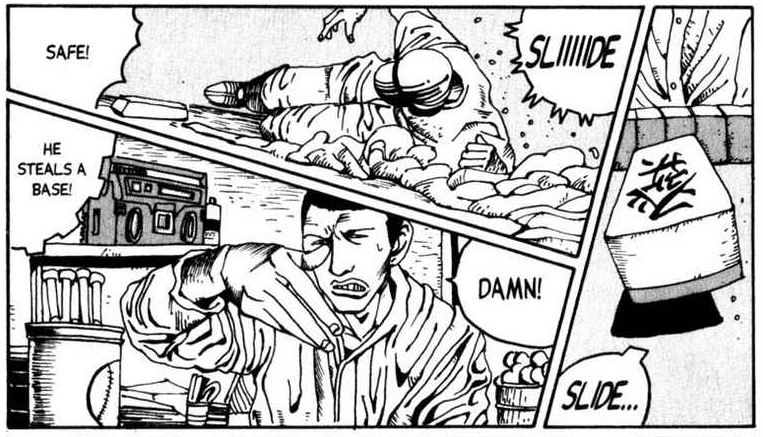
One of the most arresting aspects of Blue Spring is Matsumoto’s ability to manipulate time. In one of the book’s most visually stunning sequences, for example, Matsumoto seamlessly blends two events — a baseball game and a mahjong game — into a single sequence:

Matsumoto makes it seem as if the gambler’s action precipitated the slide into second base. It’s an elegant visual trick that establishes the simultaneity of the two games while suggesting the intensity of the mahjong play; the discarding of a tile is portrayed with the same explosive energy as stealing a base.

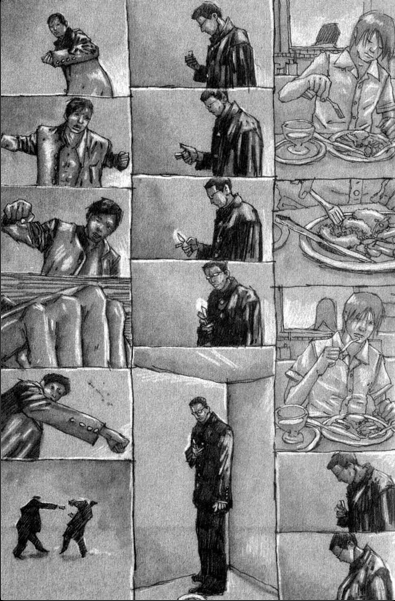
Some of Matsumoto’s time-bending sequences are more cinematic, evoking the kind of split-screen technique popularized in the 1960s by filmmakers like John Frankenheimer and Richard Fleischer. The prologue, for example, contains a series of short, vertical strips in which we see unnamed teenagers preparing for a day at school. Matsumoto deliberates re-frames the activity in each panel, drawing back to show the full scene in some, and pulling in close to reveal the blankness of a characters’ face in another:


It’s an effective montage, largely for the way it juxtaposes the banal with the violent; the fist-fight is presented in the same, matter-of-fact fashion as the student eating breakfast, suggesting that conflict is as routine for some of Blue Spring‘s characters as catching the train to school. The transitions, too, are handled deftly; the eye can process these little vignettes in a sequence while the brain grasps the entire prologue as a simultaneous collage of events, a representative cross-section of high school students going about their business on a typical day.

Matsumoto’s stark, black-and-white imagery won’t be to every reader’s taste; I’d be the first admit that many of the kids in Blue Spring look older and wearier than Keith Richards, with their sunken eyes and rotten teeth. But the studied ugliness of the character designs and urban settings suits the material perfectly, hinting at the anger and emptiness of the characters’ lives. Matsumoto offers no easy answers for his characters’ behavior, nor any false hope that they will escape the lives of violence and despair that seem to be their destiny. Rather, he offers a frank, funny and often disturbing look at the years in which most of us were unformed lumps of clay — or, in Matsumoto’s memorable formulation, a time when most of us were blue: “No matter how passionate you were, no matter how much your blood boiled, I believe youth is a blue time. Blue — that indistinct blue that paints the town before the sun rises.”

This is an expanded version of a review that appeared at PopCultureShock on 4/30/07.

BLUE SPRING • BY TAIYO MATSUMOTO • VIZ • 216 pp. • RATING: MATURE (18+)

Filed Under: Manga Critic Tagged With: Seinen, Taiyo Matsumoto, VIZ

The Best Manga You’re Not Reading: Blue Spring

January 11, 2011 by Katherine Dacey

As depicted in most shojo and shonen manga, the Japanese high school is the epitome of order, with students in neat, military-style uniforms diligently studying for exams, tidying up classrooms, staging plays, and participating in cultural festivals. Students who don’t fit into the school’s established pecking order — social, athletic, or academic — quickly find themselves ostracized by their peers for lack of purpose.

Taiyo Matsumoto, however, offers a very different image of the Japanese high school in his anthology Blue Spring. His subjects are the kids with “front teeth rotten from huffing thinner,” who “answer to reason with their fists and never question their excessive passions” — in short, the delinquents. Kitano High School, the milieu these kids inhabit, is a crumbling eyesore with graffiti-covered walls, trash-filled stairwells, and indifferent faculty. Students cut class and fill their after-school hours with girlie magazines, petty crime, and smack-talk at the local diner, marking time until they join the world of adult responsibility.

Gangs, bullies, disaffected teens playing at thug life — it’s familiar territory, yet in Matsumoto’s hands, these potentially cliche stories acquire a new and strange quality. Matsumoto eschews linear narrative in favor of digressions and fragments; as a result, we feel more like we’re living in the characters’ heads than reading a tidy account of their actions. Snatches of daydreams sometimes interrupt the narrative, as do jump cuts and surreal imagery: sharks and puffer fish drift past a classroom window where two teens make out, a UFO languishes above the school campus. Even the graffiti plays an integral part of Matsumoto’s storytelling; the walls are a paean to masturbation, booze, and suicide, cheerfully urging “No more political pacts—sex acts!”

One of the most arresting aspects of Blue Spring is Matsumoto’s ability to manipulate time. In one of the book’s most visually stunning sequences, for example, Matsumoto seamlessly blends two events — a baseball game and a mahjong game — into a single sequence:

Matsumoto makes it seem as if the gambler’s action precipitated the slide into second base. It’s an elegant visual trick that establishes the simultaneity of the two games while suggesting the intensity of the mahjong play; the discarding of a tile is portrayed with the same explosive energy as stealing a base.

Some of Matsumoto’s time-bending sequences are more cinematic, evoking the kind of split-screen technique popularized in the 1960s by filmmakers like John Frankenheimer and Richard Fleischer. The prologue, for example, contains a series of short, vertical strips in which we see unnamed teenagers preparing for a day at school. Matsumoto deliberates re-frames the activity in each panel, drawing back to show the full scene in some, and pulling in close to reveal the blankness of a characters’ face in another:


It’s an effective montage, largely for the way it juxtaposes the banal with the violent; the fist-fight is presented in the same, matter-of-fact fashion as the student eating breakfast, suggesting that conflict is as routine for some of Blue Spring‘s characters as catching the train to school. The transitions, too, are handled deftly; the eye can process these little vignettes in a sequence while the brain grasps the entire prologue as a simultaneous collage of events, a representative cross-section of high school students going about their business on a typical day.

Matsumoto’s stark, black-and-white imagery won’t be to every reader’s taste; I’d be the first admit that many of the kids in Blue Spring look older and wearier than Keith Richards, with their sunken eyes and rotten teeth. But the studied ugliness of the character designs and urban settings suits the material perfectly, hinting at the anger and emptiness of the characters’ lives. Matsumoto offers no easy answers for his characters’ behavior, nor any false hope that they will escape the lives of violence and despair that seem to be their destiny. Rather, he offers a frank, funny and often disturbing look at the years in which most of us were unformed lumps of clay — or, in Matsumoto’s memorable formulation, a time when most of us were blue: “No matter how passionate you were, no matter how much your blood boiled, I believe youth is a blue time. Blue — that indistinct blue that paints the town before the sun rises.”

This is an expanded version of a review that appeared at PopCultureShock on 4/30/07.

BLUE SPRING • BY TAIYO MATSUMOTO • VIZ • 216 pp. • RATING: MATURE (18+)

Filed Under: Manga, Manga Critic, Recommended Reading, REVIEWS Tagged With: Seinen, Taiyo Matsumoto, VIZ

Ayako

December 17, 2010 by Katherine Dacey

Ayako is an odd beast. Structurally, it resembles a Russian realist novel, using a once-powerful family of landowners to embody the political and economic upheaval caused by America’s seven-year occupation of Japan (1945-52). Temperamentally, however, Ayako feels more like a John Frankenheimer movie, with subplots involving a Communist organizer, an assassin who stashes orders in his empty eye socket, and a witness whose family condemns her to lifelong imprisonment in an underground cell. Though Tezuka makes a game effort to reconcile his literary and cinematic influences, the results are uneven: Ayako is powerful, disturbing, and, at times, flat-out ludicrous, yet it lacks the winking self-awareness of MW or the profound humanism of Ode to Kirihito, instead offering an engrossing but not entirely persuasive portrait of a family torn apart by the emergence of a new social order in post-war Japan.

Ayako revolves around the Tenge clan. The patriarch, Sakuemon, is a glutton and a bully, indulging his voracious appetites for food and sex while aggressively policing his family’s behavior. His sons aren’t much better: Ichiro, the eldest, is a manipulative coward who barters his wife for Sakuemon’s loyalty; Jiro, the middle son, is a disgraced war veteran who’s been coerced into spying for the US military; and Shiro, the youngest, is a fierce truth-teller who is slowly corrupted by his family’s secrets.

Two events threaten the Tenge’s equilibrium. The first — a murder — condemns the youngest family member to a dungeon, lest Ayako reveal a key piece of evidence linking a clan member to a murdered political dissident. Though the Tenge women are appalled by the plan, they’re powerless to help; the rest of the family views Ayako as a threat, as she’s both Sakuemon’s daughter and Ichiro, Jiro, and Shiro’s half-sister. The second — a decree from the government — forces the Tenge clan to redistribute their land among tenant farmers. Despite Ichiro’s vigorous protests, the government arrives on the property, intent on razing the structure that has kept Ayako out of public view for more than a decade.

Though the characters’ behavior is more extreme than anything found in Tolstoy or Sholokhov — unless I missed the incest in The Don Flows Home to the Sea — the spirit of Russian realism informs Ayako. Tezuka had already been to the Russian realist well before, loosely adapting Fyodor Dostoevsky’s Crime and Punishment in 1953. He wasn’t alone in taking inspiration from Russian literature; other Japanese artists — most notably Akira Kurosawa — adapted Dostoevsky and Maxim Gorky’s work, too, transplanting the settings from Russia to Japan. (Kurosawa’s Red Beard, borrows liberally from Dosteoveksy’s 1861 novel Humiliated and Insulted; The Idiot and The Lower Depths follow the original source material more faithfully.) It’s not hard to imagine what made these Russian authors so attractive to Japanese artists of the 1950s, 1960s, and 1970s: the realists’ work was both grand and intimate, using sympathetic characters to dramatize the toll — physical, economic, and psychological — of social unrest and change.

Of course, the realist approach has a potential pitfall: characters can feel contrived, lacking an identity outside the cause they represent. Ichiro and Jiro, the eldest brothers in Ayako, both have obvious symbolic intent: Ichiro represents the last vestiges of feudal Japan, a landlord in danger of losing his fields, his farmers, and his source of power, while Jiro embodies the complicated relationship between the Japanese and their American overlords, caught between the Japanese desire to restore normalcy and the American desire to refashion Japanese society in its own image. For all their symbolic baggage, Ichiro and Jiro still register as fundamentally human: they’re flawed, inconsistent, and corrupted by what little power they have, yet both are strongly driven to pursue what they believe to be in their best interests.

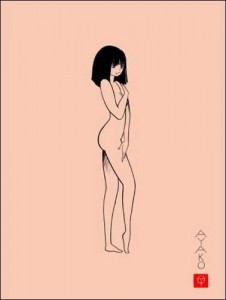
Ayako, however, is more a receptacle for other characters’ anger and lust than a true individual. She’s an innocent victim who endures over a decade of isolation, emotional neglect, and sexual abuse at Shiro’s hands, emerging from her ordeal with no real beliefs or desires of her own. Her lack of individuality makes her the most transparently symbolic member of the Tenge clan; it’s not much of a stretch to interpret her character as a representation of occupied Japan. That symbolism is underscored by one of the book’s most arresting sequences. In it, we see Ayako writhe and shed her skin like a molting insect, casting aside her girl’s body for a woman’s. The images are stark: Ayako is rendered in white lines on a jet-black background, and her ecstatic expression suggests an erotic awakening — a metaphorical re-enactment of lost innocence during a period of confinement and darkness.

The symbolic intent of Tezuka’s characters is more apparent in Ayako than in some of Tezuka’s other mature works, I think, because Ayako is more  self-consciously literary than MW or Ode to Kirihito. The absence of humor or cartoonishly evil characters — two staples of MW and Kirihito — cuts both ways. On the one hand, Ayako is sobering and adult; we can appreciate the gravity of the characters’ actions because Tezuka doesn’t punctuate serious moments with low comedy; there’s no reprieve from our discomfort with the characters’ behavior, no mustache-twirling villains on whom to pin our disgust. On the other hand, Tezuka has a natural instinct for blending high and low, using pulp genres as vehicles for exploring big questions about human nature. The heightened reality of the stories is fundamental to their success; Tezuka uses his character’s extreme behavior and dramatic physical transformations to tear away masks, to lay bare real hypocrisy, selfishness, and cowardice. That pulpy spirit asserts itself from time to time in Ayako (see “spy who stashes orders in his eye socket,” above), but there isn’t quite enough of it; the thriller elements feel tacked on, rather than fundamental to elucidating Tezuka’s central themes.

Yet Ayako is compelling, in spite of its flaws. It’s a fierce, angry work, at once intensely critical of American efforts to re-engineer Japanese society, and intensely critical of the old Japanese social order, portraying the Tenges as feudal overlords out of step with the modern world. It isn’t Tezuka’s best work, but it’s one of his most ambitious, a sincere and emotionally wrenching attempt to show the lingering effects of World War II on the Japanese psyche. Recommended.

Review copy provided by Vertical, Inc.

AYAKO • BY OSAMU TEZUKA • VERTICAL, INC. • 704 pp. • RATING: OLDER TEEN (16+)

Filed Under: Manga, Manga Critic, REVIEWS Tagged With: Classic, Osamu Tezuka, Seinen, vertical

Ayako

December 17, 2010 by Katherine Dacey 12 Comments

Ayako is an odd beast. Structurally, it resembles a Russian realist novel, using a once-powerful family of landowners to embody the political and economic upheaval caused by America’s seven-year occupation of Japan (1945-52). Temperamentally, however, Ayako feels more like a John Frankenheimer movie, with subplots involving a Communist organizer, an assassin who stashes orders in his empty eye socket, and a witness whose family condemns her to lifelong imprisonment in an underground cell. Though Tezuka makes a game effort to reconcile his literary and cinematic influences, the results are uneven: Ayako is powerful, disturbing, and, at times, flat-out ludicrous, yet it lacks the winking self-awareness of MW or the profound humanism of Ode to Kirihito, instead offering an engrossing but not entirely persuasive portrait of a family torn apart by the emergence of a new social order in post-war Japan.

Ayako revolves around the Tenge clan. The patriarch, Sakuemon, is a glutton and a bully, indulging his voracious appetites for food and sex while aggressively policing his family’s behavior. His sons aren’t much better: Ichiro, the eldest, is a manipulative coward who barters his wife for Sakuemon’s loyalty; Jiro, the middle son, is a disgraced war veteran who’s been coerced into spying for the US military; and Shiro, the youngest, is a fierce truth-teller who is slowly corrupted by his family’s secrets.

Two events threaten the Tenge’s equilibrium. The first — a murder — condemns the youngest family member to a dungeon, lest Ayako reveal a key piece of evidence linking a clan member to a murdered political dissident. Though the Tenge women are appalled by the plan, they’re powerless to help; the rest of the family views Ayako as a threat, as she’s both Sakuemon’s daughter and Ichiro, Jiro, and Shiro’s half-sister. The second — a decree from the government — forces the Tenge clan to redistribute their land among tenant farmers. Despite Ichiro’s vigorous protests, the government arrives on the property, intent on razing the structure that has kept Ayako out of public view for more than a decade.

Though the characters’ behavior is more extreme than anything found in Tolstoy or Sholokhov — unless I missed the incest in The Don Flows Home to the Sea — the spirit of Russian realism informs Ayako. Tezuka had already been to the Russian realist well before, loosely adapting Fyodor Dostoevsky’s Crime and Punishment in 1953. He wasn’t alone in taking inspiration from Russian literature; other Japanese artists — most notably Akira Kurosawa — adapted Dostoevsky and Maxim Gorky’s work, too, transplanting the settings from Russia to Japan. (Kurosawa’s Red Beard, borrows liberally from Dosteoveksy’s 1861 novel Humiliated and Insulted; The Idiot and The Lower Depths follow the original source material more faithfully.) It’s not hard to imagine what made these Russian authors so attractive to Japanese artists of the 1950s, 1960s, and 1970s: the realists’ work was both grand and intimate, using sympathetic characters to dramatize the toll — physical, economic, and psychological — of social unrest and change.

Of course, the realist approach has a potential pitfall: characters can feel contrived, lacking an identity outside the cause they represent. Ichiro and Jiro, the eldest brothers in Ayako, both have obvious symbolic intent: Ichiro represents the last vestiges of feudal Japan, a landlord in danger of losing his fields, his farmers, and his source of power, while Jiro embodies the complicated relationship between the Japanese and their American overlords, caught between the Japanese desire to restore normalcy and the American desire to refashion Japanese society in its own image. For all their symbolic baggage, Ichiro and Jiro still register as fundamentally human: they’re flawed, inconsistent, and corrupted by what little power they have, yet both are strongly driven to pursue what they believe to be in their best interests.

Ayako, however, is more a receptacle for other characters’ anger and lust than a true individual. She’s an innocent victim who endures over a decade of isolation, emotional neglect, and sexual abuse at Shiro’s hands, emerging from her ordeal with no real beliefs or desires of her own. Her lack of individuality makes her the most transparently symbolic member of the Tenge clan; it’s not much of a stretch to interpret her character as a representation of occupied Japan. That symbolism is underscored by one of the book’s most arresting sequences. In it, we see Ayako writhe and shed her skin like a molting insect, casting aside her girl’s body for a woman’s. The images are stark: Ayako is rendered in white lines on a jet-black background, and her ecstatic expression suggests an erotic awakening — a metaphorical re-enactment of lost innocence during a period of confinement and darkness.

The symbolic intent of Tezuka’s characters is more apparent in Ayako than in some of Tezuka’s other mature works, I think, because Ayako is more  self-consciously literary than MW or Ode to Kirihito. The absence of humor or cartoonishly evil characters — two staples of MW and Kirihito — cuts both ways. On the one hand, Ayako is sobering and adult; we can appreciate the gravity of the characters’ actions because Tezuka doesn’t punctuate serious moments with low comedy; there’s no reprieve from our discomfort with the characters’ behavior, no mustache-twirling villains on whom to pin our disgust. On the other hand, Tezuka has a natural instinct for blending high and low, using pulp genres as vehicles for exploring big questions about human nature. The heightened reality of the stories is fundamental to their success; Tezuka uses his character’s extreme behavior and dramatic physical transformations to tear away masks, to lay bare real hypocrisy, selfishness, and cowardice. That pulpy spirit asserts itself from time to time in Ayako (see “spy who stashes orders in his eye socket,” above), but there isn’t quite enough of it; the thriller elements feel tacked on, rather than fundamental to elucidating Tezuka’s central themes.

Yet Ayako is compelling, in spite of its flaws. It’s a fierce, angry work, at once intensely critical of American efforts to re-engineer Japanese society, and intensely critical of the old Japanese social order, portraying the Tenges as feudal overlords out of step with the modern world. It isn’t Tezuka’s best work, but it’s one of his most ambitious, a sincere and emotionally wrenching attempt to show the lingering effects of World War II on the Japanese psyche. Recommended.

Review copy provided by Vertical, Inc.

AYAKO • BY OSAMU TEZUKA • VERTICAL, INC. • 704 pp. • RATING: OLDER TEEN (16+)

Filed Under: Manga Critic Tagged With: Classic, Osamu Tezuka, Seinen, vertical

7 Billion Needles, Vols. 1-2

November 21, 2010 by Katherine Dacey

First published in 1950, Hal Clement’s Needle was a unique mixture of hard science fiction and police procedural. The story focused on an alien detective who crash-lands on Earth while chasing an intergalactic criminal. With his ship destroyed and his symbiant companion dead, The Hunter takes up residence inside a teenager’s body, eventually persuading his host to help him find the fugitive — no mean feat, as the fugitive can also hide, undetected, inside a human host.

The story was notable, in part, for Clement’s meticulous, detailed study of the alien’s physiology. Drawing on mid-century research on microorganisms, Clement imagined a highly intelligent, adaptable creature capable of manipulating its body to squeeze through tiny spaces and make use of its host’s sensory organs to learn more about its surroundings. Needle was also notable for the way in which Clement folded these speculative passages into an old-fashioned detective story; once The Hunter begins communicating directly with Bob, his host, the two retrace the fugitive’s steps, investigating everyone who might have come into contact with it and systematically ruling out suspects through careful observation of their behavior.

Nobuaki Tadano’s 7 Billion Needles (2008-10) draws inspiration from Clement’s novel, preserving the basic concept while tweaking the storyline to work in a graphic format. Gone are the long passages explaining how Horizon (as the alien detective is called in 7 Billion Needles) insinuates himself into his human host; in their place are more direct, dramatic scenes showing us how Horizon’s host, a sullen teenage girl named Hikaru, wrestles with the emotional and physical burden of helping him pursue Maelstrom, a shape-shifting creature so powerful he’s left a trail of dead planets in his wake.

As a result, 7 Billion Needles reads more like horror than hard science fiction, placing more emphasis on monster-hunting and raw adolescent emotion than the mechanics of Horizon and Hikaru’s symbiotic relationship. Tadano’s choices make good sense from the standpoint of pacing and visual drama; so much of the original novel took place inside Bob, it’s hard to imagine how an artist would have brought those passages to life in comic-book form. (That summary makes Needle sound impossibly dirty, but rest assured, it isn’t.) Tadano’s monster, too, is much better defined than Clement’s; Clement’s fugitive only appears in the final chapters of the book, the nature of his crime never fully explained, whereas Maelstrom, Tadano’s creation, is something out of a good B-movie, causing his host du jour to undergo grotesque transformations before going all-out alien.

The real genius of 7 Billion Needles, however, is the way Tadano uses teen angst as a key plot element. In the very first pages of volume one, we learn that Hikaru is an orphan, living with an aunt and uncle not much older than she is. As the story unfolds, Tadano seeds the conversation with nuggets of information about Hikaru’s past; in volume two, for example, we learn that Hikaru and her father had lived on a small island, where they became social pariahs, enduring threats, taunts, and vandalism from their neighbors. Not surprisingly, Hikaru is withdrawn at the beginning of 7 Billion Needles, openly defying teachers by wearing headphones in class and avoiding even the most basic interaction with her peers. Once she agrees to help Horizon, however, she must begin talking to other people — the only way Horizon can detect Malestrom’s presence is for Hikaru to interact with Maelstrom’s host. Her awkward attempts to connect with other students, and her fumbling efforts at friendship, add a raw emotional energy to 7 Billion Needles that is largely absent from Clement’s original story.

The series’ artwork is its only shortcoming. As Deb Aoki noted in her review of volume one, all the female characters have the same bland, plastic face, making them difficult to distinguish from one another. (Tadano’s rather weak efforts at creating a memorable supporting cast also contribute to the impression of sameness.) Some of the monster designs, too, lack inspiration — a key shortcoming in a genre known for its nightmarish, otherworldly imagery. When we first see Maelstrom in his true form, he looks like a tyrannosaurus rex; not until the second volume are we treated to a more terrifying and unsettling image of Malestrom as a grotesque composite of all the human beings he’s ingested. Perhaps most disappointing is Tadano’s over-reliance on the flash-boom, using big bursts of light and sound effects to indicate Horizon’s powers without really showing us what’s happening.

On the whole, however, 7 Billion Needles is an intelligent update on Needle, substituting the heat of adolescent angst and monster-slaying for the cool detachment of hard science and old-fashioned gumshoeing. Recommended.

Review copies provided by Vertical, Inc. Volume two will be released on November 23, 2010.

7 BILLION NEEDLES, VOLS. 1-2 • BY NOBUAKI TADANO • VERTICAL, INC. • RATING: 16+

Filed Under: Manga Critic Tagged With: Hal Clement, Seinen, vertical

Gente and House of Five Leaves

August 20, 2010 by Katherine Dacey

I find Natsume Ono’s work rewarding and maddening in equal measure. On the plus side, I love her idiosyncratic style; her panels are spare and elegantly composed, with just enough detail to convey the story’s time and place. Her character designs, too, are a welcome departure from the youthful, homogenized look of mainstream shojo and shonen manga. Her people have sharp features and rangy bodies, yet inhabit their skins as comfortably as the proverbial pair of old shoes; it’s rare to see middle age depicted so gracefully. And speaking of middle age, her characters’ maturity is another plus, as they grapple with the kind of real-world problems — failed marriages, aging parents, child-rearing — that are almost never addressed in manga licensed for the US market.

On the minus side, Ono’s artwork is an acquired taste; the reader sometimes has to take it on faith that a particular character is handsome or pretty, as Ono’s children and twenty-somethings are less persuasively realized than her older characters. Then, too, Ono’s fondness for depicting everyday moments can rob her stories of any meaningful dramatic shape, creating long, meandering stretches where very little happens and even less is revealed about the characters. More frustrating still is her tendency to vacillate between allowing readers to interpret events for themselves and slapping readers across the face with a pointed observation, as if she doesn’t trust the audience to read the scene properly without a little authorial intervention.

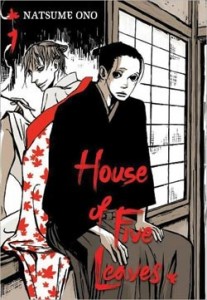
VIZ has been lobbying hard to make Ono’s name familiar to American readers, first with not simple, a story about an abused young drifter, and then with Ristorante Paradiso, a dramedy exploring the complicated relationship between Nicoletta, a twenty-something woman, and Olga, the mother who abandoned her. This fall, VIZ will release two more works by Ono: Gente: The People of Ristorante Paradiso (August) and House of Five Lives (September). Gente, the weaker of the two, is a three-volume prequel to Ristorante Paradiso that focuses less on Nicoletta and Olga and more on the bespectacled waitstaff at Cassetta dell’Orso, the trattoria owned by Olga’s husband. House of Five Leaves is a very different beast, a historical drama reminiscent of such films as Hara Kiri and The Twilight Samurai. Its hero, Akitsu Masanosuke, is a timid ronin who can’t hang on to a job; when a businessman approaches him with work, Masanosuke readily accepts, not realizing that Yaichi, his new employer, runs a crime syndicate that specializes in kidnapping.

Though Gente can be read independently of Ristorante Paradiso, readers unfamiliar with the earlier work may feel like they’ve walked into a party that’s already in progress, as many of the stories assume that the reader will be familiar with — and therefore interested in — Cassetta dell’Orso’s employees. One of the few chapters that works well for newbies and fans alike is “Luciano,” which explores the relationship between a widower and his daughter. The story succeeds because the dynamic between them feels authentic; the daughter’s persistence and gentle needling about finding a new partner is met with equally quiet resistance from her father.

Other stories, however, preserve the rhythms of everyday life with a little too much fidelity to be interesting. “Un giornata di Vito,” for example, consists primarily of a man talking, shopping, and doing crossword puzzles with an architecture student half his age, while “Il primo anniversario” depicts a luncheon for the restaurant’s employees; in the chapter’s only dramatic moment, a waiter injures his back and retires to the kitchen to lie down. A good author doesn’t need to contrive a Big Event to enliven a slice-of-life vignette, of course, but compelling dialogue helps, and it’s here that both stories stumble. The conversation tends towards the earnest and dull, with characters occasionally stating things about themselves in a bald, unnatural fashion that seems fundamentally at odds with Ono’s desire to let us learn about her characters from watching them walk through their daily routines.

house5House of Five Leaves, too, focuses less on Big Events and more on everyday activity, but in Leaves, Ono’s restraint serves an important dramatic purpose: she’s showing us events through Masanosuke’s eyes, as he tries to reconcile the bandits’ seemingly ordinary lives with their extraordinary behavior. Making the reader‘s task more difficult is that Masanosuke isn’t very astute. He tends to focus on a kind gesture or a friendly conversation, missing many of the important aural and visual cues that might enable him to understand what’s happening — a trait that the group exploits. In one chapter, for example, Yaichi encourages Masanosuke to accept a job as a bodyguard for a merchant family while the group plans its next kidnapping. Masa befriends his new employer’s son, never realizing that his true assignment is to infiltrate the target’s household so that Yaichi’s minions can snatch the boy for ransom.

Whether Masa will harden over time or cling to his desperate belief that the Five Leaves are engaged in an honorable enterprise remains to be seen. What is apparent, however, is that this naive, self-effacing man will eventually be provoked to violence. And when that happens, we’ll appreciate the meticulous way in which Ono has been building to that moment, as we’ll at have real sense of who Masa is, and why he’s been reluctant to pick up a sword. Though Toshiro Mifune and Hiroyuki Sanada have made entire careers out of playing characters like Masanosuke, Ono makes a persuasive case that you don’t need a flesh-and-blood actor to tell this kind of story with heartbreaking intensity; she can do the slow-burn on the printed page with the same skill and intensity as Masaki Kobayashi and Yoji Yamada did on the big screen.

Review copies provided by VIZ Media, LLC. Gente is available now; volume one of House of Five Leaves will be released on September 21, 2010. House of Five Leaves is currently being serialized on the SigIKKI website.

GENTE: THE PEOPLE OF RISTORANTE PARADISO, VOL. 1 • BY NATSUME ONO • VIZ • 176 pp. • RATING: OLDER TEEN (16+)

HOUSE OF FIVE LEAVES, VOL. 1 • BY NATSUME ONO • VIZ • 208 pp. • RATING: OLDER TEEN (16+)

Filed Under: Manga, Manga Critic, REVIEWS Tagged With: Natsume Ono, Samurai, Seinen, SigIKKI, VIZ

Gente and House of Five Leaves

August 20, 2010 by Katherine Dacey

I find Natsume Ono’s work rewarding and maddening in equal measure. On the plus side, I love her idiosyncratic style; her panels are spare and elegantly composed, with just enough detail to convey the story’s time and place. Her character designs, too, are a welcome departure from the youthful, homogenized look of mainstream shojo and shonen manga. Her people have sharp features and rangy bodies, yet inhabit their skins as comfortably as the proverbial pair of old shoes; it’s rare to see middle age depicted so gracefully. And speaking of middle age, her characters’ maturity is another plus, as they grapple with the kind of real-world problems — failed marriages, aging parents, child-rearing — that are almost never addressed in manga licensed for the US market.

On the minus side, Ono’s artwork is an acquired taste; the reader sometimes has to take it on faith that a particular character is handsome or pretty, as Ono’s children and twenty-somethings are less persuasively realized than her older characters. Then, too, Ono’s fondness for depicting everyday moments can rob her stories of any meaningful dramatic shape, creating long, meandering stretches where very little happens and even less is revealed about the characters. More frustrating still is her tendency to vacillate between allowing readers to interpret events for themselves and slapping readers across the face with a pointed observation, as if she doesn’t trust the audience to read the scene properly without a little authorial intervention.

…

Read More

Filed Under: Manga Critic Tagged With: Natsume Ono, Samurai, Seinen, SigIKKI, VIZ

Manga Artifacts: Lycanthrope Leo

August 15, 2010 by Katherine Dacey

Back in the 1980s and 1990s, before publishers realized that they could sell manga to teenagers through Borders and Books-A-Million, VIZ and Dark Horse actively courted the comic-store crowd with blood, bullets, and boobs. It was a golden age for manly-man manga — think Crying Freeman and Hotel Harbor View — but it was also a period in which publishers licensed some bad stuff. And when I say “bad stuff,” I mean it: I’m talking ham-fisted dialogue, eyeball-bending artwork, and kooky storylines that defy logic. Lycanthrope Leo (1997), an oddity from the VIZ catalog, is one such manga, a horror story with a plot that might best be described as Teen Wolf meets The Island of Dr. Moreau with a dash of WTF?!

The Leo of the title is Leo Takizawa, a high school student with a cute girlfriend and a gruff father. In the days leading up to his seventeenth birthday, he surprises his track teammates with an astonishing, world-record performance in the hundred-meter dash. Dad, noticing Leo’s dramatic transformation from speedy string-bean to Carl Lewis challenger, realizes that his worst fear is coming true: Leo is on the verge of turning into a lycanthrope, a powerful shape-shifter capable of rending a man limb from limb. So Dad does what all caring, self-respecting parents in his situation would do: he lures his son into an abandoned cabin in the woods, then attempts to shoot him with a fancy crossbow — but not before he gives a long, impassioned speech explaining what Leo is and why lycanthropes are mankind’s avowed enemy. Dad’s garrulousness proves his undoing; like so many villains, he spends too much time delivering an expository monologue and not enough time getting down to business, thus providing Leo opportunity to assume his true form and take Dad out with one blow of his werelion’s paw.

Yes, you read that right: Leo is a werelion. I admit the idea has potential; it liberates the author Kengo Kaji from the conventions of Western were-lore — the silver bullets and full moons and gypsies — while allowing him to milk the human/animal dichotomy for its full dramatic potential. Alas, Kaji extends the were-concept to other, less majestic animals for a subplot involving a centuries-old conflict between carnivore and herbivore lycanthropes. (The meat-eaters favor wiping out mankind; the cud-chewers prefer peaceable co-existence.) The nadir of the anything-is-more-awesome-in-were-form, however, is Mayuko Asuka, a sexy young teacher who turns out to be… a were-flying squirrel. And an evil were-flying squirrel, I might add, one who isn’t above seducing a seventeen-year-old or attacking a lycanthrope who threatens to reveal too much of the carnivores’ world-domination plans.

Kenji Okamura’s artwork is awe-inspiring and awful simultaneously. On the one hand, he draws amazingly detailed monsters, rendering their fur and claws and muscle-bound chests with exquisite care, even when they’re ripping each other to pieces; imagine Sylvester Stallone in werewolf drag, and you have some idea of what the male lycanthropes look like in their animal forms. On the other hand, Okamura’s human characters look like they belong in a Fernand Léger painting, with their plastic, impassive faces. Okamura struggles to convey emotion convincingly; about the best he can do is depict Leo sweating profusely. (By my count, Leo loses twenty to thirty pounds of water weight over the course of the first volume.) Worse still, Okamura frames almost every scene from an odd vantage point that distorts the characters’ anatomy, making them look ridiculously stumpy or leggy; I honestly thought Leo was being bullied by a midget in several scenes, thanks to the extreme angle at which we view Leo’s tormentor.

If you’re wondering why you haven’t heard more about Lycanthrope Leo, that’s because VIZ suspended production on the series after just one volume, citing poor sales. It’s not hard to imagine why Leo didn’t connect with American readers; the art has a throwback-to-the-eighties look, while the story is so preposterous and self-serious that it doesn’t work as straight horror or camp. From a reader’s standpoint, the most disappointing thing about Leo is the abruptness with which the English edition ends; Kaji introduces a key character in the final chapters of volume one, leaving readers to wonder whether the carnivores and herbivores eventually achieve detente. Of course, you probably won’t care if they do, considering all the sweaty, frantic silliness that precedes the introduction of the wise were-buffalo; for all the howling and “unsheathing of steel claws,” Lycanthrope Leo is about as scary as a kitten.

Manga Artifacts is a monthly feature exploring older, out-of-print manga published in the 1980s and 1990s. For a fuller description of the series’ purpose, see the inaugural column.

LYCANTHROPE LEO, VOL. 1 • STORY BY KENGO KAJI, ART BY KENJI OKAMURA • VIZ COMMUNICATIONS • 224 pp. • NO RATING (GRAPHIC VIOLENCE, NUDITY, STRONG LANGUAGE)

Filed Under: Manga, Manga Critic, REVIEWS Tagged With: Seinen, VIZ

Manga Artifacts: Lycanthrope Leo

August 15, 2010 by Katherine Dacey

lycanthrope1Back in the 1980s and 1990s, before publishers realized that they could sell manga to teenagers through Borders and Books-A-Million, VIZ and Dark Horse actively courted the comic-store crowd with blood, bullets, and boobs. It was a golden age for manly-man manga — think Crying Freeman and Hotel Harbor View — but it was also a period in which publishers licensed some bad stuff. And when I say “bad stuff,” I mean it: I’m talking ham-fisted dialogue, eyeball-bending artwork, and kooky storylines that defy logic. Lycanthrope Leo (1997), an oddity from the VIZ catalog, is one such manga, a horror story with a plot that might best be described as Teen Wolf meets The Island of Dr. Moreau with a dash of WTF?!

The Leo of the title is Leo Takizawa, a high school student with a cute girlfriend and a gruff father. In the days leading up to his seventeenth birthday, he surprises his track teammates with an astonishing, world-record performance in the hundred-meter dash. Dad, noticing Leo’s dramatic transformation from speedy string-bean to Carl Lewis challenger, realizes that his worst fear is coming true: Leo is on the verge of turning into a lycanthrope, a powerful shape-shifter capable of rending a man limb from limb. So Dad does what all caring, self-respecting parents in his situation would do: he lures his son into an abandoned cabin in the woods, then attempts to shoot him with a fancy crossbow — but not before he gives a long, impassioned speech explaining what Leo is and why lycanthropes are mankind’s avowed enemy. Dad’s garrulousness proves his undoing; like so many villains, he spends too much time delivering an expository monologue and not enough time getting down to business, thus providing Leo opportunity to assume his true form and take Dad out with one blow of his werelion’s paw.

Yes, you read that right: Leo is a werelion. I admit the idea has potential; it liberates the author Kengo Kaji from the conventions of Western were-lore — the silver bullets and full moons and gypsies — while allowing him to milk the human/animal dichotomy for its full dramatic potential. Alas, Kaji extends the were-concept to other, less majestic animals for a subplot involving a centuries-old conflict between carnivore and herbivore lycanthropes. (The meat-eaters favor wiping out mankind; the cud-chewers prefer peaceable co-existence.) The nadir of the anything-is-more-awesome-in-were-form, however, is Mayuko Asuka, a sexy young teacher who turns out to be… a were-flying squirrel. And an evil were-flying squirrel, I might add, one who isn’t above seducing a seventeen-year-old or attacking a lycanthrope who threatens to reveal too much of the carnivores’ world-domination plans.

Kenji Okamura’s artwork is awe-inspiring and awful simultaneously. On the one hand, he draws amazingly detailed monsters, rendering their fur and claws and muscle-bound chests with exquisite care, even when they’re ripping each other to pieces; imagine Sylvester Stallone in werewolf drag, and you have some idea of what the male lycanthropes look like in their animal forms. On the other hand, Okamura’s human characters look like they belong in a Fernand Léger painting, with their plastic, impassive faces. Okamura struggles to convey emotion convincingly; about the best he can do is depict Leo sweating profusely. (By my count, Leo loses twenty to thirty pounds of water weight over the course of the first volume.) Worse still, Okamura frames almost every scene from an odd vantage point that distorts the characters’ anatomy, making them look ridiculously stumpy or leggy; I honestly thought Leo was being bullied by a midget in several scenes, thanks to the extreme angle at which we view Leo’s tormentor.

If you’re wondering why you haven’t heard more about Lycanthrope Leo, that’s because VIZ suspended production on the series after just one volume, citing poor sales. It’s not hard to imagine why Leo didn’t connect with American readers; the art has a throwback-to-the-eighties look, while the story is so preposterous and self-serious that it doesn’t work as straight horror or camp. From a reader’s standpoint, the most disappointing thing about Leo is the abruptness with which the English edition ends; Kaji introduces a key character in the final chapters of volume one, leaving readers to wonder whether the carnivores and herbivores eventually achieve detente. Of course, you probably won’t care if they do, considering all the sweaty, frantic silliness that precedes the introduction of the wise were-buffalo; for all the howling and “unsheathing of steel claws,” Lycanthrope Leo is about as scary as a kitten.

Manga Artifacts is a monthly feature exploring older, out-of-print manga published in the 1980s and 1990s. For a fuller description of the series’ purpose, see the inaugural column.

LYCANTHROPE LEO, VOL. 1 • STORY BY KENGO KAJI, ART BY KENJI OKAMURA • VIZ COMMUNICATIONS • 224 pp. • NO RATING (GRAPHIC VIOLENCE, NUDITY, STRONG LANGUAGE)

Filed Under: Manga Critic Tagged With: Seinen, VIZ

  • « Go to Previous Page
  • Page 1
  • Page 2
  • Page 3
  • Page 4
  • Page 5
  • Page 6
  • Page 7
  • Go to Next Page »
 | Log in
Copyright © 2010 Manga Bookshelf | Powered by WordPress & the Genesis Framework