• Skip to primary navigation
  • Skip to main content
  • Skip to primary sidebar
  • Home
  • About Us
    • Privacy Policy
    • Comment Policy
    • Disclosures & Disclaimers
  • Resources
    • Links, Essays & Articles
    • Fandomology!
    • CLAMP Directory
    • BlogRoll
  • Features & Columns
    • 3 Things Thursday
    • Adventures in the Key of Shoujo
    • Bit & Blips (game reviews)
    • BL BOOKRACK
    • Bookshelf Briefs
    • Bringing the Drama
    • Comic Conversion
    • Fanservice Friday
    • Going Digital
    • It Came From the Sinosphere
    • License This!
    • Magazine no Mori
    • My Week in Manga
    • OFF THE SHELF
    • Not By Manga Alone
    • PICK OF THE WEEK
    • Subtitles & Sensibility
    • Weekly Shonen Jump Recaps
  • Manga Moveable Feast
    • MMF Full Archive
    • Yun Kouga
    • CLAMP
    • Shojo Beat
    • Osamu Tezuka
    • Sailor Moon
    • Fruits Basket
    • Takehiko Inoue
    • Wild Adapter
    • One Piece
    • After School Nightmare
    • Karakuri Odette
    • Paradise Kiss
    • The Color Trilogy
    • To Terra…
    • Sexy Voice & Robo
  • Browse by Author
    • Sean Gaffney
    • Anna Neatrour
    • Michelle Smith
    • Katherine Dacey
    • MJ
    • Brigid Alverson
    • Travis Anderson
    • Phillip Anthony
    • Derek Bown
    • Jaci Dahlvang
    • Angela Eastman
    • Erica Friedman
    • Sara K.
    • Megan Purdy
    • Emily Snodgrass
    • Nancy Thistlethwaite
    • Eva Volin
    • David Welsh
  • MB Blogs
    • A Case Suitable For Treatment
    • Experiments in Manga
    • MangaBlog
    • The Manga Critic
    • Manga Report
    • Soliloquy in Blue
    • Manga Curmudgeon (archive)

Manga Bookshelf

Discussion, Resources, Roundtables, & Reviews

Sci-Fi

Saturn Apartments, Vol. 1

May 16, 2010 by Katherine Dacey

If I’ve learned anything from my long love affair with science fiction, it’s this: there’s no place like home. You can boldly go where no man has gone before, you can explore new worlds and new civilizations, and you can colonize the farthest reaches of space, but you risk losing your way if you can’t go back to Earth again.

In Saturn Apartments, the physical distance between us and our terrestrial home is small, but the emotional distance is great. The story takes place in a future where environmental devastation has prompted humans to decamp the Earth’s surface for its atmosphere, where they build an elaborate structure that encircles the planet. That floating city resembles Victorian London in its rigid class system and physical organization: the poorest people live in its bowels, in an artificially lit environment, while the richest live on the uppermost levels, enjoying natural light and unspoiled views of Earth.

Our guide to this stratified world is fourteen-year-old Mitsu, a professional window washer who lives on the lowest level. By virtue of his job, Mitsu has access to the entire city. For a boy who’s joined the workforce at an early age, who lives in a cramped room with few possessions, and whose neighbors suffer the ill effects of chronic light deprivation, his clients, most of whom live on the top floors, seem ridiculous and exacting. At the same time, however, they intrigue Mitsu; not only do they give him a glimpse into a more affluent way of life, they also own things — animals, machines, plants — that connect them to the Earth’s abandoned surface.

As these organisms and objects suggest, all of Saturn‘s characters suffer a strong sense of terrestrial homesickness. Midway through volume one, for example, Mitsu meets an eccentric zoologist who maintains an enormous private aquarium in his apartment. The man’s aquarium and his bizarre request that Mitsu splash water on the windows — something that’s impossible to do at an altitude of 35,000 kilometers — initially seem like a wealthy man’s whims; that is, until Mitsu learns that the zoologist is trying to create a more congenial environment for the aquarium’s prized specimen, the last surviving whale from a failed effort to reintroduce mammals into Earth’s oceans.

In other chapters, the characters’ longing to go home is more palpable. When Mitsu tackles his first assignment, for example, he finds himself at the very site where his father Akitoshi, also a window-washer, plunged to his death. Mitsu sees evidence of his father’s presence — a frayed rope, handprints on the side of the building — and though he interprets the evidence as proof of Akitoshi’s desperate struggle for survival, Mitsu is briefly seized by the thought that his father wanted to die, that Akitoshi cut the safety line so that he might fall back to Earth. Mitsu himself struggles with that same impulse; caught off guard by a strong solar wind, he finds himself dangling precariously above the Earth, mesmerized by the sight of the African continent spreading below him:
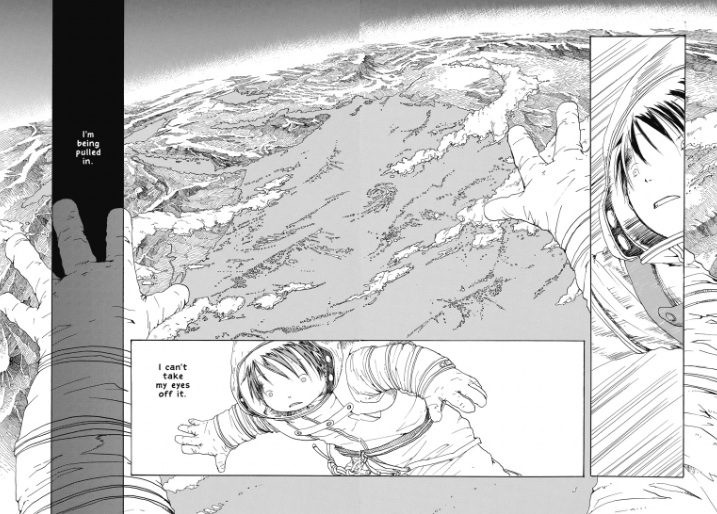
saturn_earth

Only the intervention of Jin, an experienced co-worker, snaps Mitsu out of his dangerous reverie and spurs the boy to take corrective action. Once safely tethered to a lift, however, Mitsu peers over the side for another glimpse of the surface, resolving to one day “find the spot down there where Dad landed.”

Like Planetes, Saturn Apartments is less a tale of intergalactic derring-do than of ordinary people doing extraordinarily dangerous, tedious work in extreme environments. Most of what we learn about the characters comes from observing them on the job, as they banter with co-workers, perform routine tasks, and respond to crises. In Saturn Apartments, Akitoshi’s death — an event that took place five years before the story begins — casts a long shadow over the window washer’s guild. The mystery of what happened to Akitoshi plays an important role in advancing the plot, to be sure, but most of the story explores the way in which Mitsu comes to terms with his father’s death through learning Akitoshi’s profession and befriending Akitoshi’s colleagues.

The other thing that Saturn Apartments and Planetes have in common is beautiful, detailed artwork that conveys a strong sense of place. Hisae Iwaoka’s landscapes bustle with activity, showing us how the apartment dwellers go about their daily business. Each level has its own distinctive appearance, from the basement tenements — where Mitsu and Jin live — to the middle level — a tidy grid of schools and mid-rise buildings dotted with grassy parks — to the very top — a collection of spacious lofts with enormous windows. Iwaoka renders all of these environments in gently rounded, slightly imperfect lines that make the complex look warmly inviting, rather than sterile and prefabricated; even the very lowest levels of the complex are appealing, their close yet friendly quarters reminiscent of fin-de-siecle Delancey and Mulberry Streets.

Saturn Apartments is many things — a coming-of-age story, a set of character studies, a meditation on man’s place in the greater universe — but like all good space operas, its real purpose is to affirm the truth of T.S. Eliot’s words, “We shall not cease from exploration/And the end of all our exploring/Will be to arrive where we started/And know the place for the first time.” Highly recommended.

Review copy provided by VIZ Media, LLC. Volume one of Saturn Apartments will be released on May 18, 2010. To read the first eight chapters online, visit the SigIKKI website.

SATURN APARTMENTS, VOL. 1 • BY HISAE IWAOKA • VIZ • 192 pp. • TEEN (13+)
Filed Under: Manga, Manga Critic, REVIEWS Tagged With: Sci-Fi, SigIKKI, VIZ

Twin Spica, Vol. 1

May 3, 2010 by Katherine Dacey

Asumi Kamogawa is a small girl with a big dream: to be an astronaut on Japan’s first manned space flight. Though she passes the entrance exam for Tokyo Space School, she faces several additional hurdles to realizing her goal, from her child-like stature — she’s thirteen going on eight — to her family’s precarious financial position. Then, too, Asumi is haunted by memories of a terrible fire that consumed her hometown and killed her mother, a fire caused by a failed rocket launch. Yet for all the pain in her young life, Asumi proves resilient, a gentle girl who perseveres in difficult situations, offers friendship in lieu of judgment, and demonstrates a preternatural awareness of life’s fragility.

If Asumi sounds like a stereotypically optimistic manga character, a can-do kid who maintains a positive attitude through every set-back, the first volume of Twin Spica reveals her to be more complex and damaged than her firm resolve might suggest. Mr. Lion, her imaginary friend, is proof of the wounds she carries: she “met” him when she was six, never quite outgrowing the need for his counsel or company. When Asumi suffers a traumatic flashback to the Yuigahama disaster, for example, she calls out Mr. Lion’s name; when her father responds angrily to the news that she passed the space academy’s placement test, she asks Mr. Lion if she should enroll or abandon her dream of becoming “a driver on a rocket.”

Though Asumi’s story ran in Comic Flapper, a seinen magazine, Twin Spica works surprisingly well for both adults and teens. The storytelling is direct and simple without being didactic, filled with the kind of characters that younger readers will recognize and embrace as true to their own experiences. At the same time, however, Twin Spica‘s subtexts are rich enough to sustain an adult’s interest, as the supplemental stories “2015: Fireworks” and “Asumi” attest. Both explore Asumi’s response to her mother’s death, acknowledging and validating Asumi’s curiosity about her mother’s appearance (Mom suffered disfiguring burns) and about dying itself. (Six-year-old Asumi scandalizes funeral-goers by leaning over her mother’s casket to see what death “smells like.”) Without a trace of mawkishness, Yaginuma shows us how Asumi makes sense of what happened to her mother, recognizing his young heroine’s keen emotional intelligence in the way she chooses to honor her mother’s memory. Tween and teen readers may well find these passages moving, as they touch on one of childhood’s most primal fears, but adult readers will find them more unsettling, as they remind us of our inability to protect children from painful experiences, and of the moment when we first grasped death’s finality.

The artwork, like the narrative, has a direct, expressive quality that keeps the focus on the characters’ interactions, rather than the gizmos and laboratories where their training takes place. Yaginuma draws his tyro astronauts in a simple, stylized fashion that treats them as collection of distinctive geometric shapes: Fuchuya, one of Asumi’s classmates, sports a ‘do evocative of Eero Saarinen’s iconic TWA terminal, while Asumi resembles a kokeshi doll with her exaggerated round head and tiny body. The characters’ slightly awkward proportions register as a deliberate artistic choice — call it studied naivete or primitivism — though at times the art seems a little clumsy and flat; readers will be forgiven for thinking Yusinuma’s storytelling skills outstrip his draftsmanship.

Whatever conclusions the reader reaches about Yusinuma’s style, it’s impossible to deny the emotional power of Twin Spica as a coming-of-age story about one girl’s journey from childhood to adulthood, and one nation’s journey from terrestrial power to space race competitor. A beautiful, thought-provoking book for star gazers of all ages.

Review copy provided by Vertical, Inc. Volume one of Twin Spica will be released on May 4, 2010.

TWIN SPICA, VOL. 1 • BY KOU YAGINUMA • VERTICAL, INC. • 192 pp. • NO RATING

Filed Under: Manga, Manga Critic, REVIEWS Tagged With: Sci-Fi, Space Exploration, Vertical Comics

20th Century Boys, Vols. 1-6

January 9, 2010 by Katherine Dacey

Do you remember those first, glorious seasons of Heroes and Lost? Both shows promised to reinvigorate the sci-fi thriller with complex, flawed characters and plots that moved freely between past, present, and future. By the middle of their second seasons, however, it was clear that neither shows’ writers knew how to successfully resolve the conflicts and mysteries introduced in the first, as the writers resorted to cheap tricks — the out-of-left-field personality reversal, the all-too-convenient coincidence, and the arbitrary let’s-kill-off-a-character plot twist — to keep the myriad plot lines afloat, alienating thousands of viewers in the process. Heroes and Lost seemed proof that even the scariest doomsday scenario would fall flat if saddled with too many subplots and secondary characters.

Reading Naoki Urasawa’s 20th Century Boys, however, convinced me that it is possible to tell a twisty, layered story about ordinary people saving the world from annihilation without succumbing to cliche or unduly testing the audience’s patience. The key to Urasawa’s success? A strong script with vivid characters and a clear sense of purpose, reassuring the reader that all the plot strands are just that: strands, not loose threads.

In 20th Century Boys, humanity’s future rests in the hands of an unpromising lot. There’s Kenji, a college dropout who runs a convenience store; Maruo, a cheerful, plump soul who owns a shop down the street from Kenji; Yoshitune, a shy, bespectacled office man; Otcho, a scruffy renegade who’s been living off the grid in Thailand; and Yukiji, a K-9 officer who can’t control her drug-sniffing dog. All five were childhood friends, members of a secret club that wrote The Book of Prophecy, an elaborate doomsday scenario involving superheroes and giant robots. Now in their thirties, the gang has disbanded — that is, until their pal Donkey, a high-school science teacher, leaps to his death off a building.

Or did he? As Kenji begins pushing for answers, he discovers that Donkey was investigating a mysterious cult, known only as The Friends, that had appropriated the club’s “official” symbol. The more Kenji probes, the more parallels he discovers between The Friends’ clandestine activities and the Book of Prophecy, parallels that suggest the cult is headed by one of Kenji’s old schoolmates. Terrified that The Friends will attempt to recreate the story’s climatic battle, Kenji tracks down his clubmates one by one, assembling a small army to oppose the cult.

20thcentury4From the very first pages of volume one, Urasawa demonstrates an uncommon ability to move back and forth in time, juxtaposing scenes from Kenji’s past with brief glimpses of the future. The success of these scenes is attributable, in part, to Urasawa’s superb draftsmanship, as he does a fine job of aging his characters from their long-limbed, baby-faced, ten-year-old selves into thirty-somethings weighed down by adult responsibilities.
The integrity of Urasawa’s characterizations also contribute to the success of these temporal leaps; his characters’ adult behavior jives with what we know about them from childhood flashbacks. Otcho, for example, was the club’s most worldly member, the kid who introduced his pals to rock-n-roll and gave them the lowdown on Woodstock; it’s not surprising to see him reincarnated as a long-haired thug-for-hire who despises authority. Ditto for Yanbo and Mabo, twins who terrorized Kenji and friends back in the day. When Yanbo and Mabo resurface in volume five, Urasawa gives them a more pleasing appearance and demeanor than we might have expected, luring us into a false sense that they’ve outgrown their bullying ways. Urasawa then slaps us on the wrist for not trusting our original assessment of the twins, uncorking a fiendish plot twist that’s in keeping with what we already knew about them.

Urasawa uses these flashbacks and flash-forwards to build a dense network of connections among his characters, gradually revealing how and why Kenji’s childhood fantasies are providing the blueprint for a real-life apocalyptic scenario. Heroes and Lost attempted to do the same thing, but neither show succeeded in convincing us that those connections were lying just below the surface waiting for us to discover them; those connections had an arbitrary, bolt-from-the-blue quality. With 20th Century Boys, however, Urasawa makes us feel that we might have unearthed these links without any editorial guidance, as even the most surprising developments still make sense within the story’s elaborate framework.

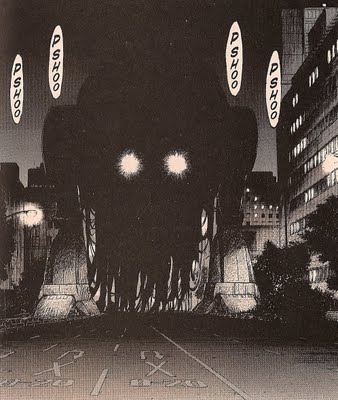
What gives the story its sense of urgency is Urasawa’s ability to create and sustain a strong sense of fear and anticipation. Six volumes into 20th Century Boys, we’ve had a few tantalizing glimpses of the robot that menaces Tokyo on the eve of the millennium, but we still don’t know what it looks like or what it can do. Urasawa has only shown us the enemy in silhouette:

20thcentury_robot

It’s a point I’ve raised in other reviews: an unseen menace is much scarier than one that’s routinely trotted out of the shadows to spook us. Consider the difference between Jaws and its sequels. In the original, Steven Spielberg hinted at the shark’s presence, showing us a dorsal fin or a dark outline moving rapidly beneath the water’s surface, but withholding the “money” shot (“tooth” shot, perhaps?) until the third reel. The few times that we see Jaws attack are genuinely scary because they finally put us face-to-face with those terrible teeth and dead eyes, confirming just how deadly the shark really is. In the sequels, however, the shark is featured prominently; we see it dine on boaters and swimmers in lurid detail. We may marvel at the stupidity of the shark’s victims, or feel disgusted by the gallons of fake blood, but we never feel scared, as we know what we’re up against from the very first scenes.

Urasawa takes a page from Spielberg’s book, showing us just enough of the robot’s form to engage our imagination. The robot’s silhouette hints at its size and strength; if anything, it looks like an enormous man-o-war lumbering through Tokyo. But what stays with us are those fierce, penetrating headlights, so evocative of a prison searchlight or a pair of eyes. As David Ford observes at Are You a Serious Comic Book Reader?, we feel a palpable sense of despair when we see the robot: how can Kenji hope to escape its all-seeing gaze? (By the way, I highly encourage you to read Ford’s essay, though spoiler-phobes should stay away until they’ve finished volume five.)

With more than ten volumes left in 20th Century Boys, I have no idea how Urasawa plans to tie all of the stories’ threads together. I’m confident, however, that he’ll do so with the skill of a master weaver, seamlessly incorporating all of the relationships, plot twists, and motives into an intricate, beautiful tapestry.

Review copies provided by VIZ Media, LLC. Volume seven will be released on February 10, 2010.

20TH CENTURY BOYS, VOLS. 1-6 • BY NAOKI URASAWA • VIZ • RATING: OLDER TEEN (16+)

Filed Under: Manga, Manga Critic, REVIEWS Tagged With: Naoki Urasawa, Sci-Fi, Thriller, VIZ, VIZ Signature

Manga Artifacts: Domu: A Child’s Dream

October 25, 2009 by Katherine Dacey

Revisiting AKIRA prompted me to re-read Domu: A Child’s Dream, an earlier work that helped cement Katsuhiro Otomo’s reputation as the leading manga-ka of his generation. Though both series include elements of horror and science fiction, the two are utterly different in approach: AKIRA is sweeping, grand, and allegorical, whereas Domu is compact, a taut psychological thriller that unfolds in a mere 230 pages.

Domu begins like a police procedural: an older detective and his hot-headed young partner arrive at a Tokyo apartment complex to investigate a series of deaths. Though the victims’ histories suggest foul play rather than suicide, the detectives are baffled by the crime scenes: all of the victims have jumped off rooftops or slashed their own throats, with no evidence of anyone watching or aiding them. A few tantalizing clues lead investigators to “Old Cho,” a seemingly benign, senile resident who spends most of his time sitting on a bench and muttering. Inspectors Yamagawa and Tamura can’t connect Cho to the crimes, but Etsuko, a stolid little girl who has just moved into the complex, knows how Cho killed them: telekinesis and hypnotic suggestion.

What follows is an intensely creepy cat-and-mouse game between Etsuko and Cho. Though Cho is nominally an adult, his mind is terrifyingly child-like; he kills his neighbors for their “treasures”: a baseball cap with wings, a fake ruby ring, an umbrella, a stuffed toy. Cho initially regards Etsuko as an impediment to his fun, but when he discovers that Etsuko can also move objects with her mind, he begins testing her strength and sense of morality. Their battle begins in the narrow hallways and dim elevator shafts of Etsuko’s building, but quickly consumes the entire complex as Cho attempts to annihilate Etsuko.

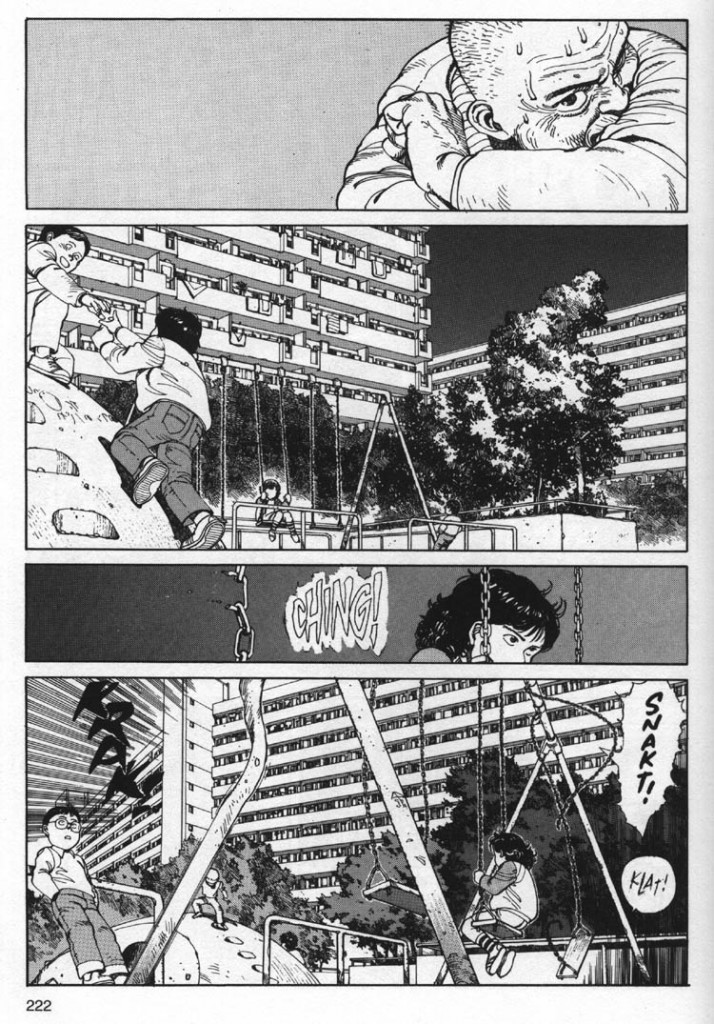
domu_page

Though I found the artwork for AKIRA a bit dated, a relic of a particular moment in sci-fi history, Domu seemed less mired in the 1980s. The characters are refreshingly realistic in their appearance; Cho actually looks like an eighty-year-old man, with a stooped frame, a deeply-etched face, and liver-spotted hands, while Etsuko’s plump cheeks and slightly awkward proportions seem appropriate for an eight-year-old. Otomo lavishes similar attention on his bit players, too, giving each apartment dweller a distinctive look that speaks volumes about his economic status, age, and fear of being swept up in Yamagawa and Tamura’s murder investigation. Even the apartment complex functions as a kind of character, a sterile collection of high-rise buildings whose imposing exteriors give way to dark, dingy interiors and cramped apartments. As Otomo guides us through its labyrinthine hallways and stairwells, we feel a palpable sense of dread; the complex is filled with the kind of dead ends and blind spots that feature prominently in our worst nightmares.

Domu would be a solid, if not remarkable, thriller on the strength of its artwork alone, but Etsuko’s predicament gives the story an added jolt of energy and terror. She’s the strongest, most adult character in the story, the only one with a clear sense of what’s happening, and the only one powerful enough to stop Cho. Making her plight more compelling is the fact that Etsuko behaves like an eight-year-old who just happens to have a deadly gift, rather than a god-like creature who just happens to be eight years old; she’s small and vulnerable, eager for the comfort of her mother’s arms, but she’s also fiercely moral and incredibly brave in the face of nightmarish events, a child whose natural desire to set things right is cruelly tested by a childish adult.

N.B. Domu has been out of print for several years, though copies are relatively easy to find through eBay and Amazon’s extended seller network. Dark Horse released Domu in several formats, including three slim TPBs and an omnibus edition.

DOMU: A CHILD’S DREAM • BY KATSUHIRO OTOMO • DARK HORSE • NO RATING (RECOMMENDED FOR OLDER TEENS)

Filed Under: Manga, Manga Critic, Recommended Reading, REVIEWS Tagged With: Classic, Dark Horse, Katsuhiro Otomo, Sci-Fi

Jyu-Oh-Sei, Vols. 1-3

August 14, 2009 by Katherine Dacey

In the year 2346 A.D., humans have colonized the Vulcan solar system, a region so inhospitable that the average life span is a mere thirty years. Rai and Thor, whose parents belong to Vulcan’s ruling elite, enjoy a life of rare privilege — that is, until a political rival executes their parents and exiles the boys to Kimaera, a penal colony reserved for violent criminals. To say Kimaera’s climate is harsh understates the case: daylight lasts for 181 days, producing extreme desert conditions and water shortages, while nighttime plunges Kimaera into arctic darkness for an equal length of time. Making the place even more treacherous is the flora, as Kimaera’s jungles team with carnivorous plants capable of eating men whole.

On the planet’s surface, Rai and Thor discover a tribal society based on physical strength and skin color. Four tribes, or “rings,” as they’re known, provide their members food and protection from the extreme climate, but there’s a catch: each person must prove himself strong enough to defend the ring from encroachment by rival factions. The strife within rings is mirrored in the uneasy relationship among the tribal leaders, a motley assortment of criminals, ex-military men, and native Kimaeran women. The ring leaders compete to become the Beast King, Kimaera’s official representative in the Vulcan government and the only person allowed to leave the planet’s surface.

Sensing an opportunity to upset the uneasy truce that exists among the Blanc, Noir, Ochre, and Sun Rings, several unscrupulous figures encourage Thor to fight his way up the ranks to become the Beast King — his best (and perhaps only) opportunity for escaping Kimaera and finding out why his parents were murdered. Aiding him is Tiz, a tough, resourceful Kimaeran girl who wants Thor for a mate. (In a nice change of pace, women choose their partners, a request men can’t decline.)

Natsumi Itsuki does a superb job of world-building in volume one, striking the right balance between exposition and action. The plot twists come fast and furious, but they feel like a natural outgrowth of the situations the characters find themselves in, rather than an arbitrary decision to move the story in a particular direction. Only in the third and final volume do things begin to fall apart; the first hundred pages are filled with talking heads explaining Kimaera’s true purpose (hint: it involves evil scientists), revealing Thor’s identity, and waxing philosophic about whether mankind should be allowed to become extinct. Perhaps sensing that the story was beginning to sag under the weight of its own pretentiousness, Itsuki then stages a lengthy, exciting battle that pits Thor against those infamous, man-eating plants and a super-computer of HAL-like malevolence.

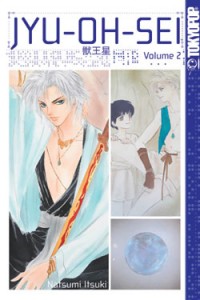
9781427810168-1Though the story is well-executed, the artwork is something of a disappointment. Itsuki goes to great pains to create a diverse cast — a task at which she’s generally successful — but her character designs are generic and dated; I’d be hard-pressed to distinguish the Kimaerans from, say, the cast of RG Veda or Basara. Itsuki also struggles with skin color; her dark-skinned women bear an unfortunate resemblance to kogals, thanks to Itsuki’s clumsy application of screentone.

More disappointing are Itsuki’s fight scenes: they register as scratchy messes, thanks to her over-reliance on speedlines and trapezoidal panels. The third volume, for example, consists of several lengthy scenes of hand-to-hand combat in which all of the action is suggested by superimposing horizontal lines on close-ups of contorted faces; we never get a clear sense of where the characters are standing in relation to one another, nor do we always have a clear sense of where the action is unfolding.

Tokyopop has done a good job of presenting Jyu-Oh-Sei. The manga was originally released in five volumes; Tokyopop wisely repackaged the story in omnibus format to allow Jyu-Oh-Sei‘s lengthy and complicated story arcs to unfold without significant interruption. The translation is clear and idiomatic, even when the characters are called upon to speak in unadulterated Science Fiction. The only downside to Tokyopop’s presentation is the paperstock: as many readers have observed, it’s thin and greyish, like newsprint, and allows images to bleed through the page.

Aside from a third-act detour into sci-fi pomposity, Jyu-Oh-Sei is a solid, entertaining read: think B-movie in manga form. Like Invasion of the Body Snatchers and District 9, Jyu-Oh-Sei addresses social taboos — race, gender roles — and scientific issues — genetic engineering, environmental devastation — while serving up generous portions of what audiences crave: action, romance, monsters, explosions. Best of all, Jyu-Oh-Sei comes in a neat, three-volume package that’s long enough to allow for world-building and character development but short enough to stay fresh and surprising until the end. It’s the perfect summer escape, minus the sticky floors, endless previews, and seven dollar buckets of popcorn.

This review is an expanded version of an earlier review posted at PopCultureShock. My original review of volume one can be found here.

Review copy of volume one provided by Tokyopop.

JYU-OH-SEI, VOLS. 1-3 • BY NATSUMI ITSUKI • TOKYOPOP • RATING: TEEN

Filed Under: Manga, Manga Critic, REVIEWS Tagged With: Natsumi Itsuki, Sci-Fi, Tokyopop

Samurai 7, Vol. 1

April 29, 2009 by Katherine Dacey

Remake or retread? That’s the question facing critics whenever someone updates a classic novel or favorite film, be it Pride and Prejudice or The Taking of Pelham One Two Three. A remake brings new urgency or wit to the original story, new clarity to its structure, or new life to a premise that, by virtue of social or technological change, seems dated—think of Philip Kaufman’s The Invasion of the Body Snatchers, which infused a 1950s it-came-from-outer-space story with a healthy dose of seventies paranoia, or Alfred Hitchcock’s 1955 version of The Man Who Knew Too Much, which featured a leaner, meaner script than his 1934 original. Retreads, on the other hand, evoke the letter but not the spirit of the originals, embellishing their plots with fussy details, slangy dialogue, or new characters without adding anything of value—think of Ethan and Joel Coens’ deep-fried version of The Ladykillers, which was louder, cruder, and longer than the 1955 film, yet decidedly less funny.

Samurai 7, a mangafication of Akira Kurosawa’s The Seven Samurai, falls somewhere between these poles, treating the source material respectfully without adding anything particularly new or interesting to the mix. The basic plot remains the same: a poor rural village hires seven samurai to protect them from a band of thugs who steal their rice and enslave their womenfolk. Though the manga takes minor liberties with the main characters—one is a headless cyborg, one is a bishonen who always seems to be falling out of his yukata—the samurai bear a strong resemblance to Kurosawa’s original crew, both in terms of their personalities and functions within the group. The manga also preserves the war-ravaged atmosphere of the original, substituting a robot-fueled world war for the carnage caused by sixteenth-century daimyo.

Such fidelity to the source material proves Samurai 7’s undoing, however, as it underscores just how lackluster this adaptation really is. The story unfolds in fits and starts, bogging down in lame comedy and windy speeches that stall the samurai’s inevitable posse formation. Though the fight scenes are competently executed, the artwork has a sterile, perfunctory quality, as if the layouts and character designs were traced from four or five different sources. The mecha elements seem especially incongruous when juxtaposed with the story’s sixteenth-century costumes, buildings, and weaponry; there’s never any compelling rationale for their inclusion, save a desire to surpass the original film’s “wow” factor.

I offer these criticisms not because I view Kurosawa’s original as a sacred text, but because Samurai 7’s creators made such a calculated, unimaginative effort to sex up the material for a new generation of fans. Alas, no amount of bitchin’ gadgetry can compensate for poor pacing, generic artwork, or flat characterizations, even if later volumes promise more samurai-on-robot action. My suggestion: skip the manga and rent the original film. Toshiro Mifune is much fiercer than anything in this samurai-lite adaptation.

SAMURAI 7, VOL. 1• BY MIZUTAKA SUHOU • DEL REY • 224 pp. • RATING: OLDER TEEN (16+)

Filed Under: Manga, Manga Critic, REVIEWS Tagged With: Action/Adventure, Akira Kurosawa, Anime Adaptation, del rey, Samurai, Sci-Fi, Seven Samurai

  • « Go to Previous Page
  • Page 1
  • Page 2
  • Page 3
 | Log in
Copyright © 2010 Manga Bookshelf | Powered by WordPress & the Genesis Framework