• Skip to primary navigation
  • Skip to main content
  • Skip to primary sidebar
  • Home
  • About Us
    • Privacy Policy
    • Comment Policy
    • Disclosures & Disclaimers
  • Resources
    • Links, Essays & Articles
    • Fandomology!
    • CLAMP Directory
    • BlogRoll
  • Features & Columns
    • 3 Things Thursday
    • Adventures in the Key of Shoujo
    • Bit & Blips (game reviews)
    • BL BOOKRACK
    • Bookshelf Briefs
    • Bringing the Drama
    • Comic Conversion
    • Fanservice Friday
    • Going Digital
    • It Came From the Sinosphere
    • License This!
    • Magazine no Mori
    • My Week in Manga
    • OFF THE SHELF
    • Not By Manga Alone
    • PICK OF THE WEEK
    • Subtitles & Sensibility
    • Weekly Shonen Jump Recaps
  • Manga Moveable Feast
    • MMF Full Archive
    • Yun Kouga
    • CLAMP
    • Shojo Beat
    • Osamu Tezuka
    • Sailor Moon
    • Fruits Basket
    • Takehiko Inoue
    • Wild Adapter
    • One Piece
    • After School Nightmare
    • Karakuri Odette
    • Paradise Kiss
    • The Color Trilogy
    • To Terra…
    • Sexy Voice & Robo
  • Browse by Author
    • Sean Gaffney
    • Anna Neatrour
    • Michelle Smith
    • Katherine Dacey
    • MJ
    • Brigid Alverson
    • Travis Anderson
    • Phillip Anthony
    • Derek Bown
    • Jaci Dahlvang
    • Angela Eastman
    • Erica Friedman
    • Sara K.
    • Megan Purdy
    • Emily Snodgrass
    • Nancy Thistlethwaite
    • Eva Volin
    • David Welsh
  • MB Blogs
    • A Case Suitable For Treatment
    • Experiments in Manga
    • MangaBlog
    • The Manga Critic
    • Manga Report
    • Soliloquy in Blue
    • Manga Curmudgeon (archive)

Manga Bookshelf

Discussion, Resources, Roundtables, & Reviews

Novels

Boogiepop Returns: VS Imaginator, Part 2

November 19, 2014 by Ash Brown

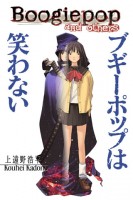
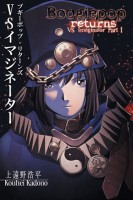
Boogiepop Returns: VS Imaginator, Part 2Author: Kouhei Kadono
Illustrator: Kouji Ogata

Translator: Andrew Cunningham
U.S. publisher: Seven Seas
ISBN: 9781933164236
Released: October 2006
Original release: 1998

Boogiepop Returns: VS Imaginator, Part 2 is the third volume in the Boogiepop light novel series written by Kouhei Kadono and illustrated by Kouji Ogata. It is also the third out of four Boogiepop novels to have been released in English. Translated by Andrew Cunningham, the second part of Boogiepop Returns was published by Seven Seas in 2006. In Japan, the volume was released in 1998, the same year as the first two books in the series. Boogiepop Returns is actually a two-part story, and so after reading the first novel in the arc I was particularly anxious to read the second. With all of the setup and steadily increasing tension in the first part, the story needed a conclusion and the final volume of the arc promised to deliver just that. Boogiepop is kind of an odd series which freely mixes the surreal with the real, making use of multiple genres in the process. But it’s also a series that I find peculiarly appealing because of that and because of its willingness to explore the more troubling aspects of the psyche.

A year ago a young woman committed suicide under the influence of an entity known only as the Imaginator. Her life was ended when, being pursued by Boogiepop, the Imaginator failed to change the world through her. But now the Imaginator has returned to inspire yet another person, this time with much greater success. Asukai Jin, with the Imaginator as a catalyst, has begun to use his unique abilities to not only read the hearts of other people but to manipulate them as well. Meanwhile, the mysterious Towa Organization also has a vested interest in the direction humankind is taking. Spooky E, a synthetic human and one of its agents, is actively hunting Boogiepop in order to prevent the spirit’s interference with the organization’s affairs. In an effort to draw Boogiepop out, he has arranged for the love-besotted Taniguchi Masaki to serve as a decoy by impersonating Boogiepop. Masaki didn’t initially realize he was being used as a pawn, and even if he had there was very little he could do to stop the developing crisis.

Despite the title being Boogiepop Returns, the real Boogiepop actually plays a very small albeit very important role in the two novels and is mostly relegated to the edges of the narrative while the other players take center stage. Granted, when Boogiepop finally does make an entrance during the second volume’s finale, it’s pretty spectacular. But until then the story largely follows the more mundane characters, the seemingly normal teenagers who have been caught up in the battle over the fate of humanity and who frequently are the victims of the supernatural and superhuman forces at work. At the same time, they are also dealing with their own personal issues and troubled relationships. In many ways I actually found these smaller struggles to be more emotionally immediate than the novel’s grander schemes, probably because they’re more relatable and the more realistic elements help to ground the stranger aspects of the Boogiepop series.

The doomed love story between Masaki and the girl he likes, Orihata Aya, has always been an important part of Boogiepop Returns but it become especially prominent in the second volume. It is because of his love for her that he “becomes” Boogiepop, his feelings and the burgeoning romance becoming closely entwined with the larger events of the novel. The second part of Boogiepop Returns has some fantastic fights and action sequences, but the  novel also has deeper contemplative and philosophical aspects to it as well. Employing the trappings of science fiction and the supernatural, the Boogiepop novels explore thought-provoking themes of free will, personal identity, the individual’s place within society, sacrifice, and what it truly means to be human. The characters are all damaged or suffering in some way but it’s how they choose to live their lives despite that pain that makes them who they are and makes Boogiepop Returns such an interesting and at times even compelling story.
Filed Under: REVIEWS Tagged With: Boogiepop, Kouhei Kadono, Kouji Ogata, Light Novels, Novels, Seven Seas

Boogiepop Returns: VS Imaginator, Vol. 1

October 24, 2014 by Ash Brown

Boogiepop Returns: VS Imaginator, Part 1Author: Kouhei Kadono
Illustrator: Kouji Ogata

Translator: Andrew Cunningham
U.S. publisher: Seven Seas
ISBN: 9781933164205
Released: June 2006
Original release: 1998

After reading Boogiepop and Others, I knew that I needed to read the rest of Kouhei Kadono’s Boogiepop light novel series, or at least all of the volumes that had been released in English. Sadly, out of the more than a dozen volumes, only four of the novels were ever translated and it is unlikely that any others will be. Boogiepop Returns: VS Imaginator, Part 1 is the second Boogiepop novel and the first volume in a two-part story arc. The novel was originally published in Japan in 1998, the same year that the award-winning Boogiepop and Others was released. The English translation of the first part of Boogiepop Returns by Andrew Cunningham was published by Seven Seas in 2006. Seven Seas was also the publisher that released the other three Boogiepop novels available in English as well as some of the Boogiepop manga adaptations (which I have yet to read). Technically, all of those Boogiepop books have gone out of print, but fortunately most of the volumes are still fairly easy to find.

When she was only seventeen, Minahoshi Suiko plummeted from the rooftop of Shinyo Academy. Initially it was believed to have been a suicide, but rumors start circulating among the students that it may have been murder or perhaps something even more sinister, something that is compelling others to follow in Minahoshi’s footsteps. It wouldn’t be the only time that Shinyo Academy has faced inhuman and supernatural influences resulting in tragedy and death. Asukai Jin is a counselor at a local cram school which is attended by several Shinyo Academy students. He seems to be able to look into the hearts of those seeking his aid, offering advice that is uncannily appropriate for each student and their specific situations. The odd ability which allows Asukai to see the flaws of others while being blind to his own has drawn the attention of the same forces a work at Shinyo Academy. The only thing that stands in the way of those forces is the fabled spirit of death Boogiepop, but there are those who are hunting Boogiepop down in order to prevent any sort of interference.

One of the things that I particularly enjoyed about Boogiepop and Others was its narrative structure, and so I was happy to see the first part of Boogiepop Returns use a similar one. Specifically, the story continues to be seen from the perspective of multiple characters, although in this volume the chronology is slightly less disjointed overall. The events in Boogiepop Returns take place both before and after those in Boogiepop and Others. (A handy timeline included in the back of the volume helps to make this all clear.) Although the plots of each novel aren’t directly related, the events of the first are alluded to in the second and both volumes do share some of the same characters. However, the importance of the characters’ individual roles has shifted somewhat. Taniguchi Masaki, for example, was a side character in the first Boogiepop novel; he wasn’t much more than a stepbrother to another important character. But in Boogiepop Returns he is one of the leads in the volume’s ill-fated love story.

The Boogiepop series has a fascinating mix of genres–science fiction, horror, mystery, and even a bit of romance all make an appearance in the novels. There are strong psychological elements and strange and bizarre occurrences, too. I didn’t find the second Boogiepop novel to be quite as dark as the first, but it could still be thoroughly disconcerting and it was consistently engaging. Because Boogiepop Returns is a two-part arc, most of the first volume is spent setting the stage and introducing the major players. At this point the significance of some of the events is still unclear and far more questions have been raised than have been answered. It’s difficult to say just exactly what is going on and perhaps even more challenging to anticipate what will happen next. This will probably either frustrate readers immensely or intrigue them. (As for me, I was intensely intrigued.) Much like Boogiepop and Others, the first part of Boogiepop Returns is peculiar and unsettling. I’m very curious to see how the story will continue to develop in the second volume.

Filed Under: REVIEWS Tagged With: Boogiepop, Kouhei Kadono, Kouji Ogata, Light Novels, Novels, Seven Seas

Attack on Titan: Before the Fall

October 3, 2014 by Ash Brown

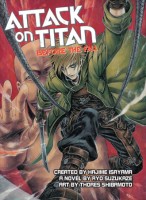
Attack on Titan: Before the FallAuthor: Ryo Suzukaze
Illustrator: Thores Shibamoto

Translator: Ko Ransom
U.S. publisher: Vertical
ISBN: 9781939130860
Released: September 2014
Original release: 2011

Hajime Isayama’s manga series Attack on Titan has become extraordinarily successful not only in Japan but worldwide as well. The series has inspired numerous manga spinoffs, anime, games, and more. Attack on Titan: Before the Fall is the first of three light novels written by Ryo Suzukaze and illustrated by Thores Shibamoto which serve as a prequel to Isayama’s original series. The second and third novels have been adapted as the manga series Attack on Titan: Before the Fall, illustrated by Satoshi Shiki, which is being released in English by Kodansha Comics. The first Before the Fall novel, however, was licensed and released by Vertical in 2014 with an English translation by Ko Ransom. Currently the novel, which was originally published in Japan in 2011, is chronologically the earliest story set in the Attack on Titan universe. I’m fascinated by the Attack on Titan phenomena and the large fanbase that it has developed, not to mention the series itself, so I was very interested in reading the Before the Fall prequel.

Angel Aaltonen may be young, but his ingenuity is impressive. A master craftsman, he and the others at the workshop he is a part of strive to design, create, and improve the weapons used in humanity’s fight for survival against the Titans. Except that Angel has never actually seen a Titan. Neither has most of the human population which seeks safety within a series of enormous walls. But while for a time they may be safe, they are also trapped by their own defenses. Only the members of the Survey Corps and Garrison forces have directly confronted the Titans, gigantic monstrosities that devour humans and bring destruction and terror. Even more dire is the fact no one knows how to stop or defeat the Titans. Angel and many others fear that one day the unthinkable will happen and the walls will fail. They are determined to discover the Titan’s weaknesses before that can happen, but the existing political and religious situation will make that prospect even more difficult than it already is to accomplish.

Most of the stories in Attack on Titan as a whole follow those characters who serve in the military–the people who are on the front lines directly fighting the Titans. Before the Fall, however, focuses on those who work behind the scenes to make those battles possible–the scientists, craftsmen, and engineers. (Granted, by the end of Before the Fall, Angel has become fairly hands-on himself.) It’s an interesting approach, giving a slight spin to an already familiar story, and one that I particularly liked and appreciated. Among other things, Before the Fall shows the development of some of the most iconic technology in Attack on Titan, the three-dimensional maneuvering gear. But as intriguing as the story is in Before the Fall, sadly the writing itself isn’t particularly engaging and the novel ends up being fairly slow going despite several intense action sequences. There were also a few frustratingly obvious oversights made by the characters; I found it difficult to believe that their logic would have been so flawed. Ultimately, I liked the premise of Before the Fall much more than its execution.

Although the writing might not be the best, where Before the Fall excels is in providing Attack on Titan with more thoroughly grounded worldbuilding, backstory, and lore. Suzukaze not only explores the development and creation of the equipment and weapons that will be used to fight the Titans, he also shows the beginning of the unrest between the general population, the military and government, and the religious cults and factions. There is enough of a basic introduction to the world that even readers who aren’t familiar with Attack on Titan should be able to easily follow Before the Fall, but the novel will appeal most to those who already know and enjoy the franchise. Before the Fall doesn’t tend to have the overwhelmingly bleak atmosphere of the original manga series, but it is still definitely a part of Attack on Titan, meaning that there are many casualties and several gruesome and horrifying turns of events. The air of dark mystery generally found in Attack on Titan remains in Before the Fall, as do the desperate punctuations of human hope and determination in the face of annihilation.

Filed Under: REVIEWS Tagged With: attack on titan, Light Novels, Novels, Ryo Suzukaze, Thores Shibamoto, vertical

The Tale of the Cavern

September 27, 2014 by Ash Brown

The Tale of the CavernAuthor: Minamoto no Shitagō
Translator: Ziro Uraki
Publisher: Shinozaki Shorin
ISBN: 9784784104376
Released: 1984
Original release: 10th Century

While reading The World of the Shining Prince: Court Life in Ancient Japan, I encountered quite a few references to a work of fiction called Utsuho Monogatari. Written in the late tenth century, most likely by the famous scholar and poet Minamoto no Shitagō, it is considered to be one of the first, if not the first, long-form narratives of Japan. That in and of itself caught my attention, but I became even more interested in reading Utsuho Monogatari (sometimes written as Utsubo Monogatari) when I learned how important of a role music played in the tale and that it was an immediate precursor to and major influence on The Tale of Genji. However, I did have a bit of trouble finding a translation of the complete work. Thankfully, with some help from other readers of classic Japanese literature, I discovered Ziro Uraki’s 1984 English translation from the Japanese publisher Shinozaki Shorin The Tale of the Cavern. (Somewhat unusual, as the title is more often translated in English as The Tale of the Hollow Tree.) Uraki was also the first person to translate Utsuho Monogatari from tenth-century Japanese into modern Japanese.

During the reign of Emperor Saga lived a young nobleman named Toshikage who was admired for his beauty, talent, and learning. At the age of sixteen he was ordered to join the embassy to China. However, the three ships that set sail for the continent encountered a large tempest and Toshikage, shipwrecked on the coast of Persia, was the only survivor. It would be many, many years before Toshikage would be able to return to Japan, bringing with him impressive musical skill and a collection of mystical koto gifted to him by the Heavens during his wanderings. These koto and the secrets to playing them–songs that could cause great storms and make the earth tremble or heal those who heard them–would be kept and cherished by his family for four generations. Toshikage’s descendents and their musical abilities were highly sought after, bringing them both strife and fortune in politics as well as love. Their lives would become closely entwined with those of the other nobility in the capital and even with those of the members of the Imperial family itself.

While the beginning of The Tale of the Cavern contains many fantastical elements, the rest of the novel tends to be much more realistic, following the political and romantic affairs of its many characters. However, the magic never entirely disappears from the tale and the novel both begins and ends with the magnificence and marvel of music. Proficiency in the arts–music, calligraphy, dance, poetry, and so on–was a highly desired quality among Heian-era nobility. Those who had such skill in The Tale of the Cavern were rewarded for their diligent study and natural talent, rising quickly through the ranks and securing advantageous marriages and promotions for themselves and their relatives. In addition to music, poetry in particular was a very important part of both court life in Heian-era Japan and in the novel iteself. The Tale of the Cavern is filled with poetry and numerous declarations of love–skillful wordplay was appreciated nearly as much as a person’s status and influenced the regard and esteem in which they were held by others.

As a story of music and love, I couldn’t help but be drawn to The Tale of the Cavern. I don’t think it will necessarily appeal to a general, modern audience, but readers who are interested in classical Japan and Japanese literature would be fortunate to read the novel. (If they can find it, that is.) The narrative does wander a bit, and the plot of the story isn’t especially driving, either. The individual chapters and the characters and events in them are related, but they aren’t always closely tied together; it can sometimes be difficult to tell just exactly how much time has passed between one and the next. Even so, The Tale of the Cavern provides a fascinating glimpse into Heian court life and all of the social and political maneuverings involved; granted, with a heavy dose of romance and just a touch of the fantastic and supernatural added to the novels’ more realistic elements. But I, for one, was glad to have the opportunity to read Utsuho Monogatari in its entirety.

Filed Under: REVIEWS Tagged With: Minamoto no Shitagō, Novels

Boogiepop and Others

September 10, 2014 by Ash Brown

Boogiepop and OthersAuthor: Kouhei Kadono
Illustrator: Kouji Ogata

Translator: Andrew Cunningham
U.S. publisher: Seven Seas
ISBN: 9781933164168
Released: January 2006
Original release: 1998
Awards: Dengeki Novel Prize

Boogiepop and Others is the first volume in a series of light novels written by Kouhei Kadono and illustrated by Kouji Ogata. The novel was originally released in Japan in 1998 after winning the Dengeki Game Novel Prize (now known simply as the Dengeki Novel Prize). Boogiepop and Others has been credited with igniting the light novel trend in Japan. Whether that is true or not, the novel has inspired more than a dozen other volumes in the Boogiepop novel series as well as other books, short stories, manga, music, a live-action film adaptation, an anime, and more. Out of the fairly large franchise, four of the light novels–including Boogiepop and Others–two short manga series, the anime, and the film have been released in English. The English-language edition of Boogiepop and Others, translated by Andrew Cunningham, was published by Seven Seas in 2006. Although I had been aware of the Boogiepop Phantom anime series for quite some time, Boogiepop and Others was actually my introduction to the franchise and is set before the events of the anime.

No one is entirely sure who or what Boogiepop is, but there are several rumors and theories among the students of Shinyo Academy. Stories are told about a spirit of death, an assassin who can kill instantly and painlessly. When a number of female students at Shinyo Academy go missing, many naturally assume that Boogiepop must have had something to do with their disappearances. Others believe Boogiepop to be nothing more than a myth or urban legend, but they can’t deny that something very strange and very wrong is going on at their school. Most of the missing girls are written off as runaways by the police and their cases are quickly dropped. And so a few of their classmates take it upon themselves to investigate since they can’t rely on the adults to pursue the matter. But it’s already too late. Some of the girls who have disappeared have lost their lives and there will be even more deaths before those who are responsible can be stopped. If they can be stopped. Any survivors will be left struggling to comprehend everything that occurred at Shinyo Academy.

Boogiepop and Others isn’t told from a single point of view, within a single time frame, or even through a single narrative. Instead, each chapter is seen from the perspective of a different student. Some of the characters are directly involved with the events unfolding at Shinyo Academy while others are only tangentially related. However, none of them know everything about what is going on, though they may have their suspicions. There’s Takeda Keiji, who becomes one of the people closest to Boogiepop, Suema Kazuko, who once was almost the victim of a serial killer herself, Saotome Masami, a deceptively unassuming underclassman, Kimura Akio, one of several boyfriends of one of the missing students, and Niitoki Kei, the president of the discipline committee. They each have their own story to tell, and each version of the events is accurate, but the complete truth can only be understood when all of the individual accounts have been completely disclosed and are then considered and taken together as a whole.

The narrative structure of Boogiepop and Others is actually quite effective in creating and sustaining the mystery and mood of the novel. It’s a slow build as little by little information is revealed and connections are made between characters and their stories. Piecing together everything is an incredibly engaging part of the novel. At times, Boogiepop and Others can be legitimately creepy and disconcerting. The elements of horror in the novel are just as strong as those of science fiction and mystery. Several of the characters are dealing with extreme mental and psychological disturbances and unfortunate family circumstances in addition to the apparent supernatural occurrences. Personally, I preferred Kadono’s exploration of the more reality-based issues over the more outrageous ideas, but in combination even those could be oddly compelling in their strangeness. I thoroughly enjoyed Boogiepop and Others, perhaps even more than I initially anticipated. I definitely plan on reading more of the series.

Filed Under: REVIEWS Tagged With: Boogiepop, Dengeki Novel Prize, Kouhei Kadono, Kouji Ogata, Light Novels, Novels, Seven Seas

Malice

August 31, 2014 by Ash Brown

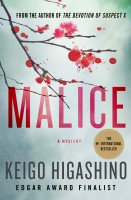
MaliceAuthor: Keigo Higashino
Translator: Alexander O. Smith and Elye Alexander
U.S. publisher: St. Martin’s Press
ISBN: 9781250035608
Released: October 2014
Original release: 1996

Ever since reading The Devotion of Suspect X I have steadily been devouring Keigo Higashino’s other novels available in English. I really enjoy his style of clever and unusual mysteries. I was thrilled to learn that Malice would be the next of his works to be translated. Technically, Malice is the fourth novel in Higashino’s series of books featuring Detective Kyoichiro Kaga. However, in English, it is the first volume of that particular series to be released. (Before Malice only select Detective Galileo novels and Himitsu, published in English as Naoko, had been translated.) But, as with many mystery series, it is not necessary to have read every volume in order to make sense of each installment; Malice holds up very well as its own work. Malice was originally published in Japan in 1996 while the English translation by Alexander O. Smith and Elye Alexander was released by the Minotaur Books imprint of St. Martin’s Press In 2014. When offered an early copy of the novel for review, I leapt at the chance to read it.

Kunihiko Hidaka is a best-selling, award-winning novelist who, soon before he moves from Japan to Canada, is murdered in his home. His body is found in his office behind a door locked from the inside. The house, too, is locked. Only three people are known to have seen Hidaka before his death: Rie Hidaka, his second wife; Osamu Nonoguchi, his friend and fellow author; and Miyako Fujio, the sister of a man who was vilified in one of Hidaka’s novels. All three have alibis and their motives, if they even exist, are unclear at best. Kyoichiro Kaga is one of the police detectives assigned to the investigation of Hidaka’s murder. It just so happens that he knows Nonoguchi. The two men used to be teachers at the same middle school before Kaga left to join the police force and Nonoguchi left to write full-time. Kaga’s intuition and his previous acquaintance with Nonoguchi correctly leads him to believe that something isn’t quite right with the other man’s story. Digging deeper he discovers that Nonoguchi and Hidaka’s relationship was much more complicated than it first appeared.

Higashino takes a different approach in each work, but much like the two Detective Galileo novels in English–The Devotion of Suspect X and Salvation of a Saint—who the murderer is in Malice becomes quite clear early on in the work. It doesn’t take very long at all for Nonoguchi to confess. The real mystery is the reason behind Hidaka’s murder and Nonoguchi’s motives. The confession is really all that the police department needs to close the case, but human curiosity demands to know the reasons why. To some extent, Nonoguchi is counting on this; he needs Kaga to investigate. Nonoguchi leads and misleads the detectives in order to create the narrative that he wants the world to believe about Hidaka and his murder. Malice is extraordinarily clever. Nonoguchi’s novelist mindset enables him to manipulate others in ways that are unexpected and yet completely reasonable. As an author he is quite skilled in creating fictions that people are willing to believe and knows how to play into their expectations.

As a whole, Malice is an extremely engaging mystery, but one of the most interesting and intriguing things about the novel is its structure. I’ve never come across something quite like it before. Some of the chapters are told by Nonoguchi, essentially forming a novel within a novel, while other chapters are devoted to Kaga’s notes on his investigation as well as the interviews he conducts as a part of it. Nonoguchi is an inherently unreliable narrator, freely mixing select facts into the fiction of his written account. Kaga’s task is to tease the truth out of Nonoguchi’s writing. Kaga is working with the same material that is presented to the readers of Malice; it is fascinating to see his thought processes and theories develop in response to the information that Nonoguchi is deliberately providing him. I’ve come to expect smart and clever writing from Higashino and I was not at all disappointed with Malice. I hope to see even more of his work translated, and perhaps even more stories featuring Kyoichiro Kaga, in the future.

Thank you to St. Martin’s Press for providing a copy of Malice for review.

Filed Under: REVIEWS Tagged With: Keigo Higashino, Kyoichiro Kaga, Novels

The Twelve Kingdoms, Vol. 4: Skies of Dawn

August 8, 2014 by Ash Brown

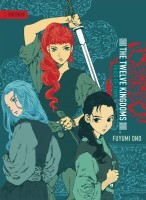
The Twelve Kingdoms, Volume 4: Skies of DawnAuthor: Fuyumi Ono
Illustrator: Akihiro Yamada

Translator: Alexander O. Smith
U.S. Publisher: Tokyopop
ISBN: 9781427802606
Released: November 2010
Original release: 1994

Skies of Dawn is the fourth and sadly final volume of Fuyumi Ono’s eight-volume fantasy novel series The Twelve Kingdoms, illustrated by Akihiro Yamada, to have been released in English. Published in Japan in two volumes in 1994, the novel was released in its entirety in 2010 by Tokyopop under its Pop Fiction imprint, first as a hardcover and then later in a paperback edition. As with the previous volumes of The Twelve Kingdoms, Skies of Dawn was translated by Alexander O. Smith. Interestingly enough, Elye J. Alexander, who frequently collaborates with Smith on translations and who worked with him on the first three volumes of The Twelve Kingdoms, does not appear to have been involved with Skies of Dawn. Though I discovered the series relatively late, I have been thoroughly enjoying The Twelve Kingdoms and Ono’s exceptionally well-developed world and characters. Skies of Dawn is easily the longest of the translated volumes, but that didn’t at all diminish my enthusiasm.

Yoko has become the king of Kei after being chosen by Keiki, the kingdom’s kirin. It’s still early in Yoko’s reign, but it hasn’t been easy for her. Many of the ministers of her court are corrupt and the others have very little trust in Yoko–Kei has had a bad history with lady-kings. Yoko lacks confidence in her rule as well. Having grown up in Japan before being suddenly swept away to the Twelve Kingdoms, her understanding of the world in which she now finds herself is limited and her knowledge of what it means to be king is even more so. Yoko isn’t the only young woman who is struggling with great changes in her life. Like Kei, the kingdom of Hou has also recently lost its ruler and those circumstances have forced its princess Shoukei into exile. Suzu, another girl who was originally from Japan, is unhappy with her lot in life in the Twelve Kingdoms. Though they don’t know each other, the destinies of these three young women will become closely intertwined, changing the direction and fate of Kei, a kingdom still struggling to restore itself after years of turmoil and calamity.

Although Skies of Dawn is technically the fourth volume in The Twelve Kingdoms, chronologically its story follows immediately after the events of the first volume, Sea of Shadow. The two intervening novels–Sea of Wind and The Vast Spread of the Seas–serve as prequels to the series, providing more context as well as back stories for The Twelve Kingdoms as a whole and for its major characters. As with the other volumes in The Twelve Kingdoms, Skies of Dawn actually stands very well on its own as a novel. Though they provide more background, it’s not absolutely necessary to have read the previous volumes in the series to understand what’s happening in Skies of Dawn. Actually, Skies of Dawn is almost like reading three novels contained in one, especially towards its beginning. It takes quite some time for Yoko, Shoukei, and Suzu’s individual stories to come together into a single narrative, but it is very satisfying when they do, especially because it happens in a way that is somewhat unexpected.

Worldbuilding has always been a major component of The Twelve Kingdoms and that hasn’t changed with Skies of Dawn. I do appreciate all of the thought and detail that Ono has put into every aspect of the series. Granted, while it is all very interesting, the worldbuilding does slow down the pacing of the plot a great deal. Much of the first half of Skies of Dawn is devoted to things like rules of governance, taxes, and marriage laws as Yoko learns more about her kingdom and the kingdoms surrounding it. It’s not until the second half of Skies of Dawn when Yoko, Shoukei, and Suzu’s stories begin to converge that events start to quickly escalate as the people of Kei come closer and closer to rebellion. The Twelve Kingdoms is an epic tale of fantasy in which the characters are required to grow and evolve, taking responsibility for themselves and for the changes in the world in which they live. Although it is unlikely that the rest of the series will be translated, Skies of Dawn and the previous volumes are still well worth seeking out.

Filed Under: REVIEWS Tagged With: Akihiro Yamada, Fuyumi Ono, Light Novels, Novels, Tokyopop, Twelve Kingdoms

Tokyo Demons, Book 2: Add a Little Chaos

July 18, 2014 by Ash Brown

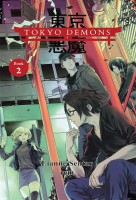
Tokyo Demons, Book 2: Add a Little ChaosAuthor: Lianne Sentar
Illustrator: Rem

Publisher: Chromatic Press
ISBN: 9780993861109
Released: December 2014

For some very silly reasons, most of which are now unclear to me, initially I was hesitant to read Tokyo Demons, a trilogy of novels written by Lianne Sentar and illustrated by Rem. But after finishing the first volume, You’re Never Alone, I was hooked. I immediately went out and devoured all of the bonus content and side stories that I could find. Honestly, I hadn’t been so excited and captivated by a series in a very long time. Soon after, Tokyo Demons became one of the flagship titles for Chromatic Press. Tokyo Demons, Book 2: Add a Little Chaos was originally serialized online between 2012 and 2014. Later in 2014 it underwent final revisions and was collected into a single volume along with two additional side stories which delve further into the pasts of some of the characters. Despite my obsession with the series, for the most part I was able to restrain myself from reading Add a Little Chaos until the novel was completed. It was a difficult wait, and so I was thrilled when the second book was finished so that I could read it.

Kiyoshi has been rescued and Core’s attack on the Byakko gang at Kiseki was able to be fended off, albeit not without casualties. The survivors who have taken refuge with the Church and sided against Core are still in danger though. Under the influence of Pitch, a powerful and highly addictive drug that he was forced to take, and due to the trauma of his kidnapping, Kiyoshi is no longer the person he once was physically, mentally, or emotionally. In fact, after being caught up in something with even graver implications than the simple drug war it initially seemed to be, everyone has changed. Ayase, Jo, Sachi, and all of their friends and allies are fighting for their lives and none of them are unaffected by the violence surrounding them. They are doing all that they can with the limited information that they have to fight against Core and save the others of their group who are still caught within its grasp. Working with the Church’s resources, members of Byakko, and contacts within the police force, as well as with some unexpected aid from within Core itself, they may have a chance. But everyone has their own agendas and it’s becoming more and more difficult to know who and what can be trusted.

As with many second volumes in a trilogy, the situation the characters find themselves in quickly escalates from bad to worse in Add a Little Chaos. Tokyo Demons has always been fairly hard-hitting, dealing with heavy themes like psychological and physical abuse and violence, but Add a Little Chaos goes to some very dark places. I have come to care about all of the characters in Tokyo Demons immensely, many of whom are broken and damaged people with tragic pasts, horrible presents, and grim futures. They are all so incredibly desperate to be strong and to protect themselves and the ones that they care about the most. It’s absolutely heartbreaking to see them go about it in the wrong ways, even when they’re doing the best that they can and what they believe to be right. Some of them are able to find a few brief moments of comfort with one another that they cling to only to have them ripped away by the chaos enveloping them. With layers upon layers of loyalty and betrayal, each revelation in Tokyo Demons is shocking and gut-wrenching, not only for the characters who have to deal with the immediate consequences, but also for the readers who can do nothing but witness it all happen.

Tokyo Demons is a complex and multilayered series; many of the seemingly independent storylines which were introduced in the first volume are now beginning to crash together in Add a Little Chaos and additional plot developments have been set into motion. Tokyo Demons also features a large and diverse cast of extremely complicated characters. Their even more complicated connections to one another are critical to the story as well. How they deal with their own personal struggles impacts the people around them as well as the larger conflict in which they find themselves. Even considering all of the superhuman elements and psychic abilities involved in Tokyo Demons, what make the series so compelling and engaging are its believably flawed, exceptionally nuanced, and constantly evolving characters and the constantly shifting dynamics of their relationships. From the beginning of the series alone I could tell that the scope of Tokyo Demons was going to be huge. If anything the story only continues to expand with Add a Little Chaos and increase in its intensity. I am still absolutely loving Tokyo Demons and am both looking forward to and dreading its conclusion.

Filed Under: REVIEWS Tagged With: Chromatic Press, Lianne Sentar, Light Novels, Novels, Rem, Tokyo Demons

The Girl Who Leapt Through Time

July 9, 2014 by Ash Brown

The Girl Who Leapt Through TimeAuthor: Yasutaka Tsutsui
Translator: David Karashima
U.K. publisher: Alma Books
ISBN: 9781846881343
Released: May 2011
Original release: 1967

One of my favorite animated films is Mamoru Hosoda’s 2006 The Girl Who Leapt Through Time which was inspired by Yasutaka Tsutsui’s short novel The Girl Who Leapt Through Time, originally released in Japan in 1967. Tsutsui is an award-winning and extremely well-known author of Japanese science fiction, though Western audiences are probably more familiar with the various anime and live-action adaptations of his works. The Girl Who Leapt Through Time is one of Tsutsui’s most beloved and popular stories. It has been the basis for several television series, films, and manga in addition to Hosoda’s anime. The novel, translated by David Karashima, was released in English by UK-based publisher Alma Books in 2011. The English edition of The Girl Who Leapt Through Time is based on the 2009 republication of the volume which collects Tsutsui’s story The Stuff That Nightmares Are Made Of as well as The Girl Who Leapt Through Time.

The Girl Who Leapt Through Time was originally serialized between 1965 and 1966 before being collected in 1967. The titular girl, Kazuko, discovers that she has gained the ability to slip through time and space after fainting in her high school’s science lab. Although the power has its advantages, it’s not one that she wants. She wishes that her life would go back to normal and that her two closest friends and classmates, Goro and Kazuo, would be able to treat her in the same way that they always have. Initially Goro is skeptical of Kazuko’s newfound ability, at least until she is able to offer him proof. The more laid back Kazuo on the other hand takes the whole situation in stride; at first he doesn’t seem to be bothered by it at all. The Girl Who Leapt Through Time is a charming story, but I will admit that I largely prefer the anime’s version of the tale. Many of the scenes are similar between the two, but the novel is much simpler and more direct. Even so, I can understand why Tsutsui’s original has inspired so many other creators—it’s imaginative science fiction with just the right touch of romance.

Whereas The Girl Who Leapt Through Time is science fiction, The Stuff That Nightmares Are Made Of leans more towards realistic psychological horror. The story follows Masako, a young woman who has started to avoid visiting her friend Bunichi’s household, though she can’t quite recall the reason why she has been staying away. After helping to dispel some of the fears of her younger brother—showing that his wild imaginings are rooted in real world happenings—she decides to face and investigate the causes of her own. Initially Bunichi teases Masako, but realizing that she really is frightened he agrees to accompany her on her mission, getting quite a scare in the process. Considering the short length of The Stuff That Nightmares Are Made Of, Tsutsui is able to incorporate an impressive number of story twists. Masako is an appealing lead—smart and clever, though perhaps a little reckless and with room to grow and mature. Her willingness to confront her fears and to improve herself is admirable, but it can also cause some problems for her and the people around her, too.

Although The Girl Who Leapt Through Time and The Stuff That Nightmares Are Made Of are two, unrelated stories, they do share some similarities. The protagonists are both intelligent, likeable young women, for one. Tsutsui’s style has a subtle, understated humor to it and the writing is simple and straightforward, making both stories approachable for younger readers. Each of the tales has a bit of romance in addition to a quickly paced plot. (The entire volume can fairly easily be read in one or two sittings.) But what I found to be the most striking commonality and difference between The Girl Who Leapt Through Time and The Stuff That Nightmares Are Made Of was Tsutsui’s use of and approach to the themes of memory and truth. Both are important elements in the two stories, but are handled oppositely: The Girl Who Leapt Through Time carries a sense of nostalgia over the loss of memory, the truth ultimately being hidden while in The Stuff That Nightmares Are Made Of it is only after a particular memory is regained that the truth is completely revealed.

Filed Under: REVIEWS Tagged With: Girl Who Leapt Through Time, Novels, Yasutaka Tsutsui

Cage on the Sea

June 29, 2014 by Ash Brown

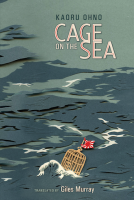
Cage on the SeaAuthor: Kaoru Ohno
Translator: Giles Murray
U.S. publisher: Bento Books
ISBN: 9780983951384
Released: March 2014
Original release: 1998

Cage on the Sea is the first book by Kaoru Ohno to be translated and released in English. The novel, originally published in Japan in 1998, was released in English by Bento Books in 2014 with a translation by Giles Murray. It was Bento Books’ involvement that brought Cage on the Sea to my attention. Though he has written novels, Ohno is primarily known as a journalist and as an author of nonfiction works with a particular emphasis on Japanese military history and World War II. Cage on the Sea suits Ohno’s interests perfectly. Based on a true story and meticulously researched, Cage on the Sea is about a group of Japanese holdouts on Anatahan, a remote island in the Marianas, and their eventual repatriation after World War II. Their tale of survival was sensationalized by the mass media in the 1950s and has served as an inspiration for various other films and novels in addition to Ohno’s Cage on the Sea. Though once a well-known story, more than fifty years later relatively few people are as familiar with this particular history of Anatahan.

In 1944 three Japanese ships–the Hyosukemaru, Akebonomaru, and Kaihomaru–were destroyed by American air raids on the Mariana Islands, stranding the surviving crew on the sparsely populated island of Anatahan. They expected reinforcements and rescue to follow soon afterwards, but days, weeks, months, and eventually years passed before they would leave the island. Initially sheltered by employees of the South Sea Development Company supervising copra production on Anatahan, the more than thirty men quickly exhausted the food stores and supplies meant for less than a handful of people. With resupply increasingly unlikely and with the continued bombardment by the Americans, the group fled for the island’s forested interior, doing their best to survive off of the land by foraging and growing what they could and by capturing lizards and bats for food. After the war in 1950, James B. Johnson, a United States naval commander, began attempts to peacefully remove the Japanese holdouts from the island, hoping to prevent additional casualties on both sides. But by that point, due to injury, disease, and infighting, only twenty men and a single woman, Kazuko Higa, were still alive.

Despite the multitude of named characters (all of whom are based on actual people), Cage on the Sea primarily follows the perspectives of three men: Lieutenant Commander Johnson, Sugataro Nakai, a seaman aboard the Hyosukemaru and a balladeer, and Seargent Junzo Itami of the Kaihomaru, the highest ranking member of the Japanese military present on Anatahan. But the person with the most vital role in Cage of the Sea, the focus to the point of obsession for many of the men and the reason for so much of the group’s conflict and strife, is Kazuko Higa. Johnson’s account actually provides the framing story for the novel, looking back on the events surrounding the repatriation of the Anatahan holdouts from the perspective of his retirement. In particular, he wonders what has become of Higa. Nakai and Itami’s narratives deal more specifically with the efforts to survive on a nearly uninhabited island for seven years, capturing the constantly shifting social dynamics and alliances among the group–a mix of civilians, seamen and fishermen, and enlisted men.

Frequently, Cage on the Sea almost feels as though it’s a documentary. Ohno has put a tremendous amount of research into the work, motivated by the question of what it must have been like to have lived and survived from one day to the next on Anatahan Island for all of those years. He read the memoirs of Michiro Maruyama, one of the survivors; he spoke with and interviewed the holdouts and those who knew them; perhaps most importantly, he gained access to Johnson’s personal archives and to the materials recording the efforts to peacefully rescue the Japanese from Anatahan. Prior to the Anatahan mission, holdouts who resisted surrender were met with force. Johnson’s innovative approach unquestionably saved lives. In the end, Cage on the Sea is a novel, so to some extent the events and key players have been fictionalized and dramatized–but Ohno treats the story with realism, sympathy, and respect, avoiding sensationalism and presenting a much more nuanced version of the events and the people involved than had previously been seen.

Filed Under: REVIEWS Tagged With: Bento Books, Kaoru Ohno, Novels

Random Musings: Cherry Bomb, Cinderseed, and Skyglass

June 21, 2014 by Ash Brown

Cherry BombBack in April 2014, Chromatic Press announced Cherry Bomb, its new imprint for mature readers. The intent was to provide an outlet for Sparkler Monthly‘s creators to explore a sexier side of their already established characters and stories with a goal to include original, unrelated material in the future as well. Cherry Bomb’s coordinator Lianne Sentar probably sums it up best: “We want our erotica to be emotionally cathartic, with a purpose and meaning behind some smoking content. If it’s all smut and no context, that’s not good enough – we demand both!”

Personally, I was very excited to learn about Cherry Bomb. The imprint launched with five titles: two short stories from Tokyo Demons, which I had previously read and enjoyed (I’ve written a little about my Tokyo Demons obsession in the past); two short comics from Awake; a Gauntlet side story; and Cinderseed, the prologue to the then upcoming illustrated novel Skyglass written by Jenn Grunigen with art by Mookie.

I’m rather ashamed to admit that after the initial Cherry Bomb announcement, I actually completely forgot about Cinderseed. But then came the even more recent announcement for Skyglass, which made its debut in June 2014 in Sparkler Monthly, Issue 11. The prose series was described as “throwing Ai Yazawa’s Nana, a space opera, and a really fresh take on post-apocalyptic Earth into a blender.” With a line like that, I knew that I needed to read Skyglass. It was at that point that I was also gently reminded that Cinderseed existed, and the lovely folk at Chromatic were kind enough to send along a review copy to me.

Sparkler Monthly, Issue 11Cinderseed opens with a girl floating through space, a fire elemental who has been ripped from the sun, her home, and confined within a human body. Understandably, she is somewhat confused and not particularly pleased by this turn of events and violently lashes out at the humans who would try to control her further. Soon after she meets Kri, who hopes that she would kill him, too. But as a Pleasure Intelligence, he doesn’t have much say in the direction his life is taking or even ownership over himself.

The two of them make an interesting contrast, similar to each other in some ways but vastly different in others. Neither are entirely human, but Kri has been designed by humans and his thoughts and behaviors are influenced by that. On the other hand, Phoenix’s actions and ways of thinking are often disconcertingly inhuman. (As they should be.) However, they both feel trapped, experience loneliness, and want to reclaim themselves and take control of their own lives. Phoenix, though, is much more likely to redirect her feelings towards revenge than Kri is.

Technically, while reading the prologue may not be absolutely necessary to follow what is going on in the novel proper, it does provide background information and additional insights into the world and characters of Skyglass, particularly the re/birth of Phoenix. Plus, it’s sexy. And hot, often literally so. (Phoenix is a fire elemental, after all.) Female-friendly, queer-friendly, and kink-friendly, too. The science fiction setting provides the opportunity for some particularly creative, audacious, and delightful, scenarios. And keeping with the intent of Cherry Bomb, the sex serves a purpose beyond titillation in Cinderseed; it’s integral both to who the characters are as people and to the plot itself.

One of the taglines for Skyglass is “Sex, elves, and rock ‘n’ roll.” The prologue covered the sex, but the elves (I promise, it makes perfect sense within the context of the story) and rock music don’t come into play until the first chapter with the introduction of the novel’s other main character Moss Wick—a half-human/half-elvish drummer who has…significant issues. And on top of those, Phoenix has attached herself to him. Unlike the prologue, which was written in the third person, the main narrative (or at least the initial chapter) alternates between Moss and Phoenix’s perspectives and is told in the first person, allowing the readers to get a very good sense of who they are. If Kri and Phoenix were opposites, Moss and Phoenix are even more so; their relationship should be quite interesting to watch unfold.

Even after only having read the prologue and the first chapter, I’m already loving Skyglass. The wait for the release of each new chapter will be torturous, but I’m definitely looking forward to reading more. The novel is shaping up to be smart and sexy and incredibly offbeat science fiction, with interesting and entertaining characters, a fascinating setting, and an engaging writing style. Personally, I think Cinderseed and Skyglass, not to mention the rest of the offerings from Chromatic Press, are well worth checking out.

Save

Filed Under: FEATURES Tagged With: Cherry Bomb, Chromatic Press, Jenn Grunigen, Mookie, Novels, Skyglass

The Black Lizard and Beast in the Shadows

April 18, 2014 by Ash Brown

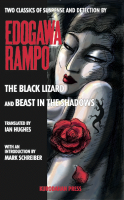
The Black Lizard and Beast in the ShadowsAuthor: Edogawa Rampo
Illustrator: Kawajiri Hiroaki

Translator: Ian Hughes
U.S. publisher: Kurodahan Press
ISBN: 9784902075212
Released: January 2006
Original release: 1934 and 1928

After being introduced to the works of Edogawa Rampo through Strange Tale of Panorama Island and Japanese Tales of Mystery and Imagination, I have slowly been making my way through the rest of his work available in English. Compared to his total output in Japan where he was and continues to be an extremely influential author, relatively little has actually been translated. Happily, in recent years Kurodahan Press has been releasing more and more of Rampo’s stories and essays. The Black Lizard and Beast in the Shadows became the first volume of Rampo’s work to be published by Kurodahan Press in English in 2006. Translated by Ian Hughes and with an introduction by Mark Schreiber and illustrations by Kawajiri Hiroaki, the book collects two of Rampo’s short novels. The Black Lizard, originally published in Japan in 1934, features Rampo’s famous detective Akechi Kogorō. The second, shorter story, Beast in the Shadows, was first released in 1928 was one of Rampo’s earlier major works.

In the Japanese underworld the Black Lizard reigns supreme. A woman of exceptional beauty and intelligence, she has become one of Japan’s greatest criminals with an entourage of underlings ready and willing to carry out her schemes and to do her bidding. Most recently the Black Lizard has had her eye on the “Star of Egypt,” the most precious diamond in Japan. Her intent isn’t to steal it. Instead, she has put into motion an audacious plan to kidnap the owner’s daughter Sanae and demand the diamond as ransom. The brilliant private detective Akechi Kogorō is called in to prevent the kidnapping, but he may have met his match with the Black Lizard. The battle of wits between these two opponents in The Black Lizard is marvelous. Both are masters of disguise and both are extremely clever. A large portion of the novel consists of their daring and unexpected tactics as they try to out-think and stay several step ahead of each other. The plot of The Black Lizard take the readers through numerous twists and turns, some of which are difficult to believe but all of which are exciting.

Beast in the Shadows is told from the perspective of a detective novelist who accidentally becomes involved in a case surrounding his fellow mystery author Ōe Shundei. The novelist has fallen in love with Oyamada Shizuko, the wife of a wealthy entrepreneur, and it is for her sake that he begins investigating Shundei. Shundei is a misanthrope and stays out of the public eye so not much is known about the author. However, Shizuko has come to the determination that Ōe Shundei is the pen name of Hirata Ichirō, an ex-lover who has been harassing her and threatening her through letters. Hirata seems to have been spying on Shizuko and her husband and knows things about their private, intimate lives that no one else should. Instead of going to the police, Shizuko turns to the novels as her confidant in order to keep the matter discreet. Though shorter than The Black Lizard, Beast in the Shadows incorporates just as many surprising plot developments if not more, include a fantastic twist ending.

When I first started reading The Black Lizard and Beast in the Shadows I wondered why those two particular novels, other than being some of Rampo’s better known works of suspense, had been collected into a single volume. But by the end it became clear that there is one particular similarity between the two stories that tie them together thematically. I’m afraid that revealing it would spoil the mystery, though. However, I will say that the Black Lizard isn’t the only incredibly cunning character in the book. Another important element in both The Black Lizard and Beast in the Shadows is the role that fiction plays in the stories and specifically how crime inspires and influences fantasy and vice versa. This is particularly prominent in Beast in the Shadows where two primary characters are novelists, giving them a unique perspective on the investigation. But fiction is influential to The Black Lizard as well, Rampo’s very own short story “The Human Chair” being a pivotal reference. I already knew that I enjoy Rampo’s work, but I found The Black Lizard and Beast in the Shadows particularly fascinating because of the power granted to stories in the volume.

Filed Under: REVIEWS Tagged With: Edogawa Rampo, Kawajiri Hiroaki, Kurodahan Press, Novels

Yukikaze

April 9, 2014 by Ash Brown

YukikazeAuthor: Chōhei Kambayashi
Translator: Neil Nadelman
U.S. publisher: Viz Media
ISBN: 9781421532554
Released: January 2010
Original release: 1984
Awards: Seiun Award

Chōhei Kambayashi is an award-winning, well-respected, and popular author of science fiction in Japan. His novel Yukikaze is one of his best known works and has even been adapted into a short anime series. It is also his first book to be translated and released in English. Originally published in Japan in 1984, Yukikaze would go on to win a Seiun Award in 1985. Kambayashi revisited and slightly revised the novel in 2002 in preparation for the volume’s sequel Good Luck, Yukikaze. Neil Nadelman’s translation of Yukikaze, published by Viz Media’s speculative fiction imprint Haikasoru in 2010, is based on this 2002 edition. Haikasoru’s release of Yukikaze also includes two very interesting essays about the novel by Ran Ishidou and Ray Fuyuki. Haikasoru also released an English translation of Good Luck, Yukikaze. Kambayashi has written a third volume in the series, Unbroken Arrow, which has yet to be translated.

Rei Fukai is one of the best pilots that the Faery Air Force has, surviving numerous encounters with the JAM, an alien force threatening humanity’s very existence. It has been more than three decades since the JAM first appeared on Earth. They were quickly pushed back to the planet from where their invasion was launched, however the prolonged war against the JAM continues with no obvious way to secure a complete victory. Survival is Fukai’s primary order and goal. A member of an elite squadron associated with the Special Air Force, his mission is to collect and record massive amounts of data about the JAM and their tactical capabilities. He is to return with that information no matter what, even if that means leaving his comrades behind to die. Because of this, he and the others in his squadron have earned the reputation of being cold-hearted bastards. Outside of himself, the only thing that Fukai believes in, cares about, or trusts is the Yukikaze, the highly advanced fighter plane that he pilots.

Kambayashi addresses several themes in depth in Yukikaze: what humanity’s purpose is within the context of war, what it means to be human or inhuman, and perhaps most strikingly what the impact of the convergence of human intelligence and the technology it develops could be. Yukikaze is an engaging war story, with kinetic and hazardous air battles that have terrifying implications, but like all great science fiction the novel is also incredibly thought-provoking. The members of the Faery Air Force, and especially those in the Special Air Force, are primarily made up of criminals, those with anti-social tendencies, and other people who are unwanted or have no place back on Earth. They are treated more like expendable resources than they are like human beings. The war and the fighting is so far removed from those living on Earth that they are mostly oblivious to what is occurring on Faery. Protecting Earth is a thankless task for those engaged in the war, people who have very few ties to the planet left but who have no better options other than to fight.

Considering all of this, it isn’t that surprising that Fukai and some of the other pilots would prefer their planes to people. I’ll admit, as unsociable as Fukai can be, I did like the guy. It did take me a couple of chapters to really settle into Yukikaze, but by the end of the novel I was completely engaged. A large reason behind that was because of Fukai and his development as the novel progressed as well as the evolution of the Yukikaze. In the chaos of war, Fukai’s relationship to his fighter is one of the only stable things remaining in his life, but even that begins to change. The members of the Faery Air Force are often called inhuman and compared to machines. At the same time those machines are becoming more and more advanced, raising the question of whether humans are even necessary anymore. The war against the JAM that humanity is waging may not be the only battle of survival that it should be concerned about fighting. After an interesting but somewhat clunky beginning, I was actually quite impressed with the depth of Kambayashi’s ideas in Yukikaze. I look forward to reading its sequel.

Filed Under: REVIEWS Tagged With: Chōhei Kambayashi, Haikasoru, Novels, Seiun Award, viz media, Yukikaze

Indian Summer

March 12, 2014 by Ash Brown

Indian SummerAuthor: Mieko Kanai
Translator: Tomoko Aoyama and Barbara Hartley
U.S. publisher: Cornell University East Asia Program
ISBN: 9781933947556
Released: August 2012
Original release: 1988

My introduction to Mieko Kanai was through her short novel Oh, Tama!, the second volume in her Mejiro series. I enjoyed it so much that I wanted to read more of her work, which is how I came to pick up Indian Summer. Although Indian Summer was Kanai’s first novel to be released in English, and only the second volume of hers to be translated (the first being the short story collection The Word Book), it’s actually the third book in the Mejiro series. Each novel in the Mejiro series, though they share some of the same characters, settings, and events, largely stands on its own. While it isn’t necessary to read one novel to enjoy another, it may add some additional depth. After being serialized between 1985 and 1987, Indian Summer was collected into a single volume with some slight modifications in 1988. The English translation of Indian Summer by Tomoko Aoyama and Barbara Hartley, published by Cornell University’s East Asia Program as part of its New Japanese Horizons series in 2012, is based on the later 1999 Japanese edition of the novel.

Momoko is a new student at a university in Tokyo. She’s looking forward to leaving her home in the country behind and setting out on her own in the city. Unfortunately, her overbearing mother isn’t about to let her nineteen-year-old daughter live unsupervised and plans for Momoko to stay with her aunt Chieko instead. The arrangement is meant to be temporary. In a year, Momoko’s younger brother Jun’ichi is also expected to be attending a Tokyo university and their mother intends for them to live together so that Momoko can look after him. Momoko isn’t at all interested in either of these plans, but happily she and her novelist aunt get along fairly well with each other. Chieko has her quirks, as does Momoko, but the two of them are doing what they can to make the best out of a rather awkward situation and to appease Momoko’s mother. Although the arrangement isn’t ideal, life does go on for Momoko as she beings university, makes friends (her classmate Hanako just so happens to be a huge fan of Chieko’s writing), and deals with any of the other curveballs that are thrown her way.

The structure of Indian Summer is particularly interesting. The novel is primarily told from Momoko’s point of view, but her narration is interspersed with the essays and stories that her aunt has written. Generally they are somehow related to whatever is currently going on in the story, but they do break it up somewhat. Much as in Oh, Tama!, Kanai frequently makes references to other works of literature as well as cinema in Indian Summer. Although I know there were some references that I didn’t recognize, I was delighted by those that I did, such as an homage of sorts to Nobuko Yoshiya’s Hana Monogatari. However, enjoyment of Indian Summer doesn’t depend on familiarity with the works being referenced, some of which are Kanai’s own. In Oh, Tama!, Kanai mentions that the characters in her Mejiro series are all based on real people. Indian Summer makes it fairly clear that she herself is at least partly if not primarily the inspiration for Chieko.

In Oh, Tama!, Momoko, Hanako, and Chieko were side characters. In Indian Summer, their roles are very much center stage. Momoko makes a genuinely appealing lead. She’s self-aware, a bit headstrong, forthright, and very capable of speaking her mind. Indian Summer, like Oh, Tama!, is lighthearted and humorous, focusing more on the characters themselves rather than on a complicated or involved plot. Not much actually happens in the novel. Mostly it’s about a young woman expressing herself and even venting a little as she deals with the very normal events in her life. Granted, while the actual events aren’t particularly unusual, the characters in Indian Summer all tend to be rather eccentric in one way or another. As Momoko begins to experience life away from home, the novel explores themes of family, interpersonal relationships, sexuality, and gender roles in a very amusing manner. Indian Summer was a wonderfully delightful and witty read. I can only hope that more of the Mejiro series will be translated in the future.

Filed Under: REVIEWS Tagged With: Mejiro Series, Mieko Kanai, Novels

Oh, Tama!

February 9, 2014 by Ash Brown

Oh, Tama!Author: Mieko Kanai
Translator: Tomoko Aoyama and Paul McCarthy
U.S. publisher: Kurodahan Press
ISBN: 9784902075670
Released: January 2014
Original release: 1987
Awards: Women’s Literature Prize

Oh, Tama! is the third volume of Mieko Kanai’s work to be translated into English. The first was The Word Book, a collection of her short stories from the 1970s, while the second was a short novel called Indian Summer. Both Oh, Tama! and Indian Summer are a part of Kanai’s Mejiro Series–a group of novels tied together more by location and characters than by an overarching plot (though some events do cross over from one novel to another.) Indian Summer is actually the third volume in that series while Oh, Tama!, even though it was translated later, is the second. Oh, Tama! was originally serialized between 1986 and 1987 before being collected and released as a single volume which went on to win Kanai the Women’s Literature Prize in 1988. The English-language translation by Tomoko Aoyama and Paul McCarthy, released by Kurodahan Press in 2014, is based on the 1999 Japanese edition of the novel. I was very pleased to receive a copy of Oh, Tama! through LibraryThing’s Early Reviewers program.

Tsuneko is pregnant. No one except for her and maybe her half-brother Alexandre (if he really is her half-brother) is entirely sure who the father is. Natsuyuki was one of the candidates, but for various reasons instead of being given the role of “father” he has had the responsibility of caring for Tama–Tusnkeo’s pet cat, also pregnant–thrust upon him by Alexandre. It’s a rather strange turn of events, especially when Tusneko leaves the country and Tama becomes one of the only remaining links to her left in Tokyo. The other potential fathers-to-be are trying to find or at least contact Tsuneko, which eventually leads them to Natsuyuki and Tama. In yet another bizarre twist of fate, one of them, Fuyuhiko, actually turns out to be Natsuyuki’s very own long-lost half-brother, making for a rather odd meeting.

There’s actually not much of a driving plot to Oh, Tama!. Instead, Kanai focuses on the mundane lives of the characters. Even the novel’s setting is unremarkable–almost the entire story takes place within the confines of Natsuyuki’s small apartment. Tama provides a focal point from which Kanai explores the interpersonal relationships between Natsuyuki, his friends, family members, and neighbors. The characters in Oh, Tama! aren’t particularly exceptional people although they’re all slightly quirky, eccentric, and offbeat. Their relationships also follow that same pattern of being just a little peculiar and unusual. I actually quite like Natsuyuki and the others and find their interactions, though fairly low-key, to be delightfully amusing as well as realistic. According to one of Kanai’s afterwords, the characters in Oh, Tama! are actually based on real people, so perhaps it shouldn’t be too surprising that their relationships, in all of their strangeness, should also feel so natural.

The translators’ introduction to Oh, Tama! describes the novel as “a treasure chest of rich and varied parody, allusion and intertextuality.” Since I haven’t actually read many of the works being alluded to, many of the references (even when pointed out) were a little lost on me. However, I could appreciate what Kanai was doing. Personally, what appealed to me most about Oh, Tama! were the characters themselves. Natsuyuki is a fairly laid back sort of guy, but this tendency (mostly because complaining or actually trying to change things would take too much effort) puts him into some odd situations. Alexandre, who seems to delight in messing with people, is often more concerned about Tama and the kittens than any of the people around him. I found their slightly antagonistic friendship and their interactions with Fuyuhiko and the others to be highly entertaining. I greatly enjoyed Oh, Tama! and its quirky, understated humor. So much so that I plan on reading the next novel in the Mejiro series, Indian Summer, in the very near future.

Thank you Kurodahan Press for providing a copy of Oh, Tama! for review.

Filed Under: REVIEWS Tagged With: Kurodahan Press, Mejiro Series, Mieko Kanai, Novels, Women's Literature Prize

  • « Go to Previous Page
  • Page 1
  • Page 2
  • Page 3
  • Page 4
  • Page 5
  • Go to Next Page »
 | Log in
Copyright © 2010 Manga Bookshelf | Powered by WordPress & the Genesis Framework