• Skip to primary navigation
  • Skip to main content
  • Skip to primary sidebar
  • Home
  • About Us
    • Privacy Policy
    • Comment Policy
    • Disclosures & Disclaimers
  • Resources
    • Links, Essays & Articles
    • Fandomology!
    • CLAMP Directory
    • BlogRoll
  • Features & Columns
    • 3 Things Thursday
    • Adventures in the Key of Shoujo
    • Bit & Blips (game reviews)
    • BL BOOKRACK
    • Bookshelf Briefs
    • Bringing the Drama
    • Comic Conversion
    • Fanservice Friday
    • Going Digital
    • It Came From the Sinosphere
    • License This!
    • Magazine no Mori
    • My Week in Manga
    • OFF THE SHELF
    • Not By Manga Alone
    • PICK OF THE WEEK
    • Subtitles & Sensibility
    • Weekly Shonen Jump Recaps
  • Manga Moveable Feast
    • MMF Full Archive
    • Yun Kouga
    • CLAMP
    • Shojo Beat
    • Osamu Tezuka
    • Sailor Moon
    • Fruits Basket
    • Takehiko Inoue
    • Wild Adapter
    • One Piece
    • After School Nightmare
    • Karakuri Odette
    • Paradise Kiss
    • The Color Trilogy
    • To Terra…
    • Sexy Voice & Robo
  • Browse by Author
    • Sean Gaffney
    • Anna Neatrour
    • Michelle Smith
    • Katherine Dacey
    • MJ
    • Brigid Alverson
    • Travis Anderson
    • Phillip Anthony
    • Derek Bown
    • Jaci Dahlvang
    • Angela Eastman
    • Erica Friedman
    • Sara K.
    • Megan Purdy
    • Emily Snodgrass
    • Nancy Thistlethwaite
    • Eva Volin
    • David Welsh
  • MB Blogs
    • A Case Suitable For Treatment
    • Experiments in Manga
    • MangaBlog
    • The Manga Critic
    • Manga Report
    • Soliloquy in Blue
    • Manga Curmudgeon (archive)

Manga Bookshelf

Discussion, Resources, Roundtables, & Reviews

manga

My Week in Manga: July 6-July 12, 2015

July 13, 2015 by Ash Brown

My News and Reviews

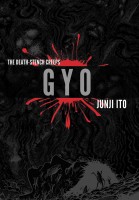
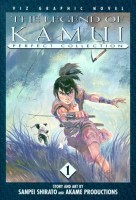
So, apparently last week was Shark Week, an annual event on the Discovery Channel. I don’t watch much television or pay attention to programming schedules, therefore it was a complete coincidence that both of the manga that I reviewed last week happened to include sharks! First up was my review of the deluxe hardcover omnibus of Junji Ito’s (comedy?) horror manga Gyo: The Death-Stench Creeps. It’s an incredibly gross and absurd manga and will certainly not be to everyone’s taste. I was entertained by its outrageousness, but overall much prefer his earlier work Uzumaki: Spiral into Horror. The second review last week was of The Legend of Kamui, Volume 1, an influential historical drama by Sanpei Shirota. The manga was actually one of the earliest series to be released in English back in the 1980s. Fortunately, it’s still relatively easy to find even though it’s long been out-of-print. I really wish that more of the series had been translated, though; The Legend of Kamui is excellent.

A couple of interesting things that I came across last week: Shojo Beat’s tenth anniversary celebration continues with five questions for Julietta Suzuki and Haikasoru posted a translation of a conversation between authors Paolo Bacigalupi and Taiyo Fujii from 2013. (I recently reviewed Fujii’s debut novel Gene Mapper, and reviewed Bacigalupi’s novel The Windup Girl, which has been very well received in Japan, at my old review blog Experiments in Reading several years ago.) Last week was the San Diego Comic-Con, but most of the news and announcements seemed to be repeats of Anime Expo. However, there was one newly announced license that was huge: Udon Entertainment will be releasing Riyoko Ikeda’s influential shoujo classic Rose of Versailles! Among other good news, Udon rescued Moyoco Anno’s marvelous shoujo series Sugar Sugar Rune, which makes me very happy. (I reviewed Del Rey’s edition of the first volume a couple of years back.) Udon will also be releasing Yomi Sarachi’s Steins;Gate manga. Kodansha has picked up Kousuke Fujishima’s manga series Paradise Residence. Dark Horse will be re-releasing Hiroaki Samura’s epic Blade of the Immortal in an omnibus edition which is great news since some of the individual volumes are out-of-print and hard to find. (The series is also a favorite of mine.) A couple of other interesting SDCC/manga-related posts: myths from the Manga Publisher Roundtable and a summary of 2015’s Best and Worst Manga panel. Oh, and Shigeru Mizuki’s Showa: A History of Japan won an Eisner Award!

Quick Takes
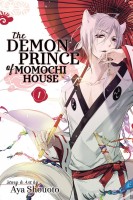
The Demon Prince of Momochi House, Volume 1The Demon Prince of Momochi House, Volume 1 by Aya Shouoto. There were mainly two things that initially drew my attention to The Demon Prince of Momochi House, the beautiful and somewhat provocative cover illustration and the promise of beautiful and somewhat provocative yokai. Himari Momochi unexpectedly inherits a house when she turns sixteen. As an orphan, it’s the only connection that she has to a family that she has never known. But when she arrives, she discovers a couple of complicating factors: the house is a gateway between the human and supernatural realms, and it is already occupied. Honestly, the story’s setup feels a little forced and employs a few well-worn shoujo tropes; it remains to be seen whether or not Shouoto will do anything clever with them. However, the artwork is attractive and I actually really do like the underlying premise of the manga. Although I wasn’t blown away by the first volume of The Demon Prince of Momochi House, I did enjoy it. The series has great potential and the manga certainly delivers on its promise of beautiful spirits. While I’m not in a rush to read the next volume, I’ll likely continue with the series to see if it develops into something really special or if it will merely remain something that is enjoyable in passing.

Dengeki Daisy, Volume 13Dengeki Daisy, Volumes 13-16 by Kyousuke Motomi. It’s been awhile since I’ve read Dengeki Daisy, but it is a manga that I tend to enjoy. Since the final volume of the series was released in English relatively recently, I figured it was about time for me to catch up. Dengeki Daisy isn’t always the most realistic or believable series—frequently things will happen because they’re convenient for the sake of moving the story forward or are being used as a punchline rather than being a convincing development—but it’s still pretty great. The manga also handles the romance between Teru and Kurosaki very well, especially considering the eight-year gap in their ages. Interestingly, while the last volume quickly wraps up the main story, it’s actually mostly devoted to a small collection of side and bonus stories, generally of a humorous nature. The volume also includes Motomi’s debut manga, “No Good Cupid.” It’s kind of a fun send off for the series, especially as the final story arc is focused more on intense action and drama rather than the manga’s humor or the quirkiness of its characters. However, I always find Motomi’s author notes and commentary to be endlessly entertaining. I definitely plan on reading more of her work in the future.
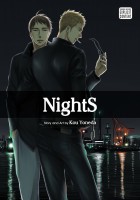
NightSNightS by Kou Yoneda. Only a few of Yoneda’s boys’ love manga have been released in English, but I enjoy her work immensely and would love to see even more of it licensed. NightS is a collection of stories: “NightS,” about a transporter for the yakuza and an older man with whom he becomes entangled (in more ways than one); “Emotion Spectrum,” a high school romance with a bit of a twist on the usual sort of love triangle; and “Reply,” featuring the blossoming relationship between a car salesman and a mechanic. Although the anthology is called NightS, “Reply” is actually the longest and most involved work in the volume. But even the shorter manga feature well-developed stories and characters. They each come across as an individual with a distinctive personality. This is a particularly important aspect of Yoneda’s manga since the plots tend to be very character focused and driven—people and their relationships, romantic or otherwise, are key to her stories. There is a maturity to the storytelling, as well. And a great sense of humor. Though they aren’t comedies, at times the manga collected in NightS can be quite funny. Also, Yoneda’s artwork is excellent; especially impressive is her use of light and shadow to create drama, mood, and atmosphere.
Filed Under: FEATURES, My Week in Manga Tagged With: Aya Shouoto, demon prince of momochi house, Dengeki Daisy, Kou Yoneda, Kyousuke Motomi, manga

The Legend of Kamui, Vol. 1

July 10, 2015 by Ash Brown

The Legend of Kamui, Volume 1Creator: Sanpei Shirato
U.S. publisher: Viz Media
ISBN: 9781569313183
Released: August 1998
Original release: 1990

Sanpei Shirato’s The Legend of Kamui had its beginnings in 1964 as one of the first series to be published in the influential alternative manga magazine Garo. In the 1980s, Sanpei would continue the manga with a second series, Kamui Gaiden. It was Kamui Gaiden that became one of the earliest manga series to be translated into English and widely published in North America. Between 1987 and 1988, Viz and Eclipse Comics released thirty-seven issues of Kamui Gaiden under the title of The Legend of Kamui, serializing edited versions of two stories: “The Island of Sugaru” and “The Sword Wind.” “The Island of Sugaru,” which was later compiled by Viz into two volumes in 1998, is probably one of the most well-known Kamui stories, and not just because of the Kamui Gaiden live-action film adaptation from 2009. The Legend of Kamui, Volume 1 collects the first half of “The Island of Sugaru,” material from a volume of Kamui Gaiden that was originally published in Japan in 1990.

Kamui is an apostate ninja during Japan’s Edo period, on the run from the members of his clan who consider him to be a traitor when he tries to leave. While traveling through Yumigahama he encounters a woman who, like him, once belonged to a clan of ninja. Sugaru has been able to avoid capture and death long enough to establish a new life with a husband and three children who love her, but she is still being hunted and must be constantly vigilant. Sugaru has managed to survive because she doesn’t trust anyone, and that includes Kamui. Although he helped to save her life when she was attacked by Iga ninja, Sugaru can’t take a chance that Kamui might be trying to kill her as well. After an intense battle in which they are both injured, they part ways. But in a strange twist of fate, Kamui is later shipwrecked on the very island where Sugaru and her family reside. Kamui lives peacefully for a time in the small, remote fishing village and Sugaru’s family becomes very fond of him, but Sugaru would rather see him dead.

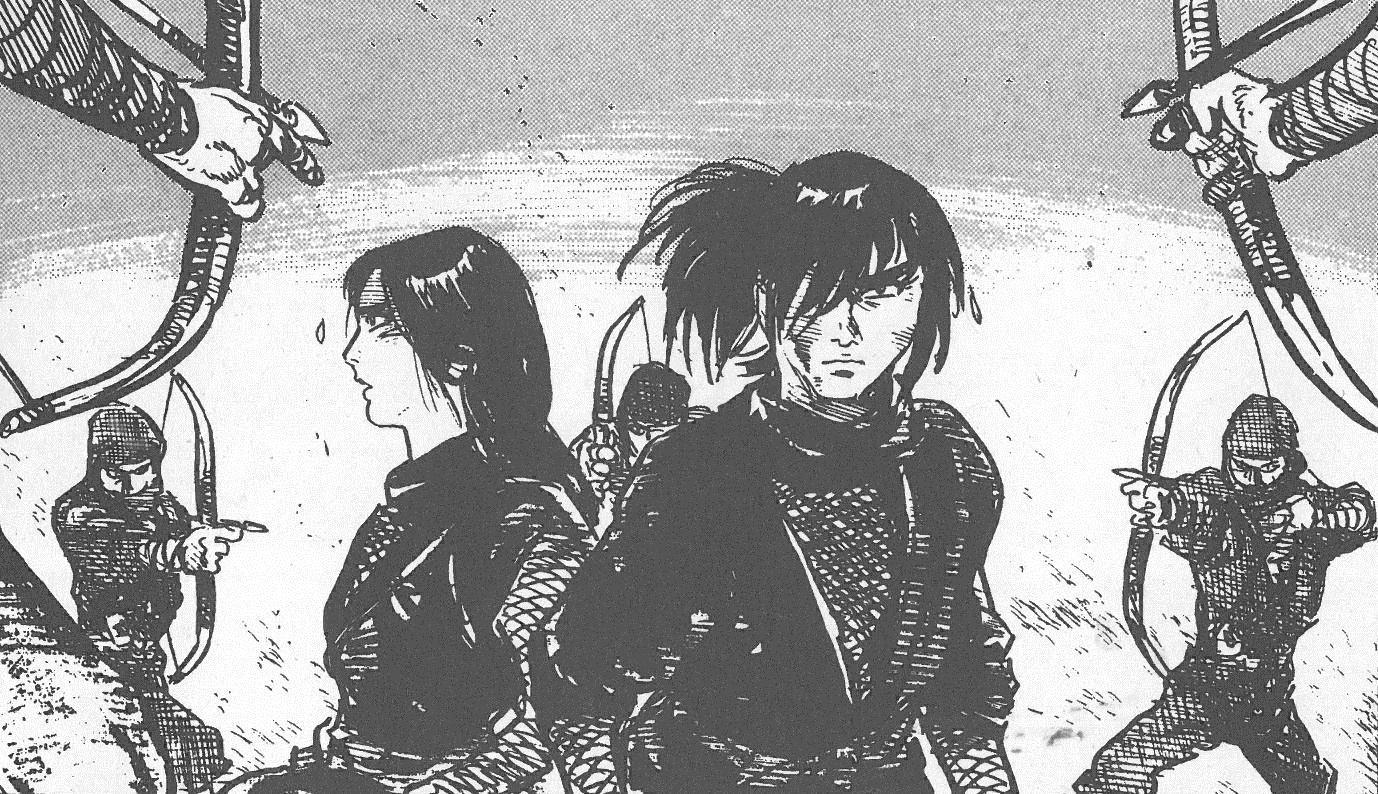
The Legend of Kamui, Volume 1, page 255From reading The Legend of Kamui, Volume 1 alone, not much is known about either Sugaru or Kamui’s past lives beyond the fact that they are trying to escape them. The hunted versus the hunter, whether the prey chooses to flee or to fight, is a theme that recurs throughout the manga, mirrored in both nature and human society. Kamui and Sugaru do have the advantage of being exceptionally adept fighters. Although Sugaru does strain under the burden of keeping both herself and her family safe, she is actually one of the strongest characters in The Legend of Kamui, Volume 1, exhibiting both great determination and martial prowess. Her skills rival and in some cases surpass those held by Kamui. Tragically, and understandably, due to her circumstances Sugaru has lost her ability to trust others; it’s simply no longer an option for her. Kamui, on the other hand, has so far managed to retain that part of his humanity, even though it has put his life in danger on multiple occasions.

I really wish more of The Legend of Kamui had been released in English because the series is excellent. The characters are complex, as are their personal struggles and their searches for freedom in an era that could be unforgiving, harsh, and violent. The action sequences are exciting and dynamic. Although a few ninja tricks are employed during the life-or-death battles—secret techniques, impressive acrobatics, illusions and transformations—there is a sense of realism that pervades The Legend of Kamui. In between the dramatic conflicts are the quieter moments of everyday life in a fishing village. Initially it appears as though Kamui, like Sugaru, will be able to outrun his fate and have a chance at a peaceful, happy existence. He learns to fish and becomes friendly with the villagers who are more than happy to welcome a strong young man into their midst. The Legend of Kamui, Volume 1 offers hope that such changes are possible, but ultimately taking charge of one’s own destiny is a difficult path to follow.

Filed Under: REVIEWS Tagged With: Legend of Kamui, manga, Sanpei Shirato, viz media

Gyo: The Death-Stench Creeps

July 8, 2015 by Ash Brown

Gyo: The Death-Stench CreepsCreator: Junji Ito
U.S. publisher: Viz Media
ISBN: 9781421579153
Released: April 2015
Original run: 2002

Gyo: The Death-Stench Creeps is a short, two-volume horror manga series created by Junji Ito. Originally published in Japan in 2002, Gyo has had several English-language releases by Viz Media. It was first translated between 2003 and 2004, a slightly updated second edition was released between 2007 and 2008, and most recently, published in 2015, was the deluxe hardcover omnibus. In addition to Gyo, the omnibus also collects two of Ito’s short horror manga: “The Sad Tale of the Principal Post” and “The Enigma of Amigara Fault.” The deluxe edition of Gyo is very similar in design to the recent omnibus of Ito’s manga Uzumaki; the two volumes look great on the shelf together. Uzumaki was actually my introduction to Ito’s work, and I consider it to be one of the best horror manga that I’ve read. Despite Gyo having been released in English three times, and despite the fact that I’ve been meaning to read more of Ito’s manga, the series’ deluxe omnibus is actually the first that I’ve read since Uzumaki.

While vacationing in Okinawa, Tadashi and his girlfriend Kaori witness the harbinger of what will eventually become a plague overrunning the entirety of Japan—a small, rotting fish walking on land with what appear to be mechanical legs. Accompanying it is an overwhelming and nauseating stench. Soon, countless fish and other sea creatures begin streaming out of the ocean. The only things that they have in common are the bizarre appendages and the sickening smell. Kaori and Tadashi cut their vacation short and return to Tokyo, but Kaori in particular is traumatized by the events in Okinawa and soon the creatures begin to be found in the city as well. No one knows where the walking fish originated or how they evolved; of much greater concern is the death and disease caused by their presence on land. And things are only getting worse with the passage of time.

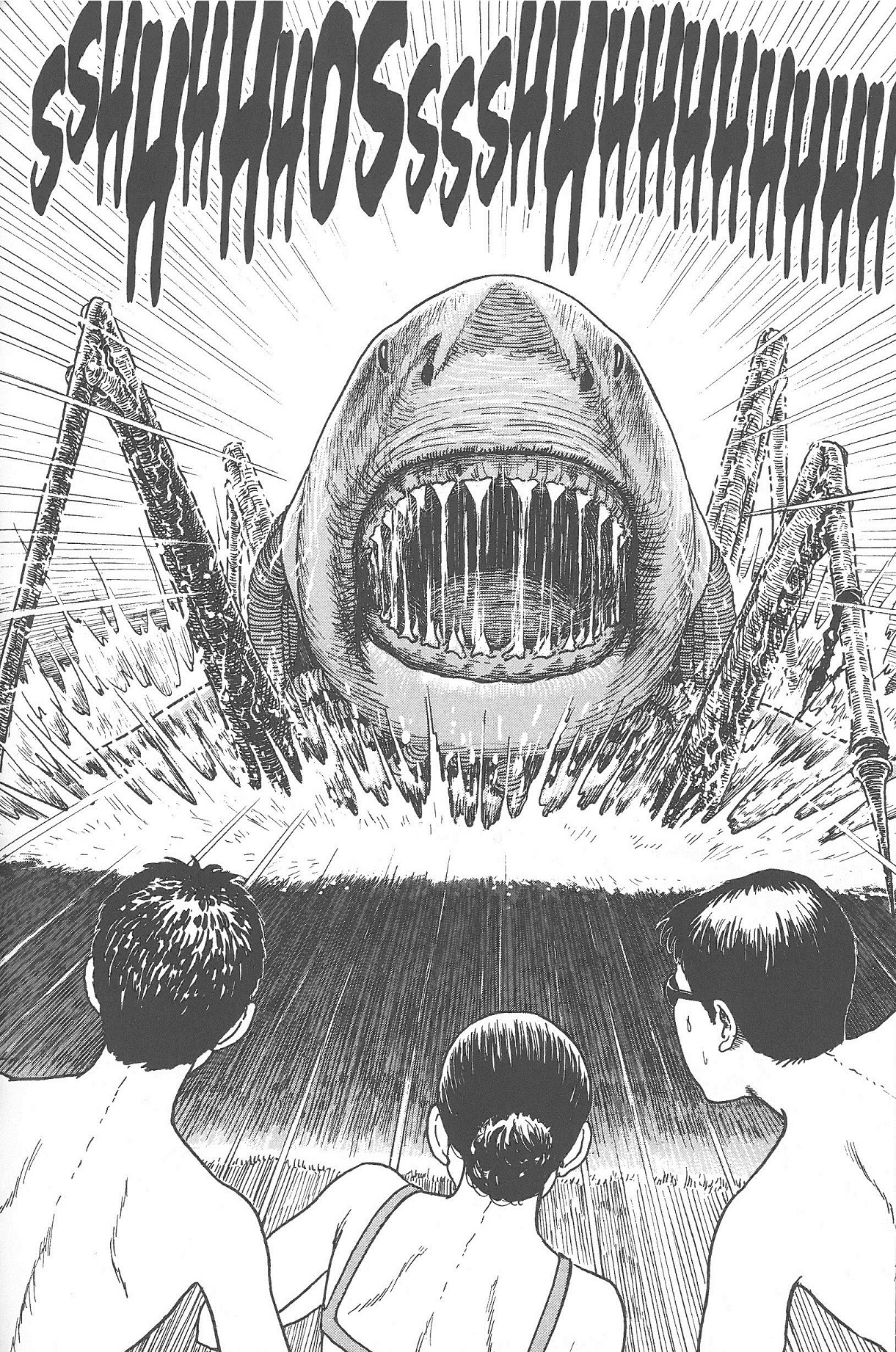
Gyo: The Death-Stench Creeps, page 66The back cover of the omnibus describes Gyo as Ito’s “creepiest masterpiece of horror manga ever.” Admittedly, some of the artwork in Gyo is fantastically creepy, not to mention gruesome and grotesque. Ito is an extremely skilled illustrator, creating images that are horrifying and nightmare-inducing. And as a whole, Gyo can be exceptionally gross. However, the manga’s story ends up being so utterly ridiculous that I would be hard pressed to call it a masterpiece, especially when compared to his earlier work Uzumaki. Whereas Uzumaki is surreal and bizarre, Gyo is so absurd as to be ludicrous, and only increasingly so as the manga progresses. I simply can’t take Gyo seriously; I can only read the series as a comedy, whether or not it is actually intended as such. The manga is perhaps closer to being a cult classic, which I suppose might make it a masterpiece of a different sort, but that’s something that could be argued either way. If nothing else, though, Gyo is a brilliantly outrageous spectacle.

Gyo is certainly not a manga that will appeal to every reader, even those who are already fans of horror manga. Though disconcerting and disgusting, especially the illustrations, the plot of Gyo is too silly to be truly terrifying. Taken alone, the art is superb, but the ridiculous nature of the story creates a weird disconnect. However, I can’t deny that I was entertained by the progressively over-the-top, illogical, and random developments in the manga: sentient gas, a circus out of the middle of nowhere, characters who are oddly oblivious or overly accepting of what is going on around them, and so on. (Though, it is rather sweet how Tadashi sticks beside Kaori through to the very end.) Assuming that one can find it palatable to begin with, Gyo is a very strange manga that is difficult to look away from as Ito presses further and further into territory that is beyond believing. I kept turning the pages to see just how far he would be able to take things. Gyo may very well be one of those manga that’s so good simply because it’s so bad; whether that’s deliberate or not, I’m not sure.

Filed Under: REVIEWS Tagged With: Gyo, Junji Ito, manga, viz media

My Week in Manga: June 29-July 5, 2015

July 6, 2015 by Ash Brown

My News and Reviews

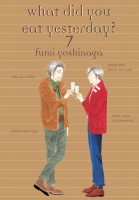
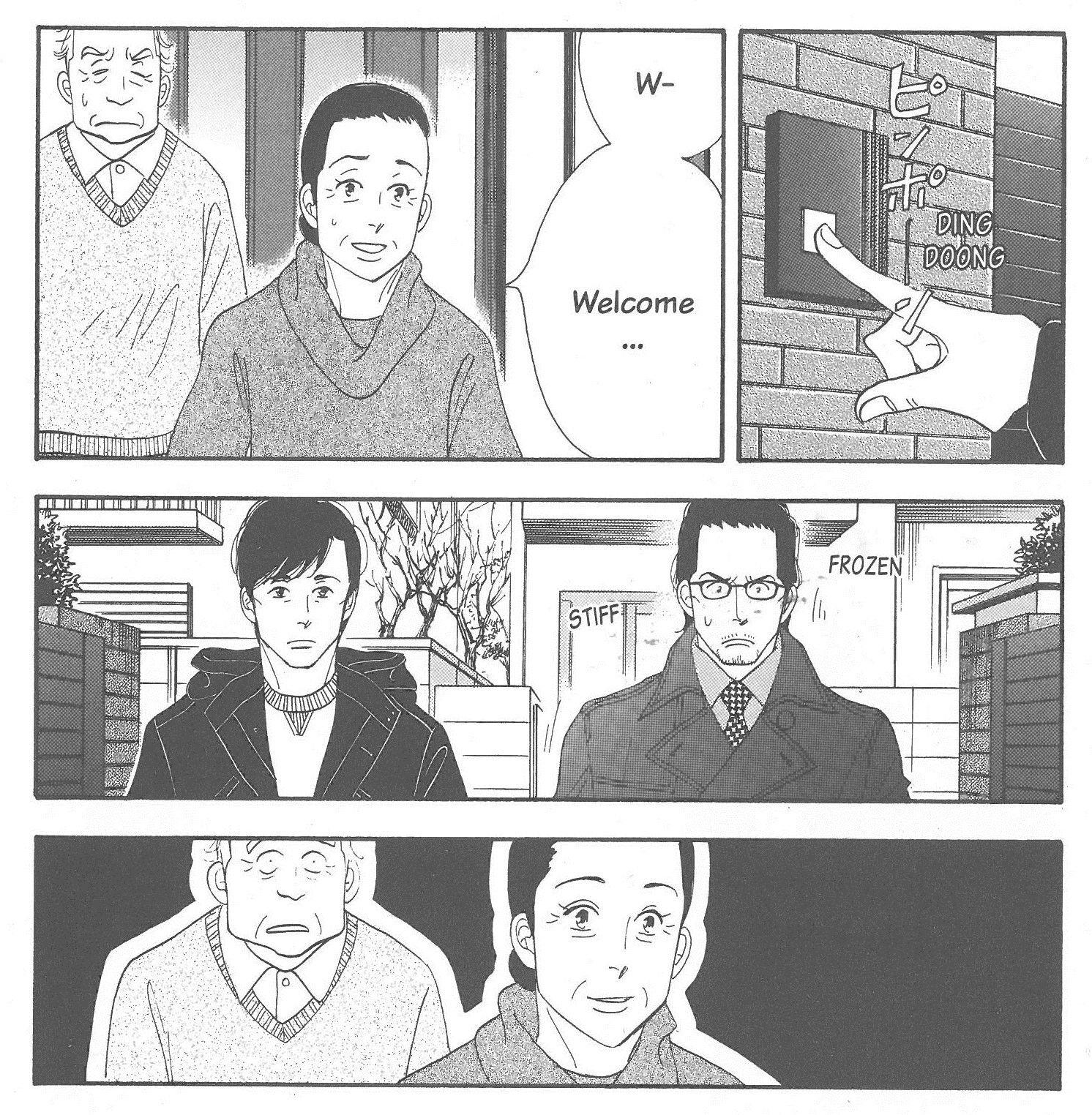
Once again, I was actually away for most of the week last week. The taiko ensemble I that primarily play with had a series of performances, a mini taiko tour of sorts, so I was traveling. We had a great time; I only wish I that could make my living in music! (Who knows, maybe in the future I’ll be able to make it work. You know, once the mountain of student loans has been paid back.) Although I fell behind in my reading and writing, I did have a few things in queue to post at Experiments in Manga. First, the Assassination Classroom Giveaway Winner was announced. The post also includes a list of manga available in English that feature teachers. I’m a couple of volumes behind in my reviews for the series, but the honor of the first in-depth manga review for July goes to Fumi Yoshinaga’s What Did You Eat Yesterday?, Volume 7. Kenji finally has the chance to meet Shiro’s parents and it’s great. Finally, over the weekend, I posted June’s Bookshelf Overload. Most notably, I found an entire set of the tragically out-of-print Banana Fish that I didn’t have to trade a kidney to obtain!

Because I was away from the Internet for so many days, I didn’t really stumble across any articles that I found particularly interesting. However, Anime Expo was held last week, and there were a ton of licensing announcements. (Manga Bookshelf cohort Sean has a nice roundup.) Kodansha has Akiko Higashimura’s Princess Jellyfish (I’m thrilled!), Shizumu Watanabe and Okushō’s Real Account, and Hoshino Taguchi’s Magatsuki. Haikasoru has the first three novels of Yoshiki Tanaka’s Legend of the Galactic Heroes (hooray!), and Sentai licensed the anime series. Shojo Beat picked up Matsuri Hino’s Shuriken and Pleats and Bisco Hatori’s Behind the Scenes. Seven Seas licensed Angel Beats!: Heaven’s Door. Tokyopop returns to manga publishing in 2016, but no specific titles have yet been mentioned. Vertical will be releasing Keiichi Arawi’s Nichijō, and Kanata Konami’s FukuFuku: Kitten Tales among other things. Yen Press announced a slew of manga and light novel acquisitions, too, including the mahjong manga Saki! (Sadly, it’s currently only a digital release.) I’m sure I’ve missed something, so please let me know what exciting news or reading I should be aware of!

Quick Takes

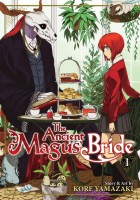
The Ancient Magus' Bride, Volume 1The Ancient Magus’ Bride, Volume 1 by Kore Yamazaki. Apparently, The Ancient Magus’ Bride started as a one-shot doujin before catching the eye of an editor. It’s a curious and atmospheric manga, mostly set in current-day England, albeit it’s a world in which magic and alchemy take their place alongside science. Although magic use seems to be fading away, fae are still very real and a few humans show rare talent for the craft. Chise is one of those humans. Sold into slavery, she is purchased and perhaps rescued by a Elias, a powerful mage who wants her to become his apprentice. He also mentions something about Chise becoming his bride, too, though she can’t quite tell if he’s being serious or not. Granted, it’s a little difficult to read a person with an animal skull for a head. Yokai exist in The Ancient Magus’ Bride as well (they can be seen in the background of some of Chise’s memories), but so far it appears as though the manga will be focusing on Europe’s fantastical and legendary creatures. I enjoyed the first volume of The Anceint Magus’ Bride a great deal and look forward to reading more of the series.

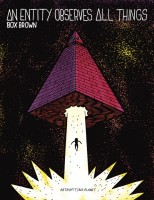
An Entity Observes All ThingsAn Entity Observes All Things by Box Brown. I was already curious about An Entity Observes All Things, but after briefly meeting Brown at TCAF I knew that I wanted to read it. The volume includes nine of Brown’s short, alternative comics, three of which were previously published elsewhere while I believe the other six are new for the collection. Though for the most part the comics are unrelated to each other—they don’t really share characters, plots, or settings and even their color palettes are different—in general, the short works fall into the category of science fiction and deal with themes of exploration, specifically of the world and of the self. They all tend to be fairly quirky, too, and can often be rather humorous without necessarily being comedies. I enjoyed An Entity Observes All Things quite a bit. As with most collections, some of the individual comics worked for me more than others, but overall I found the selections to be engaging. Sometimes funny and sometimes sad, the comics are all somewhat strange, and that’s something that I particularly appreciate about An Entity Observes All Things.

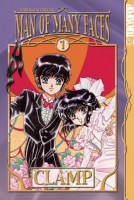
Man of Many Faces, Volume 1Man of Many Faces, Volumes 1-2 by CLAMP. I largely enjoy manga by CLAMP, but if I’m going to be honest, I was primarily interested in Man of Many Faces due to its loose connection to the works of Edogawa Rampo. For the most part, the Rampo references are limited to the characters’ names and roles. There’s the titular “Twenty Faces,” a skilled thief in both Rampo and CLAMP’s creations, a young man by the name of Kobayashi who chases after him, and even Akechi-sensei, although he’s a school doctor rather than a detective in the manga. Man of Many Faces is one of CLAMP’s earliest professional works and it is very, very silly, the more absurd elements being lampshaded and intentionally left unexplained. However, the manga ends up being rather sweet and charming, too. Twenty Faces is a third grader who has taken on the role of the gentleman thief in the absence of his father. Akira steals things according to the whims of his two eccentric mothers in addition to doing all of the cooking and housework. Although the story at first focuses on the various heists, ultimately Man of Many Faces is about romantic love.

Filed Under: FEATURES, My Week in Manga Tagged With: Ancient Magus' Bride, Box Brown, clamp, comics, Kore Yamazaki, Man of Many Faces, manga

What Did You Eat Yesterday?, Vol. 7

July 3, 2015 by Ash Brown

What Did You Eat Yesterday?, Volume 7Creator: Fumi Yoshinaga
U.S. publisher: Vertical
ISBN: 9781941220221
Released: March 2015
Original release: 2012

What Did You Eat Yesterday? incorporates so many things that I love—the work of Fumi Yoshinaga, food, queer life, and so on—that it’s really not too much of a surprise that I enjoy the manga series. Yoshinaga has had many of her manga released in English. I have always been particularly impressed by the subtle complexities of her characterizations. Her skill at writing people is especially important for a series like What Did You Eat Yesterday? in which a tremendous amount of focus is given to the characters themselves rather than to an intricate, overarching plot, at least when the manga’s not focusing on food. The characters in What Did You Eat Yesterday?, likeable or not, are all very realistically portrayed, which is one of the things that I appreciate most about the series. What Did You Eat Yesterday?, Volume 7 was originally published in Japan in 2012. The English-language edition, released by Vertical, was published in 2015.

Shiro and Kenji have been living together for years, but it’s only recently that Shiro has managed to get up the courage to actually introduce his long-term boyfriend to his parents. It’s a momentous albeit awkward occasion, but Kenji at least is thrilled by the prospect. Shiro’s family has known he was gay for quite some time, however they are still coming to terms with exactly what that means. Happily, sharing a good meal can go a long way to help acceptance and understanding grow. Food has helped to improve and stabilize Kenji and Shiro’s relationship as well—Shiro enjoys cooking and Kenji is usually more than happy to accommodate his boyfriend, not to mention eat the fruits of his efforts—which is why when work interferes with their dinner dates at home it’s particularly vexing. The salon that Kenji works at is undergoing renovations and staffing changes while the law office where Shiro is employed is inundated with bankruptcy cases. Both men have been very busy of late, but they are still ready to support each other both inside the kitchen and outside of it.

What Did You Eat Yesterday, Volume 7, page 24Food, and the preparation and consumption of said food, is a major component of What Did You Eat Yesterday?. A majority of the seventh volume, if not the entire series, is spent either cooking in a kitchen or eating around a table. While other aspects of Yoshinaga’s artwork are rather simple, she puts a tremendous amount of detail into the various dishes that are featured in the manga—the food in What Did You Eat Yesterday? is beautifully illustrated. The recipes in the series tend to be fairly detailed as well. It is entirely possible for an experienced cook to successfully recreate many of the courses. I’ve even been tempted to try a few myself. (The tea sorbet from the seventh volume sounds especially appealing to me.) Occasionally, the focus on food in What Did You Eat Yesterday? can get in the way of the stories being told, but sometimes it’s expertly integrated.

As much as I enjoy all of the food and eating What Did You Eat Yesterday? (and I certainly do), what really makes the series work for me are its characters and the realistic portrayal of their lives. I have come to love and care for the characters in the series a great deal in spite of, or maybe because of, their very human flaws. They all come across as real people with both good traits and bad. I enjoy seeing their relationships evolve and change, and I enjoy seeing them continue to grow as people well into their adulthood. The individual chapters of What Did You Eat Yesterday? provide small snapshots of the characters’ everyday lives. Sometimes the events shown are fairly ordinary or mundane, such as grocery shopping followed by a quick stop at a cafe, while others are more momentous, like meeting the parents of an established partner for the first time. But even the seemingly small and quiet moments in What Did You Eat Yesterday? are important, carrying signficant meaning and impact, and showing just how skilled a writer Yoshinaga can be.

Filed Under: REVIEWS Tagged With: fumi yoshinaga, manga, vertical, what did you eat yesterday?

Manga Giveaway: Assassination Classroom Giveaway Winner

July 1, 2015 by Ash Brown

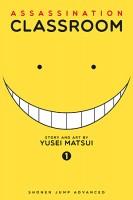
Assassination Classroom, Volume 1And the winner of the Assassination Classroom manga giveaway is… wandering-dreamer!

As the winner, wandering-dreamer (whose review blog Narrative Investigations I happen to really enjoy) will be receiving Assassination Classroom, Volume 1 by Yusei Matsui as published by Viz Media. Since Assassination Classroom features a rather unusual teacher, I was curious to hear about some of the other great teachers that other people have encountered while reading manga. Be sure to check out the giveaway comments for everyone’s detailed responses!

Some of the manga available in English featuring teachers:
Anything and Something by Kaoru Mori
Aqua by Kozue Amano
Aria by Kozue Amano
Assassination Classroom by Yusei Matsui
Blue Exorcist by Kazue Kato
Cardcaptor Sakura by CLAMP
Dr. Slump by Akira Toriyama
Fullmetal Alchemist by Hiromu Arakawa
Future Lovers by Saika Kunieda
GTO: Great Teacher Onizuka by Toru Fujisawa
GTO: 14 Days in Shonan by Toru Fujisawa
Hana-Kimi by Hisaya Nakajo
Hikaru no Go written by Yumi Hotta, illustrated by Takeshi Obata
Kobato by CLAMP
Moon and Sandals by Fumi Yoshinaga
Naruto by Masashi Kishimoto
Negima! by Ken Akamatsu
Oresama Teacher by Izumi Tsubaki
The Royal Tutor by Higasa Akai
S.S. Astro: Asashio Sogo Teachers’ Room by Negi Banno
Sunshine Sketch by Ume Aoki
Ultras by est em

There are some really great teachers included in the manga listed above, but I’m sure that there are plenty more. Thank you to everybody who participated in the giveaway and shared your personal favorites with me. I hope to see you again for the next giveaway!

Filed Under: Giveaways, UNSHELVED Tagged With: assassination classroom, manga, Yusei Matsui

My Week in Manga: June 22-June 28, 2015

June 29, 2015 by Ash Brown

My News and Reviews

Last week, the most recent manga giveaway at Experiments in Manga was posted. The winner will be announced on Wednesday, so there are still a couple of days left to enter for a chance to win the first volume of Assassination Classroom. All you have to do is tell me about your favorite teacher from a manga. I also posted two reviews last week. The first review was of Yaya Sakuragi’s boys’ love manga Hide and Seek, Volume 2. The series continues to be one of her strongest; I’m really enjoying it. The second review was of Taiyo Fujii’s novel Gene Mapper, the most recent release from the Haikasoru. Gene Mapper is a great example of realistic near future science featuring thought-provoking information and bio-technologies.

Organization Anti-Social Geniuses has been posting some great manga-related content recently, including a conversation with manga translator Amanda Haley about Book Walker and the translation field. A new manga feature at OASG was announced for the summer as well: Shoujo You Should Know, the first column focusing on CLAMP’s short series Wish. And speaking of shoujo manga, Shojo Beat is celebrating its tenth anniversary. Among other thing, the imprint is posting brief interviews with some of its creators. First up was Maki Minami followed by Yun Kouga. Over at Things We Lost at Dusk, Alicia posted and interesting essay about gender, identity, and language, specifically in regards to Moto Hagio’s manga They Were Eleven.

Last but not least, I would like to draw everyone’s attention to Chromatic Press’ Kickstarter project to help support and fund Sparkler Monthly‘s third year. I am a huge fan of Sparkler Monthly and everything else that Chromatic Press is doing. (Experiments in Manga’s Chromatic Press tag is filled with my love, reviews, and features.) The content, creators, and everyone else involved are all fantastic. So, please check out Sparkler Monthly. Most of the comics, prose, and audio, is currently available for free online. And if you like what you see, please consider pledging to the Sparkler Monthly Kickstarter project if you can. Every little bit helps. The work being done at Chromatic Press is spectacular; I sincerely hope that Sparkler Monthly and the publisher’s other efforts are able to continue.

Quick Takes

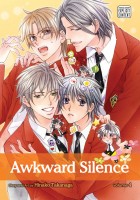
Awkward Silence, Volume 4Awkward Silence, Volume 4 by Hinako Takanaga. Some of the very first boys’ love manga that I ever read we’re by Takanaga. I soon began counting her among my favorite creators working in the genre and so was quite pleased when Sublime licensed Awkward Silence. The fourth volume in the series was actually released in English quite a while ago, but I only recently realized that I hadn’t actually read it yet, probably because Awkward Silence isn’t particularly memorable. It’s not a bad manga, and there are plenty of things that I like about it—Takanaga’s artwork is great, for one, as are some of the characters—but overall, Awkward Silence somehow manages to come across as generic. For the most part it’s enjoyable and sometimes even sweet, but the series just doesn’t stand out. Initially, I was under the impression that the fourth volume was the end, but apparently it’s an ongoing series. Being something of a Takanaga completist I’ll likely read any subsequent volumes, but otherwise I don’t know that I would feel compelled to seek the series out.

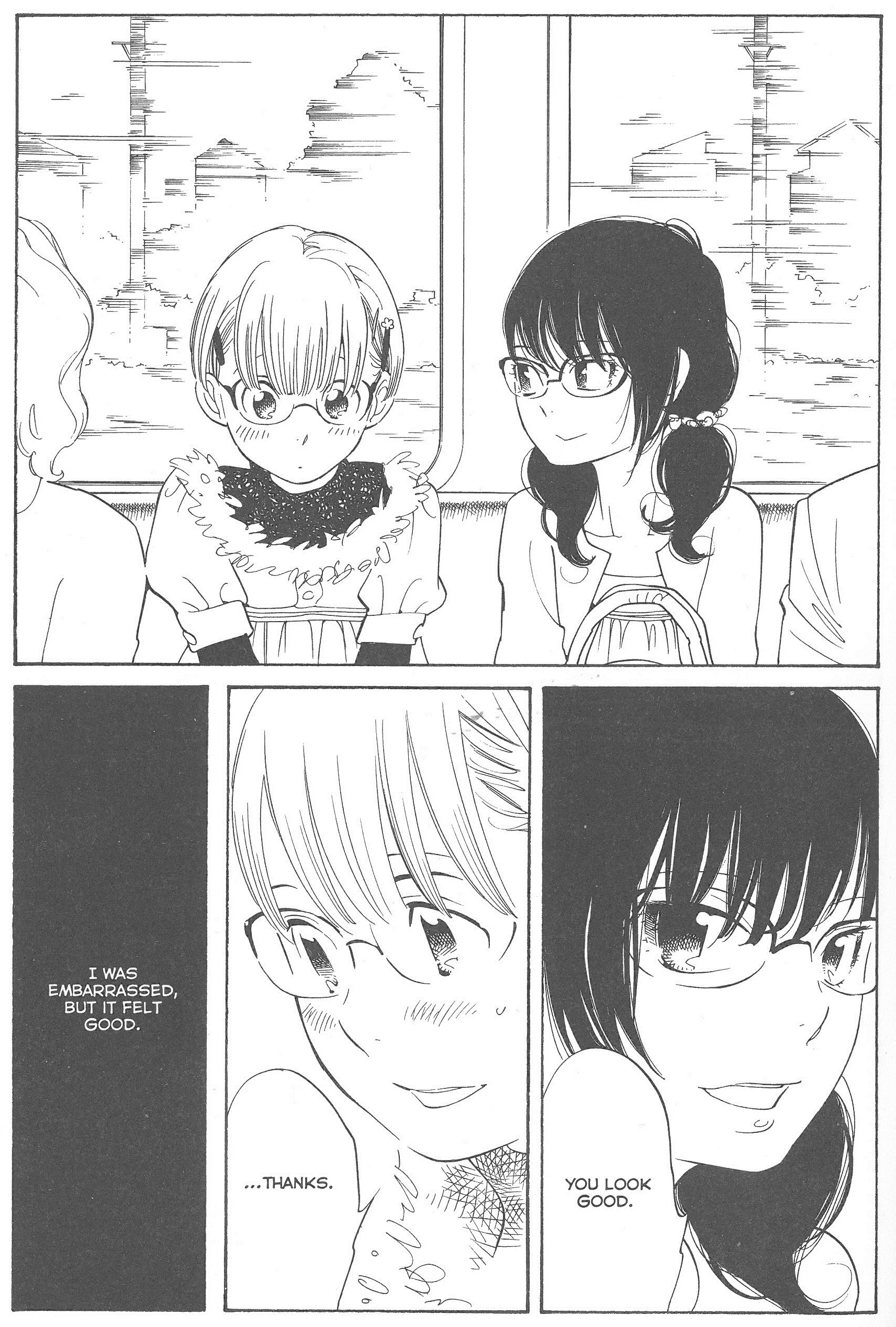
Just So HappensJust So Happens by Fumio Obata. Originally published in the United Kingdom in 2014, Just So Happens was recently released in North America. Yumiko is a designer who left Japan to study and work in London. From time to time she returns to Japan to visit her family, but she is largely satisfied with her life in England. But Yumiko’s most recent trip to Japan is different. Her father unexpectedly died in a mountain climbing accident and she wants and needs to be there for his funeral. In part drawing inspiration from the imagery and symbolism of Noh theater, Just So Happens is a beautiful and subtle work about family, grief, identity, and coming to terms with past decisions. Obata’s watercolor illustrations are absolutely lovely and very effective in conveying the work’s quiet, introspective atmosphere. The story itself is fairly simple and is emotionally resonant without being overly dramatic. Much like Yumiko, Obata is himself a Japanese artist who has made England his home, so while the graphic novel isn’t necessarily autobiographical, Just So Happens still feels very personal.
Servamp, Volume 1Servamp, Volumes 1-2 by Strike Tanaka. From my admittedly limited exposure, my impression of manga originating from Comic Gene is that they tend to have a lot of style without necessarily making a lot of sense. So far, that seems to be the case with Servamp as well. The first two volumes are entertaining, even enjoyable, but I’d be hard pressed to actually explain everything that is going on in the manga. Granted, Mahiru, the series protagonist, doesn’t really know what’s going on either, and the characters who do aren’t being particularly forthcoming. Mahiru likes to keep things simple, which basically means that he ends up doing up anything and everything himself rather than involving other people. And so he’s more or less taken on the responsibility of saving the world, or at least saving humans from the vampires who would kill them all. Mahiru does have some help though, namely an exceptionally lazy but supposedly extremely powerful vampire known as Sleepy Ash, as well as a few other allies. Though it has yet to be seen just how far those allies can really be trusted.

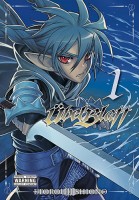
Ubel Blatt, Omnibus 1Übel Blatt, Omnibus 1 (equivalent to Volumes 2-3) by Etorouji Shiono. Although there was a fair amount that bothered me about the initial omnibus of Übel Blatt, the series still showed some potential and I was curious to see where it might go. I am happy to be able to say that the most recent omnibus is an improvement. There’s still gratuitous nudity and sexual content, but it doesn’t seem nearly as out-of-place as it was at the beginning of the series. The fact that many of women are dressed in ridiculously revealing and impractical clothing is even lampshaded at one point when Peepi celebrates the fact that she gets to wear “normal clothes.” In general, the female characters actually are treated a little better and are slightly more developed as individuals in Übel Blatt, Omnibus 1, but sadly not to the extent that I really want to see. To be fair, though, most of the characters seem to lack depth. The action sequences and artwork remain fairly strong, and I do largely like the lead, but for the most part Übel Blatt just isn’t connecting with me. This does surprise me somewhat as I usually really enjoy dark fantasy and tales of revenge.

Filed Under: FEATURES, My Week in Manga Tagged With: awkward silence, comics, Etorouji Shiono, Fumio Obata, Hinako Takanaga, manga, Servamp, Strike Tanaka, Ubel Blatt

Hide and Seek, Vol. 2

June 26, 2015 by Ash Brown

Hide and Seek, Volume 2Creator: Yaya Sakuragi
U.S. publisher: Viz Media
ISBN: 9781421558585
Released: March 2014
Original release: 2013

Hide and Seek is a three-volume boys’ love manga series by Yaya Sakuragi. The manga is a direct spinoff of another of Sakuragi’s boys’ love series, Bond of Dreams, Bond of Love, which is itself tangentially related to her series Tea for Two. All three series can be read and enjoyed separately from one another, but there are some shared characters and references. Both Bond of Dreams, Bond of Love and Hide and Seek were licensed and released in English by Sublime Manga, the boys’ love imprint associated with Viz Media. (Tea for Two was published by Tokyopop’s Blu Manga imprint back in the day.) Hide and Seek, Volume 2 was originally released in Japan in 2013 while the English-language edition was released in 2014. I began following Sakuragi’s work in translation after encountering her boys’ love one-shot Hey, Sensei?. I’ve continued to enjoy and read her manga, but I find Hide and Seek to be particularly good.

It was supposed to be a simple fling, an uncomplicated relationship to enjoyably pass the time with no expectations that it would develop into something more serious. Except that Shuji, who generally isn’t interested in other men, is falling more and more for the young neighborhood doctor Saji. Though he’s slow to admit that he’s in love, Shuji can’t deny the jealously he experiences when he sees another man kiss Saji. Those feelings intensify when he discovers that the man, Yuki, used to date Saji and due to various unfortunate circumstances is currently staying at the doctors’ home. Saji picks up on some of that jealousy, but he has already resigned himself to a fleeting relationship with Shuji. He would certainly be interested in a more devoted partnership, but he’s been burned so many times in the past that he’s trying no to get his hopes up. And with neither man being completely honest with the other about his feelings, any sort of relationship will be difficult to maintain.

Hide and Seek, Volume 2, page 107While Hide and Seek definitely has its humorous moments, overall it tends to be a much more serious, and to some extent much more realistic, manga than its immediate predecessor Bond of Dreams, Bond of Love ever was. Likewise, Shuji, the main connecting character between the two series, is significantly more developed and complex in Hide and Seek. Although at heart he hasn’t really changed much from who he was in Bond of Dreams, Bond of Love, in part due to the tone of Hide and Seek his character has now become convincingly believable instead of being intentionally comedic and shallow. Shuji amused me greatly in Bond of Dreams, Bond of Love, but I really like Hide and Seek‘s more nuanced version of him. He is much more considerate and much less self-centered than his outward demeanor would initially lead one to assume (as well a more responsible and mature), and he’s honestly concerned for the well-being of those he cares most about, including Saji.

Overall, the characterization in Hide and Seek is excellent, particularly that of Shuji, but Saji is also a realistically complicated individual. I’ve enjoyed watching their relationship evolve and develop over the course of Hide and Seek and look forward to seeing how things turn out for them in the final volume. Shuji and Saji’s relationship isn’t in danger because they’re incompatible. In fact, the two men are surprisingly well-suited for each other. It’s actually because they care so much for each other and are trying not to force their feelings on, take advantage of, or hurt the other person that their relationship has the potential to dissolve. Although they do misinterpret the meaning and motivations behind some of each others’ words and actions, and make some inaccurate assumptions as a result, Shuji and Saji do communicate with each other, something that is absolutely critical for any relationship to succeed. Granted, they still need to learn to open up to each other a little more if they’re going to make things work in the long-term.

Filed Under: REVIEWS Tagged With: Hide and Seek, manga, Sublime Manga, viz media, Yaya Sakuragi

Manga Giveaway: Assassination Classroom Giveaway

June 24, 2015 by Ash Brown

The end of June draws near, which means the end of the first half of the year is quickly approaching, too. It also means that it’s time for another giveaway at Experiments in Manga! Most schools are now out for the summer (at least in the United States), but we mustn’t forget all of those hardworking teachers. And so, this month’s giveaway is for Yusei Matsui’s Assassination Classroom, Volume 1 as published in English by Viz Media. As always, the giveaway is open worldwide!

Assassination Classroom, Volume 1

Considering the sheer number of manga translated into English that are based in a school setting, relatively few seem to grant more than a passing acknowledgement of the teachers. Sometimes they aren’t even included in the story at all or barely make an appearance beyond the background. But occasionally teachers are actually given a prominent role. Assassination Classroom is a series that stands out for that very reason (among many other reasons). Great Teacher Onizuka, the first series that I read in which a teacher was a lead character, is another manga that immediately leaps to mind. There’s S.S. Astro: Asashio Sogo Teachers’ Room, too, but I can’t think of very many other examples off the top of my head that are available in English.

(Okay, I will admit right now that there are plenty of hentai and boys’ love manga that feature teachers, but those particular stories really weren’t the ones that I had in mind…)

So, you may be wondering, how can you win a copy of Assassination Classroom, Volume 1

1) In the comments below, tell me a little about your favorite teacher from a manga. (Never noticed a teacher in your reading? Simply mention that.)
2) If you’re on Twitter, you can earn a bonus entry by tweeting, or retweeting, about the contest. Make sure to include a link to this post and @PhoenixTerran (that’s me).

There you have it! Each person can earn up to two entries for this giveaway. You have one week to submit comments. If you have trouble with the comment form, or if you prefer, entries can also be sent to me via email at phoenixterran(at)gmail(dot)com. The comments will then be posted here in your name. The giveaway winner will be randomly selected and announced on July 1, 2015. Best of luck to you all!

VERY IMPORTANT: Include some way that I can contact you. This can be an e-mail address in the comment form, a link to your website, Twitter username, or whatever. If I can’t figure out how to get a hold of you and you win, I’ll just draw another name.

Contest winner announced–Manga Giveaway: Assassination Classroom Giveaway Winner

Filed Under: FEATURES, Giveaways Tagged With: assassination classroom, manga, Yusei Matsui

My Week in Manga: June 15-June 21, 2015

June 22, 2015 by Ash Brown

 My News and Reviews

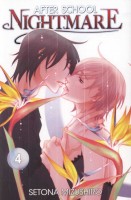
I was on vacation last week, much of which was spent in the middle of the woods in the middle of Ohio camping with my family. This meant I had very little Internet access. But even so, I did manage to post two reviews last week. My monthly horror manga review project continued with a review of After School Nightmare, Volume 4 by Setona Mizushiro. This was the first volume in the series that I hadn’t previously read before embarking on the review project. The second review was of Satoshi Wagahara’s prize-winning light novel The Devil Is a Part-Timer!, Volume 1 which is very amusing and silly. But, having watched the anime series last year, I already knew that.

As previously mentioned, I was occupied with other things last week, so I probably missed out on all sorts of interesting reading, news, and announcements. However, there were a few things that came across my radar before I left for Ohio. Kathryn Hemmann at Contemporary Japanese Literature wrote about The Cultural Cross Pollination of Shōjo Manga. And speaking of shōjo manga, Digital Manga’s most recent Tezuka Kickstarter is aiming to publish Storm Fairy. (The project also aims to reprint Unico with better image and color quality, which makes me wonder why Digital Manga didn’t do that for the first printing, but I’ve given up trying to understand Digital Manga’s decision making.) Finally, Udon Entertainment announced a new manga license: Shuji Sogabe’s adaptation of Persona 4.

Quick Takes

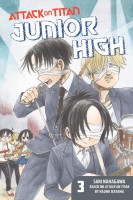
Attack on Titan: Junior High, Omnibus 3Attack on Titan: Junior High, Omnibus 3 (equivalent to Volumes 5-6) by Saki Nakagawa. Out of all the various Attack on Titan spinoffs, Junior High is the one that probably has the smallest audience overall and is the one that is the most uneven for me specifically. Sometimes the manga can be a slog to get through, but sometimes it’s absolutely hilarious. At its best, Junior High can actually make me laugh out loud; I keep reading the series for those moments because when Junior High is funny, it is very funny. The manga continues to be a very weird mix of Attack on Titan and a generic school setting with all of the standard tropes that that entails. Sometimes the combination works better than others. This particular omnibus features the school culture festival, a battle of the bands, eating contests and cooking competitions, club activities, lots of cleaning, and school rivalries among other things. I was very pleased to see that characters and storylines from other Attack on Titan spinoffs like No Regrets are now being incorporated into Junior High as well.

Lies Are a Gentleman's Manners, Volume 1Lies Are a Gentleman’s Manners by Marta Matsuo. Since for whatever reason Digital Manga often seems to be hesitant to include “Volume 1” in the title of a new manga, I didn’t initially realize that Lies Are a Gentleman’s Manners is actually an ongoing series in Japan. The first volume stands well enough on its own, but I do hope that any subsequent volumes will be licensed as well. Despite the fact that neither of the leads in this boys’ love manga are particularly likeable—Jonathan, an unscrupulous medical student selling drugs to his fellow classmates, and Paul, his equally unscrupulous (and married) college professor who uses that fact to blackmail him into a relationship—I actually do want to read more. Though some of the situations are unquestionably unsavory, the manga can also be very funny and even sexy on occasion. One of the most interesting things about Lies Are a Gentleman’s Manners is its setting. The manga takes place on America’s modern East Coast among the country’s wealthy, aristocratic upper class. While certainly a fictional representation, some of the social dynamics ring true.

TowerkindTowerkind by Kat Verhoeven. Originally self-published as a series of mini-comics, Towerkind was recently collected and released by Conundrum Press in a single volume. I was not previously familiar with Verhoeven’s work; Towerkind was a TCAF-inspired impulse buy. I’m very glad that I picked it up though because I’m loving this comic to pieces. Towerkind certainly won’t be to everyone’s liking, but there’s just something about the comic that I find oddly compelling. It’s surreal, strange, chilling, and ominous. Verhoeven effectively uses a small format to create a claustrophobic atmosphere that emphasizes the feeling of impending doom experienced by the characters. The volume opens with a foreword by Georgia Webber explaining the importance of the backdrop of Towerkind—Toronto’s first vertical neighborhood of high-rise apartments St. James Town—which helps to set the stage and tone for the comic itself. Towerkind follows a group of children gifted with unexplainable supernatural abilities who live in the towers of St. James Town while what may be the end of the world approaches.

Welcome to the N.H.K., Volume 5Welcome to the N.H.K., Volumes 5-8 by Kendi Oiwa. Having already read the original Welcome to the N.H.K. novel by Tatsuhiko Takimoto and having already seen the Welcome to the N.H.K. anime series (which, it turns out, was based on both the novel and Oiwa’s manga adaptation), I am already quite familiar with the story and characters Welcome to the N.H.K., but I somehow managed to forget just how dark and hard-hitting it can be. Ostensibly Welcome to the N.H.K. is a comedy, and it can be quite funny in a painful sort of way, but it deals with some pretty heavy subject matter including (but not limited to) drug use, self-harm, suicide, and mental illness. The second half of the series, while at times outrageous, tends to fall on the more serious side of things. Although I’ve always considered Welcome to the N.H.K. to be Satou’s story, the manga also places particular emphasis on Misaki’s story. It’s been a while since I’ve read or watched them, but I believe the manga actually has a unique ending that’s different from both the novel and the anime. All three version of Welcome to the N.H.K. are very good.

Filed Under: FEATURES, My Week in Manga Tagged With: attack on titan, comics, Kat Verhoeven, Kendi Oiwa, Lies Are a Gentleman's Manners, manga, marta Matsuo, Saki Nakagawa, Welcome to the N.H.K.

After School Nightmare, Vol. 4

June 17, 2015 by Ash Brown

After School Nightmare, Volume 4Creator: Setona Mizushiro
U.S. publisher: Go! Comi
ISBN: 9781933617336
Released: July 2007
Original release: 2006

Setona Mizushiro’s After School Nightmare is a ten-volume manga series, an intense psychological drama that explores issues of gender identity and sexuality in a fantastical sort of way. The manga incorporates elements of horror and is an effectively disconcerting work. Up until now, I had only ever read the first three volumes of After School Nightmare. Those volumes, initially borrowed from the library, left a significant impression on me and I immediately sought out a complete set of the entire series for my own. (Fortunately, though out-of-print in English, After School Nightmare is still relatively easy to find.) But while I found the start of the series to be compelling, years passed before I was able to gather the courage to read more of the manga. After School Nightmare, Volume 4 was first published in Japan in 2006 while Go! Comi released the English-language edition in 2007.

Mashiro is conflicted and confused, no longer certain of who he is as a person and struggling to determine just that. The special class that he must complete in order to graduate isn’t doing anything to ease his personal turmoil. In fact, it’s forcing him to confront his insecurities and fears. But the class is also making him stronger, encouraging him to face his feelings head on both inside the shared dreams of the class and outside of them. This also means facing Sou and his relentless advances without running away. While Mashiro is becoming more confident, he is also opening himself up to Sou’s aggressiveness and influence. Matters become even more complicated when their classmate Shinbashi witnesses them sharing a kiss. Shinbashi is in love with Mashiro’s girlfriend Kureha and cares for her more deeply than her boyfriend seems to. After seeing Sou and Mashiro together, Shinbashi mistakenly assumes Mashiro’s indecisiveness in his relationship with Kureha is due to his sexual orientation, never guessing that Mashiro’s true struggle is with his gender identity.

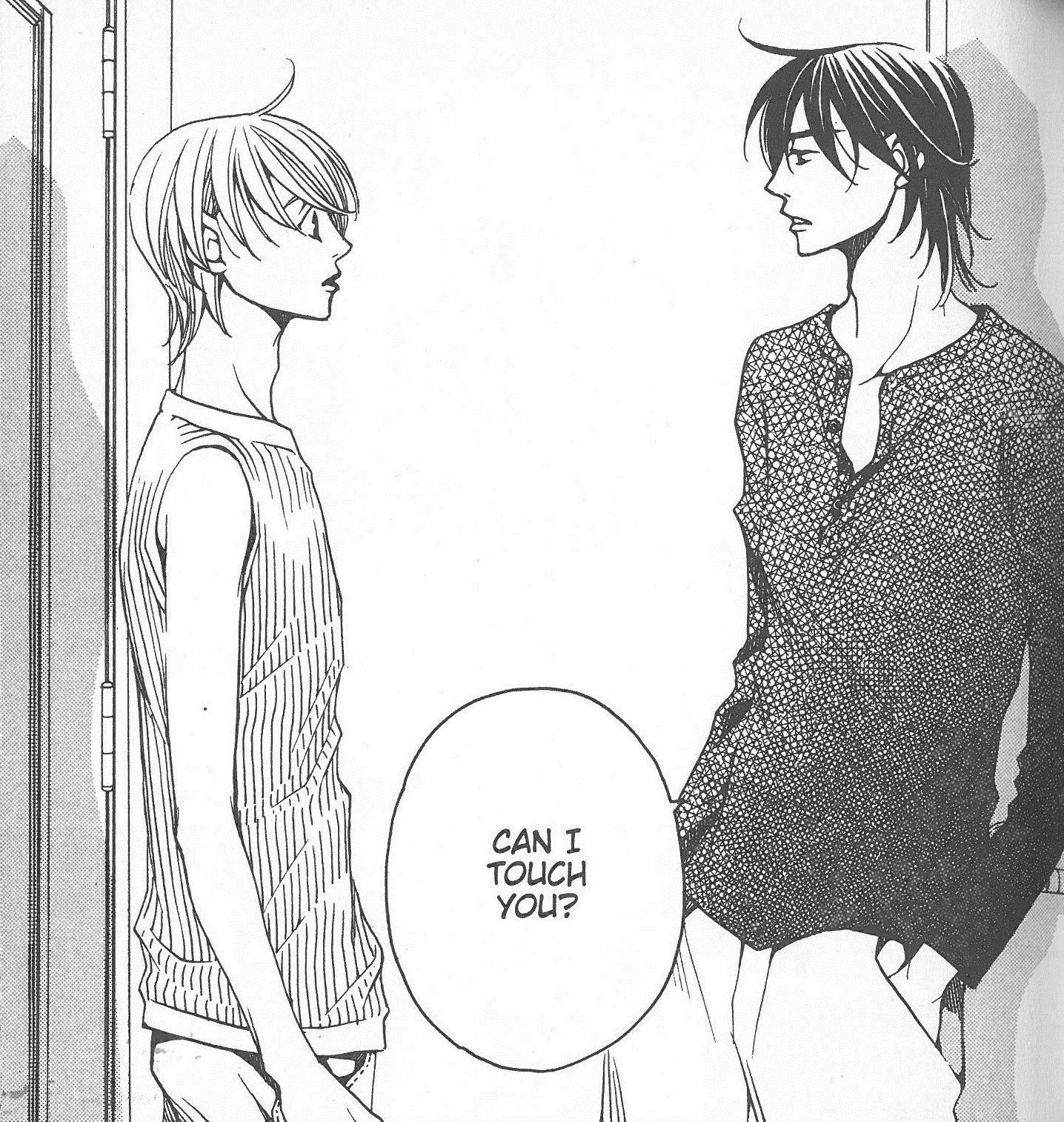
After School Nightmare, Volume 4, page 47Shinbashi has been an increasingly important character in After School Nightmare ever since he was introduced in the second volume, but the role he plays in the fourth volume is absolutely crucial. At this point in the series it doesn’t seem as though any of the characters will get a happy ending, and Shinbashi is no exception. While he may not be dealing with the repercussions of extreme physical, emotional, and mental abuse like those experienced by his fellow classmates, his story is still a tragic one. Shinbashi has become a friend and confidante of sorts to both Mashiro, who ought to be something more like a rival, and Kureha, despite her fear and hatred of men. It’s heartbreaking to see that because Kureha’s aversion is so severe, she and Shinbashi can only communicate through their cell phones; she can’t even stand to be in the same room with him. And while by nature Shinbashi is passive, he loves Kureha completely and would do anything for her, even to the point of self-destruction.

A large part of After School Nightmare is focused on Mashiro’s search for self identity and how that identity is effected by the people around him and influenced by their relationships with him. Mashiro’s friendship with Shinbashi is a rather peculiar one that, oddly enough, somehow works. Where Shinbashi is self-sacrificing to a fault, Mashiro is incredibly self-centered, so concerned with and tangled up in his own problems that he often forgets to take into consideration how his actions may hurt others. An interesting thing about After School Nightmare is that while very few of the characters are easily likeable, I still find that I can empathize with them and can even identify with some of their plights. After School Nightmare continues to be an unsettling work with an intense and ominous atmosphere—I wouldn’t hesitate at all to describe it as a type of quiet, psychological horror—but there are occasional glimmers of hope that at least some of the characters will be able to overcome their troubles and fears.

Filed Under: REVIEWS Tagged With: after school nightmare, Go! Comi, manga, Setona Mizushiro

My Week in Manga: June 8-June 14, 2015

June 15, 2015 by Ash Brown

My News and Reviews

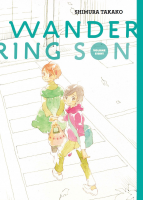
Two reviews were posted last week at Experiments in Manga. First up was my review of the short comic The Ring of Saturn by Kaiju, a creative team made up of Kate Rhodes and Jennifer Xu. I had previously read the comic online at Sparkler Monthly and loved it, but now it’s available in print! The second review was of Takako Shimura’s Wandering Son, Volume 8. The series is an incredibly important one to me, and I’m very glad that it’s being released in English. The eighth volume ends on a bit of a cliffhanger, and I have no idea when the ninth volume will be released, so now I’m doubly anxious.

Elsewhere online, the MASSIVE/Gay Manga tumblr talks a bit about the success of Gengoroh Tagame’s first manga for a general audience, My Brother’s Husband. It sounds like there’s an ongoing effort to license the series for an English-language release, which I really hope happens! Drawn & Quarterly made an interesting licensing announcement of its own, Yeon-sik Hong’s Uncomfortably, Happily. You don’t hear about many new manhwa being released in English these days. (Although Netcomics does seem to be making a quiet comeback.) Frederik L. Schodt spoke briefly on To the Best of Our Knowledge about Osamu Tezuka and his works. Finally, Organization Anti-Social Geniuses continues its Manga Advice series, this time interviewing four manga designers.

Quick Takes

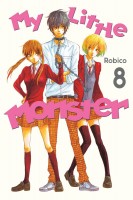
My Little Monster, Volume 8My Little Monster, Volume 8 by Robico. The last volume of My Little Monster got my hopes up as the series seemed to be regaining its momentum. I wouldn’t say my hopes were dashed reading the eight volume since there were plenty of funny and dramatic moments, not to mention the introduction of a new character as well as several confessions of love, but the series still isn’t going anywhere fast. Both Robico and the characters know this, too, and even comment on the fact that nothing has really changed all that much from the beginning of the story. Although, I do suppose that it’s an important development that Shizuku and Haru are now officially a couple. (Except that I thought they already were? Guess I was wrong.) My Little Monster does frustrate me a little with all of its one step forward, one step back approach to storytelling and relationships, and it seems to have forgotten some of the major plot threads that were started earlier, but I do still like the series as a whole. My Little Monster can be very funny at times and the quirky characters continue to amuse me. So, I’ll likely keep reading.

Say I Love You, Volume 7Say I Love You, Volume 7 by Kanae Hazuki. Although Mei and Yamato are clearly the main characters of Say I Love You, large portions of the series are actually devoted to their friends, classmates, and families. After showing the outcome of Mei and Yamato’s date (which his sister crashed before his older brother was able to drag her away) and the result of their first night spent completely alone together, the seventh volume largely focuses on Megumi’s story. After Megumi was rejected by Yamato, who remains devoted to Mei, she has been trying to ruin all of Mei’s new-found friendships. She actually ends up making herself miserable in the process and ends up withdrawing more and more from the people who legitimately care about her. Like many of the characters in Say I Love You, Megumi is dealing with some pretty serious personal issues. Her self-confidence has been destroyed, she doesn’t trust other people, and her relationships are falling apart. As unlikeable as she can be at times, it’s still heartbreaking to see her intense unhappiness. But the growth and development of the characters in Say I Love You is excellent.

Wuvable OafWuvable Oaf by Ed Luce. I was introduced to Ed Luce and his work thanks to TCAF 2014’s Queer Mixer where I learned that Fantagraphics would be releasing a collection of his most well-known creation, Wuvable Oaf. The volume opens with “Music Is My Boyfriend,” the first major Wuvable Oaf story arc which follows the titular Oaf, an ex-pro wrestler who now spends his time crafting handmade dolls (stuffed with his own body hair) and working at Oaf’s Home for Wayward Kitties Who Are Really Cute & Need Lotsa Love, and his relationship with Eiffel, a much smaller and extremely surly fellow who is the lead singer of Ejaculoid, a disco grindcore band. The volume also includes a collection of Wuvable Oaf short stories and “The Official Handbook to the Oafiverse,” which contains detailed (and humorous) character profiles among other things. Oaf himself is adorable and an absolute sweetheart. Although occasionally kind of gross, Wuvable Oaf can be surprisingly sweet and charming, filled with all sorts of marvelous queerness. Wuvable Oaf is also very, very funny. And it just so happens to be a cat comic, too!

Yamada-kun and the Seven Witches, Volume 2Yamada-kun and the Seven Witches, Volume 2 by Miki Yoshikawa. Despite the manga’s title, the witches of Yamada-kun and the Seven Witches have yet to make their presence known, though I’m assuming it’s only a matter of time. I enjoyed the first volume Yamada-kun and the Seven Witches a great deal. I enjoyed the second as well, but it didn’t manage to leave as big of an impression on me. The fanservice seemed a little more forced in the second volume, too. Still, the series is a comedy more than anything else and I continue to find it to be highly entertaining. (But then again, I do have a proclivity towards stories that include body-swapping and gender play.) Yamada has discovered that he has a strange ability that allows him to switch bodies with another person if they kiss. He doesn’t know why he has this power, nor does he completely understand how it works. But even so, he and the few people who know about it are more than willing to use Yamada’s peculiar skill to their advantage, whether it’s appropriate or not. (Often it’s not.) This of course means there’s all sorts of kissing and other antics going on.

Filed Under: FEATURES, My Week in Manga Tagged With: comics, Ed Luce, Kanae Hazuki, manga, Miki Yoshikawa, My Little Monster, Robico, Say I Love You, Wuvable Oaf, Yamada-kun and the Seven Witches

Wandering Son, Vol. 8

June 12, 2015 by Ash Brown

Wandering Son, Volume 8Creator: Takako Shimura
U.S. publisher: Fantagraphics Books
ISBN: 9781606998311
Released: May 2015
Original release: 2008

Wandering Son by Takako Shimura is a manga series that is incredibly important to me on a very personal level. The series’ exploration of personal identity, especially in regards to gender and sexual identity, is beautifully done with great sensitivity. It’s a rare comic in which gender expression and other issues relating to gender are treated realistically and not as a joke. Wandering Son is an authentically meaningful series. Fantagraphics Books has been releasing the manga in English in a lovely hardcover edition; I only wish that the individual volumes were able to be released more frequently. Wandering Son, Volume 8 was first published in Japan in 2008 while the English translation was published in 2015. Wandering Son concluded in 2013 with its fifteenth volume, meaning that the eighth volume marks the beginning of the second half of the series. I am so incredibly grateful that Wandering Son is being translated and look forward to reading the remaining volumes.

Spring has come, which means a new school year is about to begin. Shuichi, Takatsuki, and their classmates are entering the eighth grade, but with a new year comes new class assignments. The students, whose often precarious friendships and relationships were at least temporarily stable, once more find themselves confronted with new and changing group dynamics. Some friends are separated while others are reunited. And of course, not-quite-friends and past bullies are included in the mix as well, creating some challenging and awkward situations for everyone involved. Springtime has come for some of the young people in a more figurative sort of way as well. Anna and Shuichi continue to date each other and enjoy being together despite Shuichi’s lingering affections for Takatsuki. Everyone has mostly come to terms with this development in their relationship, but more than one person has commented that Takatsuki and Shuichi would make an ideal couple.

Wandering Son, Volume 8, page 101I’ve come to really like Anna as a character. When she was first introduced in the series, she came across as aloof and perhaps even a bit mean-spirited, but as Wandering Son has progressed, more about Anna has been revealed. It’s not exactly that she’s bad-natured, she just doesn’t have a high tolerance for people who don’t approach their lives and work seriously. Anna can be surprisingly mature for her age—something that may probably be true for many of the younger characters in Wandering Son—but I still find her personality and character to be a believable. She is extraordinarily accepting and kind in her own fashion, seeming to lack the jealous tendencies that cause so many problems for her peers. But what I love most about Anna in Wandering Son, Volume 8 is her acceptance and support of Shuichi through their relationship as a couple. She is perfectly content to go on dates as two girls if that’s what Shuichi wants and she never denigrates Shuichi’s interests or feelings.

For the most part, Wandering Son tends to be a fairly quiet series, which is not to say there isn’t drama. And I certainly don’t intend to downplay the very real and intense emotions experienced by the characters as they struggle through their adolescence and personal turmoils. Those are central to Wandering Son. However, the eighth volume is the first volume that really ends with a dramatic turn of events that could be described as a cliffhanger. Throughout Wandering Son, Shuichi and Takatsuki have become more comfortable and increasingly bolder with how they express themselves in the clothes they wear, largely because they’ve received encouragement from their classmates and friends. But up until this volume, that outward expression has mostly been limited to their private lives; now they’ve begun to push the boundaries in how they dress at school, which has an explicit dress codes and uniforms based on gender. I am very glad to see the two of them developing a firmer understanding and acceptance of who they are, but I also worry for them because, as Wandering Son honestly portrays, the world can sometime be a very cruel place.

Filed Under: REVIEWS Tagged With: Fantagraphics Books, manga, Takako Shimura, Wandering Son

My Week in Manga: June 1-June 7, 2015

June 8, 2015 by Ash Brown

My News and Reviews

Happy June, everyone! I’ve been super busy (I seem to say that a lot, don’t I?) but was still able to post a few things here at Experiments in Manga last week. The winner of the Ema Toyama Twosome manga giveaway was announced. That post also includes a list of manga available in English that feature novelists and other writers. The honor of the first in-depth manga review for the month of June goes to Masayuki Ishikawa’s Maria the Virgin Witch, Volume 2. Ishikawa seems to be trying to do a lot with such a short series (it’s only three volumes), maybe a bit too much. Even if he’s not able to successfully pull everything off, I still find Maria the Virgin Witch to be an intriguing series and want to read the rest of it. Finally, over the weekend I posted the Bookshelf Overload for May. I had a pretty big haul of manga and comics last month; I largely blame TCAF.

Elsewhere online there’s been some interesting reading to be found. Justin interviewed Kate Dacey (aka The Manga Critic) over at Organization Anti-Social Geniuses. Kate was one of my biggest manga blogging inspirations, so I’ve been very happy to see her recent return. Sean Kleefeld brought my attention to a panel on the history of manhwa. Drawn & Quarterly recently released the massive anthology Drawn and Quarterly: Twenty-Five Years of Contemporary Cartooning, Comics, and Graphic Novels. Joe McCulloch specifically looks at the volume’s manga content. Mangabrog has a translation of a conversation between Naoki Urasawa and Hisashi Eguchi. Last but not least, two licensing announcements were made last week that I’m very excited about: Viz Media is finally releasing a print edition of One-Punch Man by ONE and Yusuke Murata and Drawn & Quarterly is releasing more of Shigeru Mizuki’s GeGeGe no Kitaro! (I loved the publisher’s first Kitaro collection.)

Quick Takes

Welcome to the N.H.K., Volume 1Welcome to the N.H.K., Volumes 1-4 by Kendi Oiwa. Originally published in print by Tokyopop, Viz Media recently announced that it would be releasing Welcome to the N.H.K. digitally in the very near future. Tatsuhiko Takimoto’s original Welcome to the N.H.K. light novel was fantastic and I thoroughly enjoyed the anime adaptation, too. It was only a matter of time before I read Kendi Oiwa’s manga adaptation, though I am a little surprised that it’s taken me this long to get around to it. It has been a while since I’ve read or watched the other versions of Welcome to the N.H.K., but so far the manga is closer to the anime than it is to the novel, except that it seems a little more streamlined and perhaps even a little raunchier. Satou is a college dropout and hikikomori who has been targeted by Misaki, a young woman who is determined to rehabilitate him despite her own oddities and personal issues. In some ways, the more recent Watamote is reminiscent of Welcome to the N.H.K. Both series feature protagonists who are extremely socially awkward and both series can be hilarious, but they can also be somewhat depressing and painful to read at times, too. But, I am enjoying the manga version of Welcome to the N.H.K. a great deal.

xxxHolic: Rei, Volume 3xxxHolic: Rei, Volume 3 by CLAMP. Initially, I felt that it wasn’t necessary to have read xxxHolic in order to enjoy xxxHolic: Rei. However after reading the third volume, I feel I need to revise that opinion. It’s still not absolutely necessary to have read xxxHolic, but Rei makes a lot more sense and is much more meaningful if a reader has that background. I’ve actually not finished reading the entirety of xxxHolic, so while I was able to get the basic gist of what was going on in Rei, I did feel I was missing out on some important context while reading the third volume. However, I really like what CLAMP is doing with the series and I’m looking forward to reading the part of xxxHolic where Rei ties in directly. Rei has developed a marvelously ominous atmosphere that has a surreal, dreamlike quality to it. CLAMP’s high-contrast artwork in the series is great, too. At first, Rei felt directionless as though CLAMP didn’t really know what to do with the series, but the third volume begins to bring everything together in a way that actually makes sense. Of course, this also means the Tsubasa: Reservoir Chronicles connection is becoming more pronounced as well, which can sometimes feel forced.

Ze, Volume 7Ze, Volumes 7-9 by Yuki Shimizu. Despite it being a series that I tend to enjoy, it’s actually been a few years since I’ve read any of Shimizu’s supernatural boys’ love manga Ze. Although there is some dubious content (which doesn’t really surprise me much at this point), these three volumes reminded me what it is about Ze that I like so much: Shimizu has a knack for creating fascinatingly intense and complex relationship and power dynamics. The seventh and eighth volumes explore the backstories of Kotoha and Konoe; I was very satisfied with the explanation of their peculiar relationship and personalities. (Granted, most of the characters and relationships in Ze are pretty strange.) Ze, Volume 8 focuses on Shoui and Asari. Most of the story arcs have been two volumes long, but perhaps because their relationship has been developing in the background over the course of the series, the eighth volume is the only one specifically devoted to the couple. These three volumes are also very important in setting up the next and what I believe is the final story arc which will reveal more of Waki’s tragic history. I had forgotten how much of an asshole he can be, so I am curious to find out what made him the person he is.

Filed Under: FEATURES, My Week in Manga Tagged With: clamp, Kendi Oiwa, manga, Welcome to the N.H.K., xxxholic, Yuki Shimizu, ze

Maria the Virgin Witch, Vol. 2

June 5, 2015 by Ash Brown

Maria the Virgin Witch, Volume 2Creator: Masayuki Ishikawa
U.S. publisher: Kodansha
ISBN: 9781632360816
Released: April 2015
Original release: 2011

I was somewhat wary when I picked up Masayuki Ishikawa’s manga series Maria the Virgin Witch to read. I wasn’t really sure what to expect from it, especially considering part of the story is explicitly focused on the heroine’s virginity and sexuality. No that that is necessarily a bad thing, it just has the potential to go very wrong, very quickly. But because the series is by Ishikawa, whose Moyasimon I enjoy immensely, in the end I decided to give Maria the Virgin Witch a try. (At some point, I’ll likely take the time to watch the manga’s recent anime adaptation as well.) Although there were a few things that bothered me about the series’ first volume, by and large I was intrigued and enjoyed the manga, certainly more so than I had initially anticipated that I would. I liked the basic premise of the manga, particularly the quirky characters, and so I wanted to see what Ishikawa would do with the rest of the series. Maria the Virgin Witch, Volume 2 was first released in Japan in 2011. The English-language edition of the volume was published by Kodansha Comics in 2015.

Having drawn too much attention to herself by dramatically interfering with the affairs and wars of humankind, the young, idealistic witch Maria has been given an ultimatum by the Archangel Michael. Maria as been forbidden to display her powerful magic in front of humans or else forfeit her life. Additionally, should she ever lose her virginity she will lose her powers as a witch, putting her in a position where she must either choose her own happiness or the happiness of others. Since Michael has better things to do than spend all his time watching over a rogue witch, he leaves his messenger Ezekiel behind to ensure that Maria follows the rules. Whether Ezekiel is actually successful is another matter entirely. Maria still feels very strongly about aiding those who ask for her help and bringing an end to the war between England and France. With some assistance from her familiars Artemis and Priapus, she is able to take advantage of a few loopholes in Ezekiel’s charge, but it’s likely only a matter of time before Michael puts a stop to that, too.

Maria the Virgin Witch, Volume 2, page 74Maria the Virgin Witch continues to be a strange combination of crude humor largely revolving around sex (or the lack thereof) and more serious philosophical and theological questioning. The introduction of Ezekiel allows Ishikawa to more fully explore Maria’s motivations and her view of the world and all that she believe is wrong with it. If God and his angels won’t step in to put an end to humanity’s wars and violence—even when people are praying for just that—Maria sees it as her responsibility to fulfill that role since it is within her power, albeit in a much more limited fashion. She acknowledges that she is no god; she is not omnipotent, neither is she omniscient. She can only do what she can. The second volume of Maria the Virgin Witch reveals that Maria is very much an outlier in her way of thinking. Other people and other witches who have the ability to influence the course of the war actually want to drag it out as long as possible. To do so is to their advantage. They believe the position held by Maria to be incomprehensible and incredibly naive. But some, including Ezekiel, find that their assumptions and beliefs are challenged by Maria’s idealism and earnestness and are forced to reexamine them.

Although the series is set during the Hundred Years War and references actual events and people, the second volume of Maria the Virgin Witch makes it very clear that the manga is less historical fiction and more fantasy fiction. While interesting, the worldbuilding of the series is actually a little confused, or at least not thoroughly explained. Magic has always been a large part of Maria the Virgin Witch, as have demons, monsters, angels, and other divine beings (including Valkyries for some reason), but the second volume introduces a mythical and mortal non-human race to the mix. There’s nothing inherently wrong with this, but it seems to come out of nowhere and means that the manga loses some if its focus, which is something that is particularly important for a short series like Maria the Virgin Witch to maintain. With only one volume in the main series remaining, I’m afraid that Ishikawa may not be able to fully develop all of the elements and themes that he is trying to incorporate. Even so, I still find Maria the Virgin Witch to be an intriguing although somewhat uneven series; I’m very curious to see how it ends.

Filed Under: REVIEWS Tagged With: kodansha, Kodansha Comics, manga, Maria the Virgin Witch, Masayuki Ishikawa

  • « Go to Previous Page
  • Page 1
  • Interim pages omitted …
  • Page 15
  • Page 16
  • Page 17
  • Page 18
  • Page 19
  • Interim pages omitted …
  • Page 60
  • Go to Next Page »
 | Log in
Copyright © 2010 Manga Bookshelf | Powered by WordPress & the Genesis Framework