• Skip to primary navigation
  • Skip to main content
  • Skip to primary sidebar
  • Home
  • About Us
    • Privacy Policy
    • Comment Policy
    • Disclosures & Disclaimers
  • Resources
    • Links, Essays & Articles
    • Fandomology!
    • CLAMP Directory
    • BlogRoll
  • Features & Columns
    • 3 Things Thursday
    • Adventures in the Key of Shoujo
    • Bit & Blips (game reviews)
    • BL BOOKRACK
    • Bookshelf Briefs
    • Bringing the Drama
    • Comic Conversion
    • Fanservice Friday
    • Going Digital
    • It Came From the Sinosphere
    • License This!
    • Magazine no Mori
    • My Week in Manga
    • OFF THE SHELF
    • Not By Manga Alone
    • PICK OF THE WEEK
    • Subtitles & Sensibility
    • Weekly Shonen Jump Recaps
  • Manga Moveable Feast
    • MMF Full Archive
    • Yun Kouga
    • CLAMP
    • Shojo Beat
    • Osamu Tezuka
    • Sailor Moon
    • Fruits Basket
    • Takehiko Inoue
    • Wild Adapter
    • One Piece
    • After School Nightmare
    • Karakuri Odette
    • Paradise Kiss
    • The Color Trilogy
    • To Terra…
    • Sexy Voice & Robo
  • Browse by Author
    • Sean Gaffney
    • Anna Neatrour
    • Michelle Smith
    • Katherine Dacey
    • MJ
    • Brigid Alverson
    • Travis Anderson
    • Phillip Anthony
    • Derek Bown
    • Jaci Dahlvang
    • Angela Eastman
    • Erica Friedman
    • Sara K.
    • Megan Purdy
    • Emily Snodgrass
    • Nancy Thistlethwaite
    • Eva Volin
    • David Welsh
  • MB Blogs
    • A Case Suitable For Treatment
    • Experiments in Manga
    • MangaBlog
    • The Manga Critic
    • Manga Report
    • Soliloquy in Blue
    • Manga Curmudgeon (archive)

Manga Bookshelf

Discussion, Resources, Roundtables, & Reviews

kodansha

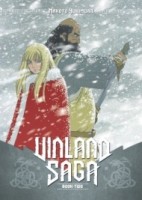
Vinland Saga, Vol 2

April 22, 2014 by Anna N

Vinland Saga Volume 2 by Makoto Yukimura

It says a lot about the quality of writing in Vinland Saga that the most memorable moments in the manga for me aren’t the Viking battle scenes but instead quiet moments that reveal more about the characters in the story. The clash of wills between determined young warrior Thorfinn and the conniving Askeladd becomes even more intriguing with the plot development in this volume. The story opens with a bit of a flashback to Thorfinn’s early adventures in infiltration for Askeladd, when he is taken in by an English family who he ends up having to betray. Thorfinn attempts to tell them to run before the Viking invasion is about to crush their village, and his concern turns to resignation as he sees the destruction coming at the hands of the Vikings.

Thorfinn has an encounter with a crazed Viking commander named Thorkell. Thorkell’s glee in battle contrasts with Askeladd’s more cerebral and cynical approach. Thorfinn is defeated, but Thorkell cheerfully waves goodbye with the stumps of the fingers that Thorfinn sliced off, saying of the fight “I enjoyed our battle! We should do it again!” The name of Thorfinn’s father still functions as an element of protection, because Thors was such a legendary warrior that Thorfinn’s Viking opponents are immediately curious about his capabilities.

Askeladd has his own agenda to execute as his band begins to march across the English countryside. They encounter the timid Prince Canute, and Askeladd strikes an unusual bargain with the Welsh. There’s an element of impending doom referenced multiple times, as Askeladd references a prophesied end of the world. The clash of religions between Christianity and paganism is also explored, as is the absolute brutality of the Vikings as they plunder a village in the winter. Yukimura’s art is always strong, and I appreciate the clarity of the battle scenes, as well as the attention to detail with the characters’ emotions as they react to the events on their journey.

While Thorfinn fits in with the traditional model of a hero, I’m finding myself more intrigued by Askeladd, simply because he’s such an unreliable narrator. I’m not sure if his stated reasons for acting are the truth, which creates quite a bit of dramatic tension in the story. The deluxe production for these volumes is always a treat, and I’m looking forward to the next volume of this saga continuing.
Filed Under: REVIEWS Tagged With: kodansha, Vinland Saga

Attack on Titan: Junior High, Vol. 1

March 19, 2014 by Ash Brown

Attack on Titan: Junior High, Omnibus 1Creator: Saki Nakagawa
U.S. publisher: Kodansha
ISBN: 9781612629162
Released: March 2014
Original release: 2013

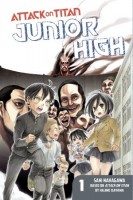
Attack on Titan: Junior High is one of several spin-off series inspired by Hajime Isayama’s hit manga Attack on Titan. Saki Nakagawa was selected to work on an Attack on Titan series after entering a manga contest. (Coincidentally, both Nakagawa and Isayama attended the same design school.) Although Nakagawa is the writer and artist for Attack on Titan: Junior High, Isayama has had some input into the series’ development. In fact, he was the one who suggested creating a manga along the lines of Tsutomu Nihei’s parody series Blame! Academy. And so Attack on Titan: Junior High was born–a comedy manga that somehow manages to combine Attack on Titan with contemporary Japanese school life. The manga began serialization in 2012 in Japan and the first two volumes were collected in 2013. Kodansha Comics is releasing Attack on Titan: Junior High in an omnibus edition. The first omnibus, collecting the first two Japanese volumes, was published in 2014 and Kodansha was kind enough to send me a review copy.

It has been five years since Eren was traumatized from an encounter with a Titan. Now that he’s in junior high he finally has the opportunity to seek revenge–both humans and titans are counted among the students and teachers of Attack Junior High. Of course Eren has other pressing matters to attend to even while his hatred of Titans remains at the forefront of his mind: making allies out of his classmates (which he’s not particularly good at), surviving epic games of dodgeball and choosing the perfect after-school club (which are both more dangerous than they might first appear), not to mention trying to stay on the upperclassmen’s good sides (which can actually be rather difficult). On top of all of that, Eren is a member of class four, a group of first years who all have their own quirks and issues to deal with. All together they’re a bunch of weirdos, but none of the other classes at Attack Junior High are much better. It’s really saying something when the Titans are the most normal ones at the school.

To really appreciate Attack on Titan: Junior High requires familiarity with the original Attack on Titan series and to some extent familiarity with Attack on Titan fandom as well. Some of Attack on Titan: Junior High will be funny, or at least amusing, even to those who haven’t read Attack on Titan, but the manga works best when it is directly parodying the original series and using it as its framework. All of Attack on Titan‘s most well-loved and reviled characters make an appearance in Attack on Titan: Junior High with some of their personality traits taken to a comedic extreme (although some were fairly over-the-top to begin with): Eren is a single-minded fanatic; Mikasa is overprotective of him to a fault; Sasha thinks about nothing but food; Jean is an arrogant ass; Hange succumbs to fits of ecstasy at the mere thought of Titans; Levi is obsessed with cleanliness, and so on. These characteristics were true of the original cast, too, but Nakagawa has stretched them to their limits in Attack on Titan: Junior High.

Nakagawa is clearly a fan of the original Attack on Titan series and is having a lot of fun with Attack on Titan: Junior High. In addition to using Isayama’s characters and taking them to their ludicrous yet logical conclusions, Nakagawa also uses pivotal and memorable scenes from Attack on Titan, giving them utterly ridiculous and absurd twists to emphasize their more comedic possibilities. The darkness, death, and destruction found in Attack on Titan is almost completely missing from Attack on Titan: Junior High. It can be just as frantic and frenetic, but as a parody the manga is much more lighthearted in tone. Even characters who have long been dead in the original series have an active role to play in Attack on Titan: Junior High; it seems as though no one really has to worry about dying in Nakagawa’s series. The worst thing that really happens in the first omnibus of Attack on Titan: Junior High is some stolen lunches. Granted, for students that can be an extremely tragic event, indeed.

Thank you to Kodansha for providing a copy of Attack on Titan: Junior High, Omnibus 1 for review.

Filed Under: REVIEWS Tagged With: attack on titan, kodansha, Kodansha Comics, manga, Saki Nakagawa

No. 6, Vol. 5

February 28, 2014 by Ash Brown

No. 6, Volume 5Creator: Hinoki Kino
Original story: Atsuko Asano

U.S. publisher: Kodansha
ISBN: 9781612623597
Released: February 2014
Original release: 2012

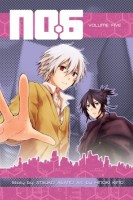
As much as I would like to read them, it is highly unlikely that Atsuko Asano’s series of science fiction novels No. 6 will ever be licensed in English. Happily, two adaptations are available: the 2011 anime series directed by Kenji Nagasaki (which was my introduction to the story) and the manga series by Hinoki Kino. Despite the anime’s bungled ending, I actually quite enjoyed the series, so I was glad to have a chance to experience another interpretation of the original story. The fifth volume in Kino’s manga adaptation was initially published in Japan in 2012. Kodansha Comics’ English-language edition of No. 6, Volume 5, published in 2014, also collects bonus stories not included in the regular Japanese edition. Though it had its high points, overall I found the first volume of the No. 6 manga to be a bit weak. However, each volume has gotten progressively stronger as Kino has had time to more fully develop the series’ characters and world.

With the increase in the number of refugees and the rise in violent crime, the population of West Block has been deemed too large and dangerous. It’s all the excuse the holy city of No. 6 needs to mount a massive cleanup operation, known to the residents of West Block as the Manhunt, in which parts of the area outside the city walls are completely destroyed and the population conveniently “removed.” The Manhunt is a way for No. 6 to keep control and prevent riots, but this time the operation serves another purpose–to gather enough undesirables to serve as human guinea pigs for a top-secret experiment being conducted and authorized by the city’s upper echelons. The Manhunt will also provide Shion and Rat with the opportunity that they need to infiltrate the Correctional Facility in order to search for and hopefully rescue Shion’s close friend Safu. Rat is one of the few people to have made it out of the Correctional Facility alive and doesn’t particular want to go back, but he isn’t about to allow Shion to attempt it on his own.

This is the volume of No. 6 in which Shion is brought dangerously close to his breaking point, and it is heart-wrenching to witness it happen. Living in West Block has been slowly changing him; it’s an environment that is drastically different from the seemingly perfect city of No. 6 where he spent almost his entire life. But the violence and suffering that Shion has been exposed to in West Block is nothing compared to the extent of the very deliberate cruelty of the Manhunt. Any faith that he still had in No. 6 is shattered when confronted with this horrifying atrocity, absolute proof that the city is not at all what it claims to be. Shion by nature has a very positive and optimistic outlook on life, but he has begun to lose that. Both he and Rat regret that change and even fear how much Shion might continue to change, especially in light of the most recent turn of events. Shion will never be able to return to the person who he once was no matter how much either of them would want it.

The characters and their growth continue to be some of the strongest elements of Kino’s No. 6 manga. This is especially true of Shion, as can particularly be seen in this volume, but Rat has also been changing in significant ways. The supporting cast, too, has almost all seen at least some minor development. The only major exception to this is the research scientist in charge of No. 6’s experiment. In fact, even though the series is more than halfway over, he doesn’t even have a name yet and is only referred to as “the man in white” in the character profiles. Since he seems to be one of the series’ main antagonists, this is a little disappointing. It’s also rather unsatisfying that the experiment, its purpose, and the motives behind it haven’t yet been made clear to the readers. This persistent vagueness and lack of clarity, instead of being mysterious or creating ominous tension, is mostly just frustrating this far along in the series. Even so, Rat and Shion’s excellent development in the manga largely makes up for this. In the end, I’m still really enjoying No. 6.

Filed Under: REVIEWS Tagged With: Atsuko Asano, Hinoki Kino, kodansha, Kodansha Comics, manga, no. 6

MangaBox: What Is It & What’s Good to Read

February 26, 2014 by Justin Stroman 4 Comments

Manga BoxA few weeks ago, I finally did what a rational manga consumer and someone who attempts to write about manga would do: consume everything that MangaBox has to offer and try and talk to people behind MangaBox. Let’s just say the last part was mostly a pipe dream. But I worked with what I got. In the end though, you probably want to know one thing: is MangaBox worth your time?

YES!

…

Read More

Filed Under: FEATURES Tagged With: Android, Araidoki, Billion Dogs, Digital Manga, First Love Suicide Pact, Free Manga, GREEN WORLDZ, High-Rise Invasion, In a Heartbeat, iPhone, Kindachi Case Files: Takato's Side, kodansha, Logick, Man's Best Friend, Manga Box, NadeNadeShikoShiko, Peephole, Schoolgirl Landlord Honoka, Spoof on Titan, The Knight in The Area Side Story

Vinland Saga, Vol. 2

February 7, 2014 by Ash Brown

Vinland Saga, Omnibus 2Creator: Makoto Yukimura
U.S. publisher: Kodansha
ISBN: 9781612624211
Released: January 2014
Original release: 2006-2007
Awards: Japan Media Arts Award, Kodansha Manga Award

The second Vinland Saga omnibus, released by Kodansha in 2014, collects the third and fourth volumes of Makoto Yukimura’s historical manga series originally published in Japan in 2006 and 2007 respectively. Vinland Saga first began serialization in 2005 and has since earned Yukimura several honors, including a Japan Media Arts Award in 2009 and a Kodansha Manga Award in 2012. Vinland Saga was a series that I had been hoping would be licensed in English for years and so I was understandably thrilled when Kodansha picked the series up. Kodansha’s edition of Vinland Saga is quite nice–hardcover omnibuses which include color pages and have a larger trim size than the publisher’s previous releases. Vinland Saga is Kodansha’s first deluxe manga; personally, I think it’s a series which deserves the special treatment. I was not at all disappointed with the first omnibus of Vinland Saga and so was eagerly awaiting the release of the second.

In the early part of the eleventh century, England was under frequent attack by Vikings. In 1013, after years of fighting, England’s King Ethelred has been driven into exile in France while King Sweyn of Denmark proceeds with his invasion of the country. The Danes aren’t entirely united though, and many of the king’s forces are more like mercenaries or bands of pirates than they are loyal followers. Some groups, such as those led by Thorkell the Tall, have actually aligned themselves with the English in the conflict. Others, such as Askeladd’s band of warriors, fight under King Sweyn simply because he currently has the more advantageous position and the chance of reward is therefore much greater. But there is some infighting among Askeladd’s ranks as well. The only reason that Thorfinn, a skilled young fighter, follows him is for the chance to seek revenge against Askeladd for the death of his father. In the meantime, Thorfinn serves both as one of Askeladd’s most valuable and most expendable assets.

I enjoyed the first omnibus of Vinland Saga a great deal, but I think that I probably enjoyed the second one even more. Yukimura has struck an ideal balance between exciting action sequences and combat and the more personal and emotional character development of the fighters who are involved. Vinland Saga is both epic and intimate in its scope. War is occurring between nations, but it is the characters’ individual struggles that make the story so visceral and compelling. Many of the warriors in Vinland Saga are bloodthirsty, seeking glory and taking pleasure from battle itself rather than from any sort of perceived noble cause. But there are exceptions. Thorfinn despises this fighting for fighting’s sake. However, while his search for revenge may arguably be more righteous, that doesn’t necessarily mean that he’s in the right. Askeladd, too, has some very legitimate justifications for fighting. But while his skills as a warrior and strategist are commendable, many of his actions are deplorable.

The depth of characterization in Vinland Saga is impressive. In this omnibus, Askeladd in particular is shown to be a much more complicated figure than he may have first appeared. Vinland Saga, Omnibus 2 delves into part of his backstory, which only begins to reveal his motivations and who he really is as a person. Yukimura’s attention to detail in Vinland Saga extends beyond the characters themselves. The amount of research he has conducted allows him to portray the time period realistically, taking into consideration major historical events but also incorporating religious issues and matters of the day-to-day lives of royalty, mercenaries, and common folk. The artwork, too, can be incredibly detailed. The landscapes and environments are beautifully rendered and each character, even the multitudes of unnamed combatants, have distinctive designs. Vinland Saga really is an excellent series. I’m enjoying it immensely and am extremely happy that it’s finally available in English.

Filed Under: REVIEWS Tagged With: Japan Media Arts Award, kodansha, Kodansha Comics, Kodansha Manga Award, Makoto Yukimura, manga, Vinland Saga

Attack on Titan, Vol 1

January 28, 2014 by Anna N


Attack on Titan Vol 1 by Hajime Isayama

At this point, given the ubiquity of Attack on Titan on manga best seller lists, reviewing it is a bit like reviewing the air, but I decided to finally get around to reading this series when Mangablog alerted me to the crazy deal for the kindle edition of the first volume that was running recently. Sometimes I have no trouble reading manga on my Kindle Paperwhite, but I had more difficulty figuring out what was going on with the art with the reduced size, and quickly switched over to reading this manga on my iPad instead.

I’ve been reading a bunch of post-apocalyptic fiction recently, just because there are so many YA dystopian novels out there, and I’m also in the middle of reading Justin Cronin’s The Twelve. Attack on Titan is an interesting twist on the dystopian genre as many years into the future humanity has retreated into walled cities in order to protect themselves from the Titian, giant zombie-like humanoid creatures who enjoy eating human flesh. Eren is in many ways a fairly typical brash and opinionated shonen hero, whose close companion is a quieter and seemingly more pragmatic girl named Mikasa. Eren is worried about the complacency his town seems to be developing, as Titans haven’t attacked it for a long time.

Sure enough, a devastating attack on the town follows, as a Titan bigger than anyone has seen before easily breaches the wall, causing panic and confusion in the town where few humans are equipped to deal with a direct attack. Years later, Eren and Mikasa are ready to take their work assignments in the town, and they have to choose the safer duty of directly protecting the townspeople or joining up with the riskier survey corps. Eren wants to avenge his family, and Mikasa is quietly determined to follow him in order to protect him.

By far the weakest element of Attack on Titan is the art. The characters are drawn stiffly and not in proportion. For much of the time Eren and his comrades are yelling at each other, with facial expressions that don’t have very much variation. At the same time, the more detailed renderings of the Titans are plenty creepy, with their musculature visible on their bodies due to lack of skin, wide jaws, and shark-like rows of teeth. In contrast to the art, the worldbuilding in Attack on Titan is excellent, and it is clear that Isayama has spent plenty of time plotting out the events in his future history, thinking through the weapon systems and defenses the humans have constructed, and setting up the relationships between the characters in an interesting way. The first volume ended on a cliffhanger that was both shocking and weirdly refreshing from a manga plotting perspective, making me wonder a bit if Attack on Titan is going to be serving up a bit of metacommentary about manga plot cliches. Even though the art was fairly awkward, I was still able to follow along with the action sequences, and the Titans were genuinely unsettling, with their grimacing silence and habits of eating people in one gulp. I’m a little leery of taking on such a long series, but I can certainly see why Attack on Titan is so popular.

Filed Under: REVIEWS Tagged With: attack on titan, kodansha

No. 6, Vol. 4

December 27, 2013 by Ash Brown

No. 6, Volume 4Creator: Hinoki Kino
Original story: Atsuko Asano

U.S. publisher: Kodansha
ISBN: 9781612623580
Released: December 2013
Original release: 2012

Hinoki Kino’s manga series No. 6 is an adaptation of a series of nine science fiction novels written by Atsuko Asano. The fourth volume of the No. 6 manga was originally published in Japan in 2012. The English-language edition of No. 6, Volume 4 was released by Kodansha Comics in 2013. My introduction to No. 6 was actually through the anime adaptation, but I have been enjoying the manga’s rendition of the story as well. I have had a fondness for dystopian fiction ever since I was introduced to the genre in high school and so I am particularly pleased that a manga series like No. 6 is being released in English. I did find the first volume to be a little rushed and disjointed in places, but each subsequent volume has continued to improve and the series has settled into an excellent pace. The characters and world-building have also been developing rather nicely. Because the series keeps getting better, I was looking forward to reading the fourth volume.

Shion’s close friend Safu has been arrested by the Security Bureau of No. 6 and taken to the Correctional Facility, which may very well mean her death. Rat has known about Safu’s predicament for some time, but it’s something that he has been keeping a secret from Shion, concerned that he would put his own life at risk in order to rescue Safu. Rat is soon proven correct when, by chance, Shion discovers that Safu has been taken. Shion is prepared to do anything that he can to save her, even if that means doing it alone. But, despite his reservations, Rat isn’t about to let that happen. Infiltrating the Correctional Facility won’t be easy. Both Shion and Rat have been classified as dangerous criminal fugitives by No. 6’s authorities which severely limits their movements outside of West Block. Simply getting information about what is happening in No. 6 is a difficult task which will require all of the connections and influence that the two young men can muster. They are at a definite disadvantage and their situation is nearly impossible, but Rat and Shion are determined to come out of it alive however unlikely.

While the previous volume or so took time to further establish the relationships between the characters in the manga, No. 6, Volume 4 ratchets up the pace again, moving the plot forward quite handily. This is not to say that Kino has forgotten the series’ main players for the sake of the story. In fact, there are some absolutely wonderful character moments in the fourth volume. These are critical for the development of both the plot and the characters themselves. It is quite clear by this point in the manga that Shion and Rat deeply care about each other. But in No. 6, Volume 4 Shion is forced to confront just how vicious Rat can be, something that he has been avoiding. Rat has never hesitated to intimidate or threaten other people and is a master manipulator. Though up until now he has largely (but not completely) kept his overt violence in check, when given a reason and opportunity he can be absolutely terrifying. Rat’s actions in this volume are nominally for Shion’s sake, but he also has an intense, deep-seated hatred and anger towards No. 6 which lends to his brutality.

West Block has always been a violent place, but at least its residents are honest and forthright about it. They hold no delusions as they often literally have to fight to survive. On the other hand, there’s No. 6. The city is presented as a perfect society even though it is anything but. Granted, most of No. 6’s citizens are completely unaware that anything untoward is going on and those who do suspect find themselves conveniently disappeared. Because of this, No. 6 is actually the more terrifying of the two places. What exactly is going on in No. 6 has yet to be made clear. There have been some hints, and Shion and the others have uncovered a few clues, but even some of No. 6’s highest ranking officials aren’t privy to that information. All that is known is that some sort of terrible experiment is being conducted on the city’s population. However, the goal, purpose, and motivation behind that experiment hasn’t been revealed yet. With plenty of questions remaining to be answered and the story increasing in intensity, I’m definitely looking forward to reading the next volume of No. 6.

Filed Under: REVIEWS Tagged With: Atsuko Asano, Hinoki Kino, kodansha, Kodansha Comics, manga, no. 6

No. 6, Vol. 3

November 20, 2013 by Ash Brown

No. 6, Volume 3Creator: Hinoki Kino
Original story: Atsuko Asano

U.S. publisher: Kodansha
ISBN: 9781612623573
Released: October 2013
Original release: 2012

Hinoki Kino’s No. 6 manga is one of two adaptations available based on Atsuko Asano’s series of science fiction novels No. 6. My introduction to the story was through the anime series, but I am very glad to see the manga being released in English as well. No. 6, Volume 3 was originally published in Japan in 2012. The English-language edition was released by Kodansha Comics in 2013. Although the manga and the anime both share the same character designs and basic story, they are both different interpretations of the original novels. The manga, which is currently still an ongoing series, actually began serialization before the anime adaptation began airing. I quite enjoyed the No. 6 anime–except for its rushed original ending–which is why I was particularly interested in reading Kino’s manga. I felt the first volume was a bit uneven, but the second volume improved in both world-building and pacing, so I was looking forward to reading the third.

Even though at one point he was considered to be among No. 6’s elite, Shion is now a fugitive hiding outside of the city in West Block. Currently he is living with Rat who has already saved Shion’s life on several occasions and who himself is listed as a violent criminal by No. 6. Fortunately, the city seems to have very little interest in what is going on outside of its walls, so the two young men should at least be safe for the time being. In fact, Shion seems to be adapting surprisingly well to life in West Block, although his kindheartedness and naivety still have a tendency to get him into trouble. Inside the city, Shion’s mother is still afraid for her missing son’s safety and Shion’s childhood friend Safu wants to do anything that she can to find him. The risks involved in searching for Shion are not small and both of the women are under close surveillance by the authorities. A single mistake could lead to their arrest or convenient disappearance.

The relationship between Rat and Shion has always been an important part of the No. 6 manga. This hasn’t changed with No. 6, Volume 3, but the volume also further develops the relationships between them and the other characters. The pacing of the third volume is happily a bit slower than the first two which allows more time for Kino to better explore those relationships. Particularly telling is Rat’s interactions with Dogkeeper and how different they are from his interactions with Shion. Rat normally doesn’t hesitate to manipulate and intimidate other people and is more than willing to resort to violence. It’s his way of distancing himself from others in an attempt to avoid being hurt or taken advantage of. There is a small amount of kindness to be found in Rat’s personality, but he keeps it very well hidden. Shion is Rat’s complete opposite in this and seems to be made up of nothing but kindness, though he certainly has become less of a pushover than he once was.

It’s not only that Shion, Rat, and the others have different personalities, it’s that they have completely different worldviews and ways of thinking. This is a sources of strife in their relationships, but from this conflict comes subtle changes in their attitudes. Shion has an effect on those around him and he in turn is slowing changing as well. As an outsider in West Block, Shion asks questions that no one else would think to ask; he’s not as naive as he first appears, simply more open-minded and optimistic. Those used to living in the harsh environment of West Block have lost that idealism, and in time Shion may lose it as well as he is confronted with the terrible reality of West Block and the truth behind No. 6. He is strangely accepting of his own situation and exile, but when it comes to those he cares about he feels compelled to protect them at any cost, even if it puts him in danger. Each volume of the No. 6 manga continues to improve; I’m definitely looking forward to seeing where Kino takes things next.

Filed Under: REVIEWS Tagged With: Atsuko Asano, Hinoki Kino, kodansha, Kodansha Comics, manga, no. 6

Vinland Saga, Vol. 1

October 9, 2013 by Ash Brown

Vinland Saga, Omnibus 1Creator: Makoto Yukimura
U.S. publisher: Kodansha
ISBN: 9781612624204
Released: October 2013
Original release: 2005
Awards: Japan Media Arts Award, Kodansha Manga Award

Makoto Yukimura’s Vinland Saga is a manga series that I have been hoping would be licensed in English for years. Understandably, I was thrilled when Kodansha Comics announced that it would be publishing the series. Not only that, Vinland Saga is Kodansha’s first foray into deluxe, hardcover manga. Kodansha’s edition of Vinland Saga uses a larger trim size than its other manga, contains color pages, and is being released in an omnibus format. The first volume of Kodansha’s Vinland Saga, published in 2013, collects the first two volumes in the original Japanese edition of the series, both of which were released in 2005. Vinland Saga is a critically acclaimed, award-winning manga. In 2009, Yukimura earned a Japan Media Arts award for the series. Even more recently, Vinland Saga won a Kodansha Manga Award in 2012. Even if Vinland Saga wasn’t already so well received, I would still want to read it. Yukimura is a the creator of Planetes, which I love, and I also happen to have a particular interest in Iceland among other things.

When he was only six years old, Thorfinn’s father was killed before his very eyes. Thors was a great man and a great warrior, but that was a life he tried to leave behind in order to live with his family in peace in a small Icelandic village. Thors’ past is inescapable and ultimately leads to his death, but in the process he is able to protect what is most dear to him. Even at such a young age Thorfinn vows to avenge his father. Ten years later he has grown into a hostile and stubborn young fighter serving under the very man who was responsible for his father’s death. Askeladd is a shrewd and cunning leader, his band of mercenaries willing to take on any job for the right price. Their battle prowess is fearsome, relying not only on their sheer strength and power but on underhanded strategies and their willingness to be utterly ruthless. Askeladd and his men may be uncouth, but they are also a terrible force to be reckoned with.

Vinland Saga is historical fiction and the series is inspired by actual events and people as well as by Norse sagas. The great adventurer Leif Ericson plays a significant role in the first omnibus of Vinland Saga and Thorfinn himself is loosely based on another explorer–Thorfinn Karlsefni. Considering that the manga deals with eleventh-century warfare and Vikings, a northern Germanic group of seafarers notorious for raiding and pillaging, it’s probably not too surprising that Vinland Saga can be rather violent. The battles in Vinland Saga are particularly well done. Some of the physical feats may be astounding or even slightly exaggerated–there are some very good reasons that Askeladd’s mercenaries are so feared–but the flow of the battles are very realistic as are the resulting deaths and injuries. Yukimura hasn’t forgotten the use and limitations of technology and tactics in Vinland Saga and they are appropriate for the era being portrayed. In general Yukimura’s action sequences are very exciting and leave quite an impression.

Vikings are often depicted as savage, bloodthirsty invaders in fiction but this portrayal misses some of the nuances and complexities of the historical reality. Yukimura notes in the afterword of the first volume of Vinland Saga that he wanted to show more than just a stereotypical representation of Vikings in his story. I think he is very successful in that. Much of Vinland Saga, Omnibus 1 focuses on brutal skirmishes, battles, and duels, but the development of Thorfinn and his family–particularly his father, but his mother and sister, too–as well as their Icelandic village and the other people who live there is also very important. The exceptional events surrounding the outbreak of war may be some of the major driving forces behind the story but the more mundane affairs of everyday life, such as the concerns over the changing weather and the coming winter and disputes over land for grazing, provide additional depth and realism to the series. I thoroughly enjoyed the first Vinland Saga omnibus and am looking forward to the release of the second.

Filed Under: REVIEWS Tagged With: Japan Media Arts Award, kodansha, Kodansha Comics, Kodansha Manga Award, Makoto Yukimura, manga, Vinland Saga

Sherlock Bones, Vol. 1

September 21, 2013 by Ash Brown

Sherlock Bones, Volume 1Author: Yuma Ando
Illustrator: Yuki Sato

U.S. publisher: Kodansha
ISBN: 9781612624440
Released: September 2013
Original release: 2012

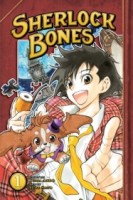
Sherlock Bones is currently a seven-volume manga series written by Yuma Ando and illustrated by Yuki Sato. The first volume was originally released in Japan in 2012 while the English-language edition was published by Kodansha Comics in 2013. I didn’t realize it at first, but I was already familiar with Sato and Ando’s previous works in English. Sato is the creator of Yokai Doctor and Ando (one of many pen names used by Shin Kibayashi) worked on Bloody Monday and Drops of God. More thematically relevant, Ando was one of the original creators of The Kindaichi Case Files. Sir Arthur Conan Doyle’s Sherlock Holmes is a well-loved and well-known detective worldwide and this is no exception in Japan. Sherlock Bones is only one Japanese work among many that is directly inspired by Doyle’s stories. I was vaguely curious about the series when it was licensed, but it wasn’t high on my list of manga to acquire. Happily, Kodansha sent me a review copy of Sherlock Bones, Volume 1, so I was able to give the series a try sooner rather than later.

When Takeru Wajima adopted a puppy from the local animal shelter, he had no idea what he was getting into. Most new pet owners have to worry about things like house and obedience training, but Takeru has an entirely different problem to deal with–Sherdog is the reincarnation of none other than the brilliant detective Sherlock Holmes. Oh, and Sherdog can speak (at least to Takeru, that is) and he is certain that his new owner is the reincarnation of his dear friend and faithful assistant Dr. John H. Watson. It’s not as if the two of them go out looking for mysteries to solve, but Sherdog and Takeru seem to be drawn into criminal investigations. When one of Takeru’s classmates is killed, and Sherdog is the only witness to the crime, they must find a way to prove the guilt of the murderer. Sherdog may have the brains to determine a solution, but it will be up to Takeru to do all of the legwork. After all, who else would belive, let alone understand, a dog.

I’ll admit, I was more than a little skeptical going into Sherlock Bones. I thought that the premise–Sherlock Holmes reincarnated as an adorable puppy–would be silly at best. And it is silly, but it also ends up being a good deal of fun. I was honestly surprised by how much I enjoyed the first volume of Sherlock Bones. Its mix of goofiness and seriousness is entertaining even if it is rather ridiculous. So far, though, it seems to work. There’s Sherdog himself–appalled that he’s a canine, though on occasion he will deign to use it to his advantage–and then there’s Takeru, who seems to be a good kid even if he’s understandably a bit befuddled by the whole situation and less than convinced that he’s Watson’s reincarnation. I also like that the entire Wajima family is made up of police officers and investigators–father, mother, and sister–so Takeru’s poking around into various criminal goings-on doesn’t seem too out-of-place.

As for the central case in Sherlock Bones, Volume 1, the mystery doesn’t lie within who killed the unfortunate student. Even why the murder took place can be fairly easily deduced. The trick is in how the culprit establishes an alibi and then carries out the deed. In part this is where Sato’s artwork plays an important role–the major clues that help Sherdog and Takeru crack the cases in Sherlock Bones, Volume 1 can be found right there on the page even before they solve the mysteries, waiting for observant readers to notice. I appreciate this sort of potential for engagement in the mystery fiction that I read, and so was happy to see it included in Sherlock Bones. Granted, not all of the clues are revealed in this way, especially when things like color come into play, but overall I was pleased with how the story and art worked together to form a cohesive whole. Sherlock Bones was a pleasant surprise for me and I look forward to reading more of the series.

Thank you to Kodansha for providing a copy of Sherlock Bones, Volume 1 for review.

Filed Under: REVIEWS Tagged With: kodansha, Kodansha Comics, manga, Sherlock Bones, Yuki Sato, Yuma Ando

No. 6, Vol. 2

September 18, 2013 by Ash Brown

No. 6, Volume 2Creator: Hinoki Kino
Original story: Atsuko Asano

U.S. publisher: Kodansha
ISBN: 9781612623566
Released: August 2013
Original release: 2011

My introduction to Atsuko Asano’s No. 6 was through the anime adaptation of the original novels. I enjoyed the setting and characters, but was disappointed in the anime’s rushed, original ending. Asano’s No. 6 novels are unlikely to be released in English, so I was glad when Kodansha licensed Hinoki Kino’s manga adaptation of the series. The second volume of the No. 6 manga, originally published in Japan in 2011, was released in English in 2013. Although Kino’s character designs are based on the same ones used for the anime and many of the underlying elements are the same (they are both adaptations of the No. 6 novels after all), Kino’s version of the story is different. The first volume of the manga was a little too quickly paced for my taste, but for the most part I still enjoyed it. However, I did have hopes that the second volume would slow down a bit after the first volume‘s rush to establish the characters, story, and setting.

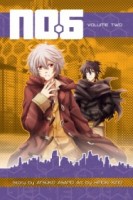
After barely escaping from the holy city of No. 6, Shion is now a fugitive hiding in West Block, a dangerous area outside of the city walls and No. 6’s dumping grounds. Although he is out of immediate danger, he still has a lot to learn about West Block if he hopes to survive there. The violent and bleak conditions outside the city are very different from the peaceful and pampered life that Shion led in No. 6. The only reason he’s made it this far is thanks to the help of Rat, the young man whose life Shion once saved as a boy. The two make an unusual pair. Shion is altruistic and slow to doubt people, characteristics which could get him into big trouble in West Block, while Rat only looks out for himself and is much more wary of others. Saving Shion’s life was a way for Rat to repay his debt, but in the process he has begun to open up to another person. For the time being Rat persists in watching over the other young man, but he is also capable of turning on Shion at any moment.

One of my favorite things about the No. 6 anime was the relationship between Rat and Shion. I’ve happily found this to be the case with the manga as well. Even though it’s only the second volume, there has already been some very nice character development. Both Shion and Rat are beginning to change due to the circumstances surrounding Shion’s escape from No. 6 and their continued association with each other. As Shion is faced with the harsh realities of living in West Block and Rat’s seemingly uncaring attitude, he is learning to stand up for himself and what matters to him. In turn, Shion is also influencing Rat to a much greater extent than either of them at first realize. When it comes to Shion, Rat finds himself acting out of character and letting his guard down. It understandably bothers and worries him, but it’s also rather touching from an outsider’s perspective. I’m really enjoying watching their relationship evolve in No. 6.

In addition to character development, the second volume of the No. 6 manga also reveals more about No. 6 and West Block. As Shion experiences West Block first hand, nearly getting killed in the process, the readers are also introduced to the world in which he now lives through the people he meets–the children who are starving, the marketplace vendors who are quick to pull guns on thieves, the prostitutes and pimps. Everyone is struggling to get by in any way that they can. It also reveals in part why Rat has the personality that he does. To survive in West Block requires people to place their own needs above those of others. Simply trusting another person means taking a huge risk. It’s a hard lesson for Shion with his innocent nature and privileged upbringing. The second volume of No. 6 does build and improve on the first in its pacing, characterization, and world-building. I can honestly say that I’m looking forward to the next volume of Kino’s adaptation.

Filed Under: REVIEWS Tagged With: Atsuko Asano, Hinoki Kino, kodansha, Kodansha Comics, manga, no. 6

Adventures in the Key of Shoujo: Sailor Moon, Vol. 8

June 22, 2013 by Phillip Anthony 1 Comment

sailormoon8Pretty Guardian Sailor Moon, Vol. 8 | By Naoko Takeuchi | Kodansha Comics | Rated: T (13+)

And the hits just keep on rolling in this volume. After the hellfire brought down by the destruction of, well, the whole district, the Sailor Senshi find themselves facing down the remains of Hotaru’s body as it takes on the form of one of Pharaoh 90’s creatures. Meanwhile Chibi-Usa’s body remains in a critical condition. If they’re not going to be destroyed by this creature, then the newest member of the Senshi, Sailor Saturn, will finish them off.

On one hand, I’m fine with this volume because we finally get to end the ridiculous Pharaoh 90 story arc. I know I should expect these arcs since they are the meat and potatoes of the whole gig. But I find myself trying to invent reasons to be excited about them. I suspect it’s the fact that, after eight volumes, I want something else to happen. I want some kind of overarching villain to appear; I want some kind of “There’s a reason all of this is happening.” But every time, the Senshi just battle just another group who want to suck the energy/emotions/blood/flesh or whatever other substitute the story requires out of people to go to Valhalla/Eden/7-Eleven or whatever other substitute the villain requires. I swear to Jiminy nobody even says out loud that it’s awful suspicious that all these groups keep attacking the girls and don’t seem to have an overarching agenda.

I don’t know, readers, I feel like I am not skilled enough to figure out the appeal of watching the same fight happen to the same team in every volume. Yes, the appeal is that the gang gets to have an adventure, but it’s getting kind of repetitious. I want to know more about the team—yes, even Usagi. We do get snippets, but for the last few volumes there seems to be some kind of attempt to answer the question of what happens when Chibi-Usa goes back home to the future? Takeuchi is going for an idea of domesticity between Mamoru, Usagi and Chibi-Usa. But it only comes out when there’s no fighting going, so you can pretty much guess how often this happens.

What is weird about reading this volume, and indeed the rest of the volumes, is that I want something closer in tone to Codename: Sailor V than what’s presented here. In Sailor V, when Minako had to fight a different foe, at least it wasn’t relentless. Foes, who are about as thin as anything that Sailor Moon comes up with, were dispatched, sure. But at least it was over and done in two volumes. This has been going on in Sailor Moon for eight volumes and I really hope that things change in the run up to the end.

So at the halfway point in the volumes, am I happy? Well, yes and no. On the one hand, I’ve gotten to watch as Takeuchi paints a pretty epic canvas taking ordinary girls and making them responsible for people’s safety, even those they don’t know. I never get a sense that they don’t take their duties seriously. As they struggle to beat every adversary that stands against them, they have their moments of indecision but they always overcome them and find inner resolve to succeed. I’m a sucker for story dynamics like these. Plus for all her insufferable points, Usagi is a good leader who cares about her flock.

Where the series lets her down is when she reverts back to type and becomes an airhead after saving the world. I could buy that for the first couple of volumes but now I have to wonder if the author is deliberately sabotaging her lead because if she became more confident then there wouldn’t be much tension. The only way to stop that would be if the author actually wanted to make the kinds of changes that would simultaneously improve and ruin the tempo already set. Heaven and hell, I suppose.

On the other hand, the series seems to be incapable of letting the story go out on a limb and have more serious stakes. When the characters risk their lives, I’m never in any doubt they will make it through. When Mamoru was facing against his old friends, there was a real sense of danger and the gang had to fight to save themselves from being destroyed. But now it’s become so par for the course that I’m not even worried about them.

The team really must work on their tactics because they get hit again by the bad guys and spend a good portion of the initial battle—you guessed it—knocked unconscious. I shouldn’t be surprised, but still I have to stare at the page and say “What, again?” The promise of the Outer Senshi returning for the next volume intrigues me as their departure from the roster is not done with any finality, but in a manner that suggests when they do return it will be interesting to see how the Inner Senshi treat them.

Again, I find myself locating genuine problems that I have with the series, but they are not enough to stop my enjoyment of the proceedings. My worry is that when the final volume comes, it will be another cases of fighting yet another unknown boss and then that’s it, we’re out of time here folks.

Filed Under: Adventures in the Key of Shoujo Tagged With: kodansha, shojo, shoujo

No. 6, Volume 1

June 8, 2013 by Ash Brown

Creator: Hinoki Kino
Original story: Atsuko Asano

U.S. publisher: Kodansha
ISBN: 9781612623559
Released: June 2013
Original release: 2011

Hinoki Kino’s manga adaptation of No. 6 is the second adaptation of Atsuko Asano’s nine-volume series of science fiction novels to be released in English. The first, and my introduction to No. 6, was the 2011 anime adaptation directed by Kenji Nagasaki. While I largely enjoyed the anime, the rushed and fumbled ending left me disappointed. The first volume of the No. 6 manga was originally published in Japan in 2011, a few months before the anime began airing. Kodansha’s English-language edition of No. 6, Volume 1 was released in 2013. It’s highly unlikely that Asano’s original novels (which are really what I would like to read) will ever be licensed in English, and so I was intrigued when Kodansha announced that Kino’s manga adaptation would be published. Since the series is still currently being serialized in Japan, I’m hoping that the story will have a properly executed ending this time around.

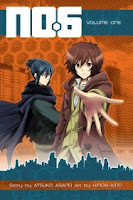
On the surface, the city of No. 6 appears to be an ideal, utopic society. The crime rate is negligible. Medical and technological advancements offer its citizens unprecedented comfort and care. Shion is among the elite of the elite. Identified at a young age as a prodigy with a particular affinity for medicine and ecology, he and his mother have their every need provided for by the city. But when Shion saves the life of a young fugitive named Rat, helping him to escape, Shion is stripped of his status and special privileges. He has seen a brief glimpse of the darker side of No. 6. Four years later he’ll see even more when he stumbles upon a pair of bizarre deaths and he becomes the perfect scapegoat for the supposed murders. With his own life now in danger, Shion has a decision to make: flee No. 6 and the only life he knows or remain in a city that no longer considers him human.

The first volume of No. 6 does a nice job of establishing the series’ two main protagonists: Shion and Rat. Although the two young men share an important connection with each other, they come from very different backgrounds and have very different personalities. Shion is intelligent but sheltered and there’s a certain innocence about him. He comes across as a bit naive and socially awkward, but he is intensely curious and searches for the significance behind things. Even though most of Rat’s past hasnt’ been revealed, it is quite clear by the end of the first volume of No. 6 that he has had a much rougher time of it. He is quick-witted but world-weary and cynical. The underlying meaning of a situation isnt’ nearly as important to him as is the immediate reality. It’s simply a matter of survival. In part because they are so different, Rat and Shion find themselves drawn to each other.

After only one volume, No. 6 has yet to really distinguish itself from other dystopian fiction. It’s a fairly standard set up with a seemingly perfect society that’s not quite everything it appears to be. The manga itself often feels very rushed in places and lacking in details in others. There were a few scenes that had I not previously seen the anime would have left me momentarily confused. In the afterword Kino admits to having had to cut much more from the manga than was ideal in order not to surpass page limits. Even so, No. 6, Volume 1 provides the needed introduction to the story and outlines the world in which it takes place. I hope that now that the stage has been set that the manga will have room to breath and slow down a little. It is a different version of the story than was seen in the anime; I’m looking forward to seeing where Kino takes it.

Filed Under: REVIEWS Tagged With: Atsuko Asano, Hinoki Kino, kodansha, Kodansha Comics, manga, no. 6

Adventures in the Key of Shoujo: Sailor V, Vol.2

November 2, 2012 by Phillip Anthony 2 Comments


Codename: Sailor V, Vol. 2 | By Naoko Takeuchi | Published by Kodansha Comics USA | Rated: T, Ages 13+

Oh, ho. What a difference a few months make. I had planned to review the second volume of Codename: Sailor V right after I reviewed the first. Then, Sailor Moon became more important to read and review, so Minako’s final solo mission was put to one side. Now that I’m officially taking a breather from Sailor Moon (it’ll be back later this month) and making time for other stuff, I want to get Sailor V out of the way first. Not that it’s a chore to read it—in many ways it is like its sister series in terms of execution—but the tone is different between the two leads.

In our last volume with Sailor Venus, a twofold structure is in place. One constitutes the bulk of the volume and is completely deceptive as to the volume’s true intentions. The other is examined near the end of the book and sets up the story to be continued on a grander scale. To explain, we get Mina fighting crime and villains for the most part—and yes, whether it’s DeVleene with her evil fattening chocolates (shame on thee!) or the Atavistic family of Nyan-Nyan, Wan-Wan and Chu-Chu (some mothers do have them), she dishes out the smite most excellently. She takes all of this in stride, all the while whining and complaining to Artemis, her familiar, about everything. At the end of the DeVleene chapter, we get a glimpse of a character who will trigger the other plot restructuring, Phantom Ace. As the final chapters started, I had no idea that Takeuchi would pull the rug from under me and ramp up some drama and heartstrings being pulled. She hadn’t done it for the whole of the other volume, so I wasn’t paying attention. When she showed Phantom Ace looking like Tuxedo Mask, I should have known what she was up to.

In many ways, I wish that Sailor V had been like this from the beginning, with some kind of gravitas to anchor the story. But then I remember that before Venus (spoilers) joins the rest of the Sailor Senshi in Sailor Moon, the girls treat Sailor V as a hero and a very serious character. So without having the Sailor V series be goofy by default, it would have been weird for Takeuchi NOT to portray Venus as a goofball to begin with and then, as she matures, the serious girl that she is. Plus when the aforementioned serious arc starts in Sailor V, all of Mina’s notions about what exactly she is destined for change for the better, but not without a bittersweet cruelty to proceedings. Mina HAS to have these challenges or what does she want to fight for? Certainly not for boys or fame, both of which she chased and lost and laughed off—but only at the end of her journey does she see how far she’s come.

This made me ask the question, to myself at least, what is the heroine/hero in a story of destiny? Is she the instrument of destiny or the catalyst of destiny? Where does her free will stop and the path of the “chosen one” come into play? If Mina had not found Artemis that day, would Artemis have sought her out anyway? If the Boss (whom we never meet at all, strange that) had not pushed Artemis to accept Mina despite her spacey moments and her reckless attitude, would Mina have succeeded? I suspect that that Mina would have become a Sailor Senshi anyway, but her journey would have been longer. She has all the talents to be one; all she needed was to accept her destiny. In the end, though, she has to make the decision to accept it. This brings me to the destiny that is revealed to her at the end. It’s not as bad a destiny as some shoujo heroines get saddled with. Certainly it sets her up for the awesome nature of being a Sailor Guardian. But still, the mantle of responsibility has a downside.

Artwork-wise, I find that Takeuchi has clean lines and excellent design work especially when she has Mina transform into whatever disguise she needs to use and with the costumes the villains wear. Things get a little busy in the crowds scenes and yes, I still have difficulty following some of the action, but it’s more manageable than in Sailor Moon. The translations by William Flanagan are excellent and he gives us a healthy dose of reference notes at the end of the book. I’m really spoiled by the level of the work.

In the end, I would say that in order to get a complete picture of the whole Sailor Moon manga experience, Codename: Sailor V is required reading. It sets up parts of the story that the reader will recognize from the main series. It also provides a fully detailed origin story for a team member other than Usagi. Not that Usagi’s origin is more or less important than Mina’s. But this is Mina’s story, full stop. You don’t need to read it to enjoy Sailor Moon—the other saga being self contained. But this is a nice arc for a character who starts out as slightly ditzy and a klutz but who takes on the whole ball of wax in regards to knowing what her path looks like and what it will take to walk it. It’s definitely not what it appeared to be in its first volume and it is a rare thing indeed for me to find a manga where I kinda liked the main character but totally got them after only two volumes. Still, however serious the last parts become, the title remains fun until the end. Mina makes me laugh as she commits crimes against basic logic and sense. As I sit reading while my family and friends talk or move around me, Mina’s silliness lets me forget my troubles for awhile. I laugh at Mina, reply to a question someone in the room asked me, and then go back eagerly to see what Mina’s going to do next. My advice: buy the two volumes, have fun and go from there.

Filed Under: Adventures in the Key of Shoujo Tagged With: kodansha, Kodansha Comics, kodansha usa, manga, shoujo

Adventures in the Key of Shoujo: Sailor Moon, Vol. 6

October 3, 2012 by Phillip Anthony Leave a Comment

Pretty Guardian Sailor Moon, Vol. 6 | By Naoko Takeuchi | Published by Kodansha Comics USA | Rated: T, Ages 13+

A curious thing happened to me the other night. After reading the sixth volume of Sailor Moon, I looked back over the earlier volumes of the series, and I came to the inescapable conclusion that the Sailor Senshi could be confused with a murderous vigilante gang. Now, before you laugh, let me explain it this way. In this volume, the girls find themselves tangling with the Mugen Group and their master, Pharaoh 90. The entire clan of bad guys all live in an evil-looking tower and seem to be happy drawing in unsuspecting minions rather than going out to destroy. Oh, and no, I’m not kidding about the evil tower part, several characters mention the fact that they get a weird feeling just looking at it. Therefore it becomes evil, the Trashheap has spoken on the matter.

As I was saying, the Mugen group are turning their students into monsters with the aid of some questionable science, at best, and then said monsters go on a rampage. The Senshi turn up and vaporize the bad guy and everything’s all right with the world. But if you viewed it another way, the Senshi have been going around destroying public property, causing mass panics and riots to break out, and killing any God’s amount of singers/idols/famous people because they were in league with that month’s chief villain. Isn’t anyone going to notice they’re, I dunno, dead? Or that there seems to be an abnormal amount of incidents around this particular part of Tokyo? Don’t get me wrong, I’m as OK with suspension of disbelief as the next person but does Takeuchi expect us to believe that nobody has noticed anything, at all? One of these days, I’ll get an answer, I just don’t think it’ll come from Sailor Moon. Not that I mind, because in this volume, we are introduced to Sailors Neptune and Uranus, two of the more interesting Senshi. I only know of these two by internet reputation so in that respect, I’m kind of trying to walk around spoiler territory for myself here. Haruka (Uranus) is interesting in that she is presented as a girl and a fella. There’s no ambiguity with her/him when they interact with other people. Strangely, the only person who is confused and states that she is confused is Usagi but that’s because Uranus kisses her in her male persona. There’s something familiar about Haruka to Usagi and it upsets her to think about it. Curiouser and curiouser. Michiru as Neptune is not as exciting but she definitely is more mysterious. I think because of her lower profile, I worry that Takeuchi will give all the revelations to Uranus, and that would be not so good.

Also, we are introduced to Hotaru Tomoe, a person whom I’ve heard about but know nothing about. Hotaru is a sick young girl whose father works for the Mugen group in their laboratory. He’s kind of like the Josef Mengele of the Mugen group insofar that nobody he knows specifically is being hurt by what he’s doing. In the meantime, eh, what do a couple of students matter? How do people like Professor Tomoe get college educations? Does nobody notice when his report cards read “COULD WORK HARDER. COULD APPLY HIMSELF. COULD BE LESS EVIL.”? Whatever his problem, Hotaru looks like she needs a friend, and she gets one in the form of Chibi-Usa. After stumbling into her in front of the Tomoe lab, Chibi-Usa decides to hang out with her. Is this going to end well? I don’t know but I’m happy that Takeuchi has decided to give Chiba-Usa something to do other than hang out with Usagi and Mamoru and monopolise their time together.

One of the wildest moments for me in this volume is the amount of bad guys who get vapourised by the Senshi. Sweet Christmas, they get enough time to say things like (and I’m paraphrasing here) “Sailor Mars! Sailor Jupiter! You won’t stop me or my master, Pharaoh 90! I’ll defeat-AARGGGHHHH!!!” before being turned into crispy critters. They even have their power levels displayed above their heads at one point and I was thinking going from head to head, “One round, one round, two round, end of level boss.” I am telling you, reading manga shouldn’t be this much fun. Every time a new villain is introduced to the series, I keep thinking of Col. Trautman saying to the Sheriff in Rambo that if he (the Sheriff) wants to send that many men to deal with the problem to not forget a supply of body bags. It’s almost like there’s no reason to give any credence to these lieutenants, they are literally not going to be in the book long enough to like or hate. Their job is to advance the plot or the characters or both. I’m not disparaging the practice, I’m just saying that you should be aware going into the series.

William Flanagan’s translation notes return in full and as always they are fun but not exhaustive. Things like naming structures and meanings of places and things always help me whenever I read manga so I was missing them in the previous volume. Kodansha continues to put out an excellent book with it being just the right size for me when I’m trying to find my groove at home (I would never read Sailor Moon out on the streets of Dublin. I value my life more!)

We are just around the halfway point in the manga and yes, we have a new villain who is in the Bwa-Ha-Ha mode again but this time, we don’t know if the new Senshi are friend or foe. This complicates matters and makes for an interesting interlude

Filed Under: Adventures in the Key of Shoujo Tagged With: kodansha, Kodansha Comics, kodansha usa, manga, MANGA REVIEWS, shojo, shoujo

  • « Go to Previous Page
  • Page 1
  • Page 2
  • Page 3
  • Page 4
  • Page 5
  • Page 6
  • Go to Next Page »
 | Log in
Copyright © 2010 Manga Bookshelf | Powered by WordPress & the Genesis Framework