• Skip to primary navigation
  • Skip to main content
  • Skip to primary sidebar
  • Home
  • About Us
    • Privacy Policy
    • Comment Policy
    • Disclosures & Disclaimers
  • Resources
    • Links, Essays & Articles
    • Fandomology!
    • CLAMP Directory
    • BlogRoll
  • Features & Columns
    • 3 Things Thursday
    • Adventures in the Key of Shoujo
    • Bit & Blips (game reviews)
    • BL BOOKRACK
    • Bookshelf Briefs
    • Bringing the Drama
    • Comic Conversion
    • Fanservice Friday
    • Going Digital
    • It Came From the Sinosphere
    • License This!
    • Magazine no Mori
    • My Week in Manga
    • OFF THE SHELF
    • Not By Manga Alone
    • PICK OF THE WEEK
    • Subtitles & Sensibility
    • Weekly Shonen Jump Recaps
  • Manga Moveable Feast
    • MMF Full Archive
    • Yun Kouga
    • CLAMP
    • Shojo Beat
    • Osamu Tezuka
    • Sailor Moon
    • Fruits Basket
    • Takehiko Inoue
    • Wild Adapter
    • One Piece
    • After School Nightmare
    • Karakuri Odette
    • Paradise Kiss
    • The Color Trilogy
    • To Terra…
    • Sexy Voice & Robo
  • Browse by Author
    • Sean Gaffney
    • Anna Neatrour
    • Michelle Smith
    • Katherine Dacey
    • MJ
    • Brigid Alverson
    • Travis Anderson
    • Phillip Anthony
    • Derek Bown
    • Jaci Dahlvang
    • Angela Eastman
    • Erica Friedman
    • Sara K.
    • Megan Purdy
    • Emily Snodgrass
    • Nancy Thistlethwaite
    • Eva Volin
    • David Welsh
  • MB Blogs
    • A Case Suitable For Treatment
    • Experiments in Manga
    • MangaBlog
    • The Manga Critic
    • Manga Report
    • Soliloquy in Blue
    • Manga Curmudgeon (archive)

Manga Bookshelf

Discussion, Resources, Roundtables, & Reviews

cmx

Mourning CMX

May 18, 2010 by MJ 2 Comments

It’s a sad day in manga fandom when the publisher brave enough to bring us Reiko Shimizu’s Moon Child is forced to close its doors.

Does that seem like a strange reaction to today’s unfortunate news? Perhaps it is. It was, however, my very first thought when first heard of DC Comics’ plans to shutter CMX in just over a month.

I was first introduced to CMX Manga via Shaenon Garrity’s fantastic Overlooked Manga Festival, where she talked about (you guessed it) Moon Child. This was not only my first exposure to a CMX title, but also my first real insight into just how gorgeously cracktastic classic shojo can be.

It was a revelation. It was as though someone had rifled through the leftovers of my rusty, once-teenaged mind, delighted in the sci-fi-laced weirdness it found there …

Read More

Filed Under: FEATURES Tagged With: cmx, manga, moon child

Diamond Girl, Vol. 1

April 15, 2010 by Katherine Dacey

Part Bad News Bears, part Boys of Summer, Diamond Girl follows a time-honored sports-comedy formula in which a team of losers have their pennant dreams rekindled after an unlikely but undeniable talent joins their ranks. In Diamond Girl, those hard-luck athletes are Baba, Seto, and Takagi, the heart and soul of the Ryukafuchi High School baseball club. The trio discovers, by accident, that the new transfer student has the throwing arm of a youthful Roger Clemens, capable of nailing a moving object hundreds of feet away or throwing a shotput with the ease and precision of a softball. The catch: Tsubara is a girl, making her ineligible to play.

Actually, there’s another obstacle to Tsubara joining the team: she doesn’t want to. At first, Tsubara vehemently denies her skills, feigning bewilderment at her ability to snatch a line drive from the air, bare-handed. When Tsubara’s classmates remain unpersuaded, Tsubara finally concedes her athletic prowess, but rebuffs Baba and Takagi’s suggestion that she play baseball in drag. (“We hide her chest by wrapping it up in bandages,” Takagi confidently asserts. “I see no problem.”) How Tsubara came by her skills, and why she refuses to play, are the central mysteries of volume one, and provide most of the series’ comedic — and dramatic — juice.

Anyone expecting a baseball version of Crimson Hero will be in for a rude shock with Diamond Girl. There’s fan service a-plenty, from a “whoops, I didn’t mean to collide with your chest!” gag to a bath scene that seems calculated to reassure readers that Tsubara is 100% girl, even if she could beat the snot out of her teammates, on or off the field. (The author annotates one panel with the cheerful admission that “Today, we bring you more fan service than usual.”) Aside from a truly distasteful scene in which the team pervert assesses Tsubara’s panty preferences — he bemoans her tendency to wear “little kid underpants” — the fan service is easy enough to overlook, even for an old feminist curmudgeon like me.

The real joy of Diamond Girl is watching Tsubara lose herself in the moment. Midway through volume one, for example, a monkey steals Tsubara’s treasured purse, ripping it open and fleeing to the safety of the school roof to examine its contents. Tsubara doesn’t hesitate; she transforms herself into a human pitching machine, lobbing balls and rocks at the culprit until one well-timed throw knocks the purse of the monkey’s hands. A similar sense of joyful abandon informs a scene in which Tsubara plays fetch with her dog Hachi, who shares his mistress’s talent for fielding extreme fly balls — as well as her ability to tune out her surroundings. (He crash-lands on top of Tsubara’s classmate, ball in mouth.) Tsubara runs their game with the intensity of a drill sargeant or big league coach, treating Hachi as if he’s a star right fielder.

Manga-ka Takanori Yamazaki demonstrates a genuine knack for caricature, neatly encapsulating each character’s personality in a few gestures: a mohawk for the slightly chubby, irreverent Takagi; a row of earrings and a maniacal gleam for the more energetic Baba; a pair of ratty pigtails and a scowl for Tsubara. Though Yamazaki makes a game effort to immerse us in the action, his fondness for dramatic camera angles and freeze-frames occasionally results in an awkwardly composed drawing; in more than one scene, he foreshortens characters to such a degree that they look a bit squashed. Yamazaki also relies on tracing just a little too often, as the monkey scene attests; all of the monkeys have a straight-off-the-lightbox quality that suggests a National Geographic spread on the hot-tubbing macaque of Honshu. Even with such obvious limitations, however, the artwork suits the story’s broad comedic tone without becoming too frantic.

If the one-note characters and suggestive situations prevent Diamond Girl from scoring a homerun, it’s certainly a solid base hit, offering an enjoyable mixture of game play and humor that should appeal to baseball enthusiasts, manga lovers, and female athletes of all stripes. Recommended.

DIAMOND GIRL, VOL. 1 • BY TAKANORI YAMAZAKI • CMX MANGA • RATING: TEEN (13+) • 160 pp.

Filed Under: Manga, Manga Critic, REVIEWS Tagged With: Baseball, cmx, Comedy, Sports Manga

Diamond Girl, Vol. 1

April 15, 2010 by Katherine Dacey

diamond_girl_coverPart Bad News Bears, part Boys of Summer, Diamond Girl follows a time-honored sports-comedy formula in which a team of losers have their pennant dreams rekindled after an unlikely but undeniable talent joins their ranks. In Diamond Girl, those hard-luck athletes are Baba, Seto, and Takagi, the heart and soul of the Ryukafuchi High School baseball club. The trio discovers, by accident, that the new transfer student has the throwing arm of a youthful Roger Clemens, capable of nailing a moving object hundreds of feet away or throwing a shotput with the ease and precision of a softball. The catch: Tsubara is a girl, making her ineligible to play.

Actually, there’s another obstacle to Tsubara joining the team: she doesn’t want to. At first, Tsubara vehemently denies her skills, feigning bewilderment at her ability to snatch a line drive from the air, bare-handed. When Tsubara’s classmates remain unpersuaded, Tsubara finally concedes her athletic prowess, but rebuffs Baba and Takagi’s suggestion that she play baseball in drag. (“We hide her chest by wrapping it up in bandages,” Takagi confidently asserts. “I see no problem.”) How Tsubara came by her skills, and why she refuses to play, are the central mysteries of volume one, and provide most of the series’ comedic — and dramatic — juice.

…

Read More

Filed Under: Manga Critic Tagged With: cmx

Oh! My Brother 2 by Ken Saito: B-

April 12, 2010 by Michelle Smith

It’s been one month since Masago Kamoguchi’s brilliant older brother, Shiro, died and began possessing her. With all of this going on, Masago hasn’t been studying, so when exam time comes around, she allows Shiro to take the tests for her and ends up with a perfect score. Her impressive performance prompts a teacher to encourage her to run for student council, a decision she waffles about for a little while until gaining some confidence. Meanwhile, Shiro debates the wisdom of lingering in his sister’s body while his friend, Kurouma, deals with the knowledge that Masago likes him but views him as utterly unattainable.

I really want to like Oh! My Brother, and sometimes I manage to do so. I like Kurouma a lot, for example—it’s so refreshing that he actually notices Masago’s feelings!—and also the way Shiro’s possession is portrayed as a double-edged sword. True, his presence lends Masago strength in crucial moments, particularly in dealing with a bullying older girl, but her reliance on him is also holding her back in certain areas; although Shiro is willing to let go, it’s Masago who desperately makes him promise to stay with her forever.

On the other hand, there is a lot of extranneous material here that detracts from what’s good about this series. Some of the comedy feels out of place, and there are a few too many Shiro-obsessed characters floating around, from the aforementioned bully, to a former soccer rival, to a cool and competent member of the student council. If the focus had been more on the drama of Masago’s situation, coupled with the need to let go of Shiro in order to become open to other kinds of love, I’d like it so much more. As it is, I must be content with the occasional glimmer of what could have been.

Review copy provided by the publisher. Review originally published at Manga Recon.

Filed Under: REVIEWS Tagged With: cmx, Ken Saito

MMF: Shirley

March 9, 2010 by Katherine Dacey

Shirley_CoverAt first glance, Shirley looks like a practice run for Emma, a collection of pleasant, straightforward maid stories featuring prototype versions of William, Eleanor, and Emma. A closer examination, however, reveals that Shirley is, in fact, a series of detailed character sketches exploring the relationships between three maids and their respective employers. And while some of these sketches aren’t entirely successful — Kaoru Mori cheerfully describes one as “an extremely cheap story about a boy and an animal” — the five chapters focusing on thirteen-year-old Shirley Madison and her independent, headstrong employer are as good as any passage in Emma.
That employer is twenty-eight-year-old Bennett Cranley, a smart, resourceful beauty. Though Bennett comes from a proper Victorian family, she deflects talk of marriage, instead taking pleasure in single-handedly running her own tavern. Of course, finding time to clean house and cook meals is a challenge when you spend most of the day on the job, so Bennett does what many of us working gals wish we could do: she advertises for a maid. The sole applicant is Shirley Madison, a neat, quiet girl who has no family and no home, but does have experience dusting, sewing, and baking “tipsy cake” — the deciding factor for Bennett, who hires Shirley on the spot.

…

Read More

Filed Under: Manga Critic Tagged With: cmx, Kaoru Mori, Maids, Victorian England

Shirley

March 9, 2010 by Katherine Dacey

At first glance, Shirley looks like a practice run for Emma, a collection of pleasant, straightforward maid stories featuring prototype versions of William, Eleanor, and Emma. A closer examination, however, reveals that Shirley is, in fact, a series of detailed character sketches exploring the relationships between three maids and their respective employers. And while some of these sketches aren’t entirely successful — Kaoru Mori cheerfully describes one as “an extremely cheap story about a boy and an animal” — the five chapters focusing on thirteen-year-old Shirley Madison and her independent, headstrong employer are as good as any passage in Emma.

That employer is twenty-eight-year-old Bennett Cranley, a smart, resourceful beauty. Though Bennett comes from a proper Victorian family, she deflects talk of marriage, instead taking pleasure in single-handedly running her own tavern. Of course, finding time to clean house and cook meals is a challenge when you spend most of the day on the job, so Bennett does what many of us working gals wish we could do: she advertises for a maid. The sole applicant is Shirley Madison, a neat, quiet girl who has no family and no home, but does have experience dusting, sewing, and baking “tipsy cake” — the deciding factor for Bennett, who hires Shirley on the spot.

What follows are five vignettes depicting Shirley and Bennett’s day-to-day life. The best of these, “Little Marie,” begins with Bennett purchasing a porcelain doll for Shirley. At first, Bennett frets that the doll was “too childish” a gift, as Shirley’s muted reaction registers as indifference. Later that evening, however, Bennett stumbles across Shirley hard at work on a dress for her new doll. In Shirley’s violent embarrassment at being discovered, we see hints that she’s been ill-treated throughout her working life, denied the opportunity to indulge in childish pleasures, while in Bennett’s calm response, we see the gentle, motherly woman beneath her bold public persona; she refrains from criticizing Shirley, instead praising the girl for her “fashion sense” and sewing skills. The final panels of “Little Marie” are an effective coda to their exchange, showing us the degree to which Shirley idolizes her employer; a faint smile passes across the girl’s lips as she gazes at the doll, rehearsing Bennett’s words in her mind.

Not all of the stories collected in this volume are as effective as “Little Marie.” The two stand-alone chapters, “Me and Nellie One Afternoon” and “Mary Banks,” both feel unfinished, a point underscored by Mori’s own refreshingly candid postscript. She notes that a suitor introduced in the beginning of “Me and Nellie” vanishes just a few pages into the story, never to be seen again (“my brain couldn’t handle two plotlines at once,” she explains), while one of the main characters in “Mary Banks” was inspired by… The A-Team. No, really: Mori claims that Sir Burton, an ornery trickster who booby-traps his house, was modeled on “Sean Connery mixed with a little of the A-Team’s Hannibal. It’s very clear where I got the pranks from.” Clio is a peculiar muse indeed!

Like the storylines, the artwork in Shirley and Emma appears similar, right down to the character designs; in her glasses and tidy bun, Nellie is the spitting image of the bespectacled Emma. Comparing the two works side by side, however, it quickly becomes obvious just how much denser Emma‘s artwork is. Emma‘s layouts are richly detailed, conveying the Victorian passion for things — for overstuffed drawing rooms, heavily patterned drapes, and richly embroidered gowns — while Shirley‘s spare layouts draw more attention to the characters’ interior states than to the material trappings of their daily lives.

Mori certainly draws her share of parlors, libraries, and kitchens in Shirley, though she often jettisons the background details after establishing the setting, preferring instead to focus on her characters’ faces, hands, and posture. In one of the most effective sequences in the volume, for example, Shirley waits for her mistress to return from a night on the town. Though Mori depicts Shirley perching on a chair and peering out a window, most of the images focus tightly on Shirley’s face: first as she anticipates Bennett’s arrival, then as she joyfully greets her, and then as she shrinks away, uncertain of how to read Bennett’s stern demeanor. The two barely exchange a sentence, yet in Shirley’s crestfallen expression and slumped shoulders, we again see Bennett as Shirley does, as a powerful, glamorous figure whose approval she craves.

CMX obviously licensed Shirley with an eye towards pleasing Emma fans, yet Shirley also works on its own terms; if anything, folks reluctant to commit to a ten-volume series, or who roll their eyes at the prospect of a manga-fied Forsythe Saga, may find this lovely, understated collection more to their liking than the melodramatic saga of William and Emma’s forbidden romance. Highly recommended.

This essay is part of the Moveable Manga Feast, a virtual book club that examines a different manga each month. This month’s MMF is being hosted by Matt Blind of Rocket Bomber; click here to view the full list of contributions.

Filed Under: Manga, Manga Critic, REVIEWS Tagged With: cmx, Historical Drama, Kaoru Mori, Maids, Victorian England

The Best Manga of 2009

December 17, 2009 by Katherine Dacey

I pity the poor critic who panned Up — it’s not fun to buck the tide of critical approbation, especially when it seems like everyone else is wholeheartedly embracing the film or book in question. I say this because my best-of-2009 list is missing two titles that I’ve seen on many others: Yoshihiro Tatsumi’s A Drifting Life and Fumi Yoshinaga’s Ooku: The Inner Chambers. The first, I’ll admit, is a beautifully crafted book, proof that manga can be a great medium for biography. Yet for all its artistry, I found A Drifting Life oddly uninvolving; too many chapters read more like historical pageants than personal drama. The second title I found more problematic. Yoshinaga starts from a humdinger of a premise, inverting the social order of Tokugawa Japan by placing women in charge of everything. Yoshinaga never fulfills the promise of her idea, however, saddling her narrative with long-winded conversations that are both tin-eared and dull, two adjectives I never thought I’d be applying to Yoshinaga’s work.

So what manga *did *I like this year? Read on for the full list.

…

Read More

Filed Under: Manga Critic Tagged With: cmx, DMP, Drawn & Quarterly, Fanfare/Ponent Mon, Jiro Taniguchi, Junko Mizuno, Last Gasp, Naoki Urasawa, VIZ

The Best Manga of 2009: The Manga Critic’s Picks

December 17, 2009 by Katherine Dacey

I pity the poor critic who panned Up — it’s not fun to buck the tide of critical approbation, especially when it seems like everyone else is wholeheartedly embracing the film or book in question. I say this because my best-of-2009 list is missing two titles that I’ve seen on many others: Yoshihiro Tatsumi’s A Drifting Life and Fumi Yoshinaga’s Ooku: The Inner Chambers. The first, I’ll admit, is a beautifully crafted book, proof that manga can be a great medium for biography. Yet for all its artistry, I found A Drifting Life oddly uninvolving; too many chapters read more like historical pageants than personal drama. The second title I found more problematic. Yoshinaga starts from a humdinger of a premise, inverting the social order of Tokugawa Japan by placing women in charge of everything. Yoshinaga never fulfills the promise of her idea, however, saddling her narrative with long-winded conversations that are both tin-eared and dull, two adjectives I never thought I’d be applying to Yoshinaga’s work.

So what manga *did *I like this year? Read on for the full list.

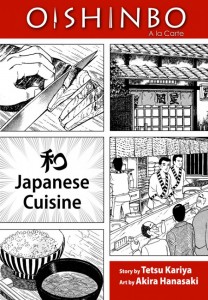
oishinbo110. Oishinbo a la Carte
Story by Tetsu Kariya • Art by Akira Hanasaki • VIZ Media
Equal parts Iron Wok Jan, Mostly Martha, and The Manga Cookbook, this educational, entertaining series explores Japanese cuisine at its most refined — sake, seabream sashimi — and its most basic — rice, pub food. The stories fall into two categories: stories celebrating the important role of food in creating community, and stories celebrating the culinary expertise of its principal characters, newspaperman Yamaoka Shiro and his curmudgeonly father Kaibara Yuzan. (Fun fact: Yuzan is such a food snob that he drove Yamaoka’s mother to an early grave, causing an irreparable break between father and son.) Though the competition between Yamaoka and Yuzan yields some elegant, mouth-watering dishes, Oishinbo is at its best when it focuses on everyday food in everyday settings, shedding light on how the Japanese prepare everything from bean sprouts to ramen. Warning: never read on an empty stomach! (Click here for my review of Oishinbo A la Carte: Japanese Cuisine; click here for my review of Oishinbo A la Carte: Vegetables.)

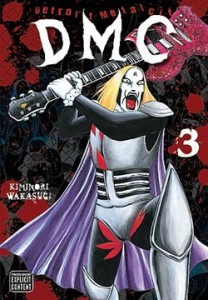
dmc39. Detroit Metal City
By Kiminori Wakasugi • VIZ Media
Satirizing death metal is a bit like shooting fish in a barrel: how hard can it be to parody a style associated with bands named Cannibal Corpse or Necrophagia? Poking fun at death metal while respecting the sincerity of its followers, however, is a much more difficult trick to pull off. Yet Kiminori Wakasugi does just that in Detroit Metal City, ridiculing the music — the violent lyrics, the crudely sexual theatrics — while recognizing the depth of DMC fans’ commitment to the metal lifestyle. Though the musical parodies are hilarious, the series’ funniest moments arise from classic fish-out-of-water situations: Negishi driving a tractor on his parent’s farm while dressed as alter ego Lord Krauser (complete with make-up, fright wig, and platform boots), Negishi bringing a fruit basket to a hospitalized DMC fan while dressed as Krauser… you get the idea. Rude, raunchy, and quite possibly the funniest title VIZ has licensed since Even a Monkey Can Draw Manga. (Click here for my review of volume one; click here for my review of volumes two and three.)

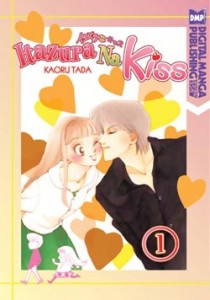
itazura18. Itazura Na Kiss
By Kaoru Tada • Digital Manga Publishing
In the twenty years since Itazura Na Kiss first appeared in Margaret, Kaoru Tada’s breezy romantic comedy has been widely imitated, but seldom surpassed. The story is as basic as they come: an airhead falls in love with a genius, is rebuffed by him, and is eventually pursued by him when he realizes just how sincere and kind she is. Tada manufactures a ridiculous situation to bring her characters together under the same roof — earthquake ahoy! — yet the story never devolves into brainless sitcom territory, thanks to her large supporting cast of characters, brisk comic timing, and strategic use of humor to reveal the characters’ true natures. Pure shojo bliss. (Click here for my review of volume one.)

7. Gogo Monster (VIZ Media)
By Taiyō Matsumoto • VIZ Media
Every elementary school has a kid like Yuki, a smart, odd student who says things that unsettle classmates and teachers alike. In Yuki’s case, it’s the matter-of-fact way he reports seeing monsters that leads to his social isolation. Newcomer Makoto doesn’t share Yuki’s vision, but he admires Yuki’s nonchalant attitude, and struggles mightily to understand what makes his friend tick. It’s to Taiyo Matsumoto’s credit that we’re never entirely sure what aspects of the story are intended to be real, and which ones might be unfolding in the characters’ heads; Yuki’s monsters remain largely unseen, though their presence is felt throughout the story. Matsumoto’s stark, primitive style suits the material perfectly, inoculating Gogo Monster against the sentimentality that imaginary friends and childhood fears inspire in so many authors.

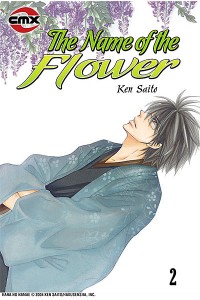
nameflower26. The Name of the Flower
By Ken Saito • CMX Manga
Had the Bronte sisters been born in twentieth-century Japan instead of nineteenth-century England, they might have penned something along the lines of The Name of the Flower, a tear-jerker about a young woman who falls in love with her guardian. Ken Saito employs many favorite Victorian tropes — muteness, garden imagery, orphans — in service of the plot, creating an atmosphere of palpable yearning that will be familiar to anyone who’s read Jane Eyre or Wuthering Heights. For all of its Victorian window-dressing, however, The Name of the Flower favors a slice-of-life approach over crazy-wives-in-the-attic melodrama. (Well, almost; the main love interest is a misanthropic — but hot! — novelist who favors yukatas over jeans, is prone to fits of anger, and writes dark, pessimistic fiction.) Saito’s elegant, understated art is the perfect complement to this delicate drama, making good use of floral imagery to underscore the heroine’s emotional state. For my money, the best new shojo manga of 2009.

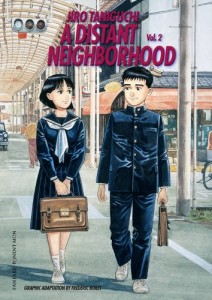
distant_neighborhood25. A Distant Neighborhood
By Jiro Taniguchi • Fanfare/Ponent Mon
A Distant Neighborhood is a wry, wistful take on a tried-and-true premise: a salaryman is transported back in time to his high school days, and must decide whether to act on his knowledge of the past or let events unfold as they did before. We’ve seen this story many times at the multiplex — Back to the Future, Peggy Sue Got Married — but Taniguchi doesn’t play the set-up for laughs; rather, he uses Hiroshi’s predicament to underscore the challenges of family life and the awkwardness of adolescence. (Hiroshi is the same chronological age as his parents, giving him special insight into the vicissitudes of marriage, as well as the confidence to cope with teenage tribulations.) Easily one of the most emotional, most intimate stories Taniguchi’s ever told.

pluto4. Pluto: Urasawa x Tezuka
By Naoki Urasawa • VIZ Media
What amazes me the most about Naoki Urasawa is his ability to transform a tried-and-true genre like the whodunnit into a vehicle for exploring deeper questions about human nature, morality, and identity. As he did with the equally compelling Monster, Urasawa starts in familiar territory — in this case, a murder investigation — but quickly takes the story in unexpected directions, pausing to fill us in on the interior lives of both the principal and secondary characters — no mean feat, given that many cast members are, in fact, robots. Though Pluto takes its inspiration from “The Greatest Robot on Earth,” a short story within Osamu Tezuka’s long-running Astro Boy series, you don’t need to know anything about the original to appreciate the smart pacing, crisp artwork, or intelligent dialogue. In almost any other year, Pluto would have been my #1 pick; it’s a testament to the depth and breadth of 2009’s new releases that it isn’t.

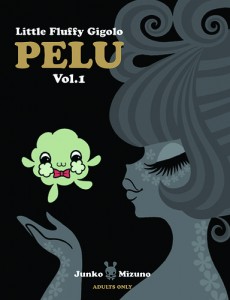
pelu13. Little Fluffy Gigolo Pelu
By Junko Mizuno • Last Gasp
Poignant is a word I seldom use to describe Junko Mizuno’s work, given the frequency with which her characters pop pills, wield chainsaws, and whip each other. But Little Fluffy Gigolo Pelu is poignant, a perversely sweet and sad meditation on one small, sheep-like alien’s efforts to find his place in the universe. In richly detailed images — if one can use the phrase “richly detailed” to describe artwork that draws its inspiration from Hello Kitty, My Little Pony, and Faster, Pussycat! Kill! Kill! — Mizuno offers one of the most bizarre, most original variations on that chick-lit staple, the quest to find a mate before one’s biological clock runs out. It’s not entirely clear how Mizuno expects her audience to react to Little Fluffy Gigolo Pelu — as a social satire? a tragedy? a Sanrio promotion? — but the clarity and appeal of her vision is undeniable. (Click here for my review of volume one.)

redsnow2. Red Snow
By Susumu Katsumata • Drawn & Quarterly
Through a series of ten vignettes, Red Snow depicts life in pre-industrial Japan, when men depended on the sea, the forest, and the field for their survival. Kappa and kitsune mingle freely with humans in Susumu Katsumata’s world, their presence treated as a matter of fact, rather than something extraordinary — a reflection of man’s close relationship with the natural world. Though Katsumata employs a self-consciously primitive style, the stories are neither bleak nor condescending towards their subjects; if anything, Katsumata’s drawings of farmers, woodcutters, and drunken monks have a rude vigor that reflects the resilience of his characters.

1. Children of the Sea
By Daisuke Igarashi • VIZ Media
Children of the Sea defies easy categorization; it’s a high-seas adventure, an exploration of pan-Asian mythology, a cautionary tale about the environment, and a meditation on the ocean as a life-giving force. Though Children of the Sea could easily devolve into mystical hoo-ha — two of its characters were raised by dugongs, for Pete’s sake — Igarashi embeds a coming-of-age story within the main narrative that grounds Children of the Sea in everyday experience, even as the plot takes a turn for the fantastic. (See “raised by dugongs,” above.) Igarashi’s naturalistic art captures the beauty and strangeness of the ocean settings, as well as the sheer diversity of undersea life; you won’t soon forget the site of a sea turtle leaving a starry trail in its wake or the image of a young boy hitching a ride on a humpback whale. Eerie and poetic. (Click here for my review of volume one.)

HONORABLE MENTIONS
Done because there are too menny… great manga, that is, to confine myself to a traditional top ten list. With apologies to Thomas Hardy, here are some of the other manga that tickled my fancy in 2009:

  • Best Continuing Series: Black Jack (Vertical, Inc.) and Real (VIZ Media)
  • Best Dressed Characters: The History of the West Wing (Yen Press)
  • Best Final Volume: Emma (CMX)
  • Best Guilty Pleasure: Cat Paradise (Yen Press)
  • Best Kid-Friendly Title: Dinosaur Hour (VIZ) and Leave it to PET! The Misadventures of a Recycled Super-Robot (VIZ)
  • Best License Rescue: Yotsuba&! (Yen Press)
  • Best Manhwa: Small-Minded Schoolgirls (NETCOMICS)
  • Best New Manga That’s Already on Hiatus: The Manzai Comics (Aurora)
  • Best Prose Novel Released by a Manga Publisher: The Cat in the Coffin (Vertical, Inc.)
  • Best Reprint Edition: Clover (Dark Horse)
  • Best Substitute for Television: Fire Investigator Nanase (CMX)
  • Best Translation of a Dense, Culturally-Specific Text: Sayonara, Zetsubou-Sensei: The Power of Negative Thinking (Del Rey)
  • Best Use of Wagner in a Manga: Ludwig II (DMP)
  • Best Yaoi: Future Lovers (Aurora/Deux)

Filed Under: Manga, Manga Critic, Recommended Reading Tagged With: cmx, DMP, Drawn & Quarterly, Fanfare/Ponent Mon, Jiro Taniguchi, Junko Mizuno, Last Gasp, Naoki Urasawa, VIZ

Oh! My Brother 1 by Ken Saito: B-

October 23, 2009 by Michelle Smith

ohmybrother1-125Masago Kamoguchi is a normal girl: normal looks, normal grades, and normal athletic ability. But normal isn’t good enough for Masago when she’s constantly being compared to her older brother, Shiro, who is smart, good-looking, popular, and someone who draws people to him wherever he goes. As the story begins, Shiro is leading the student council in preparations for the school’s Cultural Festival and Masago is keeping a relatively low profile. All of that changes when Shiro dies saving Masago’s life and his consciousness somehow ends up sharing his sister’s body. Assuming that the incomplete plans for the festival are the “unfinished business” keeping Shiro around, Masago (with some oratorical assistance from her brother) convinces the remaining members of the student council to put aside their grief and make the festival a success in his honor. The students do just that, and though Shiro doesn’t move on as a result, that’s okay with Masago, who has decided she likes having him around.

The name Ken Saito might be familiar to some as the creator of The Name of the Flower. I like that series a lot, so I’d been looking forward to Oh! My Brother ever since the license acquisition was announced. Unfortunately, I found it to be somewhat of a disappointment. There are quite a few characters introduced all at once, and their various reactions to Shiro’s death—stemming from unrequited love or unfulfilled soccer rivalry—lack poignancy when we’ve only just met them; the tone is inconsistent, with the comedic aspect of the body-sharing predicament vying with teary moments for dominance; and I literally groaned aloud when the first page revealed the series was entering well-trod school festival territory already. Also, the relationship between the siblings is kind of icky at times: seriously, who blushes furiously when their brother gives them a peck on the cheek?

That isn’t to say it’s without good moments or the potential for a compelling story. When the successful completion of the festival fails to free Shiro’s spirit from this earthly plane, Masago realizes that his unfinished business is actually her and that his wish is for his sister to live life more fully. Of course, one of the ways in which she might do this is by allowing her feelings for Shiro’s friend, Kurouma-sempai, to flourish (and most likely be reciprocated), a path that Shiro seems determined to thwart by taking control of her body any time he thinks they’re getting too close. This dichotomy in Shiro’s intentions is interesting; I hope it’ll be explored later in the series. Also, it’s always completely clear which sibling is in control of Masago’s body at any given time, either by mannerism, expression, or dialogue. That can’t have been easy to achieve.

Artistically, Oh! My Brother has a cute style, though it’s a little too sketchy sometimes, particularly where light-haired characters are concerned. There’s one panel in particular in which a wispy-looking Masago appears right next to a solid-looking, dark-haired Kurouma-sempai. Perhaps there’s actually some deep symbolism going on here—she’s not fully here while he’s got both feet firmly on the ground?—but I rather doubt it. Also, there are a few errors in CMX’s script, a “your” that should be a “you’re,” and a “thoese” that should be either a “those” or a “these,” but definitely not both at once.

Ultimately, while I am slightly disappointed in this first volume, I plan to continue reading. Maybe this one just needs a little time to grow.

Oh! My Brother is published by CMX. The series is complete in Japan with four volumes, though only one has been published in English so far.

Review copy provided by the publisher. Review originally published at Manga Recon.

Filed Under: REVIEWS Tagged With: cmx, Ken Saito

Canon, Vols. 1-4

June 5, 2009 by Katherine Dacey

canon1The eponymous heroine of Canon is a smart, tough-talking vigilante who’s saving the world, one vampire at a time. For most of her life, Canon was a sickly but otherwise unremarkable human — that is, until a nosferatu decided to make Lunchables™ of her high school class. Canon, the sole survivor of the attack, was transformed into a vampire whose blood has an amazing property: it can restore other victims to their former human selves. She’s determined to rescue as many human-vampire converts as she can, prowling the streets of Tokyo in search of others like her. She’s also resolved to find and kill Rod, the handsome blonde vampire whom she believes murdered her friends. Joining her are two vampires with agendas of their own: Fuui, a talking crow who’s always scavenging for blood, and Sakaki, a half-vamp who harbors an even deeper grudge against Rod for killing his family.

By the middle of volume two, however, nothing is quite how it initially seemed. Canon finds herself embroiled in an all-out war between full-blooded vampires and half-breeds like Sakaki (he had a human mother and vampire father), as well as an internal power struggle among the undead’s elite. Though she’s drawn to Sakaki — he’s handsome in a broad-shouldered, Seishiro Sakurazawa kind of way — she questions his truthfulness: was Rod really responsible for slaughtering her friends, or does Sakaki know more than he’s telling?

…

Read More

Filed Under: Manga Critic Tagged With: Chika Shiomi, cmx, shojo, Vampires

Short Takes: Genghis Khan and Venus Capriccio

May 7, 2009 by Katherine Dacey

Much as I love composing in-depth reviews, the sheer number of new releases makes it impossible for even the most ambitious critic to give every interesting series the 800-word treatment. In an effort to stay abreast of current titles, therefore, I’ll be posting a regular column that offers more concise assessments of new and noteworthy books — manga tapas, if you will. This week, I look at two recent releases: Genghis Khan: To the Ends of the Earth and Sea (CMX), a done-in-one biography of the famous warrior; and volume one of Venus Capriccio (CMX), a romantic comedy about a tomboy and the piano prodigy who loves her.

genghis_khanGENGHIS KHAN: TO THE ENDS OF THE EARTH AND SEA

BY NAKABA HIGURASHI AND SEIICHI MORIMURA • CMX • 178 pp. • RATING: TEEN PLUS (13+)

Cecile B. DeMille never made a movie about Genghis Khan, but if he had, it might have resembled To the Ends of the Earth and Sea, a beautiful but turgid biography of the great warrior. All of the requisite elements are there: sweeping vistas, epic battles, blood oaths, and feuding brothers. The only thing missing is camels.

To the Ends of the Earth follows Genghis Khan at two critical stages in his life: his early adolescence, when his father was grooming him to become the new head of the Borjigin clan (a powerful Monoglian tribe); and his mid-life, when he was systematically conquering the rest of Mongolia. In the first chapter of the story, we learn that Khan’s tribesmen questioned his parentage, suggesting that he was, in fact, the scion of a rival clan. We also see Khan’s fateful meeting with Jamuqua, the future leader of another powerful tribe, the Jadirat. These two scenes provide the subtext for later chapters, implying that Khan needed to conquer Mongolia to prove himself his father’s heir, and to settle an old score with Jamuqua, to whom he’d sworn a blood oath of allegiance as a child. Unfortunately, this effort to bring psychological nuance to Khan’s character falls flat; at 178 pages, the book isn’t long enough to accommodate quiet scenes of character development and epic battles without skimping on both. That leaves the dialogue with the primary responsibility of advancing the narrative, yielding passages that sound more like exposition than conversation: when was the last time you heard one of your siblings identify himself by birth order?

…

Read More

Filed Under: Manga Critic Tagged With: cmx, Seinen, shojo

The Name of the Flower 1 by Ken Saito: A-

February 28, 2009 by Michelle Smith

When Chouko Mizushima was in her first year of high school, she lost both parents in a traffic accident. The shock and grief left her unable to speak and she was shuffled around amongst various relatives before finally ending up with her father’s cousin, the reclusive and cold-seeming author, Kei. Kei sets some conditions for living with him that include tending to his decrepit garden. As Chouko cares for the plants and flowers, her heart slowly begins to mend. She credits Kei with spurring her to shake off the darkness of her grief with her own two hands, not realizing just how much her presence has affected him in return.

The first adjective that comes to mind to describe The Name of the Flower is “quiet.” Although it has its funny moments, the overall feel is serene, focusing on small moments of interaction between the lead characters rather than intense drama. One way in which it accomplishes this is through the story structure. I had been expecting that the story would begin with Chouko moving in with Kei, but actually, it begins after she’s been living with him for two years. Gradually, over a series of flashbacks from both Chouko and Kei, we see not only how they were then but also how they have changed because of each other. I found this to be a very eloquent way of getting the point across.

Kei’s garden also plays a big part in the series. Not only is Chouko’s transformation of the neglected garden into a thing of beauty indicative of her own painful journey, but it also symbolizes the gradual thawing of Kei’s heart. He had been known for very dark literary works before taking Chouko in, but his latest novel is actually a love story based on his life with her.

After reading the novel, Chouko asks Kei about it, but he cowardly claims it isn’t based on reality. Therefore, she doesn’t know that he has romantic feelings for her and he can’t believe that her love for him is real, thinking instead that it’s “more like a newborn chick following its mother.” I thought this was an interesting way to deal with the age difference (twelve years) between them. Although Chouko is technically an adult now, Kei feels she hasn’t experienced enough to know what real love is, and thinks it’d be unfair to saddle her with his unworthy self when she might be able to find someone else who could make her really happy. This makes me like him for not only his maturity but also the angsty possibilities of a hero with an inferiority complex.

Saito’s art works well with the story, though the character designs are rather familiar. Kei is the bespectacled kimono-wearing author, Akiyama (Kei’s editor) is so bland-looking I can’t even describe him, and Chouko occasionally bears a distracting resemblance to Asami from High School Debut. I really like the chibi art, though; it’s very cute.

If a calm love story sounds intriguing, or you’re a fan of CMX’s other shojo offerings, then you might want to check out this series. It’s also short, at four volumes total, if that’s any incentive.

The Name of the Flower was serialized in LaLa DX and is four volumes long. Volume one is available now and volume two will be released on May 19, 2009.

Review originally published at Manga Recon.

Filed Under: REVIEWS Tagged With: cmx, Ken Saito

The Palette of 12 Secret Colors 4 by Nari Kusakawa: B+

February 16, 2009 by Michelle Smith

This is the story of Cello, an aspiring Palette or “color magician,” who has had to repeat her first year of training school because her abilities are a bit different than those of her fellow students. The Palette of 12 Secret Colors is a very episodic series, and this volume is no exception. On the agenda are a separation from her avian partner that prompts Cello to strive to be her best, a rampaging drunken ostrich, and a swimming competition.

I’m not a fan of episodic tales in general, but Kusakawa manages to incorporate modest development for her lead characters and their relationship even while hijinks are ensuing. Over the course of the previous volumes, Dr. Guell (the school doctor) has helped Cello out on numerous occasions and now secretly harbors romantic feelings for her. The episodic nature of the story contrives to put the two of them together, occasionally in ridiculous situations, but also provides the opportunity for many warm and fuzzy moments. The final scene between them in volume four is anything but ridiculous or fuzzy, however, and may be just what Cello needs to finally begin to see the stoic doctor in a new light.

That said, this story is certainly progressing at a leisurely pace for one with only two volumes left. I can’t help but wish for a more dramatic storyline or more tangible evidence of Cello’s progressing skills. Aww-inspiring it may be, but it’s currently too mellow to generate anything akin to awe.

Review copy provided by the publisher. Review originally published at Manga Recon.

Filed Under: REVIEWS Tagged With: cmx, Nari Kusakawa

The Palette of 12 Secret Colors 3 by Nari Kusakawa: B

February 15, 2009 by Michelle Smith

From the back cover:
Cello meets Fenne, a fellow Palette-in-training who’s been having problems with his abilities ever since his bird-partner died. Despite his sarcastic attitude, Cello is determined to both help him find a suitable new bird and to become his friend. Then Olga—Dr. Guell’s jealous bird—decides that Cello is taking up way too much of Dr. Guell’s time. So now she’s determined to make sure that Cello quickly completes her Palette training.

Review:
Just as I was wishing to know more about Cello’s progress, she makes a remark in one chapter about how she has cleared “about half” of the first twelve colors. That’s a step in the right direction, I suppose.

Unfortunately, none of the stories in this volume really do much for me, though none is bad or anything. A new character, Fenne, is introduced and ropes Cello into helping him adapt one of the migratory birds that visit the island to be his new partner. At first he mocks her for having to repeat her first year, but comes to like her, which bothers Dr. Guell, who is coming to realize that Cello occupies his thoughts rather a lot.

The story with Olga serving as Cello’s tutor misses the mark for amusing and instead ventures into the territory of “too silly for me.” The same can be said for the chapter in which Cello’s father pursues an outrageously ridiculous plan of making up with his wife, with whom he’s had a fight. About the only one I really like is the one about Cello’s birthday, and how Dr. Guell sweetly buys her a present. Not only that, he’s clearly paid enough attention to her to know exactly what kind of present she would like best.

The relationship between Dr. Guell and Cello is the most interesting thing about the series at the moment, but I do rather wish for a more serialized story line. This is the halfway point of the series and though it’s very pleasant and guaranteed to foster some warm fuzzies, it feels like something more should be happening by now.

Filed Under: REVIEWS Tagged With: cmx, Nari Kusakawa

The Palette of 12 Secret Colors 2 by Nari Kusakawa: B+

February 15, 2009 by Michelle Smith

From the back cover:
It’s Christmas time on the island of Opal, and a visiting young Prince introduces holiday traditions to its residents. What could be more festive than the powers of the color wizards unleashed upon the season? But Dr. Guell is jealous of the relationship between the Prince and Cello and adds a sour note to the happy celebration. Then, find out more about Cello’s family and learn how she first bonded with Yoyo, her very special bird.

Review:
The episodic adventures continue in this volume, including a story about a visiting prince with a predictable secret, the tale of how Cello first met Yoyo, and a chapter about Cello’s family and her dad’s attempts to get some kind of facial expression out of terminally cool Dr. Gruell. Each of the episodes has something amusing about it, or some particular insight on character, but some are also a bit dull; I’m already kind of tired of seeing the triplet little girls turn up again and again.

The second story is my favorite, and not just because of Yoyo’s cuteness, though I suppose that is a factor. Mostly, though, I like it for the continuity. In an offhand remark in volume one, Cello mentions that she used to like climbing trees until she fell from one, and now she’s afraid of heights. This chapter includes that incident. It’s a minor thing, but I’m happy to see the seeds for it planted in advance.

While the current story structure is not short on charm, I still keep wanting this to be like a shounen manga somehow, with Cello acquiring mastery of new colors and her progression in skill clearly mapped. So far, she has improved enough to do well on a mid-term exam, but that’s sort of nebulous; the idea of knowing exactly how many of the twelve colors she can control and how many she has left has definite appeal.

Filed Under: REVIEWS Tagged With: cmx, Nari Kusakawa

  • « Go to Previous Page
  • Page 1
  • Page 2
  • Page 3
  • Go to Next Page »
 | Log in
Copyright © 2010 Manga Bookshelf | Powered by WordPress & the Genesis Framework