• Skip to primary navigation
  • Skip to main content
  • Skip to primary sidebar
  • Home
  • About Us
    • Privacy Policy
    • Comment Policy
    • Disclosures & Disclaimers
  • Resources
    • Links, Essays & Articles
    • Fandomology!
    • CLAMP Directory
    • BlogRoll
  • Features & Columns
    • 3 Things Thursday
    • Adventures in the Key of Shoujo
    • Bit & Blips (game reviews)
    • BL BOOKRACK
    • Bookshelf Briefs
    • Bringing the Drama
    • Comic Conversion
    • Fanservice Friday
    • Going Digital
    • It Came From the Sinosphere
    • License This!
    • Magazine no Mori
    • My Week in Manga
    • OFF THE SHELF
    • Not By Manga Alone
    • PICK OF THE WEEK
    • Subtitles & Sensibility
    • Weekly Shonen Jump Recaps
  • Manga Moveable Feast
    • MMF Full Archive
    • Yun Kouga
    • CLAMP
    • Shojo Beat
    • Osamu Tezuka
    • Sailor Moon
    • Fruits Basket
    • Takehiko Inoue
    • Wild Adapter
    • One Piece
    • After School Nightmare
    • Karakuri Odette
    • Paradise Kiss
    • The Color Trilogy
    • To Terra…
    • Sexy Voice & Robo
  • Browse by Author
    • Sean Gaffney
    • Anna Neatrour
    • Michelle Smith
    • Katherine Dacey
    • MJ
    • Brigid Alverson
    • Travis Anderson
    • Phillip Anthony
    • Derek Bown
    • Jaci Dahlvang
    • Angela Eastman
    • Erica Friedman
    • Sara K.
    • Megan Purdy
    • Emily Snodgrass
    • Nancy Thistlethwaite
    • Eva Volin
    • David Welsh
  • MB Blogs
    • A Case Suitable For Treatment
    • Experiments in Manga
    • MangaBlog
    • The Manga Critic
    • Manga Report
    • Soliloquy in Blue
    • Manga Curmudgeon (archive)

Manga Bookshelf

Discussion, Resources, Roundtables, & Reviews

clamp

3 Things Thursday: Favorite CLAMP Women

July 26, 2012 by MJ 9 Comments

It has been a while, but welcome back to 3 Things Thursday! As you know, this week is the CLAMP Manga Moveable Feast. CLAMP has written a lot of terrific female characters, like Sakura, Yuuko, Hikaru, and the list goes on. I’ve always gravitated towards supporting characters, though, especially when they’re as awesome as some of CLAMP’s. And so, this Thursday, let’s talk about my…

3 Favorite CLAMP Women

1. Hokuto, Tokyo Babylon – I already went on and on about Hokuto in yesterday’s roundtable, but really I could talk about her all day. While she’s pretty great in her capacity as “Subaru’s twin sister,” she’s even better on her own, and I’m thrilled that CLAMP decided to break away from the manga’s primary thread long enough to let us see that. Volume two’s final chapter, in which Hokuto steps in to rescue another woman from her male pursuers, is one of my favorite moments in the entire series. She’s like a superhero in this scene, and it’s impossible not to fall in love with her.

(click images to enlarge)

2. Himawari, xxxHolic – One of the characters who seems to get the least love from fans in xxxHolic is Himawari, Watanuki and Doumeki’s schoolmate who was born with the unfortunate characteristic of bringing bad luck to the people around her. But Watanuki adores Himawari, and so do I. I love her understated insights, her sweet good nature, and the smile that covers up her loneliness. This scene in which Watanuki finally realizes what’s really going on with Himawari is a favorite of mine, partly because of Watanuki being who he is, but also because of Himawari’s cheerful acceptance of what she is certain must be the end of their friendship.

3. Tomoyo, Carcaptor Sakura – Oh, Tomoyo, Tomoyo… if Cardcapter Sakura is the absolute dearest of all dear things in the world, Tomoyo is even dearer. Her complete devotion to Sakura is adorable of course—Tomoyo is a true friend—but it’s more than that. She’s a completely original little person, and it’s just a joy to watch her exist. She’s as dear as can be here, but I think my favorite moment is in the last panel, when she greats the fairly terrifying true form of Cerberus with, “Have we met?”

So, readers… who are your favorite CLAMP women?


To submit your contributions to the CLAMP MMF for inclusion in this month’s archive, please send your links by email to mj@mangabookshelf.com or via Twitter to @mjbeasi. If you would like your contribution(s) to be hosted at Manga Bookshelf, please email them to MJ, along with any included images.


Filed Under: 3 Things Thursday Tagged With: clamp, Manga Moveable Feast, MMF

CLAMP MMF Links: Day 2

July 25, 2012 by MJ 3 Comments

Here is your roundup of links for Day 2 of the CLAMP Manga Moveable Feast!

From your host: I take some time to explain Why you should read Cardcaptor Sakura, including lots of pretty images and general sighing.

At The Manga Critic, Kate favors us with her 5 Favorite CLAMP Manga, including titles like X, Clover, and Shirahime-Syo: Snow Goddess Tales.

“Shirahime-Syo: Snow Goddess Tales is testament to CLAMP’s Borg-like ability assimilate any genre or artistic style and make it into their own. The three stories that comprise this slim volume are folkloric in tone and subject-matter, but expressed in a visual language that’s a beautiful synthesis of shojo manga and ukiyo print-making; the characters — with their pointy chins and artfully tousled hair — inhabit stark landscapes reminiscent of the Kishi and Shijo schools.”

Over at Heart of Manga, Laura reminisces about the first CLAMP manga she ever read, in Memorable Manga Moment: Chobits vol. 1.

Yesterday in reviews, Lori Henderson gives the first volume of Gate 7 a try at Manga Xanadu, Ayame spends some time with Tokyo Babylon at The Beautiful World, and Lexie (a girl after my own heart) takes a look at Cardcaptor Sakura at Poisoned Rationality.

That’s all the links for Tuesday! Stay tuned as the Feast continues!


To submit your contributions to the CLAMP MMF for inclusion in this month’s archive, please send your links by email to mj@mangabookshelf.com or via Twitter to @mjbeasi. If you would like your contribution(s) to be hosted at Manga Bookshelf, please email them to MJ, along with any included images.


Filed Under: UNSHELVED Tagged With: clamp, Manga Moveable Feast, MMF

Off the Shelf: Tokyo Babylon

July 25, 2012 by Danielle Leigh, MJ and Michelle Smith 10 Comments


Warning: This roundtable contains spoilers for the entirety of Tokyo Babylon.

MJ: So, I’ll be honest, here. Though I am very anxious to see what the manga blogosphere has to say about CLAMP’s body of work as a whole, the biggest reason I proposed a CLAMP MMF in the first place was that I longed for an excuse to talk about my favorite CLAMP series, Tokyo Babylon.

As one of CLAMP’s earliest commercial works, Tokyo Babylon is certainly not their most deftly-plotted manga, nor their most polished—not by far. It is, however, one of their most honest manga, by which I mean that it contains a level of raw humanity and emotional truth that can be harder to find in some of their more sophisticated works.

And when it comes to things like “raw humanity” and “emotional truth,” who do I want to hash it out with? Why, The NANA Project, of course! This week, Michelle and I are pleased to welcome our NANA Project collaborator Danielle Leigh to the table for our MMF edition of Off the Shelf!

Welcome, Danielle, it’s so wonderful to have you here!

DANIELLE: Thanks so much for asking me to participate! We planned this so long ago but now that I’m rereading the project I found I’ve rediscovered my love of the title and, in a way, CLAMP as an artistic group. Even though parts of Tokyo Babylon are clumsy as hell I found myself really appreciating how well thought out the twists and turns were. For example, take all the artistic touches surrounding Seishirō anytime he appears in the work — CLAMP clearly knew who that character would be and what his backstory was from the very start.

And, okay, maybe the foreshadowing was heavy enough to drown in, sure, but there’s also a straightforward simplicity to how events play out that I feel CLAMP’s later titles would certainly benefit from (*cough* Tsubasa *cough*). It’s just refreshing to read a work and think, “yes, this plot was planned but not *forced.*”

MICHELLE: That was one thing I wanted to ask you two, actually. I pretty much learned about manga and CLAMP in the same breath, and because I asked a lot of questions, I was spoiled on the outcome of Tokyo Babylon before I ever read it. But, given that the foreshadowing is heavy-handed and starts at the end of volume one, was the reveal actually a surprise even to anyone who had not been spoiled?

MJ: For my part, I would say that the reveal of Seishirō as the Sakurazukamori was not remotely a surprise—nor do I think it was meant to be by that point. But what that ultimately meant for everyone involved was a huge surprise for me. I expected to find out that Seishirō was the “bad guy,” but I never expected his entire Seishirō-san persona to have essentially been a lie. I knew the truth, but I didn’t expect the consequences, if that makes sense.

DANIELLE: I was exposed to X/1999 (or the anime X) before I read this title so honestly I’m not sure if anyone would be *too* surprised about Seishirō being such a bad guy….but I think MJ’s right. The consequences are so horrific when he finally takes off his nice guy mask that emotionally the whole thing *still* feels like a vicious punch to the gut.

MICHELLE: That’s a good way of putting it!

MJ: So, we’ve sort of accidentally started with the end of the series. Let’s back up a bit, so new readers can grasp what on earth it is we’re talking about!

For a series with such a sweeping title, Tokyo Babylon is a fairly intimate manga, in that it essentially has only three characters: Subaru, a shy 16-year-old onmyōji and head of the powerful Sumeragi clan; his twin sister, Hokuto; and Seishirō Sakurazuka, a kindly veterinarian whom the two Sumeragi twins have befriended. Other characters (like the twins’ grandmother, and a young woman Hokuto meets during adventures of her own) flow in and out of the story, along with a host of onmyōji customers and “monsters of the week,” but every real theme in this story revolves around these main three, and them alone.

All three characters are introduced in the first chapter, in which Subaru is finishing up a job exorcising the spirit of a young woman who committed suicide after being cruelly dumped by a womanizing celebrity. While Hokuto chastises Subaru for helping out such a creep, Seishirō points out Subaru’s kindness in freeing the young woman’s spirit for her own sake, establishing the trio’s dynamic pretty much immediately. As the series goes on, chronicling Subaru’s continued duties as an onmyōji, two things will remain consistent; Seishirō will express his love and admiration for Subaru’s selfless spirit, while Hokuto will wish desperately for him to abandon that selflessness just long enough to want something for himself—a wish that will ultimately have consequences far beyond her expectations.

Though the beginning of the series feels straightforwardly light and (rather awesomely) humorous, even its jokes—like Seishirō’s teasing “love” for Subaru—are pretty deeply nuanced, something that’s become even more apparent to me on this particular re-read.

(reads right-to-left — click images to enlarge)


DANIELLE: MJ, you are much more generous about taking the opening premise and early characterization seriously than I am. When I was first introduced to the character I found I neither liked nor disliked Subaru and that in the early volumes both Hokuto and Seishirō behave in fairly cliched, and, to me, rather annoying ways. Hokuto often feels like the proto-yaoi fangirl (even though we find out about her deeper motivations much later on), while Seishirō plays the not-really-bad-wolf-in-veterinarian’s clothing (only later to be revealed as guilty of much, much worse than being a potential seducer of a 16 year old boy). Subaru is the empty center of the story and he lacks real definition for a very long time.

This all sounds terribly harsh but I firmly believe that all these characterizations are, in fact, carefully orchestrated by CLAMP to give the reader one hell of a payoff later on. And, of course, Subaru grows tremendously as a character over the course of the series. He starts of as a bit of a cipher (personality wise) and eventually develops real flaws, character traits, and deeper emotions.

MICHELLE: There’s definitely a sense of being lulled into a false sense of security. “Oh, nothing to see here. Just some disposable supernatural monster-of-the-week stories plus some fashion-conscious twin and a lot of BL teasing that results in Subaru taking pratfalls every three pages!” But we later learn that, with the exception of Subaru, everyone secretly had an agenda for acting the way they did, which is just marvelous.

MJ: I think why I’m so generous about this (to use Danielle’s words) is because my re-read convinced me that it was all incredibly brilliant, and it also helped me notice a lot of nuance that wasn’t apparent to me the first time around. I’m especially impressed with the way CLAMP handles Subaru.

One personal philosophy that is stated over and over again in this series (expressed by both Subaru and Hokuto at various times) is that no person can ever truly understand another person’s pain. Most often this idea is used to explain a lack of judgement made regarding other people’s choices and decisions and a respect for their uniquely painful circumstances. But while this philosophy seems on the surface to be a grand acknowledgement of individuality, Subaru takes it so much to heart that he not only refuses to make his mark on anyone else, he also resists becoming a fully realized individual himself, as though even that might be an affront to others. He lets other people dictate his movements, his feelings, his personal appearance—he is deliberately a non-entity. And while someone else as spiritually powerful as he is might do these things deliberately to facilitate deception, Subaru does this to avoid being an influence on anyone else. Once I realized that this was what he was doing, I could see it everywhere—along with Hokuto’s need to find a way to get him to rebel against it, even if it meant becoming involved with someone dangerous.

(reads right-to-left — click images to enlarge)


I’ll be honest—on this re-read I was kind of blown away by how carefully CLAMP crafted these characters, especially Subaru.

DANIELLE: I very much agree with your take on Subaru’s characterization with one important exception — I don’t think Subaru consciously understands a lot of his own choices and behaviors (in other words, I think CLAMP is being deliberate in their writing choices, rather than the character consciously making the choice to become a non-entity). Otherwise, I don’t think he would have such a shocking sense of emptiness, terror and guilt in the aftermath of Seishirō sacrificing his eye to save Subaru’s life. In those moments you can see him gradually awakening, with some desperate prodding by Hokuto, to his true self. Eventually he reaches the point where it all boils over and he basically realizes, “yes, I not only love Seishirō, but I’m also *in love* with him” (I’m just paraphrasing here). That’s the moment he reaches person-hood and it’s in that moment, of course, CLAMP tears it all down by having Seishirō reveal himself. God, it’s just so brutal.

(click image to enlarge)

MICHELLE: Yeah, I do think it’s so deeply ingrained in him he doesn’t know he’s doing it. When one of his jobs takes him to the home of a former classmate who’s spent four months asleep to avoid a traumatic reality, we see a flashback to a very young Subaru taking the delinquents’ kicks originally meant for a stray dog. He’s perfectly willing to take on consequences himself if it means protecting someone or something else, but he’s horrified that someone would do something similar for him.

MJ: Perhaps I should have chosen my words more carefully, because the truth is, I agree! When I say he’s “deliberately” doing this, I don’t necessarily mean that he’s completely aware of why or even always when he is refusing to assert himself as an individual. But I still think that kind of behavior is deliberate. Somewhere inside him, Subaru has determined that he should not put himself forward in a way that impacts anyone else—maybe it’s a reaction to the amount of power he knows he possesses, or to being given such a heavy role in the world at so young an age, or something completely different—but even if he’s not aware of all the steps between that determination and the actions he takes every day, I feel that’s still a real choice.

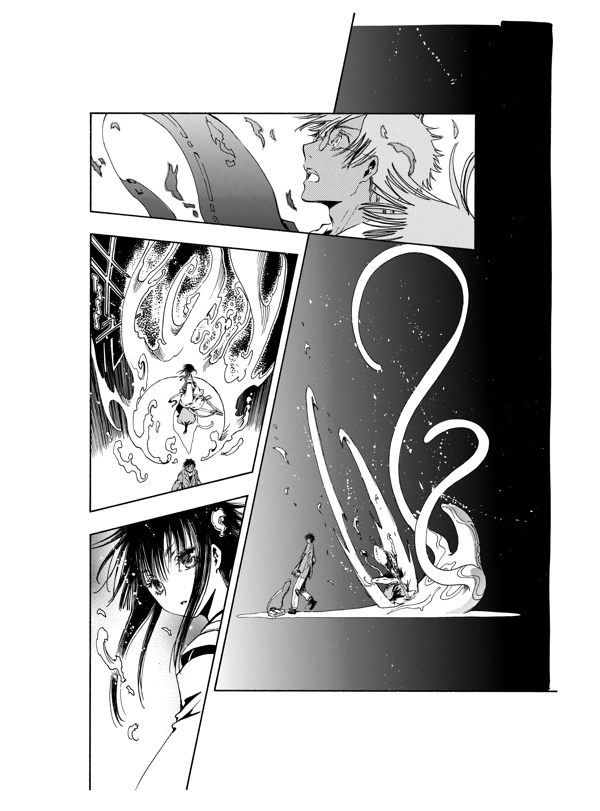
Michelle, I’m reminded too of the scene in which Subaru is trying to help a group of girls who have been practicing amateur dark magic over a party line. This scene hit me especially hard after the fact because of Seishirō’s interference, which at the time feels like absolutely the correct reaction. As Subaru is voluntarily taking all sorts of damage in order to avoid hurting the girls, I found myself somehow on Seishirō’s side, unwilling to accept Subaru’s selflessness when it meant he’d be sacrificing himself to atone for someone else’s horrible mistakes. But of course, Seishirō’s motivations are entirely sinister, while Subaru’s alone are pure. The way that CLAMP stealthily aligns the reader’s sympathies with something that is ultimately evil in a scene like this is also part of what makes later events feel so brutal.

(click image to enlarge)

This is also part of what makes Hokuto’s journey so moving and tragic, since we essentially find ourselves mirroring her own concerns for Subaru (or at least, I do), but unlike a lot of supporting female characters in manga featuring a male protagonist, she doesn’t only exist in the story for his sake. One of my favorite chapters in the entire series is one in which we get to see Hokuto’s life outside of Subaru’s (yes, she actually has one). In this chapter, Hokuto helps a young foreign woman escape from police, and in pretty spectacular fashion, too. Here, Hokuto—who is otherwise shown mostly in her role as Subaru’s caretaker and personal fashion designer—is a bona fide hero herself, showing up exactly when she’s needed to kick some serious ass. It’s the only chapter in which she appears on her own like this and I wish there were more, though I do appreciate the fact that later in the series when she’s headed out on a “date,” it’s implied that she’s meeting up with the woman she befriended at that time.

By about halfway through the series, I found I absolutely adored Hokuto—which of course made her end especially horrifying. What are your thoughts on her?

DANIELLE: Even though Hokuto has tried to distinguish herself from her brother—and to help give him the tools to do the same—I still feel like half of Subaru dies with Hokuto in the end. And I hate this feeling, because it goes against what the character herself says she stood for (i.e. that even though they are brother and sister, and twins, they are *not* the same person). On the other hand, I feel as though my inability to see her as separate from Subaru is also a consequence of that character failing to follow her own instructions. She gets so caught up in trying to give Subaru his own identity, I think she sacrifices parts of her own identity—not merely her own life—on his behalf.

(reads right-to-left — click images to enlarge)


MICHELLE: I was thinking along similar lines, actually. If one person is allowing their identity to be largely defined by another, that means there exists someone whose purpose it is to try to shape that person into what/who they think they should be. Which ultimately means Hokuto is a fairly selfless person, too.

Perhaps that’s why I so dearly loved the chapter where we see Hokuto help the foreign woman, because she suddenly comes so vibrantly and independently alive. I don’t think we even knew she had powers of her own up until that point—possibly because they are so modest that they wouldn’t be of help to Subaru on the job—but she is such a pure heroine in the other lady’s eyes that I wish we got to spend more time with her, to see how she truly sees the world when she’s not so desperately trying to save her brother.

MJ: You’re both brilliant, and (of course) right. And maybe what you’re getting at is something beyond either of the philosophies stated by Hokuto and/or Subaru over the course of the series. Perhaps both of their ideas are too simple to be useful.

While Hokuto is desperately trying to carve out identities for both herself and her brother as individuals and Subaru is desperately trying to have no identity at all, the truth is, they are both separable and inseparable at the same time. While they clearly are and must be individuals, they also can’t help being two parts of a single unit, and trying to define themselves entirely as either one or the other is simply not possible, or even desirable.

Is it wrong that they should need each other? I don’t think so. Nor is it wrong for them to be considerate to each other as individuals (this speech of Hokuto’s is one of my favorite things in the series, by the way). And in the end, the loss of either of them is inevitably devastating to the other. It would have to be. And even though I hate seeing what happened to Subaru over the loss of Hokuto (or contemplating the state Hokuto would have been in, had it ended up the other way around), I guess I can’t really wish for them to have been less important to each other. Can you?

(reads right-to-left — click images to enlarge)


DANIELLE: And forgive the irreverence of the following comment, but what the hell are two 16 year olds doing with such trenchant life philosophies anyway? Oh, CLAMP. Even though Subaru looks like a teenager, he and Hokuto never really get to act like they are one (compared to say, Watanuki, who gets to throw tantrums, complain constantly, hold irrational grudges, and generally act like a pain in the ass. Every inch of him a teenager most of the time). Even when Hokuto’s doing silly things in a silly way for a very silly reason, there’s such an element of *seriousness* to it all. It kind of breaks my heart all over again.

MICHELLE: One wonders how much of a childhood they were actually able to have, with their parents gone and such heavy responsibility thrust upon Subaru so young.

It’s such a sad life for him, and one that doesn’t get any better. I’m not sure how much either of you have read or seen of X. I’ve seen the anime, but read only the first volume of the manga, and I’m not sure MJ’s done either, or if she’s investigated to see what eventually becomes of Subaru.

MJ: I have read all of X/1999 (and didn’t care for it much, though I’m trying to let the new omnibus releases convince me that there’s more to it than just waiting for Subaru to show up), so I do know what becomes of Subaru, and you’re right, it really it does not get any better for him. There is more hope for alternate-universe vampire!Subaru in Tsubasa: Reservoir Chronicle (he at least gets to have a twin again), though of course that isn’t quite the same. I guess that’s an advantage to being a CLAMP character, though… you do get second chances, one way or another.

I actually wanted to talk a bit about both these characters in other CLAMP universes and also what traits Tokyo Babylon does and doesn’t share with other CLAMP series. While reading Cardcaptor Sakura alongside Tokyo Babylon for the purposes of the feast, I was struck by one of the funnier philosophies they share—that designing and creating outfits for someone might be the ultimate gesture of love. Comments?

DANIELLE: In spite of the fact this series is a prequel to X/1999 (and a kind of dress rehearsal for the relationship between Kamui and Fūma in that series) in my mind I connect it to xxxHolic more than CCS, Tsubasa or X/1999. But I think that’s an artistic link, rather than a character or thematic one, that’s going on in my head. Thinking it over, I feel like X/1999 is the sprawling, epically messy unleashing of the very carefully designed plot of Tokyo Babylon. The story is, in fact, so fantastically messy the damn thing — for whatever reason — can’t even be finished. I get the feeling I might be the only one here who is rather fond of X/1999 (or the anime X) but it’s a fondness that comes from appreciating how imperfect it is as a sequel and as a narrative work. In contrast, you could never use such a mild word as “fond” to describe how I feel about Tsubasa or xxxHolic (although for very different reasons).

I really like MJ’s point, though….providing a friend or family member with a costume change is the ultimate act of love in the CLAMP universe! :-)

(click image to enlarge)

MICHELLE: I’m not anti-X, but I feel oddly disconnected from it.

And yes, I am sure Hokuto and Tomoyo would get along fabulously. Hokuto could be a kind of mentor to her… it’d be great!

Of course, another theme that begins (I think) in Tokyo Babylon and proceeds to permeate CLAMP’s other works is the idea of “It’s all fun and games until someone loses an eye.” Seishirō loses his eye to protect Subaru, and then suddenly eyes are lost or swapping all over the place. It’s become such a CLAMP trademark that it’s actually a cliché now, sort of how people just stopped being surprised when Joss Whedon kills a character.

MJ: I admit I like the eye exchange in xxxHolic the best, but maybe that’s just because it was my first. Heh.

There are a lot of themes that run through CLAMP’s work as a whole, both visually and otherwise. One of the things I’m struck by with Tokyo Babylon, however, is how little it resembles its sequel, in every way, really. Danielle has already touched on this, in terms of structure and plot, but visually, too, they couldn’t be more different.

DANIELLE: Agreed. The reason I also think of X/1999 as messy is because it actually looks quite messy in comparison to the crisp, clear art of Tokyo Babylon. I absolutely love the art in Tokyo Babylon, it remains second only to xxxHolic in my own personal ranking of CLAMP styles. I think X/1999 pretty much begat Tsubasa, and my god does the art in that series drive me up the wall.

MICHELLE: I think “messy” is a great way to describe X, but for me it feels that way largely because of its huge cast, compared to the extremely intimate trio in Tokyo Babylon. Granted, I’ve not read the majority of the manga, but from what I’ve seen it looks like there’s just not time to get to know and care about everybody, there’s just so many people and so much going on in the scenes that the visuals can’t help but be all crowded and hectic. There’s no time for atmosphere, which Tokyo Babylon possesses in abundance.

I actually got used to the art in Tsubasa after a while—well, more or less—but the in-your-face gangliness of the character designs is not something I’ll ever be a fan of.

MJ: I think I may love the artwork in Tokyo Babylon even more than xxxHolic, but if so, it’s not by much. Both series are striking in their elegant storytelling, their stunning use of black, and a sort of woodblock sensibility that makes them feel somehow timeless. Even Tokyo Babylon‘s unapologetic 80s fashion sense manages to come off as elegant in CLAMP’s hands. xxxHolic also resembles Tokyo Babylon in its intimacy. Even though there are a greater number of vital characters, and obviously the story is much longer and wider in scope, the main setting of Yūko’s shop creates the same kind of private world Tokyo Babylon‘s characters live in.

DANIELLE: Honestly, MJsums up the ties I see between these series so beautifully I don’t have too much to add. I would just say if Yūko’s shop is is the centerpiece of xxxHolic, then Tokyo itself is basically the fourth character in Tokyo Babylon. Before the series gets almost claustrophobic in its tight focus on Subaru and Seishirō’s relationship, there’s a lot of pontificating in the omniscient narration about Tokyo as a kind of mirror of the human condition. It’s totally overblown and hokey, but that’s CLAMP. And I’m okay with it.

MICHELLE: That’s a great point, and you’re absolutely right. And a lot of the woes leading to the supernatural crises that Subaru is called upon to solve have something to do with Tokyo, from celebrities seducing pure-hearted girls to thugs running rampant in an apartment block, leading the residents to gossip about their misdeeds. It’s almost as if Subaru is having to clean up Tokyo’s messes.

I agree that visually (or perhaps the word I’m really looking for is stylistically), xxxHOLiC is probably the most similar to Tokyo Babylon of all CLAMP’s works. It feels like they really exhibited some restraint with these series. They didn’t go overboard with swirls and feathers and putting wings on everything, but kept things kind of understated and gloomy.

(reads right-to-left — click images to enlarge)


MJ: I certainly agree, Danielle, that CLAMP’s Tokyo parables are pretty hokey, though what makes it all worthwhile for me is the payoff in the final volume, where Seishirō mocks Subaru’s agony over his betrayal by saying, “Things like this happen in Tokyo every day.” With that one sentence, Seishirō manages to belittle not only Subaru’s feelings in the moment, but also basically every single time the two of them had ever talked about the city as they worked to help its many lost souls. It’s so cruel, but wow does he hit that on the nose. I’m not sure it would have had the same impact without the overblown narrative in those early volumes.

Another connection this series has with xxxHolic is the primary message being aimed at its protagonist by those who love him—Hokuto and (interestingly) Seishirō in the case of Tokyo Babylon and Yūko and Dōmeki in xxxHolic—that lesson being that it’s ultimately selfish and perhaps even hurtful to devalue and thoughtlessly sacrifice oneself for the sake of others. Ironically, it’s Seishirō who says this outright in Tokyo Babylon, after sacrificing his eye to save Subaru (whom he actually does not love at all), and given that irony, perhaps it’s fitting and meaningful somehow that, unlike Watanuki, Subaru never really gets the message.

DANIELLE: I must pause here to mention that Watanuki is my favorite CLAMP character of all time. Dōmeki is probably my second favorite.

Okay, here’s a question that’s been on my mind—do we really think Seishirō does not care for Subaru at all? And by “care” I mean have some interest in Subaru in his own evil, twisted fashion and not…you know. Anything resembling traditional human affection. Why in the world would he go so far in order to keep his original “bet” (that, honestly, he made with himself, not even with Subaru). Or am I letting knowledge of X/1999 cloud my reading of the prequel?

MICHELLE: “Care” has so many connotations of loving kindness, that it’s hard for me to even use the word in this context. I think Seishirō delights in tormenting Subaru, and that Subaru is his favorite plaything. So he’s not utterly unconcerned with him, by any stretch of the imagination. It still really bothers me that we don’t learn what he said to Subaru in X, and I’m not sure CLAMP ever intended to tell us, even before the series went on hiatus.

MJ: I think that’s a really fair question, Danielle, and seriously I just don’t even know. I don’t know how much we can trust everything that Seishirō says to Subaru at the end of the series. He claims to feel nothing at all for Subaru and to perceive no difference between him and a common household object, but then you’re right… what the hell? Why bother with the “bet” in the first place? Why didn’t he just kill Subaru the first time they met? And even if you (or we) are letting our knowledge of X get into the middle of this, I think that’s fair, since it is a canon continuation of this storyline.

I feel like… he’s lying. Or perhaps he doesn’t even quite realize that he’s lying, since he’s completely inexperienced when it comes to human emotion.

Also, I agree, Michelle. I really wish we knew what he said to Subaru at the end of their arc in X. It will haunt me forever, as these things do.

DANIELLE: CLAMP really loves to play with shadow selves and mirroring and Tokyo Bablyon is just *bursting* with mirroring imagery, particularly with Seishirō. Everything about his representation points to the existence of the dark identity he’s skillfully hiding (i.e. part of the foreshadowing we discussed earlier). But we never get a hint that the surface self he presents is bleeding into the hidden self. I think I would understand that character a bit more if we saw any tension or conflict in how he perceives and understands his own actions. But we never see that happen. At least in this series.

MICHELLE: Oh, now you’re making me think of a character in Cardcaptor Sakura, but I’m not sure how much I should say without knowing where certain reveals transpire or where MJ is with the series!

MJ: I’ve read all of Cardcaptor Sakura, so you’re good to go.

MICHELLE: Oh, good! I was going to mention the dual identities of Yukito and Yue. Granted, Yue is not evil, but he is rather cold and unemotive, but has been hiding himself in the body of open and friendly Yukito for so long that some of Yukito’s feelings have begun to rub off on him, particularly as regards Tōya. And that’s something that doesn’t seem to have happened with Seishirō, who is able to just manipulate the Sumeragi twins without apparent qualm.

(click image to enlarge)

MJ: I was thinking about that, too, Michelle, even though Yukito/Yue is such a drastically different character than Seishirō. I have to admit, the way that character is handled is so much more in line with what I expect from a shoujo manga than what CLAMP does with Seishirō.

You know, Danielle, I actually think what you just said about Seishirō is one of the reasons Tokyo Babylon was so surprising to me the first time I read it. I was relatively new to reading manga at the time, and I’d read a lot of shounen manga and a lot of fairly uplifting shoujo, and one of the things that nearly always happens in those series, is that characters we initially perceive as villains will turn around and become very sympathetic characters, by way of backstory or some other kind of revelation later on. The message driven home by that trope is that understanding is the key to learning to love someone, or perhaps that anyone can be granted salvation (of a sort) by way of understanding. These series are careful to always give us something to latch on to—to help us understand even the most seemingly depraved characters before the end.

Tokyo Babylon rips that trope to shreds by giving us nothing of the sort. Not only does the series end with unrepentant tragedy and despair, but there’s absolutely no sense that we should understand why it had to happen. There’s no redemption for Seishirō, because there’s not even the slightest hint of humanity for which we might feel sympathy. Seishirō’s motivations are inscrutable, he makes horrible things happen, and there is no understanding it (nor certainly any fixing it). The message of Tokyo Babylon is that sometimes people are just horrible, goodness does not always win, and our weaknesses may very well be exploited without any chance at all for us to learn from them. It’s a bleak, bleak message that I never expected to find in a shoujo manga series, and it left me absolutely wrecked as I finished it.

Of course, this was also kind of awesome.

So, I’ve talked a little here about my own personal response to Tokyo Babylon. I think you both know me well enough by now to know that it’s important to me to feel emotionally affected by a story, and I’m sure my strong emotional response to this series has a lot to do with why it’s such a favorite. Though it’s interesting to note that unlike so many favorite stories of mine, there isn’t a character I personally identify very deeply with—unlike, say, NANA, where I do find exactly that kind of touchstone in Nana Komatsu. I think I’m a more emotionally-driven reader than most, however, so I’d be curious to know what your own connections are with this series.

DANIELLE: I think my connection to this series is almost completely on the level of “that shit is entertaining.” Yes, I’m moved by what happens to Subaru and Hokuto but there’s also this *thrill* of reading a story where the creators aren’t afraid to just go for it. MJ, you’ve beautifully analyzed your expectations versus experience of the work, but man. All I can say is, that was a really *good time*—that reading this story was, in its own way, *fun.* The older I get the more I realize how rare it is to be able to say that about a piece of popular entertainment. Too often we see the flaws and the cracks and all the random authorship-by-committee stuff that gets thrown into mass culture to make it palatable for too large an audience.

Here all I see is CLAMP pulling a ripcord I didn’t even realize was there. So, yeah…I second MJ: It *is* kind of awesome.

MICHELLE: I feel similarly, Danielle, though for me there’s also a very powerful undercurrent of nostalgia, as Tokyo Babylon was one of the first manga series I ever heard about, and the first I was so excited to read that I bought the complete set in Japanese and scoured the internet for text translations.

But when I consider my response to the story itself, one of the things I’m most struck by is CLAMP’s chutzpah. I frequently wish that creators would be brave enough to go for the sad ending. It seems to me this doesn’t happen much anymore. Could this possibly be some Western influence creeping in? Now, granted, I’m not basing this on scholarly research or anything, but it seems to me that sad endings were more common in the past. Now even CLAMP seems to shy away from them—please note I say this without having read the endings of Tsubasa and xxxHOLiC, so please don’t spoil me!—if the way they handled Kobato. is any indication. There was the potential there for a bittersweet ending that would retroactively have cast the entire series in a more positive light for me, but they didn’t commit to it.

So while I lament that there aren’t more of these wonderfully, awesomely sad shoujo classics, I am very grateful for the perfect examples of same that do exist. (Aside from Tokyo Babylon, I am counting Banana Fish among them.)

MJ: You’ve rounded things out so nicely here, both of you. Thank you! And many thanks to you both as well for indulging my desire to dwell on this dark little series that has been such an enduring favorite of mine.

As we wrap things up, I’d like to make make one very heartfelt plea: We know that Dark Horse has acquired the license to reprint Tokyo Babylon in omnibus format, though the timeline has stretched quite a ways beyond what was originally reported. We know these releases take time and work, but… might it be soon? Pretty please?

It’ll be so lovely, won’t it?

MICHELLE: Very lovely indeed.


To submit your contributions to the CLAMP MMF for inclusion in this month’s archive, please send your links by email to mj@mangabookshelf.com or via Twitter to @mjbeasi. If you would like your contribution(s) to be hosted at Manga Bookshelf, please email them to MJ, along with any included images.


Filed Under: OFF THE SHELF Tagged With: clamp, Manga Moveable Feast, MMF, roundtables, tokyo babylon

My 5 Favorite CLAMP Manga

July 24, 2012 by Katherine Dacey 19 Comments

I’ve read almost every CLAMP title available in English, from X (or X/1999, as we called it in back in the day) to Gate 7, and while I can’t claim to love them all, there is a core group of manga that I’ve read, re-read, and recommended to other fans. I make no special claims of excellence for these series, though I will say that these manga impressed me with their technical brilliance, genre-bending narratives, and beautiful artwork, if not their stellar endings.

MAGIC KNIGHT RAYEARTH (Dark Horse; 2 volumes)

It’s easy to forget that Magic Knight Rayearth ran in the pages of Nakayoshi, as it adheres so closely to the friendship-effort-victory template that it almost passes for a Shonen Jump title. A careful reading of MKR, however, reveals it to be a unique fusion of shojo and shonen storytelling practices. On a moment to moment basis, MKR reads like shojo: the heroines denigrate their academic prowess, swoon over the only cute boy to cross their path, and extol the value of “heart” in defeating their enemies. The intense and protracted battle scenes, however, scream Naruto — or maybe Gundam — as the girls are pushed to their physical and emotional limits while casting spells, swinging swords, and piloting giant robots. That CLAMP reconciles such tonally different genres into a coherent whole is an impressive narrative feat; no matter how many times the heroines utter dippy or painfully sincere sentiments, their tenacity in combat makes them every bit as bad-ass as Naruto, InuYasha, or Ichigo Kurasaki. -Reviewed at The Manga Critic on July 22, 2011.

LEGAL DRUG (Tokyopop; 3 volumes)

I hesitate to use the word “intertextual” to describe Legal Drug, as that term is so heavily freighted with academic associations. But intertextual it is, as Legal Drug takes place in a universe that’s been carefully mapped out in prior works such as Angelic Layer, Cardcaptor Sakura, and Suki. Major and minor characters from Chobits and Suki wander in and out of the story, providing comic relief and commentary on the budding relationship between Rikuo and Kazahaya, two handsome young errand boys for the Green Drugstore. As in xxxHolic — a series in which Rikuo and Kazahaya make guest appearances — the supernatural frequently intrudes on mundane existence, giving rise to scenes of sublime comedy and surreal grace. An odd mixture of melancholy and whimsy, with a soupçon of shonen-ai.

CLOVER (Dark Horse; 1 volume)

Clover is a gorgeous train wreck, an unholy marriage of shojo, steampunk, and science fiction that almost — almost — gels into a coherent story. The plot revolves around a class of psychically gifted individuals known as Clovers, who have been rounded up, tested, and sorted into categories based on their abilities. The most powerful — Three- and Four-Leaf Clovers — have been imprisoned, as they pose a threat to humanity.

In the small fragment of story that CLAMP completed, the Clovers’ abilities are hastily sketched; the few demonstrations of their powers are less-than-awe-inspiring, and the government’s reasons for fearing them poorly explained. But oh, the atmosphere! Anyone who remembers what it felt like to be fourteen will recognize the Clovers’ magnificent isolation, as they struggle with feelings of loneliness, rejection, and desire; that they’ve been singled out for being different (and special!) only heightens the emotional intensity of their dilemma. The artwork, too, is a feast for the eyes, with inventive layouts and sensual character designs that rank among CLAMP’s finest. Even CLAMP’s use of soggy, overwrought song lyrics as a narrative device contributes to the story’s moody beauty, if not the pantheon of great love songs.

SHIRAHIME-SYO: SNOW GODDESS TALES (Tokyopop; 1 volume)

Shirahime-Syo: Snow Goddess Tales is testament to CLAMP’s Borg-like ability assimilate any genre or artistic style and make it into their own. The three stories that comprise this slim volume are folkloric in tone and subject-matter, but expressed in a visual language that’s a beautiful synthesis of shojo manga and ukiyo print-making; the characters — with their pointy chins and artfully tousled hair — inhabit stark landscapes reminiscent of the Kishi and Shijo schools. If the overall mood is more subdued than xxxHolic or Tokyo Babylon, the stories are nonetheless moving in their directness and simplicity. The first, “On Wolf Mountain,” is the strongest of the three, exploring how one girl’s quest for revenge is transformed by the discovery that her enemy is, in fact, more courageous and generous than she ever imagined. The other stories — “The Ice Flower” and “Hiyoku no Tori” — read more like entries in Lafcadio Hearn’s Kwaidan and Other Strange Stories, but are nonetheless effective parables about sacrifice. An out-of-print gem.

X (VIZ; 6 volumes)

On many levels, X is a bad manga: the characters are underwritten, the storytelling is lazy, and the dialogue is comically awful. (Don’t believe me? Check out Party Like It’s 1999, a Tumblr blog dedicated to exploring X on a page-by-page basis.) If you can look past the 90s hair and the tin-eared dialogue, however, what you’ll discover is a fierce apocalyptic drama that boasts some of the best end-of-the-world imagery in any manga not written by Katsuhiro Otomo. Oh, and blood. Buckets of blood.

The battle scenes are kinetic and violent, executed with a gory zest that’s difficult to resist. The dream sequences, too, are suitably shocking: characters are dismembered, crucified, impaled, and engulfed in flames, often right before their loved ones’ eyes. I hesitate to suggest that X‘s body count is a victory for women, but it is a sharp and welcome rebuke to the idea that female readers strongly prefer conversation and character development to butt-kicking and carnage. – Reviewed at The Manga Critic on 10/16/11.

So, readers, I turn the floor over to you: what are your favorite CLAMP titles? Which manga do you recommend to friends and new fans? Inquiring minds want to know!

Filed Under: Manga Critic Tagged With: clamp, Clover, Dark Horse, legal drug, Magic Knight Rayearth, Shirahime-Syo, shojo, Tokyopop, VIZ, X/1999

Why you should read Cardcaptor Sakura

July 24, 2012 by MJ 6 Comments

It’s been quite a while since I sat down to write one of my “persuasion posts.” I’d nearly forgotten that my very first of these was for another work of CLAMP’s. Of course, the two series are about as different as they could be, yet both exhibit some of my favorite CLAMP-y traits, particularly CLAMP’s ability to create warm, believable relationships within an unbelievable setting. With that in mind, let’s talk about…

Cardcaptor Sakura was CLAMP’s second series (after Magic Knight Rayearth) to be published in the shoujo anthology Nakayoshi, and the first created from the start with Nakayoshi‘s sensibilities specifically in mind. Thus, the series’ heroine, Sakura, was written to be the same age as the magazine’s core readership and also as a magical girl, though CLAMP had little experience with the genre. Of course, CLAMP being CLAMP, they’d do this in their own way.

The Premise:

“Sometimes, when you read too much manga, you get jaded. You think you’ve seen it all; you think that a whole genre sucks, like battle manga or Boy’s Love manga or four-panel manga. At times like these, sometimes you just need to read one really good manga to realize that a good enough artist can make even the most stereotypical premise seem fresh. For me, when it comes to ‘magical girl’ manga, that manga is Cardcaptor Sakura by CLAMP.”

– Jason Thompson, ANN/Jason Thompson’s House of 1000 Manga

Fourth grader Sakura Kinomoto lives with her older brother Toyo and her widower dad in the fictional town of Tomoeda, Japan, not far outside Tokyo. Sakura is afraid of ghosts, hates math, is great at sports, and loves to eat pancakes. She’s also the official collector of the Clow Cards, a deck of magical cards accidentally released from a book Sakura found in her father’s study. She’s guided in her task by a cute, winged, teddy bear-like creature named Cerberus (usually referred to by Sakura as “Kero-chan”), guardian of the book and, like the cards themselves, a creation of the long-deceased sorcerer Clow Reed. Sakura is also generally accompanied by her best friend, Tomoyo, who designs and sews elaborate costumes for Sakura to wear on her magical girl adventures—and captures it all on video.

(click image to enlarge)

If the above paragraph alone represented the entirety of Cardcaptor Sakura, it would already be the absolute dearest of all dear things in the world. But of course, there’s more.

Just as Sakura’s really getting the hang of the whole cardcaptor business, along comes Syaoran Li, a Chinese transfer student and direct descendent of Clow Reed, who has traveled to Tomoeda to capture the cards himself. Certain that an ordinary girl like Sakura is in no way up for the task, he follows her on all her adventures, sometimes helping out, but as time goes on and Sakura becomes more confident in her role, Syaoran spends more time simply being struck by the awesomeness of Sakura’s developing power which is ultimately far greater than his own.

Then there’s Yukito—a sweet, bespectacled young man who happens to be both Sakura’s brother’s best friend and (unbeknownst to Yukito) the “temporary” human form of Yue, second guardian of the Clow Cards and one thorny supernatural dude. Yue is also skeptical of Sakura’s abilities and unwilling to accept a new master of the Clow Cards, which forces Sakura into the position of having to win the right to his loyalty by defeating him in a fight—one that potentially poses grave consequences for Sakura and everyone she holds dear.

(click images to enlarge)

But in Cardcaptor Sakura, even the most dire of dire situations is something that can be overcome. Sakura’s mantra, “I’m sure I’ll be all right!” is more than just an uplifting quasi-magical spell, it’s a philosophy of the manga as a whole. Scary circumstances may arise, possible villains appear, but the world is a warm and generous place, and even our deepest wounds can be healed with the help of loving friends.

The Relationships:

Sakura’s got a huge crush on sweet, unaffected Yukito who is (sadly for Sakura) already pretty well hung up on her brother. But Toya’s not the only rival for Sakura’s affections. Prickly Syaoran also becomes quite bothered in Yukito’s presence, much to his own dismay.

(read right-to-left, click images to enlarge)


Meanwhile, new British transfer student Eriol is showing lots of interest in Sakura, just as Syaoran begins to realize that Yukito may not be his heart’s desire after all. And rounding out all the romantic complication is smiling, devoted Tomoyo, whose best friend is oblivious to her affections—a reality that kindhearted Tomoyo is mature enough to take in stride.

(click image to enlarge)

If this is all sounding kind of relationship-y and not all that magical-girl-y, well… it should. Though CLAMP makes fun and stylish use of Sakura’s supernatural journey, it’s her emotional journey that’s really the point of it all. Throughout the series, Sakura finds herself needing to re-evaluate her feelings for most of those nearest and dearest to her, as she becomes aware of the many different kinds of love she feels for them. This is the heart of Cardcaptor Sakura, and it’s one that absolutely shines.

(click image to enlarge)

One of the things you’ll note, even just from reading this description, is that this series tends to treat its same-sex crushes and romantic relationships pretty much the same as its heterosexual crushes and romantic relationships—which is to say that they’re all pretty chaste, and all very readily accepted by Sakura, who for the most part acts as the series’ moral center.

Even in a CLAMP manga, this is pretty refreshing, for although CLAMP has several series that portray same-sex romantic love (Tokyo Babylon and Legal Drug spring immediately to mind), there’s a purity to Cardcaptor Sakura—and to Sakura herself—that keeps these relationships from ever reading as deviant or exotic, as they so often do in manga (including CLAMP manga like, say, Miyuki-chan in Wonderland). And while it would be inaccurate to attribute anything we might recognize as actual gay identity to the series’ portrayal of its same-sex pairings, this straightforward, innocent approach rings true for a character like Sakura, whose ideas about love are being formed, slowly but surely, right before our eyes.

(click image to enlarge)

There’s a scene early in the second of the Dark Horse omnibus volumes, in which Sakura and a very embarrassed Syaoran are discussing their mutual feelings for Yukito. At the end of the conversation, Sakura arrives at this simple conclusion: “We can’t help it. We just… like him.” This is Sakura’s romantic worldview in a nutshell. She doesn’t know why people love who they love, or what any of it might mean in the eyes of her school, her town, Japan, East Asia, or humankind as a messy, divisive whole. She just knows that they do, and that’s more than enough for her. And with Sakura at the helm, it feels perfectly natural for her clear, unspoiled perspective to permeate the series overall.

Of course, romantic love is not the only variety on the table, and that’s one of the series’ strengths as well. Even the story’s romantic couples are decidedly friends first, and whatever “floaty” feelings may be buzzing around, it’s clear that those friendships stand strong, with or without anything more heart-throbbing behind them. Family relationships stand out as well, particularly Sakura’s relationships with her brother and her father—both of which are every bit as charming and throughly-written as her budding romantic adventures.

The Adorableness:

In our anniversary edition of Off the Shelf, David Welsh writes of Dark Horse’s first Cardcaptor Sakura omnibus,

I’ve already used the word “adorable” twice in this review, and you should gird yourself for me using it again, because this book is adorable in all of the best ways a thing can be adorable. The character designs? Adorable. The jokes and romance? Adorable. The sparkly, easy-to-read art? Adorable. It’s cheerful, heartwarming stuff that still manages to be thoughtful and exciting, and I can’t wait to read more of it, because, beyond being very endearing magical-girl manga, it seems like it might be heading interesting, even daring places.

As usual, David is not wrong. Cardcaptor Sakura is endlessly adorable. And by that I don’t mean “precious” or “saccharine” or anything like that, because Cardcaptor Sakura is none of those things. Nor is it any kind of grand satire or comment on the genre. It doesn’t need to be, because it’s just so skillfully created as exactly what it is. Cardcaptor Sakura is straight-out adorable—warm, heartfelt, genuinely cute, smart when it needs to be, and often funny.

Sakura? Adorable. Tomoyo and her costumes? So freaking adorable. Toya and Yukito? Dreamy and adorable. Syaoran crushing on Yukito and Sakura? Absolutely, positively adorable.

And while the main cast is, as I’ve said, extremely adorable, CLAMP doesn’t skimp when it comes to supporting characters, either. Most of Cardcaptor Sakura‘s minor characters are just as charming and idiosyncratic as its leads. Particular favorites of mine, for instance, are Sakura’s classmates Chiharu and Yamazaki. The two have been a couple since kindergarten, and much of their page time in the series is spent with Yamazaki conveying completely made-up facts to the other children while Chiharu rolls her eyes affectionately. Later, British transfer student Eriol joins in, much to Yamazaki’s delight. Observe:

(read right-to-left, click images to enlarge)


The Books:

The out-of-print TOKYOPOP books are becoming difficult to find, but fortunately as of September 26th, the entire series will be available in Dark Horse’s beautiful omnibus editions—worth the wait if you don’t already own the series (and probably even if you do). The omnibus editions come in a wonderful large trim size, printed on beautiful, smooth, white paper that shows off CLAMP’s delicate line work to its greatest advantage. Each volume contains beautiful color pages, including bonus images at the end of each omnibus, like these lovely drawings of Yue and Cerberus in their true forms.

I’m looking forward to changing out my older copies of the last three volumes for Dark Horse’s shiny new omnibus, and I plan to reread the entire series as soon as that volume is released.

Won’t you join me?


To submit your contributions to the CLAMP MMF for inclusion in this month’s archive, please send your links by email to mj@mangabookshelf.com or via Twitter to @mjbeasi. If you would like your contribution(s) to be hosted at Manga Bookshelf, please email them to MJ, along with any included images.


Filed Under: FEATURES Tagged With: cardcaptor Sakura, clamp, Manga Moveable Feast, MMF, persuasion posts

Pick of the Week: CLAMP Edition

July 23, 2012 by MJ, Michelle Smith and Sean Gaffney 4 Comments

MJ: With the CLAMP MMF now upon us, and a fairly skimpy showing at Midtown Comics this week, I asked my fellow bloggers if they’d like to devote today’s Pick of the Week to favorite/recommended CLAMP series. Happily, they agreed!

Since I will be talk about my favorite CLAMP series ad nauseum this week, I’ll turn things over to Michelle and Sean, to let them make their picks first.

MICHELLE: I’ve decided to let nostalgia rule the day on this one and choose Cardcaptor Sakura, which is not only the first CLAMP manga I ever read, but the first manga I ever read, period (in a bilingual Kodansha edition, if you’re curious). It boasts an insanely likeable cast, many of whom are still among my favorite CLAMP characters—my eleven-year-old Kero-chan cellphone strap is still going strong!—and a story that’s touching, uplifting, and something you can feel comfortable loaning your friend’s daughter.

The anime is also a lot of fun—I distinctly remember visiting my local mall’s Suncoast to pick up each new installment on DVD—and is probably the one occasion where I liked that there was added filler. I am also going to shamelessly use this space to heap some love on the CLAMP School Detectives anime, which I adore, and which includes material from the manga of the same name as well as Duklyon and Man of Many Faces. We don’t really see CLAMP like this anymore, and I’ll always be fond of it.

SEAN: Before there was Kodansha Comics and Tsubasa/xxxHOLIC, before there was Tokyopop’s volumes of Cardcaptor Sakura and Legal Drug, there was Mixxzine. And with Mixxzine came Magic Knight Rayearth. Still one of my favorite CLAMP series, as well as one of the few times they revisited characters to make them *happier*. This RPG-styled fantasy combined the best of D&D role-playing and giant robot fighting, wrapping it up in a surprisingly serious storyline. The 2nd half gets a bit overly complex, but still not nearly as complex as their later works. Sometimes it’s best to just enjoy iconic, simple shoujo action.

MJ: Well, since nobody else has snatched it up, I’ll take this opportunity to recommend my (still) favorite CLAMP series, Tokyo Babylon. I’ve written about it fairly extensively in the past (and you’ll see much more of this come Wednesday), but besides the heart-wrenching story and stylish artwork, another thing Tokyo Babylon has going for it is length. At just seven volumes, it’s both short enough for nearly anyone to swallow and long enough to be genuinely satisfying. The original TOKYOPOP volumes may be getting hard to find, but with Dark Horse’s promised omnibus release presumably on its way, there’s fresh hope for us all!


Readers, what CLAMP title would you most recommend during this month’s Manga Moveable Feast?

Filed Under: PICK OF THE WEEK Tagged With: clamp, Manga Moveable Feast, MMF

CLAMP MMF: Introduction & CLAMP Directory

July 23, 2012 by MJ 10 Comments


Whether you’re a devoted fan of the four-woman creative team known as CLAMP, a vehement anti-fan, or somewhere in-between, one thing that’s difficult to deny is CLAMP’s enduring presence in the North American manga market. Of their twenty-something commercially published series (and who knows how many single volumes and short stories), a whopping twenty-two of them have seen their way to North America, by way of American manga publishers TOKYOPOP, VIZ Media, Del Rey Manga, Yen Press, and Dark Horse Manga.

CLAMP began as an eleven-member doujinshi circle in the mid-1980s, creating fanworks of Masami Kurumada’s Saint Seiya and Yōichi Takahashi’s Captain Tsubasa before being discovered by an editor from Shinshokan’s idiosyncratic shoujo anthology, Wings. Wings began publication of the group’s first professional work, RG Veda, in 1989, followed by Tokyo Babylon in 1990. Genki Comics and Kadokawa Shoten’s Monthly Asuka also jumped in early on the CLAMP bandwagon, with titles like Man of Many Faces, Duklyon: Clamp School Defenders, CLAMP School Detectives, and Tokyo Babylon‘s epic (unfinished) spinoff series, X.

Since then, the group’s final configuration of four—writer Nanase Ohkawa and artists Tsubaki Nekoi, Satsuki Igarashi, and Mokona— have had their work serialized in such disparate publications as the otaku mish-mash Newtype, the shoujo classic Nakayoshi, the seinen cheesecake-mag Young, and the popular shounen anthology Weekly Shōnen Magazine, among others.

Much has been written in English about CLAMP since their 1995 North American debut (VIZ’s X/1999 six-issue miniseries), and the English-language blogosphere contains far more learned CLAMP scholars than I, so I’ll avoid simply paraphrasing their work. Instead, as an introduction to the CLAMP Manga Moveable Feast, I’ll provide here an overview of CLAMP’s works in English, with quotes and links to reviews from around the manga blogosphere and beyond.


Manga Bookshelf’s CLAMP Directory

RG VEDA (Wings, 1989 – 1996) Published in English by TOKYOPOP, RG Veda was CLAMP’s first professionally published manga, though it did not make its way to North America until 2005. Complete in ten volumes, RG Veda is a sprawling fantasy-adventure steeped in Vedic mythology. Currently out of print.

From Carlos Santos at Anime News Network, “Even in their first book, CLAMP’s florid art style is already fully developed, filling each page with broad-shouldered men, sharp facial features and expressive eyes. Principal artist Mokona Apapa shows great confidence in her linework, rendering the characters with dramatic expressions and poses. These characters look awfully alike, though—”that dude with the dark, wavy hair” could be any one of three or four possible candidates. In fact, it might not even be a dude. RG Veda has its share of androgynous characters, and while Ashura has the excuse of being a young child, Kujaku is just plain confounding. On the other hand, there’s no confusion with the page layouts, which take a straightforward storytelling approach. Even as the panels change in size and shape to fit the action, it’s easy to see what’s going on. Occasional full-page spreads add impact to the artwork, as do the lush backgrounds and exotic outfits that define the land of Tenkai.”

MAN OF MANY FACES (Newtype, 1990 – 1991) Inspired by the works of Edogawa Rampo, this short series (published in English by TOKYOPOP) chronicles the adventures of nine-year-old master thief Akira Ijyuin. Complete in two volumes. Currently out of print.

From Michael Hopcroft at RPGnet: “All in all, ‘Man of Many Faces’ is a simple case of a team that usually writes more serious fare setting out to create a manga that just plain fun to read. The artwork is brilliant as usual, the storyline is as serious as a herd of weasels (i.e. not very serious at all), and there will be times when you will be tempted to laugh out loud in places where laughing out loud might not be such a good idea. But CLAMP’s gift for characterization has not deserted them either. Akira and Utako are very interesting characters who have an extremely interesting Romeo-and-Juliet dynamic, especially for their age (Utako is 6, Akira is 9). This is evidently going to be a short series – only two volumes long – and while the second volume has not been translated yet, it will apparently finish the series with the characters much older. An interesting trick, but if anyone can pull it off it’s CLAMP.”

TOKYO BABYLON (Wings, 1990 – 1993) Published in English by TOKYOPOP, Tokyo Babylon is a supernatural detective series about a young onmyōji, Subaru Sumeragi, and the consequences of his learning to love. Complete in seven volumes. Currently out of print. Licensed (but not yet available) for omnibus release by Dark Horse Manga.

From MJ at Comics Should Be Good: “With its beautiful, clean imagery and striking use of black, Tokyo Babylon is unmistakably CLAMP’s work, though again, it doesn’t show the maturity of their later work, or even X/1999 which began its run before Tokyo Babylon was completed. As early as this work is, however, the visual storytelling is extremely effective, with the same intuitive panel layouts and creative use of space that makes all of CLAMP’s work both a pleasure to look at and easy to read. The artwork shines in black and white, capturing perfectly the stark drama and lurking melancholy of the series, and the story’s seven volumes feel truly epic, largely on the strength of its visuals … For fans of CLAMP’s newer work, Tokyo Babylon provides a glimpse into the group’s past which will be both compelling and familiar. For new readers, it is a great introduction to the CLAMP universe, in all its complex beauty.”

(click image to enlarge)

CLAMP SCHOOL DETECTIVES (Monthly Asuka, 1992 – 1993) Published English by TOKYOPOP, Clamp School Detectives is a humorous, episodic series about three elementary school boys and their quest to improve life for their school’s female population through their clever detective work. Complete in three volumes. Currently out of print.

From Lissa Pattillo at Kuriousity: “Overall, CLAMP School Detectives delivers heart-filled mysteries and charming interaction that’s great for a happy-day pick me up. As far as mysteries go, it’ll leave readers more full of warm feelings than edge of their seat suspense, so to each their own in that regard. It’s a definite must read for CLAMP fans who’ve enjoyed any others of the era, such as Man of Many Faces and Dukylon, as the pages are full of relevant character introductions and background cameos. Readers of their newer series, Tsubasa, may find interest in seeing where some of the characters there came from too. This series is one of my favourites and I was delighted to go back to it after all this time. I’ve reread it what feels like a hundred times and it never ceases to bring a smile to my face!”

DUKLYON: CLAMP SCHOOL DEFENDERS (Kadokawa Shoten, 1992 – 1993) Published in English by TOKYOPOP, this series once again takes place at the Clamp School, this time featuring teenaged superheros Kentarou Higashikunimaru and Takeshi Shukaido, who are called upon to fight dangerous foes. Complete in two volumes. Currently out of print.

From Megan Lavey at Mania.com: “The adventures are pretty standard – so standard that they get old very quick. Each chapter consists of Kentaro and Takeshi goofing around, the General saying there’s a mission, Duklyon transforming and encountering the Imonoyama Shopping District Association, fighting some weird monster and then a short epilogue. All of the chapters are self-contained and, frankly, if you read the first chapter, you’ve pretty much read the entire book … There are some bright spots in here. The last chapter pits Duklyon against the Man of 20 Faces (aka Akira from Clamp School Detectives and his own book), and it’s a very funny fight … If you’re going to read this book, take it for what it is – poking fun at general manga storylines and as a foray into the ultimate childhood dream.”

SHIRAHIME-SYO: SNOW GODDESS TALES (Haru Pretty, 1992) Published in English by TOKYOPOP, this single-volume manga contains three quite tragic short stories revolving around the “Shirahime” (“white princess”), told in the style of legend. Complete in one volume. Currently out of print.

From Katherine Dacey, in an interview with David Welsh at the now-defunct Comic World News, preserved here by Fandemonium CLAMP: “I’m also very fond of Snow Goddess Tales. The images in that volume bear traces of eighteenth and nineteenth-century Japanese scroll painting techniques. They’ve got a beautiful, spare quality that serves the folkloric subject matter and tone perfectly. It’s a great book to give an adult reader who associates manga with Pokemon or Gundam because it really showcases the expressive possibilities of the medium … another one-volume wonder that just doesn’t get enough love from all those Card Captor fans”

(click image to enlarge)


© 2001 CLAMP, English edition © 2003 TOKYOPOP

THE LEGEND OF CHUN HYANG (Hakusensha, 1992-1994) Published in English by TOKYOPOP, The Legend of Chun Hyang is loosely based on a popular Korean folk tale, though reviewers have mentioned that little is retained from that tale but the name. Only three chapters long in Japanese, this manga was released in English in a single volume. Currently out of print.

From Dusky Fey at Anime Planet: “As expected on CLAMP, all the people all lean and tall with detailed clothing. The highlight of this volume is, without a doubt, the rain dance of the priestesses. It’s absolutely gorgeous! There are some pretty solid fights in here, and the way that magic and enchanted weapons are woven into the cultural fabric is exquisite.The connection between Chun Hyang and Mong Ryong doesn’t fully develop in this volume. Their relationship, or the hint of it that we see, reminds me of Sango and Miroku in InuYasha, though I think Chun Hyang uses violence a bit too easily … I wish there was more here! One volume is not enough to really appreciate the growing love, but the manga that’s presented here is amazing.”

(click image to enlarge)


Chun Hyang image from Clamp no Kiseki, © 2005 CLAMP, English edition © 2008 TOKYOPOP

X (X/1999) (Monthly Asuka, 1992 – unfinished) Published in English by VIZ Media, originally as a six-issue miniseries, followed by serialization in their Animerica and Animerica Extra magazines, a full release of the graphic novel series, and currently as a new series of lush omnibus editions, X (sometimes X/1999) began as a spinoff of Tokyo Babylon, featuring a large cast, elaborate battles, and an epic, complex struggle between good and evil. Unfinished at 18 volumes. Older editions are out of print, but VIZ’s omnibus release is currently ongoing.

From Shaenon Garrity at ANN/Jason Thompson’s House of 1000 Manga: “Of all CLAMP manga, X just may be the CLAMPiest … Relentlessly dark, intense, and humorless, X disturbed many readers—not to mention parents who flipped through their daughters’ copies of Asuka. From the beginning, the magazine received complaints about the manga’s content … X often seems like a catalog of characters and arresting images in search of a story. The thin plot thread is in constant danger of getting totally lost amid the characters and their countless side stories, and it’s never clear if all the symbolism means anything, or if it’s just there because it looks good … In the end, the central theme of X is the nature and need for human connection.”

(click image to enlarge)

MAGIC KNIGHT RAYEARTH, Magic Knight Rayearth II (Nakayoshi, 1993-1996) First published in English by TOKYOPOP, and recently re-released in omnibus form by Dark Horse Manga, Magic Knight Rayearth (and its sequel Magic Knight Rayearth II) tells the story of three schoolgirls plucked from their ordinary lives in order to become the Legendary Magic Knights, the only beings capable of saving the magical world of Cephiro. Though the original TOKYOPOP editions are out of print (complete in six volumes), Dark Horse’s complete two-volume omnibus is currently available.

From Katherine Dacey at The Manga Critic: “Shonen manga in drag — that’s my quick-and-dirty assessment of CLAMP’s Magic Knight Rayearth, a fantasy-adventure that adheres so closely to the friendship-effort-victory template that it’s easy to forget it ran in the pages of Nakayoshi. A closer examination reveals that Rayearth is, in fact, a complex, unique fusion of shojo and shonen storytelling practices … Fuu, Umi, and Hikaru prove just as adept at repelling surprise attacks and killing monsters as their shonen manga counterparts; though all three girls experience pangs of self-doubt, they show the same steely resolve in combat that Naruto, Ichigo, and InuYasha do.”

(click image to enlarge)

MIYUKI-CHAN IN WONDERLAND (Newtype Magazine, 1993 – 1995) Published in English by TOKYOPOP, Miyuki-chan in Wonderland is a collection of short yuri manga set loosely in the world of Lewis Carroll’s Wonderland. Complete in one volume. Currently out of print.

From Erica Friedman at Okazu: “Miyuki-chan is a collection of 6 short, service-filled stories of hapless high school girl Miyuki, as she wanders through dreamscapes loosely based on Lewis Carroll’s iconic works, games and CLAMP’s own work. All of these are filled with primarily female characters, mostly adult, and almost all focused on feeling Miyuki up or stripping her down. A psychological reading of the book could easily attribute all sorts of pent-up lesbian feelings to Miyuki but, as she’s completely fictitious, we have to just assume that CLAMP really likes drawing women in underwear … The Yuri in this manga is really Yuri – there are no lesbians here. Just fictitious female beings groping a fictitious female character. There’s no emotion at all involved, unless you count titillation as an emotion.”

THE ONE I LOVE (Kadokawa Shoten, 1995) Published in English by TOKYOPOP, this set of twelve short manga stories and essays follows various female characters through their experiences with falling in love. Complete in one volume. Currently out of print.

From Mikhail Koulikov at Anime News Network: “From a purely technical standpoint, if looked at as an exercise in visual storytelling under very restricting conditions, this is an extremely interesting work. The task that needs to be accomplished is simple: tell a complete story in no more than seven pages. Of course, manga as a visual medium is uniquely suited to accomplishing such a task, since within those seven pages, there are no limits on panel number, shape, or layout. Some pages feature a simple and straight-forward layout of rectangular panels—but there are plenty of others where the layouts are much more dynamic, almost cinematic … Many readers will find it charming, not necessarily funny or memorable, but an enjoyable read nonetheless, but there are plenty of others for whom it will hold no interest whatsoever.”

CARDCAPTOR SAKURA (Nakayoshi, 1996 – 2000) Originally published in English by TOKYOPOP, and currently being released in omnibus format by Dark Horse Manga, Cardcaptor Sakura is a magical girl manga about a fourth grader named Sakura, as she works to collect all of the mysterious Clow Cards that have been accidentally released into the world. The original twelve-volume release from TOKYOPOP (divided into two parts—Cardcaptor Sakura and Cardcaptor Sakura: Master of the Clow), is out of print, with the new Dark Horse Omnibus releases still ongoing (four in total).

From David Welsh at Manga Bookshelf’s Off the Shelf: “I’ve already used the word “adorable” twice in this review, and you should gird yourself for me using it again, because this book is adorable in all of the best ways a thing can be adorable. The character designs? Adorable. The jokes and romance? Adorable. The sparkly, easy-to-read art? Adorable. It’s cheerful, heartwarming stuff that still manages to be thoughtful and exciting, and I can’t wait to read more of it, because, beyond being very endearing magical-girl manga, it seems like it might be heading interesting, even daring places.”

(click image to enlarge)


© 2010 CLAMP, English edition published by Dark Horse Manga by arrangement with Pyrotechnist Co., Ltd.

WISH (Asuka Comics DX, 1997 – 1998) Published in English by TOKYOPOP, Wish is a whimsical tale of angels, demons, humans, and love. Complete in four volumes. Currently out of print.

From Jennifer Tanko at Better Read: “… there will always be one book series that I hold in the highest regard, and that’s “Wish” from the people at CLAMP … ‘Wish’ to me exemplifies exactly what’s best about the genre with a complex storyline that combines elements of the monotheistic structure of Christianity with the nature-based spiritualism of Shinto and boasts some of the most stunning art I’ve ever seen … Beauty, trees, the four elements; “Wish” combines the cooler parts of Eastern and Western to create something stunning. Turning a page is like being at a stylized art exhibit. Since the series is so short and thus requires less commitment, I really recommend it for anyone. If you’re looking for something new and different or just haven’t stumbled onto in your encounters with this particular genre, ‘Wish’ is more than worth it.”

(click image to enlarge)

CLOVER (Amie, 1997 – 1999) Published in English by Dark Horse Manga, Clover was left unfinished in Japan after the demise of Amie magazine. The story is a dystopian fantasy involving government control of children with special powers. Originally licensed by TOKYOPOP, but never completed, the license was rescued by Dark Horse Manga, and is currently available in full in one omnibus edition.

From Deb Aoki at About.com: “With its dramatic use of black and white, typography, innovative page compositions and plot structure, Clover is a story that seduces and perplexes. It’s undeniably gorgeous, but clarity can be elusive … Clover rewards repeated readings, because your first encounter will leave you dazzled by its visual artistry and slightly confused by its unconventional story. Your second read will allow you to sort out the intertwined relationships and see how each characters’ tragic destiny is revealed, then echoed in subsequent chapters … Elegant and poetic, Clover is more than a sci-fi / romance manga; it’s a fascinating experiment in visual storytelling that seduces the eye and touches the heart.”

ANGELIC LAYER (Shōnen Ace, 1999 – 2001) Originally published in English by TOKYOPOP, and licensed (but not yet released) for omnibus editions by Dark Horse Manga, Angelic Layer is a science fiction manga about a game in which humans compete using man-made dolls called “Angels.” It is set in the same universe as their later series, Chobits. Complete in five volumes. Currently out of print.

From Alison Kotin at Teenreads: “CLAMP’s drawings of the angels of Angelic Layer are riveting — beautiful captures of speed, agility, and dancer-like grace. Next to them the human “deus” controllers seem young and awkward. Don’t be fooled, however — these girls’ powers of concentration and imagination are honed to razor-sharpness! The world of Angelic Layer is enticing for its glamour and excitement, but also as a place where anyone can become a fantastic sports competitor without possessing any special physical prowess. In these fights quick thinking and street smarts are what separate the winners — if only things had been the same on my 7th grade basketball team!”

SUKI: A LIKE STORY (Monthly Asuka, 1999 – 2000) Published in English by TOKYOPOP, Suki is the story of a childlike teen named Hina who lives along with two teddy bears. The title refers to the Japanese phrase, “Suki, Dakara Suki,” “I like you, that’s why I like you.” The series explores the complications that arise as naive Hina develops a crush on her 20-something homeroom teacher. Complete in three volumes. Currently out of print.

From Johanna Draper Carlson at Manga Worth Reading: “Hina’s innocence is well portrayed without becoming stupid or cloying … The three books in this series trace her growth from liking to love, as she explores the emotion her neighbor raises in her. We also learn why she lives alone and how her neighbor is more than he seems. Her childlike innocence protects her from the very real dangers she faces, and her joy of living inspires those around her. Suki is a modern fairy tale, but it’s affecting all the same. If only more people could be so honest and open with themselves and others.”

LEGAL DRUG (Monthly Asuka, 2000-2003) Published in English by TOKYOPOP, this BL-tinged supernatural mystery series set in a pharmacy has been unfinished in Japan since 2003. It has resumed serialization under a new name (Drug and Drop) and for a new demographic in the seinen magazine Young Ace. The new version has not yet been licensed for North American release. Originally released by TOKYOPOP in three volumes. Currently out of print.

From MJ at Manga Bookshelf: “As Kazahaya and Rikuo give off a definite Watanuki/Doumeki vibe, so do Kakei and Saiga evoke visions of Tsubasa‘s Fai and Kurogane, though in this case, what many readers see as subtext in the relationship between the later incarnations of these character types is clearly text in Legal Drug. … Sadly, with the series unfinished (perhaps indefinitely), there is an incredible amount of mystery left unsolved in this story. The art, as always, is fantastic, though more plain than something like xxxHolic. The clarity of CLAMP’s panels, with their generous white space and striking use of black, is one of the reasons I love reading their manga so much.”

(click image to enlarge)

CHOBITS (Young Magazine, 2001 – 2002) Originally published in English by TOKYOPOP, and re-released in omnibus format by Dark Horse Manga, Chobits follows the story of hapless student Hideki Motosuwa, who accidentally comes into possession of a beautiful young android called “Chi.” Though TOKYOPOP’s original 8-volume release is out of print, Dark Horse’s omnibus editions are currently available and complete in two volumes.

From Sean Gaffney at A Case Suitable for Treatment: “There’s a whole lot of philosophizing in this 2nd volume of Chobits, and it would be interminable (it verges on it already) were it not for the fact that the quartet do make me succeed in pondering whatever it is the characters talk about, at length, in the 2nd half of this series, be it the nature of humanity, what love really means, or simply how much of this is a metaphor about otaku and their love for toys. As I noted in the review of the first omnibus, this was an experiment for CLAMP, their first seinen series geared towards young men, and as such it’s a bit of a flawed success.”

(click image to enlarge)

XXXHOLIC (Young Magazine, 2003 – 2010, Bessatsu Shōnen Magazine, 2010 – 2011) Published in English by Del Rey Manga, xxxHolic tells the story of Kimihiro Watanuki, a teenager who makes a deal to work as a part-time housekeeper for a woman who grants wishes, in order to one day be free from his ability to see spirits. Complete in 19 volumes. Currently available in full. Note: xxxHolic crosses over with Tsubasa: Reservoir Chronicle.

From Ed Sizemore at Manga Worth Reading: “I love XxxHoLiC. Of the currently running manga, this is, hands down, my favorite. I confess to being completely emotionally invested in the series. CLAMP has created wonderful characters and a rich fascinating universe. … Good occult comics are hard to come by and XxxHoLiC ranks among the best. CLAMP have proven time and again they are master storytellers. XxxHoLiC is further proof of how meticulously they craft every aspect of a manga. This is one of few comics I would call perfect. Mysticism is not everyone’s cup of tea. Still, I recommend everyone pick up at least one volume of this series to experience the comic art form at its best.”

(click image to enlarge)

TSUBASA: RESERVOIR CHRONICLE (Weekly Shōnen Magazine, 2003-2009) Published in English by Del Rey Manga, Tsubasa repurposes its hero and heroine from Cardcaptor Sakura, placing them in an alternate universe in which Sakura is the princess of the Kingdom of Clow, loved by her childhood friend Syaoran, who must help reunite her with her lost soul. Complete in 28 volumes. Currently available in full. Note: Tsubasa: Reservoir Chronicle crosses over with xxxHolic.

From Michelle Smith at Soliloquy in Blue: “It’s not a surprise that when CLAMP does shounen, they don’t do it like everyone else. In most shounen series I’ve read, characters aren’t allowed to undergo such fundamental changes as have occurred in these last couple of volumes of Tsubasa. There’s also lots of rather subtle character growth and interaction, too, especially between Fai and Kurogane. I love every scene where these two are together—okay, part of it may be “squee, they’re so in love!” but there’s a lot more to it than that. Fai’s struggle to stay remote and unconnected is particularly fascinating to me … Again, I urge people not to judge this series based on its early volumes—I think it’s starting to become one of my favorites by CLAMP.”

(click image to enlarge)

KOBATO. (Newtype, 2006 – 2011) Published in English by Yen Press, Kobato is a sweet, pretty girl with a very big secret. She’s under contract with a mysterious supernatural power, and must fill a bottle with the hearts of people whom she’s healed. Kobato is watched over by her dog-like companion, Ioryogi, who is more fierce than his form would imply. Complete in six volumes. Currently available in full.

From Snow Wildsmith at ICv2: “Manga powerhouse group CLAMP kicks off a comedy series with this volume, but fans will need to hang on for the next one to get the full grasp of where the story is going. Kobato’s tale dives right into the thick of things, without any explanation of who Kobato or Ioryogi are or why Kobato doesn’t really understand the rules of human behavior. Along the way hints are dropped, drawing readers into the story. The humor is light and very silly, fashioned a little like manzai, the traditional Japanese comedy style … The art is as airy as the story and Kobato’s clothes will have fashion-minded readers drooling. References to alcohol and prostitution, as well as some language, make this for teens.”

(click image to enlarge)


© 2008 CLAMP, English translation © 2010 Hachette Book Group, Inc., rights granted by arrangement with KADOKAWA SHOTEN, CO., LTD.

GATE 7 (Jump Square, 2011 – ongoing) Published in English by Dark Horse Manga, Gate 7 tells the story of Chikahito Takamoto, a high school student with hidden spiritual powers, who finds himself mixed up with a strange set of people as he travels to Kyoto to pursue his interest in Japanese history and folklore. This series is currently in serialization in Japan, and two volumes have been released so far in English.

From Rebecca Silverman at Anime News Network: “If you have never read a Clamp series before, you have more of a chance of enjoying this one. It features many of the things that have contributed to their enduring popularity as mangaka: beautiful, androgynous characters, mystic overtones, cryptic commentary, and devotion to detail. If you’ve been a reader of the group for a while, however, you may find yourself less thrilled, as Gate 7 really does nothing new and with its emphasis on Kyoto, noodle dishes, and historic figures isn’t the most easily accessible series for Western audiences. It may be too soon to really judge, but as of the end of volume one, Gate 7 is a healthy dose of more of the same done the same way Clamp has always done things.”

(click image to enlarge)

CLAMP resources online:

Wikipedia
Chibi Yuuto’s CHRoNiCLEs (LiveJournal)
Anime News Network
CLAMP-Net (Japanese)


To submit your contributions to the CLAMP MMF for inclusion in this month’s archive, please send your links by email to mj@mangabookshelf.com or via Twitter to @mjbeasi. If you would like your contribution(s) to be hosted at Manga Bookshelf, please email them to MJ, along with any included images. Contributions to the CLAMP MMF will be archived here.

Let the Feast begin!

Filed Under: FEATURES Tagged With: clamp, Manga Moveable Feast, MMF

CLAMP MMF: Call for Participation

July 4, 2012 by MJ 8 Comments

Welcome to July 2012, and the newest installment of the Manga Moveable Feast, the manga blogging community’s ongoing conversation about the medium we all love. Each month, a single series, creator, or topic is chosen for a week-long discussion across the entire community.

This month’s feast will run from Monday, July 23rd through Sunday, the 29th, featuring the works of CLAMP, and hosted here at Manga Bookshelf.

Few manga artists have acquired a level of notoriety here in the west approaching that of CLAMP, an all-female group of writers and artists who began their careers as an eleven-member doujinshi circle in the mid-1980s. Since then, CLAMP has solidified into a group of four, including leader (and primary writer) Nanase Ohkawa and artists Tsubaki Nekoi, Satsuki Igarashi, and Mokona. Their series span multiple genres and demographic categorizations, but their work tends to be immediately identifiable due to their elaborate character designs, recurring themes, and reuse of characters across fictional universes.

CLAMP’s works published in English include: RG Veda, Tokyo Babylon, Clamp School Detectives, Duklyon: Clamp School Defenders, Man of Many Faces, Shirahime-Syo: Snow Goddess Tales, Legend of Chun Hyang, X (sometimes X/1999), Magic Knight Rayearth, Miyuki-chan in Wonderland, The One I Love, Cardcaptor Sakura, Wish, Clover, Angelic Layer, Suki: A Like Story, Legal Drug, Chobits, xxxHolic, Tsubasa: Reservoir Chronicle, Kobato, and Gate 7.

With so many series released into the English-speaking manga market, love ’em or hate ’em, nearly everyone has an opinion on CLAMP, and I want to hear them ALL!

Over the course of the week beginning July 23rd, I’ll be writing about all my favorite CLAMP series—even those I sometimes hate—and I hope you’ll do the same! No blog? No problem! Send me your submissions by email anytime between the 23rd and 29th, and I’ll post them on your behalf. There is no end to the creativity encouraged by the MMF. Please explore the works of CLAMP in any way you choose, including anything from straight-up reviews, roundtables, or essays to a video of your CLAMP-inspired interpretive dance. All submissions and all participants are welcome!

I will post an introduction to the CLAMP MMF on Monday, July 23rd, including a link to the Feast’s archive page and instructions for notifying me of your submissions. In the meantime, feel free to send links to older pieces to mj@mangabookshelf.com for inclusion in this month’s archive.

Any questions? Please let me know, or join the MMF Google Group.

Filed Under: UNSHELVED Tagged With: clamp, Manga Moveable Feast, MMF

Show Us Your Stuff: Myrah’s Tower of CLAMP

October 25, 2011 by Katherine Dacey 25 Comments

Welcome to the latest installment of Show Us Your Stuff! Today’s contributor is Myrah, an educator-in-training who’s passionate about books, baking, and CLAMP. Her collection is modest but catholic, and includes some rare Antique Bakery doujinshi. Here’s what this very busy woman had to say about her growing manga library.

Hello! I’m an undergraduate working on a major in English and minors in Education and Asian Studies. I’ve always enjoyed reading and writing and I’ve wanted to be a teacher for as long as I can remember. My decision to pursue Asian Studies is a more recent thing, partly influenced by my love for manga, and partly by my general interest in World History. I’m working on my Chinese and will hopefully study abroad in China for a semester in the near future.

I don’t have much free time between class and working as a teacher’s aide, but when I do I like to bake yummy things, ride my bike, and pet my cats. Besides my manga collection, I also have a rather large library of novels, anthologies, plays, non-fiction, and other graphic novels. Simply put, I love books!

What was your first manga?
That would be Sailor Moon, which is kind of strange because I never saw the anime. My sister (who doesn’t like books, let alone manga) borrowed the first few volumes from a girl on her school bus, and since I read everything I came across back then, I gobbled them up. I wound up buying most of the series, but sadly sold it years ago. I was very happy to hear Kodansha would be re-releasing it. (But I still haven’t seen the anime…)…

Read More

Filed Under: Manga Critic Tagged With: Awesome Manga Collections, clamp, fullmetal alchemist, fumi yoshinaga

Gate 7, Vol. 1

October 21, 2011 by Katherine Dacey

I have good news and bad news for CLAMP fans. The good news is that Gate 7 is one of the best-looking manga the quartet has produced, on par with Tsubasa: Reservoir Chronicles and xxxHolic. The bad news is that Gate 7‘s first volume is very bumpy, with long passages of expository dialogue and several false starts. Whether you’ll want to ride out the first three chapters will depend largely on your reaction to the artwork: if you love it, you may find enough visual stimulation to sustain to your interest while the plot and characters take shape; if you don’t, you may find the harried pacing and repetitive jokes a high hurdle to clear.

Art-wise, Gate 7 most closely resembles Tsubasa. The character designs are elegantly stylized, rendered in delicate lines; though their proportions have been gently elongated, their physiques are less giraffe-like than the principle characters in Legal Drug and xxxHolic. The same sensibility informs the action scenes as well, where CLAMP uses thin, sensual linework to suggest the energy unleashed during magical combat. (Readers familiar with Magic Knight Rayearth will see affinities between the two series, especially in the fight sequences.) Perhaps the most striking thing about the artwork is its imaginative use of water and light to evoke the supernatural. As Zack Davisson observes in his review of Gate 7, CLAMP uses a subtle but lovely image to shift the action from present-day Kyoto to the spirit realm, depicting the characters as stones in the water, with soft ripples radiating outward from each figure.

The story, however, is less satisfying. The plot revolves around high school student Chikahito Takamoto, a timid dreamer who’s obsessed with Kyoto as a place of “history, ancient arts, temples, and shrines.” While exploring the Kitano Tenmangu Shrine, Chikahito is transported to an alternate dimension, where he encounters three warriors: Sakura, Tachibana, and Hana, an androgynously beautiful, child-like figure who possesses even greater spiritual power than the other two. Chikahito watches the trio dismantle a ribbon-like serpent, but before he can question what he’s seen, poof! he finds himself eating noodles with them in a Kyoto apartment as Sakura and Tachibana debate the ethics of erasing Chikahito’s memory.

Hana astonishes Chikahito with an awesome display of power.

The biggest problem with this introductory section is that the subsequent chapter traces a nearly identical trajectory: Chikahito returns to Kyoto, encounters Hana in the streets, then is whisked onto the spirit-plane for another round of magical combat. As soon as the monster is defeated, Chikahito once again finds himself eating a meal with Hana, Sakura, and Tachibana. (This time around, however, they gang-press him into cooking and cleaning for them.) CLAMP even recycles the same gags from the prelude: Hana’s fragile appearance belies a monstrous appetite for noodles, an incongruity CLAMP mines for humor long past the point of being funny.

Other problems prevent Gate 7 from taking flight in its early pages. As we begin to learn more about the Kitano Tenmagu Shrine, for example, various characters take turns explaining its history. These narratives are clearly intended to set the table for a more complex plotline, but have the unintended consequence of stopping the story dead in its tracks. The script also makes some maddening detours into mystical clap-trap; in trying to understand how the seemingly ordinary Chikahito can enter the supernatural realm, characters lapse into Yoda-speak. “We’re alike,” Hana informs Chikahito. When asked, “In what areas?” Hana cheerfully replies, “In areas that are… ‘not.’ Where he’s the same is… ‘not.'”

The most disappointing aspect of Gate 7 is the flimsiness of the characterizations. CLAMP seems to be relying on readers’ familiarity with other titles — Cardcaptor Sakura, Chobits, Tsuaba, xxxHolic — in establishing each character’s personality and role in the drama. Hana, for example, slots into the Mokona role: Hana refers to himself (herself?) in the third person, repeats pet phrases, and behaves like a glutton, yet proves surprisingly powerful. Chikahito, on the other hand, is a carbon copy of xxxHolic‘s Watanuki, a nervous, bespectacled everyman who unwittingly becomes the housekeeper and magical errand-boy for more supernaturally gifted beings. The frantic pace and abrupt transitions between the mundane and supernatural world further complicate the process of establishing Hana and Chikahito as individuals; with so much material stuffed into the first two hundred pages, CLAMP leans too heavily on tics and mannerisms to carry the burden of the characterization. (Cute finger-wagging does not a character make.)

The dramatic introduction of a new character in the volume’s final pages suggests that CLAMP may finally be hitting its stride in chapter four. As promising as this development may be, I can’t quite shake the feeling that I’m reading a Potemkin manga, all surface detail and no depth. Let’s hope volume two proves me wrong.

GATE 7, VOL. 1 • BY CLAMP • DARK HORSE • 192 pp. • NO RATING

Filed Under: Manga, Manga Critic, REVIEWS Tagged With: clamp, Dark Horse, Gate 7, Kyoto

Gate 7, Vol. 1

October 21, 2011 by Katherine Dacey 23 Comments

I have good news and bad news for CLAMP fans. The good news is that Gate 7 is one of the best-looking manga the quartet has produced, on par with Tsubasa: Reservoir Chronicles and xxxHolic. The bad news is that Gate 7‘s first volume is very bumpy, with long passages of expository dialogue and several false starts. Whether you’ll want to ride out the first three chapters will depend largely on your reaction to the artwork: if you love it, you may find enough visual stimulation to sustain to your interest while the plot and characters take shape; if you don’t, you may find the harried pacing and repetitive jokes a high hurdle to clear.

Art-wise, Gate 7 most closely resembles Tsubasa. The character designs are elegantly stylized, rendered in delicate lines; though their proportions have been gently elongated, their physiques are less giraffe-like than the principle characters in Legal Drug and xxxHolic. The same sensibility informs the action scenes as well, where CLAMP uses thin, sensual linework to suggest the energy unleashed during magical combat. (Readers familiar with Magic Knight Rayearth will see affinities between the two series, especially in the fight sequences.) Perhaps the most striking thing about the artwork is its imaginative use of water and light to evoke the supernatural. As Zack Davisson observes in his review of Gate 7, CLAMP uses a subtle but lovely image to shift the action from present-day Kyoto to the spirit realm, depicting the characters as stones in the water, with soft ripples radiating outward from each figure….

Read More

Filed Under: Manga Critic Tagged With: clamp, Dark Horse, Gate 7, Kyoto

X, Vol. 1

October 16, 2011 by Katherine Dacey 19 Comments

As a child of the 1970s, I appreciate a good disaster flick, whether the devastation is local or global, natural or man-made. There’s something immensely satisfying about watching the world go up in flames, only to walk outside the theater and be reassured by the presence of stop lights, busses, coffee shops, and pedestrians going about their business. Small wonder, then, that I adored CLAMP’s X back in 2003. Not only did it have an impossibly large cast of attractive characters, it also boasted awesome scenes of destruction — scenes worthy of a Hollywood blockbuster.

When VIZ announced that it would be reissuing X in a deluxe edition, however, I had misgivings about the project: would the apocalypse be as good the second time around?

In 2003, I’d swooned over the illustrations, re-read favorite scenes, and marveled at the fact that all the characters dressed like refugees from a 1980s music video. Though my inner snob normally disdained anything so purple, I secretly loved the all-caps dialogue, the swirling lines and wind-swept hairdos, and the melodramatic death scenes, not to mention the eerie, post-apocalyptic dream sequences that were sprinkled throughout the series. X read like a hybrid of The Seventh Sign (not to be confused with The Seventh Seal, a much classier flick), Götterdämmerung, and Captain EO, and I couldn’t get enough of it.

At the time I was collecting X, I hadn’t read much else, save a handful of manga by CLAMP and Rumiko Takahashi. The very qualities that drew me to X — angstful conversations, tortured characters — soon had the opposite effect on me: I started to avoid comics in which the emotional volume was cranked up to eleven on every page, as I found them exhausting, the manga equivalent of Tristan and Isolde. Re-reading Tokyo Babylon, for example, I was mortified by my initial enthusiasm for the story, which now seemed hopelessly overripe to me; not since I’d re-read The Lion, The Witch, and The Wardrobe had I been so disappointed by a favorite text.

Revisiting X proved a more rewarding experience, though the series’ structural flaws were more readily apparent on a second reading. The dialogue, for example, is often unintentionally hilarious: bystanders comment on the main characters, helpfully telling us how wonderful they are (“Last week, he saved my son from drowning in the river,” one anonymous mother says of Fuma), while the main characters introduce themselves to one another as if they’re networking, not preparing to kill each other. (Sample: “The name’s Sorata Arisugawa! A cute ‘n’ fun-lovin’ high school senior!” “Allow me to return the favor. I am Yuto Kigai. A humble public servant in the local ward office.”) Kotori, the first major female character to be introduced, embodies the Mary Sue concept to a tee; not only is she beautiful, kind, and long of hair, but she’s also very delicate, beset with a heart so weak that she collapses whenever someone frowns. More amusing still are the characters who materialize at the very moment they’re needed: witness the introduction of Tokiko Magami, a school nurse who just so happens to be Kamui’s sole surviving relative, and a fount of information about Kamui’s mother.

Yet these moments of narrative clumsiness are overpowered by the sheer force of the imagery. The battle scenes are kinetic and violent, as characters leap across rooftops, level buildings, and plunge their swords into one another; few licensed shojo or shonen titles can match the gory zest with which CLAMP executes these moments of hand-to-hand combat. The dream sequences, too, are shockingly graphic: characters are dismembered, crucified, impaled, and engulfed in flames, often right before their loved ones’ eyes. Though these images teeter on the brink of kitsch — in one dream, Kamui cradles Kotori’s severed head in his arms — they underscore one of the series’ most important points: sacrifice and loss are a fundamental part of becoming an adult, whether that sacrifice means leaving one’s family (as Sorata and Lady Arashi have done) or losing them (as Kamui, Fuma, and Kotori do in the early chapters of the manga).

The series’ other major theme — that humans are poor stewards of Mother Earth — is less successfully illustrated; three volumes in, it still isn’t clear what, exactly, the Seven Seals are charged with doing: preventing nuclear war? staving off pollution? protecting spotted owls? What will happen if the Seals fail, however, is evocatively rendered; CLAMP draws a post-apocalyptic Tokyo worthy of Katsuhiro Otomo, a landscape of twisted skyscrapers and rotting corpses slowly engulfed by sand dunes.

The fact that these images appeared in Monthly Asuka and not Young Magazine is what makes X so remarkable: it may not be the best shojo fantasy ever written, but it certainly is one of the bloodiest, a fierce, angry blast of emotion that scorches everything in its path. I hesitate to suggest that X‘s body count is an achievement, but it is sharp and welcome rebuke to the idea that female readers strongly prefer conversation and character development to butt-kicking and carnage. Count me in for volume two.

Review copy provided by VIZ Media, LLC.

X, VOL. 1 • BY CLAMP • VIZ MEDIA • 580 pp. • RATING: OLDER TEEN (16+)

Filed Under: Manga Critic Tagged With: clamp, shojo, VIZ, X/1999

X, Vol. 1

October 16, 2011 by Katherine Dacey

As a child of the 1970s, I appreciate a good disaster flick, whether the devastation is local or global, natural or man-made. There’s something immensely satisfying about watching the world go up in flames, only to walk outside the theater and be reassured by the presence of stop lights, busses, coffee shops, and pedestrians going about their business. Small wonder, then, that I adored CLAMP’s X back in 2003. Not only did it have an impossibly large cast of attractive characters, it also boasted awesome scenes of destruction — scenes worthy of a Hollywood blockbuster.

When VIZ announced that it would be reissuing X in a deluxe edition, however, I had misgivings about the project: would the apocalypse be as good the second time around?

In 2003, I’d swooned over the illustrations, re-read favorite scenes, and marveled at the fact that all the characters dressed like refugees from a 1980s music video. Though my inner snob normally disdained anything so purple, I secretly loved the all-caps dialogue, the swirling lines and wind-swept hairdos, and the melodramatic death scenes, not to mention the eerie, post-apocalyptic dream sequences that were sprinkled throughout the series. X read like a hybrid of The Seventh Sign (not to be confused with The Seventh Seal, a much classier flick), Götterdämmerung, and Captain EO, and I couldn’t get enough of it.

At the time I was collecting X, I hadn’t read much else, save a handful of manga by CLAMP and Rumiko Takahashi. The very qualities that drew me to X — angstful conversations, tortured characters — soon had the opposite effect on me: I started to avoid comics in which the emotional volume was cranked up to eleven on every page, as I found them exhausting, the manga equivalent of Tristan and Isolde. Re-reading Tokyo Babylon, for example, I was mortified by my initial enthusiasm for the story, which now seemed hopelessly overripe to me; not since I’d re-read The Lion, The Witch, and The Wardrobe had I been so disappointed by a favorite text.

Revisiting X proved a more rewarding experience, though the series’ structural flaws were more readily apparent on a second reading. The dialogue, for example, is often unintentionally hilarious: bystanders comment on the main characters, helpfully telling us how wonderful they are (“Last week, he saved my son from drowning in the river,” one anonymous mother says of Fuma), while the main characters introduce themselves to one another as if they’re networking, not preparing to kill each other. (Sample: “The name’s Sorata Arisugawa! A cute ‘n’ fun-lovin’ high school senior!” “Allow me to return the favor. I am Yuto Kigai. A humble public servant in the local ward office.”) Kotori, the first major female character to be introduced, embodies the Mary Sue concept to a tee; not only is she beautiful, kind, and long of hair, but she’s also very delicate, beset with a heart so weak that she collapses whenever someone frowns. More amusing still are the characters who materialize at the very moment they’re needed: witness the introduction of Tokiko Magami, a school nurse who just so happens to be Kamui’s sole surviving relative, and a fount of information about Kamui’s mother.

Yet these moments of narrative clumsiness are overpowered by the sheer force of the imagery. The battle scenes are kinetic and violent, as characters leap across rooftops, level buildings, and plunge their swords into one another; few licensed shojo or shonen titles can match the gory zest with which CLAMP executes these moments of hand-to-hand combat. The dream sequences, too, are shockingly graphic: characters are dismembered, crucified, impaled, and engulfed in flames, often right before their loved ones’ eyes. Though these images teeter on the brink of kitsch — in one dream, Kamui cradles Kotori’s severed head in his arms — they underscore one of the series’ most important points: sacrifice and loss are a fundamental part of becoming an adult, whether that sacrifice means leaving one’s family (as Sorata and Lady Arashi have done) or losing them (as Kamui, Fuma, and Kotori do in the early chapters of the manga).

The series’ other major theme — that humans are poor stewards of Mother Earth — is less successfully illustrated; three volumes in, it still isn’t clear what, exactly, the Seven Seals are charged with doing: preventing nuclear war? staving off pollution? protecting spotted owls? What will happen if the Seals fail, however, is evocatively rendered; CLAMP draws a post-apocalyptic Tokyo worthy of Katsuhiro Otomo, a landscape of twisted skyscrapers and rotting corpses slowly engulfed by sand dunes.

The fact that these images appeared in Monthly Asuka and not Young Magazine is what makes X so remarkable: it may not be the best shojo fantasy ever written, but it certainly is one of the bloodiest, a fierce, angry blast of emotion that scorches everything in its path. I hesitate to suggest that X‘s body count is an achievement, but it is sharp and welcome rebuke to the idea that female readers strongly prefer conversation and character development to butt-kicking and carnage. Count me in for volume two.

Review copy provided by VIZ Media, LLC.

X, VOL. 1 • BY CLAMP • VIZ MEDIA • 580 pp. • RATING: OLDER TEEN (16+)

Filed Under: Manga, Manga Critic, REVIEWS Tagged With: clamp, shojo, VIZ, X/1999

Kobato., Vols. 1-3

July 31, 2011 by Michelle Smith

By CLAMP | Published by Yen Press

The plot of Kobato. sounds like a typical shoujo magical girl story. A dim-witted and clumsy heroine, who also happens to be guileless and compassionate, is tasked with filling a magic bottle with wounded hearts so that her dearest wish can be granted. But Kobato. isn’t shoujo.

If anything, it’s seinen, as it ran for seven chapters in Sunday GX before going on hiatus and reemerging in Newtype magazine. I’m guessing that the target audience, presumed to be young men with an appreciation for moe, is the reason why Kobato commences flailing, chibified panic mode on page two and falls down approximately fifteen times per chapter. (I may be exaggerating there, but honestly not by much.) The latter gag is run into the ground so relentlessly that I refuse to consider that anyone finds it funny, so CLAMP must be trying to inspire feelings of “Aww, she’s so cute and/or hopeless.”

The first volume of Kobato. is not very good. Kobato’s incompetency grates as does the constant browbeating she receives from Ioryogi, some sort of supernatural being currently dwelling in the form of a stuffed dog, who is testing her ability to “act according to the common-sense rules of this place.” If she passes, she earns the magic bottle. These tests—mainly centered around holidays—include taking out the trash, making nabe, and spending New Year’s day playing traditional games with an elderly woman.

Things improve somewhat in the second volume. Kobato’s got her bottle now and is ready to heal some wounded hearts. After moving into the same apartment building seen in Chobits, she starts work as a helper at Yomogi Kindergarten. The head of the school, Sayako-sensei, seems to have a heart in need of some healing, as does her hard-working part-time employee, Fujimoto. With Ioryogi’s assistance, Kobato tries to discover how best to help them, and gradually learns that Sayako is working to pay off a debt her father was tricked into incurring, that Sayako’s soon-to-be-ex husband is threatening harm to the school unless she pays up, and that Fujimoto is working himself to the point of exhaustion to earn money to contribute. They seem suspicious of Kobato at first, but her genuine sincerity eventually wins over even grumpy Fujimoto.

This is definitely an improvement over the first volume, but the kindergarten-in-peril storyline still seems to be occupying a great deal of space in what looks to be only a six-volume series. (Kobato. just recently came to an end.) There is a lot of room left in Kobato’s bottle, so I wonder how she will end up filling it after spending so much time working on these two hearts in particular.

Now that I’ve finished my litany of complaints, there are some intriguing questions about Kobato. that leave me inclined to stick with the series until the end. Where is Kobato from, exactly? What is her wish? How did she and Ioryogi meet? What is Ioryogi? (We’ve learned already that if he helps Kobato grant her wish, he may be able to get his original body back.) And, most peculiarly of all, why is it that Kobato is not allowed to take off her hat?

Kindergarten peril I can do without, but I really do want to know what’s up with the hat thing.

Review copies provided by the publisher.

Filed Under: REVIEWS Tagged With: clamp, yen press

Magic Knight Rayearth, Vol. 1

July 22, 2011 by Katherine Dacey

Shonen manga in drag — that’s my quick-and-dirty assessment of CLAMP’s Magic Knight Rayearth, a fantasy-adventure that adheres so closely to the friendship-effort-victory template that it’s easy to forget it ran in the pages of Nakayoshi. A closer examination reveals that Rayearth is, in fact, a complex, unique fusion of shojo and shonen storytelling practices.

If you missed Rayearth when it was first released by Tokyopop, the story goes something like this: three schoolgirls are summoned to defend the kingdom of Cefiro from the wicked priest Zagato, who’s imprisoned Cefiro’s regent, Princess Emeraude, in a watery dungeon. In order to rescue Emeraude, Fuu, Umi, and Hikaru must endure a series of trials that will reveal whether the girls are equal to the task. As the girls advance towards their goal of becoming Magic Knights, however, they begin to realize that Clef Guru, their guide and protector, has misrepresented the true nature of their assignment.

On a moment-to-moment basis, Rayearth reads like shojo. The girls bicker and complain about school; they chibify whenever they’re flustered or frustrated; they cluck and fuss over cute animals; and they share a collective swoon over the series’ one and only cute boy. (He makes a brief but memorable cameo early in the story, as the girls struggle to escape The Forest of Silence.) The girls’ fights, too, are tempered by shojo sentiment; “heart” and compassion play as important a role in defeating many of their enemies as strength and speed.

What sets Rayearth apart from so many other shojo fantasies, however, are the lengthy battle scenes. Fuu, Umi, and Hikaru prove just as adept at repelling surprise attacks and killing monsters as their shonen manga counterparts; though all three girls experience pangs of self-doubt, they show the same steely resolve in combat that Naruto, Ichigo, and InuYasha do. Equally striking is their fierce loyalty to one another; each girl is willing to sacrifice herself so that her friends might live to complete their mission. Though shojo manga can and does stress the importance of female friendship, Rayearth places unusual emphasis on the girls’ shared sense of purpose and commitment to one another. From the very earliest pages of the story, Fuu, Umi, and Hikaru characterize their bond as “sisterhood,” and believe that their love for one another is crucial to their success — a belief that’s systematically tested and proven throughout their journey.

And if you need further proof of Rayearth‘s shonen manga influence, look no further than the Mashins, a trio of anthropomorphic battle robots that Fuu, Umi, and Hikaru awaken in their quest to become Magic Knights. The Mashin are towering, sleek, and lupine, reminiscent of Yoshiyuki Tamino’s iconic mecha designs. Most importantly, the Mashin are fundamental to the story; they’re not an afterthought, but an essential element of the third act, providing the girls with the firepower necessary to combat Zagato.

Yet for all its shonen swagger, Rayearth has some of the most graceful, feminine artwork in the CLAMP canon. The girls’ physical transformations have the same sensual quality as Bernini’s The Ecstasy of St. Theresa, while their magical spells are depicted as undulating waves of energy that envelop their enemies, rather than jagged bolts of light that pierce and slice. Even small, seemingly inconsequential details — Princess Emeraude’s hair, Zagato’s robes — are infused with this same graceful sensibility — the visual antithesis of the spiky, angular aesthetic that prevails in shonen manga.

I only wish Rayearth was as satisfying to read as it is to critique. For all its genre-bending bravado, the script is so painfully earnest that it verges on self-parody. (Sample: “In Cefiro, the heart controls everything. The power of my belief can change the future!”) The girls, too, lack distinctive personalities. Fuu, Umi, and Hikaru are defined primarily by their magical powers and hairstyles, with only superficial differences in behavior and attitude to help readers distinguish them from one another. Perhaps most disappointing is the conclusion, in which we finally grasp the true cause of Emeraude’s imprisonment. For a brief moment, Emeraude seems poised to break free of an onerous responsibility that demands her complete self-abnegation to fulfill. Yet CLAMP’s desire for a dramatic ending demands that Emeraude be punished for even desiring her freedom, making Emeraude the umpteenth female character to be taken out to the woodshed for resisting such a fate.

That said, Magic Knight Rayearth‘s historical importance can’t be denied. Not only was it CLAMP’s first big commercial hit, it was also the title that demonstrated just how effortlessly they could cross genre boundaries. The resulting hybrid of shonen and shojo, sci-fi and fantasy, RPG and classic adventure story is as unique today as it was when it first appeared in the pages of Nakayoshi eighteen years ago, even if some of the visual details and dialogue haven’t aged well. Recommended.

MAGIC KNIGHT RAYEARTH, VOL. 1 • BY CLAMP • DARK HORSE • 640 pp. • RATING: TEEN (13+)

Filed Under: Manga, Manga Critic, REVIEWS Tagged With: clamp, Dark Horse, Magic Knight Rayearth, shojo

  • « Go to Previous Page
  • Page 1
  • Page 2
  • Page 3
  • Page 4
  • Go to Next Page »
 | Log in
Copyright © 2010 Manga Bookshelf | Powered by WordPress & the Genesis Framework