• Skip to primary navigation
  • Skip to main content
  • Skip to primary sidebar
  • Home
  • About Us
    • Privacy Policy
    • Comment Policy
    • Disclosures & Disclaimers
  • Resources
    • Links, Essays & Articles
    • Fandomology!
    • CLAMP Directory
    • BlogRoll
  • Features & Columns
    • 3 Things Thursday
    • Adventures in the Key of Shoujo
    • Bit & Blips (game reviews)
    • BL BOOKRACK
    • Bookshelf Briefs
    • Bringing the Drama
    • Comic Conversion
    • Fanservice Friday
    • Going Digital
    • It Came From the Sinosphere
    • License This!
    • Magazine no Mori
    • My Week in Manga
    • OFF THE SHELF
    • Not By Manga Alone
    • PICK OF THE WEEK
    • Subtitles & Sensibility
    • Weekly Shonen Jump Recaps
  • Manga Moveable Feast
    • MMF Full Archive
    • Yun Kouga
    • CLAMP
    • Shojo Beat
    • Osamu Tezuka
    • Sailor Moon
    • Fruits Basket
    • Takehiko Inoue
    • Wild Adapter
    • One Piece
    • After School Nightmare
    • Karakuri Odette
    • Paradise Kiss
    • The Color Trilogy
    • To Terra…
    • Sexy Voice & Robo
  • Browse by Author
    • Sean Gaffney
    • Anna Neatrour
    • Michelle Smith
    • Katherine Dacey
    • MJ
    • Brigid Alverson
    • Travis Anderson
    • Phillip Anthony
    • Derek Bown
    • Jaci Dahlvang
    • Angela Eastman
    • Erica Friedman
    • Sara K.
    • Megan Purdy
    • Emily Snodgrass
    • Nancy Thistlethwaite
    • Eva Volin
    • David Welsh
  • MB Blogs
    • A Case Suitable For Treatment
    • Experiments in Manga
    • MangaBlog
    • The Manga Critic
    • Manga Report
    • Soliloquy in Blue
    • Manga Curmudgeon (archive)

Manga Bookshelf

Discussion, Resources, Roundtables, & Reviews

Reviews

My Quiet Blacksmith Life in Another World, Vol. 4

October 24, 2022 by Sean Gaffney

By Tamamaru and Kinta. Released in Japan as “Kajiya de Hajimeru Isekai Slow Life” by Kadokawa Books. Released in North America by J-Novel Club. Translated by Linda Liu.

Apologies for being a broken record in the reviews of this series, but My Quiet Blacksmith Life in Another World has a “boring” problem. Yes, I know, “Quiet Life”, it’s that sort of series. I get it. And I’m used to a great deal of the book being detailed descriptions of Eizo making swords or spears or what have you. But usually the second half of the book has things pick up and gives us actual plot. That technically happens here, but… look, let me sum up what happens: they go on a rescue mission. They find the person. They escape. No one ever confronts them, and there are no fights. There’s Quiet Life and then there’s Dreary Life, y’know? What’s more, Eizo once again points out that he has no plans to have sex with anyone or get romantically involved with anyone, as he doesn’t want his line to carry on, so even though we get another addition to the household this time around, harem fans are also annoyed.

The first half of the book is essentially the Quiet Blacksmith Life part. Eizo and his family meet a beastman friend of Samya’s, fight another huge bear (this time far more successfully), and make lots of swords. They even discover a new restaurant in town… though it doesn’t seem to be doing too well. Then there’s a more troublesome problem: there’s an Empire next door, and they’re about to have a revolution of the common people. The actual problem is that they somehow got Helen captured, and Eizo has been asked to help go and save her. Can they infiltrate the Empire, find Helen, rescue her, and escape without anything horrible happening? Yes. See above paragraph.

There are other things that annoyed me here as well. The author straight up states that Helen was captured so easily and acted like a stereotypical helpless kidnapping victim so that she could “show off a more feminine side”, which made my eyes roll so far back in my head I think I broke them. Given that she’s one of the strongest women in the series, and was deliberately shown to be a badass over and over again, that’s annoying, especially as the book ends with her moving in and becoming one of Eizo’s wives… OK, they’re not romantically involved, but they want to be. I’d say this is a plot point, but it’s also not going anywhere, as he has no desires and they’re not rocking any boats. The author also introduced Jolanda and Athena as “novel only” characters, separate from the webnovel, and insists they’re there to add women to Eizo’s life that aren’t living with him. I give it 2-3 books.

Basically, I think I’ve decided to step off the bus here. This is a pleasant, nice series with a number of cute young women and a male lead who is “nice”. It’s basically the standard isekai harem fantasy, only written for 40 year olds rather than 20 year olds. If you want that, great. I’ll read something else.

Filed Under: my quiet blacksmith life in another world, REVIEWS

Yuri Tama: From Third Wheel to Trifecta, Vol. 1

October 23, 2022 by Sean Gaffney

By Toshizou and Kuro Shina. Released in Japan as “Yuri no Ma ni Hasamareta Watashi ga, Ikioi de Futamata Shite Shimatta” by Overlap Bunko. Released in North America by J-Novel Club. Translated by Tristan K. Hill.

One of the strong points of Japanese light novels is that most of them are written in first person singular from the point of view of the protagonist. This is especially true of high school romcoms – when reading Rascal Does Not Dream of Bunny Girl Sempai, it is immediately striking that the narration ISN’T like this. Unfortunately, this can be a double-edged sword. If your protagonist is someone whose thoughts we find ourselves entertained by, or who provides an adept running commentary, it can be quite fun. See Kyon, for example, or Koyomi Araragi. Unfortunately, when your protagonist is annoying, spending time in their head can be unrelentingly exhausting. That’s the main issue we have with Yuri Tama. Yotsuba, the main character, is a pathetic drip who hates herself, something she reminds us about every single page. Which, y’know, whatever. Except that almost every other girl in the series is in love with her. You’ll want to cry out, “WHY?”.

As noted above, our heroine is Yotsuba. The oldest of three daughters, she’s at a very prestigious high school… which she got into entirely by chance, as she used a pencil marked with A, B, C, and D to randomly choose her answers on the entrance exam. Now that she’s a second year, she’s last place in academics, and last place in athletics. However, she does have one thing that makes her stand out. She’s friends with the school’s “Sacrosanct Duo”, Rinka and Yuna. The appearances differ, but you can think “Haruka and Michiru” and you won’t be far off. They’ve also got a fan club!… one that resents Yotsuba for being near them at all. That said, Yotsuba is relatively happy with her friends… till one of them confesses to her. And then she confesses to the other one. And, brilliant girl that she is, her solution is to try to date them both and keep it a secret.

The author previously wrote “The Sidekick Never Gets the Girl, Let Alone the Protag’s Sister!”, another series where I thought it had an interesting premise but the writing choices annoyed me. I can now assume that the author and I just don’t get along. If you’re worried about the “cheating” part of the book, I would not. First of all, I figured out how this was going to resolve about two minutes after Yotsuba hooked up with her friends – it’s really very obvious if you listen to what she’s said about Yuna and Rinka. Secondly, though, this book is broad comedy, with Yotsuba’s comedy reactions to everything being the point. That’s also likely why she is how she is – the fact that everyone loves her (including her two younger sisters, something I should also probably warn readers about) because she’s so pathetic and makes you want to protect her is the comedic gag. For what it’s worth, it does land a few times. I also liked the rare moments when Yotsuba actually was good – the story of how and why she’s friends with the Sacrosanct Duo is the best part of the book.

The yuri in this book is definitely there rather than merely suggested – there’s makeout sessions, and “no, I mean I love you in a romantic way”. And, thankfully, the childhood friends are not interested in each other, so this is more of a triangle relationship rather than an OT3. That said, your enjoyment of it will depend entirely on how much you can tolerate its wet rag of a protagonist and the fact that she reminds you she’s a wet rag constantly.

Filed Under: REVIEWS, yuri tama

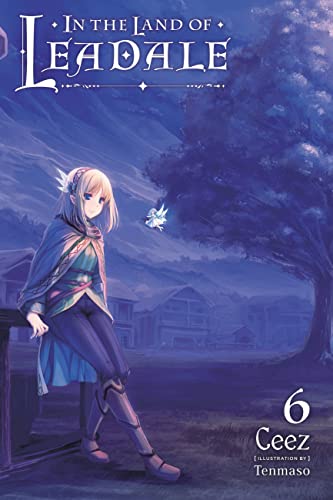
In the Land of Leadale, Vol. 6

October 22, 2022 by Sean Gaffney

By Ceez and Tenmaso. Released in Japan as “Leadale no Daichi nite” by Famitsu Bunko. Released in North America by Yen On. Translated by Jessica Lange.

Last time I wondered whether Opus’ introduction would lead to him explaining the plot a bit more, or just to him being a dick. As it turns out, it’s both. Indeed, the explanations come fast and furious, which is a bit of a surprise. We’ve occasionally thought back to Keina lying in her hospital bed, and how Leadale was created essentially for her. But this volume shows that goes MUCH deeper than we’d expected , and that Cayna is tied to Leadale in a far more significant way than I think she’d really like to be. I don’t want to get too much into spoilers, but suffice to say that Opus’ real-life identity was the least surprising part of it. That said, the real world is not an option for Cayna anymore, so best make the most of it and do what she does best – be a terrifyingly powerful mage who you never, ever want to see get angry. Sadlty, in this volume, Opus is at her side most of the time, so no luck there.

After recovering from her MP-draining rage attack on Opus from the last volume, Opus actually deigns to answers a lot of her questions about the true nature of this world. From there, she goes back to the village she’s now calling home, trailed by Opus and his Maid/Bodyguard/Tsukkomi Siren, who has definite opinions on what servants should be like but also is well aware of how much of an asshole her boss is. She then returns to the capital, where her granddaughter asks her to deal with a loose end… the player/bandit leader she put a punishment collar on several books ago, who has basically learned his lesson. As for Opus, he’s just starting to walk around and get back into the swing of things, but he certainly enjoys putting the fear of God into anyone he interacts with. This won’t change.

There’s a prologue where we see Keina at the hospital, interacting with her family and the programmer who’s there to tell her about Leadale, and it helps to hammer home how mentally exhausted she was in there, and also how truly immature she still is. I’d mentioned the reaction against her violence last time, and I think that’s because we’re told (as everyone else thinks) to see her as a 200-year-old all-powerful grandma rather than a teenage girl who get really, really excited simply by the fact that she can run around. As for her and Opus, leaving aside the various reveals, I am pleased to see that they have exactly zero romantic chemistry together… though admittedly that’s not what the rest of the cast thinks. It’s OK, sometimes you can just have a relationship be two antagonistic friends who have the power to destroy a continent. Cayna yells, Opus smugs, punches ensue, rinse and repeat. It’s fun.

Leadale is not for everyone, and if you didn’t like the anime I don’t think this adds enough value to recommend, but for those already invested, there’s a lot of payoff here you weren’t expecting.

Filed Under: in the land of leadale, REVIEWS

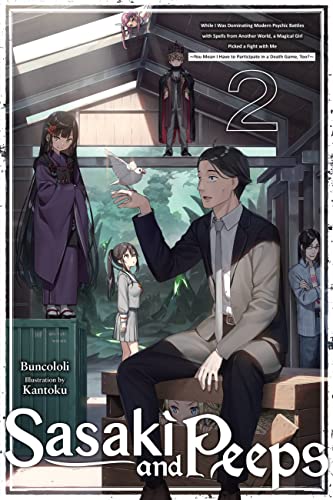
Sasaki and Peeps: While I Was Dominating Modern Psychic Battles with Spells from Another World, a Magical Girl Picked a Fight with Me: ~You Mean I Have to Participate in a Death Game, Too?~

October 21, 2022 by Sean Gaffney

By Buncololi and Kantoku. Released in Japan as “Sasaki to Pi-chan” by Media Factory. Released in North America by Yen On. Translated by Alice Prowse.

Content warning before we start: near the end of this volume there is an attempted rape scene of a middle schooler, and it is 100% played completely seriously. It helps to show off the strengths and weaknesses of this series in general. The author clearly wants to take several distinct genres and slam them all against each other. We’ve got isekai fantasy, esper battles, magical girls (and, because it’s the 2020s, they’re dark killer magical girls), and now we’re adding a battle between angels and demons using humans as proxy. This works pretty well when things are ridiculous, with our stoic salaryman Sasaki, his relatively stoic bird, and the amusing Futarishizuka. But it’s also trying to tell the story of an abused, suicidal middle school girl who is also deeply twisted, and it’s telling it with all the gravity it requires. Which… y’know, better than the alternative, but it GRATES against everything else.

As with the first volume of this series, things are slightly more interesting on the Japan side of the equation. This is not to say that the fantasy world doesn’t have a lot of danger, but it’s fantasy isekai danger, which means you have a lot of domineering nobles and sneering merchants. All Sasaki is trying to do is sell off all the modern things he’s bringing from Japan, but now he’s involved in a proxy war between two counts, two princes, and two companies. That said… he’s an experienced Japanese salaryman. This is what he’s GOOD at. He fares far less well when being tasked with his high school girl co-worker to try to recruit a new psychic who has fire powers. This goes disastrously wrong in ways I 100% was not expecting. That said, the most interesting part of the book was when the little princess from the fantasy world stows away when Sasaki returns to Japan… not the last time these two worlds intersect, I hope.

As for “the neighbor”, whose name, we find, is Kurosu, we get a little peek into her horrible, horrible daily life. She has to steal food from school to not starve to death, and it’s middle school, so she also has to avoid the class hottie helping her lest she be in trouble with the other girls. Her mother is sleeping with a guy who tries to rape her. Oh yes, and then there’s the corpse that drops in front of her as she’s walking home. Kurosu’s story has still not really intersected with the main one yet, but I expect that to change in the next book – the “death game” mentioned in the ludicrous subtitle of the volume is hers, not Sasaki’s. We also get a bit more about the magical girl… and it’s not really great news. She’s already killer her comedy animal mascot, she alleges that Sasaki’s employers killed her entire family and friends, and she now doesn’t know whether to trust him or not. So, y’know, just another day at the office.

If you enjoy A Certain Magical Index you might get a big kick out of this, because the chaos is the point. That said, unlike Index, there’s sometimes a realistic and very dark undertone to this series. I’ll read more, but YMMV.

Filed Under: REVIEWS, sasaki and peeps

The Apothecary Diaries, Vol. 6

October 20, 2022 by Sean Gaffney

By Natsu Hyuuga and Touko Shino. Released in Japan as “Kusuriya no Hitorigoto” by Hero Bunko. Released in North America by J-Novel Club. Translated by Kevin Steinbach.

It’s time for another volume of everyone’s favorite mystery series, Murder, She Grumped. We pick up where we left off, with Maomao and Jinshi at the Western Capital (and with Maomao decidedly avoiding an extremely horny Jinshi, who is so horny he’s willing to try it on with his bodyguard), but we soon get a suicide that is not what it seems. After this they finally go home (separately, Jinshi still has to wrap up investigations) and Maomao is tricked/lured by Lahan into dealing with “family business”, something that makes her very unhappy, even as we learn about how glorious potatoes can be. That said, I think the main draw of this book is not going to be Maomao but Lishu, a girl who is trapped in a series whose base qualities are set up to destroy her, and when she gets tangled up in the ongoing plot, she is very nearly destroyed. For once, I found the non-Maomao segments in the book very interesting indeed.

A chunk of this book revolves around the cultural disconnect between East and West, as one of the plot points is that the “love letter” that Lishu had been writing, which gets her in big trouble, is actually her transcribing a translated version of Romeo and Juliet, which has taken the rear palace by storm. The funniest part of the book may be when both Maomao and Jinshi find the plot of the play incredibly annoying, pointing out how miscommunication is not tragic, just frustrating, and all the sobbing young women who say they just don’t get it. Maomao is her usual excellent self here, pretending to have an uncaring, logical mind while constantly helping everyone around her. She’s still not back at the palace yet… but honestly, Jinshi visits her constantly, so that’s fine.

And poor Lishu. The concept of the “weak” Consort being bullied by everyone around her, including her own servants, is not unique to this series, but that doesn’t mean that the emotional impact is lessened. Lishu goes through a lot in this book and the previous one, from almost getting killed by a lion, to being accused of infidelity to the Emperor and locked in a tower, to (perhaps worst of all, and the lead-up even gets an illustration) having Maomao need to “verify” for the official record that she’s still a virgin. She’s not a candidate for the Emperor’s bed, and honestly, I don’t think she’s the sort to eventually win over those around her by being sweet and kind… she’s simply too ineffectual even to achieve that. Her ending here is probably the best one we can possibly expect, and I hope that she has a far better life going forward than she’s had to date.

That said, we do now have a vacant Consort position. While I briefly considered the idea of it going to Maomao, and howled with laughter (till I realized she would probably castrate me if she heard me), I suspect it will be part of the plot of future books. The part that is not about Maomao investigating crimes like the most sullen Angela Lansbury ever.

Filed Under: apothecary diaries, REVIEWS

The Reincarnated Princess Spends Another Day Skipping Story Routes, Vol. 5

October 18, 2022 by Sean Gaffney

By Bisu and Yukiko. Released in Japan as “Tensei Oujo wa Kyou mo Hata o Tatakioru” by Arian Rose. Released in North America by J-Novel Heart. Translated by Tom Harris.

Again, how much you like this series is going to very much depend on how much you can tolerate most of the cast being in love with a girl who is not yet “of age”. It’s been around since the start, and it’s not going away anytime soon. Leaving aside her main love interest Leonhart, who at least has the decency not to moon over her in an obvious way (i.e. the way that she’s mooning over him). there’s her brother, her two adopted mages, her bodyguard… the list goes on and on. Even when she goes to an outpost that consists of nothing but soldiers, the fact that she’s able to cook makes them all get starry-eyed. At its best it’s kind of exhausting, at its worst it’s pretty creepy. Fortunately, her father does not fall under this list, and he sets Rosemary out on a new quest directly related to the otome game she’s in: find the stone that seals the demon king. Alas, easier said than done…

Of course, first we have to wrap up the previous plotline. Rosemary has succeeded in stopping (well, at least for now) the plague that’s hit their neighboring country. After returning home and meeting all of her bright young boys (who all get scenes showing how over the moon they are by merely being near her), she is assigned, as I said above, to investigate temples where the stone from her “dreams” may be. The trouble is, those “dreams” are her memories of the otome game… and she’s already thrown it off the rails! Can she really rely on what she remembers? And does it really matter as long as she gets to spend some time with her beloved Leonhart?

Again, this is a “savior” sort of book, and if you are the sort who likes your fiction a bit more gritty and realistic it must be like drinking poison. Not only is Rosemary awesome (though, of course, when we’re in her head all she can do is think of the ways that she’s screwed up), but she also inspires everyone around her to be the best people they can be. Even the “grumpy prince” is forced to admit that he really does want to rule after all (which is good, as I’m pretty sure his people would not have anyone else). Of course, not EVERYONE immediately falls in love with our princess. Some people are married. Some people are assassins. And some people are restauranteurs… OR ARE THEY? That said, a good deal of this book is “Rosemary investigates and things happen around her”. Unfortunately, the ending of this volume reads very much like “the book is going to press, just finish the last page you’re on and we’ll call it the final chapter.” An epilogue would be nice.

I enjoy this series. I like Rosemary, and want to see her succeed. I frankly am 100% not invested in who she ends up with, mostly as she’s still in her early teens. If you can get past the fact that the book is very invested in that, it’s a good read.

Filed Under: reincarnated princess skips story routes, REVIEWS

I’d Rather Have a Cat Than a Harem! Reincarnated into the World of an Otome Game as a Cat Loving Villainess, Vol. 2

October 17, 2022 by Sean Gaffney

By Kosuzu Kobato and Hinano Chano. Released in Japan as “Sonna Koto yori, Neko ga Kaitai ~ Otome Game no Sekai ni Tensei Shimashita ~” on the Shousetsuka ni Narou website. Released in North America by Cross Infinite World. Translated by Jenny Murphy.

This second and final volume in the series is mostly sweet, romantic, and nice to read, but it has a slight problem. There’s almost no conflict at all. Indeed, the main conflict is similar to the early volumes of Bibliophile Princess, in that we have to convince our heroine that she really is famous and awesome, whereas she sees herself as sort of a random schlub. But yeah, no one is kidnapped or threatened with exile. In fact, the fact that this is NOT going to run along otome game rails is part of the plot, as Amy has to accept that, in fact, bad stuff ISN’T going to happen and she can actually settle down and be happy. Well, once she gets past the fighting tournament, where her wannabe fiancee is fighting. Oh yes, and finally meeting the heroine. Who’s Maria Campbell, so much so that they had to think of a reason to change her name.

After a brief diversion where we set up Couple #3 in this series which, despite Amy’s misgivings, has virtually no “harem” aspects to it, we get to the main plot of the series, which is… erm… well, following Amy around. She manages to help with a sick foal, she helps at the fighting tournament when people are injured, and she occasionally deals with a few of the remaining nobles who believe that they can sneer at her. (This goes very badly for them later on.) She also hears from her brother, who is finally heading home from his fighting monsters job, and is bringing a new friend!… and a new reincarnation, as Yasmine (real name: Maria… no, really) turns out to have also come from Japan. In fact… Yasmine is the heroine of Amy’s otome game! Does this mean she’s on the route to doom?

As indicated above, no. The heroine is sweet as pie, in denial about her feelings for Amy’s brother, and also gives out an interesting tidbit – to her, this world is based on an RPG game she and Amy’s brother played back in Japan. She’s never even heard of Amy’s otome game. This is what allows Amy to finally settle down and admit that she’s not going to end up in a Villainess book. As for her relationship with Edward, most of the conflict there is to get Amy, a girl who has never been in love either here OR in Japan, to understand what these feelings are. Once she does, things move pretty fast, even though her father has to at least pretend to be a difficult dad. (It’s been a lifelong dream of his, you see.) Tsundere girl gets far less to do here, but ends up with her foreign prince. Amy’s best friend ends up marrying Edward’s best friend, once he is able to get through to her. Everything’s fine.

This is a good book, and I’m glad I read the series, but “turns out I was fine” is the summary. If you enjoy actual conflict, you may want to look elsewhere.

Filed Under: i'd rather have a cat than a harem!, REVIEWS

My Friend’s Little Sister Has It In for Me!, Vol. 8

October 16, 2022 by Sean Gaffney

By mikawaghost and tomari. Released in Japan as “Tomodachi no Imouto ga Ore ni dake Uzai” by GA Bunko. Released in North America by J-Novel Club. Translated by Alexandra Owen-Burns.

This is not a bad volume in the series by any means, and I had fun reading it. But. There’s a definite sense of the volume treading water a bit, and it becomes apparent fairly early on that this is going to be a multi-volume arc, which means that the hints of bad things going down are all deferred to the next book. What we’re left with is mostly an examination of the character of Midori. We’ve seen her as a supporting character before, and she’s tied to the plot in several ways: she’s Sumire’s sister, she’s head of the drama club, and, most importantly for this volume, she’s developed a massive crush on Akiteru. Which is driving her nuts, because she’s a stickler for rules, and one of the biggest rules is “don’t fall in love with a guy when he’s dating another girl.” And Akiteru and Mashiro are totally dating. Right?

As with Strike the Blood, this is a series that has only one character on the cover art, and it’s always been Iroha. So it is here as well, but as you’d expect, she gets left behind early on as the rest of Akiteru’s class goes on their school trip. (If you thought “she’ll show up later anyway, well, you know how to write cliched romcoms, congrats.) As for the trip itself, Akiteru is in a group with Ozuma and Mashiro, but also three others that he knows less well; the hyperactive Takamiya, the shy Maihama, and the muscle guy Suzuki. They’ll visit temples, they’ll have baths at the hotel, they’ll do party games, and they’ll try in vain to help Maihama with her love life. All the while, though, Midori is having a massive crisis.

The plot with Midori is actually handled quite well, with only a minimum amount of standard romcom shenanigans. She’s a nice girl, and it takes most of the book for her to realize her feelings and act on them. Akiteru is also nice, but also a dense light novel protagonist, so he’s still working out what love is, but Midori gives him a major hint that might help things along. (If you’re wondering which girl will actually win, I advise you to look at the cover art of the 8 books you have.) That said, this ends up being an important book for Mashiro as well. She’s grown more quietly confident, and while she still hates social situations, she can actually handle them without help now. As such, she decides to level the whole playing field by asking her father to let her break up her “fake” relationship with Akiteru so she can pursue him for real. That said, she does this without clearing it with Akiteru first, so… as I said, there are still SOME shenanigans in a series like this.

We leave off with a set of double cliffhangers, all of which promise more high-stakes drama in the next book. Which leaves this book feeling rather uneventful and flat, even though it isn’t really.

Filed Under: my friend's little sister has it in for me!, REVIEWS

The Weakest Tamer Began a Journey to Pick Up Trash, Vol. 1

October 15, 2022 by Sean Gaffney

By Honobonoru500 and Nama. Released in Japan as “Saijaku Tamer wa Gomihiroi no Tabi wo Hajimemashita” by TO Books. Released in North America by Seven Seas. Translated by Benjamin Daughety. Adapted by M.B. Hare.

I appreciate that Slow Life books are slow starters and you have to give them room to breathe before they get going. I appreciate that “seems weak but is actually strong” is a well-worn genre, and that if you’re going to play in it you need to follow the rules for that genre. But wow, I don’t think I’ve ever seen a book get the first half as wrong as this series does. Starting on page one with a situation that is so comically evil I wondered briefly if this was a parody, we follow our heroine as she survives on her own, eating what she can and having only herself and her pet “weak” slime for company. After all, she’s a no-star tamer, and the slime was near death. How interesting can she be? The answer, at least till about 2/3 of the way into the book, is “not very interesting at all”. It’s cripplingly dull.

Our heroine is introduced to us when she gets her magic rating at the age of five, as all people do in her village. It’s… a no-star, the weakest amount. And tamer, the weakest class. Her family immediately despise her, and she is forced to go live in the woods, with only a kindly fortune teller helping her to stay alive. Then she hears the village chief plotting to have her murdered, and flees. She ends up walking from RPG-named village to RPG-named village, looking through trash heaps for useful items. The only thing she can tame is a weak slime on the verge of death. That said… once the slime starts eating used potions, it quickly turns out to be a rapidly growing slime indeed. As for Ivy (as our heroine names herself), she also seems to have hidden skills… which might stem from memories of a past life.

So much is shoehorned in here. I called the towns RPG-named, and they seem to be about as shallow as a generic RPG town as well. The fact that most of the people are surviving on field mice, rabbit, and pigeon meat tells you how far out in the boonies she is. I kept forgetting about the isekai part until it was brought up again, because it’s just there to explain why Ivy can use herbs, or make tea. Things do get a bit better once she starts interacting with actual people, but again, this takes until halfway through a pretty long book. Oh yes, and there’s slavery in this book as well, and the subplot near the end involves Ivy trying to protect herself from being kidnapped and sold as a slave. Unfortunately, this is not resolved in Volume One, so… guess I’ll never know.

TO Books has done well here with Ascendance of a Bookworm and Tearmoon Empire, but man, this was an absolute zero of a first volume. I have no doubt Ivy’s life will continue to get better as she finds more allies and gradually learns how strong she no doubt is. As for me, byeeeee.

Filed Under: REVIEWS, weakest tamer began a journey to pick up trash

Ascendance of a Bookworm: I’ll Do Anything to Become a Librarian!, Part 4: Founder of the Royal Academy’s So-Called Library Committee, Vol. 9

October 14, 2022 by Sean Gaffney

By Miya Kazuki and You Shiina. Released in Japan as “Honzuki no Gekokujou: Shisho ni Naru Tame ni wa Shudan wo Erandeiraremasen” by TO Books. Released in North America by J-Novel Club. Translated by quof.

And so another arc in the Bookworm series comes to an end, this one the longest arc yet, at nine volumes. The arcs tend to end with big dramatic world shifts, and this one is no different, as Ferdinand finally departs for Ahrensbach to start his new role as victim… erm, husband to the delightful Detlinde. That said, Ehrenfest is managing to stay busy. The entire volume has the air of waiting for an axe to fall, which does make it a wee bit frustrating that it doesn’t quite fall yet. It can make for uncomfortable reading. We are basically watching our heroes getting ready to carry out a series of politically-motivated murders, and only Rosemyne is bothering to question it. And even then, she’s just saying “are you really going to kill the 5-year-olds as well?”. The other uncomfortable part is the relationship between Ferdinand and Rosemyne. It’s still very mentorish, but is rapidly becoming The Elephant In The Room.

The author makes a joke about how Eckhart and Justus are also on the cover, but they’re hidden by the title box, but that does sort of fit the “main” segment of the book very well, as Ferdinand and Rozemyne prepare to be separated from each other, and we watch each of them try to outdo each other in “being strong” and also “giving amazing going away presents”. Unfortunately, his departure happens a lot faster than they would like, owing to the ill health of the Ahrensbach Aub. As such, there’s only time for one more big deadly adventure, as Rozemyne arrives back at the temple after Ferdinand’s heartwarming and hilarious Italian dinner, only to find that something seems off. Her intuition helps her avoid death, but there’s still a sense that Georgine has won the day somehow, and that means that Ehrenfest is also going to have to get rid of the former Veronica faction once and for all…

So yeah, let’s talk about Ferdinand and Rozemyne. The relationship between the two of them has become, for many people, the main reason to read the book. Certainly it’s more interesting than the relationship between Rozemyne and Wilfried, which seems utterly doomed, mostly as the two of them really are not interested in each other at all – even political marriages need SOME sort of connection. Ferdinand has been a teacher to Rozemyne, as well as a mentor, and it’s to the writer’s credit that he’s never felt like a father. Rozemyne has a number of dads, but Ferdinand is not one of them. And then there’s the protective hairpiece he gives her on his departure – something that everyone around notes is the equivalent of a marriage proposal, even if Rozemyne totally does not take it that way. I think the book is edging in that direction. The main problem with it is that Rozemyne, even if the book says she’s been growing “slightly”, STILL looks eight years old. Nothing should happen unless that changes. To sum up, your discomfort level may vary.

The next arc is called ‘Avatar of the Goddess’, which makes me worry that Hartmut’s gospel of Rozemyne is spreading much too far. We shall see. Till then, this was a good Bookworm, but also has all the stuff in it that makes you say “It’s great, BUT…” when you recommend it.

Filed Under: ascendance of a bookworm, REVIEWS

Suppose a Kid from the Last Dungeon Boonies Moved to a Starter Town, Vol. 10

October 13, 2022 by Sean Gaffney

By Toshio Satou and Nao Watanuki. Released in Japan as “Tatoeba Last Dungeon Mae no Mura no Shonen ga Joban no Machi de Kurasu Youna Monogatari” by GA Bunko. Released in North America by Yen On. Translated by Andrew Cunningham.

If this series were not as successful as it has been, I could easily see this being the final volume. It has a final volume sort of feel to it – no, it doesn’t wrap up anything romance wise, but if you think this series is going to end with him picking one of the girls I have a bridge in Brooklyn to sell you. It does, however, wrap up almost all the plots that we’ve had bubbling under the last few books when the series hasn’t been trying to be wacky comedy (which is to say, rarely). Lloyd’s dark older brother figure Shouma finally is forced to realize that he’s projecting onto Lloyd heavily, and that sometimes people can in fact be nice. We get the backstory of Sou, which ties into the backstory we’ve seen before, with Alka and company in the past. And we get Lloyd being the equivalent of a high school student, unable to fill out that career survey.

The career survey is actually hitting cadets a little earlier than usual. mostly because the King is trying to figure out a way to get Lloyd and his daughter together – which might work better if Lloyd ever actually figured out that Marie is the princess. He does not. He’s also very unhappy with the survey, though, mostly as he’s not sure what he wants to do with his life. Cue a series of internships, each of which are basically an excuse for shenanigans from the entire cast. Unfortunately, while this is going on, Sou has bribed/blackmailed a noble into helping with what appears to be a curse on the military city, causing people to lose control of their emotions and lash out in a rage. Can our heroes figure out what’s behind this and stop it? And what job is Lloyd best suited for anyway?

I’m always a fan of times in broad comedies where the characters show a glimpse of self-awareness. This is hard to come by in this series, especially with everyone’s favorite yandere Selen. So it pleased me greatly when she got my favorite moment in the book, where she explains to Shouma (whose mental breakdown has been nudged along by Sou into “kill his friends before they betray him”) that the fact that she’s completely obsessed with Lloyd has nothing whatsoever to do with the fact that he was strong enough to undo the belt curse, or even that he saved her at all, but that he treated her like a normal person. Again, Lloyd is nice to a fault, and not in a standard light novel potato sort of way, but genuinely altruistic. Even Riho, who confesses she *was* planning to fleece Lloyd, admits that went out the window the more time she spent with him. He’s just a good kid.

So we’ve dealt with almost everything… maybe. We still have the queen who likes to dress in a rabbit costume, and I think she’s the next major arc. Till then, this book is always funny (particularly the narrative voice), but also has some slight narrative heft this time around.

Filed Under: REVIEWS, suppose a kid from the last dungeon boonies moved to a starter town

Bottom-Tier Character Tomozaki, Vol. 8.5

October 11, 2022 by Sean Gaffney

By Yuki Yaku and Fly. Released in Japan as “Jaku Chara Tomozaki-kun” by Gagaga Bunko. Released in North America by Yen On. Translated by Winifred Bird.

I was wondering if any of these short stories would show the lead up to the cliffhanger from Book 8, but it’s the opposite. Most of these stem from the end of Book 7, and the two weeks or so where Tomozaki and Kikuchi are in love-love couple mode before he decides to forget that he has a girlfriend. That said, the real value of this book is the insight into the characters of Hinami and Rena. They’re similar in a couple of ways, with one basing her life around “goals” and the other around “guys”. More to the point, you could argue that both are vying to be the antagonist of this series. It’s become clear since the start of the series that Hinami’s advice to Tomozaki should be taken with a massive grain of salt, and that reaches its apex in Book 8. As for Rena, we get her tragic backstory, which also seems to be similar to Hinami’s in a way, in that both are characters whose minds do not work the way that we’re used to with light novel teenagers.

The stories here are: 1) a party to celebrate the success of the play, on Christmas Eve, complete with snow; 2) Some more insight into Hinami’s character, including additional allusions to her tragic past that are not third-hand like the previous book; 3) Mimimi coming to terms with the fact that Tomozaki has chosen Kikuchi over her, and talking with Kikuchi about this; 4) Rena’s past and some scenes leading up to her scenes from the 8th volume; 5) everyone gathers together to sing karaoke, and Tomozaki has the assignment to sing a song with everyone else there; 6) Kikuchi’s post-Christmas pre-New Year’s romantic glow, which also includes a conversation she had with Hinami at the Christmas party; and 7) an adaptation of a Bonus CD audio track, featuring the cast trying a virtual reality game.

Some of these stories are more important than others, frankly. The Hinami one was fantastic, and makes it even more clear (as does her conversation with Kikuchi) that she is going to be having a complete breakdown at some point before the end of this series. We’re still not sure what happened with her family, but certainly there were three siblings and now there are two. Her story, and Kikuchi’s, really hammer home how she has turned her life and her sense of self into a joyless empty shell, and I think she knows this deep down and that’s why she was briefly angry at Kikuchi for essentially figuring it out immediately. I also really enjoyed Mimimi’s story, though it once again reminds me she’s coming in third in a two-person race. As for Rena’s, it was certainly insightful, but also difficult to read. I don’t like her much.

So this was pretty much about what you want in a group of short stories, and the end audio CD story has a very satisfying beatdown that I’m sure isn’t a metaphor for anything. Good stuff. Now, let’s have Tomozaki fix his punctured romance ASAP, please.

Filed Under: bottom-tier character tomozaki, REVIEWS

The Executioner and Her Way of Life: The Promised Land

October 10, 2022 by Sean Gaffney

By Mato Sato and nilitsu. Released in Japan as “Shokei Shoujo no Virgin Road” by GA Bunko. Released in North America by Yen On. Translated by Jenny McKeon.

There is a famous quote (actually he said it a number of times) by Anton Chekhov about dramatic principles. One of the quotes says “If in the first act you have hung a pistol on the wall, then in the following one it should be fired. Otherwise don’t put it there.”. This is a perfectly fine dramatic tenet to use, and I have no real issues with it. That said… you still need to write something OTHER than the pistol hanging on the wall. You can’t just have 90 minutes of ‘pistol on the wall, la de da’ and expect the audience to stay invested. In case you’re wondering where I’m going with this, the 5th volume of The Executioner and Her Way of Life does have some guns go off near the end of the book. But the first half of this volume may be one of the most boring I’ve seen in Japanese light novels, as everyone walks around aimlessly, reiterates what we already know, and waits for Menou to have some revelations about herself.

Everyone’s arrived at the Holy Land. Flare has taken Akari, put her in an ivory tower, and given her an existential crisis to keep her busy for most of the book. Momo and Ashuna arrive there, and have some warmed-over banter before Ashuna promptly exits the plot after seeing a future plotline. Momo is, to her surprise, taken in by the Archbishop and put to work with Hooseyard, who is a summary of all the “naive but nerdy” glasses girls in anime. Manon, Pandaemonium, and Sahara have arrived to wreak havoc. And Menou has arrived to fight Flare and lose, because she knows that’s going to happen. The problem is that she’s right for the wrong reasons. Something she figures out when they fight and it becomes clear that Menou has surpassed her master… in all ways but one.

The book turns around, as I said above, once Menou has a horrific realization: she’s only killed strangers she barely knew, and when she tries to kill someone close to her, like, say, Flare… she can’t do it. In other words, despite forcing herself into the role of a “villain”, she has empathy. Surprise! That said, it is pretty dramatically satisfying, and I enjoyed her burst of hysterical laughter. Akari has the misfortune of spending most of the book in a state of shock after realizing that if Menou dies, and she has to rewind time again,. she’s probably going to start losing her memories of her time with Menou, which nearly destroys her. Of course, there’s an obvious answer to this for both of them, one that Flare (who seems to be trying to commit suicide by cop throughout this book – Menou is the cop) is trying to hammer home. By the end of this book, we’ve finally moved past “I’m going to kill Akari/Only Menou can kill me”, and it will be interesting to see where things go next, especially after seeing the last few pages, which confirm something hinted since the start of the series.

I’ll keep going with this, because I want to see what happens to the characters. But “writing style” is not a reason anyone should read this series, and it makes the front half of this volume sheer murder.

Filed Under: executioner and her way of life, REVIEWS

Didn’t I Say to Make My Abilities Average in the Next Life?!, Vol. 14

October 9, 2022 by Sean Gaffney

By FUNA and Itsuki Akata. Released in Japan as “Watashi, Nouryoku wa Heikinchi de tte Itta yo ne!” by SQEX Novels. Released in North America by Seven Seas. Translated by Diana Taylor. Adapted by Maggie Cooper.

It’s been a while since we last had the adventures of Mile and company in front of us. Most of the reason for this is that the series got a new publisher in Japan, Square Enix, which necessitated renegotiating the license for the series, which takes time. But now, a mere 16 months after the last book, we have a new volume of the series. Perhaps sensing that this was a chance to show off why the series was picked up by a larger publisher, the author has decided to get slightly more serious than usual this time around. Oh, not to worry, there’s still plenty of “Mile does OP stuff” and fourth wall breaking, it’s just that the volume as a whole seems to want to go back to the main plot of the series, the one it usually ignores for books on end. It’s going to get harder to ignore from now on, though, as there are portals opening from another world.

That said, we have another plot to get through first. The Crimson Vow are hired as escorts/bodyguards… supposedly… to take Clairia and her fellow elves back to their village. The reason turns out to be trickier than that, as they wanted the Vow to distract from what turns out to be a “get married already” meeting set up by the village. This involves a lot of inbred misogyny, and the Vow quickly take matters into their own hands. The Guild then hires them to investigate a nearby kingdom, where things are just going… slightly worse than usual. For no stated reason. Mile is the perfect person to figure out what’s really going on… robots are making portals to their world from another world and sending in stronger, smarter monsters to take out the adventurers!

The elf stuff was not as good as the rest of the book, mostly depending on “ha ha, it’s funny because elf men are lolicons” and a heaping helping of “women should stay in the village and breed more elves”. The latter, to be fair, the narrative rips apart with its bare hands, and indeed one of the main themes of the entire series has been “you don’t have to get married immediately”. The second part is more setup for the next few books, made more amusing by Mile literally sacrificing some of her nanos to a portal to another world just to get information, and their irritated response. We also see that the Crimson Vow are a mature, powerful, respected team… but only in their own lands, and when they go elsewhere, or when their intelligence is disseminated by the Crown, it still has an air of “these are stupid kids, why should we care?” to it. Mike needs to become more famous, and not just as an author.

This is a good, not great book, with the series’ usual flaws. But it also has the series’ usual strengths as well, and fans should be pleased.

Filed Under: Didn't I Say to Make My Abilities Average in the Next Life?!, REVIEWS

Emma Dreams of Stars: Inside the Gourmet Guide

October 9, 2022 by Katherine Dacey

Before Yelp! and Open Table made it easy to find a good restaurant, you had two options: consult your local newspaper’s Arts & Leisure section, or buy a guidebook that ranked and sorted joints by price, cuisine, decor, and service. Zagat’s, for example, offered pithy, sometimes withering, assessments of restaurants that were capped by a starred rating, while The Fearless Critic used a ten-point scale that resembled the scoring system for a gymnastics meet. The most trusted—in the US, at least—was the Forbes Travel Guide, which employed an army of undercover critics to evaluate hotels and restaurants, and rank them on a scale from “average” to “one of the best in the country”. Though different in tone and format, all three owed a debt to a much older publication: The Michelin Guide, which was introduced in 1900.

The Guide was the brainchild of Édouard and André Michelin, founders of the Michelin Tire Company. At the time their booklet debuted, France was just beginning to embrace the automobile; the brothers hoped that distributing free copies might encourage people to buy their first car, as the Guide contained a wealth of information for the would-be motorist, including maps, auto repair tips, and lists of hotels, garages, restaurants, and attractions. In the 1920s, the Guide introduced its first rating system, eventually settling on a scale of one to three stars. The Guide also began hiring anonymous male inspectors to visit restaurants and hotels around Europe, reasoning that the nature of the job—travelling solo for weeks at a time—made it impossible for a woman to perform.

Enter Emmanuelle Masionneuve, who joined the Guide almost 100 years after Michelin introduced its star system. Masionneuve had an unusual path to becoming an inspector, training first as a lawyer and journalist before pivoting into the culinary industry. After working for three France’s most esteemed chefs—Michael Bras, Alain Ducasse, Alain Passard—she decided to put her food expertise to the ultimate test by auditioning for the Michelin Guide. Emma Dreams of Stars: Inside the Gourmet Guide, co-written with Julia Pavlowitch and illustrated by Kan Takahama, tells Masionneuve’s story.

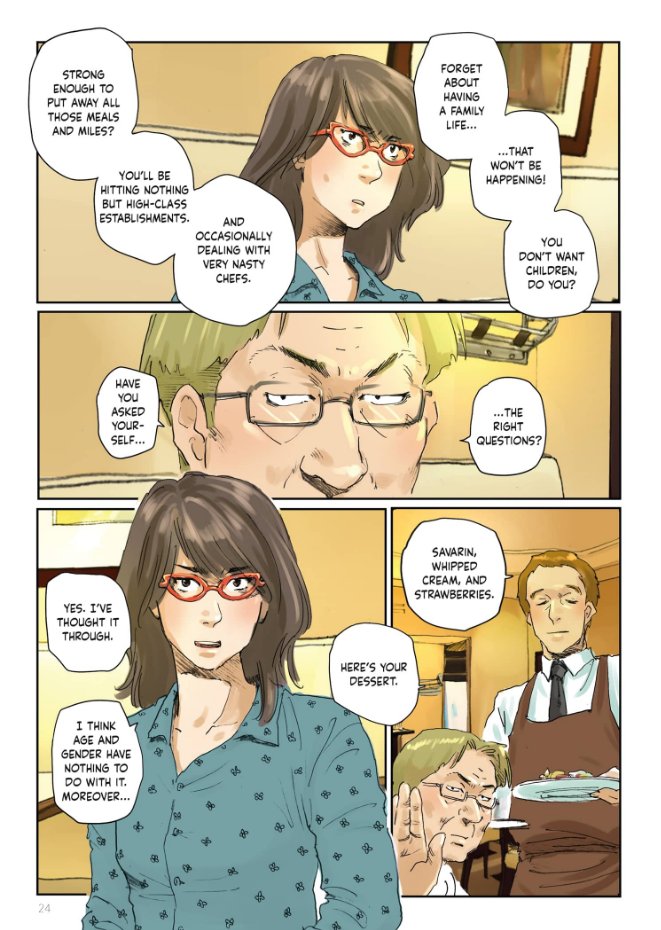
In the early chapters, Emma functions both as a character and a reader surrogate. We follow Emma through every stage of her training, from her initial interview to her first solo trip, along the way gleaning interesting tidbits about how inspectors maintain their anonymity, interact with chefs and hoteliers, and avoid heartburn. (Eating rich meals all day isn’t all it’s cracked up to be.) Emma Dreams of Stars also explores Maisonneuve’s efforts to navigate the stuffy male culture of the Michelin Guide, where she’s reminded on a daily basis that she’s the only woman inspector. Though most of her male peers are collegial, she feels the weight of being a trailblazer, worrying that even the smallest mistake will jeopardize her future with the Guide.

Of course, Emma Dreams of Stars is also a story about French cuisine, and that front, the authors deliver exceptionally well. Throughout the book, there are lengthy discussions about the merits of various cheeses and wines, as well as numerous soliloquies extolling the virtue of simply prepared dishes, locally sourced ingredients, and regional specialties. Artist Kan Takahama does an expert job of rendering the food, using a soft palette that captures the texture and presentation of each meal in life-like detail. The same is true of her backgrounds; every setting demonstrates similar attention to light, pattern, and color, making it easy for the reader to feel the atmosphere of every restaurant and hotel that Emma visits, from a chic Parisian cafe to a dim but cozy rural pub.

Whenever the shop talk threatens to stop the story in its tracks, Takahama breaks up the stream of chatter by breaking the flow of her tight, orderly grids. Characters burst out of the frame, allowing us to more fully appreciate their enthusiasm and resolve. As these panels demonstrate, Takahama has a great talent for faces, working in a naturalistic style that’s reminiscent of Naoki Urasawa; Takahama imbues each one of her characters with an individuality that speaks volumes about their age and experiences, as well their taste in food and wine.

Though Takahama’s artwork is stellar throughout the book, there are a few passages where the authors didn’t fully trust the images to tell Emma’s story, most notably when depicting her strained relationship with Thomas, her long-term boyfriend. The two never meet in person, but exchange increasingly tense voice mails and text messages that reveal just how much Thomas resents Emma’s growing independence. Takahama’s artwork does a great job of showing us how conflicted Emma feels, but the authors saddle these moments with heavy-handed voice overs that spell out what the reader can readily grasp from Emma’s facial expressions and body language: she’s determined to have a meaningful career on her own terms, even if that means leaving Thomas behind.

If these moments feel a little forced, Emma’s interactions with other female foodies do not. In one particularly delightful chapter, for example, the Guide dispatches Emma to the Côte Vermeille, where a chance encounter with Natalie, a local vinegar maker, leads Emma to a lively farm-to-table bistro on the outskirts of town. As Natalie and Emma chat about the terroir–the secret ingredient in Natalie’s concoctions–we can see how their expertise and enthusiasm helps them form an immediate bond; by the time they arrive at the restaurant, they’re chatting like old friends.

The same spirit of mutual respect animates Emma’s interactions with another culinary expert: Kanami, a travel guide who leads Emma through a whirlwind tour of Tokyo. Kanami explains the origins of particular dishes, challenges the Michelin rating for a famous restaurant, and takes Emma to the Tsukiji Market to see how local fishmongers transform enormous tuna into delicate morsels. Emma is humbled by the depth and breadth of Kanami’s knowledge, and vows to return to Japan so that she can “keep learning and growing.” By the time I finished Emma Dreams of Stars, that’s how I felt, too. I was reminded of how little most of us know about the food we eat, and pledged to develop a deeper, more thoughtful relationship with the meals I prepare, and the dishes I enjoy. Recommended.

EMMA DREAMS OF STARS: INSIDE THE GOURMET GUIDE • BY EMMANUELLE MAISONNEUVE AND JULIA PAVLOWITCH • ART BY KAN TAKAHAMA • TRANSLATED BY EAMON FOGARTY • KODANSHA COMICS • NO RATING • 192 pp. 


Filed Under: Manga, Manga Critic, Recommended Reading, REVIEWS Tagged With: Cooking and Food, Kan Takahama, Kodansha Comics

  • « Go to Previous Page
  • Page 1
  • Interim pages omitted …
  • Page 71
  • Page 72
  • Page 73
  • Page 74
  • Page 75
  • Interim pages omitted …
  • Page 346
  • Go to Next Page »
 | Log in
Copyright © 2010 Manga Bookshelf | Powered by WordPress & the Genesis Framework